


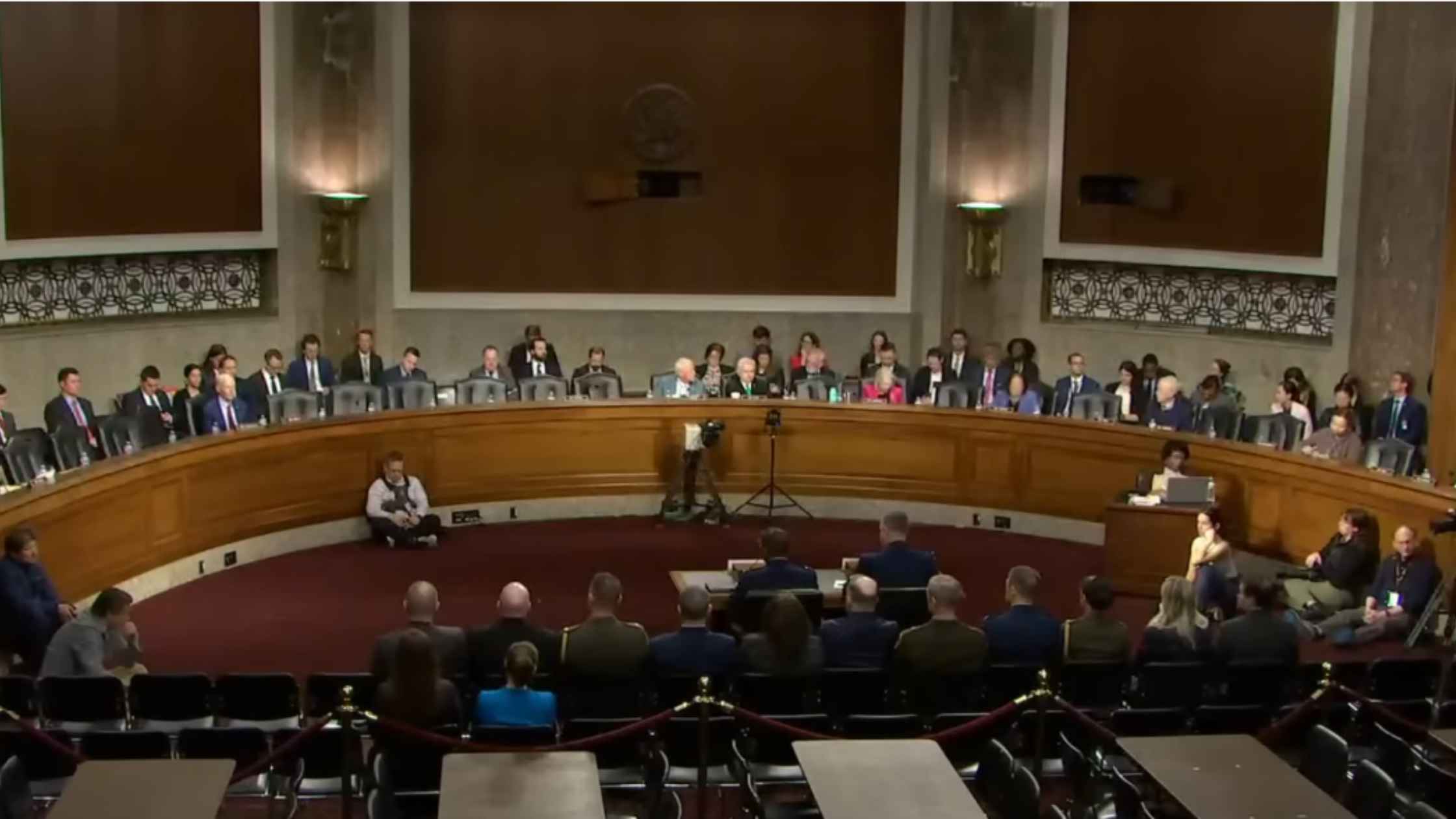
Military Commanders Testify

Military Commanders Testify

Top military commanders testify on defense readiness before the U.S. Senate Committee on Armed Services. Read the transcript here.

Senate Committee on Armed Services hearing.
Hungry For More?

Luckily for you, we deliver. Subscribe to our blog today.

Thank You for Subscribing!

A confirmation email is on it’s way to your inbox.

Share this post
LinkedIn
Facebook
X logo
Pinterest
Reddit logo
Email

Copyright Disclaimer

Under Title 17 U.S.C. Section 107, allowance is made for "fair use" for purposes such as criticism, comment, news reporting, teaching, scholarship, and research. Fair use is permitted by copyright statute that might otherwise be infringing.

Roger Wicker (00:00):

... targeted a school.

Kirsten Gillibrand (00:04):

That a missile hit a school.

Roger Wicker (00:06):

No, but it's the word targeting-

Kirsten Gillibrand (00:08):

Yes, of course.

Roger Wicker (00:09):

... that you did not mean.

Kirsten Gillibrand (00:10):

How we chose a target that turned out to be a school, albeit next to a appropriate target of a naval base, but the fact that it is chosen as a target, I'd like to know, and I hope that we can have an open hearing on this, Mr. Chairman.

Roger Wicker (00:28):

Thank you. Senator Ernst.

Joni Ernst (00:29):

Thank you, Mr. Chair. And thank you to our witnesses today for your service to our nation. President Trump has pushed our NATO allies very hard to commit 5% of their GDP toward defense and resilience. And we've seen a lot of headlines highlighting new defense investments across Europe. At the same time, NATO defense plans depend on interoperability across 32 allies operating across air, land, maritime, cyber, and space domains. So General Grynkewich, are these new investments translating into shared capabilities with NATO that are interoperable, or are there gaps that our allies need to find and fill?

Alexus Gregory Grynkewich (01:19):

Senator, that's a terrific question. We focus very much on interoperability across the alliance and at US European Command. And I would say one of the best ways to ensure interoperability is when our allies buy American equipment from our defense industrial base. That solves the interoperability problem just at face value.

(01:40)
Of course, the US industrial base can't deliver everything that Europeans need, so they're investing in their own industrial base as well. And to ensure that everything works together, we have NATO standards that both countries in the Alliance and outside the Alliance, including in the Indo-Pacific, adhere to in order to ensure that interoperability. But they're especially new members of the Alliance or folks who are newly certified to NATO standards. We do need to help them along and make sure that they understand that this gets to be very technical when you get into the beeps and squeaks, if you will, of making sure that things can work together.

Joni Ernst (02:11):

Yeah, I appreciate that very much. And the shout-out as well about the defense industrial base. And I think this just lends credibility to all of our voices when we are saying that we need to invest in more here in the United States. I'm glad that our partners are stepping up and developing their own industrial base, but certainly we need a stronger one here in our own nation.

(02:35)
Just very briefly, I am a huge supporter of the state partnership program. I know we have spoken about this before. Our Iowa National Guard and Kosovo are partnered through SPP, and we know that a strong American presence in these countries does maintain stability. Can you speak briefly about the state partnership program and your thoughts?

Alexus Gregory Grynkewich (03:01):

Yeah, Senator, thanks. I've spent some time with your commanding general of the guard unit and of your guard, and they do tremendous work in Kosovo, and I'm very thankful for it. Writ large, the SPP builds deep and lasting relationships. Some of our state partners have been in the program for 30 years or more. And over the course of those 30 years, as exercises happen on both sides of the Atlantic, it just builds a bond you can't replace.

Joni Ernst (03:27):

Yes. Thank you so much. I'm in full agreement. General Reed, we have automatic equipment identifiers, identification tags that help rail providers track the location of our assets across our transportation system. But one of the largest manufacturers of those tags and the technology is owned by a parent company with ties to the Chinese Communist Party.

(03:54)
Currently, TRANSCOM uses our rail system to move heavy assets like tanks from Fort Stewart, or you name it, or other armored vehicles throughout the US. So my concern is that the CCP could utilize these tracking technologies to monitor our military movements, which is a major security risk during a buildup or a surge. So would you agree with that vulnerability? Do you think we are giving the Chinese access into a window of our military movements and engagements, and what can we do about that?

Randall Reed (04:34):

Senator, first and foremost, the department works really hard to eliminate any kind of Chinese component wherever we find it. And that continues with all the energy and effort that we can put to that. Second of all, when it comes to all domain being contested in all domain, the cyber realm is one where this presents itself plain and clear.

(05:03)
With that being said, while it may be a vulnerability, there are ways that we can harden that and we continue to do that. There are alternative ways to make sure that we can track the information. Increasingly, as we get stronger tools, we apply those tools. And one thing that's very, very important is as we continue to use the commercial realm, there are lots of other things that move in the commercial space, and that itself makes it very, very hard for folks to track our equipment.

Joni Ernst (05:37):

Yeah, very good. We need to recognize if we do have vulnerabilities and make sure they're not being exploited. So thank you very much. Thank you, Mr. Chair.

Roger Wicker (05:47):

Thank you, Senator. Senator Kaine, I understand you intend to yield your time to a person who is not yet in the room.

Tim Kaine (05:54):

That is correct. So I'll take my time.

Roger Wicker (05:56):

I think that would be the best backup plan. You're recognized.

Tim Kaine (06:00):

Thank you. America's been at war with Iran for 12 days. The cost to our troops, to everyday Americans, and to innocent Iranian civilians, even school children are dramatic. The war is deeply unpopular. To begin, the war is illegal. The Constitution makes plain that only Congress can declare war. The reason for this provision was articulated by Abraham Lincoln.

(06:20)
Kings had always been involving in impoverishing their people in wars, pretending that the good of the people was the object. This, our convention, understood to be the most kingly of all kingly oppressions, and they resolved to so frame the Constitution that no one man should hold the power of bringing this oppression upon us.

(06:39)
The President has escalated his use of military to carry out hostilities all over the globe without Congress, while threatening military action against many more nations. We're at war because of the unilateral actions of one man who has grown very confident that Congress will not challenge his kingly behavior.

(06:57)
The war is unprecedented. We've heard from the President many shifting reasons for the war, but senators have now heard both publicly from the Secretary of State and from multiple sessions with civilian and military leaders a more precise and consistent reason. The President sent our sons and daughters, spouses, parents into war because another nation was determined to invade Iran. And if that occurred, Iran would likely target US troops for retaliation.

(07:23)
The trigger event of this war was Israel's decision to invade Iran on February 28. We could have avoided this war by persuading Israel that it shouldn't invade and that doing so would hurt its ally, America, and cause global instability. There's no evidence that we tried to do that. Or we could have focused on protecting our own troops from retaliation following an Israeli invasion. Instead, President Trump decided to join an invasion of Iran initiated by another nation.

(07:52)
He is not the first American president who has been urged to take this step. Others wisely resisted, he did not. The war's unnecessary. Iran and America were allies during and after World War II until America engineered the toppling of Iran's democratically elected government in 1953. That act followed by 26 years of a brutal dictatorship that the US helped fund, created deep hostility between our two nations, formerly friends. When the Iranian people finally threw off that oppressive dictatorship in 1979, that hostility resulted in five decades of violence between our countries, the facts of which are well known to American and Iranian citizens alike.

(08:35)
Iran engages in dangerous behavior toward the US, its neighbors and its citizens, but does that danger more than 6,000 miles from our shores warrant the sacrifice of our troops, the killing of innocent civilians, and the expense of billions of taxpayer dollars? If more war between Iran and the United States were the answer, we would have found it sometime in the last 73 years.

(08:57)
We had a diplomatic off-ramp to decades of hostility in the Iranian nuclear deal that the US and Iran together with our European allies plus China and Russia negotiated in 2015. President Trump's decision to abandon that deal, even though it was working and even though many of his closest advisors told him to maintain it, ushered in a sharp spike of Iranian aggression. American troops are dying because this nation's political leadership tragically abandoned diplomacy.

(09:28)
We owe our troops better than this. They serve with such skill and bravery, but as our experiences in Vietnam and Iraq have shown, the bravest patriotic service cannot overcome poor civilian decision making, whether by a president grown too fond of war or a Congress unwilling to provide a check against such behavior.

(09:47)
Virginians feel this deeply. One of the first casualties of the war, Chief Warrant Officer Robert Marzan lived in Spotsylvania County. Hundreds of Virginias are now deployed with the Ford Carrier Strike Group. More have received orders that they'll deploy with the Bush Carrier Strike Group. Their families ask me, "Have we learned nothing?" From 25 years of war in the Middle East, more than 14,000 American troops and contractors dead, more than 65,000 injured, more than $8 trillion spent that could have gone to our education or healthcare or economic development. Have we learned nothing?

(10:22)
Like all in this room, I pray that this war ends soon. Virginians have suffered this year as a smattering economy burdened by tariffs and chaos, produces higher prices, fewer jobs, and slower growth. Gas has gone up 60 cents a gallon in the last 11 days, costing Virginians nearly $5 million a day, just in increased fuel costs. We need a president who will honor his promises to avoid foreign wars of choice and strengthen the economy here at home, and we need a Congress who will not stand silent as these promises are broken. I yield back.

Roger Wicker (11:00):

Senator Scott, you are recognized.

Rick Scott (11:02):

Thank you, Chairman. First, I want to thank our troops. I had the opportunity to serve in the Navy at the tail end of Vietnam. Fortunately, I didn't have to go to Vietnam, but anybody that puts on the uniform, you have to admire them, because they're making the decision to put their life on the line for our freedom. We have a lot of troops at risk right now. I pray for their safety. Unfortunately, we've lost seven members, one in Florida, Cody Khork. I know we have 140 or so injured. I hope they have a full recovery, but I want to ...

(11:41)
The most important thing I think we can all say is we admire what the military has done. We respect what the military has done. We support what the military is doing, and we hope they all come back safely. And the goals of this conflict is that they don't have a nuclear weapon. The goals of this conflict, they don't have the ability to have ballistic missiles that it's going to kill Americans like they've been doing for decades. So I don't think any of us ever want to go to war, but I think we all do respect our freedom and want to keep our freedom. So I want to thank all of our troops for what they're doing.

(12:16)
Thank you both for being here. Thank you for your hard work. One of the things I appreciate about this president is he sees the value in putting America first and working with our friends across Europe, Asia, and around the world to ensure peace through strength. Over the past few years, I've had the opportunity to visit a lot of our allies. Last year, I went to Denmark, Estonia and Finland, all of which are doing their part to increase their national defense spending. They all had some great things to say about President Trump's efforts in the defense space and as a partner.

(12:45)
But a number of allies have been frustrated with being told it's a matter of policy that they can't buy US weapons and the White House and the secretary I know have had to deal with that. Nevertheless, the problem I want to focus on today is that they're also frustrated with the foreign military sales program. Frankly, I understand why. They're facing a defense industry that too often fails to deliver ships and aircraft. I think you've talked about that a little bit. Our manufacturers are not getting things done on time or on budget, or people in the Department of War saying they can't have the weapons that they want.

(13:15)
It's forcing them to turn to other countries, because they need the weapons now. They're doing exactly what we've asked. They're stepping up their defense spending, but there's not enough American weapons to buy. They want our weapons because they know they're the best weapons in the world. They want to train with us. They don't want to buy other systems, and I know you're working on interoperability, but they want to buy American weapons.

(13:37)
What's unfortunate is the President and Secretary Hegseth have made clear why it's good for our allies to buy American-made ships, aircraft, and weapons. It creates good paying jobs in America, allows our allies to fight their own fights and do it with the best weaponry in the world. And what I've gone over, I've said the most important thing is you got to defend yourself. We'll be a partner, but we're not going to be your first line of defense.

(13:58)
So General Grynkewich, is it good for our allies to buy American-made planes, ships, and weapons, and to train with us? And how does this impact our relationship with our allies? And does it make all our military a better fighting force?

Alexus Gregory Grynkewich (14:12):

Yes. Senator, I encourage our allies to buy American equipment as often as possible. We do make the best equipment in the world. It's the highest end kit in so many different areas, and it does enhance interoperability when they do so. Fortunately, there is action that's being taken here with the America first arms export strategy that the department is working on at the direction of the President, which will move several things out of the very frustrating FMS process that you described rightly so. I've heard that from allies time and time again, in moving things into direct commercial sales, which will speed the pace at which they can acquire. And then I'd also say that the work that Secretary Feinberg, our deputy, is doing to supercharge the defense industrial base is going to have a big payoff here and help allies get equipment quicker than they would without those actions.

Rick Scott (15:02):

General, when General Cavoli testified before Congress, he told us the current force posture was five brigade combat teams and two division headquarters. He said it was his advice to maintain that force posture. Is that the force posture the same today?

Alexus Gregory Grynkewich (15:17):

Senator, we have one infantry brigade combat team returned home at the end of last year, so that's the only adjustment that's been made.

Rick Scott (15:25):

Okay. Well, first off, I just want to finish by thanking you for what you're doing. I pray all our troops come home safely. Thank you.

Roger Wicker (15:34):

Thank you, Senator Scott. Senator Kelly.

Mark Kelly (15:38):

Thank you, Mr. Chairman. General Reed, everything happening in Iran in the Middle East right now highlights how critical the maritime domain is, not just for our ability to sustain military operations, but for the global economy. I want to drill into this a little bit with you. So first, on March 2nd, while docked at the port in Bahrain, the US flagged tanker Stena Imperative was struck by projectiles that caused a fire on board. Are you familiar with this, General?

Randall Reed (16:15):

I'm aware, Senator.

Mark Kelly (16:16):

Yeah. Thankfully, the crew is safe. One shipyard worker was killed. That vessel is part of MARAD's Tanker Security Program. Is that correct?

Randall Reed (16:26):

That's correct.

Mark Kelly (16:28):

And how many tankers are enrolled in that program?

Randall Reed (16:32):

Sir, the program is fully subscribed at this point, and it's upwards of 60.

Mark Kelly (16:38):

Upwards of 60.

Randall Reed (16:42):

Excuse me. If you're talking about the Tanker Security Program.

Mark Kelly (16:44):

Yes.

Randall Reed (16:45):

Yes. We currently have 10 that are funded.

Mark Kelly (16:49):

Okay. 10 that are funded. This ship, Stena Imperative was one of those, it's now damaged. So obviously, not a large fleet, 10 ships. So when even just one of these vessels is damaged or unavailable, it can have an outsized impact. Is that correct?

Randall Reed (17:10):

That's correct.

Mark Kelly (17:11):

So in your opening statement, you highlighted the importance of the commercial maritime industry to TRANSCOM strategic sealift capability during a crisis, and I agree with that. But what we're seeing in the Middle East also demonstrates that we need to do more to support the commercial industry we rely on. So let me ask a practical question here. So since TRANSCOM relies on commercial vessels that require insurance, what happens when no one is willing to ensure ships that are operating in a conflict zone?

Randall Reed (17:50):

Senator, thanks to the emergency program of the Tanker Security Program. The value of that for US Transportation Command is the fact that we have assured access to those ships. Those ships are committing to serve with us and to partner with us, and we have the ability to employ them in a maneuver scheme in conjunction with the theater commanders. Part of that also drives us to plan with the theaters to make sure that we have force protection with them as well, but to meet the need. We fully understand-

Mark Kelly (18:29):

Can you explain, General? Can you explain the Tender Security Program that you just mentioned? I mean, is this the reinsurance that the president mentioned the other day?

Randall Reed (18:39):

Sir, the Tanker Security Program is our US flagships.

Mark Kelly (18:46):

No, no, no. I thought you said something else. So my concern is with the insurance, right? Can these ships in the Tanker Security Program, the 10 ships, which really nine are available right now, without the required insurance because they're in a conflict zone, how does that affect their ability to be used to our benefit?

Randall Reed (19:10):

There is a provision for war risk insurance. That program by and large is run by the maritime administration within the Department of Transportation. USTRANSCOM works with them in conjunction. If that is required, there is a conversation and cooperation that exists between the two of us, and we can recommend the requirement for that, at which time the carriers have the opportunity to apply for the insurance.

Mark Kelly (19:42):

So do you see this as an issue today that it's going to be challenging to get some of these ships underway through the Straits of Hormuz because of insurance issues, or do you think there's no problem?

Randall Reed (19:57):

Senator, the challenge with transiting the strait really depends on the conditions that exist and actually to make the safe transit. That will depend on the conditions at hand. That will be judged best by the theater commander, in this case, CENTCOM, but once the conditions are set, we'll sail.

Mark Kelly (20:18):

So no resistance by the ship owners in the Tanker Security Program to sail as soon as TRANSCOM says it's okay?

Randall Reed (20:28):

We hold conversations with the ship owners several times a week. There's an information exchange that exists. There's also a forum that we have called the Executive Working Group. In that, we advise them of the situation. We point out to them what's going on. They fully understand the risk and they also give advice to us in terms of the best way ahead.

Mark Kelly (20:51):

If I could just have 30 more seconds, Mr. Chairman. So I think a lot of this highlights. We only have 10 ships in the Tanker Security Program. MSC has a limited number of vessels. Would you agree that our country needs a whole of government national maritime strategy so that our maritime transportation system is prepared for crises? When we look at a conflict going across the Pacific, in the Western Pacific, let's say in the future with China, are we prepared with our current maritime industry to support a long-term conflict with a near-peer adversary?

Randall Reed (21:32):

Senator, I'll tell you that if we were given the task to go today, we would all go. We would all take what we have and we would execute and support the combatant commander and their needs based on what they require. I will tell you that there is a lot of work to be done to strengthen the health of the fleet, to strengthen the help of the workforce. Part of the challenge of that is cargo. Having cargo available will actually drive the overall plan for the demand to build ships, the demand to have the ships and work to be done by the crews.

Mark Kelly (22:09):

Well, thank you, general, because I'm out of time, but that's what my ... And that issue is addressed in my bipartisan SHIPS for America Act. So I hope to move that legislation forward so you're in a better position to be able to do your job. Thank you.

Roger Wicker (22:23):

General Reed, have you had a chance to look at the SHIPS for America Act?

Randall Reed (22:30):

Excuse me. Chairman, I have.

Roger Wicker (22:32):

You have?

Randall Reed (22:34):

Yes, I have.

Roger Wicker (22:35):

What do you think about it? You've got a pretty good suggestion, don't you think?

Randall Reed (22:40):

Chairman, there are a lot of aspects in that and it's incredibly comprehensive and it does address a lot of things, but it does bring home the fact that we do need a comprehensive approach with comprehensive investment. And we also need to make sure that there's a provision to invite the commercial leaders as well to help us through this. In the end, the fundamental success will ultimately be driven by the amount of cargo. And when we have cargo, that will drive the demand for shipping, we'll find a way to actually construct here and then we'll actually have the crews, because they'll have work to do.

Roger Wicker (23:23):

Thank you for that insight. Senator Sheehy.

Tim Sheehy (23:30):

Thank you, Mr. Chairman. And I would second what Senator Kelly was saying and some others that we need to be focusing not just on our exquisite platforms, but also the broader capacity of the logistics system that's going to support that frontline fight. And to that end, to General Reed, and I'm sorry you're getting all the inbounds here, but specifically I'd like to talk about our future airlift platforms. We spend a lot of time in these hearing rooms talking about the F-47 and the B-21 and the F-35 and the F-22. And of course, those are all critical platforms,

Tim Sheehy (24:00):

... platforms, but at the end of the day, moving material into theater, especially as we evaluate a WestPac engagement with a peer adversary. I don't say near peer, because I believe we're in a peer-to-peer situation now with China, physically moving people, bullets, bombs, food, clothes. Physically moving millions of tons of gear halfway around the world quickly, especially in an area where we're fighting in someone else's backyard and we're having to project that material around the world to tiny islands that we may not be in control of.

(24:34)
Our C-5s are, I've heard in some cases, 40% dispatch reliability, they're half century old, if not more. Our C-17s, as incredible platform as they are, are also aging. And as far as I know, we don't currently have a follow-on long range, heavy lift logistics aircraft that's been decided on, awarded, and certainly not in production, but isn't quite even in decided conceptual stages. And when we look at how challenging a KC-46 program has been to roll out to replace ... I still hear that the last KC-135 pilot hasn't been born yet, and that's probably true. And the KC-46 rollout has been very problematic. So I think we need to have a very serious focused effort. This committee does, but also at the general officer level of focusing on bringing that next generation heavy airlift platform into reality.

(25:27)
And whether that's restart on the C-17 with some great upgrades or whether that's reimagining a new platform, whatever we do, we got to do it quick. So I'd like your thoughts on that, please. And I understand you're not the procurement command for this. I realize you're the customer of this platform, but I think part of the defense acquisition paradigm we're trying to change at this committee is making sure the customer is closer to the actual specification process for the platforms because we've given the power to the PEOs and the contract officers and the most powerful voice in any acquisition process should be the actual end user customer. So you and your captains and majors flying these planes and driving these ships should be the ones driving the requirements, not bureaucrats somewhere else. So if you could talk to us about next gen airlift and where you think it needs to go, I'd appreciate that.

Randall Reed (26:12):

Thank you. Our primary job at TRANSCOM is to set the conditions to move within the headquarters ... Excuse me. We frequently start with the idea. We need to set the globe to set the theater. What that means is we have aircraft that are operating around the world each day along with sealift, but when a crisis arises, there's the need to make the shift. Once we do that, every aircraft that we have available that already originates in the region, we employ them directly. All the aircraft that we have here in the United States, we generate that, and then we build the network to connect the two.

(26:58)
Our C-17s and our C-5s are the most capable things in the world right now to make that bridge to get the force out of the United States. That's incredibly key, because greater than 85% of the joint force still resides here. And so when they're needed abroad, those are the aircraft that we use to start that move.

(27:19)
The challenge that we have predominantly with our competitor is that they are actively developing weapon systems to threaten our aircraft. And so not only do we need new aircraft to get us into the future, we also need the aircraft that are more survivable. So in dealing with the Air Force, we are working with them on the requirements to meet that, but also to track the development of the threats as they emerge from our competitors.

Tim Sheehy (27:51):

What I'd also encourage us to explore all alternatives, expanding and having a wider guarantee for our contract operated cargo carriers, not best for contested environments, but at least they can get tonnage forward. And then exploring things like amphibious aircraft or even submarines that can provide logistical support. Subs have typically been reserved for exquisite tactical missions as they should. But when we're going to be operating in a WestPac, first, second island chain contestant environment, literally moving logistics under the water where we still have dominance. So thanks for your time today. I yield back, sir.

Roger Wicker (28:26):

Thank you, Senator Sheehy. We have Senator King and then Senator Hirono.

Mark Kelly (28:33):

Thank you, Mr. Chairman. There's been a lot of confusion about the war and the effects, the causes, why we did it, why we didn't, what our strategy is. But one thing has emerged just in the last few days, there is a clear winner in this war. The clear winner is Vladimir Putin and Russia. Estimates released a few hours ago are that Russia has reaped $6 billion of benefit from this war since it began just two weeks ago. It's about $400 million a day from the increase in oil prices and the easing of sanctions, which is somewhat puzzling to me. So I just think the record should show that the real winner so far is Vladimir Putin to the tune of $6 billion in two weeks. General Reed, can you give me a percentage? If we had a serious need for transport, what percentage of the transport on the sea and in the air would be commercial carriers who are under contract to TRANSCOM?

Randall Reed (29:39):

Senator, day-to-day in competition, about 40% of what we fly around the skies is commercial. When we transition to crisis or conflict, we make a conscious decision on where we actually employ the commercial aircraft. Even as we're supporting operations in CENTCOM today, the commercial airlines are supporting us in high volume in places outside the theater.

Mark Kelly (30:08):

So in a conflict situation, that 40% would go up, I presume.

Randall Reed (30:14):

If it's required, yes. In the case of sealift, once the ready reserve force makes the initial surge, commercial really plays in for sustainment and greater than 90% of all the sustainment is done by the commercial fleet.

Mark Kelly (30:30):

Okay. That's what worries me. You have controlled and I'm sure paid great attention to cyber possibilities, but we're talking about hundreds, if not thousands of commercial carriers who may or may not be as secure in terms of cyber as you are.

(30:48)
My question is, what steps do we take to ensure that this, you said 90% on the ships, 40%, 50%, 60% in the air are commercial carriers to ensure that they are protected from a cyber attack? Because if we're in a serious conflict with a significant adversary, the first thing that's going to happen is a major cyber attack to attempt to blind us and disable our transportation system. Do you red team, for example, the commercial carriers to determine the extent of their cyber vulnerability?

Randall Reed (31:23):

Senator, we do, and there's a lot of cooperation in that realm. We operate mainly through two different channels. So within the Department of War, when we organize and plan, that is done on secure systems and we have a lot of help to make sure that we can protect ourselves that once that-

Mark Kelly (31:41):

I understand that. What I'm worried about is Delta Air Lines security if they're called upon to be transporting troops and the extent to which they can be penetrated, their systems, not yours, but theirs.

Randall Reed (31:53):

Yes, Senator. Once that planning is complete, we do have some secure channels with the commercial transportation providers. And also, we red team and we cooperate and provide help with them for cyber hygiene. Among some of the sources are CYBERCOM, National Security Agency, as well as the Department of War Cyber Crime Center.

Mark Kelly (32:18):

I would urge you to step up those efforts because this is where the first wave of the attack is going to come. General Grynkewich, to what extent are the Russians, and there's been some discussion about this, probing in Eastern Europe and doing asymmetric warfare in the Baltics, for example, in Poland, disinformation, cyber attacks, even drone incursions? What are the Russians up to? Are they building troops up along their Western border?

Alexus Gregory Grynkewich (32:51):

Yeah. Senator, right now, we see a fairly robust amount of what we call Russian hybrid activities or asymmetric activities. And you mentioned some of those, whether it's information operations or sabotage and those types of things. There have been several incidences in the Baltics and in Poland in particular over the last several months since I've been in command.

(33:14)
As far as conventional troop buildups, most of the Russian ground forces are focused on Ukraine, so we do not see significant Russian buildups right now, but I know that there are concerns that those could be coming at some point in the future, particularly once Russia is able to reconstitute its forces.

Mark Kelly (33:35):

I'm sorry. If President Zelenskyy was here, what would be the one thing he would tell us that he needed right now?

Alexus Gregory Grynkewich (33:43):

Senator I-

Mark Kelly (33:44):

I suspect you hear that fairly regularly.

Alexus Gregory Grynkewich (33:46):

Yes, sir. He would ask for air defense capability based on the Russian attacks on his heating and electrical infrastructure.

Mark Kelly (33:54):

And a great deal of our air defense capability is now tied up in the Gulf region. Is that correct?

Alexus Gregory Grynkewich (34:01):

Senator, yeah, we do have a robust set of air defense capabilities in the Middle East, and I've used some of our EUCOM air defense capabilities to defend some of our NATO allies as well.

Mark Kelly (34:11):

In the Middle East?

Alexus Gregory Grynkewich (34:14):

Near the Middle East, if you will, in the Eastern Mediterranean.

Mark Kelly (34:17):

Okay. So air defense capabilities have been moved toward the Middle East as a result of this conflict. That's correct?

Alexus Gregory Grynkewich (34:25):

Yes, sir. Absolutely.

Mark Kelly (34:26):

Thank you. Absolutely. Thank you, Mr. Chairman.

Roger Wicker (34:28):

Senator Cotton.

Tom Cotton (34:30):

Thank you, gentlemen. Thank you for your appearance today, and more importantly, for your service. General Grynkewich, it's well known that Iran has supplied Russia with hundreds, maybe thousands of one-way attack drones since the start of the Ukraine conflict. I assume you agree that passing on the counter-drone warfare lessons that Ukraine and EUCOM has learned from that fight to the forces in the Middle East today and also to the Pacific is a top priority, right?

Alexus Gregory Grynkewich (34:58):

Absolutely, Senator. And we are doing that and deploying capabilities into the Middle East for those purposes.

Tom Cotton (35:04):

Could you use some additional funds to ensure that we have all the right people and processes to capture all those lessons and implement them?

Alexus Gregory Grynkewich (35:12):

Senator, more funds for things like that is always welcome.

Tom Cotton (35:15):

I agree. And I look forward to working with the committee to consider the funding for the NDAA or a potential supplemental down the road. I know that the experience that Ukraine has had and that EUCOM's had in that fight has saved lives in the Middle East today. General, can you tell us a little bit about what's going on on the southern flank of EUCOM in Cyprus right now?

Alexus Gregory Grynkewich (35:42):

Yeah. Senator, down in the ... We have a fair amount of activity in the Eastern Mediterranean. Our destroyers are out in the Eastern Mediterranean defending our allies and defending our US forces in that region. Several capabilities are on the island of Cyprus. I could go into some of the details of what those are in the classified session, but we are very, very much watching that. There have been a few one-way attack drones that we've assessed have come from somewhere, likely from Lebanon towards Cyprus, and so we are focused on defending that piece of terrain.

Tom Cotton (36:14):

Okay. Thank you. You're an old fighter pilot, right?

Alexus Gregory Grynkewich (36:20):

Yes, sir.

Tom Cotton (36:21):

16s and 22s?

Alexus Gregory Grynkewich (36:23):

Yes, sir.

Tom Cotton (36:26):

Well, I think that the men and women we have in uniform are the best fighting force in the world. I know you agree, and that our Air Force and Navy right now are on the forefront of the current campaign, Operation Epic Fury. So I have just a few questions about what they may be seeing based on your tactical experience. How complex of an operation is it for our fighters to conduct a campaign the size of Operation Epic Fury?

Alexus Gregory Grynkewich (36:53):

Senator, based on my experience looking at campaigns like this in the past, it is incredibly complex and the sequence of events and the technical acumen that's required at the operational and the tactical level is quite high.

Tom Cotton (37:08):

It's my understanding from the briefings that the secretary and the chairman have given is that our combined force and the CENTCOM commander, I should say, that the combined forces drop no less than 5,000 bombs on key enemy targets. How impressive is it for our bombers to execute a mission of that size with such precision?

Alexus Gregory Grynkewich (37:27):

Senator, that's a very powerful demonstration of American strength. And to orchestrate that size of a campaign, I think Admiral Cooper deserves great praise for how he's been able to manage that at the operational level.

Tom Cotton (37:42):

Yeah. General Caine has said that ballistic missile attacks continue to trend downward 90% from where they've started and one way attack drones have decreased 83% since the beginning of the operation, a testament to our air defenders and our air defense system. Based on your experience flying those fighters, I would assume that you would agree with him that Operation Epic Fury is a real testament to those young men and women we have on the front lines operating those systems and flying those aircraft.

Alexus Gregory Grynkewich (38:14):

Senator, I would. And I'll just take the opportunity to say it's always better to get the archer than the arrows. And so the offensive counter air aspect of this that is being prosecuted in US Central Command is impressive as the defensive side of things.

Tom Cotton (38:26):

Okay. General Reed, you also have prior experience in the cockpit. How impressive is it that our tanker fleet has supported these continuous operations in the Middle East for the largest air campaign in recent memory?

Randall Reed (38:41):

The tanker fleet has been very impressive to get the forces across the ocean and to get them into CENTCOM. I'm also very grateful to my friend here who's also been able to help with the portion of his fleet, but the fact that we were able to get our forces in place to get defense set and to go on the offensive is quite impressive.

Tom Cotton (39:02):

Do you think there's any other force in the world that has the tanker and mobility aircraft to sustain an operation like Epic Fury?

Randall Reed (39:10):

Not to the scale that we can at the moment. Thank you.

Tom Cotton (39:12):

Yeah, I didn't think so either. All right. Thank you, gentlemen.

Roger Wicker (39:15):

Thank you, Senator Cotton. Senator Blumenthal.

Richard Blumenthal (39:19):

Thank you, Mr. Chairman. Thank you both for being here today and for your service. General Grynkewich, I've recently visited Ukraine. And in addition to going to Odessa to visit with the men and women of the Ukrainian Armed Services who are serving there, also met with the American Chamber of Commerce, 600 major businesses with operations in Ukraine. Almost half of them have been targeted and attacked by Russia. Within days of my visit, an Oreo manufacturing plant was hit by Russian attacks. Are you looking into the attacks on American businesses in Ukraine? Are you familiar with that issue?

Alexus Gregory Grynkewich (40:22):

Senator, I am familiar with that. This is mostly managed through the US embassy in Kyiv who takes those reports and sends them back through state department channels, but our defense attache office is also aware of them and reports them to me.

Richard Blumenthal (40:34):

Are you taking action to protect those businesses?

Alexus Gregory Grynkewich (40:38):

Sir, we are not taking any direct action, but I would tell you that all the support that the department and the United States provides to Ukraine is certainly going to have a benefit for those businesses as the Ukrainians fight back against the Russian assaults.

Richard Blumenthal (40:54):

Isn't an attack on those businesses, in effect, an attack on American interests? Act on American property, is it not?

Alexus Gregory Grynkewich (41:05):

Certainly it is, Senator. I think it's a complex issue. And from a policy perspective, the approach that we've taken is to try to help the Ukrainians to defend things that are within their country as best as possible, and so that's where we're focused in EUCOM.

Richard Blumenthal (41:21):

Wouldn't you recommend that we take a more aggressive posture vis-à-vis Russia when it's attacking our businesses purposefully? These are not mistakes. Close to 300 American businesses have been damaged significantly as a result of these attacks targeting them by Russia.

Alexus Gregory Grynkewich (41:44):

Yeah, Senator, it's certainly a tragedy that Russia targeting is indiscriminate. It's indiscriminate against American businesses. It's indiscriminate against other targets across Ukraine. As we think about how do we best enable the Ukrainians to fight back against the Russians, all of this goes into our calculus.

Richard Blumenthal (42:02):

Well, I respectfully disagree with your use of the word indiscriminate. It is very discriminating. They are purposely targeting hospitals. I saw a hospital specifically destroyed in large part. They are targeting electric generation facilities, which I also saw, and they are targeting American businesses discriminating in a very purposeful way. Let me move on.

Roger Wicker (42:34):

Well, I'll give you a little extra time. Do you agree with that, General Grynkewich? He's pretty much correct.

Alexus Gregory Grynkewich (42:42):

Yeah. Senator, I do agree. So when I use the word indiscriminate, I'm applying to the moral lens perhaps that they're looking at this through and that they aren't discriminating in the way that we would under the law of armed conflict as to what the targets are.

Roger Wicker (42:55):

Yeah. I think you and the senator actually agree on that. You can resume your time, Senator.

Richard Blumenthal (43:02):

Thank you, Mr. Chairman. And I think your questions were helpful, and I appreciate the distinction that you're drawing, General. EUCOM is the global integrator for all defense matters relating to Russia. So I'm presuming you know about Russia's role in the war with Ukraine. I know you've been asked a bit about it so far. I am assuming the public reports are correct and that Russia is aiding Ukraine. Can you tell us more about requests from ... I'm sorry, aiding Iran. Can you tell us more about the request from Iran to Russia for assistance and how Russia has responded?

Alexus Gregory Grynkewich (43:57):

Senator, I'm certainly aware of all the public reporting on this. I can go into specifics on your question in the classified session, but I would just echo what Secretary Hegseth has said recently that if Russia is doing this, they would be wise to reconsider providing any assistance to the Iranians during Epic Fury.

Richard Blumenthal (44:14):

You believe that we should respond aggressively to that kind of assistance that's putting our men and women in greater harm's way?

Alexus Gregory Grynkewich (44:24):

Senator, anytime anyone puts American service members in harm's way in any manner whatsoever, I believe we should respond robustly.

Richard Blumenthal (44:33):

Why haven't we done it?

Alexus Gregory Grynkewich (44:36):

Senator, I am confident that we are responding robustly to anyone who is assisting the Iranians with targeting US forces.

Richard Blumenthal (44:47):

Perhaps you can tell us more in a classified setting?

Alexus Gregory Grynkewich (44:50):

Yes, sir. I'd be happy to elaborate.

Richard Blumenthal (44:51):

Thank you.

Roger Wicker (44:54):

Thank you very much, Senator Bud.

Ted Budd (44:56):

Thank you, Chairman. General Grynkewich, it's good to see you. Thanks for the meeting yesterday. Very informative. Much of the discussion of the Russia-Ukraine wars, it's focused just on those two countries, but I want to talk about other nations that are assisting the Russians, if you will. Talk about North Korea's role in this conflict and the threat that they posed and also about the Iranian contribution today and even prior to Operation Epic Fury.

Alexus Gregory Grynkewich (45:28):

Yep. Senator, you bet. One of the things that we watch very closely is how some of our competitors around the globe will work with each other when they share interests. And we've certainly seen that with the North Koreans and the Iranians and the Russians. In the North Korean case, as you know, it's been widely reported. There's a number of North Korean troops that have been deployed to the border with Ukraine and have made up some substantial combat power shortfalls that the Russians have had and supplemented them.

(45:58)
There's also a number of reports of North Korean individuals now going to work in the Russian industrial base to generate some of the ballistic missiles and UAVs that they're building based on the labor shortages that the Russians have within their industrial base. Of course, that industrial base got started, because of the Iranian sharing of technology of their Shahed drones and sharing the blueprints and teaching the Russians how to build them and how to build them at scale, and that's one of the main threats facing the Ukrainians today.

Ted Budd (46:28):

Are the Russians short on people and essentially bringing in labor from North Korea?

Alexus Gregory Grynkewich (46:34):

That's my assessment, Senator.

Ted Budd (46:35):

Okay. General Reed, thanks also for being here. Appreciate what you've done at TRANSCOM and just a heroic effort leading up to Epic Fury. Talk about some of the numbers, if you will, some of the success stories so far, and then where are the gaps where Congress can assist?

Randall Reed (46:56):

Thank you, Senator. Some of the success is the ability to generate the aircraft to actually get on the move. And so I'm grateful to the Congress for the sustained funding for weapon system sustainment and spares. Because of that, we're able to keep pace, and we've been doing that extremely well, so thank you for that. Other success stories is the fact that we've been able to establish a network for aeromedical evacuation in order to bring home the wounded and to also get them to a higher level of care.

Ted Budd (47:31):

Thank you. What concerns does TRANSCOM have regarding Chinese and Russian naval deployments and commercial investments in ports across the globe?

Randall Reed (47:43):

For the Russian deployments, we monitor those. We maintain an awareness of where they're going and make assessments in terms of what capabilities they may be seeking. When it comes to the Chinese fleet deployments, we do the exact same, but we also

Randall Reed (48:00):

... to go one step further to track their footprint infrastructure and what types of things that they put in place mainly in seaports. So we keep a very close eye on their electronic systems, cranes and that type of thing. We work with port authorities to make sure that we know where those are, and then we operate in ways to circumvent that.

Ted Budd (48:24):

So at this point, General Reed, are those adversaries, are they limiting your ability at TRANSCOM to enable logistics around the globe?

Randall Reed (48:34):

Currently, they are not. We plan for that.

Ted Budd (48:36):

Thank you. General Grynkewich, how is our air domain awareness in the Russia-Ukraine conflict throughout EUCOM?

Alexus Gregory Grynkewich (48:46):

Senator, we have a robust set of agreements with allies and partners that we stitch together a very comprehensive air picture. Certainly it's not perfect, but I'm very confident that we're on the right path to make it better. But we do have very good awareness, particularly in and around Ukraine.

Ted Budd (49:04):

I'm concerned about the uncertainty around the purchase of the E-7 Wedgetail that's affecting our NATO partners who also canceled E-7 orders last November. What's your thoughts on this platform in terms of current and future EUCOM needs?

Alexus Gregory Grynkewich (49:20):

Senator, I've seen the capabilities of the E-7 in action in previous jobs, particularly for low radar cross-section platforms, things like the UASs. It's an incredibly capable platform for detecting those.

Ted Budd (49:36):

They had canceled orders though. Any concern there?

Alexus Gregory Grynkewich (49:39):

Senator, I am concerned. On the Alliance side, the E-3 fleet is aging. It's about 50% combat effective as many of the aircraft are in depot. The Alliance does need a replacement aircraft. The E-7 was the plan for a while, but now we're looking at other options based on affordability and who is purchasing the E- 7. Depending on where the United States goes, considering the E-7 in the future, it may be back on the table or it may not, but we're looking at it closely.

Ted Budd (50:07):

Thank you. Chairman.

Mr. Chairman (50:11):

Thank you very much. Senator Hirono.

Senator Hirono (50:11):

Thank you, Mr. Chairman. General Grynkewich noted that the Russian people are probably not given accurate information on Russia's war against Ukraine. So I do think that it is very important for the American people to know what is happening with regard to Iran. So before I begin my questions, I'd like to take a moment to highlight for the American people the cost of this president's reckless decision to take our country into war with Iran without congressional authorization. The seven brave US service members have been killed. 150 wounded, eight severely injured. Over 11 billion in the first six days. And this is day 13. So we're likely closer to 20 billion already spent on this, what I would consider an illegal war with no end in sight and no plan for what will come next. Oil prices are going up. As noted, the major beneficiary of this is Russia.

(51:21)
And despite how impressive and professional our military is, this is a real war. It is not a game. It is certainly not an excursion. And it is important, even if the president won't, to acknowledge when errors happen. Preliminary findings of the strike on an elementary school in Iran that killed 175 civilians, mostly children, point to US responsibility. But this tragedy didn't happen in a vacuum. Secretary Hegseth, in his misguided attempt to focus on lethality, gutted the office that focuses on mitigating civilian casualties, reducing personnel there from 200 people to less than 40.

(52:12)
In that kind of an environment, errors can occur, and as noted once again by General Grynkewich, what may have happened in the instance of the killing of all these school children is, it's just a error upon error, a chain of errors as you put it. So we mourn the deaths of our brave soldiers, but as this war continues, there will be more civilian deaths, there will be more cost to our American families. And I joined all those who pray that this war will end, even if there is really no articulated end insight. I'd like to start my questions with General Reed. Well, it was nice to meet with you the other day. And TRANSCOM is playing a vital role supporting this war in Iran, even though as I noted, I totally disagree with the president's decision to launch this war.

(53:13)
That said, this war is placing significant demands on our acknowledged aging air mobility and refueling fleets, both of which need to be recapitalized. I'm also concerned this war is going to impact TRANSCOM's ability to support important planned exercises and training in other theaters, particularly in the Indo-Pacific. General Reed, have you had to cancel or scale back any planned TRANSCOM exercises with INDOPACOM because of this war?

Randall Reed (53:52):

Senator, since the start of the war, we have certainly surged to meet the need of CENTCOM. One of the things we've been able to do is to get access to greater numbers of guard and reserve to assist with that. In addition, access to guard and reserve also helps to preserve our ability to support other combatant commanders as well, to include exercises in the Pacific. And in addition to that, we also work with the joint staff to make sure that as the needs arise, that we can meet the needs as the best we can while we support the war fight.

Senator Hirono (54:32):

So you're telling me that as this war against Iran continues that you are needing to make adjustments with regard to any needs, particularly in INDOPACOM? Because we have a lot of exercises that are really important with our allies in that part of the world. So you are having to make adjustments. Will you commit to informing this committee if TRANSCOM is unable to fully support upcoming exercise in INDOPACOM or other combatant commands?

Randall Reed (55:06):

Yes, Senator.

Senator Hirono (55:08):

For General Grynkewich, one of the United States' greatest asymmetric... I'm running out of time. Mr. Chairman, may I finish my question?

Mr. Chairman (55:19):

Yes, ma'am.

Senator Hirono (55:21):

I did want to get your sense that we are stronger when we work closely with our international partners. And would you agree, General, that this requires constant investment in interoperability and training as technology and threats evolve? Would you agree with that?

Alexus Gregory Grynkewich (55:42):

Senator, I would, and we focus on that every single day at US European Command.

Senator Hirono (55:46):

There's a whole series of questions that follows our need to maintain that kind of interoperability, and I will submit those questions as well as others for the record.

Mr. Chairman (55:55):

We'll take another round if necessary. And of course, there'll be a classified portion.

Senator Hirono (56:02):

Thank you, Mr. Chairman.

Mr. Chairman (56:02):

Senator Slotkin is next.

Senator Slotkin (56:04):

Thank you, Mr. Chairman. Thanks to both of you for being here, and thanks for all you're doing to support the significant effort that's going on in the Middle East. As someone who was at the Pentagon and at the CIA, it's hard to miss, I think, two important trends that are happening in this war in the Middle East that are connected, I think, to what you all do. One is just I feel like the conversation on drones has come home to roost. The Pentagon, over many administrations, Democrat and Republican, has had this unbelievably glacially slow process of acquisition. And so even though we know that the drones we build are big and expensive and take two years to build and they're $30 million and you can buy them off Amazon, we just haven't been able to get them into the doctrine, into the force in a serious way. And now I feel like, unfortunately, we're paying the price for that. This is a different chapter in American warfare with the Shahed drones from Iran killing American forces, hitting US embassies, hitting civilian targets, and I think 11 other countries, evading our air defenses, which are set up for much bigger projectiles. And then we've had, I think according to press reports, 11 MQ-9s downed in the course of two weeks. The Iranians are figuring out how to bleed us with money and with time, to the point where we now have Ukrainian advisors coming from Ukraine to train us, right? Because they're the experts. And it's not for either of you two to respond to, but I just feel like we need to understand that warfare has fundamentally changed. And if Iran is able to hold us at bay and continue that power projection... We keep hearing that the reason why, or one of the reasons why we went to this war is because of Iran's power projection.

(58:11)
They're now holding the Persian Gulf at bay. We can't move ships through it. And they're able to use low cost drones, 20 to $50,000 each to kill US forces. So I hope this is in a moment of inflection for the Pentagon, for all of us, that unless we understand how to more quickly get our acquisition system to be responsive, we're going to continue to lose our soldiers. And I hope that's a major lesson that we're all learning. The second one is the role of Russia and China in supporting Iran. And I know we can't talk about it in an open setting, but there's press reports that the Russians are helping target US ships and aircraft. And I just hope we can all be on the same page. And certainly in Europe, you understand the threat of Russia, that if Russia is helping to kill US forces, we have crossed a Rubicon.

(59:16)
We are in another moment and we have to take decisive action on that. And instead, we're giving them breaks on oil. They're making a ton of money, and all the weapons and all the systems that we need for this war are what we would've otherwise given Ukraine to defend themselves. So I just hope we're all on the same page on this committee on a bipartisan basis that the situation with drones in this war and the situation with Russia in helping to potentially kill American forces and target our weapons and our systems, our ships, they are new, and we need to adjust to that new reality. Can you just tell me in my last minute here, General Grynkewich, just I'm concerned that we're going to lose a lot of capabilities out of Europe, and then this administration's never going to put them back in. Can you talk about the importance of capability in Europe?

Alexus Gregory Grynkewich (01:00:21):

Yeah, Senator, thanks. I think having capability in Europe ultimately provides options for this administration or any administration in the event of a conflict. And I would highlight that in my opening statement, I talked about one of the missions of US European Command is to serve as a power projection platform. And so it is having capabilities in Europe, munitions in Europe that allow us to help US Africa Command to target terrorists in Africa or to help US Central Command as they execute Operation Epic Fury. And so the distances are shorter, it's less expensive, and it's much easier to project power with our network of bases and allies.

Senator Slotkin (01:01:02):

I would just say American power is still important, and deterrence is the best option. And the way we do that is with capabilities. If anyone thinks that Vladimir Putin is deterred when we leave Europe, I would love to sell them a bridge. Thanks very much. I yield back.

Mr. Chairman (01:01:18):

Thank you, Senator Slotkin. Senator Banks.

Tom Cotton (01:01:20):

General Grynkewich, we hear a lot from Democrats often about how our European allies don't trust us. They don't like us. President Trump has pushed them away. But could you talk for a minute about what President Trump has taught us in Operation Epic Fury about how to bring our European allies on board? Seems like there's a lot of good news here of our European allies coming to the table to help us out.

Alexus Gregory Grynkewich (01:01:50):

Senator, I would tell you that by and large, the vast majority of our European allies, especially at the military level, which is where I engage most often, have been extremely supportive. They've provided access basing and overflight that enables General Reed's operations to refuel aircraft coming from the United States or the great amount of logistics that flow through Europe. And it's really been incredible to see. There's certainly some discussions in the press about allies who did not move quick enough or who did not provide the access that we wanted, but I would tell you that under the tip of that iceberg, there's much more support in Europe for the things that are ongoing in the Middle East right now.

Tom Cotton (01:02:37):

What do we make of it? What do we learn from that?

Alexus Gregory Grynkewich (01:02:40):

Sir, I think that the relationships we have with our European allies matter. I think they admire what the US military is able to do. I think many nations, of course, recognize, as several senators have mentioned, the threat that Iran has played over the years. I reflect on my time in Iraq during the defeat ISIS operations in 2019 to 2020, and our European allies were side by side with us. And the biggest threat to us was not actually ISIS. It was Iranian threat network backed forces that were in Iraq attacking and killing US and European forces. And so I think on the military level, many of us understand that threat and understand the menace that it poses.

Tom Cotton (01:03:23):

Can you give us a quick thumbnail on an update on NATO strength and what we're seeing from our allies stepping up to the plate to do more?

Alexus Gregory Grynkewich (01:03:31):

Senator, you bet. This coming year, we'll have five or six allies that will already be at or near the 5% Hague spending commitments. Many other allies, some of the biggest economies in Europe like Germany on a rapid pace to achieve three or 3.5% spending by the end of the decade. So there's plenty of appetite and plenty of understanding that a more balanced and strong European pillar within the NATO alliance to compliment what America has done for so many years is essential and that it will make for a stronger and more healthy alliance moving forward.

Tom Cotton (01:04:04):

This is really good news compared to years in the past where the NATO is stronger and has more money and doing more to step up to the plate to support all of our shared causes, right?

Alexus Gregory Grynkewich (01:04:17):

I agree, Senator.

Tom Cotton (01:04:18):

One thing that I am concerned about though with our NATO allies is their reliance on Chinese technology that could compromise the security of critical infrastructure that impacts our forces, US forces. Thanks to President Trump's leadership, NATO allies have committed to spending 5% of GDP, as you just discussed, on their security, including 1.5% on defense related activities. If allies use part of this funding to rip and replace high-tech Chinese technology, how would that contribute to EUCOM's mission?

Alexus Gregory Grynkewich (01:04:50):

Senator, we want Chinese technology out of anything related with the defense of the United States or Europe or across the Alliance. And so we focus our efforts to help our allies identify where they have Chinese technology and their information networks, that's particularly their defense information networks. And then there's Chinese technology and ownership across much of the infrastructure that folks like General Reed would rely on to flow forces either across or into the continent [inaudible 01:05:18]-

Tom Cotton (01:05:18):

So you're seeing progress on this front? Do all of our NATO allies share our concern about Chinese technology?

Alexus Gregory Grynkewich (01:05:24):

Sir, they do. Even the allies that I would traditionally put in a category where they didn't pay attention to this, when we highlight it today, they absolutely understand the threat and the risk and they take action.

Tom Cotton (01:05:37):

And would it likewise be helpful if our allies removed China from satellite ground stations in the Arctic?

Alexus Gregory Grynkewich (01:05:45):

Absolutely, Senator.

Tom Cotton (01:05:46):

Okay. That's all I have. Thank you. I yield back.

Mr. Chairman (01:05:48):

Thank you. Senator Duckworth.

Senator Duckworth (01:05:52):

Thank you, Chairman. We're now on the second week of President Trump's illegal war against Iran with no end in sight. And I fear the longer that this war goes on, it will have lasting impacts on the readiness of our military to respond to crises and threats elsewhere. Meanwhile, this administration is hiding its incompetence behind a valor of our military men and women as if questioning why we're at war is equal to questioning the valor of our troops. We all know that that is not true. I know that our military will always do the best and most professional job possible, but that means that we here in these chambers who are the elected representatives of the American people are beholden to do our job and make sure that this is the right war, one that is worth our troop sacrifices. And we can't forget that that sacrifice extends to our logisticians and support staff as we've been tragically reminded by the six soldiers of the 103rd Sustainment Command that we lost last week.

(01:06:45)
Anytime that we conduct significant military action, especially on this scale, we must understand the demands that it puts on our military. By choosing this illegal war, one that he still cannot justify, Trump has put our service members at risk in completely unnecessary ways. Seven service members have been killed. Seven families had to hear the worst news of their lives, and the department has now confirmed at least 140 service members have been wounded, eight severely. And with the expansion of this campaign, including to overhead air operations within Iran and possible Naval escorts, our troops may be at even greater risk going forward. General Reed, TRANSCOM has been working for years to modernize our global patient movement enterprises for the complexities of large scale combat operations. Can you explain the challenges that our medical evacuation system faces in transporting critical care patients when air spaces and maritime routes are contested as we're seeing currently happening in the Middle East?

Randall Reed (01:07:42):

Senator, initially what has to happen is we need to put the entire system in place. That requires us to forward stage teams, not just the teams that will provide the care, but the teams who actually provide the scheduling and the teams who have the initial communications with higher level facilities along the route. Sometimes we have to put those in place in an environment that's contested, and then they continue to serve throughout. But that is done in concert with the theater commander who provides the force protection. And then once the scheduling begins, we then put the aircraft in place at the point in time of need. It requires that the patients are stabilized, and once they're assembled, we pick them up and then we fly them out. We also depend on force protection to clear the airspace so that the aircraft can get to the next station. And then also important for us is the permission to overfly so that we can have the shortest and the fastest routes.

Senator Duckworth (01:08:52):

So to summarize, it's incredibly complex. We need to make investments in this system and there's a lot more work to be done, but you're doing the absolute heroic best with what you have. Our wounded service members and logistics professionals now face the realities of medical evacuation and in airspace, as you've mentioned, contested by missiles and drones from the enemy. I don't believe Trump considered these risks when he chose this war without understanding how it would spread in the region. And I know they're not investing in medical readiness in the Indo-Pacific, where despite the real possibility of military conflict, actually in our national interest, we have actually less medevac experience and much greater distances to cover. Similarly, it's the same situation in Africa.

(01:09:35)
Even before this war, the department under-invested in our medical evacuation system, which is why I've advocated for years to give TRANSCOM and the services the resources that you need to rapidly adapt to future contested environments. These gaps will only widen as we continue to strain our system. General Reed, can you speak to the importance of secure connectivity and the potential impacts, I mean, both logistically for logistical support, but also its potential impacts on existing gaps to this essential medical evacuation mission? You and I discussed this a little bit the other day.

Randall Reed (01:10:08):

Yes, Senator. What's important is making sure that we can pass the information on the status of each person that we attend to. Being able to make sure that that information gets established at the point, but also afforded to the next station, that way we can have the proper physician with the proper care and proper equipment to tend to them. As we continue to press for more secure communications, then we will make sure that there is no drop in the care.

Senator Duckworth (01:10:37):

Are you facing some challenges right now?

Randall Reed (01:10:40):

We are facing challenges in terms of secure funding.

Senator Duckworth (01:10:44):

Okay. Thank you. This administration's inexcusable poor planning in the lead up to this war of choice its own exacerbated the tow and our logistics system. General Grynkewich, I will not ask you to speak to current operations, but in your experience, do you agree that coordinating with allies and partners before an operation is critical to ensuring that our air assets have the necessary logistical nodes for rest and refueling to reduce the strain on our aging aerial refueling tanker fleet?

Alexus Gregory Grynkewich (01:11:09):

Senator, there's always a balance in terms of when you do the coordination. If you have the luxury of it based on operational security concerns to engage with allies and partners and secure access spacing and overflight ahead of time, that is incredibly valuable. But there's a host of factors that may limit your ability to do that.

Senator Duckworth (01:11:25):

Thank you.

Mr. Chairman (01:11:25):

Thank you, Senator Duckworth. Senator Warren.

Senator Warren (01:11:30):

Thank you, Mr. Chairman. So on February 28th, Donald Trump launched his war against Iran. By March 1st, Iranian strikes had hit at least six surrounding countries, but all the Trump administration said to Americans in the region was, "Exercise caution." On March 2nd, the State Department finally told Americans in over a dozen countries to evacuate, but gave no real guidance on how to do that. As thousands

Senator Warren (01:12:00):

Thousands of flights were canceled. The State Department initially told Americans to, "Not rely on the US government for assisted departure or evacuation." Let's be clear. The Trump administration chose this war, they planned this war for months, and they made no plans to safeguard hundreds of thousands of Americans in the region. There is no excuse for this. And I just want to draw a comparison here. In 2006, the State Department requested support from DOD just two days into the war in Lebanon. Trans Comm arranged ships, commercial charter, and military flights for nearly 15,000 Americans. So General Reed, let me ask you, if the Secretary of State and the Secretary of Defense asked Trans Comm for help to evacuate Americans, would you provide that support?

Randall Reed (01:12:57):

Senator, I would.

Senator Warren (01:12:59):

Thank you. So General Reed, we're almost two weeks into this war. Have Secretary Rubio and State Department made any requests for Trans Comm to help evacuate Americans out of the Middle East?

Randall Reed (01:13:14):

Senator, on the 28th of February, the Department of State made a request to my department for that, and we have provided some assistance.

Senator Warren (01:13:23):

So you're saying they made that request back on February 28th?

Randall Reed (01:13:28):

Yes, Senator.

Senator Warren (01:13:29):

So when we called them yesterday, they said they had not asked you for assistance. Can you explain why that would be so?

Randall Reed (01:13:37):

Senator, I cannot explain that.

Senator Warren (01:13:40):

I just don't understand this. And you have been helping them all this time?

Randall Reed (01:13:48):

Senator, what we have done is through... Central Command have responded to the request for the State Department to provide airlift at locations that they have specified.

Senator Warren (01:13:59):

And how much have you airlifted in this period of time? How many people?

Randall Reed (01:14:03):

Senator, I'll have to get that number for you from the record.

Senator Warren (01:14:06):

Can you give me a rough idea?

Randall Reed (01:14:07):

Senator, it's been in the hundreds.

Senator Warren (01:14:09):

Hundreds, not in the thousands?

Randall Reed (01:14:12):

That's correct. But I will say that as we continue to watch the situation, there have been other flights and other opportunities for American citizens to get out of the way. Some of that has been by ground transportation and some of it has been by commercial charters by the State Department.

Senator Warren (01:14:31):

Are you saying you're not doing more because you think that Americans who are in the region are currently being adequately served by commercial flights and private vehicles out of the region? Is that what you're saying?

Randall Reed (01:14:47):

Senator, what I'm saying is we have respond to requests for specific tasks. In conjunction with the commercial flights and what Trans Comm is providing, there are a number of ways to get our citizens out of harm's way.

Senator Warren (01:15:01):

Okay. And what I'm trying to understand is why you're not doing more. Because I'm hearing from my constituents who are stranded there, who've been stranded there for two weeks, and they're asking for help, and they're not getting help from the US government. And you're telling me that you're not helping because you think they've got plenty of other ways to get out of the region? Or is it that Secretary Rubio is not asking you for that help? I just want to understand who bears responsibility here.

Randall Reed (01:15:30):

Senator, it is the responsibility of all to care for the citizens that we have in harm's way. And as we receive a tasking and the opportunities to do that, Trans Comm is responding.

Senator Warren (01:15:42):

Okay. So my constituents and other Americans who are trapped in the region are trapped there because Secretary Rubio is not asking you for help. Is that right? I just want to understand what's happening.

Randall Reed (01:16:00):

We've been asked for help and we're available to do that. And so, as we are able and the conditions permit with Cent Comm, we are involved in all the coordination to meet our citizens where we can get to them and then transport them to safety.

Senator Warren (01:16:17):

So you have provided all the help you've been asked for. You just haven't been asked for more help. Is that right?

Randall Reed (01:16:24):

Senator, we have been tasked and we have responded to each of those tasks.

Senator Warren (01:16:29):

Look, I understand military speak here, but I don't understand how it is that we could get 15,000 people evacuated shortly after the war in Lebanon, and now we've still got thousands, tens of thousands of people trapped in the region. And I'm not understanding what your answer is here. And I don't think the American people are either.

Mr. Chairman (01:16:49):

Thank you, Senator Warren. General Reed, has the State Department contacted you in this regard to ask for help?

Randall Reed (01:16:58):

The State Department has, just as they did in the response to Lebanon as well. During that time, there were provisions to get people out by Sea Lift and Charter. And so the amount of people who left, left with Trans Comm help as well as State Department charter during that time.

Mr. Chairman (01:17:19):

Thank you very much. Senator Peters.

Tom Cotton (01:17:23):

Thank you. Thank you, Mr. Chairman. General Reed, as you're fully aware, the Straits of Hormuz is a strategic choke point in the Middle East with nearly one fifth of the global petroleum and three and a half trillion cubic feet of liquified natural gas annually transits the Straits. The Straits closure that we're seeing right now has left about 1,000 vessels stuck in the Persian Gulf. Two tankers were set ablaze just this morning. And even before these attacks, the uncertainty have caused gas prices to skyrocket oil trading up to $120 a barrel this weekend and still at elevated levels, and likely to continue to go up.

(01:18:09)
And in fact, according to the International Energy Agency, the war has caused, and this is quote from them, "The largest supply disruption in the history of the global oil market." That's a big statement. "In the history of the global market." Additionally, 30% of the world's fertilizer supply passes through the straits. This increases prices for American farmers as they're beginning planning season. This will mean food prices will also go up dramatically across the world. We have felt the impacts of the Straits closure here, surely in prices and many goods, but we also can't forget the impacts of our service members who rely on being resupplied. So a question for you, sir, is are you in talks with the Cent Comm commander, Admiral Cooper, on having actual plans to open up the straight to commercial traffic and also to ease service member resupply in the region?

Randall Reed (01:19:09):

We are working with Admiral Cooper as he continues to prosecute the operations that he has. In the war fighting sense, we are doing all that we can to help him get after the targets that he needs to actually suppress the threats on the Straits. There is intense concentration to make sure that we can reduce that enough to get to a point where we can get through the Straits. When it comes to the sustainment for the forces, the Strait is not the only way that we're restricted to in order to resupply force sustainment. We have alternatives for that, and we're currently executing that as we speak.

Tom Cotton (01:19:58):

General Reed, the Trans Comm provides basically the logistics backbone to support our forces in any conflict, including the war in Iran, as you were talking about. But this means not only moving troops into the region, but also ensuring they have food, fuel, and munitions. And we talked about this issue at length on an office call, and we talked about how Trans Comm relies heavily upon commercial partners to be able to augment your capacity to ensure the delivery of these key supplies. So, my question for you is, how has your ability to deliver these critical supplies been impacted given the contested logistics environment we're in right now where we have commercial ports, commercial fuel networks, and commercial partners that have been significantly disrupted as a result of the closure of the Straits of Hormuz?

Randall Reed (01:20:46):

So we do acknowledge the disruptions, but this is exactly what we expect in a contested environment. When it comes to the commercial participation, they are able to deliver to points that are safe, and then we will transload, and then we take the responsibility from there. And so in this way, together we do and operate where we can, where we operate the best, and then we still get the war fighter the things that they need in their hands when they need it.

Tom Cotton (01:21:17):

So you believe you're still able to rely on commercial partners for logistic capabilities, or does this mean we have to shift to more military options where we have greater control and greater security?

Randall Reed (01:21:28):

We can absolutely rely on them.

Tom Cotton (01:21:32):

Very good. General Grynkewich, we have seen public reporting on the DOD, withdrawing Patriot and Thad Missile Defense Systems from the Indo-Pacific. These are public reports and repositioning them into the Middle East. These moves I know have alarmed our allies, simultaneously weakening our regional deterrents and emboldening our adversaries, including China, as well as North Korea. Have you been asked to reposition any of your missile defense systems away from Europe in order to send them to the Middle East?

Alexus Gregory Grynkewich (01:22:07):

No, sir. I have not.

Tom Cotton (01:22:08):

Very good. Thank you, Mr. Chairman.

Mr. Chairman (01:22:11):

Thank you very much. Senator Rosen.

Senator Rosen (01:22:13):

Well, thank you, Chairman, Ranking Member Reed for holding this hearing. Thank you, General Grynkewich and General Reed. We have two Reeds here today for your service to our country. So I want to talk about support for Ukraine's critical infrastructure right now. So General Grynkewich, you know Russia has engaged in a concerted campaign to attack Ukraine's civilian power infrastructure during what's been a brutally cold winter. Despite now entering spring, I'm incredibly concerned that Russia will continue to sustain attacks in Ukraine's civilian infrastructure. So, I know you have thoughts on this based on our recent conversation in Munich. And so can you discuss your views on the threat posed by Russian attacks on Ukraine's infrastructure, and what kind of support has the US government provided Ukraine to support its critical infrastructure? What more should we be doing in this space?

Alexus Gregory Grynkewich (01:23:07):

Yes, Senator. As you alluded to, there were a number of attacks over the coldest winter and decades in Eastern Europe against the Ukrainian civilian infrastructure. This included their electrical grid. At times during this period, we saw down to just a couple of hours of electricity per day in Kyiv as an example. And then attacks on the thermo heating plants as well, cutting heat to large swaths of many of the cities across Ukraine. So what I would say is I think that these attacks were broadly intended to put pressure on the civilian population to then pressure the government of Ukraine to come to agreement to end the war. And what I've observed over the course of studying air power in history is that anytime you attack a civilian population, you usually end up finding that it just hardens their resolve. We take this all the way back to the London Blitz in World War II.

Senator Rosen (01:24:08):

Right.

Alexus Gregory Grynkewich (01:24:08):

The Brits just had a stiff upper lip and kept on fighting. And I think that's what we've seen in Ukraine as well. Moving forward, I am watching very carefully to see now that it is warming up. Do the Russians continue these attacks on that civilian electrical and thermal infrastructure, or do they shift to other targets yet? At this point, it's still unclear, but we're watching it closely.

Senator Rosen (01:24:27):

Thank you. We'll be looking forward to updates from that. I also want to talk about NATO cyber preparedness because NATO Secretary General Mark Rutte, they warned that Russia could be ready to use military force against NATO within five years. So as you know, Russia's cyber capabilities were core to its invasion and continued war with Ukraine. Russia's demonstrating a growing willingness to employ cyber aggression towards NATO. I'm glad that NATO hosts an annual cyber exercise, Locked Shields, the world's largest multinational cyber defense exercise, has begun to strengthen cyber capabilities by creating the integrated cyber defense center, but that's not going to be operational until 2028. So General Grynkewich, how are you and Cyber Comm working with our NATO allies, Ukraine, European partners to enhance our cybersecurity capabilities, our cooperation, particularly with those less cyber capable nations, because that puts us all at risk and makes us more vulnerable to our adversaries.

Alexus Gregory Grynkewich (01:25:25):

Yeah, Senator, that's a great question and thanks for asking it. This is one of the areas where the alliance and I are focused to try to understand how we can bring the cyber capabilities to bear that nations do have. And while there's some countries that don't have a lot of capability in cyber, there are some within the alliance that do, and some that we wouldn't expect to have to-

Senator Rosen (01:25:45):

But we're only as strong as our weakest link, right?

Alexus Gregory Grynkewich (01:25:48):

That's true, ma'am, but in an alliance that's built on collective defense, we can help each other. If one country is strong in air defense and another country is strong in cyber, there's a natural synergy there where we can help each other to get stronger together. In the classified session, I'd be happy to give you some details on who the main players are.

Senator Rosen (01:26:04):

Thank you.

Alexus Gregory Grynkewich (01:26:04):

But we are working to modernize how we access those cyber effects and can use them in a potential conflict.

Senator Rosen (01:26:10):

Thank you. Well, I'm going to stick on this topic because over the past year, Russian aircraft and drones have flown into NATO airspace on multiple occasions. I don't believe these incursions were accidental. Russia's deliberately testing NATO countries, the readiness to resolve and the manner and timing of all of our response to this aggression. So building on Senator Fisher, I know she asked this earlier, you think NATO can and should most effectively respond to these Russian acts of aggression even if they say they were accidental?

Alexus Gregory Grynkewich (01:26:43):

Yeah, Senator, I'm very proud of the initial responses I mentioned a little bit earlier, but I would also say that the standup of our Eastern century vigilance activity across the alliance has resulted in a dramatic decrease in this activity. So it has had not just a preventive effect in terms of when drones are incurring into the airspace, being able to stop them, but it's also deterred the Russians from taking that kind of reckless behavior in the first place. So, I think there's always work to be done here. It's not perfect. We continue to have limited incursions, but I think we're on the right path and making great progress.

Senator Rosen (01:27:18):

Thank you. I look forward to the classified briefing.

Mr. Chairman (01:27:22):

Which will begin precisely at 12:00 noon. A vote is going on right now. Members are encouraged to go ahead and vote and we will see you in the SBC precisely at 12:00 noon.

Topics:
No items found.
Hungry For More?

Luckily for you, we deliver. Subscribe to our blog today.

Thank You for Subscribing!

A confirmation email is on it’s way to your inbox.

Share this post
LinkedIn
Facebook
X logo
Pinterest
Reddit logo
Email

Copyright Disclaimer

Under Title 17 U.S.C. Section 107, allowance is made for "fair use" for purposes such as criticism, comment, news reporting, teaching, scholarship, and research. Fair use is permitted by copyright statute that might otherwise be infringing.

Subscribe to The Rev Blog

Sign up to get Rev content delivered straight to your inbox.