Senator Mike Crapo (08:59):
The committee will come to order. I would like to thank you, Secretary Bessent, for appearing before the committee today to discuss the president's fiscal year 2027 budget for Treasury Department and the administration's broader economic agenda. A central part of that economic agenda is driven by the land-
Congressman Andrew Garbarino (09:20):
... at all times and urge all members to be mindful of their remarks. Further, under the rules of the House, the chairman is responsible for maintaining order and preserving decorum in the committee room. I expect audience members to be respectful of the witnesses, members, and the public. If members of the audience are persistently or overly disruptive, it's a violation of federal law and you'll be subject to removal and arrest. I now recognize myself for an opening statement.
(09:46)
Good morning. Thank you, Secretary Mullin and Deputy Secretary Edgar, for appearing before the committee today. Secretary Mullin, I'd first like to congratulate you on your confirmation. We appreciate you being here for your first hearing before the House since being sworn in. We look forward to building a strong working relationship as we continue our shared mission of keeping the American people safe.
(10:07)
Today's hearing allows members to evaluate the Department of Homeland Security's proposed budget for fiscal year 2027. I encourage my colleagues to use this opportunity to ask insightful and productive questions that will help achieve our shared goals. DHS has a no-fail mission: protecting the American people and safeguarding our homeland. That's why it's so concerning the department has been forced to operate through 119 days of government shutdowns over the last year, especially at a time when the threats facing our country are becoming more complex and constantly evolving. The department was created in the wake of September 11th terrorist attacks with a clear mission: to protect the American people and safeguard our homeland. Nearly 25 years later, that mission remains as critical as ever. That's why Congress and DHS must work together to ensure the men and women responsible for keeping our country safe have the resources, support, and tools they need to meet the threats of today and tomorrow.
(11:03)
As we approach two historic milestones for our nation, the 25th anniversary of September 11th and the 250th anniversary of American Independence, DHS should be entering this period with certainty and stability. Instead, vital agencies within the department remain unfunded to this day. Repeated partisan shutdowns have weakened our national security posture and have delayed important work in preparation for hosting the World Cup and securing America 250 celebrations across the country in the coming weeks. While congressional Republicans continue working to fund the remainder of DHS, I appreciate that today we will focus on the department's plan for the coming year. Congress must get back to regular order through the annual appropriations process. Refusing to fund specific agencies causes instability that we cannot afford, and I would encourage my colleagues on the other side of the aisle to reengage with those efforts going forward.
(11:52)
The threat facing our country today are more complex and dynamic than ever before. From violent extremism to the growing use of artificial intelligence by our adversaries, the challenge of protecting our homeland continues to evolve. This committee has a responsibility to ensure DHS can keep pace with these threats and has the tools it needs to safeguard the American people.
(12:12)
Over the last year, the committee has engaged regularly with the department and the private sector to identify areas where national security can be strengthened and where the process for doing so can be more efficient. To that end, the committee has focused on the advancement of US cyber resilience in an increasingly sophisticated threat landscape, reauthorizing and expanding vital counter UAS authorities for state and local enforcement ahead of upcoming major events, solidifying the border security successes of the Trump administration over the last 18 months, modernizing TSA screening technology and creating a more efficient, hassle-free traveler experience, reforming the DHS Office of Intelligence and Analysis to make sure threat intelligence is promptly shared with relevant entities, and exercising the committee's oversight function to hear directly from DHS components on their efforts to accomplish and implement these goals and to understand where Congress can provide greater support to ensure successful outcomes.
(13:07)
Delivering on these objectives is no small task, but I am encouraged by the progress we have made and will continue to make in the coming months. Secretary Mullin knows well the world will be watching this summer as we host the 2026 FIFA World Cup and celebrate America's 250th birthday. These events are unique opportunities to showcase the best of America. They will require unprecedented collaboration between leaders at the federal, state, and local levels to secure these events and keep the public safe. DHS plays a leading role in that effort. While it's impossible to know every challenge that lies ahead, what we know for sure is that DHS must have the support, resources, personnel, and authorities needed to carry out its mission.
(13:49)
Today's hearing will serve as the first of what I can expect be many more discussions on how we can maintain positive momentum for the next fiscal year, and I appreciate Secretary Mullin and Deputy Secretary Edgar for joining us to discuss this budget request. I look forward to hearing Secretary Mullin's testimony. With that, I yield to the ranking member for his opening statement.
Congressman Bennie Thompson (14:11):
Thank you very much. Good morning, Mr. Chairman, and thank you for holding the committee's annual hearing on the Department of Homeland Security's budget. Secretary Mullin and Secretary Edgar, welcome to the Committee on Homeland Security.
(14:27)
Today's hearing comes at a critical time for our country with challenges at home and abroad, creating or made worse by the Trump administration. President Trump campaigned on $2 a gallon gas, ending inflation, and lowering the cost of living. Instead, he started a reckless war with Iran that has driven gas prices sky-high and imposed tariffs that sent inflation soaring. Everything is more expensive. Americans are paying higher prices. Families are struggling to put food on the table and working harder than ever to make the rent and pay their bills. Now, Trump wants the same people who are barely getting by to pick up the tab for his billion-dollar White House ballroom, a ballroom he originally told us would be paid for by private donations. He also wants taxpayers to pay for a slush fund to make millionaires out of the rioters who attacked the Capitol and beat cops on January 6th. The only people doing better in Trump's economy are his billionaire buddies who get sweetheart deals like the rest of the country is paying more at every turn.
(15:44)
Just like the nation, the Department of Homeland Security is at a critical junction. Nearly 25 years ago, DHS was created to protect our nation against 9/11 style attack. Since then, administrations of both parties have worked to strengthen the department for that critical mission while protecting our constitutional rights. That is until President Trump took office. The Trump administration has weaponized DHS against the public and used it to line the pockets of the president's cronies. It has closed essential offices meant to keep us safe and protect our civil rights and fired or forced out thousands of DHS employees with replaceable experience. He has politicized disaster aid, approving declarations for those communities he personally favors and denying aid for those he does not. He has turned our country's immigration system into something out of a dystopian movie where federal agents shoot and kill Americans, peaceful protestors are gassed and beaten, and racism and xenophobia drives the policy. In short, the Trump administration has betrayed our Democratic principles and undermined the security goals DHS was established for.
(17:12)
Last year, when then Secretary Kristi Noem came before the committee, I called on her to resign unless the president removed her first. She ended up cutting and running before that hearing ended, leaving under false pretense before she answered members' questions. We all know how Secretary Noem's time at DSHS turned out. I'm only sorry her departure took as long as it did, because the damage the Trump administration did to the department while she was secretary would take years to undo. Noem wasted millions of taxpayers dollars on vanity projects and private jets, and used her position to enrich herself and her friends. Her disastrous tenure was marked by more than just endless grifting and shameless self-promotion. The human cost was very real.
(18:09)
Two Americans, Renee Good and Alex Pretti, was shot dead on her watch. A recent report by the Brookings Institution found that 147,000 US citizen children were separated from a parent under Trump's mass deportation agenda, including tens of thousands of children under six years old. Unfortunately, Secretary Noem was the latest in a long line of failed secretaries of Homeland Security and others running DHS under President Trump. Kirstjen Nielsen put kids in cages. Kevin McAleenan and Chad Wolf served unlawfully and carried out more of the same immoral, inhumane, and illegal policies. Kristi Noem and the other disgraced former secretaries may be gone, but the Trump administration's weaponization of the department has continued.
(19:11)
I'm concerned that you are already following in your predecessor's footsteps, Secretary Mullin. Since you were sworn in just over two months ago, detainees at Delaney Hall Detention Facility have been living in squalid conditions and have been beaten and pepper-sprayed by guards. Rather than addressing these problems and forcing the contractor that runs the facility to do its job, DHS responded by attacking protestors and defending inhumane conditions. Enough is enough. Delaney Hall should be closed. Delaney Hall is just the latest example of immigration and custom enforcement and customs border protection being out of control under Trump. A record number of people are dying in Trump's detention centers around the country, at a rate roughly one person every six days. Tragically, that number is rising due to inhumane conditions, neglect, and abuse in these facilities.
(20:18)
And yet, the president wants Congress to give ICE and CBP a $72 billion slush fund in reconciliation after they just got billions in so-called One Big Beautiful Bill Act. These are the very same agencies that killed two Americans in cold blood, took parents from young American citizens out of defending, holding detainees and squalor at Delaney Hall. ICE and CBP should not get one penny more of taxpayers' dollars until they are held accountable.
(20:55)
Mr. Chairman, while we are on the topic, why isn't this committee doing its job? The Senate is at an impasse, but that doesn't mean the House can't craft a bill that responsibly funds DHS while putting guardrails around its rogue agencies. Our hands are not tied. House Republican leadership is just too lazy or too scared. Don't tell me otherwise. Previously, when the Senate started the reconciliation process, the House still did its job and marked up its own bill before making compromises with the Senate product. There's no reason we cannot do the same this year.
(21:39)
Beyond the reconciliation issue, Mr. Secretary, I'm also very concerned that you seem determined to crash the US economy by pulling CBP processing from airports in so-called sanctuary cities. The travel industry has sounded the alarm about your plan, warning of unnecessary chaos throughout the nation's air transportation system and devastating consequences to airports, airlines, and the traveling public.
(22:11)
Americans are suffering enough in Trump's economy. They quite literally cannot afford another harebrain Republican scheme. I know we will be discussing this issue further today among several others. Mr. Secretary, as I said at the outset, we're glad you're here because we have many questions for you. We expect that unlike your predecessor, that you'll stay and answer them. Secretaries of Homeland Security under President Trump have set a very low bar. Some might even say solo, it might set in hell. I wish I was more encouraged by your early actions as secretary that you'll clear that low bar, Secretary Mullin. The situation at DHS is critical, and the American people deserve better. As a principal oversight committee for the department, we will demand just that. Thank you, Mr. Chairman, and I yield back.
Congressman Andrew Garbarino (23:10):
Other members of the committee are reminded that opening statements may be submitted for the record. I'm pleased to have a highly distinguished panel of witnesses before us today. Pursuant to committee rule 8C, I ask that the witnesses please rise and raise their right hand.
(23:24)
Do you solemnly swear that the testimony you will give before the committee on Homeland Security of the United States House of Representatives will be the truth, the whole truth, and nothing but the truth, so help you God? Let the record reflect that the witnesses have answered in the affirmative. Thank you.
(23:44)
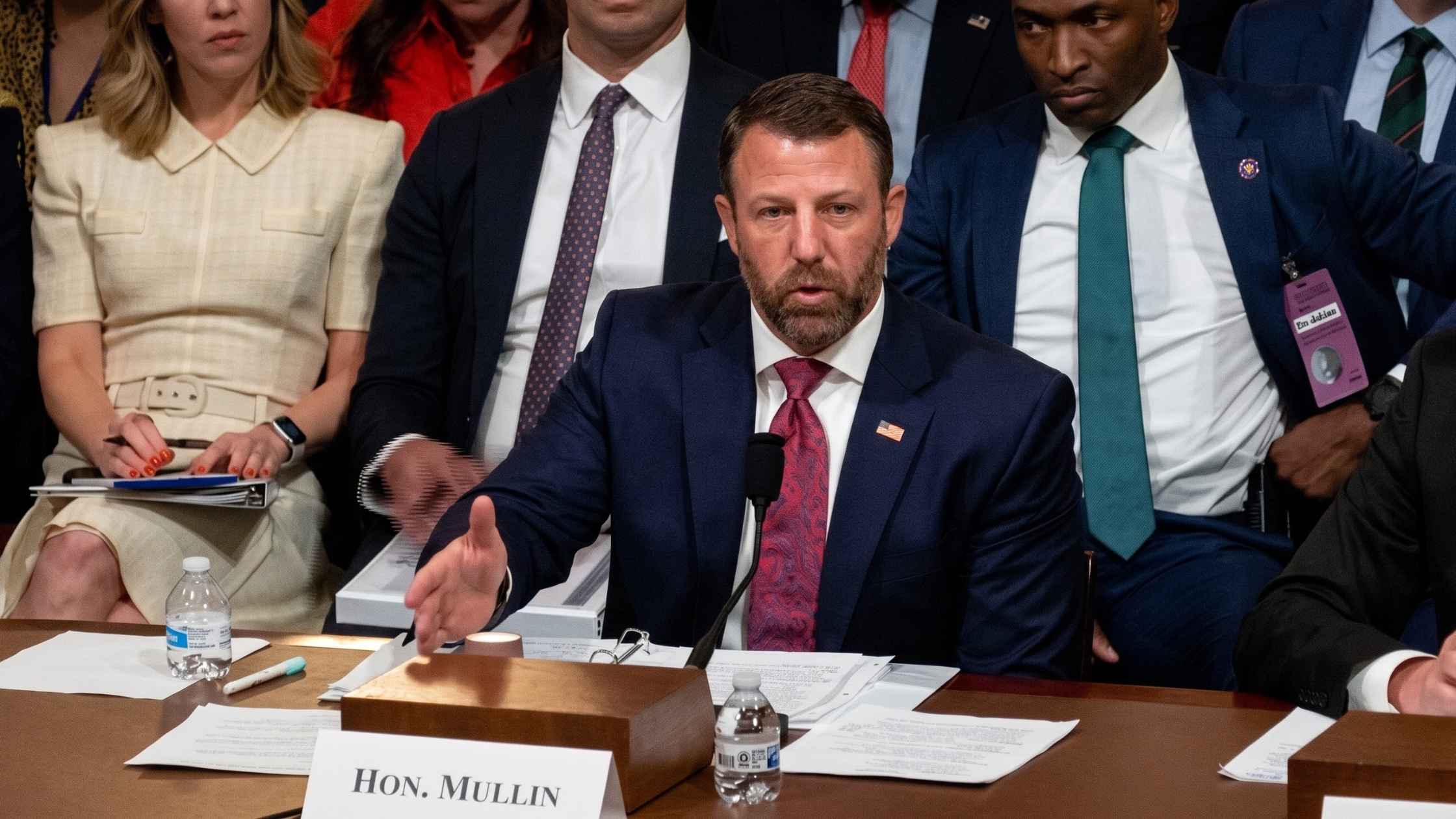
I would now like to formally introduce our witnesses. First is Mr. Markwayne Mullin. He is the secretary of the Department of Homeland Security. Secretary Mullin previously represented the people of Oklahoma for 13 years in both the Senate and the House of Representatives. Second is Mr. Troy Edgar. He is the Deputy Secretary of Homeland Security. Previously, Deputy Secretary Edgar served as department's chief financial officer during President Trump's first term. Thank you both for being here today. I now recognize Secretary Mullin for five minutes to summarize his opening statement.
Secretary Markwayne Mullin (24:15):
Thank you, Mr. Chairman, and thank you for this opportunity to be in front of you. I sometimes wish that the members had to get sworn in too so what they said would be true and factual as well, because what the ranking member just said about in his opening statement, I feel like I have to address because I'm just not sure I'll have the opportunity to do that.
(24:36)
First of all, I do thank you, Chairman, for allowing me to be here today. Ranking Member, thank you, and thank you for allowing the undersecretary Troy Edgar to be here with me. I do have an opening statement. I'll send it for the record. But too often when we see opening statements, it's about making a statement. The false statements that were made, I feel like I just have to address. I mean, when you start talking about the reckless war in Iran, what's reckless is a nuclear Iran.
(25:07)
For 49 years, they've been threatening to a death to America. For 49 years, they've been attacking America, and for 49 years, not one single president was willing to stand up until President Trump. And thank God he did, because we know their behavior, we know what they would do with their nuclear weapon. They would completely destabilize the world, completely destabilize that region. And finally, President Trump is a president that's willing to do something about it. Every single president since Jimmy Carter has looked at Iran understanding they were a threat. Every single president since Jimmy Carter has had a plan to deal with Iran and not one of them acted on it, but President Trump did.
(25:50)
You start talking about peaceful protestors and racism. The racism's a reckless term that is thrown around way too often. It's thrown around like it is true, and yet you can't point to something that is actually racism. It's just a term when you lack the words to actually describe your hatred towards President Trump, so you just use racism. What's bad is you feed in to what's causing our ICE agents that simply enforcing the law that Congress passed. They're not going outside the law, they're enforcing the law that Congress passed. We don't pick and choose which law we decide to enforce. We enforce the law. And because they're doing so, it's racism? But yet their death threats are up by 8,000%, vehicular damage is up 3,300%, assaults up 1,300%. What's that do from peaceful protest? I have no problem with people peacefully protesting. I believe in our First Amendment peacefully.
(26:52)
Delaney Hall, I've had officers bit, hit, scratched. We had one get threatened that they were going to kill him and his family. That's peaceful? Damaging vehicles and property, that's peaceful? It's interesting when the governor finally put state police there, how often you guys quit saying that it was being agitated by ICE, but yet the same behavior was happening with the state police until they pushed them back far enough where they're out of camera shot and all of a sudden the left media quit covering it. They didn't look like peaceful protests to me. I'm okay with protest in a peaceful manner.
(27:28)
You're talking about Trump's reckless behavior. What's reckless is shutting down CBP and ICE. CBP, Customs and Border Protection, you want open borders? Because, Ranking Thompson, I'm pretty sure you already said you're willing to shut them down again September 30th, even if we reopen them. That's law enforcement. Just say, "I want to defund police. I want open borders, and I want illegals running wild in our streets." Because ICE every day is taking the worst of the worst off the streets or taking those that enter this country illegally off the streets, which is exactly what they were designed to do. And CBP is protecting our ports and our port of entries and our borders. And yet we want to target them and defund them? That's reckless.
(28:14)
You're talking about President Trump's ill behavior towards children? Yet we have found over 120,000 kids that were missing underneath the Trump administration when they lost touch of 340,000, which we fear most are now in trafficking rings. I didn't hear anybody complaining about that. What we've done under the Trump administration is we've went and rescued these kids. What is inhumane about that? Nothing. He's doing the job that Biden administration turned a blind eye to. That shouldn't ever take place. If anything we can agree on, our kids should be watched over.
(29:02)
Now, I do look forward to answering all the rest of the questions because I'm running out of time, and I won't have time to go through all the ridiculous accusations you made towards the Trump administration, but I do feel a privilege sitting here in front of you. I feel a privilege of being secretary of our homeland and watching over the 275,000 employees that every day protect my yard and your yard regardless if it's blue or red. We're here to protect the homeland, and that's all we want to do. Thank you so much.
Congressman Andrew Garbarino (29:28):
Thank you, Secretary Mullin. Members will be recognized by order of seniority for their five minutes of questions. As I've done in the past, I will be strictly enforcing the five-minute rule. When that clock runs out, so does your time to keep talking. I now recognize myself for five minutes of questions.
(29:47)
Secretary Mullin, FEMA's fiscal year 2025 preparedness grant cycle under the predecessor was impacted by delays in the release of notice of funding opportunities, which left applicants with a condensed timeline to apply for these awards. For the more last-minute changes to the allocations of funding for the Homeland Security Grant program, programs resulted in litigation that held up funds well beyond the end of the fiscal year. Understanding that the enactment of FY26 appropriations was significantly delayed by the 76-day shutdown, how are you now working to ensure that FEMA's '26 preparedness grant cycle runs more smoothly and transparently than the '25 cycle?
Secretary Markwayne Mullin (30:28):
Thank you, Chairman. It is a challenge that we have because the shutdown for 76 days put us way behind on the MOUs that we had with local and state partnerships. Fortunately, the local and state partnerships just along with ICE and other DHS officials were still willing to go out and do their job for free. So we haven't dropped the mission, but it has made it more difficult. We're up against a timeline. Roughly, I think we're 11 actually, but we're 10 days from the first kickoff, 11 days from the first game in LA on June 12th. And we have a lot of work to do. But our grants are out. We're getting the local law enforcement back pay because they didn't get their grants on equipment, on personnel, on overtime. We feel like we're in a good spot, but it definitely put us at risk.
(31:24)
But I will tell you, I feel very comfortable where we're at, and we feel like we have a zero-fail mission, but it's going to be complicated. We have five to seven million visitors coming in. We have some very complicated countries that are going to be playing each other that have a tremendous amount of dislike against each other. We have open areas to where we have the fans being able to experience the game without getting inside. We have 78 Super Bowls in 38 days, and we get to highlight our country, and I'm looking forward to it. And I will tell you, even in sanctuary cities where we have some of these games, we've had great cooperation with local and state officials. And I hope when FIFA is over, we can show that we can work together and continue to keep our cities and our streets safe.
Congressman Andrew Garbarino (32:14):
Thank you very much. I actually visited one of the FIFA sites last week. They did talk about the partnership and the money that's coming in. It will be helpful both for protecting those sites as well as the Fan Fest. But moving forward, UASI grants and others that local police rely on, like NYPD in New York, FDNY, making sure that those continue to run smoothly so that money goes directly to law enforcement. And they need it, so making sure that those keep rolling smoothly is very important.
(32:45)
I want to move over to CISA. Over the last 18 months, it has seen a significant reduction in its total headcount, including through a combination of voluntary departures, reductions in force, and reassignments of cybersecurity personnel. One of my top priorities since being on this committee is ensuring that CISA can effectively execute on its core mission to protect federal civilian networks and our nation's critical infrastructure, especially as our cyber adversaries are increasingly utilizing tools like AI to enhance their capabilities.
(33:13)
I'm concerned that some of the proposals in the budget requests, including cuts to CISA's personnel and cybersecurity education programs which helps sustain a pipeline of skilled cybersecurity professionals in the US, could negatively affect those efforts. As secretary, can you talk about your vision for CISA and how this budget would support the agency's critical functions during a time of rapid development emerging AI threats? Deputy Secretary Edgar, whoever wants to jump in on that, that's fine.
Secretary Markwayne Mullin (33:41):
Yeah. So CISA technically has the ability to hire up to 3,400 people, and we have very broad authorities. During the shutdown, our forced shutdown of the year, we had to readjust the way we're looking at CISA and better lean on public partnerships. We have a very unique authority that we take care of from international cyber all the way down to local small businesses, large businesses, municipalities and states, but we also take care of the communications at every major sporting event as well, including FIFA.
(34:16)
When we looked at that, we think, do we really need 3,400 individuals? Well, we're down to 22. We probably need somewhere around 28 if we can actually have the partnerships we need with states and be able to use the grants, the monies that saved with CISA to be able to invest with local and state municipalities. And I think we can. We're not going to fail on the mission that we have in front of us. Cyber attacks are only getting stronger, and they're attacking our private partnership the most.
Congressman Andrew Garbarino (34:49):
Thank you, Mr. Secretary. My time has expired. I appreciate that. I now recognize the gentleman from Mississippi, the ranking member, Mr. Thompson, for five minutes of questions.
Congressman Bennie Thompson (34:57):
Thank you, Mr. Chairman. Mr. Secretary, while Americans struggle to pay gas-
Congressman Bennie Thompson (35:01):
Mr. Secretary, while Americans struggle to pay for gas and groceries, President Trump and his allies are constantly enriching themselves off taxpayer-funded contracts. Under then Secretary Christie Nome, DHS authorized contracts totaling billions of dollars for luxury jets, self-promotional ads featuring horses, recruiting campaigns seeking white nationalists, vehicles wrapped in ICE logo that currently sit idle, massive industrial warehouses to detain human beings.
(35:40)
As all of those contracts went to companies with ties to former Secretary Kristi Noem, her special government employee, Corey Lewandowski, President Trump and Republican donors. In March, the White House confirmed that companies complained that Corey Lewandowski tried to shake them down in return for DHS contracts, just like Tom Holman and his restaurant take out bag of cash. Secretary Mullin, have you canceled or modified any of the corrupt DHS contracts signed by Secretary Noem?
Secretary Markwayne Mullin (36:25):
Ranking Member Thompson, I wish we could just ask questions without you injecting your personal opinions and things. I'm not here to talk about Corey and Kristi, first of all. We do have some IG investigations. I'm not sure what they're about. They haven't shared with me, but we do have some stuff going on, but they were happening before I got there.
(36:45)
But when you start saying campaigns by hiring white nationalists, that's racism. And you have no proof on that. That's just your words that you want to throw out. And racism is very dangerous and we should all know that and we should all respect that, but that's dangerous language that you use there.
Congressman Bennie Thompson (37:00):
Reclaiming my time. There's no question about the contracts. We know warehouses have been bought for two, three times their appraised value. It's in the public record. There are a lot of other things. A $200 million public ad featuring the horses, the secretary riding horses, that's grifting. That's wasting money that could go on the core mission of the agency. But obviously, you don't see any problem with that.
Secretary Markwayne Mullin (37:32):
No, that's not true. We are looking at the contracts that weren't already signed and we did go through and cancel most of those.
Congressman Bennie Thompson (37:33):
Well, that's not the question that I asked.
Secretary Markwayne Mullin (37:40):
But I was talking specifically about your dangerous language saying white nationalists. That's a dangerous language and you should apologize for that.
Congressman Bennie Thompson (37:48):
So now will you provide the committee with the contracts that you have had canceled since you've been secretary?
Secretary Markwayne Mullin (38:00):
Go ahead and answer that.
Hon. Edgar (38:02):
Yeah. We're doing a couple of things right now. The first thing the secretary and I did when we came back into the organization is we met with the IG and we went through and had discussions of any of the open contracts that are out there. So at this point, like I said, what we're here to focus on is FY27, not the past. So I'm hoping that we'll be able to get into this question.
Congressman Bennie Thompson (38:22):
Reclaiming my time. If you know something is done wrong, then I think you are obligated to stop it.
Hon. Edgar (38:30):
I absolutely think so too, but I think you have to follow the process. The IG is the person [inaudible 00:38:35] in valuation of that.
Congressman Bennie Thompson (38:36):
IG is based on a complaint. A number of complaints have come directly to the agency.
Secretary Markwayne Mullin (38:44):
On the contracts, we stop the contracts moving forward on some of the stuff that wasn't already signed. Some of the contracts were already there, they're there. Unless the IG takes a look at them and says that they were falsely signed or under false circumstances, I can't cancel unless it's under penalty.
Congressman Bennie Thompson (39:00):
So what contracts can you share with the committee that have been stopped because of some irregularity?
Secretary Markwayne Mullin (39:07):
You mean the ones that we didn't sign?
Congressman Bennie Thompson (39:09):
That's right.
Secretary Markwayne Mullin (39:09):
Yeah, we can give you those, that's easy. Give us some time to respond to that and we'll get to you and we'll do it in a timely manner too.
Congressman Bennie Thompson (39:16):
All right. There has been some comment about punishing sanctuaries cities relative to withdrawing CBP agents and other things. Have you reconsidered those comments you made based on the fact?
Secretary Markwayne Mullin (39:32):
It wasn't punishing sanctuary cities. It was sanctuary cities refusing to allow local and state enforcement officers to respond when we called. And their response was is, "We don't have the resources." Well, if they don't have the resources and we have to pull the resources someplace, I'm not going to pull them from other regions. I have 80,000 law enforcement agencies.
(39:52)
And through DHS, I can pull them out of custom and border protection. That's out of the airport. And unfortunately, until they get the resources at the state level, I don't have a problem or I don't have any other option but protect my employees at these federal facilities at the state local government.
Congressman Bennie Thompson (40:08):
So the cities that you have said you would withdraw from, you're not going to do it now?
Secretary Markwayne Mullin (40:13):
No, I did not say that. I said as long as they're willing to cooperate with us. When they say they can't respond local and state officials because they don't have the resources, then I have to get the resources from some place and I pull my officers as a whole through DHS. And if that means I got to pull them out of custom and border protection from processing international flights, I will. As they're cooperating with us, then I don't have to do that.
Mr. Garbarino (40:37):
Thank you very much, Mr. Thank you, Mr. Ranking Member and Secretary, I let you finish that because I imagine that would come up again. So I think getting the answer on the record now is right. But again, I want to limit everybody to five minutes or we'll be here all day. And now we recognize the other gentleman from Mississippi, Mr. Guest, for five minutes of questions.
Mr. Guest (40:56):
Thank you, Mr. Chairman. Secretary Mullin, thank you for being here. Thank you for your leadership. You came into the agency at a very critical time for DHS. 76 day government shutdown, the longest shutdown of DHS in the agency's history. We still have components of the agency that are not funded. You mentioned about some of the major events that you will be helping secure the 11 different sites for the FIFA World Cup games across the United States, which will start next week. America 250, the preparation for the Olympics in 2028.
(41:43)
And so I personally want to thank you and your team for your service. The ranking member mentioned in his opening statement, he said that under this administration that we have set a low bar at the Department of Homeland Security for the secretaries running that. I will tell you that I am proud to have you serving in that position. If we want to talk about a low bar, let's go back under the Biden Harris administration. Let's talk about Secretary Mayorkas.
(42:15)
Under his leadership, 10 plus million illegal immigrants flooded across our southern border. Children, hundreds of thousands of children were lost under his administration. In one month, there were 300,000 illegal immigrants who flooded into our country. And so you want to look at what you have done in a short period of time and your predecessor. I want to thank you for that. I want to thank you for the fact that you have changed the direction of that agency.
(42:51)
And I want to thank you for standing up for the men and women, the law enforcement, the first responders who serve under you. Now, Mr. Secretary, you again inherited a difficult situation and I want to ask you as it relates to that, talk to us a little bit about the impact that the Democrat shutdown has had on your ability to protect the homeland and also talk a little bit about the impact that it has had on the men and women who serve under your leadership.
(43:24)
The impact it's had on morale, on retention, on hiring of additional agents to backfill positions that are currently vacant. So would you please share with the committee some of the challenges that you are facing with these critical events ahead and the fact that you are still not fully funded and we are asking you to do more with less.
Secretary Markwayne Mullin (43:49):
Thank you so much for that question, Congressman. It's been very difficult. When I walked into the building, we'd been shut down for the fourth time and I had a tremendous amount of employees that had the spirit of, "Hey, we'll work for free because we have the greatest mission in the world and that's to protect the homeland." The problem is not everybody has that mindset. Some people also have to have the ability to get to and from work.
(44:12)
So often, the left want to talk about the ones that are underpaid, but yet they refuse to pay the people that are actually showing up and protecting their backyard, their states, and our country. And it's hard. We lost just under 8% of our total workforce through those four shutdowns. And when you start trying to recruit the brightest of the brightest and the best to come work for you and say, "Oh, by the way, we may be shut down again because people on this same committee here is already starting to threaten to shut us down again September 30th, and you're going to go without pay again, by the way."
(44:45)
How are you going to get people to come work for you? And it's not that people aren't willing to. We got, as I said, I feel completely honored by simply walking in the building and realize I'm surrounded by the best government employees in the country because they're still there, they're still working and they're true patriots, but it's tough. Morale gets low when their spouses are upset that they're still having to drive to work because out there at St. Elizabeth, there's not a metro stop.
(45:16)
There's not a bus stop right there. Everybody there has to commute and so it gets very expensive at points and yet we're expecting them to continue to show up and all they're doing is enforcing our nation laws. I don't pick and choose which law we're going to enforce. We're enforcing the laws that Congress passed and put within our authority to do so, and our employees are still doing it.
(45:41)
So yes, it's difficult to retain people. It's hard to recruit people, but we still have people showing up and working every day. I'll use this quick statistic. United States Coast Guard has over 90% retention and during this last year was the first time we've dropped below 90% in retention because of them going without pay and in recent history. If that tells you anything, that's a staggering statistic.
Mr. Guest (46:08):
Thank you, Mr. Chairman. I yield back.
Mr. Garbarino (46:09):
Gentlemen yields back. I now recognize the gentleman from California, Mr. Correa, for five minutes.
Mr. Correa (46:14):
Thank you, Mr. Chairman. Welcome, gentlemen. President Trump got elected, promised to deport the worst of the worst. I'm from California, a sanctuary state from Orange County who follows the laws of a sanctuary state. So picture here, we do have a lot of exceptions, meaning we do call ice when we have the worst of the worst. We call you and we're about to release them. I'm going to show you also a statistic from Sheriff Don Barnes, who Mr. Choi Edgar knows very well.
(46:50)
In 2025, we called ICE 323 times, 52 times, didn't show up to pick up the worst of the worst. I showed these statistics through your predecessor and today you're doing better. Only six were not picked up, but that's six, the worst of the worst, that you still haven't picked up. Manpower, it's an issue. Yeah. But right now you're focusing on 70% of the people you're picking up don't have a criminal record. So I'd advise you, let those folks that are actually working and paying taxes continue to work and focus on the worst of the worst.
(47:32)
If you want to help me, Mr. Secretary, keep Main Street safe. I'm going to ask you to do me a favor. I need your help. DACA recipients. Those folks that have run here to this country, little boys, little girls. I have two of them that are police officers. Their DACA permits expired. They had to be dismissed by local police agencies. I wrote you this letter, sir, asking me to please help me renew those DACA permits. I think you're working on one, but there's a whole lot more folks out there that need to have the DACA renewals renewed in a timely basis. Can I ask you to please help me with that? I wrote you this letter. Can we work on this?
Secretary Markwayne Mullin (48:21):
Absolutely. We'd love to help with this, but as you know, Congressman, the fastest way to actually fix this DACA issue is for Congress to actually pass legislation to fix it.
Mr. Correa (48:29):
With all due respect, sir, you cut USCIS. This is a fee-based program. All you have to do is the fees that are paid go to DACA renewals. Let's work on that.
Secretary Markwayne Mullin (48:41):
I'll work with you on it, but it has to-
Mr. Correa (48:42):
And even the President Trump, I believe, supports this. So let's work on this.
Secretary Markwayne Mullin (48:46):
Congressman, I will work on it, but I will still go back. The fastest way to fix this problem is for Congress to pass something on this. How long have you been in Congress and how long have I been? I was in Congress [inaudible 00:48:58].
Mr. Correa (48:58):
This is an issue. The last time we did immigration reform, Ronald Reagan was president. But DACA, we can do this like overnight. Help me pass... Help me get these renewals of these permits. If I can move to the next issue, sir, it's very important.
Secretary Markwayne Mullin (49:13):
Congressman, you just said something that's not accurate. I cannot fix this unilaterally by myself.
Mr. Correa (49:18):
Yes, you can.
Secretary Markwayne Mullin (49:18):
I have limitations.
Mr. Correa (49:18):
No, I do not.
Secretary Markwayne Mullin (49:18):
I have limitations.
Mr. Correa (49:19):
Just help me renew these permits on a timely basis.
Secretary Markwayne Mullin (49:23):
We are going through those permits just like we look at every other visa application. There's a lot of [inaudible 00:49:31]-
Mr. Correa (49:30):
These are police officers on Main Street, sir.
Secretary Markwayne Mullin (49:33):
Not all of them are-
Mr. Correa (49:33):
Help me keep Main Street, sir.
Secretary Markwayne Mullin (49:35):
Not all of them are.
Mr. Correa (49:36):
These two are, sir. And there's whole lot more, sir.
Secretary Markwayne Mullin (49:39):
I'm saying the case by case one's fine. We can go through it. As a whole, I'm not going to wave a magic wand and just fix them all because we're-
Mr. Correa (49:44):
You have that magic wand. That's your job, sir.
Secretary Markwayne Mullin (49:47):
How does Congress, and they can fix this issue by legislation and you guys can choose what you want me to enforce in that. You're asking me to do a job that Congress isn't willing to do.
Mr. Correa (49:55):
Let me talk about American citizens, sir. I'm going to ask you the same question I asked your predecessor. Am I going to have to tell my children at home to carry an American passport with them when they're out in the street?
Secretary Markwayne Mullin (50:08):
Congressman, I'm from Indian country. I'm from Indian country and we got a lot of brown people around there too. I'm cherishing.
Mr. Correa (50:14):
No, no. I'm not talking about-
Secretary Markwayne Mullin (50:15):
We're not doing that. No, but it is. It's the same thing that you're saying today.
Mr. Correa (50:18):
Renee good and Alex Pretty, we're not brown. Oh my God. Okay? We have Americans. Citizens being arrested right now by ICE American citizens that are actually being deported. American citizens getting roughed up. I see this every day, sir. Look, your officers have a badge. They have a gun. And they have federal power, sir. They have to respect Americans. Forget about undocumented. Let's talk American citizens.
Secretary Markwayne Mullin (50:46):
Let's talk about that.
Mr. Correa (50:46):
What can we do to protect the rights of American citizens?
Secretary Markwayne Mullin (50:49):
How can we protect? We can protect the rights of American citizens all day long. They don't have the right to assault my officers. They don't have a right [inaudible 00:50:56]-
Mr. Correa (50:55):
If you're driving by taking pictures of a situation, that's their first amendment right.
Secretary Markwayne Mullin (51:01):
To impede a federal officer from doing the job?
Mr. Correa (51:03):
No. If you impede, you take them in, but if they're driving by-
Secretary Markwayne Mullin (51:04):
To assault my officers?
Mr. Correa (51:06):
What's my question? My nine seconds, sir.
Secretary Markwayne Mullin (51:08):
[inaudible 00:51:08] make an accusation.
Mr. Correa (51:09):
Are you keeping a database of American citizens?
Secretary Markwayne Mullin (51:13):
Are we keeping a database of American citizen?
Mr. Correa (51:15):
Yes, sir. A lot of your ICE agents out there have said-
Secretary Markwayne Mullin (51:18):
That's already out there.
Mr. Correa (51:18):
[inaudible 00:51:20] database of... No.
Secretary Markwayne Mullin (51:20):
Then how do you get a passport if you don't have a database of Americans?
Mr. Correa (51:24):
How can you keep a database of American citizens, sir? Why?
Mr. Garbarino (51:28):
Gentleman's time's expired.
Mr. Correa (51:30):
That's your authority.
Mr. Garbarino (51:31):
I now recognize the gentleman from Florida, Mr. Gimenez, for five minutes of questions.
Mr. Gimenez (51:35):
Thank you, Mr. Chairman. Mr. Secretary, good morning. When I was mayor of Miami-Dade County, there was a facility down in Homestead that housed children, minors. And every day that there were Democrats outside demonstrating, saying that how horrible it was inside former Senator Kamala Harris, my predecessor, a lot of other ones were out there yelling, screaming how bad it was. So I decided as mayor of Miami-Dade County, I was actually going to go in and check it out because it was in my jurisdiction. So I checked it out.
(52:06)
There was nothing wrong in there. What they were doing, they were teaching those children how to speak English. They were giving three square meals. They were in a dorm setting with a supervisor, with a chaperone. And then there was a bank of people that were actually calling around the country to find sponsors for these children. And the reason the children were there is because you can't house children in a detention center where adults are. That's why they were separated. But you know what? They weren't? They weren't lost. You said we had 340,000 lost children under the Biden administration.
Secretary Markwayne Mullin (52:42):
That is correct. That's a rough number because that's the best we can identify for sure, but that number we expect could go much higher.
Mr. Gimenez (52:50):
Much higher than 340,000 lost children. And so the Democrats on the other side of the aisle here, they're yelling and screaming because the Trump administrators separated them because they had to separate them, but actually found them sponsors, didn't lose them. And yet the Biden administration under Mayorkas lost over 340,000 children.
Secretary Markwayne Mullin (53:11):
Let me clarify this too. We do not separate families. If families want to stay together, we have a detention center in Texas where we put family units. The only time that that happens is we ask the parent if they want the child to be deported with them or not. Some parents choose not to because they want their children to stay in the US. And then we have to find sponsors.
Mr. Gimenez (53:29):
Fair enough. But the difference was when they were separated, we found sponsors.
Secretary Markwayne Mullin (53:35):
That's right.
Mr. Gimenez (53:36):
The Biden administration just lost them. And a lot of them are probably being sex trafficked or they're being used for slave labor, et cetera. Would you agree with that?
Secretary Markwayne Mullin (53:47):
Unfortunately, we had that suspicion because the ones we have found, they were actually where they said the person who picked them up at the border was. We had to track them. The ones we can't find, there's a reason why they're off the grid and it's very, very concerning. HSI is spending a tremendous amount of resource and ICE has spent a lot of resource on trying to locate these kids because it's vitally important and they should never have been released the way they were on the border when they showed up like that. It's shameful and disgraceful.
Mr. Gimenez (54:19):
It is shameful. It's disgraceful. It's actually, it's one of the worst things I've ever heard of how we, the American government, can do that to children coming in and allow them to be abused. Now my next question is this, who finds them? What agency of yours finds them or is trying to find them?
Secretary Markwayne Mullin (54:38):
HSI and ICE is trying to find them and-
Mr. Gimenez (54:41):
ICE? The agency that my Democrats don't want to fund. Is that the one?
Secretary Markwayne Mullin (54:47):
Yeah. It's been defunded for quite some time, yes.
Mr. Gimenez (54:49):
The ones that are trying to find the children, it's ICE?
Secretary Markwayne Mullin (54:51):
Yes.
Mr. Gimenez (54:52):
Okay. Well, how much more money do you need so that we can actually focus on the still hundreds of thousands of children that are missing? Is this part of this budget or do you need additional funds for that?
Secretary Markwayne Mullin (55:04):
Well, we did have it in the budget. Unfortunately, it got stripped out and the budget that was put forth that Congress originally passed in the house and then decided to flip their vote and vote against it made it difficult. So what we want to do is have continuous funding, which is why reconciliation 2.0 is vitally important because every time we have a lack in funding, we have a lack of investigations going forward because we're limited to what we can do.
Mr. Gimenez (55:27):
Will the reconciliation give you the money? The reconciliation package being looked at at the Senate, will it give you the money to go find those children?
Secretary Markwayne Mullin (55:34):
It'll give us three years of continuous funding, which allows continuity between local and state officials. Keep in mind, we don't do all the research. We actually partner and give tools for IPO addresses that help find these sex trafficking rings and we break them up every single day, but every time we have a lapse of funding, we have to relax those contracts and most states, and especially small municipalities, do not have the resources to continue. And typically, we have agents that are actually assigned to those agencies that work side by side and we have to recall them. And that's what disrupts the continuing-
Mr. Gimenez (56:10):
Mr. Secretary, this should be one of your top, if not your top priority, to find those children and get them away from the situation that they're at.
Secretary Markwayne Mullin (56:17):
It is one of the hardest missions we have, yet the most gratifying when we rescue these children out. And we're seeing a tremendous amount of kids coming in from this country that are being trafficked.
Mr. Gimenez (56:28):
One final point, I will agree with my colleague from California. I think you need to use your discretion a little bit more as to who is being deported, who's being arrested, et cetera. Let's go after the worst of the worst. To have six of the worst of the worst not being picked up, that needs to be rectified.
Secretary Markwayne Mullin (56:43):
So real quick on that, but just to respond to that, we have 48 hours from the time they're in custody to the time to pick them up and time they're in custody, not the time we get called. And if they call us, let's say six hours and they've had the individual with 42 hours and we have six hours respond, it's difficult. We can get anywhere in 48 hours, but once they're arrested and we don't get informed until the day after or right before the clock expires, it's hard for us to do that. And there's no excuse for it, but we just don't have the resources to get there like we need to.
Mr. Gimenez (57:14):
Fair enough. Yield back.
Mr. Garbarino (57:16):
I recognize the gentleman from Michigan, Mr. Thanidar. Five minutes.
Mr. Thanidar (57:20):
Thank you, chairman and thank you ranking member for having this hearing today. And thank you, Secretary Mullin for your testimony. Secretary Mullin, for the past year and a half, the American people suffered under disastrous leadership of your predecessor, Kristi Noem. Cities across the country faced an unprecedented onslaught of immigration rates targeting civilians based on color of scheme or language they spoke. Grants for communities that faced environmental disasters often went unfunded or were paused indefinitely.
(58:09)
For political donors received numerous DHS contracts worth millions and decisions made by the highest codes in our land to put a leash on your department were often blatantly ignored. Secretary Mullin, it's a yes or no question, are you making concerted efforts to fast track the backlog of FEMA grants that needs to be awarded to communities that have suffered while hearing nothing from the federal government?
Secretary Markwayne Mullin (58:47):
We made that a priority as soon as we walked in the door. The deputy and myself went to work from day one and you immediately started seeing grants start flowing again. The biggest thing we had to do was raise that threshold from where my predecessor at 100,000. We raised it significantly higher than that so we could empower those that we have in those positions to make those decisions.
Mr. Thanidar (59:08):
How about contracts with companies that work with DHS agencies? I understand that you have quite an enormous amount of shares in companies that hold DHS contracts. Are you prioritizing giving contracts to companies you hold shares in or to companies with political ties to your boss?
Secretary Markwayne Mullin (59:33):
That's not accurate. I had to sell every bit of stock I had before I was confirmed. So I have no stock.
Mr. Thanidar (59:41):
Secretary Mullin, I'm very concerned that your department is promoting white nationalist anti-immigrant sentiments on official social media accounts. One post quotes a song embraced by Neo Nazis and state law enforcement agencies have raised concerns that your post will motivate white supremacist violence. When will you stop DHS from using its social media accounts to spread bigoted and racist words and imagery promoting great replacement theory?
Secretary Markwayne Mullin (01:00:20):
It's interesting how you make those claims and give no facts, but yet your party's the one that's supporting the guy that's got a Nazi tattoo.
Mr. Thanidar (01:00:26):
I have the facts. I have the facts, sir.
Secretary Markwayne Mullin (01:00:28):
No, there is no facts. You throw out nationalism, Nazism, and that's exactly what causes the hatred and the violence that happens to our officers every single day and you should be ashamed of using that [inaudible 01:00:39].
Mr. Thanidar (01:00:38):
Well, no, no. It's not my words.
Secretary Markwayne Mullin (01:00:41):
It is your words. It is your words.
Mr. Thanidar (01:00:42):
Here is Colorado.
Secretary Markwayne Mullin (01:00:44):
Did you endorse a candidate in Maine?
Mr. Thanidar (01:00:46):
Here is Colorado.
Secretary Markwayne Mullin (01:00:46):
Did you endorse a candidate Maine that's a Nazi?
Mr. Thanidar (01:00:48):
Let me reclaim my time, sir. Colorado Fusion Center says ICE white nationalist messaging could lead to violence. There is just numerous reports.
Secretary Markwayne Mullin (01:00:59):
Who said that? Who said that? And what is they actually-
Mr. Thanidar (01:01:01):
This is Colorado Fusion Center.
Secretary Markwayne Mullin (01:01:02):
Yeah. Now tell me exactly what message you're talking about. Now, don't give me some poll that is ran by the left is talking about what your actually specific details.
Mr. Thanidar (01:01:13):
Let me reclaim my time.
Secretary Markwayne Mullin (01:01:14):
Yeah. You don't want to talk about it because, but you want to throw out racism all the time to my department. Is it true?
Mr. Thanidar (01:01:18):
Mr. Secretary, we got numerous reports. I want to move quickly to ICE training. Under Kristi Noem, new ICE agent received 42 days of training rather than the standard 72 days to meet President Trump's demand. We saw the efforts, effects of this training shortage with ICE agents often ignoring the rule of law, engaging in unprofessional behavior and using unjustified force, including shooting and killing an American. When will DHS revert back to the 72-hour day training requirement for new ICE agents? When will ICE agents who receive less training have to retake or re-certify courses they were exempt from because of the accelerated training schedule?
Secretary Markwayne Mullin (01:02:06):
It's interesting to me how you always point out the behavior of our ICE agents, but you don't point out what caused it by the so called peaceful protestors, which is a lie.
Mr. Thanidar (01:02:14):
It's a simple question.
Secretary Markwayne Mullin (01:02:15):
I'll answer the question. July 1st, we bring it back up. We had to rewrite the curriculum. All trainings starting July 1st will be back up to the regular standards.
Mr. Thanidar (01:02:23):
Secretary Mullin, can you promise the American people that the scene we saw-
Mr. Garbarino (01:02:27):
Gentleman's time has expired. I now recognize gentlemen from Texas, Mr. McCall, for five minutes.
Mr. McCall (01:02:32):
Mr. Chairman, and thank you, Mr. Secretary, for your, in such a short period of time, your leadership you brought to the department. It's been really phenomenal. Getting the funding, working with members of Congress, your accessibility means a lot to us. And when you met with us privately to talk about the funding, you got it done and we still have to get CBP nice, but it has allowed you to do a lot of things that I was concerned about as chairman of the special events task force with respect to FIFA, World Cup and the 250th anniversary.
(01:03:07)
As you know, while these are great entertainment sporting games, they also provide a high threat environment. I also want to commend you when we spoke about weapons mass destruction office, how quickly you were able to restore that and working with Congress. And I think that's the way it should be. So I just want to thank you at the outset for that. I wanted to see if you could maybe expand to the extent you can in this room, given the funding that came through, what you're able to do now to make sure these games are safe. My biggest concern are the drone threats as we've seen from Iran, Chehedrons to Ukraine and Russia, that attack here in the United States. I used to be.
Secretary Markwayne Mullin (01:04:03):
I know. Congressman, I want to say first of all, thank you for your leadership and the WMD program. You see the threat there and our conversation was very helpful and your leadership on making sure that we were able to realign it and have the funding to do so is not unnoticed throughout all DHS. So thank you for that.
Mr. McCall (01:04:23):
Thank you.
Secretary Markwayne Mullin (01:04:24):
Drones are my biggest concern too. We have spent a tremendous amount of ability and money to be able to be very offensive with drones, but on the counter drone measures, everybody's a little behind. I will tell you, all 11 of facilities do have counter drone equipment at the facilities. We have CBP that has five stadiums. United States Coast Guard has two, FBS has one and FBI has three. So we're well-prepared for it over and we learned a couple of things lately, me too. At the F1 in Miami, we had eight drones that entered the space that shouldn't be there. We were able to bring them down and find out where they came from and find the individuals or arrest them in some occasions.
(01:05:11)
During the Augusta Golf Tournament, we had 12 that entered a no-fly zone. We were able to bring those down too. Every single day we improve, but that is a huge concern that we have within the stadium. Also have concerns outside the stadium in the Fan Fest area and the soft areas that's outside security. The lone individual that's got this crazy mindset about him, maybe it's because of too much alcohol, maybe it's because of the temperature, maybe it's because his team loss, maybe because he's too excited, whatever it is. Those areas do concern me, but we have a lot of partnership with our local law enforcement that is going to be out there in that area to make it as hard as an area as it can to take the soft look away.
Mr. McCall (01:05:54):
Well, on cyber, I authorized CISA many years ago into law. The idea was to make it this civilian interface to the government, to private sector, to the federal government. There was a debate in Congress at the time about NSA taking this over. We didn't think that was the right place for this. They're offensive and it's worked. I think we've built up CISA's capabilities. I'm a little concerned. I just want to raise the issue.
(01:06:26)
I know in the latest executive order on AI that the president is putting the treasury department in the spearhead role as the clearinghouse for that effort. While I understand FNSIN and the financial sector being threatened by a lot of cyber models out there, I just want to reiterate the intent of Congress was for DHS to be the point person, the point agency on this.
Secretary Markwayne Mullin (01:07:00):
So, CISA interacts with just about every other agency out there. When we started looking at the biggest threats that AI has used for it is through financial gain, but there isn't a single agency that DHS doesn't have counter-operations with. So while Treasury and Scott Bassett and I talk all the time, he is very capable. We are very comfortable with what's happening there with them leading in this area because we're partnering with CISA and our tools with the unique authority we have and then he has separate authorities. So because of the coordination, I think we're better prepared than just leaving it within DHS.
Mr. McCall (01:07:37):
Excellent. Thanks for that answer.
Mr. Garbarino (01:07:39):
Gentlemen, you're back. I now recognize the gentleman from Rhode Island, Mr. Magazine, for five minutes of questions.
Mr. Magazine (01:07:43):
Thank you, Chairman and Secretary. We understand that laws need to be enforced, but your department has a lot of discretion in how you enforce those laws. When raids or apprehensions are carried out at schools and parents are forcefully separated from their children, as other children look on, it terrorizes those kids. When raids are carried out at hospitals, people's lives can be put in danger. When they're carried out in courthouses, people may be afraid to show up and offer testimony that could be needed to put bad guys behind bars.
(01:08:16)
But under the Trump administration, there have been numerous examples of raids and apprehensions being carried out in these types of sensitive locations, churches, hospitals, schools, courthouses. Now, I recognize that most of this occurred under your predecessor before your watch when you stepped into the role. So now that you're in charge, will you direct the people under you to avoid operations in those kinds of sensitive locations?
Secretary Markwayne Mullin (01:08:41):
First of all, Congressman, I want to thank you for coming out to St. Elizabeth and visiting me. There's not too many members that make that drive, but I hope you got to see a dedicated workforce when you walked in that building and the professionalism that we do every single day on keeping the homeland safe. So when we start talking about sensitive areas, we're not actively patrolling or enforcing insensitive areas.
(01:09:02)
However, we do serve warrants in those areas and these are going after the worst of the worst. When we go in there and we're serving the warrants at a hospital or in fact, I don't think we've ever done it at a church. The only thing that's happened to church is the protestor by Don Lemon. But when we start looking at actually what's happening in these sensitive areas, we're pulling that out. Now courts, I will say in courts, when we go pick the individuals up, we're not raiding the courts. We're picking them up on final orders, meaning that they've already went through to all the processes.
Mr. Magazine (01:09:31):
Can I just ask for some clarification on this? So are you saying it's your policy? And again, I'm talking about your tenure, not your predecessor. It's your policy that there won't be operations apprehensions in these types of sensitive locations unless you're serving a warrant?
Secretary Markwayne Mullin (01:09:45):
Unless it's a felony warrant.
Mr. Magazine (01:09:47):
And has this been made clear to everyone working under you?
Secretary Markwayne Mullin (01:09:50):
Yes.
Mr. Magazine (01:09:50):
Will you put out, have you or will you put out some sort of a written-bulletin?
Secretary Markwayne Mullin (01:09:55):
Yeah, we've made that very clear. Tom Holman and I have talked about this. Now, listen, if people are avoiding us in those areas, we got to go get them, but we're not doing full-
Secretary Markwayne Mullin (01:10:00):
... for avoiding us in those areas, we got to go get them, but we're not doing full scale immigration operations in-
Mr. Magazine (01:10:06):
So just to reclaim my time, there've been examples of this occurring still. On April 9th, several men were detained at a courthouse in Rancho Cucamonga, California. There was another incident in New York City on May 19th. And as far as we're aware, none of these individuals have been charged with any crimes. There was not a removal order. And so I just want to make sure that what you're saying is filtering down to the people under you. Will you put out some sort of a written bulletin or something to codify this [inaudible 01:10:34] is clear?
Secretary Markwayne Mullin (01:10:34):
We have it out there. Yeah. Congressman, in both those cases we looked into, both those cases, there was people that were arrested that didn't have final orders, but there was a person that was with them, in both cases, that did have final orders. So when we go into a house, for instance, we're serving a judicial warrant, and we go after the person that's there, we check everybody else's immigration policy too.
Mr. Magazine (01:10:55):
I appreciate that. My question is, again, so that everyone working under you is clear on the policy, will you put out some kind of a written directive or something just to clarify it?
Secretary Markwayne Mullin (01:11:03):
We'll look into that. I think it's already out.
Mr. Magazine (01:11:07):
Thank you.
Secretary Markwayne Mullin (01:11:07):
But-
Mr. Magazine (01:11:07):
I'd like to move to another topic now. The administration deployed thousands of border patrol and ICE officers into American cities, including Minneapolis, Chicago, and Los Angeles. In the chaos that followed, two American citizens were killed, countless other people were seriously injured. Now I recognize again, this all happened before your tenure or much of it happened before your tenure. I asked for the data of how many DHS officers have been disciplined for improper use of force in recent years. And I'll give you credit, because while your predecessor did not respond to my request for information, your office has begun to provide some.
(01:11:43)
But the data is concerning. This is CBP. At the same time that ICE and Border Patrol were engaging in all of these violent conflicts in American cities last year, the number of border patrol officers disciplined for improper use of force actually went down dramatically. And in fact, that number two there is inflated because one of them was disciplined for failing to bring his firearm to work. The other was a workers' compensation issue, which I assume was misclassified. So can you explain this and can you explain what you are going to do to ensure that those who do step over the line, those who do act inappropriately will be held accountable? Because this accountability did not exist under your predecessor.
Secretary Markwayne Mullin (01:12:20):
We hold everybody at the highest standard, and if you fail to meet that standard, we will hold you accountable.
Mr. Magazine (01:12:25):
I'm glad to hear you say that because that was not the case under your predecessor. And I think a part of your charge, part of the reason you're sitting here, by the way, is because your predecessor lost the trust of the American people. If you're trying to regain it, you need to show that there will be accountability, just like there is in any other law enforcement office agency in the country, when someone does engage in improper use of force. Last question, will you commit to continuing to provide this data, say every six months or so, and will you provide it for ICE as well as CBP?
Secretary Markwayne Mullin (01:12:52):
We'll provide it upon request, say at every six months. We get inquiries from you guys constantly and it is overwhelming.
Mr. Magazine (01:13:00):
We're still waiting on the ICE data. Will you provide the ICE data?
Secretary Markwayne Mullin (01:13:01):
As we get requests on it, we'll try to get to it as fast as possible to you.
Chairman Garbarino (01:13:04):
Gentlemen, thank you very much. Gentleman's time is expired. I now recognize gentlemen from Texas, Mr. Pfluger, for five minutes of questions.
Mr. Pfluger (01:13:13):
Thank you, Mr. Chairman. Secretary, thanks for your leadership. Thanks for coming in with an attitude of establishing the rule of law and not picking and choosing. And if there's one thing I disagreed with on your opening statement, you have had secretaries that picked and choose. Not you, but Secretary Mayorkas picked and choose which laws he would enforce. And as a result, we had an impeachment that started in this very committee room. I spoke to some of your agents, incredible people, over the weekend. And I asked him a couple of questions, and said, "Give me an idea of what's happening in New Jersey, the sickening threats that we are seeing. Give me an idea of what that means to your officers and your agents." The entire country saw a person threaten one of your agents and said, "I will effing kill you and I will effing kill your family." That is absolutely disgusting.
(01:14:10)
There is zero room or tolerance in this country for something like that. Your agents recommended that we work on enhancing the penalties for doxing, for intimidating, for threatening federal agents, including customs and border protection agents. That's exactly what I'm going to do. And I want to ask my Democratic colleagues right here in this committee room right now, who wants to join me in legislation to enhance federal penalties for doxing, intimidating, or threatening federal agents? Who wants to-
Mr. Goldman (01:14:39):
Will you include federal judges?
Mr. Pfluger (01:14:40):
No. I'm not-
Mr. Goldman (01:14:41):
Because I'll join you if you include federal judges.
Mr. Correa (01:14:43):
And if you include-
Mr. Pfluger (01:14:44):
Mr. Goldman and Mr. Correa.
Mr. Correa (01:14:47):
And if you include elected officials, because all of us have gotten our families threatened as well-
Chairman Garbarino (01:14:52):
The gentleman will suspend.
Mr. Correa (01:14:53):
... I'm happy to join you on that.
Chairman Garbarino (01:14:54):
The gentleman will suspend. This is your time. Questions are directed at the secretary. Please continue.
Mr. Pfluger (01:15:02):
Thank you, Mr. Chairman. Mr. Secretary, we're going to work in a bipartisan manner to protect your agents. And you just heard it from my colleague, Mr. Goldman, and you heard it from my colleague, Mr. Correa. We're going to work in a bipartisan manner to protect your agents to make sure that that never happens again and those penalties are enhanced as much as humanly possible.
Secretary Markwayne Mullin (01:15:20):
Yeah, I think it should be that way too, because we have your colleagues from the other side of the aisle a lot of times talk about the mask and why they're masked men, but it's the doxing that takes place. This officer that was threatened didn't have a mask on, but he does have a family. And what's interesting is they knew his family because they're very sophisticated. These aren't just peaceful rioters or peaceful protestors out there. They're well-funded and they have technology, and we see it immediately. When we have officers that are out there that don't have a mask on, they get doxed and their family starts getting attacked on social media. They start getting attacked at their schools. They start getting verbally attacked. They start getting verbally attacked at their schools and at their homes.
(01:15:58)
And so it should be, if we want to eliminate the officers from having to wear a mask, then increase the penalties. And we should all agree with, if they dox them, they threaten them in any way whatsoever, it should be a very stiff penalty to get all their attention. And then those that are funding the protests should also be held accountable the same way.
Mr. Pfluger (01:16:18):
We're going to work on that. You have my commitment and now we have a bipartisan agreement to do that. Let me ask you the same exact question that I asked Secretary Mayorkas when he was sitting here. And I said to him, "Are there people who match the terror watch list that have been let into the United States? And, if so, is the Department of Homeland Security trying to do something about it to extract them, to find them, to prosecute them, to get them out of our country, to keep our country safe?" So I'll ask you that question, same-
Secretary Markwayne Mullin (01:16:45):
Every single week we're arresting terrorists either coming across our border or that's already in this country. What's interesting to us is one of the ways we're able to find these terrorists that's on the terrorist watch list that was led in under probation with our previous administration is when they're coming back flying from this terrorist country that they came from to begin with. What they'll do is they leave the United States, they go into Canada, they fly out of Canada, and then because of the relationship we have with them, we'll recognize when they come in and land, they'll either arrest them or we'll track them until they cross the border, and we'll arrest them at the border. But every single week, we're arresting terrorists that are [inaudible 01:17:22] this country, and we've seen a dangerous tick up in Iran right now.
Mr. Pfluger (01:17:24):
It only took a change of our administration to get the correct answer on that. And I thank you for that because-
Secretary Markwayne Mullin (01:17:29):
President Trump every single day is focusing on making America safe and great again.
Mr. Pfluger (01:17:35):
I appreciate that, Secretary, and I believe you, and we know that you're doing everything you possibly can, and your agents are as well. Last question for you. It's been talked about with CISA and just want to get an understanding to make sure that CISA is definitely the central authority when it comes to the coordination, whether it's treasury or anybody else, because there were some concerning things that we heard. Last 15 seconds to you.
Secretary Markwayne Mullin (01:18:00):
So we coordinate with treasury, but we coordinate with all the agencies along the way. And CISA, as I said, has very unique authority. It hasn't completely been utilized. We're going to restore that. We're putting the right people in place. We've got a person soon to be nominated that'll be running CISA that has the ability to recruit and focus on the authorities we have. We want CISA to be the leader in cybersecurity. They should be and they will be.
Mr. Pfluger (01:18:27):
Thank you, Secretary.
Chairman Garbarino (01:18:29):
Thank you very much. I now recognize the gentleman from New York, Mr. Goldman, for five minutes of questions.
Mr. Goldman (01:18:34):
Thank you, Mr. Chairman. Secretary Mullin, how do you determine when a court order is political or not?
Secretary Markwayne Mullin (01:18:42):
Well, typically when it's overturned by a higher court.
Mr. Goldman (01:18:45):
So in the interim period when it's on appeal, do you follow that court order?
Secretary Markwayne Mullin (01:18:54):
Sir, we enforce the law every single day. We don't pick and choose law which we enforce. We simply-
Mr. Goldman (01:18:58):
I'm not talking about the law. I'm talking about a court order.
Secretary Markwayne Mullin (01:19:00):
But it is a law. So we're enforcing the law every single day.
Mr. Goldman (01:19:03):
Okay. Because yesterday, the thing that concerned me is that you would not certify to Senator Murphy that you will follow the court orders even if you disagree.
Secretary Markwayne Mullin (01:19:18):
What I said is the exact same answer I gave you right now.
Mr. Goldman (01:19:21):
Sorry?
Secretary Markwayne Mullin (01:19:21):
I gave him the exact same answer I gave you. We'll enforce the nation's laws. That we don't pick and choose which law we enforce, we enforce the nation's laws. But it is-
Mr. Goldman (01:19:26):
So then why is it relevant whether it's political or not?
Secretary Markwayne Mullin (01:19:29):
Because we see lower benches and even upper benches that make decisions based on political reasons, not just the court.
Mr. Goldman (01:19:35):
So who makes that decision? You say, "We see it." Who decides that it's political.
Secretary Markwayne Mullin (01:19:38):
We see it all the time. Tell me it hasn't happened. You guys complained about it when my administration was an office.
Mr. Goldman (01:19:42):
I didn't say that. You said it. You said you see it all the time.
Secretary Markwayne Mullin (01:19:45):
I'm saying we enforce law.
Mr. Goldman (01:19:46):
Do you decide that?
Secretary Markwayne Mullin (01:19:47):
Congressman, I said we're going to enforce the law. We don't pick and choose which law. We enforce the nation's laws. Full stop.
Mr. Goldman (01:19:53):
So you will follow court orders. Is that-
Secretary Markwayne Mullin (01:19:57):
I said we'll enforce the nation's laws.
Mr. Goldman (01:20:00):
Now you are aware, I'm sure, of a case in New York related to the arrests at immigration courthouses. In March, the US attorney for the Southern District of New York wrote an extraordinary letter to a judge accusing an ICE lawyer of concealing a memo from both the US Attorney's Office and the judge. And that memo specifically undermined the policy that ICE was using to arrest immigrants at immigration courthouses. You're familiar with that?
Secretary Markwayne Mullin (01:20:41):
I'm actually not.
Mr. Goldman (01:20:42):
You're not. Okay. Well, that is what happened. It's a little disappointing to me that you're not familiar with that.
Secretary Markwayne Mullin (01:20:48):
I don't know the number of cases we have that could [inaudible 01:20:52]
Mr. Goldman (01:20:51):
Well, this is the question though. I worked in the Department of Justice for 10 years. I've never seen a letter like that where a representation by a government agency to a court that another government agency actively concealed a memo that ultimately changed the decision. Has there been any disciplinary action taken on that ICE agency lawyer?
Secretary Markwayne Mullin (01:21:18):
I'm not familiar with the case. I already said that.
Mr. Goldman (01:21:20):
Well, that's disappointing to me because-
Secretary Markwayne Mullin (01:21:22):
We get hundreds-
Mr. Goldman (01:21:24):
You get hundreds, but I trust you. You do not get letters like this to courts from the US Attorney's office, accusing their own government colleague in a different agency of concealing a memo. And now the problem is-
Secretary Markwayne Mullin (01:21:38):
I would have to see it before I take your [inaudible 01:21:42].
Mr. Goldman (01:21:41):
That's fine.
Secretary Markwayne Mullin (01:21:42):
Unfortunately, a lot of [inaudible 01:21:44] is out of context.
Mr. Goldman (01:21:43):
You should also look at the judge's order where he then prohibited any arrests at immigration courthouses at the three federal buildings in New York City. Are you aware of that order?
Secretary Markwayne Mullin (01:21:55):
I believe he has the authority to do that because when they're on final order, we have the right-
Mr. Goldman (01:21:59):
You don't think he has the authority to do that?
Secretary Markwayne Mullin (01:22:01):
When they're on final order, we pick them up after the court case. That's law. So where are we supposed to arrest them with their own final order and it gets denied?
Mr. Goldman (01:22:10):
Sir, they're not going for a final order of removal. They are going for their asylum case.
Secretary Markwayne Mullin (01:22:16):
But that's a blanket statement that you said. You just said a blanket statement. You didn't give preference to it. I said, "If it's a final order." You said, "They're not supposed to rest any." That's what you just said.
Mr. Goldman (01:22:24):
At immigration courthouses.
Secretary Markwayne Mullin (01:22:25):
If they're on final order of removal and they final the last appeal, then we have the right to pick them up and deport them.
Mr. Goldman (01:22:32):
That never happens. Never. No appeal is ever happens at a courtroom in immigration court. Okay? What happens every day and thousands and thousands of time against your own policy, is that people who are here, lawfully seeking lawful status, go to court because they're required to do so. And then they come out of court and they're snatched by your ICE officers. They're arrested, they're sent to Delaney Hall, they're sent to the MDC. They are not the worst of the worst. They have no records. And you know how they have no records? Because those two facilities are low security. They are not allowed to go there if they have serious criminal convictions. I didn't ask a question. I didn't ask a question, sir.
Secretary Markwayne Mullin (01:23:13):
You made an accusation.
Mr. Goldman (01:23:17):
I reclaim my time.
Secretary Markwayne Mullin (01:23:18):
You said 666 people that's in Delaney Hall, 228 are serious felons.
Mr. Goldman (01:23:22):
I reclaim my time. I'd like extra time, please. So the problem is that they are being arrested without a final order of removal. Judge Castel, a Bush appointee, I don't know if that matters in the political calculation, has ordered that to be stopped. Are you going to stop that same process outside of New York City because it applies equally every single place in this country?
Chairman Garbarino (01:23:50):
The gentleman's time has expired.
Mr. Goldman (01:23:54):
I would like for him to answer this.
Chairman Garbarino (01:23:55):
The gentleman's time's expired. I will remind the witness that when this is the member's time, when they reclaim it, please allow them to move on. I am trying to hold everybody to the five minutes. I'm letting him try to answer when these are important because these are important questions, everyone. I'm trying to let him answer, but I will still keep order here. So witnesses, when the time is reclaimed, please allow the member to continue. Their time is limited to five minutes.
Mr. Goldman (01:24:22):
It's a simple question. Can he answer it?
Chairman Garbarino (01:24:23):
Nope. Your time's now expired and I will recognize the gentleman from-
Mr. Goldman (01:24:27):
Way to run interference.
Chairman Garbarino (01:24:30):
No, your time was limited five minutes and you started with the statement. I will now recognize the gentleman from Oklahoma, Mr. Brecheen for five minutes of questions.
Mr. Brecheen (01:24:38):
Mr. Secretary, it's truly great to see you in this role. I mean, I think you're doing an outstanding job. I hope that the exchange between Representative Magaziner, Democrat from Rhode Island, I thought that was a really great exchange between the two of you. He paid you a huge compliment, and you paid him a compliment. And you've shown that the way that even you started this was you didn't go on script, and that's your strength. You straight talk, and then there's also the ability to reason together. And so I just want to commend you for the tenor that you're bringing before this, and I thought his comment and his compliment to you was well-deserved.
(01:25:17)
Because we're going to talk about the budget and that's why people came here was to hear you speak, and because of the way that the One Big Beautiful Bill was fashioned on border wall construction, and you know as someone that was in the House and the Senate, how important it is under President Trump's tenure to make sure that the physical barriers. I want to give you a chance to talk about that and the progress on that for concerns for this committee, and I'll transition to something else. And I know the people want to hear you.
Secretary Markwayne Mullin (01:25:50):
Yeah. So on the border wall, first of all, we are on track to have the primary wall completed from the Pacific to Gulf of America this time next year. We'll have all contracts out by the end of this month. We're having great progress. Now the primary wall is not the secondary wall. The primary wall is the first wall up. Because of the way the cartels adjust and their criminals and their thugs and their terrorists, we have to push out a secondary wall because they've been going in and cutting the wall. And before we can respond to some of these remote areas, they've been able to get through because every mile we put up, the smaller the choke point gets for criminals across. But we see that. So we're putting 150 foot, some places, sometimes it's smaller than that, for a secondary wall that they got to go over plus a smart wall which will tell us approximately how many people are there.
(01:26:42)
If they're carrying a pack, if they're not carrying a pack, the smart wall's pretty impressive, and we can put a drone in the sky and immediately keep eyes on them. So we're well within track. The secondary wall we feel like if we can continue to have the progress we have and the partnerships we're having, we will probably complete that the summer of '28. And so all of it will be fully completed now. Weather can play a role in that, but that's being pretty generous with time.
Mr. Brecheen (01:27:08):
I think your construction background is going to be paramount.
Secretary Markwayne Mullin (01:27:13):
I have made some trips and we've been able to look over that wall, flew over a tremendous amount of it. We have some Democrat members that's had some concerns, some Democrat senators, congressmen, every one of them we try to address immediately.
Mr. Brecheen (01:27:26):
President Trump's safety. If you could talk about the things that we've seen. The multiple attempts, attack against him, your role over Secret Service.
Secretary Markwayne Mullin (01:27:36):
Secret Service does a phenomenal job, and they're understaffed. We need to hire about 860 agents right now. President Trump, unfortunately, assassination attempts on him have become normal. And it's sad. It doesn't seem like it fazes him. He's laser focused on his job. He trusts the Secret Service. I trust the Secret Service. They're the ones that protect me every single day. They are phenomenal people, but they're working around the clock. I just want to point something out, the reason why it's so important to continue funding and keep it pushing forward. In 2028, we're going to have the busiest year for Secret Service in the history of the Secret Service. And just to keep in mind, we're going to have a tremendous amount of governments that's going to be visiting during the Olympics. We're going to have an election year coming up. There's a real possibility we could have three presidential details and three VP details, and possibly more than that because if they require us to do it before the convention, it could stretch us thin. It's Secret Service's responsibility to do that.
(01:28:31)
Plus all the dignitaries that's coming in from out of the country, Secret Service provides service for that. And just about every one of these major events, even though DHS has the overall view of it, when you start taking Freedom 250, you start taking the FIFA games, you look at what's going on in the Olympics, the SEAR rating, that is the rating of seriousness of protection that needs to be there, that's all ran by Secret Service. Now we partner with them, but they are stretched thin. And we're going to have to plus their budget up significantly to be able to allow them to meet that threat coming towards us.
Mr. Brecheen (01:29:09):
Given 30 seconds, regarding the task force that was set up about trying to find more greater means for efficiency with FEMA, as someone who's from Oklahoma who readily knows how Oklahoma is often impacted by weather events, you got about 10, 15 seconds here. Anything you can tell us about the progress of that task force?
Secretary Markwayne Mullin (01:29:26):
Yeah, we're going to have to restructure the way FEMA operates and push it closer to the states. The dollars that get to the states, they can do it cheaper and more efficient and faster than FEMA could ever do. FEMA was never designed to be the first in and last out. They're there to support the state and the local community on a bad day.
Chairman Garbarino (01:29:45):
Gentlemen yields back. I now recognize the gentle lady from Illinois, Mrs. Ramirez, for five minutes of questions.
Mrs. Ramirez (01:29:50):
Thank you, Chairman. I appreciate it. Secretary Mullin, you have been now in office for 71 days, and you've been in this new row in 71 days of your watch. And I'll be honest with you, my office is getting more of the same as you can see in the posters. I'm not going to go into details here because I want to really focus on questions with you. So my questions are going to be yes or no because I want to be able to go through a list of them. First one, Secretary, as a former member of the House and Senate, are you clear that members of Congress have statutory oversight authority over federally funded detention facilities? Yes or no?
Secretary Markwayne Mullin (01:30:27):
I do with proper notice.
Mrs. Ramirez (01:30:28):
So yes. So the answer is yes.
Secretary Markwayne Mullin (01:30:29):
When we're in a shutdown, it takes a little bit more time and all of our shutdown are out.
Mrs. Ramirez (01:30:31):
I'm going to move on to the next one. I'm sorry. I'm reclaiming my time. I want to go to the second question here. Yes or no. Given that Senator Andy Kim was acting within his statutory oversight authority at Delaney Hall, would you retract your comments that a Senator probably shouldn't have been there? Yes or no, would you retract them?
Secretary Markwayne Mullin (01:30:50):
Andy Kim and I have visited multiple times-
Mrs. Ramirez (01:30:53):
Yes or no.
Secretary Markwayne Mullin (01:30:53):
There is no yes or no on that. I can sit right here and not answer any of your questions if this is going to be yes or no. Because-
Mrs. Ramirez (01:30:57):
Chairman, I'm reclaiming my time again. Thank you.
Secretary Markwayne Mullin (01:30:58):
... there's a backstory behind that, that Andy Kim-
Mrs. Ramirez (01:30:58):
Reclaiming my time.
Secretary Markwayne Mullin (01:31:00):
... and I talked multiple times and we let him in the Delaney Center that day.
Mrs. Ramirez (01:31:03):
Thank you. I want to go on to the next one-
Secretary Markwayne Mullin (01:31:04):
These are yes or no questions, Chairman. You can't... These aren't-
Mrs. Ramirez (01:31:07):
Chairman. Chairman. I am the member.
Chairman Garbarino (01:31:08):
Suspend.
Secretary Markwayne Mullin (01:31:10):
I'm glad.
Chairman Garbarino (01:31:10):
I agree.
Secretary Markwayne Mullin (01:31:11):
Somebody [inaudible 01:31:12]
Mrs. Ramirez (01:31:12):
We need to stop. We need to stop the clock.
Chairman Garbarino (01:31:14):
I said suspend. I said suspend. Okay. Again, the members are entitled to ask questions. The witness is entitled to answer them. He is here voluntarily. The members are entitled to ask their question. They cannot limit his answer. If they say yes or no and it's not a yes or no question...
Mrs. Ramirez (01:31:41):
Chairman, if he's unwilling to answer, we're reclaiming and we're moving on, correct? That's the rule?
Chairman Garbarino (01:31:45):
Yeah, that's fine. You can reclaim your time. That's fine, but you get to ask the question. The witness gets to answer it. You do not get to tell him-
Mrs. Ramirez (01:31:49):
Chairman, I reclaim it, does he stop speaking?
Chairman Garbarino (01:31:56):
It's still suspended. Okay, but this is for everyone, not just... This is for everyone, not just you. Again, I will. We can add because you did add, I think, 10 more seconds back onto the clock.
Mrs. Ramirez (01:32:08):
It's more like 20.
Chairman Garbarino (01:32:09):
10 more seconds back onto the clock.
Mrs. Ramirez (01:32:16):
So we're going back to another question.
Chairman Garbarino (01:32:18):
Let's get it. Let's get it. Let's get everything set, and then I will let everything start again. 3:46, please.
Mrs. Ramirez (01:32:26):
So Secretary, are you familiar with the ICE National Detention Standard, Standard 4 Food Service, that establishes that food in ICE detention must be nutritious and hygienic? Are you familiar with the standard? That's a pretty easy yes or no.
Chairman Garbarino (01:32:39):
Yes, I am.
Mrs. Ramirez (01:32:40):
Are you familiar with the standard? Thank you. So given ICE's standards and reports of decaying food confirmed by congressional oversight, would you retract your comments dismissing detainees' concerns about rotten food as a desire for ethnic food? Would you retract those comments?
Chairman Garbarino (01:32:55):
I didn't say rotten food. I said they wanted ethnic correct food. And I said, "This isn't a holiday Inn. We're not providing that." But we did release a menu, and if you look down to look at the menu, you could see it's pretty good food.
Mrs. Ramirez (01:33:02):
So you're not retracting your comments. Okay. So let me just make sure I clarify. These questions were important because I know it shows this. You've been in Congress before, you've been in the House and Senate. You understand the separation of powers. You know Congress's role. You understand that there are rules and standards that you're required to follow. You've been saying this in the last 45 minutes we've been here, and still you're disregarding what we know, which is that you're doing the same thing that your president and Miller want you to do, which is spew this garbage that makes immigrants criminals, and that creates the standards and conditions for even children in detention to be living in inhumane conditions. You know what I call that? I call that being a tool. And let me tell you the impact of these actions. Kevin Gonzalez, my 18 year old US citizen constituent with stage four colon cancer, he wanted to see his parents one last time, Secretary, but you rejected his parents' visa to come say goodbye to their son.
(01:34:06)
In desperation, they came the only way that they knew how. They tried to cross the border. And when they tried to cross the border, they were detained by CBP in Arizona. They weren't just released so they can go back to Mexico. They sat in that detention center for one whole month. My office, the Mexican consulate, and their legal team, they worked tirelessly to ensure that the Gonzalez family could be reunited because they knew that Kevin just had weeks to go, that he could die at any time. He was diagnosed in January.
(01:34:43)
Kevin, I want to show you the video. This is when he finally got to see his mother and father. Kevin went to Mexico. You hear that cry from that mother. What you're not seeing is the father is wrapped around his son's feet crying hysterically after a month in detention. Secretary, Kevin died less than 24 hours after that engagement. So I want to ask for every parent in this room, including Secretary Mullin and including my colleagues on both sides of the aisle, wouldn't you go at any length to be able to see your dying child one last time? Rejecting visas to Kevin's family, that didn't protect our communities. Family separation, that doesn't make any community safer. So who then ends up benefiting from this? I'm going to tell you who benefits. For-profit prison corporations, they profit from cruelty and pain, and you now are operating as a secretary inflicting cruelty and pain.
(01:35:56)
And I have to say this for Kevin, for Virginia, his grandmother, who's my constituent, we will not forget the terrorize, and we will not forget what DHS continues to do even under your watch. We know that a better world is possible. We need something new and that means, I will say it loudly so that you could go ahead and quote it if you need to, we need to abolish ICE, and we need to dismantle DHS. And like I told your predecessor, Secretary, I wouldn't get comfortable, because you have to be held accountable. With that, I yield back.
Chairman Garbarino (01:36:29):
Gentle lady yields back. I now recognize the gentleman from Alabama, Mr. Strong, for five minutes of questions.
Mr. Strong (01:36:35):
Thank you, Chairman Garbarino and Ranking Member Thompson, Secretary Mullin, thank you for being here today and for the work you and your team are doing to keep our nation safe. I represent Alabama's fifth congressional district home in Huntsville, Alabama and Redstone Arsenal. You may know that North Alabama offers a unique combination of mission, capability, affordability, workforce talent, and room for future growth. We're proud to host HSI's EXCOM-South for the National Academy for Advanced Training and Leadership, along with numerous companies, organizations, and other federal components that support DHS mission every day. I'd like to welcome the opportunity to host you in Huntsville. I know that you're well aware of us, but it'd be a great trip if we could have you there to see all of our different things that we have to offer in North Alabama.
(01:37:23)
Like many of my colleagues, the threat posed by UAS is at the top of our mind, especially as we prepare to host major international events such as FIFA World Cup and the Olympic Games. Redstone Arsenal is home to the National Counter UAS Training Center, which trains federal, state, and local personnel to detect, track, and respond to drone threats. The Center is playing a critical role in preparing law enforcement partners ahead of the World Cup and other major national events. Secretary Mullin, can you discuss the role the National Counter UAS Training Center is playing in DHS's broader counter drone strategy? And do you believe we are making the investment and building the partnerships necessary to stay ahead of emerging UAS threats?
Secretary Markwayne Mullin (01:38:11):
Thank you for the question. I'm actually going to be there at the facility on Friday with Katie Britt. Understand you can't make it because you got duties here in Congress. I think we're trying to make Huntsville too. We're going to reschedule it to where you can be there, because Alabama is leading in this area. We really appreciate the leadership. As I said, Counter US is, I think, the largest concern that I have on a daily basis. And the fact that we're able to partner with Alabama to be able to put this center there, be able to bring local law enforcement from all over the country, and really, quite frankly, we're going to be bringing people from all over the world to be able to train in this facility and continue to grow and collaborate with those that had the best technology, the best ability, work with a private public partnership is invaluable.
Mr. Strong (01:39:01):
Thank you-
Secretary Markwayne Mullin (01:39:01):
And we look forward to seeing what that's going to produce by 2028 when the Olympics are here.
Mr. Strong (01:39:06):
Thank you, Mr. Secretary. We welcome you to the Rocket City. I recently introduced a bill, the SAFEGUARD-
Secretary Markwayne Mullin (01:39:12):
That's what it's called is Rocket City?
Mr. Strong (01:39:13):
Rocket City.
Secretary Markwayne Mullin (01:39:14):
I didn't know that.
Mr. Strong (01:39:14):
Huntsville, Alabama, the propulsion capital of the world. I recently introduced a bill, the SAFEGUARD Act to mandate that revenue collected through TSA's 9/11 passenger security fee be dedicated to bolstering aviation and airport security. Can you speak to the importance of investing in security technology and what it would mean if Congress could end the diversion of these fees when it expires next year?
Secretary Markwayne Mullin (01:39:40):
Right now, we're looking at rolling out new programs with TSA. TSA, they touch more Americans and more people on a daily basis than any other government agency. And the top 20 or the top 10 of the top 20 airports that operate within the United States is actually privately ran TSA agents where we reimburse them for. But we only reimburse them for personnel. What we're doing now is we're going to roll that out even further and partner with public companies, private companies to be able to bring in technology and have it run smoothly without decreasing our security, but increasing our security. There's a lot of technology that's out there that we're just not utilizing. We feel like when we really bring in the private sector, we'll be able to expand and be ready. Once again, we have five to seven million visitors coming in for FIFA. We're going to have more than that in 2028 during the Olympics, and we need that process to continue to move without interruption.
Mr. Strong (01:40:43):
I believe that it's about $5.50 per direct flight going anywhere. And what I want to do is get that money just like you've said where it's doing great things for safety. Switching gears, I want to commend DHS and the administration for their continued focus on strengthening operations and addressing the challenges along the southern border. Given the scale and the complexity of ongoing border security efforts, does DHS currently have the internal expertise and operational capacity needed to execute its large scale initiatives on time?
Secretary Markwayne Mullin (01:41:17):
Are you specifically talking about the wall?
Mr. Strong (01:41:21):
What we're seeing there to carry out those initiatives from protecting the southern border, the construction of the wall, those dollars that we've approved here in Congress.
Secretary Markwayne Mullin (01:41:28):
We do. We see the cartels are adapting right now because they had a luxury city availability during the last administration where they didn't have to invest in technology. They simply walked across, drove across, and rode across. And so what we're doing now is we're seeing that... Well, we discovered a tunnel for the first time recently in many years, and we're seeing more drone technology. So we're adapting, but we had the ability and we definitely need more resources.
Mr. Strong (01:41:57):
Thank you, Mr. Secretary. Mr. Chairman, I yield back.
Chairman Garbarino (01:41:58):
Gentleman yields back. I now recognize the gentleman from New York, Mr. Kennedy, for five minutes of questions.
Mr. Kennedy (01:42:04):
Thank you, Mr. Chairman. Nurul Amin Shah Alam. Secretary Mullin, does that name mean anything to you?
Secretary Markwayne Mullin (01:42:10):
I'm sorry, repeat that.
Mr. Kennedy (01:42:12):
Nurul Amin Shah Alam. Does that name mean anything to you?
Secretary Markwayne Mullin (01:42:15):
No, I don't think so.
Mr. Kennedy (01:42:16):
I'm very saddened, heartbroken, and disgusted by that, quite frankly. Mr. Shah Alam was here lawfully in our country, arriving in Buffalo, New York as a refugee in December of 2024 with his wife and children. He and his family were in search of the American dream, a life free from persecution, free of genocide at the hands of their government, free from crimes against humanity, unimaginable to those of us that are lucky enough to be born in our free country. Mr. Shah Alam was promised to fate far different from what he'd been subjected to in Burma. Instead, his 14 months in the United States came to a tragic end following his release from your department. On February 19th, Mr. Shah Alam was detained by DHS. DHS agents determined he was here lawfully, and upon release, they dropped him at a closed coffee shop in Buffalo, New York in the dead of winter.
(01:43:12)
That night, agents left him without proper clothing, without the care of his family, without any resources to find safety in near freezing temperatures. He was blind, disabled, spoke little to no English. His family who filed a missing person's report days later had no idea of his whereabouts or that he'd even been released. Tragically, Mr. Shah Alam was found dead five days later on February 24th, 2026 on a street in the unforgiving Buffalo winter, five miles from his home.
Secretary Markwayne Mullin (01:43:43):
Congressman, I-
Mr. Kennedy (01:43:43):
I have my time.
Secretary Markwayne Mullin (01:43:44):
Well, I just want to say that I am familiar with this case.
Mr. Kennedy (01:43:44):
His death was caused by a stress ulcer, dehydration, and hypothermia, and it's been ruled a homicide. In the days following his passing, DHS claimed Mr. Shah Alam was dropped at a warm, safe location. DHS said he showed no signs of distress, mobility issues, or disabilities requiring special assistance. So Mr. Secretary, yes or no. Would you say that someone who's blind, has severe mobility issues, and who speaks a specific non-English dialect, generally requires special assistance?
Secretary Markwayne Mullin (01:44:19):
First of all, I need to correct my answer. I am familiar with this case. It is under investigation, and that's all I can say about it.
Mr. Kennedy (01:44:26):
And would you say that the back of a dark parking lot in a closed coffee shop on a winter night in Buffalo without proper clothing is a warm, safe location?
Secretary Markwayne Mullin (01:44:38):
It's under investigation, sir.
Mr. Kennedy (01:44:40):
The family of Nurul Amin Shah Alam, the Burmese community, the people of Buffalo, refugees in every community in our country, and every single American, deserves answers from your department. I've sent multiple letters to your department, including the day after you were sworn in on March 24th demanding that DHS open an investigation into this case. I've-
Mr. Kennedy (01:45:00):
... DHS opened an investigation into this case. I've received nothing in return.
Markwayne Mullin (01:45:05):
I just told you twice, it's under investigation.
Mr. Kennedy (01:45:08):
Okay, so why wouldn't you explain that and answer very simply in some sort of public response to the American people over two months ago, over two months ago when this letter was written and over three months ago when this man was found dead? And the last people that had any contact with him that we are aware of were your department.
Markwayne Mullin (01:45:32):
I apologize about not responding to you in two months. We want to really lean into that. In the past, I don't think this department underneath anyone's leadership has been real responsive to Congress. I have changed that. We are trying to be as responsive to anybody that calls me, reaches out to me. That's not acceptable, two months, I agree with that, but we could have easily told you it was been under its investigation.
Mr. Kennedy (01:45:54):
So, will you commit to providing my office and the people of this country with a timely response to my March 24th letter?
Markwayne Mullin (01:46:02):
I just answered the question for your letter. If you want me to put it in writing, I can put it in writing for-
Mr. Kennedy (01:46:06):
Yes, we want it in writing.
Markwayne Mullin (01:46:07):
[inaudible 01:46:08] a piece of paper, I'll put it down for you.
Mr. Kennedy (01:46:09):
Yeah. We want the American people to see what your department is doing, so this committee deserves answers, the people of this country deserve answers. Your predecessor, Kristi Noem ran this department straight into the ground. Her conduct as Secretary disgraced the brave career law enforcement officials who signed up to work at the Department of Homeland Security to protect their fellow citizens. Since you became Secretary, what have you done to change the culture of your department and ensure the actions of all DHS officials are consistent with the Constitution and our values as Americans?
Markwayne Mullin (01:46:40):
Underneath the previous administration, they took the teeth out from our law enforcement, DHS. My predecessor and myself were enforcing the law of the land, not turning a blind eye to it, and that's what Marokis did. He turned a blind eye to it.
Mr. Kennedy (01:46:54):
Your predecessor is no longer here. She disgraced this department, and it seems like you are following right in her footsteps. Under your leadership-
Markwayne Mullin (01:47:04):
That is not true. Don't accuse me of something that's not true.
Mr. Kennedy (01:47:06):
... [inaudible 01:47:07] without food. [inaudible 01:47:08].
Markwayne Mullin (01:47:08):
You can say all you want, but don't accuse me of something that's not accurate. You can sit up there and tell lies all day long and all it is is a lie.
Chairman Garbarino (01:47:14):
Gentleman's time.
Markwayne Mullin (01:47:15):
That's a flat out lie and you know it's a flat lie. That's a lie. That's a lie.
Chairman Garbarino (01:47:19):
The gentleman's time is expired.
Markwayne Mullin (01:47:22):
You know that's a lie. That's a lie. You know it's a lie.
Chairman Garbarino (01:47:26):
Secretary. Mr. Secretary, please, everyone. We will continue to do this hearing like we have done the ones in the past. I am asking everyone, please, questions, answers. Do not attack each other's characters. That is something that is a violation of House rules. No attacking characters-
Mr. Kennedy (01:47:53):
I did not attack his character, Mr. Chairman.
Chairman Garbarino (01:47:55):
I'm just saying the statement is for everyone.
Mr. Kennedy (01:47:56):
I just stated facts about the department.
Chairman Garbarino (01:47:58):
What I saying right now is-
Markwayne Mullin (01:47:59):
That is not a fact. You can't point to a single factor that's accurate.
Chairman Garbarino (01:48:02):
Wait.
Speaker 1 (01:48:03):
Mr. Chairman, I think the point is if the witness is not addressing a question, but making a statement, that's not a question. He shouldn't be allowed to ask.
Chairman Garbarino (01:48:23):
The point is we've had these hearings before. This is not the first time we've had a Secretary in front of us. Members know how we do things around here since I've become chairman. I'm trying to keep a lid on this. Members will ask questions. They know there are rules. You cannot attack other members. Questions can only be directed to me or the witnesses. Witnesses will answer the questions. When a member reclaims their time, the witness should give back that time. Nobody should be going after anyone's character. That is not how we do things. We will get back on track here. Again, questions, answer, questions, answer. This is not the first time. We are going to keep a lid on this hearing today. If and when a member asks a question, they get to ask their question, the witness gets to answer it. They can't direct how the witness answers it.
(01:49:23)
They can reclaim their time. They cannot tell the witness what to say. The witness is here and gets to answer the question that is asked. If the member does not like the answer and wants to get another question in before their time is expired, they can reclaim their time. And I will enforce that, but they can't be upset. And I don't want people talking over each other. That has been happening quite a lot today. So, again, rules of decorum. Members will ask questions. witnesses will answer the question. If the member doesn't like... If they want to get onto something else, they can reclaim their time.
Speaker 1 (01:50:02):
Mr. Chairman, the only point I'm trying to make is the witness is interrupting the members in the midst of asking their question, and just direct the witness just hold whatever he is has to say until the question is asked, not interrupt the question being asked.
Chairman Garbarino (01:50:23):
Yes. And I understand that. And I think what the Secretary was doing there was just pointing out that he was familiar with the answer. And I think he did clear that up. But of course, questions asked, answered. So, everybody, we're going to move forward now. I now recognize the gentleman from Arizona, Mr. Crane, for five minutes of questions.
Eli Crane (01:50:43):
Thank you, Mr. Chairman. Thank you, Mr. Secretary, for coming. We've had a lot of names of people thrown out in this committee hearing so far. I want to throw out some names myself, and I don't expect you to know these names, Mr. Secretary; Mary Ann Mendoza, Doug and Patricia Quetz, Steve Ronebeck, Fernardo Beserto, Shannon Estes, Patty Fox, Karen Griffin, Ann Funder. I know you don't know these names, but myself and Congressman Biggs, we spent about two and a half hours with these angel families last week in Arizona with the Drug Czar Sarah Carter. And these stories were shocking and they were horrific. And I'm just interested... I find it so sad and curious why my colleagues on the other side of the aisle are so concerned with living conditions, food and safety of illegal aliens, but they never seem to care or bring up these angel families and the fact that their loved ones are no longer with us.
(01:51:54)
They don't get to eat food anymore. Their living conditions don't matter anymore because they're gone. They're dead. And the saddest thing to me, Mr. Secretary, in talking to them, and this is what broke all of their hearts was that in every single one of these cases their family members should be alive, and it was completely avoidable. Mr. Secretary, do you find it interesting that in the past Democrats have supported border security and barriers, Democrats like Obama, Clinton Schumer voted for in 2006 for the Secure Our Fence Act. They also supported enhanced barriers in 2013 immigration bills. Do you find it interesting that the Democrat Party has shifted away from helping protect the homeland?
Markwayne Mullin (01:52:52):
Unfortunately, what we continue to see is political theater because of the far left base is where they demand them to be. And it has nothing to do with the living conditions. And if you would permit me here, Congressman, sorry, point out a couple of things about Delaney versus the state penitentiaries in New Jersey. In Delaney, you are... In the state penitentiaries in New Jersey, you're two times more likely to die in New Jersey State facilities than you are in Delaney. We have two times the amount of space in Delaney, so when they say it's overcrowded, that's not accurate. We have two times as much more space than they do in the state penitentiaries in New Jersey. We have two times the medical personnel based on individuals that are in the Delaney versus the state penitentiaries. When you started talking about pourable conditions in the Northern State Penitentiary, the Garden State Youth Correctional Facility and in the New Jersey State Prison, they have horrible conditions.
(01:53:48)
Let me just talk about this Garden State Youth Correctional Facility. They received citations for filthy conditions in the kitchen, standing water, rodent and insect infestation and expired fire extinguishers. In Northern State Penitentiary, they have multiple violations for continuing flooding, raw sewage, wastewater spillage and lack of temperature control that they've never fixed. Not one of these individuals have ever protested about what's happening in their own state yard or backyard.
Eli Crane (01:54:20):
Thank you, Mr. Secretary. It was interesting because several of my colleagues earlier on in this hearing brought up DHS supporting white nationalism. Do you remember a couple members pointing that out?
Markwayne Mullin (01:54:33):
Yes, yes.
Eli Crane (01:54:33):
And then you actually brought up something. You said... You asked one of my colleagues if he had endorsed the Senate candidate from Maine, Mr. Platner, I believe his name is, who was a Nazi sympathizer. I actually looked it up, he had not endorsed that individual, but certain members of Congress had, and I'm going to read those names for you: Bernie Sanders, Elizabeth Warren, Ruben Gallego and Martin Heinrich and Ro Khanna have all endorsed this Senate candidate from Maine. You find it interesting that all these accusations and targets of DHS and White nationalism are being targeted at you, yet their party continues to support this Nazi sympathizer running in Maine?
Markwayne Mullin (01:55:23):
It's hypocritical at best.
Eli Crane (01:55:25):
Thank you. Yeah, that's what I thought. I want to move on to tunnels real quick. I know my time's running out. You guys just discovered a big tunnel. What are you guys doing to make sure that the cartels aren't going underground, since we've done a good job in stopping a lot of what they're trying to send through the ports of entry and at the ports themselves?
Markwayne Mullin (01:55:47):
As you know, this is the first tunnel that has been discovered in many years. We're deploying technology all around there for this because we see that we're forcing them underground because of President Trump's policies.
Chairman Garbarino (01:55:59):
Gentlemen, yields back. Now recognize the gentlelady from New Jersey, Ms. McIver, for five minutes of questions.
LaMonica McIver (01:56:05):
Thank you, Mr. Chairman. I asked unanimous consent to enter the SOS letter signed by 300 plus detainees of Delaney Hall into record.
Chairman Garbarino (01:56:14):
Without objection.
LaMonica McIver (01:56:15):
Thank you so much. Secretary Mullin, have you ever had a visit to Delaney Hall for an oversight visit?
Markwayne Mullin (01:56:21):
No, I have not.
LaMonica McIver (01:56:22):
Thank you. The Department of Homeland Security was meant to safeguard the people, our homeland and our values, with the legal obligation to observe the basic human right, and due process for everyone on US soil. We have seen former administrations support transparency and cooperate with congressional oversight. Unfortunately, Trump and his administration are doing the exact opposite. This is a humanitarian crisis happening in my district at Delaney Hall Detention Facility in Newark, New Jersey. We're talking about Newark New Jersey Delaney Hall Detention Center. Recently, more than 300 detainees sent an SOS letter about the torturous conditions they face inside. After that letter, detainees went on a hunger strike to protest spoiled rotten food, lack of medical care, and violent and unsanitary conditions. I have spoken to these people. I have seen these conditions with my own eyes.
(01:57:18)
Detainees and their families have told me that the food served inside Delaney Hall is green and rotten, even containing live worms. They report that shower walls are covered in black mold, and that toilets are backed up in what can only be described as an overflowing sewage. They are not given adequate cleaning supplies, and they are told that they must use paper towels, and their own toothbrushes sometimes to try to get the facility to a safe level of cleanliness. Detainees and their families also share horrific accounts of being dumped into solitary confinement cells after surgery for medical observation and remaining there for months without any actual medical care. There are three detainees currently right now at Delaney trapped in this medical isolation right now. Sometimes when I visit, no doctor is present, no doctor. When the doctor has been there, they have known almost nothing about their patient's care.
(01:58:15)
There were pregnant women in there without getting any OBGYN care, that the doctor didn't even know where they go for outside services. Tragically, two pregnant women miscarry after their emergencies were dismissed as psychological frenzies by GEO staff. Additionally, when they tell members of Congress about these conditions, when they participate in hunger strikes, when they tried to seek help, they face retaliation in this facility and from ICE. Communication access is revoked, visitations are cut, and even worse, things happen to them. Instead of addressing these inhumane conditions and attempting to solve them, this administration has chosen to weaponize DHS to cover up the abuses. Thankfully, Secretary Mullin, you are here today to answer some of these questions that my colleagues have.
(01:59:08)
The Department of Homeland Security issue official statements calling the hunger strike a complete fabrication, while quietly transferring 15 women from Delaney Hall to a facility in Louisiana soon after the hunger strike began, along with other detainees, they were transferred. One of those women transferred is a victim of medical neglect who miscarried. I will continue to say his name as well: 41 year old Jean Wilson Brutus. He died within 24 hours of entering an ICE custody at Delaney Hall, and ICE passed his death off as natural causes. And even as a family member... And even as family members and civil rights groups practiced their constitutional right to peacefully protest, federal agents tased pepper sprayed and put them under arrest. Inside Delaney, officers beat detainees in Unit 2A and 2B, pepper sprayed them, and proceeded to cut off their communication with family and their attorneys by placing them under lockdown. Secretary Mullin, Unit 2A and 2B. Hopefully you're taking notes. This department has doubled down on partisan showmanship as well, even threatening to stop the processing of international flights in cities like mine and Newark because they don't like that Americans are protesting inhumane conditions and demanding oversight and accountability. This is not a matter of politics. The American people are concerned by what they hear and are unwilling to give their hard-owned tax dollars to what is happening. Lastly, Secretary Mullin, you talk about racism a lot in today's hearing. You know what's racist is the fact that every detainee in Delaney Hall is a person of color. The cruelty runs to the top of DHS, weaponizing the immigration system for your President and this administration racist grievances. With that, I yield back.
Chairman Garbarino (02:01:06):
Gentlelady yields back. I now recognize the gentleman from New York, Mr. LaLota, for five minutes of questions.
Nick LaLota (02:01:12):
Thank you, Chairman. Thank you, Mr. Secretary, for being here and for your leadership and all your hard work to help secure our awesome homeland. I know, Mr. Secretary, that your short tenure as Homeland Security Secretary, you fought hard to ensure our people have the resources they need to do their jobs. In light of the DHS shutdowns, you've properly advocated for our people that they receive compensation for their hard work so they can keep our homeland safe, and I want to thank you for your efforts there. Along those lines, Mr. Secretary, I want to talk about the housing allowances afforded to our Coast Guard personnel. My Long Island district is home to several Coast Guard equities, including Sector Field Office Moriches, Marine Safety Unit Coram, AIDS Navigation Team Moriches, Station Eaton's Neck, Station Shinnecock and Station Montauk. Several of those bases, Mr. Secretary, are in the Hamptons. This isn't a trick question, Mr. Secretary, but what comes to your mind when you think of the Hamptons?
Markwayne Mullin (02:02:10):
Hamptons?
Nick LaLota (02:02:11):
Yes, sir. Not a trick question.
Markwayne Mullin (02:02:15):
Someplace I can't afford.
Nick LaLota (02:02:16):
What is it?
Markwayne Mullin (02:02:16):
Someplace I can't afford.
Nick LaLota (02:02:17):
That's the right answer. Would you be surprised to hear, Mr. Secretary, that the housing allowance afforded to Coast Guard personnel stationed in the Hamptons is the same. The housing allowance there is the same in the Hamptons as the amount afforded to those who were stationed in more affordable middle-class blue collar neighborhoods elsewhere on Long Island. Is that a surprise to you, that those two allowances are the same?
Markwayne Mullin (02:02:44):
Well, yeah, it is, but it isn't because we have talked to the Commandant about this. We're looking at doing a pay raise across the force by 7%. We're looking at the housing too. The Commandant has made this an issue because unfortunately, a lot of places where the Coast Guard has been for many, many years, it's a beautiful area, and communities have grown up around it, which has put a strain on housing. So, we got to bring back Coast Guard Housing to make it affordable.
Nick LaLota (02:03:09):
We're going to talk about Coast Guard housing in a few minutes, Mr. Secretary, and my staff is coming with a map in a moment. The disparity, the lack of Coast Guard personnel to afford to live in the areas they protect has caused many of them to live far away from their duty stations. Good here. The map, as you can see, Mr. Secretary, shows that some of our Coastees stationed on the South Fork of Long Island and Montauk in particular have to live a good hour and 40 minutes one way, almost three hours round trip, sometimes four hours round trip with bad summer traffic. They're in their cars four hours a day simply to live in a place that they can afford because they can't afford to live based on the current housing allowance structure where they're stationed. The impact in my mind, Mr. Secretary, is twofold.
(02:04:01)
First, their own quality of life. This is time spent away from their families. This is time on the roads. This is some folks showing up to work, a very important job, fatigued because they have to be in that car for two hours. Second, as it relates more directly to the mission, it's a harm to recruiting that I've heard in my couple of years of visiting these bases, that a lot of Coastees don't want to take orders to some of these Coast Guard stations because they can't afford to live there, their kids can't go to the local schools, they have to go far away and the recruiting efforts are damaged. And when we don't get the best Coastees on Long Island, the mission gets degraded. So, my question, Mr. Secretary, is can you help us Long Islanders resolve this issue?
Markwayne Mullin (02:04:46):
We're working on it. President Trump has made it a mission to reinvest in the Force focus for 2028. He's investing $24 billion into the Coast Guard, first President to do that in decades to take an emphasis on there. The only way we're going actually be able to fix it is we're going to have to build housing. It's going to be very difficult to fluctuate the-
Nick LaLota (02:05:10):
Let me ask you about housing as my one minute of time starts to wind down. Right now, there's a Coast Guard property, I don't expect that you know all the different Coast Guard properties throughout the nation, there's a Coast Guard property in my district at West Hampton Beach. It's not a small property. It includes 24 units, two single family homes, an office, a workshop facility. It was initially built in 1977, but we're going to sell it. I don't oppose the premise of selling it, but the question I have relates to what we do with the funds afterwards. I've asked some folks in and around the government, "What are we going to do with the money once we divest ourselves of this very valuable piece of property?" And the answer I've gotten so far, Mr. Secretary, is they're just going to put it into a national fund and figure out what to do with those dollars nationally.
(02:05:54)
I've presented, Mr. Secretary, a very regional, a very localized problem that has a lot to do with money. We're going to cash out on this property. I don't oppose the cashing out. My request to you, Mr. Secretary, is: can you commit to, when we dispose of that property and get money for it, that we keep those dollars regionally so we don't exacerbate an existing problem. You've said that we need more housing. Let's reinvest those dollars more locally so we don't have... complicate an existing problem.
Markwayne Mullin (02:06:24):
We'll look into that. I do understand the situation that we have here because it's very costly because of environmental impacts we have in that area to develop it because we're going to have to basically tear down those buildings and rebuild it, but I would think it [inaudible 02:06:38] make sense to reinvest in housing.
Nick LaLota (02:06:40):
Thank you, Mr. Secretary. I appreciate your leadership, sir.
Chairman Garbarino (02:06:43):
Gentlemen yields back. I now recognize the gentlelady from Texas, Ms. Johnson, for five minutes of questions.
Ms. Johnson (02:06:47):
Thank you, Mr. Chairman, Mr. Ranking member. And Mr. Secretary, thank you for being here today. DHS personnel carry enormous responsibilities every single day. TSA officers protect our transportation systems, FEMA personnel respond when communities are devastated by floods, hurricanes, and wildfires, cybersecurity and counter-terrorism professionals work around the clock to identify threats before Americans are harmed. These public servants should be empowered to focus on these missions, not forced to operate inside a department increasingly consumed by political agendas and headline-driven decision making. Serious operational failures continue to mount at the Department of Homeland Security under this administration. We've seen individuals with lawful legal status being wrongfully detained or reported despite having authorization to remain in the United States.
(02:07:34)
We've seen repeated allegations of detainees being denied adequate medical care, and in some cases dying while in federal custody. Secretary Mullin, Americans are now looking to your leadership to determine whether this department can return to its mission it was originally created to fulfill. They want to know what steps you are taking to restore professionalism within DHS, improve oversight of detention facilities, prevent further deaths in federal custody, stop the wrongful deportation of individuals with legal status, eliminate political interference inside FEMA, improve training and operational standards for enforcement personnel, and ensure that disaster response decisions are driven by urgency and public safety, rather than bureaucracy and politics. To highlight some of the incompetence we've seen over the past year, I want to take a moment to quote directly from the final report, which was released earlier this month issued by the President's own FEMA review council under the Trump administration.
(02:08:29)
This report was not written by Democrats. This was your administration's own assessment of FEMA. And frankly, the report reads like a broader indictment of how this agency has been allowed to deteriorate over the past year. The report states that, "FEMA acknowledges concerns about staffing sufficiency, disaster response delays and operational shortcomings that have weakened FEMA's disaster response capabilities." Americans of my home state saw the consequences of those failures during Texas floods, and overwhelmed systems, staffing concerns and response delays left families waiting for help during one of the worst disasters in our recent history. So, frankly, I think you and this administration should spend less time turning DHS into a political messaging operation, and more time focused on fixing these failures.
(02:09:13)
Mr. Secretary, I was sitting here listening to my colleagues and I too have a line of questions about a gentleman and one of my constituents that died in DHS custody. And I too have letters written to DHS that have been unresponded to. This seems to be a pattern and practice. In fairness to you, a lot of it is from your predecessor, but we as members of Congress deserve timely responses to our inquiries when we have constituents that have had terrible outcomings with your agency. And I heard you say earlier that you're committed to do that, and I hope that's true for the letters that my office have sent you on multiple occasions relating to a death of Mr. Paktiawal.
(02:09:58)
He was a 41-year- old husband and father who was brought here on the Afghan Evac Program. He served alongside our men and women in military and Afghanistan, and was brought here because his life was deemed in danger if he remained due to his service to our military men and women, and he was detained and dead 24 hours later. I think he and his family and this country and the Afghan community who've risked their lives to help our men and women in the military deserve an answer as to what happened. And I've sent multiple letters, and I'm here again. And I asked your predecessor if she would respond, she told me she would, she did not. Now I'm asking you: can you please give me a response to what happened to Mr. Paktiawal in your custody?
Markwayne Mullin (02:10:43):
Yes.
Ms. Johnson (02:10:44):
Because-
Markwayne Mullin (02:10:46):
Is it possible that we can get a copy of that letter just so we can find it? There was a lot of stuff that's been hard to find.
Ms. Johnson (02:10:51):
Absolutely.
Markwayne Mullin (02:10:52):
And I don't think... I may be wrong, but I don't think we received that letter since I've been in office.
Ms. Johnson (02:10:57):
I will be happy to resend it to you.
Markwayne Mullin (02:10:58):
Thank you.
Ms. Johnson (02:10:59):
Because we have asked on multiple occasions... It's not normal for a 41-year-old to be detained taking his kids to school and to be dead in your custody 24 hours later. That's not a normal natural course of events, and I think we all deserve an answer as to what happened, and a comprehensive review, because we've had just in this one hearing, sir, three members of Congress have had three constituents die after being in DHS custody in a very relatively... for 24 hours or a few days or whatever. And this is part of the problem with why the American people are so frustrated because these events happen that should not happen, and there's no accountability and there's no transparency as to the cause and what happened, and no assurances that they're going to stop in the future. And I'm so sorry, I just ran out of time. I yield back.
Chairman Garbarino (02:11:53):
Gentlelady yields back. I now recognize the gentlelady from South Carolina, Ms. Biggs, for five minutes of questions.
Sheri Biggs (02:12:01):
Thank you, Mr. Chairman, and thank you, Secretary Mullin, for being here today. In January of 2025, President Trump issued an executive order, Number 14157, formally designating cartels and other transnational criminal organizations as foreign terrorist organizations and specially designated global terrorists. This was a consequential action, and one that fundamentally reframes how the federal government must approach the threat these groups pose. These are sophisticated, violent, ideologically motivated organizations that control territory. They weaponize human beings and deliberately target the vulnerable and those on our borders only to advance operations inside the United States.
(02:12:57)
The FTO designations created by Executive Order 14157 are legal tools with operational consequences, and I want to understand how DHS is using them. With that framing in mind, I want to ask you directly: how has the Department of Homeland Security used these new tools to protect Americans from terrorist cartels? And have these tools help the department arrest cartel linked criminals, and seize their money and assets, and break up their networks here in the United States?
Markwayne Mullin (02:13:35):
Thank you so much. Through CBP and HSTF and the partnership with the Mexican Government, we've seen record amount of seizures, of drug seizures, of money seizures, weapon seizures, and plus the arrest of these cartel leaders. They are highly sophisticated. They're highly organized too. Every single inch of our southern border and Mexico's northern border is controlled by nine separate cartels, and they call them plazas, and they have plaza bosses in every single one of them. Majority of those plaza bosses... Well, actually every single one of them, we know who they are. We're actually searching for them, we're actually arresting them. And we're constantly leaning in towards the threat. We've seen drug seizures go up and the availability of drugs in our cities go down. Fortunately, we've seen fentanyl deaths go down, but they're way, way too high.
(02:14:29)
That's all the pressure that we continue to pour into it. That's because of President Trump's leadership and the war that we have waged against the cartels and the poisoning of our streets and our cities and the amount of criminal activity that's taken place. Every single order that the President has put in place has caused these cartels to squeeze. And because we see we took the human trafficking away, which was a multi, multi-billion dollar industry that was stood up underneath the Biden administration, has went away, they started pushing harder on the drugs.
(02:14:59)
We started... The narco boats, we started attacking. We started attacking the trafficking lanes on their borders. Now we're seeing them go underground. We're putting in that technology, but we need more partnership. And I just recently returned from Mexico City speaking with President Sheinbaum and her cabinet about the cooperation, and I will tell you, we've been impressed. They have been very cooperative, way more cooperative than the last administration, but they still believe in their sovereignty and we have to respect that.
Sheri Biggs (02:15:30):
Well, thank you so much for your efforts. I know there has been a lot done, but we still have a lot of work to do. I represent a district that covers between Atlanta and Charlotte on Interstate 85, and we have seen trafficking of drugs and people, as a matter of fact.
Markwayne Mullin (02:15:50):
Huge human trafficking corridor right there, as you're aware of.
Sheri Biggs (02:15:54):
Absolutely. We were in district this week this past week working, and I met with one of my constituents who just recently lost his wife to a fentanyl overdose. And people are still crying out, and it's still a huge problem, and we should have never gotten to this point. And thank you, and thank you to your staff for all of their efforts in stopping this.
Markwayne Mullin (02:16:22):
Thank you so much. A staggering statistic I learned yesterday from Senator Hagerty was that they've had 41 deaths in Tennessee that is directly related to illegals in this country. That's part of the problem with the human trafficking. The drugs are a second problem. Every death that comes from illegal drugs come in the country or from someone that was entered in this country legally is one too many. It should never happen.
Sheri Biggs (02:16:47):
Absolutely. And it's hard to sit here, and hear about the negativity and pointing the finger at ICE agents, when I can tell you over and over individuals in my district that have been impacted by illegals who've taken the lives of so many people, and it's unfortunate that we turn our head to that. Thank you. I yield back.
Chairman Garbarino (02:17:08):
Gentlelady yields back, and I recognize the gentleman from Puerto Rico, Mr. Hernandez, for five minutes of questions.
Mr. Hernandez (02:17:13):
Thank you, Mr. Chairman. Mr. Secretary, FEMA has failed Puerto Rico. We're three months away from the ninth anniversary of Hurricane Maria, and there's still over $24 billion left to disperse. According to a RAND report at the current pace, the reconstruction projects won't be finished until 2051, basically after my newborn baby graduates from college and when he is probably graduating from grad school. This is not by accident, this is by design. There's an inspector general report that says that inadequate technical assistance and guidance from FEMA is responsible for the slow disbursement of funds. The Trump administration is largely responsible for this failure. Kristi Noem made things a lot worse. She enacted a stupid, ridiculous, absurd policy that anything over $100,000 had to be signed off by her. That blocked over $2 billion for Puerto Rico. Secretary Mullin, I believe you rescinded that policy. Do you agree that it was a bad policy?
Markwayne Mullin (02:18:26):
People have different leadership styles. That's not my leadership style. I believe in empowering people.
Mr. Hernandez (02:18:31):
It's a yes or no question. Do you agree it was a bad policy? It's not personal-
Markwayne Mullin (02:18:35):
It wasn't my decision. I'm just saying I just managed different.
Mr. Hernandez (02:18:37):
Well, you decided to rescind the policy, right?
Markwayne Mullin (02:18:39):
Well, if you hire different managers for different parts of the company [inaudible 02:18:42]-
Mr. Hernandez (02:18:42):
I think we agree it was a bad policy. Thank you. Would you support legislation to make sure that policy doesn't get reinstated? Would you support legislation to basically enact your leadership preference that that policy is-
Markwayne Mullin (02:18:56):
I no longer make the policy, you guys do. I will enact whatever you guys pass.
Mr. Hernandez (02:19:00):
And would you be supportive of that? You have opinions over policy. You're here giving your opinion [inaudible 02:19:03].
Markwayne Mullin (02:19:02):
It's not my place to lean in on the policy. I just want to get my agency funded. That's it.
Mr. Hernandez (02:19:07):
Okay. I think you do lean in on policy a lot. You're doing it today constantly, but I think you should. I have a bill called the Disaster Without Delay-
Markwayne Mullin (02:19:15):
I should say proposed policy, sorry.
Mr. Hernandez (02:19:16):
Sorry, I reclaim my time. I reclaim my time. My bill, the Disaster Without Delay Act, would do just that and I hope my colleagues join in cosponsoring it. Now, Mr. Mullin, on February 20th, after meeting with our Governor, Kristi Noem fired FEMA's Puerto Rico recovery coordinator, Andres Garcia Martino. On May 20th, three months later, we found out he was reinstated. Why was he fired?
Markwayne Mullin (02:19:40):
I wasn't the one that fired him. I don't know.
Mr. Hernandez (02:19:42):
Why was he reinstated?
Markwayne Mullin (02:19:44):
Well, we're looking for good people to be put in place, and people have different ideas. I reinstated several people in court, including my Deputy Secretary that's sitting beside me.
Mr. Hernandez (02:19:53):
So, is it common to fire and rehire people at DHS right now?
Markwayne Mullin (02:19:57):
No, I think people have different management styles.
Mr. Hernandez (02:19:58):
Is that good for the agency's stability?
Markwayne Mullin (02:20:01):
Do you want me to answer the question?
Mr. Hernandez (02:20:03):
Sorry?
Mr. Hernandez (02:20:00):
Stability.
Markwayne Mullin (02:20:01):
You want me to answer the question?
Mr. Hernandez (02:20:03):
Sorry?
Markwayne Mullin (02:20:04):
I mean, you asked me a question I'm willing to answer. I don't want to talk over you.
Mr. Hernandez (02:20:06):
Okay. Is it good for the offices stability to be firing and rehiring?
Markwayne Mullin (02:20:11):
We have different management styles, and that's just common in any business or government. When you bring in different leadership, they have different management styles and they look at things differently because they may reprioritize their roles. And that's what we did.
Mr. Hernandez (02:20:22):
Since I'm running out of time, Mr. Mullin, are you familiar with COR3?
Markwayne Mullin (02:20:25):
Did you say COR3?
Mr. Hernandez (02:20:28):
Yes.
Markwayne Mullin (02:20:29):
I don't know if I am or not, sir.
Mr. Hernandez (02:20:30):
Okay. It's a central office for recovery, reconstruction and resiliency that manages FEMA funds for Puerto Rico, the largest amount in history. So a month ago, COR3 announced that FEMA approved an extension for the period of performance for almost 600 disaster reconstruction projects in Puerto Rico. Are you familiar with the term period of performance?
Markwayne Mullin (02:20:48):
I am.
Mr. Hernandez (02:20:49):
So do you support a blanket extension of the completion deadline for all projects in Puerto Rico until 2035?
Markwayne Mullin (02:20:57):
I don't, and unfortunately, sir, I've got a great relationship with your governor there. I think she's absolutely wonderful.
Mr. Hernandez (02:21:01):
And she's proposed that, and it's something that I think we should all support.
Markwayne Mullin (02:21:05):
Yes. And we have talked multiple times. Unfortunately, we found with rebuilding this grid in the first go around and including through the Biden administration is a lot of the funds that we were awarded through FEMA just wasn't getting to where they need to go. And while the millions of dollars have been spent, you couldn't see the progression like you would here inside the States.
Mr. Hernandez (02:21:23):
So would you say-
Markwayne Mullin (02:21:23):
You got to stop and say, "Listen, there must be fraud going on or they're incapable of doing it themselves."
Mr. Hernandez (02:21:29):
And let me reclaim my time and I appreciate that answer. It's the government of Puerto Rico who's been administering these funds during the past nine years since the hurricane happened. So would you say that this fraud is occurring under those governments of Puerto Rico?
Markwayne Mullin (02:21:41):
No, I'm not saying that. I'm saying that we're putting in safeguards where we're looking at the program to make sure that it is used for its intended purpose and not have the broad abuse that it could take place the way it was rigged before.
Mr. Hernandez (02:21:52):
Then do you have a lot of proof of abuse?
Markwayne Mullin (02:21:54):
Sorry?
Mr. Hernandez (02:21:54):
Do you have proof of the abuse?
Markwayne Mullin (02:21:56):
Well, we're still looking into that. According to the last administration-
Mr. Hernandez (02:21:59):
I'm sorry, but I'm running out of time. We don't want to wait more. We've waited too long. At the current pace, you're going to make us wait until 2051. Your agency is responsible for this problem. Your agency is responsible for fixing this problem.
Markwayne Mullin (02:22:13):
We are not responsible for the failed system, sir. The failed system in Puerto Rico was abused for many years.
Mr. Hernandez (02:22:16):
And your agency should do more to make sure the reconstruction of Puerto Rico is finished in a timely manner. Thank you and I'm out of time.
Chairman Garbarino (02:22:24):
Gentleman, yields back. I now recognize the gentleman from Colorado, Mr. Evans, for five minutes of questions.
Rep. Gabe Evans (02:22:29):
Thank you, Chairman, ranking member, and of course to the secretary for coming today. And thanks to the new administration and Republicans in Congress, the border is secure and are homeland safer. Unfortunately, in places like Colorado, sanctuary states and sanctuary cities and their soft on crime policies are continuing to endanger communities. In Colorado and Denver today, homicides in Denver are up 50% compared to this time last year. Colorado's got 2% of the nation's population, but 10% of the human trafficking in Colorado. And we're one of only a handful of states in the country where overdose death rates are going back up again.
(02:23:06)
And so Mr. Secretary, we know who's responsible for a lot of that. It's the cartels, the foreign terrorist organizations, the organized criminal enterprises. And that's why I support policies to identify and dismantle these organizations that are bringing death and poison into our communities. And so my question to you is, Mr. Secretary, you mentioned it earlier, deporting the worst of the worst. How are you prioritizing immigration enforcement resources on these terrorist, criminals, drug dealers, gang bangers, and how are sanctuary policies impeding your efforts?
Markwayne Mullin (02:23:39):
Sir, there's a couple answers in this one. First of all, the 287G program where we partner with local law enforcement and state law enforcement really helps put the pressure on these illegals. It's where we reimburse a local community, the state for equipment for hours that they put in to help go after the worst of the worst. We don't see that cooperation throughout Colorado because of Governor Polis's policies. We also have a huge issue with the lax banking policies in the state banking system with the drug trafficking, it creates a safe haven for money laundering to take place throughout Colorado, and we see some of the worst places in Denver.
(02:24:20)
When you do that, you encourage that kind of behavior. When you become a sanctuary city, you don't just become a sanctuary city where you're housing criminals, but that criminal activity pushes out from that state into surrounding states and surrounding areas and you attract more of that criminal activity because the individuals feel like they're safe in there.
(02:24:37)
They don't have to worry about local law enforcement looking at them because they're a sanctuary city. They know they'll be pulled over and be released. Even when we ask for retainer on some of these individuals that have serious criminal backgrounds, they release them constantly. And I know it's not the state police or the local law enforcement, they want to do their job. It's the local officials and your governor that's handcuffing them from being able to enforce the rule of law.
Rep. Gabe Evans (02:25:02):
Thank you, Mr. Secretary. I wish we could have 287G programs in Colorado, but ruling Democrats explicitly outlawed those. We've talked before, you know I was a cop in the Denver Metro area for a little bit over a decade, sergeant lieutenant. So not only was my responsibility to get the bad guys, but it was to preserve those professional standards within the agency and make sure we're following the law. And so during your confirmation, I was very pleased to hear you say that under how you run the department that ICE would need judicial warrants unless there were some of the exceptions, but they would need judicial warrants to go into homes to make arrests the same way I needed when I was a cop. Can you just talk very briefly about how you're implementing that requirement in the department?
Markwayne Mullin (02:25:50):
Yes, if we're going to be entering a business or a house and we're not in pursuit currently after the individual, we want a judicial warrant to go in there. It's two things that happens, right? It covers the officer that's walking in the door just in case something takes place. It also assures us that we have the authority to do so what is deemed necessary to get the fugitive we're after. So we want to make sure we have cover, but there is exceptions.
(02:26:15)
The administrative warrant can be administrated if the individual is avoiding us by running through places of business, running into an apartment complex, going through a door. We feel like they're a danger. We've got to enter in there. We don't have time to stop. If we're going to knock on your door at 3:00 in the morning though, we'll have a judicial warrant.
Rep. Gabe Evans (02:26:31):
Glad to hear that there's Supreme Court approved exceptions to the judicial warrant. You got to learn them in police academy. It sounds like that's exactly what you're referring to, exigency, fresh pursuit, things like that. Final question to you. I got a lot of constituents in my district, farm workers, youth ministers, nurses, grocery store business managers. They've been living and working legally in the US for decades with visas, but because Biden threw the borders open and flooded the immigration system, a lot of these folks that are legal are having trouble renewing their visas, and so would love to work with you to be able to find ways to help expedite these approvals so that we can keep the American economy working and keep those employers working. Last 15 seconds to you.
Markwayne Mullin (02:27:15):
We would applaud any assistance you could give us, any assistance that Congress could give us by passing new policies to help us streamline this would be wonderful. But unfortunately, we haven't upgraded our immigrations true legislation since 1959, and it needs to be updated today.
Rep. Gabe Evans (02:27:32):
I'm out of time, yield back.
Chairman Garbarino (02:27:33):
Gentleman yields back and I recognize the gentle lady from New Jersey, Ms. Pou for five minutes of questions.
Rep. Nellie Pou (02:27:39):
Thank you, Mr. Chairman and thank you Secretary Mullin for being here. Let me just begin real quickly by following up on something that you've recently stated. Recently it was indicated that you had threatened to have your department pull customs custom agents from Newark Liberty Airport among other airports. The idea that thousands of international travelers around arriving in the United States for the World Cup could be turned around at the airport is not only obscured but reckless and dangerous. That is why a broad coalition of industry groups, including the Chamber of Commerce, the US Travel Association and the Airlines for America are strongly opposing your plan, noting that it will cause chaos for travelers, flights and our economy, while also posing safety risk. Today, Mr. Secretary, would you commit to not pulling any custom officers at Newark International Airport?
Markwayne Mullin (02:28:52):
Ma'am, first of all, I want to thank you. You've been sitting in front of me this whole time and your demeanor has been very polite, and I do appreciate that. That speaks a lot about someone. My whole purpose of having to flex with personnel was because prior to the Governor Cheryl allowing the state police and local police to respond, they were saying they didn't have the resources. We were having officers get bit, get hit. We were having employees have a hard time getting in and out of work. Their vehicles were getting damaged, federal vehicles are getting damaged. And what we have to do is prioritize our resources. So as long as they're still cooperating, which they are, and it worked out great. When the state police showed up and local police showed up and started taking control of their streets, we can secure our building, but when we got to make ways for our employees to get in and out of work because our vehicles are getting damaged, they're getting threatened, we have to prioritize our staff.
Rep. Nellie Pou (02:29:42):
Secretary, I'm so sorry. I know.
Markwayne Mullin (02:29:44):
And I'm just trying to answer your question.
Rep. Nellie Pou (02:29:45):
No, no. I appreciate it. It sounds to me like you're agreeing that you will not be pulling any of the officers from the Newark International Airport so long as the two entities are able to work, and it appears as though that there's cooperation being-
Markwayne Mullin (02:30:02):
As long as the cooperation continues, yes, Ma'am. That is correct.
Rep. Nellie Pou (02:30:05):
Thank you very much. I'm not trying to be rude. I just want to make sure that I get an opportunity to ask the other questions. As you know, last week I conducted a visit to Delaney Hall. This was an oversight of a rogue facility that should, in my opinion, be shut down. What I witnessed was shocking. Delaney Hall cannot provide the basic need of human beings being held there. It is a stain on New Jersey and on our country.
(02:30:36)
Detainees are being given moldy bread and lunch meat. In fact, while I was there, that was clearly shown to me where there was actual mold on the lunch meat. Those are the kind of food that they are being served, food with worms, and absolutely filthy water. They are not receiving adequate medical care. Let me just ask Mr. Secretary, when the New Jersey Department of Health arrived to examine conditions, they were initially turned away.
(02:31:13)
They were later allowed to enter only into the kitchen and nowhere else. Not any of the medical base, not the sleeping areas, not bathrooms, nothing. That was absolutely inappropriate and it's a disgrace that they were not allowed. New Jersey continues to push for full access, but ICE and the GEO, please tell me otherwise, groups have refused. Can you commit to granting New Jersey Department of Health full access? Can we get your cooperation to the facility to ensure basic sanitary conditions that are being met?
Markwayne Mullin (02:31:52):
We allow them to enter the facility and inspect areas that they are contracted and legally able to inspect. Because it is a federal location, not all state inspectors have access to it. There is federal inspectors. But let me point out that not one single fine this year has been given to Delaney, yet in your own state penitentiaries, they have over 8,000 complaints because of medical conditions, because of sleeping conditions, because of facility conditions that's filed annually with the state penitentiary. We don't even touch that. There's been 333 in Delaney. I would say we probably need to spend as much time looking at their state penitentiaries as we do Delaney, but Delaney's a political topic.
Rep. Nellie Pou (02:32:29):
No, no, I don't want to make it a political.
Markwayne Mullin (02:32:30):
It is.
Rep. Nellie Pou (02:32:33):
We're not talking about individuals that have had their due process and were sentenced to go to jail at a correction facility. We're talking about people who are detained, have yet not to be proven, given the opportunity for due process in order for them to be granted one decision or the other. Very, very different situation that we're talking about here. Thank you, Mr. Secretary Chairman. I yield back.
Chairman Garbarino (02:33:02):
Gentle lady yields back and I recognize the gentleman from North Carolina, [inaudible 02:33:06].
Rep. Brad Knott (02:33:06):
Thank you, Mr. Secretary. Just a point of reference. I believe it was President Obama who opened up an ICE facility at Delaney Hall, so your point is well taken.
Markwayne Mullin (02:33:14):
That is correct.
Rep. Brad Knott (02:33:15):
This is strictly political. It's strictly political. And I think that your agency is doing quite well when one of my Democrat colleagues just complained that an illegal immigrant subject to deportation had a legitimate complaint that he was not being served ethnic food. That was stated just across the aisle to you, that we need to provide a menu service for their ethnic food before they are deported. I find it just staggering. And what's most staggering about this, Mr. Secretary, is that unchecked mass migration obviously transforms our country for the worst. We saw that over the last five to six years, the Biden open border. It was felt in every pillar, every corner of our country, but it remains integral to the Democrats and their policies.
(02:33:59)
They're still defending it. They're still promoting it. They're still fighting for it. And when you look at the effects of it, it's very obvious that mass migration robs Americans of a whole lot. Of the American dream, of public safety, of good schools, of affordable healthcare. Mass migration will transform this country for the worst, yet they still defend it. And from where I sit, sir, I don't know why they continue to defend it, but there's really only three reasons that someone would defend mass migration. The first, big business wants cheap labor. The second, nefarious political motivation starting with congressional apportionment and then with the mass amnesty voting block.
(02:34:39)
And then second, some type of twisted ideology that Americans owe the world free healthcare, free schooling, free housing on our soil. And I find every one of those justifications disqualifying. Thank you for your partnership and trying to get this problem under control. And I want to give you a chance to respond to some of the unbelievably slanderous accusations that you have been the recipient of at this hearing. First, that those who are resisting you in New Jersey and elsewhere in sanctuary jurisdictions, that they are peaceful protests. Your response.
Markwayne Mullin (02:35:19):
That's absolutely not accurate. And I think when the state police showed up with their right unit, by the way, phenomenal group of guys, real professionals, they recognized really quick that these weren't peaceful protestors and they took action because of it. In fact, the next day they showed up with a bus to start arresting the individuals. And when we saw them respond with the cooperation with local government, we got the rioting, not protesting. We got the rioting under control.
Rep. Brad Knott (02:35:45):
Yep. This is criminal activity, it's organized, and it's funded by far left agitators. Isn't that correct?
Markwayne Mullin (02:35:50):
We saw FIFA... Or not FIFA, sorry. Sorry, my guys. We saw ANTIFA flags being flown. We were doing facial recognition out there. We saw individuals coming in from Portland that had organized those riots, and we were in the process of tracing down the funding, which was funding this rioting, not protesting rioting.
Rep. Brad Knott (02:36:13):
It's criminal. Secondly, one of the most disgusting but common accusations is that your agency exercises white supremacy. I'm a former federal prosecutor. I know that Border Patrol is a majority minority workforce. The agents for Border Patrol are majority minority, heavily occupied by Hispanic Americans. Patriots to say that they are white supremacists is disgusting, it's a lie, and it's a politically motivated attack. Same thing with ICE officers, vastly overpopulated with minorities as opposed to the general population. Your response.
Markwayne Mullin (02:36:48):
Unfortunately, what we see is when the left can't argue actual factual points, they just move to racism, and it's reckless and demeaning to all of our federal employees throughout DHS. And we have to stop it because it feeds into this narrative that you hear chanted all the time in these rights. Not protest, I'm okay with protest.
Rep. Brad Knott (02:37:09):
Sure.
Markwayne Mullin (02:37:10):
You have the right for the First Amendment, but you do it in a peaceful way in a legal area.
Rep. Brad Knott (02:37:15):
That's right. If anything, sir, I would submit that we're being too tolerant to the rioters who obstruct law enforcement from carrying out their duties.
Markwayne Mullin (02:37:21):
Not anymore. I have zero tolerance.
Rep. Brad Knott (02:37:22):
Good.
Markwayne Mullin (02:37:22):
If you verbally assault our officers, you go after our vehicles, you assault our property, you assault one of our officers, we will find you, we will arrest you.
Rep. Brad Knott (02:37:30):
And lastly, I want you to answer. The Democrats claim to be that they want to remove the worst of the worst, but in judiciary committee, we had a sanctuary prosecutor from Northern Virginia who campaigned on the fact that he was going to consider immigration consequences before charging and before plea deals. He released murderers, he released pedophiles. He released violent criminals because they were going to be subject to deportation. It's disgusting. They are not working to remove the worst of the worst. They're not working with you to achieve that. Your response.
Markwayne Mullin (02:38:02):
In Delaney alone, over 35% or roughly 35% of the detainees have serious criminal records.
Rep. Brad Knott (02:38:09):
Yep. But if you release the criminals, you can't get a conviction.
Markwayne Mullin (02:38:12):
That's right.
Rep. Brad Knott (02:38:13):
It's a nefarious circle.
Markwayne Mullin (02:38:14):
That's right.
Rep. Brad Knott (02:38:15):
There's a lot more to talk about. Thank you for your time, sir, and we're ready to help you in any way that we can.
Markwayne Mullin (02:38:19):
Thank you.
Rep. Brad Knott (02:38:19):
I yield back.
Chairman Garbarino (02:38:20):
Gentleman yields back. Thank you very much. And I now recognize the gentleman from Virginia, Mr. Walkinshaw, for five minutes of question.
Rep. James Walkinshaw (02:38:26):
Thank you, Mr. Chairman. Mr. Secretary, do you recognize this?
Markwayne Mullin (02:38:30):
Actually, no, I don't.
Rep. James Walkinshaw (02:38:31):
Okay. You stated that you have a different management style than Secretary Noem. And when you started, there were reports saying that DHS staff hoped that you could be the night in shining armor to repair the agency's reputation, which was damaged by your predecessor. You mentioned earlier shutdowns and the impact that shutdowns have had on DHS. There's no question that's true. One of the things that the 2025 shutdown did not impact or slow down at DHS was the purchase of luxury jets. Your predecessor purchased two Gulfstream G700s and then later I think a Boeing 737 max that they termed The Big Beautiful Airplane during the shutdown while DHS staff were not getting paid.
(02:39:24)
The Gulfstreams had special paint and cabin enhancements, the largest cabin of any Gulfstream, this is the top of the line Gulfstream. An expert on private planes in the industry when asked about the purchase said it was "bizarre" and that, "These jets are normally associated with billionaires." You just said you can't afford to visit the Hamptons, neither can I.
Markwayne Mullin (02:39:51):
Okay. I can afford-
Rep. James Walkinshaw (02:39:52):
Hold on, I haven't asked you a question. On April 17th, a spokesperson from your agency said, "Under new leadership, DHS is assessing all of our resources, including aircraft to maximize efficiency and that you, the secretary, 100% focused on ensuring the needs of our department are met while being the best possible steward of taxpayer dollars." That's April. On May 27th, it was reported that flight logs show that you have used one of the Gulf Streams to fly to Oklahoma, the $80 million Gulfstream. Have you used the Gulfstream jet to fly to Oklahoma, Mr. Secretary?
Markwayne Mullin (02:40:30):
Sir, under statute, I'm required to provide government-
Rep. James Walkinshaw (02:40:33):
You used the G700. Okay. Thank you.
Markwayne Mullin (02:40:35):
No, you asked me a question, sir. Can I answer the question?
Rep. James Walkinshaw (02:40:38):
You answered the question, you said yes.
Markwayne Mullin (02:40:40):
No, I didn't. No because-
Rep. James Walkinshaw (02:40:40):
You're claiming my time. Mr. Chairman, reclaiming my time.
Markwayne Mullin (02:40:42):
... he's walking over an important fact-
Rep. James Walkinshaw (02:40:43):
He answered the question.
Chairman Garbarino (02:40:44):
Again, we'll remember you get to ask questions. The witness gets to answer the question.
Rep. James Walkinshaw (02:40:48):
Which he did.
Markwayne Mullin (02:40:49):
By statute, I'm required to provide-
Rep. James Walkinshaw (02:40:51):
I'm familiar with the statute.
Markwayne Mullin (02:40:52):
Okay, then you know why I had to fly a government plane.
Rep. James Walkinshaw (02:40:55):
Yep.
Markwayne Mullin (02:40:56):
And so my family is in Oklahoma, like you-
Rep. James Walkinshaw (02:40:59):
Reclaiming my time, Mr. Chairman.
Markwayne Mullin (02:41:00):
... I also like to go visit my family.
Rep. James Walkinshaw (02:41:01):
Reclaiming my time. It appears to me that you assessed the aircraft and your assessment is you really like flying on the Gulfstream. As a Senator-
Markwayne Mullin (02:41:13):
You're making accusations-
Rep. James Walkinshaw (02:41:15):
Reclaiming my time, Mr. Chairman.
Chairman Garbarino (02:41:17):
Questions and answers.
Rep. James Walkinshaw (02:41:19):
I didn't ask a question.
Chairman Garbarino (02:41:20):
Okay.
Markwayne Mullin (02:41:20):
He's making an assumption about something you're walking into that you're not familiar with-
Rep. James Walkinshaw (02:41:23):
As Senator, Mr. Chairman, are you going to control the witness? Mr. Chairman.
Chairman Garbarino (02:41:25):
Suspend the clock, please. Suspend the clock.
Rep. James Walkinshaw (02:41:29):
In the Senate-
Chairman Garbarino (02:41:29):
Hold on. Suspend the clock. Everything's suspended right now. Again, you have statement, questions. Secretary, you can address the questions when there's a question. Members, as you know, we had some just read statements. When you have the time to answer and you want to say that something was not truthful, you can. You can answer the questions. But again, this is the member's time. We will let them use it as long as they do it within the rules as they see fit.
(02:42:06)
When you are asked a question, you will be afforded the opportunity and the members should afford the witness the opportunity to answer the question. When people are talking over each other, we're not actually getting to what we want to get to. So let's try not to do that. I appreciate it. We'll add 10 seconds back on because I did suspend and the clock kept running. But again, please, Mr. Secretary, if something that is said is not truthful, you can address it, but just wait for the question to be asked. Wait for the question to be asked and then you can address it.
Markwayne Mullin (02:42:44):
Question asked, sir. He's making accusations just because he's trying to make a point-
Rep. James Walkinshaw (02:42:46):
Nothing I have said is untruthful, Mr. Secretary.
Chairman Garbarino (02:42:49):
Still me. Still me.
Markwayne Mullin (02:42:50):
Doesn't make it fact just because you want to say something-
Chairman Garbarino (02:42:51):
Still me, everyone.
Rep. James Walkinshaw (02:42:53):
Everything I've said is a fact.
Markwayne Mullin (02:42:54):
That is not true.
Rep. James Walkinshaw (02:42:55):
It is.
Markwayne Mullin (02:42:56):
It is not true.
Rep. James Walkinshaw (02:42:56):
It is.
Chairman Garbarino (02:42:56):
Excuse me. Excuse me.
Markwayne Mullin (02:42:57):
How do you think it's the truth? Factually because it's your opinion isn't anything.
Chairman Garbarino (02:43:01):
I don't want to be here all day, but I will adjourn this until everybody calms down. Again, if something that is said is not truthful in a statement and the secretary wants to address it when he's asked a question, he can say something was not truthful. He can answer the question. You can ask it. If you want to make your statement, you'll make your statement, but we will not talk over each other. And Mr. Secretary, if you're not asked a question here and you want to address it when somebody asks you a question later, I'm sure some of my colleagues might allow that. But again, we are not going to be talking over each other. We have only a few more questioners to go through. Let's finish this. Questions, answers, if it's a statement, that's fine. But again, let's not talk over each other.
Rep. James Walkinshaw (02:44:00):
Thank you, Mr. Chairman. I'll share a fact. Mr. Secretary, when you were in the Senate, you voted for the so-called Big Beautiful Bill that blew up the deficit, trillions of dollars of deficit spending, and some of that was used to buy the Gulfstreams. You are deficit riding on a Gulfstream G700. So I want to give you the opportunity to answer a question. NBC News reported recently that the department was considering selling some of the luxury purchases that your predecessor made.
(02:44:39)
And as you well know, I think, or certainly your deputy knows, there are other jets that could meet the needs of the secretary. There's a Gulfstream G280. I don't know whether that would meet your standards. Only $25 million, not $80 million. You have aircraft in the Coast Guard fleet folks who work for you are flying. MH65, a helicopter. They've been flying it since 1984.
(02:45:08)
But Secretary Noem and you need a brand new shiny Gulfstream G700. So my question for you is will you commit today to sell the Gulfstreams, sell the big beautiful plane, the 737 Max, and put that money maybe into helping Mr. LaLota's constituents who can barely get by on their housing allowance?
Markwayne Mullin (02:45:32):
Actually, those planes are inside the Coast Guard, so they were actually purchased for the Coast Guard.
Rep. James Walkinshaw (02:45:37):
Will you sell the planes?
Markwayne Mullin (02:45:40):
Why do I need to sell them, sir? We need assets inside the Coast Guard, just like the-
Rep. James Walkinshaw (02:45:43):
So you want to keep the Gulfstream? You want to keep the 737 Max? You got to have top of the line?
Markwayne Mullin (02:45:50):
737 Max is actually detailed to the executive branch. And I've never seen it. Oh, actually I've seen it. I drove by it. I've never-
Rep. James Walkinshaw (02:45:58):
Have you flown the Gulf Stream to Oklahoma?
Markwayne Mullin (02:46:00):
Of course I have. I'm required to.
Rep. James Walkinshaw (02:46:02):
All right. I yield back.
Markwayne Mullin (02:46:03):
Well, actually, I don't fly it personally myself because I'm not a pilot.
Chairman Garbarino (02:46:07):
Gentleman yields back. I now recognize the gentleman from California, Mr. Fong, for five minutes of questions.
Rep. Vince Fong (02:46:17):
Thank you, Mr. Speaker. Thank you, Mr. Secretary. I want to congratulate you on your appointment. You're the right man for the job and I look forward to working with you. I know as someone who represents Bakersfield, you have a personal relationship traveling with your son for some medical treatment. So we just appreciate just you acknowledging, I guess, our region. I want to give you some time to address any questions that you felt you didn't get to answer.
Markwayne Mullin (02:46:41):
Well, I think what is failed to mention is because of the continuity that I'm required to be in communication 24/7, 365 days a week, I cannot fly commercial. I'm required by statute the same as the Department of War, same thing as the Department of Justice, same thing as the vice president and the president. We have to be in communication at all times. So if I'm going to go see my family, which my family lives in Oklahoma, I'm required to take that. If I had other means, I'd be happy to take it. But just like I did when I was in the Senate, I flew back and forth every weekend.
Rep. Vince Fong (02:47:15):
Thank you. As a Californian, we certainly are concerned about the planning for the World Cup as well as the LA Olympics in 2028, heightened threat environment. Clearly the two Homeland Security shutdowns were not good and certainly we, as Republicans, we've been trying to give you the resources that you need. With that being said, these two international events will test every level of our Homeland Security operations. As the secretary now, what are the top vulnerabilities that keep you up at night and what resources do you need to address these challenges?
Markwayne Mullin (02:47:56):
The biggest concern I have is honestly with drone defense. Our countermeasures with drones is, I wouldn't say a vulnerability, but it is one of the areas that we are struggling with every single day. When we start talking about the soft areas, having great cooperation with local law enforcement is vitally important to us. Soft areas are areas outside of our perimeter, leading up to the perimeter, and we rely heavily on that. We've asked for some states to help a National Guard. They could use it for a training event if they wanted to in some of these weekends. A lot of these cities are going to be doing every other day will have an event at their facility for weeks on end. It puts a strain on everybody and just the more police presence we have out there, the better we'll be.
Rep. Vince Fong (02:48:52):
Thank you. Oh, go ahead.
Markwayne Mullin (02:48:54):
Congressman, can I address one more thing too?
Rep. Vince Fong (02:48:55):
Yes.
Markwayne Mullin (02:48:56):
By statute, I'm also required to have a number of seats, a set number of seats that's on the plane with me when I travel because of the continuity aspect of it. The resources plus Secret Service has to fly with me. So I can't simply jump into a smaller plane. I didn't make these rules. These roles were in place when I was nominated and confirmed to be in this seat.
Rep. Vince Fong (02:49:21):
Your role as the head of Department of Homeland Security is extremely vital. I totally, totally understand. You had mentioned earlier in, I think in another question that because of the shutdowns, we've missed milestones in the planning of the Olympics and the World Cup. I wonder if you could go into a little bit more specifics in terms of how you and your department are trying to catch up.
Markwayne Mullin (02:49:49):
Sorry. We had to start prioritizing when we came back alive after 76 days of being shut down, is what I say. When we came back alive, we started, had to prioritize what we can put efforts to because during the shutdown we weren't able because we didn't have the employees and we didn't have the department to be able to start issuing these FEMA grants that we need to run with all the host cities for the Olympics and in also FIFA.
(02:50:17)
So when we came back alive, we had to start really focusing on FIFA because we were behind and those agencies were hurting for finances. We had to put all efforts into it. Now we're caught up, well, we're not totally caught up, Troy, but we're close to being caught up and as soon as FIFA is over, which is the 19th of July, is that correct, sir? I think it's the 19th of July or the 18th, one of the two of July, we will be able to just start focusing on Olympics again.
Deputy Secretary Troy Edgar (02:50:48):
Just let me add too, in the last three weeks since Secretary has taken over, we've released $6 billion in FEMA and a big part of that to get out to the States because we were pent up with these shutdowns. And I'll also just add to this is that one of the hardest part is we've had to piece together the Big Beautiful Bill money and the appropriations. Something we really haven't talked a whole lot about today is FY27 and what we're doing here today. I think at some point I would just say big things that are out there, they talked about the TSA passenger fee.
(02:51:21)
That was something every year in the president's budget we put that forward and we asked for you guys to give that to us to make the investments in TSA. Same thing this year, we hope that you guys would help us out. We'd really be able to use that money for the technology to help screen for this big event for FIFA.
Rep. Vince Fong (02:51:36):
I appreciate that. I run out of time, but thank you for your questions. We should focus on the topic of the committee hearing. And with that, I yield back.
Chairman Garbarino (02:51:42):
Gentleman yields back, and I recognize the gentle lady from New Jersey, Ms. Mejia for five minutes.
Rep. Analilia Mejia (02:51:48):
Thank you, Chairman. Thank you, ranking member Thompson, Secretary Mullin. You called our complaints about facilities like Delaney Hall a hoax, and have stated that detainees receive healthcare three meals a day, due process, but I will say that from dozens of conversations like my colleagues, Pou and MacGyver, that I have personally had with detainees and what I have witnessed at Delaney Hall and at the Elizabeth Detention Center, I can say that I am horrified about the conditions that I am seeing, that I have witnessed in these facilities.
(02:52:29)
The most shocking, to be honest, is what I would describe as medical abuse. I will say that I met detainees who complained about weaponized poor sanitation, spoiled food, specifically lack of medical care and as it is related to their medication, a level of abuse that frankly is putting immigrants' lives and detainees lives at risk. I will share that I interviewed teenagers, pregnant mothers, the elderly, vulnerable people with chronic conditions and here's what I heard.
(02:53:10)
I met detainees who were given critical medication sporadically, insulin, metformin, diabetes medication, other diabetes medication, high blood pressure medication, cholesterol medication, thyroid medication, hormonal medication, all medication that if given sporadically can in fact harm in individual's lives. I met detainees who not only were given their medications sporadically or had their dosages lowered without consultation of their doctors. But I met detainees who were not even made aware of what medication they were given, just handed a bunch of pills and not told what had changed and whether or not any additions had been made.
(02:53:59)
I also met detainees with chronic health conditions that were not being treated at all or if they were being treated insufficiently. So sir, I'm going to make it easy. I would like to ask you a few yes or no questions since we're short on time, again questions. So first, do you audit how many detainees have chronic illnesses like diabetes, cancer, heart disease, or any chronic disease? Yes or no?
Markwayne Mullin (02:54:29):
As I said before, we provide two times the medical personnel per person-
Rep. Analilia Mejia (02:54:33):
Yes or no, sir, because I'm short on time.
Markwayne Mullin (02:54:34):
... than the New Jersey State Penitentiary does.
Rep. Analilia Mejia (02:54:36):
So you do audit the-
Markwayne Mullin (02:54:38):
I didn't say that. I don't know if we audit that specific issue, but we are constantly overseeing our medical staff-
Rep. Analilia Mejia (02:54:43):
Okay, so that's a no. Okay, I'm going to take that as a no. Do you monitor the conditions of detainees as warranted and prescribed by their doctors and not just by ICE employees or contractors? Yes or no?
Markwayne Mullin (02:54:55):
There's two times more medical staff than state penitentiary does per individual.
Rep. Analilia Mejia (02:54:58):
Do you monitor the conditions of detainees who have chronic conditions as prescribed by-
Rep. Analilia Mejia (02:55:00):
... detainees who have chronic conditions as prescribed by their doctors. Yes or no? They're two
Markwayne Mullin (02:55:05):
Times the medical personnel
Rep. Analilia Mejia (02:55:06):
That is also Okay. I'm going to take that as a I do not know the answer. Third question, detainees complain of healthcare treatment taking up to a week or more. Do you audit or track how long it takes between complaining about a health condition and the time it takes to receive care? Yes or no?
Markwayne Mullin (02:55:24):
In a state penitentiary, a 48-hour [inaudible 02:55:27] healthcare goes-
Rep. Analilia Mejia (02:55:27):
We're not talking about state penitentiaries, sir. You do not oversee-
Markwayne Mullin (02:55:29):
... 35% unanswered.
Rep. Analilia Mejia (02:55:31):
I'm not speaking of state penitentiaries. I'm speaking of Delaney Hall and immigrant detention centers.
Markwayne Mullin (02:55:32):
Our standards pass and succeed your own state penitentiary-
Rep. Analilia Mejia (02:55:33):
Okay, so as I-
Markwayne Mullin (02:55:39):
... that you pay no attention to.
Rep. Analilia Mejia (02:55:39):
... understand it, yet again, the answer is, "I don't know." Will you allow New Jersey's Department of Health to conduct full and routine inspections of all areas, including areas that have impact on the health of detainees and staff?
Markwayne Mullin (02:55:56):
Where they are legally able to go by state statute and the federal contract, we will allow them to enter, which is what we did the other day.
Rep. Analilia Mejia (02:56:02):
So if the bathrooms pose a health threat, are they allowed to go inspect the bathrooms?
Markwayne Mullin (02:56:07):
Depends on what's within their contracts and our state agreement that we have with that federal facility.
Rep. Analilia Mejia (02:56:11):
So I am hearing that it's a yes, that they should, given that detainees-
Markwayne Mullin (02:56:18):
Where they are legally able to go based on the contracts we have with the state. Not for political purposes.
Rep. Analilia Mejia (02:56:19):
So again, I'm going to politically take that as a, "I don't know." Will you provide the state with the number of individuals that are detained, the number of seniors, pregnant women, individuals with chronic diseases like diabetes, congestive heart failure, hormonal conditions, cancer, or more?
Markwayne Mullin (02:56:37):
We are required to report, we will report. By the way, you made a statement about teenagers being held there-
Rep. Analilia Mejia (02:56:42):
I haven't finished.
Markwayne Mullin (02:56:42):
... we don't hire, we don't hold-
Rep. Analilia Mejia (02:56:43):
You can add-
Markwayne Mullin (02:56:43):
... youth there.
Rep. Analilia Mejia (02:56:44):
... in a moment. Will you institute a no tolerance policy for retaliation against any detainee or staffer that is a whistleblower? Is that a no?
Chairman Garbarino (02:56:57):
Gentlemen, gentlelady's time ha now expired and I recognize the gentleman from Tennessee, Mr. Van Epps, for five minutes of questions.
Matt Van Epps (02:57:04):
Thank you, Mr. Chairman, for convening this hearing today. And thank you, Secretary Mullin and Deputy Secretary Edgar for joining us. You both lead one of the most critical components of our entire government. The men and women of the Department of Homeland Security devote every day to keeping Americans safe at home, and as a citizen and as a father, thank you for all you do.
(02:57:22)
The first group of questions are on the alignment between DHS and local law enforcement. There's an opportunity to improve DHS Intelligence and Analysis intel sharing with local law enforcement that we have worked on and you all are leading on, so that intelligence sharing is a two-way street. Can you discuss how your plan to consolidate I&A with other offices to report directly to you will affect reporting structures and improve intel sharing, and how it will better enable DHS's relationship with local law enforcement who need actionable intelligence?
Markwayne Mullin (02:57:56):
Yes. We're trying to expand the 287(g) program to bring I&A in to allow us to work and cooperate. We have a cooperation where we reimburse for equipment, for overtime hours, for salaries, and that's from vehicles, to drone defense, to everything in between.
(02:58:14)
To be able to work with them, to train them on intelligence gatherings, there's a lot of small municipalities that doesn't have the ability to do so. If we're able to give a grant to them where they can hire somebody full-time, and then we're able to train them and bring them up for training facilities, that's what we're doing. We have the ability to do it in a small scale. If we can include it in the 287(g) program, it'd be extremely helpful.
Matt Van Epps (02:58:40):
Great. Thanks, sir. Next question. How is DHS working with fusion centers in every state to maximize communication, clarity, and effectiveness? And many fusion centers are heavily reliant on DHS grants for staffing. How will this budget better support fusion center functions in relationships with DHS components?
Deputy Secretary Troy Edgar (02:59:00):
Yeah. Hey, I'm going to go ahead and answer that, and it kind of relates to your first question. The way that I&A is set up, we have 88 different fusion centers across the US we insert ourselves into. So we are the key line between the intelligence community and the law enforcement community into the local jurisdiction.
(02:59:18)
So this budget, as you know, is kind of a combination between FY '27, what we've asked for at DHS, and FY '27, what the ODNI asked for in Title 50 type money, because a lot of stuff that we do is classified. So the way this is set up, the OSEM consolidation that you asked about, that actually consolidates I&A. One of the benefits of that that the president put forward is that we'll be able to consolidate the mission support, the things that aren't focused on the fusion centers, like CFOs, three CFOs for those different groups, procurement leads, all that. We basically are taking a lot of the back office out of that organization, and being able to focus in on fusion centers.
Matt Van Epps (02:59:57):
Thank you, sir. Moving on to the Coast Guard, the budget request follows through on transforming the Coast Guard to meet modern needs. As the Arctic grows increasingly competitive, the Coast Guard is a critical piece of the US force posture in the region. How does this budget support increase Coast Guard operations in the Arctic, and what else is necessary to ensure a capable and sustained presence in the Arctic?
Markwayne Mullin (03:00:19):
Icebreakers are obviously a huge asset that we lack. We have one icebreaker. Russia has 49. The president has made this a focus. Right now we have 11 under contract. Hopefully three will be delivered by 2028, and being able to respond to our own cargo ships, being able to respond to our own flagships, and also be able to help surrounding countries is vitally important, but it also allows us to get up to areas that are contested areas to which China is fishing in, Russia is exploring in, and areas they shouldn't be.
(03:00:54)
So the focus that President Trump has put in there by putting $24 billion into realignment and investment with the Coast Guard is extremely important. Keep in mind, the Coast Guard is our first line of defense. Before they make it to our sovereign land, they take care of our coastal waters, and in some areas, pushing into the international waters. And the way they've been neglected over the years, for me, now being secretary over DHS and over the Coast Guard, I can't tell you how much I appreciate the investment President Trump has made and the focus he's put in there.
(03:01:29)
We recently just came back from the academy graduation. That's his second time to go to the Coast Guard graduation and be the commencement speaker. It's just unheard of.
Matt Van Epps (03:01:38):
Yes, sir. I agree. Very, very glad to have that investment.
Deputy Secretary Troy Edgar (03:01:42):
Can I add something?
Matt Van Epps (03:01:42):
Yes sir.
Deputy Secretary Troy Edgar (03:01:42):
Something specifically to FY '27, so you'll see that the president asked for about another $1.8 billion to actually help with the staffing, and so specific to your request of the Arctic, not only for the Arctic cutters, but for the people that are needed to go up there. It's really important. We hope that you guys will support the budget. Thank you.
Matt Van Epps (03:02:00):
Great. Thank you, gentlemen, for what you do. And with that, I yield back.
Chairman Garbarino (03:02:04):
Gentlemen yields back, and I recognize the gentleman from Louisiana, Mr. Carter.
Troy Carter (03:02:07):
Thank you, Mr. Chairman. First of all, let me thank you for at least an attempt to balance and to measure the discussion. In order to get answers, we have to be able to have some flow of respect back and forth. So thank you for attempting to do that.
(03:02:27)
Secretary Mullin, I'm a balls and strike kind of guy. I get the impression that you are too. So I'm going to treat it that way. And my line of questioning will be, I'll assume that you're going to tell the truth and you're going to do the right thing, as I'm going to be honest in my questions and try to return the favor.
(03:02:46)
Let me start by thanking your organization for approving critical projects in my district that have been stalled for nearly a year, including flood mitigation projects in St. Bernard Parish and New Orleans. These types of mitigation projects are critical to communities in my district of south Louisiana, where we can still see destruction caused by Hurricane Katrina.
(03:03:06)
Over 20 years later, the storms are the costliest natural disaster in US history, claiming over 1800 lives. FEMA's partnership and resources have been the backbone of Louisiana's rebuilding efforts. While the states have closed over 99% of the 2000 recovery projects, we still need help. We have projects that are still waiting for resources.
(03:03:31)
Mr. Secretary, the city of New Orleans and the Joint Infrastructure Recovery Program, JIRR, is a comprehensive FEMA-funded initiative to repair some 10,000 blocks of streets, drainage systems damaged by historic floods and storms. Will you please consider a time extension for these projects through 2028, to ensure that they can be completed responsibly? It's been just dragging along.
Markwayne Mullin (03:04:00):
I'll definitely look into it, sir.
Troy Carter (03:04:02):
And any effort that you can will be greatly appreciated. Additionally, the state of Louisiana submitted time extensions for-
Markwayne Mullin (03:04:07):
And I'll get back to you on that too, what we come up with, and what is the holdup, and why if we do or if we don't, what the reason is.
Troy Carter (03:04:14):
Fair enough. Additionally, Louisiana submitted time extensions for 43 other Katrina-related infrastructure as facilities, recovery projects across south Louisiana. These projects face extraordinary challenges beyond grantees' control, including COVID-19 disruptions and construction firms' capacity supply chain. They were held up. Will you please also consider time extensions for these last few Katrina projects?
Markwayne Mullin (03:04:42):
Yes, sir. I'll definitely look into it. And once again, I'll get back to you with our findings on it.
Troy Carter (03:04:46):
Fair enough. Finally, I'd like to bring your attention the impact of the recent Jones Act waiver on the American Mariners. The Merchant Marine Act of 1920, also known as the Jones Act, requires that goods shipped between the US and ports to be transported on vessels are American-built, American-owned, crewed by Americans, ensuring a strong domestic Merchant Marine fleet ready to transport national defense and economic security.
(03:05:15)
The current waiver, initially issued in March and subsequently extended in August, has resulted in the loss of millions of dollars to our domestic maritime industry, with work instead going to foreign flag vessels that undercut cheaper labor. Approximately 95% completed waiver voyages primarily benefit maritime operators that do not pay US taxes or comply with the US immigration laws. If there's time, if there's a way, can you assist with advancing issues to address these?
Markwayne Mullin (03:05:55):
We've just recently opened up a new shipyard, I think in Corpus Christi. Is that correct? In Galveston, I'm sorry. And what we've seen, sir, I haven't seen the millions of dollars lost, because we're seeing that there was a huge backlog of product needing to move to the inland waters, and we didn't have the flagships, the vessels and the crews to be able to get to them.
(03:06:16)
And so right now, until we can get the ships built that can be flagged inside the United States, and we don't want to do any harm. The Jones Act, I have no issue with the Jones Act itself-
Troy Carter (03:06:26):
Okay. With no disrespect, I have 43 seconds, and I think you've answered me, and I appreciate that. And notwithstanding, we can get into the particulars of if it was a million, it was 10 million, whatever.
(03:06:34)
The reality is we need to make sure, and I think you'll agree, that we protect our American vessels-
Markwayne Mullin (03:06:40):
Agreed.
Troy Carter (03:06:40):
... to make sure that they're correct. The Jones Act is a way of doing that. Listen, it's been exhausting, very frankly, to hear my colleagues on the other side go back to Obama and Biden and Mayorkas. Listen, I'm a balls and strike kind of guy. I'm going to assume whatever happened in the past, whoever did it wrong, your job now is to get it right, and I want to give you enough time and room to do just that.
(03:07:03)
Let me ask you a final question in my final five seconds. Mr. Secretary, the agents and officers who shot Marimar Martinez and killed Renee Goode and Alex Pretti, are they still working for DHS?
Markwayne Mullin (03:07:15):
I'm not sure. I know one of them's under investigation, the situation's under investigation, but I would assume typically in those situations they've been put on administrative leave. Once the investigation is complete, there'll be a determination if they stay on the force or not.
Troy Carter (03:07:30):
And you mentioned, thank you, and I appreciate that. And then finally, thank you Mister ... You indicated that you had a zero tolerance for anyone that would violate the rights or safety of your agents. Will you also say on the record that you will also have zero tolerance for anyone who violates the rights of citizens?
Chairman Garbarino (03:07:48):
Gentleman's time's expired.
Troy Carter (03:07:49):
Can he please just answer that?
Chairman Garbarino (03:07:50):
If he wants to answer it in his next second, he can. I now recognize-
Troy Carter (03:07:54):
I think he was shaking his head for the record, so thank you, Mr. Secretary.
Chairman Garbarino (03:07:56):
Thank you. I've known the secretary for a very long time. He's a man who takes his job very seriously, and I'm sure he will [inaudible 03:08:02]-
Troy Carter (03:08:02):
And I think my comment suggested that I agree with that.
Chairman Garbarino (03:08:04):
Yep, I agree. I now recognize the gentleman from Pennsylvania, Mr. Mackenzie, for five minutes of questions.
Ryan Mackenzie (03:08:11):
Thank you, chairman, and thank you to Secretary Mullen for joining us today. Appreciate you being here before the committee. I want to start by expressing my appreciation to your department, and specifically FEMA, for working with our Pennsylvania communities to recover millions of dollars of funding that they were owed from the COVID-19 pandemic.
(03:08:31)
Earlier this year, I led an effort with several of my colleagues in our Pennsylvania delegation to advocate for the release of longstanding public assistance reimbursements that were owed to hospitals and health systems across Pennsylvania. These funds went back to an application that they submitted back in 2021. Ultimately, it ended up being $580 million of previously-outstanding public assistance funding, over $103 million in support of hospitals and healthcare networks right in my Lehigh Valley and Pocono district.
(03:09:04)
That funding is critically important. Obviously, it can go into their ongoing operations to keep our community safe and healthy, but that money was held up for years on end. And so I want to thank your department for being so responsive. When we sent you that letter, very quickly in short order, you and your team were able to get those funds released and coming back to Pennsylvania to help, again, keep our communities safe and healthy. So I want to thank you for that.
Markwayne Mullin (03:09:30):
I can't take all the credit on that. That was a culmination between the deputy secretary and Brian Cavanaugh, who brought it to my attention. When we took it to the White House with President Trump, he immediately agreed to get the money out the door. So we went to Russ Vought and the money started flowing. But it was just a matter of bringing it to the president's attention to get it done.
Ryan Mackenzie (03:09:53):
Well, we appreciate that, because again, hadn't happened for probably about five years that they were owed that funding. So appreciate you being so responsive and getting it out to everybody back in our communities that needs that assistance.
(03:10:06)
To that end, I would like to look forward, what are we going to do to make sure that these types of hangups don't happen going forward with FEMA? So can we talk about fiscal year '26 preparedness grant cycle, how it's being administered, what you're seeing going forward so that hospitals, nonprofits, local governments, and first responders, everybody else in our community doesn't experience this type of delay again?
Markwayne Mullin (03:10:30):
Unfortunately with FEMA, we have an issue with our own bureaucracy, and we have a gentleman right now, Cameron, who has been nominated by the president that hopefully we get confirmed quick.
(03:10:42)
President is laser focused in FEMA, and getting it working, and streamlining, making sure the dollars get to the states faster, instead of being held up in FEMA like this. And I appreciate that, but it's going to take some time. It's a huge agency. And I told the president when I met with him last week, I said, "Give me two months once I get Cameron in place, and we will start looking at all these systems and seeing how we can streamline it, take care of what we are required, by Congress's statute. So statute, what are we required to do, and what layers we have built on top of because of our own bureaucracy, and get it down to mission focus.
Ryan Mackenzie (03:11:23):
Thank you, and appreciate your focus on this issue. As you pointed out, these funds are so critically important, and getting them out in an appropriate, but also timely fashion is important. So thank you for your focus and work that you're doing on that going forward.
(03:11:37)
I'd like to shift gears. In your opening remarks, you talked about how the Biden administration had lost track of over 100,000 unaccompanied minors, and that you were in part tasked with tracking down and rescuing some of these children who were in really heinous situations, whether it be sex trafficked, human trafficked, forced labor. Please talk about your ongoing efforts, how you're making progress on that front, what we can do to be of assistance as we move forward.
Markwayne Mullin (03:12:07):
Using rough numbers, 340,000 kids were lost underneath the Biden administration, lost. We had no idea where they're at. There had been no checks on them. From the time they were released at the state level, excuse me, or from the border to where they'd been, no one had been contacted to say that that was actually where they're at and what they were supposed to be doing.
(03:12:29)
We have now recovered over 120, that could be 140, but I think it's 120,000. And those were the cases that they were where they were supposed to be. Some of them we had moved and we had to track them down. Now we're going after the hard ones, which is the ones we're very afraid are either in labor trafficking, human trafficking, sex trafficking and it's very, very concerning. Every single day matters during the shutdown, it put that mission at risk, and we wasn't able to do things. We've been through four shutdowns. The last one was 76 days. HSI is the one that leads this, and we lost our partnerships with state and local, because we wasn't able to fund them, because we fund their activities as they work alongside us. And so we're just now standing that up.
Ryan Mackenzie (03:13:14):
Thank you for your work to protect those incredibly vulnerable children, and look forward to continuing to work with you.
Markwayne Mullin (03:13:19):
Thank you, Congressman.
Chairman Garbarino (03:13:21):
Thank you. The gentleman yields back. I now recognize the gentleman from Texas, Mr. Green, for five minutes of questions.
Al Green (03:13:27):
Thank you, Mr. Chairman. I thank the ranking member as well. Mr. Chairman, the secretary has commented on race, a topic that I believe I'm eminently qualified to speak on, given that in my lifetime, I went to the back door to get my food. I drank from filthy, colored water fountains. I sat in the back of the bus, in the balcony of the movie when a seat was available.
(03:13:59)
So let me just share some of the characteristics of a racist, Mr. Secretary. A racist will depict people of color as apes. The pictures have been blurred, but you know who they are. This is what a racist would do. And a racist wouldn't apologize after doing this, Mr. Secretary, that's what a racist would do. A racist, Mr. Secretary, would take offense at peaceful protests. You said you believed in peaceful protest. This was peaceful protest, Mr. Secretary. Racists take offense at peaceful protests. A racist, Mr. Secretary, would do what happened to Ruby-
Markwayne Mullin (03:14:59):
Are you calling me a racist?
Al Green (03:15:01):
A racist-
Markwayne Mullin (03:15:02):
I'm asking a question.
Al Green (03:15:03):
Reclaiming my time, ask him to shut up.
Markwayne Mullin (03:15:05):
That's a pretty-
Al Green (03:15:06):
Shut up.
Markwayne Mullin (03:15:07):
Did you say shut up?
Al Green (03:15:08):
Shut up. It's my time.
Markwayne Mullin (03:15:11):
I'm not going to let anybody call me a racist, chairman.
Al Green (03:15:15):
I never called him a racist. It's my time.
Chairman Garbarino (03:15:17):
It is. Gentleman will suspend.
Al Green (03:15:19):
He will not ... Tell him to shut up.
Chairman Garbarino (03:15:21):
No, the gentleman will suspend.
Markwayne Mullin (03:15:25):
No one will call me a racist. I'm Cherokee too. My family has been-
Chairman Garbarino (03:15:29):
Excuse me-
Markwayne Mullin (03:15:30):
... pretty [inaudible 03:15:31]-
Al Green (03:15:31):
I ask that my time be restored. I ask that my time be restored.
Chairman Garbarino (03:15:35):
The clock has been stopped since I suspended the clock.
Markwayne Mullin (03:15:38):
I will continue to interrupt as long as someone's sitting there assuming-
Chairman Garbarino (03:15:40):
Yes, I agree.
Markwayne Mullin (03:15:40):
... calling me a racist.
Chairman Garbarino (03:15:41):
And as I said before, there will be no addressing anyone's character in negative way. By the way, Mr. Green, when you're speaking, I need you speaking to the microphone, because I can't hear you up here. But we will-
Markwayne Mullin (03:15:59):
Evidently, his constituents heard enough of him, because they voted him out office.
Chairman Garbarino (03:16:03):
Mr. Secretary, please. Again, we're almost done here today. Mr. Green, you can continue, but again, I will stop if this sounds like you are either directing that the secretary is a racist, or, as well as the president or vice president, because we do know, under our rules, you cannot disparage a member of Congress, or the president, or the vice president. I understand what you're trying to do. Be very careful, because it is a violation of our committee rules to disparage another member, a witness, or the president or the vice president. I will-
Al Green (03:16:48):
Parliamentary inquiry. Mr. Chairman, when I'm speaking, I believe that the time belongs to me. I don't think that the secretary should interrupt me when I'm speaking.
Chairman Garbarino (03:17:02):
I have made very clear today that when the member has their time, it is their time. But again, I want to reiterate it is a violation of House rules to make statements that might be personally offensive to the president or vice president. So we will let you continue with your time. Your time has stopped since I suspended the clock. But again, it is a violation ... It is your time, sir. It is your time. I agree. But it is a violation of the rules at the house to make statements that might be personally offensive to the president or the vice president of the United States, as well as other members, or question motives of colleagues. So I will let you continue, but we want to be very ... I've now stated the rules, so we want to follow them.
Al Green (03:17:54):
Thank you, Mr. Chairman. I will speak into the microphone so that I may be heard. I ask that any person who desires to interrupt me shut up.
(03:18:07)
Now, this is Ruby Bridges. She was integrating a school. You can see the hate on the faces of people. This was called racism. This was racism. All I did at the State of the Union address was display this, Mr. Chairman. This was what I did. I was peaceful. The secretary says he believes in peaceful protest. Cue the video, please. Cue one. Freeze the frame, please.
(03:18:58)
That, my friends, is the Secretary of Homeland Security. He traversed some distance to get to a peaceful protestor and display his despicable behavior. Unbought, that's me. Unbossed, unafraid. That's me. And, by the way, unelected. Yes. Liberated Democrat. You, sir, have engaged in despicable behavior. Now, let's just talk for a moment about this behavior. It's not the only time that you've behaved in a dastardly way. Cue the second video, please.
Markwayne Mullin (03:19:44):
Quit the tough guy act in these Senate hearings. You know where to find me, any place, anytime, cowboy. Sir, this is a time, this is a place. If you want to run your mouth, we can be two consenting adults. We can finish it here.
Sean O'Brien (03:19:59):
Okay, that's fine. Perfect.
Markwayne Mullin (03:20:00):
You want to do it now?
Sean O'Brien (03:20:01):
I'd love to do it right now.
Markwayne Mullin (03:20:02):
Well, stand your butt up then.
Sean O'Brien (03:20:03):
You stand your butt up-
Bernie Sanders (03:20:04):
Oh, hold on-
Sean O'Brien (03:20:05):
... big guy.
Bernie Sanders (03:20:05):
... oh, stop it.
Sean O'Brien (03:20:06):
Is that your solution to-
Bernie Sanders (03:20:10):
No, no. Sit down. Sit down.
Markwayne Mullin (03:20:10):
[inaudible 03:20:11] look at you.
Bernie Sanders (03:20:10):
Yeah, no, you're a United States Senator.
Al Green (03:20:15):
That was the Secretary of Homeland Security. The Secretary of Homeland Security concerns me because of his behavior: as it relates to peaceful protest, as it relates to the way he chose to come over and with force address a peaceful protestor. It concerns me because in that department they have many people of color. I'm concerned about how they will be treated under the leadership of this Secretary of Homeland Security. I do not believe that he is qualified, because he doesn't have the temperament to deal with people in a respectful way. I peacefully protested. I would do it again, because I know the history of apes, and how they have been used to demean people of color.
Chairman Garbarino (03:21:16):
Gentleman's time has expired. I recognize the ranking member for a unanimous consent request.
Bennie Thompson (03:21:24):
Thank you very much, Mr. Chair. I ask unanimous consent to enter into the record the following: a bulletin from the Colorado Information Analysis Center, warning that ICE recruitment materials could motivate white supremist violence. A report from the Global Project Against Hate and Extremism that DHS continues to post white nationalist content on social media, and an article from the New York Times that DHS hired a social media manager with a history of making white nationalist posts.
Chairman Garbarino (03:22:07):
Without objection. I recognize the gentleman from California for UC request.
Lou Correa (03:22:11):
Thank you, Mr. Chairman. I have unanimous consent to submit for the record a article, woman held by ICE for 25 days, despite evidence of citizenship, finally gets a US passport.
Chairman Garbarino (03:22:22):
Without objection.
Al Green (03:22:24):
UC request.
Chairman Garbarino (03:22:25):
Recognize the gentleman from Texas for a unanimous consent request.
Al Green (03:22:28):
That the posters, in appropriate size, be placed in the record, and that a document indicating the percentage of persons of color in Homeland Security be added to the record as well.
Chairman Garbarino (03:22:46):
Without objection. The members of the committee may have some additional questions for the witnesses, and we'd like to ask the witnesses to respond to these in writing. Pursuant to committee rule 7(e), the hearing record will be held open for 10 days. Without objection, the committee stands adjourned.