Speaker 1 (03:00):
Can you guys here me okay? Can you guys hear me?
Peter (07:45):
Jesse we think that we are going to have Sean Duffy and Mark Wayne Mullen out here any minute. The point that you were just making though, about that outage of Microsoft yesterday, the global email outage, I asked DHS Secretary Mullen about that earlier, that it's just a coincidence that that happened one day before this huge ground stop-related outage. And he said they don't think that these two things are connected, but we know that a lot of people who are watching this show right now are skeptical, because it just seems like there is something that the government knows about what is causing all of this and we hope to get answers to those questions. And basically what we're left with here at the White House is two choices, right?
(08:29)
It's either some kind of a cyber attack, or it is a system that is relying on old broken stuff and it has broken down. Which one is worse? We might get an assessment on that. I spoke to the president a few minutes ago, old broken stuff is the term that he used when he was explaining what he thinks happened here. He said this does not seem at this moment to be a cyber attack, and he says that nobody is taking credit for a cyber attack, which is something that would presumably happen if it was a cyber attack. But he said that the nation's air traffic relies on a system of 55-year old stuff and that there is some old broken stuff in the system that he says he has tried to upgrade. And if that is the case, it has not been upgraded and that's where we're at.
(09:19)
But again, it's been a couple hours. We have been told that nobody is in danger that is in the air right now. But if it is a simple telecommunications problem, what caused it and why hasn't it been turned back on? Why are flights still grounded including, as Laura Ingram was just talking about, once they're coming in from Europe? So it seems like there's a lot we don't know. We actually pretty much know nothing. So this is going to be a pretty big [inaudible 00:09:49].
(09:53)
No, and this is an important point. It did not sound like he was frazzled from getting all these constant updates that they tell us that he's been getting. He was calling me back because I called him earlier trying to figure out what's going on. Actually something else that's not funny but I should mention now. I also called the transportation secretary and a few minutes later he called me back, and the first thing he said is, "Oh Peter, I did not mean to call you back. I don't have any info yet." But he said that he would be over here for a briefing and so we'll get the info all together. We're going to get all the info at the same time.
Speaker 1 (11:45):
Absolutely, Halley. Sort of a whole of government approach here. Secretary Mullen, the [inaudible 00:11:49] secretary of course was the one who did take a couple of questions from reporters. About three hours ago now he came out to try to sort of tamp down concerns or fears that what is going on right now could be, in his words, a potential nefarious attack. He said so far there was no indication that that was the case with the federal government, the Department of Transportation, Department of Homeland Security. Many different agencies were trying to investigate exactly what caused and led to this telecommunications outage. I do know the president is getting constant updates I'm told by a senior White House official. He's basically been briefed by all the key cabinet secretaries involved in this over the last couple of hours. Notably, we haven't heard from him. We haven't seen him today. All events were listed as behind closed doors.
(12:40)
So we have a lot of questions about exactly what they have been monitoring and exactly what the federal government could do to try to answer questions, not only about what they have contributed to this, but also what happens now. How long will this outage actually last and what their message is to these Americans stranded at airports across the country. Many of them are being told that their flights may not go tonight, but will they go tomorrow and at what point does this shift into a multi-day problem? We know often when there are these kinds of closures at airports due to weather and other factors, you have a multi-day sort of domino effect. But we do expect to hear just moments from now from Secretary Mullen, from Secretary Duffy. And we have been asking the White House whether this is a potential cyber attack, whether this is potentially something related to an AI system that was rolled out a couple of days ago that the FAA is supposed to be using.
(13:39)
But according to one of the companies involved in that one, the contractors, that does not appear to be what has caused this. But again, Hallie, we have more questions than we have answers right now for the White House that is holding this late briefing again, we expect just in the next couple of minutes. And we should point out that in the coming day, the president has a very high profile trip overseas. He's supposed to be headed to the Philippines and then to China early on Monday morning. So plenty of time between now and then to get more information, but certainly that will be a major question for the president as well in the coming days.
Speaker 2 (18:24):
If you're standing on the side, you can fill in the empty seats if you want.
Speaker 1 (19:30):
I did set it up, I have no idea which one [inaudible 00:26:40]
Speaker 3 (26:38):
He said, "I'm sure that's not the case." I'm like, "No, it was."
Speaker 4 (31:31):
Latest pool guidance is five minutes.
Speaker 5 (31:40):
Thank you.
Speaker 3 (31:40):
Is it five minutes then a two-minute warning?
Speaker 4 (31:40):
Yeah.
Speaker 6 (31:40):
Five minutes and a ten-minute warning.
Speaker 4 (31:40):
Don't quote the messenger, that's just what I'm told at PPO.
Speaker 6 (33:03):
Did your fiance get the car yet?
Speaker 7 (33:05):
I told him, I'm like [inaudible 00:33:07]
Speaker 6 (33:08):
Do you actually? Is it a matinee or a nighttime?
Speaker 7 (33:10):
Nighttime-
Speaker 6 (33:11):
Stealth. I know. I don't think you're going to get it.
(33:14)
It is. It's the big song. It's like the Love is Blind song. I love it. She's performing on the...
Speaker 3 (33:34):
Jackie, from wherever she is, says there's a two-minute warning.
Speaker 8 (36:00):
That's what I thought [inaudible 00:36:05]
Speaker 11 (36:02):
... Four and a half [inaudible 00:36:21]-
Markwayne Mullin (36:31):
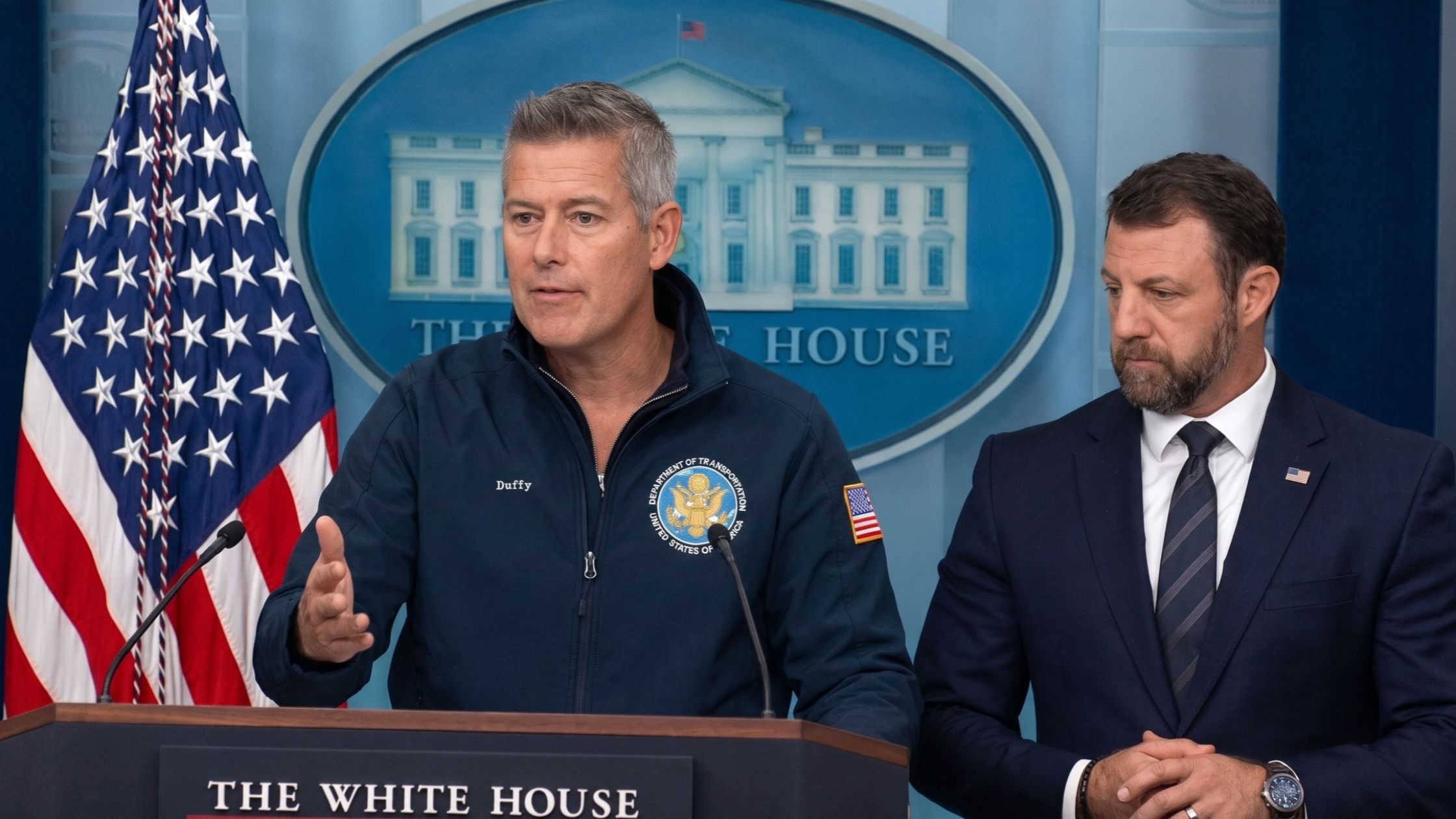
Well, good to see you guys again. Welcome to Friday the 13th. I want to make sure everybody understands that there is no connection between this and Microsoft. I know a lot of people are making that jump. So far what we've seen, there is actually no cyber attack. We're still working through that process. Our teams are working. This is what the leadership of President Trump looks like by the organization and the team he's put together. We're built to handle crisis like this, and that's exactly what we're doing. We're moving at an unprecedented pace as a whole of government to make sure that we are doing the public justice by making sure everybody is safe, which everybody is. We are working with the airports, with the communities, with the cities, the states to make sure those passengers that may find themselves in need. FEMA has activated their centers to make sure that there's no medication that is being missed. If it is, we're going to have people for them to reach out to. The airport has got a direct number to reach out to us. We can provide that medication for them working through the state. So right now things seem to be working, as we can say, in the right direction. As you can see to my right, I have Secretary Sean Duffy who is here to provide the update on FEMA, where we're at and where we're going. Once Sean is completed with his update, then we will be happy to take questions from everybody.
(38:26)
I just want to reiterate this. The public was never at danger through this process. There was never any lives at risk. There was no flights at risk. FAA was able to handle it. We did it out of an abundant of caution, but I do understand the internet traffic and where all these conspiracies start running towards. I just can't say this enough. All your loved ones are safe. We are working to resolve the issue and we hope to have operations up and going normal at some point.
(39:05)
So with that, I'll turn it over to Secretary Duffy.
Sean Duffy (39:09):
Thank you, Markwayne and good night to everybody. First of all, thank you for your partnership and assistance. Markwayne has been great. Stephen Miller put together all of the intelligence assets of the White House. We were in multiple times talking to the president about what was happening in the airspace, complete engagement by President Trump's team.
(39:32)
So just I want to walk through what happened today. So at 3:36 PM, we experienced instability for our radar and our communications in our centers and our TRACONs across the country. So if you don't know this, at airports we have towers. The next rung out is a TRACON. After that we have en route centers. The TRACONs and the centers, we started to have inconsistency in the data from the radars and our communication with airplanes. And we have procedures for this. Our pilots are well trained, our air traffic controllers are well trained. And at that point we issued a ground stop. We had over 3,500 airplanes in the air. They all engaged. And last time I looked, we had less than 400 in the airspace as they were all coming in to safely land and we navigated it with our well known procedures that we have when these incidents happen.
(40:28)
I'm going to talk about where we're at now, but before I do that, when we shut down the airspace, oftentimes there are critical movements that have to take place, whether it's medevac, there's cargo operations that are moving critical medicines that save people's lives. We didn't lose all telecom. We didn't lose all radar, but that instability, because of abundance of caution and making sure we keep the American flyer safe, we did the ground stop, but we were going to allow those life saving movements to still occur as well as with law enforcement as well.
(40:58)
So what happened? I've heard a lot of the rumors like Markwayne has. But what we have is an incredibly old air traffic control system. I think every single one of your networks have covered the president and myself talking about this for the last two years. The president for the last year has been asking Congress to fully fund a full build of a brand new air traffic control system. So we have TDM telecom. So this is analog telecom. Our switches, our routers actually got overloaded with data and they went down. And I shouldn't say they went down. They started to give us inconsistency in the data from those routers. And because of that, we shut the system down. Now I have already replaced some of those switches with President Trump and our new IP switches did not go down. It's the old hardware that went down.
(41:55)
And I think the question for the American people is, do you want your Congress to fund this? President Trump has asked for the money. He's asked the Congress on a bipartisan approach to say, give us the resources to build a state-of-the-art air traffic control system. Let's not do a patchwork, a fix to a system that's critical for every single family. It's not red, it's not blue, it's not Democrat, it's not Republican, it's American. Give us the money to fix it. Now, if you look to the past administrations, going back 25 years, $ 15 billion has been given to the FAA to fix this air traffic control system. And guess what? Barely anything was done. We had a down payment. President Trump asked for it in the One Big Beautiful Bill of $12.5 billion. We are building in that $12.5 billion, that portion of the build will be done by the time President Trump leaves office. We are moving at a speed that has never been seen before with regard to the FAA. But that's a partial funding. I think America demands that the Congress give the rest of the resources to finish the build.
(43:08)
And I think the Congress at a point looked to the history of the FAA and said, "We don't trust you." Well, with President Trump and what we've done, I think they do trust because what we've done with that first tranche of money. And so with a brand new state-of-the-art system, you won't have these outages. So what you experienced today, but you can think back, many of you covered the story from a year and a half ago we had outages in Newark, multiple outages in Newark. This is a continual problem that we have and it should be fixed.
(43:41)
And so what we want to do, I've asked, the president's asked for $30 billion. I want $50 billion. And by the way, if you look at how much money congressman... Peter, you've covered Congress. They waste a lot of money. What's more important than having an air traffic control system that actually works? And so the president said, "You know what? Let's finish this job, new hardware, new software, new telecommunication." Many of our towers are almost a hundred years old. Our air traffic controllers have leaky roofs, air conditioning that doesn't work. They're high in the air. Their elevators don't work. Their roofs leak. I want new towers. We should also invest in many of the airports around the country that frankly, many of them are embarrassing. Let's get the money. Let's invest so we never have to come at 8:30 at night and have a press conference on why air travel was shut down, why we have tens of thousands of people in airports separated from their families without any knowledge of where they're going to sleep tonight.
(44:46)
Now you probably picked up that we've identified the problem. We've got our centers and our TRACONs operational right now. And so at 8:15 tonight, Eastern Time, we've opened up the airspace. Now, does that mean every flight is going to fly right now? It's going to be slow, right? So if you're watching, you're at an airport, check with your airline. It depends on do we have crews available? Do we have pilots and flight attendants available to fly your flight? We're going to try to move as many of those as we can tonight if we have the capacity with crews to move those flights. If not, we're going to start tomorrow morning with our airline partners moving those aircraft, but it's going to take us some time to unwind what's happened this afternoon.
(45:32)
Finally, with general aviation, if we have aircraft that's moving six people, that's a lower priority. But this weekend we have movements of aircraft that are general aviation that might have 60, 80, 100 people on those aircraft. We are going to give those aircraft a priority. So hopefully tomorrow we are going to start to see a far better movement. But we'll take your questions. This is an emergency. This is an emergency. I want Congress to give us emergency funding. This is bipartisan. This is American. I want $50 billion. President Trump is a builder, he's going to build this network and deliver for the American people. But the president can't deliver for America unless the Congress delivers the money to make it happen.
(46:25)
So with that, we're happy to take questions, Peter.
Peter (46:27):
Secretary Duffy, what you're describing, routers overloaded with data that then start to show instability. That sounds like something that could be caused by a cyber attack. Can you say with 100% certainty that this was not caused by a cyber attack or a rogue AI?
Sean Duffy (46:47):
I'm going to give this to Markwayne.
Markwayne Mullin (46:50):
All right. There's nothing completely certain right now. It doesn't appear that way. We've activated our teams. This is what Department of Homeland Security is all about. This is why we're stood up to have the continuity of government to bring all the resources together in an emergency like this. This is exactly what this is. This is a national emergency. We have all of our assets, be it from DOW to CISA, to all of our NOCs, then all the other components we have inside of DHS. NSA is working with us. There is nothing that indicates it yet.
(47:26)
Now when we start looking at cyber threats, cyber attacks, typically some people is going to raise their hand up and say, "Hey, we did that." There's no chatter. We haven't seen any footprints, as you would say, or identifications of people that got into the system. It appears that this was mechanically driven. However, we're still looking, so we're not going to rule that out.
(47:52)
I want to hit back on to what Secretary Duffy said with the funding. This is a national security risk. We just saw what took place when we have vulnerabilities and we have old systems. The president has declared this a national emergency and now we have to have Congress act and fund it. This is vitally important that we get this system built. The president has said this, Secretary Duffy has said this multiple times. Our air traffic control system is outdated and it hasn't been a priority from Congress. And so this is what happens when Congress kicks the can down the road.
Peter (48:31):
So when you say that you just haven't seen footprints suggesting a cyber attack and nobody's taking credit for a cyber attack, have you seen any evidence specifically? Can you tell people who are watching and don't believe it? Because we saw Microsoft go through this-
Markwayne Mullin (48:42):
We have seen zero evidence. We've seen zero evidence that this was a cyber attack or a SI attack.
Peter (48:51):
So then it must be something else. What is the other thing? What caused the instability?
Sean Duffy (48:56):
So it's very easy. We have old switches, old routers. We use 1980s little copper lines. It's an old system that went down and went down everywhere. It got overloaded.
Peter (49:11):
Can that be hacked?
Sean Duffy (49:14):
Here. Right now we've opened up the airspace. We've got our centers and our TRACONs operational. It would be much... And I don't want to rule out that we didn't have nefarious activity here, that's Markwayne and the cybersecurity team that works with us. We were able to deploy fixes to reduce the overloading on our switches that we're able to bring the networks back online and our TRACONs and our centers back online. So I think our fix gives us a pretty good indication that it was a legacy network problem that went down. And by the way, all of the new equipment that we put in, none of that went down. This is all the old legacy equipment that's existed forever.
(49:59)
By the way, none of your networks run on 1980 technology. You all got fiber state-of-the-art high-speed networks that cover all of your stations, but not the FAA. I think the American people deserve the same kind of network that you all use, the same kind of connectivity and speed that you all use. That's what we're asking the Congress to give us.
Speaker 9 (50:23):
One question for each of you. Mr. Mullin, are you able to completely rule out foreign interference? And then Mr. Duffy, you're talking about old systems being to blame here. The ground stop is lifted, but this is not going to get fixed overnight. Thousands of flights have been delayed, thousands of flights have been canceled. How can you assure the American people that it is going to be safe to fly and how long is it going to take for flights to be fully operational and back to normal?
Markwayne Mullin (50:49):
So let's talk about cybersecurity. Once again, we're still looking at it. We're not ruling out anything. What it appears to be right now is as Secretary Duffy and FAA was going in and putting patches into the system, they were putting new equipment and new technology and that new equipment, new technology, it was overwhelming the older system, which is why Secretary Duffy made it very clear, the patchwork doesn't work. We need one complete system. We need someone to come in and build the whole system. Doing it nickel and diming it together does not work. This is what happens when that takes place. That's why the president has made it very clear. We can't do this, it has to be a complete overhaul of the system, which we estimate to be about $50 billion.
(51:40)
However, out of abundance of caution, we are still going to do everything we can to rule it out. If that changes, we will let you know, but it doesn't appear right now that this was anything to do but with technology.
Sean Duffy (51:54):
So to answer your question, this is not going to get done overnight. You're right. But when do you want to start it? America, when do you want to start building a brand new system? Well, you have a team with President Trump that actually is building it right now, but we don't have full funding. And so I think there's no better time than the present to actually give us the money and let us finish the build. What went down was old, right? It was the old legacy equipment. It failed. And listen, it's going to continue to fail, but my number one job is America's safety.
Speaker 9 (52:28):
But is it going to be safe for Americans to fly with these old systems tomorrow?
Sean Duffy (52:32):
That is my first charge. And so if you look at what happened today, we had a failure. And what happened? We effectively and safely got aircraft out of the airspace, right? And sometimes people will complain, "Why did you shut the airspace down?" We just had an incident a couple months ago in Newark where that system went down. It was a telecom issue. We will shut the system down. I want you to fly safely. If you miss a baseball game, you miss a wedding, I care about you getting there without any harm. Again, this is a time you have a builder president... By the way, play politics all you want on all kinds of issues. That's great. And there's a lot of issues to play politics on. This is not one of those issues. This is an American issue, an American build with an American president that knows how to do it.
Speaker 10 (53:25):
[inaudible 00:53:26]
(53:25)
Sir, thank you. Will this cascade to Thanksgiving travel plans for college students coming home? Do you expect to see delays, cancellations even though we're days out?
Sean Duffy (53:33):
That's a great question. So I believe that it's going to take us some time to get back to capacity and then get people who were disrupted over the course of the last eight hours to get them back to their destination. So we're going to have some makeup to do. I would imagine a lot of... My kids are flying next Friday back from college, I imagine that's when a lot of kids are flying and everyone starts their Thanksgiving travel, which by the way, is a very busy time for travelers. I think we're going to be back up and operational as we come into-
Sean Duffy (54:00):
I think we're going to be back up and operational as we come into the heat of travel during Thanksgiving.
Speaker 12 (54:07):
And one more. You said, earlier you mentioned medical flights, organ transplants are still being flown across the country?
Sean Duffy (54:12):
Yes. Yes, we don't stop those, because it wasn't a complete outage, it was just, we were getting varying degrees of our inputs from radar and from telecom, we were able to still fly those flights safely. And we understand people's lives are basically in the hands of these flights being able to get from point A to point B. So we were allowing those to go, as well as law enforcement.
Speaker 12 (54:38):
The tanker riverboat crash today down in New Orleans, terrible. I'm sure you saw the video. Do you have any idea how that happened? A tanker runs right into the side of it. What are you learning?
Sean Duffy (54:48):
That's the Coast Guard.
Markwayne Mullin (54:51):
This looks like it was a major engineering defect that took place during either they hit the bridge or something caused the ripple effect. I do want to announce though, by the grace of God, we have not lost one soul. There was 195 souls on board. All 195 souls are accounted for. 32 are at the hospital, were still in various conditions, but my last report was there was no critical conditions that was taking place. So just an absolute miracle there. But once again, not connected at all. That was something that took place.
Speaker 13 (55:43):
Mr. Secretary [inaudible 00:55:44]. In the run up, Mr. Secretary, you are having war against Iran. Was there any input at all beyond this incident that there were Iranian elements or any other elements who may be comporting cyber attacks?
Markwayne Mullin (55:54):
No. We're not seeing that at all. Yes?
Speaker 14 (55:57):
Thank you much. Thank you guys for your coordination about this emergency. Speaking of college, a huge entity that relies on travel this weekend is college football. Have you guys been in communication with these universities and do you plan to implement any coordination there?
Sean Duffy (56:09):
So as I mentioned, we're going to allow for general aviation, those larger movements to take place as a priority. Smaller movements will take a lower priority. And so if you talk about football teams moving, many of those are on charters and there's a lot of individuals on those charter planes. So I would encourage those football teams to reach out to the FAA to schedule their flight times and make sure they can move to make sure we have games going off tomorrow.
Speaker 15 (56:42):
Thank you. Cameron Arcand from Townhall. Has there been any communication with the major commercial airlines? And then can you just clarify what rights do passengers have right now? I know you mentioned FEMA, but what other rights do they have?
Sean Duffy (56:53):
So we are in communication with all of our airline partners. We're making them aware as soon as we can with what the issues are because they're also concerned, "Was this cyber? What took place where we had a ground stop?" And Markwayne and our airlines are navigating the passengers who are stranded in airports, but we work fully with them as we come back online and what planes we can move as quickly as possible to get people to their final destinations. And this is one of those scenarios where this is not the fault of the airline. Again, I'm happy to blame the airlines. I'm happy to blame the weather, but I'm also happy to take the blame when it's with the FAA and air traffic control. And this is a legacy system problem that took place tonight and we have to handle it accordingly.
Speaker 16 (57:46):
Thank you, sir. Just describe how this manifested in the air today. Were airplanes still able to communicate with air traffic controllers? How did it specifically impact that? And separately, do you have any estimate at this point of the economic impact of this stoppage and where that goes from here?
Sean Duffy (58:04):
So we had intermittent communication and intermittent radar, which is why we then shut the airspace down. So it wasn't a complete blackout in communication or radar. So we were able to keep some of those communications going. But when you have issues and you can't immediately communicate and immediately see where aircraft are at, that's a risk that we're unwilling to tolerate. In regard to economic consequences of what happened today, I think it underscores how important aviation is to our economy. We haven't done a calculation. I was on an airplane from Dallas when this happened, hence my attire and haven't gone to change. So I apologize for wearing a jacket and jeans with you. There'll be time to do an economic analysis, but this is critical for the American economy, which is why the Congress, I'm going to say it a million times, the Congress has to give the resources to the president so we can finish this bill.
Speaker 16 (59:03):
Just to be clear to follow up, that means there were times when airplanes and air traffic controllers were not communicating with each other at all.
Sean Duffy (59:10):
So that can happen, yes. And we have-
Speaker 16 (59:11):
That's a big safety risk.
Sean Duffy (59:13):
Well, we have emergency procedures in place. If this happens, pilots know what to do and air traffic controllers know what to do. And whether it's systems on airplanes that are still operational, it's still communication, though not consistent, we're able to navigate the airspace. And as you saw today, we systematically but slowly brought down 3,500 plus aircraft safely across the national airspace, which I want to give credit to the pilots and to our air traffic controllers who are very well trained and know how to navigate this situation.
Speaker 17 (59:49):
Are you saying that it was the FAA patching a system that caused this outage? Is that something that's happening constantly?
Sean Duffy (59:59):
I want to clarify that. This is our old TDM analog system that got overloaded with data and started to experience these issues. And it was in our TRACONs and our centers throughout the NAS. Now we do have some in our TRACONs and centers that have been upgraded to digital, to IP. Those did not experience these issues, which underscores the point. It's important that we're able to finish this work with additional resources.
Speaker 17 (01:00:33):
But how can Americans be confident that this vulnerability won't be an issue again in the coming weeks if what today took place happened and it's still a problem?
Sean Duffy (01:00:40):
This is a great question. So listen, I can't build things if I don't have money.This is a great question that you ask. How can America be confident? Well, we do everything. We have the busiest airspace in the world, bar none. We have the safest airspace in the world, bar none. No one competes with us on safety or complication of the airspace. But if you ask the question, "What should we do?" Well, we should talk to our senators and our members of Congress to say, "We don't deserve this, America." This is the greatest country, by the way, with the greatest president. Let's give the money to fix this very real problem. And this is not the first time. We had this happen in New York when we had global leaders were flying in for the UN. We had a similar issue. We had an issue in Newark. It happened twice. How many times does this have to happen before Congress gives the money to fix it?
Speaker 17 (01:01:32):
But the Trump administration has been in office for almost two years now, sir. So why hasn't this been a bigger priority for the president? Republicans controlled both chambers of Congress-
Sean Duffy (01:01:40):
Where are you from?
Speaker 17 (01:01:41):
And still do.
Sean Duffy (01:01:42):
What network?
Speaker 17 (01:01:42):
I'm with NBC News.
Sean Duffy (01:01:44):
NBC. So maybe you haven't covered the hundred-plus press conferences that I've done on this issue that have been led by the president, but I know Fox has, Peter's carried the story. I know many of you have covered the story about the president's ask and my ask to get the money. And so I identify-
Speaker 17 (01:02:03):
[inaudible 01:02:04].
Sean Duffy (01:02:04):
Well, because the Congress has to give it to us. Well, oftentimes... It's a great point. Oftentimes you need a bipartisan vote. So I did get partial funding through one big beautiful bill. I got 12 and a half billion. And with that money, we are spending it and spending it well. But the Congress at the time knew that that was not going to be enough. By the way, this is bipartisan, but on that bill, I didn't have Democrats that voted for it. We now have an opportunity in an emergency funding bill before the end of the year to give the money. And I think the question should be from NBC to every member, "Do you support actually modernizing, making a state-of-the-art air traffic control system?" And it's going to take us some time.
(01:02:52)
I can't snap my fingers and build a network overnight, but do you want us to build this for America? And I think every member of Congress should say yes, but every American, I guarantee you, would tell those members, yes, give President Trump, give Duffy the money, let them finish this job so we don't have to do a press conference at 8:30 at night ever again.
Speaker 18 (01:03:14):
Sir, while you're building the new system, is it safe to fly? How do we know this isn't going to happen again tomorrow when you bring in new patches?
Sean Duffy (01:03:21):
So this is the safest system in the world. And by the way, it hasn't been done in the past because it is complicated. I don't want to lie to anybody. What we're doing is hard and it hasn't happened in the past because it is hard. But I'll tell you, by doing nothing, you inject way more risk into the system. To use 1980s technology, 1990s software, to use 1970s radar that we don't make parts for anymore, to have an old network, an old network configuration from the 80s versus re-networking the air traffic control system through the FAA. I believe that should be a priority. And our number one mission when we do any of this is safety. But if you do nothing, the system doesn't get more safe, it gets less safe.
(01:04:15)
And so I would say, America, Congress, let's make this system more safe. Let's continue to lead... We led the world in aviation, we led it in the jet age. We've led in space. Let's continue to lead with a state of the art, a system that no one has that's the best in the world, but that takes cash.
Speaker 19 (01:04:35):
Given your knowledge of the old system and what ins and outs there, why wasn't the agency prepared for some catastrophic failure like we saw today?
Sean Duffy (01:04:46):
Well, I can't anticipate every catastrophic failure that'll happen with a TDM network, with an analog network.
Speaker 19 (01:04:52):
Shouldn't there have been a backup plan in place in case this network failed? You knew it was an old system you were trying to replace to keep people in the air?
Sean Duffy (01:05:00):
So I didn't anticipate that we would have an outage like this. We've had small outages that I've mentioned previously. We didn't think we would have this kind of outage. We did. And what I would tell you is the systems that were deployed kept everybody safe, everyone landed. We were able to review what went wrong and then reboot the system and go. But you will have more of these. You will have more of them unless the American people and the Congress tell us to build. And I can't wait for that.
Speaker 19 (01:05:34):
You say this is a priority for President Trump. Why have we not heard from him at all on this issue since it happened?
Sean Duffy (01:05:41):
Well, the two of us have talked to him. I've talked him on the phone. I've talked to him in the Oval, so has Markwayne. I don't run the president's comms. I just know that Markwayne and I are going to come out and talk to you about it, but I know he's fully engaged because he has communicated with the both of us multiple times from the point that it happened to moments before I came out. I was in constant communication. Markwayne and I were in the oval with him, which by the way, I appreciate his leadership. And what's just unique about the president is he loves aviation. He loves the airspace, which is why he has been so engaged on this. He understands it very well and he's been frustrated... Before I actually was sworn in, he was talking about how old the system is, how past administrations had failed and how he wants to fix the air traffic control system in America and deliver the best in the world.
(01:06:33)
And it takes a president's leadership like President Trump to make sure we can ask the Congress and get the money and give the deliverable.
Speaker 20 (01:06:42):
Thank you, Mr. Secretary. I'm curious, I don't think we have clarity yet. What was different about today specifically? The system has been in place for a long time. Why did today the system go out and can you give more clarity? You're saying this will happen again. Should Americans feel safe when they fly if these outages are still possible?
Sean Duffy (01:06:58):
In what vintage you'll have it happen again, I don't know. Is this exact thing going to happen again? I don't know that this exact scenario will happen, but I did have New York a couple of months ago. I had Newark a year and a half ago. So we're still working on the details of what went wrong today. I'll be happy to give you more information when we have it. I don't want to give you the wrong information. Our team is working overtime trying to navigate what happened here, what was the cause and how do we prevent it in the future should similar situations arise.
Speaker 20 (01:07:35):
Do you know if it had anything to do with the AI program you guys just introduced, the SMART program for the FAA?
Sean Duffy (01:07:38):
So as I mentioned, this is all the old legacy equipment. All of the new equipment that's been deployed did not go down. Our SMART system, which is a system that we have a feed for the whole airspace that's going to help us better manage trajectories of airplanes and better manage weather so we can one, drive safety in the airspace and drive efficiency in the airspace. But that SMART system isn't plugged in to STARS and ERAM. This is completely disconnected and I love that some people have said this would be the root cause. And by the way, if it was, I would tell you that, but this is not even plugged in.
(01:08:17)
What this does is gives information from the airspace to a human being and gives them a prompt on how they could better navigate weather or trajectories. Then the human being will actually decide to accept or deny that prompt. So we're not even tied in. So there's no possible way SMART would have impacted what happened today.
Speaker 20 (01:08:37):
You said today that there was no one in any danger. I'm curious for people who are frustrated right now about the fact that their flight's been delayed or canceled, why was there a ground stop put in place for five hours if no one was in any danger?
Markwayne Mullin (01:08:48):
Well, let me explain that one very easy. No one was in danger because of the procedures we put in place. The system went down. We reacted the way that we were trained to react and everybody came together. President Trump immediately had people in his office. We were communicating. Secretary Duffy, the FAA took immediate actions that they had put in place to assure everybody was safe. And that's why you saw, as Secretary Duffy had said, we had over 3,000 flights in the air. We had a ground stoppage and they were all able to land safely, even with the communication problems. And I just can't speak enough about President Trump's leadership. And this is what President Trump does. He puts leaders in place and he allows them to lead.
(01:09:36)
They even ask why is the president not talking? It's because he's allowed Secretary Duffy and us to go out there and explain to you what took place. President Trump trusts his leadership and that's why we really lean in towards his leadership. And when Secretary Duffy said he's the greatest president we've had, you've never had a builder and a leader like President Trump lead this nation, have a vision and put the team together. Thank you guys so much. Appreciate it.
Speaker 19 (01:10:06):
Is the full ground stop your only option moving forward?
Speaker 18 (01:10:09):
Secretary Duffy [inaudible 01:10:13] hotel rooms and passengers-
Speaker 19 (01:10:09):
Does this have to do with L3Harris?
Speaker 17 (01:10:09):
How does this affect the G20?
Speaker 21 (01:10:09):
All right. All right. I'm here.