Speaker 1 (00:00):
(silence)
FBI Speaker 1 (18:52):
The FBI will have a lead when it comes to the intelligence and threat monitoring, but we are not doing that alone. We are heavily engaged with our partners to ensure that we are monitoring potential threats, which we have been doing so for an extended period of time. We are actively working to identify and disrupt threats before they occur.
(19:12)
Currently, there are no known threats to the FIFA games here in the Atlanta area. That being said, we want people to be aware that hoax threats will not be tolerated. They remain a huge concern for large public events. All threats, including those made by phone, text, email, or social media will be taken seriously. Making threats is a federal crime. The public is encouraged, like Sean said, to report suspicious behavior concerning information to the FBI.
(19:54)
Human trafficking during large scale events is also known as a threat. However, we have human trafficking task forces that will be actively monitoring throughout the summer. Our efforts include identifying traffickers, assisting victims, working with victim advocacy organizations. And just so it's known that we have more than 1,000 human traffickers nationwide, but we are monitoring and ensuring that this will be a safe environment and we will attempt to engage prior to, to ensure that threat is mitigated as much as possible.
(20:33)
In closing, I want the public to know that this event is our top priority and ensuring that it is safe and remains that way, we are committed to that. FBI Atlanta wants to ensure that this is a successful event for players, fans, residents, and visitors. We want everyone to participate in the event, to know that it will be safe to be in downtown Atlanta for a Fan Fest and for participation in watching some of the games. The FBI encourages the public to remain vigilant when you are present downtown and report anything that you see that seems out of the ordinary to the FBI. Thank you.
Speaker 2 (21:12):
All right, we can take a few questions. We'll make it [inaudible 00:21:15].
Speaker 3 (21:16):
Can you talk to us a little about getting more agents from other parts of the country, given that we have so many here, in terms of staffing and where the agents are going to be? Going to just be the area by Mercedes-Benz? Or walk us through the awareness in terms of FBI agents across Georgia.
FBI Speaker 1 (21:31):
Yeah, so because this is known obviously throughout our state, I actually have recently met with our other regional offices to let them know that, "Hey, if there is a crisis, if there is an event, we will rely on the region to actually bring forth resources to assist." But as far as Georgia is concerned, we are pulling from the entire state to support for the event. We have brought folks in town to support, but I also additionally met with our entire office yesterday to notify all employees that we will be prepared to ensure that we cover to make the game safe. Wherever there's a gap that presents itself, we will cover down on to ensure that there's safety for the public.
Chase Houle (22:17):
Chase Houle with 11Alive. As you know, we've seen a lot of hoax threats go around the country. Right here in Atlanta, we just had one at the zoo. What are you guys going to do when those calls come in? Are you guys going to evacuate the whole entire stadium? I should say if they come in, how do you guys plan on handling that, I guess pose the hoax to a real threat?
FBI Speaker 1 (22:33):
Yeah, so there's standard operational procedures that we will always follow when it comes to hoax threats, but we will take them seriously. We will cover to investigate it and then we will deploy resources as needed depending on what we find.
Chase Houle (22:47):
But will you guys be, I guess, telling people to leave the stadium if you guys do get one of those threats? Because how do you guys deem it credible versus a hoax?
FBI Speaker 1 (22:55):
So, naturally, there are ways in which you can determine where the phone call is coming from, where the email is coming from. You track those things, you run them to ground to determine if it is a isolated incident, meaning there is one threat being reported or if it has been a barrage of events being reported. Or if it's a known number or a known email that's known to us to produce hoax, then we will identify that and let that be known and that will dictate our response.
Speaker 4 (23:26):
What role will the FBI play, if any, in securing Hartsfield-Jackson International Airport during the World Cup?
FBI Speaker 1 (23:32):
I'm sorry, I couldn't hear you.
Speaker 4 (23:34):
Okay.
FBI Speaker 1 (23:34):
There's a drone flying above.
Speaker 4 (23:36):
What role will the FBI play in securing Hartsfield-Jackson International Airport during the World Cup, if any?
FBI Speaker 1 (23:42):
Sure. Naturally, we have a presence at the Jackson-Hartsfield International Airport, but I will say that we rely heavily on our partners. We are working with them all to ensure that there's a safety, there's an increased presence in every avenue that is related to FIFA. And that across the board, whether it's Fan Fest-
FBI Speaker 1 (24:00):
... FIFA, and that across the board, whether it's Fan Fest, whether it's the facility where the game is played, Mercedes-Benz or the airport. So there's increased presence everywhere, and so we are part of that presence and we will remain.
Interviewer 1 (24:11):
So we see the drone in the air now, and you guys talked about having drone migration, or being able to attack or deal with drones that are in the area. Can you guys talk about the operation in terms of making sure the guys are safe, what you guys will be doing, what counterintelligence will be using for drones when you put a no-fly zone around the area?
FBI Speaker 1 (24:32):
This is a perfect question for me to defer to my supervisor. Yes.
Aaron Hope (24:38):
Good afternoon, everyone. Aaron Hope. Can everyone hear me? Good afternoon. Aaron Hope, I'm the Supervisory Special Agent for our Crisis Response Squad. And so, your question, again, was, what are we going to do for drone mitigation? So we're working with our partners right now to ensure that we have safe skies. Our biggest priority right now is messaging, making sure that individuals are aware that this is a no drone zone, and we want to ensure that that messaging gets out. Should there be the need for us to interdict a drone, we have the capability to do that. However, right now, our primary focus, again, is just getting messaging out.
Interviewer 1 (25:14):
People fly drones, obviously, for taking pictures and some of that, but you're saying nowhere around that area can people fly a drone?
Aaron Hope (25:23):
That's correct. This event is a no drone zone.
Interviewer 2 (25:26):
Do you guys shoot it down? Do you guys intercept the technology? What does that mean?
Aaron Hope (25:30):
That's correct. So we do have technology that we can use to identify drones and then locate operators. And so, that's something that we will be doing if we need to, if those circumstances allow.
Interviewer 3 (25:46):
The last time Atlanta hosted a global event like this was the '96 Olympics. Obviously, we have social media and the internet, like they say. What kind of challenge does social media and the internet play? And tell us how you guys are going to attack that.
Aaron Hope (25:58):
Sure. I would say that there's no challenge. It actually provides us a benefit. It provides us a benefit to reach broader audiences and let the community know that, again, this is a no drone zone. We want a safe event for everyone, to include international visitors. And so, by leveraging social media, I think we have a good opportunity to put that message out there.
Interviewer 3 (26:16):
I did a bad job asking a question. I meant specifically when it comes to threats. Nowadays, you've got [inaudible 00:26:21] ready, Facebook and internet. How do you guys go about doing that when there's so much activity on social media?
FBI Speaker 3 (26:28):
Yeah, I think it's the same answer. It's actually a plus for us, right? So, information travels a lot faster today than it did 35, 30 years ago during the Olympics in Atlanta. So, we obviously utilize that information for early notifications, as well as our partners, right? So, with the real-time crime centers and real-time information centers, all that social media presence, we find that it reports stuff quicker and provides more information on an early basis that then our folks, both investigators and our intel folks, can work with to either address a concern or get ahead of a concern.
Interviewer 4 (27:03):
Were there lessons learned from the 1996 Olympics you guys hope to apply to the World Cup?
FBI Speaker 3 (27:10):
I don't think so. I don't have an answer.
FBI Speaker 1 (27:13):
Absolutely. Law enforcement has evolved tremendously since 1996. And so, we will put forth everything that we have learned and developed through that time. Many of us were not even working in a law enforcement capacity at that time, right? But I will say that our tactics and techniques have definitely evolved, and we will be leveraging those to everyone's benefit, to include the players, participants, and the community at large.
Interviewer 5 (27:36):
Can you talk about manpower?
Moderator 1 (27:37):
[inaudible 00:27:38].
Interviewer 5 (27:38):
Thank you. When you talk about manpower, do you have a number of personnel, like hundreds? Are we talking about FBI personnel working the World Cup game, or can you release that information?
FBI Speaker 1 (27:48):
So, not to release a number per se, but we have enough employees here in Atlanta to be able to cover down on an event of this magnitude. We have brought in some reinforcements, whether that's for some of our tactical teams or whether that's for supervisors that have specialties in certain areas, particularly maybe counter-UAS, right? So, we have brought in some reinforcements, but actually, Atlanta is equipped to handle an event of this magnitude.
Interviewer 6 (28:18):
Can you talk about chain of command? We're hearing from, obviously, agencies, federal, local, state, everything. It seems like every agency has their own state command center, whether it's APD or the Secret Service, the White House, the FBI. Who's leading? And how does that collaboration involve?
FBI Speaker 1 (28:36):
So that collaboration starts from the top, right? And quite naturally, there's a White House taskforce that is responsible for FIFA, and everyone falls under that chain of command. And each entity, obviously, myself being the SAC here, everyone that works for the FBI will fall under me, but we are all collaborating within one structure. And so, we will all be in the same room to be on the same sheet of music, and everyone has their own mission that we're going to adhere to to ensure we're doing our part to make things safe.
Interviewer 6 (29:08):
I think we're talking a lot about-
Interviewer 7 (29:09):
I've seen other large-scale events in the past. Thank you. Super Bowl, college/national football championships. How is the FIFA World Cup different from a preparation standpoint for the FBI, different than these other events that Atlanta has seen?
FBI Speaker 1 (29:22):
You know what? It's not. The only thing that's different about FIFA is the duration. The duration is something that is unusual, 39 days from start to finish of a tournament that is happening, that is having an impact on our city. We have eight games to cover, one of them being more significant than the rest because it's a semi-final. So, that's what's different about it. However, the preparation remains the same, and that preparation involves routine, it involves practice. Our tactical teams have been practicing, commingled with other tactical teams from other agencies for months leading up... Each other so that, if there is something, we're equipped and we're ready to go.
Interviewer 7 (30:04):
Will you all be concentrated in the downtown Atlanta, of course, specifically, throughout the city? Will you be on the Beltline? Will you be at MARTA station?
FBI Speaker 1 (30:11):
I think you will see enhanced law enforcement present throughout the city, particularly, obviously, downtown is where the FIFA events are, so we will be there. But you will see a heavy law enforcement present because we want everyone to know, "It is safe. Come out, come enjoy, and have a good time."
Interviewer 8 (30:28):
I also want to talk... Okay. We've talked a lot about ground. We talked a lot about air. But we have cyber on the table now.
FBI Speaker 1 (30:34):
Absolutely.
Interviewer 8 (30:35):
Talk to me about how we're going to prevent more cyberattacks on infrastructure here in Atlanta that's crucial for us to operate.
FBI Speaker 1 (30:42):
Yes. All teams... When I say the FBI is all there and ready to participate in working, we are, and that includes across the board. That's our criminal team, that's our criminal program, that's our cyber program, that's our counterintelligence, that's our counterterrorism. Everyone has a role to play. That tracking and monitoring of cyber activity has been ongoing. And so, our teams are working to ensure that, if there is something, we are in line to mitigate it.
Interviewer 8 (31:10):
And last question about a follow-up with human trafficking, working with [inaudible 00:31:16] and other agents, especially with our sporting events, is there a specific separate resources that are going to be monitoring that, whether it's online or in person, given that this is going to be one of the biggest ones after the Olympics when it comes to specifically trafficking the victims here in Atlanta?
FBI Speaker 1 (31:30):
I'm sorry.
Interviewer 8 (31:31):
Is there going to be additional resources put in to prevent trafficking for the FIFA games over the 39-day period?
FBI Speaker 1 (31:38):
No. So, additional resources, meaning there is a greater presence online for us. There's a greater focus that is online to monitor human trafficking for this particular reason because there's large events. But you have to remember, FIFA is going to be in 11 U.S. cities, so it's not just Atlanta that were monitoring that. So, it's across the board. So, our FBI headquarters is playing a significant role in that coordination piece.
Moderator 2 (32:05):
A couple more questions, then we got to go.
Interviewer 1 (32:05):
If I can just go back to the drones for a second, just to make sure I understood correctly. FBI Atlanta will be taking the lead when it comes to monitoring for and potentially interdicting drones that are in the air. And the other point, if you can explain a little bit about... You're going to have people who say, "You know what? I'm just taking pictures with my drone. Why is this such a big deal?" Can you explain what the potential concern is? What the potential threat that is presented by a drone being in the air over a large event like [inaudible 00:32:30]?
FBI Speaker 1 (32:30):
Sure. You've seen it across the board, you've seen it everywhere right now, the way drones are being leveraged for nefarious reasons, right? And so, we just want to eliminate that potential by having a no-fly zone and having teams on the ground that can mitigate a drone that goes up, even if it is for a hobbyist or pictures, as you said, right? This is not the time to have a hobbyist when there's so many people that are there for a particular event. So, to keep it safe, a no-fly zone is what's being enacted.
Interviewer 4 (33:08):
Do you have specifics about the no-fly zone itself? Where it is, how high, how wide?
FBI Speaker 1 (33:08):
That's a good question. Aaron, do you have that info?
Aaron Hope (33:10):
All that information for the no drone zone can be found on the FAA's website. They'll have more specific information regarding the NOTAM, which is the Notice to Airmen.
Interviewer 4 (33:25):
Okay. So it's not just around the stadium, but it is around other parts of the city, too?
Aaron Hope (33:26):
That information can be found by the FAA. We'll be enforcing the FAA's no-fly zone.
Moderator 1 (33:32):
Last question?
FBI Speaker 1 (33:40):
Fantastic. Thank you all.
Moderator 2 (33:41):
Thank you. All right. We're going to launch a drone over here, if you want some drone video, and then we'll move a robot around, too, for you.
Aaron Hope (33:49):
Stick around.
FBI Speaker 1 (33:49):
[inaudible 00:33:49].
Aaron Hope (33:49):
Okay.
Moderator 2 (33:49):
[inaudible 00:33:49].
Interviewer 1 (33:49):
Can you actually commander a drone, or do you just interfere signal and just disable it?
Aaron Hope (35:42):
So there's a lot of different technologies out there, and we'll be exploring a couple of different options, but one of our biggest concern is for safety. So, we don't want to do is interfere with a drone signal and cause it to fall out of the sky [inaudible 00:35:54] to interject. So everything is going to be [inaudible 00:35:57].
Interviewer 1 (35:53):
I guess-
Aaron (36:00):
Yeah.
Speaker 5 (36:02):
I guess I've been seeing all this fiber optics in the Russian-Ukraine war. But I guess that's not really a concern because that would be a literal flying back to where it was flying.
Aaron (36:12):
That is true. [inaudible 00:36:12].
Speaker 5 (36:12):
Fiber optic [inaudible 00:36:12]
Aaron (36:12):
Yeah. And so [inaudible 00:36:12] that would be a higher level of concern for us. That would be [inaudible 00:36:12]
Speaker 5 (36:12):
I used to watch you all the time in DC. Nice to meet you.
Aaron (36:47):
Nice to meet you too.
Speaker 6 (36:47):
How you doing? [inaudible 00:36:51].
Dan (36:47):
And I'm Dan.
Speaker 6 (36:54):
[inaudible 00:36:54]. We'll go back around.
Aaron (36:55):
Gotcha. Okay. Pleasure meeting you guys.
Speaker 6 (36:59):
Which one, which channel were you on in DC?
Aaron (36:59):
NBC.
Speaker 6 (36:59):
Okay.
Aaron (37:00):
I grew up watching [inaudible 00:37:01].
Speaker 6 (37:01):
He was the anchor forever. [inaudible 00:37:02].
Aaron (37:04):
Jim Vance.
Speaker 6 (37:04):
Jim Vance is who I'm thinking. Yeah, I remember Jim Vance.
Aaron (37:06):
[inaudible 00:37:06].
Speaker 6 (37:06):
Who's the guy that does the crime reporting?
Aaron (37:09):
Pat Collins.
Speaker 6 (37:10):
Pat Collins.
Aaron (37:11):
Yeah. Pat retired.
Speaker 6 (37:12):
Yeah. His stories were always funny, man.
Aaron (37:18):
Yeah.
Speaker 6 (37:18):
[inaudible 00:37:19].
Aaron (37:18):
Was he the one with the snow stick also?
Speaker 5 (37:19):
Yeah.
Aaron (37:20):
He got all the fun stuff.
Speaker 6 (37:20):
Yeah.
Aaron (37:26):
[inaudible 00:37:24] That's awesome. Thank you. Yeah, I'm looking forward to seeing you.
Speaker 7 (37:28):
You can look it up.
Aaron (37:29):
[inaudible 00:37:30]
Speaker 5 (37:41):
I thought it was just me.
Aaron (37:41):
[inaudible 00:37:44]
Speaker 7 (38:02):
Oh yeah, yeah. So we can have ... Aaron, can we walk down in a minute about the tactical gear? A couple of them want to know what's what on the table.
Aaron (38:10):
Okay.
Speaker 7 (38:15):
[inaudible 00:38:14] HRT suits out. Okay. Yeah, yeah. We'll go down the line and just explain it.
(38:21)
He can see you.
Speaker 5 (38:24):
Don't do that to me.
Aaron (38:26):
He's watching you right there. He's got a smile on his face. See.
Speaker 5 (38:29):
Oh.
Aaron (38:29):
It's okay. It's not Johnny Five.
Speaker 6 (38:37):
I can't believe somebody else knows that reference.
Dan (38:37):
Shooting the robot operator, he said not his face if you can. But you can get him. I'm sorry, he's on the back end of the truck over here.
Speaker 5 (38:46):
Yeah, I don't know. All bets are off on that thing.
Dan (38:48):
Yeah, I know. I was worried about her.
Speaker 7 (38:59):
All of them are all their speaker names [inaudible 00:39:02].
(39:05)
Yeah. All right. Guys, we're going to just have Aaron tell you what everything is on the table if you want to get videos of them.
(39:18)
You just point to them.
Speaker 5 (39:28):
We'll need you.
Aaron (39:30):
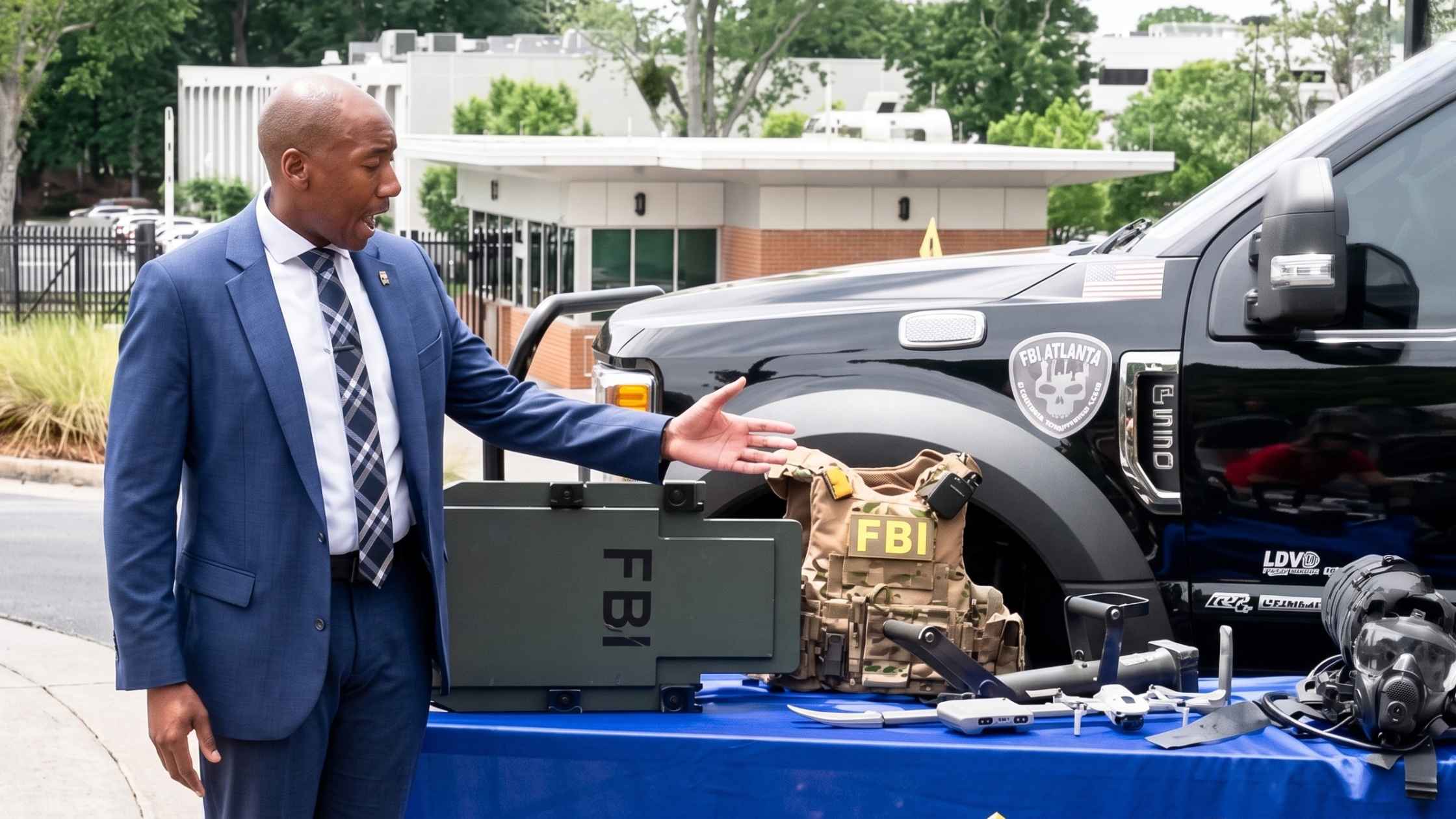
So here are a few tools that we'll be using for FIFA. These are tools that we use on a regular basis, but we'll of course be bringing these out for the FIFA match. We have shields and obviously protective gear for our agents.
(39:50)
In addition to that, we have reaching equipment. We have [inaudible 00:39:53] gear that we can use to-
(39:55)
... and then this vehicle is our evidence response team vehicle, our ERT vehicle. This vehicle is used to deploy to crime scenes to collect evidence and to support investigations with our local partners.
Speaker 8 (40:34):
[inaudible 00:40:34] drone. The drone [inaudible 00:40:36]?
Aaron (40:36):
This particular drone?
Speaker 8 (40:37):
Just overall about drones.
Aaron (40:38):
Okay. So again, this is a no drone zone and so we will be utilizing our drones to provide an overview of the space. We'll also be using these drones to ensure that the [inaudible 00:40:52] remains safe and secure and help us with responding to incidents that might arise.
Speaker 9 (41:04):
You've got different types of drones here. Do they have different capabilities? Small ones versus huge ones?
Aaron (41:10):
Generally it's about deployability. The large drone obviously has a longer battery life, things like that. It could stay on station for a longer period of time. The smaller drone is more portable. We could get it somewhere quicker when needed.
Speaker 7 (41:28):
All right. I think we're good. Thank you.
Aaron (41:29):
Thank you all.
Speaker 5 (41:29):
Thank you.