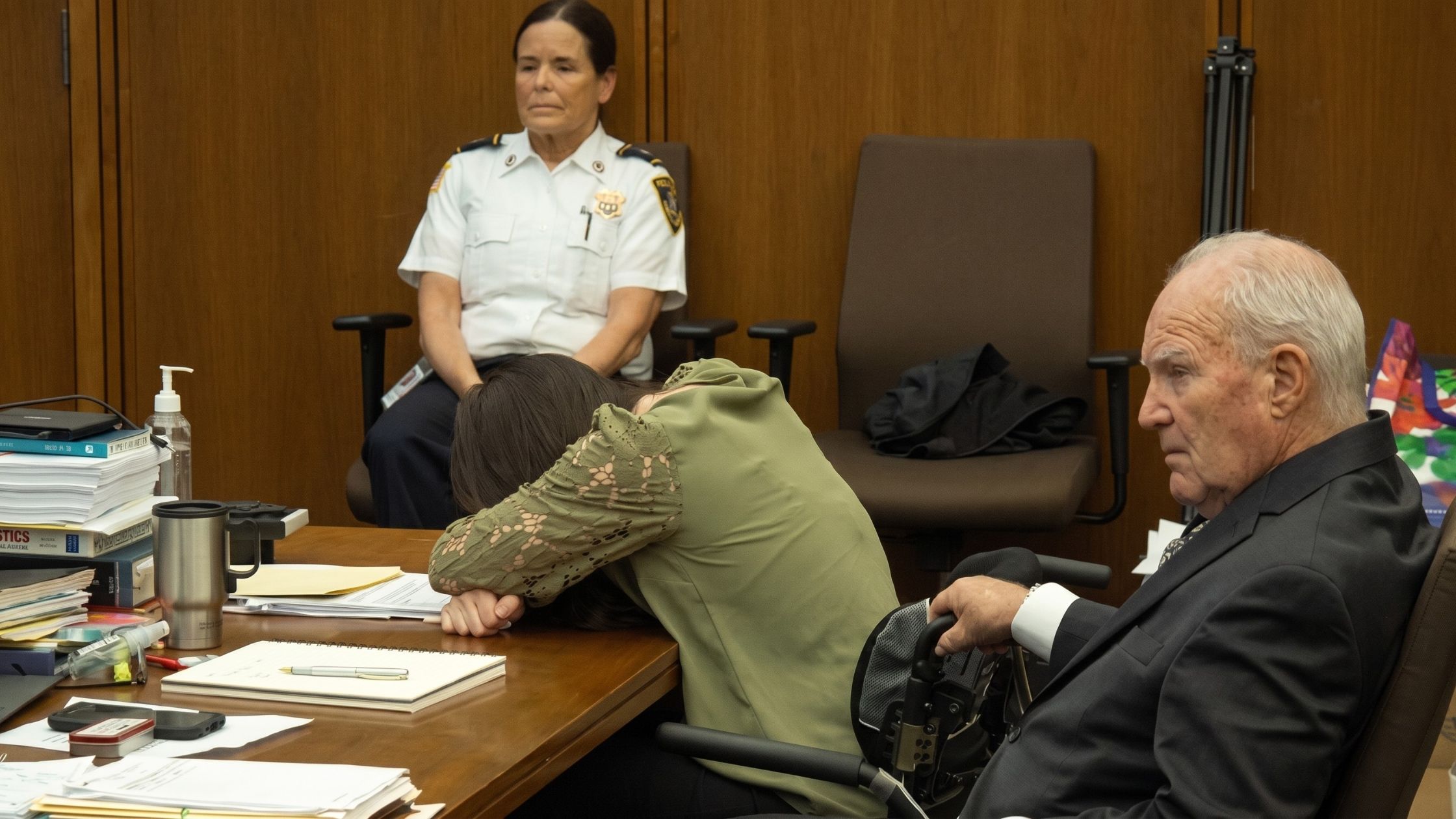
Speaker 1 (00:00):
This court is now in session. Please be seated.
Madam Clerk (00:03):
Good morning, Your Honor. May I proceed?
Judge (00:04):
Yes, please.
Madam Clerk (00:05):
Your Honor, before the court, we have the matter of Commonwealth versus Lindsay Clancy. Ms. Clancy is present. She is represented by attorney Kevin Reddington, and the Commonwealth is represented by Assistant District Attorney Jennifer Sprague and Assistant District Attorney Shannon Buckingham.
Judge (00:17):
All right. Well, good morning everyone. And good morning, counsel.
Mr. Reddington (00:21):
Morning.
Judge (00:21):
Good morning, Ms. Clancy.
Ms. Clancy (00:22):
Morning, Your Honor.
Judge (00:23):
All right. So before we get going, let me talk to counsel about today's schedule and kind of where we go. So if I could see everybody at sidebar, please.
(00:31)
So are we set for the jury at this point?
Ms. Buckingham (00:31):
Yes. Do you still have the driver in the DVD?
Judge (00:31):
Yeah.
Ms. Buckingham (00:31):
It might be that.
Judge (00:31):
I don't think I made that statement.
Speaker 2 (00:31):
Court, all rise. Jury is entering.
Speaker 1 (01:43):
Here ye, all persons having anything to do before the Honorable William Sullivan, Justice of the Superior Court, now sitting in Plymouth within and for the Commonwealth. Your Honor, give your attendance and you shall be heard. God save the Commonwealth of Massachusetts. This court is now in session. Please be seated.
Madam Clerk (02:00):
Good morning, Your Honor. May I proceed?
Judge (02:03):
Yes, please.
Madam Clerk (02:03):
Your Honor, before the court today, we have the continuation of the jury trial in the matter of Commonwealth versus Lindsay Clancy. Ms. Clancy is present. She is represented by attorney Kevin Reddington. The Commonwealth is represented by Assistant District Attorney Jennifer Sprague and Assistant District Attorney Shannon Buckingham.
Judge (02:17):
All right. Well, thank you, Madam Clerk. Good morning, everyone. What I'm going to do, as you know, I'm going to ask you those questions to make sure everybody was able to follow my instructions. And then at that point, we'll talk a little bit about today's schedule. All right? So we'll get to the questions. First question, has any member of the jury read, seen, heard, or overheard anything from any source about any aspect of this case that would affect your ability to be fair and impartial?
Speaker 3 (02:48):
No.
Judge (02:48):
All right. Last question. Is there any other serious matter or concern bearing on your service as a juror in this case that anybody needs to bring to my attention? All right, great. Thank you for following those instructions. Today, we're going to continue with the Commonwealth's presentation of evidence. The anticipation is that we will go probably similar to we had the last couple of days, into the afternoon.
(03:13)
All right? And then after that, before I send you home, I'll talk again with counsel in regards to the schedule for the rest of the week and kind of where we are. All right. So when you leave here today, you probably have a little bit better idea as the schedule for the rest of the week and into next week. All right. And so with that, I think we'll return to the Commonwealth's case. Attorney Buckingham?
Ms. Buckingham (03:41):
Your Honor, Commonwealth would call Daniel Lawler to the stand, please.
Speaker 2 (03:44):
Good morning, sir. One sec. Stop right there. Raise your right hand for the clerk.
Madam Clerk (04:02):
Good morning. Do you solemnly swear that the testimony and the evidence you shall give to the court and the jury [inaudible 00:04:08] shall be the truth, the whole truth, and nothing but the truth, so help you God?
Dan Lawler (04:09):
I do.
Madam Clerk (04:09):
Thank you, sir. You may have a seat.
Speaker 2 (04:13):
Watch your step.
Judge (04:16):
Hi, good morning, sir.
Dan Lawler (04:16):
Good morning, Your Honor.
Judge (04:22):
All right, counsel.
Ms. Buckingham (04:23):
Thank you. Good morning.
Dan Lawler (04:26):
Good morning, ma'am.
Ms. Buckingham (04:27):
Could you please tell the jurors your first and last name?
Dan Lawler (04:29):
Yes. First name's Dan. Last name's Lawler.
Ms. Buckingham (04:32):
And where are you employed?
Dan Lawler (04:34):
With the Massachusetts State Police.
Ms. Buckingham (04:36):
What's your rank with the state police?
Dan Lawler (04:37):
Sergeant.
Ms. Buckingham (04:38):
And how long have you worked for the state police?
Dan Lawler (04:40):
Nine years.
Ms. Buckingham (04:43):
At some point, did you work in an assignment with the Plymouth County District Attorney's Office as part of the State Police Detectives Unit?
Dan Lawler (04:51):
Yes.
Ms. Buckingham (04:51):
And how long were you with the Plymouth County DA's Office State Police Detectives Unit?
Dan Lawler (04:56):
From March 2021 until June 2025.
Ms. Buckingham (05:01):
I'm going to draw your attention back to January of 2023. Do you recall going out or responding to an incident that occurred in Duxbury?
Dan Lawler (05:13):
Yes.
Ms. Buckingham (05:14):
And the incident occurred at 47 Summer Street in Duxbury?
Dan Lawler (05:19):
Yes.
Ms. Buckingham (05:20):
And you're aware that that involved a death investigation, where two children had been declared deceased, and at the time there was another child that was being treated at the hospital?
Dan Lawler (05:30):
Yes.
Ms. Buckingham (05:34):
What were you asked to do or what was the first thing you did in relation to this investigation?
Dan Lawler (05:40):
I responded to the South Shore Hospital in Weymouth.
Ms. Buckingham (05:43):
And why did you go there?
Dan Lawler (05:45):
I was advised by my supervisor to respond.
Ms. Buckingham (05:47):
Okay. And were you aware that a woman by the name of Lindsay Clancy had been transported there, to South Shore Hospital?
Dan Lawler (05:53):
Yes.
Ms. Buckingham (05:55):
And when you arrived at South Shore Hospital, was a Duxbury police detective already on scene?
Dan Lawler (06:00):
Yes.
Ms. Buckingham (06:02):
And do you recall who that was?
Dan Lawler (06:03):
Detective Matthew.
Ms. Buckingham (06:06):
Now, when you, meaning the State Police Detectives Unit, are involved in an investigation, is it common that you would utilize the services of the crime scene services section of the state police?
Dan Lawler (06:19):
Yes.
Ms. Buckingham (06:20):
And the Crime Scene Response Unit?
Dan Lawler (06:23):
Yes.
Ms. Buckingham (06:23):
And in this case, did members of those two units respond as well to the South Shore Hospital at the time that you were there?
Dan Lawler (06:30):
Yes.
Ms. Buckingham (06:31):
Do you recall who, from the crime scene services and the response unit, responded?
Dan Lawler (06:37):
[inaudible 00:06:37] Maureen Hartnett and Trooper Rostauffers.
Ms. Buckingham (06:42):
Did you have the occasion to observe Lindsay Clancy at the South Shore Hospital?
Dan Lawler (06:46):
Yes.
Ms. Buckingham (06:46):
And she was in the emergency department, correct?
Dan Lawler (06:50):
Correct.
Ms. Buckingham (06:50):
And was she able to speak or was she intubated?
Dan Lawler (06:56):
She was unable to speak.
Ms. Buckingham (06:58):
Did you observe her to have medical equipment and being treated while you were there?
Dan Lawler (07:02):
She had medical equipment attached to her person, yes.
Ms. Buckingham (07:05):
And did you observe her to have injuries, visible injuries?
Dan Lawler (07:09):
Yes.
Ms. Buckingham (07:11):
At the South Shore Hospital, in addition to speaking to Detective Maffio and assessing Lindsay Clancy, did you do or serve anything on the hospital themselves?
Dan Lawler (07:23):
Yes.
Ms. Buckingham (07:23):
What did you do?
Dan Lawler (07:24):
A preservation notice.
Ms. Buckingham (07:26):
And what is a preservation notice?
Dan Lawler (07:27):
The preservation notice is to preserve the defendant's urine and blood.
Ms. Buckingham (07:31):
And you provide that to staff at the hospital to ensure that the blood is saved unless and until a warrant is obtained for that material?
Dan Lawler (07:40):
Correct.
Ms. Buckingham (07:42):
And in addition to serving the preservation order, did you collect some items that were removed from medical staff, that were on Lindsay Clancy, the defendant?
Dan Lawler (07:52):
Yes.
Ms. Buckingham (07:53):
What did you collect or what did they provide you?
Dan Lawler (07:56):
It was her clothing, and a wedding ring, and wedding band.
Ms. Buckingham (08:14):
If I may approach the witness?
Judge (08:15):
You may.
Mr. Reddington (08:24):
Well, she's putting her gloves on. I have no objection to any of this, judge.
Judge (08:27):
Okay. All right.
Ms. Buckingham (08:34):
Sergeant Lawler, as far as the items collected, when they're received from the hospital staff, what do you guys do with them?
Dan Lawler (08:43):
So it originally went to Detective Maffio from Duxbury PD. Then it went to me and then it was documented by Trooper Stauffers. And then some of it will go to the office, or it will go out to the crime lab. In this case, went to the crime lab.
Ms. Buckingham (09:01):
Okay. But as the state police trooper on scene, the investigator on scene, you at some point retain custody of the item?
Dan Lawler (09:10):
Correct.
Ms. Buckingham (09:10):
And I'm just showing you a paper bag. Is that familiar to you?
Dan Lawler (09:14):
Yes.
Ms. Buckingham (09:14):
And is this the bags that generally the detective's unit or crime scene uses to put particular pieces of evidence inside of it?
Dan Lawler (09:23):
Yes.
Ms. Buckingham (09:24):
Since I just struggled to put the gloves on, I'm just going to show you the item, if that's okay.
(09:42)
So I'm showing you one item. Is that familiar to you?
Dan Lawler (09:45):
Yes.
Ms. Buckingham (09:45):
What do you know this item to be?
Dan Lawler (09:48):
A shirt.
Ms. Buckingham (09:51):
Is it a piece of clothing that you obtained from the hospital?
Dan Lawler (09:53):
Yes.
Ms. Buckingham (09:54):
Does it appear to be a woman's tank top?
Dan Lawler (09:56):
Yes.
Ms. Buckingham (09:56):
Okay. And are you able to observe some staining on the front, looking close?
Dan Lawler (10:03):
Yes.
Ms. Buckingham (10:04):
And again, it's cut down the middle.
Dan Lawler (10:06):
Correct.
Ms. Buckingham (10:07):
This is how it was received from the hospital?
Dan Lawler (10:14):
Yes.
Ms. Buckingham (10:14):
I would move to admit the tank top as the next exhibit.
Judge (10:14):
All right. That may be admitted.
Madam Clerk (10:14):
Exhibit 223.
Judge (10:25):
Thank you.
Ms. Buckingham (10:29):
I'm showing you another item. Is that familiar to you?
Dan Lawler (10:33):
Yes.
Ms. Buckingham (10:34):
And what are these?
Dan Lawler (10:35):
Jeans.
Ms. Buckingham (10:37):
And these were also cut off the defendant and received by the medical staff at South Shore Hospital?
Dan Lawler (10:42):
Yes.
Ms. Buckingham (10:43):
And on these jeans, do you see a little bit of staining on the front?
Dan Lawler (10:49):
Yes.
Ms. Buckingham (10:52):
I would move to admit these as the next exhibit.
Judge (10:54):
That may be admitted.
Madam Clerk (10:59):
Exhibit 224.
Judge (11:00):
Thank you.
Ms. Buckingham (11:07):
Just showing one more item. Is that familiar to you?
Dan Lawler (11:12):
Yes.
Ms. Buckingham (11:13):
Appears to be a woman's bra, correct?
Dan Lawler (11:15):
Correct.
Ms. Buckingham (11:15):
Cut down the middle?
Dan Lawler (11:17):
Yes.
Ms. Buckingham (11:19):
And it has some staining in the front, in the middle where the cuts are?
Dan Lawler (11:22):
Correct.
Ms. Buckingham (11:22):
And is this an item that was collected, that was on Lindsay Clancy's body on January 24th, 2023?
Dan Lawler (11:29):
Yes.
Ms. Buckingham (11:30):
Move to admit this as the next exhibit.
Judge (11:33):
It may be admitted.
Madam Clerk (11:33):
Exhibit 225.
Judge (11:37):
Thank you.
Ms. Buckingham (11:43):
You indicated there was also some rings that were collected, correct?
Dan Lawler (11:48):
Correct.
Ms. Buckingham (11:49):
And eventually these items were then taken by Forensic Scientist Heartnet, and eventually they get returned to the State Police Detectives Unit, in your experience. Is that fair to say?
Dan Lawler (12:02):
Fair to say.
Ms. Buckingham (12:05):
Now, in addition to going to the South Shore Hospital on January 24th, 2023, did you go to any other hospitals?
Dan Lawler (12:13):
Yes.
Ms. Buckingham (12:13):
Which hospital did you go to?
Dan Lawler (12:14):
Boston Children's Hospital.
Ms. Buckingham (12:16):
And why did you go there?
Dan Lawler (12:18):
I was advised to go there by my supervisor.
Ms. Buckingham (12:21):
Okay. And did you learn that one of the children, Callan Clancy, had been transported to the Boston Children's Hospital?
Dan Lawler (12:26):
Yes.
Ms. Buckingham (12:27):
And were you there to just obtain what his current status was at that time?
Dan Lawler (12:31):
Yes.
Ms. Buckingham (12:32):
And the time that you were there at the Boston Children's on January 24th, fair to say he was still alive, but noted to be in critical condition?
Dan Lawler (12:39):
Yes.
Ms. Buckingham (12:42):
Now, in the early morning hours of January 25th of 2023, were you aware that a search warrant was obtained for the home of 47 Summer Street in Duxbury?
Dan Lawler (12:52):
Yes.
Ms. Buckingham (12:53):
And in your time with the State Police Detectives Unit and during that time in January of 2023, how did you guys approach the execution of a search warrant?
Dan Lawler (13:03):
So the house would've been frozen pending the search warrant being signed. Once it's signed, we begin the execution and crime scene would document the residence inside and outside before we would go in.
Ms. Buckingham (13:16):
Okay. So when crime scene goes in and they document, you're familiar they use photographs and video, right?
Dan Lawler (13:24):
Correct.
Ms. Buckingham (13:25):
And once they've gone through and documented the scene as it was secured, do you, as part of the detectives unit team, then go in the house to begin search?
Dan Lawler (13:34):
Yes.
Ms. Buckingham (13:34):
And fair to say there are a lot of hands on deck during something like this?
Dan Lawler (13:40):
Correct.
Ms. Buckingham (13:40):
And in this instance, the detective's unit was searching the entire home at 47 Summer Street, including three floors, basement, first floor, second floor, as well as any vehicles that were on the property?
Dan Lawler (13:54):
Correct.
Ms. Buckingham (13:55):
And in addition to people or troopers with the detectives unit, were there other local law enforcement also assisting?
Dan Lawler (14:04):
Yes.
Ms. Buckingham (14:05):
And what was your role that night or that morning in the execution of the warrant?
Dan Lawler (14:11):
I was the evidence officer.
Ms. Buckingham (14:12):
And what does that mean?
Dan Lawler (14:13):
I document evidence that is located by investigators during the search warrant.
Ms. Buckingham (14:17):
And so, at that time period, when you're executing a search warrant and searching a place like a home, is the information that you know at that point what guides the search?
Dan Lawler (14:33):
Yes.
Ms. Buckingham (14:34):
So you don't know what you're looking for unless you know what happened, right?
Dan Lawler (14:38):
Correct.
Ms. Buckingham (14:39):
So in this circumstance, fair to say the state police had limited information about what had actually transpired in that house?
Dan Lawler (14:46):
Correct.
Ms. Buckingham (14:48):
But each and every room was searched to your knowledge?
Dan Lawler (14:51):
To my knowledge, yes.
Ms. Buckingham (14:52):
And your role was just to document items that were going to be collected and returned to the State Police Detectives Unit?
Dan Lawler (15:01):
To document items that would be collected and needed to go back to the State Police Detectives Unit or to the crime lab.
Ms. Buckingham (15:07):
Okay. And fair to say when the crime lab takes items back to the lab, they have an entirely different process on how to monitor, track them and inventory the items, correct?
Dan Lawler (15:17):
Correct.
Ms. Buckingham (15:20):
So in this particular warrant of execution, did you engage in the search?
Dan Lawler (15:28):
Yes.
Ms. Buckingham (15:29):
And you said you documented what other members of the group found and located where they located it, correct?
Dan Lawler (15:36):
Correct.
Ms. Buckingham (15:37):
And so you, as the evidence officer, were aware that Trooper Rabbit located some prescription pill bottles in the kitchen that morning, correct?
Dan Lawler (15:47):
Correct.
Ms. Buckingham (15:49):
And so, as the evidence officer, were you responsible for kind of keeping custody of those bottles?
Dan Lawler (15:56):
Correct.
Ms. Buckingham (15:57):
At some later point, after those bottles were photographed and collected, did you inventory those bottles?
Dan Lawler (16:04):
Yes.
Ms. Buckingham (16:10):
I'm going to just show you what's been marked as Exhibit 155, if I may approach the witness.
Judge (16:14):
You may.
Ms. Buckingham (16:21):
So Sergeant, just showing you this bag here. It's already been marked Exhibit 155. I'm going to show you four pill bottles.
(16:27)
And you could take a look at them. Do they look familiar to you?
Dan Lawler (16:45):
Yes.
Ms. Buckingham (16:45):
Okay. So the first one I'm looking at is labeled Trazodone. And as far as how you inventory these, what do you do when you inventory them?
Dan Lawler (17:01):
Just count them.
Ms. Buckingham (17:02):
Okay. So do you also review the information on the label as to what should be in the bottle or what the original prescription was?
Dan Lawler (17:09):
Yes.
Ms. Buckingham (17:09):
So as far as the Trazodone, it says filled on January 12th, 2023 with 30 in it. And so you counted to determine how many were left, right?
Dan Lawler (17:21):
Correct.
Ms. Buckingham (17:22):
And so fair to say there were 20 remaining in this bottle when you inventoried it?
Dan Lawler (17:26):
Correct.
Ms. Buckingham (17:28):
The diazepam five milligrams, date filled January 9th of 2023, with 14 as the quantity, you counted what was in this bottle?
Dan Lawler (17:37):
Correct.
Ms. Buckingham (17:38):
And there's two and a half left in there, correct?
Dan Lawler (17:41):
Correct.
Ms. Buckingham (17:42):
And diazepam two milligrams, date filled January 16th, 2023. It has three listed on there, right? In type?
Dan Lawler (17:54):
Yes.
Ms. Buckingham (17:54):
But there appears to be a pink mark through it.
Dan Lawler (17:56):
Correct.
Ms. Buckingham (17:57):
Did you put that pink mark on there?
Dan Lawler (17:58):
No.
Ms. Buckingham (17:59):
Would that have been there when the bottle was seized?
Dan Lawler (18:01):
It could have been.
Ms. Buckingham (18:02):
Okay. But regardless of how many it said were the quantity, you counted how many were actually in this bottle?
Dan Lawler (18:09):
Correct.
Ms. Buckingham (18:09):
And fair to say there were nine and a half remaining in that bottle?
Dan Lawler (18:12):
Correct.
Ms. Buckingham (18:14):
And the last one, amitriptyline, 10 milligrams. It says date filled January 16th, 2023. Quantity: 30. And you counted how many were left in this bottle as well?
Dan Lawler (18:25):
Correct.
Ms. Buckingham (18:25):
And there were 22 in this bottle?
Dan Lawler (18:27):
Correct.
Ms. Buckingham (18:28):
And you documented that as this was put into evidence in the state police?
Dan Lawler (18:34):
Yes.
Ms. Buckingham (18:57):
Did you search in the upstairs master bedroom of the house during the search warrant?
Dan Lawler (19:04):
Yes, I assisted with the search.
Ms. Buckingham (19:05):
Did you locate anything that you documented or collected to take back to the state police?
Dan Lawler (19:11):
Yes.
Ms. Buckingham (19:12):
In the master bedroom?
Dan Lawler (19:14):
Yes.
Ms. Buckingham (19:15):
Okay. What did you locate?
Dan Lawler (19:16):
I believe it was a baby monitor and a Google Nest camera.
Ms. Buckingham (19:22):
Okay. Did you observe the room, the master bedroom?
Dan Lawler (19:28):
Yes.
Ms. Buckingham (19:28):
And did you search in a nightstand that was next to the bed?
Dan Lawler (19:32):
I don't recall searching on a nightstand next to the bed.
Ms. Buckingham (19:35):
Were there other investigators that were also in the room, searching other areas of the bedroom?
Dan Lawler (19:39):
Yes.
Ms. Buckingham (19:41):
And as far as any additional work you did on this particular investigation, again, fair to say the detectives unit works as a team and divides up work for follow up?
Dan Lawler (19:53):
Correct.
Ms. Buckingham (19:54):
And you participated in some follow-up investigation by speaking to some witnesses, correct?
Dan Lawler (20:00):
Correct.
Ms. Buckingham (20:01):
And at some point you were also asked to go to the Brigham and Women's Hospital, where the defendant was following the Sheriff's Department, keeping watch of her?
Dan Lawler (20:13):
Correct.
Ms. Buckingham (20:14):
Do you recall what day you went there?
Dan Lawler (20:16):
I don't recall the exact date.
Ms. Buckingham (20:18):
Okay. When you went to the Brigham and Women's Hospital, was she in her own room or was she in an open area?
Dan Lawler (20:26):
She was in her own room.
Ms. Buckingham (20:29):
When you were there on watch, did you go into the room or were you outside the room?
Dan Lawler (20:34):
Outside the room.
Ms. Buckingham (20:36):
And as far as your memory of whether anyone else besides medical staff went in there, at any point when you were there at the Brigham Hospital, did you observe another individual come in to visit with her or meet with her?
Dan Lawler (20:49):
Yes.
Ms. Buckingham (20:50):
And were you advised that that person was coming in?
Dan Lawler (20:53):
Yes.
Ms. Buckingham (20:54):
And were you advised that that person was allowed in with a court order?
Dan Lawler (21:01):
Yes.
Ms. Buckingham (21:01):
Okay. When the person went in, did you know if it was an attorney, a doctor, somebody else?
Dan Lawler (21:07):
It was not an attorney. It wasn't a doctor. It was, I believe, a psychiatrist.
Ms. Buckingham (21:12):
And when that person went into the room, did you go in the room as well?
Dan Lawler (21:16):
No.
Ms. Buckingham (21:17):
And where did you stay?
Dan Lawler (21:19):
Outside the room.
Ms. Buckingham (21:20):
And when this man went into the room, did he leave the door open or close the door, if you recall?
Dan Lawler (21:24):
I believe it was closed.
Ms. Buckingham (21:28):
And when he came out, did he speak with you?
Dan Lawler (21:30):
I don't recall.
Ms. Buckingham (21:32):
Okay. But as far as you knew at that time period, that person was permitted to be in there and could close the door?
Dan Lawler (21:40):
Correct.
Ms. Buckingham (21:44):
And you don't know what was said or what was done in that room?
Dan Lawler (21:46):
No. No.
Ms. Buckingham (21:52):
Thank you.
Judge (21:54):
Mr. Reddington.
Mr. Reddington (21:55):
So your position was as a sergeant for the state police on these dates that you testified to?
Dan Lawler (22:04):
No, sir. At the time I was a trooper.
Mr. Reddington (22:06):
Trooper?
Dan Lawler (22:07):
Yes, sir.
Mr. Reddington (22:07):
Were you assigned to the district attorney's office?
Dan Lawler (22:09):
Yes, sir.
Mr. Reddington (22:10):
It'd be the Plymouth County DA's office, meaning these prosecutors here, right?
Dan Lawler (22:13):
Correct, sir.
Mr. Reddington (22:14):
Actually, you have an office in their office, right?
Dan Lawler (22:16):
Correct, sir.
Mr. Reddington (22:18):
You don't have to call me, sir. So the first time you got involved with this case was on the evening of, was it the 24th or 23rd?
Dan Lawler (22:29):
Tuesday, I think it was the 24th.
Mr. Reddington (22:34):
Okay. And do you recall what time it was that you went there?
Dan Lawler (22:37):
To the South Shore Hospital?
Mr. Reddington (22:39):
Yes. I'm sorry.
Dan Lawler (22:41):
Approximately 7:30 PM.
Mr. Reddington (22:44):
Now, at that point, you had known obviously that this was a major investigation involving the death of two children and one serious injury to another child. Is that correct?
Dan Lawler (22:58):
Correct.
Mr. Reddington (22:59):
The media was absolutely insane, all over the location of the house and in the hospitals and everywhere. Isn't that right?
Dan Lawler (23:07):
I recall media at the house. I'm not sure about the hospitals though.
Mr. Reddington (23:11):
Okay. It was a fairly horrific and largely attended to, if you will, event. Is that correct?
Dan Lawler (23:20):
Yes.
Mr. Reddington (23:21):
And Lindsay was, when you went to the South Shore Hospital, that's where you saw her before she was transferred to the Brigham and Women's, right?
Dan Lawler (23:30):
Yes.
Mr. Reddington (23:31):
When you went in to see her at the South Shore Hospital, she was in the emergency room, right?
Dan Lawler (23:36):
Yes.
Mr. Reddington (23:37):
Would you agree with me that she was pretty well. She had the intubation tube in her mouth, she had tape on her face, she had her arms all taped up and wires, and tubes, and everything else, right?
Dan Lawler (23:49):
Yes.
Mr. Reddington (23:49):
And it was a very confusing and quite frankly shocking sight to walk into that room and see her there in that condition, right?
Dan Lawler (23:57):
Yes.
Mr. Reddington (23:58):
And you, about your duty, collected clothing in her wedding band, correct?
Dan Lawler (24:02):
Yes.
Mr. Reddington (24:03):
And you went through all that with the items you seized and you introduced those into evidence and noted what the government said appears to be stains, but it was blood on her clothing. Is that right?
Dan Lawler (24:14):
I would say-
Mr. Reddington (24:14):
[inaudible 00:24:15].
Dan Lawler (24:15):
Yeah.
Mr. Reddington (24:15):
In your experience?
Dan Lawler (24:15):
Yes.
Mr. Reddington (24:19):
Okay. Any shoes? Did she have any shoes, sneakers, slippers, anything like that?
Dan Lawler (24:23):
I don't recall shoes. I think two black socks. I don't recall shoes.
Mr. Reddington (24:27):
Right. If there were shoes on her person or brought to the hospital, the odds are that when they saved the clothing, they would've saved the shoes as well, right?
Dan Lawler (24:37):
Yes.
Mr. Reddington (24:39):
So you took the clothing and then you went to the Boston Children's Hospital, right?
Dan Lawler (24:43):
Yes.
Mr. Reddington (24:44):
And after you left the Boston Children's Hospital, you went back to the house and then assisted in the search of the property with a search warrant?
Dan Lawler (24:53):
Yes.
Mr. Reddington (24:54):
And were you the lead investigator at that point or were you one of the guys just searching?
Dan Lawler (25:00):
I was not the lead investigator.
Mr. Reddington (25:02):
But there was a court order, search warrant, right?
Dan Lawler (25:05):
Yes.
Mr. Reddington (25:06):
And you, meaning collectively you, knew that you had a search warrant that authorized the search for a number of items, including medications, or pills, or pill bottles, right?
Dan Lawler (25:16):
Yes.
Mr. Reddington (25:18):
I don't have to grab this and ask if you saw this. You never did see that, did you?
Dan Lawler (25:22):
I did not recall seeing that, sir.
Mr. Reddington (25:24):
You don't know what, if anything, was inside that item, right?
Dan Lawler (25:27):
I don't know.
Mr. Reddington (25:29):
And counsel asked you whether or not it's a collaborative effort on the part of the detective units and that you all collaborate and work together. Can you explain that? Do you report to each other? Do you keep each other advised as to what you get for evidence?
Dan Lawler (25:45):
Yep. So when we go into a house, we're not familiar with the layout. We'll walk the house and figure out where bedrooms are located. And then essentially we kind of just break up into teams, if you will, and search the residence as evidence is located. And at that time, as the evidence officer, I would be alerted that, hey, there's evidence here. We're going to document and collect it.
Mr. Reddington (26:13):
Okay. And you videotape the scene and you take photographs of the areas of different rooms, right?
Dan Lawler (26:17):
I do not, but crime scene does.
Mr. Reddington (26:20):
But you were in the house and you were able to observe the rooms, you could see all sorts of wall hangings and paintings and fingerprints and hand prints and all that stuff on the wall, right?
Dan Lawler (26:28):
Yes.
Mr. Reddington (26:29):
Downstairs, you saw in the basement or the finished basement, that there was an area that was an office or appeared to be an office. Is that correct?
Dan Lawler (26:38):
I don't recall the exact layout of the basement.
Mr. Reddington (26:41):
Do you remember that items were seized from the basement, like a Mac Pro laptop, something like I have right here, there were two of them that were seized. Do you remember that?
Dan Lawler (26:51):
Yes.
Mr. Reddington (26:52):
And from your investigation, you're aware that those would have been Pat Clancy's laptops, his business and personal laptop, correct?
Dan Lawler (27:01):
At the time, I'm not sure who the laptops belonged to, but I know they were collected.
Mr. Reddington (27:05):
Okay. And how about Lindsay Clancy's, her cell phone? Was that seized, if you know?
Dan Lawler (27:11):
I believe that was seized from the master bedroom.
Mr. Reddington (27:13):
From the master bedroom. And do you remember, was it located on the bed?
Dan Lawler (27:19):
There was a phone located on the bed. I think there was another phone located in a dresser drawer. I'm not sure which phone was what though.
Mr. Reddington (27:25):
All right. So both of those phones, regardless which one was what, did either one of them have blood on them?
Dan Lawler (27:31):
I don't recall.
Mr. Reddington (27:32):
But if you guys were seizing the items in the property, such as the cell phone that had blood on it, in your experience, you probably would've remembered that, right?
Dan Lawler (27:40):
Correct.
Mr. Reddington (27:41):
And you don't remember that?
Dan Lawler (27:43):
I don't.
Mr. Reddington (27:43):
Okay. You did notice a lot of blood on the floor and on the walls, on the mirror, and the window ledge in that area. Is that fair?
Dan Lawler (27:52):
I recall blood on the floor by the mirror and then blood on the floor going towards that back right window.
Mr. Reddington (27:58):
Okay. At no time did you ever come across or discover a, what do you call it? Apple Watch, right?
Dan Lawler (28:05):
No, sir.
Mr. Reddington (28:07):
And after you all concluded your search of the home, and how long did that take? A couple of hours?
Dan Lawler (28:18):
Probably. I don't recall the exact time we concluded.
Mr. Reddington (28:22):
Okay. The next thing you did was to go to the Brigham and Women's Hospital. Is that right?
Dan Lawler (28:27):
After the search warrant?
Mr. Reddington (28:29):
Yeah. She had asked you a question about Brigham and Women's. I mean, did you do something else in between? I don't know.
Dan Lawler (28:35):
I don't recall exactly what I did after the search warrant, but at some point I did go to the Brigham.
Mr. Reddington (28:41):
Okay. Can you tell us when you went to the Brigham?
Dan Lawler (28:47):
I don't recall the exact date. I was-
Mr. Reddington (28:49):
All right. So whatever date you went to the Brigham, you went there for what purpose?
Dan Lawler (28:56):
... She was transferred to that facility and it was to maintain custody of her at that point.
Mr. Reddington (29:01):
So you were going to maintain custody of her?
Dan Lawler (29:05):
So the sheriffs, I believed, had custody of her. And then our unit was tasked to facilitate, providing coverage over the next couple of days.
Mr. Reddington (29:17):
Right. And she was actually in the bed with all, again, tubes and all sorts of things coming out of her body when you saw her, right?
Dan Lawler (29:25):
Yeah, she was in the hospital bed.
Mr. Reddington (29:27):
And she was in an emergency room. It was a little small room with a lot of machines in it, that took up a lot of space, right?
Dan Lawler (29:33):
I don't think she was in the emergency room. She was in one of the floors.
Mr. Reddington (29:37):
One of the floor rooms, but it was an intensive care unit, right?
Dan Lawler (29:41):
I believe it could have been the surgical intensive care unit.
Mr. Reddington (29:43):
Surgical intensive care.
Dan Lawler (29:44):
Yeah.
Mr. Reddington (29:45):
And when you went there to facilitate custody, who were you facilitating custody for? The DA's office?
Dan Lawler (29:54):
Yes, essentially.
Mr. Reddington (29:58):
Okay. Do you remember how many day days, was it like two days, a week, two weeks after the incident that brought you to the house in Duxbury? Do you recall how long it was before you went to the hospital to maintain custody, facilitate?
Dan Lawler (30:13):
I don't recall how many days, maybe two or three. I'm not sure the exact count.
Mr. Reddington (30:18):
All right. So she had been transferred out of South Shore Hospital. She was transferred to Brigham and Women's Hospital. You went to Brigham and Women's Hospital. I imagine you had to go through security to get in there, right? Well, [inaudible 00:30:30], right?
Dan Lawler (30:32):
At some point, yeah, we were probably assisted with security to get up there.
Mr. Reddington (30:36):
Right. Well, you know that nobody could get access to Lindsay Clancy in that hospital, and I mean nobody, right?
Dan Lawler (30:41):
Correct.
Mr. Reddington (30:43):
And this went on for day, after day, after day, to your knowledge, facilitating, right?
Dan Lawler (30:47):
Correct.
Mr. Reddington (30:48):
Her parents couldn't get in to see her, correct?
Dan Lawler (30:50):
I don't believe so.
Mr. Reddington (30:52):
She had an attorney that had difficulty, not me, but another guy that had difficulty getting in to see her. Isn't that right?
Dan Lawler (30:58):
I'm not aware of that difficulty.
Mr. Reddington (31:00):
I had to get a court order to get a doctor in there to see her, didn't-
Mr. Reddington (31:00):
I had to get a court order to get a doctor in there to see her, didn't I?
Sergeant Lawlor (31:04):
Yes, it was a court order.
Mr. Reddington (31:06):
And when I got the court order, a doctor came in and met with Lindsay pursuant to that judge's order. And that was Paul Zeisel, correct?
Sergeant Lawlor (31:16):
I believe that's the name. I'm not sure if he was a doctor, but I believe that was the gentleman that came on the court order.
Mr. Reddington (31:22):
Okay. Only because in your direct you said that he was not a doctor, but he was a psychiatrist. So I mean, it's just you knew that he had something to do with head doctor, psychiatrist, psychologist, something like that.
Sergeant Lawlor (31:35):
Correct.
Mr. Reddington (31:35):
Okay. Did he have to clear it with you to get into the room?
Sergeant Lawlor (31:41):
He checked in with myself and the other trooper. We were advised that he was coming, and to let him in on the court order.
Mr. Reddington (31:47):
All right. Now, I wasn't there on that occasion, right?
Sergeant Lawlor (31:49):
No.
Mr. Reddington (31:50):
And when Dr. Zeisel or whoever it was, went into the room to see her, it's your memory that he was allowed to shut the door. Is that correct?
Sergeant Lawlor (31:59):
I believe he shut the door.
Mr. Reddington (32:00):
Now, you were involved in this investigation pretty intensely working with the DA's office, right?
Sergeant Lawlor (32:07):
Correct.
Mr. Reddington (32:08):
Isn't it fair to say that one of the contentions of the district attorneys is that Paul Zeisel, my doctor, that I got a court order to get in to see her, told her to call Pat and tell him that she heard voices?
Ms. Buckingham (32:24):
Objection.
Judge (32:26):
Can I see counsel at the sidebar in regards to this? All right. So members of the jury, like I said to you, I think a couple of weeks ago, sometimes I got to talk to the lawyers for a little bit longer than it takes over here at the sidebar. So this is one of those situations. So I'm going to ask you to go back to the jury room just for a couple of minutes, I think, and then we'll bring you right back in and we'll resume with the testimony. Okay?
Speaker 4 (32:57):
Court, all rise. Good. All folks. On the chairs. Be quiet, please.
Speaker 5 (33:36):
[inaudible 00:33:37] this court's in session. Please be seated.
Judge (33:42):
All right. So counsel, what we're going to do is we'll have... Just so the record's clear, the jury's out of the room at this point. We will just conduct a short voir dire on the issue that we talked about over at sidebar. So I'll allow Mr. Reddington to ask questions at this point and then I'll allow Commonwealth to also ask questions. Go ahead, counsel.
Mr. Reddington (34:09):
Okay. Thank you. So you're in the hospital at Brigham and Women's, correct?
Sergeant Lawlor (34:14):
Yes.
Mr. Reddington (34:15):
And when you're there, with the purpose of obviously with other law officers to enforce the fact that she's in custody, Dr. Zeisel, or a doctor came in pursuant to a court order, right?
Ms. Buckingham (34:31):
Yes.
Mr. Reddington (34:33):
All right. And obviously had been cleared through security and went into the room where Lindsay was laying on the bed, right?
Sergeant Lawlor (34:44):
Yes.
Mr. Reddington (34:46):
You don't know or you don't recall if he closed the door or if he kept the door open or if it was half open. You just don't remember, right?
Ms. Buckingham (34:54):
Yes.
Mr. Reddington (34:55):
Okay. Would you agree with me that in the course of preparing this case for trial, that you have worked and collaborated with the prosecutors, the two district attorneys, correct?
Sergeant Lawlor (35:11):
Yes.
Mr. Reddington (35:12):
And you guys would talk about theories of the case and evidence that they want you to run down perhaps as an investigator or try to obtain or interviews and things of that nature, right?
Ms. Buckingham (35:22):
Yes.
Mr. Reddington (35:23):
And one of the theories that they had indicated to you is that Patrick Clancy had indicated to the investigators and to the grand jury, I believe, that Lindsay called him from the hospital, right?
Sergeant Lawlor (35:38):
I recall that.
Mr. Reddington (35:39):
And that Lindsay used that doctor's cell phone to call him from the hospital, right?
Ms. Buckingham (35:45):
Yes.
Mr. Reddington (35:46):
And they basically had a theory that they wanted to run with that Zeisel told her, Lindsay, to say that she heard voices, right?
Sergeant Lawlor (35:57):
I don't know if it's a theory or not. I just recall that conversation at some point.
Mr. Reddington (36:00):
Okay. So when was the conversation?
Sergeant Lawlor (36:03):
I don't recall exactly when.
Mr. Reddington (36:05):
Do you remember where the conversation was?
Sergeant Lawlor (36:08):
No.
Mr. Reddington (36:09):
Okay.
Sergeant Lawlor (36:10):
I'm assuming at the office. I just don't recall specifically where.
Mr. Reddington (36:12):
And who was it you were talking to?
Sergeant Lawlor (36:18):
Probably could have been one of the troopers in the office working the case.
Mr. Reddington (36:22):
One of the trooper. Is it McKelligan?
Sergeant Lawlor (36:26):
Probably. He's the case officer, so I imagine it probably would've been him, sir.
Mr. Reddington (36:30):
Probably could have been him.
Sergeant Lawlor (36:31):
Yeah.
Mr. Reddington (36:31):
How about any of the prosecutors? You talk to the DAs about that?
Sergeant Lawlor (36:35):
I don't recall specifically speaking to a prosecutor about this.
Mr. Reddington (36:38):
Well, how about not necessarily [inaudible 00:36:41].
Sergeant Lawlor (37:27):
Conversation Lindsay [inaudible 00:37:29]. If the facts are [inaudible 00:37:50] check.
Mr. Reddington (37:53):
Okay. You already said that. I know and I [inaudible 00:37:56]. Right?
Sergeant Lawlor (38:04):
Yes.
Mr. Reddington (38:18):
You [inaudible 00:38:18].
Sergeant Lawlor (38:18):
She had told Patrick on [inaudible 00:38:20] the voices. [inaudible 00:38:50] Logan.
Mr. Reddington (38:48):
[inaudible 00:39:15].
Judge (38:48):
Attorney Buckingham.
Ms. Buckingham (39:53):
Anything about a [inaudible 00:40:04] did you? Had a conversation with the [inaudible 00:40:12]. Anything that you [inaudible 00:40:17] conversation with another trooper [inaudible 00:40:19] testimony today. [inaudible 00:40:25] that incident after [inaudible 00:40:39] husband, do you?
Sergeant Lawlor (40:57):
No.
Ms. Buckingham (41:03):
All you [inaudible 00:40:59] the call was and who he said the call is from and how the call occurred, correct?
Sergeant Lawlor (41:09):
Correct.
Ms. Buckingham (41:12):
Thank you.
Mr. Reddington (41:13):
So if I may, Judge?
Judge (41:14):
Yeah, please.
Mr. Reddington (41:15):
So basically, my contention is that you're obviously up here testifying as honestly as you can. It's pretty apparent, right?
Sergeant Lawlor (41:24):
Yes.
Mr. Reddington (41:25):
And you're very consistent with your oath and you understand that it's important. It might be difficult, but you're trying to explain what your memory is about conversation with the lead investigator, McKelligan, right? I mean, you're trying to tell us what your memory is, right?
Sergeant Lawlor (41:42):
Yes.
Mr. Reddington (41:44):
So your testimony pertains to your conversation with the lead investigator, McKelligan. It's got nothing to do with the fact that you don't recall this or you don't recall that. What you've testified to is for the judge to consider, right?
Sergeant Lawlor (41:57):
Yes.
Mr. Reddington (41:57):
Okay. That's all I have.
Judge (42:01):
All right. All right. Why don't we do this? I'm going to take about a 10-minute break at this point.
Mr. Reddington (42:05):
Okay.
Judge (42:06):
And we'll come back out and we will resume cross-examination.
Mr. Reddington (42:10):
Okay.
Judge (42:10):
Okay.
Speaker 4 (42:12):
Court, all rise. All rise, please.
(42:16)
Court, all rise. Jurors and jury. This court's now in session. Please be seated.
Ms. Buckingham (43:00):
Your Honor, for the purpose of the record [inaudible 00:43:03] Commonwealth versus Lindsay Clancy. All parties are present, including the defendant and including the 18 jurors.
Judge (43:10):
All right. Members of the jury, thanks for your patience. We're able to deal with that issue. And so we're going to return now to the cross-examination. We're still going to take a morning break, as I've told you before. Might just be a little bit affected by the fact that you took that break. We didn't take that break. So with that, we're going to return to the cross-examination.
Mr. Reddington (43:32):
Thank you.
Judge (43:32):
Mr. Reddington.
Mr. Reddington (43:36):
So Sergeant Lawlor, we're at the point where you are assisting, if you will, in the custody of Lindsay at Brigham and Women's Hospital when you observed a doctor enter into that area and ultimately into her room. Is that correct?
Sergeant Lawlor (43:55):
Yes.
Mr. Reddington (43:55):
All right. And the door was either closed or open or halfway, you don't recall, which is understandable, but you just don't remember if it was closed completely or open a little bit, right?
Sergeant Lawlor (44:08):
Correct.
Mr. Reddington (44:08):
But either way, you weren't eavesdropping or trying to hear anything, were you?
Sergeant Lawlor (44:13):
No.
Mr. Reddington (44:14):
And then when the doctor finished talking with Lindsay, at some point, you as investigators were aware that the doctor had allowed her to call her husband and use his cell phone to speak to her husband, correct?
Sergeant Lawlor (44:30):
I later learned that, yes.
Mr. Reddington (44:32):
And you later learned and knew from the investigation that it was fairly recently to that point that the tubes had been removed from her mouth and she was able to at least talk to a degree, and then she talked on the phone, correct?
Sergeant Lawlor (44:46):
Correct.
Mr. Reddington (44:47):
And after that, fair to say that you did not, when I say you, I mean collectively all the police officers investigating for the DA's office, you did not see any reports or anything that would indicate what, if anything, was said between Dr. Zeisel and Lindsay in that room, right?
Sergeant Lawlor (45:07):
Correct.
Mr. Reddington (45:08):
And who is Sergeant, is it McKelligan?
Sergeant Lawlor (45:11):
Sergeant McKelligan. Yes, sir.
Mr. Reddington (45:13):
And Sergeant McKelligan... Joshua?
Sergeant Lawlor (45:15):
Yes.
Mr. Reddington (45:16):
He's the lead investigator in this case. Is that correct?
Sergeant Lawlor (45:18):
Correct.
Mr. Reddington (45:20):
And at the time, he was a sergeant and you were a trooper, right?
Sergeant Lawlor (45:23):
At the time, we were both troopers.
Mr. Reddington (45:24):
Oh, both troopers. Okay. So you both got promoted. And he, as the lead investigator, told you in a conversation, or perhaps more than one, that the government theory is that Dr. Zeisel told Lindsay to say to her husband that she heard voices, right?
Ms. Buckingham (45:47):
Objection. Form of question.
Judge (45:48):
If you could rephrase that.
Mr. Reddington (45:51):
Okay. Did you talk to McKelligan about the theory that Dr. Zeisel is the reason that she told her husband that she heard voices?
Sergeant Lawlor (46:03):
Yes.
Mr. Reddington (46:05):
And do you remember where or when that conversation occurred or how many times that you guys discussed that?
Sergeant Lawlor (46:11):
I believe it would've been at the office. I don't recall exactly when.
Mr. Reddington (46:15):
Okay. And there's no investigator basis for that, that's McKelligan's speculation. Is that correct?
Sergeant Lawlor (46:23):
Correct.
Mr. Reddington (46:25):
When you went there and you observed Lindsay after the doctor left, she's still obviously in the bed because she's paralyzed, right?
Sergeant Lawlor (46:34):
Correct. She was still in the bed.
Mr. Reddington (46:35):
Was she restrained by either soft restraints or handcuffs or whatever? Do you remember, were her hands or her wrists restrained to the bed posts?
Sergeant Lawlor (46:42):
I don't recall specifically restraints.
Mr. Reddington (46:43):
Okay. And you mentioned that the state police were there. That would be people that were obviously working with you, right?
Sergeant Lawlor (46:49):
Correct.
Mr. Reddington (46:50):
And do you remember how many state police were there that you were coordinating or assisting?
Sergeant Lawlor (46:55):
Per shift, there was two of us.
Mr. Reddington (46:57):
Two?
Sergeant Lawlor (46:58):
Yes, sir.
Mr. Reddington (46:58):
Okay. And also, there were sheriffs from the Plymouth County Sheriff's Department that were there, right?
Sergeant Lawlor (47:04):
So we relieved the sheriffs.
Mr. Reddington (47:06):
Okay. And how many sheriffs did you relieve?
Sergeant Lawlor (47:09):
I don't recall exactly. Probably two though.
Mr. Reddington (47:11):
Okay. And how about Duxbury Police? You recall the Duxbury Police being there?
Sergeant Lawlor (47:17):
I do not recall Duxbury Police there.
Mr. Reddington (47:18):
How about the security cops for the hospital? Do you recall them being there either in the room or outside the room?
Sergeant Lawlor (47:24):
I don't recall them being outside the room.
Mr. Reddington (47:27):
Do you recall coordinating with the security boss, the head guy for the hospital security?
Sergeant Lawlor (47:32):
I recall having some assistance at some point from security to get up there.
Mr. Reddington (47:37):
Okay. And do you remember how many days it was that you were assisting in the custody situation of Lindsay before she was allowed to have family and me or different people visit with her?
Sergeant Lawlor (47:48):
I don't recall exactly how many days.
Mr. Reddington (47:51):
About a week maybe or less or longer?
Sergeant Lawlor (47:53):
Less than a week.
Mr. Reddington (47:54):
Less than a week?
Sergeant Lawlor (47:54):
I think. Yeah. I don't remember exactly though.
Mr. Reddington (47:57):
And even though she was allowed to have visitors, still the police presence was there. Is that correct?
Sergeant Lawlor (48:04):
After I left? I'm not sure after I left what the visitation was like.
Mr. Reddington (48:09):
So when you say after you left, do you mean when you left the hospital, you mean after you were finished with your tasked duty of dealing with her security and being under arrest?
Sergeant Lawlor (48:19):
Correct. After my assigned shifts, I don't recall [inaudible 00:48:22].
Mr. Reddington (48:21):
So after you were involved, obviously you don't know what happened after that?
Sergeant Lawlor (48:25):
Correct.
Mr. Reddington (48:26):
Okay. That's all I have. Thank you, sir.
Sergeant Lawlor (48:32):
Thank you, sir.
Judge (48:34):
Redirect, Ms. Buckingham.
Ms. Buckingham (48:39):
Sergeant Lawlor, in your experience working in the detective's unit as a trooper, is it fair to say you oftentimes will have conversations as investigations are unfolding with other investigators that you're working on a case with about the case, potential evidence, theories of the case?
Sergeant Lawlor (48:56):
Yes.
Ms. Buckingham (48:57):
And is it also fair to say that theories change over time based on your investigation and what evidence you find?
Sergeant Lawlor (49:02):
Correct.
Ms. Buckingham (49:03):
Is there anything about a conversation that you had with Trooper McKelligan about this theory that affects your testimony as you stand here today?
Sergeant Lawlor (49:12):
No.
Ms. Buckingham (49:13):
And you didn't hear anything that occurred in that room that day that you were there when Dr. Zeisel was there, did you?
Sergeant Lawlor (49:19):
I did not hear anything.
Ms. Buckingham (49:20):
Nothing further.
Mr. Reddington (49:22):
Just briefly. Well, your testimony, basically unobjected to, is talking about clothes that were seized at the house and the other investigation going to the hospitals. That's it, right?
Ms. Buckingham (49:32):
Objection. Beyond the scope.
Judge (49:34):
Sustained. All right. All right. Anything further? All right. Thank you, sir.
Sergeant Lawlor (49:39):
Thanks, Your Honor.
Judge (49:40):
Thank you.
Ms. Buckingham (49:52):
The Commonwealth would call Latiesha Dukes as its next witness, please.
Speaker 4 (49:54):
Good morning, mam.
Latiesha Dukes (49:54):
Good morning.
Speaker 4 (49:54):
Stop right there. Raise your right hand for the court, please.
Speaker 6 (49:54):
Good morning. Do you solemnly swear that the testimony you'll [inaudible 00:50:57] shall be the truth, the whole truth, and nothing but the truth [inaudible 00:51:04]? Thank you, mam. You may have a seat.
Speaker 4 (49:54):
Come, take a seat.
Judge (49:54):
Good morning.
Latiesha Dukes (49:54):
Good morning.
Judge (51:13):
Hi. I'm going to ask you to keep your voice up and speak into that microphone. Okay?
Latiesha Dukes (51:16):
Sure.
Judge (51:16):
All right. Thank you. Yes, counsel.
Ms. Buckingham (51:18):
Thank you. Could you please tell the jury your first and last name?
Latiesha Dukes (51:22):
My name is Latiesha Dukes.
Ms. Buckingham (51:24):
And how do you spell your first name?
Latiesha Dukes (51:25):
L-A-T-I-E-S-H-A.
Ms. Buckingham (51:29):
How do you spell Dukes?
Latiesha Dukes (51:30):
D-U-K-E-S.
Ms. Buckingham (51:32):
What do you do for work?
Latiesha Dukes (51:34):
So I'm a licensed mental health counselor. I worked as a perinatal clinician at South Shore Hospital.
Ms. Buckingham (51:41):
And what kind of education did you receive in order to do that?
Latiesha Dukes (51:45):
So I have a bachelor's in psychology, a master's in mental health counseling, and a master's of education in mental health counseling.
Ms. Buckingham (51:54):
And you mentioned the South Shore Perinatal Clinic. Do you still work there?
Latiesha Dukes (51:59):
No, I do not currently still work there.
Ms. Buckingham (52:01):
How long did you work there?
Latiesha Dukes (52:03):
I worked there for about five years.
Ms. Buckingham (52:04):
What did you do there?
Latiesha Dukes (52:07):
At the perinatal clinic, I worked as a perinatal clinician, which involves short-term therapy from prior to birth, birth to postpartum. And supported with connection to care, whether that be therapy or higher levels of care, so intensive outpatient therapy, partial hospitalization, or inpatient care.
Ms. Buckingham (52:32):
And do you often collaborate with patients and other clinicians at the clinic or nurses about treatment plans for patients?
Latiesha Dukes (52:41):
Yes.
Ms. Buckingham (52:42):
And do you help to manage the treatment plans with the patient?
Latiesha Dukes (52:48):
Yes.
Ms. Buckingham (52:50):
For your role at the clinic, doing the therapy and being the clinician, are you often referred patients by the nurse practitioners or somebody else who had seen the patient or did an intake with the patient?
Latiesha Dukes (53:05):
Yes.
Ms. Buckingham (53:06):
And do you work with that prescriber or practitioner over the course of the treatment with that patient?
Latiesha Dukes (53:12):
Yes.
Ms. Buckingham (53:15):
And as far as your role and what you do with patients, is it fair to say that a large amount of your ability to work with the patient is based on your relationship and rapport that you develop with the patient?
Latiesha Dukes (53:27):
Yes.
Ms. Buckingham (53:28):
And do you rely heavily on things that they report to you when you're assessing them diagnostically and trying to help them come up with a treatment plan and offering therapy?
Latiesha Dukes (53:37):
Yes.
Ms. Buckingham (53:39):
And one of the things that might be important in that is to assess a patient's presentation each and every time you meet with them, right?
Latiesha Dukes (53:49):
Yes.
Ms. Buckingham (53:50):
So do you do that in each appointment or each interaction with a patient, assess them for various things?
Latiesha Dukes (53:57):
Yes.
Ms. Buckingham (53:57):
And what kinds of assessments do you perform?
Latiesha Dukes (54:00):
So I typically perform a psychosocial assessment, which is getting their behavioral health history, as well as their current presentation and reason for coming in for therapy. So whether that be a specific diagnosis or current concern or recent crisis or trauma, and also a risk assessment that assesses how they're doing in that moment.
Ms. Buckingham (54:25):
Okay. And as far as the therapy component of your interactions, is that largely based on the patient?
Latiesha Dukes (54:31):
Yes.
Ms. Buckingham (54:32):
And what kinds of therapy can you offer in that short-term therapy?
Latiesha Dukes (54:37):
In that short-term therapy, we offer cognitive behavioral therapy, dialectical behavioral therapy. I also offer something called EMDR, eye movement, desensitization and reprocessing therapy for patients that have gone through trauma. As well as it could be even short-term support, like a couple of weeks until they're transferred to the appropriate level of care.
Ms. Buckingham (55:00):
And in your sessions with patients, is there a minimum or a maximum time limit?
Latiesha Dukes (55:07):
Typically, our program would go from birth to postpartum up to two years. If it did go a little bit over two years because of lack of connection to care, then it would go a little beyond that, but typically it's two years.
Ms. Buckingham (55:20):
Okay. And that's the duration of your treatment or your interaction with patients, but what about in each appointment that you have? Is there a minimum or maximum time set by the clinic of when you see a patient in a particular visit?
Latiesha Dukes (55:34):
Yes. So do you mean as far as weekly or hour, half an hour?
Ms. Buckingham (55:40):
Well, I guess the question is, if a patient's coming into you because they're referred and you're meeting with them on a regular basis, how long are the appointments and duration? An hour, half an hour?
Latiesha Dukes (55:52):
So appointments could be anywhere from a half an hour to a hour based on a patient need at that time.
Ms. Buckingham (56:00):
And when you're interacting with a patient and you're making all those assessments, are there tools available to you if you feel or you experience that a patient needs a higher level of care or is heading or is in some sort of crisis? What tools are available to you for that?
Latiesha Dukes (56:17):
So tools that are available to me is connection to my direct supervisor as well as crisis coordination, as well as the crisis support numbers that are in that area. So I could either call with the patient or sit with the family, create a safety plan, and the patient can call later on if they feel like they're safe to go home and they have supports at home.
Ms. Buckingham (56:39):
Okay. And at some points, could it be that you would need to involve authorities like the police?
Latiesha Dukes (56:46):
Yes.
Ms. Buckingham (56:47):
And you also are familiar with the Section 12?
Latiesha Dukes (56:50):
Yes.
Ms. Buckingham (56:51):
And then that it's an involuntary procedure where the court gets involved?
Latiesha Dukes (56:56):
Yes.
Ms. Buckingham (56:58):
Okay. Now, as far as when you do meet with patients on that regular basis, either for a follow-up or an intake, is it a telehealth situation, an in-person situation?
Latiesha Dukes (57:12):
It depends on what the patient is comfortable with and what the patient is able to do as far as access. So we offer both in-person and virtual appointments.
Ms. Buckingham (57:21):
Okay. As far as when you first meet with a patient when they've been referred to you, that first intake procedure, is there a recommendation for whether that be in-person or telehealth?
Latiesha Dukes (57:31):
All the perinatal behavioral health appointments for mental health counseling are in person, that initial visit.
Ms. Buckingham (57:38):
And then the subsequent appointments are oftentimes directed by the patient?
Latiesha Dukes (57:43):
Correct.
Ms. Buckingham (57:44):
Would there be instances where you would insist or prefer that the patient actually come in person if they've elected for telehealth?
Latiesha Dukes (57:54):
Typically, you prefer someone to come in person because they have either fallen out of care or their concerns for their safety for some reason.
Ms. Buckingham (58:04):
Okay. And if you don't have those immediate concerns and it's the preference of the patient, do you often engage via telehealth?
Latiesha Dukes (58:11):
Yes.
Ms. Buckingham (58:14):
I'm going to draw your attention to a particular patient by the name of Lindsay Clancy. Do you remember when your first contact was with her?
Latiesha Dukes (58:22):
I remember it was around late November, early December.
Ms. Buckingham (58:26):
Okay. And you're aware that she came to the perinatal clinic and was being initially treated by Julie Paul?
Latiesha Dukes (58:35):
Yes.
Ms. Buckingham (58:36):
And by the time you engaged with her, her care had been transferred to Rebecca Jollotta, correct?
Latiesha Dukes (58:43):
Yes.
Ms. Buckingham (58:43):
So fair to say you had the most contact with Rebecca Jollotta about this particular patient?
Latiesha Dukes (58:48):
Yes.
Ms. Buckingham (58:49):
And if I mention December 2nd, does that sound familiar as the first intake with Lindsay Clancy?
Latiesha Dukes (58:59):
Yes. As I said, around late November, early December. So that sounds about right.
Ms. Buckingham (59:04):
Okay. And the intake appointment, was it in person with Lindsay Clancy?
Latiesha Dukes (59:10):
Yes, it was in person.
Ms. Buckingham (59:13):
And what were the services that were being offered for her? Why was she referred to you?
Latiesha Dukes (59:19):
So she was referred to me for postpartum anxiety and depression symptoms. Yeah, that's what she was referred for.
Ms. Buckingham (59:28):
Okay. And in this first intake, did you go through that psychosocial history with Lindsay Clancy?
Latiesha Dukes (59:36):
Yes.
Ms. Buckingham (59:36):
And did you have some previous information from an intake with Julie Paul or did you do it fresh on your own?
Latiesha Dukes (59:45):
Fresh on my own.
Ms. Buckingham (59:46):
Okay. And so again, this is information that the patient is reporting to you about their history?
Latiesha Dukes (59:53):
Yes.
Ms. Buckingham (59:53):
And so in this instance, you noted that the defendant told you, or Lindsay Clancy told you that she had some prior contact with mental health, right?
Latiesha Dukes (01:00:12):
Yes.
Ms. Buckingham (01:00:13):
That she had engaged with a psychiatrist in nursing school and that she had been prescribed medication at that point, correct?
Latiesha Dukes (01:00:20):
Yes.
Ms. Buckingham (01:00:21):
And that prior to coming to the clinic, that she had been engaged with a psychiatrist?
Latiesha Dukes (01:00:27):
Yes.
Ms. Buckingham (01:00:29):
Did she identify what her concerns were or what her presenting concerns were to you?
Latiesha Dukes (01:00:35):
Yes, she did.
Ms. Buckingham (01:00:36):
And what were the concerns?
Latiesha Dukes (01:00:38):
Her presenting concerns were anxiety, lack of sleep, depression symptoms, frequent passive suicidal ideation, thoughts of wanting to die and no longer be here.
Ms. Buckingham (01:00:54):
Okay. And had she reported to you that she had been on a number of different medications?
Latiesha Dukes (01:00:58):
Yes.
Ms. Buckingham (01:00:59):
And you're aware that those medications were being managed by the nurse practitioners in the clinic?
Latiesha Dukes (01:01:05):
Yes.
Ms. Buckingham (01:01:06):
As far as your role as a social worker, do you often get into the weeds with patients about their medication?
Latiesha Dukes (01:01:13):
I'm not a social worker, I'm a mental health counselor.
Ms. Buckingham (01:01:15):
I'm sorry.
Latiesha Dukes (01:01:16):
Yeah, no problem. But I typically have a overview of medications, but I don't particularly get into prescribing or how to take medications.
Ms. Buckingham (01:01:27):
Okay. And so what's the focus of your role in offering counseling services to women with postpartum anxiety and depression at the clinic?
Latiesha Dukes (01:01:36):
Yes. My role would be to create a treatment plan to address the concerns, which would be the anxiety and depression symptoms, and work on coping skills and building community supports around that. Or if she needed a referral to a higher level of care, I would do that.
Ms. Buckingham (01:01:50):
And do you come to your own conclusions as far as diagnosis goes based on your interaction with the patient?
Latiesha Dukes (01:01:56):
Yes.
Ms. Buckingham (01:01:57):
And in this first interaction with Ms. Clancy, you got her history-
Ms. Buckingham (01:02:00):
... with Ms. Clancy, you got her history, you also did some of those assessments, correct.
Latiesha Dukes (01:02:06):
Mm-hmm.
Ms. Buckingham (01:02:07):
And so as far as assessing her present condition, kind of how she presented to you, did you make observations of her mood?
Latiesha Dukes (01:02:18):
Yes.
Ms. Buckingham (01:02:19):
And do you recall her mood being low, that she felt numb and unable to laugh?
Kevin Reddington (01:02:25):
I apologize. If it's medical record, I don't have any objection, but I prefer not the leading. I have no problem if she reads from the record though.
Judge William F. Sullivan (01:02:31):
All right. If you could just ... It was objection. In fact, leading question sustained. So there's no objection-
Kevin Reddington (01:02:39):
No.
Judge William F. Sullivan (01:02:40):
... if this witness ... If you want to look at your notes. I don't know if you have your notes with you.
Latiesha Dukes (01:02:42):
I do not. Do they have a copy that they can share?
Judge William F. Sullivan (01:02:45):
I don't know if the parties have a copy that she could look at.
Kevin Reddington (01:02:53):
I do. I could [inaudible 01:02:54].
Judge William F. Sullivan (01:02:53):
All right.
Ms. Buckingham (01:02:57):
Do you have a blank copy?
Latiesha Dukes (01:02:58):
Well, I mean, it has a date on it. It doesn't have a lot of notes on it. It's just [inaudible 01:03:02].
Ms. Buckingham (01:03:02):
I can approach page by page. It's fine.
Latiesha Dukes (01:03:04):
All right. Sure. That's fine.
Judge William F. Sullivan (01:03:08):
So if you need or want to look at the rec, just let us know and we'll do that.
Latiesha Dukes (01:03:11):
Sure thing. Thank you.
Ms. Buckingham (01:03:12):
I'm just going to show you that page.
Latiesha Dukes (01:03:13):
Sure.
Ms. Buckingham (01:03:14):
I can leave that with her if that's okay.
Judge William F. Sullivan (01:03:14):
Sure. Yeah.
Ms. Buckingham (01:03:21):
So Ms. Dukes, on this particular visit on 12/2, what was her mood?
Latiesha Dukes (01:03:31):
So she reported having low mood and feeling numb.
Ms. Buckingham (01:03:35):
Okay. And so you said she reported. So in the note that you're reviewing, these particular questions or these observations that you noted, are they based on her reports to you about these areas?
Latiesha Dukes (01:03:49):
Yes, and as well as my observation of her.
Ms. Buckingham (01:03:53):
Okay. So did it appear that her mood was consistent with what she was reporting to you based on your observations?
Latiesha Dukes (01:04:00):
She appeared to have, if you can say, normal mood. There was no tears or sadness or there was no blunted interaction. She was able to make contact, eye contact.
Ms. Buckingham (01:04:14):
Okay. And kind of moving to what's identified in your record as mental status exam.
Latiesha Dukes (01:04:23):
Yes.
Ms. Buckingham (01:04:24):
What is a mental status exam?
Latiesha Dukes (01:04:26):
So a mental status exam is an exam that's assessing how the patient is appearing, what she is reporting, as well as any concerns about safety, which would be any suicidal ideation, homicidal ideation, as well as any intrusive thoughts or worry, any hallucinations or delusions.
Ms. Buckingham (01:04:49):
Okay. And so in this exam, is it a mixture of what the patient tells you and what you're observing?
Latiesha Dukes (01:04:55):
Correct.
Ms. Buckingham (01:04:56):
Okay. And if I can approach you with another page, page 53.
Kevin Reddington (01:04:58):
[inaudible 01:05:02].
Latiesha Dukes (01:05:05):
Thank you.
Ms. Buckingham (01:05:10):
In regards to, on this particular first encounter on December 2nd, when it comes to the mental status exam, were you able to observe her facial expressions?
Latiesha Dukes (01:05:20):
Yes.
Ms. Buckingham (01:05:21):
And what were your observations of her facial expressions?
Latiesha Dukes (01:05:31):
She was tearful when discussing her anxiety symptoms.
Ms. Buckingham (01:05:35):
Okay. And did you also ask those questions about thought, thought content? You just have to answer out loud.
Latiesha Dukes (01:05:48):
Yes.
Ms. Buckingham (01:05:49):
Okay. And so what did she say about thought content?
Latiesha Dukes (01:05:53):
So though content, worry about her infant, and that she had an addiction to Ativan.
Ms. Buckingham (01:05:59):
And you said you also, in this assessment, assessed suicidal thoughts, correct?
Latiesha Dukes (01:06:04):
Correct.
Ms. Buckingham (01:06:05):
And so did you ask her anything more about those passive thoughts that you indicated she reported?
Latiesha Dukes (01:06:11):
Yes. And what she reported as far as passive thoughts were thoughts of not wanting to be here or no longer wanting to live, but no plan.
Ms. Buckingham (01:06:20):
And is that significant to you, the fact that she identified there was no plan?
Latiesha Dukes (01:06:25):
Yes.
Ms. Buckingham (01:06:26):
And why is it significant?
Latiesha Dukes (01:06:28):
Because if she identified that she in fact had a plan, then that would escalate me to see it as a crisis and request higher level of support at that time.
Ms. Buckingham (01:06:39):
As far as your observations of her thought process, were those within normal limits?
Latiesha Dukes (01:06:48):
Yes.
Ms. Buckingham (01:06:48):
And her intellectual functioning, were those within normal limits?
Latiesha Dukes (01:06:52):
Yes.
Ms. Buckingham (01:06:55):
Did she report to you any past attempts to harm herself or others?
Latiesha Dukes (01:07:00):
No.
Ms. Buckingham (01:07:07):
Did you go through with her her behavioral health history?
Latiesha Dukes (01:07:11):
Yes.
Ms. Buckingham (01:07:14):
And other than what you indicated as the anxiety and sleep, did she identify any concerns around substance abuse issues?
Latiesha Dukes (01:07:26):
So she did identify concerns about, not in her history, but in that visit, about misuse of Ativan.
Ms. Buckingham (01:07:39):
And if somebody expresses concern about that substance use, do you have a tool available to you to assess whether they have substance use issues?
Latiesha Dukes (01:07:51):
Yes. So there is an assessment within the initial intake appointment that has a specific section to further assess substance use disorder.
Ms. Buckingham (01:08:01):
Okay. And did you identify whether she presented with any substance use disorder issues?
Latiesha Dukes (01:08:07):
I did assess that she did not present with any substance use disorder issues.
Ms. Buckingham (01:08:16):
And as far as her expressed concern to you, fair to say it was focused on one particular medication, the medication Ativan, correct?
Latiesha Dukes (01:08:26):
Yes.
Ms. Buckingham (01:08:26):
And why did you not find that to be an issue based on your assessment?
Latiesha Dukes (01:08:33):
Based on my assessment and how she stated she was supposed to be using it was used correctly to remedy the anxiety symptoms.
Ms. Buckingham (01:08:45):
Okay. And after this initial intake. I guess the first question is approximately how long is this initial intake appointment?
Latiesha Dukes (01:08:52):
The initial intake appointment is typically an hour.
Ms. Buckingham (01:08:54):
Okay. And after having spent the hour, gone through these assessments, spoken to her about her history, were you able to come up with or give an opinion about diagnosis?
Latiesha Dukes (01:09:06):
Yes.
Ms. Buckingham (01:09:06):
And based on her presentation to you, what was your opinion about diagnosis?
Latiesha Dukes (01:09:10):
At the time, my opinion about her diagnosis was postpartum anxiety because she had a lot of anxiety about most things.
Ms. Buckingham (01:09:19):
Okay. And so what were your recommendations as far as a treatment plan for her?
Latiesha Dukes (01:09:24):
My recommendations at that visit was outpatient therapy, continued medication and weekly visits with me.
Ms. Buckingham (01:09:34):
And why did you recommend outpatient therapy on top of therapy with you?
Latiesha Dukes (01:09:39):
So outpatient therapy was kind of like a blanket therapy, but more so like intensive outpatient therapy, partial hospitalization therapy.
Ms. Buckingham (01:09:48):
And was your role in offering her weekly sessions an attempt to kind of bridge services and make sure she was getting everything she needed or something different?
Latiesha Dukes (01:09:59):
To bridge services.
Ms. Buckingham (01:10:05):
And so after that meeting with the recommendation for weekly visits, did you begin to schedule additional visits with her?
Latiesha Dukes (01:10:12):
Yes.
Ms. Buckingham (01:10:13):
And after that particular visit on December 12th, did you send her any particular information?
Latiesha Dukes (01:10:20):
Yes.
Ms. Buckingham (01:10:21):
And how do you do that? How do you send patients information if you're not able to give it to them?
Latiesha Dukes (01:10:27):
I can send it through MyChart messaging.
Ms. Buckingham (01:10:29):
And on this particular day, after your meeting with her, you sent her some resources about cognitive behavioral therapy, did you not?
Latiesha Dukes (01:10:39):
Yes.
Ms. Buckingham (01:10:40):
Your next contact with her was December 5th. Why December 5th, if you had just met with her on the 2nd?
Latiesha Dukes (01:10:47):
That may have been the soonest available appointment that week for her.
Ms. Buckingham (01:10:51):
Okay. And it was shy of the one week, right?
Latiesha Dukes (01:10:57):
Mm-hmm.
Ms. Buckingham (01:10:57):
Was there anything in your meeting with her on the 2nd that made it necessary to have a shorter appointment?
Latiesha Dukes (01:11:06):
No.
Ms. Buckingham (01:11:07):
This next contact on the 5th, was that in person or telehealth?
Latiesha Dukes (01:11:11):
Telehealth.
Ms. Buckingham (01:11:13):
And on this day on the 5th, when you met with her, did she report some additional information or report how things had gone over the weekend to you?
Latiesha Dukes (01:11:26):
May I see my notes?
Ms. Buckingham (01:11:27):
Sure. [inaudible 01:11:39]. If it's okay, I'm just going to give her all the pages from that note.
Judge William F. Sullivan (01:11:46):
That's fine.
Ms. Buckingham (01:11:46):
[inaudible 01:11:51].
Latiesha Dukes (01:11:51):
Thank you. Yep.
Ms. Buckingham (01:11:52):
Thank you.
Latiesha Dukes (01:11:57):
Okay. I'm just reviewing the note.
Ms. Buckingham (01:11:59):
Sure. Take your time.
Latiesha Dukes (01:12:16):
And can you repeat the question?
Ms. Buckingham (01:12:18):
Sure. In that visit on December 5th, did she indicate to you or did she report to you how the weekend went for her?
Latiesha Dukes (01:12:25):
Yes, she did.
Ms. Buckingham (01:12:26):
And what did she say about the weekend?
Latiesha Dukes (01:12:28):
She reported that over the weekend she had a difficult weekend having intrusive thoughts about wanting to die, and that she had contacted Aspire Crisis Support. She met with the clinician virtually and was told that she did not meet the criteria for inpatient treatment due to having no SI plan, suicidal ideation plan.
Ms. Buckingham (01:12:49):
And so when she reported the intrusive thoughts and having a tough weekend, did you follow up with her and begin to kind of talk with her about that?
Latiesha Dukes (01:12:56):
Yes.
Ms. Buckingham (01:12:57):
And what did she tell you about what she was feeling in those intrusive thoughts?
Latiesha Dukes (01:13:04):
So in those times, what she reported was that it was continuous intrusive thoughts of not wanting to be there, but no plan.
Ms. Buckingham (01:13:14):
Okay.
Latiesha Dukes (01:13:15):
So kind of like the same report that she gave to crisis.
Ms. Buckingham (01:13:17):
Okay. And as far as kind of the difficulty of the weekend and how she was feeling, did she tell you how she was feeling?
Latiesha Dukes (01:13:24):
No.
Ms. Buckingham (01:13:29):
In that particular meeting, when she had talked about wanting to die or not wanting to be there anymore, did you kind of follow up with her about those statements and whether she had any sort of intent or plan?
Latiesha Dukes (01:13:42):
Yes.
Ms. Buckingham (01:13:44):
And did you ask her additional information and complete that full mental status exam from that meeting?
Latiesha Dukes (01:13:50):
Yes.
Ms. Buckingham (01:13:51):
And were there any signs of psychosis or signs of mania or homicidal or homicidal ideation?
Latiesha Dukes (01:14:00):
No.
Ms. Buckingham (01:14:02):
And at the time that you met with her on the 5th, was she currently having those thoughts about wanting to die, if you know?
Latiesha Dukes (01:14:08):
Just reviewing my notes.
Ms. Buckingham (01:14:09):
Sure.
Latiesha Dukes (01:14:22):
In that visit, she had no suicidal ideation.
Ms. Buckingham (01:14:26):
Okay. And on this particular visit on the 5th via telehealth, did somebody else participate in the visit as well? I could direct you to page 45.
Latiesha Dukes (01:14:46):
45?
Ms. Buckingham (01:14:47):
Yeah.
Latiesha Dukes (01:14:48):
Okay. Yes, her husband joined the visit.
Ms. Buckingham (01:15:19):
And this visit, approximately how long was it, if you recall?
Latiesha Dukes (01:15:24):
This visit was approximately 30 minutes.
Ms. Buckingham (01:15:27):
Okay. And fair to say focus of the visit was to kind of deal with that bad weekend and calling the crisis center?
Latiesha Dukes (01:15:35):
Yeah.
Ms. Buckingham (01:15:35):
So what did you offer her as far as recommendations or assessments or assistance during this meeting?
Latiesha Dukes (01:15:44):
So support during this meeting, I offered her support in connecting to, it seemed like she needed a higher level of care, so intensive outpatient therapy, partial hospitalization therapy, as well as we reviewed one of her main concerns was also issues with sleeping. So we reviewed sleep hygiene and how to support better sleep to see if that would help with some of the intrusive thoughts.
Ms. Buckingham (01:16:05):
Okay. And as far as the recommendation for intensive outpatient or partial hospitalization, did she want to connect with those programs at that time?
Latiesha Dukes (01:16:18):
At that time, she didn't decline services, but she was interested in the information.
Ms. Buckingham (01:16:24):
Okay. And so did you agree to send her some information?
Latiesha Dukes (01:16:27):
At that time, I did not agree to send her information.
Ms. Buckingham (01:16:31):
Did she ask for any other information in that meeting?
Latiesha Dukes (01:16:35):
She did ask for information and support connecting to psychological testing.
Ms. Buckingham (01:16:40):
And is that something that you do at your clinic do psychological testing?
Latiesha Dukes (01:16:45):
Yes.
Ms. Buckingham (01:16:46):
Okay. And so did you make a referral for her to see somebody else in the clinic or did you provide her other information?
Latiesha Dukes (01:16:54):
So I discussed this information with the provider at the time, which was the psychiatrist and medication provider at the time.
Ms. Buckingham (01:17:03):
And would that have been Rebecca Jollotta?
Latiesha Dukes (01:17:05):
Yes.
Ms. Buckingham (01:17:06):
And so did you subsequently send Lindsay Clancy some information about psychological testing?
Latiesha Dukes (01:17:12):
Yes.
Ms. Buckingham (01:17:14):
But there was no recommendation for it to be done at the clinic?
Latiesha Dukes (01:17:18):
No.
Ms. Buckingham (01:17:19):
Do you know why?
Latiesha Dukes (01:17:22):
At the time, it sounded like she wanted extra support or outside opinion as far as diagnosis and medication.
Ms. Buckingham (01:17:29):
Okay. And was the testing something that she brought up or did it come out naturally in your conversations with her?
Latiesha Dukes (01:17:37):
That's something she brought up.
Ms. Buckingham (01:17:40):
In your meetings, did she discuss medication side effects with you?
Latiesha Dukes (01:17:44):
Yes.
Ms. Buckingham (01:17:45):
Okay. And what were your observations of her demeanor during this visit on the 5th?
Latiesha Dukes (01:17:53):
On the 5th? One second. Her presentation overall was within normal limits. She didn't appear anxious or different than in any other visit I had with her.
Ms. Buckingham (01:18:46):
And this is kind of your second meeting with her, right? And how many meetings did you have overall with her during the time she's at the clinic, if you know?
Latiesha Dukes (01:18:55):
Four.
Ms. Buckingham (01:18:56):
Four. But you had spent an hour with her on that intake where there's a lot of information exchanged, right?
Latiesha Dukes (01:19:02):
Yes.
Ms. Buckingham (01:19:02):
So was there anything different about how she presented, how she spoke to you or answered questions during this follow-up on the 5th?
Latiesha Dukes (01:19:11):
No.
Ms. Buckingham (01:19:12):
And as far as the conversations about the bad weekend and calling crisis, did you have any concern that she was in crisis? Care, correct?
Latiesha Dukes (01:19:28):
Yes.
Ms. Buckingham (01:19:29):
But nothing that would've prompted you for those other interventions that you've previously described to us, right?
Latiesha Dukes (01:19:34):
Right.
Ms. Buckingham (01:19:40):
Did you ever in this visit see signs of mania?
Latiesha Dukes (01:19:44):
No.
Ms. Buckingham (01:19:44):
And is that something you look for?
Latiesha Dukes (01:19:47):
Yes.
Ms. Buckingham (01:19:47):
And did you ever see signs of delusions or paranoia?
Latiesha Dukes (01:19:51):
No.
Ms. Buckingham (01:19:52):
How about psychosis?
Latiesha Dukes (01:19:53):
No.
Ms. Buckingham (01:19:55):
Now, your next contact with her was December 12th, correct?
Latiesha Dukes (01:19:58):
Yes.
Ms. Buckingham (01:20:10):
And was that in person or telehealth, if you recall?
Latiesha Dukes (01:20:12):
Telehealth.
Ms. Buckingham (01:20:14):
And on the 12th, did you have further conversation with her about your previous recommendations about partial hospitalization programs?
Latiesha Dukes (01:20:26):
May I review?
Ms. Buckingham (01:20:27):
Yep. May I approach?
Kevin Reddington (01:20:27):
You may.
Latiesha Dukes (01:20:34):
Thank you. Yes, we did have further conversation about recommendations.
Ms. Buckingham (01:20:55):
Okay. And did she indicate to you that she would be starting a program soon?
Latiesha Dukes (01:20:58):
Yes. She indicated that she would be starting a partial hospitalization program in Norwell on December 20th, 2022.
Ms. Buckingham (01:21:06):
Did she provide you any details about that program? Do you know?
Latiesha Dukes (01:21:16):
No, just that she would be starting a program in Norwell.
Ms. Buckingham (01:21:19):
Had you referred her to any programs in Norwell?
Latiesha Dukes (01:21:22):
No.
Ms. Buckingham (01:21:23):
And in this meeting with her, did you continue to talk about her need for higher level of care?
Latiesha Dukes (01:21:30):
Yes.
Ms. Buckingham (01:21:31):
And did you make recommendations on a different program?
Latiesha Dukes (01:21:34):
Let me look. Yes, I did make a recommendation on Women & Infants.
Ms. Buckingham (01:21:52):
And why did you recommend Women & Infants or why were you recommending this higher level of care?
Latiesha Dukes (01:22:00):
I was recommending this higher level of care because of continued passive suicidal ideation, even with crisis intervention, as well as Women & Infants was more so for postpartum women, and the infant would be able to come to the program with her.
Ms. Buckingham (01:22:19):
And so the program at Women & Infants is something that you're familiar with working through your clinic, correct?
Latiesha Dukes (01:22:23):
Yes.
Ms. Buckingham (01:22:24):
And you often make referrals over there?
Latiesha Dukes (01:22:25):
Yes.
Ms. Buckingham (01:22:26):
Do you require the patient's consent to make a referral?
Latiesha Dukes (01:22:29):
Yes.
Ms. Buckingham (01:22:29):
Did Lindsay Clancy consent to the referral at that time?
Latiesha Dukes (01:22:46):
Yes.
Ms. Buckingham (01:22:47):
And so did you work to make that referral after that visit?
Latiesha Dukes (01:22:51):
Yes.
Ms. Buckingham (01:22:52):
Now, you mentioned that she had continued passive suicidal ideation. In this meeting that you had with her, did you assess that, her suicidal ideation?
Latiesha Dukes (01:23:04):
In this visit particularly, did she have passive suicidal ideation?
Ms. Buckingham (01:23:08):
Well, do you ask if they still have that?
Latiesha Dukes (01:23:11):
Yes.
Ms. Buckingham (01:23:12):
Or if they currently have thoughts of suicide?
Latiesha Dukes (01:23:14):
Yes.
Ms. Buckingham (01:23:14):
And in this instance, did she have thoughts of suicide or wanting to die?
Latiesha Dukes (01:23:21):
Just reviewing. Hold on. So yes, she reported continued suicidal ideation at the time.
Ms. Buckingham (01:23:39):
Okay. But did she ever indicate a plan?
Latiesha Dukes (01:23:42):
No.
Ms. Buckingham (01:23:43):
Okay. Having met with her on the 12th, did she ever articulate to you that she had made any attempts?
Latiesha Dukes (01:23:57):
No.
Ms. Buckingham (01:24:00):
And in your conversation with her on the 12th, were you able to identify any protective factors based on everything that you knew about her at this time? Now, this is your third time with her, right?
Latiesha Dukes (01:24:12):
Yes.
Ms. Buckingham (01:24:12):
So what were you able to identify as protective factors for this particular patient?
Latiesha Dukes (01:24:18):
At this time, she had supports, which were her husband and her mother-in-law. At this time, she was able to, from the past visit I had with her, able to contact crisis when she felt like she needed extra support. So she was able to follow through with suggestions that I had given her in the previous visit.
Ms. Buckingham (01:24:39):
Okay. And based on your visit with her on the 12th, she accepted a willingness to go to one of those programs, right?
Latiesha Dukes (01:24:46):
Yes.
Ms. Buckingham (01:24:47):
Or at least be referred?
Latiesha Dukes (01:24:48):
Yes.
Ms. Buckingham (01:24:49):
So was there anything about your interaction with her on December 12th that warranted any of those higher levels of intervention from you?
Latiesha Dukes (01:24:58):
No.
Ms. Buckingham (01:25:00):
Now, the next time you met with her was on December 19th, correct?
Latiesha Dukes (01:25:04):
Yes.
Ms. Buckingham (01:25:05):
And was that the final time that you met with her?
Latiesha Dukes (01:25:08):
Yes.
Ms. Buckingham (01:25:09):
On that day of December 19th, was that an in-person or telehealth?
Latiesha Dukes (01:25:15):
May I review the note?
Ms. Buckingham (01:25:16):
Sure.
Latiesha Dukes (01:25:31):
Thank you.
(01:25:38)
That visit was virtual. And what was the question?
Ms. Buckingham (01:25:44):
That was the question.
Latiesha Dukes (01:25:44):
Okay.
Ms. Buckingham (01:25:46):
Thank you. So on this particular visit on the December 19th, did she report any further issues or anything that had happened between the 12th and the 19th that were of concern?
Latiesha Dukes (01:25:58):
So she was continuing to have low mood and numbness. She did not have any SI and had no need for crisis intervention over that weekend.
Ms. Buckingham (01:26:08):
Okay. And did she indicate to you that she had been doing things at home to try to help with her mood?
Latiesha Dukes (01:26:16):
Yes.
Ms. Buckingham (01:26:16):
And what was she doing?
Latiesha Dukes (01:26:19):
Let's see. She was spending time with family and her children and exercising.
Ms. Buckingham (01:26:27):
Now, at this point, as the December 19th rolled around, had you already put in that referral to Women & Infants?
Latiesha Dukes (01:26:33):
Yes.
Ms. Buckingham (01:26:35):
And did you know if she engaged with Women & Infants by that point?
Latiesha Dukes (01:26:39):
By that point, Women & Infants had reached out to her, but she had missed a call, but said she would contact them back.
Ms. Buckingham (01:26:47):
Okay. Now, one of the concerns that you often talked about in your meetings with her was sleep, right?
Latiesha Dukes (01:26:54):
Yes.
Ms. Buckingham (01:26:54):
And in this meeting with her on December 19th, did she report any improvements in her sleep?
Latiesha Dukes (01:27:21):
No.
Ms. Buckingham (01:27:23):
Well, if I direct your attention to page 13 at the top of the page where it says risk assessment, there's a category for neurovegetative disturbances. Do you see that?
Latiesha Dukes (01:27:37):
Yes.
Kevin Reddington (01:27:38):
Can you show me what you mean by page 13?
Ms. Buckingham (01:27:39):
Oh.
Kevin Reddington (01:27:39):
Where is this page 13?
Ms. Buckingham (01:27:42):
I'm looking at prior ones. I don't know. Those don't have page numbers, but the one I gave her has 13. It's December 19th.
Kevin Reddington (01:27:50):
Okay.
Ms. Buckingham (01:27:51):
It's last page of her notes.
Kevin Reddington (01:27:53):
It's this one here, right?
Ms. Buckingham (01:27:55):
Yep.
Kevin Reddington (01:27:56):
Okay, okay.
Ms. Buckingham (01:27:56):
There should be three pages.
Kevin Reddington (01:27:57):
[inaudible 01:27:59].
Ms. Buckingham (01:28:02):
What did you note under neurovegetative disturbances?
Latiesha Dukes (01:28:05):
I reported that sleep has improved.
Ms. Buckingham (01:28:08):
And that would be information that's reported to you, correct?
Latiesha Dukes (01:28:12):
Yes.
Ms. Buckingham (01:28:12):
You can't make observations of whether somebody's sleep is improved, can you?
Latiesha Dukes (01:28:15):
No.
Ms. Buckingham (01:28:15):
Okay. So in this instance, she told you she was going to follow up with the referral, that she was waiting for a call back, that she had improved sleep, but that her mood kind of had remained the same, low mood, numbness, right?
Latiesha Dukes (01:28:32):
Yes.
Ms. Buckingham (01:28:32):
Okay. Anything about your interaction with her that day that was different from the prior interactions?
Latiesha Dukes (01:28:39):
That day, she seemed to be more engaged. She was able to smile. She was able to laugh and she was enjoying time with family.
Ms. Buckingham (01:28:51):
And so did you look at that as something positive?
Latiesha Dukes (01:28:55):
Yes.
Ms. Buckingham (01:28:57):
Was there anything about your interaction with her on this day, on December 19th, that made you think that you needed to invoke a higher level of care?
Latiesha Dukes (01:29:05):
No.
Ms. Buckingham (01:29:14):
As far as in-person visits, did you have any other in-person visits with Lindsey Clancy after the 19th?
Latiesha Dukes (01:29:20):
No.
Ms. Buckingham (01:29:21):
Fair to say your contact with her was very limited after that point?
Latiesha Dukes (01:29:25):
Yes.
Ms. Buckingham (01:29:26):
And on December 27th, did you have some interaction with her and her husband?
Latiesha Dukes (01:29:33):
Yes.
Ms. Buckingham (01:29:33):
And why did you have interaction with them?
Latiesha Dukes (01:29:36):
May I see the note?
Ms. Buckingham (01:29:38):
Sure.
(01:29:58)
Just for her notes.
Kevin Reddington (01:30:02):
[inaudible 01:30:01]. Thank you.
Latiesha Dukes (01:30:13):
Thank you.
(01:30:13)
Can you repeat the question?
Ms. Buckingham (01:30:16):
On December 27th, why did you have contact with her? Why did you make contact with Lindsay?
Latiesha Dukes (01:30:25):
I was calling her to inform her that her referral had been completed.
Ms. Buckingham (01:30:30):
Okay. And so you had a call with her at 10:23, 10:17, going back 9:44. Do you see that in the records that you have, the four notes that you have in front of you? They kind of go in reverse order.
Latiesha Dukes (01:30:53):
Yes.
Ms. Buckingham (01:30:54):
But prior to the contact about the referral being completed and just reaching out to her and letting her know, did you have a conversation with her husband?
Latiesha Dukes (01:31:07):
Yes.
Ms. Buckingham (01:31:08):
And was that at Lindsay's request? Did she give consent for that?
Latiesha Dukes (01:31:14):
She did give consent for that.
Ms. Buckingham (01:31:16):
Okay. And fair to say he was reporting concerns of prescriptions, right?
Latiesha Dukes (01:31:21):
Yes.
Ms. Buckingham (01:31:22):
And that's not your area in the clinic, is it?
Latiesha Dukes (01:31:25):
No.
Ms. Buckingham (01:31:26):
So did you refer him to the prescriber?
Latiesha Dukes (01:31:30):
At this time, yes. I redirected him to speak to the prescriber.
Ms. Buckingham (01:31:33):
Okay. And again, in each and every encounter that you've had, did you further recommend that she engage with a higher level of care, either a partial hospitalization program or an outpatient program?
Latiesha Dukes (01:31:46):
Yes.
Ms. Buckingham (01:31:51):
Now, at any point that you were interacting with her between December 2nd and the last contact with December 27th, albeit limited. Did you ever have any concerns about her physical wellbeing?
Latiesha Dukes (01:32:05):
No.
Ms. Buckingham (01:32:06):
Did you ever have any concerns about the physical wellbeing of others in her presence?
Latiesha Dukes (01:32:10):
No.
Ms. Buckingham (01:32:11):
Did you ever see or observe any signs of mania, delusion, or paranoia?
Latiesha Dukes (01:32:16):
No.
Ms. Buckingham (01:32:17):
Any signs of psychosis observed by you?
Latiesha Dukes (01:32:19):
No.
Ms. Buckingham (01:32:20):
Did you ever have any difficulty understanding what she was saying or notice any differences in her speech patterns?
Latiesha Dukes (01:32:25):
No.
Ms. Buckingham (01:32:27):
Did you ever have any concerns that she wasn't accurately reporting things to you?
Latiesha Dukes (01:32:32):
No.
Ms. Buckingham (01:32:34):
And did you ever feel the need to collaborate with your provider for higher level of care or an additional intervention?
Latiesha Dukes (01:32:46):
When I did, yes.
Ms. Buckingham (01:32:48):
And so would that be for the calling the police section to have her safety?
Kevin Reddington (01:32:55):
Do you know when this was?
Judge William F. Sullivan (01:32:56):
Hold on. Go ahead. We'll ask that and then we'll ...
Ms. Buckingham (01:32:59):
My question was, in any of the times that you engaged with her, did you ever-
Ms. Buckingham (01:33:00):
In any of the times that you engaged with her, did you ever engage with your provider to come up with a plan for safety planning, section 12, or any other of those interventions you discussed before?
Latiesha Dukes (01:33:12):
No safety or section 12, no.
Ms. Buckingham (01:33:15):
So as far as recommendations, would you agree that those were the recommendations for higher level of care?
Latiesha Dukes (01:33:22):
Yes, for IOP or PHP services.
Ms. Buckingham (01:33:29):
Okay. And on that last visit that you had with her, she reported doing things outside of the home, right?
Latiesha Dukes (01:33:36):
Yes.
Ms. Buckingham (01:33:36):
And that stood out to you?
Latiesha Dukes (01:33:38):
Yes.
Ms. Buckingham (01:33:38):
As what?
Latiesha Dukes (01:33:40):
As an improvement in mood and ability to connect with others.
Ms. Buckingham (01:33:46):
Okay. Thank you. If I may have a moment to put these back together.
Judge (01:33:51):
Why don't we take the delayed morning break at this point? So hopefully, it'd be a little bit shorter than normal, but we can stretch our legs. We'll have you back here in a couple minutes, okay?
Bailiff (01:34:03):
Court, all rise please.
(01:34:05)
Jurors, close your notebooks.
(01:34:06)
[inaudible 01:34:12].
Mr. Reddington (01:34:06):
[inaudible 01:34:22].
Ms. Buckingham (01:34:22):
Yeah.
Mr. Reddington (01:34:22):
Thanks.
Ms. Buckingham (01:34:23):
I just have to put them back together because they're a little out of order.
Mr. Reddington (01:34:25):
Okay.
Judge (01:34:25):
Why don't you leave those notes [inaudible 01:34:46]?
Bailiff (01:34:25):
Jury breaks. Courtroom.
Judge (01:34:47):
So we'll be in a short recess at this time. Thank you.
Mr. Reddington (01:34:50):
Thank you.
Bailiff (01:35:04):
This court is back in session. You may be seated.
Judge (01:35:06):
All right.
Speaker 7 (01:35:06):
[inaudible 01:35:08].
Judge (01:35:09):
All right. We all set for the jury?
Bailiff (01:35:09):
Yes.
Judge (01:35:09):
Okay.
Bailiff (01:36:23):
All rise. Jurors entering.
(01:36:23)
This court's now in session. Please be seated.
Speaker 7 (01:36:23):
Your Honor, for the purpose of the record, we returned back to the trial of Commonwealth versus Lindsay Clancy. All parties are present, including the defendant and including the 18 jurors.
Judge (01:36:32):
All right.
(01:36:32)
Counsel?
Mr. Reddington (01:36:33):
Thank you, Your Honor. Morning.
Latiesha Dukes (01:36:39):
Good morning.
Mr. Reddington (01:36:42):
So can you tell me, is it four times that you yourself actually met with Lindsay or more?
Latiesha Dukes (01:36:50):
Can you repeat that?
Mr. Reddington (01:36:50):
I'm sorry. Was it four times that you actually met with Lindsay or more? And that would include telehealth.
Latiesha Dukes (01:36:56):
Four. Yes.
Mr. Reddington (01:36:58):
Four times. Okay. You met with her on the 2nd of December, right?
Latiesha Dukes (01:37:07):
Yes.
Mr. Reddington (01:37:08):
And you met with her on the 12th of December, is that right?
Latiesha Dukes (01:37:13):
Yes.
Mr. Reddington (01:37:15):
You met with her on the 19th of December, right?
Latiesha Dukes (01:37:19):
Yes.
Mr. Reddington (01:37:20):
And is it the 27th as well? Was there another one? Do you remember when that was?
Latiesha Dukes (01:37:23):
That was by phone.
Mr. Reddington (01:37:26):
By phone. Would that be the 27th?
Latiesha Dukes (01:37:28):
Yes.
Mr. Reddington (01:37:29):
Okay. So what I'm going to do is give you the documents that the district attorney is questioning you from so that you may have it in front of you, okay?
Latiesha Dukes (01:37:46):
Thank you.
Mr. Reddington (01:37:46):
And you can slide up and just [inaudible 01:37:48].
Latiesha Dukes (01:37:46):
Yep.
Mr. Reddington (01:37:53):
And if I get confused or something, just let me know that you're on a different page than me.
(01:37:59)
Couple of background questions. When you met with Lindsay, for example, on the 2nd of December, you were at least able to look at the records of Nurse Paul as well as Nurse Jollota, right?
Latiesha Dukes (01:38:13):
No.
Mr. Reddington (01:38:14):
Oh. I mean, you guys work in the same place though, right?
Latiesha Dukes (01:38:17):
Yes.
Mr. Reddington (01:38:19):
Okay. So when a woman is in postpartum and comes to South Shore Health for help, when you're trying to help them, you can't see the medical records from what the other people like Nurse Paul and Nurse Jollota have written down?
Latiesha Dukes (01:38:38):
You can see the records, yes.
Mr. Reddington (01:38:38):
You can?
Latiesha Dukes (01:38:39):
Yes.
Mr. Reddington (01:38:40):
Okay. So you did look at the records?
Latiesha Dukes (01:38:43):
I did not look at the records.
Mr. Reddington (01:38:45):
Okay. On the 2nd of December, and you can look along with it if you wish, looking under what would be referred to as behavioral health intake... Your pages are numbered, mine are not. So if you can find that one page, behavioral health intake on December 2nd. And the jurors will have this as an exhibit, but just going through the pages. You have it?
Latiesha Dukes (01:39:09):
One second. Yes, I have it.
Mr. Reddington (01:39:20):
Okay. Now, one of the things that you would be interested in when you're interacting with a patient that comes to your facility for help is how honest they are, right?
Latiesha Dukes (01:39:32):
Yes.
Mr. Reddington (01:39:33):
Especially in psychiatry. You want to make sure that the person is not lying to you or hiding something. You want them to be honest, right?
Latiesha Dukes (01:39:42):
Yes.
Mr. Reddington (01:39:42):
And for example, Lindsay disclosed to you and to the others that back in 2012, while she was in nursing school, she actually had Prozac because she was very nervous actually about public speaking, but she was on Prozac, right?
Latiesha Dukes (01:40:00):
One second.
Mr. Reddington (01:40:01):
Sure. I think it's right under behavioral health history, first paragraph.
Latiesha Dukes (01:40:06):
Yes. Yes.
Mr. Reddington (01:40:20):
Okay. And she also told you that she had been prescribed Ativan, for example, by a psychiatrist, Jennifer Tufts, right?
Latiesha Dukes (01:40:30):
Just reviewing.
Mr. Reddington (01:40:31):
Second paragraph?
Latiesha Dukes (01:40:45):
So no, that's not what I see here.
Mr. Reddington (01:40:48):
Okay. Do you see where it says, "Prior to attending the Shore program," sentence, second paragraph?
Latiesha Dukes (01:40:53):
Yes.
Mr. Reddington (01:40:54):
"Patient was prescribed Ativan by psychiatrist Jennifer Tufts."
Latiesha Dukes (01:40:58):
It says here she was prescribed Zoloft.
Mr. Reddington (01:41:02):
I must be misreading something. I apologize. Let me approach you. This is what I have here. History and current functioning, right? History and current... Okay. And then behavioral health history, paragraph 1, right? References the Prozac, right?
Latiesha Dukes (01:41:26):
Yes.
Mr. Reddington (01:41:26):
Okay.
Latiesha Dukes (01:41:26):
But it doesn't say... You said Dr. Tufts?
Mr. Reddington (01:41:29):
No, I was saying the second paragraph, prior to attending Shore program, she disclosed to you that she was prescribed Ativan, right?
Latiesha Dukes (01:41:38):
So which one are you wanting-
Mr. Reddington (01:41:39):
Second paragraph right here.
Latiesha Dukes (01:41:40):
Okay.
Mr. Reddington (01:41:40):
Yeah. "Prior to attending Shore program, patient was prescribed Ativan," right?
Latiesha Dukes (01:41:45):
Yes.
Mr. Reddington (01:41:46):
Okay. And that was by Dr. Tufts, right?
Latiesha Dukes (01:41:49):
Yes.
Mr. Reddington (01:41:50):
So she told you that she was prescribed benzodiazepine by her treating psychiatrist. And further on into your interaction with her, she told you that she was very concerned about taking medication, right?
Latiesha Dukes (01:42:07):
Yes.
Mr. Reddington (01:42:07):
And she was really concerned about becoming addicted to medication such as a benzo like Ativan, right?
Latiesha Dukes (01:42:15):
She was concerned about becoming addicted to medication, yes.
Mr. Reddington (01:42:19):
All right. In the very last paragraph, it says, "When no longer taking Ativan." You see that one?
Latiesha Dukes (01:42:26):
Yes.
Mr. Reddington (01:42:27):
Okay. She then explained that she had issues with the sleep and she started having heart palpitations and she went to the ER for anxiety. Is that right?
Latiesha Dukes (01:42:36):
Correct.
Mr. Reddington (01:42:37):
And at that time, she told you that she felt that she had an addiction to Ativan. That's why she couldn't sleep, right?
Latiesha Dukes (01:42:44):
Yes.
Mr. Reddington (01:42:45):
And she was stressing about that, was really concerned about that, right?
Latiesha Dukes (01:42:48):
Yes.
Mr. Reddington (01:42:50):
She then said that she had weight loss, right?
Latiesha Dukes (01:42:53):
Yes.
Mr. Reddington (01:42:54):
No appetite, right?
Latiesha Dukes (01:42:56):
Correct.
Mr. Reddington (01:42:56):
Panic attacks, right?
Latiesha Dukes (01:42:59):
Right.
Mr. Reddington (01:42:59):
Couldn't sleep, right?
Latiesha Dukes (01:43:00):
Yes.
Mr. Reddington (01:43:01):
Next page, December 2nd, office visit, the same visit. First paragraph, "She was prescribed Remeron and Seroquel in the past four days," right?
Latiesha Dukes (01:43:16):
I'm sorry, this is a different date on this one. What date do you have?
Mr. Reddington (01:43:18):
Okay. So the next page [inaudible 01:43:31].
Latiesha Dukes (01:43:30):
Mine it goes to 12-5.
Mr. Reddington (01:43:33):
Okay. All right. Let's look at this one then. Would you agree that this is a record from South Shore Health and it talks about continuing your appointment, December 2nd?
Latiesha Dukes (01:43:41):
Yes.
Mr. Reddington (01:43:42):
Okay. If you can find that-
Latiesha Dukes (01:43:46):
I think they were just out of order. Here it is.
Mr. Reddington (01:43:48):
Okay. That's fine. No problem. It's not your fault. So are you with me on that, that she was prescribed Remeron and Seroquel?
Latiesha Dukes (01:43:57):
Yes.
Mr. Reddington (01:43:57):
Okay. And that was within the past last four days. Is that right?
Latiesha Dukes (01:44:04):
Yes.
Mr. Reddington (01:44:05):
So when you saw her on December 2nd, after telling you about the Ativan and telling you about her weight loss and her anxiety and everything else, she told you that she had been prescribed Remeron and Seroquel. And I understand you don't do the drugs, so you don't really have-
Latiesha Dukes (01:44:22):
No, I don't do medication.
Mr. Reddington (01:44:22):
... very difficult to get the brand names and the other names, but we have a chat for that. So she started Remeron and Seroquel. And then she told you that since starting the medication, she's had thoughts that she no longer wants to be here, meaning I guess what? On the earth?
Latiesha Dukes (01:44:41):
No longer wants to be here-
Mr. Reddington (01:44:42):
Try to kill herself?
Latiesha Dukes (01:44:44):
Could mean anything. But in that instance, when assessing for suicidal ideation, "no longer want to be here" qualifies as passive suicidal ideation.
Mr. Reddington (01:44:53):
Okay. And then she indicates further that this week that she was seeing you, "Feels like she's going to die." That's what the DA read to you, right?
Latiesha Dukes (01:45:03):
Yes.
Mr. Reddington (01:45:04):
But then it goes on and says, "But she doesn't care if she dies, basically. Feels like she's going to die, but she doesn't care." She said that, right?
Latiesha Dukes (01:45:13):
Yes.
Mr. Reddington (01:45:15):
"She then talked about how the Remeron and Seroquel were not helping her sleep. Yesterday she took Ativan," she told you, right?
Latiesha Dukes (01:45:23):
Yes.
Mr. Reddington (01:45:24):
"Due to intrusive SI suicidal ideation thoughts," right?
Latiesha Dukes (01:45:29):
Yes.
Mr. Reddington (01:45:31):
Did she indicate what the intrusive suicidal ideation thoughts were yesterday, which would be December 1st? Did she tell you what that meant? Did you ask her what she meant by that?
Latiesha Dukes (01:45:40):
I did ask her what she meant, and that would mean that she had the thoughts that she told me about, about no longer wanting to be here.
Mr. Reddington (01:45:48):
Okay. And you then told her that she could go to the ER and that you then sent her local crisis contact information. Is that right?
Latiesha Dukes (01:45:59):
Yes.
Mr. Reddington (01:46:01):
And then talks about Onset. It says, "Three months after the baby was born, she had unmanageable anxiety," correct?
Latiesha Dukes (01:46:09):
Correct.
Mr. Reddington (01:46:10):
And what did she tell you the anxiety was about?
Latiesha Dukes (01:46:14):
One second.
Mr. Reddington (01:46:15):
Yep. It's under Onset.
Latiesha Dukes (01:46:36):
And what was the question?
Mr. Reddington (01:46:46):
Under Onset, she indicated, "Three months after the baby was born, she had unmanageable anxiety," is what the district attorney asked you.
Latiesha Dukes (01:46:55):
Yes.
Mr. Reddington (01:46:55):
And then it continued on with a sentence. What was her anxiety about?
Latiesha Dukes (01:47:00):
About her children, especially the baby.
Mr. Reddington (01:47:02):
And what does that mean, that she was having unmanageable anxiety? What does unmanageable mean?
Latiesha Dukes (01:47:09):
So constantly worried that something was going to happen to her children or something bad was going to happen to the baby.
Mr. Reddington (01:47:15):
And at that time, the children were four, three, and six months, right?
Latiesha Dukes (01:47:19):
Correct.
Mr. Reddington (01:47:21):
Under Social, the notes indicate that "She reported she talks about her anxiety all the time with her mom, husband, and mother-in-law," correct?
Latiesha Dukes (01:47:30):
Correct.
Mr. Reddington (01:47:31):
And one of the questions the DA asked you is about her support, family supports or collateral contacts. And you indicated the mother-in-law. She also had her mother and father as family support as well, right?
Latiesha Dukes (01:47:43):
Correct.
Mr. Reddington (01:47:43):
And you knew that her mother and father had actually lived in Connecticut, but moved up or came up and stayed with her for at least a week, if not longer, during December, right? If you know. And I know it's difficult if it's not in the notes for you to remember. I'm just asking, do you remember at all that she said that her mother and father came up and stayed with her to help out?
Latiesha Dukes (01:48:05):
I don't remember that.
Mr. Reddington (01:48:06):
Okay. She further went on and said that she's uninterested in other topics from friends. What did that mean? She just didn't want to talk to her friends about anything?
Latiesha Dukes (01:48:16):
She just had a lack of interest in conversation with friends.
Mr. Reddington (01:48:21):
And that would be her social circle. She just didn't care, right?
Latiesha Dukes (01:48:24):
Right.
Mr. Reddington (01:48:26):
She said that she felt numb, right?
Latiesha Dukes (01:48:28):
Yes.
Mr. Reddington (01:48:29):
She had a lack of attention, right?
Latiesha Dukes (01:48:30):
Right.
Mr. Reddington (01:48:32):
Confusion, right?
Latiesha Dukes (01:48:33):
Right.
Mr. Reddington (01:48:35):
Under Mood, it says... Well, of course you have disturbed sleep. She's only sleeping two to four hours a night is what she told you, right?
Latiesha Dukes (01:48:42):
Correct.
Mr. Reddington (01:48:43):
And then it says, "Supports: Mother and father had been staying with her for the past week." Does that refresh your memory that you did get that info that they were staying with her for the past week?
Latiesha Dukes (01:48:56):
Yes.
Mr. Reddington (01:48:56):
That's fine. I just saw that too, so no problem.
Latiesha Dukes (01:49:01):
Yes, sir.
Mr. Reddington (01:49:01):
You took her history, that she was a nurse, that she had been on leave, and she told you that she lost 10 pounds in the past month, right?
Latiesha Dukes (01:49:08):
Correct.
Mr. Reddington (01:49:09):
Now, can you flip to the next page and make sure we're both on the same page? Under substance use assessment, do you have that?
Latiesha Dukes (01:49:18):
One second.
Mr. Reddington (01:49:19):
Yep.
Latiesha Dukes (01:49:27):
Yes.
Mr. Reddington (01:49:27):
Okay. So one of the things that you're concerned about is whether or not your patient has a substance abuse problem like drugs or alcohol or something like that, right?
Latiesha Dukes (01:49:39):
Correct.
Mr. Reddington (01:49:39):
And you've already told us that your opinion was that Lindsay did not have any substance abuse problems other than her fear about the prescribed Ativan, right?
Latiesha Dukes (01:49:48):
Correct.
Mr. Reddington (01:49:49):
So did you ask her about alcohol?
Latiesha Dukes (01:49:51):
Yes.
Mr. Reddington (01:49:52):
Can you tell me what she said about alcohol?
Latiesha Dukes (01:49:54):
She said the last time she drank alcohol was in October of 2019.
Mr. Reddington (01:49:58):
Did she... Go ahead.
Latiesha Dukes (01:50:00):
Yeah.
Mr. Reddington (01:50:01):
Did she tell you how much what it is that her alcohol of choice was?
Latiesha Dukes (01:50:05):
She said her alcohol of choice was wine. She would have one to two glasses.
Mr. Reddington (01:50:10):
Did she say why she would do that?
Latiesha Dukes (01:50:13):
To cope with anxiety.
Mr. Reddington (01:50:15):
Okay. And this was back in 2019, right?
Latiesha Dukes (01:50:18):
Correct.
Mr. Reddington (01:50:18):
That would be three years before you actually met with her in December of '22, right?
Latiesha Dukes (01:50:22):
Correct.
Mr. Reddington (01:50:23):
Cannabis. The weed. The devil's lettuce. How about that? Did she confess that she was using marijuana?
Latiesha Dukes (01:50:34):
Yes. She said she did use marijuana.
Mr. Reddington (01:50:36):
When?
Latiesha Dukes (01:50:38):
Last use was November 15th, 2022.
Mr. Reddington (01:50:41):
Why?
Latiesha Dukes (01:50:43):
I'm sorry?
Mr. Reddington (01:50:44):
Why did she say that she used it? It's under comments.
Latiesha Dukes (01:50:48):
Yes. I'm taking a look.
Mr. Reddington (01:50:49):
That's okay.
Latiesha Dukes (01:50:52):
She said she tried a marijuana gummy to help with sleep.
Mr. Reddington (01:50:57):
And that was on November 15th of '22, right?
Latiesha Dukes (01:51:00):
Yes.
Mr. Reddington (01:51:03):
Go to the next page, Assessment and Recommendation. If you have that, make sure we have it.
Latiesha Dukes (01:51:11):
Let's see. Yes.
Mr. Reddington (01:51:26):
Okay. And I think the district attorney had asked you about the mental status exam, facial expression, and you indicated that her facial expression showed anxiety, right?
Latiesha Dukes (01:51:37):
Correct.
Mr. Reddington (01:51:37):
Fear, right?
Latiesha Dukes (01:51:39):
Yes.
Mr. Reddington (01:51:39):
You know what the fear was?
Latiesha Dukes (01:51:44):
Just going back to that part of the assessment.
Mr. Reddington (01:51:45):
Sure. Yep. It's under facial expression.
Latiesha Dukes (01:52:00):
And you said facial expressions, right?
Mr. Reddington (01:52:01):
Yes, please. Yep.
Latiesha Dukes (01:52:04):
Anxiety, fear, apprehension, sadness.
Mr. Reddington (01:52:07):
Okay. So if I can... I apologize. If you just keep your voice... You're very soft-spoken.
Latiesha Dukes (01:52:11):
Yes. I'll [inaudible 01:52:13].
Mr. Reddington (01:52:12):
Voice up so the jurors can hear you.
Latiesha Dukes (01:52:13):
Yeah.
Mr. Reddington (01:52:16):
Thank you. And you said that her facial expression exported to you anxiety, right?
Latiesha Dukes (01:52:21):
Correct.
Mr. Reddington (01:52:22):
Fear of something, right?
Latiesha Dukes (01:52:24):
Yes.
Mr. Reddington (01:52:24):
Apprehension, right?
Latiesha Dukes (01:52:26):
Yes.
Mr. Reddington (01:52:27):
Sadness?
Latiesha Dukes (01:52:28):
Yes.
Mr. Reddington (01:52:28):
Depression?
Latiesha Dukes (01:52:30):
Yes.
Mr. Reddington (01:52:31):
And she expressed that she was having anxiety and numbness, right?
Latiesha Dukes (01:52:35):
Yes.
Mr. Reddington (01:52:36):
And she was crying when she was telling you this, right?
Latiesha Dukes (01:52:39):
Yes.
Mr. Reddington (01:52:42):
And again, indicated that her thoughts were worried about her baby, the new baby she had, the infant, as well as if she's being addicted to Ativan is what she told you, right?
Latiesha Dukes (01:52:52):
Yes.
Mr. Reddington (01:52:52):
And again, thoughts of wanting to die, but there was no plan.
Latiesha Dukes (01:52:55):
Correct.
Mr. Reddington (01:52:56):
Next page, Risk Assessment. There's a whole lot of stuff on it, these pages. I'm just trying to cut to the chase here. So you see where it says Risk Assessment?
Latiesha Dukes (01:53:07):
I am trying to find it. One second.
Mr. Reddington (01:53:09):
Yep. Under Current... I'm sorry. It's under a risk assessment.
Latiesha Dukes (01:53:35):
I'm taking a look.
Mr. Reddington (01:53:35):
Okay.
Latiesha Dukes (01:53:42):
I see protective factors, but I don't see risk assessment.
Mr. Reddington (01:53:45):
Okay. Let me ask you, under risk assessment on December 2nd, when you asked her about that, so at that point, just so you can see here, she again admitted to suicidal ideation, right?
Latiesha Dukes (01:54:00):
Yes.
Mr. Reddington (01:54:01):
It was passive?
Latiesha Dukes (01:54:02):
Yes.
Mr. Reddington (01:54:02):
It says, "Plan to go to ER if she feels unsafe" or has a plan, right?
Latiesha Dukes (01:54:07):
Yes.
Mr. Reddington (01:54:08):
And then farther down, you have current medications and she was on Quetiapine or Seroquel, right?
Latiesha Dukes (01:54:14):
Yes.
Mr. Reddington (01:54:15):
Fluoxetine or Prozac, right?
Latiesha Dukes (01:54:17):
Correct.
Mr. Reddington (01:54:18):
Lorazepam or Ativan, right?
Latiesha Dukes (01:54:19):
Yes.
Mr. Reddington (01:54:19):
Ritazapine or Remeron, right?
Latiesha Dukes (01:54:23):
Yes.
Mr. Reddington (01:54:23):
And that was all active prescriptions that she had on December 2nd, right?
Latiesha Dukes (01:54:29):
Yes.
Mr. Reddington (01:54:33):
Told you that she is seeking counseling for postpartum anxiety, right?
Latiesha Dukes (01:54:38):
Yes.
Mr. Reddington (01:54:39):
Do you have on December 2nd, continuing on with your evaluation, where it says clinical notes? Do you have the clinical notes?
Latiesha Dukes (01:54:48):
One second.
Mr. Reddington (01:54:59):
What I could do is read what I have rather than stand next to you. And if you trust me then I'm not misrepresenting it... I mean, I'm just reading off of this to make it quicker for you.
Latiesha Dukes (01:55:08):
Okay.
Mr. Reddington (01:55:08):
If it refreshes your memory. If it doesn't, I can walk up and show it to you, okay?
Latiesha Dukes (01:55:12):
Okay.
Mr. Reddington (01:55:16):
On that date, your notes say, "Patient requested addiction support services." Do you recall that?
Latiesha Dukes (01:55:22):
Yes.
Mr. Reddington (01:55:22):
And that you indicated that you would be sending patient addiction support resources by MyChart or the message thing, right?
Latiesha Dukes (01:55:30):
Correct.
Mr. Reddington (01:55:31):
You then indicate that based on history reported, patient meets the criteria for postpartum anxiety, right?
Latiesha Dukes (01:55:38):
Yes.
Mr. Reddington (01:55:39):
That she would benefit from OP therapy. What does that mean?
Latiesha Dukes (01:55:42):
Yes, from outpatient therapy services.
Mr. Reddington (01:55:46):
PHP?
Latiesha Dukes (01:55:46):
Yes. Partial hospitalization program.
Mr. Reddington (01:55:49):
IOP?
Latiesha Dukes (01:55:49):
Intensive outpatient program.
Mr. Reddington (01:55:51):
And that you then helped her out by bridging the therapy services, right?
Latiesha Dukes (01:55:55):
Yes.
Mr. Reddington (01:55:57):
You then noted again postpartum anxiety on December 2nd, according to your notes, right?
Latiesha Dukes (01:56:03):
Yes.
Mr. Reddington (01:56:08):
Okay. Now, did you know that she had been seeking and receiving therapy? I don't know if that's therapy or counseling or that type of thing. There's a woman that works in your business that provides therapy, right?
Latiesha Dukes (01:56:32):
Yeah. So that person would be me.
Mr. Reddington (01:56:35):
So did she come to see you for therapy?
Latiesha Dukes (01:56:37):
Yes.
Mr. Reddington (01:56:38):
How many times?
Latiesha Dukes (01:56:39):
Four.
Mr. Reddington (01:56:39):
So is it fair to say that she was more than willing to accept help from somebody like you?
Latiesha Dukes (01:56:45):
Yes.
Mr. Reddington (01:56:46):
She didn't appear to be avoiding any therapy when recommended, right?
Latiesha Dukes (01:56:50):
No.
Mr. Reddington (01:56:52):
If you could, Ms. Dukes, please look at, I think it was December 12th was the next time perhaps that you saw her.
Latiesha Dukes (01:56:58):
Okay.
Mr. Reddington (01:57:03):
Unless there's another intervening period.
Latiesha Dukes (01:57:09):
So there's December 12th and then there's December 5th.
Mr. Reddington (01:57:12):
Oh, okay. So if you could pull out December 5th.
Latiesha Dukes (01:57:16):
Yes.
Mr. Reddington (01:57:17):
And if I can come up and look at it. [inaudible 01:57:23].
Latiesha Dukes (01:57:23):
Yep.
Mr. Reddington (01:57:25):
All right. So on December 5th, again, you were meeting with her for therapeutic intervention, right?
Latiesha Dukes (01:57:33):
Yes.
Mr. Reddington (01:57:34):
And on this occasion, she reported she had a difficult weekend, right?
Latiesha Dukes (01:57:39):
Yes.
Mr. Reddington (01:57:39):
Intrusive thoughts of wanting to die, right?
Latiesha Dukes (01:57:42):
Yes.
Mr. Reddington (01:57:42):
That she contacted Aspire Crisis Support, right?
Latiesha Dukes (01:57:47):
Yes.
Mr. Reddington (01:57:47):
She met with an Aspire clinician, right?
Latiesha Dukes (01:57:51):
Yes.
Mr. Reddington (01:57:52):
And what happened when she met with the Aspire clinician?
Latiesha Dukes (01:57:55):
She met with the clinician virtually and was told that she did not meet the criteria for inpatient treatment due to not having any suicidal ideation plan.
Mr. Reddington (01:58:05):
So if she said, in addition to the fact that she's been in counseling and therapy and seeing psychiatrists and on medications for the past three months or whatever the period ultimately would be, and that she wanted to kill herself, didn't want to be here, couldn't care if she died, they told her because she didn't have a plan that they couldn't help her?
Latiesha Dukes (01:58:26):
Correct.
Mr. Reddington (01:58:28):
Did they, to your knowledge, make any recommendations? Did they recommended that she attend a day program?
Latiesha Dukes (01:58:36):
Yes.
Mr. Reddington (01:58:37):
All right. And that person from Aspire then said he would send her patient resources, right?
Latiesha Dukes (01:58:43):
Correct.
Mr. Reddington (01:58:44):
But nothing ever happened. He never sent her any... You did, but he never sent her any patient resources, right? If you know.
Latiesha Dukes (01:58:50):
Not to my knowledge.
Mr. Reddington (01:58:51):
Okay. All right. So she had you at least to talk to and counsel and advise her. You continued on to make your observations. Fair to say that pretty much things stayed the same as far as her appearance, appearing anxious, appearing sad, unable to relate to people, that type of thing?
Latiesha Dukes (01:59:13):
Correct.
Mr. Reddington (01:59:14):
Okay. Then you have "is a chief complaint of present illness." And again, that would... Well, wait a minute.
Latiesha Dukes (01:59:27):
That's not my note.
Mr. Reddington (01:59:27):
That's not you. Okay. All right. So you can hold onto that again.
Latiesha Dukes (01:59:30):
Yep. Thank you.
Mr. Reddington (01:59:37):
Next time you saw her would be December 12th. Is that correct?
Latiesha Dukes (01:59:40):
Correct.
Mr. Reddington (01:59:41):
All right. Now on December 12th, that was a teleconference that she had called by an appointment with you?
Latiesha Dukes (01:59:48):
Yes.
Mr. Reddington (01:59:50):
And at that point, she reported that she had a difficult weekend and was experiencing intrusive thoughts of wanting to... Do you have it in front of you? I don't want to take advantage of it.
Latiesha Dukes (02:00:00):
Hold on one second.
Mr. Reddington (02:00:00):
Yep.
Latiesha Dukes (02:00:28):
I don't see the 12th in here.
Mr. Reddington (02:00:33):
Okay. Page 28.
Latiesha Dukes (02:00:34):
Page 28.
Mr. Reddington (02:00:45):
And just for the record, I think, Your Honor, that she's looking at the actual exhibit. Am I right? That's the exhibit that's in evidence?
Speaker 8 (02:00:51):
No.
Mr. Reddington (02:00:54):
No, it's not? Okay. Can it be in evidence? Can I offer that? Yeah. Okay. Can I offer that?
Judge (02:01:00):
Any objection?
Ms. Buckingham (02:01:02):
Can we approach on the issue, Your Honor?
Judge (02:01:03):
Sure. Yeah. Ma'am, if I could just [inaudible 02:01:08].
Mr. Reddington (02:01:23):
Do you have December 12th? Again, I could do what I did before.
Judge (02:01:32):
She probably had it before I took it.
Mr. Reddington (02:01:33):
Right. Yeah. It references provider's interventions. Would that be you, provider?
Latiesha Dukes (02:01:38):
Correct.
Mr. Reddington (02:01:39):
Okay. And you're talking about symptom management. And yet again, she's reporting she had a difficult weekend, experienced intrusive thoughts, wanted to die. Didn't have a plan for suicidal plan, but she contacted Crisis over the weekend. And that would be, again, Aspire apparently, right?
Latiesha Dukes (02:01:57):
Right.
Mr. Reddington (02:01:58):
Because there were two times she contacted Aspire, not once?
Latiesha Dukes (02:02:00):
Correct.
Mr. Reddington (02:02:01):
Twice. Both times they told her that there's nothing they could do for her, right?
Latiesha Dukes (02:02:06):
Correct.
Mr. Reddington (02:02:10):
And she told you that she was going to start a PHP in Norwell on December 20th, right?
Latiesha Dukes (02:02:15):
Correct.
Mr. Reddington (02:02:16):
But in fact, you were able to... Knowing people that you may have and pull strings, you were able to try to get her into the Rhode Island Women and Infants Program, right?
Latiesha Dukes (02:02:26):
Correct.
Mr. Reddington (02:02:27):
Which is a really pretty good program.
Latiesha Dukes (02:02:28):
Correct.
Mr. Reddington (02:02:31):
And did you know that she did in fact go to Women and Infants on December 20th? She didn't go to the Norwell program. She went to Women and Infants Program and that she was there for the day and that they basically turned her away?
Latiesha Dukes (02:02:51):
I did know that she went to the Women and Infants Program. I was not sure of the date.
Mr. Reddington (02:02:55):
Okay. So if I suggest to you it was the same date that she had told you that she was going to go to the program in Norwell on December 20th, and then that you and Nicole Harden-Francis reviewed various options, one of which was that... Which made sense to attend the Women and Infants program, IOP, or PHP program, right?
Latiesha Dukes (02:03:18):
Correct.
Mr. Reddington (02:03:19):
And that she, patient, provided you with verbal consent-
Latiesha Dukes (02:03:22):
Correct.
Mr. Reddington (02:03:23):
... to sign whatever had to be signed and get her into that program, right?
Latiesha Dukes (02:03:26):
Correct.
Mr. Reddington (02:03:28):
So you know that she did on December 20th, after not getting anywhere with Aspire times two, and after dealing with Jollota for all those times that she dealt with... I'm sorry, the other one, Tufts, you were trying to get her into this program, which would be pretty good for a woman that had postpartum problems, right?
Latiesha Dukes (02:03:47):
Correct.
Mr. Reddington (02:03:48):
And you made your referral, you opened the door for her, and she got in there to at least be interviewed, right?
Latiesha Dukes (02:03:54):
Correct.
Mr. Reddington (02:03:55):
And they didn't take her, right?
Latiesha Dukes (02:03:56):
Correct.
Mr. Reddington (02:03:57):
Do you know why?
Latiesha Dukes (02:03:57):
I am not aware as to why.
Mr. Reddington (02:04:01):
Would you be surprised if I told you that they indicated-
Latiesha Dukes (02:04:00):
... Why?
Mr. Reddington (02:04:01):
Would you be surprised if I told you that they indicated that they could not help her out because their diagnosis or secondary diagnosis was that she was over-medicated?
Latiesha Dukes (02:04:13):
Repeat the question.
Mr. Reddington (02:04:15):
Would it surprise you to know that they indicated that they couldn't treat her as a woman with postpartum psychosis or postpartum depression or postpartum anxiety or any of that because their opinion was that she was suffering from an over-medication?
Latiesha Dukes (02:04:33):
It would surprise me, yes.
Mr. Reddington (02:04:35):
But you don't know?
Latiesha Dukes (02:04:36):
I do not know.
Mr. Reddington (02:04:38):
Okay. Did you know that the records from women and infants indicate that in fact, on that very same day, they reached out to Nurse Gelada and asked her to call them so that they could discuss the medication and Gelada never got back to her?
Latiesha Dukes (02:04:57):
I was not aware of that.
Mr. Reddington (02:04:58):
I'm sorry?
Latiesha Dukes (02:04:59):
I was not aware of that.
Mr. Reddington (02:05:03):
Okay. I think the district attorney had asked you a question about the last time that you saw her or had any activity with her was on December 19th. Is that right?
Latiesha Dukes (02:05:13):
Correct.
Mr. Reddington (02:05:14):
Okay. And I may have misunderstood. Did she ask you, did you call Lindsay four times and she never got back to you that day or is that just a list of different things that you did for her?
Latiesha Dukes (02:05:26):
That's a list of different things that I did for her that day.
Mr. Reddington (02:05:29):
Okay. So you were calling other contacts, you were talking to Patrick, you would contact her. I mean, she certainly was not avoiding you, that's for-
Latiesha Dukes (02:05:36):
Yes, we were in communication.
Mr. Reddington (02:05:37):
All right. You're familiar with, maybe you are, what's called the Edinburgh Scale?
Latiesha Dukes (02:05:48):
I'm aware of it, yes.
Mr. Reddington (02:05:49):
And did she have the Edinburgh Scale administered to her, to your knowledge?
Latiesha Dukes (02:05:54):
To my knowledge, no.
Mr. Reddington (02:05:56):
Okay. What is polypharmacy? What does that mean?
Latiesha Dukes (02:06:05):
Polypharmacy?
Mr. Reddington (02:06:06):
Yeah. You ever heard of that, polypharmacy?
Latiesha Dukes (02:06:08):
I've heard of it, but I'm not sure of the exact definition.
Mr. Reddington (02:06:12):
Is it something to do with having too much medications thrown at you all at once? If you know?
Latiesha Dukes (02:06:17):
No, I'm not sure.
Mr. Reddington (02:06:18):
Not sure. Okay. Excuse me for one minute. Apologize. I just had something pulled up and it just went back to default on me. So I just need a second. I apologize.
(02:07:09)
Okay. I got it. And how long have you been working in your particular field?
Latiesha Dukes (02:07:28):
Since 2011.
Mr. Reddington (02:07:30):
Okay. And you have obviously a very impressive background as far as your educational background and your experience. Do you continue to, like with continuing education?
Latiesha Dukes (02:07:41):
Yes.
Mr. Reddington (02:07:44):
Have you ever been aware, are you aware of the Mass General Hospital Center for Women's Mental Health?
Latiesha Dukes (02:07:52):
I am aware of it, yes.
Mr. Reddington (02:07:54):
Do they offer seminars and programs as well as research articles?
Latiesha Dukes (02:08:00):
I believe they do.
Mr. Reddington (02:08:01):
Okay. Do you know that Mass General Center for Women's Mental Health about a year ago issued a fairly major study and various recommendations for people that are dealing with women that have postpartum periods and how they break up the periods? You familiar with that?
Latiesha Dukes (02:08:24):
No, I'm not familiar with that.
Mr. Reddington (02:08:25):
So if I suggest to you that in that particular Mass General Hospital article, it goes on about postpartum period, and do you agree that the postpartum period, 85% of women that are pregnant or after pregnancy, experience some type of mood disturbance? Would you agree with that?
Latiesha Dukes (02:08:48):
No, I wouldn't agree with that.
Mr. Reddington (02:08:50):
All right. Would you agree that 10 to 15% of women develop more significant symptoms of depression or anxiety?
Latiesha Dukes (02:09:01):
I agree.
Mr. Reddington (02:09:02):
Okay. And then postpartum psychiatric illness is then divided into three categories. One sounds like something out of the 50s, postpartum blues. Would you agree with that?
Latiesha Dukes (02:09:16):
Yes.
Mr. Reddington (02:09:16):
You've heard that expression before?
Latiesha Dukes (02:09:18):
Correct.
Mr. Reddington (02:09:19):
And that's, it can be bothersome, it can be aggravating, it can be intrusive, but it's not threatening the life of the mother or baby or anybody else?
Latiesha Dukes (02:09:32):
Correct.
Mr. Reddington (02:09:33):
And it's fairly common?
Latiesha Dukes (02:09:35):
Correct.
Mr. Reddington (02:09:37):
Number two would be postpartum depression. That's a different issue, correct?
Latiesha Dukes (02:09:42):
Yes.
Mr. Reddington (02:09:43):
And number three would be postpartum psychosis. Is that right?
Latiesha Dukes (02:09:49):
Yes.
Mr. Reddington (02:09:50):
All right. Now postpartum depression prior to morphing, if you will, into postpartum psychosis consists of a number of symptoms, symptomology? For you to diagnose a woman, whether she's pregnant, has a baby, or after having the baby with postpartum depression, there are certain things that are symptoms that you look for?
Latiesha Dukes (02:10:19):
Correct.
Mr. Reddington (02:10:20):
Okay. One of which would be depressed or sad mood?
Latiesha Dukes (02:10:24):
Yes.
Mr. Reddington (02:10:25):
Lindsay had that?
Latiesha Dukes (02:10:26):
Yes.
Mr. Reddington (02:10:27):
Next would be tearfulness?
Latiesha Dukes (02:10:29):
Yes.
Mr. Reddington (02:10:30):
Lindsay had that?
Latiesha Dukes (02:10:31):
Correct.
Mr. Reddington (02:10:32):
Next one would be loss of interest in social activities or usual activities or her friends. She had that?
Latiesha Dukes (02:10:39):
Correct.
Mr. Reddington (02:10:40):
Feelings of guilt. She had that?
Latiesha Dukes (02:10:43):
She didn't express feelings of guilt.
Mr. Reddington (02:10:45):
Okay. Feelings of worthlessness. Did she express that she felt worthless?
Latiesha Dukes (02:10:52):
She did not express that.
Mr. Reddington (02:10:53):
How about fatigue? Did she have that?
Latiesha Dukes (02:10:54):
She did not express fatigue, but lack of sleep.
Mr. Reddington (02:10:58):
I know the lack of sleep. Were you aware that, in fact, that she had indicated that she was so wiped out that she couldn't even get out of bed, couldn't put her feet on the ground, and if she did, she felt heavy?
Latiesha Dukes (02:11:10):
I did not hear that from her.
Mr. Reddington (02:11:11):
Okay. How about, you've mentioned it, you got it. Sleep disturbance is another issue, correct?
Latiesha Dukes (02:11:17):
Correct.
Mr. Reddington (02:11:17):
She had that?
Latiesha Dukes (02:11:19):
Yes.
Mr. Reddington (02:11:20):
Change in appetite. She had that, lost 10, 15 pounds?
Latiesha Dukes (02:11:25):
Yes.
Mr. Reddington (02:11:26):
Poor concentration. She had that? She said she was numb. She could not focus.
Latiesha Dukes (02:11:30):
Yes.
Mr. Reddington (02:11:31):
Suicidal thoughts?
Latiesha Dukes (02:11:33):
Yes.
Mr. Reddington (02:11:33):
We know she didn't have a plan, but she had suicidal thoughts?
Latiesha Dukes (02:11:37):
Correct.
Mr. Reddington (02:11:38):
So under the Mass General Hospital research project for women that are suffering from postpartum issues, she pretty much hit every one of the postpartum depression symptoms, correct?
Latiesha Dukes (02:11:54):
Correct.
Mr. Reddington (02:11:56):
And then it talks about if it increases in severity, significant anxiety symptoms may occur. Not generalized anxiety. Significant anxiety symptoms can occur. Is that right?
Latiesha Dukes (02:12:08):
Correct.
Mr. Reddington (02:12:09):
And one of the ways that you determine that is by the test that it can be administered to a person who is in a postpartum status. And that would be what we talked about, the Edinburgh test?
Latiesha Dukes (02:12:23):
Correct.
Mr. Reddington (02:12:23):
And you're aware that she was given the Edinburgh test and had a 23 out of 30, I think it was.
Latiesha Dukes (02:12:29):
I was not aware.
Mr. Reddington (02:12:32):
Okay. And some women develop panic attacks referred to as hypochondriasis. You'd agree with that?
Latiesha Dukes (02:12:42):
Agree with that in reference to?
Mr. Reddington (02:12:44):
Lindsay. She had panic attacks and complained of having panic attacks.
Latiesha Dukes (02:12:48):
Yes.
Mr. Reddington (02:12:48):
Okay. And then you can get into the various diagnoses of which on a postpartum person in that timeframe, obsessive compulsive disorder, OCD?
Latiesha Dukes (02:13:02):
Correct.
Mr. Reddington (02:13:02):
Or bipolar I or bipolar II?
Latiesha Dukes (02:13:07):
Are you using them interchangeably or could develop?
Mr. Reddington (02:13:10):
Trust me. Let's say bipolar one. Okay. So that would be one mental disease, correct?
Latiesha Dukes (02:13:17):
Correct.
Mr. Reddington (02:13:18):
And it's pretty serious stuff?
Latiesha Dukes (02:13:20):
Yes.
Mr. Reddington (02:13:20):
And if a person is diagnosed as bipolar, one of the things that you shouldn't, if you know, is prescribe SSRIs such as Prozac or Zoloft? If you know.
Latiesha Dukes (02:13:32):
I'm not sure of that.
Mr. Reddington (02:13:33):
Okay. Would you agree that with various cases dealing with postpartum depression, all of the symptoms that we talked about, they utilize the Edinburgh Postnatal Depression Scale, which is a 10 item questionnaire that can identify women that have postpartum depression and the severity that they have. And on the scale, a score of 12 or greater, it raises concern and indicates a need for more thorough evaluation?
Latiesha Dukes (02:14:07):
Correct.
Mr. Reddington (02:14:08):
Do you know whether she was thoroughly evaluated by anybody other than Tufts and Gelada?
Latiesha Dukes (02:14:14):
I'm only aware of Tufts and Gelada.
Mr. Reddington (02:14:16):
Okay. I mean, you were trying to do the best you could with what you had to work with?
Latiesha Dukes (02:14:19):
Correct.
Mr. Reddington (02:14:22):
Okay. Now we get to postpartum psychosis. That's the third category? Postpartum psychosis, you'd agree, is the most severe form of postpartum psychiatric illness. Is that right?
Latiesha Dukes (02:14:36):
Correct.
Mr. Reddington (02:14:37):
Would you agree that it occurs and averages about 2 out of 1,000 women?
Latiesha Dukes (02:14:44):
Correct.
Mr. Reddington (02:14:45):
And its presentation can be very dramatic with onset of symptoms, and that can be within a year, according to the CDC, Center for Disease Control?
Latiesha Dukes (02:14:54):
Yes.
Mr. Reddington (02:14:54):
Okay. And when it hits you, it just hits you, bang, quick?
Latiesha Dukes (02:15:00):
Correct.
Mr. Reddington (02:15:01):
And when you think about two out of a thousand people, seems like a daunting number, but if I tell you that Fenway Park, when they're full, when they're playing the Yankees, they have 37,700 people. If you take the 37,000 people and you multiply it by two, that would mean as you're sitting there behind first base, 74 women possibly have postpartum psychosis?
Latiesha Dukes (02:15:30):
Not sure of that number, but ...
Mr. Reddington (02:15:32):
Well, if you agree that it's 2 out of 1,000, according to the studies and the statistics, and if Fenway Park has 37,000 seats, times 2 would be 74.
Latiesha Dukes (02:15:46):
Okay.
Mr. Reddington (02:15:47):
That's a pretty large number of people? 74 people out of that crowd? Okay. It's not that horribly unusual. I mean, it's something that perhaps you've dealt with in your practice?
Latiesha Dukes (02:15:58):
Yes.
Mr. Reddington (02:15:59):
And when you're dealing with people with postpartum psychosis, do you agree that generally they present with an episode of bipolar illness? If you know.
Latiesha Dukes (02:16:10):
No.
Mr. Reddington (02:16:11):
No, they don't or no, you don't know?
Latiesha Dukes (02:16:12):
No, I don't know.
Mr. Reddington (02:16:13):
Okay. Bottom line is, from your dealing with Lindsay, she appeared to be sincere?
Latiesha Dukes (02:16:30):
Correct.
Mr. Reddington (02:16:31):
She appeared to be looking for help?
Latiesha Dukes (02:16:34):
Correct.
Mr. Reddington (02:16:35):
She appeared to be hurting?
Latiesha Dukes (02:16:36):
Yes.
Mr. Reddington (02:16:37):
Turning in every direction she could for help?
Latiesha Dukes (02:16:39):
Correct.
Mr. Reddington (02:16:42):
And the last time you saw her was when?
Latiesha Dukes (02:16:45):
December 19th.
Mr. Reddington (02:16:48):
Okay. Thank you very much.
Judge (02:16:54):
Attorney Buckingham.
Ms. Buckingham (02:17:00):
[inaudible 02:16:57]. Ms. Dukes, you indicated that you didn't review the records of Nurse Paul or Nurse Gelada.
Latiesha Dukes (02:17:08):
Correct.
Ms. Buckingham (02:17:08):
Why?
Latiesha Dukes (02:17:11):
I wanted to have a fresh set of eyes to look at the situation and to assess it when she came in for her visit. That's typical practice.
Ms. Buckingham (02:17:18):
And that's why you do an entirely new process, where you do your own intake, you assess diagnostics for determining whether there's any sort of mental illness?
Latiesha Dukes (02:17:30):
Correct.
Ms. Buckingham (02:17:30):
And while you can collaborate or speak with the providers about an overall treatment for the patient, your therapy is your therapy?
Latiesha Dukes (02:17:39):
Correct.
Ms. Buckingham (02:17:41):
And as far as your role, you don't have any role in medication management, do you?
Latiesha Dukes (02:17:48):
No, I don't.
Ms. Buckingham (02:17:49):
Okay. And so when the note read current medications, is that just based on what prefills for the patient based on their historical records for the clinic?
Latiesha Dukes (02:18:01):
Yes.
Ms. Buckingham (02:18:02):
Okay. And so you don't know what she was prescribed and when and if all of those prescriptions were active, you just know what's in the computer?
Latiesha Dukes (02:18:08):
Correct.
Ms. Buckingham (02:18:09):
And as far as the timeline here for the recommendations for partial hospitalization, I just want to make sure that we're clear. You had been for some time recommending some sort of partial hospitalization program, correct?
Latiesha Dukes (02:18:26):
Correct.
Ms. Buckingham (02:18:27):
And on December 12th, you had already talked to Lindsay Clancy about the Women and Infants Program, had you not?
Latiesha Dukes (02:18:37):
Correct.
Ms. Buckingham (02:18:38):
And so when she told you on the 12th that she was starting that program in Norwell, that wasn't from your referral?
Latiesha Dukes (02:18:48):
No.
Ms. Buckingham (02:18:49):
And you still recommended Women and Infants?
Latiesha Dukes (02:18:52):
Correct.
Ms. Buckingham (02:18:52):
And you got her consent on that visit?
Latiesha Dukes (02:18:55):
Yes.
Ms. Buckingham (02:18:56):
And on the 19th when you saw her, were you aware that she had been at the Mass General ER on December 15th for evaluation?
Latiesha Dukes (02:19:04):
No.
Ms. Buckingham (02:19:05):
And that she had reported then to them that she opted for an outpatient program at Women and Infants as opposed to going inpatient to McLean? Did you know that?
Latiesha Dukes (02:19:14):
I wasn't aware of that.
Ms. Buckingham (02:19:16):
Okay. And when you met with her on the 19th after the visit to the ER, she still hadn't engaged with Women and Infants, had she?
Latiesha Dukes (02:19:23):
No.
Ms. Buckingham (02:19:23):
And so you had to re-refer her?
Latiesha Dukes (02:19:26):
Yes.
Ms. Buckingham (02:19:27):
But you weren't aware that she had already gotten a referral from Mass General?
Latiesha Dukes (02:19:31):
No.
Ms. Buckingham (02:19:32):
And so you did later learn she went on December 20th, correct?
Latiesha Dukes (02:19:37):
Correct.
Ms. Buckingham (02:19:38):
And were you able to review those records about this visit to the 20th?
Latiesha Dukes (02:19:45):
No I wasn't.
Ms. Buckingham (02:19:46):
So you don't know that the ultimate plan and assessment for her was that they didn't think she qualified for the program, but they provided her with several options for other inpatient treatments for medication management, partial hospitalization, and general mental health. Did you know that?
Latiesha Dukes (02:20:08):
No.
Ms. Buckingham (02:20:13):
And as of your last meeting with her on December 19th, ultimately, what were your impressions of how she was doing?
Latiesha Dukes (02:20:23):
My impression was that her symptoms were improving because of the social aspects, spending time with family and friends and able to exercise when before it was difficult for her to engage or pay attention.
Ms. Buckingham (02:20:38):
And your observations of her while you were interacting with her, were they more positive than on previous occasions?
Latiesha Dukes (02:20:44):
Yes. She was able to smile and laugh.
Ms. Buckingham (02:20:47):
Okay. Thank you.
Mr. Reddington (02:20:48):
What was she laughing about? When was it she was laughing with you?
Latiesha Dukes (02:20:56):
I believe that was the last visit, the 19th.
Mr. Reddington (02:20:58):
So on the 19th, it was on television or was it in person?
Latiesha Dukes (02:21:03):
It was a virtual visit, a video visit.
Mr. Reddington (02:21:04):
Virtual visit?
Latiesha Dukes (02:21:05):
Yes.
Mr. Reddington (02:21:05):
And on the 19th, on the virtual visit, what was the purpose of that visit?
Latiesha Dukes (02:21:10):
The purpose of that visit was to see if she was able to connect with care.
Mr. Reddington (02:21:15):
Okay. So you would have, I guess, in your notes or a reference to the fact that on the 19th of December that she was laughing.
Latiesha Dukes (02:21:31):
Not that she was laughing, but that she was able to laugh.
Mr. Reddington (02:21:34):
Able to laugh?
Latiesha Dukes (02:21:35):
Yeah.
Mr. Reddington (02:21:35):
Okay. Because I'm looking here on December 19th, telemedicine. Latiesha, I apologize, Dukes, perinatal behavior health program. And you talk in that form about the date of the service, December 19th, psychotherapy, PCP. Margaret, that would be the primary care, Margaret Anastasi. Perinatal behavioral health program. You talk with the quote, "If this is telehealth visit, please dot the phrase video visit," whatever. "Therapeutic intervention. She's 32 years old. Married female. Presents for postpartum anxiety. Symptom management. Patient continues to have low mood and numbness." Numbness. Was she laughing when she had numbness?
Latiesha Dukes (02:22:20):
What date are you looking at?
Mr. Reddington (02:22:21):
December 19th. The last day you saw her or the last time you had any contact with her.
Latiesha Dukes (02:22:26):
She didn't appear to have that, no.
Mr. Reddington (02:22:28):
She didn't appear to have what? Laughing or numbness?
Latiesha Dukes (02:22:30):
Numbness.
Mr. Reddington (02:22:31):
Well, it says right in the notes, does it not, that patient continues to have low mood and numbness?
Latiesha Dukes (02:22:39):
Yes.
Mr. Reddington (02:22:39):
Okay. I don't want you to say yes, unless I show it to you. "Patient continues to have low mood and numbness?"
Latiesha Dukes (02:22:49):
Correct.
Mr. Reddington (02:22:50):
"Patient has not had suicidal ideation and did not need crisis intervention over the weekend." In other words, she didn't kill herself?
Latiesha Dukes (02:22:58):
Correct.
Mr. Reddington (02:22:59):
"To help with the mood, patient has been spending time with her husband, children, and exercising?"
Latiesha Dukes (02:23:05):
Yes.
Mr. Reddington (02:23:06):
And exercise is one of the things that your people would generally recommend that the mother do?
Latiesha Dukes (02:23:14):
Correct.
Mr. Reddington (02:23:15):
That's a good thing to try to do is to exercise?
Latiesha Dukes (02:23:17):
Correct.
Mr. Reddington (02:23:18):
So if the fact that the government has records that show that she would take her kids or her husband would take her kids, that they would go to a local gym and exercise or swim, that's consistent with what she was advised?
Latiesha Dukes (02:23:31):
Correct.
Mr. Reddington (02:23:32):
It doesn't mean that she's just out there having a good time exercising?
Ms. Buckingham (02:23:36):
Objection.
Judge (02:23:37):
Overruled.
Mr. Reddington (02:23:42):
She was told that's a good thing to do?
Latiesha Dukes (02:23:45):
She was told that that was a good thing to do, but the fact that she's able to follow through and do it shows improvement.
Mr. Reddington (02:23:50):
Oh, okay. So when did she go to the gym?
Latiesha Dukes (02:23:53):
She didn't give me exact dates. These are things that she told me she did.
Mr. Reddington (02:23:55):
Did you ever ask her, if you're telling me that this is showing improvement, is it in the records? Does it indicate that you asked her if she was exercising? And if so, where and when?
Latiesha Dukes (02:24:06):
So we don't write down everything that we talk about in the meeting. It's particularly a summary of that visit.
Mr. Reddington (02:24:13):
Okay. And all I did was ask you about patient was spending time with her husband, children and exercising. And then you said that that's an indication that she's improving?
Latiesha Dukes (02:24:24):
Correct.
Mr. Reddington (02:24:25):
Okay. And then I asked you if she's going to a gym. That's not a bad thing, is it?
Latiesha Dukes (02:24:30):
No, it's not.
Mr. Reddington (02:24:32):
Okay. And then it says that she received a call and counsel asked you about this. She received a call from Women and Infants, but missed the call. Do you remember that? Remember the DA asking you that question and you said that she missed the call?
Latiesha Dukes (02:24:50):
Yes.
Mr. Reddington (02:24:51):
She didn't continue to read that the reason she missed the call is that she was at another medical appointment?
Latiesha Dukes (02:24:57):
Correct.
Mr. Reddington (02:24:58):
And she called you back?
Latiesha Dukes (02:24:59):
Yeah.
Mr. Reddington (02:25:02):
Okay. Clinician, maybe you, "Provided contact information for Women and Infants. Patient reported that she would contact them today," being December 19th, but in fact she did and you did with ... Back it up. She did with your help and she then went the following day on the 20th?
Latiesha Dukes (02:25:20):
Correct.
Mr. Reddington (02:25:20):
Okay. And finally, fair to say that nowhere in here does it say that she was laughing?
Latiesha Dukes (02:25:31):
You would have to go to the assessment, the risk assessment.
Mr. Reddington (02:25:35):
Okay. You got it?
Speaker 9 (02:25:40):
Yes.
Mr. Reddington (02:25:40):
Let me see it please.
Speaker 9 (02:25:41):
[inaudible 02:25:48].
Mr. Reddington (02:25:51):
Okay. Now, what's a mental status exam?
Latiesha Dukes (02:25:54):
So a mental status exam is to assess how the person is appearing that day, their mood and their interaction with you in that visit and how you perceive them.
Mr. Reddington (02:26:04):
Okay. So with the help from the DA, we have December 19th, the telemedicine form, clinical notes?
Latiesha Dukes (02:26:18):
Yes.
Mr. Reddington (02:26:20):
The laughing wouldn't be in that area, would it?
Latiesha Dukes (02:26:24):
No, it would be more so in this area.
Mr. Reddington (02:26:26):
Okay.
Latiesha Dukes (02:26:26):
Yes.
Mr. Reddington (02:26:26):
Mental status exam. Appearance, hygiene, WNL.
Latiesha Dukes (02:26:30):
Within normal limits.
Mr. Reddington (02:26:32):
Okay. Clothing normal. Eye contact normal. Build normal. Posture normal. Body movement normal?
Latiesha Dukes (02:26:38):
Yes.
Mr. Reddington (02:26:39):
Behavior is cooperative?
Latiesha Dukes (02:26:42):
Yes.
Mr. Reddington (02:26:43):
And speech is within normal limits. Is that correct?
Latiesha Dukes (02:26:45):
Correct.
Mr. Reddington (02:26:47):
Emotional state. Affect. "Patient reports feeling numb and having low mood for most of the day?"
Latiesha Dukes (02:26:56):
Yes.
Mr. Reddington (02:26:56):
Facial expression. Other. "Facial expression calm. Was able to laugh and smile?"
Latiesha Dukes (02:27:04):
Yes.
Mr. Reddington (02:27:04):
Would that be in response to you saying something funny or why was she laughing?
Latiesha Dukes (02:27:08):
That would be in response to me saying something funny.
Mr. Reddington (02:27:10):
So you guys were kind of bonding a little bit?
Latiesha Dukes (02:27:13):
Yes.
Mr. Reddington (02:27:13):
All right. But she basically still continued to report that she was numb, having low mood, and basically the symptomology that she had already reported?
Latiesha Dukes (02:27:22):
Correct.
Mr. Reddington (02:27:22):
Okay. Thank you, ma'am. I appreciate it.
Judge (02:27:30):
All right. Commonwealth?
Ms. Buckingham (02:27:30):
Nothing further. Thank you.
Judge (02:27:31):
All right. Thank you. Thank you. You may step down. Thank you.
Latiesha Dukes (02:27:32):
Thank you.
Judge (02:27:32):
All right. Commonwealth, you want to call your next witness?
Ms. Buckingham (02:27:45):
Commonwealth will call Cameron Daley as its next witness, please.
Speaker 10 (02:28:16):
Good afternoon-
Cameron Daley (02:28:16):
Afternoon.
Speaker 10 (02:28:17):
... Stop right there [inaudible 02:28:20].
Speaker 11 (02:28:20):
Good afternoon. Do you solemnly swear that the testimony and the evidence you shall give to the court and the jury in the matter now pending between the Commonwealth and the defendant [inaudible 02:28:26] truth, the whole truth, so help you God?
Cameron Daley (02:28:25):
I do.
Speaker 11 (02:28:29):
Thank you, sir. You may have a seat.
Speaker 10 (02:28:30):
Watch your step, please.
Judge (02:28:34):
All right. Good afternoon, sir.
Cameron Daley (02:28:35):
Afternoon, Your Honor.
Judge (02:28:35):
All right, Ms. Buckingham, please.
Ms. Buckingham (02:28:39):
Thank you. Sir, could you please tell the jury your first and last name?
Cameron Daley (02:28:41):
Cameron Daley.
Ms. Buckingham (02:28:43):
And how do you spell your first name?
Cameron Daley (02:28:44):
C-A-M-E-R-O-N.
Ms. Buckingham (02:28:46):
And can you just spell your last name for the record?
Cameron Daley (02:28:48):
D-A-L-E-Y.
Ms. Buckingham (02:28:50):
And where do you work?
Cameron Daley (02:28:51):
Duxbury Police Department.
Ms. Buckingham (02:28:53):
How long have you been there?
Cameron Daley (02:28:54):
Six and a half years.
Ms. Buckingham (02:28:55):
And back in January of 2023, what was your assignment then?
Cameron Daley (02:28:59):
Patrolman.
Ms. Buckingham (02:29:00):
And I'm going to draw your attention specifically to January 24th, 2023. Were you asked to do a particular assignment out of Duxbury on that evening?
Cameron Daley (02:29:09):
Yes.
Ms. Buckingham (02:29:09):
And what were you asked to do?
Cameron Daley (02:29:11):
Report to Brigham and Women's Hospital.
Ms. Buckingham (02:29:13):
And why were you going there?
Cameron Daley (02:29:15):
For hospital watch of the suspect.
Ms. Buckingham (02:29:17):
And that individual was Lindsay Clancy?
Cameron Daley (02:29:20):
Correct.
Ms. Buckingham (02:29:21):
Was there already a Duxbury officer on scene at Brigham and Women's when you got there?
Cameron Daley (02:29:27):
Yes, two.
Ms. Buckingham (02:29:28):
Two?
Cameron Daley (02:29:28):
Yes.
Ms. Buckingham (02:29:30):
And who were they?
Cameron Daley (02:29:31):
Officer Lippard and Officer Broderick.
Ms. Buckingham (02:29:34):
And when you arrived at the Brigham and Women Hospital, were you by yourself or was there somebody else with you?
Cameron Daley (02:29:42):
I was with another officer, Officer Thomas Johnson.
Ms. Buckingham (02:29:45):
Okay. And were you able to make observations of the suspect of the defendant, Lindsay Clancy, on that day?
Cameron Daley (02:29:55):
Yes.
Ms. Buckingham (02:29:55):
And she was asleep, was she not?
Cameron Daley (02:29:57):
Correct.
Ms. Buckingham (02:29:57):
And she had medical devices attached to her?
Cameron Daley (02:30:01):
Yes.
Ms. Buckingham (02:30:02):
Was she being treated by the medical staff there at Brigham?
Cameron Daley (02:30:06):
Yes, periodically.
Ms. Buckingham (02:30:07):
Okay. And were you inside or outside the room, if you know?
Cameron Daley (02:30:10):
Outside the room.
Ms. Buckingham (02:30:11):
And were any visitors or any other people other than the medical staff in that room with her while you were there?
Cameron Daley (02:30:19):
No.
Ms. Buckingham (02:30:20):
And from the 24th into the 25th, what time did you leave the next day on the 25th?
Cameron Daley (02:30:36):
So I reported to the hospital on the 25th.
Ms. Buckingham (02:30:38):
Oh, okay.
Cameron Daley (02:30:40):
I arrived at 10:00 AM.
Ms. Buckingham (02:30:41):
So your shift there at the hospital was what?
Cameron Daley (02:30:45):
I got there at 10:00 AM. I left about 7:00 PM that night, but it was an 8:00 to 4:00 scheduled patrol shift.
Ms. Buckingham (02:30:52):
Okay. And you said that was on the 25th?
Cameron Daley (02:30:54):
Correct.
Ms. Buckingham (02:30:54):
And you took over for Officer Lippard?
Cameron Daley (02:30:57):
Correct. We were there on the overnight previous.
Ms. Buckingham (02:30:59):
Okay. Thank you for clarifying. And when you left that next evening on the 25th at 7:00 PM, was there another Duxbury officer who came to relieve you or who came to relieve you?
Cameron Daley (02:31:13):
No. At that time, State Police Detective McDonald arrived on scene with his crime scene team, and then Plymouth County Sheriff deputies came to take over the hospital watch.
Ms. Buckingham (02:31:24):
And during that entire shift that you were there, were any attorneys or any other individuals in the room to see Ms. Clancy?
Cameron Daley (02:31:34):
No.
Ms. Buckingham (02:31:36):
And did you go back to the hospital for any shifts after that day?
Cameron Daley (02:31:39):
No.
Ms. Buckingham (02:31:40):
Thank you. Nothing further.
Mr. Reddington (02:31:42):
Were you in uniform?
Ms. Buckingham (02:31:44):
Yes.
Mr. Reddington (02:31:44):
Had your gun on?
Ms. Buckingham (02:31:45):
Correct.
Mr. Reddington (02:31:46):
Had your badge?
Ms. Buckingham (02:31:47):
Yes, sir.
Mr. Reddington (02:31:47):
The other guy too?
Ms. Buckingham (02:31:48):
Yes, sir.
Mr. Reddington (02:31:49):
You were going to what? Guide the woman that was tied to the bed?
Ms. Buckingham (02:31:52):
Correct.
Mr. Reddington (02:31:52):
That's all we have.
Judge (02:31:52):
Anything?
Ms. Buckingham (02:31:52):
Nothing further.
Judge (02:31:56):
All right thank you, sir. You may step down.
Cameron Daley (02:31:57):
Thank you, Your Honor.
Speaker 10 (02:31:57):
Watch your step, please.
Judge (02:32:05):
All right. So members of the jury, rather than start another witness for just a couple of minutes, we're going to break. Take the afternoon recess. At this point, the plan would be to come back approximately two o'clock, come right back, resume with the Commonwealth's case. Remind you again, I think you probably know what I'm going to say. No talking about this case. Don't do any research about this. Don't read anything about it. While you're on break, don't go anywhere that has anything to do with this case. Take the next hour. Just kind of put this out of your head. We'll see you. Okay. Thank you.
Speaker 10 (02:32:38):
Court, all rise. [inaudible 02:32:45].
Judge (02:33:18):
All right. Council, just for one second, sidebar for a minute.
Speaker 10 (02:33:34):
This court is back in session. You may be seated.
Speaker 11 (02:33:37):
Your Honor, for the purpose of the record, we return back to the matter of Commonwealth v. Lindsay Clancy. All parties are present, excluding the jury.
Judge (02:33:43):
All right. Counsel, can I see you at sidebar?
Ms. Buckingham (02:33:49):
Your Honor, if we could just go back to sidebar-
Judge (02:33:54):
Oh sure.
Judge Sullivan (02:35:16):
While we're waiting for the jury, I just kind of remind, again, that there were... We've got people coming in and out at all times. I want to remind everybody of the pending media order regarding certain pieces of evidence. I also want to remind the warning that I gave, I think it was last week, that there are to be no disruptive statements or anything that's going to disrupt these proceedings. If that's done, they will be dealt with summarily, as we say. All right? So just a warning in regards to that. Okay.
Officer of the Court (02:35:50):
[inaudible 02:35:58].
Speaker 12 (02:35:50):
[inaudible 02:36:08].
Mr. Reddington (02:35:50):
[inaudible 02:37:05].
Judge Sullivan (02:37:07):
We all set? All right. Yep. Ready for the jury.
Officer of the Court (02:37:22):
[inaudible 02:37:11].
(02:37:22)
Court all rise. Jurors enter.
Ms. Sprague (02:37:24):
His voice gets louder as the day goes on.
Officer of the Court (02:37:51):
This court's now in session. Please be seated.
Court Clerk (02:37:54):
Your Honor, for the purpose of the record, we return back to the trial of Commonwealth versus Lindsay Clancy. All parties are present, including the defendant and including the 18 jurors.
Judge Sullivan (02:38:03):
All right. We thank you for your patience. Thought we'd give you a couple extra minutes to look at the solar eclipse while you're up here. So what we're going to do is we're going to return now to the Commonwealth's case. And Commonwealth, may you call your next witness, please?
Ms. Sprague (02:38:19):
Prior to the witness, Your Honor, I would just move to enter in as the next exhibit the excerpted pages from the South Shore Health System Perinatal Behavioral Health Program regarding the last witness, Leticia Dukes.
Judge Sullivan (02:38:34):
Okay. Any objection?
Mr. Reddington (02:38:35):
By agreement, Judge.
Judge Sullivan (02:38:36):
So it's by agreement?
Ms. Sprague (02:38:39):
Exhibit 226. And we would call Nicole Bradley as the next witness, please.
Judge Sullivan (02:38:47):
Okay. Thank you.
Mr. Reddington (02:38:49):
Just for the record, Your Honor, I object. It's not contested. I don't think it's necessary, so I object.
Judge Sullivan (02:38:57):
All right. Same finding.
Mr. Reddington (02:39:01):
Yes.
Officer of the Court (02:39:01):
Good afternoon.
Nicole Bradley (02:39:01):
Good afternoon.
Officer of the Court (02:39:01):
Can you stop right here, raise your right hand for the clerk please.
Court Clerk (02:39:12):
Good afternoon. Do you solemnly swear that the testimony and the evidence you shall give to the court and the jury now pending between the common law and the defendant shall be the truth, the whole truth, and nothing but the truth, so help you God?
Nicole Bradley (02:39:24):
I do.
Court Clerk (02:39:25):
Thank you. You may have a seat.
Officer of the Court (02:39:26):
Watch your start, please.
Nicole Bradley (02:39:27):
Thank you.
Judge Sullivan (02:39:27):
Hi, good afternoon.
Nicole Bradley (02:39:27):
Good afternoon. How are you?
Judge Sullivan (02:39:31):
Good, thanks. Just going to ask you to keep your voice up so the jury can hear you and speak into that microphone. Okay?
Nicole Bradley (02:39:36):
Okay. Yeah.
Judge Sullivan (02:39:36):
Thank you. Yes, Commonwealth.
Ms. Sprague (02:39:37):
Thank you. Could you please tell the jury your first and last name?
Nicole Bradley (02:39:41):
Yep. Nicole Bradley.
Ms. Sprague (02:39:42):
And where do you work?
Nicole Bradley (02:39:49):
... division.
Ms. Sprague (02:39:51):
And as one of the roles of the field services division, does the Sheriff's Department engage in what's called hospital watch?
Nicole Bradley (02:39:58):
Yes, we do.
Ms. Sprague (02:39:59):
Can you tell us very briefly what that is?
Nicole Bradley (02:40:01):
Yep. So if any safekeep, detainee, or inmate goes over to the hospital, we use our deputies and matrons to cover them on a security watch.
Ms. Sprague (02:40:10):
And are the employees from the sheriff's department who are on those watches required to log the activity of who comes and goes from the individuals who they are there to watch?
Nicole Bradley (02:40:22):
Yes, they are.
Ms. Sprague (02:40:23):
And are those records kept in the normal course of business at the sheriff's department?
Nicole Bradley (02:40:26):
Yes, they are.
Ms. Sprague (02:40:27):
And you're familiar with those records and what they look like?
Nicole Bradley (02:40:30):
Yes, I am.
Ms. Sprague (02:40:31):
If I may approach?
Mr. Reddington (02:40:37):
Objection to the record, just so you know.
Judge Sullivan (02:40:37):
You want to approach and then-
Ms. Sprague (02:40:37):
Yes, please. Thank you.
Judge Sullivan (02:40:37):
Then there'll be no objection.
Ms. Sprague (02:40:41):
Just going to show you a packet. If you could take a quick look at that.
Nicole Bradley (02:40:43):
Yep. Yes.
Ms. Sprague (02:40:51):
And does that packet reflect the hospital logs that are kept by the Sheriff's Department?
Nicole Bradley (02:40:56):
Yes, they are.
Ms. Sprague (02:40:57):
And you're familiar that between January 25th, 2023 and December, excuse me, February 3rd of 2023, that the Sheriff's Department engaged in hospital watch on a patient by the name of Lindsey Clancy?
Nicole Bradley (02:41:11):
Yes, I am.
Ms. Sprague (02:41:12):
We would move to admit these as [inaudible 02:41:14].
Judge Sullivan (02:41:14):
Those may be admitted.
Court Clerk (02:41:14):
Exhibit 227.
Ms. Sprague (02:41:22):
No further questions. Thank you.
Judge Sullivan (02:41:24):
Mr. Reddington?
Mr. Reddington (02:41:24):
No, thank you.
Judge Sullivan (02:41:24):
All right. Thank you, ma'am. Thank you.
Nicole Bradley (02:41:25):
Thank you very much.
Ms. Sprague (02:41:32):
Commonwealth calls Dr. Renee Stonebridge.
Mr. Reddington (02:41:41):
Same objection as decided by a judge. It's not contested. It's not necessary.
Judge Sullivan (02:41:46):
Okay. All right. Same finding. Same analysis. Thank you.
Officer of the Court (02:41:48):
Good afternoon, ma'am.
Dr. Renee Stonebridge (02:41:48):
Good afternoon.
Officer of the Court (02:42:07):
Can you stop right there? Raise your right hand for the clerk, please.
Court Clerk (02:42:25):
Good afternoon. Do you solemnly swear that the testimony and the evidence you shall give to the court and the jury now pending between the common law and the defendant shall be the truth, the whole truth, and nothing but the truth, so help you God?
Dr. Renee Stonebridge (02:42:25):
I do.
Court Clerk (02:42:25):
Thank you. You may have a seat.
Dr. Renee Stonebridge (02:42:26):
Thank you.
Officer of the Court (02:42:26):
Watch your step, please.
Judge Sullivan (02:42:26):
Good afternoon.
Dr. Renee Stonebridge (02:42:26):
Good afternoon.
Judge Sullivan (02:42:28):
All right, Ms. Sprague. Thank
Ms. Sprague (02:42:29):
You, Your Honor. Good afternoon. Can you please state and spell your name for the record?
Dr. Renee Stonebridge (02:42:32):
Yes. My name is Renee Stonebridge. R-E-N-E-E S-T-O-N-E B-R-I-D-G-E.
Ms. Sprague (02:42:38):
Where do you work?
Dr. Renee Stonebridge (02:42:39):
I work at the Commonwealth of Massachusetts at the Boston office.
Ms. Sprague (02:42:43):
And what department do you work for?
Dr. Renee Stonebridge (02:42:45):
I work for the Chief Medical Examiner's Office.
Ms. Sprague (02:42:48):
And how long have you worked there?
Dr. Renee Stonebridge (02:42:49):
I have worked there since July of 2017.
Ms. Sprague (02:42:54):
And can you describe your educational background?
Dr. Renee Stonebridge (02:42:57):
Yes. I did four years of college at SUNY at Stony Brook in New York. I was a double major in German languages and literature and biology. And then I did four years at the American University of Antigua where I got my medical degree. I also graduated with honors, magna cum laude. After that, I did a four-year combined anatomic and clinical pathology residency program at NYU Winthrop Hospital in Long Island, New York. I also served as chief resident during my final year there, so 2016 to 2017. After that, I did a one-year forensic pathology fellowship at the Boston Office of the Chief Medical Examiner. And then after that, I did a two-year neuropathology fellowship program through Brown University at Rhode Island Hospital. And I am board certified in forensic pathology, anatomic pathology, clinical pathology, and neuropathology.
Ms. Sprague (02:43:51):
What is neuropathology?
Dr. Renee Stonebridge (02:43:52):
Neuropathology is the study of the brain, the dura, the eyes, and spinal cord and muscle.
Ms. Sprague (02:44:00):
What is your role at the Office of the Chief Medical Examiner here in Massachusetts?
Dr. Renee Stonebridge (02:44:03):
My role there is the director of cardiac and neuropathology. I'm also a medical examiner, but my primary focus is brains and hearts.
Ms. Sprague (02:44:13):
And so will there be an occasion where a medical examiner is doing an autopsy and they will send you either a brain or eyes or things of that nature to examine?
Dr. Renee Stonebridge (02:44:25):
Yes.
Ms. Sprague (02:44:26):
And why are those things sent to you in particular?
Dr. Renee Stonebridge (02:44:29):
We have certain criteria that is followed in order for a neuropathology consult to occur. Some occasions are any children under the age of two, I am to receive the brain. Typically, the spinal cord, depends on circumstances, the eyes and the dura as well. Also, if there's any suspicion of some type of homicidal injury to the head, blunt trauma, typically those cases will typically come to me as well. Sometimes there are cases in which it may just be something that is a surprise. A person, one of the MEs is doing the autopsy, the head is opened up and they see something unexpected. They see something that may be hard to diagnose as someone who is not neuropathology trained, or it may be something like a tumor that is unexpected or a rare neurologic disease, neurodegenerative disease that requires further neuropathologic evaluation.
Ms. Sprague (02:45:32):
And were you tasked with doing some examinations regarding Cora Clancy, Dawson Clancy and Callan Clancy?
Dr. Renee Stonebridge (02:45:42):
Yes.
Ms. Sprague (02:45:43):
And specifically for Cora Clancy, what did you examine?
Dr. Renee Stonebridge (02:45:47):
For Cora Clancy, I examined the eyes.
Ms. Sprague (02:45:50):
And what were your findings when you examined her eyes?
Dr. Renee Stonebridge (02:45:53):
The findings when I examined the eyes were that there was acute hemorrhage of the extraocular muscles and adipose tissue. So when the eyes are taken out, this happens after the brain comes out of the skull. And there is a thin portion of bone in the bottom frontal portion of the skull where that bone is broken and the eyes can then be examined on the inside of the head. Obviously they're examined also on the outside of the head as well.
(02:46:21)
But you can look at the optic nerve and you can look at the tissue that is surrounding the eyes. So the eyes are within the head with some muscle and some adipose tissue. So there is hemorrhage in these portions of adipose tissue and muscle that is surrounding the eye itself. And then also one of the findings was that the optic nerve sheath on the left side has some punctate hemorrhage. So the eyes, they're sitting in the head and then there's the optic nerve that connects to the back of the eye and goes to the brain, which sends these signals so people can see. And there was some hemorrhage in this portion surrounding the nerve that connects the left eye.
Ms. Sprague (02:47:09):
And are you able to determine by seeing these hemorrhages what caused them?
Dr. Renee Stonebridge (02:47:16):
Hemorrhages themselves are a very general finding. However, given the entirety of the case, knowing what I know from the autopsy findings, I can say it is consistent with something asphyxial.
Ms. Sprague (02:47:30):
And why is it that when there's something asphyxial... That means strangulation of some type, correct?
Dr. Renee Stonebridge (02:47:37):
Yes, it can be.
Ms. Sprague (02:47:38):
Why is it that these types of hemorrhages occur in the eye?
Dr. Renee Stonebridge (02:47:42):
What happens when there's some sort of asphyxial element to a person, it could be from many different things, but what happens is the blood in the head, if there's say some type of compression of the neck or something else that causes asphyxia, there's many things, but if there's some sort of compression, the blood basically gets kind of stuck in the head area. And because the blood can't flow back down through the body, what happens is there's little tiny blood vessels, they're in the eyes, they're in the skin, in the mouth, all over the head region, they basically get blocked up with this blood because it can't move. And these little blood vessels will burst, which leads to these little hemorrhages.
Ms. Sprague (02:48:28):
And in terms of Dawson Clancy, what did you examine with Dawson Clancy?
Dr. Renee Stonebridge (02:48:36):
For Dawson Clancy, I examined the eyes as well.
Ms. Sprague (02:48:38):
And what were your findings?
Dr. Renee Stonebridge (02:48:40):
The findings were that there was also some acute hemorrhages in these muscle and adipose tissue surrounding the eyes. And then the right eye had some small, small hemorrhages in the posterior retina and the optic nerve sheath. So the back of the eye, there's the retina within the eye and the retina connects with the optic nerve at the back portion of the eye. And in this case, there was a little bit of hemorrhage at that connection point where the retina connects to the optic nerve.
Ms. Sprague (02:49:11):
And what is a hemorrhage?
Dr. Renee Stonebridge (02:49:13):
Hemorrhage itself is just blood that is no longer contained in a blood vessel
Ms. Sprague (02:49:17):
So it's burst from that vessel?
Dr. Renee Stonebridge (02:49:19):
Correct.
Ms. Sprague (02:49:20):
And then in terms of Callan Clancy, what did you examine with Callan Clancy?
Dr. Renee Stonebridge (02:49:24):
For Callan Clancy, I examined the brain, the dura, the spinal cord, and the eyes. And what
Ms. Sprague (02:49:30):
Were your findings?
Dr. Renee Stonebridge (02:49:31):
The findings were that there was hypoxic ischemic changes. Essentially, that means that there has been some sort of incident which has caused the brain to have a certain period of time in which blood and oxygen flow were not appropriate. So in this case, there was a timeframe in which there was no blood going to the brain. There wasn't enough oxygen going to the brain, and the brain will show certain findings in these sort of circumstances.
(02:49:58)
One of the things I note is that there's edema. Edema is when the brain starts to swell. Edema is also a very general finding. It can happen in many instances, but the edema basically means that the brain starts to swell, so you don't have the nice kind of bumpy pattern on the brain. It starts to swell up and it gets a little more flattened because the brain is encased in the skull. So now it's pressing against the skull because it's swelling up and getting bigger.
(02:50:28)
One of the other things I noted with that was that there was compression of ventricles. So the ventricles are almost like a tunnel system inside the brain that allow for the cerebral spinal fluid to flow through the brain and go into the spinal cord. And when the brain starts to swell up, it not only swells up outwards, but swells inwards on itself as well. So these ventricles that are located in the inside portion of the brain are starting to get kind of squashed because the brain is swelling. Another thing I noted was that the brain was diffusely friable, meaning that it's very soft. So one of the things I do on all my brain cases is they go into formulin. The formulin allows them to fix, which basically firms up the tissue, and it makes the tissue more easy to manipulate.
(02:51:16)
A fresh brain coming out of a skull is very soft. It's very easy to damage it. It's very easy to put your fingers through it if you're not careful. So one of the things that gets done is these brains will go into formalin. I typically will let them fix for about two weeks or so. And sometimes regardless of the fixation time at the formalin, sometimes the brain still will not firm up the way it should because if I'm receiving a brain and it's already has hypoxic ischemic changes, the formalin is only going to penetrate the tissue so much because the tissue is essentially already dead.
Ms. Sprague (02:51:51):
Can I just stop you for a second?
Dr. Renee Stonebridge (02:51:52):
Yes.
Ms. Sprague (02:51:52):
What is hypoxic ischemic changes?
Dr. Renee Stonebridge (02:51:55):
Hypoxic ischemic changes is when you are getting lack of blood and oxygen flow. So hypoxic is the oxygen portion and ischemic is the blood portion.
Ms. Sprague (02:52:06):
So what you saw with Callan's brain was consistent with the lack of blood and oxygen?
Dr. Renee Stonebridge (02:52:11):
Correct. Yes.
Ms. Sprague (02:52:12):
Which then led to brain death?
Dr. Renee Stonebridge (02:52:13):
Correct. Yes.
Ms. Sprague (02:52:15):
How long, based on your training and experience, does it take for a brain to start dying after the loss of blood flow and oxygen?
Dr. Renee Stonebridge (02:52:22):
It varies based on different sources. Most sources say it's between about six to eight minutes. If there is no oxygen flow, then the brain will essentially start dying. It depends on if there's resuscitation that occurs afterwards, but it's generally in the frame of six to eight minutes or so.
Ms. Sprague (02:52:41):
And once brain tissue dies, it can't be brought back, correct? Correct.
Dr. Renee Stonebridge (02:52:45):
Yes.
Ms. Sprague (02:52:51):
I have nothing further. Thank you.
Dr. Renee Stonebridge (02:52:52):
You're welcome.
Judge Sullivan (02:52:52):
Mr. Reddington?
Officer of the Court (02:52:53):
Stop, please?
Judge Sullivan (02:53:12):
All right.
Ms. Sprague (02:53:14):
Commonwealth calls Doctor-
Judge Sullivan (02:53:15):
Hold on. Counsel, hold on. We're going to take a short break. All right? So why don't we... This will be a very short break. Come out, we'll come right back. Okay?
Officer of the Court (02:53:22):
Court, all rise. Jurors, close your notebooks. Place them on the chairs, please. This way.
(02:53:29)
Jurors have exited the courtroom. Closing session.
Judge Sullivan (02:54:03):
All right. We'll be in a short recess. Clear the courtroom.
Officer of the Court (02:54:07):
Everybody clear the court-
(02:54:08)
Court, all rise. Jurors entering. This court is now in session. Please be seated.
Court Clerk (02:54:49):
Your Honor, for the purpose of the record, we return back to the trial of Commonwealth versus Lindsay Clancy. All parties are present, including the defendant and including the 18 jurors.
Judge Sullivan (02:54:57):
All right. Well, members of the jury, I just kind of want to revisit an instruction I've given you a couple of times, I think, during the course of this trial. It's important to understand and remember that sometimes there's evidence that's presented in the trial, it creates an emotional reaction. But as jurors who have taken an oath to follow the law, I'm instructing you that the law says you must separate any emotional reaction on your part from the informational value and weight that the evidence produces.
(02:55:32)
Your verdict in this case is going to have to be based solely on the evidence and it cannot be based on sympathy or anger or passion or prejudice. So you've got to keep that in mind. All right? And so with this, we're going to go to the next witness. Okay?
Ms. Sprague (02:55:50):
Commonwealth calls Dr. Barbara Vidal Olson.
Mr. Reddington (02:55:52):
Same objection.
Judge Sullivan (02:56:05):
All right. Same finding and analysis.
Officer of the Court (02:56:06):
Afternoon, ma'am. Stop right here, raise your right for the clerk, please.
Court Clerk (02:56:09):
Good afternoon. Do you solemnly swear that the testimony and the evidence you shall give to the court [inaudible 02:56:16]
Dr. Barbara Olson (02:56:10):
I do.
Court Clerk (02:56:10):
Thank you. You may have a seat.
Officer of the Court (02:56:10):
Watch your step, please.
Judge Sullivan (02:56:24):
All right. Good afternoon, Doctor.
Dr. Barbara Olson (02:56:25):
Good afternoon.
Judge Sullivan (02:56:26):
All right. I'm going to ask you also to keep your voice up so the jury can hear you and speak into that microphone if you would. Okay?
Dr. Barbara Olson (02:56:33):
Okay.
Judge Sullivan (02:56:34):
All right. Have Ms. Sprague.
Ms. Sprague (02:56:35):
Thank you, Your Honor. Good afternoon. Can you please state and spell your name for the record?
Dr. Barbara Olson (02:56:39):
My name is Dr. Barbara Olson, B-A-R-B-A-R-A O-L-S-O-N. I previously practiced under my maiden name, Barbara Vidal, V-I-D-A-L.
Ms. Sprague (02:56:50):
Can you describe for us your educational background, please? I
Dr. Barbara Olson (02:56:53):
Completed my undergraduate studies at the University of New Mexico. I also completed four years of medical school at the University of New Mexico School of Medicine. Afterwards, I came to Boston to study the field of pathology at Beth Israel Deaconess Medical Center. I completed a four-year residency program there studying both anatomical pathology and clinical pathology. And after my residency, I did a surgical pathology fellowship studying the gastrointestinal tract, liver and pancreas. And I ended my training doing a fellowship of forensic pathology at the Boston Office of the Office of the Chief Medical Examiner. I am board certified in anatomical pathology, clinical pathology, and forensic pathology.
Ms. Sprague (02:57:34):
And what is forensic pathology?
Dr. Barbara Olson (02:57:36):
It is essentially the study of causes that are diseases, disorders or trauma that results in sudden, unexpected, or non-natural deaths.
Ms. Sprague (02:57:46):
And do you currently work at the Office of the Chief Medical Examiner?
Dr. Barbara Olson (02:57:50):
Yes. I'm a medical examiner at the Cape Cod office of the Office of the Chief Medical Examiner.
Ms. Sprague (02:57:54):
How long have you worked there?
Dr. Barbara Olson (02:57:56):
Since 2021.
Ms. Sprague (02:57:57):
And approximately how many autopsies have you performed? I
Dr. Barbara Olson (02:58:00):
Have examined over 1900 bodies and performed over 800 autopsies.
Ms. Sprague (02:58:05):
And when performing an autopsy, is there a specific process or procedure that you follow?
Dr. Barbara Olson (02:58:13):
Yes. So an autopsy is composed of many parts. The first part being documentation review, and the second part being the examination of the body, which is broken up into two parts. The first part being the external examination, where I look for identifying characteristics of a decedent, such as eye color or hair color. I also look for any evidence of natural disease or trauma on the outside of the body. And the second part is the internal examination where I create a Y-like incision on the chest and abdomen and examine the soft tissues, bones, and organs looking for any evidence of natural disease and trauma. I also examine the brain.
Ms. Sprague (02:58:53):
And did you perform an autopsy on Cora Clancy on January 25th, 2023?
Dr. Barbara Olson (02:58:58):
Yes.
Ms. Sprague (02:58:59):
And did you follow that same process with Cora Clancy?
Dr. Barbara Olson (02:59:02):
Yes.
Ms. Sprague (02:59:03):
And so that started with a document review, is that correct?
Dr. Barbara Olson (02:59:06):
Yes.
Ms. Sprague (02:59:06):
And what type of documents are you reviewing when you do that?
Dr. Barbara Olson (02:59:09):
Typically, I have a preliminary police report to review as well as either EMS records or records from the emergency department.
Ms. Sprague (02:59:19):
And did you start with an external examination of Cora?
Dr. Barbara Olson (02:59:22):
Yes.
Ms. Sprague (02:59:23):
And what did you observe during that external examination?
Dr. Barbara Olson (02:59:27):
The external examination of Cora, I saw evidence of medical intervention. She was intubated, had various EKG pads and defibrillator pads on her body. She also had a catheter on her right hand and puncture sites on her left hand and her left groin. She had her neck stabilized with a cervical collar, and she had an intraosseous catheter, which is a type of IV they put directly into the bone on her right lower leg. Her hands at the time of my external examination were covered by police evidence bags and they were secured at the wrist with tape.
(03:00:01)
When I removed those, the fingers showed no evidence of injury and the fingernails were all of equal length and intact. And then I noted evidence of trauma of the neck with associated injuries of her head and minor injuries of her right arm and of her legs as well.
Ms. Sprague (03:00:19):
And in terms of the injuries that you observed, evidence of trauma to her neck, were there also injuries to her face and neck area that seemed to go along with the trauma to her neck?
Dr. Barbara Olson (03:00:41):
Yes. There were findings of the head that were associated with the trauma of the neck.
Ms. Sprague (03:00:45):
And what were those?
Dr. Barbara Olson (03:00:47):
So on her neck, she had a ligature furrow. A ligature is an object used to apply external force to the neck or compress the neck. And a furrow is simply the pattern of injury that develops underneath the side of compression. So for Cora, her ligature furrow consisted of a linear, horizontally oriented area of pallor or paleness around her neck with distinct superior and inferior edges. On the front part of her neck, the lower half of the ligature furrow was associated with additional red abrasions ranging from one to two millimeters in size. And on the back of her neck, the superior and inferior edges of the ligature furrow had developed some linear bruising as well.
Ms. Sprague (03:01:32):
And what do you mean by a furrow?
Dr. Barbara Olson (03:01:36):
So, again, the furrow is... A ligature is when you have external compression by an object on the neck. And a furrow is simply a pattern of injury that occurs beneath it. It can be an imprint, it could be a pattern, or it could be more developed types of injuries such as bruising or abrasions.
Ms. Sprague (03:01:52):
And what about injuries?
Lindsey Clancy (03:01:56):
I can't [inaudible 03:01:56].
Judge Sullivan (03:01:56):
All right, Counsel, could... Let me take a break at this time. All right.
Officer of the Court (03:02:06):
All rise. Jurors, close your notebooks. Place them on the chairs, please. This way, please.
(03:02:08)
Jurors have exited the courtroom.
Judge Sullivan (03:02:44):
We'll be in recess for a few minutes and come back. We'll speak to counsel in regards to schedule.
Mr. Reddington (03:02:47):
Thank you.
Judge Sullivan (03:02:47):
Okay?
Ms. Sprague (03:02:47):
Thank you.
Officer of the Court (03:02:47):
Can I have everyone step out-
(03:02:47)
Court is in session. Please be seated.
Court Clerk (03:03:02):
Your Honor, for the purpose of the record, we return back to the matter of Commonwealth versus Lindsay Clancy. All parties are present, excluding the jury.
Judge Sullivan (03:03:06):
All right. Counsel, sidebar please.
Clerk (03:06:00):
Do you want the witness back on the stand?
Judge Sullivan (03:06:26):
Yeah, please.
Bailiff (03:06:26):
Right this way. Just watch your step.
Clerk (03:06:27):
I'll remind you, you're still under oath. [inaudible 03:06:58].
Bailiff (03:06:55):
Okay. Ready for the jury?
Judge Sullivan (03:06:55):
Yes. All set.
Dr. Barbara Olson (03:07:11):
Yes. I am still under oath.
Bailiff (03:07:11):
Court all rise. Jury is entering.
(03:07:11)
The court is now in session. Please be seated.
Clerk (03:08:25):
Your Honor, for the purpose of the record, we return back to the trial of Commonwealth versus. Lindsay Clancy. All parties are present, including the defendant and the 18 jurors.
Judge Sullivan (03:08:33):
All right. Attorney Sprague.
Ms. Sprague (03:08:35):
Thank you, Your Honor.
(03:08:38)
You had described previously the injuries to Cora's neck. Were there also injuries on her face that correlated to those marks?
Dr. Barbara Olson (03:08:46):
Yes. On examination of her face, she showed diffuse petechial hemorrhages of the skin of the face, most prominently around the skin of the eyes. She showed petechial hemorrhages on the inside of her eyelids as well as the inside of her lips.
Ms. Sprague (03:08:59):
And if I could have photo 2246, please. Doctor, there's a remote here. If you press and hold the top button, you can highlight what you're talking about in the photo when it comes up. What are we seeing here? Is that the area of the petechial hemorrhage?
Dr. Barbara Olson (03:09:26):
Yes. In this photo, I have the lower lip pulled down and on the inside of the lower lip, we can see punctate hemorrhages, which are the petechial hemorrhages.
Ms. Sprague (03:09:33):
Okay. And if you could... Is that working for you? Let me just see that.
Dr. Barbara Olson (03:09:41):
There we go.
Ms. Sprague (03:09:41):
This area here?
Dr. Barbara Olson (03:09:41):
Yes.
Ms. Sprague (03:09:46):
Okay. You just hold that top button and hold it down. And so we can remove that photo. When you talked about petechial hemorrhages in the eyes and eyelids, did it look similar to that?
Dr. Barbara Olson (03:09:59):
Yes.
Ms. Sprague (03:10:00):
And basically it's those red marks all around the mouth and then those same red marks were on the eyes?
Dr. Barbara Olson (03:10:07):
Yes.
Ms. Sprague (03:10:07):
Eyelids? You tell me where they were.
Dr. Barbara Olson (03:10:09):
So they are pinpoint hemorrhages that occur. And again, they were located on the inside of the eyelids. So I inverted the eyelids and I looked open the inside of the lips and they were also in those locations.
Ms. Sprague (03:10:24):
And if we could have photo 7784, please. If you could tell us what injuries we're seeing here in this photo.
Dr. Barbara Olson (03:10:32):
In this photo, we are looking at the body from the left and you can see the ligature furrow in this photo. Here is the linear area of pallor with the distinct superior and inferior edge. You can also appreciate in this photo some small punctate hemorrhages or the petechial hemorrhages of the face.
Ms. Sprague (03:10:52):
And if you could show photo 7782, please. What are we seeing here in terms of injuries?
Dr. Barbara Olson (03:11:01):
In this photo, we are looking at the front of the neck. Again, focused on the ligature furrow, which is this distinct area, linear area of pallor. And on the front of her neck, the lower half of this ligature furrow had scattered red abrasions associated with it.
Ms. Sprague (03:11:16):
You can take down the photo. What are abrasions in terms of what you do?
Dr. Barbara Olson (03:11:22):
So abrasion occurs when there is sufficient friction against the skin to cause a removal of the superficial layer of the skin.
Ms. Sprague (03:11:29):
Is it basically a scrape?
Dr. Barbara Olson (03:11:31):
Yes.
Ms. Sprague (03:11:34):
And can we have photo 2256, please? You can tell us what we're looking at here, please.
Dr. Barbara Olson (03:11:41):
This is a closeup photo of the back of the neck. Here is the linear area of pallor with the distinct superior and inferior linear edges. You can appreciate that the linear edges in this photo started to develop linear bruising.
Ms. Sprague (03:11:56):
And were there other injuries on the body other than those on the neck and the face?
Dr. Barbara Olson (03:12:01):
Yes. She had injuries to her right arm and on her legs.
Ms. Sprague (03:12:06):
And if I could show you photograph 7789. Are you able to tell us what we're looking at here?
Dr. Barbara Olson (03:12:15):
This is an up close photo where we can see a very small faint bruise. All of the bruises on her legs as well as her right arm consisted of small scattered bruises.
Ms. Sprague (03:12:27):
And if we could have photo 7770. What are we seeing here?
Dr. Barbara Olson (03:12:34):
This is an image focused on her right leg. Here, we see three bruises on her knee and two bruises on her left lower leg. This is an excite of medical intervention, the intraosseous catheter site where the needle enters the bone.
Ms. Sprague (03:12:50):
And if we could see 7790, please. What are we seeing here?
Dr. Barbara Olson (03:12:58):
This is a photo, a closeup photo of her left leg. Again, we can see a bruise here as well as a bruise here on her left lower leg.
Ms. Sprague (03:13:07):
And then the last photo, 2233. I'm sorry, one more after that. What are we seeing here in this photograph?
Dr. Barbara Olson (03:13:15):
In this photo, we can see the bruises I described earlier. As well as the inside of her left ankle, we're seeing two additional bruises.
Ms. Sprague (03:13:23):
And if we could see photograph 7794. What is shown in this photo?
Dr. Barbara Olson (03:13:32):
This is a image of her left leg. Again, showing the two bruises close to her left ankle and then additional bruises on her left lower leg.
Ms. Sprague (03:13:40):
And then 7775, please. What are we seeing in this photo?
Dr. Barbara Olson (03:13:48):
This is an image of her right arm extended and I have the image focused on her right bicep where there was three small bruises.
Ms. Sprague (03:13:55):
And in terms of bruising, are you able to tell the age of a bruise by looking at it?
Dr. Barbara Olson (03:14:05):
No.
Ms. Sprague (03:14:07):
Can you tell whether it's a fresh or an old bruise?
Dr. Barbara Olson (03:14:10):
So generally speaking, we can appreciate the color of bruises. So red, blue, purple bruises tend to be bruises that occur more recently. And as they heal over time, they start to take on a yellow or green appearance.
Ms. Sprague (03:14:23):
And the bruises that you observed on Cora's body, how did they appear?
Dr. Barbara Olson (03:14:29):
They all had versions of red appearance to their [inaudible 03:14:34].
Ms. Sprague (03:14:33):
So because they had red appearance does that mean that they are fresh wounds?
Dr. Barbara Olson (03:14:39):
They occurred recently.
Ms. Sprague (03:14:41):
And again, you can't tell how they occurred or the exact time and date they occurred?
Dr. Barbara Olson (03:14:45):
Correct.
Ms. Sprague (03:14:48):
Is there any information you can glean from the location of the wounds where some of the bruises were close together, like the three on the knee or the two on the lower right leg?
Dr. Barbara Olson (03:14:59):
No, I can only document where they are and their measurements.
Ms. Sprague (03:15:04):
Now, if I may have a moment.
Judge Sullivan (03:15:13):
Sure.
Ms. Sprague (03:15:19):
Going back to the injuries on her neck, what do those tell you based on your training and experience when you're trying to determine the cause of death, what do those wounds tell you?
Dr. Barbara Olson (03:15:32):
When I see a ligature furrow that is horizontally oriented in association with significant petechial hemorrhages, those findings are consistent with a ligature strangulation.
Ms. Sprague (03:15:42):
And what is ligature strangulation?
Dr. Barbara Olson (03:15:44):
Again, a ligature is an object used to apply external force to the neck and a strangulation is when it is done by someone else.
Ms. Sprague (03:15:53):
And when that happens, what effect does it have on the body? What is the mechanism of death?
Dr. Barbara Olson (03:16:00):
So ligature strangulation results in a category of asphyxial type of deaths. Asphyxia means that the body is deprived of oxygen, and in this case, specifically the brain. So when you have compression on the outside of the neck, well, blood is how oxygen is delivered throughout our body. So the right side of the heart delivers blood to our lungs where during breathing and respiration, we then put oxygen into our blood. It then moves to the right side of our heart and gets pushed out to our body through blood vessels we call arteries.
(03:16:31)
Once the oxygen is released at its targeted site, it then recirculates to the right side of the heart through blood vessels called veins. And the process starts all over again. It's a continuous circulation. But when you have compression of the neck, first and foremost, your airways reduce, it's compressed. So you can have a reduction in your ability to breathe or complete inhibition in your ability to breathe. When you have compressions of the veins of the neck, the blood cannot drain from the head. And so then the blood actually has a backwards flow of pressure that meets the arterial blood.
(03:17:04)
And that results in an increase of blood pressure within the blood vessels as well as an overall increase in intracranial pressure. And with the compression of the artery, there's no oxygenated blood being delivered to the brain.
Ms. Sprague (03:17:17):
And as this blood is gathering in the face and head area, is that kind of causing the same type of pressure as a balloon filling up?
Dr. Barbara Olson (03:17:28):
Yes, or like a water pipe as well.
Ms. Sprague (03:17:32):
And what happens as that blood pools and causes that pressure in the face and the head?
Dr. Barbara Olson (03:17:39):
What normally happens is first and foremost, the brain just has a reduced ability to take in oxygen. And in the smallest vessels in the face and brain, such as capillaries or venules, they are subject to rupture.
Ms. Sprague (03:17:53):
And as that pressure is building and those veins are rupturing, is that painful?
Dr. Barbara Olson (03:18:00):
So just like our blood vessels run throughout all of our body, there are nerves throughout all of our body as well. And so there is a component of pain present until loss of consciousness occurs.
Ms. Sprague (03:18:11):
And how long can it take, or does it take for loss of consciousness to happen?
Dr. Barbara Olson (03:18:18):
I cannot put a specific time on it for the interval. There is multiple variables to consider in a case by case basis. The type of ligature used, the force of the ligature used against the neck, as well as the intensity and duration of the altercation. However, in situations where there's complete oxygen deprivation, loss of consciousness can occur as early as 10 to 30 seconds. With brain damage beginning at the one-minute mark and irreversible brain damage and subsequent death occurring around as early as five minutes. Again, with the caveat that there are variables that might accelerate or decelerate that timeframe.
Ms. Sprague (03:18:56):
Is there a type of constant pressure that's required to cause that loss of consciousness?
Dr. Barbara Olson (03:19:05):
Ultimately, once the brain has a critically low level of oxygen, a loss of consciousness will occur. It takes an average of four pounds to compress the veins of the neck and an average of around 10 pounds to compress the arteries of the neck.
Ms. Sprague (03:19:20):
And so if someone's squeezing something or pulling something around the neck at that four pounds or 10 pounds of pressure in a consistent basis without any resistance, does unconsciousness happen faster?
Dr. Barbara Olson (03:19:34):
It could occur faster, yes.
Ms. Sprague (03:19:35):
What if someone's resisting or struggling or pulling away? Could that take longer?
Dr. Barbara Olson (03:19:39):
When the body is in a state of stress, you have a stress response that demands an actual increase in oxygen utilization by our body. So in the presence of an increased demand with a decreased amount being delivered to the brain, it can accelerate the timeline to loss of consciousness.
Ms. Sprague (03:19:56):
What do you mean by accelerate the time to loss of consciousness?
Kevin Reddington (03:19:59):
It's obvious what she means. Objection.
Judge Sullivan (03:19:59):
Overruled. You can ask.
Dr. Barbara Olson (03:20:02):
It would just make it occur faster.
Ms. Sprague (03:20:05):
And so if that pressure isn't constant, say someone struggles and is able to get free a little bit, and then you have to tighten it again, does that make it take longer?
Kevin Reddington (03:20:15):
Objection.
Judge Sullivan (03:20:15):
Sustained. Sustained.
Ms. Sprague (03:20:18):
You said anywhere from five to 30 seconds. What are the factors... I'm sorry, you said 10 to 30 seconds, is that correct?
Dr. Barbara Olson (03:20:24):
Yes, for loss of consciousness.
Ms. Sprague (03:20:25):
What are the factors that are at play for whether it's 10 seconds or 30 seconds?
Dr. Barbara Olson (03:20:29):
Again, there's multiple variables though the force of the ligature against the neck, the actual ligature itself, and the intensity and duration of the altercation.
Ms. Sprague (03:20:39):
And once someone loses consciousness, do they immediately die?
Dr. Barbara Olson (03:20:42):
No. So if there's no intervention, the brain continues to have a lack of oxygen. And so until the brain cells start to die, it's irreversible injury to the brain. The person is alive until the body can no longer sustain the lack of oxygen.
Ms. Sprague (03:21:00):
If someone is strangled to the point of unconsciousness and the strangulation stops, can they wake up?
Dr. Barbara Olson (03:21:07):
Without intervention it's very unlikely.
Ms. Sprague (03:21:11):
So do you recall testifying previously that when asked if a person were to use a ligature around someone's neck to the point where they pass out-
Kevin Reddington (03:21:19):
Objection.
Judge Sullivan (03:21:20):
Counsel, we've had that answer, right?
Ms. Sprague (03:21:24):
It's an inconsistent statement.
Judge Sullivan (03:21:26):
This is your witness.
Ms. Sprague (03:21:27):
I know, and I can impeach with an inconsistent statement.
Judge Sullivan (03:21:30):
Can I see you at sidebar.
Ms. Sprague (03:22:15):
Doctor, do you have to continue to strangle someone past the 30 seconds to cause death?
Dr. Barbara Olson (03:22:21):
No. Once the brain is subject to oxygen deprivation and brain cells start to die, it's irreversible. And so it will continue to progress towards death if there's no intervention.
Ms. Sprague (03:22:34):
What do you mean by intervention?
Dr. Barbara Olson (03:22:36):
Resuscitative efforts. If somebody tried to give CPR.
Ms. Sprague (03:22:45):
It would be your opinion that pressure would need to be continually applied even after losing consciousness to cause death?
Judge Sullivan (03:22:55):
Sustained. Hold on. Sustained. Next question.
Ms. Sprague (03:22:59):
So your testimony is that you can strangle someone for 30 seconds, let go, and then they die?
Dr. Barbara Olson (03:23:05):
I said that in this presence of complete oxygen deprivation, there is a general timeframe. And so 30 seconds, I cannot give a specific number to that. Once strangulation occurs, again, the brain starts to be subjected to a lack of oxygen. So whether the ligature is present or whether the ligature is not present, the oxygen deprivation and irreversible brain damage is already occurring.
Ms. Sprague (03:23:32):
And there's no coming back from that.
Dr. Barbara Olson (03:23:34):
Not without intervention. It's very unlikely. Again, the brain cannot heal those cells.
Ms. Sprague (03:23:44):
Did you form an opinion to a reasonable degree of professional certainty or to medical certainty as to the cause of death of Cora?
Dr. Barbara Olson (03:23:49):
Yes.
Ms. Sprague (03:23:50):
And what was that?
Dr. Barbara Olson (03:23:51):
Asphyxia.
Ms. Sprague (03:23:52):
And was that by manual strangulation?
Dr. Barbara Olson (03:23:57):
By strangulation.
Ms. Sprague (03:23:58):
Mechanical strangulation, I mean.
Dr. Barbara Olson (03:24:00):
Yes.
Ms. Sprague (03:24:03):
Did you also examine or do an autopsy on Dawson Clancy?
Dr. Barbara Olson (03:24:07):
Yes.
Ms. Sprague (03:24:09):
And when was that?
Dr. Barbara Olson (03:24:10):
January 25th.
Ms. Sprague (03:24:15):
And did you observe injuries on Dawson Clancy when you did the external examination?
Dr. Barbara Olson (03:24:20):
I did observe injuries to Dawson. He had trauma to his neck with associated injuries of the head, as well as minor injuries to his left arm and his legs.
Ms. Sprague (03:24:31):
And if we could pull up photo 2166. What are we seeing in this photo?
Dr. Barbara Olson (03:24:52):
This photo is a picture of the lower lip of Dawson being pulled down. And we can see, again, similar to Cora, these petechial hemorrhages on the inside of the mouth.
Ms. Sprague (03:25:03):
And can you also see them on the eyes in this photo?
Dr. Barbara Olson (03:25:06):
You can see periorbital petechial hemorrhages, so the skin around the eye.
Ms. Sprague (03:25:10):
And were there also those same type of hemorrhages when you lifted the eyelid?
Dr. Barbara Olson (03:25:14):
Yes.
Ms. Sprague (03:25:15):
And if we could have photo 2149. What are we seeing here?
Dr. Barbara Olson (03:25:25):
Dawson on his neck, similar to Cora, had a linear horizontally oriented ligature furrow consisting of an area of pallor around the neck. He had distinct superior and inferior edges to his furrow as well. This is on the backside of the neck where we can also appreciate abrasions that are in line or parallel with the inferior and superior edges of the furrow.
Ms. Sprague (03:25:48):
And if we could have photo 2147, please. What are we seeing in this photograph?
Dr. Barbara Olson (03:25:55):
In this photograph, we can appreciate the distinct area of pallor here on the neck. Again, representing the ligature furrow with diffuse petechial hemorrhages of the skin of the face.
Ms. Sprague (03:26:06):
And what are we seeing there on his shoulder?
Dr. Barbara Olson (03:26:08):
This is just some dried body fluid.
Ms. Sprague (03:26:11):
And if we could see photo 2151, please. What is depicted in this photograph?
Dr. Barbara Olson (03:26:24):
This is a similar photograph to the one just shown here where you can see the distinct area of pallor representing the ligature furrow with superior and inferior edges. And again, the diffuse petechial hemorrhages of the face.
Ms. Sprague (03:26:37):
And these photos of Dawson's face, the petechial hemorrhaging on the face appear to be darker than those and more expansive than those on Cora's face, correct?
Dr. Barbara Olson (03:26:46):
They appear more prominent in Dawson than in Cora, yes.
Ms. Sprague (03:26:49):
And what can cause the damage being more prominent and more dispersed over the face?
Dr. Barbara Olson (03:26:57):
Again, petechial hemorrhages occur as a result of rupturing of small vessels in the skin. And so the fact that there are more present in Dawson is indicative that there were moments where some blood did reach or push through the furrow or the ligature in little spikes or peaks, which would just result in momentary increases in blood pressure that would result in more petechial hemorrhages.
Ms. Sprague (03:27:21):
And what would cause that blood being able to flow?
Dr. Barbara Olson (03:27:25):
Any movement against the carotid arteries. The carotid arteries are thicker and more muscular than the veins, so they're more likely to push through with the blood. So that could be movement of the ligature or movement of the person handling the ligature, or movement of Dawson himself.
Ms. Sprague (03:27:41):
So it could be from Dawson struggling or it could be from more pressure or force of the ligature?
Dr. Barbara Olson (03:27:47):
Yes. Changes in the pressure of the ligature.
Ms. Sprague (03:27:50):
And if I could see photo 2143, please. What are we seeing in this photo?
Dr. Barbara Olson (03:27:58):
This is the back of his left forearm. It is a little pale with the light, but there were three small bruises on the back of his left forearm.
Ms. Sprague (03:28:12):
And going to photo 2155. What are we seeing in this photo?
Dr. Barbara Olson (03:28:21):
This is a picture of us, so at this position, Dawson is face down. So we're looking at the side of his right leg and we can see a small faint bruise here.
Ms. Sprague (03:28:34):
And then going to photo 2144. What are we seeing in this photograph?
Dr. Barbara Olson (03:28:42):
This is an up close photograph, but I can appreciate that there are small bruises in the center of the image.
Ms. Sprague (03:28:49):
And photograph 2156. What are we seeing in this photograph?
Dr. Barbara Olson (03:28:55):
In this photograph, we're looking at the back of the legs. The one closest to us is the left leg. The one farthest from us is the right. You can see bruises here, here, and here, as well as the inside of the right knee.
Ms. Sprague (03:29:07):
And so when you said here, here, and here, that was the outer portion of the-
Dr. Barbara Olson (03:29:10):
Of the left upper leg.
Ms. Sprague (03:29:12):
Thank you. If we could have photo 2119, please. What is depicted in this photograph?
Dr. Barbara Olson (03:29:20):
This is an up close photo of his hands.
Ms. Sprague (03:29:23):
And is there any significance to the blueness of the fingernails?
Dr. Barbara Olson (03:29:29):
I would not have called these necessarily blue or cyanotic. That would be more of the discoloration of his face. There is some subtle blueness to the nail beds, which is again a sign of cyanosis, which is just reflective of a decrease in oxygen in the body.
Ms. Sprague (03:29:44):
And last photo is the PDF, please. What are we seeing here?
Dr. Barbara Olson (03:29:51):
This image, Dawson is face up and we can see his right and left legs. Here on his right lower leg, we see small bruises on his right knee, or left knee, we are seeing a bruise. And here is a site of medical intervention, the intraosseous catheter site.
Ms. Sprague (03:30:08):
And what are you able to tell us about the bruises on Dawson in terms of whether they're fresh or old?
Dr. Barbara Olson (03:30:15):
They were all red and purple and appearance, so they were more recent.
Ms. Sprague (03:30:18):
And based on your examination of Dawson, were you able to determine a cause of death?
Dr. Barbara Olson (03:30:43):
Yes.
Ms. Sprague (03:30:44):
And did you determine that to a reasonable degree of medical certainty?
Dr. Barbara Olson (03:30:47):
Yes.
Ms. Sprague (03:30:48):
And what was that?
Dr. Barbara Olson (03:30:49):
Asphyxia.
Ms. Sprague (03:30:54):
Your Honor, I'd move to submit the original photos of Cora and Dawson for identification and the other, the ones that were just shown to the jury as exhibits.
Judge Sullivan (03:31:09):
So mark the first set for identification.
Clerk (03:31:15):
Exhibits N and O for identification.
Judge Sullivan (03:31:21):
All right. Then over the defendant's objection, using the same analysis as stated in sidebar, those other photographs may be admitted.
Ms. Sprague (03:31:33):
The photos of Cora and then Dawson as the next exhibits, please.
Clerk (03:31:36):
It's 228 and 229.
Ms. Sprague (03:31:54):
And then the, excuse me, death certificate of Cora Marie Clancy as the next exhibit.
Kevin Reddington (03:32:02):
I have no objection to the death certificate.
Judge Sullivan (03:32:08):
All right. That may be admitted.
Clerk (03:32:08):
[inaudible 03:32:09].
Ms. Sprague (03:32:08):
And the death certificate of Dawson William Clancy as the next exhibit. I have nothing further. Thank you.
Judge Sullivan (03:32:18):
Mr. Reddington?
Kevin Reddington (03:32:19):
No, thank you.
Judge Sullivan (03:32:22):
All right. Thank you, Doctor. You may step down.
Dr. Barbara Olson (03:32:22):
Thank you, Your Honor.
Bailiff (03:32:22):
Watch your step, please.
Judge Sullivan (03:32:34):
All right. Members of the jury, we're going to break at this time. I'm going to ask you to come back tomorrow at nine o'clock. I would expect the schedule similar to what we had today. I'm going to remind you again, don't talk about this case. Don't read about this case. Don't read about any similar cases. Don't watch anything. Don't do any research. Put this out of your head until tomorrow morning, all right? And I'll see everybody tomorrow morning. Thank you so much.
Bailiff (03:33:08):
Court, all rise. Jurors, close your notebooks, place them on your chairs, please. This way, please. Jurors have exited the courtroom. This court's in session.
Judge Sullivan (03:33:45):
Counsel, anything we need to address before tomorrow morning?
Kevin Reddington (03:33:48):
No, thank you.
Judge Sullivan (03:33:49):
So we'll be in recess on this matter till tomorrow at nine o'clock. Thank you.
Bailiff (03:33:57):
Court stands in recess. Please exit the courtroom.