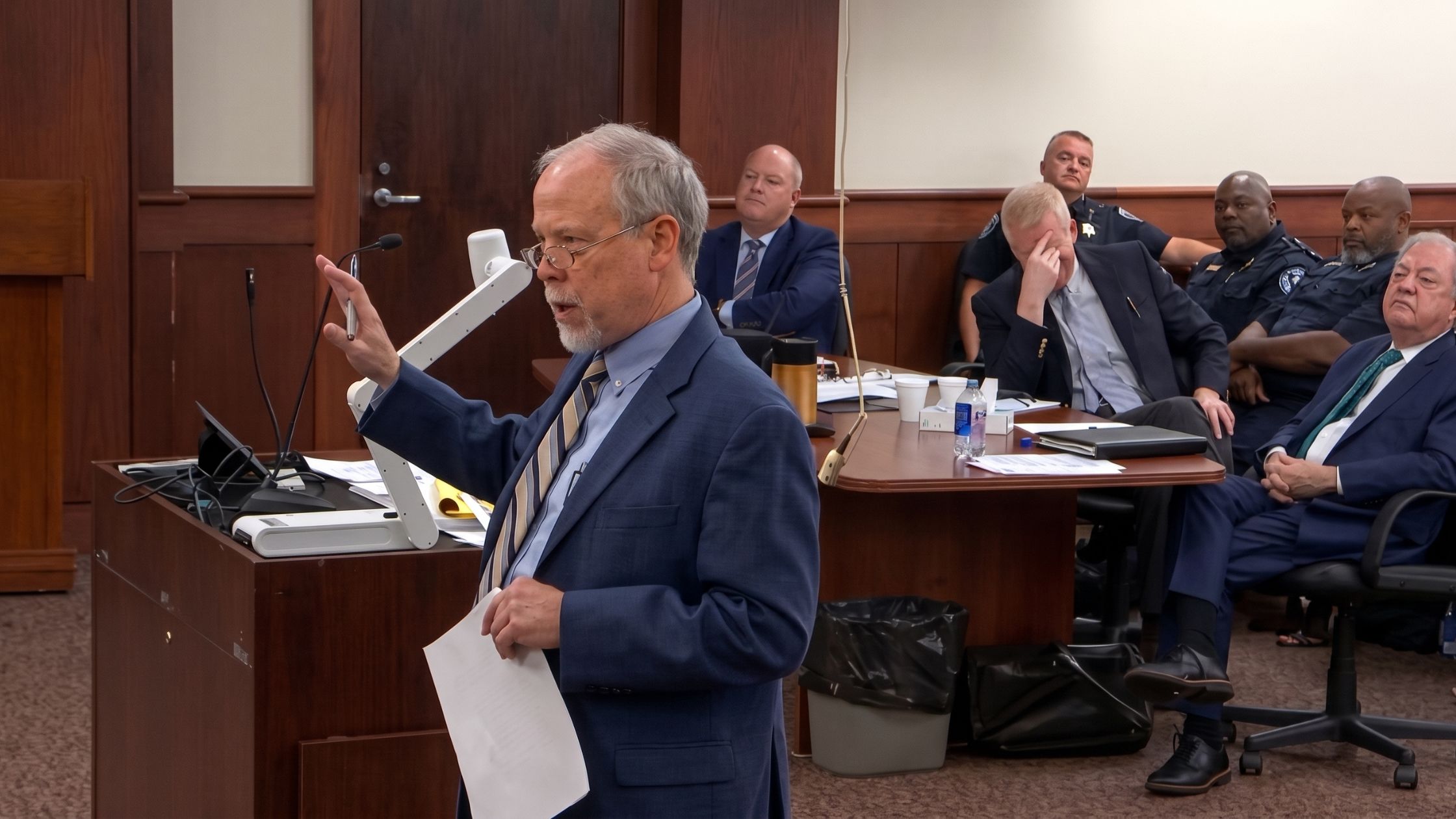
Speaker 1 (00:00):
The court's now in session. Honorable Judge Debra McCaslin presiding.
Judge Debra McCaslin (00:04):
Please be seated. Good morning.
Mr. Harpootlian (00:08):
Morning.
Mr. Creighton Waters (00:08):
Good morning.
Mr. Harpootlian (00:13):
Your Honor, may we have our client brought out please?
Judge Debra McCaslin (00:14):
Absolutely.
Mr. Harpootlian (00:15):
Thank you. He's dressed, he's ready.
Judge Debra McCaslin (00:27):
Okay, good. Let me tell everybody else. Good morning. Welcome to Lexington County and to the Lexington County Courthouse. As soon as we get Mr. Murdaugh brought out, we'll get started. Mr. Waters, how are you?
Mr. Creighton Waters (00:45):
Good, Judge. How are you today?
Judge Debra McCaslin (00:46):
I'm good. While we're waiting, let me introduce y'all to my new law clerk. This is my old law clerk. This is his last day. So you will not be emailing him anymore. This is Mary L. McKissick, and she will be the new law clerk that y'all will be getting emails from. So just wanted to introduce her so y'all would know when you did get them.
Mr. Harpootlian (01:22):
Your Honor, while we're waiting for Mr. Murdaugh, could I address one administrative thing? I've already talked to the clerk from Colleton County. When you file an order, on some occasions, you copy us when you file it. On some occasions, if we don't get it, the order allowing him to be present without the shackles. We read about it in FITSNews before we were aware there was an order. If you could, I don't know whether it's over, but when you send an order to Colleton County, if you copy the lawyers, I think you've done that on every order.
Judge Debra McCaslin (01:57):
Let me tell you, I usually, my office usually sends an order. I do that not only in this case, but any lawyer who appears in front of me. I send a copy of my own order. I apologize for that.
Mr. Harpootlian (02:12):
Nothing to apologize for, but once things crank up, getting it quick, I mean, getting it next day just follows in this, but it may be that as you make evidence and rule, whatever.
Judge Debra McCaslin (02:30):
Absolutely. Well, I'll make sure that everybody gets a copy. Again, I apologize for that.
Mr. Harpootlian (02:35):
Nothing to apologize for.
Judge Debra McCaslin (02:38):
I usually do send it myself.
Mr. Harpootlian (02:40):
Thank you, Your Honor. Here we go. Mr. Murdaugh is here.
Judge Debra McCaslin (02:43):
Okay. We ready to get started then?
Mr. Griffin (02:46):
He's ready, Your Honor.
Judge Debra McCaslin (02:47):
All right. Well, let me just kind of do a little housekeeping here. Mr. Harpootlian, let me just address kind of what we did last time as far as making arrangements out at the Bureau of Prisons for a conference room where you could take discovery to your client. Have you had any issues with that?
Mr. Harpootlian (03:15):
Let me confirm.
Speaker 2 (03:15):
None at all.
Mr. Harpootlian (03:19):
We have no issues whatsoever. Everyone's been wonderful.
Judge Debra McCaslin (03:22):
Okay, good. And then I told you that I would check on if there's any kind of download that you could do to the tablet that he has, and there's not. So we're going to have to stick with the computer from either the law clerk or one of your staff members going out to the BOP.
Mr. Harpootlian (03:45):
At this juncture, we have a law clerk, this young man back here, who's going down there. And of course, two and a half hour drive. Typically, it's two and a half, three hours with him and [inaudible 00:03:56] a half hour drive back. We understand. We're willing to put up with that.
Judge Debra McCaslin (03:59):
Okay.
Mr. Harpootlian (03:59):
That's not a problem. However, we have retained some experts and at some point we're going to need to, and they've done this in the past for us, but we've done some FaceTime meetings with them so they can show Mr. Murdaugh drawings and all those sorts of things. So we're going to try to... And I don't think they're going to have a problem with that, but if we arrange for an expert to be available and we're paying them hundreds of dollars an hour, we'd like it to work seamlessly if we can.
Judge Debra McCaslin (04:32):
Well, do you have any problem? All you have to do is just let me know.
Mr. Harpootlian (04:36):
Yes, ma'am.
Judge Debra McCaslin (04:37):
And we'll try to work around that.
Mr. Harpootlian (04:39):
Thank you, Your Honor.
Judge Debra McCaslin (04:42):
Okay. We'll make sure it gets done. All right. If y'all don't mind, I've got how I want to do this hearing today because I plan to hear all of your motions except for three. And I've kind of picked out the ones that I though we could go through right easily this morning. I know that both of you renewed your discovery motions and your reciprocal discovery motions. Let me ask the state, right now, do we have any problems with discovery?
Mr. Creighton Waters (05:19):
Not that I'm aware of, Your Honor. Obviously we have filed a motion as it relates to that defense phone extraction. That's obviously one of the things on the table today.
Judge Debra McCaslin (05:26):
And I'm going to rule on that today.
Mr. Creighton Waters (05:28):
We are obviously always auditing discovery. And of course it has been a few years since the trial. So there may have been things that we would turn over that have developed since that time. And we're in the process of doing that. But we are not aware of any discovery issues at this time. Indeed, not too long ago, the defense realized that one of the original big murder downloads that we gave them back in August of 2022 had been corrupted on their end and our staff worked and did hours and hours of work to report all of that to provide that to them. So my understanding is that they have all that, which they had then at the time.
Judge Debra McCaslin (06:02):
That's certainly not anything new.
Mr. Creighton Waters (06:04):
Not anything new.
Judge Debra McCaslin (06:04):
Just something you had to re-copy and give to them.
Mr. Creighton Waters (06:07):
That's right.
Judge Debra McCaslin (06:07):
Okay. How about you, Mr. Harpootlian? Do you have any discovery issues right now?
Mr. Harpootlian (06:16):
Mr. Griffin would like to address that, Your Honor.
Judge Debra McCaslin (06:18):
Mr. Griffin, be happy to hear from you.
Mr. Harpootlian (06:21):
Oh, [inaudible 00:06:21]
Mr. Griffin (06:21):
I'll come up here, Your Honor, since I don't have a microphone. Good morning.
Judge Debra McCaslin (06:24):
Good morning.
Mr. Griffin (06:27):
I want to make a record. I mean, there's ongoing obligation by the state. They say that we-
Judge Debra McCaslin (06:33):
There's an ongoing obligation by both of y'all.
Mr. Griffin (06:37):
And so there's some items that we would have expected to receive by now and we have not.
Judge Debra McCaslin (06:43):
Let me know what those are. What are they?
Mr. Griffin (06:46):
So as Your Honor well know, the state has to produce evidence, information pertaining to, that the defense could use to challenge the credibility or truthfulness of a witness. It's called Giglio material. And it's in United States Supreme Court, Giglio v. United States. And these include plea deals and promises, even secret agreements, evidence of witness bias and credibility issues of police where the evidence of past misconduct. And in that category, I have a few items as to secret agreements, there is a co-defendant in some cases, and then he's been charged separately. His name is Eddie Smith. Curtis Eddie Smith, who's a distant cousin of Mr. Murdaugh, was charged on November 2021, almost five years ago, of ABHAN, pointing and presenting conspiracy, filing a false police report, and that's related to a roadside shooting that involved Mr. Murdaugh.
(07:56)
Subsequently, in June of 2022, he was indicted by the state grand jury of four counts of money laundering, trafficking and meth, of other things. Four plus years have gone by, and those cases have not been disposed of. Every other case that we're aware of have been disposed of. And it begs the question, why not? Do they have a cooperation agreement with Mr. Smith? If so, what are those terms? He has been identified as a witness in this case since the last trial, well before the last trial. So we've got nothing on Mr. Smith. And if they have a deal, they're obligated to disclose it. If they have an understanding, they're obligated to disclose it and we've never received it. With regard to credibility issues of police, we are aware that Judge Roger Young dismissed a murder case.
(08:54)
And the name of that case is State v. Michael Colucci. And he was indicted in 2015. In June of 2025, Colucci's attorneys filed a motion to [inaudible 00:09:08] indictment saying that the state withheld critical exculpatory evidence on the eve of jury selection. The motions identify David Owen, SLED Agent David Owen, who was the lead case agent in this case, who after this case received SLED Agent of the Year Award. Judge Young dismissed the Colucci case because of withholding of exculpatory evidence. We want to know what's in Mr. Owen's, SLED agent, I think he's retired now, in his HR file, was he reprimanded? Was he sanctioned? Were any steps taken as a result of the Colucci matter? There's another SLED agent who was the lead SLED agent in the financial crimes case. Right now, we assume he's going to be a witness. He retired or resigned from SLED. We don't know exactly under what circumstances, but then he went to work for the Charleston County Sheriff's Department.
(10:11)
On June 8th, 2026, Captain Ryan Kelly was terminated from his position, according to the Sheriff's Department, for violating, for conduct unbecoming, harassment, improper procedures. And so that would be information. We don't have subpoena power unless we subpoena them to a hearing. They have control and can request this. We don't have it and we would like it. And so, Your Honor, that's some Giglio material. Some Brady material that we think we're entitled to. And as you know, Your Honor, Brady has evidence that could be exculpatory. We have learned through reporting from FITSNews that there was a recent murder, we believe, in Allendale County. And what has come out of that investigation and what has been leaked to the press is that Murdaugh murder weapons were connected to the Allendale County murder. Now, how could that be? And so we would like to know, were Murdaugh murder weapons connected to this Allendale murder?
(11:28)
Now, if Your Honor will get into this, you'll learn that the SLED Agent Ballistic Forensic Lab did an analysis of just the shell casings on the 300 Blackout that was used to murder Maggie Murdaugh. And the ballistics expert testified that the extraction marks on those shell casings found at the murder scene matched extraction marks found on shell casings around the Moselle home and at a shooting range. And their analysis was, in his opinion, it was the same gun that injected the shell casings of the 300 Blackout at the house, at the driver range and at the murder scene. Which leads us to, we don't know if it was the same murder weapon in Allendale, but if they did an analysis of the shell casings in the Allendale murder case, and they're saying it matches the shell casings for the Murdaugh murders, either their test is bad or someone's out there using the gun to murder other people.
(12:40)
And so we would like that information. We are aware that SLED has received tips because we've received tips. We've not been provided any information about tips of whether it's reliable or not identifying anyone else other than Alex Murdaugh participating in the murders. We've not received any information. Have they found the murder weapons? Have they found the murder weapons since the last trial? And there's related information underlying all of those. And so we don't think the state is taking their obligation seriously enough to find out what Brady materials out there has been developed and what Giglio material out there has been developed. And this is what we are aware of today, but we don't have the benefit and we don't have the ability to contact law enforcement and get this information. So those are our concerns.
Judge Debra McCaslin (13:52):
Okay. Mr. Waters, let me hear from you on the Giglio.
Mr. Creighton Waters (14:00):
Yes, ma'am. First of all, I want to say we take our obligations very seriously.
Judge Debra McCaslin (14:04):
I know you do.
Mr. Creighton Waters (14:05):
And have never had a problem. This is the first they've raised these specific issues. They could have given me a call. And if I ever discovered anything of importance, they're the first people that I call. And that's always been our practice. As to Giglio, as to Eddie Smith, of course, there is no cooperation agreement. I don't have any secret agreements. If I had any agreement with the individual, I would disclose that to him. They have all the witness statements. They have the state grand jury testimony. They've had every bit of information and every bit of discovery that we have on Eddie Smith. And there are no secret agreements. And if I do ever engage in agreement with any witness, I will disclose that immediately to the defense. I understand that obligation very well. As to-
Judge Debra McCaslin (14:43):
And those cases are still pending.
Mr. Creighton Waters (14:45):
That's correct. Yes, ma'am, Your Honor. As to Colucci and Kelly, we are all aware of our Giglio obligations. And as far as the Colucci matter, the judge, as I understand it, I wasn't involved in that matter, but ultimately dismissed that indictment without prejudice, just to allow some additional information to be presented back to the grand jury that the individual said that he forgot. But there was no finding that he misrepresented anything. I have made inquiry and I am not aware in any HR file of a finding of dishonesty or anything like that that would ultimately trigger Giglio. I have made those inquiries and I will renew those inquiries. And if anything is applicable there, I will immediately provide that to the defense as we do every law enforcement witness in the case. The same thing with the termination of Ryan Kelly from Charleston. My understanding is-
Judge Debra McCaslin (15:39):
That was a SLED agent?
Mr. Creighton Waters (15:40):
He was a SLED agent. He went to Charleston County Sheriff's Office and deputies served that will and he was terminated. But the inquiries I've made, and my understanding is that none of that had anything to do with dishonesty or falsification of reports or anything that would go to Giglio, that they were personnel matters. I will, of course, re-verify that. And if there's anything that needs to be provided in that regard, I will of course provide that to the defense. But that is my understanding at this time. And again, we always renew our Giglio inquiries for any law enforcement witness that testifies as we move to trial. And obviously if anything's forthcoming, we'll provide that. But those issues are not there.
(16:18)
As to tips, we provided a lot of that information before, but as I said, this case was tried over three and a half years ago. And so we are in the process of correlating. Heck, I get emails from all over the world to this day. But we categorize those and there will be any sort of information, no matter how fanciful and farfetched, and that'll be provided to the defense as well. And so again, as you recognize and as we recognize, that obligation is ongoing. We take it seriously and anything that has developed since that time, we will make sure to provide to that defense. We are constantly always doing discovery audits and discovery checks.
Judge Debra McCaslin (16:57):
All right. Well, tell me about the Allendale with-
Mr. Creighton Waters (16:58):
Oh, that's the... I'm sorry, Your Honor.
Judge Debra McCaslin (16:58):
... the murder weapons.
Mr. Creighton Waters (17:06):
That's the first I've heard of that. I have never heard the first thing about that. If somebody told me that they had matched that to the murder weapon, not only would I... The first call, again, I would be making would be to them. And the second call I'd be making would be to Your Honor. That is the first I've heard of that. I've never read the FITS article. Certainly nobody at SLED, who I communicate with on a daily basis has said, "Hey, Creighton, by the way, X happened." So I will certainly look into that, but I would be flabbergasted to find out that that actually had happened and no one had advised this office of that.
Judge Debra McCaslin (17:39):
Okay. All right. I hope that answers your questions. He's going to get back with you. He's going to double check on Agent Kelly. But to his understanding, there was no dishonesty, but that would raise the bar to Giglio. But he's going to get back with you. As far as the murder in Allendale with the murder weapons, you certainly raised my eyebrows on that.
Mr. Griffin (18:03):
Your Honor, throughout this case, FITSNews has been breaking stories that we were unaware of. And we can go through a long litany of that. But there was a podcast. There's a reference to what I just said to you.
Judge Debra McCaslin (18:19):
Maybe you could forward that to Mr. Waters and let him look at it and see if there's anything to it.
Mr. Griffin (18:28):
But we would ask that they look into that.
Mr. Creighton Waters (18:30):
And I'll be the first to say, Your Honor, is that I don't watch the podcast and I don't read the blogs because I try to base what I'm doing on the evidence and not on speculation that's out there in the media. But certainly I've never heard of that thing and I will make inquiries, but it would blow my mind if something like that had happened and SLED had not called me. I communicate with them daily. There are general counsel sitting here in the gallery here today.
Judge Debra McCaslin (18:52):
Okay.
Mr. Griffin (18:52):
And Your Honor, we would ask for the underlying documents on the Colucci matter involving judge's ruling, anything that was filed, anything related to the Colucci matter. And we'd ask-
Judge Debra McCaslin (19:07):
On the one that's going back to the grand jury that was dismissed that was referred back or dismissed without prejudice.
Mr. Creighton Waters (19:17):
Without prejudice, just to represent to the grand jury is my understanding. And again, my knowledge of that case is very limited. All this really was publicly reported and there's a public transcript in the judge's ruling, which is available to the defense.
Judge Debra McCaslin (19:31):
I think you can get it in the clerk's office.
Mr. Griffin (19:33):
Well, we do have some materials, but we don't know if we have all the materials. And then Agent Kelly's documentation relating to his termination, I don't think it's just sufficient for him to say, "Well, I've asked and there's nothing related to misconduct because what's publicly reported seems to be related to misconduct."
Mr. Creighton Waters (19:54):
Well, there's a difference between what's in a personnel file that may be powerful [inaudible 00:19:58]
Judge Debra McCaslin (19:57):
That's exactly right. And there's a different avenue to go. When you're talking about law enforcement's personnel file, usually you can ask for them, but then they come to me. And then I go through them and in camera. And if there's anything in there that I think that needs to be reported to both sides, not just one, but both, then I'll give it to you.
Mr. Creighton Waters (20:23):
Absolutely, Your Honor.
Mr. Griffin (20:24):
We'd love for that to happen.
Judge Debra McCaslin (20:26):
I don't mind doing that.
Mr. Griffin (20:28):
All right. Thank you.
Mr. Creighton Waters (20:28):
Absolutely.
Judge Debra McCaslin (20:30):
That's fine. Y'all need to get together, get them. I don't want anybody looking at them. I want them delivered to my office.
Mr. Creighton Waters (20:41):
Thank you, Your Honor.
Judge Debra McCaslin (20:41):
Okay.
Mr. Creighton Waters (20:41):
We'll get that done, Your Honor. Thank you.
Judge Debra McCaslin (20:46):
All right. Next, Mr. Harpootlian, I think this motion should be moot. I heard Judge Gergel dismissed without prejudice, and I think you have it on appeal, to modify the protective order for your federal case. Are you going to withdraw this and maybe refile it later after the appeal?
Mr. Harpootlian (21:14):
Yes, Your Honor.
Judge Debra McCaslin (21:14):
That's what-
Mr. Harpootlian (21:20):
We filed it before Judge Gergel precipitously dismissed the case.
Judge Debra McCaslin (21:22):
Perfect. I figured that made this motion moot and I could get rid of it. If you need to refile it, please feel free to do so after the appellate.
Mr. Harpootlian (21:32):
Once the court clerk sends it back, we'll be doing that.
Judge Debra McCaslin (21:34):
Okay. Then my next motion was the state sent me a proposed order for an amended protective order. This is by consent because I received your email, Mr. Harpootlian, that you consent. Mr. Waters, what I want to make sure is because this is a new case. That means there's new filings. And in your motion for this proposed protective order, you listed a bunch of stuff. Is that included in all of this? Or was that just a history Exhibit B that you gave me?
Mr. Creighton Waters (22:17):
Yes. The Exhibit B just was for, this is a new case, but I just wanted to provide the court sort of the historical development of the protective orders and sealing orders in this case.
Judge Debra McCaslin (22:29):
While we're signing it. Why I'm signing it and y'all are agreeing to it. Is that right?
Mr. Creighton Waters (22:33):
Yes, ma'am. It was just for the court's information as to how things started, how they progressed through the first trial, and how they now set up for Your Honor.
Judge Debra McCaslin (22:41):
Okay. Well, if you both agree, I'm going to tell you I'm going to sign it. I also took the liberty of putting a consent for both of you to sign. If y'all sign that, I'll have the clerk file it and take it back to Colleton today.
Mr. Creighton Waters (23:03):
Want us to do it right now, Your Honor? May we approach?
Judge Debra McCaslin (23:06):
Mm-hmm. And I'm going to give it to the clerk and that one's done. Yeah. Thank you.
Mr. Harpootlian (23:27):
Thank you, Your Honor.
Judge Debra McCaslin (23:29):
All right. Now, the next motion that I wanted to hear, Mr. Harpootlian, I did not get a response from you, but this is for the pre-voir dire. It's a questionnaire.
Mr. Harpootlian (23:48):
Your Honor, we agree this should be a questionnaire.
Judge Debra McCaslin (23:51):
Okay.
Mr. Harpootlian (23:52):
But we think we, as this case develops, there's going to be additional questions we're going to want to have in that questionnaire. Now what we did in Colleton, not that that matters too much, but what we did in Colleton was we had this questionnaire they filled out and mailed back in. And then when they got there, there was an additional more case specific questionnaire. We're not going to be mailing questionnaires to jurors until-
Judge Debra McCaslin (24:18):
January.
Mr. Harpootlian (24:18):
... January. So we've got several months to deal with that. If you just give us to the 1st of November to flesh that out, I think we can agree on a questionnaire.
Judge Debra McCaslin (24:27):
Is that fine with you, Mr. Waters?
Mr. Creighton Waters (24:29):
Yes, ma'am, Your Honor. We worked together last time to develop this questionnaire, and obviously I think we can do that again. And then if we have any issues, we'll bring them to the court.
Judge Debra McCaslin (24:37):
Well, I looked at it. I thought it was great.
Mr. Creighton Waters (24:39):
It worked great.
Judge Debra McCaslin (24:41):
Seems like it was helpful.
Mr. Harpootlian (24:41):
It did.
Mr. Creighton Waters (24:41):
It was great.
Mr. Harpootlian (24:45):
Your Honor, what we didn't address in a questionnaire, and we've got a consultant we're talking to about is do we ask in that questionnaire a level of awareness about this case? I'm not saying we should. I'm just saying we're examining that and that's why I'd like till the 1st of November. And of course, in the question, if you do a questionnaire when they get here, obviously we want to know a little bit more about their specific knowledge of the case. So yes, we agree there needs to be a questionnaire. We may want to add some questions to that questionnaire. Just not sure, but we will be by the 1st of November.
Mr. Creighton Waters (25:26):
And what we did last time, Your Honor, that worked very well is we had that questionnaire. The parties went through that questionnaire. We actually then had a dialogue where we agreed based on certain responses of jurors to exclude. And so they were already gone by consent, but we already identified ones that would need additional questioning. And then of course there was additional questioning with the court and the parties in private for either the jurors by their questionnaire or by responses in court that just needed further inquiry. And again, we were able to do that in two days.
Mr. Harpootlian (25:56):
And Your Honor, we would ask that there be direct supervision by you of the issuance of the jury summons, how they're picked. There were huge questions obviously after we learned of the clerk's conduct about how certain people maybe got on the venire and others did not. She was apparently excusing people we believe, and of course this litigation could help us, litigation that's on appeal of the court circuit, let us develop that. Her daughter appeared on the jury venire. And she, and I guess at the time, either I nor Mr. Waters thought that was unusual, but she was talking to both of us about how she'd make a great juror. She talked to me. I hope she talked to you.
(26:39)
I'm not saying expecting that to happen again. Got a new clerk. But in terms of summonsing jurors, there's a process. The Supreme Court, I found out later on, that there's a list. Actually, they're generated in Columbia. And then the clerk excuses, before he or she issues those summons. There's a screening process. That's what I'm concerned about. In other words, the big list will come from Columbia, but how it gets narrowed down before we ever see it, that would be me and Mr. Waters, concerned me greatly.
Mr. Creighton Waters (27:16):
Again, this is the first that I've heard of any issues with that. I mean, my understanding is with Judge Newman's supervision, obviously number ones that were excused based on patent exemptions such as over 65 who claimed that were non-residency issues and that sort of thing.
Judge Debra McCaslin (27:33):
Right. That would be my understanding of what normally happens when we pick a jury here.
Mr. Creighton Waters (27:40):
When we had the whole panel arrive, yes, there was something like that. Obviously she was excused. There were also people that had relationships, close relationships with Alec Murdaugh and the Murdaugh family. And of course we vetted all of that and excused as appropriate.
Mr. Harpootlian (27:53):
Well, what was never done, and I tried to get the list to compare the initial list that was generated in Columbia, to what actually were summons that were issued. And certainly there were people that the clerk said-
Judge Debra McCaslin (28:09):
They don't live here. They're over 65.
Mr. Harpootlian (28:12):
Right. Dead, whatever. I get that. But we never got the original list, so we don't know. And again, call me suspicious, but when we have evidence that the clerk of court is attempting to influence the jury to obtain a guilty verdict so she could sell more books, when did that start? Did it start when she started winnowing down people she though might be helpful to us? And I'm not saying that could happen again, but I think I need to mention it. I need to say to the court, I never expected it to happen the first time. I've been doing this 50 years. I've never seen a clerk of court interfere in this process. And clearly our Supreme Court found she did.
Judge Debra McCaslin (29:01):
Okay. Well, I can tell you, Mr. Harpootlian, I certainly don't mind overseeing it.
Mr. Harpootlian (29:04):
Thank you, Your Honor.
Judge Debra McCaslin (29:05):
That's for sure.
Mr. Harpootlian (29:06):
And again, I mean-
Judge Debra McCaslin (29:07):
Mr. Waters, wherever this trial is going to be, I will certainly make sure that it is on the up and up. I can promise you that.
Mr. Creighton Waters (29:18):
And just to be clear, there's absolutely no evidence that there was any shenanigans with that part of the process.
Judge Debra McCaslin (29:25):
I haven't heard of any of that, but we'll just make sure that everything is done properly.
Mr. Harpootlian (29:31):
Thank you, Your Honor. That's all I'm asking. And again, I would agree. We were never allowed to look at that piece of it for our motion for a new trial. It wasn't relevant to that. And the clerk was not going to. She never admitted she talked to any jurors. The court, both Jean Toal and the Supreme Court found her to be a horrible liar. So you'd have to prove it extrinsically. We don't need to go there. We may go there in our federal case, but we don't need to go there. I'm just saying, call me naive, I just want to make sure you are in charge of this process and it's not deferred to some functionary.
Judge Debra McCaslin (30:11):
No, I don't have a problem with that.
Mr. Harpootlian (30:13):
Thank you, Your Honor.
Judge Debra McCaslin (30:14):
All right. The next motion-
Mr. Creighton Waters (30:16):
Your Honor, real quickly, if I could just say-
Judge Debra McCaslin (30:17):
Oh, yes.
Mr. Creighton Waters (30:17):
... that as we got the dumps from the clerk's office with the jurors, it had the numbers on there with the over 65s and had the return from those individuals.
Judge Debra McCaslin (30:28):
You did get those?
Mr. Creighton Waters (30:28):
That's my recollection.
Mr. Harpootlian (30:29):
We did. But the question is, who got off that list before we got it?
Judge Debra McCaslin (30:33):
Okay.
Mr. Harpootlian (30:34):
That's the problem. And do we have any evidence that-
Judge Debra McCaslin (30:38):
You just want the original list-
Mr. Harpootlian (30:39):
I want the original list.
Judge Debra McCaslin (30:39):
... is want you want. I understand.
Mr. Harpootlian (30:39):
I want you to have the original list. So when the summons go out, you know that everybody on that summons list was summoned unless you were told they were dead. And again, I'm a little paranoid after our last experience, not realizing the clerk was trying to fix the jury.
Judge Debra McCaslin (31:01):
Okay. Well, I'll make sure I speak with the clerk before that process.
Mr. Harpootlian (31:10):
And Your Honor, certainly Mr. Waters is not vouching for her veracity and truthfulness here today. I understand that we're here because she attempted to fix the jury, right?
Judge Debra McCaslin (31:25):
I think he understands. Let me hear from you, Mr. Waters. I think he understands why we're here today.
Mr. Creighton Waters (31:33):
I went through a lot and actually suggested a lot of these procedures. Ultimately, all we were trying to do, recognizing the uniqueness of this case, and there's no denying it, is get a fair and impartial jury. And the process that we put in place worked very well. Actually the person who was handling all that and sending out those juror responses, there was multiple staff involved and all that was under the supervision of Judge Newman. So we certainly understand what the Supreme-
Mr. Creighton Waters (32:00):
... So we certainly understand what the Supreme Court ruled, but I know Your Honor will supervise whatever process. And my only goal and my only intent is to have the first screen process take place and then give us the jurors that are in play and then we'll put together a fair process to put 12 in the box.
Judge Debra McCaslin (32:19):
I agree with you, Mr. Waters. I'll take care of that. You don't need to worry. Neither one of you. All right. Next motion. It's going to be the state's motion in limine to exclude evidence of the polygraph. Let me hear from you, Mr. Waters.
Mr. Creighton Waters (32:37):
Yes, ma'am, Your Honor. Your Honor, this was just a prophylactic motion in limine that we filed prior to the first trial. And again, the case law is cited in there. I'm happy to detail it for Your Honor, but obviously the case law is very clear in South Carolina that polygraphs are a no-no. And that's because while they may be an investigative tool, the reliability of them is questionable. And of course, even the U.S. Department of Justice manual notes that it's not a lie detector. What it does is record physical responses that in the subjective opinion of the examiner may indicate deception, but that deception may or may not be related to concerns of guilt or innocence. And that's why the courts have always rejected those in addition to the fact that they go to the heart of why we have courts and why we have juries. And that's of course for the ultimate determination of the truth of the matter.
(33:41)
And so obviously from the state's perspective, if ever there's a polygraph issue or there's an interview that occurred after polygraph, we are rock solid to make sure that that witness and that officer or whatever does not say the P word out loud. And that's just been the general rule. And this is the way I do things, just like we did the financial evidence last time. We laid all our cards on the table, did a long extensive hearing. There was no gotcha moments or anything like that. And we just ask for the same thing, that there be just sort of an in-camera ruling and an instruction that the polygraph word is not to be mentioned because again, it can be hard to unring the bell.
Judge Debra McCaslin (34:19):
That's right. Let me hear from you, Mr. Harpootlian or Mr. Griffin.
Mr. Harpootlian (34:25):
[inaudible 00:34:26] please the court, Your Honor.
Judge Debra McCaslin (34:25):
Sure.
Mr. Harpootlian (34:28):
So generally, Mr. Waters is correct. And let me point out to the court and I'll hand up a copy of the case. It's the State v. Henry Eastwood, which-
Judge Debra McCaslin (34:41):
It's the Eastwood case, is that what you said?
Mr. Harpootlian (34:48):
I'm sorry?
Judge Debra McCaslin (34:48):
It's the Eastwood.
Mr. Harpootlian (34:50):
It's the Eastwood case.
Judge Debra McCaslin (34:58):
I've got a copy of it. Go ahead. No, I've got a copy.
Mr. Harpootlian (35:02):
So as you know, if you've got a copy of it, the Supreme Court said there's not an absolute ban. There are circumstances under which a polygraph could be used. I mean, again, it's not a lie detector, but the question is, if somebody was confronted with the fact that they failed a polygraph, did they give it ... I mean, in this case, did they give a confession? The Eastwood case, it was a confession [inaudible 00:35:30]. In this case, and we want to argue this more fully depending on whether or not this witness is called, Eddie Smith, who as we've already understood, was charged with a whole bunch of stuff, had a proffer agreement with the state. And the proffer agreement was conditioned on him passing a polygraph. And as Mr. Waters knows, in other words, he had a deal and the deal was predicated on him passing a polygraph. This is a copy of the results of that polygraph. And the polygraph was, "Did you kill Paul and Maggie Murdaugh?" He failed it. And so they, relying on that, canceled his proffer agreement.
(36:16)
Now, I'm not saying necessarily that's admissible on cross, but I am saying that it's an issue, not now, but much closer to trial that we need to be able to litigate. And there may be others. Again, we're going back through ... I will tell you, Mr. Murdaugh passed a polygraph, flying colors. So the same polygrapher. So it may play a role in this trial. I'm not going to concede that not under any circumstances can a polygraph ever be used. I'm just giving you this example of Eddie Smith failing the polygraph and them relying on it to cancel his deal. Now, that's what our understanding is from the limited documents. They never called Eddie Smith in the first trial, which we were shocked by. But should they call him in the second trial, we may want to go into this. So I would ask you not to issue an order prohibiting any mention of polygraph with this guarantee. We would not mention polygraph in a courtroom with a jury until given permission by Your Honor to do so.
Judge Debra McCaslin (37:25):
All right. Well, let me tell you, anything else from Mr. Waters?
Mr. Creighton Waters (37:30):
Well, Your Honor, just to correct one thing, there's never been any sort of deal with Eddie Smith. A proffer is not a deal. It says in big bold letters, this is not a cooperation agreement. It's only essentially a first aid provision. Again, polygraphs can be an investigative tool, but I never base decisions on them. And frankly, in my experience, I've found them to be wrong or for people to indicate DI for other emotional reasons than them to be accurate. This is why they're not ever relied upon in court. The case that they cite is a completely different issue where in that particular instance, the defendant wanted to bring up the fact that he had been given a polygraph and was told by the examiners he was lying as part of his defense in presenting an expert on false confession. And that is nothing that we have in this particular case whatsoever.
(38:20)
And in fact, if you look at the cases that we cite in the memo, Your Honor, a prime example of what the Supreme Court has ruled was there was one situation, and give me one second, I'll find the case. That would be State v. Counsel, which is the seminal case on that. And in that particular case, there was another witness who took a polygraph on, "Were you present? Were you involved?" And DI was shown. Deception indicated was shown. And of course the court said that because "A polygraph cannot reliably show truth, it's of no assisting to the jury because it doesn't show anything." So that's a vastly different situation, more akin to what we have here where the Supreme Court has already said no than the situation in the Eastwood case where that false confession and this aspect of it was crucial to that expert's opinion.
Judge Debra McCaslin (39:12):
Okay. Thank you-
Mr. Harpootlian (39:14):
... Very, very briefly. It was a proffer agreement. And the proffer is, "You're going to tell us stop. And if you pass the polygraph, we can go to the next step," Which would be perhaps giving him something for his testimony. They were using it as a screening device. No question about it. But he failed the polygraph, so he didn't get the deal. He's right. He doesn't have a deal as far as we know. And the reason he doesn't have a deal is he failed the polygraph. Now, whether we get to talk to the jury about that nine months from now is an issue altogether different. But all I'm saying is we would ask you not to issue an order, blanket order prohibiting the mention of polygraph. Although I will concede I would not do that without having pretrial, an in-camera hearing of some sort and getting clearance from you.
Judge Debra McCaslin (40:02):
Well, that's going to be my ruling, Mr. Harpootlian. I'm going to rule that the results of a polygraph examination are not admissible as well as the defendant's willingness or refusal to submit to a polygraph. And I'm going to tell you now, there is to be no mention of a polygraph test before the jury. This ruling is based on counsel and case and the Palmer case. Should the defense seek to introduce any evidence or testimony or reference concerning a polygraph examination, you must notify the court and obtain a ruling outside of the presence of the jury or risk this case being a mistrial. You understand?
Mr. Harpootlian (40:53):
Well, I think, Your Honor, you probably should threaten mistrial. You ought to threaten contempt.
Judge Debra McCaslin (40:57):
Contempt.
Mr. Harpootlian (40:57):
There you go.
Judge Debra McCaslin (40:57):
Yeah. You don't want me to hold you in contempt, Mr. Harpootlian-
Mr. Harpootlian (41:03):
... Mistry the case.
Judge Debra McCaslin (41:05):
And I might mistry it if you start screaming polygraph without letting me know beforehand. You understand? I want to make sure everybody's on the same page.
Mr. Harpootlian (41:18):
I got it. I think I suggested it. I agree with you. I just wanted you to know there are circumstances, and that's one where we may seek to do that. We're not going to do it without getting your approval.
Judge Debra McCaslin (41:29):
Perfect.
Mr. Harpootlian (41:30):
And that may come up in the context of his testimony. He may say something that-
Judge Debra McCaslin (41:36):
I mean, you never know what happens at trial.
Mr. Harpootlian (41:38):
Right.
Judge Debra McCaslin (41:39):
I'm just telling you right now, I'm telling you a polygraph is not admissible. If you're going to bring it up, you need to let me know first and then we'll have an in-camera hearing.
Mr. Harpootlian (41:51):
Thank you, Your Honor.
Judge Debra McCaslin (41:52):
Any objection, Mr. Waters?
Mr. Creighton Waters (41:53):
None at all, Your Honor.
Judge Debra McCaslin (41:54):
All right. Then let's move on to the next motion. The next is the state's motion in limine to allow the state's use of the defendant's prior testimony in retrial. Let me hear from you, Mr. Waters. I've done a lot of research on your motion.
Mr. Creighton Waters (42:15):
Yes, ma'am, Your Honor. Obviously at the first trial, Mr. Murdaugh, who of course had given multiple statements to the police in which he said he had never been down at the kennels. He had told all his law partners, all his friends, all his family that he had never been down at the kennels either. And obviously during the state's case in chief, we presented witness after witness who knew him very, very well saying 100% that's his voice on the kennel video, which again, was taken at the scene with the victims and according to the timeline, just moments before they died. And so he ultimately, with the full waiver with Judge Newman, said, "I'm going to testify and I want to testify." And of course, right out of the gate, the first series of questions asked by Mr. Griffin on direct examination was an explanation of why did you lie about being down at the kennels? It was the most important issue in the case at that point.
(43:17)
Obviously, as a general rule under Harrison, a defendant's testimony at a former trial is admissible. And I'll get to the statute in a second. And then I'll also, of course, under rule 804(a)(1), it would be admissible, of course, based on unavailability, assuming that he would refuse to or exercise his Fifth Amendment right at a second trial.
(43:40)
The issue, of course, boils down to the statute. And of course, the statute says that "The testimony of a defendant in a criminal case shall not be afterwards used against the defendant in any other criminal case except upon an indictment for perjury." And of course, our position in that is that this is the same criminal case. This is not an other criminal case. It's the same indictment. It's the same allegations. It's the same case that we are doing. There's no question that we are starting the evidentiary presentation again from new, but that doesn't change the fact in the plain language of the statute that this is the same criminal case. And we cite-
Judge Debra McCaslin (44:15):
That's the critical distinction for the statute. Either you're in the same case or you're not.
Mr. Creighton Waters (44:21):
I agree. And we cite Tucker for that proposition. Now, I do agree that Tucker's a little different. It was a death penalty bifurcated case in that the go phase was affirmed and the sentencing phase was reversed. But the court clearly said there that during the re-sentencing phase, that prior testimony was admissible because it was the same case.
(44:39)
Now, the defense obviously argues that because of the Supreme Court's guidance on the financial issues, that ultimately his decision to testify is somehow impelled by that. And we would respond to that in two ways.
(44:58)
Number one is the first thing is it's very clear that the most important reason for him, "I want to testify," is that he had to explain that kennel video, which again, was the most important issue for the defendant to testify.
(45:14)
Secondly, as we look at the opinion, and obviously I know you've deferred on the mode of evidence, and we'll get to that at a later time, of course. But the Supreme Court, while saying that perhaps the trial court let the state go too far with that evidence, the court did say that the court appropriately ruled the evidence admissible under 404 and did appropriately admit at least some of that evidence. So ultimately, depending on how Your Honor rules on that mode of evidence, admission of any prior testimony should the state decide to do so, could be very much tailored to whatever the appropriate parameters are based on this court's ruling as to the extent of that testimony-
Judge Debra McCaslin (45:54):
... I think it would go along with what financial crimes are allowed in at the time of trial.
Mr. Creighton Waters (46:01):
Absolutely. Absolutely. And the state certainly understands that and is willing to do that. And then even aside from that issue, clearly whether it's impeachment of this defendant, should he testify again, or if the defense were to present a new theory through evidence that would be refuted by this testimony, I think that the law's very clear that then it could be used for impeachment to sort of ... If they change tack, then it would be fair game regardless of the issue of the statute.
Judge Debra McCaslin (46:32):
Okay. Who's going to argue that?
Mr. Griffin (46:37):
Mr. Barber will-
Judge Debra McCaslin (46:38):
Mr. Barber, come join us.
Mr. Barber (46:42):
Good morning, Your Honor.
Judge Debra McCaslin (46:43):
Good morning.
Mr. Barber (46:46):
Of course, we oppose this motion on two grounds, a statutory ground and a constitutional ground. And I would like to address the statutory one first on the generally accepted principle that if a constitutional issue could be avoided, that you should rest on statutory grounds. And the statute here is 191150, which as Mr. Waters said, prohibits using his testimony in another criminal case. And so we're concerned on what is the same cases versus another case. At 10:23 AM in this hearing, Mr. Waters standing at this podium said, "This is a new case." That was his statement on behalf of the state. On a different motion, he said, "This is a new case." Now for the purposes of this motion, it becomes again the same case. The defense's position is that a trial de novo is another case, that that is the logical rational conclusion from the statute, that the purpose of the statute is to protect the ability of a defendant to testify in one criminal case without a broad irrevocable waiver of his Fifth Amendment rights.
(48:05)
The state, as far as I can tell, takes the position that the indictment number controls whether this is another case or not. Not anything substantive happening in a case. And I would point out that there's not a single case in which with a trial de novo, because of an error by a state actor, not the prosecution, but certainly a state actor, that that constitutes irrevocable waiver of the defendant's Fifth Amendment rights. Tucker is the closest case. Mr. Waters conceded it's not really applicable. It's a re-sentencing on the same conviction. Here we're having a trial de novo and everything is new. As the court just went through with all those other motions, it's a new case. Even the protective order has to be redone. Everything is new. All the motions in limine have to be redone.
(48:50)
The one thing that is eternal and cannot be changed from the previous trial is one witness's decision to testify. That Fifth Amendment waiver is the only thing, according to the state, that's not waived. For purposes of the statute, we suddenly become the same. And before getting to the constitutional infirmity of that, as Your Honor knows, we filed a motion to dismiss the indictment shortly after this motion. It was responsive to this motion. If the state ... It's a reductio ad absurdum argument. If we're really going to take the position that it's not a substantive question, whether this is the same case or a different trial, well, if it's the indictment numbers under Thrift, we clearly meet the standard under Thrift for dismissal in the indictment.
(49:36)
Now, is that a waste of the court's time? I would say yes, because they'll just go to a grand jury and re-indict it. But if we're going to put substantive import on the indictment numbers, the arbitrary indictment numbers, well, the grand jury ... We have testimony from the first trial that the grand jury was presented evidence that the state admitted in its reply closing argument was incompetent, which the witness also admitted was incompetent. We have, if you look at that very lengthy motion for sanctions that's still pending, it's a colorable claim of misconduct. I would point out in Thrift, the Supreme Court explicitly held there was no misconduct. But because there's a colorable case for it, which is the least possible burden. Well, fabricated evidence. It's a colorable claim of misconduct. Okay. Is it prejudicial? Well, it would be the only direct evidence linking the accused to the crime. The only direct forensic evidence. Something that would prove his guilt. It must be prejudicial.
(50:43)
So we meet the Thrift requirements, the indictment should be dismissed. They should have to go back and re-indict it. We'll get a different indictment number and be right back here with a different case if that's really their position that a trial de novo is not another case. And this is just a statutory argument. There is, of course, a constitutional argument, which is the Harrison argument, which is that because he was testifying to address evidence that was ruled to be inadmissible, that his Fifth Amendment waiver cannot be held in this new trial. I mean, that's the clear holding of Harrison. It clearly ... In Simmons as well, which was a suppression hearing. In that case, someone testified in a suppression hearing and electing to assert that Fourth Amendment right in a suppression hearing, you're not required to waive other constitutional rights. The case law clearly held, and Your Honor indicated that you've done a lot of research on this, that a witness cannot be required to surrender his constitutional rights to address inadmissible evidence. And I think Mr. Waters agrees with that in that the dispute is whether or not he was testifying to address the financial crimes evidence. But as our response motion with many quotes and block quotes, that was explicitly preserved. In Harrison, it was just an inference.
(52:09)
In this case, counsel repeatedly put on the record why he was testifying. On page three of our response, Mr. Harpootlian said at that time, quite explicitly put on the record that our advice as to whether to take the stand or not would have been different had the financial crimes information that he was also renewing the objection to had not been admitted over objection. And the court held in response to that, that the objection was preserved. So here we are. Harrison directly prohibits this. Though I would suggest to Your Honor that the statute would be an easier ruling because there's no reason to reach a constitutional question. This is another case which we just said a dozen times when discussing previous motions.
Judge Debra McCaslin (52:58):
Thank you.
Mr. Barber (53:00):
Thank you, Your Honor.
Judge Debra McCaslin (53:02):
Any response, Mr. Waters?
Mr. Creighton Waters (53:04):
Very briefly, Your Honor. First of all, just because I just got this from general counsel. It said that there was a 300 blackout that was used in Allendale. However, it was entered into IBIS and there have been no leads or no matches on that. So that's what I was just informed.
Judge Debra McCaslin (53:21):
Is that going back to-
Mr. Creighton Waters (53:23):
Going back to the prior motion, yes.
Judge Debra McCaslin (53:25):
To the prior where the blackout was-
Mr. Creighton Waters (53:27):
And I'll find out more, but it doesn't-
Judge Debra McCaslin (53:28):
... Said to have been used in another murder in Allendale or somewhere. You understand that, Mr. Griffin?
Mr. Griffin (53:35):
I understand what he just said.
Judge Debra McCaslin (53:36):
Okay. Sometimes a real novel idea is to pick up the phone and call each other and talk. That's what we used to do when we were younger. Just call and ask if you've got a question. And then if you have a problem with it, I'm more than happy to settle it for you. I hate that we have to do this in court. I do. It's easier just to ... Now we can email. If you don't want to talk to each other, you can just email each other. Say, "Hey, you heard about this."
Mr. Creighton Waters (54:08):
I have never not taken a call from these gentlemen. Love talking to them.
Judge Debra McCaslin (54:11):
Yes, sir. Mr. Harpootlian?
Mr. Harpootlian (54:13):
Did he just say he loves talking to me?
Mr. Creighton Waters (54:14):
I did.
Judge Debra McCaslin (54:15):
He did. So maybe you ought to pick up the phone there, [inaudible 00:54:19]-
Mr. Harpootlian (54:19):
... They need to start drug testing [inaudible 00:54:21]. In all seriousness though, seriousness, I have never questioned Mr. Waters' integrity. But as a result of this case, I cannot help but question the SLED lab integrity and the SLED agency.
Judge Debra McCaslin (54:38):
I understand, but see how easy it was for him to make a phone call and turn around and give Mr. Griffin an answer.
Mr. Harpootlian (54:49):
Okay. And the answer is SLED entered it into some database and got no matches. Did they pull the shell casings from the Murdaugh trial and compare them to the shell casings to this? And that's not what I heard. That's not what I heard. And remember now, and if you've read the sanctions motion, they misled Mr. Waters about the blood spatter for months, months. And misled us. And misled an expert. That was the SLED lab. And when we talk about DNA in a little while, that's the context in which we are approaching this case because we were lied to. The grand jury was lied to by SLED. And he was lied to. So I appreciate the fact he called and I was a prosecutor for a while. Trust but verify when dealing with police officers-
Judge Debra McCaslin (55:44):
Well, I'm sure he'd be happy to do that for you.
Mr. Creighton Waters (55:47):
I think I have personally been involved in the indictment of seven sheriffs and multiple police officers. If I had any evidence, anybody intentionally fabricated evidence, I don't play that. There is a difference between Mr. Harpootlian, excuse me.
Judge Debra McCaslin (55:58):
Let him finish. Let him finish.
Mr. Creighton Waters (55:59):
There is a difference between where mistakes or the two ships pass in the night and intentional fabrication. That might be their characterization, but that's not what the evidence reveals. And obviously that'll be something that we'll discuss later on. But I will obviously look into that more. But NIBIN is the database where you put guns in, kind of like the fingerprint database, and then it gives you hits whether it shows up with other crimes.
Judge Debra McCaslin (56:22):
Would it show if you put in the casings or the markings from the case?
Mr. Creighton Waters (56:30):
I'm going to find out more and double check and we're going to run this down. But again, there is no ... From what I was just told by SLED, there are no leads or hits on that blackout that was used in the Allendale shooting. I promise you though that I'm going to find out more if there-
Judge Debra McCaslin (56:43):
And if you got any other questions, Mr. Griffin, just email him. He'll check it out for you.
Mr. Griffin (56:48):
Sure will, Your Honor.
Judge Debra McCaslin (56:50):
And I mean, if you want some kind of verification, I'm sure he won't have a problem giving it to you.
Mr. Harpootlian (56:55):
As long as, again, a phone call between him and an agent who has a stake in maintaining this conviction is okay for him. It's not for us. We want to say if they submitted it, what was the result? Is there a written result?
Judge Debra McCaslin (57:08):
And what I'm trying to tell you, Mr. Harpootlian, is just ask him. I think he will give you just that.
Mr. Harpootlian (57:16):
Okay.
Judge Debra McCaslin (57:16):
Instead of just throwing all these questions at him at one time, just send him an email. And if you want something verified, tell him. Do you have a report to that? I understand you being distrustful. I got it. But if he doesn't know what you want, he can't give it to you.
Mr. Harpootlian (57:35):
We'll be explicit. Thank you, Your Honor.
Judge Debra McCaslin (57:39):
Let's go back now. I'm sorry about that, Mr. Waters. Let's go back to the defendant's prior testimony in his retrial.
Mr. Creighton Waters (57:46):
Sure. And just to start out, he said at 10:23, I said new case. And I think he's parsing my words a little closely when I'm talking about Your Honor's reconsideration of a ruling. It's still the same indictment. It's still the same testimony under oath. It's still the same evidence that's going to be presented. It is the same case. And while Tucker is a bifurcated proceeding, it still was a brand new evidentiary proceeding de novo in that particular case. So I think Tucker is still applicable. Ultimately, again, I think that the appropriate solution is going to depend on Your Honor's parameters as we get to that financial evidence. But ultimately, the Supreme Court said, "We agree with the state that under the facts and circumstances in existence in the first trial, the trial court acted within its discretion in deciding not to exclude the evidence under 404." And went on to say, "We hold the trial court acted within its discretion in admitting some evidence of his financial crimes."
(58:39)
So that issue was in play. So it is not going to give them sort of a complete out. Unlike Harrison, which I believe was a completely false confession that was played on TV for everybody to see prior to trial. The financial crimes, according to the Supreme Court, were appropriately in play. The only issue was to an extent which Your Honor and the parties can clearly circumscribe that based on Your Honor's ultimate ruling as to those issues.
Judge Debra McCaslin (59:04):
Okay. All right. I did ... Mr. Barber?
Mr. Barber (59:08):
Your Honor, just very briefly. We anticipated the argument Mr. Waters just made on page nine of our response brief. It is under Harrison, it is the state's burden to show that its action did not induce the testimony. So this idea that you can parse out that they could have introduced some unknown quantum of financial evidence, we don't know exactly what would have been admissible or not. And maybe that quantum would have been admissible and therefore not triggered Harrison or Simmons. It's the state's burden to say that what they introduced did not compel his testimony and simply saying that we perhaps could have introduced something is not sufficient to meet that burden.
Judge Debra McCaslin (59:51):
Okay. All right. Well, I've read the case law. I've read the statute in this case. And I think it's pretty clear. A criminal defendant's testimony from a first trial is admissible at a retrial in the same case. And that is from 191150. "The testimony of a defendant in a criminal case shall not afterwards be used against the defendant in any other criminal case." That is our Supreme Court interpreted 191150 narrowly and it limited its protection to the use in a different criminal case, not the same case. So I believe that his testimony may come in under 804. I've got (b)(1) or (a)(1), I think it's (b)(1), or for impeachment purposes. The court does not find the defendant's argument prevailing. I think you rely heavily on Harrison v. U.S. where the defendant was forced to testify as a result of the prosecution using illegally obtained confessions by the defendant.
(01:01:13)
Here, the defense argues that the evidentiary decision of the trial judge to allow evidence of the financial crimes coerced the defendant into testifying. However, I went and looked at the ruling again from our Supreme Court. The court ruled that the evidence of the financial crimes in this case is admissible in the new trial so long as it is probative to the murders. Accordingly, this is inherently different as an evidentiary issue versus illegal conduct.
(01:01:51)
Now let me, with all that said, I don't know, Mr. Harpootlian or Mr. Barber, what the state intends to introduce in their case in chief. I don't know what financial crimes are going to be allowed in and what's not going to be allowed in. If it's not allowed in, certainly that testimony related to it, I mean, it's all subject to rules of evidence. If it's not relevant, it's not in your case in chief, then that prior testimony's not coming in, obviously. I think you agree with that.
Mr. Barber (01:02:37):
Yes, ma'am.
Judge Debra McCaslin (01:02:40):
But I do think when you testify in a case, there's consequences. Testifying and not testifying, there's consequences. You don't get to tell your story, but then you're also at the peril of cross-examination and it's sworn testimony. So I'm going to allow it in subject to what is being testified to in the trial. Okay?
Mr. Harpootlian (01:03:13):
Your Honor, for the record, we would respectfully-
Judge Debra McCaslin (01:03:16):
Disagree?
Mr. Harpootlian (01:03:17):
Disagree. Are you going to issue a formal written order or is that your ruling?
Judge Debra McCaslin (01:03:21):
That was going to be my ruling.
Mr. Harpootlian (01:03:23):
That's fine. And of course we would renew it when it becomes relevant, but I just want to make sure we're not perceived [inaudible 01:03:30] objection to that.
Judge Debra McCaslin (01:03:30):
Sure. I'm not going to let you waive any objections. You can take objections to all my rulings at the end if you'd like, and it'll be on the record. We'll revisit it again at trial.
Mr. Harpootlian (01:03:43):
Thank you, Your Honor.
Judge Debra McCaslin (01:03:44):
Okay. All right. Now ...
Judge (01:04:04):
Let me go to the state's motion as to the privilege review of the defendant's phone and the motion to compel defense to turn over the digital evidence.
Mr. Creighton Waters (01:04:17):
Thank you, Your Honor. And may it please the court. Just to kind of set the table a little bit, and I know we have done so in our motion, the night of the murders, Mr. Murdoch, although he was referring to his phone saying, "See, hey, I called Maggie. See, I went..." At that time, the phone was not downloaded. It was not until three days later on June the 10th that actually a 14th circuit investigator, who's now a SLED agent, did an advanced logical download of that phone, of course. And so there was that. And then later on after the side of the road happened, or I think it was maybe in August, excuse me, then his phone was seized again and there was a download done by SLED at that point. Okay? Obviously he's a lawyer and like any case where we have a phone, but particularly one where there's a lawyer involved, we had in both instances, the first one was done prior to the Attorney General's direct involvement, but there was a privilege review done in order to protect the rights of the defendant.
(01:05:19)
And so ultimately the investigators only and the prosecutors only received the redacted parts of that phone, whereas the defense always got the unredacted copies with everything on it. Same thing happened with the SLED download. It was privilege reviewed by a taint team at SLED and then the investigators and prosecutors only got the redacted portion of which thousands of messages were excluded. The defense got the unredacted portions as well. So the first part of this motion is, and I believe they can sense, I'm not going to talk too long about that, is that since that time, of course, there's been a number of developments. And we painted a broad brush because frankly, Your Honor, the last thing in the world I want to do is to become privy to some communication I'm not supposed to. In fact, we go through great lengths to ensure that doesn't happen. But we've since had, I think, 12 attorney-client privilege waivers from former clients of his. He of course has pled guilty to conspiracy with another lawyer and a banker.
(01:06:17)
And so those things I think would require a reassessment of that privilege because of either attorney-client fraud or these waivers. And so we propose to do that with the taint team. And then we also propose, and I think they agree to this, that we would identify new communications to be released to the prosecution and investigative team, but give them a chance to review those without us seeing them and make any sort of issue they want. And if there is an issue, we'll bring it to the court.
Judge (01:06:43):
Are these waivers? Are they affidavits or what are they?
Mr. Creighton Waters (01:06:47):
Yes. During the course of the financial investigation, many of the clients executed written waiver, attorney-
Judge (01:06:53):
Okay. So there's a written waiver from these clients?
Mr. Creighton Waters (01:06:57):
That's correct. Yes, ma'am, Your Honor.
Judge (01:06:58):
Okay. Any objection to that being sent back to OGC and reevaluated?
Speaker 3 (01:07:09):
No, Your Honor. We don't object to the process that was described in Mr. Waters' motion where the taint team would bring to our attention and the court's attention any potentially privileged stuff before the prosecution receives it.
Mr. Creighton Waters (01:07:23):
Okay. All right. The next part of this is that early on, of course, we were told that there was a defense extraction that had been done. We've now, since their response, they've said that it's a logical extraction as opposed to a full file extraction. The thing about phones are is that they really represent a snapshot in time. They are, I hate to use the word breathing, but they're sort of living items where the evidence on them can change through manipulation of the phone and just how they operate from one day to the next. And so ultimately the defense had that extraction. We never asked for it at the prior trial. They of course never used it and didn't call the examiner who did that. And so we filed this motion to ask for it. I think, and just for the sake of right now, I think the defense has raised these constitutional objections while we have our arguments where we believe these things can be authenticated other ways and that there would not be an act of production Fifth Amendment violation.
(01:08:24)
At this point in time, I'm going to state that I think a better solution might be, because under rule five, of course, their disclosure obligations require them to disclose those if they plan to use them in their case in chief at trial. The problem as I see it and why we ask for this is that those things can't really be easily assessed overnight because they are very large. And so what I would suggest and request to the court is that, and I understand that during trial things can change, but that there be ultimately a scheduling order whereby at least it's this issue, they can declare that intent or at least give this information if they're going to use it, to the state in a reasonable enough time prior to trial so that we're not broken down with a jury on ice so that we can assess a phone dump of 256 gig phones.
Judge (01:09:18):
All right. So you agree that they don't have to turn it over to you unless they're going to use it in their case in chief? Unless it's provided that it's not protected by attorney-client privilege. It's not protected under the Fifth Amendment.
Mr. Creighton Waters (01:09:39):
Well, I think what I'm saying is we raised arguments as to why the Fifth Amendment would not apply in this case, why attorney-client privilege and work product would not apply in this case. And again, we're not asking for the opinions of the examiner or the impressions of that. But what I am saying is I, at this point in time, given their consent on the privilege review, am not willing to push us into this particular thorny issue at this time, as long as maybe we have a remedy that if they are going to use it is provided to us in sufficient time.
Judge (01:10:09):
You want notice?
Mr. Creighton Waters (01:10:10):
That's correct. Yes, ma'am. I think that's a fair resolution.
Judge (01:10:13):
Any problem in giving him notice if you're planning on using anything from this phone in your case?
Speaker 3 (01:10:21):
No, Your Honor. We didn't use anything the first trial because the full extraction the state did less than a month later has that and more. So I don't anticipate that we would use it at all, frankly.
Judge (01:10:35):
I will.
Speaker 3 (01:10:36):
I have no issue with giving notice if we change our mind.
Judge (01:10:39):
Well, let me ask you this. I set the trial for April the 5th and I intend to stick by it. How about if you're going to use anything, can you turn it over to him by March 1st? That'll give you like 30 days to have any rebuttal or expert witness or any objection to that?
Speaker 3 (01:11:06):
If Your Honor is ... If this is only about the Chip Johnson cell phone extraction that we're talking about, if that's what's subject to that notice requirement, there's no objection.
Mr. Creighton Waters (01:11:18):
Thank you, Your Honor. That's absolutely acceptable. The only other thing I would just ask, and I'm sure they would do that anyway, is that as we work out these issues, that any extraction be preserved during the court's ruling.
Judge (01:11:28):
March 1st deadline. Okay. March-
Mr. Creighton Waters (01:11:32):
I think that takes care of that issue, Your Honor.
Judge (01:11:34):
Perfect. But we're just going right through these. All right. Let's talk about the DNA. This is the defendant's motion. This was brought up at the status conference. The way I left it was to find out if there was a viable sample to test. And I want to make sure I got this right. It looks like there was really two samples. A sample the state tested and there's some leftover, for a lack of a better word, leftover stuff. I don't know that it contains all DNA in it, but leftover. Then there's a reserve DNA sample. So I want to make sure because there's two. Am I correct in saying that?
Mr. Creighton Waters (01:12:47):
Yes, ma'am. So these are of course the fingernail clippings.
Judge (01:12:52):
Right.
Mr. Creighton Waters (01:12:52):
And so you got the clippings in the package. As I understand it, a representative sample was prepared and tested. And from that, there's 47 microliters of extract remaining. And testing can proceed from that. There is also though, the reserve portion of that sample itself that has yet to be processed, which-
Judge (01:13:15):
The same sample?
Mr. Creighton Waters (01:13:16):
Well, the same set of clippings.
Judge (01:13:18):
Right.
Mr. Creighton Waters (01:13:19):
But it's kind of like a shirt or pants. You get the pants, you do cuttings from it. You don't cut the entire thing. And so there's still parts of the pants that could potentially be cut and tested and that sort of thing. So it's very similar. So we have extract and we also have the unprocessed sample. And so what we have. And we've had a discussion with their expert and he said that's barely even a mixture.
Judge (01:13:45):
But he's talking about the leftover stuff though, right?
Mr. Creighton Waters (01:13:49):
He's talking about the remaining extract. Correct.
Judge (01:13:51):
The leftovers.
Mr. Creighton Waters (01:13:52):
And we're willing to let them test that extract even though he says it-
Judge (01:13:59):
The leftovers.
Mr. Creighton Waters (01:13:59):
Correct. But what we would want is at least some recognition to them because he said it's going to be consumed, that that's going to be gone. We have preservation of evidence requirements and all the rest of it.
Judge (01:14:13):
Are we still talking about the leftover stuff?
Mr. Creighton Waters (01:14:15):
And then on the unprocessed, what we have said is that we will process and quantify that and then stop. Okay? And at that point, we will know the quantification. We will also know the likelihood, which is highly likely, that there will be leftovers from that, from which that the defense could have that as well. And so we're willing to do that in conjunction with and in discussion with the defense and their expert, which is an extremely fair way that all parties have access to all -
Judge (01:14:50):
I read your motion. I was just. Mr. Griffin, you arguing this?
Mr. Griffin (01:14:54):
Yes, Your Honor.
Judge (01:14:55):
I just wanted to make sure that they're willing to give you the leftover stuff. When I read it, I'm like, okay, there's two DNA samples all from the fingernails. They want to give you the leftover stuff, but then they want to go and do a quantitative test on the unprocessed sample.
Mr. Griffin (01:15:23):
Right.
Judge (01:15:24):
And then decide what to do with it. If maybe y'all could share it or do I have to give it all to you?
Mr. Griffin (01:15:37):
And in that conversation, we ask, to what end do you plan to use it? And we've gotten no answer.
Judge (01:15:48):
Okay. Well, I'm going to get to that in just a minute.
Mr. Griffin (01:15:51):
And so our expert says the whole quantitative analysis, I mean, it does consume some minute portion. So they would be consuming the minute portion. At Othram, they do the exact same thing. If they got. And to be clear, Othram has in the past, and I'm sure will in the future. They receive DNA samples from SLED. They're in chain of custody. They have routinely tests.
Judge (01:16:24):
From our lab?
Mr. Griffin (01:16:24):
Yes.
Judge (01:16:25):
So there is a way, because that's one of my questions to-
Mr. Griffin (01:16:28):
They-
Judge (01:16:28):
... Maintain a chain of custody.
Mr. Griffin (01:16:31):
Absolutely certified to do that. They do that with law enforcement around the country. And Your Honor, I've just watched recently the Idaho murder documentary on-
Judge (01:16:43):
I haven't watched it.
Mr. Griffin (01:16:46):
But Othram is right there. I mean, they are the lab who does this. And it's a-
Judge (01:16:50):
Well, that was going to be my next question to you. I mean, are they an accredited facility?
Mr. Griffin (01:16:55):
100%.
Judge (01:16:57):
I just can't be handing over DNA to somebody who's not accredited and they know what they're doing.
Mr. Griffin (01:17:03):
And when we were on the phone with them and he says, "We work with SLED Lab," and they receive samples from them. They do that work. They do it work on behalf of cold cases around the country, and they do some work on behalf of the Innocence Project. And so they are certified, and there's been no dispute about that. And what Dr. Middleman says is " What's their scientific purpose for doing quantitative analysis? What are they going to do next?" Because we'll do quantitative analysis and we'll share that with them. And then we'll give everything back to them when we're done.
Judge (01:17:42):
And we're talking about the unprocessed.
Mr. Griffin (01:17:46):
Both. We're talking about both. So there's leftover extraction that was processed.
Judge (01:17:52):
Right.
Mr. Griffin (01:17:54):
And we want to test that. And then we want to have the unprocessed and to do a quantitative analysis and then include that in the testing. I mean, and the question is, if you're doing STR analysis of the same DNA sample, why do you think anything different's going to happen? I mean, that-
Judge (01:18:19):
Well, let me ask you this. If Othram is willing to process it?
Mr. Griffin (01:18:27):
Yeah, absolutely. Quantitative analysis and give it before they do it the next step. I mean, we'll do that. And we'll share it with them before we do anything further.
Judge (01:18:39):
Can they do the other test, the STR testing?
Mr. Griffin (01:18:44):
I'm confident they do STR testing.
Judge (01:18:47):
They can do the STR and the SNP.
Mr. Griffin (01:18:51):
And the SNP test. Yes, they can.
Judge (01:18:59):
And that's what-
Mr. Griffin (01:19:00):
And we also-
Judge (01:19:02):
And let me make sure I got this right, because the SNP is really different from the STR. Those results are based and compared against like CODIS, known samples.
Mr. Griffin (01:19:16):
STR is.
Judge (01:19:17):
The STR. The SNP is a bigger, I want to say a bigger database, because it's genetic. So like all the people who-
Mr. Griffin (01:19:29):
23andMe.
Judge (01:19:32):
23andMe and all the other agencies.
Mr. Griffin (01:19:35):
If you or I or anybody in the courtroom gets a sample, submits it to 23andMe, that's a SNP analysis. And that uses a whole lot more of the genome, whole lot more of the DNA.
Judge (01:19:45):
Not that it's going to give you the one individual, but what it might give you, and no guarantees, is a family tree that you might can trace back. Is that right?
Mr. Griffin (01:19:59):
Absolutely.
Judge (01:20:00):
Okay.
Mr. Griffin (01:20:01):
And in addition, what Othram can do, so we do know that this sample is male, the unknown male. So there's Y chromosome in that sample. Othram can test and analyze that Y chromosome. And depending on how much it is, they can go back to origin. Is it an Asian? Is it a white male? Is it ... And they're able to do that. And so they have so much more capacity than the SLED lab. It's expensive and we're wasting time. We want to pay for it and we want to get on with it.
Judge (01:20:44):
Well, I already told you I'd let you pay for it. That's a given. That's going to happen. How long is it going to take them to do it?
Mr. Griffin (01:20:54):
Well, we put in our supplemental memo that it would take 60 to 90 days. I mean, honestly, he says, "We'll make it a priority. We can do it in 60 days." And I said, "Well, how about. Don't say that. Let me say 90 days." But what we'd like to do is have it all at one time so we can do it all at one time.
Judge (01:21:18):
I understand that. But let me ask you this. What does your expert say about having something left over that they can give and share with the state? Do they think if they had it all, is there something going to be left over to give to the state? They want to do their STR test again.
Mr. Griffin (01:21:38):
So we would know that, Your Honor, after the quantitative analysis that we would like Othram to do. And then we would like to share that with the SLED lab. There's no reason because they're doing the same thing and Othram says why?
Judge (01:21:53):
Well, if you're going to share the STR results, are you going to share the SNP results?
Mr. Griffin (01:21:59):
Well, Your Honor, I didn't say we're going to share any results. I mean, I said they could do that. The rule doesn't require us to share results of scientific analysis unless we intend to use it.
Judge (01:22:09):
Right. I agree with you on that. But I'm asking if they wanted ... Volunteering to do the STR, which they want to do also-
Mr. Griffin (01:22:23):
Well, I'm not sure they want to do that, Your Honor. I haven't heard that. I've said, "To what end do you want to use this after doing a quantitative analysis? Well, what are you going to do with it? You're going to do the same thing twice? You expect a different result?" I promise you they're not going to do that because then that would pretty much cause their lab to be ... The credibility to be challenged at that lab. They do the same test, get two different results. I mean, you're talking about the same sample, Your Honor. And they know the mixture. And they tell us the mixture is 99% Maggie Murdoch and 1% unknown male. So I mean, they've got that information. But we'll do the quantitative analysis. We'll come back and share that with them. I don't know that we want to do SDR.
Judge (01:23:20):
But you can't tell me that you can share it with them because you don't know yet because we don't know how much is there to share.
Mr. Griffin (01:23:29):
Right. And so what I'm saying is we do the quantitative analysis, then we would know, have an idea of if we're going to use it all or not. I mean, they didn't use it all when they took their sample. And so there's extract. There will be extract that can be sent back. Othram will work off the extract that they mix it with a mixture. They put it in their DNA holding devices and Othram will do the same thing.
Judge (01:24:05):
All right. Let me hear from you, Mr. Waters.
Mr. Creighton Waters (01:24:16):
Thank you, Your Honor. This is, first of all, the first time that I've heard that they said they would share. In fact, what I was told expressly was that they would not share anything to start out with.
Judge (01:24:29):
I don't think they want to share the results with you-
Mr. Creighton Waters (01:24:31):
All right.
Judge (01:24:34):
... Is what they're saying. However, if they want to do the STR, I think I'd make them share the results with you on the STR. They want to do the SNP for themselves and they don't have to share it with you under the rules of discovery.
Mr. Creighton Waters (01:24:50):
Okay. Well, and so first of all, I was informed-
Judge (01:24:53):
Unless they use it in their case in chief.
Mr. Creighton Waters (01:24:55):
Right. And hopefully with sufficient notice. But my understanding is, and I was just texting this, is, that they are not accredited in STR. They are accredited in the SNP testing.
Judge (01:25:09):
Okay.
Mr. Creighton Waters (01:25:11):
But to explain what this is, and so there's a bag full, as I understand it, and this was recently explained to me, there's a bag full of the little fingernail clippings. And they pick out a representative sample and put it in a tube and shake it up. And that's from what's generated. And then you have the remaining portions of that item that are in that bag. And so that's what needs to be processed. So it's not a question of necessarily doing the same thing over. It would be like taking a different cutting from an item of clothing.
Judge (01:25:38):
Right. You might have a little bit of DNA over here and then you might have it on the other side of your fingernail a little bit more.
Mr. Creighton Waters (01:25:45):
Correct. And so there is the chance that there could be something that comes out differently. And so SLED can turn around this quant in a couple of weeks. And again, there's nothing to indicate, and this is what I suggested, is that we would do the quantification and the processing and stop. Okay? We're not going to proceed forward with STR on it without calling the defense and letting them interface with their expert. And at that point, we'll know, which is probably likely, that there'll be enough for SLED to do STR or YSTR and there'll be enough extract for them to do what they want. But their own expert has indicated with the quantification for the leftovers that it's three alleles. That's hardly even a mixture. It's over 99 and one. He's like-
Judge (01:26:25):
That's the leftover stuff.
Mr. Creighton Waters (01:26:29):
That's true. But he says there's-
Judge (01:26:31):
... Not the unprocessed. They want it all so maybe they can get something detected.
Mr. Creighton Waters (01:26:36):
And I am happy to facilitate that, but we have to have a fair access to that second half as well. And that's what we're offering to do and to do that with the defense. So again, SLED has the burden of proof. SLED or the state has the burden of proof. SLED has custody-
Judge (01:26:52):
You can't tell me either that if you prepare the reserve sample, that there's going to be enough for them to do the SNP test.
Mr. Creighton Waters (01:27:06):
What I can tell you is that we will do the processing in quant and that will stop. And that's when we will know. And then we can discuss that. Is there going to be enough just for STR? Is there going to be enough for one? If that's the case, then we can talk about that issue. Or what's more likely is there's enough for column A and enough for column B. But there's going to be no prejudice to that if SLED does the processing in the quant. And that's what I proposed to them, which is fair to both sides. And we will stop and have a conversation with them before proceeding so that there's no prejudice to either side.
Judge (01:27:34):
Let me-
Mr. Griffin (01:27:35):
Your Honor, they've had five years and we're on appeal for a while, but from '21 to '23, they did all the testing they wanted to do. And now we've come up and asked to test it. And guess what? Oh, we want to test it. Well, they've already tested it. And now because we asked to test it, they want to take control of our testing. I mean, that's not fair.
Judge (01:28:03):
I got it. Let me ask you something. Do you know if you can do an SNP and an STR test from the same sample?
Mr. Griffin (01:28:15):
I don't know the answer to that Your Honor.
Judge (01:28:17):
SNP first and then do the STR?
Mr. Griffin (01:28:20):
I personally don't know the answer. We can find the answer out. Please find the answer out.
Mr. Creighton Waters (01:28:24):
I'm sorry, Your Honor.
Judge (01:28:25):
I was just wondering if he did the SNP, the SNP test first, can you take that same sample and do the STR?
Mr. Creighton Waters (01:28:35):
As I understand it, we have to process and get the quants. And then we will have an idea of what sort of sample that we have. And then, as I said before, then we can have a discussion with the defense and see what we have and whether there's enough for this, that or the other thing. And we can have a discussion. And again, I'm here to be completely fair and this is a fair process for both sides. And if there's a dispute, then we can come back to Your Honor. But I think SLED, who has custody of this evidence, should do that processing and that quant, at which point we will stop. There will be no prejudice to either side. We'll know what we're dealing with. And we can talk to Dr. Middleman. We can talk to the SLED lab and say, "Is there enough for column A and enough for column B?"
(01:29:16)
And I want to correct something that-
Judge (01:29:18):
Let me ask you this. Are you expecting a different result from your retesting of this sample on the STR?
Mr. Creighton Waters (01:29:25):
I'm not expecting a different result, but there's always the chance, just like if there was a different cutting from the same clothing
(01:29:31)
Or a different part of the swab. It's always a chance. But that's why they. And with best practices, and I gave you the memo, that reserve sample is kept. And then we're talking about fundamentally burning it all up. And that's fine. It is best practice for a law enforcement agency, particularly with the Preservation of Evidence Act, to keep stuff in reserve. But if we're going to burn it, then it needs to be burned in a fashion that is fair to both sides. We can rush job this quantum processing. There'll be no prejudice to either side. Stop there and I'll talk with the defense. Again, Dr. Middleman already said with the three alleles and the leftovers that there's unlikely that he can do anything with that, but we'll have that conversation.
Mr. Griffin (01:30:14):
We can do the quant analysis and share it with them, Your Honor. We can do the quant analysis.
Judge (01:30:24):
Oh, give me just a second. If Othram is accredited to do STR?
Mr. Griffin (01:31:15):
He says they're not. I don't know the answer to that. I would accept that, that they're not.
Mr. Creighton Waters (01:31:22):
I need to correct. I think I said they're not accredited in either STR or STP. It's just STR. They're not accredited in according to what I'm advised.
Judge (01:31:29):
Okay. They're not. Yes, ma'am.
Mr. Griffin (01:31:29):
But they are in SNP.
Judge (01:31:29):
Okay.
Mr. Creighton Waters (01:32:14):
I was also advised as well that because of the FBI accreditation standards for law enforcement, that SLED has to run the processing first. So it really needs to go consistent with their accreditation needs to go from SLED to them. But that's why we're willing to stop and again, do nothing without any prejudice. But their general rules are it can't go the other way based on the accreditation and the FBI standards.
Judge (01:32:40):
Do you have any response to that? He's saying that if I let you go, let Othram do the analysis first, that then their STR won't be accredited. You know anything about that?
Mr. Griffin (01:33:04):
I don't know anything about that, Your Honor, but let's step back and look where we are. We're at the defendant. He's asking for this. Who can complain? It's only us. And we can't complain if the court orders SLED to do something that we've asked for. I don't think it jeopardizes SLED's accreditation because in one single case, which they've had-
Judge (01:33:30):
It's not often that I get the defense asking for DNA. That doesn't happen very often.
Mr. Griffin (01:33:37):
Well, there's a lot in this case that you're going to find out doesn't happen very often, but this is one of them. And so, Your Honor, they do quantitative analysis as part of their accreditation. I mean, it's not like they're doing something that's outside Othram's accreditation. I mean, they are accredited.
Judge (01:33:58):
Let me ask you, I mean, what harm would it be Because if I give you the leftovers, they've already done the quantitative analysis on it. Is that right?
Mr. Creighton Waters (01:34:09):
Give them the leftovers-
Judge (01:34:10):
If I give you the leftovers and let them do the quantitative analysis on that and then hand it over to you. So whatever left over, they did the quantitative analysis, you could give back to them and they can do their STR. What's wrong with that? That way they could keep their accreditation for their STR. I'm just trying, what if he gets a different result and he wants to use it at trial? And I'm trying to make sure you get your SNP test and I want to make sure that you get it.
Mr. Griffin (01:34:55):
From talking to Dr. Middleman, he says to me, " What scientific purpose do they want to do this? What's their next step?" If there's no next step, then there's a risk when you do quantitative analysis that it will get destroyed. And why take that risk?" Now, first time I've ever heard him say, and you talk about we need to communicate, I've emailed him, we've had conversations about this, and I've said, "What's the scientific basis? What do you plan to do with this once you do this thing and stop?" And today for the first time he says STR analysis. I've not heard that before.
Judge (01:35:36):
I thought I saw it in his motion. Did I not, Mr. Waters?
Mr. Creighton Waters (01:35:40):
And also in email to Mr. Griffin as well.
Mr. Griffin (01:35:41):
[inaudible 01:35:42].
Mr. Creighton Waters (01:35:41):
Well, I can find it.
Judge (01:35:49):
You know, it's not like a piece of paper. I can make a copy of it. And it's just such a little amount and I'm trying to make sure I want you to have your test.
Mr. Griffin (01:36:03):
Well it's ...
Judge (01:36:01):
... I want you to have your test.
Mr. Griffin (01:36:03):
Well, if certainly we can get the leftover extraction pronto, that would give us movement.
Mr. Creighton Waters (01:36:11):
And Your Honor, if I could, this is an email to Mr. Griffin, Harpootlian and Barber and Associated Folks from July 21st, 2026, in which I stated, "As we also discussed, I plan for SLED to process the reserve portion of the 70 and 71 samples where we can get quantification, at which point we would stop and consult with the defense on quantifications and the likelihood of remaining extract before proceeding with STR or Y-STR. However, as I told you, I'll pause that process while we discuss the matter. This is a fair process for both sides and one I'm willing to work with you on, but I should point out Dick made it very clear that the defense would not even promise to turn over results if reserve sample or extract was sent to you. I'm happy to discuss this further and ensure a fair process for both sides."
Judge (01:36:59):
But you would agree with me, Mr. Waters, that he doesn't have to turn it over to you unless he's going to use it in his case in chief.
Mr. Creighton Waters (01:37:05):
Well, I will say this, that if we're talking about... That's why we need to process the reserve unprocessed sample. And then we can figure out and almost certainly there's going to be enough for column A and column B, but I'm willing to do that and stop and then have a conversation with them. And that's what I've offered. That's the fair result. It doesn't prejudice anyone. And of course, the quantification is going to determine how much material we have. And at that point, the scientists can analyze what is likely and what is reasonable. And I'm willing to involve them in that process. We just got to get to step one and SLED and turn that around in just a couple of weeks. And then I will stop and give them a call and we'll hash it out. And I'm 100% willing to make sure that there's no prejudice to either the state or the defense.
Mr. Harpootlian (01:37:55):
Your Honor, to respond to that email, we discussed it. You have to understand the context. Before we tried the last case, they indicated there was blood spatter on a t-shirt. We wanted to examine it. We wanted to have it tested. SLED violated every rule known to man and destroyed the T-shirt in the process of processing. Now it turns out that they also, when they processed it, determined it wasn't human blood. We didn't find that out till very late. But the point is, we want Othram, who is the gold standard, to do the quant piece. They want them to take that piece they've had for five years. Did they check it to make sure the first one was right five years ago? No. Now when we have Othram, oh, we better check that so make sure we didn't screw this up. This is just a CYA.
(01:38:48)
This has nothing to do with seeking justice. So I would say, let us have the unknown sample, the admin process. Let Othram quantify it. Let them. And it's not going to result in them losing their certification. Don't test it. They've taken five years and not tested it. Why should we run the risk of them screwing that up? If we screw up the quantification, we accept that. If they screw it up, we don't have a sample.
Judge (01:39:24):
I understand.
Mr. Harpootlian (01:39:25):
And that's why I'm so passionate about it, because we went out there to SLED. We dressed all in... Mr. Waters with us, had on lab coats and went in there and examined the thing and took pictures. And we couldn't test it. I don't have any faith they won't screw this up. But whether they have faith in them or not, why don't we have an independent right to examine the untested DNA? Why don't we have that?
Mr. Creighton Waters (01:39:51):
Your Honor-
Mr. Harpootlian (01:39:52):
Except some procedural issue about their certification. We have a right to a fair trial. We want to-
Judge (01:40:00):
Do you have somebody from SLED here that can tell me about, well, you can't do an STR?
Speaker 4 (01:40:08):
Yes, ma'am. We do have Lieutenant Stanley from SLED.
Judge (01:40:14):
Come up here and speak with me, but I'm going to put you under oath. Madam Clerk.
Speaker 4 (01:40:27):
Raise your right hand. Do you solemnly swear or affirm that the testimony you give in the court is the truth, the whole truth, and nothing but the truth, so help you God?
Lieutenant Stanley (01:40:32):
I do.
Judge (01:40:34):
Okay. All right. Well, tell me how you lose your accreditation if I give them a sample and then you like take the leftovers.
Lieutenant Stanley (01:40:43):
[inaudible 01:40:45].
Judge (01:40:47):
Yeah, you can go right there at the podium. And you can't produce an STR that could be admissible in court. Is that what you're telling me?
Lieutenant Stanley (01:41:00):
Good morning, Your Honor. I am the quality manager for the laboratory. So my job is our accreditation and making sure that we are complying with accreditation standards. The DNA laboratory is accredited by the same entity as Othram, but in different capacities. We also follow the FBI quality assurance standards or FBI QAS standards that are put out by the FBI for DNA caseworking or testing laboratories, as well as DNA databasing laboratories. In order for us to accept data from or accept a sample from another laboratory, they need to be accredited in the same services for us to continue our testing. So it's not necessarily losing accreditation because we just wouldn't be able to accept it and perform the testing.
Judge (01:41:48):
Well, let me ask you this. What if you got a sample and it was the only sample you had that had already been processed? Just hypothetically, are you going to tell me that you're not going to do an STR on it and try to admit it into court?
Lieutenant Stanley (01:42:06):
We may not be able to, is what I would like to tell you. We share samples with Othram, for example, or third party laboratories, but we're typically giving them the extract or the remaining portion. And they're able to work with that for their samples. We are unfortunately not able to work with theirs.
Judge (01:42:30):
Why?
Lieutenant Stanley (01:42:31):
I'm not as familiar with the SNP testing. So my understanding of that is it has to do with the standards that are followed for the accredited laboratories.
Judge (01:42:42):
Okay. All right. Thank you. Mr. Griffin, let me ask you this. If I give you the leftovers and I give you the unprocessed sample, you have it quantitative and you do your SNP test. And then you give them the leftovers and they can do their STR test. Would you consent to it being admitted into court?
Mr. Griffin (01:43:13):
Yes, Your Honor. We wouldn't raise any objection as to the-
Judge (01:43:16):
To accreditation.
Mr. Griffin (01:43:16):
Accreditation, chain of custody.
Judge (01:43:16):
Anything on that.
Mr. Griffin (01:43:21):
Now, if there's some other irregularity in the process, sure. But not because of it flowed from Othram back to SLED. No, we would not object to that.
Judge (01:43:34):
Okay. Anything else from the state?
Mr. Creighton Waters (01:43:41):
Your Honor, just as to that last hypothetical that Your Honor stated, I think that the same thing would have to happen, that after processing, you have to stop because only then are you going to know whether there will be leftovers. And that's the whole... What I'm proposing is we process and we stop. And at that point, we'll know whether there's going to be enough for STR on SLED and enough for them to have the leftovers of that. And that's exactly what I'm saying. But if they go ahead and run the SNP without consulting with us, there may not be any leftovers is what I'm saying.
Judge (01:44:11):
Well, let's talk about that because why even get it processed if we're going to stop? Then what's going to happen?
Mr. Creighton Waters (01:44:21):
So we'll know at the quantification point, we'll have an idea at that point that if we proceed with SDR testing, whether there will be, like there was in the other examples, 47 or however many microliters of extract remaining four then to be provided to Othram, which again, the original leftovers we're willing to provide. But the processing in the quant is where we know what we have and what if we do further with it, do actual testing with it, what is the consumption possibility at that point? And so that's why I'm proposing that we process it. We'll know what we have. And then we can actually have a discussion of who can do what with what. And that's what I'm proposing to do and have SLED do that. We can turn around in a couple of weeks.
Judge (01:45:05):
Well, this is their motion to do their SNP test.
Mr. Creighton Waters (01:45:09):
Sure.
Judge (01:45:11):
And that's what I intend to rule on today. Not get halfway through it and come back and hash this all over again.
Mr. Creighton Waters (01:45:22):
Absolutely, Your Honor. But once we get that quant, and their expert will know exactly, first of all, is SNP viable? And secondly, the amount of consumption that will be necessary for that. And so that's why we're not stopping. We're just-
Judge (01:45:39):
What is your position if the SNP test destroys the whole sample and there's nothing left?
Mr. Griffin (01:45:47):
So Your Honor, what we want to do, we want it all to go to Othram. The unprocessed, they will process it. They'll do a quantitative analysis. And we'll share that quantitative analysis with SLED. And then we'll know whether there's enough to do both. If there's not enough to do both, they'll know that, we'll know that. And we want to do the SNP testing with that. We may have to be back here and having the same back and forth. But what we don't want is SLED to keep it, SLED to do a quantitative analysis and then say there's not enough for you to use. I mean, that's what we don't want.
Mr. Creighton Waters (01:46:25):
That's my whole offer is I wouldn't proceed without having that discussion with him. And so that's the whole point of what I've made is that we'll know what we have at that point. I'm not going to do anything to prejudice anybody, but we got to process it to know exactly what we have and what we can do with it.
Mr. Griffin (01:46:43):
And we want to process it.
Judge (01:47:28):
I understand. Mr. Griffin, I'm going to grant your motion. I'm going to let you take it. The leftovers, the new. Y'all make sure you make a chain of custody. I'm going to let you have the analysis done quantitative. Then I want you to report back to the court and tell me if there's leftovers before you do your SNP test.
Mr. Griffin (01:47:55):
Yes, Your Honor.
Judge (01:47:56):
I want to know beforehand. And then, because I've got to get this started. You need 90 days at least. So we need to get it started. I want you to report to the court, let me know, and then I'll have a discussion with y'all on what we're going to do.
Mr. Creighton Waters (01:48:26):
All right. Thank you, Your Honor.
Judge (01:48:26):
Okay.
Mr. Griffin (01:48:26):
Thank you, Your Honor.
Judge (01:48:39):
Thank you. All right. You're going to hold up and let me know. All right. Let's talk about transfer of venue. Whose?
Mr. Harpootlian (01:48:45):
Your Honor, before you do that, do you have a five minute recess?
Judge (01:48:48):
I'm sorry. I have a bad habit of keeping right on going. Absolutely we can. Court's going to be at recess for let's say 15 minutes so I can give everybody else out there a break too. All restrooms are located on each floor in the same place over to the right. Thank you.
Mr. Harpootlian (01:49:57):
Thank you, Your Honor.
Judge (01:49:57):
Please be seated.
Mr. Harpootlian (01:49:58):
Thank you, Your Honor.
Judge (01:49:58):
You're welcome.
Mr. Harpootlian (01:49:59):
I remind you of my age.
Judge (01:50:02):
And how old is that now, Mr. Harpootlian?
Mr. Harpootlian (01:50:06):
Really? On the record? I'm old. Okay.
Judge (01:50:09):
You're not under oath. You're not under oath. All right. Do I have... No. Do I have everybody? Okay. Mr. Waters, you got everybody at your table?
Mr. Creighton Waters (01:50:24):
Yes, ma'am. I do.
Judge (01:50:25):
All right. Then let's proceed with the defense's motion to transfer venue, please.
Mr. Harpootlian (01:50:32):
Your Honor, let me, at the outset, and we attempted to try to negotiate something with Mr. Waters, which has not been successful. But the only person in this courtroom that has a constitutional Sixth Amendment right to a fair trial is sitting right there. Now, the state has some due process concerns. If we wanted to try it somewhere that was totally, for instance, inaccessible, we wanted to go to Oconee County.
Judge (01:51:07):
I'm going to be there next week.
Mr. Harpootlian (01:51:10):
Hopefully you'll get back. But we understand that, but they don't have beyond that due process right, any pick, if you will. They're not entitled to the venire they would like to have. The venire we have to have is the venire that's the fairest to him. The venire we have to have is the one that's more likely to either have not formed an opinion, or if they have formed an opinion, it's such that they could disregard it and base their verdict on what you tell them and what comes out of that witness stand. I mean, that's black letter constitutional law for the last 200 years. Now, this is a complicated situation because the media coverage of this has been, in my experience, unprecedented for a number of reasons that go beyond just the fact of the notoriety of the case. I tried a death penalty case in Newberry County 25 years ago, covered gavel to gavel by court TV, watched all over the country.
(01:52:19)
There was no social media. There was no internet. There was no... We actually had newspapers where people got their news.
Judge (01:52:26):
Social media wasn't invented then.
Mr. Harpootlian (01:52:29):
Wasn't even invented yet. We had three networks, three television stations. And it got some notoriety. It was a pretty famous case. The son of the Episcopal Bishop of the state was charged with murdering his wife, who was the daughter of a state senator. Got a lot of coverage. And Henry Floyd heard the case and had a jury from Oconee County seated. We didn't even have it... I mean, because everybody in the county knew one or the other. So I've been through this process before, but no. I mean, the most notice I got was I get a call from somebody from Arizona who watched it when I got back to the office telling me what I'd screwed up that day. But nothing like what we've seen in this case, wall to wall coverage internationally, nationally. And the state, when you start talking about, and they talk about media markets, it's irrelevant.
(01:53:24)
Whether you're in Greenville or Charleston or Beaufort, it didn't matter. It permeated everybody's consciousness. 10 million people watched this. And if they didn't watch it live, they watched it on YouTube or court TV that night or with the feed on their phones. I mean, it just permeated everything. So what's the solution? Well, first of all, I don't believe the state is arguing we should go to the 14th circuit and try to pick a jury.
(01:53:52)
And we have enclosed a copy of an order issued by Judge Kelly, I think yesterday or the day before yesterday in a civil case where the defendants in that case, with a lot more resources than us, developed all kinds of factual basis as to why that case, which is related to the boat death case, the Parker case, should not be tried in the 14th Circuit. And he moved it to Spartanburg. And we would ask the court to allow us to introduce all the exhibits relied on by Judge Kelly in that matter into this matter so that Your Honor will have the ability to review all those. We'll get them and get them to you if necessary. There are statistical studies. Judge Kelly's order is a work of art.
Judge (01:54:44):
I read it yesterday.
Mr. Harpootlian (01:54:50):
And like you, I think you probably would agree with me. Well reasoned, factual basis is extraordinary. And that's a civil case where there is no Sixth Amendment right on either side. So I would say, and I don't believe anybody's going to seriously argue that we go to Colleton County or even Beaufort County and try to pick a jury and waste our time down there. That's number one. So where do we go? Now we suggest to Charleston. And why did we suggest Charleston? A whole number of factors. One is it would be convenient to the 30 or so or more witnesses from Colleton County that will be testifying in this case. They won't have to travel, go somewhere, spend overnight or travel four or five hours in a car one way and back. That's number one, convenience to witnesses. Two, the jury pool in Charleston is larger than the entire jury pool for the 14th circuit.
(01:55:45)
More people. And why is that important? Because once we got through the questioning of the hundreds of jurors that were brought into Colleton County, only 14% remained. 86% went away. And so if you're going to have to bring, again, being as old as I am, I've been through this exhaustive process before in a case I tried in 1983, a death penalty case. We went through 400 jurors to get 12 in a death penalty case. Took four weeks to get the jury. So this will be complicated to... And we're going to, closer to trial, ask for extensive. We would ask for attorney conducted voir dire, but we would concede that's not allowed by the statute. But we're going to ask you to conduct individual voir dire of each and every juror with some very specific questions and allow us to approach you if we think there's additional questions needed.
(01:56:45)
But everyone's going to know of this case and everyone is going to perhaps have a preliminary opinion. The question is, can they put that aside and base their verdict on what you tell them and what they hear from the witness stand? So the second reason for Charleston is not only is it convenient, they've got a courthouse with 16 courtrooms in it. It's not going to shut down the county judicial system to try that case there. They did the Slager case there. Court operated normally, nationally covered case. Courtroom was packed every day and it got a lot of attention. And right across the street, they tried Dylann Roof for three or four weeks. Didn't shut down down the city. Now, to that suggestion, the attorney general has suggested a number of other counties, but before I get to that, I'd like to address, and they have handed us an affidavit this morning, which-
Mr. Creighton Waters (01:57:38):
I didn't say I was admitting anything at this point.
Mr. Harpootlian (01:57:40):
You're not putting this in?
Mr. Creighton Waters (01:57:42):
I didn't say I was putting that in. I just gave you that as a courtesy.
Mr. Harpootlian (01:57:45):
What are you going to do with it?
Mr. Creighton Waters (01:57:47):
Waiting to hear what you do. It's your-
Mr. Harpootlian (01:57:49):
I'm going to say this is wrong. You going to put it in?
Mr. Creighton Waters (01:57:51):
I'm waiting to see what you do.
Mr. Harpootlian (01:57:52):
Okay. I'm going to offer it if I can.
Judge (01:57:54):
Okay.
Mr. Creighton Waters (01:57:56):
I object at this point. As a courtesy, I gave him an affidavit of our investigator that I potentially was going to admit depending on their evidentiary presentation and did that as a courtesy. Now he's going to put that in. If we're going to do that, that's fine. Let's go ahead and admit the real affidavit. But I just think that that's-
Mr. Harpootlian (01:58:14):
Well, this isn't the real affidavit?
Mr. Creighton Waters (01:58:15):
No, there's a signed notarized one. I just gave that to you as a courtesy.
Mr. Harpootlian (01:58:18):
[inaudible 01:58:20], I'll put that in for you.
Mr. Creighton Waters (01:58:21):
Because I don't play ambush.
Mr. Harpootlian (01:58:24):
You gave it-
Judge (01:58:26):
Okay. Well, one of y'all needs to put it in. You could wait for Mr. Waters to put it in or Mr. Harpootlian.
Mr. Creighton Waters (01:58:36):
All right. We would offer this as State's Exhibit one.
Mr. Harpootlian (01:58:38):
[inaudible 01:58:42].
Mr. Creighton Waters (01:58:45):
I would offer this as a state's exhibit.
Judge (01:58:49):
Probably out of turn, but go ahead, Mr. Harpootlian. It really doesn't matter who puts it in. It's in evidence. I would assume court's exhibit number one. Is that-
Mr. Harpootlian (01:59:04):
States-
Judge (01:59:04):
... State's Exhibit number one? You want it to be an exhibit or a court's exhibit?
Mr. Harpootlian (01:59:10):
We'll make it a joint.
Mr. Creighton Waters (01:59:11):
We put it in as a state's exhibit in support of our response. Again, Your Honor, I gave him a courtesy because-
Judge (01:59:18):
And he just jumped the gun on you. Is that what you're telling me, Mr. Waters?
Mr. Creighton Waters (01:59:22):
And I told him I didn't know if I was putting it in or not, but as a courtesy, I was going to go ahead and give that to him so I wouldn't be handing it to him right in the middle of the hearing. But I was waiting to see what, if any, evidentiary presentation they made before deciding-
Judge (01:59:35):
Mr. Harpootlian, he doesn't want you putting in his exhibits. So he's going to jump the gun and put in state's exhibit number one for you. So could you-
Mr. Harpootlian (01:59:45):
You get to see it.
Judge (01:59:46):
I'd like to see a copy of what it is y'all are arguing over.
Mr. Harpootlian (01:59:50):
As long as you're looking at it. Okay. So-
Judge (01:59:53):
Thank you.
Mr. Harpootlian (01:59:55):
And I can summarize. It's the same argument he makes in his brief that Charleston is too expensive. And although he didn't get an affidavit saying it floods, that he did put that in his response. So as to the flooding issue, we've checked. Nobody can tell us that court down there, other than during a hurricane, has been suspended in any way because of flooding. And of course, I'm sure the state will take judicial note or you should take judicial notice that galoshes or Wellies, if you will, can be placed on your feet to get you through any sodden street in Charleston to get to the courthouse. So I don't think that's a serious objection, although they made it. The major objection they have is it's too costly. So I'd like to call a witness, please.
Judge (02:00:47):
Sure.
Mr. Harpootlian (02:00:48):
Phil Barber to the stand, please.
Judge (02:00:52):
Do you want us to swear in Mr. Barber, the lawyer on your side?
Mr. Harpootlian (02:00:56):
He probably would tell the truth anyway, but that's probably a safe process.
Speaker 4 (02:01:01):
Raise your right hand. Do you solemnly swear or affirm that the testimony you give the court is the truth, the whole truth, and nothing but the truth so help you God?
Phil Barber (02:01:07):
I do.
Mr. Harpootlian (02:01:12):
And Your Honor, as he takes the stand, their allegations are so ludicrous I have to respond with my own lute property, if you will.
Judge (02:01:15):
Okay. Continue on, Mr. Harpootlian.
Mr. Harpootlian (02:01:15):
Mr. Barber, where do you live?
Phil Barber (02:01:26):
I live in Mount Pleasant, South Carolina.
Mr. Harpootlian (02:01:27):
And where do you work? Where's your office? We have an office in Arkansas.
Phil Barber (02:01:31):
I principally work in an office in downtown Charleston within walking distance of the Charleston Courthouse.
Mr. Harpootlian (02:01:37):
Near church and Broad?
Phil Barber (02:01:39):
It is on State Street near Broad Street.
Mr. Harpootlian (02:01:41):
Okay. And do you drive to work every day?
Phil Barber (02:01:46):
I do.
Mr. Harpootlian (02:01:47):
And how long does it take you to get from Mount Pleasant to basically two blocks, three blocks from the courthouse?
Phil Barber (02:01:53):
It takes 15 minutes.
Mr. Harpootlian (02:01:55):
Okay. And that's rush hour?
Phil Barber (02:01:55):
Yes.
Mr. Harpootlian (02:01:58):
Okay. Now, also, before you get on the bridge to come over the Cooper River Bridge, are there any accommodations that someone was in a trial in Charleston could stay in?
Phil Barber (02:02:12):
Yes.
Mr. Harpootlian (02:02:13):
And just give us a sample of what those facilities would be.
Phil Barber (02:02:18):
There are, I believe, at least nine budget hotels clustered at the base of the Ravenel Bridge on the both north and south of 17 in Mount Pleasant.
Mr. Harpootlian (02:02:29):
And you can get a room there at a reasonable price?
Phil Barber (02:02:32):
Yes. There's a Comfort Inn, a Holiday Inn, a Hampton Inn, there's an Indigo Inn. There are various economy, extended stay suite. There's nine of them total. There's everything you could imagine.
Mr. Harpootlian (02:02:44):
And they're more in the vicinity, correct?
Phil Barber (02:02:47):
Yes. And I pass those every day going to the office.
Mr. Harpootlian (02:02:50):
Now, when we tried this case in Colleton County, do you know where the state folks stayed? They rented a big chunk of a Hampton Inn, did they not?
Phil Barber (02:02:58):
They stayed at a Hampton Inn. I believe it was at the Interstate 95 interchange.
Mr. Harpootlian (02:03:03):
Okay. And do you know how, and have you Googled how long it takes to travel from that Hampton Inn to the Carlton County Courthouse?
Phil Barber (02:03:09):
I have not. I know that it took at least... I've driven it before. The Cracker Barrel was there when we went to there. It was a good. It was a comparable 15 minute drive.
Mr. Harpootlian (02:03:21):
Cracker Barrel was there. Yeah. It's about 15 minutes, right?
Phil Barber (02:03:23):
Yes.
Mr. Harpootlian (02:03:23):
About the same time it would take you to drive from one of those Mount Pleasant hotels, Budget Hotels, to the courthouse?
Phil Barber (02:03:33):
Yes. If you wanted to get in early, there's a lot of the hotels north of 17 have a highway on ramp that's right there at the hotels without even having a stoplight.
Mr. Harpootlian (02:03:42):
Okay. And then does the Charleston County Courthouse have a parking garage?
Phil Barber (02:03:45):
It does.
Mr. Harpootlian (02:03:46):
And if we went to the Charleston County Courthouse, do you believe that we could get some spaces set aside for the prosecution and the defense and perhaps even witnesses to parking?
Phil Barber (02:04:00):
All I can say is it would be incredible to me if attorneys for the state of South Carolina could not obtain parking spaces at a South Carolina judicial facility.
Mr. Harpootlian (02:04:12):
And does the state. I mean, there's a solicitor's office in the courthouse, is there not?
Phil Barber (02:04:17):
It's either in the courthouse or adjacent. There's actually a collection of buildings, so there's 16 courtrooms in the actual judicial center, but that doesn't include... I believe magistrate's courts have a whole separate building adjacent to it.
Mr. Harpootlian (02:04:28):
And so the solicitor's office would be available. I mean, the solicitor works for the attorney general, right?
Mr. Creighton Waters (02:04:40):
Your Honor, I object and that's also legally incorrect.
Phil Barber (02:04:44):
I would answer no, that the solicitor doesn't-
Judge (02:04:46):
Well, wait a minute. He just objected. Be glad to hear from you.
Mr. Harpootlian (02:04:51):
Well, Your Honor, the only point I'm making is the solicitors certainly make space for a prosecutor from the AG's office to prosecute. When they're down there doing statewide grand jury cases, I'm sure they cooperate with the solicitor's office. They're all in the same game. They all both have constituted-
Judge (02:05:09):
Well, I don't know that you know that to be true.
Mr. Harpootlian (02:05:13):
Well, that's been my experience. I was 12
Judge (02:05:13):
Your experience [inaudible 02:05:14]-
Mr. Harpootlian (02:05:13):
... 12 years as a prosecutor.
Judge (02:05:16):
If you want to talk about your experience, that's fine. I just don't want any testimony saying that's true if y'all don't know it to be true.
Mr. Harpootlian (02:05:24):
All right.
Judge (02:05:24):
Go ahead.
Mr. Harpootlian (02:05:25):
So based on your driving in every day and based on those hotels, you believe it's a 15-minute drive from those hotels to the courthouse, correct?
Phil Barber (02:05:38):
Yes. I pass the hotels every day.
Mr. Harpootlian (02:05:40):
And now this affidavit, you read this affidavit?
Phil Barber (02:05:43):
I have glanced at it.
Mr. Harpootlian (02:05:45):
And in the affidavit, their investigator says that there are no inexpensive hotels within a walking distance of the courthouse, correct?
Phil Barber (02:05:55):
That's correct. I don't know all the hotels within walking distance of the courthouse. There are certain really expensive ones. I never really thought of that because after all, when we were in Walterboro, no one stayed at a hotel within walking distance in the courthouse.
Mr. Creighton Waters (02:06:09):
There are no hotels.
Phil Barber (02:06:09):
If we had a trial in say Richland County, I would imagine that the Columbia area prosecutors would stay at home and not rent a downtown hotel. So when I looked at hotels, I immediately thought of the nine affordable extended state hotels I passed going into work every day to the courthouse.
Mr. Harpootlian (02:06:28):
Which are within 15 minutes of the courthouse?
Phil Barber (02:06:30):
Yes. And I have Googled the price of those. I did that the day before yesterday and the different ones and different prices. The prices are not elevated because of the Masters Tournament, because the master's tournament. No one stays in a Hampton Inn below a bridge in Mount Pleasant to go a six-hour round trip to Augusta. The prices are comparable to the Hampton Inns anywhere. They're not significantly more expensive with the exception of sometimes the weekend prices are higher or usually higher because you're near the beach. So there is some peak then.
Mr. Harpootlian (02:07:03):
They would go up on the weekend, but...
Phil Barber (02:07:05):
It's the same price as any other Hampton Inn or Holiday Inn.
Mr. Harpootlian (02:07:08):
Did we have any weekend court sessions in Colleton County?
Phil Barber (02:07:13):
When we were in Colleton County, everyone went home for the weekend. It was the only chance to go home.
Mr. Harpootlian (02:07:17):
So if there is an increase in price on the weekends, that would not affect the price anybody would pay during the week, including us. We may stay actually in one of those budget hotels. We're on a budget.
Phil Barber (02:07:33):
Yes. Presumably the weekday prices would be what would be relevant.
Mr. Harpootlian (02:07:39):
Okay. I believe that's all I have for Mr. Barber. I'd like to continue with my argument. You want him to be able to cross-
Judge (02:07:46):
We might want to cross-examine him right quick.
Mr. Harpootlian (02:07:52):
Fine with me. I just, because of the affidavit thing, I'm confused with who's going what, when.
Judge (02:07:55):
Would you like for him to cross examine him now and then you can continue?
Mr. Harpootlian (02:07:59):
Yes, please.
Judge (02:08:01):
All right. Go ahead while I have him on the stand so I can let him down.
Judge Debra McCaslin (02:08:00):
All right, go ahead while I have him on the stand so I can let him down.
(02:08:04)
Go ahead, Mr. Waters.
Mr. Creighton Waters (02:08:05):
Thank you, Your Honor. May it please the court.
(02:08:07)
Good afternoon or morning or whatever it is, Mr. Barber, how are you doing today?
Phil Barber (02:08:11):
Good, sir. It's just in the afternoon.
Mr. Creighton Waters (02:08:13):
Yep. When was the last time you stayed in a hotel in Charleston?
Phil Barber (02:08:21):
It's been a while. I will say that I had my best friend visit two weeks ago and I put him up at the Hampton Inn that I'm speaking about and I paid for it.
Mr. Creighton Waters (02:08:28):
Okay. And you mentioned that there's a parking garage there in Charleston near the courthouse. Do you park there frequently?
Phil Barber (02:08:40):
It's been a while since I've parked there.
Mr. Creighton Waters (02:08:42):
It's been a while since you parked there. So you don't have-
Phil Barber (02:08:44):
I have parked there in the past, so I've seen it with my eyes, but I haven't parked there recently.
Mr. Creighton Waters (02:08:48):
Right. And so it is true then that that parking garage is filled to the max very early in the morning and it can be very hard to get a spot there. Is that correct?
Phil Barber (02:09:01):
I don't know. I will say this, I have parked there on occasion, not for just because it's a parking place and it's been about three years I've done this, but just as a place to park. And I remember onetime I had to go to the clerk's office for some personal affairs. The probate offices are in there. And it is mostly full, but that's because it's mostly reserved spaces.
Mr. Creighton Waters (02:09:28):
That's right, it's mostly reserved spaces.
Phil Barber (02:09:30):
For people who work for the State of South Carolina.
Mr. Creighton Waters (02:09:34):
And when you testified earlier, you haven't actually talked to anybody at the court administration or at the clerk as to who manages that parking garage, as to how many spaces could be, if any spaces would be reserved for rental. Is that correct?
Phil Barber (02:09:47):
I have not spoken to the clerk about the parking.
Mr. Creighton Waters (02:09:50):
All right. You would agree that Charleston, on a larger scale, probably has the most big city traffic of anywhere in the state.
Phil Barber (02:10:01):
I would not agree with that. First-
Mr. Creighton Waters (02:10:02):
All right. Where do you think has more traffic?
Phil Barber (02:10:04):
If you've ever driven through York County, the Charlotte traffic going into York County, I would probably nominate that as the worst in the state.
Mr. Creighton Waters (02:10:13):
Okay. So second then?
Phil Barber (02:10:15):
The traffic here in Columbia, especially around the what's called malfunction junction, but also coming in, when I do come into Columbia, sometimes I'm staying a little north and come in down Bull Street, that is a nightmare every day.
Mr. Creighton Waters (02:10:30):
Okay. So you're saying the traffic in Columbia is worse than the traffic during rush hour in the Charleston metropolitan area?
Phil Barber (02:10:36):
I'm saying that it's worse than the traffic coming from the Ravenel Bridge side of Mount Pleasant into Charleston.
Mr. Creighton Waters (02:10:42):
Would you at least agree-
Phil Barber (02:10:43):
I want to, if I can finish, you had a very broad question about the Charleston metro area. It's certainly true that if you're coming in from Summerville, right, down I-26 in the morning, that that is extremely difficult. But I don't think that that's a, no one's going to be doing that. And I don't have experience with that. I've seen it. But coming from those hotels in Mount Pleasant every day, the Charleston, it's a consistent 15 minutes.
Mr. Creighton Waters (02:11:12):
Okay. Well, it was a simple question. You wouldn't say it's the worst, but you would agree that the traffic in Charleston during rush hour is a lot. Would you agree with that?
Phil Barber (02:11:21):
I would agree that it is typical of a city of its size.
Mr. Creighton Waters (02:11:24):
Traffic downtown, particularly during rush hour or during the business day is a lot. Would you agree with that?
Phil Barber (02:11:33):
Honestly, it's a bit dead down at the Broad Street area. Most of the... If you go up the King Street in that area, yes. But down where the courthouse is, no, it's really not.
Mr. Creighton Waters (02:11:41):
Would you agree that parking is difficult in downtown Charleston?
Phil Barber (02:11:46):
I would agree that parking is difficult in downtown Charleston if you're not permitted to park in the, I think, nine-story parking deck that the courthouse has.
Mr. Creighton Waters (02:11:55):
And you would agree that when you talk about spaces being reserved for maybe a prosecution team, that doesn't include witnesses and law enforcement and all of that, that would be necessary for the state to do what it did in the first trial, and that is to not let court break down once for six weeks. In fact, the only time court did break down was after two witnesses on the defense case. Is that correct?
Phil Barber (02:12:16):
I'm sorry, you were speaking fast. I didn't quite catch your question.
Mr. Creighton Waters (02:12:19):
You would agree that if there are parking spaces being reserved for a large prosecution team, that doesn't include spaces that would be needed for witnesses and for law enforcement and that sort of thing, that would be necessary because the state has the burden of proof to prevent court from breaking down in a large complex trial?
Phil Barber (02:12:41):
No. If you're asking my agreement, I guess then my opinion is that the parking deck is available for people there at the behest of the state because it's the state's parking deck.
Mr. Creighton Waters (02:12:52):
Would you agree that the Charleston area is one of the most expensive, just generally expensive areas in the entire state?
Phil Barber (02:13:02):
I don't understand what you mean. The expense of what?
Mr. Creighton Waters (02:13:05):
Cost of food, cost of groceries, cost of hotels, cost of anything down in that area, as opposed to let's say Newberry or Laurens.
Phil Barber (02:13:16):
I don't believe that the groceries are any more expensive. I've spoken to the hotels that I've spoken of are no more expensive. If you went to a fancy restaurant, they have more fancy restaurants certainly than most parts of the state does.
Mr. Creighton Waters (02:13:29):
So you don't think the cost of-
Phil Barber (02:13:30):
So that would cost more if you chose to do that.
Mr. Creighton Waters (02:13:32):
You don't think the cost of living is higher in Charleston?
Phil Barber (02:13:34):
McDonald's is the same price in Charleston as anywhere else.
Mr. Creighton Waters (02:13:36):
Listen to my question. You don't believe that cost of living is higher than Charleston than in many other areas of the state?
Phil Barber (02:13:43):
I believe that it is because the real estate prices are higher, which I don't believe is relevant here.
Mr. Creighton Waters (02:13:50):
All right. You mentioned something about people going home on the weekends. So do you know if all of the prosecution team went home on the weekends or do you know if they actually had to stay and work because they had the burden of proof for six weeks?
Phil Barber (02:14:06):
I have no idea what the prosecution team do on the weekends.
Mr. Creighton Waters (02:14:10):
All right. Because you would agree that a complex trial is pretty much a seven-day-a-week job. Would you agree with that?
Phil Barber (02:14:16):
Oh, absolutely.
Mr. Creighton Waters (02:14:17):
All right. Let me ask you this. Charleston, you would agree, has a lot of tourism. Is that correct?
Phil Barber (02:14:25):
Yes.
Mr. Creighton Waters (02:14:25):
It's probably premier tourist destination in South Carolina or one of them, I believe.
Phil Barber (02:14:30):
One of them, certainly.
Mr. Creighton Waters (02:14:32):
I mean, it's a great place, right?
Phil Barber (02:14:33):
Yes.
Mr. Creighton Waters (02:14:34):
Most historic city we have, right?
Phil Barber (02:14:36):
Yes.
Mr. Creighton Waters (02:14:38):
Okay. And Charleston has a lot of events. Is that correct?
Phil Barber (02:14:42):
Sure if what a lot means there are several events during the year.
Mr. Creighton Waters (02:14:45):
Okay. All right. And would you agree that the spring season is the busiest tourist time for downtown Charleston?
Phil Barber (02:14:51):
I-
Mr. Creighton Waters (02:14:51):
Did you research that?
Phil Barber (02:14:55):
I would. The spring, I mean, the winter is less. Beyond that, there are tourists pretty consistently through the year.
Mr. Creighton Waters (02:15:05):
Did you look at the fact that the weekend prior to the trial being scheduled, that there's the 50th anniversary of the Cooper Bridge Run?
Phil Barber (02:15:13):
No, I did not look at outside the trial-
Mr. Creighton Waters (02:15:15):
Would you agree that that brings a lot of traffic and a lot of people to the Charleston area?
Phil Barber (02:15:22):
It brings people to the Charleston area who run the bridge. The bridge is closed for a few hours on the weekend. I don't know about traffic, but it brings people in, certainly.
Mr. Creighton Waters (02:15:34):
Did you also look at the fact that that very weekend as well, there's also the Credit One Tennis Tournament in the area as well?
Phil Barber (02:15:46):
No, that's not anywhere near the area we're talking about.
Mr. Creighton Waters (02:15:49):
You don't think that affects the traffic in Walterboro or in the Charleston area?
Phil Barber (02:15:53):
I've been to that tournament before. It's in Daniel Island. It's nowhere near. It does not affect the Broad Street downtown area.
Mr. Creighton Waters (02:16:00):
Would you agree that that same weekend is also Flowertown in Summerville?
Phil Barber (02:16:07):
Summerville is very, very far away. I don't know what happens in Summerville.
Mr. Creighton Waters (02:16:10):
So let me get this straight-
Phil Barber (02:16:12):
It's a different city and different county.
Mr. Creighton Waters (02:16:13):
As a Charlestonian, you would not say that that particular weekend in particular, much less April and May, are not busiest tourist times with the most influx of people than probably the rest of the year? You wouldn't agree with that?
Phil Barber (02:16:26):
No.
Mr. Creighton Waters (02:16:27):
Okay. All right.
Phil Barber (02:16:32):
I can tell you SEWE would be when the most tourists would be there.
Mr. Creighton Waters (02:16:38):
Now which one would be?
Phil Barber (02:16:39):
SEWE, south of the wildlife expo.
Mr. Creighton Waters (02:16:43):
You would agree that state has an obligation to try its best to be good stewards of taxpayer money. Would you agree with that?
Phil Barber (02:16:49):
Yes.
Mr. Creighton Waters (02:16:55):
And you would also agree that the statute specifically states that in considering venue changes, that what must be considered is logistics and expense and that at least one of those and most convenient ones of those should be chosen. You agree with that too, don't you?
Phil Barber (02:17:12):
No, you added on what should be chosen. I do not agree that the state of South Carolina cannot afford to try a case in Charleston, South Carolina.
Mr. Creighton Waters (02:17:22):
But you don't agree that Section 17-21-85 says that in making a determination whether to proceed is allowed by this section or to order a change of venue for trial, the court shall consider all the logistical and expense elements consistent with demands of justice, choose the method that results in the least expense and greatest convenience for all parties.
(02:17:43)
You don't agree that that's what the statute says?
Phil Barber (02:17:45):
They're consistent with the interest of justice, yes.
Mr. Creighton Waters (02:17:46):
All right. And I understand consistent with the interest of justice, but would you agree that Charleston is one of the most logistically challenging counties in all of South Carolina?
Phil Barber (02:17:57):
Absolutely not.
Mr. Creighton Waters (02:17:57):
Disagree?
Phil Barber (02:17:58):
Absolutely.
Mr. Creighton Waters (02:17:59):
All right. And would you agree that Charleston, downtown Charleston, is one of the most expensive areas in all of South Carolina?
Phil Barber (02:18:09):
Again, that's a very difficult question to answer when you're not saying what's being purchased.
Mr. Creighton Waters (02:18:14):
Food.
Phil Barber (02:18:18):
So where you buy your food, as I said earlier, the same places cost the same amount of money. There's plenty of food. The McDonald's doesn't cost any more. The fast food costs what fast food costs. If you go to one of the many expensive restaurants, it will be expensive.
Mr. Creighton Waters (02:18:34):
So it's your testimony here today that spending weeks down in downtown Charleston would result in no greater expense than if you were in many of the other counties of the state?
Phil Barber (02:18:44):
Absolutely. And to your earlier question about logistical difficulty, the logistically difficult counties are the counties that don't have the infrastructure to support the trial. There was no place to eat, there was no place for us to stay, for example, in Walterboro. There were no hotels. There were hardly any restaurants. You were bumping, there was a huge crowd. That's why they had the food trucks come out. Those were the logistical difficulties. I eat lunch in downtown Charleston every day. If you want to get a sandwich, it costs what a sandwich costs. It is not especially expensive.
Mr. Creighton Waters (02:19:21):
Let me ask you one last question. Would you agree that the United States District Court for the District of South Carolina recognizes the high cost of Charleston lodging in its reimbursement schedule and has a price of $380 per night, by far the greatest in Charleston from March through May? Would you agree with that?
Phil Barber (02:19:50):
I have not looked at the GSA schedule for their per diem.
Mr. Creighton Waters (02:19:59):
But you wouldn't dispute what I just told you, would you? Would you dispute that?
Phil Barber (02:19:59):
No, I would. I'm not going to offer an opinion on what I would or wouldn't dispute. I haven't even seen it.
Mr. Creighton Waters (02:20:05):
So you don't know, being a lawyer in downtown Charleston, that they reimbursed by far the most during March through May in Charleston than anywhere?
Phil Barber (02:20:14):
What I know based on being a downtown lawyer is what it costs me to go get a sandwich. I know how long it takes to get to the office. I know how long it takes when I pass the hotels. I know what those hotels cost because I just put somebody up in one of them. That's what I know from personal experience.
Mr. Creighton Waters (02:20:30):
All right. Nothing further, Your Honor.
Mr. Harpootlian (02:20:32):
A couple questions.
Judge Debra McCaslin (02:20:33):
Briefly, Mr. Harpootlian.
Mr. Harpootlian (02:20:36):
Yes, ma'am.
(02:20:36)
Mr. Barber, you heard the Attorney General ask you specifically compared to Newberry and Laurens, right?
Phil Barber (02:20:48):
Right. Newberry and Laurens.
Mr. Harpootlian (02:20:50):
Newberry and Laurens. Newberry County has the same number of population as Colleton County, right?
Phil Barber (02:20:59):
Yes, we-
Mr. Harpootlian (02:21:00):
Very small.
Phil Barber (02:21:01):
39,000 some people in each county.
Mr. Harpootlian (02:21:03):
Okay. And Laurens is even smaller. So based on our experience in Colleton County, it is your opinion, having been through that, that there would be sufficient jury members after we go through all the... Remember now, that was before the conviction, before the movies, before the six books. Would that have an impact on our ability to obtain a jury in either one of those jurisdictions? Do you have an opinion as to whether or not there'd be sufficient jurors?
Phil Barber (02:21:35):
I think it's commonsense that when you have a jury pool that is more than 10, I think that would be 11 or 12 times bigger in a county, that you are proportionately 11 or 12 times more likely to be able to pull a jury. And I would also think that those considerations would carry more weight in picking a venue than it's how much the prosecution has to pay for a Hampton Inn.
Mr. Harpootlian (02:22:06):
And do you understand that the solicitor for those two counties is Mr. Stumbo, who will be the new attorney general in January and his boss, and has been the elected solicitor from those counties for about 20 years. Do you understand that?
Phil Barber (02:22:21):
All of that, except I didn't know it had been 20 years.
Mr. Harpootlian (02:22:23):
And that he would have had the ability to running for re-election to have a much more knowledgeable relationship with jurors than we would ever have than Mr. Murdaugh. In other words, it would be home cooking to have him doing it in those counties. Don't you think?
Phil Barber (02:22:45):
I honestly don't know what happens. I've never driven through Laurens, but I would assume that the local prosecutor who's been there for 20 years has tremendous knowledge of the local population.
Mr. Harpootlian (02:23:00):
Okay. Thank you. I have no further questions.
Mr. Creighton Waters (02:23:04):
Nothing further, Your Honor. I do, would like to come in, Mr. Harpootlian, on going ahead and conceding the election, the general election in November.
Judge Debra McCaslin (02:23:13):
Can I excuse this witness?
Mr. Creighton Waters (02:23:15):
Yes, ma'am, Your Honor.
Judge Debra McCaslin (02:23:16):
All right. Now, let me ask y'all something, because here we are talking about counties and where we're going. Am I correct in assuming that y'all have agreed to transfer venue from Colleton County and not only from Colleton County, but out of the Circuit?
Mr. Creighton Waters (02:23:40):
No, Your Honor. We have not agreed to that as our motion states. And again, I don't want to jump the gun. I'm responding to Your Honor's direct question, but of course our point was we actually tried to negotiate without conceding anything and we're essentially told Charleston. And there were no other counties that they were willing to consider.
Judge Debra McCaslin (02:24:03):
So are you telling me that you would have conceded had they picked somewhere else?
Mr. Creighton Waters (02:24:05):
I said, just as I said in my motion, that I'm always happy to have a reasonable discussion. What I can't do is just have the defense dictate the most expensive and what we consider, the most logistically difficult county in the state. That's the point that we're making. And that I think I put in my motion as well, we're happy to have discussions, absolutely. The state has an interest in picking a fair and impartial jury as much as the defense. And despite what he says, the state is entitled to a fair trial as well. It says in our appellate opinions all the time. I want to get somewhere where we can get 12 in a box and get a process that win, lose or draw is going to be one that sticks, and that's the state's goal.
Judge Debra McCaslin (02:24:45):
Okay. All right.
Mr. Harpootlian (02:24:45):
Based on his filings and our discussions, I'd assume that we were going to leave the 14th Circuit. First of all, if you want me to walk through the rationale Judge Kelly had in his order he issued yesterday, I'd be happy to do that. But I think our filings make it very clear.
Judge Debra McCaslin (02:25:00):
I've read your motion. I've read your memorandum in support and then I read the state's response. Then I read your response again that you filed with the court. I've read it all. But if you would put your position on the record for me.
Mr. Harpootlian (02:25:17):
Well, the 14th Circuit, which is Colleton, Jasper, Beaufort and Allendale is where the defendant is from, where his law firm has operated for a hundred years. The Murdaugh name is well known throughout that entire circuit. And so that circuit, the movies that were filmed, the five movies that were filmed were filmed in Colleton, Jasper and Beaufort. The Murdaugh case is a local freak show. You have people being interviewed on the street in all those counties commenting on whether they thought he was guilty or not, or whether this happened or that happened. I mean, it was so outrageous that Buster Murdaugh is suing Netflix for accusing him of murder. That's a civil case that's going on in Hampton County.
(02:26:14)
So there's no, I mean, do we have the money to have some sort of poll or do what they did in the Parker case? No. And that's why I want to rely on what they found in terms of their ability, Parker's ability to get a fair trial in this community that's permeated with this pretrial publicity, the movies, the books, six books on this. And many written, a couple of them written by folks down there other than the clerk.
Judge Debra McCaslin (02:26:47):
And I also read in your motion, Mr. Harpootlian, that there were fewer than, correct me if I'm wrong, fewer than one in seven prospective jurors who were qualified to serve. That was during the first trial.
Mr. Harpootlian (02:27:02):
Correct. Before the conviction. Before the movies.
Judge Debra McCaslin (02:27:05):
Exactly.
Mr. Harpootlian (02:27:06):
Before the books.
Judge Debra McCaslin (02:27:07):
And before Becky Hill.
Mr. Harpootlian (02:27:10):
Before Becky Hill.
Judge Debra McCaslin (02:27:11):
Which is something totally different, but also very prejudicial to the defendant, would you not say?
Mr. Harpootlian (02:27:17):
Your Honor, I concur completely. And so, Colleton County is poison. I don't think he, with a straight face, the state would argue that we should go back to Colleton County. The courthouse, no offense to my friend, the clerk over here, but the courthouse is the scene of the crime. We can't go back there. So once you get that out, Allendale and Jasper are smaller than Colleton County. One out of seven, if that, and I think that's probably what's going to happen in that entire Circuit. Beaufort is a county where their firm operated. He's well known and he's a local guy, and so he's vilified. He's convicted of murdering his wife and child, it's horrendous. Stealing $12 million, horrendous.
(02:28:11)
But he's entitled to a jury that can put all that aside and base their verdict on what you tell them and what the witnesses say. And that ain't going to happen in the 14th Circuit. That definitely ain't going to happen in Colleton County. And it would be an exercise in futility to go down there, set up all the infrastructure and try to pick a jury. After three or four weeks of not being able to get a jury or people, most normal people would run like a scalded dog from this case because it could be three weeks taken away from their, we're not moving for sequestration at this point anyway, taken away from their family and their jobs. No rational person wants on this jury. And that's going to be tough, especially in that community. And now, I'm not telling you that we go to, and we say Charleston, that there won't be a huge number of people who know about it and have made up their minds. But if you have a potential-
Judge Debra McCaslin (02:29:13):
Well, that's due to all the publicity.
Mr. Harpootlian (02:29:14):
Due to all the publicity. And it's just that we're going to have a huge... We went through 400 jurors in the Gaskins case, 400 before we could get 12, and it took four weeks. So I've watched this process. And if Your Honor's voir dire is as incisive as I believe it will be, folks will come off the, "Well, yeah, I think he's guilty, but I could give him a fair trial," or, "I've know-all about the case. I've watched all the movies. I've read all the books, but I can put that aside." I mean, that just doesn't, I mean, somebody like that should not be allowed on the jury. And we're going to see many, many, many more of those than we saw in Colleton County five years ago.
(02:30:04)
Now, their counter is Charleston's too expensive. There's no evidence in that record that you can't get accommodations within 15 minutes of the courthouse that are the same as you'd pay in Gaffney. That's number one. Number two, the convenience to getting there, it's 15 minutes. Number three, he says, "Well, we don't know we're going to have parking allocated by the court down there or by the court." This morning, Mr. Waters and I drove into. We had two reserved, I think he may have had more, two reserved parking places right out in front of the courthouse. It happens, that's what happens.
(02:30:48)
So yes, they can accommodate the parking, the drive, cheap hotels. I mean, he's asking... And by the way, if it did cost a little bit more, let's say it did, he has a right to at least have access to jurors who either haven't made up their mind, who have read about it perhaps, and could honestly say to you, "I haven't made up my mind. I listen to you and the witnesses and follow the charge." And that's the acid test. Not whether you're going to have to pay 20 bucks a night or more a night there than you would in Newberry where the solicitor there is going to be prosecuting the case or Laurens. And of course, we would say to you, we need a big county, not a small county. We need a big county. So you're basically limited to Greenville, Columbia, and Charleston in terms of the jury pool.
(02:31:52)
Greenville, for all the witnesses, would be every witness would have to spend the night, Colleton is 45 minutes, Walterboro's 45 minutes away from Charleston. Witnesses can drive over at 2:30 in the afternoon, testify and drive home. So the cost of putting witnesses up is gone. If you have an expert witness coming in, very easy to get them into, I mean, of course, we had the problem in Walterboro, no airport. They had to fly into Charleston, drive down, fly into Savannah, drive up. So you need someplace that has good access to airports because we are going to have several out-of-state experts. I'm not sure what experts they're going to use. So Greenville logistically doesn't work.
(02:32:38)
And by the way, I mean, if you're going to stay at a Days Inn in Greenville, they're charging the same price in Mount Pleasant, same price. And of course, if you are looking for a jury pool where you can find those 12 or 14, however many alternates you're going to have, the bigger the panel, the easier that will be. If you use that 7%, let's say it's 5%, if you summon a thousand jurors, which you could do in Greenville or Charleston or Columbia, and 5% are qualified, that's 50. We can get a jury out of 50 people. But you go to one of these small counties. I bet you can't get a thousand jurors to show up. It's been my experience in the rural counties they are a little less willing to come in and they don't want to be gone for three weeks or two weeks from their jobs.
(02:33:40)
Getting a jury in this case is going to be extraordinarily difficult. Why make it more difficult by limiting your choices? Why make it more difficult? Because, and again, there's no tactical advantage to us in Charleston. He's not from Charleston. I'm not from Charleston. The Charleston is going to give us a larger jury pool that's more accessible to 30 or 40 witnesses in this case from Colleton County. So when you look at the cases on this issue, they all come back and I understand they have a right to a fair trial too. But he has a Sixth Amendment right to a fair trial, and that Sixth Amendment right means... And let me say this to you, you know what else you get with Charleston? No appeal. I'm putting on the record, if you give us Charleston, we will not appeal the venue issue ever. Take that one off the plate. Not that you-
Judge Debra McCaslin (02:34:39):
You're requesting the change of venue.
Mr. Harpootlian (02:34:41):
I know.
Judge Debra McCaslin (02:34:41):
I just want to make sure I've got that right.
Mr. Harpootlian (02:34:43):
If you deny the motion for change of venue, we're going back to Colleton. So I don't really think, and correct me if I'm wrong, that that is a viable alternative. I think we've got to move it somewhere. And we're suggesting Charleston because we think that will be the most expeditious way to get a jury that truly has not made up their mind.
Judge Debra McCaslin (02:35:06):
Okay.
Mr. Harpootlian (02:35:06):
Now, he's arguing cost. I heard him. He's trying to get Mr. Barber to say it's a... Charleston is expensive. And when I'm there, not on business, well, sometimes on business too, I stay at really nice hotels and eat in really nice restaurants. But we won't be for this. He's broke. He hadn't had a job in four years. And if he did have a job, the feds or the state would be seizing the money. And let me say this, we have an office in Charleston within walking distance of the courthouse. So that makes it more economical for us and allows us to have the money to hire a DNA laboratory in Texas. And we're going to have to hire other experts from outside the state. And we want to put our money into that, not having to stay somewhere else or even paying for witnesses to have to come somewhere else.
(02:36:04)
Now, our memo talks about all kinds of things and the factors. But Your Honor, first of all, I would say to you, if he gets up here and argues we need to go back to Colleton County, then he is. And I don't know why he would do that. I have no idea why he wants to go back to Colleton County. Maybe it's his lucky courthouse, but it's not rational and compared to what his Sixth Amendment rights are.
(02:36:33)
I'd be happy to answer any questions you have.
Judge Debra McCaslin (02:36:37):
Thank you. All right. Well, let's hear if I may, Mr. Waters.
Mr. Creighton Waters (02:36:49):
Your Honor, I want to start out by saying, and the state was in a leadership position prior to the first trial in putting together logistics, doing things like asking for a gag order in order to try to do exactly what the state wants. And that is to put 12 in the box who honestly can be fair and impartial to both sides. That's been our entire goal the entire time. This is a, as I wrote in my motion, this is the world we live in and the genie is out of the bottle. I'm not going to sit here and not say that this case has been unique almost nationwide in the amount of publicity that has been generated. And so that is going to be something that's going to be overcome.
(02:37:36)
But the law is very clear that the remedy for that is, of course, an effective voir dire process. And we put together a good procedure last time. It was very efficient. It worked even though the frenzy was out there then too. I want to be clear that I'm here to be reasonable because I, as I said before, I want to pick a jury that win, lose or draw, will stick and that we have a figure to both sides. And I believe that we can do that, but the issue, of course, is not pretrial publicity. Long gone are the days where people got their news from the evening paper or the morning paper, and it is ubiquitous out there. So we're going to have to rely on our citizens and identify those citizens who can put whatever they may have heard aside and honor their oath to be fair and impartial.
(02:38:25)
I also want to be reasonable here when I say that I am happy to consider any other option, but I also am a steward of the taxpayer money and the statute also requires the least logistical expense. I also, as I said before, we didn't let court break down for six weeks, and it was a logistical, huge effort that I give credit to a lot of these staff members back here in keeping one witness coming up after another to get this thing going. And so I'm thinking about those things and I have been in court, I love Charleston. Charleston's one of my favorite places in the world. I have been to court down there many a time, and it is always a logistical difficulty, and to contend it's not the most expensive city in the state, I don't know what to say to that.
(02:39:12)
So I have to at least not be, when the defense says Charleston or nothing, I have to at least say, "Your Honor, there's problems with that. And we believe that there are other choices in the state that would be better," of which I am happy to talk about and consider those other choices. That's been the state's position. In the end, Your Honor, all I want is a fair jury to the state and to the defense and have us be able to present our case to citizens who are going to abide by their oath and be fair and impartial to both sides. And that's the process that we're looking to have happen.
Judge Debra McCaslin (02:39:44):
Okay. Thank you. Anything else from the state?
Mr. Harpootlian (02:39:50):
Defense?
Judge Debra McCaslin (02:39:51):
I mean, defense. I'm sorry.
Mr. Harpootlian (02:39:53):
I have so much to say, but probably not. Thank you, Your Honor.
Judge Debra McCaslin (02:39:58):
Thank you, Mr. Harpootlian. All right...
Judge Debra McCaslin (02:40:03):
All right. I understand. It sounds to me like y'all are just agreeing to disagree. Each one of y'all want a different place to hold it. But let me tell you, I read your motions and I took them seriously and went through and did some work on them. And I'm going to tell you after reviewing the motion submitted by both sides, I even went back and looked at the transcript of the jury selection that was conducted back in January of 2023. And also the opinion from our Supreme Court. I'm going to order that venue be transferred to a county outside of the Fourteenth Judicial Circuit because I believe that the defendant cannot receive a fair and impartial trial in Colleton County. I'm making this ruling in pursuant to the South Carolina Code 17-21-80, and it's supported by case law. That would be State v. Law where the circuit court retains the power to transfer venue outside of the circuit where a fair and impartial trial cannot be had.
(02:41:23)
So I'm transferring it not only from Colleton County, but out of Colleton County completely. I find that the defendant has satisfied his burden under State v. Manning where he's demonstrated actual juror prejudice. And unlike the ordinary pretrial publicity case, the evidence before this court is based on the actual results of the voir dire conducted in this case in the January 2023 trial. Fewer than one in seven prospective jurors were qualified to serve, demonstrating an extraordinary degree of community exposure and prejudice. Second, under Remmer versus U.S., the interference with the jury process by an officer of this court is deemed presumptively prejudicial and cannot be measured by any voir dire. Ultimately, the decision to change venue lies within the sound discretion of the trial court, providing that a showing of actual juror prejudice is made. This ruling rests on four grounds. First, the exceptional rate of juror disqualification during the January '23 jury selection.
(02:43:02)
Second, the community prejudice arriving from the size of the county and the longstanding association between the defendant's family and the Fourteenth Circuit. Third, the South Carolina Supreme Court's determination that the former Colleton County Clerk of Court improperly influenced the jury, depriving the defendant of his constitutional right to an impartial jury. And fourth, the form of publicity surrounding this case. There's case law that says, "I can't transfer something just for publicity."
(02:43:45)
That can be cured. But with the four grounds that I've just stated, I am transferring it. Further, this ruling is supported by the court's recent order in Beach v. Parker that I just read yesterday that Judge Kelly was interested in his order. I did go read it. There, the court found that the moving party made an affirmative showing that a fair and impartial trial could not be had in Hampton County due to the extraordinary pretrial publicity and the surrounding litigation. The court concluded, other than publicity, the settlement of the wrongful death action, the criminal prosecution of Mr. Murdaugh, the defendant in this case, including his reversal by the clerk of court. The same publicity and public attention that justified transfer in Beach is present here and further supports this court's determination of a change of venue is necessary to protect the defendant's constitutional rights.
(02:45:08)
Further, I'm going to find that under Section 17-21-85 is not an adequate alternative. That procedure would require Colleton County to bear the substantial cost of transporting, housing, feeding, and securing an out-of-county jury throughout a multi-week trial. More importantly, it would not remedy the prejudice identified by this court or eliminate the concerns arising from retrying this case in the same community where the constitutional violation occurred. I find that there's no lesser remedy that will adequately protect the defendant's constitutional right to a fair and impartial jury. The court rules, venue is transferred outside of the Fourteenth Circuit. I'm going to reserve my ruling to the specific county in which this matter will be transferred. Let me tell y'all, it takes a village to get this case transferred. For those of you who don't know, there's a lot of other things besides walking into a courthouse and sitting down and trying to try a case.
(02:46:35)
We have to consider security, transportation. Is a courthouse adequate? Is there lodging? There's also docket considerations that have already been set for next year. There's a bunch of matters to consider. So what I'm going to do is I will think about it. I need to look at it. I will tell you, Mr. Waters, you are correct. Cost is a concern because Colleton County does bear the cost of the retrial in this case. Colleton County is not a rich county, it's a poor county. So that will be at the foremost of my thoughts when I transfer this case. I was in hopes that the two of y'all could agree on a destination, but since that's not happening, I will decide and I will let y'all know. I will issue an order. I will do a formal order on my transfer of venue and also will designate the county into which we are going to try this case. Okay. Any objections?
Mr. Creighton Waters (02:47:57):
None from state, Your Honor.
Judge Debra McCaslin (02:47:58):
Perfect.
Mr. Harpootlian (02:47:59):
Thank you, Your Honor.
Judge Debra McCaslin (02:48:01):
You're welcome. All right. Now, the last motion, Mr. McCulloch, I know you've been sitting here since 10:00. If you could come up and just for the record, state your position. I believe I've got, Mr. Waters, I believe I have your stance on this, but I'll get you to put it on the record and let me rule, please. Go ahead, Mr. McCulloch.
Mr. McCulloch (02:48:31):
Your Honor, the benches are hard and life is short, but I wouldn't have missed the Charleston travel log for anything.
Judge Debra McCaslin (02:48:38):
I wish I would have. Go ahead.
Mr. McCulloch (02:48:42):
Your Honor, I don't want to detail the... I'm here representing Myra Crosby, a former deposed jury in the criminal trial, which you're obviously familiar with. And given your nature of preparation, I know you've read my initial filings. If you have any qualms about how this matter comes before you, I will streamline that by simply saying that following the plea of Ms. Hill in December of 2025, during that proceeding, Solicitor Hubbard, who was placed in charge of the investigation for jury tampering, indicated the case was closed. No charges would be filed. From that point, shortly, several months after that in March, and then again in May, we filed freedom of information requests for the jury tampering investigations, which were closed and therefore no longer susceptible to any exception under the Freedom of Information Act. And we sent that to SLED, the Attorney General's office, and to Solicitor Hubbard's office. In response to that motion, I think it is correct, and I don't want to preempt, but Mr. Waters is here, general counsel for SLED is here.
(02:50:03)
And I spoke to Solicitor Hubbard outside to just confirm their positions are not in opposition to the remedial attention to the protective order, but they do say that they all three as agencies are constrained by protective order, which includes at least, if not is, the protective order of Justice Toal from January of 2024 issued preceding her new trial motion hearing. At that time, she issued a protective order, which I think the primary concern was to protect the identity of the jurors in the case that may have been to some extent interviewed in whatever jury tampering investigation led up to that point, January '24. And of course, that investigation continued after that hearing after January '24. So we are simply asking, and there was no other way to get here, Your Honor. We originally filed a motion to intervene, to have a court review the protective order to determine that those issues were now moot.
(02:51:18)
And at least the issues that Justice Toal addressed or the reason, as I read her protective order, for constraining any release of investigative materials relative to jury tampering. Now, there's been a little confusion. The in-camera proceedings, I am not seeking the release of because I have that, but I am constrained by the order of Judge Newman. I was allowed to have them, but I can't disseminate them. I'm good with that. And I don't think those. Those aren't the issue today. So I wanted to eliminate that confusion. I'm here today simply asking, Your Honor, pursuant to the freedom of information and the purpose of the FOI is to simply make it possible for citizens and their representatives to learn and review the activities of their government. And secondarily, Ms. Crosby asked me to pursue this because she wants to see the quality of the investigation. She wants to evaluate it.
(02:52:19)
She believes the public should be able to evaluate it. She is hopeful that it will lead to additional information in support of her belief that she was targeted through an orchestrated effort to remove her from the jury. So for all those reasons, Your Honor, I believe that it's appropriate for me to be before you as the assigned judge for all things Murdaugh, and to ask you to review that protective order and any others that could be referenced that I'm not aware of. And to conclude-
Judge Debra McCaslin (02:52:51):
You're not asking for any jurors' names or any kind of-
Mr. McCulloch (02:52:55):
I'm not, Your Honor. But that's the worst kept secret on the planet. I think that half of the jurors went to New York and appeared on the Today Show, I think.
Judge Debra McCaslin (02:53:11):
Well, I understand all that, but you understand as a court-
Mr. McCulloch (02:53:11):
I'm not opposed to the redactions.
Judge Debra McCaslin (02:53:11):
... as a court, we protect our jurors. Now, whether they want to get out and go dance on ABC and tell them everybody who they are, that's fine.
Mr. McCulloch (02:53:19):
Your Honor-
Judge Debra McCaslin (02:53:20):
I'm not comfortable in unsealing any identifying factors for a juror or a juror's name.
Mr. McCulloch (02:53:29):
Not asking for that, Your Honor.
Judge Debra McCaslin (02:53:30):
Okay. Just wanted to make sure.
Mr. McCulloch (02:53:32):
I respect the position of the Attorney General's office, which actually filed the only responsive pleading. So I respect that. My only concern is simply this, when you begin redactions, I do not want to have to be back here or through the freedom of information and a lawsuit complaining about Epstein proportionate redactions. Protecting the identity is one thing, but I don't want to get pages and pages of blacked out, redacted...
Judge Debra McCaslin (02:54:02):
I understand.
Mr. McCulloch (02:54:03):
So that's our position.
Judge Debra McCaslin (02:54:04):
Okay. Mr. Waters.
Mr. Creighton Waters (02:54:06):
Thank you, Your Honor. First of all, as we detail in our response, there were multiple protective orders during the course of this. And of course, the first thing we have to talk about is what you just recognized is that the court promised those jurors over and over again, both Judge Newman and Justice Toal, "We're not going to release your identity." And we deal with this all the time. Just because I might be subject to state grand jury secrecy doesn't mean somebody who's subpoenaed can't go run their mouth about it. And I still can't run my mouth about it, right? Except as necessary in court. And so the other thing is that we also wanted to protect, of course, ongoing investigations, which have resolved at this point. And so that's why we have filed a motion to unseal. However, our motion to unseal also includes the sealed portion of the initial inquiry that got that juror kicked off the jury. Okay? And that's important that that come out.
(02:54:56)
In fact, I find it interesting how Mr. McCulloch says he wants the public to judge what happened, but he doesn't want them to see what was the basis for the exclusion in the first place. And so that needs to be unsealed at this point now. There's no reason to do that. Of course, redacting identities. And that of course is the only limitation that we have is that those juror identities be redacted. The main difficulty in that is there are some MOIs, those are easily redacted and other personal identifying information that are normally redacted to protect people's privacy.
(02:55:27)
The MOIs are going to be easy to do that, Memorandums of Interview, but they are summary documents only. And there are of course body cams of interviews and that sort of thing. And so that's going to be a little bit more difficult and it's going to take some time to do. But subject only to that, to honor the court and frankly the state's promise that we won't be the ones to release your identities, we believe that not only should the sealed inquiry at trial be released, but also within the appropriate bounds of FOIA and subject to redaction, the investigative file as well.
Judge Debra McCaslin (02:55:57):
Okay.
Mr. McCulloch (02:55:59):
And, Your Honor, I would only respond by saying that with regard to the in-camera proceedings, we're not asking for that to be unsealed. I find it fascinating that the Attorney General's office is. I don't know how you're going to redact the identity of the person that everybody in the universe knows was the object of the in-camera proceedings and the only person who was removed from the jury. But I certainly will respect your ruling.
Mr. Creighton Waters (02:56:29):
Well, if someone else decided to run their mouth and go to the media, then that's on them, it ain't on us. I would also point out, Your Honor, that Mr. McCulloch on June of 25th, 2024, requested unsealing of the in-camera proceedings and then filed on September 4th, 2024, a petition to intervene with the Supreme Court to seek it unsealed. So on multiple occasions he has requested to have it unsealed.
Mr. McCulloch (02:56:52):
And I achieved my goal, which was to have access.
Judge Debra McCaslin (02:56:58):
I like for everybody to know everything. So this is the deal. We're going to unseal it. We're going to protect the juror's names. I want that redacted. I want any identifying information concerning a juror redacted. Unseal the rest of it.
Mr. McCulloch (02:57:25):
Thank you, Your Honor.
Mr. Creighton Waters (02:57:25):
That's exactly what the state wants. Thank you, Judge.
Judge Debra McCaslin (02:57:27):
Thank you. All right. Now with all that done, let's talk about when we shall meet again.
Mr. Harpootlian (02:57:35):
Already?
Judge Debra McCaslin (02:57:38):
Already. Yes. I'm telling you, I'm keeping us on schedule. We're going to get this done. My two dates for my next hearing... And let me just tell the lawyers this, I did have a motion to exclude evidence and the state's motion to admit evidence of motive. And that's going to involve the financial transactions. I think a ruling at this time would be way too premature. I want to be closer to trial. I probably will not even consider those motions until the beginning of next year when we start doing pretrials. However, Mr. Harpootlian, in your motion to dismiss, I was told I would be getting a supporting memorandum, which I do not have. I pushed that out because the state hasn't been able to respond to it because they haven't been afforded the opportunity. They don't have it. I will push that out to the next pretrial hearing.
(02:58:57)
I do not want the DNA, Mr. Griffin, to wait that long because I'm thinking either November the 13th or November the 20th, that would be here in Lexington. Again, at 10:00. That way I can address any other matters that might come up. Any of those, do those dates work for y'all? I know it's close to Thanksgiving, but I was trying to get it in so I won't bother you over Christmas because I'm going to start bothering y'all again in January.
Mr. Creighton Waters (02:59:37):
The 13th would be far preferable for us so I can have all my staff available and everything for that.
Judge Debra McCaslin (02:59:42):
Okay. How about you, Mr. Harpootlian?
Mr. Harpootlian (02:59:46):
What was the first date, Your Honor?
Judge Debra McCaslin (02:59:47):
The 13th.
Mr. Harpootlian (02:59:47):
Of?
Judge Debra McCaslin (02:59:49):
November.
Mr. Harpootlian (02:59:49):
November. Okay. Let me look. It's wrong date.
Mr. Griffin (02:59:49):
It works for me.
Mr. Harpootlian (02:59:49):
It's a Friday.
Mr. Griffin (02:59:49):
The 13th?
Mr. Harpootlian (02:59:58):
Yep. Friday.
Judge Debra McCaslin (03:00:00):
Oh, gosh. Is it really Friday the 13th? Well, I didn't mean to do that.
Mr. Creighton Waters (03:00:07):
That's perfect, Your Honor. I think that's perfect, actually.
Mr. Harpootlian (03:00:07):
The way things gone, that's our lucky day. That'll be fine.
Judge Debra McCaslin (03:00:12):
Okay. That's too funny. I'm sorry. I did not realize that was Friday the 13th, but I'm not superstitious. I hope you're not. All right. November the 13th, 10:00 a.m. is going to be our next pretrial. We will take up your motion to dismiss. Please have your memorandum filed timely. Timely. Let me say timely because I was working the weekend. I get 18 motions at 5:15 on the 7th, that was fine. Then I've been getting motions all week long. And that's fine too. I understand y'all are busy and you have stuff to do. But please try to be a fine way. So I'm going to tell you before you say that, Mr. Harpootlian, let me see. Deadline, the Friday before. Again, 11/7. It's going to end on a seven. All motions that you would like for me to hear that day, please have them filed.
Mr. Harpootlian (03:01:21):
Your Honor, may I make an inquiry?
Judge Debra McCaslin (03:01:22):
You may.
Mr. Harpootlian (03:01:22):
The problem this week for I think us and the attorney general is we filed a bunch of stuff, motions last Friday.
Judge Debra McCaslin (03:01:32):
And we got responses.
Mr. Harpootlian (03:01:34):
We had to do responses. So if perhaps you would-
Judge Debra McCaslin (03:01:37):
Set it up.
Mr. Harpootlian (03:01:38):
... maybe move back a week...
Judge Debra McCaslin (03:01:40):
Be sure.
Mr. Harpootlian (03:01:40):
... for the motions and then give us a week to respond. And then if you want to file some sort of sur-reply, do it at your own risk.
Judge Debra McCaslin (03:01:49):
All right. How about October the 30th, which is a Friday? It's the day before Halloween.
Mr. Creighton Waters (03:02:00):
Yeah, Halloween and Friday the 13th at this point-
Judge Debra McCaslin (03:02:04):
Well, why not?
Mr. Creighton Waters (03:02:04):
Why not?
Judge Debra McCaslin (03:02:06):
Just to have your motions in. Then y'all can respond the following week. And I'm putting my deadline for the 7th.
Mr. Harpootlian (03:02:12):
Response deadline.
Judge Debra McCaslin (03:02:17):
Yes. Response deadline will be the 7th.
Mr. Harpootlian (03:02:19):
So 30th, first.
Judge Debra McCaslin (03:02:22):
File your motions.
Mr. Harpootlian (03:02:23):
30th.
Judge Debra McCaslin (03:02:23):
Response by the 7th so I'll have time. I mean, believe it or not, y'all, I really do sit down and read every motion that y'all file.
Mr. Harpootlian (03:02:34):
Would you like us to shorten them a little bit?
Judge Debra McCaslin (03:02:35):
Always. Always. The shorter, the better. But I do read all of them.
Mr. Creighton Waters (03:02:42):
I think the 6th is actually Friday, Your Honor.
Judge Debra McCaslin (03:02:45):
It's 11/6. 11/6. All right. Anything else from the state?
Mr. Creighton Waters (03:02:56):
Not at this time, Your Honor.
Judge Debra McCaslin (03:02:57):
Anything else from the defense?
Mr. Harpootlian (03:03:00):
No, Your Honor.
Judge Debra McCaslin (03:03:03):
All right. Mr. Griffin, you're going to let me know. Now let me ask y'all about this, when he does let me know about the DNA, because I want to be on this. It's going to be long before November. Is it possible for us to have a quick hearing so we can decide what to do with the DNA?
Mr. Harpootlian (03:03:28):
Sure.
Mr. Griffin (03:03:28):
Yes, Your Honor.
Mr. Creighton Waters (03:03:29):
Absolutely. And again, once we get that, I'm happy to work with that.
Judge Debra McCaslin (03:03:32):
It's hard for me to set a date until I hear from Mr. Griffin, but maybe we could set a date and once he calls me and I'll email y'all a few dates and maybe we can have a quick hearing one Friday afternoon or something.
Mr. Griffin (03:03:48):
Your Honor, we need the transfer of the material from SLED Lab to Othram. That's chain of custody. We're out of it, but nothing can happen until that transfer takes place.
Mr. Creighton Waters (03:04:00):
Well, and I'm going to talk with them about that, but my thought that he represented to the court that they were going to agree and not challenge chain and accreditation issues and that sort of thing.
Mr. Griffin (03:04:10):
We're not.
Mr. Creighton Waters (03:04:10):
And then secondly, we'll work on that facility.
Judge Debra McCaslin (03:04:14):
Are y'all going to try... Turnaround's fair play. Are you going to challenge any chain of custody on him?
Mr. Creighton Waters (03:04:21):
Not if we agree to the procedure and my scientists are okay with it. Then there wouldn't be, unless shenanigans happen somewhere.
Judge Debra McCaslin (03:04:33):
Okay, let's see.
Mr. Griffin (03:04:33):
Did you say shenanigans?
Mr. Creighton Waters (03:04:33):
I did say shenanigans. But I would also add that, just to be clear, it's still the same deal that I offered, that they're going to process in quant and then stop. And then we'll find out-
Judge Debra McCaslin (03:04:39):
Stop. That's exactly right. You understand that, Mr. Griffin?
Mr. Griffin (03:04:41):
Absolutely. And we're coming back to the court.
Judge Debra McCaslin (03:04:43):
I'm going to put it all in one place, let you process it. Then you're going to contact the court. You're stopping. You're not doing any test until we know. And we're going to have a hearing on it, a quick hearing. It won't take long. You can tell us, is there going to be enough reserve for the state?
Mr. Griffin (03:05:04):
Correct. I just want to be clear. We're talking about the unprocessed material.
Judge Debra McCaslin (03:05:11):
Unprocessed and the leftover is going.
Mr. Griffin (03:05:15):
It's going, but can we go ahead and test the leftover?
Mr. Creighton Waters (03:05:18):
We're okay with that, Your Honor. They can run the leftovers. It's the unprocessed that we need the results on.
Judge Debra McCaslin (03:05:23):
Okay. You don't need both of them to do the test?
Mr. Griffin (03:05:27):
I'll talk to the lab. I'll talk to Dr. Middleman. So I'll find out. But we want to get this thing going.
Judge Debra McCaslin (03:05:36):
Okay. Well, I'm just telling you, before you do any test whatsoever, we're going to have a hearing.
Mr. Griffin (03:05:42):
Okay. We won't do any testing. We're going to comply.
Judge Debra McCaslin (03:05:45):
Just go ahead. Get it quantitative.
Mr. Creighton Waters (03:05:49):
And I guess one last thing I would ask is that by doing this procedure, they're waiving any claim under the Preservation of Evidence Act, at least as to these items.
Judge Debra McCaslin (03:05:59):
Well, I mean, we have to because if it's destroyed during it, I don't find that to be a willful. I read the Preservation Act and I don't think us doing this is in anything intentionally on either side to destroy any evidence, which you're obligated to uphold. I don't see that. So the court doesn't find that to be a problem. I mean, if it gets destroyed, y'all understand it's destroyed.
Mr. Griffin (03:06:29):
I understand, Your Honor.
Judge Debra McCaslin (03:06:32):
Okay. All right. Thank y'all.
Mr. Creighton Waters (03:06:33):
Thank you, Your Honor.
Judge Debra McCaslin (03:06:33):
Court's adjourned.
Mr. Harpootlian (03:06:33):
Thank you, Your Honor.
Speaker 5 (03:06:33):
[inaudible 03:06:40]