

Speaker 1 (00:00):
[inaudible 00:00:00] have a seat right there.
Duane Davis (00:10):
Okay.
Judge Carli Kierny (00:10):
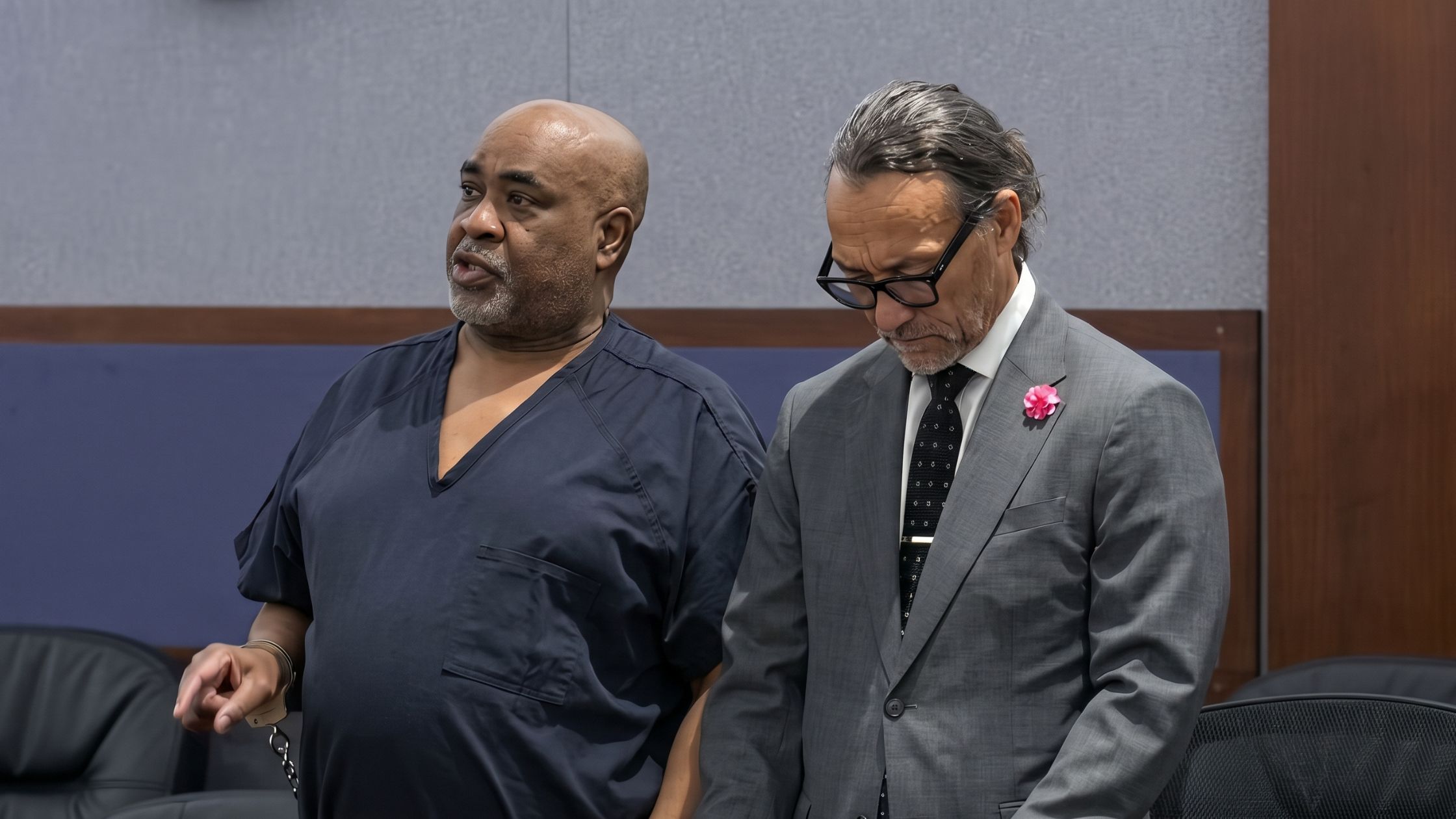
All right, we are on record in State versus David, C377407. Mr. Davis is present in custody with Mr. Sanft. We also have the state appearing through Mr. DiGiacomo. This is the time and date set for sentencing pursuant to a jury verdict.
Michael Sanft (00:33):
[inaudible 00:00:26] don't say anything at all. We still [inaudible 00:00:32] work it out, so just don't say anything at all. Don't give these guys [inaudible 00:00:34].
Judge Carli Kierny (00:33):
All right, Mr. Sanft, is this ready to proceed to sentencing?
Michael Sanft (00:41):
Yes, Your Honor.
Judge Carli Kierny (00:42):
Any Stockmeyer issues?
Michael Sanft (00:44):
We had informed the court of a couple different issues with regards to the PSI in this matter. First being that the law that is quoted as the charge information on the first page of the PSI misquotes the actual penalty with regards to Mr. Davis as Mr. Davis' offense was in 1996, prior to the modification of the law in the early 2000s. We also had informed the court that under the aliases in this case, one of the things we had talked about during the course of the trial and one of the things I had emphasized in closing was that the first name Keefe spelt on the jacket that was found in the home of Mr. Davis was spelt a certain way, and the other spellings, including the name that's on the book, is not listed as an alias, which would've been located under the aliases found on page two of the PSI.
(01:44)
We had also informed the court with regards to the dates of the criminal history that under the May 5th, 1988 indication here that he was arrested on that date, that that is inaccurate, that that was the date that he was actually released from his previous case that was dated on 6/29/1986. And that finally, in terms of his credit for time served, there has been a miscalculation in terms of his credit. And we had informed the court that it's in 700, and I can't remember the last part.
Marc DiGiacomo (02:18):
31.
Michael Sanft (02:18):
30 days. Yeah.
Duane Davis (02:20):
No, [inaudible 00:02:21].
Judge Carli Kierny (02:20):
Okay. Taking those matters in turn, I agree that the charge range is incorrect in the PSI. However, I don't believe that it rises to a Stockmeyer issue. To be clear, this offense was committed in 1996. In 1995, truth in sentencing started, which mandated that there be an equal and consecutive deadly weapon enhancement. And so if the court were to impose anything but the law that was in place in 1996, which mandates an equal and consecutive deadly weapon enhancement, it would be turned back by the prison. So I do agree that that is incorrect. However, I don't agree that it rises to a Stockmeyer violation.
(03:02)
As to the alias and the release date error, I don't find that those rise to the level of Stockmeyer issues as well as they will not affect his classification or ultimately affect the court sentencing or understanding of his criminal history. So at this point we will proceed to sentencing, but I will note those objections for the record.
(03:21)
Yes, sir.
Duane Davis (03:25):
I got 1,111 days.
Judge Carli Kierny (03:25):
A lot of those days, Mr. Davis, did go to the other case that you served time on. And I know you're rolling your eyes at me but that's how-
Duane Davis (03:31):
I was in here for this case. I was in jail for this case.
Judge Carli Kierny (03:34):
Right.
Duane Davis (03:37):
They let that man out to attack me. That's wrong.
Judge Carli Kierny (03:39):
I understand that's your position. However, legally speaking-
Duane Davis (03:42):
My position? That's true.
Judge Carli Kierny (03:44):
I understand that's your version. However, the law says that I cannot credit that towards your sentence. All right. At this time, the state has retained the right to argue given that this was a jury verdict.
Marc DiGiacomo (03:59):
Yes, Judge.
Judge Carli Kierny (03:59):
State, you may be heard.
Marc DiGiacomo (03:59):
And I wasn't actually going to make much of an argument because the nature of this sentence is such that whatever sentence that the court imposes on Mr. Davis, he is guaranteed, assuming he gets no relief anywhere else, to die in the Nevada Department of Corrections. But as I was thinking about it, I actually though that's kind of wrong of me. And that's because when you look at sentencing, it's not just about the consequences of what happens to a defendant. A sentence from a court has more meaning than that. It has more meaning to these people that are sitting behind me. It has more meaning to the public. And I don't want to go into it very much, but when you look at sentencing, the first thing you look at is the harm that was committed here.
(04:58)
And there has been a lot of publicity about the world losing Tupac, but those letters that were sent to you that you read, those strike at how much pain this man's actions have caused to them. And it's not just what you hear every day in a courtroom. This is a uniquely painful situation for this family. It's not just about losing a family member. It's not just about knowing that the perpetrator is out there, because that happens in the justice system and there's nothing we can do about it. But it is unique in the criminal justice system for somebody like Mr. Davis to inflict continued punishment on him from 2018 till 2023, publicly grandstanding in the death of Tupac Shakur. Their pain is something that is unique to the criminal justice system. And for that, he doesn't deserve the minimum sentence.
(06:02)
What else do you look at? You look at the person who committed the crime, and let's look at him in 1996. He's a five time convicted felon. He is the head of a violent street gang in Compton. And by his own admission, by his own admission, he's the one who gives the order. But more importantly, what pain happened after that? I mean, we all kind of talk about it as like a legend, the 10-day war in Compton, but those were real people. That was a real six-year-old that caught a bullet in that war. And the amount of violence that existed, that stemmed from this particular act, the death of another rapper that stemmed from this particular act had wide-ranging effects upon the world and individuals just like them, other family members that suffered from his actions. And so that means he doesn't get the minimum sentence.
(07:05)
And you know what? He was a young man back then. I consider the early 30s, maybe he was 29, 30, 31, somewhere in that range, right? He's old for the criminal justice system, but he's still a young man. And you would expect that he'd grow up. And then you listen to him on those jail calls after being indicted for murder.
(07:29)
And I know Mr. Sanft has said publicly about, well, everybody sort of has blood on their money from this case, the documentarians, everybody. I mean, theoretically, I wouldn't have a job if people didn't die, so there's blood on my money. He wouldn't have done this pro bono if he didn't want something from this as well. So there's blood on all of our money, but there's one exception that Mr. Davis that I think needs to be identified. He's the only one who's trying to profit off a killing that he committed. And for that, he doesn't deserve the minimum sentence.
(08:05)
And honestly, there is no difference really from 40 to 100 to 40 to life as it relates to Mr. Davis. After being a five time felon, before he gets arrested, he picks up two more felonies and now he's a seven time felon. Then after being arrested for murder and being in our jail, he gets convicted again of another felony. And now he's an eight time felon sitting before you on this crime perpetrated upon this family members, these family members, brothers. And you have to ask yourself for this crime, for this person, what sentence does he deserve? And whatever your decision is, ultimately in my mind, he deserves the maximum possible sentence because he's earned it through his actions, his behavior and who he is as he stands here today. He 100% deserves the maximum possible sentence. And I'll submit it to the court.
Judge Carli Kierny (09:13):
Who will you be calling for your victim speakers? Of course they'll be allowed to speak last.
Marc DiGiacomo (09:16):
The brother and the sister of Mr. Shakur. Sekyiwa and Mopreme Shakur.
Judge Carli Kierny (09:18):
Okay. Sounds good.
(09:24)
Turning to you, Mr. Sanft.
Michael Sanft (09:29):
[inaudible 00:09:30].
Duane Davis (09:29):
I just want my stuff back they took out my house. Just want all my stuff back. All them pictures, that photo log, that my daughter's.
Judge Carli Kierny (09:43):
Okay. Anything else you want to say?
Duane Davis (09:44):
I just want my stuff back. What?
Judge Carli Kierny (09:44):
Anything else you want to say?
Duane Davis (09:46):
No, I'm good. I'm going to appeal this case, for sure.
Judge Carli Kierny (09:48):
You've told me.
Duane Davis (09:49):
Okay.
Judge Carli Kierny (09:49):
Okay. Mr. Sanft, turning to you.
Michael Sanft (09:52):
Your Honor, look, typically my standard response on a case where you have a jury verdict is that while we respect the jury's verdict, we understand that as right now we're ...
Michael Sanft (10:00):
While we respect the jury's verdict, we understand that, as of right now, we're disappointed, but we are going to be seeking appellate relief. And I wouldn't say anything more than that, because typically there's not much more to say. My concern here is when the state tells to the court that from the time of 2017 to the time of 2023, that my client was profiting off of the death of Tupac Shakur. The problem that I have with it, in terms of representations made, is that, as the court recalls in the evidence that was proven or shown during the course of the trial, that in 2017 they had information, but yet the district attorney's office didn't do anything with it. In 2018, they developed information, but they didn't do anything with it. 2019, 2020, 2021, 2022, 2023. And you know what the problem is with it on some level is when we turn around and say the family has suffered, we all agree the family has suffered.
(11:03)
But to put that onus back on Mr. Davis to say, "Okay, we want him to have the maximum sentence," in this case, I think is a disingenuous argument made by the state in this matter when they are the ones who purposely delayed. They could have very easily taken this case to the grand jury in 2017. So to turn around and say that somehow it's his fault that they waited from 2017 to 2022, I think is a disingenuous argument. Now with all that being said, Mr. Davis does understand that he's looking at significant time. He has expressed to the court his desire to appeal. We are going to appeal this case. I just want to make sure that we're clear with regards to representations made, because the one person that should have been here to testify on this case, Detective Mogg, would not. There's reasons for it.
(11:48)
The state has turned around in interviews that they have had with other people indicating that they strategically, after my opening, said, "I'm not putting up Detective Mogg on the stand." I think that leads to a problem and here's the problem. The district attorney's office should be here for the truth, regardless of which way it goes in terms of the evidence, in terms of the investigation. But what we do instead is now we're having the game. And the game is, we don't like the fact that the detective that's going to testify in this case was not doing his job. So we are going to retract that away. I think that's a problem. But once again, I would not have said anything but for the fact that the state comes up here and says from 2017 to 2023, the victim's family suffered. That's disingenuous. And I'm just asking the court in this particular case that he understands he's doing 40 years on the bottom, that it's just a 40 year to a hundred-year sentence and be done with this.
(12:44)
Thank you.
Judge Carli Kierny (12:45):
Thank you, Mr. Sanft. State, at this time, you can call your victim speakers.
Speaker 2 (12:54):
And Judge, I've shown these to Mr. Sanft. They had some family photos that we didn't want to file in the record.
Judge Carli Kierny (13:00):
Okay. Just for the court.
Speaker 2 (13:00):
[inaudible 00:13:01].
Judge Carli Kierny (13:06):
Of course. All right, ma'am, we're going to have you sworn in.
Court Clerk (13:09):
You do solemnly swear the testimony you're about to give in this action shall be the truth, the whole truth, and nothing but the truth, so help you God?
Sekyiwa Shakur (13:15):
Yes.
Court Clerk (13:16):
May I please have you state and spell your first and last name for the record?
Sekyiwa Shakur (13:20):
Sekyiwa Shakur.
Court Clerk (13:25):
May I have you spell it?
Sekyiwa Shakur (13:26):
S-E-K-Y-I-W-A S-H-A-K-U-R.
Court Clerk (13:34):
Thank you.
Judge Carli Kierny (13:35):
Thank you, ma'am. And what did you want to tell me about the impact that this crime has had on your life, which I'm sure has been immense?
Sekyiwa Shakur (13:44):
Thank you for hearing us out. Your Honor, when you ask about that, asking me about the impact of my brother's life, I feel like you first have to know what he meant to our family. My brother was born an icon. He was born a legend. My mother fought for his life while she was herself on trial facing 365 years in prison. While she was on trial and on bail, she wanted to leave something behind in case she got the time. She was 22 at the time. She went against her husband, against everything she knew to conceive this child.
(14:46)
She fought the courts to feed him, to get nourishment. And after she was acquitted, one month and three days later, Tupac Amaru Shakur was born. She first named him Parish Lesane Crooks because she was afraid that the government, the state or enemies would try to take him from her while he was in the hospital. So I say we begin with that because my mother's not here to see this day. And she fought for his life since before he was born. She consciously raised him to be a human rights activist, someone to stand up for those weaker and smaller than he was. And that's who he was to me and all of the family. He was the person that you go to for protection, even as a nine-year-old. As a nine-year-old, we lived in New York City in the 80s. He was the oldest of the younger kids in the family and his responsibility was to watch over the younger kids.
(16:01)
When I say watch over, I mean he would take us back and forth to school. We lived in Harlem, went to school at Lower East Side, had to take two trains, two buses and walk plenty blocks every single day, him being responsible for the five kids younger than him. And he did that. He never stopped.
(16:24)
He's not only my brother four years my senior, but he's also my father figure. He was the man in my home. He was charged with being the man in the home. He was charged with being the person to be responsible and take care of me, to keep me out of trouble, to pull me off the street corners with my friends when I was past my curfew. He was his responsibility to make sure I ate. And it wasn't just me, again, everybody in our immediate family, our extended family, and as we got older, our community as a whole. So, when you take the protection from a young woman, I was two weeks before turning 21 when he was murdered.
(17:23)
My children was 18 months and nine months, which already tells you that the responsibility that he had on his plate, just from me alone. He was paying all of the bills, all of the rent, all of the food, clothes for at least, I've counted them, 17 different families at the age of 25. And he had started that when he was 17, 18. When he began his career, and I was in New York going to school, separate lives, he sent what he could every single month. He sent my aunt $50 a month in the beginning just to contribute to the household that his sister was living in. To me, that's an amazing example of a 20-year-old, of a 19-year-old.
(18:24)
My son was six months when he died. His father, his uncles were in that car procession that night. My younger cousins was in that car procession that night. My little brother was in that car procession that night. And none of these men in my family were the same again. That day, the loss of Tupac, for a long time crippled my entire family emotionally and mentally. I've been hospitalized multiple times for depression, suicidal ideation and trauma, PTSD. The family that... As we was raised, like I said, he was, of the men in our family, and I finally had a child, which meant my son wouldn't have had to grow up the way the other men in my family did without having an elder man to...
Sekyiwa Shakur (20:00):
My family did without having an elderly man to support them and guide them, and that was taken away. Both of my children were raised in my grief. So they have trust issues, abandonment issues, relationship issues, because the first 10 years of their lives, I really couldn't get over the loss of my brother, Tupac. But Yafeu Fula, who was also in a car and back, was my godbrother and was murdered two months after Tupac died. So again, this day, this night of hunting and murdering, who I know to be a prince. This may sound weird, but I say all the time that I can believe in Jesus, I can believe that Jesus existed because I know someone who I can describe in the same way that Jesus has described.
(21:28)
For me, he has put his life on the line many times to protect others. He dedicated his career to the advancement of his people. He was gentle and kind to women and children. He fed anyone he knew that didn't have. He was truly my shining star, my shining prince. He was who God trusted to take care of me. My mother had two children and God gave me to him and him to me as he's supposed to be my life partner. He's supposed to be who I can go to when I needed advice when growing up. I'm now 51 and I spent 30 years without my protection. I believe that if any life matter, if all life matters, for sure, this man's life mattered. He died two months after he turned 25, not just 25, but just turned 25. And where would we be if Malcolm X died at 25, Martin Luther King died at 25, John F. Kennedy died at 25? He had so much promise, intention, intentions for a better world for our people. He had plans, he had manifestos. And actually, he had a theory that if he can get the world to fall in love with him, that comes from the gutter, that comes from the same streets that our other Black men come from, that gets judged and get looked at like they're demons and villains because we survive the streets that we come from. He had a theory that, "If I can get people to fall in love with me and respect me when I know I look and I move just like my brothers and sisters in the street, then maybe one day they'll stop seeing them as animals and villains and demons and they can see love for them as well."
(24:10)
It was hard sitting, listening over and over and over again to someone describe bit by bit how they hunted Tupac Amaru Shakur down and killed him with his body laying in the gutter. He's so much more than street father. We now, our family, we have now found two new brothers, long lost brothers since his passing. And it's painful that they don't have the relationship or the stories. It's painful that I know I truly feel like if they were around, they would be a better example of a big brother for him and he wouldn't have had to stray into the friends that he had.
(25:41)
But he was worth it. He was worth every ounce. To be loved by him, to be picked on by him was special, to be teased by him was amazing. People ask me often what do I think he would have done, been doing right now? Well, in this final shooting when he was killed, he lost a lung in the hospital. So I always knew he probably wouldn't go back to rapping, but he was such an amazing artist, an amazing actor, an amazing poet and an amazing orator. I truly believe he would have been in government. I feel like, I truly believe he would have already constructed organizations and homes for lost boys and wayward teens.
(26:41)
As a matter of fact, he died on a Friday and that Monday he had an appointment to adopt one of the young people that was in his group. This group, these entourage, it's not entourage for him. The ones they weren't entourage, they were family and he treated them like family. Their mothers trusted him to protect their children. And this is a 25 year old and he was 22, 23, he was younger than 25 when these mothers trusted their sons with him and he honored that. He was a wonderful human being. I have suffered through my pain, but time goes on, to quote him, and everybody grows. And so I've grown up through it.
(27:46)
Well, who would I have been able to be if my protection was still here? I would have still been able to be a baby girl who would have been softer and lighter. My children and I would have had more happy days than growing up. My mother would have been able to enjoy the fruits of her labor, the fruits of her work, this man that she brought into this life and she protected. Tupac and Yafeu were very similar, I always say, to John Connor and Sarah Connor. She treated him like it's like you are the one that's going to change the world. And he believed her and he believed her and he went out into the world to do that. And I believed he would have done it. I believed he would have done it with all his mistakes, whatever mistakes he's ever made, he has done so much more to become a better man to each day, each mistake or each blunder. I don't even want to say mistake, but blunder. He was so focused in it and being some, not even a...
(29:09)
He was cocky. He did have a big head. He did think he was Black Jesus. He did think that everything that has happened actually, the way that we know Tupac today was exactly his plan. He wanted to have a bobblehead. He wanted to be known in Africa. He wanted to be... This was his plan and he would have done such good work with that platform. I miss my brother. I do, I do, I do. I miss his skin. I miss his scars on his head. He had a strawberry on his chest. I miss the way he ate. I miss his recipe of barbecue chicken. I miss his laugh. He laughs so sloppy. He-
Sekyiwa Shakur (30:00):
He laughed so sloppy. He was sloppy when he laughed. He laughed so full and so big. We lost something. Our whole generation lost something huge September 13th, 1996. I was the little sister that just wanted to be with my brother. I just wanted to be with my brother. I want to go. I want to go with you. I want to go. Why can't I go? And that walked me into all of my suicide attempts. I'm grateful that I've made it out. I'm grateful that I've learned lessons.
(30:52)
My first day, the first time I went to a hospital in Arizona. It was a beautiful place. I wish that my brother knew the tools that I was able to learn around trauma and around carrying old wounds and how to heal them. He deserved to walk around feeling better than he did. He deserved to not feel like he had the world on his shoulders. But my guy, he did a great job in those 25 years. And I'm just proud, proud, proud, proud to have been cared for by him. You'll see the pictures. Just about all of the young people you see in those pictures was probably in that entourage in that car. He kept those same young boys with him. He kept his promise to them and to their mothers.
(32:04)
Today, he's still feeding families. I mean, so many families. He was ... my mother named him Tupac Amaru after the Inca chief, Peruvian Inca chief, who was also a human rights liberation activist as a leader. And she named him in the hopes that he would follow in those same steps. And again, he did. He would've been the promise of all of our grandparents. I think that's all I have to say. I do believe that when you take a life like that, you deserve every minute, every minute of the maximum amount of punishment, time to sit down and contemplate what you've done to this world, not just to me. Thank you again.
Judge Carli Kierny (33:11):
Thank you so much for sharing all of these stories with your brother. This isn't the side that we got to hear during trial, so I appreciate it so much that you were willing to give this to us and I can see how much his love has shaped you. I am so sorry you lost him in the way that you did.
Sekyiwa Shakur (33:25):
Thank you very much.
Judge Carli Kierny (33:53):
Thank you. All right, sir, we're going to have you sworn. Please raise your right hand.
Speaker 3 (33:56):
You do solemnly swear the testimony you're about to give in this action shall be the truth, the whole truth, and nothing but the truth, so help you God?
Maurice Shakur (34:03):
Yes.
Judge Carli Kierny (34:03):
Thank you. May I please have you state and spell your first and last name for the record?
Maurice Shakur (34:09):
Maurice Shakur, M-A-U-R-I-C-E S-H-A-K-U-R.
Judge Carli Kierny (34:16):
Thank you so much, sir. What did you want to tell me about this crime and the impact it's had on your life?
Maurice Shakur (34:23):
The impact from my brother's murder has been devastating, heartbreaking and sad for me, my family, and the nation of Pac fans and loved ones. Pac didn't get a chance to have any kids. Pac didn't see his nieces and nephews grow up, and Pac didn't have a trial. All Pac got was a death sentence. So the longest possible, Your Honor. Thank you.
Judge Carli Kierny (35:10):
Thank you so much for being here.
(35:21)
Any other victim speakers?
Speaker 4 (35:22):
That's it Judge.
Judge Carli Kierny (35:23):
Okay. Thank you, Mr. Shakur.
(35:26)
All right, Mr. Davis, for three years, I've heard you say some variation of the same thing to law enforcement, to BET, in your book. And it's something like, "Yeah, I was involved in this, but I'm different. I've moved on. I got out of Compton. I'm a grandfather now." I'm here to tell you that's not how this works, okay? You don't get to take a man from his family. You don't get to take his very life, his whole future from him and just walk away from it, especially when that man is Tupac Shakur. The world never forgot about him and his death, and neither did Las Vegas. It took us 30 years, but at this time, you are going to face justice for what you did on September 7th, 1996. In accordance with the laws of the state of Nevada, you're hereby judged guilty of first degree murder with use of a deadly weapon, a felony.
(36:16)
Going to impose the $25 administrative assessment fee, $3 DNA collection fee, $150 DNA fee, as well as the test. As to the first degree murder portion, you are sentenced to 20 years to life. As to the deadly weapon enhancement, you are sentenced to a mandatory consecutive 20 years to life. The aggregate sentence is 40 years to life. You have 731 days credit time served toward that sentence. You are hereby remanded.
Speaker 5 (36:41):
Thank you, Judge.
Judge Carli Kierny (36:42):
We'll be in recess. Thank you everyone.
Speaker 4 (36:43):
May I approach and get the picture?
Judge Carli Kierny (36:46):
Yeah.
Speaker 5 (36:46):
[inaudible 00:36:54].
Mr Davis (36:46):
[inaudible 00:36:54].