Senator Hoeven (05:31):
The Ag Appropriations Subcommittee to order and want to begin by thanking Secretary Brooke Rollins for being here today. We appreciate it very much. Of course, today we're going to talk about the appropriation for next year on behalf of our incredible farmers and ranchers. Thanks to our network of family farms and ranches across this country, we have, I think, on the order of 16 million people are involved either directly or indirectly in agriculture.
(06:03)
And unlike many industries, it's not just a few big businesses, it is a family based network of farms and ranches, something that I believe the American people very much want to keep in place, not only because our farmers and ranchers produce the highest quality, lowest cost food supply in the world that Americans benefit from every single day. Every American benefits from every single day, but I truly believe that in this country, we are dedicated to that network of family farms and ranches because it really is about the strength and vitality of rural America.
(06:48)
I mean, think about it. That is the bedrock of rural economies, small communities across our whole country, and it's diverse. Think of agriculture in California versus in Louisiana, my state of North Dakota, New Hampshire. It's incredibly diverse, but for all those reasons, and then ultimately because food security is national security.
(07:15)
And so when we talk about farm policy, and of course, all the things you do at USDA, and we talk about how we're going to fund that, it's just incredibly important. And it touches every single American every single day. And sometimes we take it for granted. I think it's kind of like when you come in the room, you flip the switch, you expect the lights to go on. We expect that same thing with our food supply. And it's not just food, it's food, fuel, and fiber. Again, brought to us by this amazing industry, this ag industry, and the way we have it here, family based. And we want to keep it that way, and we want to work very hard to bring the next generation in, right? I mean, it really is not only about sustaining the network we have, but bringing that next generation into farming and ranching as well.
(08:04)
I want to thank you secretary up front for recognizing that, for working very hard on it, for traveling the country and getting out there and talking to folks across the country that are involved in agriculture. And of course, recognizing that we needed the Farm Bridge Assistance, the 12 billion that was provided, working with us, working with the administration, working with President Trump to make sure that that 12 billion was there to get our farmers and ranchers through a really tough time where they have high input costs and low commodity prices.
(08:33)
And in the Working Families Tax Cut Act, we did provide enhancements to ARC PLC and crop insurance, which our producers will see this year, but the marketing year, ag marketing year doesn't end until October, so that they don't see that enhanced ARC PLC until that October timeframe. So that Farm Bridge Assistance is incredibly important, and we've got more to do there. And I know you've said that, Madam Secretary, and we look forward to continuing to do more on that Farm Bridge Assistance.
(09:06)
One other thing I want to bring up before we dive, before I turn to Ranking Member Shaheen, and we dive into the numbers and the budget is I want to thank you for coming to North Dakota last year and then for supporting and working with us on precision ag and really for your incredible initiative on ag technology, ag tech, and developing the proving grounds, including us at Grand Farms and issue and with our tremendous ARS office out there, but recognizing ...
(09:39)
And under Secretary Scott Hutchins said it very well when he was out in North Dakota not too long ago, and that is how do we help our farmers and ranchers be more profitable? And so when we talk about ag tech and these test sites or proving grounds and that kind of thing, it is about making our farmers and ranchers more profitable so they're around for the long haul. So we keep this network of family farms and ranches and so we get that next generation in to carry on this great legacy. So again, thank you for being here. And with that, I will turn to Ranking Member Senator Shaheen.
Senator Shaheen (10:15):
Thank you, Chair Hoeven. And thank you, Secretary Rollins, for being here today. And we're still hoping we're going to get you to New Hampshire. As you know, farms in New Hampshire are very different than farms in North Dakota, and so we would love to have a chance to show you what we are very proud of in New Hampshire, the agriculture that we practice there.
(10:37)
I believe that all of us in this room can agree that this is a challenging time for farmers and for ranchers as Senator Hoeven laid out. Our producers are facing rising input costs, stubborn commodity prices, export market uncertainty, and a rapidly changing climate, including new pests and diseases that we're seeing in New Hampshire and across the country. Families in rural America are not immune or shielded from the affordability crisis that so many are facing, from housing to energy costs, to the difficulty in starting and operating a small business. But rather than put the focus on these challenges and working to provide certainty where producers and communities are otherwise subject to so many forces outside their control, I remain concerned by the ways that the administration is instead injecting chaos into the system.
(11:29)
Over the last year and a half, we have seen scores of canceled grants, including for programs that were helping small producers build out local supply chain infrastructure. We've seen haphazard tariff regimes, which have driven up food prices. We've seen major changes to keep programs like the Section 502, Single Family Housing Direct Loan Program without notice and comment opportunities that people usually expect. And now we have a war in Iran, which is driving up the cost of fuel and fertilizer.
(12:03)
And through all of this, I remain concerned about what I'm hearing from farmers and communities in New Hampshire. Concerns about USDA's staffing capacity. What we're hearing too many people say is that they are walking into empty or near empty offices that USDA has occupied in the past. And I was disappointed to see that rather than tackling these challenges head on, the president's fiscal year 2027 budget request doubles down on many of the cuts that were proposed last year, cuts that this Congress put money back in to support.
(12:41)
The proposed budget, I believe, once again, misses the mark when it comes to advancing critical research, including core capacity and agricultural station funding at our land grant universities like the University of New Hampshire, protecting vital nutrition programs, particularly for pregnant women, children, and seniors, and restoring key staffing capacity that has been lost over the last year. Most notably, the institutional knowledge in field offices in the granite state and across the country.
(13:12)
I hope that we'll be able to discuss during this hearing the Food for Peace Program as well, and other international programs that USDA runs and that this budget proposes to eliminate. What is clear, as I said, is that this budget fails to meet the moment. I hope we can once again reject it on a bipartisan basis, because there are still plenty of places where we can work together to deliver for our farmers, for our producers, and for rural America. Again, I appreciate you being here, Secretary Rollins, and I look forward to our discussion. Thank you, Chair Hoeven.
(13:50)
Actually, if I could just add one more thing before I close, because while it's not under the jurisdiction of this subcommittee, it is under USDA, and I want to register my strong opposition and concern about the plans to close facilities at the Bartlett Experimental Forest in New Hampshire, where they have been collecting data for about a hundred years. With that closure, that data is going to be lost. Our experimental forests conduct critical research that supports healthy forests and bolsters local economies, and I hope USDA is going to reconsider and reverse course on this plan, because I think it's going to set us back when it comes to forest management. Thank you.
Senator Hoeven (14:33):
Thank you, Senator Shaheen. And with that, Secretary Rollins will turn to you for your opening statement.
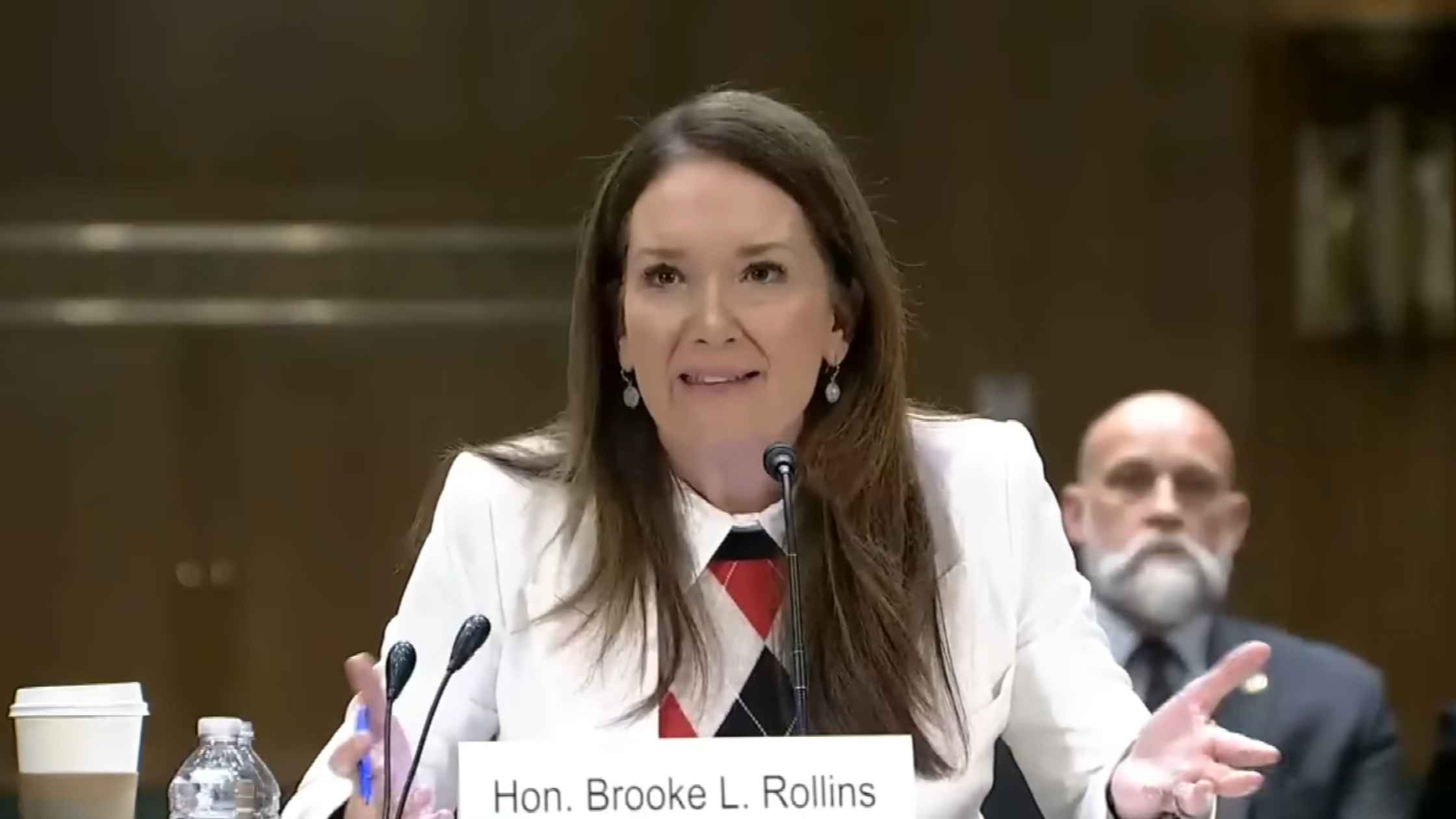
Brooke Rollins (14:39):
Well, thank you. And I'll just say first, I look forward to working with you. I've kept a list of all of this, so I really appreciate it. Chairman Hoeven, Ranking Member Shaheen and distinguished members of this subcommittee, first, I must apologize for my voice. I'm in the middle of a lot of allergies and I so apologize, but I didn't want to cancel on y'all and we'll just suffer through it together. So I apologize at the front end, but I think we'll get to the end of this. Again, I appreciate the opportunity to provide an update on the Department of Agriculture, the challenges that we've inherited, what we've accomplished so far, and where we are heading under President Trump's leadership, and the opportunity to be back in front of so many of you, friends and partners in this effort to revive, restore rural America, and certainly at the heart of that, our agriculture system, our farmers and ranchers. We have not been shy about noting that the administration, when we came in a little over a year ago, inherited a farm economy that saw the cost of doing business skyrocket. Commodity prices had plummeted from 30-year highs in the last administration. Farm income experienced historic declines and our farmers saw no new trade deals in four years and inherited a forecasted $50 billion US agricultural trade deficit after leaving just four years before with an agricultural trade surplus.
(16:06)
While we've already made substantial progress in reversing this trajectory for American ag, I want to acknowledge that such a seismic reroute cannot happen overnight, which is why it is so important that our work continues, because food security remains a matter of national security and it's been a pleasure being able to partner with all of you on both sides of the aisle as we have continued this important work this last 14 months.
(16:35)
We are providing our farmers with the short-term support that they need through our Farmer Bridge Assistance Program and others. In just the last year alone, we have delivered tens of billions of dollars in targeted direct relief to farmers, farmers who are weathering rising input costs, devastating storms and temporary market disruptions.
(16:56)
President Trump and our congressional Republicans delivered unprecedented wins, the largest investment in rural American history under the working family's tax cuts. This included an increase in reference prices for the first time in over a decade. Senator Hoeven, I remember our little meeting last spring when we talked about, is there even a possibility to include a lot of this in the One Big Beautiful Bill?
(17:22)
And thanks to your leadership and our president's support, you were able to include those reference price increases, improving crop insurance by enhancing coverage and lowering premiums, making the death tax exemption permanent for over two million family farms, permanently doubling the small business expensing under Section 179 and authorizing. There's just a few wins, authorizing $50 billion for a new rural health transformation program now run by Dr. Oz.
(17:50)
Input costs, of course, remain top of mind for our farmers. And recently, USDA has been working literally around the clock to harness the cost of key inputs like fertilizer, certainly what has happened in the last 45 or 50 days. The Trump administration has already taken a whole suite of actions to make fertilizer more affordable and available. We are working across the cabinet to accelerate private investment, to lift permitting slowdowns, to align on transportation challenges, lifting the Jones Act, opening up lines from Venezuela, and much more to be announced very soon.
(18:28)
These are meaningful actions in the short term, but we are also working on a long-term strategy, and that has really been ... The spotlight that has been shined on these input costs recently has allowed a larger conversation than normal about the importance of reshoring our fertilizer industry and certainly our domestic supply chains for our agriculture, including amplifying new technologies and ensuring farmers will continue to have secure accessible options when any crisis heads our way.
(19:01)
I'm confident we will meet this challenge because of how USDA has successfully managed other challenges in the last 14 months. Senator Baldwin, we were just speaking about eggs before the hearing began and HPAI. One of our very first actions at USDA a year ago was launching a comprehensive $1 billion plan to combat avian flu and bring egg prices down. That plan is working. HPAI cases in commercial poultry and turkey flocks are down 61% over this time last year, and the number of birds affected are down 46%.
(19:36)
Now, we still have a lot of work to do, but we are making progress. Of course, the price of eggs has plummeted as well. We have also made substantial progress to protect our livestock producers from the New World screwworm. Just Friday, I was in South Texas to break ground on an historical New World screwworm, new sterile fly production facility in America. For decades now, we've relied on a facility in Panama and some facilities in Mexico, but it was time that we, again, reshore the solution to these challenges for our livestock producers. And so we are doing just that at warp speed. We broke ground and we expect this new facility to be phase one to be up and running by the end of next year, again, something that normally would take three to five years.
(20:23)
Through America First trade policies, President Trump has made sure our farmers can compete and win in global markets. We have already secured in just year one alone, 18 reciprocal trade deals and frameworks that level the playing field and lay the foundation for long-term prosperity. After inheriting a nearly $50 billion agricultural trade deficit in year one for Trump two, with no new trade deals under the last administration, we are now looking ... The data is showing that, that agricultural trade deficit will be slashed by 42% in year one of our second term alone.
(20:59)
Looking ahead, we will continue to build on this momentum, improving foreign market access for our producers and addressing the remaining agricultural trade deficit. Of course, that's in combination with the battle to open up the domestic markets for our biofuels producers as well.
(21:16)
In partnership with Secretary Kennedy, USDA is carrying out the most significant reset of federal nutrition policy in American history. Our new dietary guidelines are science-based and entirely devoted to ensuring that American producers, our farmers and ranchers are at the forefront of providing affordable nutrient dense food to American families.
(21:40)
It's important to remember that USDA's biggest line item by far are our 16 nutrition programs where we spend more than $400 million every single day. This work and so much more is highlighted through our partnership and ensuring across the federal government that we're doing everything we can to ensure that those who truly need the programs have access to them, but those who are part of a fraudulent effort to take from our taxpayers and to take from those who are most needy. Currently, an effort being led by our vice president continues to be a priority for us at USDA.
(22:16)
From day one, I have said nonstop and certainly with you, Senator Hoeven in North Dakota, that farm security is national security. Last summer, we launched our National Farm Security Action Plan that boldly integrates agriculture into the federal government's national security strategy for the first time ever. Our plan treats the ownership of farmland, it treats animal disease defense, and it treats food supply chains as major national security issues that they are. And we continue to work with our congressional and state partners on these issues.
(22:54)
I'll close by saying this. Our farmers, ranchers, and our rural communities not only feed, fuel, and clothe us, they bear and sustain a set of values that make our very way of life possible, and that is required to pass on liberty to future generations. It is an honor to fight for these indispensable patriots every single day alongside President Trump. And as we celebrate our 250 years of freedom, all of us at Abraham Lincoln's People's Department will continue fighting as hard as we possibly can for the men and women who help make our very freedom possible. Thank you, and I look forward to your questions.
Senator Hoeven (23:31):
Thank you, Madam Secretary. And we'll now turn to five minute rounds of questioning. Something that you emphasize, and I appreciate very much in terms of the vitality and the future of agriculture, value added agriculture, ag tech, as I mentioned before, precision ag, and then access to markets. All those things, I think, are things that our farmers and ranchers want and that will make them strong now and for years to come, and that market-based approach is really important.
(24:03)
Right now, our ranchers are doing better after a long down cycle. They suffered for a long darn time, and people forget how tough they've had it. And as they work to grow their herds, they've actually increased the amount of meat per animal, such that we're actually close to record production. I think we hit record production in 2022, but we're still very close to it.
(24:24)
And so not only will they grow the herds, but they're producing more meat per animals while we need to keep that in mind, and they will respond to the market and they're doing an incredible job. And it's good to see them getting back on their feet after one of the longest down cycles I've seen in cow calf operation.
(24:43)
Our farmers, on the other hand, are not. I know you're very focused on it. Again, appreciate the Farm Bridge Assistance Program, the 12 billion we provided through CCC. And again, thanks to your willingness to be innovative, creative, and work with the administration and President Trump, that's how we got it done. I want to thank you for that.
(25:03)
We need to do more there. And so there's two aspects. One is, I firmly believe that in a supplemental, along maybe with weather assistance, maybe some funding for the military, that there needs to be an ag piece there. I want your thoughts on that. And then also on the CCC, which has been a vital, vital tool. And as you know, I feel that we need to increase it and update it. And I believe you do too, I'll let you speak for yourself on it, but that is a vital tool, not only in terms of the Title I commodity programs, which it funds which, of course, we've updated our PLC, which is going to help our farmers now, but that's the mechanism through which it's funded. But then it also has a big role to play in terms of the other assistance we've provided, like Farm Bridge Assistance, but also conservation other things as well. So if you would, kind of reference both, what more we do on Farm Bridge Assistance and your thoughts on CCC.
Brooke Rollins (25:57):
Yeah. Thank you for that. And so first, the importance of moving this assistance out and certainly carving out that additional 12 billion that we released on December 6th of last year with the President in the cabinet room and focused on that, I think was helpful. I agree with you. I think there is more to do. And you and I have certainly spoken about that and I have with many members of your committee. And I personally don't want to speak on behalf of the administration, but personally would really appreciate the opportunity to ensure that we do have additional funds available, especially as we are facing some unforeseen consequences of the conflict overseas, especially with some of our input prices.
(26:39)
So I think as these numbers continue to shake out, and it's a day by day dynamic, certainly set of numbers, but I think those conversations are really important. And your leadership and this committee's leadership and focusing on our ag community, again, it is a matter of national security. And there's so much we could talk about in that, the consolidation of so many of our industries, the purchase by foreign interests of a lot of our agriculture is all part of this, but being able to support our farmers and ranchers in America and making sure they can continue what they do best is a priority. So that's the first part.
(27:14)
The second part on the CCC, as you know, under the One Big Beautiful Bill, the Working Families Tax Cuts Act, there were a lot of new commitments that were made for agriculture, and that was welcome and certainly part of our list as well, but as a result of that, the CCC has become frankly committed, perhaps over-committed as we look to a new round of payments and borrowing against that limit for this year as we move toward this fall.
(27:44)
There are also some other potential significant projects that need to be looked at. I'll be announcing a couple of those in the next few days. In fact, I think I'll be in Wisconsin on Monday, Missouri on Friday to talk about some of this. So I personally
Brooke Rollins (28:00):
... And have been on record as saying, I think it's time. It's been what? 30 years since the last time we increased the limit of the CCC, and we would certainly welcome that at USDA.
Senator Hoeven (28:09):
Yeah. I think that's right on. And I would emphasize that that's very bipartisan, that is a tool that has been used by both parties. And I get that the priorities may be a little different from time to time, but that's reality. What's good for the goose is good for the gander. And I think this committee tries to be bipartisan. And so as we approach that issue, I think we need to be mindful of that. So thank you for your comments. Senator Shaheen.
Brooke Rollins (28:34):
Thank you, Senator.
Senator Shaheen (28:35):
Thank you, Mr. Chairman. Secretary Rollins, more than 12,000 women, infants and children in New Hampshire rely on the WIC program for healthy food, for breastfeeding support, and for nutrition education. You pointed out how much money we spend on food programs in this country. We know that nationally 53% of babies born in the country are served by WIC, ensuring that they have the nutrition they need to get through to age five. And one of the most important parts of the WIC program is the cash value voucher, which allows participants to afford the cost of fresh fruits and vegetables each month. Yet, the FY27 budget request would reduce WIC's cash value voucher back to 2014 levels, providing only $13 a month for pregnant breastfeeding and postpartum women, and only $10 a month for children when adjusted for inflation.
(29:33)
Now, I know you've been to the grocery store lately as I have, and that $10 or $13 isn't going to buy very much fresh fruits and vegetables these days. So help me understand these proposed cuts to benefits given the administration's stated MAHA goals or the recently updated dietary guidelines for America that would encourage Americans to eat real food. So can you support fully funding the WIC program and including the cash value voucher program?
Brooke Rollins (30:07):
Senator, thank you for that question. And what I will say is a lot of the focus and the reason the President was elected in 2024, 2025, was Americans sincerely believed that the government and government programs had just grown too large. And I want to answer your question directly on WIC, but I just want to provide the framing for that. And so what we were tasked with as the leads of his agencies was to do everything we could to realign the federal government in putting the taxpayer and the taxpayer dollar to its best and highest use. Having said that, under the Biden administration, the infusion of funding into WIC was a 200% increase under the 4 years of Biden, 200%.
Senator Shaheen (31:04):
I understand-
Brooke Rollins (31:05):
That's just not sustainable.
Senator Shaheen (31:07):
... Out of time. And I don't want to discuss what the Biden administration did. I want to discuss-
Brooke Rollins (31:12):
But that's what we're rightsizing.
Senator Shaheen (31:13):
... Amount of money that is being talked about for the cash value vouchers for fruits and vegetables, which I believe is too low.
Brooke Rollins (31:22):
Well, and I think certainly we could have longer conversations on that, and that's a reasonable position to have. We are taking it back to pre COVID levels, adjusted-
Senator Shaheen (31:32):
... Is earlier than pre COVID levels.
Brooke Rollins (31:34):
Pre COVID, the rates $9 for children, $11 for moms, adjusted for inflation. And again, all of these programs are also, they're also available through the food stamp program, through the SNAP program, et cetera.
Senator Shaheen (31:47):
As we know under the Big Beautiful Bill, the food programs have been reduced as well. So the SNAP program has been reduced. The number of people who qualify have been reduced. And yet what I hear in New Hampshire when I go home and New Hampshire is a relatively high income state. We're a small state. And yet what I hear is that we have more and more need for food assistance because people are still food insecure.
(32:12)
Keeping on food, I want to go to the foreign assistance programs because I was disappointed to see that the FY27 budget request eliminated the Food for Peace Program. It eliminated McGovern-Dole Food for Education Program. Now, I have appreciated very much the ... Senator Hoeven and I have worked under Secretary Lindberg on the Food for Peace program. He was very responsive. I'm glad that the FY25 awards have finally been signed and we understand that food will begin to move through the pipelines again soon, four months in to this new calendar year and way into the fiscal year. But can you assure us that regardless of where the administration stands on the future of Food for Peace, that if this committee continues to provide funding for it in FY27, as I think we will, do you commit to continuing the program and fulfilling all of the statutory requirements of Food for Peace, including those outlined in the interagency agreement?
Brooke Rollins (33:19):
Yes. Clearly, if it is funded, anything that is funded from this committee and this Congress, we will absolutely step up and do the very best we can to ensure that we're meeting every metric that has been given to us. And I think we've proven that with the Food for Peace Program and Under Secretary Lindberg has been a real leader on that, I believe, as it's moved over to USDA.
Senator Shaheen (33:40):
Well, as you know, given the other constraint that farmers are struggling under to eliminate this market for them would also be a significant hit. Thank you, Mr. Chairman.
Brooke Rollins (33:51):
Thank you, Senator.
Senator Hoeven (33:52):
Thank you, Senator Shaheen. Now, Senator Moran, you're next, but I'm wondering, would you be willing to defer to Senator Collins?
Brooke Rollins (34:00):
It's a tough question.
Jerry Moran (34:08):
Certainly at this early point in the [inaudible 00:34:13].
Senator Hoeven (34:12):
Senator Collins. Thank you, Jerry.
Susan Collins (34:16):
Thank you very much, Mr. Chairman. And thank you very much, Senator Moran. That was very gracious of you. Let me start by thanking the Secretary for taking an action that we have been pushing for for many years, and that is the establishment of the Office of Seafood at the USDA for recognizing that our fishermen, our lobstermen and women are farmers of the sea.
Brooke Rollins (34:46):
That's right.
Susan Collins (34:47):
And I'm very appreciative. This is something that has been needed to be done for years to help with everything from disaster assistance to marketing opportunities, and I am delighted that you have brought it about.
Brooke Rollins (35:05):
Thank you.
Susan Collins (35:06):
So I start with that thank you. And I do want to point out that the Ag Appropriations Bill includes funding for you to establish a seafood industry liaison and hope to see that happen next.
Brooke Rollins (35:21):
That's great.
Susan Collins (35:23):
Thank you.
Senator Hoeven (35:24):
Will they be technically ranchers then?
Susan Collins (35:29):
Farmers. We'll stick with farmers.
Brooke Rollins (35:32):
Senator, I will say that I remember we talked about this when I came to visit you during the nomination process, and I never forgot. And we kind of touched base a few times over the last 14 months. I didn't understand why it hadn't been done in the past. It seemed so clear to me that was the right thing to do. And we had some fishermen. I'm so sorry you couldn't be there last week when we launched it, but we had some fishermen from your state, so gave you a lot of credit for getting to that point and your leadership and focus on that. So thank you. It was an honor to get to do it.
Susan Collins (36:00):
Well, thank you for getting it done. There was another issue that you and I discussed early on, and I know have a common concern about, and that is the impact of PFAS, the toxic class of forever chemicals that are being found in our soils, water, animal feed, crops, and livestock. This is having a detrimental impact on agricultural producers. In Maine, the presence of PFAS and wastewater sludge spread decades ago as a fertilizer. We're here, the farmers were trying to help out the municipality in which they lived, but the result is preventing some of our family farmers from being able to sell their products, such as milk, for example, causing them significant financial harm. The University of Maine has undertaken research that is relevant to the presence of PFAS and how to remove it. I've been pleased to support this important work by securing nearly 33 million over the past 5 years for the Agricultural Research Service at the University of Maine to establish a new center of excellence for PFAS solutions. Madam Secretary, I know this is something that's near and dear to your heart and that your mother has been very involved in this issue as a legislator as well, so that you're very familiar with it. I simply will ask that you continue your support of this partnership between the ARS and the University of Maine.
Brooke Rollins (37:57):
Yes. Thank you. And I know Maine is sort of the hub for the research, for the leadership. It's in large part due, well, probably primarily due to you, if not entirely due to you, Senator. And certainly as we discussed, my mom, who is the oldest freshman state legislator in Texas history, maybe in American history at almost 80, she ran and won for the first time, and she's known as Hurricane Helen in Austin because of this issue. And she certainly has been following in your footsteps, a pioneer. So yes, I am fully supportive and we'll do whatever I can to make sure we're making sure our farmers and ranchers have what they need on that.
Susan Collins (38:36):
Thank you. I love your mother's role in this, and I know that she cares deeply about it and is making a real difference. I want to switch quickly to other issues. One is that the budget has cuts in rural development. That is extraordinarily important to my state, which is one of the most rural in the entire nation. It helps to provide access to safe and reliable water and wastewater systems, telecommunications, broadband connectivity, housing, and so much more. So I was disappointed to see that the President's budget request has major funding cuts to several rural development programs, which follows other changes such as handbook revisions, creating significant restrictions on home loans. What is your plan for ensuring that rural Americans continue to have access to programs that rural development has traditionally funded?
Brooke Rollins (39:52):
Yeah. I will respond a couple different ways. First, obviously my boss, the President and our OMB is very focused on, again, realigning the government and making sure every dollar that is spent is spent in the best possible use. Having said that, I agree with you that our rural development programs are key. We have talked at length about the importance of returning prosperity to rural America. Having grown up in a town of 1,200, raised by a single mom, I can attest firsthand to the importance of these programs. So finding that balance is what we're looking toward. We did inherit in rural development a 25% default rate for the loans that were pushed out. Certainly in the last administration, there was a lot without any guardrails on. So trying to rightsize that at the same time, that we are righting the budget is a big priority, but understanding that there are really important programs that need to be supported through these programs.
(40:56)
So as I have hopefully for the last 15 months worked with each of you, when you have something that pops up, something specific, my promise is to continue to do that and to keep sending us feedback as well on these programs.
Susan Collins (41:08):
Thank you. And finally, very quickly, specialty crops are very important in Maine, whether it's our wild blueberries, apples, potatoes, and they've had a hard time lately. Our wild blueberry crop and our apple producers were affected by an excessively rainy spring that prevented pollinization from occurring, and then they were hit with a drought in the summer and fall. A lot of times the disaster assistance programs are really tailored for row crops, and they're not easily accessible for specialty crops. There was some money set aside, but frankly, it's not enough. So I would simply ask you to commit to work to ensure that our specialty crop producers have this backstop that is needed to overcome conditions not of their making, not of their fault, but which have a truly detrimental effect.
Brooke Rollins (42:28):
Yeah. If I could ... Three very quick things on this. First of all, we are almost at the finish line for the specialty crop block grant for Maine. I know we've had 19 meetings with your team from your state. We got the work plan about a month ago. We are literally about to be able to deploy those funds. That's the first thing.
(42:47)
The second thing I'll say is in Missouri on Friday, I'll be announcing some tweaks to the SDRP program, and they're tweaks specific to specialty crop producers. If you're a blueberry grower, you don't have the same paperwork that a corn or wheat farmer does. And so that has been what I've learned is that has been to the detriment of these specialty crop growers. They don't fit into the box of applying for these programs. So we've got, I think, a really good announcement on Friday to adjust for that and to create some more bandwidth there, which again, I don't want to get too far ahead of the announcement. We're still finalizing all the details.
(43:26)
And then the third thing on the one billion that we did carve out from the Farmer Bridge Assistance in December of last year, we announced, and we are moving through the specialty crop deployment of that funding right now. We got word, we closed the portal to start figuring out how to deploy the money. And then I got a call from Senator Slotkin actually from Michigan, another big specialty crop state. And she said, "Brooke, my guys didn't even know how to apply. This is such a new day for them." So we reopened the portal for another 30 days and deployed more resources to help the specialty croppers be able to apply for these programs. So again, I realize we have a long way to go, but I do think we're making some progress.
Susan Collins (44:06):
Great. Thank you.
Brooke Rollins (44:08):
Thank you, Senator.
Jerry Moran (44:09):
Thank you for allowing me to show-
Senator Hoeven (44:10):
Thank you Madam Chair. ...
Jerry Moran (44:10):
... My deference.
Senator Hoeven (44:14):
I knew you would want ...
Brooke Rollins (44:15):
Such a gentleman.
Senator Hoeven (44:16):
I knew you'd want to do that Senator Moran.
Jerry Moran (44:18):
I'm usually [inaudible 00:44:21].
Senator Hoeven (44:21):
Yes. Senator Merkley.
Jeff Merkley (44:25):
Thank you very much, Secretary Rollins. And for decades, we have successfully partnered in Oregon with USDA's Agricultural Research Service. I visited a number of these research stations on dry wheat and grasslands. And we have berries, we have a horticultural ... Because we have so many diverse products coming off our acreage in our state. So what I've been concerned about is that I keep hearing from our Oregon producers that our crops are in jeopardy because research positions remain unfilled. And just to give you an example, the horticultural crops, disease and pest management, which does like all this different stuff, fruits and flours and vegetables and ornamental plants, the whole kind of breadth of the horticultural world, they lost their plant pathologist a year ago and the position hasn't been filled and they're also missing administrative officers, lab technicians. And so the scientists don't feel they have the technical support to be able to address the huge variety of threats that are coming from every direction, invasive species and so on and so forth. Can we fill, can you fill these positions quickly?
Brooke Rollins (45:52):
Yes. And why don't we get in touch with your office and if I can get those specifics, I've just written them down, but let me get more information and we'll prioritize that.
Jeff Merkley (46:01):
Great. We'll get you all the details on that. I appreciate that. And then you have amplified and emphasized the importance of research across the department, but the budget proposes reductions that include the elimination of the Forest Service research. Now, our state is a very forested state. We have a lot of different types of conifers, 20 plus different types, different slopes, different dry land, wetland species, different challenges on mitigation of pests. But just to give you an example, one threat is Sudden Oak Death, and Sudden Oak Death is a big threat as it moves. It's kind of a waterborne mold that's moving up from California. We've been trying to control it, but there's a variation of it that is a threat to the Douglas fir. Wow, that's a massive concern for our forest world. And so do you really want to eliminate the Forest Service research or can we persuade you to support that research?
Brooke Rollins (47:11):
Well, I believe what you're talking about, and correct me if I'm wrong, is under the President's current budget that moves, it isn't eliminating it. It's actually moving it over to ... And sorry, I didn't prepare as well for Forest Service because I didn't realize we were going to be talking about it, but my understanding is we're actually not getting rid of it. We're just moving it over to the Department of the Interior. So we're aligning all of the research on all the Forest Service-specific programs. But let us look into that, if you will. My directive, as USDA has gone through its reorganization, moving the Forest Service more to a state-based effort, ensuring that the people that are serving the forests are the ones that are closest to the forest, not necessarily here in Washington, that nothing has been eliminated. We're only realigning and recalibrating to get it closer to the people that it serves, and frankly, the forest that it serves as well. But let me dig into that and I'll circle back.
Jeff Merkley (48:07):
Okay. Well, you did mention an issue I've been more broadly concerned about. I'm hearing about it from people all over Oregon, and that is the movement ... Well, there's two things. It's the restructuring of the Forest Service in general, and the move of headquarters to Salt Lake City, the move of research headquarters to, I believe, to Colorado, because we have outstanding research done in our Oregon forests. Every little town was a timber town, and so it's kind of in our blood, in our culture, and so we've had just world-class research, and we're really worried about losing that. BLM does have forest lands, but the bulk of the forest lands are Forest Service lands. So I would hope that if the research is being moved, maybe hold a dialogue with the stakeholders-
Brooke Rollins (49:06):
100%.
Jeff Merkley (49:07):
... Before making that decision to move it.
Brooke Rollins (49:10):
Yes, sir. Again, my understanding is there should be no change to anything in Oregon. The whole goal is to move all of the work closer to you, not to take it away from those that are closest to the forest. So hopefully this is actually additive to that project and that program in Oregon, and that forest specifically, that we'll be able to actually maybe even do a little bit more there. That's the goal.
Jeff Merkley (49:37):
And that's why I want to have the stakeholders embedded in the conversation to make sure that it is a win and an advance and not something that ... A reduction. And my time's out. So I'll just mention that we are worried about the transfer of the firefighting out of the Forest Service. And again, would like to see a bunch of consultation to make sure that it's done ... Reorganizations in a fashion because the forest fires are brutal in the West.
Brooke Rollins (50:07):
No, agreed. And I think you have been part of it. I'll start the calls again with our key senators as we move into fire season. I do them weekly and several of ... It's obviously bipartisan from people from the west, lots of the senators from the ag committee are on, but I'll make sure you have an invitation to that too where Doug Burgum and I get on and we just talk to you guys on exactly what's happening, where, how we're moving resources around what that looks like. To your point, I'm not sure I've ever been more impressed with a group of people than the U.S. Forest Service wildland firefighters. They are an extraordinary group of patriots who do a remarkable job. And we had a, I don't want to say a good fire season. No fire season is ever good, but we had a much less destructive one last year than we have in a couple of years. And hopefully we're able to track for that again this year in the coming years.
Jeff Merkley (50:57):
Thank you.
Brooke Rollins (50:57):
Thank you so much, sir.
Senator Hoeven (51:00):
Senator Moran.
Jerry Moran (51:00):
Chairman, thank you. Secretary, welcome. It seems when you're in the room, it's like family and I think Kansas farmers and agriculture producers feel that way as well. I want to follow up on a topic that Senator ... I want to talk about five things and I'm going to try to do it very briefly because I noticed that you're taking notes and I want to have all five on your notepad.
Brooke Rollins (51:18):
Make sure I'm writing them all down.
Jerry Moran (51:19):
Thank you. And the topic that was raised by Senator Shaheen, I continue to believe that Food for Peace, the national home for that program is at USDA, and I'm going to continue my efforts to permanently transfer that program to your department. In the absence of that transfer, I appreciate the arrangement that was made between USDA and the State Department. I know in January it was announced that USDA planned to buy 200,000 tons of commodities for the Food for Peace program. There's a lot of Kansas ties to this Food for Peace program, and you're partnering with World Food Program to send it out. I think that was done, I'm pretty certain it was done with FY25 funding. You now have FY26 funding, and I presume, assume that you'll have FY27 funding. Can you tell me what the next step is to make certain that food is in the places it needs to be and that hungry people are being fed? What needs to happen that's not happening?
Brooke Rollins (52:20):
My understanding from Undersecretary Lindberg and the team that's been working on this is obviously there's always going to be a little bit of clunkiness as we're moving things around, but that ultimately the team feels confident. They're happy to accept the program. We have a really good group of people working on it, fewer numbers than were working on it before, but seemingly it is working. If you were hearing different, please let me know and we'll work to solve for that.
Jerry Moran (52:44):
I appreciate that. And I'd have a shout-out for Secretary Lindberg for his leadership in this project.
Brooke Rollins (52:50):
He's been great.
Jerry Moran (52:51):
Glad to see this take place. I still would like for you to join me in Kansas, and I want to show you and let you see for yourself the National Bio and Agroscience Facility in Manhattan, Kansas. The Agricultural Appropriation Bill required, and first of all, I guess I should say that there are impediments to NBAF coming fully online and taking over the mission of Plum Island, the Animal Disease Center, but you spoke to this last year and indicated that USDA was working hard to accomplish this. Secretary Vaden has been with me in Kansas, and I appreciate you supporting that visit. This is the largest federal investment in Kansas in our history, $1.25 billion, and we have a significant asset that needs to be operational as quickly as possible, and that's for reasons that we wouldn't want to be wasting those dollars and those personnel, those people with expertise. But also Plum Island managed by the Department of Homeland Security is set to close in short order, and we wouldn't want a gap between that time and the capability of NBAF to doing its replacement to do that job.
Brooke Rollins (54:08):
Correct.
Jerry Moran (54:08):
So you were required in the FY26, not you personally, but the Department of Agriculture to provide a joint briefing between USDA and Homeland Security to this committee in regard to this process. That hasn't happened, and I would guess it's because of the shutdown at the Department of Homeland Security, but I would highlight for you that in the absence of that, I'd love to have a conversation, you and I personally about that, about NBAF. And I'll restate my invitation for you to see, but I'd like to be able to personally impress upon you the value of this asset.
Brooke Rollins (54:43):
I would welcome that. And I have touched base with the new Secretary Mullins on this, and once the DHS is back up and running, he's ready to go, so we'll get that scheduled. Yeah.
Jerry Moran (54:54):
Fertilizer production and fertilizer prices. As you know, the American Farm Bureau indicated that 70% of farmers are unable to afford fertilizer that they need this season. On Tuesday, you stated that more details would be forthcoming on USDA's work in the fertilizer space. Anything you want to share today?
Brooke Rollins (55:17):
I don't want to get ahead of any finalization. What I will say is we've had daily calls with the White House, with EPA, with DHS, with DHS, with Commerce, with Treasury, the very top of these organizations for an all of government approach on fertilizer. Obviously, the short term issues are acute and really require significant effort as we work to bring those prices down for the short term. As I mentioned in my opening remarks, the long term though cannot be overlooked. The fact that we have offshored so much of our fertilizer over the last decade or so is
Brooke Rollins (56:00):
It's astounding to me. It is a national security effort issue and we're relying on Russia and China for our fertilizer. So the announcements coming, I think, will be on both the short and the long term, but really good news long term structurally and some potential funding that's going to be there. And I've been talking to the heads of the big fertilizer companies as well.
Jerry Moran (56:22):
It is hugely significant. The price is dramatically different. And I would indicate that we've asked the folks at the Department of Commerce to look at tariffs that are placed on input issues, commodities that come from outside the United States, Morocco, for example.
Brooke Rollins (56:41):
Right.
Jerry Moran (56:41):
And we have American fertilizer producers, but some of the components in which they use to make that fertilizer are subject to tariffs increasing the price.
(56:51)
So we want to manufacture process and create fertilizer in the United States, but we still have to import some of the components that make up that fertilizer.
Brooke Rollins (56:57):
Correct.
Jerry Moran (56:58):
So there's an opportunity there for that to occur. I have two more points, which I will only mention and then talk to you in person. Only one. 45Z and sustainable aviation fuel.
(57:09)
Please make certain that we have an opportunity to have a conversation about another renewable fuel that could advance the cause of profitability in agriculture. Thank you, Secretary.
Brooke Rollins (57:20):
I'm honored. Thank you, Senator.
Senator Baldwin (57:24):
I believe I'm likely next.
Brooke Rollins (57:27):
It's been waiting very patiently.
Senator Baldwin (57:28):
Okay.
Madam Chair (57:30):
Senator Baldwin.
Senator Baldwin (57:31):
Thank you. I always love it when there's overlap in our questions. And I want to say that Senator Moran, both his last point, but also the longer question before was exactly where I wanted to start.
(57:43)
I'm not going to have you repeat what you were saying to him. I'm listening with interest about announcements that might be forthcoming. So feel free to answer it for the record later.
(57:58)
But I just want to reiterate that I too am hearing from my farmers and our agricultural industry about their struggles with the Trump administration's tariff policies and trade wars, input costs from fertilizer to farm machinery and fuel.
(58:15)
But rising fertilizer costs are top of mind right now. And I hear from farmers back home routinely about this. The war in Iran is driving up the cost of fertilizer and fuel, and farmers are heading into the spring planting seasons facing significant financial strains.
(58:37)
So as I said before, I want some assurances that the administration is taking this very seriously. But as you just said to Senator Moran, you have some forthcoming announcements. If you can get back to me also-
Brooke Rollins (58:51):
Sure.
Senator Baldwin (58:51):
... with that information, my farmers need relief emphatically.
Brooke Rollins (58:57):
Yes, ma'am.
Senator Baldwin (58:57):
Secretary Rollins, this is not the first time that you and I have talked about the Dairy Business Innovation Initiative.
(59:06)
Last February, Trump's DEI executive order froze funds for the Dairy Business Innovation Initiative, funds that were already appropriated. I sent a letter to USDA, then you and I spoke on the phone to restart these already committed payments.
(59:26)
Given the valuable investment that this program provides for dairy farmers and the bipartisan support behind it, I was disappointed to see that the administration proposed eliminating the Dairy Business Innovation Initiative for fiscal year 2027.
(59:44)
Can you explain why the USDA wants to eliminate a program that so many American dairy farmers and rural communities benefit from?
Brooke Rollins (59:54):
Senator, I will need to look into that and get back to you. Do you know which, was that under the RD budget? Do you know specifically what budget that was under? Because that's the first-
Senator Baldwin (01:00:06):
Under the ag marketing.
Brooke Rollins (01:00:07):
Oh, under AMS. Okay. Okay. Yeah. Let me look into that and get back to you. Obviously, we have been working around the clock on the dairy opportunities, whether it is putting whole milk back in schools. The dairy exports are expected to be up 17% this year.
(01:00:24)
I've actually visited six dairies in the last year and will continue to do so. So my commitment is to look at that very, very closely and make sure that if it is important, you and I have discussed it before, that that program continues to receive the support it deserves.
Senator Baldwin (01:00:41):
Okay. I will look forward to that. This past December, Wisconsin had its first confirmed case of highly pathogenic avian influenza in dairy cattle. This spring, Wisconsin lost over 4.3 million hens and two farms had to lay off 87 employees between the two.
(01:01:08)
The public health response has been expensive for American farmers and American taxpayers. The response from this administration has been lacking, and it seems like this administration continues slow walking its own approach for a vaccine plan.
(01:01:26)
So Secretary Rollins, I have written you twice since December about the pressing urgency of the outbreak, and I asked you to deliver on your pledge to address avian influenza by following through on nationwide vaccination policy.
(01:01:42)
Well, I do appreciate your response that I received at 1:00 PM today to my letter.
Brooke Rollins (01:01:49):
Gosh, I'm sorry. We're going to do. We're doing better. We're going to do better, I promise.
Senator Baldwin (01:01:53):
To get it before the hearing. I still don't feel confident that the administration is taking the vaccine policy seriously. So what updates on deploying these vaccines can you provide us today?
Brooke Rollins (01:02:05):
Well, if I may, Senator, the first thing I'll say is I'm going to gently push back that we haven't taken it seriously. I'm not sure other than the screwworm that I have spent more time in the last 14 months on any one issue than I have on HPAI.
(01:02:17)
And in fact, I've been in touch with all of your governors, all of your ag commissioners. We put a billion dollars into this effort a year ago. We spent about 450 million on biosecurity as we're working on the vaccine question. And we have 100 million dollars. We have an innovation grant challenge. We've got about 80 different private sector partners that are looking to move out on that. We've already awarded the funding. I mean, all of this is moving very significantly with good news coming.
(01:02:44)
As I mentioned, the HPAI numbers are significantly down this year because of the biosecurity. 61% down in cases, 46% down in birds. The vaccine question is one I take very, very seriously. In looking around the world, there hadn't yet been a vaccine that had been deployed successfully, that had actually beaten the HPAI back.
(01:03:06)
Having said that, France is in year two. The Netherlands is in year one, and I think one other European country. So now we begin to see some movement around the world.
(01:03:16)
There was some real concern. I've visited several of the labs that are researching this, that if we put a vaccine out too quickly, the virus could mutate, which viruses usually do and jump to humans. So that's why I have been so extremely careful in stepping out on a vaccine and doubling down on the biosecurity.
(01:03:34)
Having said that, we are as close as we have been. We're looking at pilot projects right now. I have not felt comfortable yet deploying that, but as you can see based on funds spent, Senator, we are taking this very seriously and will continue to do so. That's my promise that.
Madam Chair (01:03:53):
Thank you, Senator Baldwin.
Brooke Rollins (01:03:54):
Thank you.
Madam Chair (01:03:55):
Senator Rounds.
Senator Rounds (01:03:59):
Madam Chair, thank you. Feels good.
Madam Chair (01:04:04):
Senator Hoeven's coming back, is a hearing.
Senator Rounds (01:04:06):
First of all, Madam Secretary, first of all, thanks for being here today.
Brooke Rollins (01:04:11):
Thank you.
Senator Rounds (01:04:12):
I want to talk just a little bit about a couple of items that we've visited about in the past.
(01:04:16)
First of all, throughout your year in office, you have made eating real food and making America healthy again a priority. I had a very similar discussion yesterday with Secretary Kennedy, and appreciate each of you partnering together on this issue.
(01:04:31)
South Dakota farmers and ranchers have worked tirelessly to produce the safest and the highest quality products in the world. I have serious concerns regarding lab grown cells or cell cultivated products attempting to enter the US food system posing as meat.
(01:04:47)
One example of these experiments takes pork fat cells grown in a lab and combines them with plant protein. This product is sold to consumers at the grocery store as a meatball. Yesterday in our subcommittee, Secretary Kennedy expressed his concerns with the overall safety of these products.
(01:05:06)
My question to you today is on labeling. Do you share my concerns with these ultra-processed lab grown products being labeled as meat?
Brooke Rollins (01:05:16):
100%.
Senator Rounds (01:05:18):
Thank you. If we both believe in truth in labeling, I was pleased to see your administration roll out guidance for the product of the USA label for meat, poultry, and egg products derived from animals exclusively born, raised and harvested. I'll say that again. Exclusively born, raised, harvested, and processed in the United States.
(01:05:41)
As you know, for years, we've led the effort in the Senate to restore integrity to this voluntary label through my bill, the USA Beef Act. My question as a follow-up question to your last answer, Secretary Rollins, do you believe any ultra-processed lab-grown products should ever receive the product of the USA label?
Brooke Rollins (01:06:06):
Absolutely not.
Senator Rounds (01:06:07):
Thank you. And then Secretary Rollins, in order to help consumers have transparent labeling, does the USDA plan to establish a uniform labeling standard for products that are made with lab grown cells so consumers aren't misled?
Brooke Rollins (01:06:25):
I am not familiar with anything happening right now, but if it is not happening, it will begin this afternoon. Yes.
Senator Rounds (01:06:31):
Excellent. I like that answer. That's appreciated. Let me talk just a little bit. In South Dakota, we had a very unfortunate instance where the Maude family, a family farming operation, had a real serious discussion over about 20 some acres of land where there was a dispute on boundary layers.
(01:06:55)
Talk a little bit about your approach with resolving these issues and the way that you want to see the Department of Ag work with our farmers and ranchers, where if there are boundary disputes with the Forest Service and so forth, how do you want to see those handled in the future?
Brooke Rollins (01:07:11):