Brian Kemp (00:11):
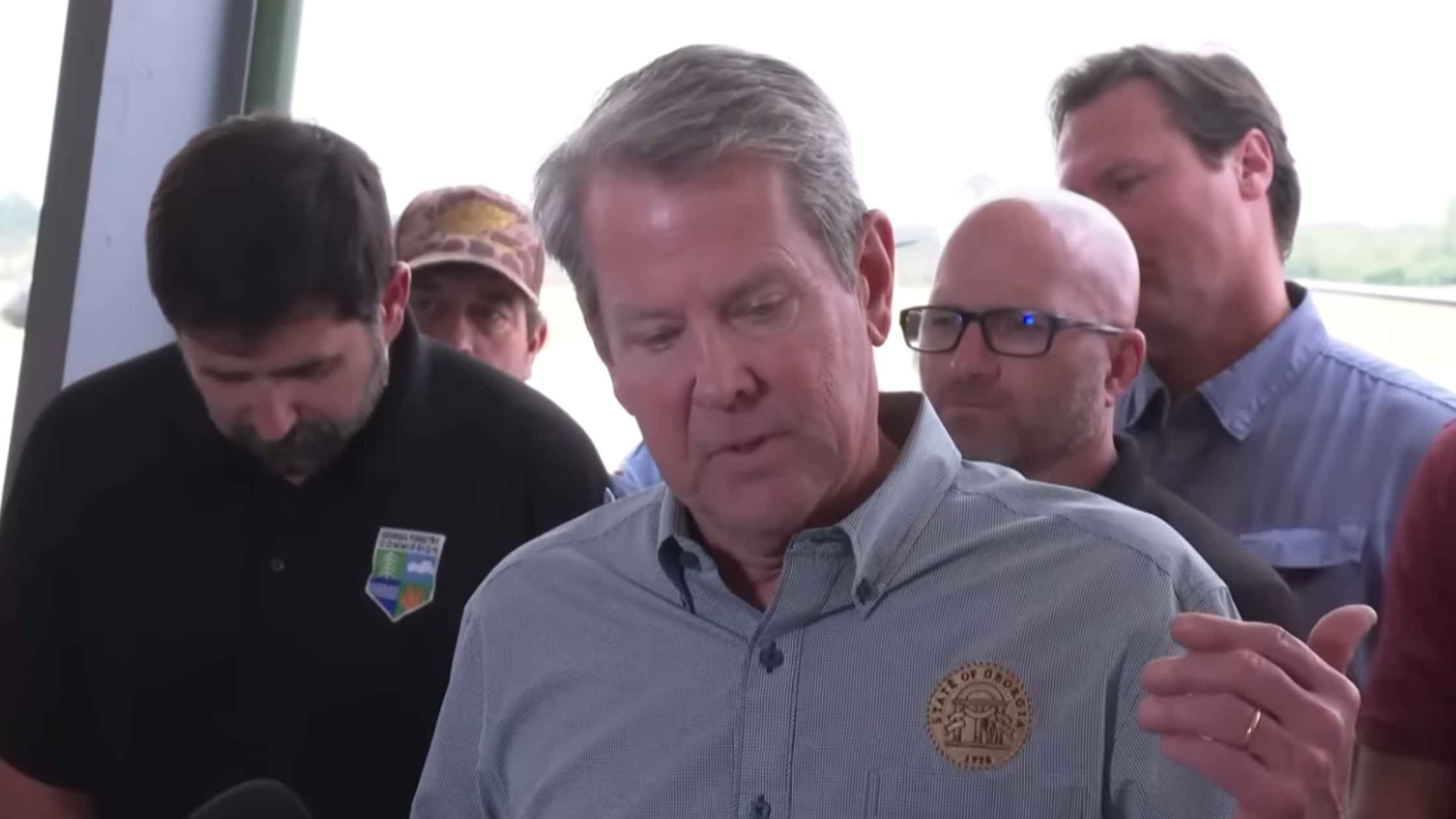
[inaudible 00:00:09] Y'all come over here. [inaudible 00:00:12] Come over here. Y'all come over here so we can [inaudible 00:00:20] All right, well good morning or good afternoon, whatever time it is. Just real quick, I want to let everybody know who we got with us standing behind us and just appreciate all these folks, assets, and things that they're doing. Appreciate the lieutenant governor, Burt Jones, for being here. These are in no particular order, by the way. Our agriculture commissioner, Tyler Harper, Insurance Commissioner John King, Secretary of State Brad Raffensperger, Labor Commissioner Barbara Holmes, many members of the general assembly, and Congressman Austin Scott.
(00:54)
I just want to start by first of all thanking Congressman Scott, President Trump, the folks in the White House, really all our federal partners. We've had a great response for them as well as the locals, so we're very grateful for all the local first responders, sheriffs, police chiefs, law enforcement, fire chiefs, volunteer firefighters. Anybody you could imagine is doing everything that they can to help with these fires, and we are very grateful for their partnership. And from our visit out there just now, you cannot believe how hard these people work, in very tough conditions, but they're doing a great job and we're grateful for that.
(01:32)
So every fire in the United States is measured, so the Fed's working with the states to figure out where to put resources. The two fires that we're fighting, among many others in Georgia, but the Pineland fire and the Highway 82 fire rank number one and two in the country, so we got the two most dangerous, biggest, problematic fires anywhere in the United States within really just a very small area that we're having to fight. So as you can imagine, it's a lot for us to have to deal with.
(02:06)
We've looked at all the records going back historically with the state. We believe that these two fires have created the most lost homes ever in the history of our state. So being the number one and two ranked fires in the country, also the most homes lost ever in a Georgia fire, really shows you just how bad these two fires are. Just an update on the Highway 82 fire, which is in Brantley County, started Monday, April the 20th. A little over 7,500 acres burned. That fire is 15% contained. We believe it was started by a balloon landing on the power line and causing an arc that created the fire. As of right now, there's been 87 homes and/or structures lost to that fire. We have over 800 fires... Can y'all hear me all right? Okay. We've got over 800 homes that are in harm's way right now, and that's what the folks on the ground, one of the things that they're doing is trying to protect.
(03:18)
The Pineland Road fire, over 3,100 acres, is 10% contained. It's been 35 homes lost, and there's about 160 homes that are in harm's way. So we've got a total of 38,873 acres that have been burned or are burning between just these two fires. Unfortunately, fire activity... We'll hold just a second.
Speaker 1 (03:45):
[inaudible 00:04:05]
Brian Kemp (04:11):
Unfortunately, we believe that fire activity's going to remain extremely high throughout the weekend, and really, we need a change in the weather. I was telling Marty earlier, we've got to get her, not only her pray shirt, but a pray for rain shirt, because that's what we need. We need a change in the weather, but until we get that, we're just going to stay after these fires and do everything we can to keep them contained and also protect homes and obviously lives.
(04:38)
We also have Florida, Alabama, and South Carolina that are facing similar issues, so we've been swapping resources back and forth, and obviously resources are getting shared with our neighbors. Director Sabo issued a burn ban for the 91 counties in South Georgia on Wednesday, so that's about from the middle of the state down. This'll run for 30 days unless extended. I would like to add, I know it's aggravating for people not being able to burn debris in their yards and other things, but we just need to make sure to adhere to the burn ban. Any fire that breaks out that we have to go chase, or the locals do, takes resources away from us dealing with these devastating fires that potentially can burn another home. So I would just ask all Georgians to please adhere to the burn ban in the 91 counties.
(05:32)
As you know, I issued a state of emergency for the same 91 counties that'll also run for 30 days. I mentioned earlier we've been in touch with the White House and all our federal partners after Saturday's fire started, and we're grateful for their assistance. FEMA approved a fire management assistance grant for Clinch and Echols County. They also approved a federal incident management team, which is 75 skilled national fire safety team professionals that's helping us with management of the fire. The Georgia National Guard has six air assets able to help with fire suppression. Department of Natural Resources and the response teams are deployed, as well as the insurance commissioner's office. The Georgia State Patrol is providing support with traffic and other things. The Department of Agriculture's doing a host of issues, livestock relocation. Their law enforcement division is here, and many other things. We also have other state agencies involved, the Department of Human Services, Georgia Department of Transportation, Department of Community Supervision, and we have a fire team from the Department of Corrections that's helping us.
(06:43)
So I'm going to call on Director Sabo to come up and give you an update from the Forestry Commission's standpoint and all that his team is doing on the ground. Then we'll hear from Director Lam and General Wilson, and then all the folks behind me are here to answer any questions you may have when we get done. You're up.
Johnny Sabo (07:03):
Yes, sir. Thank you, Governor. My name's... I'll wait. My name's Johnny Sabo. I'm the director for the Georgia Forestry Commission. First, I just want to say our thoughts are with the families and communities that's been impacted. It's not just a number. We understand that this is your livelihood, extremely disruptive for your life, and for that, we are truly sorry, and we are doing everything we can to quickly contain these fires. Also, we recognize that the firefighters, first responders, and partners who have worked around the clock, many just who have not went home, who just stay out on the line and keep fighting, so thank you to them.
(07:47)
We are currently experiencing extreme to exceptional drought. Exceptional is as bad as it gets. There's not a number higher than that. And that has caused our wildfire activity to succeed our five-year average as far as number of wildfires. To put that in perspective, in the last 30 days, we've had over 800 wildfires for 43,507 acres. So most of that acreage is unfortunately Highway 82 and the Pineland fire, but any spark, any spark, chains, grill, is causing new wildfires for us.
(08:21)
As the governor mentioned today, Brantley County's the most significant home loss we have ever experienced in this state from a single wildfire. We've received a lot of questions on what have we done to prepare for this, so I'd like to address that for just a moment. The situation is serious, but for everybody to understand, we have been trending in this direction for a long time, with the lack of rain, drought, fire conditions. Also, Hurricane Helene, the fuel loading that we have seen. That is absolutely playing a part in the Pineland fire, with the increased fuel loading on the ground, and although we've been actively preparing for these fire seasons, there's no way to predict where a wildfire's going to start. Annually, our pre-suppression
Johnny Sabo (09:00):
... Efforts, we put in enough lines the Georgia Forge Commission does to circumnavigate the globe. So on top of that, we have put in over 4,000 lines in the Helene area before these fires started to give ourselves a place to make a stand before a fire starts. We also have a very robust prescribed fire program. That is how we play offense in Georgia to prepare before wildfire starts and have healthy forests. 1.4 million acres of healthy prescribed fire this year. And any of those areas that are burned, that gives us defensible space in these catastrophic times. We also work with communities to have a community wildfire protection plan. So we have those in place in 145 of our counties. And we have 139 firewise communities where we work with homeowners associations to make sure they have defensible space. They're not putting firewood up against your house and just different things like that that help these firefighters when they are having to go in and protect structures.
(09:54)
You've heard this is a coordinated effort with local, state and federal partners. I've never seen anything like it in 22 years of fighting wildland fire as far as just the support from the agencies, governor's office and everybody else. It is, "What can I do to help?"
(10:07)
And I cannot thank everybody behind me enough. Also understand there's a desire to help, but these are extreme conditions. We've received an outpouring of support of, "Hey, I have equipment, I have bulldozers, I have tractors, I would like to help."
(10:24)
Please understand our firefighting tractors are not something you can just go by. They're completely broken down. Every hose, every piece of electrical is wrapped with fire retardant. We have specialty blades that we make, heavy duty fire plows. And then our firefighters are trained to the highest standards nationally. So this is something to where we can't just grab somebody and put them on a line with this erratic fire behavior that we are having. So we do appreciate the support and the outpouring for that.
(10:49)
And I will leave it as... Apologize.
Speaker 2 (10:55):
Just a little bit about the equipment that we got a year and a half ago.
Johnny Sabo (11:00):
Yes, sir. Thank you. I do want to thank our elected officials, they have been extremely supportive. I mentioned that the 4,000 miles of line, that was done with extra funds we received from General Assembly to prepare. Also, increased funds for wildfire fighting equipment. That was roughly 28 tractors that we have received from two years ago. This year, we also received the additional 10 million. Unfortunately, we haven't had time to get those tractors in yet and on the line, but just to continue support. Also, a new helicopter for pre-suppression for us. It has been actively engaged. Unfortunately, it had something fly up and hit the rotor about a week ago. And so our helicopter's out and I cannot thank our partners enough for everything that they're bringing to the table to help us.
(11:46)
I will end it with just thank you for the continued support from the community. It has been tremendous. We have a resource in that has a lot of experience in Western states and he's tied in with our GFC team on the Pineland Fire. And he made a statement to us the other day that he has never seen anything in a country like the support that we're receiving from our local communities right now. So I just want to thank you and emphasize that. And happy to introduce Director Lamb.
Brian Kemp (12:13):
Good afternoon, everybody. My name's Josh Lamb and I'm the director of GEMA Homeland Security. GEMA Homeland Security is actively monitoring the South Georgia wildfires, working with state and local partners and providing logistical support to ensure that resources are available where needed. As Governor mentioned earlier, he's issued a state of emergency that's going to be in effect for 30 days. And what that has allowed us to do is stand up the state operations center at a level two activation. We've currently received coordinated responses to over 68 resource requests from our local partners. That's to include law enforcement personnel, public assistance coordinators, volunteer liaisons, 911 operators, water tenders, water pumps, fire engines, electronic traffic signs, and light towers, just to name a few. We have numerous state agencies on the ground assisting. You heard a few of those from the governor earlier. I'll go through and just give you a quick snapshot of what they're doing, but this is by no means all-inclusive.
(13:09)
The Department of Natural Resources is providing three helicopters with fire suppression capabilities, a D6 dozer for debris removal, two type two water engines along with personnel and gang wardens to assist with evacuations. Georgia Department of Public Safety is providing three helicopters to support wildfire response efforts and is also helping with traffic control and road closures. And they've also provided one of their command buses, which is helping with communications. The Georgia Department of Agriculture is assisting with livestock relocation in affected areas and their law enforcement and EM division has been stood up. They're deployed and assisting. Department of Human Services is working closely with the American Red Cross to assist with children. Georgia National Guard, General Wilson will speak to their efforts in a minute, but they've been a great help. Georgia Department of Transportation has been out providing road barricades and signage and helping us deal with road closures.
(14:03)
Department of Community Services has provided security, traffic control, and assisting otherwise as needed. Department of Corrections has provided inmate firefighting teams, which I've seen out on the roads today. And of course, the Office of Commissioner of Insurance and Safety Fire's here to help with any insurance claims while also trying to fight against any insurance fraud.
(14:25)
So I think anybody that lives in the area that has seen the fire or the smoke plume understands what I'm about to say, but for others that may be a little bit more far removed. You've heard the governor and commissioner Sabo talk about fire safety and how important it is for the burn ban, but I just want to go through a couple of things and for people to understand that we have a lot of resources here now. And if you'll do your part, hopefully we can keep them here, but if you're not, they're going to be drawn away because they're going to have to go deal with other fires. But remember to always stay alert and follow instructions from your local authorities and emergency management. Keep your phones on, keep your alerts on. It can happen quickly. Make sure you got your phone where you can receive your alerts.
(15:04)
Avoid roads around the fire where equipment, trucks, and personnel continue to position and reposition to safely and aggressively fight the fire. If you can stay out of the first responders' ways out there, they're going to better be able to fight this fire and hopefully get folks home even quicker. But do your part where they can do theirs. This is a very important one. Do not fly your drones near wildlife fires as they can ground firefighting aircraft. One of the best tools we have in fighting this fire is aircraft. If people put their drones up in air, that comes to a halt. So let's don't keep these aircraft on ground. Let's keep them in the air where they need to be. Keep a shovel and fire extinguisher ready to use. I talked about your cell phone. We're currently under a burn van. People at home wonder, does that apply to you?
(15:47)
Yes. It applies to you. Don't burn things, nothing. Don't burn anything at all, because like I said, that's going to pull resources away from where we need them, and it's something that could be prevented very easily. Don't use fireworks or anything else that could create a spark. Make sure you dispose of your cigarettes safely and never toss them outside. Don't drive your vehicle on the dry grass or brush. Make sure your vehicle's properly maintained with nothing dragging on the ground. It's all very important and I can't tell you how important it is. We've got to keep those resources in place. GEMA Homeland Security will continue to monitor wildfires and collaborate with local and state officials to assess conditions and determine the best steps forward. Please continue to monitor your Georgia Forestry Commission's updates as well as your local official's instructions. And for more preparedness information, please visit our webpage at gema.georgia.gov or the Georgia Forestry Commission's website at georgiatrees.org.
(16:36)
You can also find additional information and updates regarding South Georgia wildfires via our social media. And one last thing, I'll tell you two things that really stand out to me. One is these first responders that are out fighting this fire. I've been out with them the last two days and the looks of commitment and dedication on their face. I can't think of anybody I would want out there and the team that's on the ground right now because they're fighting with everything they've got to try to get this fire under control. The second is the private community and the donations that have been coming in. It is almost overwhelming the donations that have been coming in and it's a good reminder of all the good that's out there in the world.
(17:13)
But what I would encourage everybody to do with your donations, because there has been such an outpouring of help is coordinated through your local EMA office, and that way they can make sure that it's being coordinated and we get those donations put through as efficiently as we can. And with that, I will introduce General Wilson where he can talk about the Georgia National Guard. Thank y'all.
Dwayne Wilson (17:31):
Thank you, sir. Hey, well, good afternoon. I'm Dwayne Wilson. I'm the Adjutant General of the Georgia National Guard. And so again, just our thoughts and prayers are with this community and this part of the state. The Georgia National Guard, we have a long history of partnering with our local state and our federal agencies to ensure the safety and the security of not only our local communities,
Dwayne Wilson (18:00):
... our state and our nation as well. This operation is no different from anything that we've had to accomplish in the past.
(18:07)
Our soldiers and air crew members are certainly trained and equipped very, very well to be able to do this mission. In fact, I'm a little biased, but you have the best in the nation, best soldiers in the nation right here in the Georgia National Guard. We're using both CH-47 and UH-60 Black Hawk helicopters. To my right, your left probably within 24 hours of the governor's executive order we were down here with the first four dropping water on the fire. And so we're certainly grateful to be able to just be part of this team.
(18:39)
We're focusing on both Clinch and Brantley Counties. Just yesterday, we flew about 20 hours. We're able to drop about 40,000 gallons of water or 310,000 pounds of water on the fire. We've added two more aircraft today, so we have a total of six down here, and I think we're just waiting on this afternoon's missions, and then those aircraft are going to be out doing the same thing, working with our partners, getting after the fight.
(19:07)
Like you've heard before up here, it's just been an outstanding job though so far. Just a lot of collaboration with a lot of great teammates at the local, state, and the federal level. And so our soldiers, they're part of the community. We live here in the communities, and so we're not going anywhere. We're going to be here until we get this thing under control. So just thanks to all of the hard work so far. We're grateful to be part of the team, and I'll be happy to answer any questions at the end of this thing.
(19:36)
Sir.
Brian Kemp (19:36):
Thank you. Well, thank you, General. Just four questions. I'll just end with one quick story of something we saw. Literally, to Director Sabo's point about the training and the kind of equipment we have. Even with all of that, there was an area where we lost a bulldozer, completely burned up, literally right next to this house's yard, probably 100 yards from the highway. But the fire got so hot in the live oak trees, it just burned the whole canopy. And this individual was trying to protect that home and the fire just surrounded him. Thankfully, he got out of there safe. That's the conditions that we're dealing with and it's the conditions that these communities and these families that have lost their home are dealing with too. So I would just continue to ask all Georgians to keep them in their prayers. Also, all those that are on the line and anybody that's working the fire, just that they stay safe.
(20:30)
As far as we know right now, we have had no loss of life. Thank the good Lord for that. With that, I'll open it up for questions. And obviously anybody that's here can also-
Reporters (20:38):
Governor, can you talk about your personal reaction to seeing what you saw out there? And you spoke with the firefighters on the line. How was their morale and is there anything they need that they may not have?
Brian Kemp (20:50):
Well, I would tell you, number one, they're focused because we stopped on the side of the road. Literally, the fire's burning right up to the right of way. There's people hosing down where they were back burning. And I just got out of the truck, Marty and I were shaking their hands and thanking them. And one guy shook his hand didn't even look up and kept going, even know who I was. And a minute later he came back and goes, "I'm sorry about that, sir." But that's how focused they are out there. They are focused on getting this fire put out.
(21:17)
I know they're tired, but they're not going to say that. But you can just see, when you look at them, look at their uniforms and fire suits that they got on, they've been doing this for days and very little sleep. And it's an incredible testament to those hardworking state employees and the forestry commission, but also all the other people that are out working. We got a lot of law enforcement, got our game wardens over here. You can't imagine who all's involved.
(21:45)
But when you pass them and you go see literally a home, there's just nothing left but the slab. And then next door, you had a house that got saved and it was because there was somebody that was able to keep that fire out of there. They just couldn't do it all. Like Director Sabo, I think told me Saturday night, he said, "This fire is so dangerous we were having to pull people off the line." He said, "I don't ever remember us ever having to do that before, but we were worried about their life safety."
(22:16)
But it was incredible to see just how many people are working hard, the outpouring of support. And these people are... I felt like they were fairly motivated. We were going down Highway 110 today. There was an area that they were back burning on the flank of the fire. So they're just trying, while the winds are not real high, to control the flank. And the front of the fire's running on out because you just can't do a whole lot with it, and they're just trying to get it contained on the back end and hope the weather changes or it runs into a river or somewhere where we contain it. But we know we're going to have to fight this for several more days.
Reporters (22:54):
Yesterday, Governor, the Georgia forestry official said in the news conference that we saw this coming. My question is, if we saw this coming, was or wasn't the state better prepared to tackle this fire? And do you feel enough resources were thrown into this firefight with all those homes that were burned?
Brian Kemp (23:08):
Oh, no doubt about it. But listen, you can't... When you have fire that is burning to the top of trees and burning from one tree top to another, it doesn't matter how many fire breaks you got. When you have a fire that's shooting sparks, literally, and Director Sabo can talk more about what they've had to deal with. But we flew over a patch that was a small burned area where you had an ember from a fire a mile away that blew and landed somewhere else. And thankfully they were able to contain that. So there's no way to stop this fire. They're having to contain the flanks in the back of it, and then hopefully we get a change in the weather and run it out for the front. And then we're doing everything we can to save homes, the volunteer firefighters are.
(23:51)
But this is extreme conditions that we're dealing with and extreme fires. I don't know if you have anything you want-
Reporters (23:59):
Governor, you mentioned, I'm sorry-
Brian Kemp (23:59):
You want to add anything to that?
Johnny Sabo (24:00):
Happy to. Yes, sir. So like I said, we were trending in this direction, and we can't ever say we saw this coming or we're going to have a wildfire in one specific place, but even pre-positioning resources around the nation. So the large air tankers that you've seen dropping, we normally don't have these in the southeast, so working with our federal partners to make sure we have some in Chattanooga and in Lake City are two tanker bases that we use. So those were there, here, ready to go.
(24:27)
Anything we can do to be pre-positioned, we have crews scattered all out. Our average response time statewide is 26 minutes from time we get a notification till we're on a fire. That's nights, weekends, and holidays. And so we take this very serious, but at the end of the day, we have an extreme drought and we have extreme fire weather conditions on a normal day without drought that we would be having severe wildfires. So you combine those two, and there's only so much you can do when the fire breaks out. Thank you.
Reporters (24:51):
Governor, I appreciate you talking about the FEMA declaration. Will this become a full disaster? And how does that relate to the victims and the [inaudible 00:25:03]?
Brian Kemp (25:03):
Yeah, I'll let Director Lamb answer.
Director Josh Lamb (25:07):
So a couple things. One, we're still in the middle of this event, so it's a little too early to decide whether it's going to make a major dent or not. We're going to get through the other side of it and be able to do some damage assessment. Take all that into consideration and see where that sum comes out. We were approved for an FMAG, which means we are going to get some reimbursement for firefighting measures. That's something that's unique to the firefighting world, but that's going to just help with those firefighting measures. The major declaration is going to be something that we'll have to work through and get there officially, but we're not there yet.
Brian Kemp (25:48):
We'll just add to that that's also one of the things that Commissioner King's doing. They'll have a whole team down here helping folks with their insurance and making sure they're getting what they're needing out of that.
Reporters (25:55):
And you mentioned the cause of the original fire. Is there a cause [inaudible 00:26:00]?
Brian Kemp (26:02):
Well, we believe that one of the fires started, somebody was welding their gate. Spark fell on the ground, started a fire. They couldn't get it put out and just spread from there. We believe the other fire was a balloon that landed on the power line and created an arc, which then caused the ground on fire. We got investigators that are working on that now. We'll confirm all that later.
Johnny Sabo (26:31):
Georgia Forestry Commission has investigators that investigate arson from a wildfire perspective, and so that is what those individuals are trained to do. And so the Brantley Fire was absolutely a, I don't really want to describe too, but it's like a kid's party balloon that's got that aluminum look to it, landed on the power line, cause a spark and that's what caused this wildfire. So that has been determined.
Reporters (26:56):
Governor, what's your message for evacuees who are watching this, wondering when they're
Reporters (27:00):
... going to be able to go home and if they're going to have a home to go back to.
Brian Kemp (27:02):
Well, I would just tell people to talk to their local law enforcement, first responders, the folks that are on the ground. I mean, when you fly over, there's state troopers, local law enforcement, all kind of folks that are on the ground that are communicating with the locals. That is something else people need to, like if there's an evacuation notice, they need to get out. They don't need to be grabbing things, they need to get out. Because these fires, I mean, I had a guy know that, luckily they didn't lose their house, but they were dealing with a really tough fire. They got it under control. That was yesterday morning. He texted me yesterday afternoon and said the wind shifted and now the thing is about to hit their house.
(27:42)
And thankfully it didn't, but that's how quick things can change, especially right now it's not too awful bad, but in the afternoons when these winds pick up or tomorrow. The other thing is, we've got a chance of rain down here tomorrow, which is good, but it's not a great chance. But also if it is a thunderstorm, we could actually have more fires that we got to deal with because of lightning strikes, then the rain helps us. So that's the kind of conditions we're dealing with.
(28:10)
I mean, the good example is that guy that's like Director Sabo was talking about, this trained firefighter on that dozer. And thankfully he got out alive, but his tractor got burned up. That's how quick things can change.
Speaker 3 (28:22):
Director Sabo, can you talk about how many firefighters you have on the ground? And is there a breakdown between full-time and volunteer?
Johnny Sabo (28:29):
So we are a full-time agency. We don't have any volunteers. I have 524 employees and I have 10 that are still assisting Department of Ag with the timber [inaudible 00:28:39] and 514 that are in fire or fire support. So this is all hands on deck. We suspended any other operation that we are doing and they are all supporting wildfires or fighting fire.
Speaker 3 (28:48):
The local county and municipal fire department is helping as well?
Johnny Sabo (28:52):
Yes, sir. Absolutely.
Brian Kemp (28:53):
One thing I would just add to that, Richard, when we were at this back burn on Highway 110, you had a lot of the forest service guys that were out there too with their trucks after they burned, making sure they're knocking down any hotspots where it doesn't blow up later in the afternoon, jump across the road. But there was all kind of county fire trucks that were out there, water tanks and they're helping them spray in the water. Somebody told me they saw a fire truck from Fannin County that was down here. So then up to the director's point, about how many people are actually helping respond to this fire from all over the state, we just can't thank them enough for that. That's how Georgia is though.
Speaker 4 (29:33):
Is there a single number that people can call or a website?
Brian Kemp (29:36):
Let me get him right here.
Speaker 7 (29:37):
You had mentioned obviously that conditions can change. We were here yesterday during a news conference at 4:30. That's when the [inaudible 00:29:43] of smokes started coming. The chance of rain has gone down significantly from what we were expecting earlier in the week. How concerned are you for the weekend ahead and the next week that if you guys can't keep it contained enough that we could be talking, this could explode to what we're seeing in the Pineland fire?
Brian Kemp (29:57):
Well, I'm hoping it doesn't explode, but I mean, we're dealing with very tough conditions. I mean, I felt like the guys on the front line were pretty optimistic there on Highway 10 because they got a good block knocked out this morning, but there's still an awful lot to do. And I'll let the director talk about the weather this weekend, where we are on the Pineland fire versus 82.
Johnny Sabo (30:21):
Yes, sir.
Brian Kemp (30:22):
And we have actually moved resources. You might want to talk a little bit about that.
Johnny Sabo (30:24):
Yes, sir. So we did shift resources from the Pineland fire over to this fire just with the fire activity that we're seeing currently on Highway 82 fire. But we are extremely concerned through the weekend. It's calling for 20% chance for rain, but strong gusty winds. Something that we measure is called dispersion. That's about a lift. So when everybody sees the column starting to build and get a lot of convection, that's supposed to be really high this weekend. And one thing that I cannot stress enough is even if we receive an inch of rain, these fires aren't even close to out.
(30:57)
One thing that we're seeing on every fire that we have, especially the Pineland fire, is all of our swamps are dry and that soil in the swamp is what we call peat or duff, depending on where you are. And it's 90% organic material and it will burn for months and months and months. So it is going to take inches, I mean, eight to 10 inches before we can walk away from these fires. So we have a very long way to go. Wildfire forecast is for us to be less than average rainfall until July. So we're going to be here for a while.
Speaker 4 (31:28):
Is there a single number people can call if they need help or a website we can direct them to.
Brian Kemp (31:30):
[inaudible 00:31:31].
Johnny Sabo (31:31):
Yup, sorry.
Speaker 5 (31:32):
What was that?
Speaker 4 (31:33):
Is there a single number that, director, that people can call if they need help or a website, a central website we can send folks to?
Speaker 5 (31:39):
The best place to go to?
Speaker 4 (31:40):
Yes, sir.
Speaker 5 (31:40):
Is to go to our website at gema.georgia.gov or to the forester website at georgiatrees.org. Either way, they will get the information they need and then [inaudible 00:31:55]
Brian Kemp (31:54):
And if it's emergency, they just need to call 911.
Johnny Sabo (31:58):
There are a lot of residents without insurance. Is there anything that could be done on the state or federal level? And we talk to people who have zero insurance.
Brian Kemp (32:06):
Yeah. Well, we'll deal with all of that through any disaster relief that we may have that GEMA will handle. Our first priority is making sure we get this fire put out, but I would just send those people to Commissioner King's office, the Department of Insurance, or to GEMA, and we can steer them in the right direction.
Speaker 3 (32:22):
And Richard is going to close us out, all right?
Richard (32:24):
Madam First Lady, I'd like to ask about your shirt and prayers.
Speaker 6 (32:31):
Well, it was given to me back at one of the hurricanes in his first administration by an employee at GEMA. And so I take pride in it to be able to come out here. And if I can't say anything, I just remind people that we do need to be praying for these families and keep these firefighters that are on the front lines and everybody that's trying to do this to continue to pray for everyone. Thank you.
Brian Kemp (32:51):
[inaudible 00:32:52]