

AI Legal Document Review: Benefits, Risks, & Best Practices
Learn how AI document review differs from traditional review, where it earns its keep, and how to bring it into your workflow with this guide from Rev.



AI legal document review is the use of AI tools to read, categorize, and summarize contracts, discovery documents, and case files faster than manual review. So, instead of the traditional process of an associate opening file after file in sequence, an AI legal document review tool scans them all at once, flags the ones that matter, and points a reviewer straight to the relevant language.
The appeal is obvious. After all, every litigation team is drowning in more digital evidence than ever before, such as emails, text threads, contracts, PDFs, as well as hours of audio and video recordings. Staffing hasn't grown to match. AI document review exists to close that gap, not to replace the judgment that only a licensed attorney can apply.
This guide breaks down how AI document review actually differs from the traditional process, where it earns its keep, where it can get a legal team into trouble, and how to bring it into your workflow the right way.
Traditional vs. AI Legal Document Review
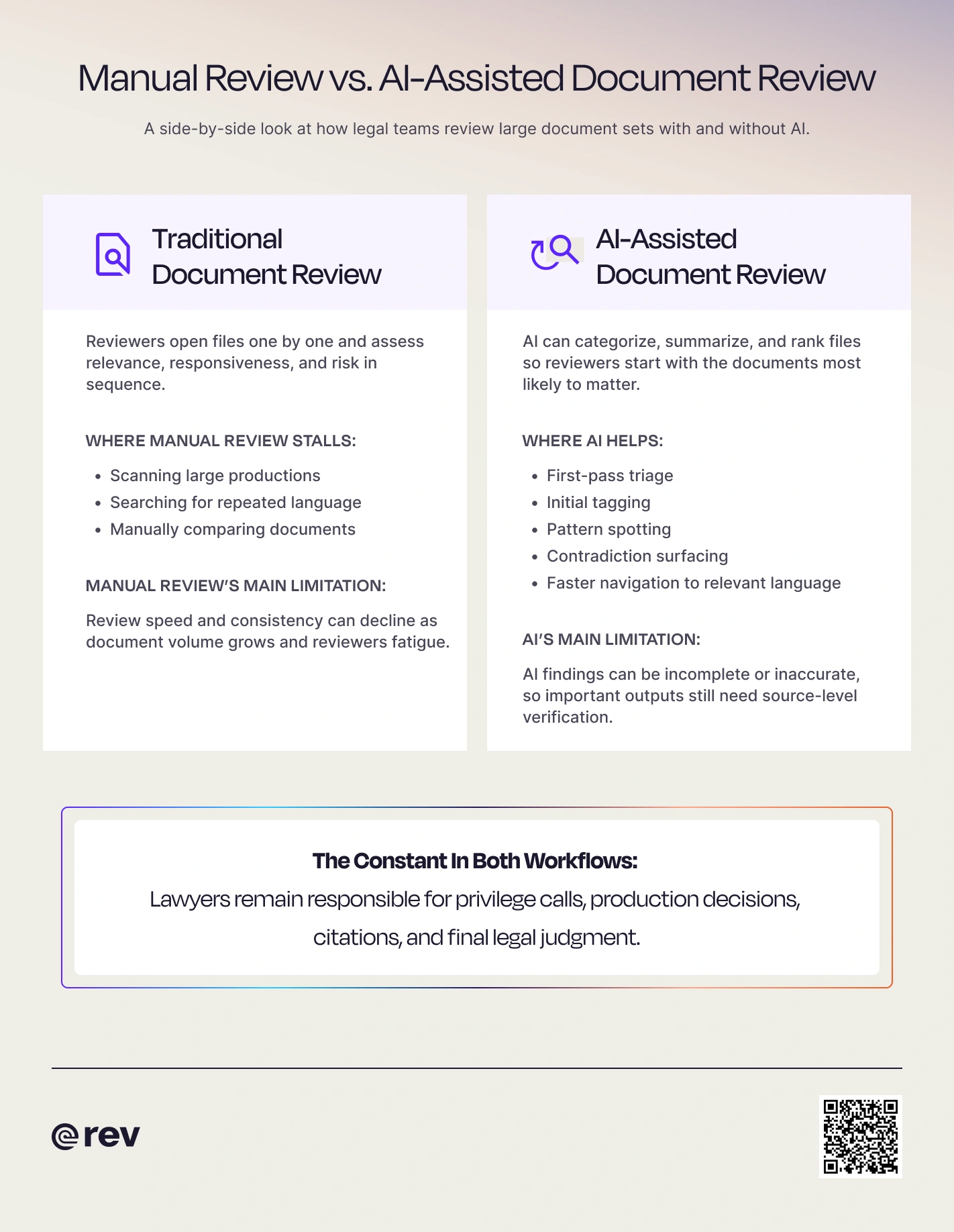
The main difference between traditional and AI legal document review is that one is entirely manual, while the other uses technology to assist with a still human-driven process. Instead of replacing judgment, AI is used to categorize and surface the most important documents automatically, so the human reviewer starts with a ranked list instead of a blank stack.
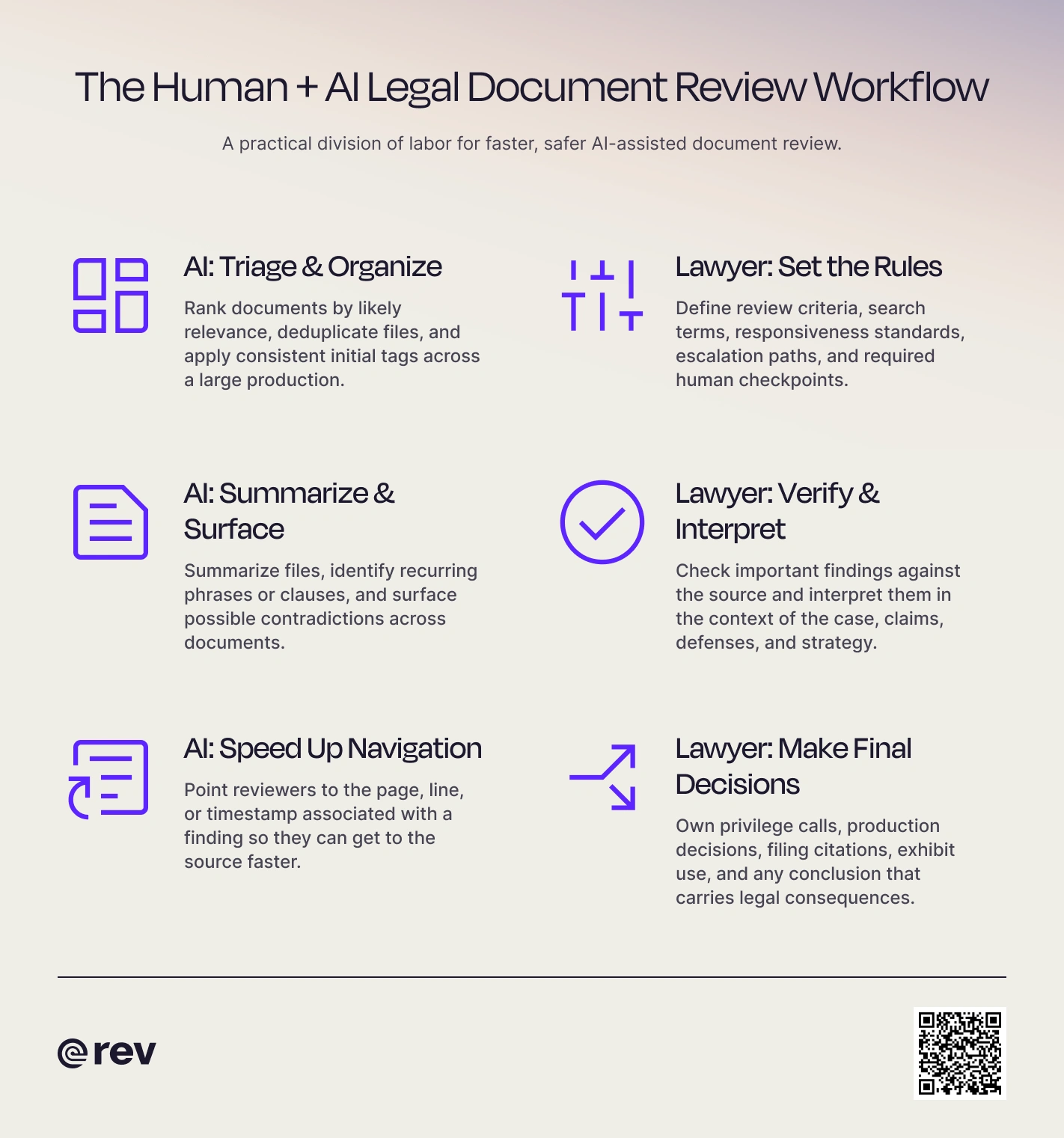
Differences between the two also depend on the role. For litigation associates, it means less time on first-pass review and more time on strategy and depositions. For paralegals managing large productions, it means the software handles deduplication and initial tagging so their review time goes toward privilege calls and exhibit prep. For in-house counsel, it means faster answers on contract risk without outside counsel billing hours for a first read.
If you want a deeper look at how the manual process works step by step, our guide to the traditional legal document review process covers it in full.
Benefits Of Integrating AI Into Your eDiscovery & Doc Review Process
AI Doc Review tools that are worth spending money on share three traits: they rank documents rather than just searching them, they cite sources on all their findings, and they leave a clear record of what the AI flagged versus what a human confirmed.
These benefits stack up to deliver real results for your firm. When a case involves tens of thousands of files, even a modest reduction in per-document review time adds up to real budget and hours back. Here's how these benefits show up in practice:
- Faster first-pass review: Instead of scanning line by line, AI can summarize entire document sets in an instant, allowing lawyers to review quickly without sacrificing accuracy. For example, DA Brian Anderson cut evidence review time by 94% by using Rev.
- Lower cost per document: Per-document review costs have historically been pretty high (around $1-$8 per document), but with AI, that number is quickly falling. When you have a tool with a flat monthly fee that can review as many documents as you want in just moments, you can expect to slice that cost down to a fraction of what it used to be.
- Consistency across large productions: A model applies the same criteria to document 1 as it does to document 100,000. Human reviewers get tired; software doesn't.
- Pattern-spotting across volume: AI document review can surface a recurring phrase, a contradiction between two witnesses, or a clause that appears across dozens of contracts — the kind of pattern that's nearly invisible to someone reading files one at a time.
- More attorney time on judgment calls: The hours AI gives back don't disappear. They go toward privilege review, strategy, and client counsel. AKA the work a machine can't do.
"Document review software is crucial for efficiently sifting through large volumes of ESI, identifying key documents, and flagging them for use during the deposition," explains Anna Blood, Founder and Attorney at Blood Law.
"Technology allows me to access and synthesize vast amounts of information more effectively, freeing up time to focus on strategic thinking and witness preparation."
Potential Risks To Watch Out For
AI document review isn't risk-free, and courts have made that clear. Judges in Colorado have sanctioned attorneys and issued five-figure fines over fabricated citations generated by AI tools, and the exposure only grows when a firm uses a tool that wasn't built with legal evidence in mind. Here's what to watch for, and how to manage it.
- Problem: Fabricated or inaccurate findings. Generative AI tools can produce plausible-sounding summaries that aren't actually supported by the underlying document.
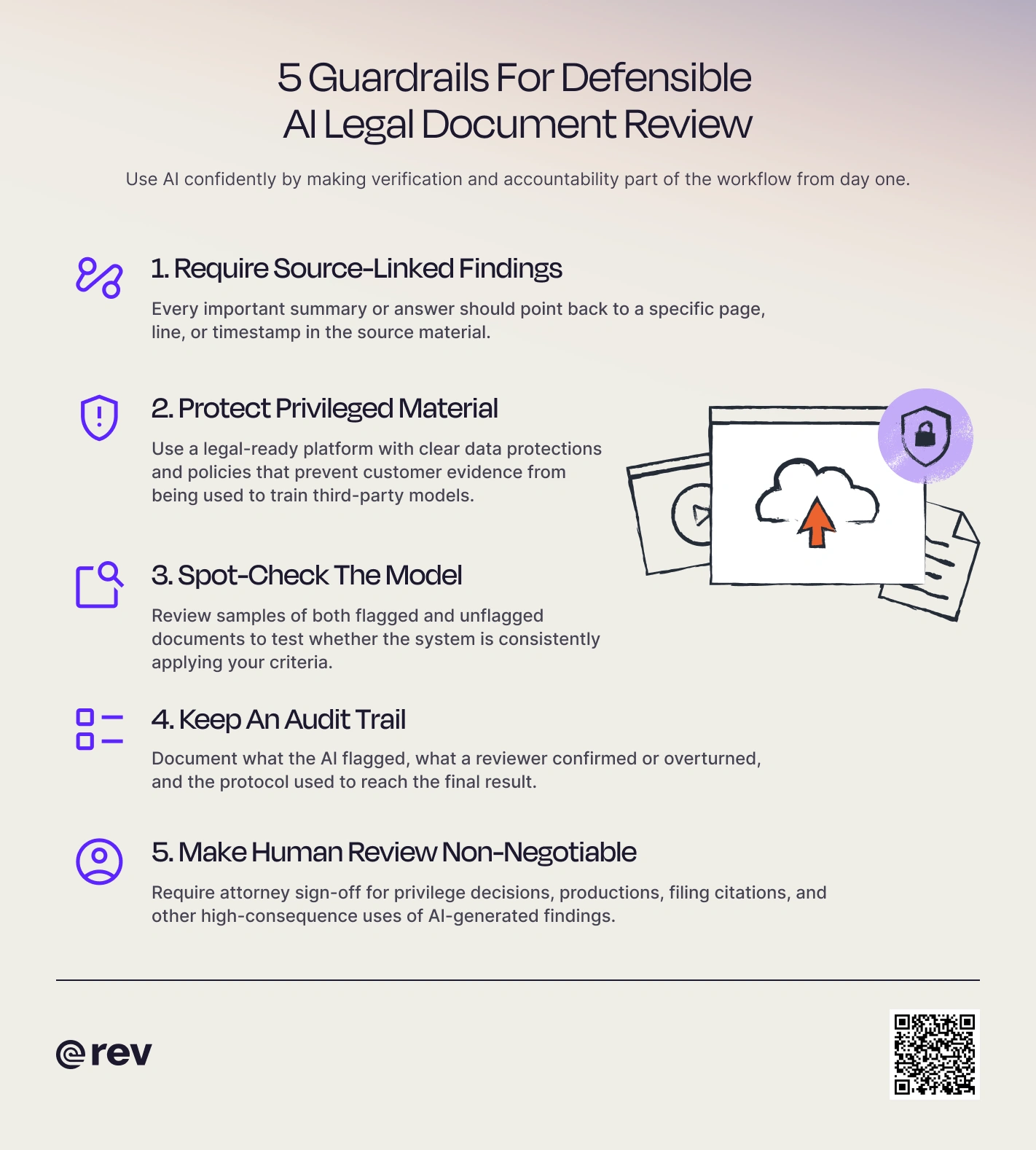
Solution: Use tools that tie every finding to a specific page, line, or timestamp in the source file, and verify anything that will be cited or produced. - Problem: Privilege and confidentiality exposure. Feeding case documents into a public, general-purpose AI tool can waive privilege protections that would otherwise apply.
Solution: Use a closed-loop platform that doesn't train third-party models on your evidence. - Problem: Bias in the underlying model. If a model was trained on skewed data, it can under- or over-flag certain document types as responsive.
Solution: Spot-check a sample of both flagged and unflagged documents, and document that the check happened. - Problem: Thin legal precedent for generative AI specifically. Technology-assisted review has more than a decade of judicial acceptance behind it. Generative AI tools used for summarization and drafting don't have that same track record (yet).
Solution: Keep a documented, repeatable review protocol you can defend if a court asks how the review was done. - Problem: Over-reliance on the tool. Treating an AI-flagged document list as the final word, instead of a starting point, is how details get missed.
Solution: Build a human review checkpoint into every stage where a document could be produced, withheld, or cited.
How To Integrate AI The Right Way
Bringing AI document review for law firms into an existing workflow works best as a staged process, not a single software purchase. These are the steps that hold up across matters of different sizes.
1. Audit Where Your Review Time Goes
Before choosing a tool, track where your team's hours go today — first-pass review, privilege log building, exhibit prep, deposition cross-referencing. The stage eating the most time is usually where AI for eDiscovery pays off first.
2. Choose A Tool Built for Legal Evidence
A general-purpose AI assistant wasn't built to handle privileged material, courtroom-grade audio, or a chain-of-custody requirement. Look for a platform built specifically for legal and investigative use, one that flags responsiveness and privilege risk rather than just answering questions about a file.
3. Set Non-Negotiable Human Review Checkpoints
Decide upfront which decisions always require a human sign-off: privilege calls, anything going into a production, anything cited in a filing. Build that into the workflow rather than leaving it to individual discretion.
"The key is establishing clear protocols for data collection, processing, and review before starting," suggests Ryan Perdue, Litigator at Simon & Perdue Law.
"I create detailed privilege logs and use predictive coding to prioritize document review. Regular communication with IT experts and opposing counsel about technical issues prevents delays. My biggest tip: invest time upfront in proper search terms and review protocols, it saves enormous time and costs during the review phase."
4. Document Your Processes for Defensibility
Keep a record of what the AI flagged, what a human confirmed or overturned, and why. If exhibits need to be organized and produced, a consistent numbering system matters here too — our guide to Bates numbering for legal document management walks through how to keep a large production organized from review through production.
5. Train Your Team and Set a Usage Policy
The firms getting the most value treat this like any other case-management skill: new hires learn the tool, the checkpoints, usage limits, and the escalation path before they get started using it with a real case. This will prevent them from relying too heavily on the tool, or from blowing your AI budget out of the water unexpectedly.
The Importance Of Accuracy & Citing Your Sources
Every benefit above depends on one thing: being able to trust what the AI found. A summary you can't verify is a liability waiting to surface in a deposition or a motion to compel.
This is where Rev's approach to AI legal document review is built differently. Every finding is tied to a timestamp or a specific location in the source file, so nothing is generated without something to point back to.
That matters whether the underlying evidence is a contract, a deposition transcript, or a body camera recording — Rev treats documents and multimedia evidence as part of the same searchable, citable record. And when a finding needs the highest level of confidence, Rev's legally trained human reviewers are available to provide that extra layer of protection.
If you want to learn more about the legal document and AI tools available, check out our roundup of eDiscovery tools.
Start Reviewing With Confidence, Not Just Speed
We aren't suggesting you cut corners when it comes to document review. Rather, we want to make sure your team can go through everything worth reviewing before opposing counsel does. The firms getting real value from AI Legal document review tools are the ones treating accuracy and human oversight as part of the process, not an afterthought bolted on at the end.
.webp)

.webp)