
Florida's New AI Citation Rule: What Every Attorney Needs to Know
On 6/15/26, Florida’s Supreme Court’s new AI citation ruling went into effect. Here is what it means for attorneys practicing within Florida’s state lines.


.webp)
The latest Florida Supreme Court news affecting practicing attorneys moved swiftly. On May 28, 2026, the Florida Supreme Court issued Case No. SC2026-0673, amending Florida Rule of General Practice and Judicial Administration 2.515(d)(2). The amended rule took effect June 15, 2026.
The ruling wasn't a surprise. Courts across the state had already been watching AI-generated hallucinations creep into filings through fabricated case names, invented quotations, nonexistent holdings that read as convincing as the real thing. One Florida attorney was recently sanctioned for using AI in his filings that contained 46 different hallucinations.
The Supreme Court recognized the obvious problem with that approach: Florida was heading toward a patchwork of conflicting requirements depending on which courthouse you were filing in. That ends now. Here’s what you need to know.
What Rule 2.515(d)(2) Actually Requires
The amendment does two things:
- Adds a new certification. Every signer of a court filing (attorney or even a self-represented litigant) is explicitly certifying that "the legal authorities identified exist and are accurately cited."
- Authorizes sanctions. Courts may impose sanctions for any filing inconsistent with that representation, including reprimand, contempt, striking the document, dismissal of proceedings, costs, and attorneys' fees.
The accompanying administrative order (AOSC26-12) goes further as it preempts every local AI order in the state. This means that no other court can create its own AI-filing regime going forward, and current ones, such as the Miami-Dade Broward Courts ruling, no longer apply.
What the rule does not require: disclosure that you used AI. There is no statewide certification form, no box to check, no required language. The rule is general. How you produced the citation doesn’t matter; what matters is that the citation is real and accurate.
What This Means In Practice
For Florida attorneys, the practical compliance burden is familiar but now formally enforceable:
- Verify every citation before filing. Confirm the case exists, the quoted language is accurate, and the holding is characterized correctly. "Looks right" is not enough.
- Forget local AI-certification guidelines. Firms can keep internal AI-use policies, but the filing-level language is gone.
- Document your verification process. The rule gives signers notice and an opportunity to be heard before sanctions. A record of how you verified each authority is your best defense.
To make comments regarding these rulings or request to schedule an oral argument, the deadline is August 11th, 2026.
The Deeper Shift This Signals
The court's commentary is direct: AI can be used, but accountability remains. What was once a niche field is now mainstream, and the Supreme Court is making it clear that statewide, attorneys are on the hook for hallucinations.
That framing has consequences for how Florida attorneys should think about every AI tool in their workflow. Using an AI that you can trust (read: one that cites its sources) should now be top of mind for law firms looking to move faster without sanctions.
“Law Firms should evaluate legal AI software based on whether it clearly improves existing workflows, delivers measurable ROI, and provides legal work that can be trusted,” explained John Moore, Director of Attorney Development at Angel Reyes & Associates.
“Ultimately, legal AI is only worth the investment if it saves time, reduces risk, and allows the staff to better service their clients rather than to be stuck doing other administrative tasks.”
Where Rev Fits In
Most AI tools operate at the document layer — they draft, summarize, and suggest. But when it comes to filing things in court, the risk sits at the evidence layer (after all, spoiled evidence can tank an otherwise slam-dunk case). Can you certify the audio recordings, depositions, witness interviews, and prior hearing transcripts? These become the factual base of your legal arguments.
Rev's Investigative Intelligence Platform is built for exactly that layer. With Rev, Florida attorneys get access to the following features:
- Depositions and recorded testimony become searchable, citable records.
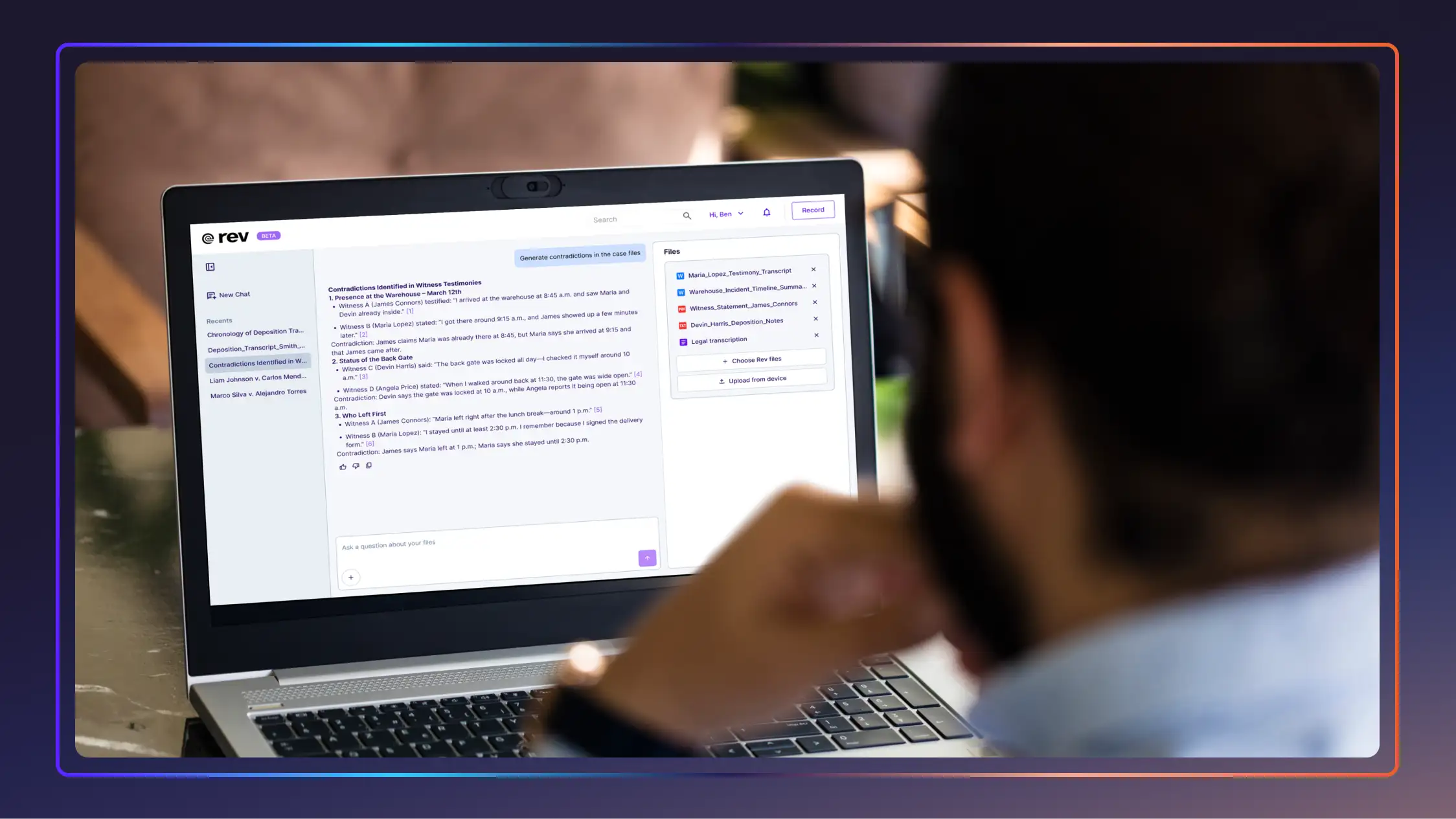
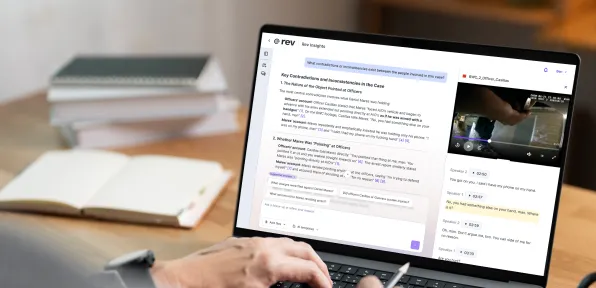
- Drop hours of deposition audio into Rev and interrogate it the same way you cross-examine a witness. Every finding is tied to a timestamp and the original source file — not a model's summary of it.
- Every Rev output is verifiable.
- Rev doesn't guess. Every output traces back to a timestamped moment in your original recording.
- Your data is safe from the start.
- Rev operates as a closed loop — zero data sharing with third-party models, no training on client evidence, and CJIS-compliant for criminal justice environments.
- Human review options available.
- When a transcript will anchor a motion or appear in a filing, our human reviewers are available to double-check accuracy and ensure peace of mind.
Rule 2.515(d)(2) doesn't prohibit AI. It requires that what you put in a filing can withstand scrutiny. That standard is exactly what Rev is built to meet. Learn more about recent AI rulings on our blog, including New York's 161 Ruling on AI Usage, Texas' Ethics Opinion 705 & TRAIGA and California's AI Guidance.

.webp)