Texas AI Law for Attorneys: Ethics Opinion 705 & TRAIGA
Learn more about Ethics Opinion 705, TRAIGA, and local Texas guidelines for using AI in legal settings with this guide from the experts at Rev.



In November 2024, a lawyer in Beaumont filed a brief in a wrongful termination case against Goodyear Tire & Rubber Co. There was one big problem: the brief cited two cases that don't exist. It also quoted lines that show up nowhere in the real cases it cited.
He'd used an AI tool to write the response, and never checked its work. A federal judge issued an order and fined him $2,000, made him take a class on AI, and made him hand the sanctions order to his own client.
Texas doesn't have one big AI rule like New York's Part 161 or Florida's Rule 2.515(d)(2). Instead, there's a mix: an ethics opinion, a bunch of different judge-specific rules, and a much bigger AI law that has almost nothing to do with court filings. Here's what you actually need to know.
The Baseline: State Bar of Texas Ethics Opinion 705
In February 2025, the State Bar of Texas Professional Ethics Committee put out Opinion No. 705. It's the state's first real guidance on AI in legal work.
It doesn't ban AI. However, it highlights potential ethical issues and how lawyers should approach them should they choose to work with AI. Guidelines include:
- “Acquire basic technological competence before using any generative AI tool”
- “Always ensure that the tool does not imperil confidential client information”
- “Always verify the accuracy of any responses received from a generative AI tool”
- “Should not charge clients for the time “saved” by using a generative AI program”
The bottom line: if you don't check the AI's work, you can get in trouble for the same old reasons — dishonesty, unfairness, and not being straight with the court.
The Federal Court Patchwork
Opinion 705 is guidance, not a court rule. So do you actually have to tell a judge you used AI? Depends who you're in front of.
The Northern District of Texas has a rule that says AI-drafted briefs need a note on the first page, and a few other N.D. Tex. judges use similar language now.
Over in the Southern District, Judge Olvera makes lawyers sign a similar certificate, but just once, at the start of the case. The Eastern District is more relaxed: Local Rule AT-3(m) skips the certificate and just reminds everyone that Rule 11 still applies, AI or not. That's the rule that got the Beaumont lawyer in trouble above — the court said he'd violated it, plus Local Rule AT-3(b), and pointed out that opposing counsel spent $7,521.26 tracking down his fake citations.
There's no single Texas rule here. Just check what your judge wants before you file anything.
TRAIGA: The Bigger Texas AI Law Every Firm Should Know About
Texas also has a much bigger AI law called TRAIGA, short for the Texas Responsible AI Governance Act. Governor Abbott signed it in mid 2025, and it kicked in on January 1, 2026.
This one isn't about court filings. It's about what AI tools are allowed to do at all. Lawmakers scaled back an earlier, stricter draft. What's left bans AI systems built to do specific, harmful things: pushing people toward self-harm or crime, making illegal deepfakes or child sexual abuse material, or messing with someone's constitutional rights. Read more on what TRAIGA covers.
Only the Texas Attorney General can enforce it — you can't sue someone yourself under this law. If the AG catches a violation, the business gets 60 days to fix it. Fix it in time, and you're fine. Don't, and fines start around $10,000 and can climb past $200,000, plus daily penalties if it keeps going. The AG's complaint portal is expected to go live in September 2026.
TRAIGA doesn't touch what you file in court. But it's one more reason to know exactly what your AI vendor does with your data.
Where Rev Fits In
Opinion 705, the federal rules, and TRAIGA are all about drafting and filing. None of it covers the evidence itself: depositions, witness interviews, body cam footage.
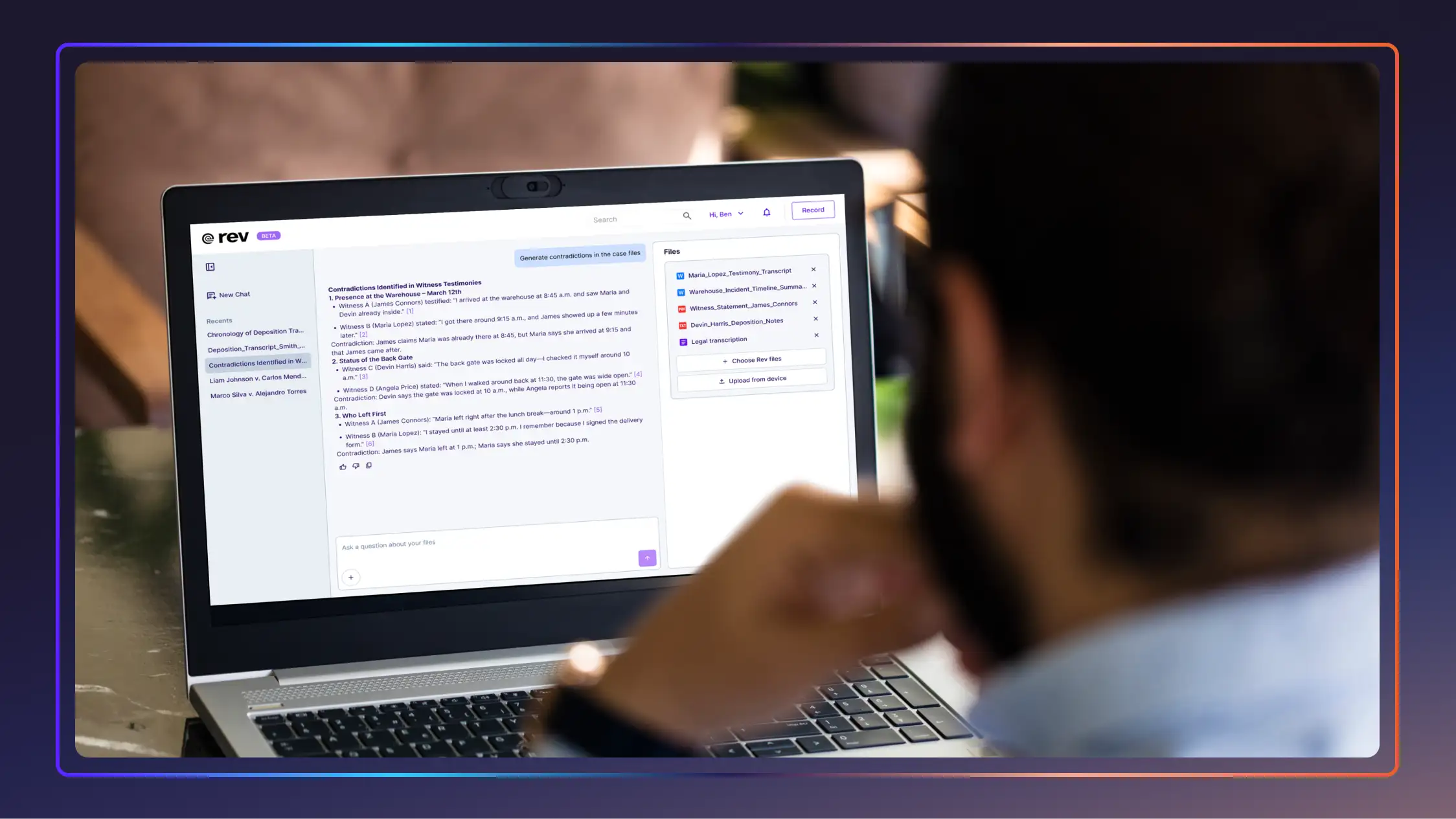
That's Rev's world. Our Investigative Intelligence Platform turns hours of recordings into a searchable record. Every answer links back to a timestamp and the actual file — not a guess.
In fact, the State Bar of Texas recently made Rev its first-ever AI partner. Rev's citation-first design, its policy against training on your data, and its SOC 2, HIPAA, and GDPR compliance were a big part of why.
While the rules are still ambiguous in Texas, current events make it clear that the bar will keep rising. Rev is built for where it's heading.
Learn more about Rev's legal transcription services in Texas.

.webp)
.webp)