
California's New AI Law: What SB 574, Courts, & CCPA Require
California has a new law and several rulings on how lawyers should approach generative AI in their practice. Learn what’s required with our guide.


.webp)
In September 2025, a California Court of Appeal published an opinion in an otherwise ordinary employment case, Noland v. Land of the Free, LP. The lawyer's briefs contained 23 case quotes. Twenty-one of them were fabricated.
He'd used ChatGPT and other AI tools to help write the briefs, and never checked what came out. The court fined him $10,000 and referred him to the State Bar. It is the largest AI sanction in California so far, and two more instances happened quickly after.
As of 9/30/26, California signed SB 574 into law. Though other states have enacted similar rulings, like New York’s Part 161 or Florida’s Rule 2.515(d)(2), California is the first state to regulate attorneys’ use of gen AI by statue. In addition, they also have plenty of rulings to help guide lawyers on ethical uses of AI. Here's what you need to know.
SB 574 Now California Law
The State Bar of California put out its first Practical Guidance for the use of generative AI in the practice of law back in 2023. But earlier this year, they updated that guidance to add language about agentic AI. After several amendments and opportunities for public comment, SB 574 was officially signed into law on September 30th, 2026. The law will take effect on Janurary 1st, 2027.
The new law's requirements include:
- Competence. Attorneys must continue to exercise reasonable competence and diligence when using generative AI in their legal work.
- Human Oversight. AI can assist with legal tasks, but attorneys cannot delegate the practice of law or their professional judgment to AI tools.
- Confidentiality. Attorneys cannot enter confidential, personally identifying, or nonpublic information into AI tools unless access is restricted to authorized individuals who must protect that information.
- Accuracy. Attorneys must take reasonable steps to verify AI-generated information and correct any errors or hallucinations before using it in their work.
- Citations. Attorneys must personally verify every citation included in court filings, whether it was generated by AI or another source.
- Disclosure. Attorneys must disclose their use of generative AI for documents submitted to the court and consider disclosing AI use in public-facing content.
- Accountability. Attorneys who violate these requirements may face court sanctions or State Bar disciplinary action. Law firms may also be held responsible for certain violations.
- Arbitration. Arbitrators cannot delegate their decision-making to generative AI tools.
Judicial Council Rule 10.430
Separate from anything the State Bar does, California's courts made their own rule for how they use AI. In July 2025, the Judicial Council adopted Rule 10.430 — the first statewide court rule on generative AI in the country.The gist of it is this: any California court that lets its judges or staff use generative AI had to have a written policy in place by the end of 2025. That policy has to block confidential information from public AI tools, prohibit unlawful discrimination using AI, require someone to catch and fix AI mistakes of all kinds, and flag anything that's entirely AI-written before it goes out.
Judges have their own version of the same idea, too, since a hallucinated fact in a court order is a much bigger problem than one in a first draft.
2026 CCPA AI Rules
Separate from anything about court filings, California has a privacy law that could affect how firms use AI in their own operations, not just in briefs.
New rules under the California Consumer Privacy Act took effect January 1, 2026, covering something called automated decision-making technology, or ADMT.
If your firm uses AI to make a significant decision about someone — hiring, screening clients, evaluating an employee — these rules apply. Businesses have to tell people when ADMT is being used, let them opt out in most cases, and sometimes give them a way to appeal the decision to an actual human. Firms already using ADMT this way have until January 1, 2027, to fully comply.
None of this touches what you file in court. But it's one more reason to know exactly what your AI tools are doing behind the scenes.
Where Rev Fits In
While the guidelines above don’t regulate evidence itself, every lawyer worth their weight understands that’s what their case actually runs on.
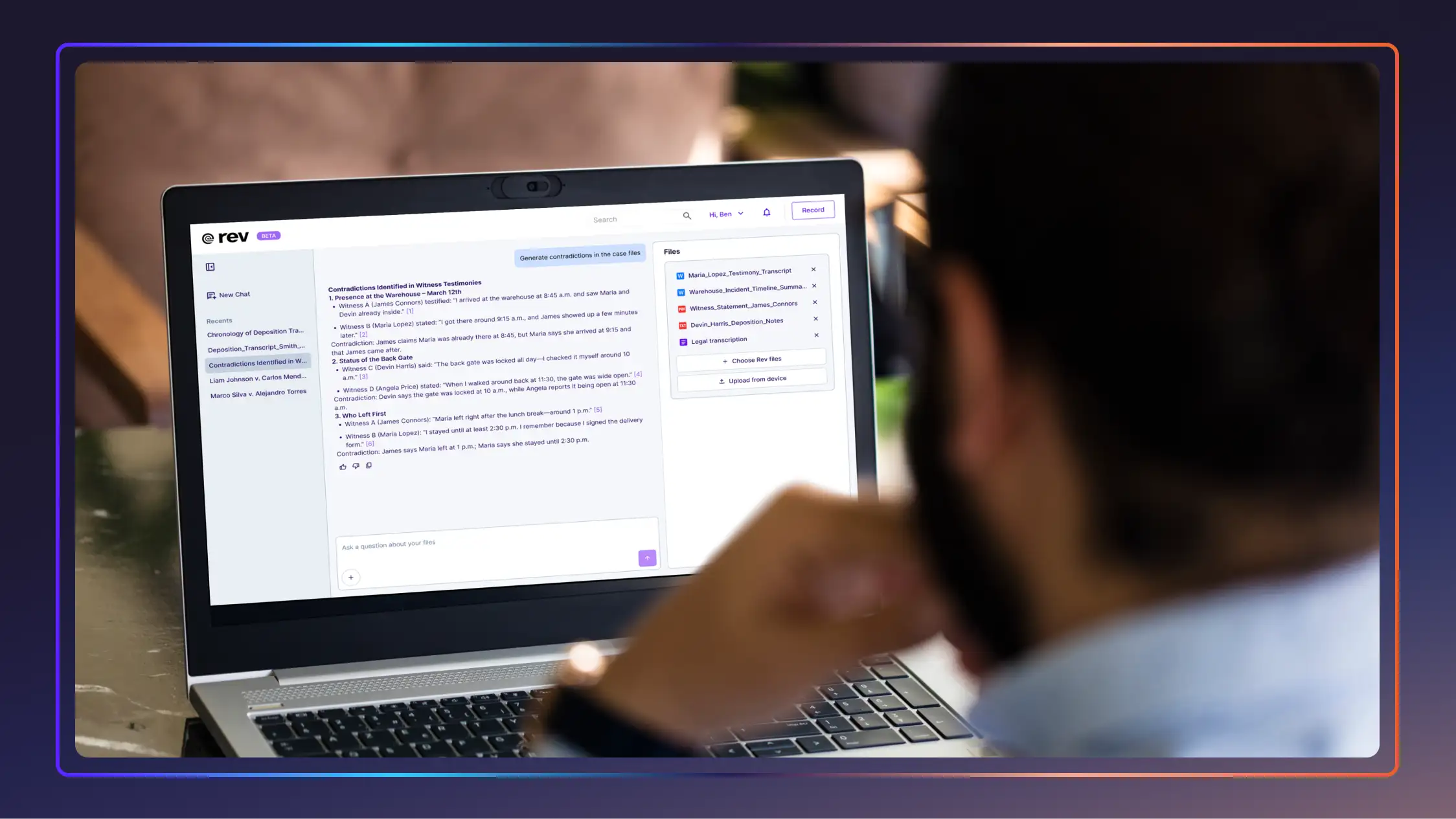
That's where Rev's Investigative Intelligence Platform comes in. Every output ties back to the source, rather than a generated or hallucinated best guess. Here’s what this means in practice:
Litigators can search every deposition in a matter at once and pull the exact page and line before opposing counsel does. Criminal defense and prosecution teams can find the one moment buried in hours of body cam footage before a hearing — cited to the second, not pulled from memory.
California's rules don't require any of this yet. But after three sanctioned lawyers and a state supreme court pushing for tougher rules, the bar for defensible AI use in a California courtroom is only going up. Rev is built for where it's heading.
Learn more about Rev's legal transcription services in California.
Curious how other states handle this? Check out our posts on Colorado AI rules and Texas’ AI law for attorneys.


.webp)