

Evidence Backlogs Are Driving Delays and Burnout, New AI-Era Survey Finds
34% of legal professionals spend 60+ hours per case reviewing evidence — driving burnout, delays, and lost revenue. New survey data reveals the hidden costs.


Evidence review has quietly become one of the most consequential constraints in modern legal work. As digital evidence volumes explode, legal teams have to spend more time than ever validating, contextualizing, and preparing that material for court. Careful, manual review remains essential given the stakes involved — but the demands of modern evidence are placing unprecedented pressure on teams.
Our new survey of 500+ legal professionals finds that the strain isn’t driven by evidence volume alone. Instead, it’s more about reviewing that evidence with processes that haven’t kept pace, even as AI tools become more available. Review time often approaches or exceeds the length of the underlying recordings — creating backlogs that affect efficiency metrics and outcomes.
In fact, our survey found that 49% of legal teams spend 40+ hours per case reviewing evidence, time that could be spent on other important tasks like case strategy or client communication.
So it’s no surprise that evidence review optimization has become a major discussion topic in legal circles. As AI continues to improve, more lawyers than ever are turning to this technology to help them get more done, faster.
Key Takeaways
- Evidence review can overwhelm teams without modern workflows: 29% of legal professionals report collecting more than 100 hours of audio/video per case. 34% spend over 60 hours on review, including 7% who report spending more than 200 hours.
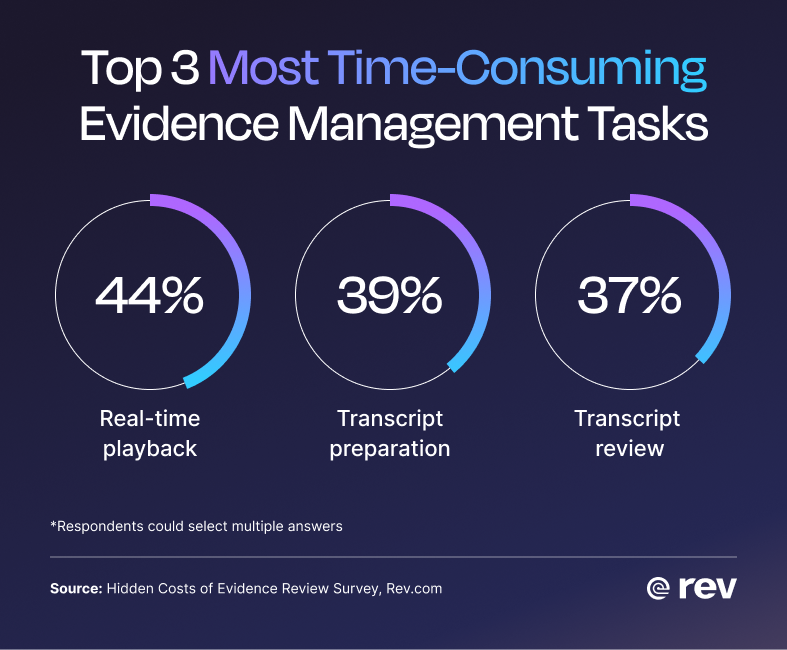
- Legal professionals point to a small set of tasks as the most time-consuming: real-time playback (44%), transcript and exhibit preparation (39%), and transcript review (37%).
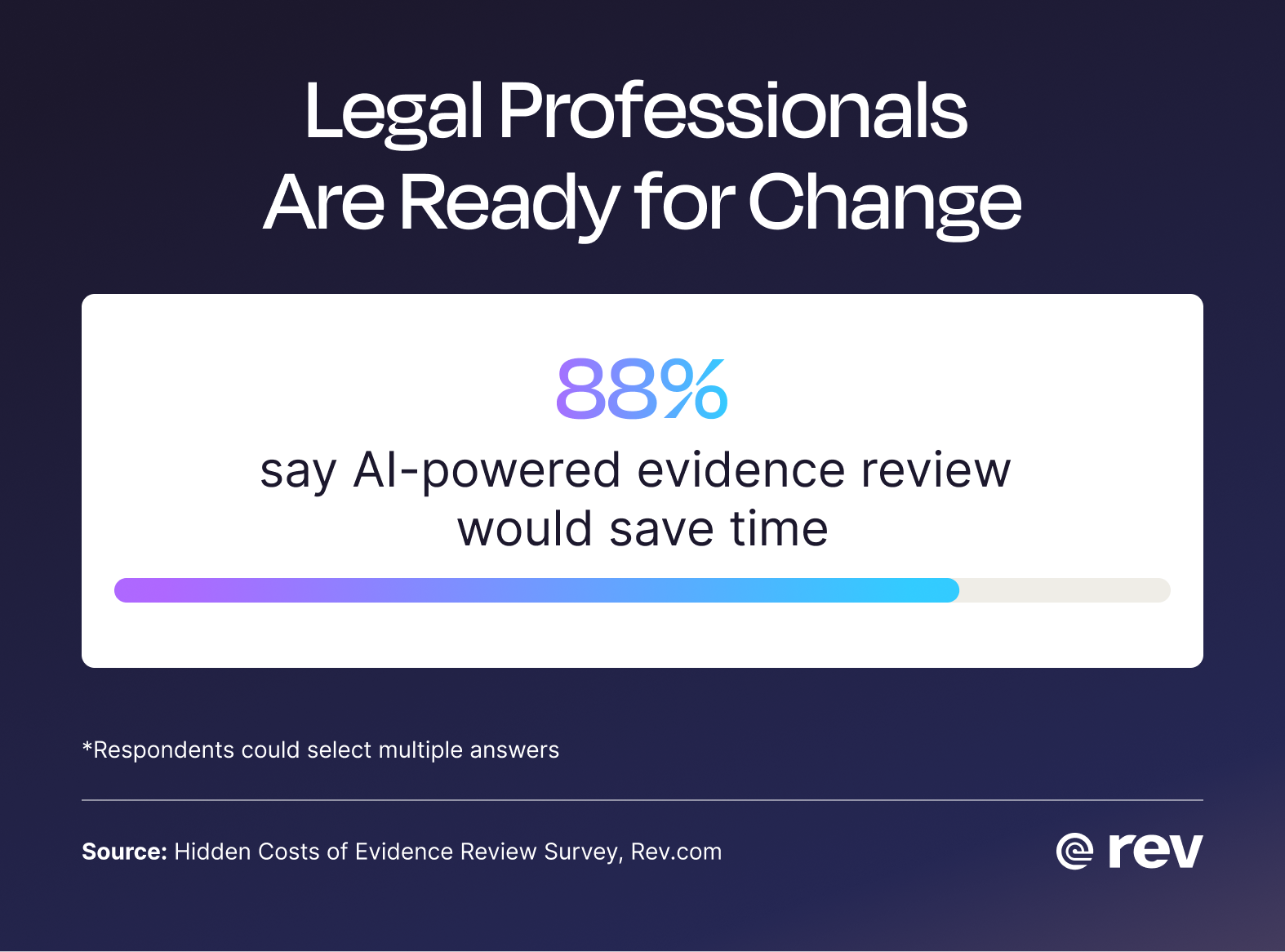
- AI readiness is high: 88% of legal professionals say AI that identifies themes, inconsistencies, and insights across multiple case files at once would save them time. 54% expect 1–20 hours back per case.
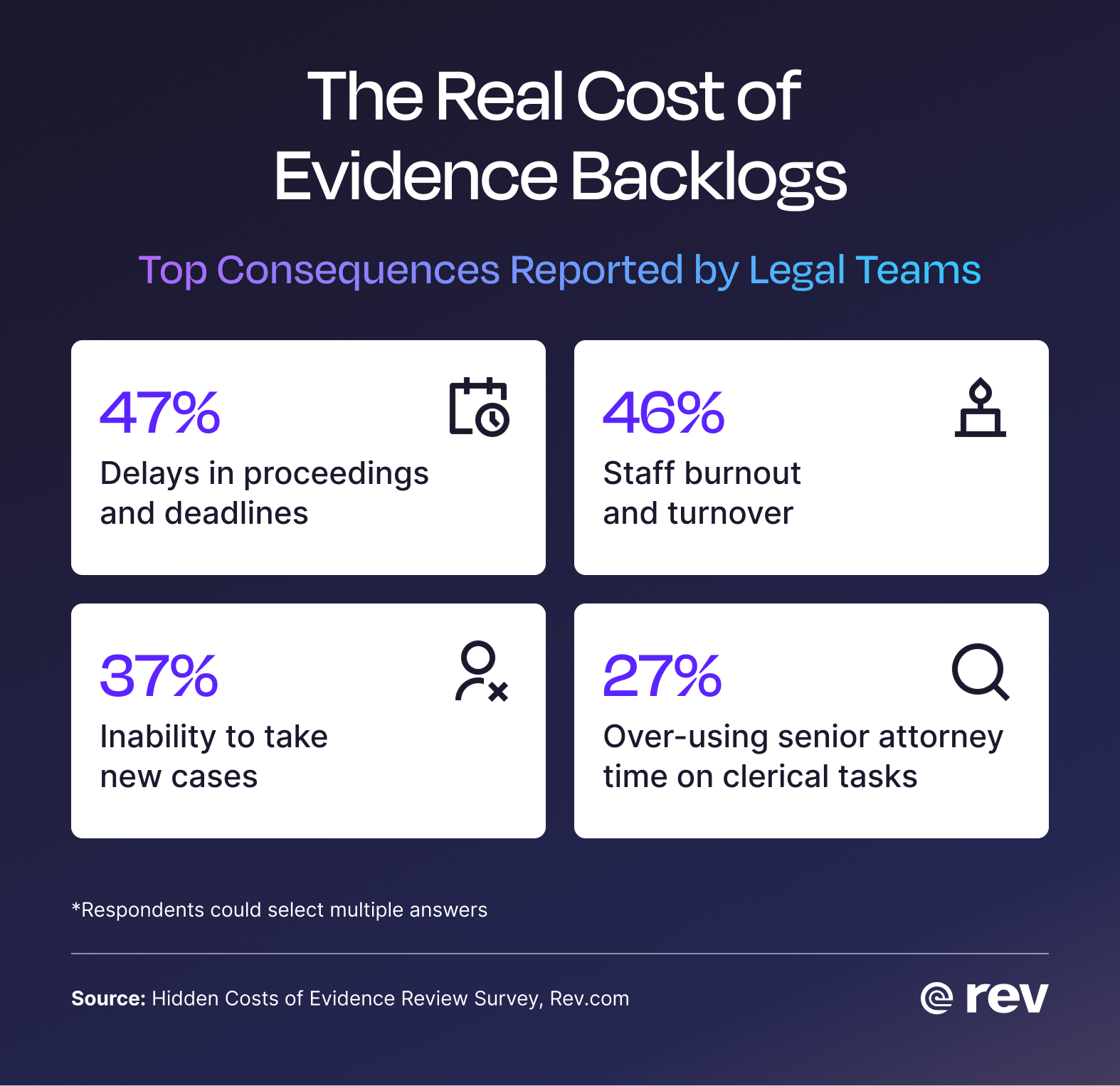
Managing large evidence backlogs creates real human and business challenges: 47% report delays in legal proceedings and deadlines, 46% cite staff burnout and turnover, and 37% say backlogs limit their ability to take on new cases.
Why Evidence Review Workflows Can’t Keep Up With Volume
Modern legal cases now span evidence from multiple sources, but review workflows haven’t evolved to match that reality. Our survey found that 55% of cases involve 50 or more hours of evidence, including 28% that exceed 100 hours
Review time scales accordingly: 34% of legal professionals spend over 60 hours per case reviewing evidence — far more than a typical workweek — and 7% report workloads exceeding 200 hours for a single case.
That time reflects the reality of legal work: careful, manual review takes time (and always will). But when time-intensive review relies on linear, file-by-file workflows, the burden compounds rapidly — especially for teams managing multiple cases simultaneously.
As criminal defense attorney Ben Michael explained, the challenge is scale, not diligence. “Without these kinds of (AI) tools, gathering evidence can take longer and increases the risk of missing important details.”
Technology can help legal professionals move faster through the early stages of evidence review by improving organization, surfacing key moments, and reducing manual setup. With end-to-end evidence review — from intake through preparation — teams spend less time searching and formatting evidence, and more time applying judgment and strategy to what matters most.
A Small Set of Manual Tasks Drives Disproportionate Time Loss
The data shows that evidence review inefficiency isn’t spread evenly. Instead, most of the time is spent on a few highly manual steps that form a cascading workflow — where delays, pressure, and risk compound as evidence moves toward court.
Legal professionals cited listening to or watching audio/video in real time (44%) as their biggest time drain, followed by preparing transcripts and exhibits for court (39%), and reviewing transcript drafts for accuracy and completeness (37%). Each step depends on the one before it, meaning delays compound as evidence moves through review.
In legal matters, accuracy is paramount. A missed detail in a transcript or exhibit can materially affect credibility, admissibility, or even the outcome of a case. That’s why effective AI evidence review tools enhance careful review by helping legal teams find, prioritize, and synthesize material, so manual review time is spent where professional judgment adds the most value.
Evidence Backlogs Actively Strain Legal Teams
The consequences of managing large evidence backlogs show up clearly in day-to-day legal operations. 47% of legal professionals report delays in legal proceedings or deadlines, while 46% cite staff burnout or turnover tied directly to evidence workload pressures. And 37% admit that high workloads prevent their teams from taking on new cases. Together, these pressures slow work down and leave teams stretched thin — increasing the risk of missed details, delayed filings, and weaker case outcomes for the clients they serve.
Backlogs limit capacity, stall case progress, and force teams into reactive workflows. Without better digital evidence management, evidence review becomes a bottleneck that constrains firm growth and undermines sustainability across private practice, public defense, prosecution, and investigative roles alike.
Inefficient Review Undermines Trust, Outcomes, and Talent Allocation
As evidence backlogs grow, the risk extends beyond delays. Nearly one in four legal teams (23%) report increased malpractice risk, as sustained time pressure makes it harder to validate facts, timelines, and inconsistencies across complex evidence.
This issue can be improved with infrastructure like closed-loop AI architecture for legal evidence review, where human feedback continuously improves accuracy and reliability. When mistakes or missed details occur, the consequences can follow firms long after a case closes.
Client relationships suffer as well. Nearly 20% say evidence backlogs have damaged client trust, while 15% report negative case outcomes tied directly to review delays. These findings suggest that inefficient evidence review not only slows cases down, but it can also expose firms to lost clients, legal liability, and reputational damage that directly affect long-term stability and growth.
The strain also shows up in how senior legal talent is deployed. Over 1 in 4 (27%) legal professionals report that senior attorneys spend a disproportionate amount of time on review-heavy tasks.
Senior attorneys will always need to be involved in evidence review in some form, but inefficient workflows can force them to spend time on tasks that should go to junior attorneys or legal assistants.
Together, the data reveals a clear chain: Inefficient review workflows create backlogs, which increase risk and client strain, contribute to worse outcomes, and misalign senior expertise. Solving the problem means accelerating informed manual review — not automating judgment away — to help reduce staff burnout and improve quality and capacity.
Why Evidence Review Is Ripe for Change
Despite the legal industry’s cautious approach to new technology, the survey reveals striking openness to improvement. 88% of legal professionals say AI-powered tools that identify themes and inconsistencies across multiple case files would save time, and 54% expect to reclaim up to 20 hours per case.
Legal professionals want technology to support — not replace — expert judgment. As personal injury attorney John Michael Bailey explains, “Our team uses AI-driven platforms to research legal questions, generate internal drafts, and streamline communication. These tools help us work faster and more efficiently, allowing us to dedicate more time to the human side of advocacy.” The goal is to improve preparation and provide clearer insight before decisions are made.
AI evidence review can help firms reach this goal by accelerating prioritization, synthesis, and validation without compromising accuracy or accountability.
As evidence volumes continue to grow across formats and cases, tools that shorten the path to informed manual review can help legal teams reduce backlogs, protect quality, and sustain capacity — while keeping human judgment firmly in control.
Reclaiming Time for Higher-Value Legal Work
When evidence review becomes more efficient, the benefits extend far beyond time savings. Legal professionals say reclaimed hours would be reinvested in conducting more in-depth legal research and precedent analysis (37%), enriching client representation with more comprehensive research, analysis, and case preparation (36%), taking on new clients or cases (35%), and focusing on high-level legal strategy (31%). For many teams, reclaimed time translates directly into expanded capacity — clearing long-standing backlogs and taking on complex or pro bono cases that previously felt out of reach.
For teams navigating growing evidence demands, the next step isn’t rushing review — it’s rethinking workflows. Solutions built for modern legal work can help teams move from raw evidence to court-ready insight more efficiently, so attorneys spend less time managing evidence and more time applying judgment where it matters most.
Methodology
The survey was conducted by Centiment between December 1 and December 12, 2025, among 520 legal professionals ages 18 and older. Respondents were screened to ensure they work in legal roles and have familiarity with evidence review processes. The survey included seven core questions and five demographic questions. Data is unweighted, and the margin of error is approximately ±3% for the overall sample at a 95% confidence level.