
Complete Guide to Criminal Case Evidence Review with Rev
See how AI streamlines criminal casework from intake to trial – faster review, deeper insight, zero compromise.


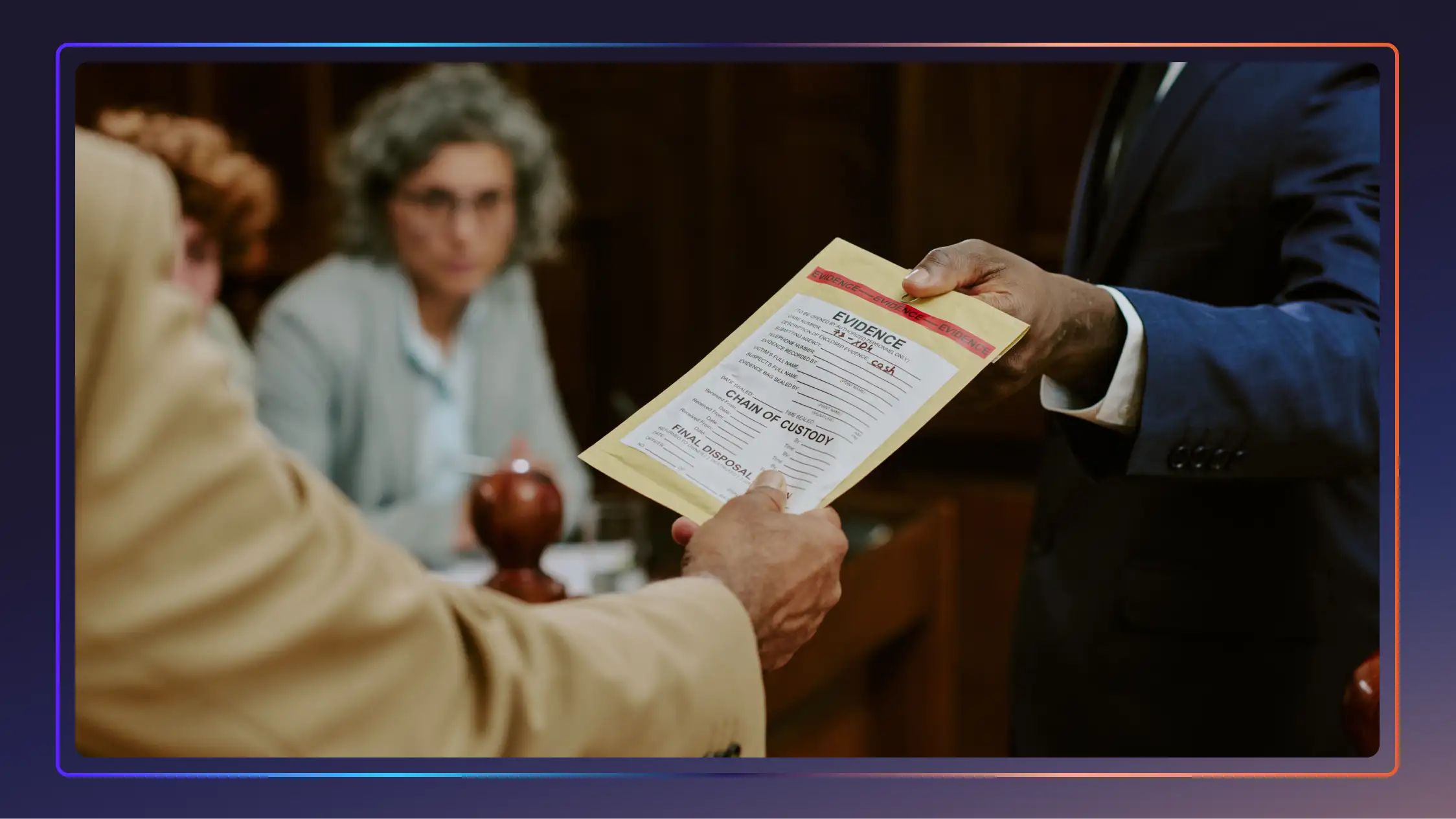
Criminal justice professionals face one of the most complex and demanding evidence review challenges in the legal system. From initial case intake to final trial arguments, the criminal case lifecycle requires meticulous management of vast amounts of multimedia evidence, witness statements, police reports, and forensic documentation. Whether working as a prosecutor building a case or a defense attorney protecting client rights, understanding this evidence review process is crucial for achieving just outcomes and ensuring the integrity of the legal system.
What is Evidence Review in Criminal Justice?
Evidence review in criminal justice refers to the systematic process of analyzing, organizing, and evaluating all case materials and discovery documents. For prosecutors, this means building a comprehensive understanding of the evidence to present a compelling case, while for defense attorneys, it involves identifying exculpatory evidence, uncovering inconsistencies, and developing effective counter-arguments.
This comprehensive review process encompasses audio recordings, video footage, police reports, witness statements, forensic reports, medical records, and any other documentation relevant to the case. The evidence review process serves multiple critical functions across both sides of the criminal justice system: ensuring all relevant evidence is properly considered, identifying procedural issues, spotting inconsistencies in testimony, and building a complete understanding of the case facts.
The Four Stages of Criminal Justice Evidence Review
1. Case Intake and Initial Evidence Assessment
The evidence review lifecycle begins differently depending on your role in the criminal justice system. For prosecutors, it starts when law enforcement presents a case for filing, while defense attorneys begin when they first meet with a client or receive appointment to a case.
During the intake phase, prosecutors receive an initial collection of materials that may include:
- Jail call recordings between suspects and family members or friends
- Police body camera footage from arrests and investigations
- Initial police reports and booking documentation
- Witness statements taken at the scene
- 911 emergency call recordings
- Interview recordings with suspects, victims, and witnesses
For prosecutors, this initial evidence assessment helps determine whether charges should be filed and what level of charges are appropriate. Defense attorneys use this phase to understand the basic facts of the case and begin formulating a preliminary defense strategy. Both sides must quickly organize their thoughts and identify key themes, potential witnesses, and areas requiring deeper investigation.
2. Discovery Review and Analysis
The discovery phase represents the most intensive period of evidence review in criminal cases. During this stage, prosecution has already looked at evidence and decided to file a charge and defense teams are handed over all of the relevant evidence, which they must quickly analyze. This process involves both traditional hard copy documents, but also the much larger world of eDiscovery, where every piece of evidence that lives online—emails, texts, cloud storage, databases, social media accounts—is collected, preserved, and reviewed. Criminal discovery typically includes everything we talked about in case intake and initial assessment, plus:
- Complete police investigation files with all reports and supplemental documentation
- Forensic evidence reports including DNA, fingerprints, ballistics, and digital forensics
- Surveillance footage from multiple sources and angles
- Extended witness interview recordings and follow-up statements
- Expert witness reports and testing documentation
- Medical records and autopsy reports when applicable
- Financial records and digital communications when relevant
For prosecutors, this phase involves organizing evidence to build the strongest possible case while ensuring all exculpatory evidence is properly disclosed to the defense. Defense attorneys focus on identifying inconsistencies, challenging the reliability of evidence, and uncovering any material that supports their client's innocence or mitigates charges.
Both sides must meticulously catalog and cross-reference materials to spot contradictions, verify timelines, and ensure no critical evidence is overlooked. This process often reveals the strengths and weaknesses of each side's case, informing plea negotiation strategies and trial preparation.
3. Trial Preparation and Evidence Organization
As cases move toward trial, the evidence review process shifts from comprehensive analysis to strategic preparation. This phase represents one of the most critical and time-intensive periods in criminal case management, where legal teams must transform months of evidence review into a coherent, persuasive trial strategy.
Core Trial Preparation Activities:
- Evidence Organization and Exhibit Preparation Teams create systematic organization of all trial exhibits, ensuring proper marking, authentication, and presentation readiness. This includes exhibit lists, foundation questions, and multimedia file organization while coordinating with court personnel on submission requirements.
- Witness Preparation and Examination Planning Effective preparation involves strategic planning for each witness's role in the case narrative. Teams develop examination outlines for direct and cross-examination scenarios, conduct practice sessions to identify weaknesses, and prepare witnesses for hostile questioning while developing impeachment rehabilitation strategies.
- Impeachment Strategy Development Teams analyze opposing witnesses' statements and prior testimony to identify inconsistencies and credibility issues. This involves creating impeachment files with prior statements and bias evidence, organizing materials for quick access, and strategically timing impeachment for maximum jury impact.
- Timeline and Fact Verification Creating accurate chronologies becomes crucial for presenting case theory. Teams cross-reference evidence sources for consistency, resolve factual discrepancies, and develop visual aids while preparing contingency arguments for alternative interpretations.
- Motion Practice and Evidence Challenges Strategic motion practice identifies evidentiary issues impacting case outcomes. Teams prepare motions in limine, develop admissibility arguments for complex evidence, and research recent case law affecting evidence rulings.
4. Trial Presentation and Real-Time Evidence Management
The trial phase represents the culmination of months of evidence review and preparation, where legal teams must execute their strategies while adapting to the dynamic demands of courtroom advocacy. This stage requires seamless integration of evidence mastery with persuasive presentation skills.
Real-Time Evidence Challenges:
- Immediate Information Retrieval Teams need to be able to instantly access their evidence evidence, witness statements, and legal authorities. To do it best, this requires searchable databases with multiple indexing and clear communication protocols between attorneys and support staff.
- Dynamic Witness Impeachment Live testimony creates unanticipated impeachment opportunities requiring immediate recognition and strategic decisions. Teams must spot inconsistencies with prior statements while assessing whether to impeach immediately or strategically delay.
- Evidence Authentication and Foundation Establishing proper foundation requires preparation and adaptability to authentication challenges. Teams prepare foundation scripts while remaining flexible for objections and alternative foundation witnesses.
- Jury Communication and Persuasion Effective advocacy requires continuous jury assessment and presentation adaptation. Teams must read non-verbal feedback, adjust pace based on comprehension, and modify emphasis based on jury interests.
- Opponent Response and Counter-Strategy Trial advocacy demands constant anticipation of opposing counsel's strategies. Teams prepare response strategies for anticipated arguments while maintaining flexibility for unexpected tactics and developing counter-narratives.
The Evolution from Manual to Technology-Enhanced Evidence Review
Most criminal attorneys who adopt AI start by experimenting with isolated tasks such as summarizing discovery, generating draft motions, or reviewing jail calls. But what happens when these same attorneys begin to integrate AI more holistically across their practice?
The result is a truly modern legal workflow – one in which every stage of a case becomes faster, less taxing on attorneys and legal staff, and consistently more effective for clients. In short, it’s the kind of speed and precision that transforms a practice from capable but capacity-constrained into a leader in both outcomes and efficiency.
As AI adoption increases across other high-stakes industries, many criminal attorneys are beginning to reassess early skepticism. What once felt like hype is now backed by real-world outcomes, as competitors and cross-industry leaders alike use AI to reduce burnout, speed decision-making, and uncover insights that manual review might sometimes miss.
So what exactly can AI do for a criminal practice? When applied across the full lifecycle of a case – from intake to trial – it turns a scattered mix of intake notes, jail calls, PDFs, body cam footage, and interview recordings into a single, searchable system of truth, streamlining each stage of litigation along the way. Instead of juggling files or retracing steps, attorneys can simply ask questions and get precise, time-stamped answers – whether they’re reviewing discovery or preparing for cross. It’s like having an expert on every case who never forgets a detail, never misses a contradiction, and is always ready at a moment’s notice.
The Hidden Cost of Evidence Chaos
Criminal cases – like any case – rely on extensive evidence. When evidence is coming in from all directions, it's easy for work to become disorganized or, at least, inefficient. Police reports, 911 calls, jail recordings, body cam footage, interview transcripts, handwritten notes, and forensic transcript summaries quickly become extreme evidence loads. Even when all the pieces are digitized, they arrive in different formats, from different sources, at different times. Finding a single quote, timeline detail, or moment of contradiction can still mean scrubbing through hours of video or flipping through dozens of PDFs.
It’s true that things have improved. Digital records are far more accessible than physical ones. But accessibility isn’t the same as usability. Legal teams may eventually find what they’re looking for – but at what cost? Every hour spent hunting down a moment of testimony or verifying a claim is an hour not spent preparing a stronger argument, engaging with a client, or refining trial strategy. The risk isn’t just what gets missed. It’s what doesn’t get done instead.
Any attorney knows that true evidence chaos is highly risky and unprofessional, but too often semi-chaotic case file organization comes to feel like the best a firm can do. When the pressure is constant and the backlog never clears, the goal becomes survival. That shift has real – but sometimes hidden – consequences for both case outcomes and attorney well-being.
From Intake to Trial: The Case Lifecycle, Reimagined

Evidence processing in criminal cases can be organized into four broad stages: intake, discovery, preparation, and trial. AI has the potential to transform each of these stages in distinct, measurable ways.
This isn’t about automating judgment – nothing will ever replace an attorney’s experience and knowledge. Implementing these tools is about amplifying what legal teams can do with limited time and high expectations. From surfacing contradictions and extracting key facts to highlighting inconsistencies across files, the right tools allow legal teams to work faster without sacrificing reliability and nuance.
These tools have the potential to create both a smoother and stronger case. With less time lost to tedious review, attorneys can invest that time where it counts: developing trial strategy, immersing in their clients’ stories, and building arguments. When AI is used consistently from intake through trial, it doesn't just create a centralized, searchable system – it becomes a built-in expert on the case, capable of pulling up critical details in seconds that might otherwise take hours to track down. The more integrated these tools are into the case lifecycle, the more they can contribute to speed, insight, and clarity at every turn.
Intake and Initial Review
Cases often start with a flood of disjointed materials – jail calls, body cam footage, handwritten notes, interview recordings, PDFs, and 911 audio. Each piece is essential, but when they live in different formats, different folders, and different platforms, the simple act of organizing what’s been received becomes its own bottleneck, let alone analyzing it.
Rev replaces that bottleneck with a centralized, searchable system of truth. From day one, attorneys and staff can upload everything – calls, clips, documents, field notes – into a single workspace where each file is instantly transcribed and structured for legal use. Even evidence captured live via mobile or Zoom can be transcribed in real time and automatically stored for later review.
Accuracy is essential in legal work. Rev delivers 96%+ AI transcription – with 99%+ accurate human transcription available – across challenging audio. Human review makes for reliably court-ready documents. Each transcript includes speaker labels, timestamps, and searchability, making it easy to surface key phrases or identify contradictions as the case develops.
Instead of scrubbing through hours of audio, attorneys can ask direct questions like, “What did the potential client say that might be relevant to constructing a timeline?” – and get answers tied to the record. AI tools can make the challenging early work of understanding the basics of a client’s story dramatically easier. Especially for firms with a heavy flow of incoming potential clients, AI at intake can be a game changer.
Discovery
AI tools may be most transformative during discovery. This is the stage where attorneys are handed a flood of police reports, witness statements, interview transcripts, and supplemental evidence – often with no time to sort through it all thoroughly before deadlines hit. For defense attorneys, this can be a time when it feels like there’s almost nothing they can do to level the playing field with prosecution. But with AI, that first wave of mental triage becomes nearly instant.
Instead of reading from page one and asking, What is this document even about?, attorneys can upload it and ask Rev Insights directly: Is this helpful to my theory? Does it contradict the earlier witness statement? Is there anything in here about the alleged weapon or July 3rd? Would reviewing this more thoroughly be a waste of my team’s time? The system responds with time-stamped, source-linked answers – turning a scattered pile of materials into an organized, actionable set.

This doesn’t replace a full review. It informs it. Rev helps attorneys decide which pieces need their full attention and which can be deprioritized.
Rev Insights doesn’t analyze files in isolation. It processes all discovery documents as one cohesive set, identifying discrepancies and contradictions across police reports, witness accounts, and supporting materials. It highlights key moments, phrasing shifts, and gaps in the record – giving attorneys a sharper view of where facts align or unravel.
When used consistently across discovery, AI becomes more than a shortcut. It’s an on-call expert – always ready to help answer the hardest question: Where should I look next?
Witness and Cross-Examination Preparation
An experienced attorney knows how to highlight contradictions in testimony, pinpoint vague answers, and expose narrative drift. But the irony is that the better the attorney, the more likely they are to be pulled into multiple cases at once. Back-to-back interviews. Trials stacking up. Critical prep hours getting squeezed. Even the sharpest cross-examiner can feel unprepared when there's no time to review everything.
That’s where AI tools come in.
Rev creates searchable, structured transcripts of every interview, statement, or deposition – complete with timestamps, speaker labels, and AI-extracted highlights. Rather than hunting through folders or rewatching hours of video, attorneys can ask targeted questions and get immediate, record-tied answers.
And attorneys don’t need to figure out the perfect question. In AI, a prompt is the instruction given to a system to retrieve information, but Rev’s prompts are built for criminal casework, so attorneys don’t have to write their own. For example, with a standard piece of evidence like DUI body cam footage, Rev can automatically flag location references, inconsistencies in reported behavior, timing gaps, and changes in the suspect’s or officer’s phrasing – all built by Rev for attorneys.
These tools can make trial prep so much easier for attorneys. For example, preparing for cross-examination in an assault case, an attorney might use Rev Insights to ask questions across multiple reports and previous witness statements. For example, it might look something like this:
Attorney writes in Rev Insights chat: “Did this witness ever mention alcohol at any point?”
Rev’s AI Assistant responds with specific citations: “Yes. Reference to ‘a few drinks earlier’ on p. 2 of interview_1.mp4, 00:04:32.
Witness denies presence of alcohol in interview_2.mp4, 00:12:07.”
These verifiable answers come in seconds, much faster than if the attorney had to do all of that review manually. By identifying phrasing shifts, key claims, and contradictions across files, Rev helps attorneys walk into the room with a complete, confident plan. It doesn’t just save time – it expands attorney capacity without sacrificing work product quality.
Trial
Even with thorough preparation, trial moves fast. Attorneys must react in real time – catching discrepancies as they happen, recalling prior statements on the fly, and adjusting strategy mid-exam. When those details live in long transcripts or scattered notes, that kind of precision requires countless hours of prep and potentially extra staff.
Rev brings that prep into the courtroom itself. Remember, Rev acts as an in-your-pocket or on-your-computer expert in all attorney case files who has memorized every detail. With synced video and searchable transcripts, attorneys can verify testimony in seconds, pull direct quotes, and cross-reference statements with ease. With just a little bit of prompting, the AI Assistant can flag inconsistencies or answer questions about prior statements in real time, giving trial teams a strategic edge when it matters most.
Case in point: Swingle Levin, a Georgia-based firm specializing in complex felony defense, uses Rev in high-stakes criminal trials.
“We were in trial this week and had a real-world opportunity to utilize Rev in a high-stress environment. I was able to use Rev to successfully cross-examine witnesses by leveraging the transcripts, video synced with transcripts, and various other features to effectively impeach testimony. While it's possible to do this with other technologies, it's much harder and requires a gazillion more hours of prep. Rev is a very cool product for trial lawyers.”
– Adam Levin, Criminal Defense Attorney
Looking Ahead: The Future of Evidence Review
Legal teams are no longer asking whether AI can help with casework. The question now is how to use it – and who will use it best. As adoption grows across the criminal field, attorneys who implement these tools early are gaining a critical edge: faster case review, deeper client understanding, and the ability to do more without lowering the quality of their work.
Rev Insights is built for this shift to modern evidence review. It’s a deeply complex AI tool purpose-built for criminal cases. With Rev Insights, attorneys can upload discovery materials of almost any kind – witness statements, body cam MP4s, jail calls, PDFs – and Rev Insights instantly creates a secure, AI-powered workspace where they can ask specific, case-critical questions and get time-stamped, citation-linked answers. The future of manual review is fully optional.
What was once seen as experimental is becoming infrastructure. Tools like Rev Insights don’t just organize what’s already known – they surface what might otherwise stay buried. They identify what matters. And they do it fast.
In the years ahead, that kind of clarity won’t be a bonus or a competitive edge. It will be the industry-wide baseline.
Try Rev Today
Criminal practice is only getting more complex. More media evidence. More client calls. More pressure to work faster without missing anything. The attorneys who thrive in this new era aren’t necessarily working harder: they’re working with better tools.
Rev was built to meet the real demands of criminal casework. From intake to trial, it helps attorneys turn audio, video, PDFs, and notes into one centralized, searchable system of truth. Instead of wasting hours scrubbing jail calls or flipping through PDFs, legal teams can ask targeted questions and get instant, time-stamped answers backed by transcripts that are structured, secure, and court-ready.
Whether you're managing a public defense caseload or running a private firm, Rev helps your team stay focused on what actually moves a case forward: building strategy and understanding your client’s story.
AI doesn’t replace attorney judgment. It protects it. By giving attorneys more time, better records, and a built-in expert on every case, attorney work can reach new heights that seemed impossible with older technologies.
Try Rev today and see what modern criminal practice looks like when every phase of your case is supported by tools designed for the realities of litigation.