
Bates Numbering Explained: Best Practices For Legal Doc Management
Learn everything you need to know about Bates numbering, formatting, and how to make your entire document workflow smoother and more defensible with Rev.


Managing documents in litigation is a complicated process, but an important one, as it can directly impact your credibility. That one missed page, mislabeled exhibit, or document you can’t locate under pressure? Just one of these can undermine a case you’ve spent months building.
That’s where Bates numbering comes in. It’s one of the oldest and most reliable systems in legal document management, and it’s still essential in modern litigation. Bates numbering can be used in everything from small civil matters to complex eDiscovery productions, so it’s crucial you know how it works. Below, we break down everything you need to know about Bates numbering and how to make your entire document workflow smoother and more defensible.
What Is Bates Numbering?
Bates numbering is the process of assigning a unique, sequential identifier to every page in a set of legal documents, so that any page can be quickly located, cited, and tracked across an entire case. This can be done through numbers only, like 000001, or by using letters and numbers, like SMITH_000001.
You might also hear it called a Bates stamp or Bates label. But regardless of the name, the function is the same: every page related to your case set gets a permanent, unique reference point. It’s what makes it possible for attorneys, paralegals, opposing counsel, and judges to all reference the same page without confusion, even when working from different copies.
How Is Bates Numbering Used In Law?
Bates numbering of legal documents is standard practice throughout the litigation lifecycle, as it helps attorneys comply with FRCP 34(b)(2)(E). It’s used during discovery to organize legal documents between parties, during depositions to reference specific exhibits, and at trial to present evidence without ambiguity. When an attorney says, “Please turn to Exhibit SMITH_002347,” everyone in the room knows exactly which page is being discussed.
Legal Bates numbering also creates an audit trail. If documents are added, removed, or altered, gaps or inconsistencies in the sequence are easy to spot. And in high-volume cases involving thousands of pages of evidence, finding that issue quickly can often be the difference between a won and a thrown-out case.
“Although Bates numbering may seem old-fashioned, it is still important to use Bates numbering for a couple of reasons. First, courts, witnesses, experts, and opposing counsel all rely on a consistent method of referencing evidence,” explains Alan Heimlich, President and Attorney at Heimlich Law.
“Second…the Bates number provides a stable reference point from which to cite evidence, regardless of whether the original file remains intact or if it has been converted to a PDF or other format. Furthermore, Bates numbers provide a way to track evidence through deposition testimony and motion practice.”

Other Use Cases For Bates Stamping
While Bates stamping is most closely associated with litigation, it shows up across industries wherever document integrity matters. In healthcare, medical record retrieval services use Bates numbering to organize and verify patient records during insurance claims, malpractice cases, legal holds, and audits.
In business, Bates numbering is commonly used for contract management, compliance documentation, and internal audits. Government agencies use it for FOIA requests and regulatory filings. TLDR: Any environment where large volumes of documents or PDF files need to be tracked, produced, and verified benefits from the structure that Bates numbering provides.
Take A Step Back: The History Of Bates Numbering
The method of sequentially numbering pages is named after Edwin G. Bates, an American inventor and patent attorney born in Boston in 1864. In the late 19th century, the sheer volume of paperwork in legal and business environments was becoming unmanageable. Manual page numbering was slow, inconsistent, and error-prone. Bates set out to fix that.
In 1891, he patented the Bates Automatic Numbering Machine, which is a rubber-stamp device that has a self-inking mechanism and an automatically advancing number wheel. This meant office workers and legal teams could now stamp hundreds of pages quickly and consistently. The device was so well-regarded that Edwin Bates received the Longstreth Award from the Franklin Institute in 1895.
As document management moved from paper to digital, the physical stamp was replaced by software, but the name and the logic stuck. Today’s digital Bates numbering tools operate on the exact same principle: sequential, unique, permanent identifiers applied to every page.
Elements of Bates Numbering To Memorize
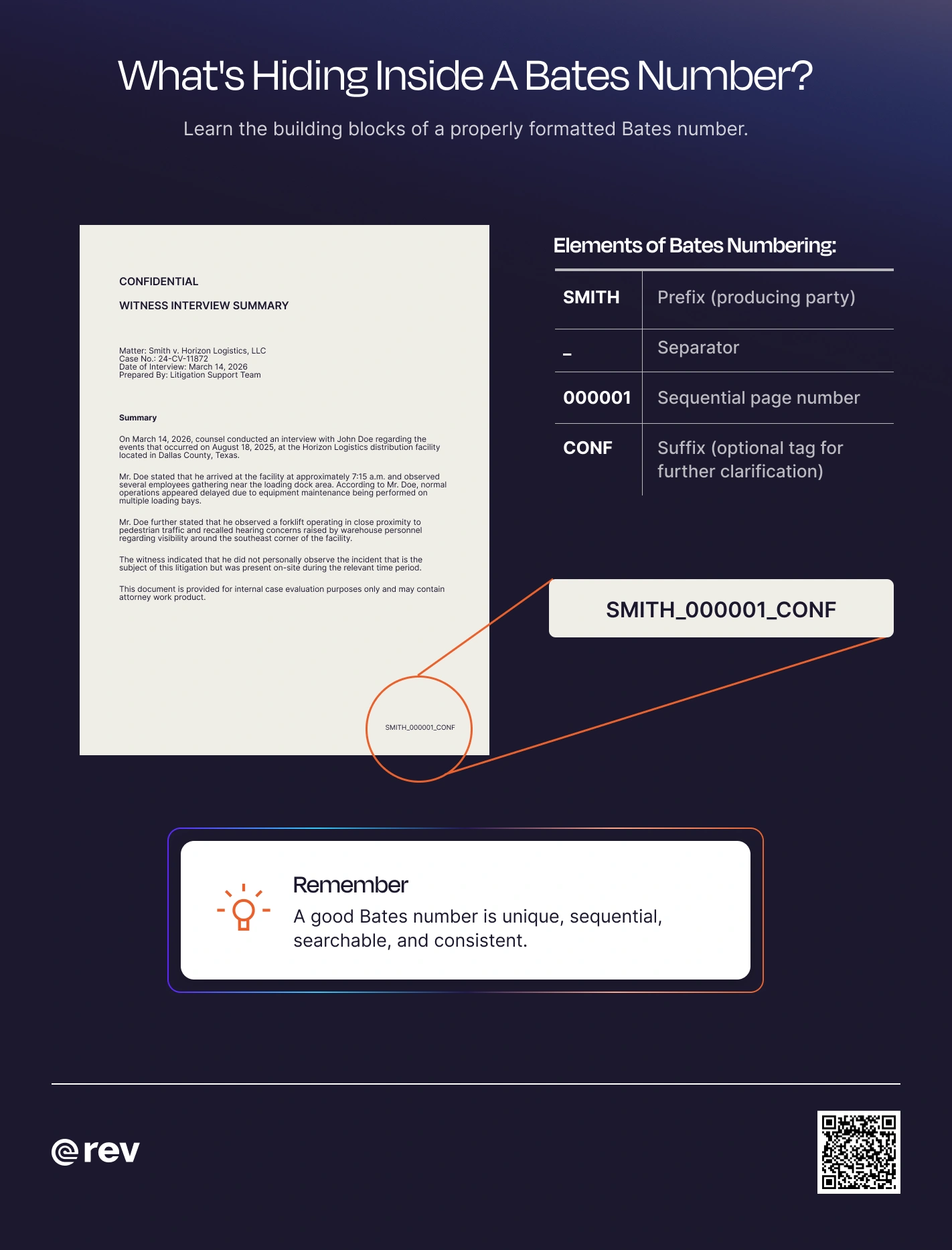
A well-constructed Bates number collection has a clear, consistent structure. Most legal teams combine some or all of these components to build identifiers that are unique, sortable, and informative at a glance. Here are the key elements to keep in mind when adding Bates numbering:
- Prefix: A letter-based identifier at the start of the number, usually representing the client, case, or matter (e.g., SMITH, PLF, DEF). This ensures pages stay identifiable even when documents from multiple parties are mixed together.
- Separator: A character between the prefix and number, typically an underscore or hyphen (e.g., SMITH_000001 or SMITH-000001). Pick one and use it consistently.
- Digit length: The total number of digits in the sequence, used consistently throughout all files. Six digits is standard, but eight digits is recommended for large litigation matters.
- Sequential number: The core numeric sequence that should be padded with leading zeros to maintain consistent digit length (e.g., 000001 rather than 1). This keeps pages correctly sorted when organized electronically.
- Suffix: An optional tag added at the end, sometimes used to indicate document type, sensitivity level, or version (e.g., _CONF for confidential).
- Placement: Where the Bates number consistently appears on each page (most commonly in the footer at bottom right or bottom center) for easy access and to avoid obscuring the content.
How To Bates Number Documents
Bates numbering follows a simple process, but consistency is critical. Before producing documents, establish a numbering system and apply it uniformly across every page.
- Organize your documents: Gather and arrange all files in the order they will be produced.
- Choose a numbering format: Decide on a consistent structure, such as:
- DEF_000001
- PLF_000001
- SMITH_000001_CONF
- Set a starting number: Most productions begin with 000001 and continue sequentially without duplicates.
- Apply numbers: Tools like Adobe Acrobat Pro, Relativity, and Everlaw can automatically stamp large document sets.
- Verify the sequence: Check for missing numbers, duplicates, or formatting inconsistencies before production.
- Maintain a production log: Record each production's Bates range so documents can be tracked later.
For example, a defendant's first four pages might be labeled:
DEF_000001
DEF_000002
DEF_000003
DEF_000004
Once assigned, Bates numbers should remain permanent and consistent throughout the life of the case.

Best Practices When Bates Numbering Legal Documents
Following a consistent process is what separates a clean production from a messy one. Apply the following best practices from the start of trial preparation, not as an afterthought when you’re already under deadline pressure.
1. Plan Your Numbering Convention Before You Start
This is the most important step, and it’s the one teams most often skip. Before you touch a single file, decide on your prefix, digit length, separator, and starting number. Write it down. Share it with everyone on the team.
Many experienced litigation teams map out the full expected sequence on a spreadsheet before labeling begins, think of a range like PLTF_000001 through PLTF_002500. This prevents gaps, duplicates, and mid-production format changes. Once you start, you can’t easily change the convention without creating confusion across all documents with reference numbers.
2. Always Use Leading Zeros
ABC-1 and ABC-000001 might seem similar, but the difference really matters. Without leading zeros, electronic sorting breaks down. Files named ABC-1, ABC-2, ABC-10 will sort as ABC-1, ABC-10, ABC-2—putting pages completely out of order.
Use at least six digits for standard cases and eight digits for large productions. It’s also smart to build in extra capacity: if you think you’ll have 10,000 pages, format for 100,000. Running out of digits mid-production is an avoidable headache.
3. Never Skip Or Reuse Numbers
Gaps in a Bates sequence can be red flags that opposing counsel and judges are bound to notice, as it raises immediate questions about whether documents were withheld or destroyed.
Never reuse a number from a document that was withdrawn. If a document is removed from a production, its Bates number should be documented with a clear explanation. Reusing numbers compromises the integrity of your audit trail and can create serious legal issues down the line.
4. Use Prefixes That Identify The Producing Party
In multi-party litigation, documents from multiple sides get combined into single review sets. Without clear party identification in the Bates prefix, it quickly becomes impossible to tell who produced what.
Common conventions include party abbreviations (SMITH, PLF, DEF), case numbers (CV2026), or matter codes (MAT-A). Whatever you choose, decide on it before the case begins and stick to it. Consistent prefixes keep every page traceable back to its source.
5. Apply Numbers Consistently In Headers Or Footers
The placement of a Bates stamp matters. Most legal teams default to the footer—bottom right or bottom center—because it’s visible without obscuring document content. Pick a position and use it for every page in the production.
Inconsistent placement creates confusion when documents are printed or reviewed side by side. It also makes it harder to build automated workflows around your documents. Choose a position, document it in your case protocol, and stick to it.
6. Maintain A Production Log
Every production should be accompanied by a log that records what was produced, what Bates range it covers, when it was produced, and who owns it. This is your paper trail inception.
A production log lets you quickly answer questions like: “Did we produce that email thread?” or “What’s in the range SMITH_004000 to SMITH_004500?” It also protects your law firm if there are later disputes about what was or wasn’t produced.
7. Stamp Both Digital And Physical Copies
If you’re working with both paper documents and digital files (which is extremely common), both versions need to carry the same Bates numbers. Physical documents without matching digital Bates labels can create a nightmare scenario.
When converting paper documents to digital format, make sure to scan them first, and then apply the Bates numbers on your evidence management and investigation platform. Sometimes the scan quality can affect label legibility, so to avoid issues, make sure to follow this order of operations.
8. Use Bates Numbering Software For Large Productions
Manual Bates numbering is error-prone and slow. For any production involving hundreds of pages or more, dedicated Bates numbering software is a great option. Modern tools let you apply numbers across entire batches in minutes, with full control over format, placement, font size, and color.
Adobe Acrobat Pro is the most widely used tool for PDF Bates numbering, with a built-in “Bates Numbering” option under the Header & Footer tools. It supports batch processing across multiple PDFs, custom prefixes and suffixes, and flexible placement options. Other dedicated tools like Relativity and Everlaw offer similar functionality with added workflow features for legal teams.
9. Coordinate With Opposing Counsel On Format
In many cases, the format for Bates numbering is negotiated as part of the discovery protocol or ESI agreement. And some courts even have specific local rules about Bates numbering format.
Before getting started, make sure to check with both. Producing documents with a non-compliant format can result in having to re-produce the entire set, often at your expense and under intense court scrutiny. Getting alignment upfront is always worth the conversation.
10. Follow eDiscovery Bates Numbering Standards
eDiscovery has its own layer of best practices. Electronically stored information (ESI) may be converted to PDF or TIFF format before Bates numbers are applied. Then follow a consistent format, add sequential numbers without gaps, and add a clear identification of who produced what.
Some eDiscovery software automatically applies Bates numbers as part of the processing workflow, which can save you a lot of time. Just make sure your settings match your agreed-upon format before running a batch.
11. Link Bates Numbers To Case Files
Bates numbers are only as useful as the system they’re connected to. A page number without a corresponding index, transcript, or search function is still just a number.
The real power comes when your Bates-numbered documents are integrated into a searchable case file system like Rev. When you can search your transcripts, pull a deposition, and jump directly to a cited Bates number, document review becomes dramatically faster. That kind of integration is what separates teams that manage documents from teams that leverage them.
Bringing Bates Numbering Into The Modern Era
The core logic of Bates numbering hasn’t changed in over a century—but the tools and workflows around it have transformed completely. What once took a paralegal days to accomplish by hand can now be done in minutes with the right software. More importantly, modern platforms don’t just label documents: they make those labeled documents searchable, cross-referenceable, and citable.
AI-powered legal tools are extending this further. Platforms like Rev can transcribe audio and video evidence with legal-grade accuracy, turning recordings into searchable, timestamped transcripts that integrate directly into your operational workflow.
When your Bates-numbered exhibits are linked to searchable transcripts and files, you’re not just organizing documents anymore. You’re building a searchable source of truth across your entire case. That’s the modern version of what inventor Edwin Bates set out to accomplish in 1891: making it faster and easier to find exactly what you need, right when you need it.
Keep Your Documents (And Your Case) In Order
Bates numbering is foundational to legal document management. It creates order, accountability, and credibility across everything you produce. But it’s one piece of a larger puzzle.
The firms winning in discovery today are building systems where every document, transcript, and piece of evidence is organized, searchable, and ready to use in court. Rev helps legal teams get there.