


Free Case Brief Template For Lawyers And Law Students
Download a free case brief template and learn how to organize facts, holdings, and procedural history in order to prep faster and argue stronger.


.webp)
You've got the case. You've got the stack of materials. Now you need to make sense of it quickly.
A solid case brief is how you do that. It's the difference between walking into a courtroom prepared and scrambling to find the detail you know you read somewhere. This guide walks you through the full case brief format, shows you a real example, and gives you a free case brief template you can download and start working with today.
What Is A Case Brief?
A case brief is a structured summary of a legal case that captures the facts, issues, reasoning, and outcome in an organized format. It's how lawyers and law students break down complex court opinions into something they can really use — whether that's prepping for class, building a legal argument, or reviewing precedent.
The best case briefs go further than notes; instead, they serve as a decision-making tool. It gives you the case summary and key facts at a glance, so you can compare holdings, spot inconsistencies, and build stronger arguments without re-reading a 40-page opinion when your brain is already fried.
How To Create A Case Brief
Every case brief follows the same basic structure, but there's some judgment involved in how you apply it. Here's how to build one from scratch.
1. Identify The Case Name And Citation
Start with the basics: the full case name, the court that decided it, and the year. This matters more than it sounds. The citation (example: Miranda v. Arizona, 384 U.S. 436 (1966)) tells you the jurisdiction, the level of court, and the era. Those details shape how much weight the ruling carries and whether it applies to your situation.
Write it exactly as it appears in the opinion. Precision in citations is non-negotiable.
2. State The Facts
This is where you capture what actually happened. Stick to the legally relevant facts, as not every background detail is important. Focus on the details that will influence how the court rules.
Ask yourself: what would change the outcome if it were missing? If removing a fact would shift the holding, include it. If it's background noise, cut it. It’s also important to keep this section short. Two to four sentences is usually enough for most cases, but for more complex issues, use a bulleted list to stay organized.
3. Document The Procedural History
Procedural history tells you how the case got to this court. Did it start in district court? Was there an appeal? Did it get remanded and come back up?
This section matters because each court can come to different conclusions. A trial court decides facts. An appellate court reviews whether the law was applied correctly. Knowing where you are in that chain tells you what kind of precedent or rule of law you're actually looking at.
For a case brief, one to three sentences is plenty enough to capture the key procedural steps. Don't get lost in the weeds. Remember, this section serves as the context, not the main event.
4. Identify The Legal Issue
The issue is the specific legal question the court had to decide. It should be framed as a question that can be answered yes or no, or with a specific holding. An example of a well-stated issue looks something like this: "Does the warrantless search of a vehicle that leads to an arrest violate the Fourth Amendment?"
Most cases have one central issue, but complex cases can have several. Brief each one separately if needed.
5. State The Holding
The holding is the court's answer to the issue. It's the rule that comes out of this case — what the court actually decided. This is the most important part of the brief.
Write the holding as a clear, direct statement. Reference the facts where they matter. For example, a holding wouldn’t just be "suspects have rights" — it's that law enforcement must inform suspects of their Fifth and Sixth Amendment rights before an interrogation. That specificity is what makes holdings usable in practice.
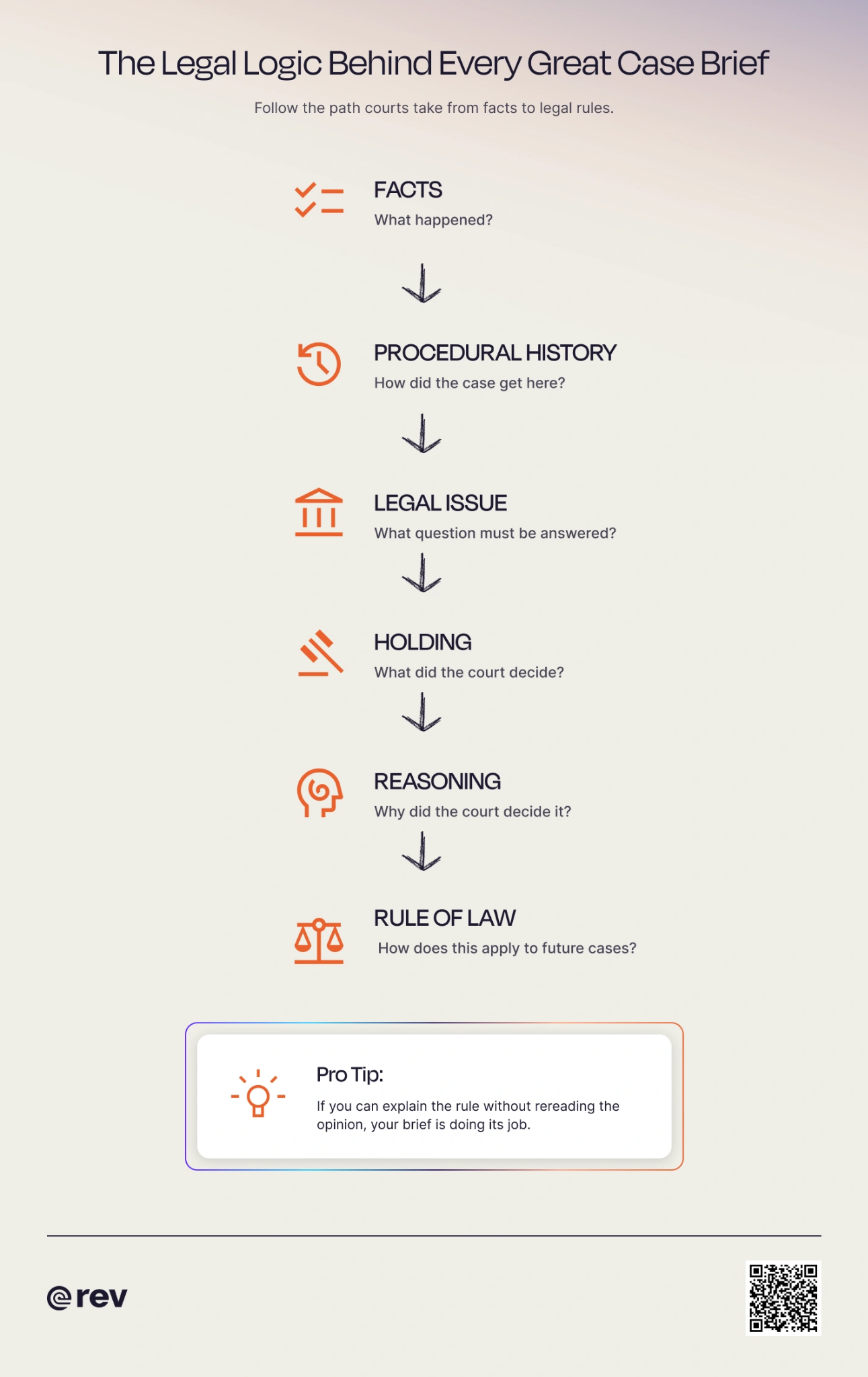
6. Summarize The Reasoning
The reasoning explains why the court ruled the way it did. This is where you capture the legal logic (sometimes called the rationale); the statutes, precedents, and principles the court relied on.
This section is especially useful when you're trying to apply a case to a new fact pattern. Understanding the why gives you the flexibility to argue by analogy or distinguish the case when the facts don't line up perfectly.
Two to four sentences is usually enough for a case brief. However, if the reasoning is complex, a short bulleted list can help.
7. Extract The Rule
The rule is the broader legal principle that comes out of the case, meaning the part that applies beyond this specific fact pattern.
Think of it as the holding, generalized. If the holding answers "what did the court decide here," the rule answers "what does this mean for future cases." This is the piece you'll actually cite in briefs and arguments. Write it in clean, precise language — the way you'd reference it in a legal memo.
Case Brief Example + Template
Here's what a completed case brief looks like, with an imaginary case we’re calling Johnson vs. Ohio.
Case Name: Johnson vs. Ohio XXX U.S. XXX (2025)
Facts: Johnson was accused of removing advertising signs from a local hardware store after business hours. The store owner reported that six promotional signs, valued at approximately $180, disappeared overnight. Security camera footage showed Johnson loading several signs into the bed of his pickup truck. Johnson admitted taking the signs but claimed he believed they had been discarded because they were displayed near a dumpster. The State argued the signs remained on the store's property and were clearly being used for advertising.
Procedural History: Johnson was charged in the Franklin County Municipal Court with misdemeanor theft under Ohio law. After a bench trial, the court found him guilty. Johnson appealed, arguing that the State failed to prove he knowingly deprived the owner of property because he reasonably believed the signs had been abandoned.
Issue: Can a defendant be convicted of theft when he claims he reasonably believed the property he took had been abandoned?
Holding: Yes. A theft conviction may be upheld when the evidence demonstrates that a reasonable person would have understood the property remained under the owner's control and was not abandoned.
Reasoning: The court concluded that the signs were positioned on the business's property for promotional purposes and had not been discarded. Although Johnson argued he believed the signs were trash, the evidence showed they were neatly displayed, undamaged, and located within the business's landscaped frontage rather than inside or immediately adjacent to a dumpster. The court found that these circumstances would have informed a reasonable person that the signs still belonged to the business. Because Johnson knowingly removed property without the owner's consent and intended to keep it, the State satisfied each element of theft.
Rule: A person commits theft by knowingly obtaining or exerting control over another's property without the owner's consent and with the purpose of permanently depriving the owner of that property. A mistaken belief that property has been abandoned is not a defense when the surrounding circumstances would lead a reasonable person to conclude the property remains under the owner's possession and control.
Judgment: The appellate court affirmed Johnson's conviction, holding that sufficient evidence supported the trial court's finding that the signs were not abandoned and that Johnson knowingly committed theft.
We also created a free, downloadable case brief template you can use for your next case or in the classroom. The template is built around these seven components and can help you stay organized. It works for law school case briefs, bar exam prep, and real-world case analysis.
Looking for more templates? Check out our downloadable demand letter template and our incident report templates.
What To Know About Highlighting And Annotating
Good annotation starts before you write a single word of your case brief. As you read the opinion, mark the facts that stand out, circle the issue when you spot it, and flag the court's holding when it appears. Different colors work well for different sections — facts in one color, the rule in another. What matters is that you have a system in place for your entire team, and that you all use it consistently.

Margin notes are where briefs actually get built. When you read something that answers the question "why did the court decide this?" — write it down right there. Don't wait to find it again later. The synthesis happens in the margins first, then in the brief.
For longer opinions, annotating as you go also saves you from re-reading. Once you have your highlights and margin notes, writing the actual case brief format becomes assembly work, not analysis work. Tech can also aid in this as well. Legal tools like Rev can read and analyze thousands of documents at once, always cites it sources, and allows you to build customizable templates that you can use again and again (including case brief templates).
“When I began practicing law, we went to the law library and used books to find cases. It was laborious and time-consuming,” explains Lisa Lanier, President of Lanier Law Group.
“Now technology has zoomed from finding cases online to AI at warp speed. AI legal research tools assist with so much more than finding cases. AI can suggest legal arguments, analyze and predict judge’s reactions, and essentially write the brief.”
What Is The Proper Format For A Case Brief?
The proper format for a case brief follows a seven-part structure: case name and citation, facts, procedural history, issue, holding, reasoning, and rule. This format is standard across most law schools and widely used in legal practice.
That said, there's no single official format mandated by any court or bar association. Some professors require specific structures. Some firms have their own templates. The seven-part structure in this guide covers all of the components you'll encounter across any case brief format — you can always adapt it from there.
- For law students: follow whatever format your professor specifies for class.
- For practicing attorneys: a good sample case brief is one you'd actually use. If your typical brief has fewer sections because the cases are simpler, trim accordingly. The goal is a document that helps you move faster, not a compliance exercise.
“In my experience, the most persuasive briefs are the ones that show restraint. It’s not that the persuasive brief tries to glaze over things or deny anything, so if anything, it openly addresses the “bad facts.” But it also keeps the narrative moving towards the end goal,” said Riley Beam, Managing Attorney at Douglas R. Beam.
How Many Pages Should A Case Brief Be?
A case brief should be one to two pages for most cases. For more complex cases with multiple issues or significant procedural history, two to three pages is reasonable.
The common mistake is making case briefs too long. A four-page case brief usually means you included too many facts, over-explained the reasoning, or didn't distill the rule clearly enough.
If you're regularly going over three pages, the case brief format isn't the problem — it's the cutting. Practice identifying what's legally relevant versus what's just interesting, and your briefs will tighten up fast.
Build Stronger Cases With Better Evidence Organization
A well-structured case brief is just one piece of thorough case prep. For attorneys working through mountains of discovery, depositions, and witness interviews, the bottleneck usually isn't the analysis — it's getting to the facts fast enough to analyze them at all.
Rev turns hours of audio and video evidence into searchable, citable transcripts so you can build your case strategy without spending days in playback. Every finding is tied back to a timestamp and a source file — so when you're building your legal brief, you're citing the record, not your notes.


.webp)
%20(1).webp)