

How to Format a Legal Brief (Example + Template)
Learn how to format a legal brief step by step. Includes a sample legal brief, free downloadable templates, and tips for faster, more accurate brief writing.


%20(1).webp)
A legal brief can win or lose a case before anyone says a word in court. Judges read them before oral argument. Clerks use them to frame their recommendations. Opposing counsel combs through them looking for gaps.
Yet most attorneys spend more time on the substance of their argument than on the structure that delivers it. But a well-formatted brief doesn't just look professional — it makes your argument easier to follow and harder to dismiss (learn more about motions to dismiss on our blog).
This guide walks through how to format a legal brief step by step, includes a sample table of authorities and brief structure, and offers free downloadable legal brief templates you can use right away.
What Is a Legal Brief?
A legal brief is a written document filed with a court that sets out the legal and factual arguments supporting a party's position. It's the primary vehicle for persuasive legal writing in appellate and motion practice.
People often confuse a legal brief with similar documents. Here's a quick breakdown:
- Legal Brief: Filed with a court to argue a party's position on a legal issue. Persuasive by design.
- Case Brief: An internal summary of a court decision, used by law students and attorneys for research. Not filed with any court. (See our case brief template for a ready-to-use format.)
- Legal Memorandum: An objective analysis of the law on a given question, typically written for internal use by attorneys advising clients, also not filed with a court.
Legal briefs come in several types: opening briefs, response briefs, reply briefs, and amicus curiae briefs. Each follows a similar structure but serves a different role in the proceeding.
How To Format A Legal Brief In 9 Steps
Under Federal Rule of Appellate Procedure 28, appellate briefs must include specific sections in a prescribed order. Most state courts follow a similar structure, though local rules vary. Always check the court's local rules before filing.
Here's the standard legal brief format:
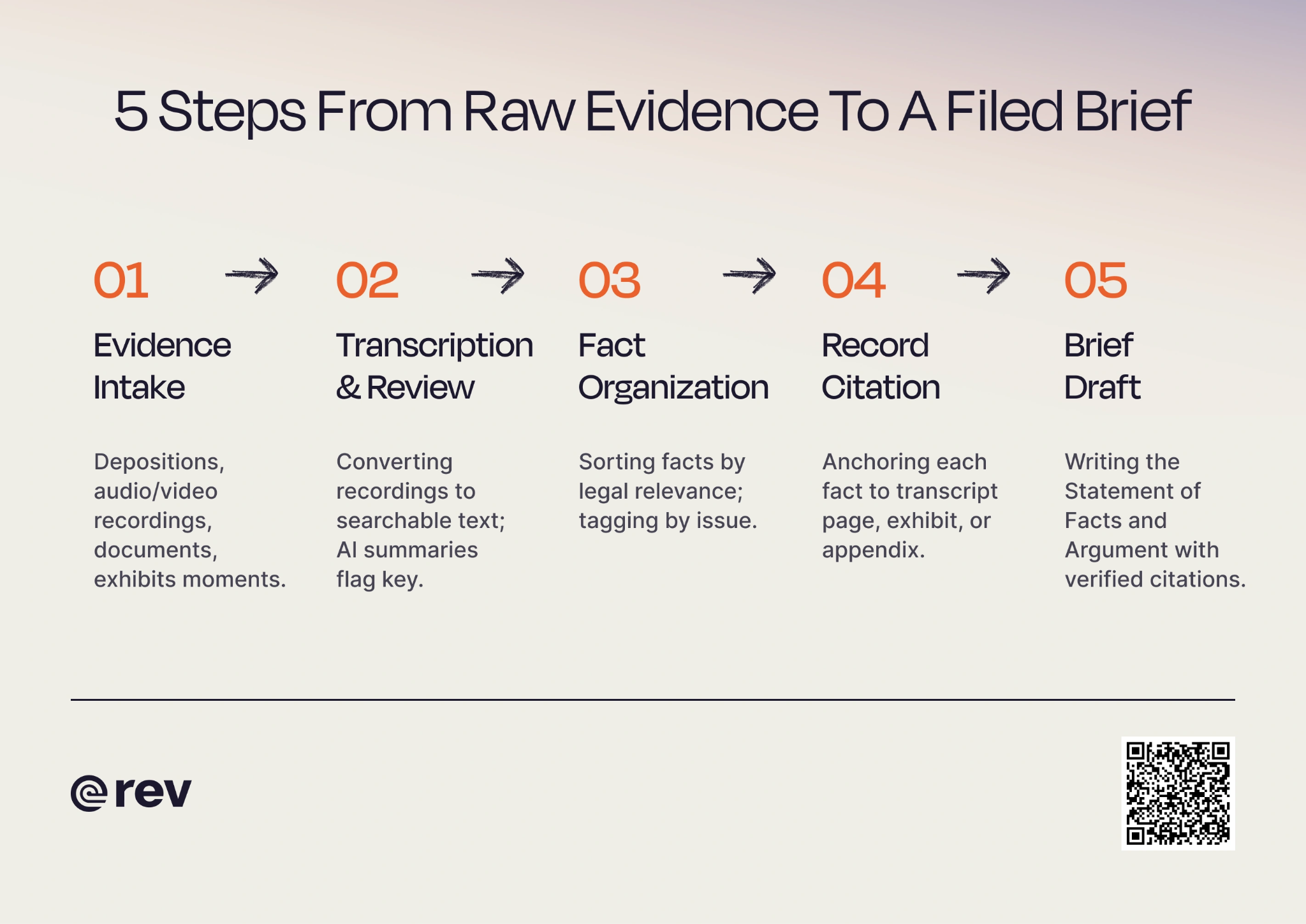
- Cover Page: Lists the case name, court, docket number, the party filing the brief, and attorney contact information.
- Disclosure Statement: Often required by FRAP Rule 26.1 in federal practice, it identifies corporate parties and their parent companies.
- Table Of Contents: A navigational map of everything in the brief, including all headings and subheadings with corresponding page references.
- Table Of Authorities (TOA): An alphabetical index of every case, statute, regulation, and secondary source cited in the brief, with page references for each.
- Jurisdictional Statement: A concise statement establishing the court's authority to hear the case. Cites the applicable statutes and explains the basis for subject-matter and appellate jurisdiction.
- Statement Of Issues: The legal questions the brief asks the court to resolve. These should be framed in favor of your client's position.
- Statement Of Facts. An objective, record-supported account of the facts relevant to the legal issues. Every factual assertion must be tied to a specific page in the record or transcript.
- Argument And Citation Of Authority: This should use the CREAC structure (Conclusion, Rule, Explanation, Application, Conclusion) to walk through each legal issue. Point headings and subheadings organize the argument and appear in the Table of Contents.
- Conclusion: A short, precise statement of the relief sought.
Some briefs also include a Summary of Argument, a Certificate of Compliance with word or page limits, and an Addendum with required attachments. Always do your research to ensure you are following your jurisdiction's requirements.
Why Structure Matters In Legal Briefs
Courts process hundreds of briefs, meaning by the time they pick up yours, their eyes might be going blurry. If your brief buries its argument in dense paragraphs, you’ll risk frustrating the reader and even hurting your client’s chances.
We spoke to Lisa Lanier, President of Lanier Law Group, who echoed this sentiment:
“Beyond the basic elements of a legal brief, effectiveness is enhanced by eliminating fluff and getting right to the point in the recitation of the facts and concisely refining the explanation of the case law. Less really can be more.”
A good structure in your legal brief specifically does three things:
- Signals credibility.
- A clean, properly formatted brief tells the court this attorney knows the rules and respects the court's time.
- Makes your argument accessible.
- Point headings act as signposts. A judge should be able to read your headings alone and understand your entire argument.
- Survives scrutiny.
- When every factual claim is tied to the record, and every legal proposition is supported by authority, your position is harder to argue against.
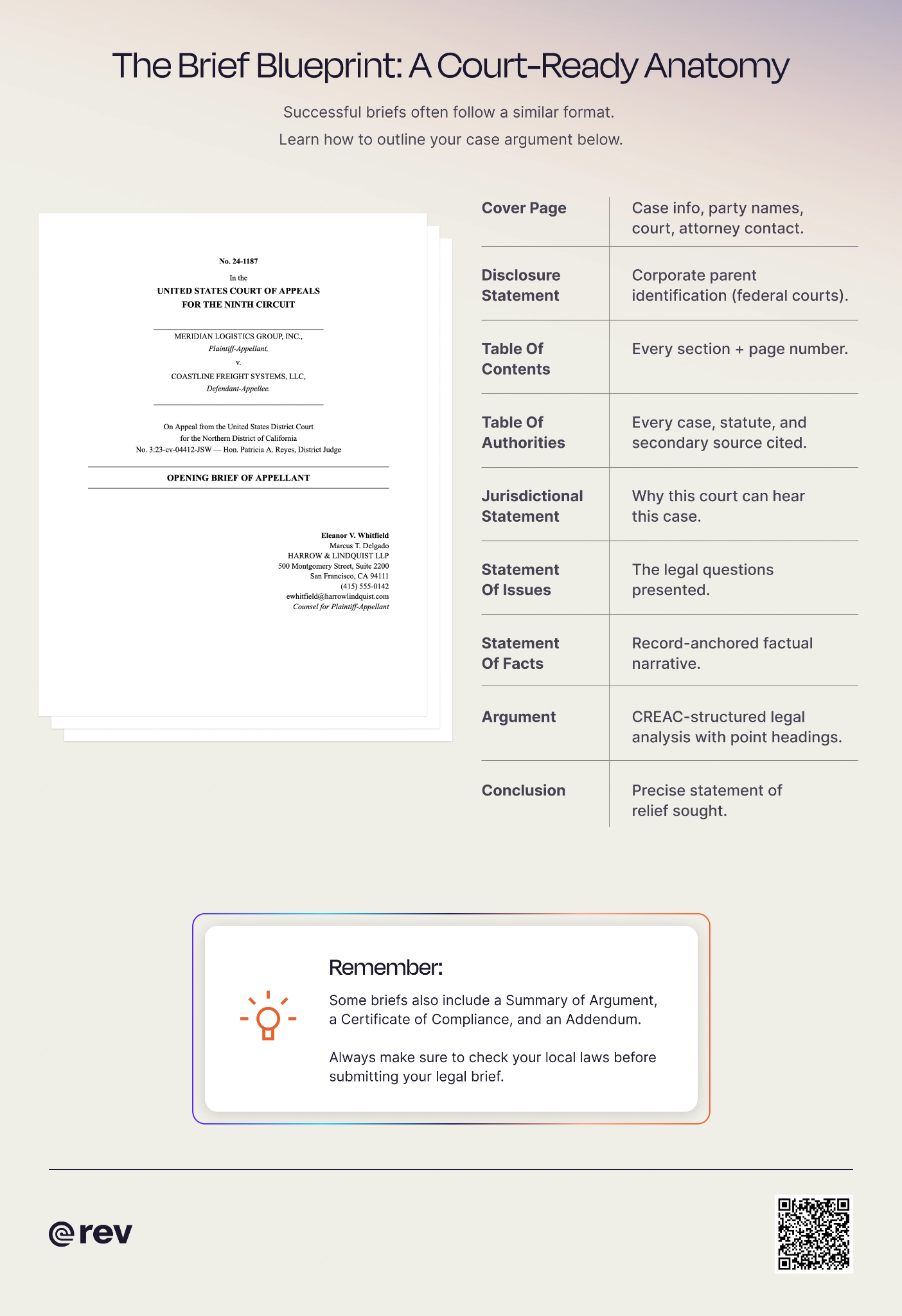
Per FRAP Rule 32, briefs must be on 8½ by 11-inch paper, double-spaced, with one-inch margins and 14-point proportional type. The Supreme Court and most Federal Circuit courts limit briefs to 13,000 words, though local rules can tighten those limits further.
Sample Legal Brief
Below is a simplified example of how a legal brief's opening sections are typically structured. This is a representative sample for formatting reference only, not a model for legal argument.
─────────────────────────────────────────────
IN THE UNITED STATES COURT OF APPEALS
FOR THE NINTH CIRCUIT
Case No. 25-12345
JANE DOE,
Appellant,
v.
ACME CORPORATION,
Appellee.
APPELLANT'S OPENING BRIEF
TABLE OF CONTENTS
Table of Authorities ...................................................................................... ii
Jurisdictional Statement ................................................................................. 1
Statement of Issues Presented ........................................................................ 2
Statement of the Case ................................................................................... 3
Statement of Facts ....................................................................................... 4
Summary of Argument ................................................................................... 7
Argument ................................................................................................... 8
I. The District Court Erred in Granting Summary Judgment ............................ 8
II. Appellant's Claim Survives Under the Proper Legal Standard .................... 14
Conclusion ................................................................................................. 22
Certificate of Compliance ............................................................................. 23
TABLE OF AUTHORITIES
Cases
Anderson v. Liberty Lobby, Inc., 477 U.S. 242 (1986) .................................... 9, 14
Celotex Corp. v. Catrett, 477 U.S. 317 (1986) ............................................... 9
Statutes
28 U.S.C. § 1291 ......................................................................................... 1
Fed. R. Civ. P. 56(a) .................................................................................... 8
─────────────────────────────────────────────
Free Legal Brief Templates
Different proceedings call for different brief formats. Below are templates for the most common types. Make sure to adjust for your jurisdiction's local rules.
Looking for more templates? Check out our incident report templates and our free case brief templates.
Advanced Tips For Brief Writing
If you are looking to take your brief to the next level, consider these tips when writing your next brief:
- Lead with your strongest argument.
- Courts apply different standards of review to different issues. Frame your strongest issue first, especially if it's subject to de novo review.
- Write your point headings as persuasive conclusions.
- "The District Court Erred" is weak. "The District Court Applied the Wrong Legal Standard to Undisputed Facts" tells the judge exactly what happened and why it matters.
- Cite every fact to the record.
- Every factual claim must be tied to a transcript page, exhibit number, or appendix page. Unanchored facts invite opposing counsel to dispute them and signal to the court that you're working from memory, not the record.
- Build your Table of Authorities last.
- The TOA is alphabetically organized by source category — cases first, then statutes, then secondary sources — with every page number on which each authority appears. It can only be finalized once the brief is paginated.
- Know your word limits before you start.
- The Supreme Court as well as most Federal courts cap briefs at 13,000 words. Exceeding the limit without permission is grounds for the court to strike the brief entirely, so make sure to do your research before submitting.
Make Legal Briefing More Efficient
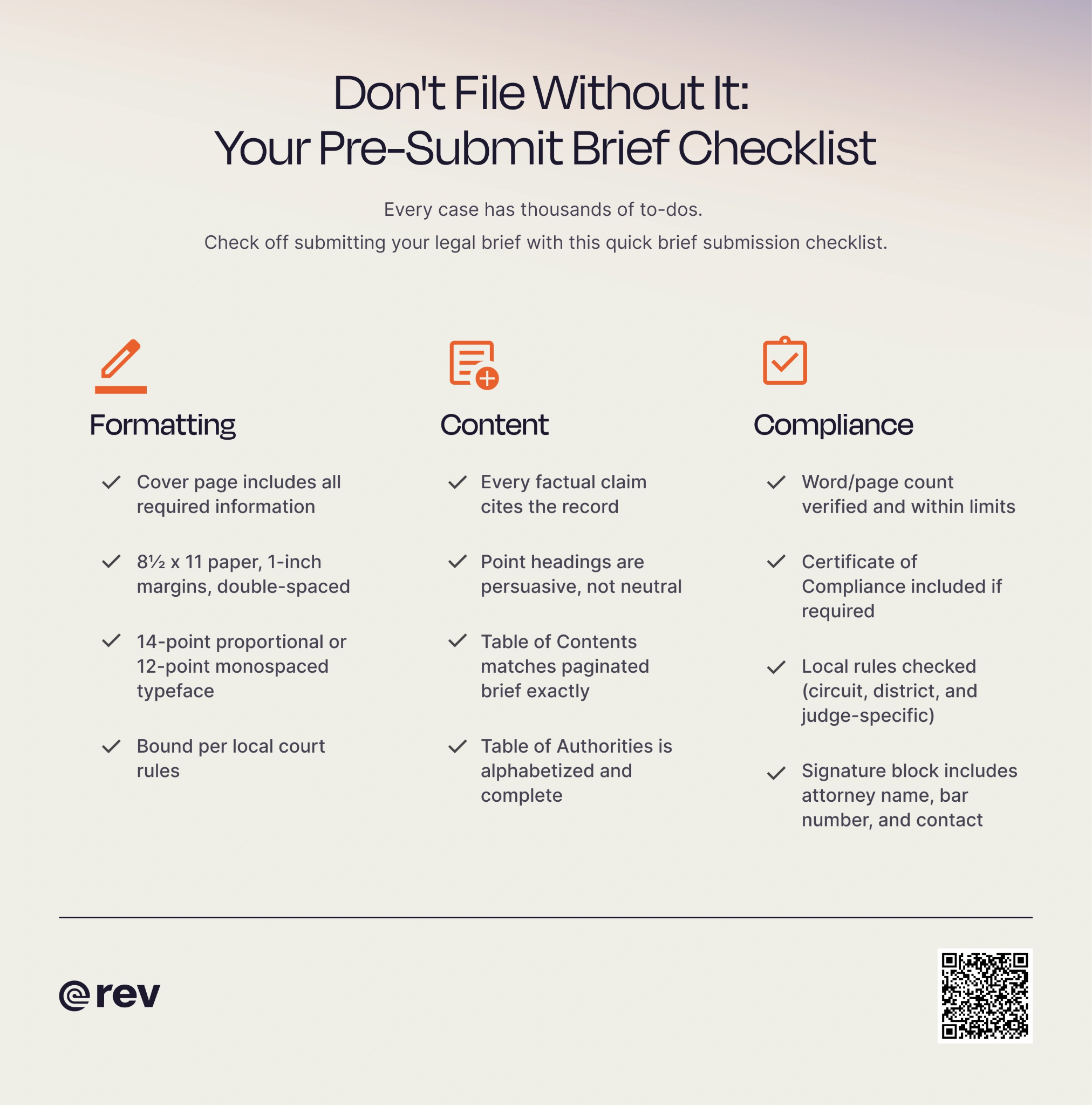
The most time-consuming part of brief writing often has nothing to do with writing. It's the evidence review — combing through deposition transcripts, hearing records, and audio or video exhibits to find the facts that belong in your Statement of Facts and support your Argument.
This is where technology can make a real difference. Searchable transcripts and document comparison tools let attorneys move through hundreds of pages of deposition or trial testimony in seconds. AI tools that summarize deposition transcripts can surface the key moments and contradictions that would take hours to find manually.
“AI has allowed me to focus less on research queries and more on honing my arguments,” explains Aaron A. Pelley, Partner at Gleam Law.
“Further, running a final draft of a dispositive motion through AI has, for all intents and purposes, provided me with a second opinion on the strengths and weaknesses of my arguments.”
Rev's Investigative Intelligence Platform is built for exactly this workflow. Attorneys can upload audio, video, images, and documents, and the platform returns searchable transcripts with AI-generated summaries. Every finding traces back to the source file, so when you cite to the record in your brief, you're citing something you can verify and show opposing counsel.
For firms handling high-volume litigation or complex cases with large evidentiary records, this kind of searchable infrastructure can compress the evidence review phase from days to hours — and make the Statement of Facts section far less painful to draft.
Get Your Brief Right The First Time
A well-formatted legal brief is a major part of your persuasion strategy. After all, arguments land harder when facts are properly cited, and deadlines feel less brutal when you're not manually rebuilding a TOA at midnight.
Rev helps attorneys move from evidence to brief faster, with every transcript anchored to a timestamp and every summary tied to the source. See Rev pricing and plans to get started.


.webp)
.webp)