Survey: 48% Say AI In Legal Education Delivers An Advantage
New survey of legal pros shows AI's rise in legal education. Nearly half say it gives students a career edge, while accuracy and ethics outrank speed and cost.


Nearly half (48%) of people involved in legal education and legal work say access to AI during law school gives today’s students a significant professional advantage over previous generations.
We surveyed people across the U.S. who study, teach, and practice law to understand how they use AI in their day‑to‑day work, in everything from class prep to client matters. We also asked how much they trust AI results.
This study looks at where AI has become essential in legal education, how much time it saves, and what matters most to students and professionals when they choose to use these tools.
Key Takeaways
- Nearly half (48%) of legal students and professionals say AI access gives today’s students a major advantage over previous generations.
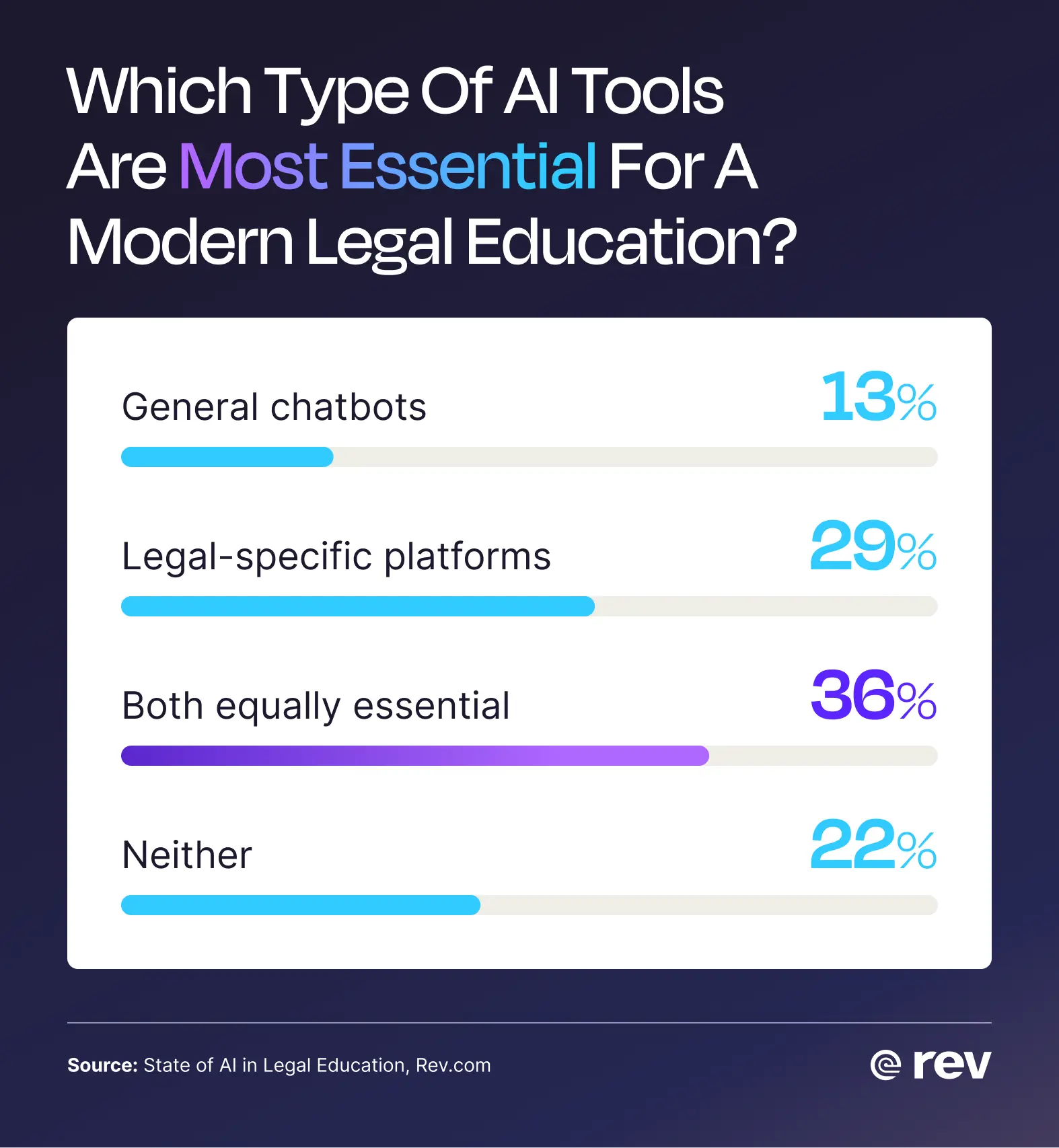
- 65% see AI as essential to modern legal education, either preferring legal‑specific platforms (29%) or saying both general and legal‑specific AI are equally essential (36%).
- Accuracy, ethical and responsible use training, and data privacy and security rank above speed and affordability as priorities for AI tools in legal education.
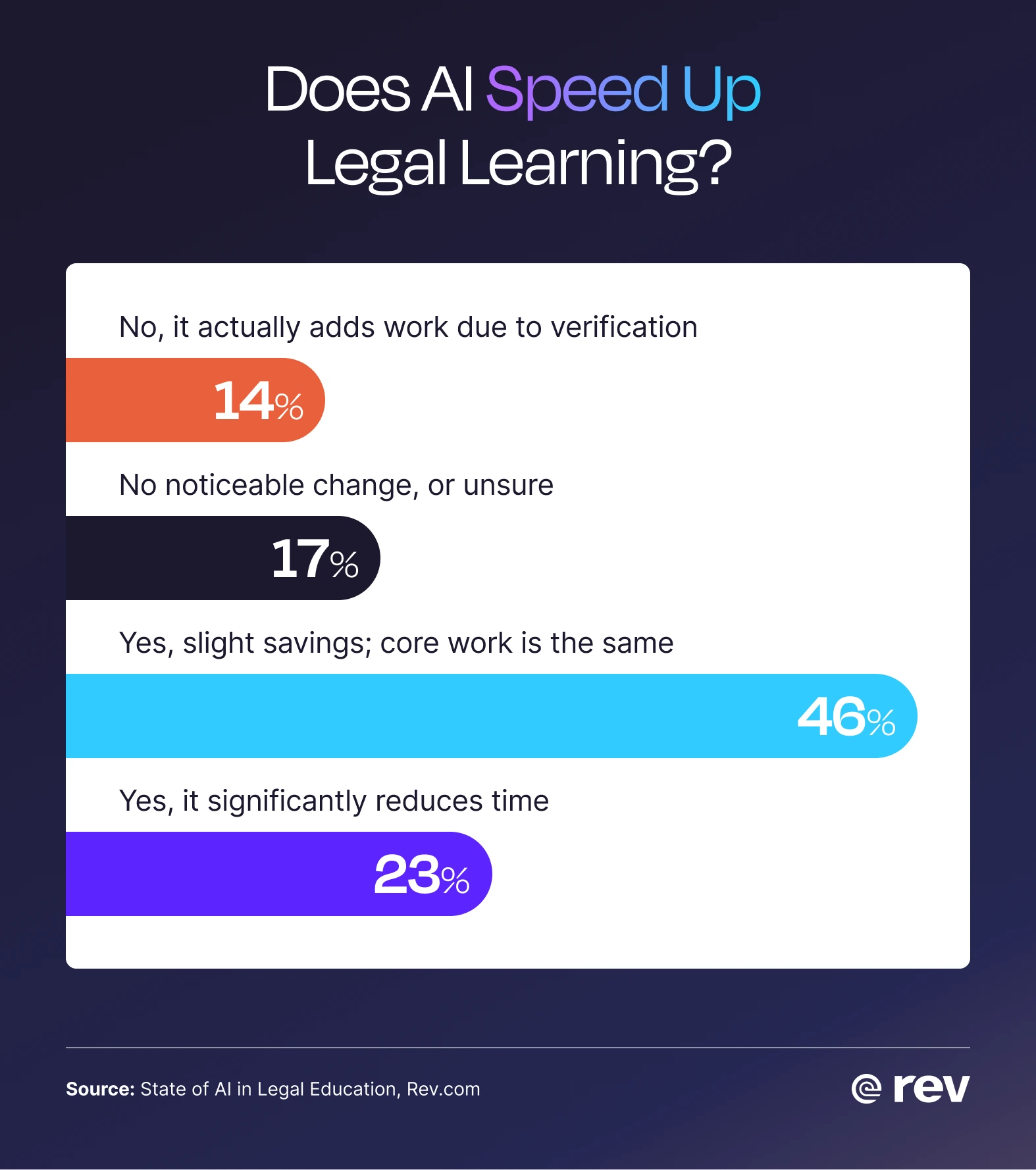
- 69% say AI makes legal education more efficient, but most say the core work stays the same and requires verification rather than blind trust.
- When summarizing complex legal transcripts, 42% trust a legal‑specific AI platform most, compared with just 17% who would rely on a general chatbot.
AI Is Becoming Essential To Modern Legal Education
Law students aren't waiting for professors to sign off on AI. Our survey shows 65% of respondents consider AI essential to modern legal education, with 29% saying legal-specific platforms are the most essential type of AI tool needed and 36% saying both general chatbots and specialized tools belong in the mix.
Many feel AI is reshaping the playing field. 37% agree, and 11% strongly agree, that access to AI during legal education gives students a significant professional advantage over past generations. For law students, that advantage shows up in small daily wins, like getting to a clearer case brief faster or having more time to focus on how to argue a point instead of just finding it.
Students now treat AI as another standard part of their research toolkit, alongside familiar case law and reference resources. At the same time, professors and future employers expect them to use these AI tools with a focus on accuracy, ethics, and responsible review.
AI Saves Time, But Human Review Matters
Our respondents spend serious time on primary sources during their legal research. 28% log over 20 hours a week reviewing transcripts, case files, and discovery, with most others (46%) spending 5-20 hours on these tasks.
For professors, this shift often means students arrive having used AI as a starting point, and the real work happens in class when they test and refine those drafts against the record.
That's exactly why students turn to AI tools for these time-intensive tasks. 69% say using these types of tools makes legal education more efficient, including 23% who see major time savings and 46% who see slight gains in their efficiency.
Michael Akiva, managing partner at Jacoby & Meyers, offers this example from his own practice:
“AI creates the biggest efficiency gains in a personal injury case lifecycle when it is used to manage information. Our cases often involve extensive medical records, billing documentation, and investigative materials. Tools that assist with organizing and retrieving that data allow our attorneys and records teams to focus on liability analysis and negotiation strategy.”
Human review stays essential, according to the 14% who say AI adds work because they must verify outputs. Law students understand professors and employers will hold them accountable for accuracy, just like practicing lawyers do every day.
That instinct matches reality. Rev's Hidden Costs of Evidence Review study found 54% of lawyers expect AI to help them reclaim up to 20 hours per case. Students anticipate AI delivering similar gains in their own work.
What Matters Most In Legal Education AI Tools
Accuracy is the top priority for our respondents when using AI tools for legal tasks. Law students know these priorities matter most when grades, justice, and future jobs are on the line.
You can see the hierarchy in their prioritization responses clearly:
- Accuracy of information
- Ethical and responsible use training
- Data privacy and security
- Workflow productivity and speed
- Affordability for students/professionals
A first‑generation law student reading a dense transcript and a clinic professor supervising live client work are both looking for the same thing in these tools — help that speeds them up without cutting corners on the facts.
When law students face messy, real‑world transcripts instead of neat hypotheticals, they become more selective about which tools they trust. For complex tasks like summarizing legal transcripts for coursework, 42% pick legal-specific AI platforms as their most trusted AI tool. Only 17% choose general chatbots, while 21% trust both equally. Just 20% insist on manual review only.
In other words, students are already thinking like practicing lawyers. They want tools that behave more like seasoned co‑counsel than generic assistants.
These preferences reveal what law students expect from AI. They want outputs they can rely on for exams and assignments. Professors expect the same. Tools that deliver accuracy first build trust that lasts from the classroom to the courtroom.
![List ranking the top priorities for legal AI tools preferred by law students and legal professionals]](https://cdn.prod.website-files.com/65e5ae1fb7482afd48d22155/69c6018ad622631b1a46ea5a_top-priorities-for-legal-ai-tools.webp)
Where AI In Legal Education Could Have The Biggest Impact
Our respondents see specific parts of the legal system as the biggest beneficiaries of AI efficiency.
- 41% say AI will have the greatest impact in large and boutique private law firms.
- 20% say AI will most benefit public interest and legal aid organizations.
- 16% say AI will most benefit corporate in‑house legal teams.
This lines up with the real-world usage of AI in the legal industry, as we discovered in Rev's AI Criminal Defense study. We found that 71% of defense attorneys already use AI, particularly in criminal justice, which just happens to be the fourth sector our respondents highlighted (13%).
Mike Kruse, a criminal and DUI lawyer at Kruse Law, shared some insights based on his personal experience:
“Technology makes working with a lot of data easier, however, it does not eliminate the necessity of critical thinking and judgment at the preparation stage. When formulating a strategy for a deposition, human interaction and insight are vital.”
Many law students understand these stakes. 69% of our respondents are first-generation learners who can benefit from AI training for demanding private practice and public interest jobs where accuracy determines critical outcomes.
Equip Law Students With Reliable AI
AI has become standard in legal education. As we’ve noted, 65% of our respondents see it as essential, and 69% say it saves time, even with the understanding that every output must be verified. Accuracy always ranks first, with ethics and privacy close behind.
Law schools and training programs now have clear expectations. Students want AI tools that deliver reliable results for case briefing and exam prep. Professors want responsible use. Get ahead of this shift by exploring Rev's legal AI tools.
Methodology
The survey of 330 people involved in legal education or legal practice in the United States, ages 18 and over, was conducted via Centiment in February 2026. The sample included law students, legal educators, and legal professionals at a range of career stages.
Data is unweighted and the margin of error is approximately +/-3% for the overall sample with a 95% confidence level.