Consumers Value AI Over Netflix, But Won't Pay More
A new survey reveals what people value in AI tools, what they'd realistically pay to keep them, and which features they'd never give up.


The streaming wars trained Americans to decide what's worth paying for. Every subscription gets weighed against its ever-growing list of competitors, and cut when the service doesn’t outweigh the cost. AI is now facing the same reckoning.
Rev surveyed over 1,000 Americans to find out what they really think AI is worth. The results tell a more complicated story than the hype suggests.
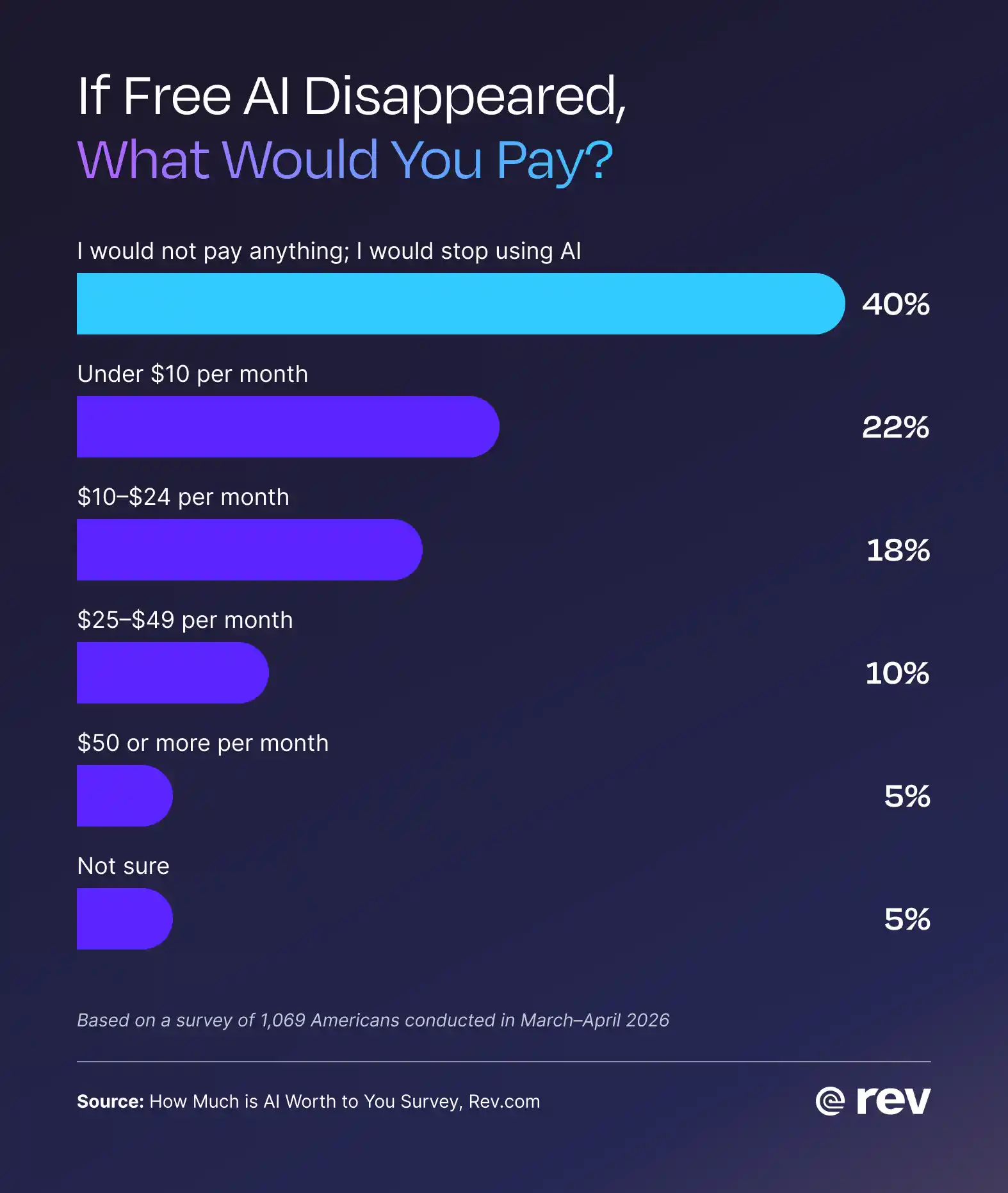
Six in ten said they'd pay to keep their access to AI if free tools disappeared. Yet of those willing to pay, 40% would cap their spending at $25 or less per month, about the price of a single streaming subscription.
For a tool that 35% of people rank above most or all of their other subscriptions, that price point says a lot about where AI stands right now. The data suggests most people see AI as valuable, just not valuable enough to pay much for.
Key Takeaways
- 17% of Americans say AI saves them at least $100 worth of time per month, but most still wouldn't pay more than streaming-level prices for it.
- The No. 1 reason people turn to AI is quick answers (63%), but time savings still matter to nearly a third of users (32%).
- 55% say AI has reduced their stress or burnout, but a third of respondents say it hasn't changed their stress at all or it’s made things worse.
- Only 15% would sacrifice accuracy to pay less, but 39% still wouldn't pay more for a significantly more accurate tool.
For Most Americans, AI Is Worth About as Much as a Streaming Subscription
For those willing to pay for AI, their price ceiling is modest. Two out of five of those are willing to pay $25 or less per month, putting AI in the same category as a single streaming service rather than a professional tool subscription.
The perceived value runs higher for some users. 17% say the time AI saves them each month is worth at least $100, and, of those, 5% put that figure at $1,000 or more. And 35% said AI is more valuable to them than most or all of their other subscriptions, ranking it above Netflix, Spotify, or cloud storage in terms of what it adds to their life.

Pie chart showing how Americans rate AI's value compared to their other monthly subscriptions.
So what would it actually take to get people to open their wallets? When asked what AI would need to do to feel worth paying for, avoiding costly mistakes (18%) and saving a few hours per month (18%) topped the list. For many users, getting more out of AI may simply come down to how they prompt it.
Everyone Uses AI — And 60% Are Ready to Pay for It
ChatGPT alone now has 900 million weekly active users — but only about 50 million of them pay for it. For most people, AI has become a regular part of daily life without ever requiring a financial commitment.
Our survey found that 60% of Americans would pay something to keep that access if free tools disappeared, which is a telling sign of just how embedded AI has become in everyday routines.
Nearly half (45%) of respondents use AI at least once a day, mostly for quick answers (63%) and writing help (36%). And 18% said they turn to AI specifically to reduce their stress or burnout, not just as a productivity tool.
But for many, the value hasn't yet felt tangible. 46% say AI either saves them no time worth paying for, or they aren't sure what that time is worth. And 55% say it's reduced their burnout, while a third say it's made no difference at all.
That perception changes when things get busy. During their most demanding periods, 41% of respondents said AI feels completely essential or very important to them. But even under pressure, 42% said AI is only somewhat helpful or makes no real difference to their workload.
But for users where AI does make a difference, it goes beyond convenience. It's part of how the work gets done now.
That's especially true in the legal profession, where four in five lawyers experienced burnout in the past year. For legal professionals managing that kind of pressure, using trusted legal tech can be a meaningful advantage.
Our 2025 Legal Tech Survey found that 22% of legal professionals are already using AI-powered transcription to accurately capture depositions, client meetings, and court proceedings.
85% Won't Sacrifice Accuracy To Pay Less, But 39% Won't Pay More for It Either
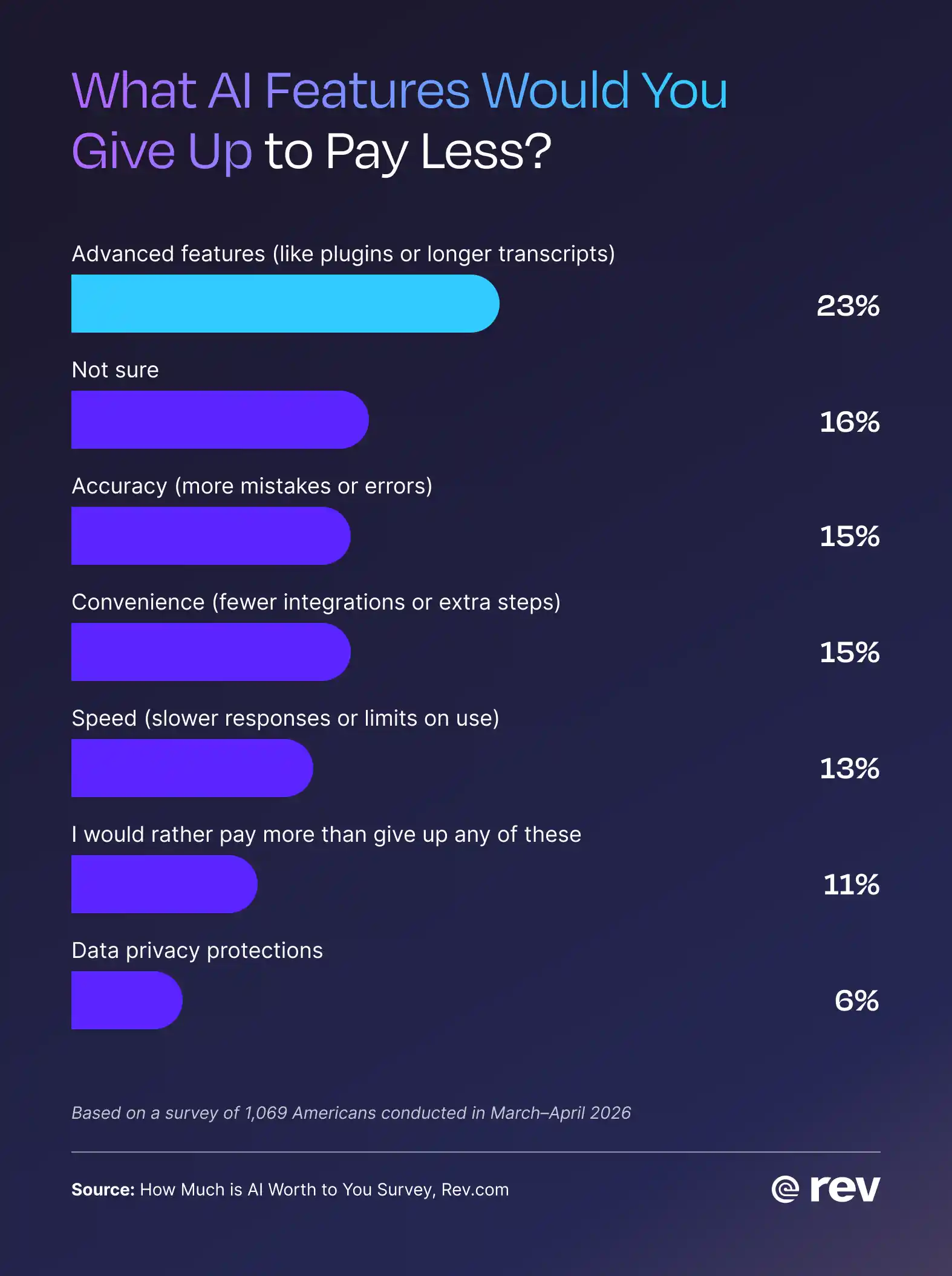
Of all the features people could give up to lower their monthly AI cost, accuracy was one of the least expendable. Only 15% of respondents said they'd accept more mistakes or errors in their AI exchange for a lower price, followed by speed (13%) and data privacy protections (6%).
What people are most willing to give up is advanced features like custom models, plugins, or longer transcripts. 23% said that's the first thing they'd cut. Convenience came in close behind at 15%.
The most likely explanation for those unwilling to sacrifice accuracy is the stakes. For most people, AI handles everyday tasks where the cost of an error is low. That changes entirely when the output has real consequences.
65% of Americans have already turned to AI for legal help, but trust drops sharply when the stakes rise, which is exactly why the cost of an inaccuracy in something like a legal brief can be so high.
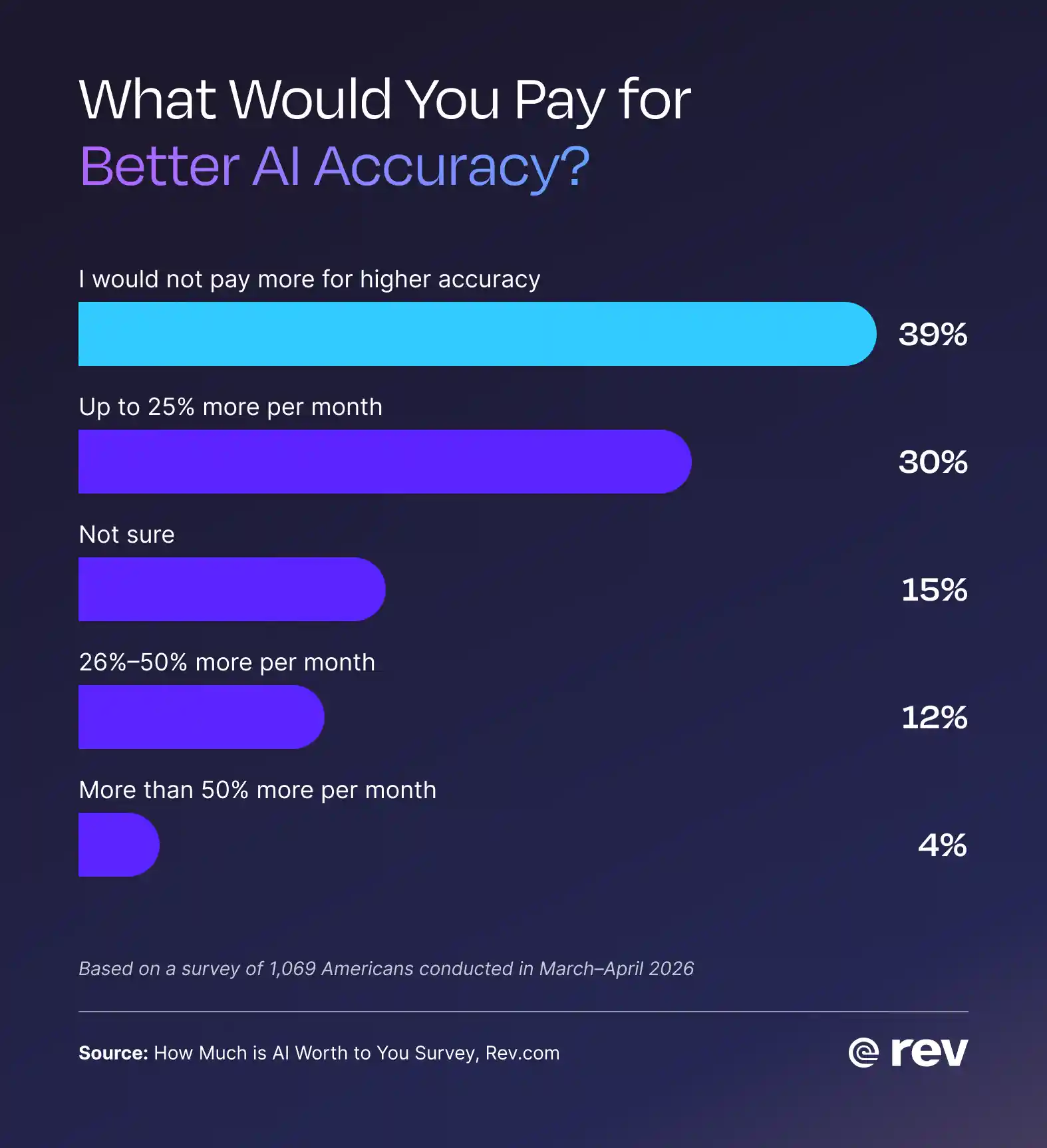
But protecting accuracy in principle doesn't mean people are willing to pay more for it in practice. 39% of respondents said they would not pay more for a significantly more accurate AI tool. But 30% would be willing to pay up to 25% more, and 16% are open to paying even more than that. For most users, accuracy is expected, not a feature worth a premium.
That dynamic is reflected in the 11% of respondents who said they'd rather pay more than give up any feature at all. For legal teams where every word in a transcript or summary carries weight, that's exactly the kind of thinking that shapes how Rev approaches accuracy.
What Would Make AI Worth Paying for?
Many people use AI regularly and genuinely value it, but they haven't yet found a use case where it feels worth paying a premium. For the majority, AI is a helpful tool for everyday, low-stakes tasks, and they price it accordingly.
The exception is users whose work demands more. Those who consider AI completely essential or very important during their busiest periods aren't evaluating it the way the general public is. For them, the question has never been whether AI is worth paying for. It's whether the tool they're relying on is accurate enough to trust.
That's the standard Rev is built for. For the 69% of legal professionals already relying on AI tools in their work, moving from raw audio and transcripts to court-ready evidence means accuracy can never be treated as a premium feature.
Methodology
This survey was conducted by Centiment on behalf of Rev. The survey was fielded between March 30 and April 3, 2026. Results are based on 1,069 completed responses from adults aged 18 and older in the United States, with nationally representative quotas applied. Respondents who indicated they do not use AI tools were screened out. Data is unweighted, and the margin of error is approximately ±3% for the overall sample at a 95% confidence level.