


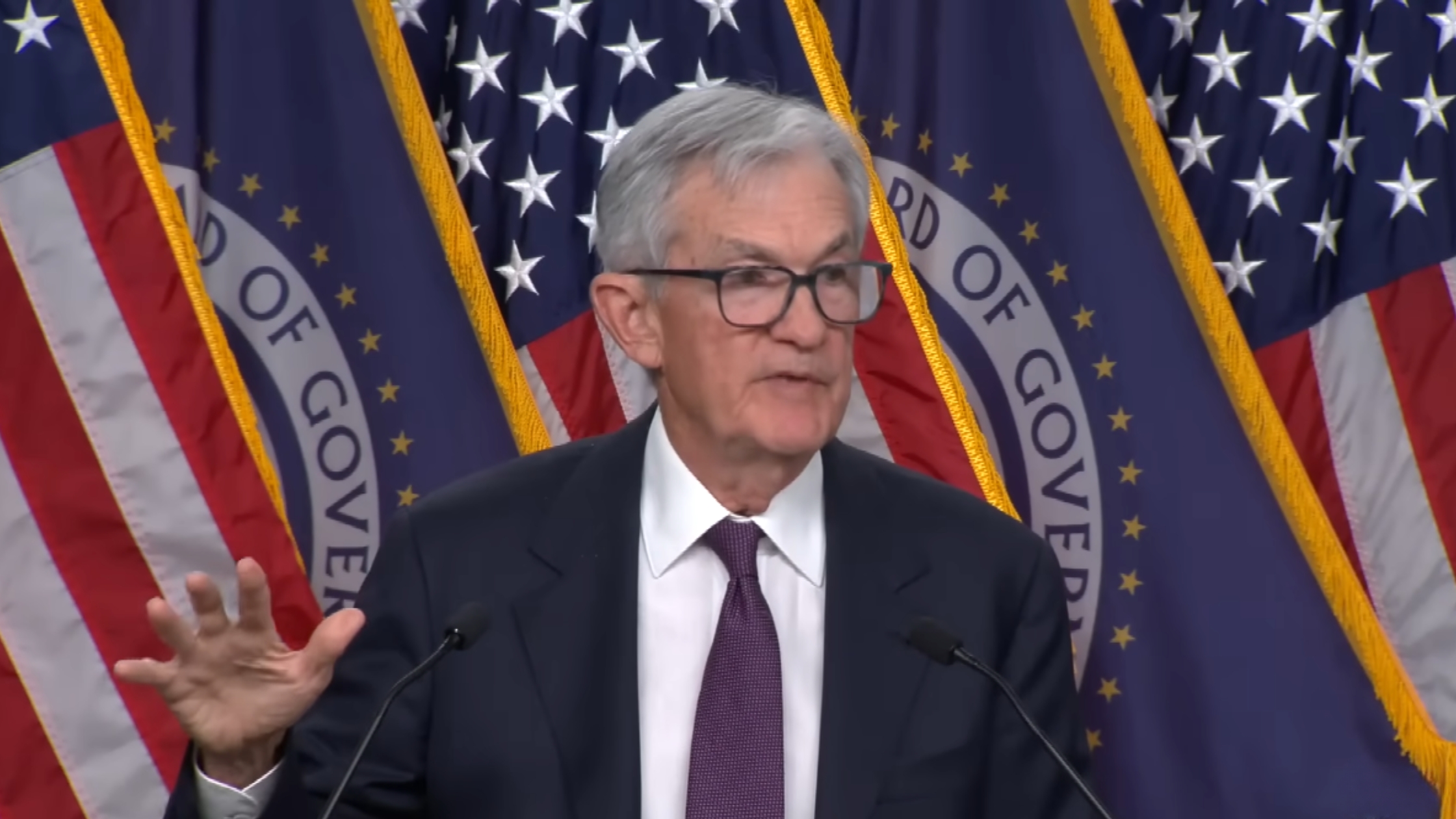
Jerome Powell (00:38):
Good afternoon. My colleagues and I remain squarely focused on achieving our dual mandate goals of maximum employment and stable prices for the benefit of the American people. The US economy has been expanding at a solid pace. While job gains have remained low, the unemployment rate has been little changed in recent months and inflation remains somewhat elevated.
(01:02)
Today, the FOMC decided to leave our policy rate unchanged. We see the current stance of monetary policy as appropriate to promote progress toward our maximum employment and 2% inflation goals. The implications of developments in the Middle East for the US economy are uncertain. We will remain attentive to risks to both sides of our dual mandate. And I'll have more to say about monetary policy after briefly reviewing economic developments.
(01:33)
Available indicators suggest that economic activity has been expanding at a solid pace. Consumer spending has been resilient and business fixed investment has continued to expand. In contrast, activity in the housing sector has remained weak. In our summary of economic projections, the median participant projects that real GDP will rise 2.4% this year and 2.3% next year, somewhat stronger than projected in December.
(02:03)
In the labor market, the unemployment rate was 4.4% in February and has changed little since late last summer. Job gains have remained low. A good part of the slowing in the pace of job growth over the past year reflects a decline in the growth of the labor force, due to lower immigration and labor force participation, though labor demand has clearly softened as well. Other indicators, including job openings, layoffs, hiring, and nominal wage growth, generally show little change in recent months. In our SEP, the median projection of the unemployment rate is 4.4% at the end of this year and edges down thereafter.
(02:48)
Inflation has eased significantly from its highs in mid 2022, but remains somewhat elevated relative to our 2% longer-run goal. Estimates based on the consumer price index and other data indicate that total PCE prices rose 2.8% over the 12 months ending in February, and that excluding the volatile food and energy categories, core PCE prices rose 3.0%. These elevated readings largely reflect inflation in the goods sector, which has been boosted by the effects of tariffs.
(03:22)
Near-term measures of inflation expectations have risen in recent weeks, likely reflecting the substantial rise in oil prices caused by the supply disruptions in the Middle East. Most measures of longer-term expectations remain consistent with our 2% inflation goal. The median projection in the SEP for total PCE inflation this year is 2.7% and 2.2% next year, a bit higher than projected in December.
(03:52)
Our monetary policy actions are guided by our dual mandate to promote maximum employment and stable prices for the American people. At today's meeting, the committee decided to maintain the target range for the federal funds rate at 3.5 to 3.75%. From last September through December, we lowered our policy rate three quarters of a percentage point, bringing it within a range of plausible estimates of neutral. This normalization of our policy stance should continue to help stabilize the labor market while allowing inflation to resume its downward trend toward 2%.
(04:27)
But the implications of events in the Middle East for the US economy are uncertain. In the near term, higher energy prices will push up overall inflation, but it is too soon to know the scope and duration of the potential effects on the economy. We will continue to monitor the risks to both sides of our mandate. We are well positioned to determine the extent and timing of additional adjustments to our policy rate based on the incoming data, the evolving outlook, and the balance of risks.
(04:58)
In our SEP, FOMC participants wrote down their individual assessments of an appropriate path of the federal funds rate under what each participant judges to be the most likely scenario for the economy. The median participant projects that the appropriate level of the federal funds rate will be 3.4% at the end of this year and 3.1% at the end of next year, unchanged from December. As is always the case, these individual forecasts are subject to uncertainty and they are not a committee plan or decision. Monetary policy is not on a preset course and we will make our decisions on a meeting-by-meeting basis.
(05:37)
To conclude, the Fed has been assigned two goals for monetary policy, maximum employment and stable prices. We remain committed to supporting maximum employment, bringing inflation sustainably to our 2% goal, and keeping longer-term inflation expectations well anchored. Our success in delivering on these goals matters to all Americans. We at the Fed will continue to do our jobs with objectivity, integrity, and a deep commitment to serve the American people. Thank you, and I look forward to your questions.
Speaker 1 (06:10):
Calling Colby.
Colby Smith (06:13):
Thank you. Colby Smith of the New York Times. There's been some debate about whether the Fed should look through the inflation that will come from higher oil prices stemming from the Middle East conflict. Is that the right approach at this juncture? And to what extent does the fact that inflation has been above target for roughly five years now influence the committee's thinking around this?
Jerome Powell (06:36):
First, let me say, we're well aware of the performance of inflation over the last few years and how a series of shocks have interrupted progress that we've made over time. And that happened most recently with tariffs and now there will be some effects on inflation coming forward. The thing that's really important that we see this year is progress on inflation through a reduction in goods inflation as the one-time effects on prices of tariffs go through the system, go through the economy. That's the main thing we're looking for going into this exercise.
(07:15)
And we need to be seeing that to understand that we actually are making progress, because on net we didn't make progress. And if you look at total core inflation, it's about 3%, and some big chunk of that, between a half and three quarters, is actually tariff, so we're looking for progress on that.
(07:34)
The question of whether we look through the energy inflation doesn't really arise until we have checked that box. It, of course, is standard learning that you look through energy shocks, but that's always been dependent on inflation expectations remaining well anchored. And I think now, it's also dependent now on what you mentioned, which is that broader context of five years now of inflation above target.
(07:59)
We have to keep all of those things in mind. And the question of looking through when it does arise will be one to approach not lightly, but in the context that you mentioned.
Colby Smith (08:10):
And just on the SEP, can you help us make sense of why there is still a bias to cut for most officials this year, despite the upward revision to headline and core inflation and the essentially unchanged forecast for growth and unemployment? Just curious, what's the genesis behind the need? What's the need for the cut?
Jerome Powell (08:29):
There are 19 people, and so 19 reasons, 19 individual submissions. And if you notice, the median didn't change, but there was actually a meaningful amount of movement toward fewer cuts by people. So, four or five people went from two cuts to one cut. And each person has individual stories behind what they want to do, but essentially, the forecast is that we'll be making progress on inflation, not as much as we had hoped, but some progress on inflation.
(09:06)
It should come, as we start to see in the middle of the year, progress on tariffs going through once and then tariff inflation coming down. We should be seeing that. The rate forecast is conditional on the performance of the economy, so if we don't see that progress, then you won't see the rate cut.
Speaker 1 (09:33):
Calling Howard.
Howard Schneider (09:33):
Thank you. Howard Schneider with Reuters. Just to follow up a little bit and to be clear, is the higher inflation penciled in here for 2026 solely the result of the oil shock or something else?
Jerome Powell (09:48):
That's going to be part of it, but that wouldn't be most of core, right? The oil shock-
Howard Schneider (09:53):
Right.
Jerome Powell (09:53):
... for sure, shows up here. Some of that will be in core as well, yes. But no, there's also just the feeling that we haven't seen the progress that we had hoped for on core goods and on tariffs and on the rest of it.
(10:09)
For whatever reason, people did write up their inflation forecast, that will certainly be tied to events in the Middle East and the price of oil. But it's also, I think, a reflection of the slow progress we've seen on tariffs, which we believe we will see. It's just a question of how long it takes for them to get all the way through the economy and it just takes some time.
Howard Schneider (10:30):
Is the lack of change in the SEPs, again, just to explicate this a little bit, more due to the expectation that the oil portion of this will pass through or more out of concern that there is a potential blow to consumption and growth coming in the form of wealth effects with the stock market down in the form of gas prices diverting spending from other parts of the economy?
Jerome Powell (10:59):
I didn't get the second part of your question.
Howard Schneider (11:00):
The consumer's going to be potentially diverting money to gasoline...
Jerome Powell (11:04):
Yeah.
Howard Schneider (11:04):
... from other parts of the economy. There could be a growth shock or a redistribution of spending there, [inaudible 00:11:10] consumption, wealth effects as well. I guess I'm wondering, is the rate forecast not changing because you think the oil shock is going to be temporary or because you want to be sure your position in case growth starts to slow?
Jerome Powell (11:22):
The thing I really want to emphasize is that nobody knows. The economics effect could be bigger, they could be smaller, they could be much smaller or much bigger. We just don't know. People are writing down something that seems to make sense to them, but have no conviction that...
(11:36)
To your point, if we have a long period of much higher gas prices, that's going to weigh on consumption, that'll weigh on disposable personal income, and it'll weigh on consumption. But we don't know if that's going to happen, it... Something quite different than that. We might have much lower than expected pass through.
(11:55)
This is one of those SEPs where a number of people mentioned if we were ever going to skip an SEP, this would be a good one, because we just don't know. I wouldn't say there's a conviction that this is going to go through quickly or not quickly. It's just you got to write something down and this is something that people wrote down.
(12:18)
We don't debate how long... How do you do that? We wouldn't be able to debate what the length or size of these effects would be. We just have to make an individual statement. And also, what you've written down before will be... You'll be reluctant to move too far away from that, just because you don't know. It's so unclear what the direction from this particular end will be.
(12:38)
Meanwhile, the growth has been solid and the overshoot is mainly from the goods and tariffs. And the labor market is... The unemployment rate, of course, has little changed since September. You have a very, very low breakeven rate apparently for new jobs, with little
Jerome Powell (13:00):
... Growth in either demand or supply, but the US economy is doing pretty well. It's just we don't know what the effects of this will be and really no one does.
Speaker 2 (13:09):
Steve.
Steve (13:14):
Mr. Chair, in the past the staff has suggested that higher oil prices, they have a hit to consumption, which Howard was talking about, but that's somewhat offset by increase to domestic production. Wonder if you could talk about that dynamic, especially to the extent that how much US production is happening right now.
Jerome Powell (13:34):
So the first thing is, the original thinking, the longstanding thinking, put it that way, is that you do look through energy shocks. But as I mentioned, that's condition on inflation expectations and that kind of thing. Sorry, your question was?
Steve (13:49):
What the staff is saying about, and has said in the past about.
Jerome Powell (13:52):
So there'd be an offset.
Steve (13:53):
Offsets, yeah.
Jerome Powell (13:55):
So that's true. We're a net exporter of energy, right? So any effects on employment and economic activity and spending would be offset to some extent by the fact that our oil companies will be more profitable, and they may even do more drilling. If you ask oil companies about doing more drilling though, they're going to want to see a consistent rise in oil prices from where they were before the buildup for the war. And they're going to want to believe that that's going to be persistent for a fairly long time. So they're not sitting there waiting for oil to go over $70 a barrel and then they're going to start drilling and whatever. They're going to make a reasoned, careful judgment that we're going to have higher oil prices for an extended period, meaningfully higher. So I wouldn't say there's much of that happening. Not much will be happening now, but some of that could happen over time if you see that. So the net of the oil shock will still be some downward pressure on spending and employment, and upward pressure on inflation, of course.
Steve (15:02):
And if I could just follow up on Colby's question. How much do you worry that having looked through tariff inflation and inflation running above target and looking through the oil price shock would undermine the credibility of your commitment to the 2% target?
Jerome Powell (15:16):
We have to do our analysis and think these things through carefully, but of course that's on everyone's mind. We're well aware of the history, but you don't want to overreact to that. You want to make the best judgment you can based on the facts. I don't think we're going to let it color our decision making more than is appropriate. It's more of the thought that it's been five years and we've actually had the tariff shock, we had the pandemic, and now we have an energy shock of some size and duration. We don't know what that's going to be actually. And it's one of those things where it's a repeated set of things, and you worry that that's the kind of thing that can cause trouble for inflation expectations. And so we worry a lot about that and we are very strongly committed to doing what it takes to keep inflation expectations anchored at 2%. And I think it's important that we do that. Very important.
Speaker 2 (16:16):
Nick.
Nick Timiraos (16:21):
Nick Timiraos, the Wall Street Journal. Chair Powell, you've described monetary policy as modestly restrictive. If the unemployment rate is roughly stable, inflation moving sideways in the high twos with an ongoing overshoot in services and non-housing services, not just goods, and the economy doing fairly well as you just outlined, what gives you confidence that inflation returns to target over the next couple of years?
Jerome Powell (16:46):
Okay. So I would say that the rate is, you can characterize it as in the high end of neutral or you can characterize it as perhaps mildly restrictive, even modestly restrictive. No one knows for sure, but it's in that range where it's somewhere around the borderline between restrictive and not. Remember that a big part of the disinflation we're looking for is just the runoff of when tariffs are put into place, of course what they do is they raise prices to some extent, to the extent those prices are, the tariffs are paid by consumers, on a one time basis. And we're waiting for that process. It takes eight, nine, 10, 11 months, a year, to go through the system. And we're waiting for the tariffs, which were put in place over the course of the middle part and later last year. We're waiting for that to go through the system so that goods inflation will return closer to what it's always been.
(17:43)
It used to be for many, many years, it was negative. And then the year before tariffs came in, it was zero, and it's running at like 2% now. And so that's kind of... Goods inflation is running at 2%. So that's not coming from standard Phillips curve, restrictive policy, it's coming from the runoff of a one time thing. We also think it's important though to keep policy either mildly restrictive or close to that, but not too restrictive because of the weakness and the downside risk in the labor market. We are balancing these two goals in a situation where the risks to the labor market or to the downside, which would call for lower rates and the risks to inflation are to the upside, which would call for higher rates, or not cutting anyway. So we're in a difficult situation and we feel like our framework calls on us to balance the risks, and we feel like where we are now, which is kind of on that borderline, the higher borderline of restrictive versus not restrictive, we feel like that's the right place to be.
Nick Timiraos (18:47):
Can I ask about core non-housing services though? Because there are some people who think that it hasn't come down very much if at all over the past year. If wage growth has come down, if the labor market has loosened, why has non-housing services inflation maybe been slower to follow?
Jerome Powell (19:03):
That's a good question. It's frustrating. Non-housing services have, they basically move sideways for a year, they're at the same level. And we do expect that they will come down. But it's a bunch of idiosyncratic things, but at the same time, that is one of the things we should be seeing, because to your point, the labor market is clearly not a source of inflationary pressures and that should really matter for non-housing services, but we're not seeing progress there. So what we expect for next year is continued... What we want to see for this year rather, is continued progress on housing services, finally seeing that the goods inflation come back down, because the one time effects of tariffs are through, and then also get some help from non-housing services. That's what we like to see, but it's a good question why we didn't see much of that last year.
Speaker 2 (19:52):
Edward.
Edward Lawrence (19:58):
Thanks, [inaudible 00:19:58]. Edward Lawrence with Fox Business. So in December, we saw employment numbers revised down to negative 17,000, January, revised down, February, posted a loss of 92,000. Is the employment side a far greater risk than the inflation side? Because we are seeing inflation, CPI is close to 2%, PCE has ticked down overall.
Jerome Powell (20:19):
I wouldn't say that. I wouldn't say that that's clear at all, that one is more at risk than the other. So you can point to the unemployment rate being stable. And in a world where both supply and demand for workers have come down very, very sharply over the course of the past year due to immigration policy largely, a ratio is going to be a better thing to look at than job creation, for example. So, and the ratio is the unemployment rate and it's been stable since September, so that tells you that. Inflation, we're at 3.0% core, inflation 2.8% headline, so we've been well above the 2%, that amount, whatever it is, 0.7%, 0.8%, we're a full percentage point above 2% for some time, and that's a concern. We need to get back down to 2%, and we need to keep focused on that, even though we do now face some new inflation from energy. So I'd be hard pressed to say that one of them is obviously more at risk than the other.
Edward Lawrence (21:23):
And if I may, what happens if there's no Federal Reserve Chairman confirmed on May 15th, would you stay on?
Jerome Powell (21:30):
So if my successor is not confirmed by the end of my term as Chair, I would serve as Chair Pro Tem until he is confirmed. That is what the law calls for. That's what we've done on several occasions, including involving me, and it's what we're going to do in this situation. And while I'm at it, on the question whether I will leave while the investigation is ongoing. I have no intention of leaving the board until the investigation is well and truly over with transparency and finality, and I would refer you to the statement that was in the Fed's brief that you will all have seen, and I won't have anything more for you on that. On the question of whether I will then continue to serve as a governor after my term ends and after the investigation is over, I have not made that decision yet, and I will make that decision based on what I think is best for the institution and for the people we serve.
(22:22)
Figuring you probably were going to set the dominoes off there, Edward. And I'm not going to have any more to say on those issues, by the way.
Claire Jones (22:34):
Thank you very much. Claire Jones from the Financial Times. People have drawn quite a few historical parallels with the current situation. We've seen oil price shocks in the past. Some people have said the first Gulf War and the Fed's response to that where there was a focus on the growth risks is the right parallel. To what extent would you agree with that? And to what extent would you think we're in a different place today? Thank you.
Jerome Powell (23:01):
It's really hard to say until we see the situation, the actual situation. In some circumstances, that might be the right case. In fact, for example, if we do see the kinds of disinflationary progress that we expect to see due to tariffs that I mentioned, I think it's hard to say, and it will depend to some extent on the size and duration of the effects we're seeing on prices, and it will depend a lot on what we can see in inflation expectations.
Claire Jones (23:30):
And just one follow up, if I may, just on the BLS report that was mentioned briefly there. It doesn't seem from the projections or from the comments you've made today about the unemployment rate and focusing on that, that your view on the labor market story to a large [inaudible 00:23:46] supply side story has changed despite the quite negative number in February. Would that be the right take and was there anyone else in the room who thought differently and that the February jobs report was cause for concern?
Jerome Powell (24:00):
So I think you have to take the two together. In a way, the January report was a positive surprise, and the February report was a negative surprise. If you put them together, you get something in the middle, and I think you have to really, as you do, I'm sure realize there was a strike and there was weather and that's about 80,000 of the negative effect total on the February report. Notwithstanding that, so what do you see if you take a step back overall? There are a number of indicators that suggest a degree of stability, but the thing that I think a good number of people on the committee are concerned about is just the very, very low level of job creation. If you adjust what has been the trend job creation over the past, let's say six months, if you adjust that for what we think, our staff thinks, is the overstatement due to over counting, effectively there's zero net job creation in the private sector.
(24:58)
But actually, that looks like that's about what the economy needs in terms of dealing with very, very low non-existent really, growth in the labor force, which of course we've never had in our history. So you've got sort of a zero employment growth equilibrium. Now that's balance, okay? But I would say it does have a feel of downside risk, and it's not kind of a really comfortable balance. So we look at that, we see it, we get it, and everybody understands the arithmetic, and that's, you can say the break even is zero. But nonetheless, it's something we're watching carefully and are concerned about. But ultimately though, you can argue that it's a consequence of deliberate policy, which is really the changes to immigration. That's the biggest factor there. But nonetheless, something we watch carefully.
Speaker 2 (25:54):
Andrew.
Andrew (25:58):
Thanks, Chair Powell.
Speaker 3 (26:00):
The economy's experienced a series of supply shocks in the last few years, COVID, tariffs, two oil price shocks. Do you think that is bad luck or is something changed in the world that makes supply shocks more common? And does the central bank need to start taking account of the risk of supply shocks as a more common problem?
Jerome Powell (26:20):
We did go through a long period where the shocks were all demand shocks. And so, we've had a lot of practice thinking about supply shocks in the last four or five years, for sure. And it's just a very different thing and a much more difficult thing because it does immediately raise the question of tension between the two parts of our mandate. But has the world changed? I mean, COVID is a one time thing, right? This energy supply shock is a one time thing. It's not because of some broad tendency or anything, I don't think. And the oil shock with Ukraine was also a consequence of military action. So I don't know that the world has changed in a way that there'll be more supply shocks, but there's people have written that paper and that speech a number of times. A number of people have tried to make the case that that is the case. And in fact, we have seen more supply shocks in the last five years than we've seen in many years before that. It's a fact.
Speaker 3 (27:21):
Okay. You said last year that the Fed was reviewing its communication strategies, including the SEP as part of its framework review. Whatever happened to that, and I have like five followups to that, but I guess, what would you change about Fed communications if you had the time? Thanks.
Jerome Powell (27:40):
What happened about that was not much. And I'll tell you why. So we looked carefully at many aspects of the SEP and of our communications, and there weren't any ideas that had very broad support on the committee. And you don't want to make a change to your communications unless you have the committee behind that. So we didn't really make any changes on that. I had hoped that they had some things that I wanted to do, but they didn't attract broad support and we'd already made all the changes we made to the framework. That was a critical thing. So we didn't. I wish we had been able to do some things, but we didn't. So maybe the next chair will take a look. I'm sure he will.
Speaker 5 (28:31):
Mike McKee.
Michael McKee (28:31):
Michael McKee from Bloomberg Television and Radio. The minutes show in January, some members of the committee wanted to include a two-sided guidance on policy. Was that discussed today? And given the rise in the inflation expectations, how much support for a two-sided policy warning would there be?
Jerome Powell (28:50):
So it did come up today. The policy that the possibility rather that our next move might be an increase did come up at the meeting, as it did at the last meeting. The vast majority of participants don't see that as their base case. And of course, we don't take things off the table, but you correctly characterized what was in the minutes that several participants indicated and something very much like that conversation did happen. What was your second question though?
Michael McKee (29:14):
Oh, that was just one question there, but a follow-up would be, there are a lot of goods besides oil that are trapped in the straight right now, and a lot of supply chains getting snarled. How much concern do you have about whether if this becomes an inflation problem beyond just oil, whether there's anything you can do about it or would do about it, given the efficacies of monetary policy?
Jerome Powell (29:42):
You can worry about other commodities. You can worry about all of the ways that oil related commodities go into manufacturing and that kind of thing. The truth is it's completely out of our hands and we just, like everybody else, we have to just wait and see what happens. And it'll come down to how long the current situation lasts and then what are the effects on prices and then how do consumers react and that kind of thing. Really, I wouldn't speculate in any way, and there's really not a lot we can do other than watch and see.
Speaker 5 (30:22):
Maria Eloisa.
Maria Eloisa Capurro (30:25):
Afternoon, Chair Powell. Maria Eloisa Capurro with Bloomberg News. I wanted to ask you, you said longer term measures of inflation expectations reflect confidence that the Fed will get back to its 2% goal, but there are some colleagues of yours who have pointed to higher dispersion in household service and business service as well and that they take as a signal that inflation expectations may be less sticky than in the past. I'm wondering if there was a discussion around that at this meeting across the committee and what were the views of what is the state of inflation expectations and the risks from higher oil and gas prices?
Jerome Powell (31:04):
So at this meeting, I mean, a number of people mentioned and staff briefed on short term expectations having moved up quite a lot for reasons we understand well, but long term expectations, you can always find one that's troubling or some aspect of one that's troubling, but ultimately right through this whole period, the overwhelming majority of the things we look to, including markets, including surveys of the public and also of forecasters, they've all been pretty solid on longer term inflation expectations being right where they need to be, consistent with 2%. So that continues to be the case. We didn't have a lot of conversation about that. I think everyone does agree that we'll be watching those extremely carefully as we see the effects of the price increases come through from the conflict.
Maria Eloisa Capurro (32:00):
And still on how the discussion went across the committee, before coming to this meeting, there were some members who were discussing the risks of a slowdown in growth at a time of when inflation remains high. It really doesn't seem that most members are penciling a slowdown in growth.
Jerome Powell (32:19):
No.
Maria Eloisa Capurro (32:19):
But has there been any discussion of the risks of stagflation at this point?
Jerome Powell (32:25):
So people actually wrote up their growth forecast by a 10th, and I think that's probably to do with just growing confidence in productivity. Sorry, and your second question was just...
Maria Eloisa Capurro (32:42):
If there had been any discussions about the risk of stagflation scenario.
Jerome Powell (32:45):
Of stagflation. So as I mentioned, there's tension between the two goals, the upward risk for inflation and downward risk for employment, and that puts us in a different situation. When we use the term stagflation, I always have to point out that that was a 1970s term at a time when unemployment was in double figures and inflation was really high and the misery index was super high, add them together, you get the misery index, and that's not the case right now. We actually have unemployment really close to longer run normal, and we have inflation that's one percentage point above that. So calling that stagflation, it's not... I would reserve the term stagflation for a much more serious set of circumstances. That is not the situation we're in. What we have is some tension between the goals, and we're trying to manage our way through it. It's a very difficult situation, but it's nothing like what they faced in the 1970s, and that's... I reserve stagflation for that, the word for that period. Maybe that's just me.
Speaker 5 (33:48):
Elizabeth.
Elizabeth Schulze (33:51):
Thanks so much. Elizabeth Schulze with ABC News. President Trump says that oil prices and overall inflation will go down very rapidly as soon as the war ends. Do you agree with that?
Jerome Powell (34:02):
I don't have a forecast on that.
Elizabeth Schulze (34:05):
When we're thinking about the impact on American households, as you know, they've been facing these higher prices for years. They've seen an almost $1 increase in gas. How worried are you about households, especially lower income families being able to afford those price hikes, and should people be bracing for higher costs, including for food now?
Jerome Powell (34:24):
We don't know how big these effects are going to be, and I don't want to characterize them in any way. Of course, people are already seeing gas prices. Gas prices are up almost $1 a gallon. We hope that isn't for a long period of time, and of course people will feel that, but I don't want to speculate about what that might mean, because honestly, that would sound like I have some idea of what's actually going to happen, and I don't think anybody really does. We're going to see how this works out, and I just would leave it at that.
Speaker 5 (34:51):
Victoria.
Victoria Guida (34:58):
Hi, Victoria Guida with Politico. I just wanted to ask, for purposes of the next meeting, how the Middle East war develops between now and then, how are you thinking about what might guide action at your next meeting? I mean, if we have oil prices above $100 a barrel the entire time until the next meeting, is that going to change your wait and see stance? What would lead you all to move or are you on hold pretty indefinitely?
Jerome Powell (35:29):
We'll have to wait and see. I mean, we always say we're going to learn more by the next meeting, and usually we do, but in this case, we're going to learn a lot because we're going to learn six weeks to the day till the next meeting. And we're going to see whether what happens is... It's going to be very important for the way the economy looks and the way the outlook evolves with what happens in Middle East, that's going to be a big factor. And we'll know that then. I don't know how it's going to affect our thinking. I really don't. And we did talk about alternative scenarios a little bit, but it's just... I wouldn't bring that in here. It's very uncertain and I just want to just remember that we don't know and we shouldn't assume it's going to be one thing or another. We're going to see.
Victoria Guida (36:15):
So is it a matter of you don't know how the situation itself is going to evolve, or even if things remain as they are, the economy could still remain relatively durable in face of them?
Jerome Powell (36:26):
Yeah, that's true too. No, I mean, the US economy has just made... It's been strong through a whole bunch of challenges. I mean, if you go back to 2023 when we raised rates a lot in '22 and '23, and close to 100% of economists called for a recession, which didn't happen. In fact, 2023 was a really strong year. So the US economy has really been just doing pretty well through a lot of significant challenges over the past few years. It's been amazing to see. And again, I don't know what's going to happen in the next intermediate cycle and I don't know what's going to happen in the Middle East. I wouldn't want to speculate.
Speaker 5 (37:10):
[inaudible 00:37:14].
Speaker 4 (37:16):
Hi, Chair Powell. Thanks for taking our questions. What makes you so certain that tariff related price increases will be a one time effect? I don't think we've seen you since the Supreme Court tariff decision, and it's pretty clear that none of us know what the extent of the tariff shock will be as the administration moves to replace some of the tariffs that were overturned. So I suppose I'm curious, what would make you question this certainty that tariffs are going to be a one time price effect?
Jerome Powell (37:48):
Well, I would not at all use the word certain about my views on that. I'm not certain. I'm uncertain, but just if you think about what it is, it's a one time increase in the price of a good. And what inflation is is ongoing increases in prices this year, next year, the year after. That's what inflation is. It's not a one time price increase. There's a very, very big difference. The public doesn't really focus on that, but that's the difference. And tariffs should be, in theory, unless they cause people to start expecting still more tariffs the next year and still more tariffs the next year, they should be a classic one time thing. People say the same thing traditionally about an energy price spike because traditionally prices go up and they come back down. And by the time monetary policy would react, it would be over.
(38:39)
So I don't have tons of confidence on that. I mean, I think that the theory is probably right, but as usual, the time it takes to get all the way through the economy is just very uncertain. And we found that coming out of COVID, that the inflation did go away and largely for the reasons we thought it would, but it took two years longer than we thought.
Jerome Powell (39:02):
I think we have to be humble about knowing how long it will take for tariffs to go all the way through the economy. And so what we've been doing, what our staff's been doing, it's very interesting. They started off with just an estimate because there wasn't a real history. And then they've built based on the history that they're seeing of tariffs coming through into prices.
(39:24)
They can now have an arc and for all the tariffs they can say... So we have, I think, slightly more confidence that we will see tariff inflation coming down. Not prices, but you won't see further increases. And we should start seeing that more and more in the middle parts of the year.
(39:42)
We do expect that. Now you're also right though that the level of tariffs came down fairly meaningfully in the wake of the court decision, but the administration said they're going to get that rate right back up to where it was. And we assume that they'll do that over time. So that's how we think about it.
Speaker 6 (40:11):
Thank you.
Speaker 7 (40:11):
Chris Rugaber.
Chris Rugaber (40:12):
Hi, thank you. Chris Rugaber at Associated Press. You talked about the shortcomings of the SEP in this environment. I wanted to throw in an additional thing, which is the fact that it's happening before transition. Is there still some value perhaps in the public knowing what other Fed officials are thinking, the ones who will stay on for the rest of the year and beyond? And does that even handicap your successor in any way? Well, just in terms of having a whole committee expressing its views, is that something that locks them in for the rest of the year?
Jerome Powell (40:48):
No. No, no. The SEP is never... People are more than happy to change their SEP dots. They're in no way bound by them. It's your opinion at a moment in time, which can change based on events sometimes very quickly. So it never locks people in. People are more than happy to be proven wrong in either direction. And so I just think we do it.
(41:16)
I mentioned this was a time when it's very hard to do it. During the pandemic, we actually took one meeting off, I think. But we don't like to do that just because it's hard to do. We should just keep doing it. But I just would say for this one though I think it's, even more than usual, good to take the forecast with a grain of salt because subject to just very high levels of uncertainty.
Speaker 7 (41:41):
Brian.
Brian Cheung (41:44):
Hi, Chair Powell. Brian Cheung with NBC News. So you mentioned at the beginning of this conversation that you're well aware of the history of inflation running above target. It seems like that might be what's underpinning the affordability problem that we're hearing a lot about on Main Street. Are there any signs to you that that's impacting the psychology of the consumer, especially given that they're a big driver of overall economic activity?
Jerome Powell (42:07):
I'm not sure what that's all about, but I'll tell you what I think and what we see in surveys, and that is there were big price increases. All around the world, by the way, everywhere in countries like the United States had basically the same kind of thing. It was global inflation coming out of the pandemic. And everywhere people are feeling like they... Real wages have been going up in the United States now for three years, roughly, but they're not feeling good about it yet.
(42:38)
And it will take some years of positive, real earning gains for people to feel good again, we think. But you're right. But when you talk to people, they do feel squeezed. And there are areas where prices are still going up, like insurance. Various different kinds of insurance are getting more and more expensive. And that's just catching up really from inflationary pressures that take a while to get to the price, into the price.
(43:06)
So we take it very seriously. We don't dismiss it at all. It's a very real thing from the standpoint of what people are experiencing. And what it does for us is makes us even more committed, if that's possible, to getting inflation back to 2% on a sustained basis.
Brian Cheung (43:24):
How does the Fed's independence play into the ability to address affordability?
Jerome Powell (43:29):
Well, independence is what allows us to do our jobs. And stable prices is half of our mandate. It's one of our two mandates. The maximum employment being the other. Look at every advanced economy that looks anything like the United States, anywhere in the world, in a market economy, in a democracy, and you'll see pretty much central bank independence that looks a lot like, in some cases, stronger than what we have.
(43:56)
But it's critical that we have that so that we can do the things when we need to do them to preserve price stability. And it's an accepted standard practice and I think has a lot of support certainly in Congress, which is where our oversight is, is in Congress. And you see that among Democrats and Republicans in the House and the Senate.
Speaker 7 (44:23):
Richard Escobedo.
Richard Escobedo (44:24):
Hi, Chair Powell. Richard Escobedo at CBS News. Thanks for doing this. Two questions. One, how high would oil prices and broader inflation have to go and for how long for the committee to consider hiking rates? And then secondly, diesel prices are rising faster than gas prices. How concerned are you that the increase in diesel might drive up food and goods prices and lead to broader inflation?
Jerome Powell (44:48):
Yeah. I'm not going to give you an example or a specific answer on the first question. We're prepared to do what needs to be done, but I wouldn't want to hypothesize about what that might be. In terms of diesel prices, so your question there is, are we concerned about it?
Richard Escobedo (45:06):
How concerned and whether or not it will drive up the cost of food and other goods that really rely on it across the country?
Jerome Powell (45:13):
I think it's a more general concern than that. It's diesel prices because that's transportation of food and things like that. There are just lots of ways that oil and derivatives of oil get into the production and transportation of many, many things. And there are big effects in headline inflation, but things like that leak into core as well.
(45:34)
And the effects may not be as big, but they're quite real and they're material. So we are aware of that and we're watching it, but we're right at the beginning of this and you just don't know how big this will be and how long it lasts. It may or may not be something that really makes a big imprint on the US economy. We're just going to have to wait and see.
Richard Escobedo (45:55):
Thank you.
Speaker 7 (45:57):
Archie, for the last question.
Archie (46:00):
Thanks very much. Just to stare into the future for a little bit, I was looking at the longer run bits of the SEP and noticed that the growth estimate had been revised up a good chunk from 1.8 to 2 and the long-term Fed funds rate as well. It'd be great just to hear, is that AI productivity or what's going on there exactly?
Jerome Powell (46:19):
Yeah. Well, I think it's just productivity. We actually started seeing meaningfully higher productivity some years ago, four years ago, five years ago, and that's not because of generative AI. We won't know for years what it's really due to, but it could be due to the kind of things that people did during the pandemic to economize and somehow become more productive because there was an incredible labor shortage.
(46:47)
And I think economic forecasters are very skeptical of periods of high productivity because they're so rare and they're often revised away. And for many of us, I never thought I'd see this many years of really high productivity, and by the way, expect it to continue. And we haven't really started to see the effects of generative AI, and that should certainly contribute to that. So it's quite unusual, and higher productivity is the thing that allows incomes to rise over time, and so it's a great thing. Was that your question?
Archie (47:24):
Yeah. No, I was just curious what lay behind that. And just briefly on that as well, to finish up, you hear the argument a lot, this is all a disinflationary story, and if you believe that productivity thing, that should also weigh down on inflation over time, maybe then pull down where rates end up. Do you agree with that line of thinking, or do you think that's not how you should think about where the rates are going?
Jerome Powell (47:44):
I think you have to be cautious about that in particular if you're talking about generative AI. So remember in the short-term, what's happening is we're building data centers everywhere, and that's actually putting pressure on all kinds of goods and services that go into building these things. So that's actually probably pushing inflation up at the margin. In addition, it probably raises the neutral rate.
(48:10)
So in the near-term, you're not looking at something that would immediately call for lower rates or that would be lowering inflation. Over time though, sure, if it's expanding potential output, which is what higher productivity does, then it actually can be. But I think it's an empirical question because it's really, is the demand growing faster or slower than the supply side? And I think we just don't know that answer ex ante going in. We'll just have to wait and see. Thank you very much.
Speaker 8 (48:43):
[inaudible 00:48:59]. I had to take a break a few times. It's one of those days, man. But you do it constantly now. I was looking at you and I'm like, "You do it constantly now." [inaudible 00:49:30].