


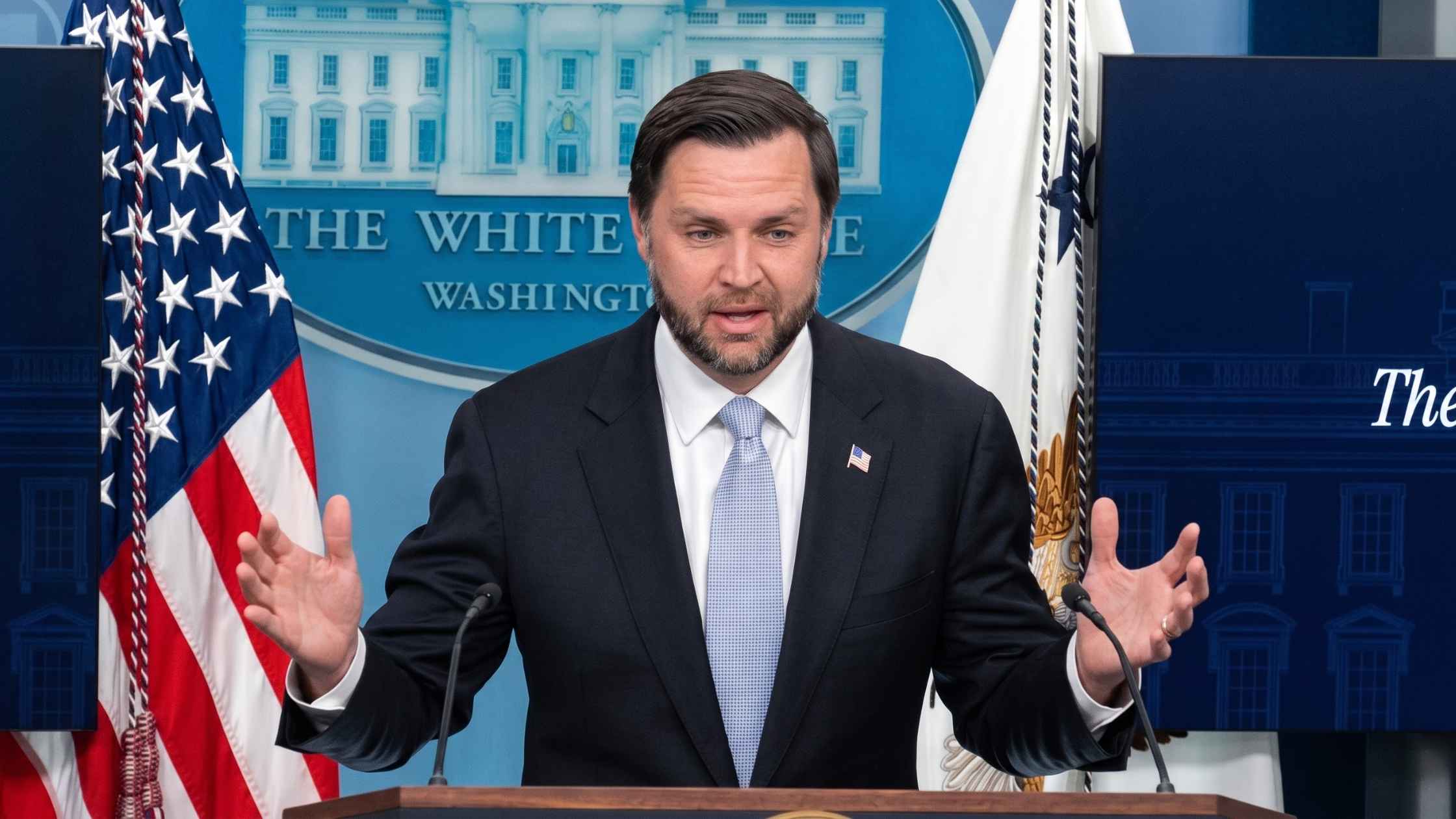
Speaker 1 (00:00):
Two minutes until the briefing, two minutes until the briefing.
JD Vance (15:42):
All right. Good afternoon everybody. How you guys doing? Good, good. Okay. I've got my cheat sheet here so I know who to call on, most importantly, who not to call on. Let me start out with a few things. So first of all, proud to announce that next week I will be speaking at the Air Force Academy Commencement Ceremony. Last year I spoke at the Naval Academy Commencement Ceremony and it was one of the great honors and privileges of my life. So I'm excited to go out there to Colorado and participate in that ceremony. The second thing is, I want to highlight a little bit of some of the work that we've been doing, the great work our team has been doing on the anti-fraud task force where we have caught just in the last couple of months billions upon billions of dollars of fraud in our hospice system, in our Medicaid system and our Medicare system and our immigration system. We've seen hundreds of millions of dollars of fraudulent loans that were being handed out through the small business administration that we've identified and stopped.
(16:33)
We've also started investigating some of the fraudulent criminal activity and also prosecuting some of the fraudulent criminal activities. So the thing that I say to the American people and I'll repeat here to all of you is, fraud is a crime that has two victims. It has, first of all, the American taxpayer, people who pay their taxes, who out of their generosity and because they have to, of course, they pay their taxes expecting that it's going to go to pay our troops and ensure that low income children have access to food and ensure that people get medical benefits even if they're not able to afford a doctor. I think that's a great thing about our country is that we have this generosity of spirit where we take care of one another, but fraud takes that away from us because it steals money from the taxpayer when they pay their taxes and it also steals money from innocent people who are meant to benefit from these programs but can't when the money runs dry because it's gone to fraudsters instead of the people who benefit from it or should benefit from it.
(17:26)
So we're going to keep that work up. The President of the United States has been very clear that he wants us to focus on fraud. He wants us to prosecute the fraudsters and he wants us to save the American people as much money as we possibly can. So we're going to keep at it. We're very proud of that work and importantly, very proud of the team who've done an incredible job. And then finally, just to give an update on the Iran negotiation, the Iran situation. I just talked to the president very briefly before I came out here. It's actually a very simple proposition here. There are two options, two pathways we can go down when it comes to the Iran situation. So step back for a little bit. What the President of the United States has said is number one, Iran can never have a nuclear weapon. And I think it's important for the American people and all of you to appreciate that when we say that it's not just that Iran cannot have a nuclear weapon, it's what would happen if the Iranians did get a nuclear weapon.
(18:14)
We know that a lot of nations all across the Gulf would then want their own nuclear weapon and then a lot of nations all across the world. And what has been a very effective bright spot of American foreign policy really for the last 20 or so years would disappear overnight. If you have every country in the world scrambling to try to get a nuclear weapon, it would make us all much less safe and Iran would really be the first domino and what would set off a nuclear arms race all over the world, that's very, very bad for the safety of our country. As the father of three young kids, I don't want them to inherit a world where 20 additional regimes, half of them very dangerous and very sympathetic to terrorists have nuclear weapons. We want to keep the number of countries that have nuclear weapons small and that's why Iran cannot have a nuclear weapon on top of-
JD Vance (19:00):
... And that's why Iran cannot have a nuclear weapon on top of all the other things that we might be worried about, that they themselves could use it, that they could use it in leverage in economic control or economic negotiations. We just don't want them to have a nuclear weapon. Now, what we did here is that we effectively degraded their conventional military capability. That has been done. That has been successfully done. You could always do a little bit more, but where we are now is the president has asked us, has told us to aggressively negotiate with the Iranians. Why did I go to Islamabad, Pakistan? Why did I spend, I think, probably 22 hours on a plane going there, 24 hours coming back, and then 21 hours on the ground, negotiating with the Iranians, is because we wanted to show a sign of good faith.
(19:43)
The Vice President of the United States is willing to cut a deal, so long as the Iranians are willing to meet us, again, on that core issue of never having a nuclear weapon. We think that we've made a lot of progress. We think the Iranians want to make a deal. The President of the United States has asked us to negotiate in good faith, and that's exactly what we've done, so we're in a pretty good spot here, but there's an option B. The option B is that we could restart the military campaign to continue to prosecute the case, to continue to try to achieve America's objectives, and we could talk a little bit about what that looks like, but that's not what the president wants, and I don't think it's what the Iranians want either. We have an opportunity here, I think, to reset the relationship that has existed between Iran and the United States for 47 years. That's what the president has asked us to do.
(20:29)
Hat's what we're going to keep on working at, but it takes two to tango. We are not going to have a deal that allows the Iranians to have a nuclear weapon, so as the president just told me, we're locked and loaded. We don't want to go down that pathway, but the president is willing and able to go down that pathway if we have to. With that, I will say thank you all. It's cool to be here. I'm going to give a shout-out, of course, to the person I am replacing today, Carolyn Levitt, who hopefully is at home enjoying some time with her beautiful kids. I told Carolyn I would stand in for her today for the White House press briefing on the condition that when Usha has our baby in July, that she would be vice president for a couple of weeks. So, thank you guys. I actually want to start first with Nick from Breitbart. Nick, it's good to see you.
Nick (21:14):
Good to see you, Mr. Vice President. Thank you. Today we saw the president endorse Ken Paxton over John Cornyn in the Texas Senate race. Do you think that sends a message, going forward, for the next cycle to senators considering running for reelection or any mega-aligned potential candidates that are considering challenging them?
JD Vance (21:34):
Well, I'd say a couple of things, Nick. First of all, the president's very gratified by the response that he's heard from the base and from a lot of voters. I think we're passionate about Ken Paxton. We think Ken Paxton is going to be a great senator for the people of Texas, but most importantly, a great United States Senator who can work on solving the problems that all of us confront as a country together. I've known John Cornyn for a long time, but unfortunately, when it really counted, Ken Paxton was there for the country, was there for the president, and that's why he ultimately earned the president's endorsement.
(22:06)
He thinks he's going to be a better senator, thinks he's going to make a better candidate, and so I do think it sends a message, but really, not just the endorsement, but one of the things the president has done very effectively, going back 10 years in his leadership of the Republican Party and the country as President of the United States, is he said, "I want people who fight for the good. I want people who can't be bought by corporate lobbyists, who can't be bought by Wall Street, who can't be bought by special interests, who are going to go to Washington and fight for the people who actually elected them to those positions."
(22:38)
I think one of the things we've seen in the Republican Party, while I can't say that all of our representatives are perfect or all of our senators are perfect, we have seen a much better crop of talent come into Washington since Donald Trump has been the leader of the party and the leader of the movement. I do think we're going to continue to see that happening, but I think the message that people should take from this is, fundamentally, you have got to serve the people who sent you, and if you don't do that, you're going to find yourself out of step with voters or out of step with the President of the United States, and that's not a good place to be politically.
Nick (23:09):
Thank you.
JD Vance (23:10):
Yeah. Go ahead.
Kaitlan (23:12):
Thank you very much. Just following up on what you just said, you said that the White House is negotiating with Iran in good faith. I think Americans tend to believe that, but what is it about the Iranian side that you personally have seen, where you believe that they are negotiating with us in good faith?
JD Vance (23:30):
Well, first of all, I'd say it's a very complicated country, and it's a country that I wouldn't pretend that I understand, even after as deep as I've been involved in this process from the very beginning, it's a great and proud civilization, amazing people. We, obviously, have a great Iranian American community here in the United States of America, smart people, very hardworking, and you see some of that in the negotiating team on the other side. You also see some very hard lined positions in the negotiating team on the other side, and so I think you see that conflict, the fact that maybe the Iranians aren't themselves quite clear in what direction they want to go to. They also are just a fractured country, so you have the leadership of the country, there's the Supreme leader, and there are a lot of officials below the Supreme leader that has some influence in the negotiation.
(24:15)
It's not sometimes totally clear what the negotiating position of the team is. I don't know if that's sometimes bad communication, if that's bad faith. I wouldn't pretend to venture a guest there, but I will say, with confidence, it's sometimes hard to figure out exactly what it is that the Iranians want to accomplish out of the negotiation, so what we've done is tried to be as clear as possible. What are our red lines? What are the things that we're willing to be accommodating on, and what are the things that we absolutely must have? As the president has said, ad nauseum, and I think I've said it a lot too, Iran cannot have a nuclear weapon. We want to see not just the commitment to not have a nuclear weapon, but the commitment to work with us on a process to ensure that not just now, not just when Donald Trump is president, but years down the road, that the Iranians are not rebuilding that nuclear capability, and that's what we're trying to accomplish in the negotiation. Sorry. You had a follow-up.
Kaitlan (25:08):
For Americans at home, because this has been going on for several weeks now, I think what people just want to know is, do you personally believe that the Iranians will come to a deal? Because we keep seeing this over and over again when they go back and forth.
JD Vance (25:21):
So, do I personally believe that the honest answer is how could I possibly know? And you negotiate with people, and sometimes you feel like you're making progress and sometimes you feel like you're not making progress. What I think is that the Iranians want to make a deal. What I think is that the Iranians recognize that a nuclear weapon is the red line for the United States of America, that they've internalized that, but we're not going to know until we're actually putting pen to paper on signing a deal. We've had a lot of drafts, a lot of pieces of paper, going back and forth, but I will not say with confidence that we're going to reach a deal until we're actually signing a negotiated settlement here. I think that it's ultimately up to the Iranians whether they're willing to meet us, because I think we're certainly doing a good job and we're certainly negotiating in good faith. We're going to have to see what ultimately happens with them. I can't say with confidence, because I don't know what's in the mind of the other side. John?
John (26:15):
[inaudible 00:26:16]. Vice President, thank you. I want to ask you about that $1.8 billion fund set up, weaponization fund as it's being called. Why should taxpayers be paying to settle a $10 billion lawsuit that was brought by the President of the United States, and should people that attacked the Capitol building and assaulted police officers, should they be eligible? Should they receive money? Should they receive money from this fund?
JD Vance (26:42):
Well, let me say a couple of things about that. First, John, I think in some ways the media has misrepresented what this is actually about. This is about compensating Americans for the lawfare that we saw under the last administration. By the way, anybody can apply for it. Republicans can apply for it. Democrats can apply for it. As you know, the President of the United States has pardoned a number of Democrats who he felt were actually subject to this lawfare. I mean, if Hunter Biden wants to apply for this particular fund, he is welcome to. It's going to go through a normal process where we vet everything, where we try to identify whether people's claims are actually legitimate, but here's the question. When you say, "Why should taxpayers fund this?" Whenever the United States government incurs legal expenses, it pays out those legal expenses. When it's settling a lawsuit, it pays out money to settle that lawsuit. The question is, is a dollar of this money going to the Trump administration? No. Is a dollar of this money going to Donald Trump personally? No. Is a dollar of this money going to Donald Trump's family? No. The people that would get the money are people some of whom have been prosecuted completely disproportionate to any crime they've ever committed. Let's just take a couple of examples. Tina Peters is this woman who is about to get out of prison, thanks in large part to the president's good work in Colorado. This is a woman who, at worst, if you believe everything that the prosecutor said about her, committed misdemeanor trespassing, and somebody threw the book at her. This innocent grandmother was going to spend 10 years in prison, completely disproportionate to any misdemeanor trespassing that I've ever seen. Was that fair? No. Is it reasonable for her to get some compensation for the fact that she was treated unfairly? I think the answer is yes.
(28:23)
I think that what we're going to see, hopefully, is the entire country led by this Department of Justice turning the page on the law fair. What I would like to propose, and I think the Democrats, hopefully they're willing to meet us halfway here. I won't hold my breath, but what I would propose is something very simple, that if you are willing to turn the page on Joe Biden's law fair, why don't we prosecute people? Very simple principle. Why don't we prosecute people who violate the law? Let's not prosecute people because they said the wrong thing, because they had the wrong political candidate, or because they had the wrong viewpoint. I think part of that, part of turning the page on that, is to actually ensure the real victims of that lawfare receive some compensation. That's what this fund is going to be targeted at. Again, there's going to be a process to ensure that that money is only given to people who have actually, I hate to say earned it, but the people who actually were really mistreated by the previous administration and Department of Justice.
John (29:21):
I understand that everybody is eligible to apply for this fund. I mean, you're eligible, but I assume you're not going to apply and you don't think you should get money out of this fund.
JD Vance (29:28):
Of course.
John (29:29):
So, isn't it just as easy to say that people that attacked police officers should not get taxpayer money from this fund?
JD Vance (29:37):
Look, John. We're not trying to give money to anybody who attacked a police officer. We're trying to give money, not give money, we're trying to compensate people, where the book was thrown at them, they were mistreated by the legal system. Sometimes we do have, John, in this country, innocent until proven guilty. We do have people who are accused of attacking law enforcement officers. That doesn't mean that we're going to completely ignore some of the claims that they're going to make. We're going to evaluate these things on a case-by-case basis.
(30:08)
If we think that somebody, whatever they were accused of, if we think that somebody was unfairly prosecuted and deserves just compensation, then that's what this fund is going to exist to provide. It's just going to correct a wrong, and I think that's a good thing, and I'd encourage everybody, Democrat, Republican, independent, let's turn the page on this thing that we did under the last administration, where we tried to throw people in prison because they had the wrong politics. Let's throw people in prison who broke the law. I think this fund is a good part of getting justice for the people who are wrongly treated. Back there, yeah?
Speaker 2 (30:43):
Thank you, sir. Just to follow up on that quickly, does that mean that people that were violent, that were convicted, were mistreated? Are you saying that?
JD Vance (30:54):
Well, you're asking me to comment on hypotheticals and on any number of dozens of cases. Here's the thing. We're going to look at everything case by cases. As you know, every single case has its own details. There are things about it that maybe don't meet the eye. We're just going to look at every case, case by case. That's all I'm saying. I'm not committing to giving anybody money or committing to giving no one money. What I'm committing to is a legal process to review these claims and to make sure that people who are mistreated by their government get a little bit of compensation because of it. Go ahead.
Speaker 2 (31:30):
Thank you, sir.
Speaker 3 (31:30):
Thank you, Mr. Vice President.
JD Vance (31:32):
I realized that the pointer finger is not as precise as I thought it was. Sorry. I have this cheat sheet, but the problem with being 41 years old is I am blinder than I was a few years ago. So, we'll say blue blazer, blue tie.
Speaker 3 (31:45):
This one right here?
JD Vance (31:46):
Yeah.
Speaker 3 (31:46):
Okay, great. Thank you, Mr. Vice President. I'd like to ask a quick follow up on Iran, but first I'd like to ask you about fentanyl. Fentanyl, sourced largely from China, killed about 403,000 Americans over the past seven years, according to CDC data. That's 1 in every 850 Americans who died. White House counter-terrorism director Sebastian Gorka said, last week, that China's exports amounted to the targeted killing of Americans and war by other means. Do you agree with that assessment, and what is the Trump administration doing to punish and deter China, especially since the Supreme Court struck down the [inaudible 00:32:23] tariffs?
JD Vance (32:24):
So, go ahead ask the second question, because I'll try to take each question, and then I'll try to answer them and then we'll go on. If you ask two questions, I can only guarantee that I'll answer one. In fact, I'm a politician, maybe I won't even answer the one that you asked, but I will try at least to answer one question.
Speaker 3 (32:37):
Well, I'd love to hear the fentanyl response too. If not today, sometime.
JD Vance (32:40):
Go ahead.
Speaker 3 (32:42):
On Iran, is Russia taking possession of the enriched uranium in Iran a plausible end to the war, and if not, why not?
JD Vance (32:50):
So first, on the Russia taking possession of the enriched uranium, look, these things are being discussed through negotiation. That is not currently our plan. That has never been our plan. I've seen some reporting on that. I don't know where it comes from, but the president's going to continue to negotiate a deal. That is not currently the plan of the United States government. The Iranians have not raised it. My sense is that's not something the Iranians would be particularly excited about, and I know the president isn't particularly excited about it either, but who knows? I'm not going to make pre-commitments in a negotiation on any particular topic. On the question of fentanyl, a lot of people have died from fentanyl, absolutely. A lot of it has come from mainland China.
(33:26)
We're certainly aware of that, but here's what I'll say. First of all, we've made incredible strides under Donald Trump's leadership to cut down on fentanyl deaths. If you look at the number of people who died in 2026, it's going to be lower than the number who died in 2025, which is way lower than the number who died in 2024. This is one of the things that I think all Americans, we should be celebrating, and I'm certainly proud of the president's leadership for making this possible. We ran, if you remember, in November of 2024 on a very simple idea, that a lot of fentanyl came from East Asia. It was smuggled into Central and South America, and then the cartels would bring it into our country and a lot of our people would get poisoned and killed because of it.
(34:06)
We said, if you got control of the southern border, we would see a substantial reduction in the number of people who died from fentanyl overdoses in the United States of America, and that is exactly what's happened. Now, yes, the president has raised this with President Xi any number of times. I know it came up during the meeting that they had in China just last week, but it's come up in any number of phone calls, and our sense is that President Xi has been willing to work with us on this, and obviously we want to continue to ensure that the Chinese work with us as much as possible, because we don't want our people to be poisoned. We'll keep working on that issue with the Chinese. There's been, I think, a big amount of progress that's been made, but of course we can make a lot more progress, and we're certainly going to be committed to doing exactly that. Yeah, white jacket. Sorry.
Natalie (34:53):
Oh, hey. Yeah. Natalie with Washington.
JD Vance (34:54):
Natalie, thank you.
Natalie (34:55):
Yeah. Thank you, Mr. Vice President. Does the government need to create new mandatory review process for new AI models, given the concerns about Mythos? And secondly, in a few days, Pope Leo is going to release his encyclical on artificial intelligence. What influence, if any, do you see the Pope's guidance on AI having to broader society?
JD Vance (35:16):
Well, I mean, I think when the Pope issues its encyclical on artificial intelligence, it's going to have some influence. I, of course, don't know how much influence. I don't know exactly what it's going to say, but I think when the leader of the world's largest Christian denomination speaks on an issue like that, it's certainly going to have some influence, and I'm sure it'll contain a lot of insights, some of which I'll probably agree with, some of which I may not, but I think that it's going to be a very, very important document. I think that one of the things I always found fascinating about Pope Leo is that he chose the name Leo the 14th, which of course is recollecting Leo the 13th. Leo the 13th was the Pope during a period of incredible industrial transformation in the entire world. Of course, that industrial transformation, according to a lot of people, led to the rise of fascism and communism in Europe.
(36:01)
I think it was interesting that Leo the 14th chose that name to maybe apply Christian social teaching in a new era with a new technological innovation in the same way that the Industrial Revolution was the technological innovation of its time, so I think it'll be fascinating. I'm looking forward to reading it. My guess is it's going to have a lot of influence. On the question of what our policy is going to be, look, what we're trying to do in the Trump administration is very simple. The president wants us to be pro innovation. He wants us to win the AI race against all other countries in the world. He recognizes that AI is going to be an important tool, not just for our economy, but for our military. And so, he wants to ensure that we are winning that particular race. We also want to make sure that we're protecting people. We're protecting people's data. We're protecting people's privacy.
(36:44)
I think with this mythos release, one of the things that we're very focused on, of course, is whether, not necessarily the developers of Mythos, but whether some other bad actor could use Mythos to target various cybersecurity vulnerabilities. It's something that, right now, we're working in a collaborative way with the technology companies. We're just trying to make sure that the American people are as safe as possible. I'm not going to get ahead of the executive order or any other actions that are going to come out, but we're trying to balance those two things. We want to be pro innovation. We recognize artificial intelligence could be great. It could help us find cures to diseases that currently people are dying from or suffering from. It also does have some downsides, and we're trying to balance that safety against innovation. We think that we've got the right balance here in the Trump administration, but it's something we're going to have to keep on working on, because that's just the nature of these technologies, is they certainly change. Let's go, is that Reagan all the way in the back, Daily Caller? There we go.
Reagan (37:41):
Yes.
JD Vance (37:41):
Okay.
Reagan (37:42):
Awesome.
JD Vance (37:42):
I figured out, finally, how the seating chart works.
Reagan (37:46):
I want to ask you about the anti-fraud task force. You previously mentioned that Ilhan Omar seemed to have committed immigration fraud. Do you anticipate an indictment against her, an indictment related to that situation?
JD Vance (37:59):
Yeah. So Reagan, I don't want to prejudge an investigation. I mean, you read the-
JD Vance (38:00):
So Reagan, I don't want to prejudge an investigation. You read the things about Ilhan Omar, and about who she married and whether she didn't marry this person or that person. It certainly seems like something fishy is there, but everybody's entitled to equal justice under the laws.
(38:15)
So we're going to investigate it. We're going to take a look at it. If we think that there's a crime, we're going to prosecute that crime. And that's something the Department of Justice is looking at right now. Go ahead.
Speaker 4 (38:26):
Based on what you've seen during your work on this anti-fraud task force, do you believe anything should change about our immigration or refugee policies to stop fraud in the United States?
JD Vance (38:36):
Well, yeah. Look, one thing I'd say is that the biggest immigration fraud that existed under the Biden administration, it's not just that they let a flood of people across the southern border. That was obviously a very major problem, and something I'm proud of the President for stopping, but it's also that they allowed the asylum and refugee claimant process to become totally fraudulent.
(38:55)
And so here's what would happen. You would take a person, who in normal cases, would just be a traditional economic immigrant. Whether you let them into the country or not, they're trying to come because they want a better job. They would come into the country and say that they were fleeing persecution, and they would say that they were an asylum claimant.
(39:13)
And then effectively what the Biden administration would do is say, "Okay, you're an asylee, go into the interior of the country, here's a work permit, maybe come back in 10 or 12 years for your hearing on whether you actually have a legitimate asylum claim."
(39:27)
So what did that mean? That meant that person was just completely given amnesty and released into the interior of the country. Well, what if that person was a criminal? What if that person actually had a violent history? We didn't do any of the work necessary to ensure that the people coming into our country claiming to be asylum claimants actually had anything legitimate or anything good in their background.
(39:47)
So, that is a serious problem. It is something that we have fixed in the Trump administration, but fundamentally that loophole, you're going to see sometime in the future somebody is going to try to exploit that loophole. And it's one of the things that we're very focused on in the fraud task force, is making sure that the people who exploited that loophole are actually prosecuted for it, assuming they committed a crime. So I don't know your name. You have a beautiful cross necklace though, so go ahead.
Cara Castronuova (40:13):
Cara Castronuova from Lindell TV. Thank you so much.
JD Vance (40:16):
Hi, Cara.
Cara Castronuova (40:16):
I have two questions. One of them is going back to the $1.8 billion fund, not to keep beating that, but sadly Democrat lawmakers are misrepresenting that fund.
JD Vance (40:27):
I agree.
Cara Castronuova (40:27):
Yes.
JD Vance (40:27):
It's a great question.
Cara Castronuova (40:29):
And sadly, some of the mainstream media doesn't understand the magnitude of the political persecution of J6ers. So if a violent offender like a J6er was still over sentenced and mistreated, literally some of them were sentenced to 24 years in prison, put in on an unconstitutional pre-trial detention, literally tortured in cages, wouldn't that person still be able to apply for the fund because of due process? And-
JD Vance (40:53):
This is why we say, just to answer that very briefly, this is why we say we have to evaluate this thing case by case. We don't in the United States say that everybody who's accused of a crime is automatically guilty in a court of public opinion. You've got to actually look at this stuff and figure out what were they accused of. Maybe they did something bad even, but what they were accused of was way worse of what they actually did. Maybe they had their entire lives ruined in a totally disproportionate way. That's fundamentally illegitimate and political.
(41:22)
And I find, just here on this point, one of the interesting things about the American media is there is a fascination. If you go to any American law school, there are these prisoner rights clinic. There are people who objectively committed heinous crimes, but the American media and the American legal academy has decided that even though they committed bad crimes, their sentence was disproportionate, they were mistreated in some way. You know who never ever gets an ounce of sympathy when it comes to that disproportionate sentencing? Is people who voted for Donald Trump and participated in the January 6th protest.
Cara Castronuova (41:59):
Thank you so much.
JD Vance (42:00):
Go to your second question.
Cara Castronuova (42:00):
[inaudible 00:42:01] about Pete Davidson. He made a horrific obscene joke about the murder of your friend Charlie Kirk. What does this still say about where our political divisions have gone, and what are you specifically doing to bridge the divide, especially as a potential future president?
JD Vance (42:12):
Well, sorry, who was it that said something?
Cara Castronuova (42:14):
Pete Davidson made a really obscene joke about Charlie Kirk. So what are you doing as a potential future candidate or a president to bridge a divide?
JD Vance (42:21):
Well, first of all, I'm not a potential future candidate. I'm a vice president and I really like my job, and I'm going to try to do as good of a job as I can, but let me just say this. So, you talked about Pete Davidson who said something bad about Charlie Kirk. Charlie was a very, very dear friend, but more importantly than that, Charlie was a father of two beautiful kids, and he did not deserve to have all of those moments with his kids, all of those moments with his beautiful wife taken from him in the way that that happened.
(42:48)
I would expect everybody, everybody with a heart or a conscience would say whatever we agreed or disagreed with about his particular viewpoints, this is a tragedy and it's totally unacceptable that it happens in the United States of America. To their credit, a lot of the reporters in this room, even though I don't agree with their politics, they were open about the fact that what happened to Charlie was disgusting and it shouldn't happen in a civilized country.
(43:12)
You talk about bridging the divide. One thing that happened that hits not quite literally close to home, but there was a very terrible shooting that happened today at a Muslim community center. It seems like three people are dead, plus the shooters, and that community center is actually very close to this restaurant that Usha and I go to. Her family lives in San Diego. She was born and raised in San Diego. Every time we go to San Diego, we go to this restaurant that is maybe a five-minute drive from this community center.
(43:43)
And I found out about it actually on my way to the White House this morning and I texted her, I said, "Would you have known anybody who was involved in this?" And she said, "Absolutely, I would have known some people or at least their parents who might have actually used the services at this community center."
(43:57)
I don't know a single person who would say anything other than what I'm about to say, which is that that type of violence in the United States of America is reprehensible, and I encourage every single American to pray for everybody who was involved and affected by it. We don't want that to happen in our country, and may God rest the souls of the people who lost their lives.
(44:16)
What I do find a little distressing, is that while every person I know, every politically conservative person I know would say exactly what I said about these innocent people who were killed, there were a lot of people who were celebrating the death of Charlie Kirk. And I think one way that we can bridge the divide is just have a very simple principle in this country. Number one, we don't want the government throwing people in prison because they have bad politics, however you define bad politics.
(44:42)
Number two, and way more importantly, political violence, wherever it comes from, is unacceptable in the United States of America. Let's talk with one another, not shoot each other when we disagree. I think that's the principle that everybody in this room agrees with. It's certainly the principle the President of the United States agrees with. All right. Sorry. Sorry, I'm going to try to read this here. I'm sorry? Okay. Okay. That was kind of interesting, so I'm going to give you the question. All right, go ahead.
Speaker 5 (45:14):
So last week, the Pentagon halted deployment of 4,000 troops, US troops in Poland, to Poland. This is in direct contradiction to President Trump explicitly promised not to reduce the troop level in Poland. So, I'm going to ask you this question, which many people in Poland think. Why are you rewarding Putin and punishing your best ally in Europe?
JD Vance (45:49):
Well, first of all, I'd say there's been no president who's done more, frankly, to ensure that Ukraine survived the invasion of Russia than Donald Trump. As he famously said, "Obama gave them sheets, I gave them javelins," and it was those javelins that ensured that Ukraine still has its territorial sovereignty.
(46:06)
What he's also said is that he wants to pursue an American policy that focus on the interests of the United States. And part of that foreign policy is not to reward Putin or not to punish a country like Poland, which we love. We love Poland. We love the Polish people.
(46:21)
No, no, no. What we're trying to do, what our foreign policy is geared towards is promoting European independence and sovereignty. We want Europe to take more ownership over its own territorial integrity. We want Europe to step up in a big way.
(46:36)
Now, I think you said 4,000 troops. We've not reduced the troop levels in Poland by 4,000 troops. What we did is that we delayed a troop deployment that was going to go to Poland. That's not a reduction. That's just a standard delay in rotation that sometimes happens in these situations.
(46:53)
But here's the fundamental problem. Poland is capable of defending itself with a lot of support from the United States. We're not talking about pulling every single American troop out of Europe. We're talking about shifting some resources around in a way that maximizes American security. I don't think that's bad for Europe. That's encouraging Europe to take more ownership.
(47:15)
The United States cannot be the policeman of the world. We want to be good allies. We want to make sure that our troop presence promotes regional stability in Europe. The President has not said that he could. The President has not said that he's taken all of the troops out of Europe, but Europe has to stand on its own two feet. And that's something that he's been consistent of.
(47:34)
Frankly, not even since the beginning of this administration, going back to the first administration is we have got to have more sovereignty and more of Europe standing on its own two feet. That will continue to be our policy in Europe.
Speaker 5 (47:49):
Those troops will go eventually to Poland?
JD Vance (47:52):
What I said is that it is a delay in troop rotation. Those troops could go elsewhere in Europe. We could decide to send them elsewhere. We actually haven't made the final determination about where those troops are ultimately going to go. But what I'm saying is it is not accurate to say that we are pulling a bunch of troops out. It is a very small and very minor thing. And I think frankly, a lot of the European media, again, is overreacting to this a bit.
(48:14)
And here's one thing I'll say about this. Look, I have for my entire life, I'm 41 years old, for my entire life, I have heard chirping from the European media about everything that's wrong with the United States of America. "We don't have this. We don't have that. We don't spend enough on healthcare," even though part of the reason why we spend so much on defense was because we have tens of thousands of troops in Europe.
(48:38)
I think that if the European media wants to attack the President of the United States, they need to start looking in the mirror. All he has said is that we're going to be good allies, we're going to be good friends, we're going to be trading partners, but it is reasonable for Europe to take a little bit more ownership over its continental integrity. Kaitlan?
Kaitlan (49:00):
I have a question on the war, but just to follow up, you previously told me that anyone who assaulted a police officer on January 6th should go to prison. So why not rule out giving them taxpayer funded money?
JD Vance (49:12):
Well, Kaitlan, what I said is we're going to look at everything case by case.
Kaitlan (49:15):
But why not rule it out?
JD Vance (49:16):
Because Kaitlan, there are people who I don't know their individual circumstances and I don't rule things out categorically when I know nothing about a person's individual circumstances.
(49:27)
Let's say a person is accused, let's say hypothetically, a person is accused of doing something that they never actually did, that they got a kangaroo court, that they had a judge who mistreated them.
(49:38)
I think that we should look at those things case by case. We're not making commitments to give anybody money. We're just making commitments to look at things case by case.
Kaitlan (49:48):
But just to follow up on the war, you, last week, denied that the President said he was not taking Americans financial situations into consideration when he's making decisions on the Iran war.
(49:59)
He was asked about that again. He stood by it, called it a perfect statement, and said he would make it again. Do you believe that Americans' financial situations should be taken into consideration when you're making decisions as an administration about the war?
JD Vance (50:11):
No. See, Kaitlan, what you did is you misrepresented the question that I was asked and then you misrepresented the answer that I gave. What I said is that a question that was asked where the President allegedly, he allegedly said that he didn't care about Americans' financial situations, he never said that. It was totally taken out of context. What he said is that when he is negotiating with the Iranians, he's focused on the national security objectives that he's trying to achieve.
(50:37)
Of course, the President has a mandate to be focused on a number of things. And I guarantee you every single day, I have conversations with him about it, every single day he's worried about his fellow Americans. He wants them to be prosperous. He wants them to thrive. He wants them to have good jobs. That's why we've done the things and taken the steps that we've taken in order to create record job growth, in order to create record wage growth, in order to induce trillions of dollars of new investment into our country, that's because he cares about that stuff.
(51:05)
What he also said, is that when he's talking to the Iranians, he's talking to the Iranians about questions, of course, of national security. Like their nuclear program. You could hold two thoughts in your head at the same time, that the President cares about financial security for Americans, but also when he's negotiating with the Iranians, he's talking about the issues that are germane to the concerns of that particular conflict. Go ahead.
Natalie (51:30):
Just going back to the price tag for this DOJ fund, $1.8 billion, you have people that can't afford groceries. Gas is high. People are making sacrifices in their personal lives to accommodate for this rise in prices. People are telling us that they feel financially worse off. They're very concerned about the uncertainty.
(51:50)
How can you justify that amount of taxpayer money for that fund when people are struggling? What do you say to Americans who wonder, "Why this fund is getting all this money and I can't afford basic life amenities?"?
JD Vance (52:05):
Well, let me say a couple of things about that. First of all, you said $1.8 billion, and it's important for people to realize we're not just writing a $1.8 billion check. We're going to take a lot of people who are going to apply and say that they have been mistreated by their government. We're going to handle those situations case by case. And if we determine they were, in fact, mistreated by their government, we think it's reasonable to give them just compensation.
(52:27)
But when you talk about funds and pots of money that are out there, thanks to Donald Trump's leadership and the Working Families Tax Cut, we put $40 billion into a rural healthcare fund in order to stop the closure, or at least prevent some closure of rural hospitals and rural clinics that had been decimated under the Biden administration. We had a piece of tax legislation that put hundreds of billions of dollars into the pockets of families, no taxes on social security, no taxes on overtime, no taxes on tips.
(52:58)
So, I reject the idea that we can't walk and chew gum at the same time. We can give just compensation to people who are mistreated by the government. We can also make sure that the American people, we do everything that we can to make their lives better, to make them more prosperous, to give them better jobs. That is the primary focus of Donald J. Trump's White House. That's the question all of us ask every single day is, "How do we make our fellow citizens more prosperous?" We can do that while also taking care of people who are mistreated by the last administration. Go ahead, sir. Yeah.
Mr. Kudis (53:31):
Thank you, Mr. Vice President. Thank you very much, Mr. Vice President. Mr. Kudis here. After the ceasefire with Iran, drone and missile attacks on the Kurdistan region have not stopped it. That happened yesterday as well. What is your position on this issue, and what do you expect from the new Iraqi government regarding the control of militias?
JD Vance (53:56):
Well, you've asked the President this question before, and we certainly love the people of Kurdistan. Anytime that drone attacks or missile attacks are hitting anybody, but particularly civilian populations, that's not something we like to see at all. And it's one of the things that sometimes happens. Unfortunately, these ceasefires, they're not always perfect. We've seen that in Gaza. We've seen that certainly in Iran and some of its neighbors, but we have seen a significant reduction in violence over the last few weeks of the ceasefire.
(54:23)
And look, fundamentally, the President's been quite clear this is going to go again in one of two directions. We're going to restart the war, which is not the preference of the President of the United States. We're going to restart the operation or we're going to strike a deal, and I think that's an important thing. That's what we're focused on and that's what we're going to keep on working for. Okay. In kind of the purple dress there. Yeah. Go ahead.
Rowena Ortiz (54:54):
Thank you so much, Mr. Vice President. Rowena Ortiz with Turning Point USA. There has been an uptick in religious violence across the country. What's your message to protect people across all faiths in America?
JD Vance (55:16):
I appreciate that question. Obviously, Turning Points would know a lot about this issue. As we talked about earlier, you guys have been the subject of a fair amount of violence yourself. I guess what I would say is the principle of religious violence is particularly disgusting, especially in the United States of America. And as a devout Christian, I would say it's one of the most anti-Christian things and anti-American things that you could do, and here's why.
(55:42)
One, because a fundamental principle of all the great faiths is we are all children of God. And because of that, we are endowed by certain rights that are unique to our status as human beings. You violate those rights, most importantly when you commit violence against another person. You can violate them in other ways as well, but the most profound way to violate the fundamental right of human dignity is to commit violence.
(56:06)
But here's why the religious piece of it is particularly egregious. One of the fundamental American rights that I think came from our Christian heritage as a civilization is the idea that we respect people's religious freedom, in part because we respect them as human beings, but also because we respect their right to find their own pathway to God. You can't force anybody to a pathway to God. They have to, through their own free will, find God themselves.
(56:33)
That's one of the reasons why that right of religious freedom is the very first right enshrined in our Constitution. So when you commit acts of violence, you're committing an act against this fundamental idea that people are created in the image of God, and that they have the right, through their own free will, to find God however they might want.
(56:50)
And as a Christian, of course, you might have your preference for how they find their pathway to God. They have to find that choice. And anybody who would commit violence against another human being in the name of religion is, I think, doing something...
JD Vance (57:00):
... against another human being in the name of religion is I think doing something that is a violation, of course of the laws of man. But I think more importantly, it is a fundamental violation of the laws of God.
Press (57:11):
[inaudible 00:57:12]-
JD Vance (57:18):
Let me go with... Okay. Garrett, you have your hand up. Garrett, that's right.
Garrett (57:23):
That's right. Okay. Thank you, Mr. Vice President. Midterms are well underway. You've got voters going to the polls in six states today. You and the President ran on a platform that included no new wars, cutting gas prices, cutting inflation. What do you say to people who are going to the polls today and who feel like those promises are unkept?
JD Vance (57:40):
Well, I'd say a few things. First of all, we've delivered great wins for the American people. We ran on delivering tax cuts to the American people, which we did, the largest tax cuts in American history. We ran on cutting taxes, particularly on people who were working on overtime, working on tips. We cut taxes for those Americans. We ran on the promise of bringing investment back into the United States of America. That rather than factory closures, we were going to have factories opening. And we've seen both construction jobs and manufacturing, but also manufacturing jobs have great rebounds under the Trump administration and under our leadership.
(58:13)
We are very aware, that because of what's going on in the Middle East, gas prices have gone up, and a lot of Americans are struggling because of that. Our view is that it is a temporary increase. We're taking a number of steps to try to push back against it and try to ensure that Americans are paying as little at the pump as possible. But I feel quite confident, after we've taken care of business in the Middle East, those prices are going to come down. And there have been a lot of prices, as you know, a lot of prices from rent to housing where we still got a lot of work to do, but we do see some real progress made across the economy on pricing but also on people's jobs.
Press (58:48):
[inaudible 00:58:49]-
JD Vance (58:49):
Okay, I have... I'm going to call on John. I'm just going to start calling. John Ross.
John Ross (58:59):
John Ross with the Daily Mail?
JD Vance (59:01):
Yes.
John Ross (59:01):
Great to see you. Thank you.
JD Vance (59:01):
Great to see you too. Thank you.
John Ross (59:03):
Trump initially said that the war would last six weeks. We are now, it's been going on for 11 weeks and three days. What's your message to the American people as to why it's gone on so long and it hasn't ended yet?
JD Vance (59:14):
Well, first of all, the President said it's going to be a short-term operation, and I think that has proven out to be true. The active period of conflict lasted about five, five and a half weeks. And now we've been in the ceasefire where we're trying to get a negotiated settlement that gets the American people the things that we need for our national security.
(59:31)
I've said before that we're going to go one of two options here. We're going to have a good settlement that actually gets the American people what they need, or we're going to go back to a kinetic operation. Obviously, the President prefers to get that settlement. I think the Iranians prefer to get that settlement. But regardless of what direction the President ultimately goes down, whatever he ultimately decides, I think it's important for the American people to know two things.
(59:52)
Number one, it will be for their security and their prosperity. That's why we're doing this. And number two, this is not going to be the sort of thing that lasts forever. I think a lot of Americans, especially in my generation who are worried about forever endless conflicts, we have to remember... I think you said 11 weeks, a big chunk of that has been a ceasefire. This is not a forever war. We're going to take care of business and come home. That's what the President's promised, and that's exactly what he's going to deliver.
Press (01:00:18):
[inaudible 01:00:18]-
JD Vance (01:00:18):
Go ahead. Yes.
Press (01:00:18):
[inaudible 01:00:21]-
JD Vance (01:00:26):
The orange. Yeah. Guys, please don't shout over each other.
Speaker 6 (01:00:30):
Thank you, Mr. Vice President. Egyptian foreign minister today on an interview on CNN, he said that the Arab countries are working with you on a memorandum of understanding between the US and Iran that can lead to [inaudible 01:00:46]. Can you confirm that? And on other question also on Iran. You've spent over than 20 hours with the Iranian negotiating. Do you believe that other countries may be able to achieve what those negotiations could not?
JD Vance (01:01:03):
Well, I think that the purpose of our initial negotiation was, one, to establish some relationships between two countries that hadn't talked directly in a very, very long time. And number two, just to get the pathway started to negotiation. I don't think any of us, meaning me, Jared Kushner and Steve Witkoff, had any great confidence that we were going to be able to reach a deal, but we did think we were going to take important steps along the pathway to reaching a deal. And we did.
(01:01:28)
Now, you asked what the Egyptian foreign minister said. I haven't seen his comments, so I won't comment on them myself. What I'd say is I'm not going to detail what's going on in the negotiation. There's a lot of back and forth, a lot of good progress is being made. But we're just going to keep on working at it, and eventually we'll either hit a deal or we won't, but we're going to keep on working at it.
(01:01:48)
And I think it's important for us to actually privately have these conversations. Because sometimes when you're doing a negotiation and you put everything out there in public, it actually complicates things more than it should. So we're going to keep these negotiations private until we've got something, of course, to tell the American people. And at that time we will.
Press (01:02:04):
[inaudible 01:02:05]-
JD Vance (01:02:08):
Is that a magenta tie? It's hard to tell.
Press (01:02:09):
Magenta tie?
(01:02:10)
[inaudible 01:02:14]-
JD Vance (01:02:15):
Like a purple tie there, right?
Press (01:02:17):
Thank you, Mr. Vice President.
JD Vance (01:02:19):
Thank you. This guy insists that he has the real purple tie, so I'll give you a question too. Go ahead.
John (01:02:25):
Thank you, Mr. Vice President. Two questions for you, one on Iran and one on China, given the President's trip last week to Beijing. On Iran, you met on April the 11th with Iranian negotiators, including the foreign minister. Is it your sense, Mr. Vice President, that they're just stringing the US along? That's this sense from lawmakers from both parties. And then on China, you come from a state that manufactures a lot of automobiles. Is it your sense that within this term that you have with the President that China branded vehicles will be sold right here in America?
JD Vance (01:03:04):
Well, I think that what the President has shown a willingness to do, unlike any President in my lifetime, is to protect the American automotive industry. We are not going to let the American automotive industry disappear. There are a lot of ways in which we've reinvested and which we've tariffed foreign competitors to ensure that American car workers, American auto workers, and the products they develop are going to be made right here in the United States of America and also available right here in the United States of America.
(01:03:31)
I think it's important for just the American people... I want to make this point. Car manufacturing is one of those skills that when it disappears, it's hard to regain. And when you've got people who can build complex machines, and are great workers in Ohio, Michigan, and elsewhere, they do a very good job. They also, God forbid in times of national emergency, can be called on to manufacture other complex machinery. It's very, very important that we protect that native auto industry. The President has done more on this than anybody, but we're certainly going to keep on working at it.
(01:04:02)
You asked about being strung along. Look, you never know until you know. Right? Well, all we can do is negotiate in good faith, try to find a pathway that accomplishes the President's objectives, that accomplishes the national security interest of the American people, and gets this thing in a good place. I think somebody earlier asked this question. I am not certain, and I'm not going to be certain until we sign a deal that we have a deal. But I feel confident enough to keep on doing the work and to try to find a good deal for the American people, and that's what I'm going to do. The guy with the real purple tie, I will give you the final question and then I'm going to have to hit the road.
Press (01:04:34):
[inaudible 01:04:36]-
Speaker 7 (01:04:37):
Thank you, Mr. Vice President.
JD Vance (01:04:39):
Sorry. This guy and then the very tall guy here, we'll give him [inaudible 01:04:43].
(01:04:45)
Sorry, I can't get to everybody. Marco's right, this really is chaos. This is crazy. You guys got to behave yourself.
Speaker 7 (01:04:53):
Thank you, Mr. Vice President. The President's financial disclosures were released recently, and they showed a lot of stock trades in companies that he has talked up at events, official events at the White House, on his Truth Social account. Sometimes even putting the stock ticker symbols in his posts and encouraging people to buy their stock. Americans, according to recent polling, are increasingly describing the President as corrupt. And trading stocks-
JD Vance (01:05:31):
This is a hell of a question.
Speaker 7 (01:05:33):
Thank you, sir. Trading individual stocks is something that you said that public officials should not be able to do when you ran for Senate, all those years ago. And yet the President, who arguably has access to more non-public information than your average senator, is not only buying and selling individual stocks either through his trust-
JD Vance (01:05:56):
Okay. What's the question?
Speaker 7 (01:05:59):
The question, sir, is how can you and your administration argue to Americans that you're cleaning up corruption, you're preventing fraud, you're fighting the sorts of things that harm people and people's financial situations, when the President seems to be talking up stocks that he owns, selling them and enriching himself?
JD Vance (01:06:21):
Okay. Here, let me answer your question here. That was a doozy. Before I answer your question, I want to just observe there are different ways to ask a question, okay? You can just ask a question, try to get your answer. Or you could do a speech where you say, "Mr. Vice President, you're a terrible human being and so is the President, so is the entire cabinet." And then I'm like, "What's your question?" And then your question is, "How dare you?" Come on, man. Have a little bit of objectivity in the way that you ask these questions. Because there were a lot of things in that speech masquerading as a question that didn't actually get asked. Okay?
(01:06:57)
Number one, the President doesn't sit at the Oval Office on his computer on his Robinhood account buying and selling stocks. That's absurd. He has independent wealth advisors who manage his money. He is a wealthy person. He has had success in business. He's not making these stock trades himself, and your question imputes that. It doesn't say it exactly, but a reasonable person listening to that question would assume the President is sitting around and doing that. He's not.
(01:07:25)
Second of all, you're right, I am a big fan of banning members of Congress from trading stocks. So is the President of the United States. All of us believe that nobody should be taking proprietary information gained from public service and buying and selling stocks. We want to ban that process. And I think the way to lead by example is banning that process, banning that approach and making it illegal, which is exactly what the President has proposed doing.
Press (01:07:52):
[inaudible 01:07:53]-
JD Vance (01:07:54):
Yes.
Speaker 8 (01:07:56):
[inaudible 01:07:56] Gateway Pundit. I'll try to make this short. You might have seen this, there was a massive United Kingdom rally in London just last weekend, they were protesting mass illegal immigration and the replacement of British culture. What message do you think this should send to globalist European leaders and to leaders here? And also, I wanted to ask about several House members are revamping this push to pass a... It's called the Dignity Act, but it's really just an amnesty bill giving work visas and allowing millions of illegals in countries. Is that something the White House wants to see stopped in the House?
JD Vance (01:08:29):
Well, number one, I don't like giving amnesty to anybody. Number two, since you asked about Great Britain and the United Kingdom rally, one of the great ironies of this job is that for the past couple of years you see these protests break out all over the country, and sometimes they're fairly well attended and sometimes they're very poorly attended. Everybody holds these signs saying "No kings", right? And how many Democratic lawmakers have I seen holding up signs that say "No kings"? They were very, very insistent that we not have kings. And then King Charles comes to the congressional chamber and these guys break out in rapturous applause. So maybe they don't care so much about kings as they pretend that they do. Maybe they just don't like the agenda that we're implementing that's actually making American workers and American families safe and prosperous again.
(01:09:15)
But to answer your question about this immigration issue, look, one of the problems that we have in all of Western societies is that we have a lot of people who've decided Wall Street bankers, corporate lobbyists, and government officials that what the United States and what the West need is more and more cheap labor. What we believe in this White House is what we need more and more of is high wages for American workers and investing in our own people. What you see all over the West, and it's kind of crazy, is this idea that the way to generate prosperity is to bring in millions and millions of unvetted people and drop them into your neighborhoods. And we simply reject that idea.
(01:09:56)
So to everybody in the UK who rejects that idea, I'd encourage them to just keep on going. It's okay to want to defend your culture. It's okay to want to live in a safe neighborhood. It's okay to want your job to go to yourself and your neighbors and not to a stranger who you don't even know. It is reasonable for the people in Western societies to want to control who comes into their country and who doesn't. A lot of people, frankly, a lot of people in the media have tried to persuade all of those people that it's somehow racist to want to protect your borders. Even though very often the very people who are most affected by low wage immigration are lower income Black and Hispanic Americans right here in the United States of America. And I guarantee that's true in the UK. We believe in making America great again. You can't do that unless you protect your borders. I'd encourage our friends in the UK to follow the same path. Thank you all. Good to see you.
Press (01:10:47):
[inaudible 01:10:48].