Senator Chris Van Hollen (26:10):
... [inaudible 00:26:11] dollar signing bonuses, and hiring prosecutors with no prior legal experience, seeking applicants who personally pledge support to the President. You've also refused to share with members of Congress the Office of Legal Counsels purported legal justification for the blatantly illegal war the President and Prime Minister Netanyahu started in Iran.
(26:33)
You have clear conflicts of interests between your prior job as the president's personal lawyer, and your duty to ensure justice. This is especially true with respect to the cases of the survivors of the heinous crimes committed by Jeffrey Epstein. Many of those survivors are in New York City today as we speak, as part of a 24-hour public reading of the Epstein files. Many reading excerpts from their own FBI 302 reports documenting the abuses they endured. These survivors have tried to share their stories with you. Instead, you spent two days interviewing his convicted associate, Ghislaine Maxwell, and shortly thereafter she was moved to a lower security prison camp with special perks.
(27:21)
Mr. Blanche, the record is crystal clear. You are still acting as the President's personal lawyer, not as acting Attorney General. It is hard to justify giving you any funds that will enable this pattern of wrongdoing to continue. Thank you, Mr. Chairman.
Senator Jerry Moran (27:42):
Senator Van Hollen, thank you. Senator Collins, do you have an opening statement?
Senator Susan Collins (27:45):
I don't, Mr. Chairman, I look forward to asking questions after hearing from the witness. Thank you.
Senator Jerry Moran (27:53):
Thank you, Senator Collins, for joining us. With that, General, you are recognized for your opening statement.
Todd Blanche (27:59):
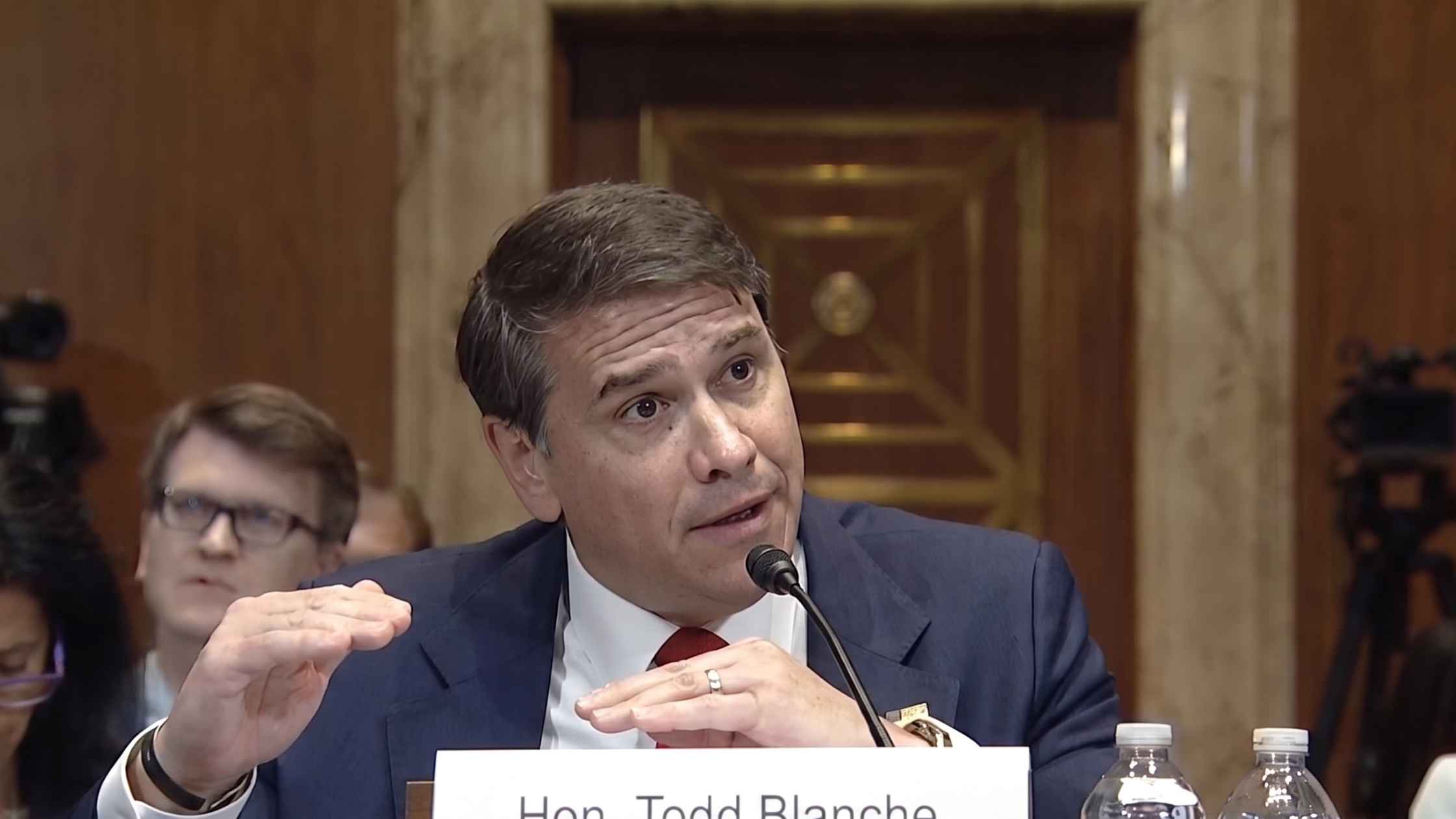
Thank you very much, Senator Moran. Good morning to all of you, Ranking Mayor Van Hollen. Senator Collins, Senator Moran, good morning. Thank you for the opportunity to present President Trump's fiscal year 2027 budget for the Department of Justice. As Senator Moran noted, the request totals 41.2 billion, a 13% increase over fiscal year 2026. This underscores our department's renewed focus on reducing violent crime, combating the fentanyl crisis, strengthening border and immigration enforcement, expanding fraud prevention, and ensuring our law enforcement agencies have the resources they need to protect the American people.
(28:42)
Violent crime reduction remains one of the department's highest priorities. Since January 20th of last year, the DOJ has indicted hundreds of members of TDA, crippling their leadership and dismantling operational networks. Across our major law enforcement components, the results have also been historic. Federal law enforcement helped drive a 20% decrease in the national murder rate in 2025, arrested 44,000 violent offenders, which has doubled the prior year, by the way, and seized over 2,200 kilograms of fentanyl. Last year, law enforcement captured eight of the FBI's 10 most wanted fugitives, located 6,300 missing children, and arrested more than 2,000 child predators.
(29:35)
The DEA has made thousands of fentanyl related arrests and seized millions of fentanyl pills and hundreds of kilograms of fentanyl powder. In one August surge alone, DEA executed over 600 arrests, seized multi-ton quantities of narcotics, and recovered more than $11 million in drug proceeds. With 82 offices in 62 countries and 26 US field divisions, DEA continues to disrupt global supply chains from source to street of illegal narcotics.
(30:08)
The US Marshal Service, one of the smallest federal law enforcement agencies, with roughly 3,800 deputies, arrested more than 73,000 fugitives last year, conducted 308,000 prisoner movements, and housed over 55,000 detainees, and provided protection for 18 federal protectees, including Supreme Court justices and their residences. The Marshals also manage over $10 billion in seized assets, and are obviously essential to federal judicial security.
(30:42)
ATF continues to be a leader in the federal effort to combat violent firearms crime. Since January of last year, ATF has arrested more than 8,700 violent offenders and seized nearly 44,000 firearms, including 5,100 which were interdicted before reaching Mexico, which was their intended des-
Todd Blanche (31:00):
... before reaching Mexico, which was their intended destination. ATF agencies, 2.7 million rounds of ammunition, more than 28,000 illegal explosives, and conducted over 3,500 arson and explosives investigations. They process hundreds of thousands of traces every year, 856,000 last year alone, and are continuing to do great work.
(31:27)
To sustain these historic results, the fiscal year 2027 budget includes 22.2 billion for DOJ's law enforcement components and U.S. Attorney's offices. This is a 16% increase over fiscal year '26, and these investments will build on our tremendous progress and will ensure our continued momentum in violent crime reduction nationwide.
(31:53)
We are also strengthening immigration enforcement efforts. The Executive Office for Immigration Review has completed well over one million immigration cases and reduced backlog by more than 447,000 cases since President Trump took office last year. This budget provides for $899 million for EOR. This is to continue rebuilding our workforce and modernizing our case processing systems. Across the department, nearly $4 billion supports immigration-related enforcement activities.
(32:27)
Finally, the department launched the National Fraud Enforcement Division earlier this year to expand federal fraud enforcement and better protect taxpayer-funded programs. The budget includes $30 million to hire 100 attorneys and enhanced data analytics capabilities to combat large scale criminal fraud schemes. DOJ is also modernizing the grants process by consolidating COPS, OJP and OVW into the new Bureau of Justice grants, providing a unified and simplified approach to federal grant making while obviously continuing to preserve the important missions of each office.
(33:06)
The department faces serious budgetary constraints. Fiscal year 2026 marked the second year of flat budgets for several components, basically equating to a decrease in funding because costs and expenses increase every year, but the budget remained flat. The Bureau of Prisons remains under-resourced funded at $8.1 billion, almost 300 million below fiscal year 2025, and risks insolvency without additional support. The president's request of 10.3 billion for the Bureau of Prisons is essential to restore staffing and maintaining safe and secure federal facilities.
(33:48)
In closing, the fiscal year 2027 budget reflects our unwavering commitment to public safety, strong law enforcement partnerships, and responsible stewardship of taxpayer dollars. With your combined continued support, the Department of Justice will remain strong, effective, and fully equipped to protect the American people.
(34:10)
Thank you again for the opportunity to appear in front of you, and I look forward to your questions.
Senator Jerry Moran (34:15):
Attorney General, thank you. I recognize now the Chairwoman of the full committee, Senator Collins.
Senator Susan Collins (34:21):
Thank you, Mr. Chairman. Mr. Attorney General, yesterday the Justice Department announced the creation of a nearly $1.8 billion anti-weaponization fund to compensate individuals who were purportedly targeted by the Biden administration in exchange for which President Trump dropped his $10 billion lawsuit against the IRS for the completely inappropriate league of the president and his organization's tax data.
(35:01)
Amounts for this new fund will come from the Judgment Fund, a permanent law appropriation for paying claims and settlements brought against the United States government. Amounts in the Judgment Fund have traditionally been used for the payment of specific claims against the government or amounts owned for the settlement of those claims, but not for future claims that have yet to be by.
(35:34)
So I have some questions for you. First, has the DOJ ever used amounts in the Judgment Fund to pay claims that have yet to be brought against the United States government based on the settlement of a completely unrelated case?
Todd Blanche (35:56):
Thank you, Senator. The short answer is yes. I mean, we have done this in the past. This was done during the Obama administration, something almost identical in structure to what we announced yesterday. In that case, there were allegations made by Native Americans that the Department of Agriculture had systematically treated them unfairly and some had filed claims. There was a pending lawsuit, but many had not.
(36:22)
A fund very similar to the one that was established yesterday was set up. It was funded by, in today's dollars, a little over $1 billion, and a single claims commissioner was appointed to review the claims and to distribute funds. In that case, at the end, there was around 300 million left over and the Obama administration had set it up so that that money from the Judgment Fund was distributed to nonprofits and other NGOs.
(36:57)
So what we've done with this fund... And by the way, it is true that this is unusual. That is true, but it is not unprecedented, and it was done to address something that had never happened again either. There is an unprecedented nature of what we did yesterday in response to years and years of weaponization just to correct a few things, Senator. It's not limited to Republicans. It's not limited to-
Senator Susan Collins (37:25):
I didn't say it was.
Todd Blanche (37:26):
It's not limited to the Biden weaponization. It's not limited to in any way scope or form to January 6th, or to Jack Smith. There's no limitation on the claims. The other thing we've done, just to finish up in comparison to what was done previously, is we intend to appoint five commissioners. And also at the end, the money goes back. Any leftover funds go back to the federal government, not to nonprofits.
Senator Susan Collins (37:58):
How would the commission that you've just referenced that oversees the fund determine whether future claims from the fund are eligible to be paid out of it, and how will they determine how much will be paid for each claim? What's the legal basis for those decisions?
Todd Blanche (38:19):
Well, there's commissions that are established all the time where a commissioner is charged with determining the correct amount, if any, to repay a claimant who's asking for funds. In this case, what we expect is the commissioners will take in information. It's entirely voluntary. If an individual wants to apply and assert that they were a victim of weaponization, the commission can do anything according to what was set up yesterday from issuing an apology to the claimant to awarding compensation and the monetary compensation.
(38:56)
It depends on the claim, and there will be five commissioners who will review each claim. It won't be reviewed by me. It won't be reviewed by others in the administration. It'll be reviewed by the five commissioners.
Senator Susan Collins (39:09):
Aren't those commissioners appointed by the president?
Todd Blanche (39:12):
No, they're appointed by-
Senator Susan Collins (39:13):
Who are they appointed by?
Todd Blanche (39:14):
Four of them are appointed by the Attorney General, and one of them is appointed by the Attorney General in consultation with leadership of this body.
Senator Susan Collins (39:22):
Will the information related to the claims be publicly reported?
Todd Blanche (39:29):
That's a good question. I mean, look, there's privacy laws that exist, so I don't want to sit here today and say every scintilla of data collected will be released. But of course, there's accountability that the commission has, a quarterly report that has to come to the Attorney General, which will certainly be public. There's a process that you all will get information and there's a FOIA process. I very much anticipate that the claims that are awarded, the basis in the amount will for sure be made public along the way.
Senator Susan Collins (40:03):
Let me switch to a different issue which Chairman Moran brought up. Along with Chairman Moran and other members of this committee, I was one of the lead sponsors of the Violence Against Women Act reauthorization of 2022. These programs are critical to reducing violence against women, ensuring that justice is served, and strengthening services to victims and survivors of domestic violence, dating violence, sexual assault, and stalking.
(40:41)
In Maine, the Rural Victims Program is especially critical. Despite the importance and effectiveness of these programs, the department's budget request proposes reducing funding by about 25%. Why is the department proposing a reduction in funding to combat domestic violence and to support survivors?
Todd Blanche (41:12):
Well, first of all, I completely agree with you that these are extraordinarily important programs, and the funds are well-used to support these programs. We have asked for $539 million, I believe, in money to support all these programs. I mean, look, there's a lot of money that goes... 190 million for grants to stop stop grants, which is extraordinarily important. And so, it is a priority.
(41:40)
Obviously, we have to make choices and the president's budget has to make choices on where to spend that money, but it is extraordinarily important. The $539 million that we've asked for will go to support all these programs. I mean, so yes, we are asking for less money than the budget had last year, but it's not because we don't view it as extraordinarily important.
Senator Susan Collins (42:02):
Well, I would suggest that cutting the budget for these important programs by 25% is a huge cut, and I hope that's something the subcommittee will take a close look at. Thank you, Mr. Chairman.
Senator Jerry Moran (42:18):
Thank you, Senator Collins. Senator Van Hollen.
Senator Chris Van Hollen (42:21):
Thank you, Mr. Chairman. Mr. Attorney General, this is an outrageous, unprecedented slush fund that you set up. Simple question, will individuals who assaulted Capitol Hill police officers be eligible for this fund?
Todd Blanche (42:36):
Well, as it makes plain, anybody-
Senator Chris Van Hollen (42:39):
Just let me know if they're eligible for the fund.
Todd Blanche (42:41):
As was made plain yesterday, anybody in this country is eligible to apply if they believe they're a victim of weaponization.
Senator Chris Van Hollen (42:50):
Mr. Attorney General, let me ask you this. Are there going to be rules that say that if you've assaulted a Capitol Hill police officer or committed a violent crime, you will not be eligible? Why not make that a rule?
Todd Blanche (43:01):
I expect that the... Well, because I'm not one of the commissioners setting up the rules, I expect that there will be rules-
Senator Chris Van Hollen (43:05):
But you're appointing four of the five members, aren't you, Mr. Attorney General?
Todd Blanche (43:08):
Pardon me?
Senator Chris Van Hollen (43:08):
You're appointing four of the five members.
Todd Blanche (43:10):
I am appointing all five members.
Senator Chris Van Hollen (43:12):
You can slightly set up the rules. I would hope you would make a rule that anyone convicted of assaulting a police officer or violent crime is simply not eligible. They should not apply.
Todd Blanche (43:21):
Well-
Senator Chris Van Hollen (43:21):
Let me ask you this because you compared it to the Keepseagle case, but I think you know full well that in that case, the Settlement Agreement was approved by a federal judge, including the payments to people who were not originally parties to the lawsuit. No federal judge has approved this fund, have they, Mr. Attorney General?
Todd Blanche (43:39):
No. No federal judge did approve this.
Senator Chris Van Hollen (43:41):
So that's a big difference between this case and the case that you compared it to?
Todd Blanche (43:45):
No, it's not.
Senator Chris Van Hollen (43:46):
Did a judge sign off on this case?
Todd Blanche (43:49):
No.
Senator Chris Van Hollen (43:49):
A judge did sign off on the other one.
Todd Blanche (43:51):
Yes, but your question was whether it's a big difference. It's not.
Senator Chris Van Hollen (43:54):
Of course, it is because that allows for an independent person to look at it rather than the [inaudible 00:44:00]-
Todd Blanche (43:59):
There was no independence. There was no independence. There was a single commissioner. A judge signed off on it. A judge had nothing to do with providing the money.
Senator Chris Van Hollen (44:05):
Mr. Attorney General, there was a judge who looked at it and signed off on it. So to compare that case to this one is incredibly deceptive. Let me ask you this about the Epstein case because as we speak, many Epstein survivors are in New York. They're reading portions of the Epstein files about the abuse that they suffered, otherwise they might have been here with us today.
(44:31)
At a House hearing, your predecessor refused to acknowledge the pain experienced by some of those victims when the administration improperly released their names in identifying information. I want to know where you stand. I spoke to the representatives of some of the Epstein survivors yesterday. They are extremely frustrated that you keep calling for people to come forward with more evidence, but you have not met with them to hear their stories. So simple question, if I connect you with these survivors, will you meet with them?
Todd Blanche (45:05):
Absolutely. And what you just said is false. I have met with them. I've met with many of the lawyers for the survivors of victims, as did Attorney General Bondi. Whoever told you that unfortunately gave you bad information. I would encourage them to reach out to the Department of Justice because like we do every single day, we absolutely care for victims and we absolutely want to hear from them and their lawyers.
Senator Chris Van Hollen (45:29):
Well, I've been told directly from their representatives they've not had a chance, at least this group, to meet with you.
Todd Blanche (45:37):
Did they represent... Did they ask-
Senator Chris Van Hollen (45:38):
So I'm glad to hear that.
Todd Blanche (45:39):
Did they represent they asked for a meeting?
Senator Chris Van Hollen (45:42):
Can I ask you to commit that the Justice Department will not recommend a pardon for anyone named in the Epstein files?
Todd Blanche (45:53):
Can you repeat that question? I'm sorry. I didn't hear what you said.
Senator Chris Van Hollen (45:55):
Can you commit that the Justice Department, you, the acting Attorney General, will not recommend a pardon for people named in the Epstein files?
Todd Blanche (46:05):
When you say people named, there's tens of thousands, hundreds of thousands of "people" named.
Senator Chris Van Hollen (46:11):
How about Ghislaine Maxwell? Can you commit that you will be part-
Todd Blanche (46:14):
Yes, I can commit to that. Of course.
Senator Chris Van Hollen (46:15):
Okay. Let me go back to this slush fund because there's also an individual who, after being pardoned by the president, went on to molest two children. That person actually tried to buy the silence of these children by saying that he would pay them some of the funds that he was hoping to get from your slush fund. Can you commit to making the rule so that that person is not eligible for a payout under this fund?
Todd Blanche (46:49):
Well, you're obviously lying in your question because there's no way that this person committed to that. The "slush fund", as you call it, which it's not, didn't exist, but I can commit-
Senator Chris Van Hollen (46:59):
Mr. Attorney General, don't ever do that again. I am reporting-
Todd Blanche (47:04):
Do what again?
Senator Chris Van Hollen (47:04):
... what he said. He said on the expectation that he hoped to get some of the funds from a payout. He's been [inaudible 00:47:11] involvement here.
Todd Blanche (47:11):
But you said from the slush fund, Senator, and that didn't exist when he said that.
Senator Chris Van Hollen (47:15):
This is the fund that the president and all of you have been telegraphing all along that you're going to use to help the president's friends.
Todd Blanche (47:24):
Can you point to-
Senator Chris Van Hollen (47:24):
Mr. Attorney General, this is my question.
Todd Blanche (47:24):
... a certain telegraph I made? What telegraph did I-
Senator Chris Van Hollen (47:27):
I have a last question for you. Do you know that it is a criminal offense to lie to Congress?
Todd Blanche (47:35):
I am very well aware of that.
Senator Susan Collins (47:38):
I'm glad to hear that. Thank you.
Senator Jerry Moran (47:42):
Senator Kennedy.
Senator John Kennedy (47:47):
Thank you, Mr. Chairman. General, how are you?
Todd Blanche (47:51):
I'm great. Thank you, Senator.
Senator John Kennedy (47:59):
In America, unlike other countries where they let you die in a ditch, in America, if you're too poor to be sick, we'll pay for your doctor. Isn't that right?
Todd Blanche (48:12):
It is.
Senator John Kennedy (48:14):
One of the programs we do that through is Medicaid.
Todd Blanche (48:18):
Correct.
Senator John Kennedy (48:22):
This money for Medicaid, it didn't just fall from Heaven. We thank Heaven for it, but it came out of people's pockets, didn't it?
Todd Blanche (48:30):
Every dime of it.
Senator John Kennedy (48:32):
And some of that money is stolen, isn't it?
Todd Blanche (48:36):
Yes.
Senator John Kennedy (48:37):
The states, not all of them, but many of them allow it to be stolen, don't they?
Todd Blanche (48:43):
Yes.
Senator John Kennedy (48:46):
Let's take Medicaid in California, for example. I don't mean to just pick on California, but because this happens in other states, we saw it happen in Minnesota, for example. But in California, for every dollar that the California state government puts up for the Obamacare portion of Medicaid, the federal taxpayer puts up $9, don't they? And so, is that right?
Todd Blanche (49:18):
That's correct, Senator.
Senator John Kennedy (49:19):
And so as a result, California has allowed thousands and thousands of these social assistance and so-called healthcare providers pop up in California, haven't they?
Todd Blanche (49:36):
Yes.
Senator John Kennedy (49:37):
And some of those providers steal the money, don't they?
Todd Blanche (49:40):
Yes, we know that to be true. Yes.
Senator John Kennedy (49:42):
And the money never gets to the people they supposedly are trying to help; isn't that correct?
Todd Blanche (49:46):
Correct. That's correct.
Senator John Kennedy (49:47):
The other way that California and others abuse the fact that they're putting up $1 and the American taxpayer's putting up $9... Did I mention it was $9?
Todd Blanche (49:57):
I think some say it's even more, but yes, nine works.
Senator John Kennedy (49:59):
They expand the services, don't they?
Todd Blanche (50:02):
Yes.
Senator John Kennedy (50:02):
Because some states like California, I don't want to paint with too broad a brush, it's not everybody in California state government, but it's a lot of them. They see this as free money, don't they?
Todd Blanche (50:14):
They're not paying for it, yes.
Senator John Kennedy (50:16):
Isn't it a fact that for example, Medicaid in California will pay a provider to provide tribal prayers? I looked all this up.
Todd Blanche (50:29):
I mean, I'll accept that. I didn't know that, but yes.
Senator John Kennedy (50:31):
That California will actually pay a healthcare provider, I didn't know this was a medical expertise, to pay for exorcisms. Is that right?
Todd Blanche (50:43):
I'll accept that, Senator, but that's-
Senator John Kennedy (50:44):
The California Medicaid program will pay for herbal medicines, meal deliveries. They'll pay for housing. I don't know what housing has to do with healthcare. Is that correct?
Todd Blanche (50:59):
Yes.
Senator John Kennedy (51:00):
Were you aware that the Medicaid program using federal money, taxpayer money, will pay for an in-home chef?
Todd Blanche (51:11):
Yes.
Senator John Kennedy (51:12):
Okay.
Todd Blanche (51:13):
If it's a family member, yes.
Senator John Kennedy (51:14):
Yeah. They'll even pay for gymnasium fees through Medicaid in California. They'll pay for bicycles, scooters, gym memberships. Did you know that?
Todd Blanche (51:28):
Yes. Several states do, but California does for sure.
Senator John Kennedy (51:31):
They'll even repay your student loans. Were you aware of that?
Todd Blanche (51:35):
I was not aware of the student loans repayment.
Senator John Kennedy (51:38):
Yeah. Yeah. They'll repay somebody's student loans to encourage them to become a healthcare provider. I mean, California, they're just setting all kind of records. These folks, they're wild people. California's got 12% of the population. In the last 10 years, they're responsible for half of these new so-called health providers to provide exorcisms and other things. Now, what the hell are we doing about it? Why has this gone on for so long?
Todd Blanche (52:13):
Senator, listen, it's a great question. What you just described are programs that are allowed under the program. You have a whole other issue in California where a lot of these folks are just stealing the money, not even running it through for exorcism.
Senator John Kennedy (52:25):
They're thieves, aren't they?
Todd Blanche (52:26):
They're thieves. Correct. Correct.
Senator John Kennedy (52:29):
And California just watches it happen, don't they? Not everybody in California. The government vote does though, doesn't it?
Todd Blanche (52:37):
Well, that's the challenge in a lot of states is that we don't have a state government, which you all have entrusted to run these programs and take care of the money that you all give them. There's state structures that absolutely do not do any compliance and they don't do their job and-
Senator John Kennedy (52:52):
Because they don't have no incentive to. They're getting free money. Isn't that right?
Todd Blanche (52:57):
Yes. I think so. Yes.
Senator John Kennedy (52:58):
We got to change this, General.
Todd Blanche (53:01):
We're trying.
Senator John Kennedy (53:01):
I call this a slush fund. You want to talk about slush fund? This is a tier one slush fund that's been going on for years and years and years. Hundreds of billions of dollars is stolen.
Todd Blanche (53:19):
Yes, Senator. That's why, look, this department stood up a whole new Fraud division, and AU.S.As around the country prosecute fraud every day. So it's not as if we didn't have the work out there, but it's so systematically taking money from the American taxpayer that we very much believe that it needs its own standup structure. I think it's true for the reasons that you just said.
Senator John Kennedy (53:41):
If you need an exorcism, you can go to California, can't you?
Todd Blanche (53:44):
Thank you, Senator.
Senator Jerry Moran (53:45):
Senator Coons.
Senator Christopher Coons (53:47):
Thank you, Chairman Moran, Ranking Member Van Hollen. Thank you Acting Attorney General Blanche for appearing before us today. I want to talk about some areas where I think we're making progress and we can work together and then raise some real concerns I have. I do think it's worth recognizing the hard work of the men and women of the department and the progress you're making on combating fentanyl and a violent crime.
(54:08)
I've long been involved in criminal justice reform. I've talked with and worked with your predecessor in this. I was pleased to see the president's message during Second Chance Month where he said he wants to ensure those who take responsibility and seek to rebuild their lives have a chance to succeed. Senator Lee and I have a bill called the Safer Supervision Act. It's co-sponsored by Senators Tillis and Wicker, Kramer and Lankford. It's got strong law enforcement and conservative support, and it fits squarely in that framework.
(54:38)
Currently, federal supervision is imposed in nearly every case, leading to badly overworked federal probation officers who then can't properly supervise those who actually most need it. There's more than 120,000 people on average per year being supervised. This bill would help ensure courts are more thoughtful, more analytic when deciding when to impose supervision. Is this a piece of legislation you can support?
Todd Blanche (55:03):
What you just said, I very much agree with. Without looking at every word of the legislation, there's no disagreement for me on a word you just uttered.
Senator Christopher Coons (55:12):
Well, thank you. I'd like to work with you on that.
Todd Blanche (55:15):
Yes, I look forward to that.
Senator Christopher Coons (55:16):
Let me raise two questions. I've been gravely concerned about IP theft, especially from China the whole time I've served. I was struck that the department's proposed budget cuts the funds for IP enforcement. Why? Is the department under your leadership committed to protecting American innovation?
Todd Blanche (55:33):
Very committed. While you're calling it a cut, Senator, I would say that it's a major focus of every-
Senator Christopher Coons (55:40):
It's a lack of an increase?
Todd Blanche (55:41):
Well, no, no, no. I don't mean lack of an increase. I mean that we're focused on it at the U.S. Attorney's office level. When we take money and spend it around the U.S. Attorney's offices, and so it's baked into that big number, rest assured, every U.S. Attorney's Office, all 93 of them, are focused on the threats that we have from there. And so, we're trying to spend our money more wisely.
Senator Christopher Coons (56:02):
Chair Collins raised a concern about the Violence Against Women Act funds. Let me raise a concern about the victims of Child Abuse Act programs. Senator Roy Blunt and I worked to reauthorize this program. I've long been actively engaged with it. I've seen how children's advocacy centers in Delaware make a critical difference bringing together law enforcement, medical, mental health professionals to do child abuse investigations in a child-centered way to make sure children are not re-victimized.
(56:29)
The number of victims served by these centers has increased fourfold over 25 years. Why are you proposing cutting this program?
Todd Blanche (56:38):
We have asked for $41 million for that program, and I agree with you, and I want to work with you to make sure that we're spending that 41 million where we should. I agree with you. It's extraordinarily important and has had a lot of success over the past 15, 20 years as it's been up and running.
Senator Christopher Coons (56:54):
Thank you. Let me return to the line of questioning from the Ranking Member, Senator Van Hollen, that I strongly agree with. I'm just looking at the Settlement Agreement in Trump versus IRS, and I just want to make sure I heard you properly when you responded previously. Your announcement said that the fund will send you quarterly reports.
(57:14)
Will you commit to making these reports fully public so Americans know who's getting taxpayer dollars out of this settlement fund? This says they'll be confidential. This is Section IV, Part E of the Settlement Agreement.
Todd Blanche (57:27):
The reason why I want to be careful my answer is because there's obviously laws that exist around privacy that may prevent some of the information that the commission takes in from being fully public. Beyond that, there will be full transparency, and I commit to you that beyond the applicable laws that exist around privacy and privileges and whatnot. As far as being transparent and having those quarterly reports released, yes.
Senator Christopher Coons (57:53):
Thank you. You referenced a previous case, I think it was Keepseagle versus Vilsack under the previous administration. Did that case involve a president suing his own government and then settling that case before it could be reviewed or approved by a judge?
Todd Blanche (58:08):
So no, neither does the commission.
Senator Christopher Coons (58:10):
It did not. And so, when you suggested that they're nearly identical, they're not identical. I think there's a critical difference here. President Trump is the first president to sue his own government and then direct his chosen acting Attorney General to reach this kind of settlement. Will you commit that none of President Trump's family will receive a direct payout from this fund?
Todd Blanche (58:34):
Yes, but what you just said is not true. I mean, if I can correct that.
Senator Christopher Coons (58:38):
Please.
Todd Blanche (58:39):
The president did not direct me to do anything. Secondly, when we said that the structure of the commission is similar to Keepseagle, that's true. The underlying case is not the same. The structure of the commission is the same as the Keepseagle commission.
Senator Christopher Coons (58:55):
Has it ever happened that a sitting president sued his own government for $10 billion and then directed the settlement of the case and the establishment of a payout fund?
Todd Blanche (59:06):
Not that I'm aware, but there's a lot of things that President Trump's the first of. No president had been indicted one, two, three, four, five, six, seven, eight times either.
Senator Christopher Coons (59:14):
Correct. Correct. No president's been indicted. Will you commit that none of this money will go to President Trump's campaign donors?
Todd Blanche (59:21):
I am not committing to anything beyond the Settlement Agreement itself. When you say campaign donors, they are not excluded from seeking compensation. They're weaponized.
Senator Christopher Coons (59:29):
Last question. During Police Week, I heard from a number of law enforcement friends who found it appalling that there was the possibility that folks like the peace, the oath keepers, the Proud Boys who had assaulted Capitol police officers could receive multimillion dollar payouts from this fund. Will you commit that no one who has been convicted of assaulting a police officer will receive a payout from this fund?
Todd Blanche (59:54):
I shared the concerns that apparently members of law enforcement gave to you last week, although none of this was announced last week, so that's surprising.
Senator Christopher Coons (01:00:02):
They had heard rumors there would be a settlement fund.
Todd Blanche (01:00:04):
Okay. But anybody can apply. The commissioners will set rules, I'm sure. That's not for me to set. That's for the commissioners. Whether an individual, an oath keeper, as you just mentioned, applies for compensation, anybody in this country can apply.
Senator Christopher Coons (01:00:20):
Well, we'll be watching this very closely as this goes forward. I don't think the settlement fund should be set up this way or for these purposes. I appreciate your answers today. Thank you, Mr. General.
Todd Blanche (01:00:30):
Thank you.
Senator Jerry Moran (01:00:30):
Senator Murkowski.
Senator Lisa Murkowski (01:00:32):
Thank you, Mr. Chairman. Attorney General, thank you for being here this morning and responding to our questions. I want to follow on a couple that have been asked with regards to the Department of Justice's state and local law enforcement programs. $1.2 billion in proposed cuts. We're looking at it very carefully because many of these grants and programs have significant impact on our state, small population, large area to deal with. The budget also calls for consolidation of the Office of Violence Against Women, the Community Oriented Policing Services, and the OJP programs. Is the Office of Tribal Justice one of the offices that are also intended to be consolidated?
Todd Blanche (01:01:21):
We're just consolidating the grant components, so OJP, COPS, and then... By the way, we're not combining them. We're just making them more efficient. They will still maintain their own independence and brand for lack of a better word. What we heard from the field is that there were inappropriate inconsistencies and inefficiencies in having three separate bureaucracies running each of those programs, so that's what we're trying to-
Senator Lisa Murkowski (01:01:49):
Don't disagree with wanting to reduce bureaucracies. My interest is making sure that the fidelity of these grants and the availability to very rural and oftentimes just very high cost because of what we're dealing with out there.
Senator Lisa Murkowski (01:02:00):
... just very high cost because of what we're dealing with out there, that they do not get overlooked, because when you have cuts to the level that you're proposing, one has to assume that, okay, you can talk about reducing the bureaucracy and just what the program itself might look like, but again, my interest is making sure that this much-needed assistance is still pushed down to the very, very local levels.
Todd Blanche (01:02:29):
Senator, I assure you that the rural communities, and I appreciate that they have the most challenges applying for grants, because of just the way they're structured.
Senator Lisa Murkowski (01:02:39):
Lack of capacity.
Todd Blanche (01:02:40):
Of course. And there's, obviously, I forget the exact percentage, but a large percentage of our grants do go to rural communities, as they should, and rural police departments, as they should. And we are going to continue to do that. I mean, the COPS Office is required to distribute half of it, half of the grants to rural communities. And I don't want to take up all your time, Senator, but that's one of the reasons why we built in... We're trying to make it more efficient because the field said, especially rural communities, big cities don't have issues applying for grants. They have a bunch of people that can do it. And so, yes, we are very focused on that in Tribal justice space, but also in the grant space.
Senator Lisa Murkowski (01:03:17):
Well, know that we're watching this one very carefully. I understand that in response to Senator Collins, you acknowledge 25% cut to the Office on Violence Against Women. I was very involved in that reauthorization, and within that, we provide that OVW may not be subsumed by another grant-making component within DOJ. So, we want to make sure that, again, DOJ is going to maintain OVW's statutory responsibilities and how they move forward with their grant-making and not losing out on that subject [inaudible 01:03:56].
Todd Blanche (01:03:55):
We will. And we're aware of that. Yes, ma'am.
Senator Lisa Murkowski (01:03:58):
Let me ask about the Not Invisible Act. This was legislation that I introduced some years ago. It became law. May 5th is the day that we recognize as Missing and Murdered Indigenous Persons Awareness Day. We had a big round table that Senator Sullivan helped to organize just a couple weeks ago. I had a lot of the folks from your department, along with Alaska state and local, as well as Tribal. One of the things that kept coming up was the commission issued its final report. I thought it was pretty substantive. They issued it November 1 of 2023 after great testimony and consultation all across Indian country. But then it was removed. The report was removed very early on in the second Trump administration, and the related materials have been removed from DOJ and the Department of Interior websites. So, people keep asking me, "Where'd it go? Why? What is happening?" And we tried to get further information to that again up in Anchorage a couple weeks ago.
(01:05:10)
So, the question to you is why was the report taken down? When will it be restored? And more importantly, what concrete steps is DOJ taking with the Department of others and others to implement the recommendations? We don't want the work of this really important commission to just kind of sit and be ignored.
Todd Blanche (01:05:32):
Yeah. So, I don't have an answer as to why it was taken down, but I will get back to you promptly. I will tell you-
Senator Lisa Murkowski (01:05:38):
I would appreciate that, yeah.
Todd Blanche (01:05:40):
And your big picture question, we are on the same page when it comes to Tribal justice and the work that we have to do with our Native American community in making sure that we're giving them the resources, the law enforcement. I've visited two so far as the Deputy Attorney General, my staff has gone out to multiples, to northern New York, the Dakotas, Oklahoma, and we'll continue to do that. I think that, at the end of the day, it is a funding and training issue that is our responsibility, and I recognize that, and it's a priority.
Senator Lisa Murkowski (01:06:13):
Well, and we've seen positive signals in the first Trump administration. That was when Operation Lady Justice was stood up. I think that that is good. We need to continue on that. You've put good people tasked to this, but this is where it gets confusing, because when you have a public-facing website that helps people navigate through some of the reporting and the lack of data, that's where we could use a little help. So, if you can get back with me on that, I would appreciate it.
Todd Blanche (01:06:42):
I will, Senator.
Senator Lisa Murkowski (01:06:43):
Thank you, Mr. Chairman.
Speaker 1 (01:06:44):
Senator Shaheen.
Jeanne Shaheen (01:06:46):
Thank you, Mr. Acting Attorney General, for being here. As you alluded to in your opening statement, there is an acute staffing shortage at the Bureau of Prisons. At FCI Berlin in New Hampshire, staffing levels have dropped to 58% of authorized levels, and that's at a time when correctional officers are being asked to take on added duties, where they have detainees being sent to our federal prison, and the retention incentives have dropped significantly. So, as you point out, the bureau received an additional $3 billion in the reconciliation bill to address staffing issues, and you're asking for additional funding, which I appreciate, but how do you plan to use those supplemental funds to address recruitment and detention of staff at facilities like FCI Berlin?
Todd Blanche (01:07:37):
Thank you for that question. It is a crisis, and the crisis on staffing is twofold. One is we're not paying them enough, and they can walk across the street to county jails and make more money. And two, because we're not paying them enough, there's shortages, so they're required to work overtime. They're required to [inaudible 01:07:54]-
Jeanne Shaheen (01:07:53):
I understand the problem. Can you explain what you're going to do to address it?
Todd Blanche (01:07:57):
So, we're doing both. I mean, we're addressing the compensation, and we've already worked with Director Marshall over the past several months to give some retention money to officers who are staying, but we have to pay them more, and we have to make it worthwhile for them to stay. And that the only way to do that is with money. The only way to do that is with more hiring.
Jeanne Shaheen (01:08:15):
I can tell you that FCI Berlin has not seen that money yet and it's going to be critical to get it out.
(01:08:21)
Let me change to another topic, because we have a new DEA drug lab in Londonderry, New Hampshire. I'm very pleased that we've got that New England regional drug lab, I worked hard to try and support the effort to get it there, but I'm concerned now that DEA doesn't have the personnel that they need in order to fully operate it. And when we raised this at hearings, both in the House and Senate, with DEA, what they told us was that DOJ has routinely denied its request for greater allocations of personnel, meaning that they are going to have difficulties hiring the sufficient personnel they need to fully operate this new lab. So, can you commit that you will ensure that the personnel that are needed to operate the lab are able to be hired?
Todd Blanche (01:09:09):
Yes, and our budget asks for that funding. And I agree with you, Senator, that it's crucial to have that. And that there's shortages, you're right.
Jeanne Shaheen (01:09:19):
Let me weigh in with Senator Collins and Senator Murkowski and their concerns about the Office of Violence Against Women and the grants. I don't support the cut of 25% for that budget, but we have a greater issue, because my staff has heard from organizations in New Hampshire working on domestic violence concerns that the department is continuing to hold fiscal year '25 funding for the office. And for some of these organizations, they had their grants canceled early in 2025. This disruption has caused those organizations to scale back, to start laying off staff, which limits their ability to help survivors. So, when is the department going to make available that fiscal year '25 and '26 grant funds that have already been approved by Congress?
Todd Blanche (01:10:14):
So, the NOFOs for two of the three agencies are all out and back. There's one NOFO that's pending from '25 that we expect to get out any day now, and then we'll start working on '26. And so it's done on a rolling basis, and we're working every day very hard to get that money out.
(01:10:36)
As far as grants that were canceled, I believe 330-some were canceled, just about 5 or 6% of the overall grants awarded, for various reasons. But grants that were... More than that were initially canceled and the grants-
Jeanne Shaheen (01:10:54):
But those are grants that had been approved by Congress that had already been sent out. Why is the department canceling funding that our organizations are depending on in order to help survivors?
Todd Blanche (01:11:04):
Well, it's not that they were approved by Congress, the money was. And so for a very small portion of grants, they were canceled for various reasons.
Jeanne Shaheen (01:11:13):
Well, they were canceled because DOGE came in and made significant cuts, and the administration has made cuts. I guess I'm not going to argue with you about why that happened. I think it was wrong. I'm going to acknowledge your commitment to ensure that those funds are going to go out to the organizations that are depending on them, so that they can serve the people who need it.
Todd Blanche (01:11:35):
I commit to that.
Jeanne Shaheen (01:11:36):
Thank you.
(01:11:39)
Last fall, the US trustee for Region 1 didn't name a new Chapter 13 standing trustee for New Hampshire. Instead, he assigned New Hampshire's duties to Maine's standing trustee, over the objections of the New Hampshire bankruptcy bar. The transition from New Hampshire's standing trustee to the new Maine trustee, who's supposed to be serving both states, has not gone well. Debtors who had completed their payments were not being discharged from bankruptcy, creditors and attorneys were not getting paid. In fact, a motion to remove the New Hampshire and Maine trustee was filed, and the New Hampshire bankruptcy judge admonished the trustee, but unfortunately didn't ultimately remove him.
(01:12:23)
I am very concerned that we have grant [inaudible 01:12:26] who need to use the Chapter 13 bankruptcy and that they're being disadvantaged because of this decision, for whatever reason. We have no idea, because the US government doesn't pay those standing trustees. There's no reason, that's not a benefit, in terms of savings. So, I don't know if it was a shot at New Hampshire, or what the issue was, but will you commit to naming a New Hampshire-only Chapter 13 standing trustee and look into this? Because it's a real problem.
Todd Blanche (01:12:58):
So, we have that-
Katie Britt (01:12:59):
And Mr. General, the time is expired, so if you can quickly wrap that up, I would appreciate that.
Todd Blanche (01:13:02):
Okay. We have that in many districts, not just New Hampshire, and we're working very hard to rectify it for the reasons that you state, the challenges it presents.
Jeanne Shaheen (01:13:12):
So, you will look into that and try and fix it?
Todd Blanche (01:13:14):
We've been looking into it and we'll continue to do so, Senator, yes.
Katie Britt (01:13:20):
Thank you. Mr. General, appreciate you being here today. I wanted to start with an issue that I raised with you in your confirmation hearing in the Senate Judiciary Committee. We talked about the Executive Office for Immigration Reform. Some people call it EOIR, some people call it EOR, but ultimately, it oversees our immigration courts. As you're aware, there was a significant backlog that was left by the Biden-Harris administration. Unfortunately, they created a culture of that, of dragging their feet and not actually completing these cases. I know they also rolled back a number of reforms that were put in place during the first Trump administration to ensure that our immigration courts functioned in an efficient manner. By contrast, obviously, under the current Trump administration, the courts in FY25 have completed the highest number of cases that we have seen in a single year in EOR's history, finally achieved a reduction in the case backlog, and hopefully that's something that we can continue.
(01:14:20)
I saw in your budget that you increased this by 12%. I wanted to talk, is that going to help you continue on eliminating this backlog, improve efficiencies and operations of these immigration courts? And then also on that, how does the budget request support efforts to actually modernize this process, making sure that we're not only using the current system, but we're looking at how can we be more efficient in the future?
Todd Blanche (01:14:44):
Yes, thank you, Senator. The first answer, in reverse order, we have asked for $37 million to modernize the IT programs that the immigration courts use. That, in and of itself, will create efficiencies that will help us in ways that should have happened years and years ago, and it didn't. We're also asking for more money because we need more judges. And the Big Beautiful Bill gave us authority to hire a bunch of immigration judges and we're hiring a ton. We have a graduation tomorrow, the largest graduation of immigration judges in many, many years, if not history. And we're continuing to try to find good judges that will work hard. And the budget also... A judge needs staff. So, a judge needs clerks to help process the cases. Almost 500,000 cases were processed last year. That's extraordinary, and we're getting into the backlog.
(01:15:37)
But when you have something like four million immigration cases, four million immigration cases backed up, even if you cut it down by a million a year, you're still looking at three or four years to catch up, but we're very focused on doing that. We tell our new judges they're going to be working harder than they've ever worked in their lives, and we expect that. And so this budget is really addressing that, the IT problem and the staffing challenge that we have.
Katie Britt (01:16:06):
Good. Thank you.
(01:16:08)
Changing gears a little bit, obviously we are so proud to see the crackdown on crime across the country, lowest murder rate that we have seen, the significant just actually getting back to the mission of getting the bad guys and putting criminals behind bars. I talked to Director Patel about this last week, but there's great work being done by the FBI and DOJ in my home state. Operation Southern Star in Montgomery has been significant, that's where I live. We appreciate that effort. I know that communities across the country appreciate the work that you're doing. Can you discuss how this request increase in resources that you have in this budget is going to allow us to build on the current successes and enhance cooperation with state and local partners across the country, so that we can do more of what we've seen in Montgomery over the Operation Southern Star?
Todd Blanche (01:17:02):
Yes. So, there is nothing more important than our state and local partnerships when it comes to combating violent crime. Nearly every violent criminal that's arrested by the Feds, the Feds are assisted by a cop or a detective or a trooper in that case. And so when we talk about the work that the federal government and the FBI and DEA and Marshals and ATF and HSI have done over the past year, we are really talking about the work that they did partnering with the state and locals. So, our budget reflects that. We want $2.9 billion for state and local grants. That's money that's going to go to law enforcement to combat violent crime. $12 billion for our budget for violent crime.
(01:17:40)
And you said that, but I want to make sure I'm giving props to the great men and women of law enforcement in our country. It worked. And we did see meaningful reductions in violent crime, which means everybody's streets are safer than they were a year and a half ago.
Katie Britt (01:17:55):
Well, as someone who is raising two teenagers and wants these streets to be safer, particularly the ones where all these families are trying to build their lives, we say thank you.
(01:18:07)
Last question. I know that the budget also is going to stand up the National Fraud Enforcement Division. I know that there's been a lot of misnomers about that out there. It is important we make sure that taxpayer dollars are used judiciously and the people who do not do that are held accountable. Can you talk about some of the work that the division has been doing and how the funding will allow DOJ to continue protecting Americans and their hard-earned tax dollars?
Todd Blanche (01:18:33):
Yes. So, we asked for $30 million because we need lawyers to help build this new division up. And what we've done already, and you've seen it in the news in Minnesota and other locations... Really everywhere. Minnesota's been a focus, but in every state, the National Fraud Division has an AUSA assigned to that division now, and their goal is very simple: to find criminals who are stealing from the government. That's it. And so that comes in the area of healthcare, but it comes in a lot of different places. And I expect that everybody in this body will be very satisfied with the work when I come back next time-
Katie Britt (01:19:09):
Excellent.
Todd Blanche (01:19:10):
... because it's doing great work.
Katie Britt (01:19:11):
Americans are sick of people not being held accountable, so we hope that we see some people actually prosecuted for these crimes. Thank you so much.
Todd Blanche (01:19:18):
Thank you.
Katie Britt (01:19:20):
Senator Merkley.
Jeff Merkley (01:19:22):
Thank you, Madam Chair. And Senator Murray, do you want to jump in first?
Patty Murray (01:19:27):
Go ahead, go ahead.
Jeff Merkley (01:19:28):
Okay. Thank you, Acting Attorney General. So, the budget has a $500 million cut to the COPS grants. Those grants are certainly important to our local law enforcement for staff, for equipment, for investigations. Is there any particular reason that you think the police departments need less money now than they did before? And would you be supportive if we advocate for more funding rather than less?
Todd Blanche (01:19:54):
So, local law enforcement needs all the money we can get. I agree with that very much. And whether I would be supportive of more money that you all come together for local law enforcement, yes, I will. I mean, look, this budget-
Jeff Merkley (01:20:06):
Thank you. I appreciate that.
Todd Blanche (01:20:07):
Sure.
Jeff Merkley (01:20:08):
There is a bill called the Stop Institutional Child Abuse Act that senators on both sides of the aisle supported, including Senators Tuberville and Cornyn. And this is about the troubled teen industry, where there are basically all kinds of fairly unregulated, without oversight companies that say, "Hey, send your teen to us and we'll get them on the right path." This institutional care often results in institutional abuse.
(01:20:39)
And what we did when we passed and funded that bill, because we had both authorized it and then we funded it, was to have the National Academies of Science study, because there's 50,000 kids that are in these institutional settings each year. They're often taken away in the middle of the night, under arrangements with the parents. The parents think they're sending their kids to get help, but often they're sending their kids into abuse. Will you take a look at this issue and just kind of track the National Academies as they proceed to study this, and if there are ways that we can reduce abuse, help us find that path?
Todd Blanche (01:21:15):
Yes, of course.
Jeff Merkley (01:21:17):
Thank you.
(01:21:18)
To follow up, you noted that it would be up to the five commissioners that you appoint to determine whether there are any guidelines. Will you encourage the folks that you select to ensure that folks who were convicted of violent acts against police officers do not get compensation from this fund?
Todd Blanche (01:21:38):
Well, I expect they will. They don't have the option of establishing guidelines. The commissioners will establish guidelines. And so I feel like-
Jeff Merkley (01:21:45):
Will you encourage them to have a guideline that says those who have been convicted of violent acts against police officers are not eligible?
Todd Blanche (01:21:53):
I will definitely encourage the commissioners to take everything into account when determining who should get compensation.
Jeff Merkley (01:21:59):
But why not this specific issue of violent acts, convicted of violent acts against police officers? Do you feel they should get compensation after being convicted of violent acts?
Todd Blanche (01:22:07):
My feelings don't matter, Senator, in my mind. My mind is not limiting to say, "Yes, I will commit to this or that." What I will commit to is making sure that the commissioners are effectively doing their jobs, and that includes setting guidelines like you're describing.
Jeff Merkley (01:22:23):
Okay. I'm disappointed that you feel it's acceptable that those who are convicted of violently assaulting-
Todd Blanche (01:22:32):
I definitely did not say that. Definitely did not say that. I didn't say I found it acceptable, Senator.
Jeff Merkley (01:22:36):
Will you agree to encourage those commissioners to set a guideline that compensation will not go to individuals who are convicted of assaulting police officers?
Todd Blanche (01:22:47):
I expect-
Jeff Merkley (01:22:48):
Just a yes would answer my question or a no.
Todd Blanche (01:22:50):
A yes will not answer that question. I mean, you're asking whether I will encourage. I don't think that's a fair word. I don't think it's the Attorney General's job to encourage commissioners to do or not do anything.
Jeff Merkley (01:22:58):
Okay. Well, we'll move on, but I will say that you have complete power over who you appoint, so you have huge influence. You are going to be evaluating the inclinations and attitudes of those who will serve. And certainly this looks extraordinary. You described it as parallel to a fund set up to compensate Native Americans who were discriminated against in the agricultural world. It's not parallel at all. President Obama did not sue his own Department of Justice. He did not have a judge saying that Williams had... Let's see. How did she put it? Kathleen Williams, the judge handling the lawsuit, dismissed the case and [inaudible 01:23:41] admonished the government agency, notably the Justice Department, for not being transparent about the settlement deal. Williams previously assigned a group of attorneys to determine whether there was a conflict of case since, as sitting president, Trump was suing, quote, "entities whose decisions are subject to his direction". This type of conflict of interest is not at all involved in the funds set up to compensate those who were discriminated against in the agricultural realm.
(01:24:10)
I want to go on to the Epstein investigation. Is it closed or open?
Todd Blanche (01:24:14):
When you say the Epstein investigation, what are you referring to, Senator?
Jeff Merkley (01:24:17):
Well, the FBI said in last year in July that it had closed the Epstein investigation. So, I'm just using their words. Is it open or closed?
Todd Blanche (01:24:25):
I don't believe the FBI said that. I mean, if you're referring to-
Jeff Merkley (01:24:31):
Well, you're head of the Department of Justice. Is the Epstein-
Todd Blanche (01:24:32):
I am.
Jeff Merkley (01:24:33):
... investigation open or closed?
Todd Blanche (01:24:34):
But I guess I don't understand what "Epstein investigation" means. The investigation into Jeffrey Epstein himself?
Jeff Merkley (01:24:39):
Well, let me put it a different way.
Todd Blanche (01:24:40):
Yes, he's dead. Any investigation into potential other bad guys will always be open if we have evidence that supports, in any way, shape, or form, that we can make a case.
Jeff Merkley (01:24:50):
Okay. So, Trump said in November, this was after the FBI, and it was the FBI's words when they said the investigation was closed, but what Trump wrote in November of last year, "I'll be asking the Attorney General," Pam Bondi, "and the Department of Justice, together with our great patriots FBI, to investigate Jeffrey Epstein's involvement and relationships with," and he gave a specific list, "Bill Clinton, Larry Summers, Reid Hoffman," people at JP Morgan, "and many other people... To determine what was going on". Is there a list particularly targeted at Democrats, as opposed to being, if you will, blind, blind to party affiliation, investigations that are being pursued under your direction?
Todd Blanche (01:25:37):
Any investigation, no matter Republican, Democrat, man, woman, old, young, any investigation will be open if the Department of Justice and the FBI have evidence that a crime's been committed. And that doesn't, I mean, you're talking about Epstein-
Jeff Merkley (01:25:49):
Do you commit to pursue regardless of political affiliation?
Todd Blanche (01:25:52):
Excuse me, Senator?
Jeff Merkley (01:25:53):
Do you commit to pursuing investigations free of prejudice about party affiliation?
Todd Blanche (01:25:59):
Of course, yes.
Jeff Merkley (01:26:00):
Well, you say "of course", but this enemy has repeatedly... This president has repeatedly spoken of an enemy's list that he wants to go after, and I must say it's one of the symbols of the breakdown of a democratic republic when a president uses his Department of Justice, which you now head, to go after his perceived political enemies. I hope you won't be party to that. Thank you.
Todd Blanche (01:26:21):
I mean, I couldn't agree with you more, and that's why what happened during the Biden administration was so disgusting.
Jeff Merkley (01:26:27):
That is completely inappropriate and wrong. There is no comparison to the absolute fair-minded pursuit of justice under the previous administration and this administration's pursuit of an enemy's list. Thank you.
Speaker 1 (01:26:39):
Senator Murray.
Patty Murray (01:26:42):
I believe Senator Fischer was next. Yeah.
Speaker 1 (01:26:46):
Yes, you are. Senator Fischer, so glad of you to join us.
Deb Fischer (01:26:51):
Thank you.
Speaker 1 (01:26:52):
Trying to ingratiate myself with the ranking member of the committee.
Deb Fischer (01:26:55):
No, you didn't see me at the kiddie table. It's fine. So, Mr. Attorney General, welcome. Senator Murkowski brought up to you about the consolidation of the grant programs, and also that the budget request is $1.2 billion, a cut to the state and local grants. I thank you for clarifying that this consolidation, what its intent is, but I'm still concerned about the impact of funding reductions and what that would have on our state and local law enforcement agencies. So, I hope that you will be very cognizant of that as you look at the rural, and really the under-resourced agencies that are out there.
Todd Blanche (01:27:46):
Yes, I will, Senator. Yes.
Deb Fischer (01:27:47):
Thank you.
(01:27:47)
In 2024, I passed legislation, the Recruit and Retain Act, and that was signed into law, and this authorized law enforcement agencies to use those COPS grants for recruitment and retention activities. It required a study. The study came out. Not surprisingly, it identified a relationship between local law enforcement staffing levels and crime rates. More staff leads to lower crime. And the study also found that from 2019 through 2024, officer resignations and retirements have increased, and that's obviously then a decrease in officer staffing. So, Mr. Attorney General, how do you anticipate that DOJ's proposal to consolidate its grant-making components, reducing that funding for that account, how's that going to impact recruitment and retention by those local agencies, and how do you plan to address that?
Todd Blanche (01:29:00):
So, we will spend tons and tons of grant money on that issue, and not only giving money to state and locals to get them new bodies, but also overtime and equipment, which all goes to keeping people on the job. More meaningfully and beyond the grant program itself, we are making law enforcement a very good thing to be part of now. And that was one of the reasons that there was a steep decline and a lot of retirements during the 2019 to 2024, because there was this inappropriate stigma that law enforcement or cops were bad. That's not the case anymore. And so we're working every day. We have our Homeland Security Task Forces set up, which is a partnership with state and local law enforcement and sheriffs. They're getting money. They're getting overtime pay. We're thanking them. We're giving them cars. We're giving them vehicles. And so that's what we're going to continue to do.
Deb Fischer (01:29:48):
Have you reached out to local agencies to see if their recruitment has improved? Because I can attest to disappointment by many police departments. OPPD, Omaha, for example, did see their numbers really decrease. Have you reached out and have any numbers on what it is now?
Todd Blanche (01:30:12):
Regularly, including last week during Police Week, I met with a lot. It's still a problem. We have not fixed it yet. I mean, look at what happened over the past year with law enforcement officers getting doxxed and having rocks thrown at them and having local leaders say to good, hardworking cops, "You can't help." So, this isn't something that we've won yet, but it's a priority to win that fight. And I'll keep on talking to state and local sheriffs and cops and detectives, and letting them know that we appreciate them, and not only with our mouth, but with our pocketbooks as well.
Deb Fischer (01:30:41):
We do. Thank you.
(01:30:43)
Last year, the FBI and Homeland Security Investigations announced a new Homeland Security Task Force based out of Kansas City, Missouri, and that included a location in Omaha, and focus is obviously combating trafficking of humans and drugs and weapons, money laundering, alien smuggling, homicide extortion, on and on. We did see members of this task force, they arrested a MS-13 gang leader in Grand Island, Nebraska in the middle Eastern part of the state.
(01:31:23)
The '27 budget request cites the elimination of the Organized Crime Drug Enforcement Task Force's component, and instead requests appropriations be made directly to agencies like DEA and FBI. Can you share how this proposed reorganization is still going to ensure strong interagency coordination, so that we can see a continued focus on transnational crime threats, and specifically with those local law and enforcement agencies? It's very important.
Todd Blanche (01:32:03):
I agree. So, look, we dissolved the OCDETF executive office. That is true. But the money that we're asking for and the money that we're going to spend is exactly like we've been spending for a long time, except for more efficiently. So, the HSTF model is built off of the OCDETF model, but with a lot of improvement. There was a lot of overlap in OCDETF money that we're now being more efficient with. So, there is no doubt, as a matter of fact, the opposite is true, that we're spending that same OCDETF type money, we're spending more of it, and we're getting more of it out to the field through the Homeland Security Task Force. And so that's the goal.
Deb Fischer (01:32:42):
So, is that a line item within your agency, or does it need to be a line item on appropriations, to make sure that it's covered?
Todd Blanche (01:32:54):
So, it's a line item through the appropriations, I believe. Although I'll double check that and-
Deb Fischer (01:32:59):
We'll check it out.
Todd Blanche (01:32:59):
... get back to you if I'm wrong. I will, yes.
Deb Fischer (01:33:02):
Okay. Thank you, I yield back.
Speaker 1 (01:33:02):
Senator Fischer, thank you.
Todd Blanche (01:33:00):
... actually if I'm wrong, I will. Yes.
Senator Fischer (01:33:01):
Okay. Thank you.
Mr. Chairman (01:33:02):
Senator Fischer, thank you. Now I would like to recognize the Vice Chair of the Full Committee, Senator Murray.
Senator Murray (01:33:07):
Thank you, Mr. Chairman. Acting Attorney General, right now, families are paying 4, 5, even 6 or $7 for gas. Inflation is at its highest level in years because of the President's policies. But instead of helping Americans get by, President Trump is literally using their tax dollars to set up a slush fund to enrich his own friends. On Monday, your department settled the President's lawsuit by setting up a fund with $1.8 billion and you and the President will pick the handful of people who decide how that money gets doled out.
(01:33:47)
So let's be clear. What we're talking about is nothing short of the sitting President of the United States looting from the treasury for his own gain. Do you seriously think this arrangement is appropriate, the President telling the federal government to settle a case and let him pay billions to the people that he chooses?
Todd Blanche (01:34:08):
What you just described wouldn't be appropriate and that's absolutely not what happened, and that's not what's happening now. So you just set up a series of facts, most of which were not true, to say is it-
Senator Murray (01:34:18):
No, they-
Todd Blanche (01:34:18):
No, it's not.
Senator Murray (01:34:19):
The President has set up a slush fund, however you want to say that it got set up, and he literally will get to choose, through his handpicked apointees, who gets paid that fund. That is absurd.
Todd Blanche (01:34:31):
The President did not set up this fund. It's not a slush fund. It's been done many times. We have lots of funds set-
Senator Murray (01:34:39):
Oh, I heard your response earlier to Senator Van Hollen. This is not comparable to the case that you cited. A judge was not involved. This is the President versus himself setting up a fund.
Todd Blanche (01:34:50):
The judge wasn't involved in the distribution in the Keepseagle case at all. It just wasn't. There was a single commissioner that was set up, not five. And so when I-
Senator Murray (01:34:59):
The judge signed off on that case.
Todd Blanche (01:35:02):
Yes, it was at a much later point in the litigation.
Senator Murray (01:35:04):
That's my point. That is all of our point. And I just have to tell you, this is corruption that has never been more blatant or more widespread. What is happening is you write the check, Trump and his carnies cash it. American taxpayers who are already being whacked with high prices are going to foot the bill. That's what we are seeing today and that is what many of us are really, really angry about.
(01:35:28)
So let me move to another topic. This Department of Justice is sending the message that if you're wealthy, if you're powerful, if you are well connected, you won't be held accountable even if you abuse children. You know this after Congress passed the Epstein Files Transparency Act and DOG finally began to release the files, your department exposed survivors' names, their sensitive personal information, and even nude photos while redacting names of alleged perpetrators of those crimes. The message that sends is this Department of Justice worked harder to protect the privacy of potential child abusers than the survivors. Your predecessor refused to apologize to those victims, but I want to give you the same opportunity to apologize for the way the department handled the release of these documents. Will you apologize to the survivors?
Todd Blanche (01:36:29):
When the President passed the Epstein Transparency Act, that was the only time ... When the President signed the Transparency Act, that was when we were legally allowed to release the files. Prior to the passage of the act, which you all passed, I agree.
Senator Murray (01:36:43):
That is so not the question I'm asking.
Todd Blanche (01:36:45):
It was a question you asked. You asked five or six questions. I'm answering them in order. That was one of the questions you asked.
Senator Murray (01:36:50):
No, the question I want you to answer is will you apologize to the victims whose names, sensitive personal information and even nude photos were not redacted by your department? Will you apologize to them?
Todd Blanche (01:37:03):
Of course.
Senator Murray (01:37:03):
[inaudible 01:37:04].
Todd Blanche (01:37:04):
We never want to release a single victim's name.
Senator Murray (01:37:07):
That is what they want to hear.
Todd Blanche (01:37:07):
Can I answer the question, please? Is it fair?
Senator Murray (01:37:09):
I'm asking if you'll apologize.
Todd Blanche (01:37:11):
And I just said yes, but I would like an explanation to be given to that. What this act did is it required us to review over six million pieces of paper in a very short period of time. And so 0.001%, we made mistakes and we owned up to them. And the second that a victim or their lawyer told us that we made a mistake, we pulled that document down and we put lawyers 24/7 in being responsive to victims and their lawyers to make sure that we fixed every single problem. And so yes, [inaudible 01:37:41].
Senator Murray (01:37:41):
I hear your anger.
Todd Blanche (01:37:42):
I'm not angry. No, I'm not angry. I'm just making sure it's understood that we matter.
Senator Murray (01:37:47):
And I will tell you who's really angry, it's people who had their nude photos released. I just want to hear you say I apologize to those victims.
Todd Blanche (01:37:52):
So as I just said, of course, anytime we release a victim's name that shouldn't be released, we have failed as a Department of Justice. And so we have to do everything that we can to not fail.