


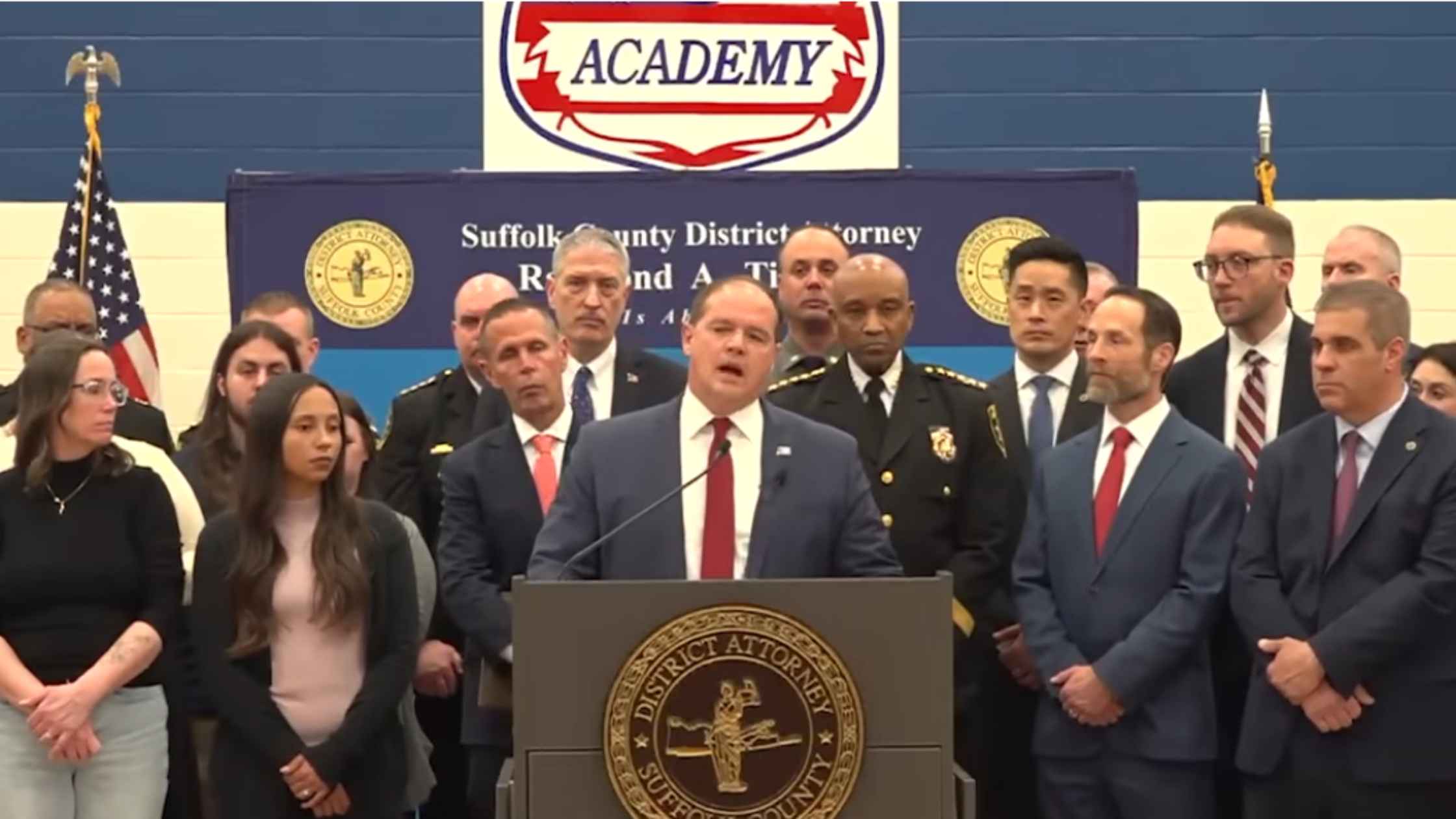
District Attorney Tierney (00:00):
Is he yes? Yes. Okay, good afternoon. Thanks everyone for coming. This defendant walked among us play-acting as a normal suburban dad when in reality all along, he was obsessively targeting innocent women for death. He identified these women, lured them into Nassau County, murdered them and left their bodies in Suffolk County. He thought that by killing them, he could silence them forever and get away with murder. But he was wrong because it was these victims, these women who refused to stay silent. First, that silence was broken by the victim's families who advocated for their loved ones and agitated for justice.
(00:49)
Then the noise grew louder through the ensuing investigation and examination of the evidence that the defendant left at or around the crime scenes, as well as on the bodies of the women themselves that further told the stories of these victims and what had actually happened to them. It was this evidence that ultimately was put together by the task force that proved to be the defendant's undoing and led to the pleas of guilt in today's court proceeding. And it is in this way that these murders were solved. And while we in law enforcement, as well as our Suffolk County citizens, mourn the loss of these victims, we were also grateful to them and to their families because without them, this defendant would have never been brought to justice and would still be walking amongst us.
(01:41)
And he would still be portraying himself as that same harmless father next door instead of what he is, a convicted murderer. Ultimately, this case is really about these victims and their stories. It is not about this defendant. And I speak for everyone in law enforcement and when I say we are honored and thankful for being able to have played a small role in obtaining a small measure of justice for these families. For decades, this case stood out as a painful scar on the face of Suffolk County law enforcement, Suffolk County government, the citizens of Suffolk County, and the victim's families as well.
(02:27)
However, with the defendant's pleas of guilt today, it means that for the first time since the deaths of these women, we can turn to all of these same people and say Rex Heuermann will be held responsible for the 1993 murder of Sandra Costello. The 1996 murder of Karen Vergata, the 2000 murder of Valerie Mack, the 2003 murder of Jessica Taylor, the 2007 murder of Maureen Brainard- Barnes, the 2009 murder of Melissa Barthelemy, the June 2009 murder of Megan Waterman, and the September 2010 murder of Ms. Costello. Despite this tragedy, there's a lot of different emotions. And I guess the word for today, despite the tragedy and despite all those emotions, is thankfulness. We are thankful.
(03:36)
We have a lot to be thankful for despite these emotions. First and foremost, we are thankful for the victims and the victim's families who told their stories, their loved ones stories, and defended their loved ones legacies. Without them, we would have never truly have gotten to know those victims. Personally, my start in this case occurred before I took office. A homicide detective with the Suffolk County PD, Pat Portela, gave my phone number to Melissa and Amanda. Melissa is of course Maureen Brainard-Barnes sister and Amanda is Melissa Barthelemy's sister. And they spoke with me. We had a really good phone conversation. And during that phone conversation, I heard the pain and frustration in their voices. They wanted answers. They wanted closures. We told them, or I told them that we were going to do things differently. It was going to be a new manner of doing things. We were first and foremost, we were going to form a task force and we were going to bring all of the talents of all these people standing here to bear and we were going to work together. We were going to not use this case as a political football to be kicked into the news stream on slow days or whenever it suited the political leader's purpose. We were going to be quiet. We were going to pretend as though it was business as usual in Suffolk County.
(05:17)
And the reason why we were going to do that was because we knew what we were doing. We were playing to an audience of one, and that one person, of course, was the murderer. We wanted to lure that individual into a false sense of security. We wanted him to think he got away with this, and that was exactly what we did. And the reason why we wanted to do that is because when we solved this case and we had those arrest warrants and executed those search warrants, we wanted more evidence, and that's exactly what we got. So, we were thankful for that. We were thankful we were able to bring this case to a close, but it started.
(05:59)
Our inspiration was these victims and their families, but those families were so much more to us. Through them, we truly got to know these victims. When we started, the victims were nothing but names on her blotter, black and white, writing on investigative reports. But once we spoke to the victims, they provided us with the color of these women, and we got to know them as the wonderful mothers, sisters, friends, and daughters that they were. And that inspired us even more to close this case, to come to a resolution. So, again, first and foremost, we are thankful for those families. And I just want to individually mention all of the families.
(06:44)
The Brainard-Barnes family, I already spoke with Melissa, but I want to thank Melissa and her husband, Chris, and their children. Marie, who is Maureen's mom, Nicolette and Dylan, who are Maureen's two children. We want to thank them for their support, not only of Maureen, but for our investigation as well. And we want to say on behalf of Suffolk County, we're sorry. The Barthelemy family, Amanda, who's Melissa's sister, Lynn, her mom, and Jeff, Lynn's partner, we want to thank them as well. When this case started, it started with the... Well, it didn't start, but the charging started with the grand jury and Amanda, Lynn, and Melissa came down and helped us with the grand jury.
(07:39)
And I remember when Lynn came in, it was about two day proceeding. And when Lynn first walked in, she appeared a certain way. And by the end of that second day, she looked completely different. You could see that having forced her to relive this, you could see the sadness in her face and in her eyes, and we're sorry for that, but without their cooperation, we wouldn't be here today. So, to Amanda, Lynn, Jeff, and everyone in the Barthelemy family, we want to say thank you, and we want to say we're sorry. To the Waterman family, we have Megan's aunt, Liz, and we have her daughter, Lily. We want to thank them.
(08:19)
We didn't get to know them until after the indictment, but again, the way that they stood by Megan and the way they supported us, we want to say to them, "Thank you, and we're sorry." To Amber Costello and her family, again, specifically Amber's sister, Kim, we want to say thank you. And again, thank you for the support. And again, we're sorry for the loss of Amber. Valerie Mack, we met shortly before the indictment, we met Ed and Joanne Mack. Ed and Joanne Mack were foster parents and then the adopted parents of Valerie, and they gave Valerie the only happy home she ever knew, and really the only support she probably ever knew in her life.
(09:07)
And meeting with them, they're incredibly special people. They're heroes. We also got to know Valerie's sister, Angela, and her son, Erin. Again, equally wonderful people. So, to them, we want to say thank you and we're sorry. Jessica Taylor, we got to know Jessica's mom, Liz. After the indictment, prior to the indictment, we got to know Jessica's cousin, Jasmine. And right after the initial indictment of the first three victims, Jasmine came to us on behalf of Liz and said, "Please help us. Please find out what happened to Jessica." And at that time, we didn't have enough and we said, "Look, we're going to work and we're going to try to get there and we're going to work as hard as we can. Please trust us."
(09:59)
And Jasmine on behalf of Liz said they would do just that. So, did Jasmine and Liz, I want to say thank you. And again, we're sorry to the Vergata family, Karen Vergata. We recently went, I did. I mean, I know members of the Suffolk County PD had already spoken to the family, but my team recently went and we saw Eric and Gary who are Karen's sons. Gary's not here today, but we got to meet Gary and I know Gary's watching. So, we want to say hello to Gary. Eric's here. We want to thank Eric. And again, we want to thank you and tell them how much we admire them for supporting their mom and for supporting us. And again, we want to say we're sorry. On behalf of all of Suffolk County, we're sorry for Karen's passing.
(10:53)
The Costello family, Cassandra Costello. We had the opportunity shortly before the indictment to meet with Ariel, who's the husband of Ruth. And Ruth is Sandra's sister. Again, wonderful people who really stood by and supported Sandra. So, we want to thank them for that. We want to thank them for their support of our investigation. And on behalf of Suffolk County, we want to tell them we're sorry. We're sorry. So, that's the family. Again, they inspired us. They're the reason why we do what we do. And today was a very special day for us in law enforcement because it gave us the opportunity to turn to these victims and their families and say, "Listen, we told you we were going to work really hard. We told you we were going to do everything we can to bring closure to you."
(11:47)
And that's why we work in law enforcement and we were able to do that to a small measure today. So, we're happy for that. And again, so thankful for them. In addition to our victims families, we have our law enforcement family. And this case was brought home by a task force, a task force that brought to bear the talents of a number of really great investigators from a lot of really great agencies. And again, so thankful to be able to have worked with so many talented people. It's not really, some people say, "Well, this person solved Gilgo or that person solved Gilgo." That's not it at all.
(12:36)
It was so many different pieces from so many different people starting back in 1993 and culminating all the way through 2021. So, again, and really beyond actually. So, again, so thankful for the great work. First and foremost, I have to thank my chief investigator, Rich Zacarese. I've been doing this for 30 years. I've had the benefit of working with truly the best investigators in the country and in the world. Rich is the finest investigator I've ever worked for and worked with. I do sometimes feels like I work for him, but he was the architect of our grand jury. He put together our grand jury, and I think there's, whether it's an attorney or an investigator, I think there are very few people who could have done that logistically. And so, to Rich, I want to say thank you. To our detective investigators, our analysts, again, all great. And I'm going to mention a lot of people because it's not exciting to mention a lot of people, but they deserve mention. So, I'm going to mention them and we're going to go through everyone, but not everyone, but a lot of people. We're going to talk about our phone experts, Justin Doolittle and John Primiano. Unbelievable work in this case and so many others. Our analysts, Kaylee Holmer, Aaron Hansen, unbelievable work combing through this evidence, this miles of evidence. And that's just to name a few. They're indicative of so many more.
(14:17)
Our law enforcement partners, we had our DA people, our PD, our FBI, our New York State Police, our Suffolk County Sheriff's Office, our core people, Rory Forrest all, a DI. I hired Rory. He was supposed to come in and help us with our child abuse section, but he got way laid in here and he worked like heck for us and did a great job. We're so thankful for Rory. For Suffolk County PD, our homicide guys who are still with the task force today, Chris Calvacca and Scott Aqualina, great individuals, great investigators. Thank you so much, Chris Scott. We had Jimmy Watson who worked with us and no longer with us. He's in Nassau. FBI agent Craig Matteo, Special Agent Craig Matteo.
(15:05)
Everybody's young, I guess, compared to me, but I see him as a young guy, really talented agent, really great guy, really, really helpful. Investigator Tiffany Ati with the state police. Again, along with Rory, Erin and Kaylee really plunged into the evidence in this case and really, really helped us out. She was also the one who did the infamous avalanche search. So, we want to thank Tiffany for all of the work and all the work that they all did. We have a number of retired task force and former law enforcement officers with us today. We invited them and I saw John Santoro. I saw Donna Giordano, Pat Albergo, just to name a few.
(15:52)
And we wanted to invite those retired members because again, there was a lot of talk about this case, a lot of talk about no one cared about the women who were murdered in this case. Nothing, nothing could be further from the truth. I'll talk about Pat Albergo. He worked Jessica Taylor's case. He retired. When we had brought enough evidence to bring that case together, we called Pat and he came to help us testify. Actually, he and Donna Giordano testified for us. But when Pat Albergo, who's retired, came in, he sort of walked through the door like a kid, like a little kid walking down the stairs during Christmas. And he's like, "Why am I here?" And I'm like, "Because we're going to charge this case."
(16:46)
He was thrilled and that attitude is indicative of every single one of all these agencies. So, grateful to work with all of these people, both past and present. Our ADAs, Nick Santomartino, Andrew Lee, Michelle Haddad, Larry Opizo, God help them, right? They get to know what I'm really like. And so, they were with us right from the very beginning through the grand jury and through today. Great job by them. I want to thank them. My chief assistant, Alan Bodie. He really, along with Rich and I, we really thought a lot about how we were going to go forward with this case and planned a lot of things from the grand jury. And he was really helpful to that.
(17:33)
And also, he ran the office while I was running around pretending to be a lawyer. Our discovery expediters, our analysts, our paralegals, everyone. And that's just us. So, now, we come to the Suffolk County PD and I'll talk a lot about the... Suffolk County PD was with us every step of the way. Our police commissioner Catalina, our chief of department, Bill Doherty, our Chief of Detective Sean Barron, a whole host of other people are with us today. We have our Suffolk County Sheriff, Errol Toulon with us, as well as Undersheriff Kevin Heavey, as well as Undersheriff John Becker. We really want to thank those two agencies. We want to thank Errol Toulon and we want to thank Police Commissioner Catalina.
(18:21)
They're two phenomenal partners. I can say this about Suffolk County and Suffolk County citizens. When it comes to Police Commissioner Catalina and Sheriff v, you are all in wonderful company. In addition, with regard to our sheriff's department, they provided logistics and traffic and sex trafficking related intel throughout our interviews, helped us to identify a lot of potential interviews of inmates and other people who had been sex trafficked. So, we want to thank Suffolk County Sheriff for that. We also have the FBI here. We have a special agent in charge, Michael Raffa, who's the FBI New York Criminal Division.
(19:10)
So, Special Agent in Charge Raffa is in charge of the criminal division of the FBI in New York State. We want to thank Michael for coming in. We want to thank a supervisory senior resident agent, Don Osbacker, who's been with us from the very beginning. We want to thank them for lending us their expertise and more importantly, their people. The cell phone analysis that we all heard about, that was done by the CAST or cellular... The FBI CAST stands for Cellular Analysis Survey Team, and specifically special agents, Eric Perry and Mike Sabric. Really unbelievable work by them.
(19:57)
Eric, he provided the drive time records, so those boxes, those areas of interest in Manhattan and in Massapequa Park, that was developed because in 2011, Eric Perry drove with equipment through every single neighborhood and extensively mapped the cell phone coverage in those areas and allowed us with specificity to be able to develop these areas of interest. That had to be done in 2011. The landscape changed, the cell sites changed. After Superstorm Sandy, the geography changed. So, we went back to 2011 and that work that Eric did and just phenomenal. So, we want to thank the FBI. We want to thank Eric Perry and Mike Sabric. They both created maps for us to use in the grand jury.
(20:53)
They testified in the grand jury as well as John Primiano from my office with the help of Justin Doolittle
District Attorney Tierney (21:00):
... and just great work. With regard to forensics in this case, I think I had said earlier that IGG, investigative genetic genealogy did not play a role in this case. I was wrong. I had forgotten that IGG was used to identify victim Valerie Mack prior to my involvement in the case. I want to thank the FBI and Laurie Giordano for that. They also with us helped to identify Karen Vergata. So again, thank you. FBI, they provided surveillance of the defendant, both in the city and on Long Island. And their surveillance team, I was nervous, I had never met these guys. I had worked for them. I worked with them as a federal prosecutor, but that was a high risk, high reward thing. If they get made, everything comes down. If they get detected. But they weren't detected. Not only did they follow the defendant, but they recovered the abandonment samples.
(22:05)
So we want to thank them. Suffolk County PD, they recovered DNA from the defendant's house. We want to thank the homicide squad for that. And again, working together, we were able to really develop that DNA evidence. So we want to thank them. Also, the FBI provided a searchable account. Digitalized this entire file for us. We want to thank the FBI for that. New York State Police. Today we have Major Chris Casal, who's the troop commander of Troop L. We have Captain Chris Jean, who works in Troop L as well. Again, they provided Tiffany a tie to our task force, who was integral to our success. They provided assistance to search warrants of all the search warrants with regard to this case and all the various locations. They were on the scene with our Suffolk County Police Department gathering evidence. They transported evidence from the house to Suffolk County property, along again with Suffolk County PD.
(23:16)
The Avalanche truck, they transported from South Carolina to our lab. There was a Ramcharger from Pennsylvania that was associated with the Sandra Castillo case. State troopers took that from Pennsylvania, brought it to our lab. We were able to develop evidence linking that truck to the murder of Karen Vergata. We want to thank them. They provided us with K-9 units along with the NYPD, Suffolk County PD. Want to thank all of those agencies. We want to thank Nassau for helping us with the search warrant. We want to thank Nassau County DA's office for helping us with the prosecution of the weapons case. Our Suffolk County Crime Lab. We want to thank them. Tremendous work. Is Clyde here? Where's Clyde? Clyde, raise your hand. Where's Clyde? All right. Clyde's all the way in the back as usual, hiding. So Clyde was the hair analyst in this case.
(24:11)
He collected hairs from all the victims in this case, save for Jessica Taylor. And he pushed the PD and he pushed our office to send certain hairs out for mitochondrial and then later nuclear DNA testing. And when we started this case, he was working with Nick Santomartino in my office. And he was recalling with great specificity, certain hairs of interest that he thought were really going to bear fruit. And I was talking to Nick and I was saying, "Does this guy really... Is he really... Did he really... Was he this meticulous? Is he this sure?" And so Nick said, "Sit down with him. Sit down with Clyde." And we sat down with Clyde. And to go to a crime scene in the 2000s and not have the capability to get nuclear DNA, but yet to be so precise and exact in gathering evidence, cataloging the evidence, safeguarding the evidence, and then being able to advocate for its use.
(25:19)
Without Clyde, we probably wouldn't have gotten that evidence. So Clyde is retired now, but we really want to thank Clyde. Bob Genna, he collected hairs on the Castillo case. He recovered two hair. He was a former chief of Suffolk County Crime Lab. He's retired. He collected two hairs on Sandra Castillo, did a great job similar to Clyde. Don Dollar, the former chief. He was the chief of the lab when we started this. Great job. We want to thank him. Connie Dinkel is the current chief of the lab, and she did a great, great job and continues to do a great job. We want to thank them. Bob Allman, Helen Wong, Liz Sepulveda, Kerry Annitto, Craig Hamer. All of these forensic scientists did a fantastic job and we want to thank them. Again, they were in the house with our law enforcement partners gathering this evidence meticulously, precisely, and without... I was thinking about this, this isn't a cast of hundreds.
(26:31)
When you bring all this together, it's a cast of thousands. So we want to thank all of those individuals. Office of Chief Medical Examiner City of New York, Brad Adams, Mark Desire and Neha Desai. Brad Adams was the anthropologist. He identified the Gilgo four and he was the one who urged investigators to go back after the discovery of Melissa Barthelemy, which resulted in the discovery of the three other victims known as the Gilgo four. Mark Desire is the assistant director of biology of the lab. He was our liaison. He made all of his people available to us. Ms. Desai, she testified first in the grand jury. Her DNA analysis led to the identification of the Gilgo Beach four. Again, she testified in the grand jury a fantastic job. Our outside experts, mitotyping technologies, Gloria Dimick and Jenna Manges. Gloria testified first in the grand jury, fantastic scientist, fantastic person.
(27:42)
Astrea Forensic, Dr. Ed Green, Dr. Christina Valencia, Kelly Harkins-Kincaid. Those scientists with Astrea are at the very top of their field, and they did something revolutionary in this case. And they've set the bar high going forward, and we're going to be able to utilize this technology going forward to solve a great many cases. So we want to thank Astrea Forensics. And I want to tell you, if you think you're smart, you should spend a week with Dr. Green, and then suddenly you realize maybe you're not as smart as you think you are. At least that's the sense I got after spending time with all those great scientists. NYPD, again, they helped us with the cadaver search in April of 2025. We had individuals from their tarot unit testifying in the grand jury with regard to phone calls made by the defendant. They helped us to attain records, missing person records involving this case, spanning back years and years.
(28:48)
Again, at a drop of a hat, even though it wasn't their case, they came in and helped us. Scarborough Police Department, with regard to Megan Waterman, the Megan Waterman case came in as a missing person case. And it went across the desk of a detective, Don Blatchford, who's here with us today. And Don gathered the evidence and really did everything he could to try to locate Megan. And when the trail took him to Suffolk County, he didn't stop. He continued to help us in our investigation. He brought the Waterman family to Long Island for interviews and for court proceedings. He testified in the grand jury, and he's had a long illustrious career in Maine. He's going to retire, but he held off his retirement to see this case through. And again, I talked about the Suffolk County PD guys who cared about these victims. Don Blatchford is another individual who cares about these victims, like all of the people in law enforcement.
(29:53)
So we want to thank them. United States Secret Service with the massive digital evidence in this case and their forensic science division, all of the massive amount of digital evidence, they helped us process it. Their forensic science division, we recovered a bounty paper towel off of the crime scene of Megan Waterman. They processed that and they compared that to the same bounty towel that we recovered in the home of the defendant. They matched, and this was a memento that we argued the defendant kept, would have been a key piece of evidence. So we want to thank the Secret Service for that. The telephone carriers, Verizon, T-Mobile, Sprint, Nextel, and AT&T. Again, phone records spanning back to 1993. We've got to get those records in evidence. Again, Rich Zacharys was integral in this, but they went above and beyond for us because they knew this case was important.
(30:59)
We want to thank them with regard to the court staff, Judge Mazzei and his staff. I want to thank them for their courtesies and I want to thank them for all that they did and their professionalism. And this is a difficult case and they handled it with a plumb. So I'm going to turn it over to our partners, but just to clarify regarding the plea of guilt, the defendant has pled guilty to three counts of murder in the first degree, pertaining to the murders of Melissa Barthelemy, Megan Waterman and Amber Costello and all of those three individuals were killed within 18 months between July of '09 and September of '10, that enabled us. The proximity of those murders enabled us to charge those three murder one counts. In addition to the sentences of that is life without the possibility of parole.
(32:04)
With regard to the other four victims, they pled guilty to four counts of murder in the second degree. That's Sandra Castillo, Maureen Brainard Barnes, Valerie Mack and Jessica Taylor. Those sentences, 25 to life to run consecutive to each other and to the murder one charges. This defendant has additionally agreed to accept responsibility for the murder of Karen Vergada. And again, the sentence will be 25 years to life without the possibility of parole on the first three and 25 to life on the last four, all of which is going to run consecutive. So we have three life without parole sentences and four 25 to life sentences all to run consecutive. So with that, I'm going to turn it over to our law enforcement partners. So I'm just going to leave with this. This case closes and another one opens. There are still bodies on that beach. There are still bodies in Suffolk County. There's no rest for the weary. We are going to continue to work with our partners and to try to obtain closure for as many families as we can. Thank you very much, and we're going to call up Police Commissioner Catalina.
Police Commissioner Catalina (33:27):
Thank you, District Attorney Tierney. The calm, serene, almost grandfatherly image that Rex Heuermann portrayed since his arrest was a lie. And quite frankly, an insult to both law enforcement, but more importantly, the families that had to endure that during every court appearance over the last two and a half years. Today, he was exposed for exactly what he is, a sadistic, soulless, murderous monster. And thankfully, everybody today got to see that. I want to thank all of the members of law enforcement who were a part of this.
(34:09)
I don't have as long a list as Ray, but most importantly, I want to thank the Suffolk County Police Department, both passed and present. We have many retirees who came out here, participated in this case because like Ray said, they cared and this was a part of them for a long time. All of our law enforcement partners, everybody who was involved in this task force really did really an amazing, amazing job. So thank you to everybody who was involved in this and to the families. No one can ever replace the lives that were taken from all of you and way too often they were way too young, but we hope that this brings some measure of solace to you. So thank you. Thank you for all your cooperation.
District Attorney Tierney (35:01):
Next, we'll hear from Sheriff Toulon.
Sheriff Toulon (35:06):
I want to thank the district attorney and this entire task force for the hard work that they've done over the last two and a half years. Today's plea delivers a measure of justice to families who have waited decades for answers after unimaginable loss. While nothing can bring the loved ones back, I am proud we were able to hold Rex Heuermann accountable. Again, thanking the DA and the police commission and all the men and women who worked tirelessly. I also want to thank my staff to uproot an entire jail security system to accommodate an individual of this magnitude over the last two and a half years. Our staff has done a phenomenal job in our Riverhead facility where he's been housed, and also the staff that have been assigned to our anti-trafficking initiative. And since his arrest in 2023, my priority has been ensuring that he was safely housed in our correctional facilities because justice needed to be served in the courts and not in our jails.
(36:05)
This responsibility is one for me and my officers who have taken very seriously, and I've spent my entire career in corrections overseeing some of the most notorious individuals and what has been the most alarming is how ordinary Heuermann has been. It's a chilling reminder that those capable of horrific acts can often go unnoticed. And another reminder of how much great investigative work has been done to finally apprehend and have a plea today. Most importantly, today is about the victims and their families. You have endured profound loss and years without answers. We hope this guilty plea brings all of you some peace and closure. Our thoughts remain with you and your loved ones today and always. Thank you.
District Attorney Tierney (36:54):
Next, we'll hear from Special Agent in charge of the FBI Rada.
Michael Rada (37:06):
Thank you. Good afternoon. I'm Michael Rada, the special agent in charge of FBI New York Field Office Criminal Division. I'm proud to stand alongside Suffolk County Police Department Commissioner Kevin Catalina, Suffolk County District Attorney Tierney, Suffolk County Sheriff Toulon, to announce the plea of Rex Heuermann, the Gilgo Beach serial killer. Today's announcement highlights the importance of partnerships and perseverance. For decades, the families of these women have been left searching for answers and waiting for justice. This ends today because these agencies before you never gave up. The detectives, the troopers, the agents tirelessly chased every lead and left no stone unturned. In 2011, FBI New York began collaborating with the Suffolk County Police Department to find out who was responsible for these cold-blooded murders.
(37:53)
Our office leveraged many resources, some of which have been described already, over the years to include our cast, our cellular analysis survey teams, behavior analysis teams, evidence response teams, the surveillance groups, forensic and document lab teams at Quantico and investigative genealogy tools to identify some of Heuermann's victims and help Suffolk County Police piece this puzzle together. The close coordination across every agency ensured that a monster lurking in our community was held accountable for his heinous crimes. While we'll never be able to fill the hole in the lives of the victim's loved ones, I hope that today brings a small sense of closure.
(38:31)
Once again, I'd like to thank our state and local partners for their unwavering determination and investigative grit, and that includes the retired agents, detectives, and troopers that are here today to see them sitting in that courtroom today in the back of that room was really awe-inspiring to see their commitment to justice doesn't end when they hand in their badge and gun when they retire. Finally, thank you to the agents and analysts of FBI New York, Long Island Safe Street's Task Force, the Special Operations Group, our cast folks, investigative genealogy program folks, and I'd really like to thank DA Tierney and your office for what you did and the resolve that you showed in this case, just tremendous. Thank you all.
District Attorney Tierney (39:17):
So Rada has just been appointed from New Jersey to head the New York office, and we thank him for coming today, and we're really looking forward to continuing our great relationship with the FBI and our federal partners. Last but not least, we're going to hear from the state troopers and Chris Casal. Chris Casal was with us. Then he went to, I believe Albany or New York City. He's back with us. We couldn't be happier, but he's going to say a few words.
Major Christopher Casal (39:53):
Thank you, DA Tierney. I'm Major Christopher Casal. I served as the troop commander for the New York State Police Troop L. Today marks a significant moment for Long Island and for the families who have endured unimaginable loss for many years. The guilty plea of Rex Heuermann represents a measure of accountability in a case that has deeply impacted our communities. While this brings us closer to justice, it does not lessen the pain suffered by the victims and their loved ones. This outcome is a result of years of persistent investigative work and strong collaboration among our law enforcement partners who made up the Gilgo Beach Homicide Task Force, and I commend all of them for their dedication and extraordinary work on this case.
(40:37)
It reflects an unwavering commitment to our mission to never forget the victims and to continue pursuing justice, regardless of how much time has passed. This case not only underscores the importance of coordination across agencies, but the role of advancements in forensic science, technology, and intelligent sharing. Today's not a day of celebration. It is a day of reflection, accountability, and remembrance. We honor the victims and stand with their families who have shown extraordinary strength and resilience. The state police and all the agencies you see represented here remain committed to serving our communities and to the continued pursuit of justice for every case that is entrusted to us. Thank you.
District Attorney Tierney (41:24):
Thank you, Chris. And now that you're back, we look forward to resuming our great relationship with you. Obviously, we have a lot of victims' families here. I believe that we are going to ... Gloria Allred represents a number of those victims, and I think they asked for Gloria to come forward and make a statement on behalf of many of the victims. So we'll call Ms. Allred.
Gloria Allred (00:00):
Gloria Allred (42:02):
Thank you. I'm Attorney Gloria Allred, and I represent a number of the family members who suffered the terrible fate, the tragedy that was inflicted on their loved one. Today, Rex Heuermann, who thought he had the perfect blueprint and plan for serial murder, pled guilty to the murder of eight young women. Some of these murder victims were young mothers just trying to earn a little extra money to support their children. Because many did not have funds to go to college or get a decent job that would help them to provide adequate support for their children, they turned to sex work in order to help their families. It wasn't what they wanted to do, but it was what they felt forced to do because they had no meaningful alternatives. Some wanted to help their parents, their grandparents, and their loved ones. Some just wanted to survive in this difficult and challenging world.
(43:28)
Little did they know that the defendant, Rex Heuermann, did not care about their hopes and dreams or that they had families and friends who loved them. He appeared to care only for himself and executing what he thought was his perfect blueprint for murder. The evidence gathered and articulated in the prosecutor's response to the defendant's bail application demonstrated that the defendant had a "planning document utilized by Heuermann to methodically blueprint and plan out his kills," and those are quotes from the bail application. He also believed he had a perfect plan to avoid collection of evidence against him and to evade capture by law enforcement. However, what he had thought was his perfect blueprint for serial murder did not take into account the courage and the persistence of the murder victims' family members who refused to give up until the murderer of their loved ones was found, convicted, and sent to prison for the rest of his life without the possibility of parole.
(44:50)
Many of the murder victim's family members became the voices of their loved ones, crying out for them not to be ignored and forgotten and demanding answers and justice for them. Many of those family members whom I represent are here today. It was bittersweet for them to be in court and hear the defendant plead guilty to the murder of their loved one and the manner of their death, but the truth was important to them and they heard it today. Last week, they were faced with a difficult question. Did they agree with the Suffolk County District Attorney's decision to agree to accept the defendant's plea of guilty in lieu of trial? Or would they have preferred that a trial take place so that they could hear all of the evidence that the prosecutor would seek to admit against the defendant?
(45:57)
In a few moments, you will hear their answers to that question. And I will ask them to come up to the microphone or if they would prefer to stay where they are, they can answer from there. In no particular order, family members of Megan Waterman, please come forward and state your name and relationship to Megan Waterman. Elizabeth Meserve is her aunt. A little louder, please, Elizabeth. Or can you come up here? Thank you.
Elizabeth Meserve (46:48):
So my name is Elizabeth Meserve. I'm Megan Waterman's aunt and I helped to raise her daughter. And on behalf of Megan, we definitely accept the plea.
Gloria Allred (47:00):
Thank you. And also, we have with us Megan's daughter, Liliana Waterman. Oh. Okay, good. Thank you. Thank you.
Liliana Waterman (47:20):
My name is Liliana Waterman. I am the daughter of Megan Waterman and on behalf of her and my aunt and all of our family back home, we do accept and we are very, very thankful for everything that they've done for us.
Gloria Allred (47:36):
Thank you. Family members of Melissa Barthelemy, please come forward and state your name and relationship to Melissa Barthelemy. Lynn, Bartholomew, mother. No? Okay. Amanda Funderburg, sister.
Elizabeth Vakil (48:19):
I'm Elizabeth Vakil. I'm Jessica Taylor's mother. And I am glad that this is over as far as him pleading guilty. It took a big chunk of stress off of me and my family.
Gloria Allred (48:39):
Thank you. And do you accept that the plea ...
Elizabeth Vakil (48:42):
Oh, yes. I accept the plea wholeheartedly.
Gloria Allred (48:45):
Thank you so much. And then we have Jasmine Robinson, who is a cousin of Jessica Taylor, victim Jessica Taylor. She okay?
District Attorney Tierney (49:02):
Do you want me to bring it over there?
Gloria Allred (49:03):
Okay. Okay. Family members of Maureen Brainard-Barnes. Please come forward and state your name and relationship to Maureen Brainard-Barnes. Missy Cann, sister, Nicolette, Brainard-Barnes' daughter, Dylan Haggett, son. This is Nicolette.
Nicolette Brainard-Barnes (49:42):
I am Nicolette Brainard-Barnes, the daughter of Maureen Brainard-Barnes. And on behalf of my mother, I accept this plea.
Gloria Allred (49:49):
Thank you. Dylan Haggett.
Dylan Haggett (49:56):
I am Dylan Haggett, the son of Maureen Brainard-Barnes, and I accept the plea.
Gloria Allred (50:03):
Thank you. Okay. So I think we have everyone that I represent. If there's anyone I don't represent who would like to say something, feel free to come forward. The defendant's plan to get away with the murders he committed was also unsuccessful. Okay, good. Thank you so much. Okay. I could actually just use this. Thank you. Somebody else. Oh, good. Just say your name please.
Diane Doherty (50:54):
I'm Diane Doherty and I'm the mother of Karen's sons, Eric and Gary. And I just want to say I'm thankful that we came to a conclusion that brought peace to everybody. Thank you.
Gloria Allred (51:07):
Well said. Thank you. Okay. Anyone else?
District Attorney Tierney (51:15):
Do you want to say something?
Gloria Allred (51:18):
Yeah, she will. Okay, good. Thank you. The defendant's plan to get away with the murders he committed was also unsuccessful because many of the many law enforcement officers who participated in this massive investigation were so dedicated. We would like to thank each and every one of you who contributed to bringing the defendant to justice. We deeply appreciate you and your dedication to finding, testing, and preserving evidence for this case. The result today would never have been achieved without your hard work and sacrifice. Even if we cannot meet and thank each one of you in person, please know that your efforts on behalf of the family's loved ones are respected and appreciated. We look forward to thanking as many of you as possible after the time of the sentencing in June. The journey to justice has been painful for each and every family member who I represent.
(52:23)
In conclusion, Melissa Cann, also known as Missy, would like to share her feelings about this day and the almost two decades in which she has sought justice for her sister, Maureen Brainard-Barnes. Missy.
Melissa Cann (52:45):
I just want ... Can I have my family behind me?
Gloria Allred (52:47):
Of course you can. Sure.
Melissa Cann (52:49):
Thank you.
Gloria Allred (52:49):
Would you like to use this for this?
Melissa Cann (52:52):
I'll see. Hello. Okay. Hi, my name's Melissa Cann. Everybody calls me Missy and I'm the sister, Maureen Brainer-Barnes, and this is my family, well some of it. First, I want to begin by thanking the district attorney, his office, the detectives, the FBI, the New York State Police, and the entire task force. For years, they never stopped. They carried this case with determination and heart, and our family will forever be grateful. We are forever thankful for the work that led us here. Finally, a sense of relief. The guilty plea brings solace, and I'd like to thank everyone who had a part in that fight for justice. Thank you to our lawyer, Gloria Allred. I also would like to thank the media for continuing to keep this case in the public eye.
(53:55)
Today is not about the person responsible. Today is about the women's lives who were stolen. It's about their voices, their future, and their families, the love that still surrounds them. They are the reason why we are here. 19 years, I lived in the space between heartbreak and hope. Throughout these years, I searched for answer, for truth, for justice. There were moments when the weight felt unbearable, but I never gave up. Maureen was never forgotten, not for a single moment. From the day she went missing until today, she has been carried in every breath, every memory, every fight for answers. This has been a long journey of hope, hope that one day we would stand here and say her name with justice beside it.
(54:41)
Today, that long, painful journey brings us to this moment. Our mission, our promise to Maureen, is finally met with accountability. For Melissa's, Megan's, Amber's, Jessica's, Valerie's, Sandra's, and Karen's family, I stand with you in deep love and understanding. No one should ever have to walk this path yet here we all are, connected by loss, by strength, and the unbreakable bond of our loved ones. The bond some of us has created has been one that is unique in a sense that it did not form from a previous friendship or blood. It was created by trying to pick up the pieces of our world that had shattered in tragedy, and I am so grateful for us. To every family out there still searching, still waiting, still holding on, please do not give up hope. Even when it feels impossible, even when the years pass and the silence grow heavy, keep going. Your loved ones matter. They are not forgotten, and one day answers can come.
(55:52)
Finally, to Maureen, the promise I made to you so long ago was simple. Sorry. I would never stop searching for justice for you. Through every year, every setback, every ... Okay. Every unanswered question, I carried you with me and I kept that promise. And today it has been done. Justice has finally found its way to you. Your voice was never silenced, your story never forgotten, and your life will always be more than the tragedy that took you. This moment is not the end, but a reminder that love endures, truth prevails, and hope never fades because even in the darkest moments, justice will find its way. Thank you.
Gloria Allred (56:44):
The victims will not be answering questions. I call them the victims because they are also victims, even though they are family of murder victims. I can take one question. And if there are none? Yes, sir. Could you speak up a little, please? I'm sorry.
Kevin Sheehan (57:12):
I'm sorry. Kevin Sheehan, New York Post. So after today's proceeding, the defense attorney, Michael Brown, when asked, why did he accept the plea deal? Why didn't he want to go through it because he kept saying all the while, the last years, innocent, why now? Why all of a sudden? And his answer was quote, "He certainly wanted to save the families of the victim the ordeal of going to trial." I just wanted to hear what the victim's families thought of that sentence as far as an answer.
District Attorney Tierney (57:35):
Not much.
Gloria Allred (57:35):
Yeah.
Speaker 1 (57:47):
I saw something on Facebook today that the New York Post is still calling our girls sex workers. Stop it.
Gloria Allred (57:59):
I don't have a comment on anything he says. Perhaps the district attorney does.
District Attorney Tierney (58:03):
Yeah, no, I think ... Yeah. So thank you, Ms. Allred. Thank you, Missy. Thanks to the victims. Does anybody have any questions? Yes.
Speaker 2 (58:17):
Was the plea in the formal [inaudible 00:58:17] deal in the formal sense, was there a deal? Was there anything that you offered him or really was a change of plea?
District Attorney Tierney (58:23):
Well, I think traditionally a change of plea is when they plead guilty to every single count in the indictment. In this sense, we are going to be dismissing three charges, so that is a plea deal. Obviously, he's getting the maximum under the sentence. So how you categorize that, I would leave it to everyone. Yes?
Mary (58:50):
It seems like one of the only cases that's pretty much unsolved [inaudible 00:59:07].
District Attorney Tierney (59:09):
So I know, Mary, you're going to get sick of hearing this because I say it every time. It doesn't matter what I think. It matters what I can prove. You've heard that before, Mary? I think that first thing we need to ... Well, there's a number of things we can do, but a huge step in moving that case forward would be to finally identify that individual. We're continuing to work with that IGG and hopefully that we can do that, but we'll continue to work that case. We'll continue to work all the other, unfortunately, many cases in Suffolk County.
Mary (59:42):
[inaudible 00:59:43].
District Attorney Tierney (59:42):
Again, it doesn't matter what I believe. It matters what I can prove. So I'll leave the belief and the conjecture up to whoever wants to do that. I'm going to continue to do what we do, speak through our indictments, and we are where we are, but we're going to continue to work forward and so gratifying to be able to provide closure for these families, hopefully for that individual and his family and the people who cared about him, we want that same closure. Yes. Go ahead. I'm sorry.
Speaker 3 (01:00:35):
Do you have any disappointment that the [inaudible 01:00:45] wasn't tested on appeal and that it's not set as case law from this case?
District Attorney Tierney (01:00:46):
Oh, it most certainly is case law.
Speaker 3 (01:00:48):
But it's not appeals case law.
District Attorney Tierney (01:00:51):
Did you work for the defense? We prevailed in the Frye hearing. It happens all the time. Not every time that you make law in New York State does the case result in a trial. So that is the existing law since that decision, like we knew it would. Nuclear DNA from hair samples has moved forward. We're on even stronger footing than we were at the time of the hearing. So we feel great about it and we're happy and we're going to use that science, we're going to defend that science and let's do it. We feel great about it because the science is most definitely on our side.
Darla Miles (01:01:40):
Good afternoon, Darla Miles, Channel 7. Can you talk about the [inaudible 01:01:44]. And then kind of explain the allocation, how you came up with that questioning and why you answered it that way, because obviously [inaudible 01:02:05] why it was like that, and then what it was like for you.
District Attorney Tierney (01:02:07):
Yeah, I think we wanted to synopsize ... So we wanted to name the victims because it's about them. And we're talking, starting in 1993, ending in September of 2010, we had these 8 women and all of the years in between. So I think it provided a context of this defendant and what he's done and what he pled guilty to. So it was important for us to do it in that way. And then with regard to the allocution, every jurisdiction, their elements for murder or what have you, those elements are slightly different, but in every jurisdiction, you have to prove each and every element of the crime charged against the defendant. So for instance, when you ask the defendant how old he is, that's an element. He has to be above the age of 18. So really the allocution is really guided by the elements of the crime
District Attorney Tierney (01:03:00):
... crime, and it has to be satisfactory to the judge, so that's just the way we decided to do it.
Journalists (01:03:06):
Just a quick follow up on that because I ask that because some people want to hearing if they aren't guilty, [inaudible 01:03:12] answering yes to a question. So talk to us into that. Why he didn't say I'm guilty or guilty as opposed to answering a question yes or no?
District Attorney Tierney (01:03:21):
I mean, I think that's just the way we do it in New York. I mean, that's a standard plea. So he had admitted responsibility, allocuted to it. So that's that. We still have the sentencing, so we'll hear more from that.
Journalists (01:03:37):
[inaudible 01:03:37]?
District Attorney Tierney (01:03:37):
Yeah. We're not going to have individual investigators speak. Again, we want to thank Trooper or Investigator Atai for the great work she did in that regard and very emblematic of all the great work that was done in this case.
Journalists (01:04:12):
Are you still working with other jurisdictions on unsolved murders, and were any promises made with no further charges being brought against him as part of the deal?
District Attorney Tierney (01:04:16):
So with regard to the no further charges, that pertains to the eight murders that were discussed. That's it. So with regard to other investigations, those potential investigations are not covered by the plea in this case. So we'll just have to see what happens with... see how that unfolds. But the plea and the coverage pertains to the eight women that were discussed in court today. That's it.
Journalists (01:04:46):
Is your office still working with other jurisdictions, other states?
District Attorney Tierney (01:04:49):
Yes. Again, what we do is when somebody wants information, we give it to them, and we share that information all the time. We've been sharing information. We'll continue to share that information. I think when people talk about now he's going to... after sentencing, he'll go into CODIS. I said this before, but I want to make clear, we have the ability, as investigators, to provide evidence in our case on a case-by-case basis. So in other words, if there's a case in a state and they want specific information about one of our cases, we could share it, and we've done that.
Journalists (01:05:27):
[inaudible 01:05:30]?
District Attorney Tierney (01:05:42):
Yeah, sure. Again, I think that the FBI does such phenomenal work, but then you have the real work that the FBI does and then the work you see on TV. So one of the many great units that the FBI has is behavioral analysis unit. And that unit, and one of its core missions is like a clinical role, in other words, they're going to interview the defendant, gain insight into his motivations and background as sort of an academic and scientific exercise. So that's what that's about. Those are clinical interviews, those aren't investigative interviews. I believe that they're going to limit that to just the four corners of what he pled guilty to and try to gain insight. So they could gain insight and knowledge going forward on new cases. And that's kind of what the FBI does.
Journalists (01:06:51):
You mentioned the Pennsylvania vehicle. Was that a car or truck owned by Rex Heuermann, and was it used to transport Karen Vergata [inaudible 01:06:55]?
District Attorney Tierney (01:06:56):
Yeah, I believe it was. Yeah, it was a Ramcharger owned by him, and it was Sandra Costilla.
Journalists (01:07:03):
In terms of the plea deal, are there any other concerns or anything in there, like [inaudible 01:07:10]?
District Attorney Tierney (01:07:13):
No, no. I was a federal prosecutor, and as a federal prosecutor, you have a lot more, I would say, sway with the Federal Bureau of Prisons, and you could sort of dictate those things. In the state, the State Department of Corrections does their thing. And so not only is there nothing in there, I don't believe I would really be able to do anything obviously. So that'll be a function of the Department of Corrections, but no.
Journalists (01:07:46):
[inaudible 01:07:46] walk through a little bit of how you got to this complaint specifically with the plea? When you started talking to Mr. Brown, when you started talking to the families about where they were on that, just sort of the last few weeks coming to this point?
District Attorney Tierney (01:07:58):
Yeah. I mean, I think with regard to this, again, he's not serving less time. So as far as that, it's pretty much the best we could do. But I think every single case you have, there's these discussions. And talking about pleas as a prosecutor, that's third rail stuff because defendants have a presumption of innocence. They have a right to trial. So imagine if every time in one of my cases in my office, I said, "Oh, Smith, yeah, he's going to plead guilty. He knows he did it." That's third rail stuff. That's unethical behavior. So we don't talk about pleas because it would be unethical as prosecutors, because we're impeding upon that presumption of innocence. So we don't do that, number one.
(01:08:50)
Number two, we don't have control over what a particular defendant's going to do. And in every single case, there's talk of pleas, maybe it'll happen, maybe it won't happen. We prepare a case, we go forward, we see what happens. I don't think until the allocution was completed, I didn't know whether or not this was going to go through. So you wait and see. I think people say, "Oh, it's going to be a plea." Well, maybe.
Journalists (01:09:16):
Was there a point of anything in your mind where [inaudible 01:09:19]? Was it the DA ruling? Was it the keeping all the charges together? Were there significant moments that sort of [inaudible 01:09:30]?
District Attorney Tierney (01:09:30):
No, I think I've been doing this for 30 years and as a young prosecutor, you chase pleas. Every day you say, "Look, maybe we'll get a plea, maybe we'll get a plea. We'll call." It makes you look desperate. It takes you away from your preparation. So you go forward, forward, forward, forward. And if the defendant decides to plead guilty, go ahead and let him plead guilty. But it doesn't really factor into our mindset, because a lot of times you're absolutely sure that a case is going to plead guilty. It doesn't. Other times you think it... And they're just the exact opposite. So you don't know, so you don't waste your time thinking about it. Yes, ma'am.
Journalists (01:10:08):
I have a question for the families. Is there a personal anecdote or a favorite memory that you can share about your loved ones?
District Attorney Tierney (01:10:18):
So Mr. Allred just said that the families were not taking questions. So perhaps offline, you can address that. Yes?
Journalists (01:10:26):
Just to clarify, can you please explain how the plea deal came about? Was there one already on the table or were you contacted by Mr. Heuermann's attorneys?
District Attorney Tierney (01:10:35):
I don't really think... It's just sort of organic. It happens organically. What happens is you sort of go from talking about it and talk... Just going forward, and then at a certain point in time, there was discussion with regard to Karen Vergata. And that's done in a proffer setting where the defendant discloses, but you can't use it against them, unless they waive that. So once that happen, we began to think that certainly a plea might occur, but you never know.
Journalists (01:11:10):
So just to clarify, it was only after the Karen Vergata case was amended to Mr. Heuermann that there were discussions? Had there been a framework? I know you said it's always happening, but I just want to be able to pinpoint a timeline?
District Attorney Tierney (01:11:23):
Yeah. Well, normally, like say this was a robbery case, and there's a maximum of 25 years and the person could get 10 years, right? So you're negotiating, all right, I think we could dispose of this for 12 years or 10 years or six years or whatever it is. That's a normal plea. There was no negotiation with regard to numbers. So it was basically like, "We'll continue to work this case." If it comes a time when this defendant, and it's the defendant's decision, when this defendant wants to plead guilty, we'll go ahead and take it. But we're not discussing, we'll give him this or we'll give him that. So there really wasn't all those discussions.
(01:12:04)
And I can tell you that the decision... The reason why this case pled guilty was because it was the defendant's decision to do so. The defendant wanted to plead guilty. If the defendant didn't want to plead guilty, the defense would have taken the case to trial and we would have followed along. But at a certain point in time, it was the defendant's decision to say, "I'm pleading guilty."
Journalists (01:12:28):
Was it all out of the blue, I guess, that's what I'm trying to nail down [inaudible 01:12:33] to your office?
District Attorney Tierney (01:12:28):
No.
Journalists (01:12:42):
What did Karen Vergata [inaudible 01:12:36]-
(01:12:42)
[inaudible 01:12:36], but now that there's not a trial, is there a lot of others [inaudible 01:12:45] that we will never know about?
District Attorney Tierney (01:12:46):
Well, I mean, if you look at... I always talk about this, Mary, and we've talked about this, right? And I like to kid you, when you say, "Well, we're talking about a case in this jurisdiction" And you ask me and I'll say, "What does the bail letter say?" And you say, "Well, your jurisdiction's the only jurisdiction that does bail letters." Right? So we've provided a tremendous amount of evidence. And the evidence in this case is primarily almost... The lion's share of the evidence was the phone evidence, the financial records, the information with regard to the witness statement with regard to Amber Costello the night before, the Chevy Avalanche, the DNA. I think I said cellular phone analysis and that, and of course the planning document and the mementos that were found, that's the case.
(01:13:51)
I think there's a tremendous interest in this case. But when you get down to it, the actual commission of the crime, there were two witnesses to the commission of all of those crimes. And unfortunately, each time... The other witness is no longer with us, so we can't answer every single question because there are no eyewitness to these cases.
Journalists (01:14:14):
DA was there something [inaudible 01:14:16] thought for a very long time would never be caught. And I know you're the district attorney, but [inaudible 01:14:23] today handling this guilty plea, how did it feel that he admitted to these eight murders?
District Attorney Tierney (01:14:32):
I felt great. I mean, the reason why I felt great was because I knew it would provide closure to the families. This is a tough forum for victims. The protections extend to the defendant and it's a process that's tough on victims. So to go through an extensive trial would have been difficult for the family. So we're glad that we were able to spare the families of that, and that's what we're most happy with.
Journalists (01:15:04):
[inaudible 01:15:05]?
District Attorney Tierney (01:15:14):
So again, look at this deal and you tell me what we offered and what we didn't offer, and I'll let you decide. I know what I think. Again, it very seldom matters what I think. So if we gave him a deal, then we gave him a deal.
Journalists (01:15:33):
Mr. Tierney, can you take us back to the renewed effort to find this person, the task force? Your idea, and the police department's commissioner at the time had an idea, to have fresh eyes on this as well. How did that all come about and then break completely to these leads?
District Attorney Tierney (01:15:50):
Well, so when I ran for office, and when I spoke with the victim's families before I took office, I discussed this task force. And I said, "If you look at Suffolk County, the history of this case, every time there's a new person on the case, prior to me getting there, you'll see they go out to Gilgo Beach and all you guys follow, and they're walking along the beach looking for clues, presumably. I don't know what the heck they're doing." But it's a great media event and it's a great opportunity to talk about all the great work they're doing and how close they are to catching someone.
(01:16:24)
We did the exact opposite. When we came in, we wanted the one person who mattered, the murderer, to think it's business as usual. We didn't say, "Hey, it's a slow day. Let's toss Gilgo in the media pool to sort of get some clicks." We purposely wanted everyone, especially the individual who committed these crimes, to go to sleep. Because when we wanted to work our case, develop our case, and when we proved it, when we got that grand jury indictment, we wanted to simultaneously arrest him and execute a whole bunch of warrants. And if he was lulled to sleep, we would get additional evidence, and that's precisely what happened. So I am very proud for the work that we and the other members of the task force did. Because how we envisioned it happening, that's what happened. Yes.
Journalists (01:17:26):
If you had to pick one precise turning point in the case that actually got to him, would it be the car or both, was [inaudible 01:17:34]-
District Attorney Tierney (01:17:36):
I'm sorry, I cut you off. I apologize for that.
Journalists (01:17:38):
[inaudible 01:17:40].
District Attorney Tierney (01:17:40):
Yeah, I anticipated your question. I don't think there was one. The phone evidence, the financial evidence, the mementos, the planning document, and the DNA evidence off of those hairs, all of it is layered. And so when you take it all together, really, really significant. And I think the key for us was, initially we had the Avalanche. Well, that's great, let's get more. We had mitochondrial DNA. That's great, let's get more. We had cellular data. Let's get financial records to link that in. So more, more, more, more.
(01:18:27)
You have too much evidence. Too much evidence is not enough evidence. We realized this was a significant case. These families waited years. So we were going to make sure that when we brought this case to court, it was going to be a very strong, powerful case. And I can tell you, due to the work of these great agencies and these great people, to my left primarily, some to my right, we built a great case, a great case. And the reason why we built such a great case is because at no time did we ever say, "Well, that's enough. We're good." Keep on going. Keep on going.
Journalists (01:19:06):
So [inaudible 01:19:07]-
District Attorney Tierney (01:19:06):
Sure. I'm sorry.
Journalists (01:19:07):
So at the end of your opening statement just now, you said this case closes and another one opens. But the task force has asked for help identifying some other remains found out there. And I think those are still unidentified. So how could this case actually close?
District Attorney Tierney (01:19:27):
Well, I'm talking about the case against Rex Heuermann and that indictment, which he pled guilty to the murders of every single woman on that indictment, plus an eighth woman, that case closes. But any case involving an unsolved homicide in Suffolk County, those cases remain open.
Journalists (01:19:45):
And he's being looked at for other unsolved cases that... ?
District Attorney Tierney (01:19:50):
That's not the way it works. We don't presume that he did or didn't do any more cases. We go to each case like we did with each of these women. We develop the evidence from those cases. We see where it leads us, and that's what we do.
(01:20:02)
But a lot of other people in Suffolk County said, "We think it's this person." We don't think anything. We go to the crime scene, we start at the crime scene, we develop the evidence, and we see where it leads us. That's it. When I'm ready to charge somebody, I will, but I'm not going to sit here and say, "This murder, we think it's one or two of these people, maybe a third." We don't speculate. We work until we get the evidence to speak through an indictment. Sorry, I don't mean to... But I think that that's the way you do cases and that's the way we do cases.
Journalists (01:20:35):
Mr. Tierney?
District Attorney Tierney (01:20:35):
Yeah.
Journalists (01:20:36):
We've been waiting for word on the lady that was found. Obviously we know that [inaudible 01:20:40] for that case?
District Attorney Tierney (01:20:53):
Yeah. So while we were doing this case, Nassau was working on the case involving Tanya Jackson, and they've brought an indictment. And prior to that, we brought our indictment and Nassau gave us the space to work. We appreciate that. Now Nassau has brought their indictment, we're going to give them the space to work. So we'll leave it at that.
Journalists (01:21:22):
[inaudible 01:21:27]?
District Attorney Tierney (01:21:33):
I'm sorry?
Journalists (01:21:33):
[inaudible 01:21:35]?
District Attorney Tierney (01:21:43):
We had evidence linking him to the commission of this case. Whether we would have indicted it, I'm not sure. Certainly once he accepted responsibility for it, that concluded our investigation. So we took the win and went with it.
(01:22:07)
Okay. So I think we got to call this, because I think the families have travel plans. But if you'd like, offline, I could continue answering questions. Thank...