
Moderator (09:18):
Okay. Welcome and good morning. Dear colleagues, welcome to this press conference on the Spring Economic Forecast with Commissioner Dombrovskis. Before we jump in, let me remind you that as always, we've organized a technical briefing which will take place after this event. That will be an occasion to raise questions of technical nature, and on top of that, there will be country-specific background briefings as well. So whole lineup for you on this topic. And with that, I will give the floor to the commissioner.
Valdis Dombrovskis (09:50):
So good morning everyone. Let me start right away with five key messages contained in our Spring 2026 Economic Forecast. First on the broader context, the conflict in the Middle East has triggered a new energy shock with a major impact on the global and European economy. It fuels inflation and shakes economic sentiment.
(10:19)
Second on growth. The EU economy is expected to continue expanding but at a slower pace. Third on inflation. Energy inflation is already on the rise and price pressures are set to spill over to other areas. Fourth on public finances. Slower economic growth and rising expenditure is increasing deficits.
(10:48)
And fifth's on uncertainty. An exceptionally high degree of uncertainty surrounds the evolution of the conflict in the Middle East. The development of energy prices in this forecast is based on futures prices. They point to a relatively swift, albeit partial normalization of supply conditions. Our baseline projections are however complemented by a scenario assessment of a more severe and long-lasting disruption to energy supplies.
(11:23)
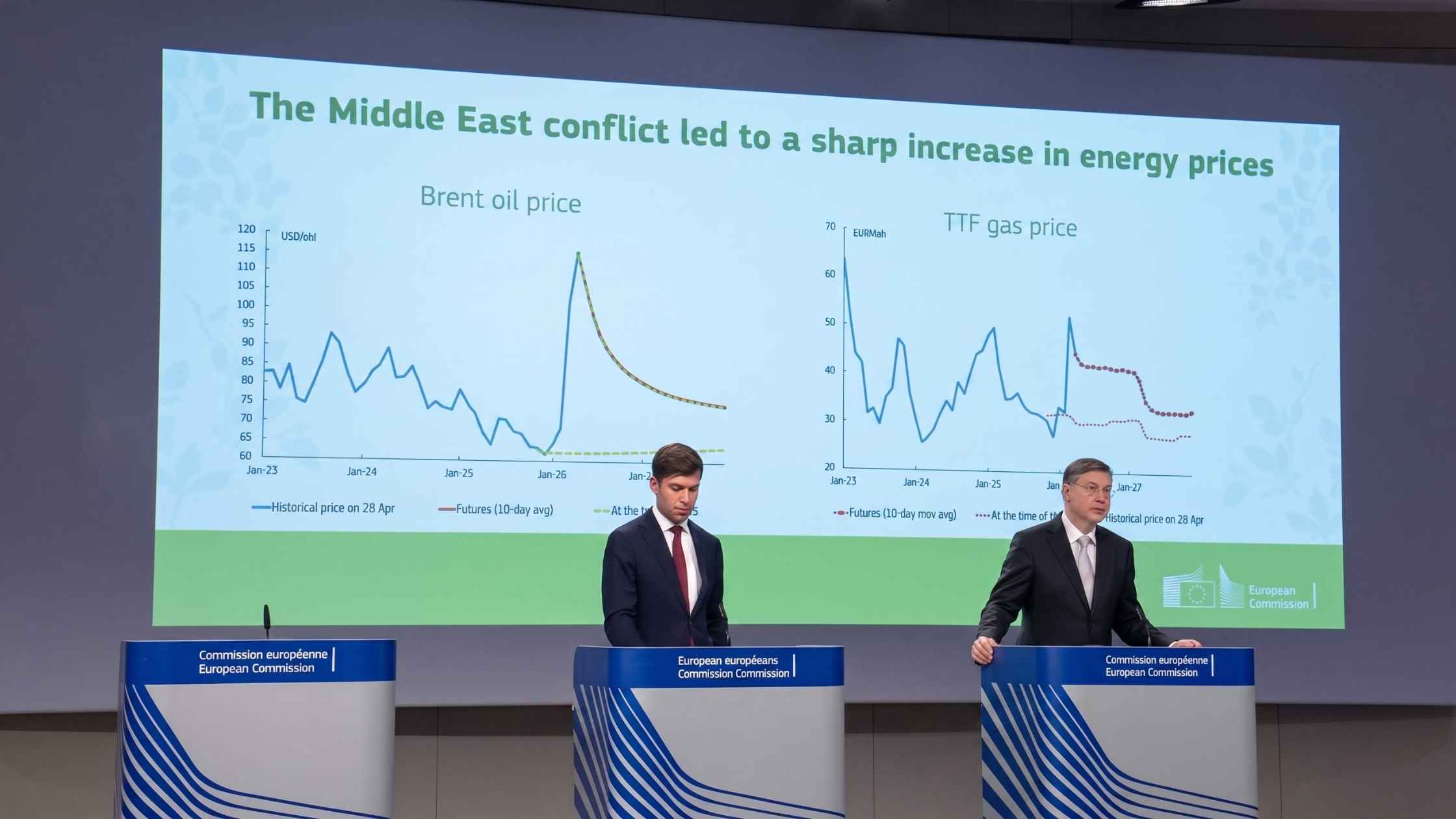
So let me begin with a broader picture. The conflict in the Middle East has triggered an unprecedented disruption of energy supplies. This has in turn led to sharp increase in energy prices. At the cut-off date, oil prices were 65% above the pre-conflict levels while gas prices were 50% higher.
(11:52)
Future markets at the time of the cut-off date point to a gradual decline in both oil and gas prices over the forecast horizon. However, even by the end of 2027, prices will remain at around 20% above the levels expected by markets before the conflict's outbreak. This points to market expectations of persistent supply disruptions.
(12:19)
On a more positive note, the EU's coordinated push towards supply diversification, decarbonization and lower energy consumption has left our economy better placed to absorb today's shocks. Our investment in energy resilience, especially in the aftermath of Russia's full scale invasion of Ukraine is paying off.
(12:46)
While expected to be more contained than in a previous energy crisis, inflation is still projected to rise sharply. Higher energy prices are already hitting our consumers and businesses with data from March and April of this year showing a sharp increase in energy inflation. Energy inflation is expected to rise further in May and June in both the EU and Euro area, peaking about 11% year-on-year in the second quarter and remain elevated until early next year. After that, price pressures are set to broaden progressively as the increase in energy costs feed their way into production chain and are partially passed to the consumers.
(13:39)
All in all, headline inflation in the EU is projected to reach 3.1% this year before easing to 2.4% next year. Inflation in the Euro area is expected to follow a similar pattern reaching 3.0% this year and easing to 2.3% next year. For the EU, it represents ...
Valdis Dombrovskis (14:02):
For the EU, it represents a substantial 1.0 percentage points upward revision in 2026 compared to the autumn forecast. The more modest revision of 0.2 percentage points in 2027 should be seen in the context of the decision to postpone the introduction of the ETS2. The introduction of ETS2 was included in the autumn projections and was estimated to add some 0.2 to 0.3 percentage points to the headline inflation in 2027.
(14:42)
The longstanding pattern of higher inflation in central and Eastern Europe is expected to persist. There are two primary reasons for these differences. First, the region's greater share of energy in consumption basket means that changes in energy prices have a stronger impact on inflation and households' purchasing power. Second, more dynamic wage growth in these countries is expected to strengthen the inflationary pressures.
(15:18)
In response to higher inflation, financial markets have reassessed the expected paths of monetary policy. In response to higher inflation, the ECB and most other EU central banks are expected to tighten their monetary policy stance, or at the minimum, delay previously anticipated easing measures. In the latest ECB bank lending survey, banks reported tighter credit conditions which, coupled with lower demand, are set to weaken bank lending growth this year. At the same time, market valuations of private assets such as equities and bonds have proven particularly resilient to the energy price shock and rising geopolitical uncertainty. Also, investor sentiment remains uneven across sectors. Most corporations continue to benefit from relatively low market funding costs.
(16:20)
The energy shock is also affecting economic sentiment across the EU. In April, consumer confidence fell to its lowest level in 40 months amid fears of raising inflation and job losses, while intentions to make major purchases plunged. Household concerns are likely to encourage precautionary savings, further restraining consumption growth. For businesses, the iteration of confidence has been most pronounced in services which are more directly exposed to weakening consumer demand. But production expectations have dropped sharply in the manufacturing sector. In parallel, firms selling price expectations surge, signaling an increasing intention to pass higher energy costs through the production chain.
(17:24)
Regarding growth within the EU, we expect continued expansion albeit at a slower pace. The EU economy ended 2025 on slightly stronger footings than previously expected, but this positive momentum ended in March when the conflict in the Middle East materially changed the outlook. Consumers are now facing weaker growth in purchasing power due to higher inflation. Private consumption growth is projected to decelerate sharply to 1.1% this year before picking up to 1.3% in 2027. Businesses are set to respond to higher uncertainty, higher funding costs, and lower revenues by scaling down investments, particularly equipment investment. Net exports are expected to be subdued in 2026 and contribute negatively to growth. Overall, GDP growth in the EU is projected to be at 1.1% in 2026 before edging up in 2027 to 1.4%. Gross projections for the Euro area have also been revised down to 0.9% in 2026 and 1.2% in 2027.
(18:51)
In the context of strong performance of the EU labor market in recent years, indicators now point to gradual leveling off. Employment growth is projected to slow down further to 0.3% this year and 0.4% next year. The unemployment rate is no longer projected to decline, but to stabilize at around 6%. As economic output is projected to slow down more than employment, productivity growth is expected to slow to 0.7% in 2026 before recovering to 1% in 2027. Nominal wage growth or increase in wages result adjusting for inflation is expected to continue decelerating this year and stabilizing by 2027. But now, it seems a bit stronger than previously expected. It is projected at 3.5% in 2027, 0.4 percentage points higher than expected in autumn. Still, when adjusting for higher inflation, real wage growth is subdued, thereby reducing the growth of households' real disposable income.
(20:09)
The energy shock is also affecting our public finances. The average deficit in the EU is forecast to raise from 3.1% of GDP in 2025 to 3.5% this year and 3.6 in 2027. This is mainly driven by slower economic growth, rising interest expenditure, and higher defense spending. In addition, many member states have introduced fiscal measures to mitigate the impact of rising energy prices. EU government debt is also set to rise from 82.8% of GDP last year to 85.3% of GDP in 2027. This is driven by higher primary deficits and less favorable differential between interest rates and economic growth.
(21:08)
10 member states reported deficits exceeding 3% of GDP in 2025. By 2027, this number is expected to rise to 13. The largest deficits in 2026 are expected in Poland, Romania, Hungary, France, and Belgium. In these countries, the deficit is projected to exceed 5% of GDP. Overall, some public finances are vital asset for preserving macroeconomic stability in increasingly unpredictable and challenging world. We must be vigilant and safeguard fiscal sustainability. In the context of the current energy shock, that means the EU must learn from past crisis by keeping fiscal support measures for vulnerable households and businesses temporary and well targeted.
(22:08)
Looking beyond Europe, global growth excluding the EU is now projected at 3.1% this year. This represents a 0.3 percentage point downgrade from the autumn forecast. We expect global growth to accelerate to 3.5% next year. Countries and regions are not affected by energy shock equally. Energy importers are being hit the hardest. The outlook for the US, a major net energy exporter, has strengthened. In China, growth is expected to gradually moderate amid subdued consumption. By contrast, most energy-importing economies, especially emerging markets in Asia, have seen their growth outlook weakened. Gross prospects in the main region have also weakened markedly, owing to the direct effects of the conflict.
(23:12)
Of course, major risks surrounding the forecast concerns the duration and scope of the conflict in the Middle East. Beyond this, continued uncertainty surrounding global trade policies could further weight on confidence and activity. On the other hand, new trade negotiations and broader economic agreements could help diversify export markets, strengthen supply chain resilience, and reduce vulnerabilities. The softening of labor market demand could be a prelude to a more adverse impact on employment growth. Artificial intelligence represents both an opportunity and a risk. It can lead to productivity gains but may further weight on the labor markets. At the same time, a possible correction of AI-related equity violations in the US could reverberate in global financial markets.
(24:14)
Domestically, faster implementation of structural reforms addressing longstanding bottlenecks to the EU growth is an important upside risk to the outlook. Strong public investment in sectors such as the defense and energy transition may offset some of the weaknesses expected in the private sector. Finally, a just and lasting resolution of Russia's war of aggression in Ukraine could constitute a clear net positive for the EU, not least given Ukraine's role in safeguarding European security.
(24:54)
As I already mentioned, the uncertainty surrounding the duration of the conflict in the Middle East and its implications for the global energy markets means that this forecast is characterized by unusually high degree of uncertainty, even by the standards of recent years. Furthermore, the baseline assumptions of this forecast are underpinned by rapid normalization of supply conditions, and the window for such rapid normalization is narrowing. This prompted us to complement our baseline scenario with a model-based scenario analysis exploring the impact of the long-lasting supply disruption on energy prices.
(25:44)
Under this scenario, oil and gas prices would increase up to the end of 2026. They would peak at $180 per barrel for oil and 80 euros per megawatt hour for gas respectively. This would carry very serious implications for the EU growth and inflation outlook. Inflation would raise more markedly and remain high for longer, exceeding the baseline projections by 0.3 percentage points in 2026 and 1.1 percentage points in 2027. Growth would be roughly half relative to the baseline scenario both in 2026 and '27. Importantly, inflation would not ease, and economic activity would fail to rebound in 2027 as projected in the baseline forecast. Let me emphasize again that this is a model-based scenario analysis, not our central projection. So with this, I will conclude my presentation and stand ready for your questions. Thank you.
Moderator (26:58):
Thank you very much, Commissioner. Before we jump in, let me just ask you to focus your questions first on the forecast. The commission, of course, is a very broad portfolio. If you want to bring up another question, we'll try to do it in the end, but first let's start with the forecast-related questions. Sabina, take the floor, please.
Sabina Rosset (27:18):
Thanks for the floor. Sabina Rosset with Italian news agency ANSA. I see that the cutoff date for the forecast was 29th of April. Do you think that the outlook was worsened significantly in the following three weeks given the continuous debate around Hormuz? And then if I may, I have also a question on Italy and the fiscal rules if there will be time at the end. Thank you.
Valdis Dombrovskis (27:46):
Well, yes. Thank you for this question. Indeed, there were two cutoff dates of 28th of April and 4th of May respectively for external assumptions and a-
Valdis Dombrovskis (28:01):
External assumptions and government policies and measures. What we see that since then, indeed there is no obvious solution to the conflict in Middle East and blockage of Strait of Hormuz has emerged. So the conflict is continued, the Strait continues to be blocked and that's what I was mentioning that from that point of view, this window for normalization of supply conditions is narrowing. That's something which we need to keep in mind. And given this uncertainty, that's why also we did this scenario analysis also assessing the impact of possibly longer energy price shock.
Moderator (28:56):
Thank you. To the right, Matthew, please.
Valdis Dombrovskis (30:10):
Well, yes. So on the first question, indeed we do the monitoring and mapping of member state's measures taken in response to this energy shock and we have quantified them. So I don't have those figures with me right now, but colleagues certainly can follow up and do this assessment. I would say so far it's fairly contained and that's exactly the policy advice we are giving in this regard, that it's important that policy measures in response to a crisis have to be temporary and targeted and not to sustain or lead to the increase in demand for fossil fuels. And on this latest point I would emphasize, since we are facing a supply shock, providing a broad stimulus to sustain the fossil fuel demand would just help to sustain high energy prices in international markets, and in this way, governments can spend lots of money for little benefits. So therefore it's important that when designing the short term policy measures, we need to keep in mind our long term goals of decarbonization of economy. Well, we need to keep it in mind.
(31:47)
All in all, we see that already now our economy is proving more resilient to this energy price shock than to the previous shock in 2022 thanks to the measures we had taken in diversifying our energy supplies, in improving interconnections between EU member states, in further rolling out renewable energy and energy efficiency measures. And it's important that we continue to work on this, and that's exactly what our Accelerate EU communication we presented for ECIS as a policy response. Then on the fiscal tendencies. Indeed the budget deficit in the EU is on average is set to widen from 3.1% of GDP this year to 3.5% of GDP next year, and 3.6% of GDP in... 3.5 this year, 3.6 next year. So what is driving this is several factors. Indeed, one of the factors is the need to rapidly increase defense expenditure and the flexibilities we provided with our National Escape Clause.
(33:17)
Another driver is automatic stabilizers, which can play their role in the new economic governance framework. In situations like this when we are facing economic slowdown, member states do not need to compensate for revenue shortfall due to this slowdown, they do not need to compensate for higher interest rate expenditure and they do not need to compensate for cyclical component of unemployment benefits. So in a sense, that allows for certain fiscal buffer but also iteration of fiscal situation before even member states start taking discretionary policy measures. And then obviously there are discretionary policy measures on top of this which member states are taking. So therefore on this fiscal developments, it's something which we need to monitor closely. And as I was mentioning also in my introductory presentation, sustainability of public finances is an important anchor for macroeconomic and financial stability and it's important to keep it in this way. And our fiscal room of maneuver now is more limited than during the previous crisis.
(34:53)
If you look, for example, at COVID, we were doing broad-based fiscal stimulus, but we were doing it in a very different interest rate environment with around zero interest rates, whereas now interest rates are much higher. That brings me back to our policy recommendation on sticking with a temporary and targeted support measures to the economy, also to limit their fiscal impact. But today in any case, we are not providing our assessment of member state's fiscal performance. We are presenting the forecast and we'll be providing our assessment of member state's performance on 3rd of June during our spring European semester cycle.
Moderator (35:46):
Thank you. Jorge.
Jorge Valero (35:53):
Good morning, good afternoon, Jorge Valero with Bloomberg. Coming back to the scenarios. Given that the cut off date was already a few weeks ago, would you say that we are actually closer to the downside scenario that your baseline scenario, especially also considering what you said that the window, I mean that there is no end in sight for the conflict. And if once we reach that downside scenario, would you consider that at least will be warranted for you to consider using the flexibility and used for defense under the fiscal rules, given for defense under the fiscal rules? Thank you.
Valdis Dombrovskis (36:34):
Well, as regards these downside risks for the forecast... Well, risks are clearly on the downside, and as I was saying, this window for normalization as per our baseline scenario is indeed narrowing. Well, that said, our baseline scenario remains our main scenario which we'll be using also for assessing member state's fiscal performance and so on. This scenario analysis, in any case, it's based on certain assumptions. So the baseline scenario is based on energy markets futures curves. So what are the market expectations in terms of development of energy prices? Whereas the scenario assessment is just certain assumptions. So what happens if energy prices stay higher for longer, and we do this assessment based on that analysis. And even with the assumptions we were using for this scenario analysis, we see that economic growth in the EU would continue at slower pace. So as I said, roughly half, to compare with our baseline scenario, but we still would expect economic growth.
(38:08)
Well, in terms of the fiscal flexibilities, yes, we are looking at this policy response and what also needs to be done on a fiscal policy side and, I'd sort of say, ready to react to the developments, but already outlined the main parameters, both in flexibilities, which are already existing in a framework which we can let play out as automatic stabilizers, but also some words of caution on limitations we are facing in terms of fiscal space.
Moderator (38:46):
Thank you. Vitaly.
Vitaly Sizov (38:51):
Vitaly Sizov, Freedom TV channel. There is several pages devoted situation in Ukraine. What is your forecast for Ukraine and how it influence situation in European Union? And this forecast for Ukraine, does it include help from European Union? Thank you.
Valdis Dombrovskis (39:16):
Well, yes, I don't have figures for Ukraine now with me. I'm sure colleagues can help. So in terms of assessment for developments of Ukraine, in a sense, yes, it includes assumptions that the financing needs of Ukraine will be met, and I would say that's plausible assumptions because we are making progress with Ukraine support loan. We reached agreement on the memorandum of understanding underpinning as a conditionality for our macro financial assistance program, and just yesterday I signed it and now it's for Ukraine [inaudible 00:40:05] to ratify it and sign. One element which is still in negotiation, which needs to be finalized, is a loan agreement. But all in all, we can expect that we'll be able to disperse to Ukraine as planned in June.
Moderator (40:23):
Thank you. I need to take two questions from the online system as well. So I give the floor to David Thomas, please.
David Thomas (40:34):
Oh, sorry. Hello. Thank you. I was wondering how concerned you are about risks to the growth outlook because of the escalating trade tensions with China. And in particular, I was just going to point out that MOFCOM this morning, or earlier today rather, warned that it would take firm counter measures should the EU go ahead with new trade instruments and take a generally more assertive policy towards China. Thank you.
Valdis Dombrovskis (41:16):
Well, indeed I was outlining the ongoing trade tensions proliferation, or proliferations, of trade barriers as a downside risk to our forecast, and that obviously remains the case. Well, in terms of the measures we are taking, it's obvious when we are seeing disruptions in the EU market, we need to take measures to protect our market, and there are several measures we are taking in this regard, notably tightening requirements for...
Valdis Dombrovskis (42:01):
... tightening requirements for steel imports in the EU, where we know that we are having a global or capacity largely driven by China, and it's affecting negatively also the EU markets. That's why we need to take this action or also tightening the requirements from so called small parcels, which are now reaching EU in billions, and also creating disruptions just to say some of the measures, and obviously we are open to dialogue with Chinese authorities on also measures and implications, and actually have been emphasizing and sharing our concerns on a number of occasions. Then there are also some positive developments in the trade area as we are diversifying and expanding our network of free trade agreements. As you know, recently we have concluded agreements with India, Indonesia, [inaudible 00:43:11] modernized our agreement with Mexico and so on, that negotiating further trade agreements, that all provides us also with the new opportunities in terms of diversifying our trade flows and thus also strengthening our resilience.
Moderator (43:31):
Thank you. Next question online. Next question online goes to Camelia Dontu, please.
Camelia Dontu (43:39):
Hello. Could you hear me, I think? Because I don't hear you.
Moderator (43:46):
Yeah, go ahead.
Camelia Dontu (43:49):
So I'm Camelia Dontu from PRO TV, Romania. Given the political situation in Romania and the economic data in the commission's forecast, how concerned is the European Commission about Romanian's outlook, and what should the authorities in Bucharest do next? Thank you very much.
Valdis Dombrovskis (44:12):
Well, as regards situation in Romania, indeed economic situation is quite challenging with very slow economic growth. So just 0.7% growth last year. Only 0.1% growth this year. But we expect some rebound of 2.3% next year. And obviously major fiscal challenges as Romania continues to have one of the highest budget deficits in the EU. So we forecast 6.2% deficit this year. 5.8% deficit next year. We actually expect that Romania will be exceeding 60% of GDP threshold for public debt this year. So therefore the main message is important to stick with agreed fiscal trajectory in line with excessive deficit procedure to ensure financial stability in Romania and to therefore put the whole economy on a more stable footing. And another important element is to use the opportunities provided by EU funding. Like now we are in an end game effectively with a recovery and resilience facility. So the government needs to focus to maximize the use of the RF funding, especially the grants part of the funding, and similarly use opportunities provided by EU cohesion funds also to strengthen economic growth.
Moderator (46:10):
Thank you. We come back to the room. Gregorio, please.
Gregorio Sorgi (46:16):
Hello, good afternoon. This is Gregorio Sorgi from POLITICO. I had a first question on the UK relaxing sanctions on jet fuels and diesel and are you disappointed that they are relaxing Russia sanctions at this time without pre-notifying the G7? And a second question, if I may, on the drone incursions in the Baltics, what is your reaction, and do you think that these attacks warrant a new sanctions package against Russia before the European Council, which is one of the ideas that is being floated?
Valdis Dombrovskis (46:59):
Well, so on as a first question on UK rolling back certain sanctions against Russia in energy sector. Well, indeed that was not something which it was not flagged during our G7 finance ministerial meeting earlier this week, so came as a surprise. And what we were discussing in G7 actually that now it is not a time to roll back sanctions against Russia, because Russia is actually a country which is benefiting from the war in Iran and having substantial windfall profits due to the higher energy prices. Therefore, it's important to sustain and if anything, strengthen sanctions against Russia in a current situation. And that's a point we'll continue to insist with our international partners including UK.
(48:02)
On the question on drone incursions in the Baltic States. Well, as President von der Leyen also said yesterday that the threat against one member state is threat against our entire union. And Russia and Belarus bear direct responsibility for drones endangering lives and security of people in the Baltic States and Eastern flank. And the EU will respond with unity and strength, and will continue to reinforce security of our Eastern flank with strong collective defense and preparedness at every level. And also Russia's public threats against Baltic States are completely unacceptable. So that's a very clear position. As regards sanctions. Yes, we are working on the 21st sanctions package as we see that Russia is now in fact scaling up its threats and hybrid operations against EU member states and notably Baltic States.
Moderator (49:27):
Thank you. We have time for one last question. David Carretta, please.
David Carretta (49:35):
Thank you. David Carretta, Radio Radicale, Italian radio. First question on all the data that you presented today. Are you worried by the debt situation of Italy and France and the debt trajectory of those two important countries since one is going toward 140% of GDP, the other on 120% of GDP. Is it a problem for the European Commission? The second question is linked in a way. Giorgia Meloni have sent a clear request to use the national escape close for defense to finance national measure for the energy crisis. You have already said that you are considering it. But could you provide a clear answer if Italy has the fiscal space to do it? Thank you.
Valdis Dombrovskis (50:39):
Well, yes, to start with this latest question. Indeed, we are in a sense assessing the policy options as regards our response to the energy crisis. So the fiscal policy response. What elements there may be on the table, I probably will not reiterate the overall message about temporary and targeted measures and so on and so forth, which remains the case. But yes, we are doing some assessment in a sense what can be done within our fiscal framework. But it's obviously linked also with a second important point, which I was mentioning before as well, that indeed in general we have more limited fiscal space now than we maybe had during the previous crisis, that also requires therefore fiscal prudence, especially for high debt countries.
Moderator (51:40):
I will have to cut it there. Thank you commissioner for briefing us, and we are going to continue in a bit with a technical briefing. Thank you very much for your attention.