

What Appellate Judges Look For When They Review a Case
See what appellate judges look for when they review a case, from preserved errors and standards of review to harmless error, and how to prep the record.



Federal appellate courts handle tens of thousands of cases each year. According to data from JDSUPRA, the average appellate judge decides on about 140 cases a year. And overall, the U.S. Court of Appeals receives about 40,000 new filings every single year,
With so many cases moving through the system, a strong appeal needs more than a disagreement with the trial court's decision. The appeals that do get heard (and the appeals that win) usually share a few traits: a clear legal error, raised at trial, proven by the record, and serious enough to have affected the result. That’s what an appellate judge looks for when they review a case.
Appellate review is the process of reviewing the trial court record, including the briefs, transcripts, and filings, to determine whether the trial court applied the law correctly and whether any mistake mattered. Below, we’ll cover what judges focus on, what they can do once they decide, and how appellate teams can prepare the record before the first brief is filed.
1. Whether the Error Was Preserved at Trial
The first question is usually whether anyone raised the issue at the right time. Under Federal Rule of Evidence 103, a party challenging a ruling that admitted evidence generally must have objected on the record and stated the specific ground. If evidence was excluded, the party must have made an offer of proof, unless the substance was apparent from the context.
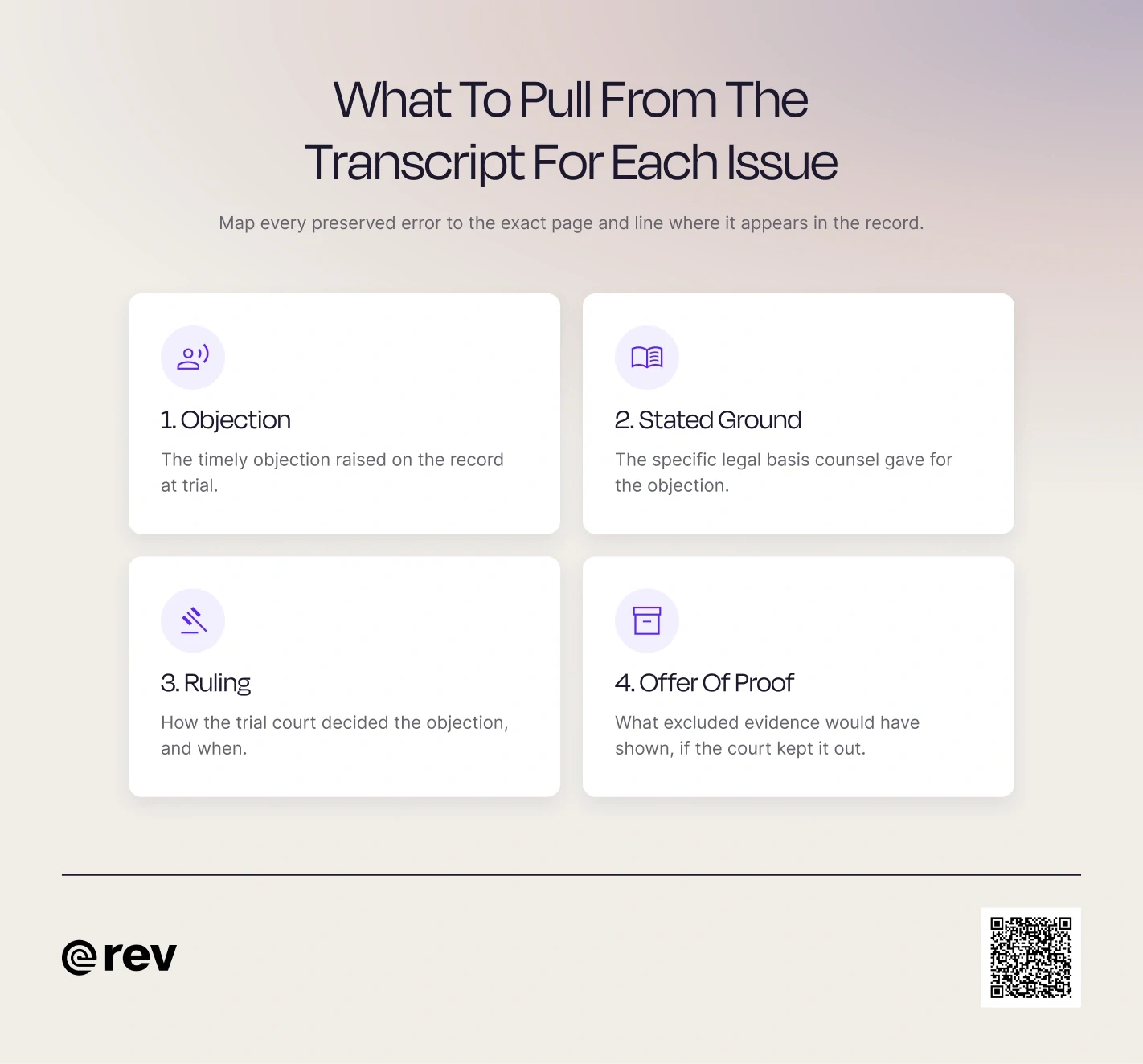
However, unpreserved issues aren't always lost. Courts can still notice a plain error affecting substantial rights, but that exception is narrow and hard to meet. But it’s not impossible. Start your preservation work in the transcripts: find every objection, the stated ground, the ruling, and any offer of proof, then note exactly where each one appears.
Strong grounds for appeal almost always begin with a preserved error that can be pinned to a specific page and line.
2. Which Standard of Review Applies
Once an issue is preserved, the standard of review decides how much deference the trial court gets. Federal Rule of Appellate Procedure 28 requires the appellant's brief to include a concise statement of the applicable standard for each issue, and judges notice when that statement is missing or wrong. Generally, the standards of review are:
- De novo review.
- Questions of law, such as how a statute or rule should be interpreted, get a fresh look with no deference to the trial judge.
- Clearly erroneous standard.
- In federal civil cases, Rule 52(a)(6) says findings of fact must not be set aside unless clearly erroneous, with due regard for the trial court's opportunity to judge witness credibility.
- Abuse of discretion.
- Appealing an action the court took. Discretionary calls, including many evidentiary rulings, are reversed only when the decision falls outside the range of reasonable choices.
The standard often predicts the result. An argument framed as a legal question reviewed de novo has far more room to succeed than the same complaint framed as a disagreement over how the judge weighed testimony.
3. Whether the Record Supports the Argument
Appellate judges can only consider what’s in the record on appeal. In federal court, Rule 10 defines that record as the original papers and exhibits filed in the district court, the transcript of proceedings, and a certified copy of the docket entries.
If a key exchange happened off the record, or a hearing transcript was never ordered, the argument may have nothing to stand on.
Judges also expect every factual statement in a brief to show where it came from. Rule 28 calls for citations to the parts of the record the appellant relies on. A brief that says the court “repeatedly cut off cross-examination” without page citations is basically the same as asking the judge to take your word for it.
Teams filling gaps should start by learning how to get court transcripts for every relevant hearing, not only the trial itself. Then, make sure to cite each statement to the source.
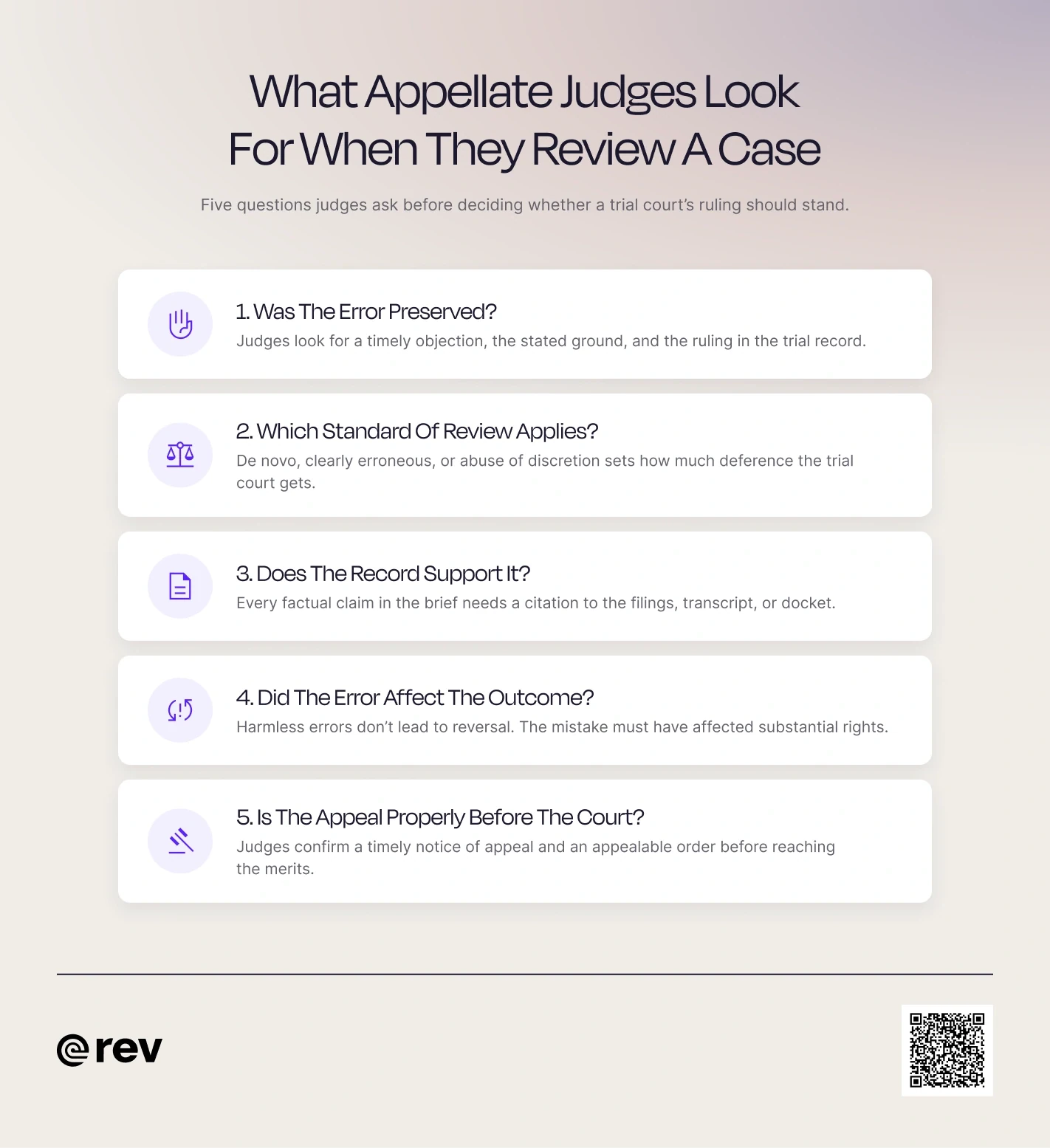
4. Whether the Error Actually Affected the Outcome
Finding an error is only half the argument. Federal law directs appellate courts to give judgment “without regard to errors or defects which do not affect the substantial rights of the parties” under the harmless error statute. Federal Rule of Criminal Procedure 52(a) applies the same principle in criminal cases.
So judges ask whether the mistake likely changed the result. An improperly admitted exhibit may be harmless if other evidence proved the same point. The same exhibit may be reversible error if it was the only support for a key element or if closing argument leaned on it. Appellate teams make this case by tracing the error through the whole record: every time the evidence was mentioned, relied on, or argued to the jury.
5. Whether the Appeal Is Properly Before the Court
Before reaching the merits, judges have to confirm that they have authority to hear the case. In federal civil cases, the notice of appeal generally must be filed within 30 days after entry of the judgment or order, and a criminal defendant generally has 14 days under Federal Rule of Appellate Procedure 4. Federal appellate jurisdiction also usually requires a final decision, with limited exceptions.
These questions can end an appeal before anyone reads the argument. Asking an appellate court to review a case starts with confirming the deadline, the appealable order, and any post-trial motions that affect timing.
What Can Appellate Courts Do After Reviewing a Case?
After appellate review, the court issues a decision on each issue raised. Under 28 U.S.C. § 2106, a federal appellate court may affirm, modify, vacate, set aside, or reverse a judgment, and it may remand the case for further proceedings. Decisions can also be mixed, affirming on some issues and reversing on others.
Learn more about these options in our guide to common legal terms and our full breakdown of the entire appeal process.
What Happens When an Appellate Court Upholds a Verdict?
When an appellate court upholds a verdict, the trial court's judgment stays in place, and the appeal ends at that level. The opinion may explain that the court found no error, that an error wasn't preserved, or that an error was harmless.
The losing party may still have some options, such as petitioning for rehearing or seeking review from a higher court. Those options are discretionary, so in most cases an affirmance is the final word on the issues raised.
What Happens When an Appellate Court Rejects a Verdict?
When an appellate court rejects a verdict, it reverses or vacates all or part of the judgment, and the case usually returns to the trial court with instructions. Depending on the error, that could mean a new trial, a new sentencing hearing, entry of judgment for the other party, or reconsideration under the correct standard.
A reversal rarely ends the case outright. The remand instructions define what happens next, so trial and appellate counsel need to read them closely and prepare for the next round with the same record in hand.
How Rev Helps Appellate Teams Review the Record
Every factor above depends on knowing the record cold. Preservation often lives in objections scattered across days of transcript. Harmless error analysis depends on tracking every time a piece of evidence comes up. A trial record can run to thousands of pages, and the issue that matters most on appeal may sit in a sidebar on day six.
“When dealing with voluminous, digital records, it is important for the author to create a record map that can be accessed easily,” Mark Hirsch, Attorney at Templer & Hirsch, explained to Rev.
“After pulling relevant sections from the record, including objections, orders, and dates, the writer must make sure that each is properly cited within the brief and in the appropriate location. The writing itself should pull from the entire record, verifying that every reference to a page, exhibit, ruling, or order is accurate.”
Rev gives appellate teams one place to work through that record. Upload hearing and trial transcripts, filings, exhibits, and any available recordings, then interrogate them together: search for every objection to a specific witness, every mention of a disputed exhibit, or every ruling on a motion in limine.
Multi-file analysis lets you ask questions across the case at once, and every answer cites back to the source, including page:line citations for depositions, so you can confirm the exact wording before it goes into a brief. And when you're ready to draft, our guide on how to format a legal brief can help you structure the argument.
Build Your Appeal on a Record You Know Inside and Out
What appellate judges look for when they review a case comes down to preserved errors, the right standard of review, solid record support, and real prejudice. Every one of those starts with the transcripts and filings.
Rev can help your team search, compare, and cite the full record in one place, so you spend more time sharpening the argument and less time hunting for page numbers.