

How To Write An Appellate Brief From Your Trial Record
Learn how to write an appellate brief in just seven steps, and how uploading all case documents into a searchable workspace can help you move faster.



Some appellate briefs start with a blank document. The better ones often start somewhere else: deep inside the record.
Maybe it’s a line from a suppression hearing that undercuts the trial court’s ruling. A preserved objection buried hundreds of pages into the transcript. Or a witness answer that looks very different once you read the five questions that came before it.
The hard part is rarely knowing that the record matters. It’s finding the right part of it, verifying it, and building an argument that sends the appellate court directly back to the source.
That makes the trial record one of your most important drafting tools. When transcripts and case files are searchable, attorneys can move from a legal issue to the underlying testimony, ruling, or objection without repeatedly combing through hundreds or thousands of pages.
Here’s how to write an appellate brief with the record doing more of the work.
What Is An Appellate Brief?
An appellate brief is a written legal argument asking an appellate court to affirm, reverse, modify, or otherwise review a lower court’s decision. It explains the relevant facts and procedural history, identifies the legal issues on appeal, applies the appropriate standard of review, and supports each argument with legal authority and citations to the record.
“The appellate court does not re-litigate the case, they consider the record and ruling under the standard of review, and the alleged error in the trial court's ruling,” explains Mark Hirsch, Attorney at Templer & Hirsch.
The exact terminology and requirements depend on the court, so always check the applicable rules before drafting. For example, Federal Rule of Appellate Procedure 28 sets out the required contents of a federal appellant’s brief, but state appellate courts and individual federal circuits can impose additional requirements.
For more information on the appeal process, check out our breakdown on our blog. But for the purposes of this article, we are going to focus strictly on the creation of the brief itself.
Main Sections Of An Appellate Brief
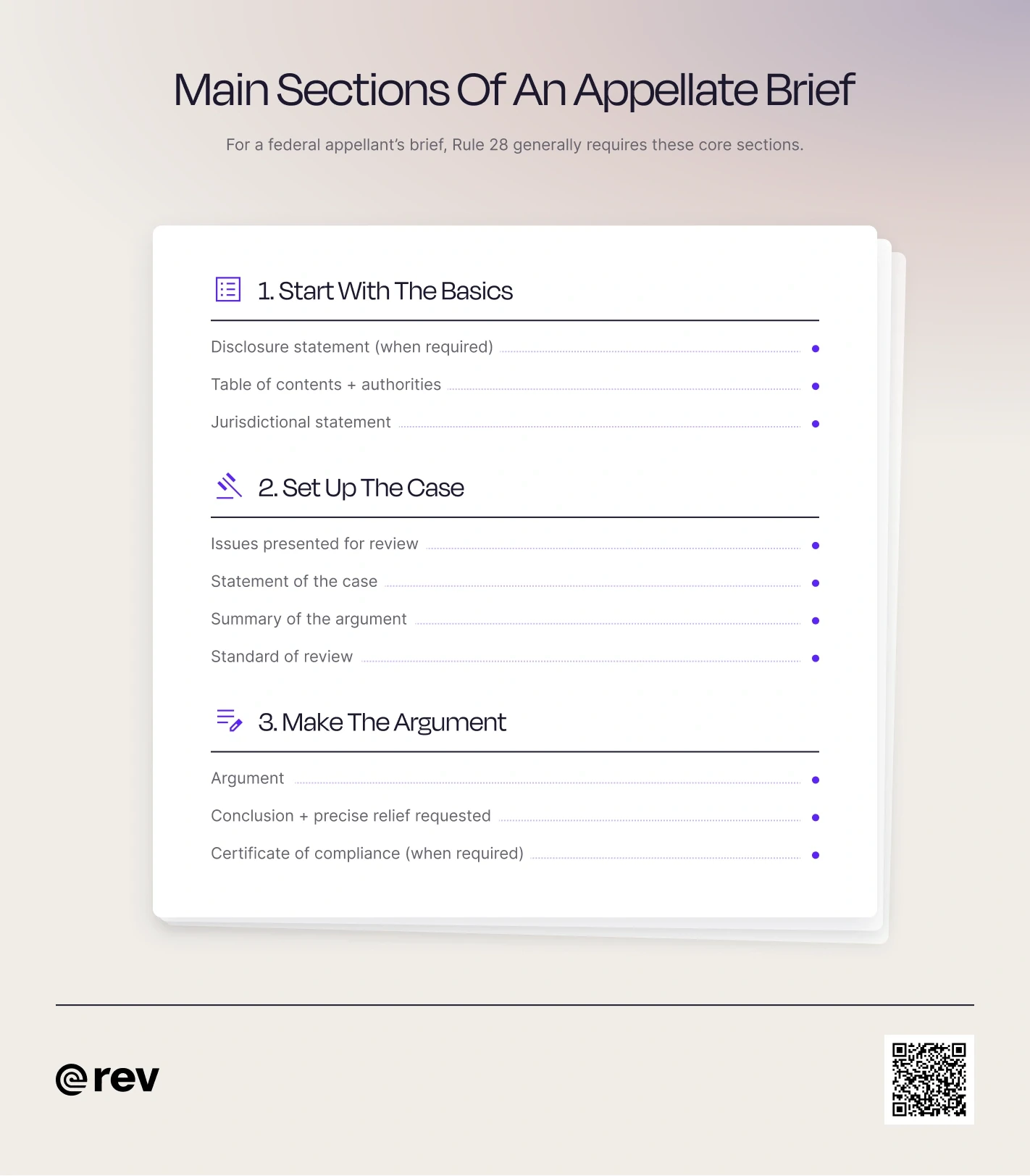
For a federal appellant’s brief, Rule 28 generally requires sections including:
- Disclosure statement, when required under Rule 26.1
- Table of contents
- Table of authorities (organized alphabetically)
- Cases and authorities
- Statutes by number
- Jurisdictional statement
- Statement of the issues presented for review
- Statement of the case, including relevant facts, procedural history, and rulings under review
- Summary of the argument
- Argument
- Applicable standard of review for each issue
- Conclusion stating the precise relief requested
- Certificate of compliance, when required
An appellee’s brief has somewhat different requirements, and a reply brief is even more specific. Cross-appeals, amicus briefs, administrative appeals, and state appeals can also follow different rules, so it’s important to do your research before getting started.
Formatting and length vary too. For example, a principal brief is generally capped at 13,000 words, while a reply brief is capped at 6,500 words. However, local rules may add other requirements that change these numbers.
How To Write An Appellate Brief In 7 Steps
Before writing, identify which court’s rules control the appeal. Download its briefing checklist, local rules, formatting requirements, and record-citation guidance. Then, turn to the record and follow these seven steps.
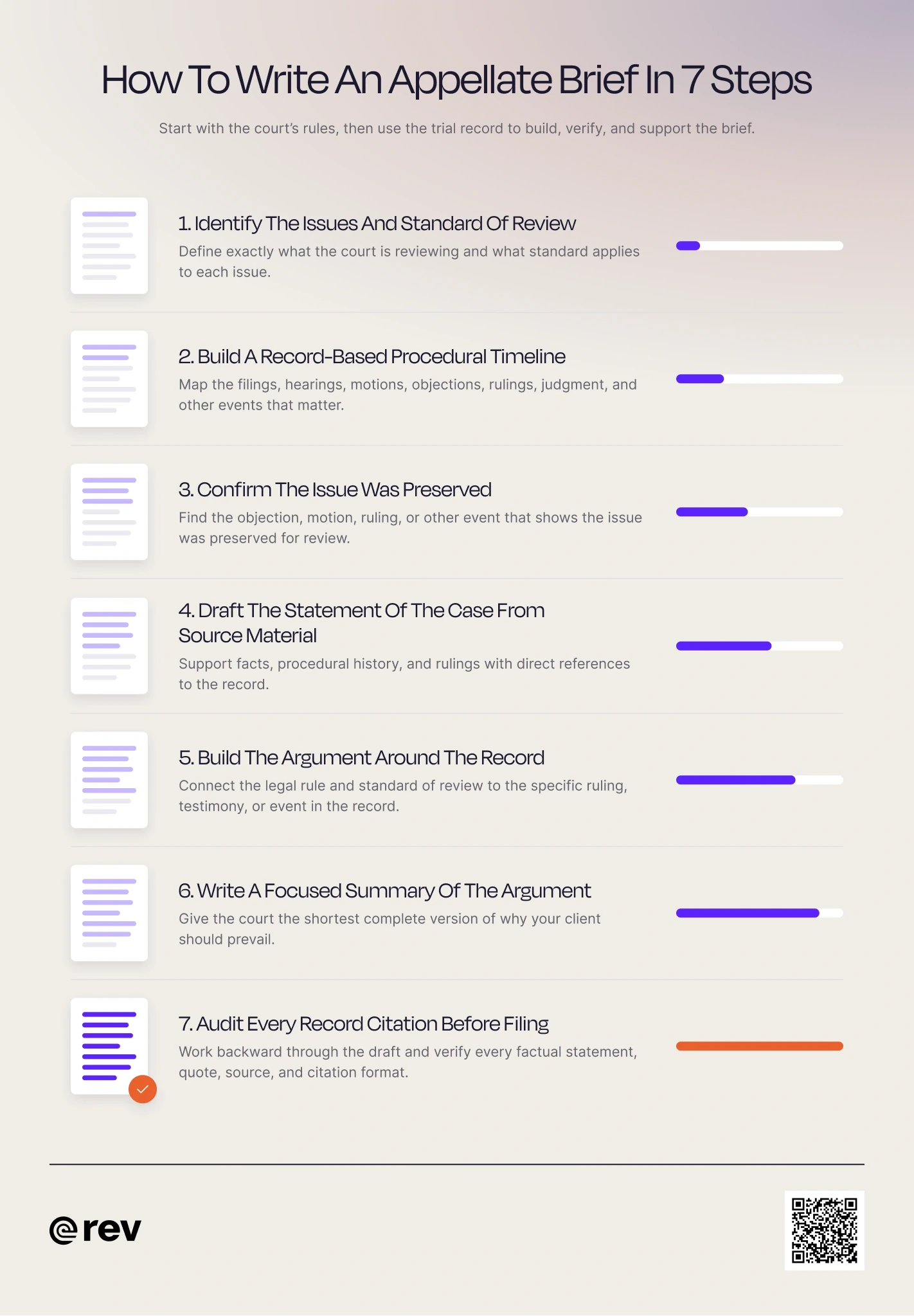
1. Identify The Issues And Standard Of Review
Start by defining exactly what the appellate court is being asked to review. The issue determines what parts of the record matter, what standard the appellate court will apply, and what you need to prove. Ask yourself the following questions:
- Was there an evidentiary ruling?
- A statutory interpretation issue?
- A ruling on summary judgment?
- A jury instruction problem?
The appellate brief standard of review also shapes how the argument should be written. Questions of law are generally reviewed de novo, factual findings for clear error, and discretionary rulings for abuse of discretion. Other standards, including substantial-evidence review, may apply depending on the issue and jurisdiction.
Rule 28 requires an appellant to provide a statement of the applicable standard of review for every issue. The Ninth Circuit also maintains a detailed standards-of-review resource, though it cautions attorneys to verify the governing authority independently.
2. Build A Record-Based Procedural Timeline
Next, you’ll need to map what has already happened. List the filings, hearings, motions, objections, rulings, trial events, judgment, post-trial motions, and notice of appeal that matter to the issues being raised. This will become the backbone of your procedural history.
A searchable workspace, like what you can create in Rev, makes this much faster. Instead of working from memory or manually paging through individual transcripts, search for motion names, hearing dates, rulings, witness names, exhibit numbers, or phrases used by the court.
Rev makes it easy to verify every entry against the underlying source, and search and compare hundreds of documents at once. The goal is a timeline that another attorney on the case could trace backward without asking where a fact came from.
3. Confirm The Issue Was Preserved
A strong argument on merit does little good if the issue wasn’t properly preserved for appellate review (though there are some exceptions).
Search the trial record for the objection, motion, offer of proof, requested instruction, ruling, or other event relevant to preservation. But don’t stop at the line you expect to cite; instead, read the surrounding exchange too.
The exact language and timing matter a lot. After all, an objection may have been raised, withdrawn, narrowed, answered by a later ruling, or discussed again outside the jury’s presence.
Searching transcripts can help attorneys locate every mention of the issue before deciding which passage best shows preservation.
4. Draft The Statement Of The Case From Source Material
The statement of the case should give the court the factual and procedural background it needs to decide the issues presented, without turning into a transcript summary. Under Rule 28, it should set out relevant facts, describe the relevant procedural history, identify the rulings under review, and include appropriate references to the record.
Treat factual propositions as claims that need proof. When you write that a witness testified to something, open the testimony. When you describe a trial-court finding, open the ruling. When a date matters to jurisdiction, verify the docket entry.
That way, all your statements are backed up by the record. Remember: search makes discovery faster, but the source still controls what ultimately gets added to the brief.
5. Build The Argument Around The Record
In step 5, you’ll need to connect the law to what actually happened. For each issue, a useful working structure is:
- State the governing rule and standard of review.
- Explain the relevant legal authority.
- Identify the specific ruling or action being challenged.
- Cite the record showing what occurred.
- Explain why that record satisfies the legal standard.
- Address the strongest likely response.
This is where searchable transcripts can be especially useful.
Suppose your argument turns on whether a witness gave a particular answer at trial. Search can take you directly to that testimony, but it can also reveal earlier or later passages that change its meaning.
That context matters on appeal. A quote that sounds decisive in isolation may look considerably weaker once the surrounding examination is included.
6. Write A Focused Summary Of The Argument
The summary of the argument in an appellate brief should tell the court why your client should prevail before the judges reach the full analysis.
Federal Rule 28 calls for a “succinct, clear, and accurate” summary and specifically says it should not simply repeat the argument headings. Think of it as the shortest complete version of your reasoning, and make sure to do the following:
- State the error.
- Explain why it matters under the applicable standard of review.
- Connect it to the record.
- State the result you are asking the court to reach.
- Skip background that does not help answer those questions.
Rajeh A. Saadeh, Attorney at The Law Office of Rajeh A. Saadeh, spoke to us about the importance of getting the brief right:
“A brief that is clear, honest, and human is more persuasive and makes it harder for a court to rule the other way. Appellate work can appear academic and technical, but it's very practical, and it gets sharper when you've been involved in them as both counsel and a party.
“I am the petitioner in a matter pending before the United States Supreme Court. This perspective changes how I understand what persuades an appellate court, particularly at the highest level, including brevity, hyper-focused issue selection and framing, and giving the court reason to care beyond your case, and yourself. The best appellate advocates remain mindful that the judges and justices reading their work are people, and the surest way to persuade people is to be credible, clear, brief, and human.”
7. Audit Every Record Citation Before Filing
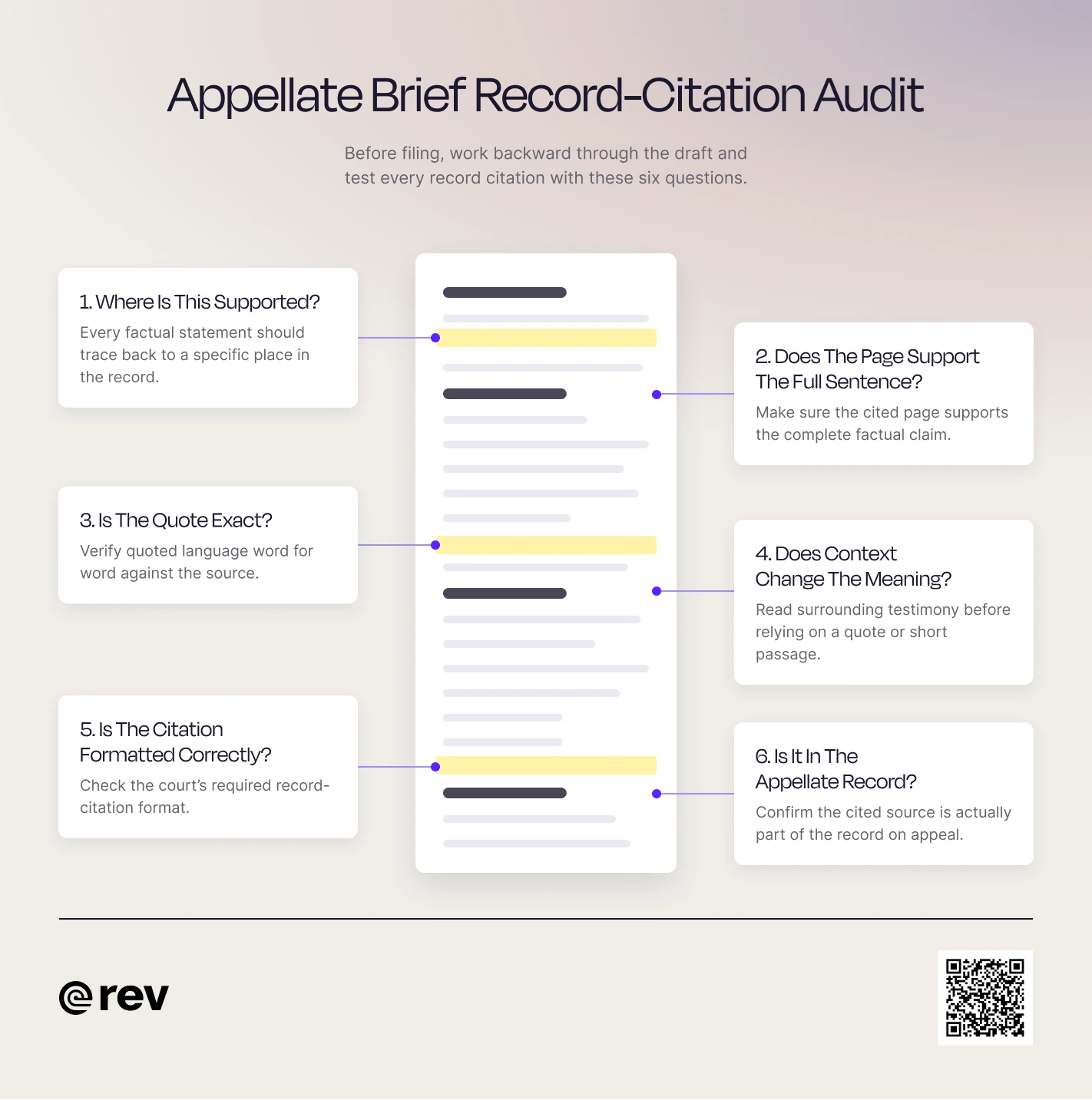
Once the draft is complete, work backward through it. For every factual statement, ask:
- Where in the record is this supported?
- Does the cited page actually support the entire sentence?
- Is the quote exact?
- Does surrounding testimony change its meaning?
- Is the citation formatted according to this court’s rules?
- Is the source part of the appellate record?
Record-citation conventions can be extremely specific. The Fourth Circuit, for example, has formatting requirements designed in part to let its electronic Citelinks system connect brief citations directly to appendix pages.
Technology can help with this review. Rev’s Document Editor can turn findings into an editable first draft while retaining citations back to the source material. You will still control the final legal analysis, citations, formatting, and filing. Rev just helps you get there faster.
Tips To Strengthen Your Appellate Brief
A strong appellate brief does more than summarize what happened below. It gives the court a clear path from the legal issue to the exact part of the record that supports your argument. Before filing, use these tips to tighten your analysis and make the brief easier to verify:
- Write to the standard of review.
- Don’t argue only that the lower court was wrong. Explain why the ruling fails under the standard the appellate court must apply, whether that is de novo review, abuse of discretion, clear error, or another standard.
- Cut facts that don’t help resolve the appeal.
- The trial record may span thousands of pages, but the brief should focus on the facts the court actually needs to decide the issues presented.
- Search for facts that hurt your argument, too.
- Use the record to pressure-test your position. Look for testimony, rulings, or later clarifications that opposing counsel could use against you so you can address them before they do.
- Check the context around every quote.
- Read the questions and answers surrounding a key line of testimony. A strong quote can lose its force if the surrounding exchange changes its meaning.
- Verify every record citation.
- Make sure each factual statement is supported by the cited page, the quote is exact, and the citation follows the appellate court’s formatting rules.
- Use a searchable copy of the trial record to speed up review.
- With Rev, legal teams can search across transcripts and case files, locate relevant testimony and rulings, and trace findings back to the source. That makes it easier to build procedural histories, confirm facts, spot inconsistencies, and create a cited first draft while keeping the attorney in control of the final legal argument.
- Once judgment enters, keep the calendar close.
- Rev’s Legal Deadline Calculator can help estimate litigation deadlines, but applicable statutes, court rules, scheduling orders, and local procedures should always be independently verified.
Turn The Trial Record Into A Brief You Can Verify
The best appellate argument can still stumble if the record behind it is hard to find, incorrectly cited, or taken out of context.
A searchable trial record gives attorneys a cleaner path from issue to source. With Rev, legal teams can search case materials, surface cited findings, and turn those findings into an editable first draft without separating the writing process from the underlying evidence. You bring the appellate strategy. Rev helps keep the record within reach.