

How To Win An Appeal In Court: Build An Airtight Argument
Learn how to win an appeal in court: find real grounds, prove preservation, apply the right standard of review, and build every argument from the record.



Not every case that applies for an appeal actually gets one. In fact, from September 2024-2025, the federal courts of appeals only reversed about 7.9% of the appeals filed on merit.
That number reflects less on the success of appellate lawyers, and more on how the entire appeals process works. An appellate court doesn't actually retry the case or reweigh the evidence. Instead, it looks for legal error in the record, decides how much deference the trial court gets, and asks whether the mistake changed the result.
Learning how to win an appeal in court is mostly learning how to work the record: finding the right error, proving it was preserved, and showing it mattered. Here's how to build that argument step by step, and how Rev can help you get to the insight that changes the case faster.
Note: This guide focuses primarily on appeals in U.S. federal courts. State appellate procedures, filing deadlines, and standards of review vary by jurisdiction.
1. Identify Legitimate Grounds For Appeal
Losing at trial isn't an automatic basis for appeal. Legitimate grounds for appeal are specific legal mistakes, such as:
- Admitting or excluding evidence improperly
- Giving a flawed jury instruction
- Misinterpreting a statute or contract
- Entering a judgment the evidence can't legally support
Appeals built only on factual grounds are much harder, because appellate courts generally defer to the jury's verdict and the findings that the trial judge gave. A stronger appeal argument frames the problem as a legal one: the jury heard evidence it never should have heard, or never heard evidence it should have.
List every possible error, then rank each by how clearly the record shows it and how much it affected the outcome. That will help you determine if you have a legal argument an appellate court will actually want to hear.
2. Confirm The Error Was Preserved In The Record
An error that wasn't raised at trial usually can't be raised on appeal. Before appealing a court ruling, confirm that the issue was preserved in the first place.
In federal court, Federal Rule of Evidence 103 requires a timely objection that states the specific ground when evidence is admitted, and an offer of proof when evidence is excluded. Courts can still review plain errors that affect substantial rights, but that's a much steeper climb.
Timing matters here too. Unlike an appeal letter for an insurance claim denial, a court appeal starts with a formal notice of appeal. Under Federal Rule of Appellate Procedure 4, parties in most federal civil cases have 30 days from entry of the judgment or order to file a notice of appeal, while criminal defendants generally have 14 days.
Exceptions apply, including certain government cases and qualifying postjudgment motions. Always check the specific rule, triggering event, and applicable deadline before filing.
Proving preservation can mean searching thousands of transcript pages for a single sidebar. With Rev, attorneys can search hearing and trial transcripts for the objection, the ruling, and every later mention of the issue, then confirm the wording in the official record.
Our legal deadline calculator can help organize these dates, but remember to always verify them against the federal and state governing rules.
3. Apply The Correct Standard Of Review
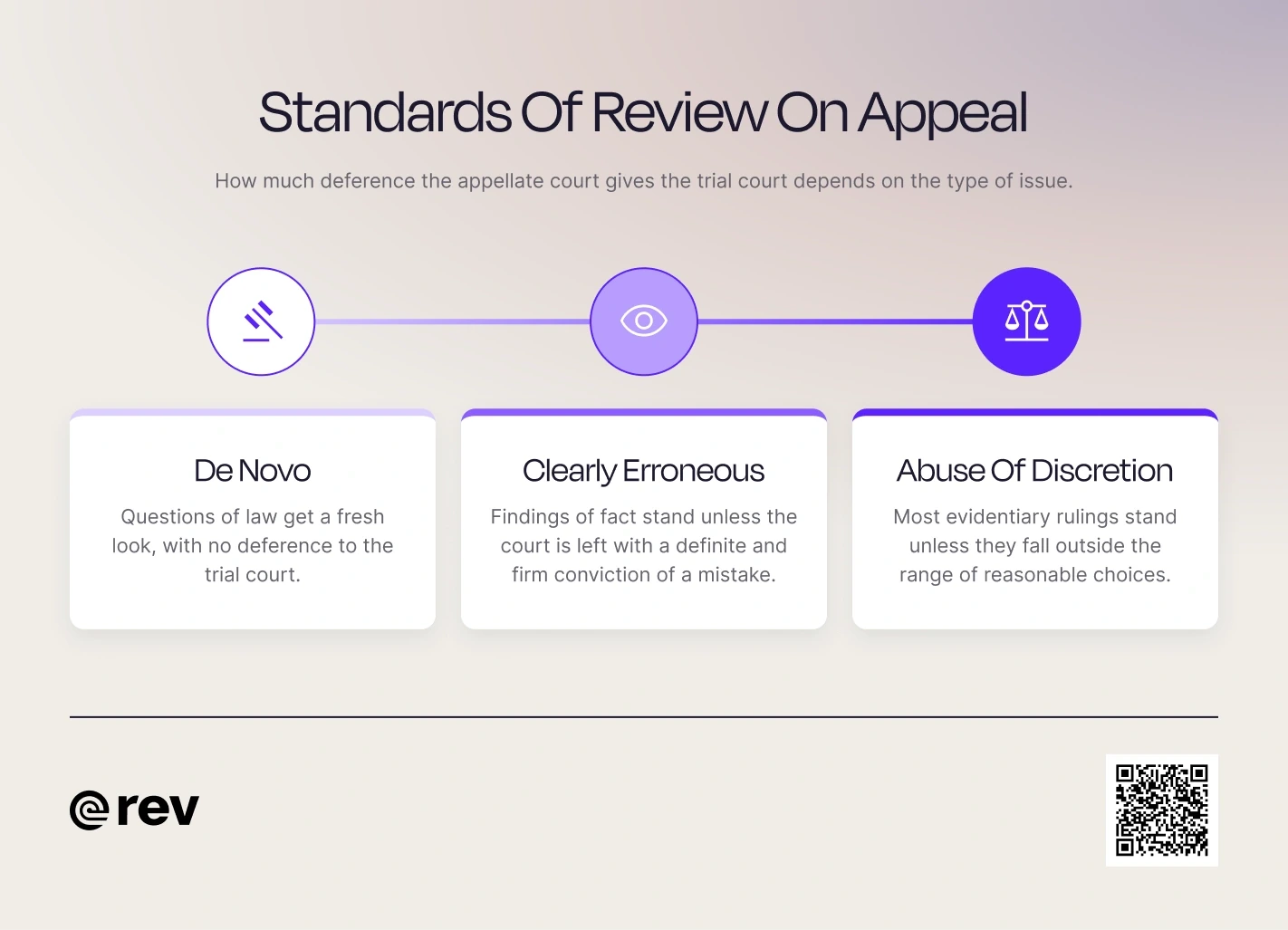
The standard of review sets how much deference the appellate court gives the trial court, and it often decides an appeal before the merits do. In Highmark Inc. v. Allcare Health Management System (2014), the Supreme Court summarized the three traditional standards:
- De novo
- Questions of law, like statutory or contract interpretation, get a fresh look with no deference. This standard gives the appellant the most room.
- Clearly erroneous
- Under Federal Rule of Civil Procedure 52(a)(6), findings of fact stand unless the reviewing court is "left with the definite and firm conviction that a mistake has been committed," as the Court put it in United States v. United States Gypsum Co.
- Abuse of discretion
- Most evidentiary rulings fall here, including expert testimony rulings under General Electric Co. v. Joiner. The argument has to show the ruling fell outside the range of reasonable choices.
Name the standard for each issue and write to it. For quick definitions of other appellate terms, see our list of common legal terms.
4. Show The Error Was Reversible, Not Harmless
Even a preserved error won't win an appeal if it didn't matter. Federal Rule of Civil Procedure 61 and Criminal Rule 52(a) both direct courts to disregard errors that don't affect substantial rights.
A harmless error is a real mistake that didn't change the result, like improperly admitted testimony that repeated what three other witnesses already said. A reversible error likely affected the outcome, such as excluding the only evidence supporting a key defense.
Use the record to show how central the evidence was, how often it came up, and whether opposing counsel leaned on it in closing. Expect the other side to argue the evidence presented was overwhelming anyway, and answer that directly.
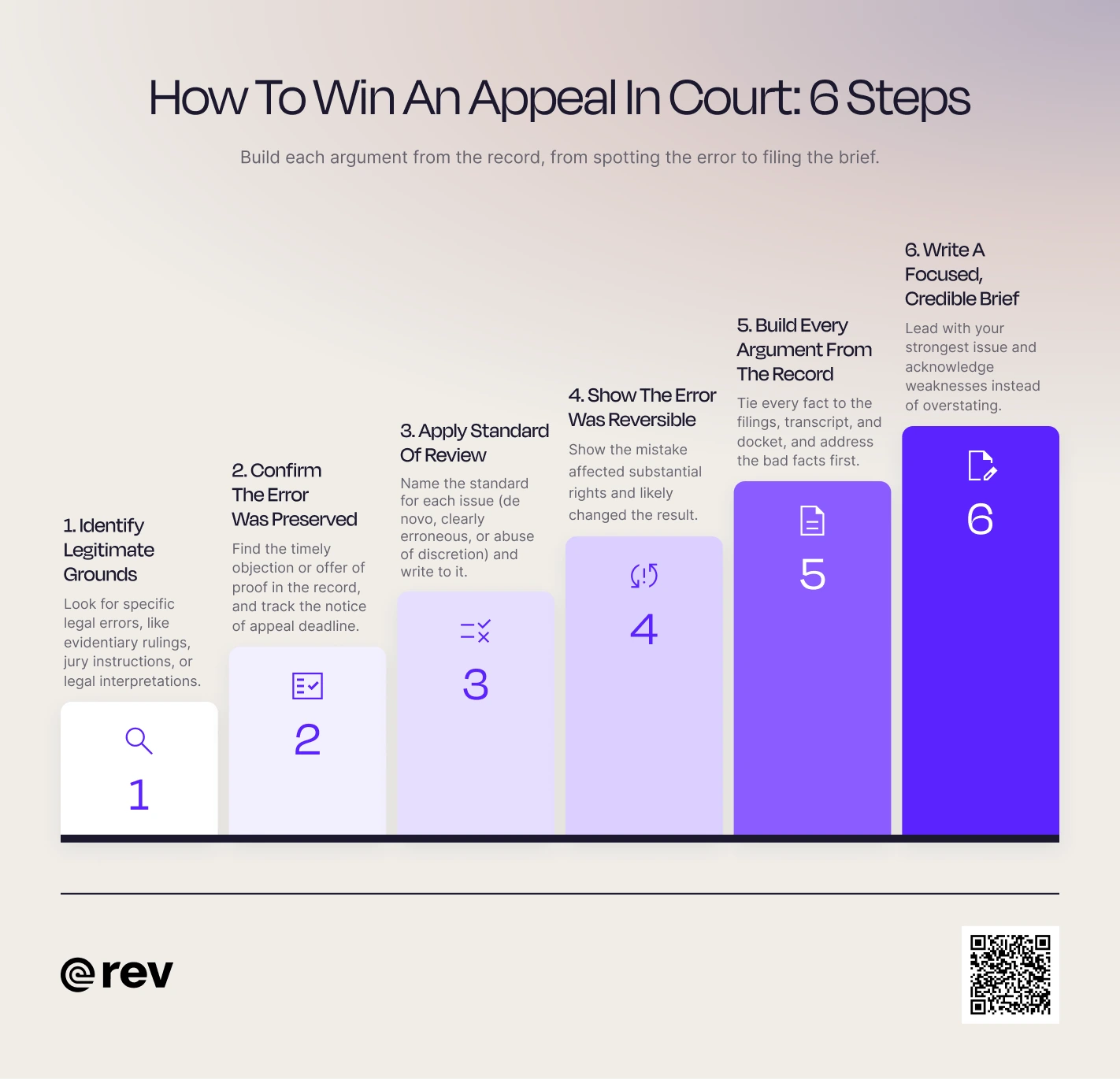
5. Build Every Argument From The Record
Under Federal Rule of Appellate Procedure 10, the record on appeal includes the filings and exhibits below, the transcript, and the docket entries. New evidence generally can't come in.
That makes every factual statement in your brief a claim that needs a citation. Build a record map early, with rulings, objections, key testimony, and exhibits tied to a page and line. Think of it like a digital trial notebook built for the appeal. Then read around every passage you plan to quote, because context can change what an answer means.
When searching, look for the bad facts as well as the good ones. The appellee will find them, so you’ll be in a better place if you can address them first. If parts of the record are missing, our guide to getting court transcripts can help.
6. Write A Focused, Credible Brief
Most appeals are decided on the appellate briefs, and many never reach oral argument. Raising every possible issue dilutes the strongest ones, so lead with your best issue.
For each issue, state the standard of review, explain the governing law, show the error in the record, and explain why it changed the outcome. Acknowledge weaknesses instead of hoping the court misses them. Credibility is hard to rebuild once a panel catches an overstated fact.
Possible Appeal Outcomes
After reviewing the briefs and the record, and hearing oral argument if it grants one, the appellate court issues a decision. Depending on the case, the court may:
- Affirm
- The judgment stands.
- Reverse
- The court overturns the decision, in whole or in part.
- Vacate and remand
- The court sets the judgment aside and sends the case back for further proceedings, such as a new trial.
- Modify
- The court changes part of the judgment, such as a damages award or sentence.
But what if you don’t get the result you wanted? How many times can you appeal a case? In federal court, parties generally have one appeal as of right from an appealable final judgment. After the court of appeals rules, they may request panel rehearing, rehearing en banc, or both.
They may also petition the U.S. Supreme Court for review, although the Court accepts relatively few cases. State appeals follow separate rules and may allow further review by the state's highest court.
What Are The Chances Of Winning An Appeal?
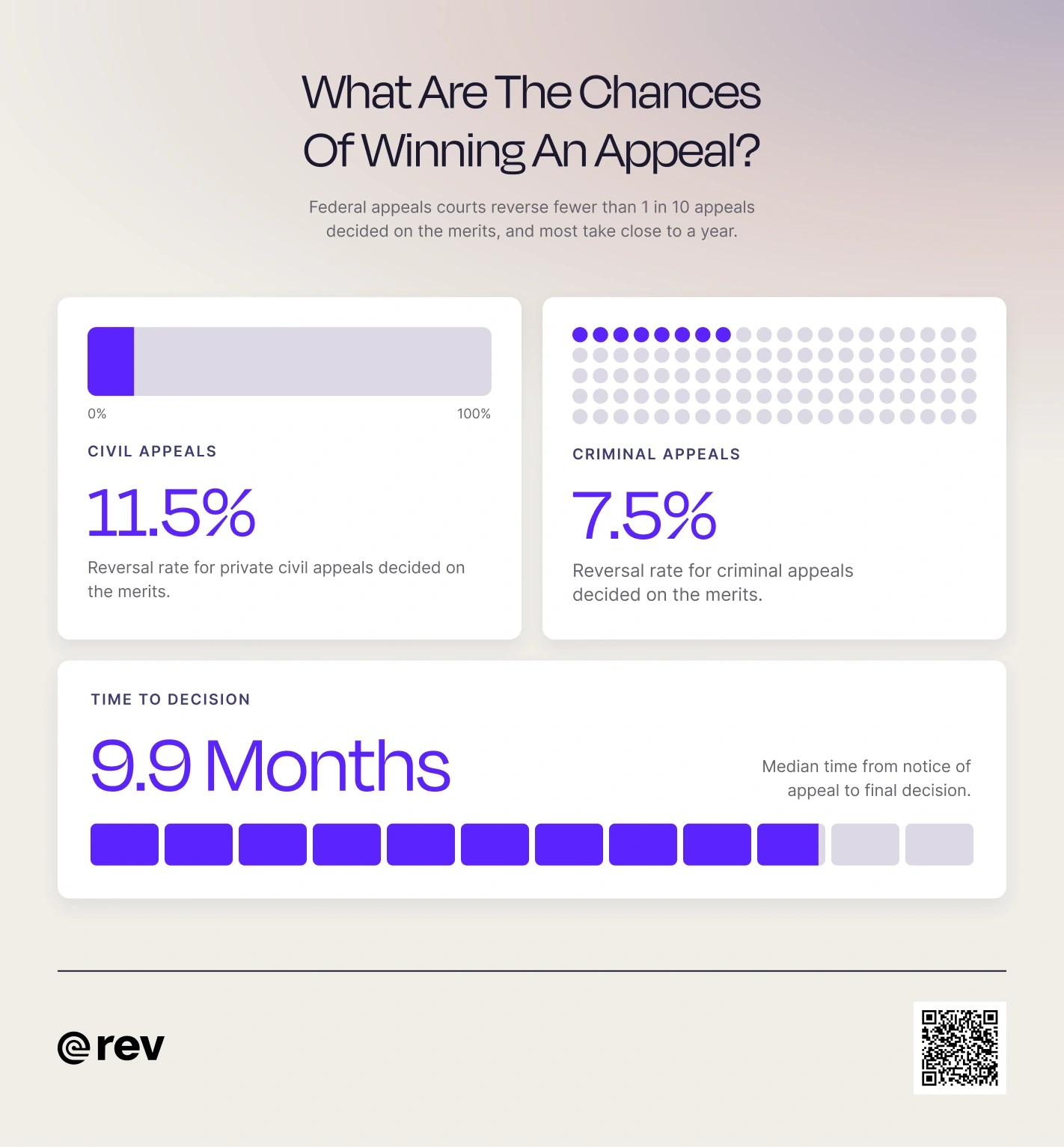
The chances of winning an appeal are low overall: federal courts of appeals reversed 7.9% of the appeals they decided on the merits in the 12 months ending September 30, 2025, according to U.S. Courts Judicial Business data.
The rate was about 11.5% for private civil appeals and 7.5% for criminal appeals. Though that doesn't count partial wins like remands, and state courts publish their own numbers.
How Long Does An Appeal Take?
A federal appeal typically takes about 10 months: the median time from notice of appeal to final decision was 9.9 months for the 12 months ending September 30, 2025, according to U.S. Courts data. State timelines vary widely, and rehearing or further review can add months to that number.
Advice From Appellate Lawyers
Experienced appellate attorneys are selective about which errors they raise.
“It has to be something that would change the result, or it's not worth the time and effort of an appeal,” says John (J.R.) Moore, Director of Attorney Development at Angel Reyes & Associates. “For it to be worth appealing, it has to be reversible error; that is, a mistake that was correctly preserved on the record that, if corrected, would lead to a different result.”
Mark Hirsch, Co-Founder and Personal Injury and Maritime Attorney at Templer & Hirsch, applies the same discipline to the brief: “I think that a brief works best when it tells the Judges exactly what the counsel is asking them to do by citing only the errors of law that they preserved at trial.”
How Tech Can Help You Brake The Case
An appeal can turn on one objection, one ruling, or a few lines of testimony buried deep in a long record. The hard part is usually finding every place the issue appears across transcripts, exhibits, and recordings.
Rev helps legal teams work that record. Upload transcripts, photos, recordings, and case documents, then use multi-file analysis to interrogate them together. Find an objection and every ruling on it, trace how a witness's testimony shifted between deposition and trial, or build a chronology of the procedural history.
Every finding cites back to the source file, so you can open the exact passage and confirm the wording. Rev's document editor can then turn those findings into an editable first draft with the citations carried through.
With Rev, the official record stays the source of truth, and the legal judgment stays with you.
Build Your Appeal From The Complete Record
Knowing how to win an appeal in court comes down to choosing the right error, proving it was preserved, writing to the standard of review, and showing it changed the result. But that is easier said than done. But with Rev on your team, you can easily search the whole record, find the moments that matter, and cite them back to the source. Every single time.