See exactly what you'll pay — no surprises. Estimate costs for human and AI transcripts, captions, and subtitles in seconds, and find out how much a subscription can save you.
58+ Chatbot Statistics That Demonstrate The Future of AI
58+ Chatbot Statistics That Demonstrate The Future of AI
The popularity of AI chatbots for businesses and beyond doesn’t seem to be slowing down. Let’s look at some statistics that cover the popularity, use cases, and future of AI chatbots.
It isn’t uncommon these days to have an AI chat when you need help solving a customer service issue, want to ask a question, or need clarity on how to complete a task on a website. For example, you might have an AI chatbot walk you through the steps to troubleshoot why your Internet connection is down or help you update your address on your banking app.
AI chatbots for businesses can help streamline your customer service and help customers quickly get answers to easy questions without having to go through the motions (and potential wait times) to chat with a human agent. Of course, AI chatbots can’t completely replace human agents to help with more complex queries and issues, but one of the many benefits of chatbots is their ability to help with easier fixes so your agents can focus on the heavier lifts.
Even outside of a business space, AI is on the rise, and AI chatbots are becoming more and more commonplace. Just look at how many people use ChatGPT to get help when they need it (according to Exploding Topics, the number is 800 million per week). It’s clear that people want quality answers fast, and artificial intelligence can help with that in a major way. Let’s look at some AI in customer service statistics and other chatbot trends that highlight how useful they can be for modern business (and beyond).
General Chatbot Statistics
Some consumers respond enthusiastically to AI chatbots, while others miss the days when human communication was king. But like it or not, chatbots are here to stay. Let’s look at some general chatbot statistics regarding their popularity, usefulness, and more.
40% of consumers are interested in interacting with chatbots from major brands. (2)
30% of consumers expressed disinterest in interacting with chatbots. (2)
43% of those who have interacted with chatbots say they think the bots need to improve their ability to accurately understand what customers are looking for. (2)
Americans turn to chatbots for entertainment - 35% of Americans who used a chatbot in the last few months did so because they thought it would be fun. (4)
ChatGPT is the most popular AI chatbot, with 19% of chatbot users reporting it as their go-to. (4)
If given a choice, 87% of consumers report that they still prefer to interact with a human agent instead of a chatbot. (5)
82% of consumers said they would try a chatbot to see if it can help them with their needs instead of waiting for a human agent to become available. (10)
96% of consumers believe that companies should opt for AI agents or chatbots instead of human customer service teams. (10)
The average company has adopted four AI features, integrations, or software into its day-to-day internal workflow. (11)
67% of business leaders expressed confidence in their AI systems' security and ability to protect consumer data. (11)
21% of Americans who used a chatbot in the last few months did so to get health advice or answer a health-related question. (3)
Chatbot Market Size Stats
The chatbot market has exploded in the past few years. It seems like almost every business, brand, and company has their own chatbot ready to step in and help with customer service, while systems like ChatGPT are becoming just as commonplace as Google. This interest in letting AI do the talking is only expected to grow in the coming years.
Let’s look at some statistics regarding the current market size of chatbots and expected growth.
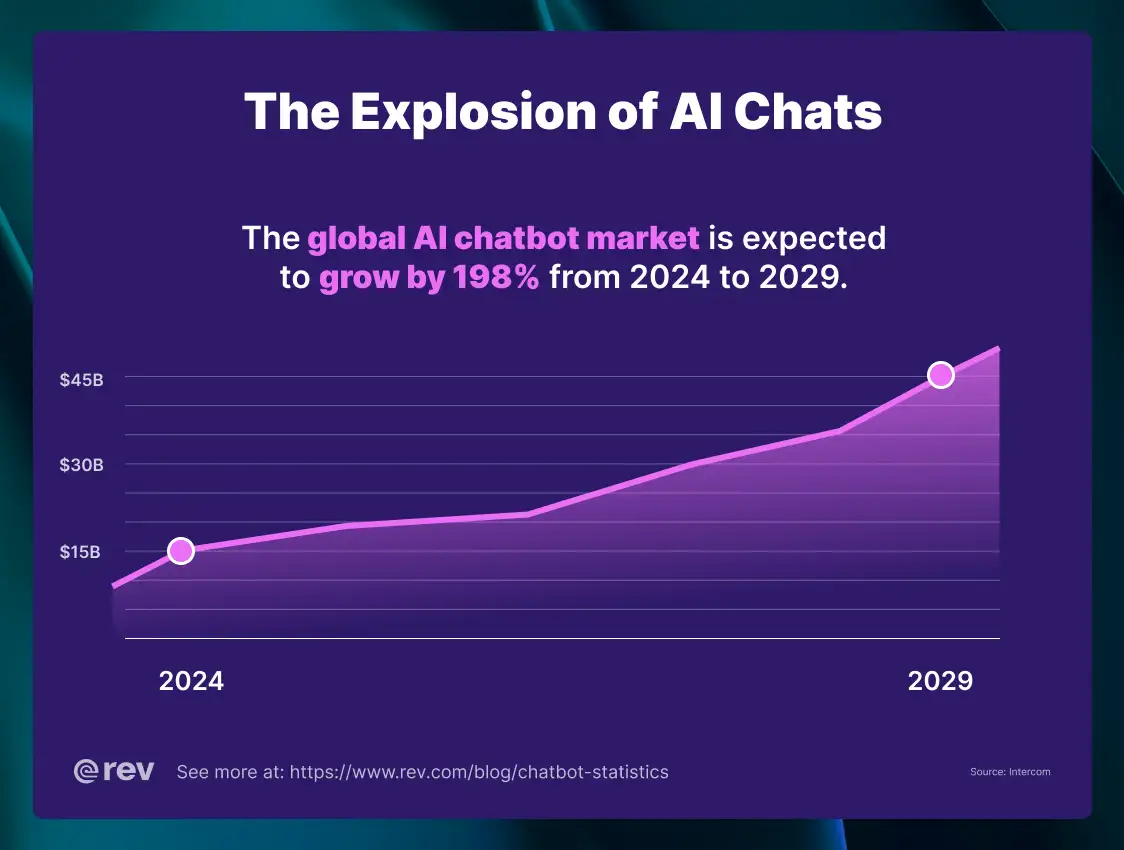
The global AI chatbot market is expected to grow in the coming years, going from $15.6 billion USD in 2024 to $46.6 billion USD by the end of 2029. (1)
987 million people currently use AI chatbots, and even more interact with AI chatbots via business websites. (4)
Meta AI is the largest AI chatbot, which has 500 million users. (4)
The North American chatbot industry is the largest, and accounts for 31% of the market share. (7)
The global chatbot market is valued at $7.8 billion. (7)
The United States is responsible for most of the traffic to the ChatGPT website, accounting for 14% of the traffic. (8)
The top three countries that visit the ChatGPT website are: The United States, India, and Kenya. (8)
77% of devices feature some sort of AI software, feature, usage, or capability. (14)
The number of AI tech startup companies has increased 14 times since 2000. (14)
Chatbot Conversion Rates and Usage Trends
AI chatbots for businesses can help increase conversion rates by giving customers the answers they need, fast. The ease and speed of responses is one of the reasons why many customers are using chatbots more and more. Let’s look at some statistics about how and why customers use chatbots.
80% of people who have interacted with a chatbot said the interaction was positive, with 14% saying it was very positive. (2)
16% of people who have interacted with a chatbot said their interaction was negative, and 4% said their interaction was very negative. (2)
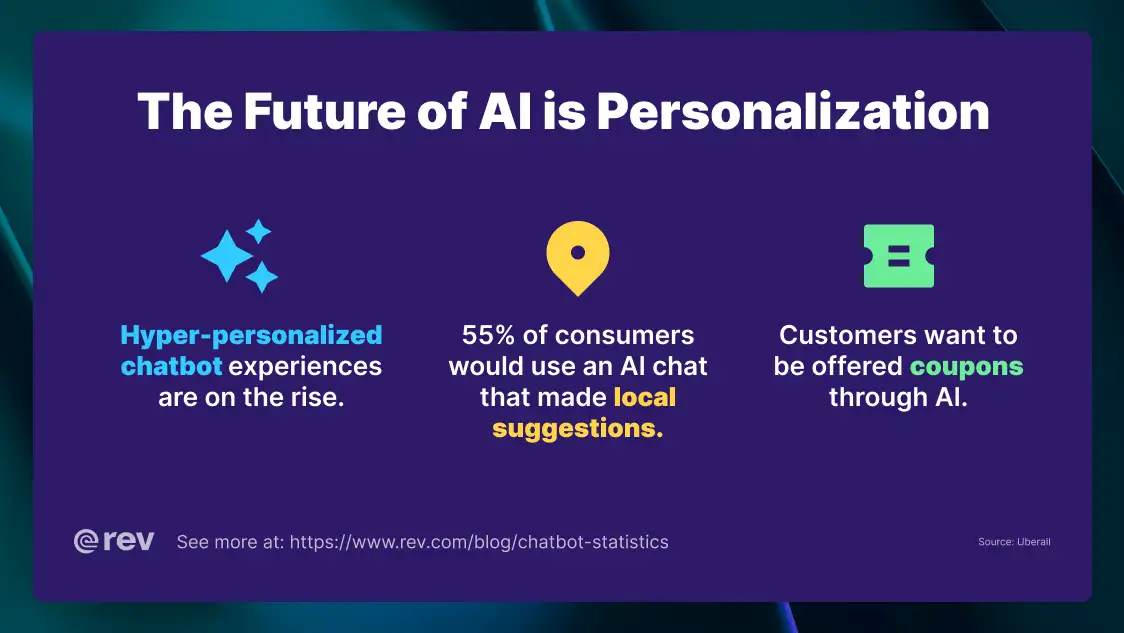
38% of consumers said they are most interested in seeing chatbots provide information about deals, coupons, and promotions. (2)
35% of Americans who have used a chatbot in the last few months used it instead of a search engine when they had a question they wanted answered. (3)
23% of Americans who have used a chatbot in the last few months have used it to write or edit content. (3)
When selecting software to use in their businesses, 79% prioritize finding a software with AI capabilities. (11)
69% of businesses and organizations have adopted AI chatbots or virtual agents, making them the most-adopted AI tool. (11)
In the United States, 52% of men and 53% of women have used an AI-powered chatbot. (16)
51% of A.I. users say that they use A.I. chatbots for personal use and informal learning. (16)
AI chatbots increased conversion rates by 23%. (17)
Companies using AI chatbots had a typical ticket resolution time of 6 minutes and 25 seconds, while those not using them had an average resolution time of 7 minutes and 50 seconds. (17)
The Future of AI Chatbots + AI Tools
Chatbots are currently a useful tool for answering customer queries and providing support. But what if they could proactively solve problems or identify customer needs before they even know what they need? What if they could solve problems you didn’t even know you had?
As the chatbot market grows, we can expect to see innovations in the field. Let’s look at some statistics regarding the expected growth of chatbots.
The global AI chatbot market is expected to grow at a Compound Annual Growth Rate (CAGR) of 24.5%. (1)
As location-based chatbots start to grow, 55% of consumers said they would be willing to use a chatbot that offered deals, coupons, or suggestions based on their location. (2)
72% of customer experience leaders expect their company’s AI chatbot to embody their brand’s personality, voice, and values. (9)
56% of consumers believe that AI chatbots and AI agents will be able to have natural-sounding human conversations by 2026. (9)
94% of consumers believe that AI advancements will make call centers for customer service unnecessary. (10)
The market for AI technology is expected to grow to over $800 million in the United States by 2030. (12)
Generative AI is expected to be the fastest-growing AI type through 2030. (12)
62% of Americans believe that artificial intelligence will have a large impact on workers and businesses in the coming years. (13)
AI will result in an overall gain of 12 million jobs, after it eliminates some jobs and creates others. (14)
Data on the Benefits of Chatbots
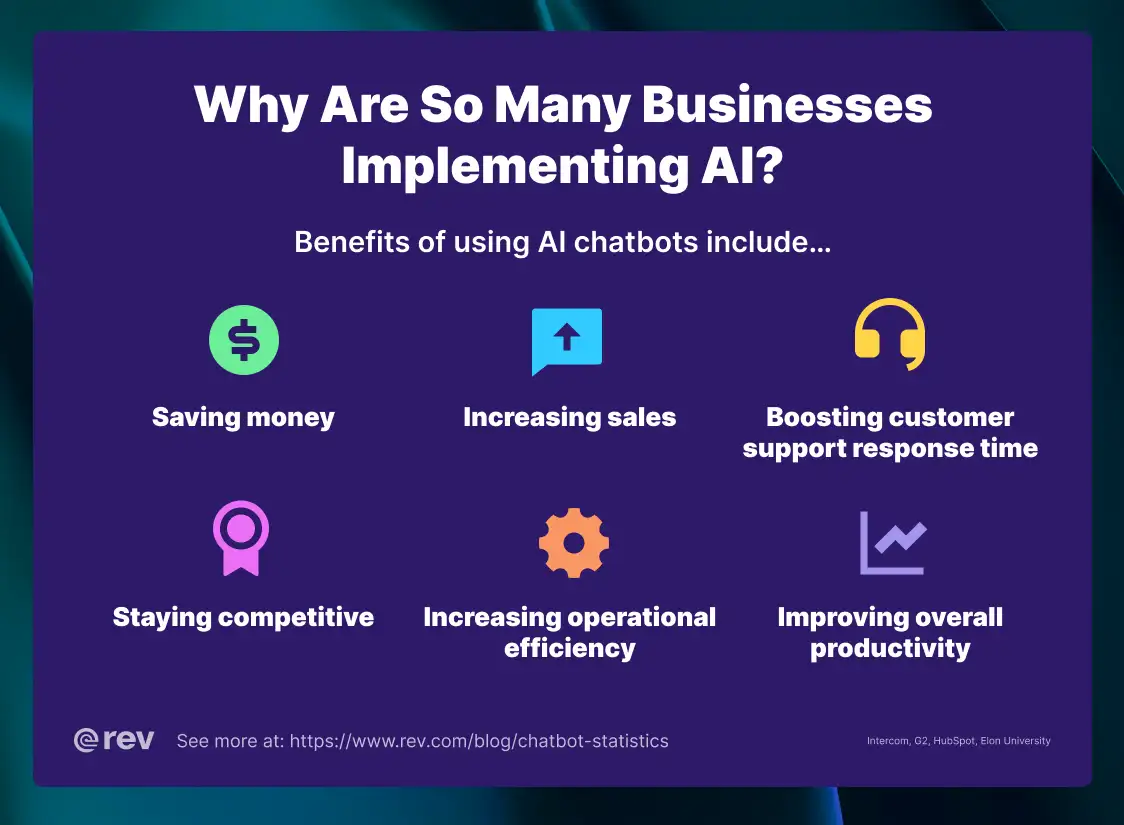
Chatbots can help deliver a great customer experience. But even more, they can improve the efficiency of your business by freeing up your employees to focus on more crucial tasks while saving you money by decreasing the amount of labor you need on your support team.
Let’s look at statistics regarding these and other benefits of using chatbots in and out of the workplace.
In 2019, business leaders saved an average of $300,000, thanks to AI chatbots. (5)
According to business leaders, using AI chatbots for sales increases sales by 67%. (5)
Chatbots increase customer support response times by 3x. (5)
56% of consumers think that AI agents or chatbots help them understand the product or offering they’re researching better. (9)
20% of organizations that use AI report that they do so to stay competitive in their markets. (11)
39% of organizations that use AI report that they do so because it increases their operational efficiency. (11)
92% of CRM professionals report that adoption of AI has improved their response times to customer queries. (15)
86% of CRM professionals report that adopting AI has helped them scale and grow their operations. (15)
54% of those who use A.I. chatbots like ChatGPT say that the bots have improved their productivity. (16)
Chatbots in Business: Facts + Stats
Chatbots are being used in a variety of verticals. A chatbot might help you rent a car for your vacation, pay a medical bill, or make a return on a pair of jeans that didn’t quite fit. Let’s look at some statistics regarding how chatbot technology is fitting into businesses in a variety of industries.
Sales is the most common usage for AI chatbots in business, with 41% of business leaders reporting that they use their bot for sales purposes.(5)
Tech is the industry that is most satisfied with AI chatbots, with 73% of businesses reporting satisfaction.(5)
Following tech, the industries most satisfied with AI chatbots are: retail (67%), manufacturing (67%, and healthcare (56%).(5)
53% of business organizations report that their marketing teams were the quickest to adopt AI into their workflow. (11)
Alternatively, businesses report that their IT departments are the slowest to adopt AI, with only 2% of businesses reporting quick AI adoption by IT departments. (11)
71% of Americans oppose the idea of AI being used to make final hiring decisions. (13)
80% of retail executives anticipate that they will adopt AI automation for their workflows. (14)
Businesses with over 100,000 employees are more likely to have some form of AI usage or technology in place. (14)
68% of healthcare organizations have implemented AI. (14)
48% of chatbot users say that their chatbot tools don’t accurately solve user problems or understand user intent. (16)
Chatbot users report the following struggles with using AI chatbots: the chatbot doesn’t understand the user's needs (61%>); the chatbot gives incorrect answers (45%); and the chatbot doesn’t understand or use natural language (43%). (16)
Care For A Chat?
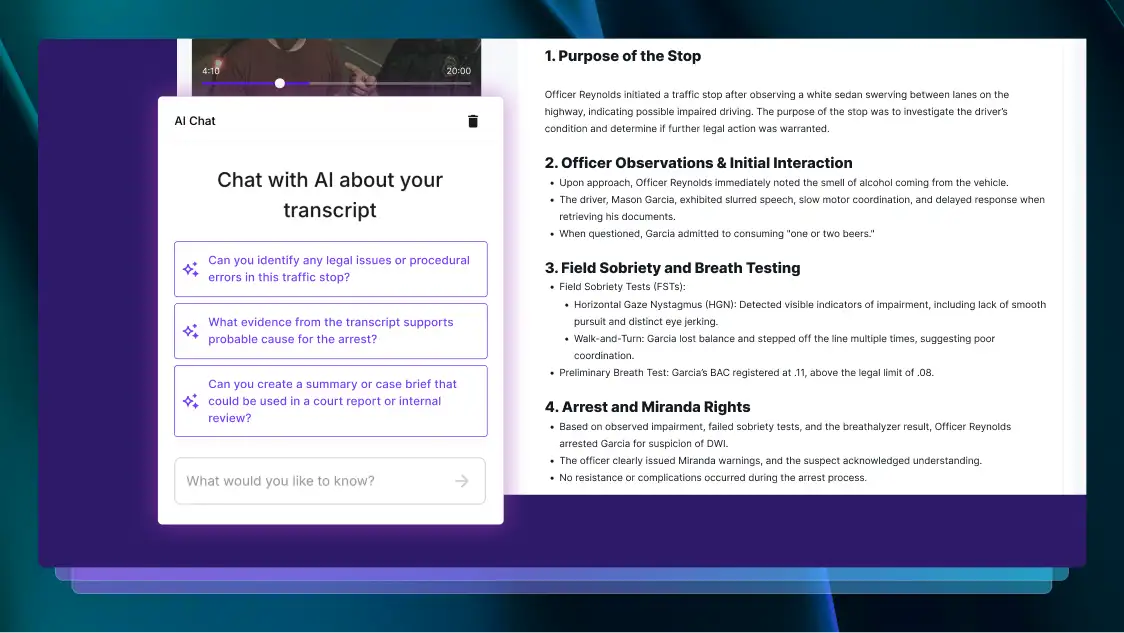
Here at Rev, we know just how much artificial intelligence can help your business. Our AI transcription and insights tool can help you get the most out of your recordings by highlighting the most important topics. We even have our own AI chatbot feature that can help you easily comb through your files to find what you need.