Borge Brende (00:12):
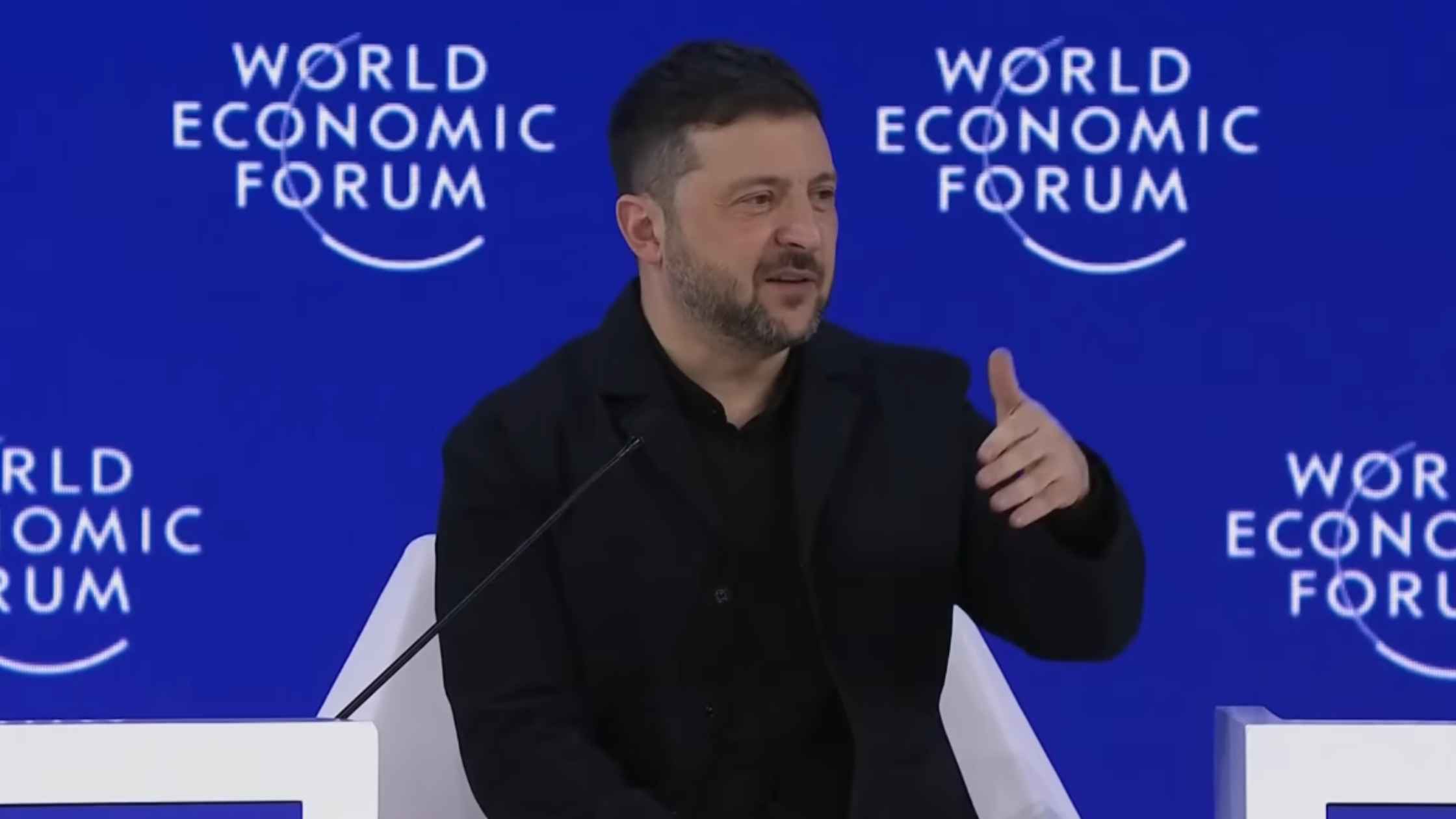
Welcome to Davos again, dear President Zelensky. Mr. President, it is really my great honor to welcome you back to Davos. This week, Ukraine and its people once again endured deadly attacks by Russia. We are approaching four years since the beginning of the full-scale invasion of Ukraine, the largest European conflict since World War II.
(00:43)
Mr. President, you have led your country through one of the most consequential periods in modern European history. Under extraordinary circumstances, Ukraine continues to defend its sovereignty, its democracy and its people while engaging the international community on questions that extend far beyond its border: the future of security in Europe, the resilience of democratic societies, the state of the rules-based international order, and the cost of inaction in the face of aggression.
(01:24)
In recent months, the United States has taken a central role in advancing diplomatic efforts aimed at ending the war, working closely with Kiev and European partners.
(01:36)
These efforts have resulted in a comprehensive 20-point peace plan aimed at laying the foundation for a just and lasting peace. And I know that President Zelenskyy just met with President Trump, and I hope that was a very, very good meeting.
(01:56)
These efforts, as I mentioned, reflect the sustained push, grounded in shared values and strategic cooperation to reach and negotiate its resolution that respects Ukraine's territorial integrity and long-term security. It's in this spirit of cooperation and with the urgency for peace that we welcome today a leader whose courage and commitment continue to shape the word... continues to shape the path forward.
(02:29)
I think you see, Mr. President, that we're all ready for your speech and that you also chose to come here in Davis during a very difficult time for you and your people. Welcome, Mr. President.
Volodymyr Zelenskyy (02:52):
Thank you very much. Dear friends, everyone remembers the great American film, Groundhog Day with Bill Murray and Andie MacDowell. Yes. But no one would want to live like that: repeating the same thing for weeks, months, and of course for years. And yet, that's exactly how we like... how we live now. And it's our life.
(03:29)
And every forum like this one proves it. Just last year here in Davos, I ended my speech with the words, "Europe needs to know how to defend itself."
(03:46)
A year has passed and nothing has changed. We are still in a situation where I must say the same words, but why? The answer is not just about the threats that exist or may appear. Each year brings something new for Europe and for the world.
(04:12)
Everyone turned attention to Greenland. And it's clear most leaders simply are not sure what to do about it. And it seems like everyone is just waiting for America to cool down on this topic, hoping it will pass away. But what if will not? What then?
(04:38)
There was so much talk about the protests in Iran, but they drowned in blood. The world has not helped enough the Iranian people, and it's true. It has stood aside. In Europe, there was Christmas and New Year celebrations, the seasonal holidays. By the time politicians came back to work and started forming a position, the Ayatollah has already killed thousands. And what will Iran become after this bloodshed? If the regime survives, it sends a clear signal to every bully: kill enough people and you stay in power. Who in Europe needs that message to become a reality? And yet, Europe hasn't even tried to build its own response.
(05:40)
Let's look at the Western Hemisphere. President Trump led an operation in Venezuela and Maduro was arrested, and there were different opinions about it. But the fact remains: Maduro is on trial in New York; sorry, but Putin is not on trial.
(05:59)
And this is the fourth year of the biggest war in Europe since World War II. And the man who started it is not only free, he is still fighting for his frozen money in Europe. And you know what? He is having some success. It's true. It's Putin who's trying to decide how the frozen Russian assets should be used. Not those who have the power to punish him for this war. Thankfully, the EU decided to freeze Russian assets indefinitely. And I'm grateful for that. Thanks, Ursula, thanks António, and all the leaders who helped.
(06:40)
But when the time came to use those assets to defend against Russian aggression, the decision was blocked. Putin managed this, yes, managed to stop Europe, unfortunately.
(06:56)
Next point. Because of the America's position, people are now avoiding the topic of the International Criminal Court. And that's understandable; it's American historical position. But at the same time, there is still no real progress on establishing a special tribunal for Russian aggression against Ukraine, against Ukrainian people.
(07:22)
And we have an agreement. It's true. Many meetings have taken place, but still Europe hasn't reached even the point of having a home for the tribunal with staff and actual work happening inside. What's missing? Time or political will. Too often in Europe, something else is always more urgent than justice.
(07:49)
Right now, we are working actively with partners on security guarantees, and I'm grateful for that. But those are for after the war ends. Once the ceasefire begins, there will be contingents and joint patrols and partner flags on Ukrainian soil. And that is very good step and the right signal that UK and France are ready to actually commit their forces on the ground, and there is already a first agreement on that. Thank you, Keir, thanks Emmanuel, and all the leaders in our coalition. And we are doing everything to make sure that our coalition of the willing truly becomes a coalition of action. And again, everyone is very positive, but, always but, but the backstop of President Trump is needed. And again, no security guarantees work without the US.
(08:53)
But what about the ceasefire itself? Who can help make it happen? Europe loves to discuss the future, but avoids taking action today, action that defines what kind of future we will have. That is the problem.
(09:12)
Why can President Trump stop tankers from the shadow fleet and seize oil, but Europe doesn't? Russian oil is being transported right along European shores. That oil funds the war against Ukraine. That oil helps destabilize Europe. So Russian oil must be stopped and confiscated and sold for Europe's benefit.
(09:39)
Why not? If Putin has no money, there is no war for Europe. If Europe has money, then it can protect its people. Right now, those tankers are making money for Putin, and that means Russia continues to push its sick agenda. Next point. I've said it before, and I'll repeat it again. Europe needs united armed forces, forces that can truly defend Europe. Today, Europe relies only on the belief that if danger comes, NATO will act. But no one has really seen the alliance in action.
(10:25)
If Putin decides to take Lithuania or strike Poland, who will respond? Who will respond? Right now, NATO exists thanks to belief, belief that the United States will act, that it will not stand aside and will help. But what if it doesn't?
(10:49)
Believe me, this question is everywhere in the minds of every European leader, and some try to get closer to President Trump.
Volodymyr Zelenskyy (11:00):
It's true. Some wait hoping the problem will disappear. Some have started acting, investing in weapons production and et cetera, building partnerships, getting public support for higher defense spending. But let's remember, until America pressured Europe to spend more on defense, most countries were not even trying to reach five percent of GDP, the minimum needed to ensure security. Europe needs to know how to defend itself. And if you send 40 or 40 soldiers to Greenland, what is that for? What message does it send? What's the message to Putin, to China? And even more importantly, what message does it send to Denmark, the most important, your close ally?
(12:08)
You either declare that European bases will protect the region from Russia and China and establish those bases or your risk not being taken seriously because [inaudible 00:12:19] or 40 soldiers will not protect anything. And we know what to do. If Russian warships are sailing freely around Greenland, Ukraine can help. We have the expertise and weapons to ensure not one of those ships remains. They can sink near Greenland just as they do near Crimea. No problem. We have the tools and we have people. For us, the sea is not the first line of defense, so we can take actions and we know how to fight there if we were asked and if Ukraine were in NATO. But we are not. We will solve this problem with Russian ships.
(13:08)
As for Iran, everyone is waiting to see what America will do. And the world offers nothing, Europe offers nothing, and doesn't not want to enter this issue at the support of the Iranian people and the democracy they need. But when you refuse to help the people fighting for freedom, the consequences return and they are always negative. Belarus in 2020 is the example. No one helped their people. And now Russian Oreshnik missiles are deployed in Belarus within range of most European capitals that would not have happened if the Belarusian people had won in 2020. And we have told our European partners multiple times, "Act now. Act now against those missiles in Belarus." Missiles are never just decoration, but Europe still remains in Greenland mode. Maybe someday someone will do something.
(14:20)
The issue of Russian oil is the same. It's good that many sanctions exist. Russian oil is getting cheaper, but the flow has not stopped. And Russian companies that fund Putin's war machine are still working and that will not change. That will not change without more sanctions. And we are grateful for all the pressure put on the aggressor. But let's be honest, Europe must do more so its sanctions block enemies as effectively as American sanctions. Why is that important? Because if Europe is not seen as a global force, if its actions don't scare bad actors, then Europe will always be reacting, catching up with new dangers and attacks.
(15:14)
We all see that the forces trying to destroy Europe do not face a single day. They operate freely, even operate inside Europe. Every victor who lives off European money while trying to sell out European interests deserves a smack upside the head. And if he feels comfortable in Moscow, it doesn't mean we should let European capitals become little Moscows. We must remember what separates Russia from all of us. The most fundamental line of conflict between Russia and Ukraine and all of Europe is this: Russia fights to devalue people, to make sure that when dictators want to destroy someone, they can. But they must lose power, not gain it. For example, Russia's missiles are produced only because there are ways to bypass sanctions. It's true. Everyone sees how Russia tries to freeze Ukrainians, now, our people, Ukrainians to death at minus 20 degrees Celcius. But Russia couldn't build any ballistic or cruise missiles without critical components from other countries. And it's not just China.
(16:47)
Too often people hide behind the excuse that China helps Russia. Yes, it does. But not only China. Russia gets components from companies in Europe, the United States and Taiwan. Right now, many are investing in stability around Taiwan to avoid war, but can Taiwanese companies stop contributing [inaudible 00:17:17] to Russia's war? Europe says almost nothing. America says nothing. And Putin makes missiles. And I think every country, of course, and every company that helps Ukraine repair its energy system... This is crucial. Thank you to all who support the PURL program, helping us by patriot missiles. But wouldn't it be cheaper and easier to just cut Russia off from the components it needs for missiles production or even destroy the factories making them. Last year, most of the time was spent talking about long range weapons for Ukraine. And everybody said that the solution was [inaudible 00:18:10] within range.
(18:12)
Now, no one is even talking about it, but Russian missiles and Shaheds are still here. And we still have the coordinates of the factories where there are made. Today, they target Ukraine. Tomorrow, it could be any NATO country. And here in Europe, we are advised not to mention Tomahawks, not to mention Tomahawks to the Americans, not to spoil the mood.
(18:50)
And we are told not to bring up Taurus missiles. When the subject is Turkey, diplomats say, "Don't offend Greece." When it's Greece, they say, "Be careful with Turkey." In Europe, there are endless internal arguments and things left unsaid that stop Europe from uniting and speaking honestly enough to find real solutions. And too often, Europeans turn against each other, leaders, parties, movements, and communities instead of standing together to stop Russia, which brings the same destruction to everyone. Instead of becoming a truly global power, Europe remains a beautiful but fragmented kaleidoscope of small and middle powers. Instead of taking the lead in defending freedom worldwide, especially when America's focus shifts elsewhere, Europe looks lost, trying to convince the U.S. president to change, but he will not change. President Trump loves who he is, and he says he loves Europe, but he will not listen to this kind of Europe.
(20:13)
One of the biggest problems in today's Europe, though it's not often talked about in the mindset, some European leaders are from Europe, but not always for Europe. And Europe still feels more like geography, history, a tradition, not real political force, not a great power. Some Europeans are really strong, head strong, but many say we must stand strong and they always want someone else to tell them how long they need to stand strong, preferably until the next election.
(20:58)
But that's not how great power works to my mind. Leaders say, "We must defend European interests, but I hope someone else will do it for them." And speaking of values, they often mean valueless. They are all like, "We need something to replace the old world order with," but where is the line of leaders who are ready to act? Act now on land, in the air, at the sea to build a new global order. You can't build the new world order out of words. Only actions create real order. Today, America has launched the Board of Peace. Ukraine was invited, so was Russia, Belarus, though the war hasn't stopped, and there is not even a ceasefire. I have seen who joined. Everyone had their
Volodymyr Zelenskyy (22:00):
... reasons. But here is the thing: Europe hasn't even formed a united position on the American idea. Maybe tonight, when the European Council meets, they will decide something. But the documents were already signed this morning and tonight, they might also finally decide something on Greenland. But last night, Mark Rutte had spoken to President Trump. Thank you, Mark, for your productiveness. America is already changing its position, but nobody knows exactly how. So things move faster than we. Things move faster than Europe. And how can Europe keep up?
(22:44)
Dear friends, we should not degrade ourselves to secondary roles, not when we have a chance to be a great power together. We should not accept that Europe is just a salad of small and middle powers seasoned with enemies of Europe, when united, we are truly invincible. And Europe can and must be a global force, not one that reacts late, but one that defines the future. That would help everyone from the Middle East to every other region in the world. That would help Europe itself, because the challenges we face now are challenges to the European way of life, where people matter, where nations matter.
(23:37)
Europe can help build a better world. Europe must build a better world and a world without war, of course. But for that, Europe needs strengths. For that, we must act together and act in time. And most of all, we must have the courage to act. And we are actively working to reach solutions, real solutions.
(24:03)
Today, we met with President Trump, and our teams are working almost every day. It's not simple. The documents aimed at ending this war are nearly, nearly ready, and that really matters. Ukraine is working with full honesty and determination, and that brings results. And Russia must become ready too, to finish this war, to stop this aggression, Russian aggression, Russian war against us. So the pressure must be strong enough, and the support for Ukraine must grow even stronger.
(24:43)
Our previous meetings with President of the United States brought us air defense missiles, and thanks Europeans, they helped also. And today, we also spoke about the protecting the skies, which means protecting lives, of course. And I hope America will continue to stand with us. And Europe must be strong, and Ukraine is ready to help with anything needed to guarantee peace and prevent destruction. We are ready to help others become stronger than they are now. We are ready to be part of a Europe that truly matters. A Europe of real power, great power. Today, we need that power to protect our own independence, but you need Ukraine's independence too, because tomorrow, you may have to defend your way of life. And when Ukraine is with you, no one will wipe their feet on you, and you will always have a way to act and act in time. This is very important. Act in time.
(25:57)
Dear friends, today is one of the last days of Davos, though definitely not the last Davos, of course. And everyone agrees on that. And many people believe that somehow things will work out on their own, but we cannot rely on somehow for real security. Faith is not enough. Faith in a partner in a lucky turn of events, no intellectual discussions are capable of stopping wars. We need action. World order comes from action, and we just need the courage to act. Without action now, there is no tomorrow. Let's end this Groundhog Day, and yes, it's possible.
(26:57)
Thank you. Slava Ukraine.
Borge Brende (27:37):
The President wanted me to sit, but I think you deserved every part of that standing ovation-
Volodymyr Zelenskyy (27:49):
Thank you so much.
Borge Brende (27:49):
... Mr. President. It is very good to have you back. How did your meeting with President Trump go?
Volodymyr Zelenskyy (28:02):
Honestly?
Borge Brende (28:04):
Of course, honestly. But of course, in the interest of your country.
Volodymyr Zelenskyy (28:09):
Yes, it was in the interest of my country. Yeah, the meeting was, I think-
Borge Brende (28:13):
I would never question that.
Volodymyr Zelenskyy (28:15):
No, no, no. The meeting was good thanks to President and thanks that he found time for us. And it's really ... Today I saw my team and they spoke with American team. And before my meeting with President Trump, my team spent a lot of time with Americans, and even I wanted to ask President Trump to give them American passports because they, yes, really spend a lot of time.
(28:47)
But be honest, I think that the meeting is very important. We need in our boat, I hope this is the boat, this is ship to peace, and we need very much to have the United States. For the future, for security guarantees, we understand that Europe has to be more stronger, but Europe will need time. And today, America is very strong. And I think that our teams worked well and come... I think this like last mile, which is very difficult, which during any dialogue with any president, I have to defend the interests of my country. That's why the dialogue is... Maybe it's not simple, but today it was positive. That's enough.
Borge Brende (29:43):
I think that's a good answer.
Volodymyr Zelenskyy (29:46):
Thank you.
Borge Brende (29:51):
We know that Jared Kushner and also special representative Steve Witkoff is traveling this afternoon to Moscow.
Volodymyr Zelenskyy (30:06):
Yeah.
Borge Brende (30:07):
I think now it is also about when Russia is ready to stop the war. And it's hard to really understand what is in the head of Mr. Putin, too. But what do you think are the current calculations in Moscow?
Volodymyr Zelenskyy (30:29):
First of all, yes, American team will go to Moscow today. Yes. They waited for our meeting with President Trump, and now they will go, and my team will meet American team. And I think that it will be the first trilateral meeting in Emirates. It will be tomorrow and the day after tomorrow. Yes, it will be two days meetings in Emirates. I hope that Emirates know about it. Yes. Sometimes we have such surprises from American side. Yeah. But in any way, they will go there. And I think this is good. If on the technical level we'll begin this trilateral meeting, I hope that we will find some... I don't know. Russians have to be ready for compromises, because everybody have to be ready, not only Ukraine. And this is important for us. So we will see what result will be, but that Russians will meet... That our guys meet today with Americans. Then Americans will meet with Russians tomorrow, today is at night. I don't know when. I don't know. Maybe Putin is sleeping. You said that nobody knows what is in his head. Yes. But-
Borge Brende (31:57):
And they might have to wait a little bit for the meeting.
Volodymyr Zelenskyy (32:00):
I don't know. I don't know. And tomorrow and the day after tomorrow, our guys will have trilateral meetings. It's better than not to have any kind of dialogue. So we are under attack. People live without electricity, and we are in a difficult situation, but Russians also in a difficult situation. We are answering on the attacks, and God bless the war will stop. I hope so.
Borge Brende (32:39):
And what is now the most difficult part for Ukraine? We know its attack on your whole energy system and electricity, but then there are also the casualties on the borders. So the humanitarian situation is
Borge Brende (33:00):
... more challenging though than a year ago.
Volodymyr Zelenskyy (33:06):
Yes. With Russia attacks energy, and they are focusing on it. This is not a secret. This is not a mistake. This is their goal to make breakouts in Ukraine. And they attack mostly civilians. They don't use a lot of missiles, these expensive missiles. What about I spoke before, they don't use it on the front. They use it against civilians, infrastructure, critical infrastructure. It's about everything, and hospitals, kindergartens, schools. But mostly, it's all about the technical things which are focusing on destroying electricity, heating systems, water supplies. Everything. Yes, this is where we are. This is the face of Russia. And really, this is the face of this war.
(34:02)
We have defending systems. We really created, I think, great ideas with drones interceptors. We'll use them. We really produce them about thousand per day. We really produce about around it. But it's not enough. It's still not enough. Russia has about 500 drones, Iranian drones, each day, and dozens of missiles, ballistic missiles. And even those systems, what partners gave us, of course they could give us more. Yes, and I spoke with President Trump today about it again. And I hope it was the last words, my last words. Like in Ukraine said, "Everybody remember only the last words." So my last words has been, several times to President Trump, "Don't forget about the air defense. Don't forget about patriots." And so, this is very important for us during this winter.
(35:12)
So I think that all of these attacks, I can't say that these attacks make us stronger because it's about our people. The people, they are surviving. They're surviving in any case. But they are heroic people, civilians and soldiers, because they are not losers of this war. And this is important. They fight for their families, houses, and of course, for the freedom. And of course.
Borge Brende (35:44):
Wow. Would you be willing to say something about the situation on the borders? The con-
Volodymyr Zelenskyy (35:52):
You mean, contact line?
Borge Brende (35:53):
Yeah, contact lines.
Volodymyr Zelenskyy (35:55):
It's Russia wants to have a border there, but it's contact line.
Borge Brende (35:59):
I'm glad you corrected me, President.
Volodymyr Zelenskyy (36:01):
No, it's okay. It's not the first time for me.
Borge Brende (36:05):
This is not okay. But coming back to the borderline, would you like to say something about that contact line?
Volodymyr Zelenskyy (36:12):
Yeah, on the-
(36:12)
Yes. Look, what we can-
(36:15)
I mean, this again, it's about technologies. And I wanted to show you, but I had some technical questions. But I wanted to show you how we work. We see online the war. We see the real enemies. We see our losses, and Russian losses. Russian losses are the biggest what they had ever. So I'm just sharing with you, the real statistic is 45,000 killed per month. So, the 5,000 soldiers. Last year, this month, it was about 14,000. So Russia is not thinking about it, but we think about it. We think how they lose and how many soldiers they lose. We know that they mobilize 40, 43,000 per month, and they begin to lose 35. From this 43, you have to know that about 10, 15% are runaway, and there are some wounded, but you can understand that their army stopped increasing. This is important, because of our drones technologies and our operators of drones. But in any way, we want to stop tomorrow this war, of course. But you have to know that if the war will continue, Russia will start begin to lose the number of the army, or Putin will decide to mobilize this country. His country, I mean.
Borge Brende (37:53):
Maybe last question, because I know you also need to go back to Kiev.
Volodymyr Zelenskyy (38:00):
It was not interesting with me yet.
Borge Brende (38:02):
Your people is behind you and showing my watch all the time. I would love to continue for another 15 minutes, Mr. President. So-
Volodymyr Zelenskyy (38:11):
But not more.
Borge Brende (38:13):
Fifteen is okay?
Volodymyr Zelenskyy (38:13):
No, no, no, no.
Borge Brende (38:13):
No. So-
Volodymyr Zelenskyy (38:14):
Okay, the last question.
Borge Brende (38:18):
So my last question, Mr. President, how can the people here at the World Economic Forum and in Davos support the most? I think you heard the applause. I think everyone wants to also show solidarity with you and the country.
Volodymyr Zelenskyy (38:39):
To defend our land, this is very expensive task. So if during economic forum, we can find as more businesses as possible, which can open offices in Ukraine. It mean that you really trust and you believe that peace will come. And that you really... Yes, a little bit risk now. A little bit. We decided at the beginning, "Be honest today." A little bit. But we need your offices and companies. It means that you believe and you trust in Ukraine, in our independent life after the war. This is the biggest chance what you can do: to invest now, to give jobs for our people. And I think this is the most important. This is real support. Not words, real support. Jobs, money, investment, come often into Ukraine.
Borge Brende (39:48):
Thank you.
Volodymyr Zelenskyy (39:49):
Thank you.