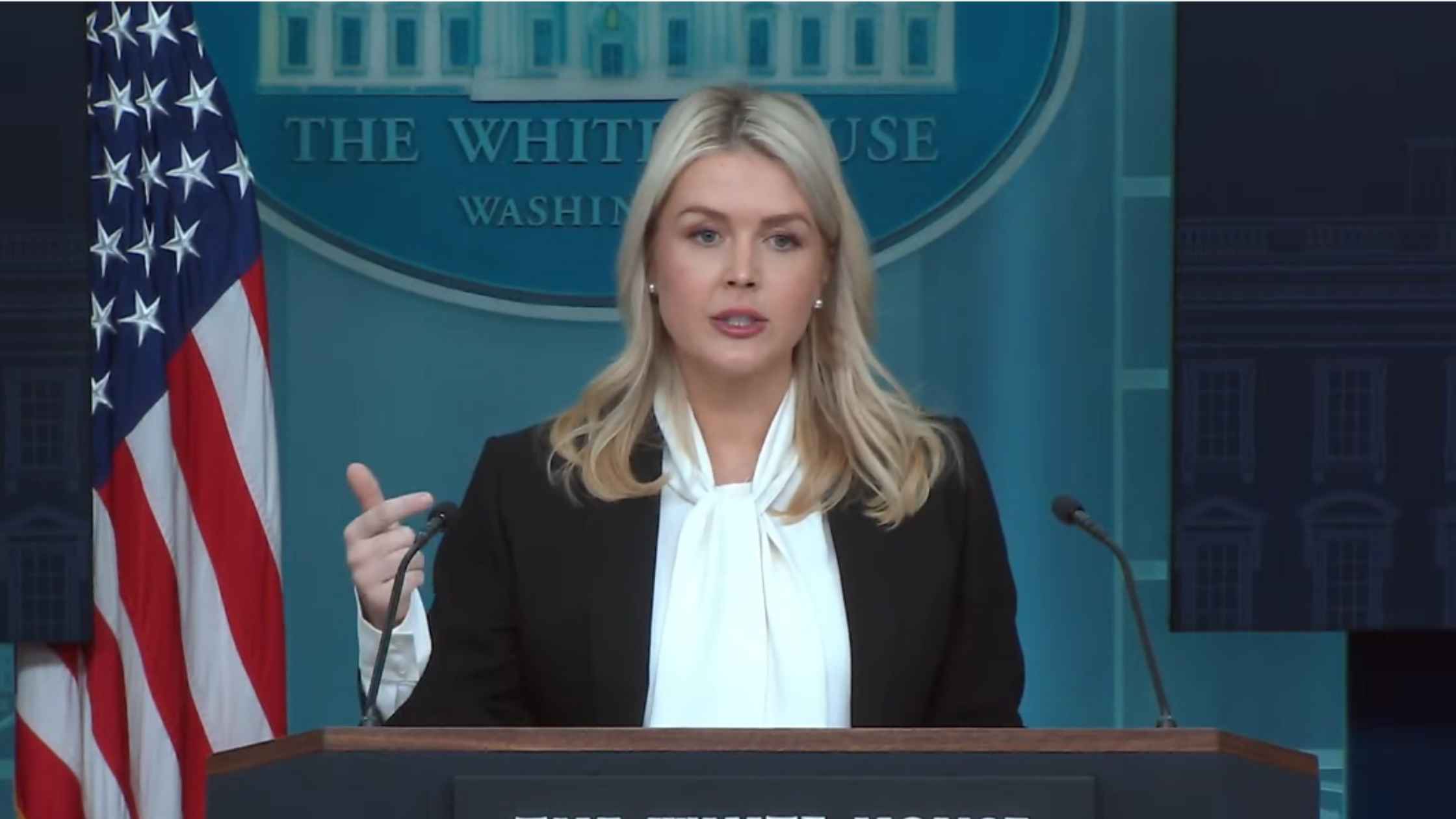
Karoline leavitt (00:05):
Good afternoon, everyone.
Audience (00:08):
Good afternoon.
(00:08)
Yeah.
Karoline leavitt (00:08):
Under the leadership of President Donald J. Trump, the rogue Iranian terrorist regime is being absolutely crushed. 47 years of tolerating and enabling the world's leading state sponsor of terrorism are over. Iran's murderous terrorist leaders are paying for their crimes against America and they are paying in blood. Since 1979, the terrorist Iranian regime has actively and intentionally facilitated the killings of Americans. They chant "Death to America" and fund other radical terrorists who attack our country and are seeking to destroy Western civilization itself. These terrorists seized our embassy and took 66 Americans hostage in Tehran. They slaughtered 241 U.S. service members with a truck bombing in Beirut. They killed and maimed hundreds of American service members in Iraq. And this is just a small fraction of their bloodsoaked record.
(01:09)
Prior leaders have been too weak and ineffective to address this threat. Some, like Barack Hussein Obama, even sent pallets of cash that ultimately financed this terrorist crusade against the United States and our people, while signing stupid and naive deals that put Iran on the path of developing nuclear bombs. After years of endless appeasement and empty statements from politicians on both sides of the political aisle in this town, President Trump is finally the man of action. President Trump is holding these monsters accountable and permanently extinguishing their nuclear ambitions. Future generations of Americans will look to this moment as the moment where the specter of a nuclear armed Iran ended.
(01:58)
At the beginning of Operation Epic Fury launched last weekend, President Trump laid out clear objectives to the American people on what the U.S. military seeks to accomplish through these major combat operations. Number one, destroy the regime's deadly ballistic missiles and completely raise their missile industry to the ground. Number two, annihilate the Iranian regime's Navy. And so far, we have destroyed more than 20 Iranian ships, including their top submarine last night, using a torpedo for the first time since World War II. There is not a single Iranian ship underway in the Arabian Gulf, straight of Hermus, or the Gulf of Oman. Number three, Operation Epic Fury will ensure the regime's terrorist proxies in the region can no longer destabilize the region or the free world and attack our armed forces. And thus far, Iran's proxies are hardly putting up a fight. Number four, this mission will guarantee that Iran can never obtain a nuclear weapon. It's safe to say that thus far, Operation Epic Fury has been a resounding success. American forces have struck more than 2,000 targets, destroying hundreds and hundreds of ballistic missiles, launchers, and drones. As the Department of War said this morning, we expect to have complete and total dominance over Iranian airspace in the coming hours, clearing the skies for our brave warriors to continue achieving these noble and long sought after objectives.
(03:28)
There's been a lot of misreporting and intellectual dishonesty from the American media on why President Trump decided to launch this operation. So let me remind you, Operation Midnight Hammer, which took place last June, obliterated Iran's three major nuclear sites, yet the terrorist Iranian regime has remained fully committed to rebuilding its nuclear program. How do we know this? Because Iran has pursued this path of war and violence despite President Trump dispatching two of his top and most trusted negotiators to engage in exhaustive and good faith negotiations to try and reach a deal.
(04:05)
And the world knows this president's preference is always peace and diplomacy first. Look no further than the eight additional global conflicts he has ended in the past year as proof. Unfortunately, the terrorist Iranian regime refused to negotiate in good faith. They chose this path of violence and destruction, and they are reaping the consequences of their horrible decision. The regime did what they always have done, they lied, they delayed. They tried to string the United States of America along. They wanted to buy themselves time to continue building ballistic missiles and other deadly weaponry that could harm our U.S. personnel and troops in the region and to continue aggressively pursuing their unacceptable nuclear ambitions.
(04:51)
U.S. negotiators offered to lift crippling sanctions on Iran and even provide nuclear fuel to Iran at no cost to support a civil nuclear power program. They additionally had the opportunity to accept U.S. support as an investor in potential projects to develop peaceful nuclear energy together under a mutually agreed upon framework. Yet in response, Iran would have to forfeit their enrichment capacity once and for all. But Iran rejected. They accepted none of these generous and unprecedented offers by the United States. Simply put, they refused to say yes to peace. And their refusal made clear that their number one priority was building a nuclear weapon with which to threaten the United States of America. Again, the country they have been chanting death to for nearly five decades.
(05:43)
Let me state this again clearly, Iran rejected the path of peace because the terrorist in charge of this regime wanted to build nuclear weapons to use against Americans and our allies. President Trump made the determination, a courageous determination and decision, that the path the United States was on with Iran had only one outcome, massive death and destruction at the hands of a nuclear armed terroristic regime. That path of death and destruction and threats against the American people have ended with Operation Epic Fury.
(06:17)
Operation Epic Fury has forged a new path that will better ensure the security of the United States and our people. The terrorists made a bet that President Trump would be like many of his predecessors, that he would just talk and he would refuse to enforce his clear red lines. But that has proven to be a catastrophic error in judgment.
(06:37)
When President Trump makes a threat, and I have reiterated that threat many times from this podium to all of you over the past year, President Trump does not bluff. The president's words are backed up by the mightiest warriors in the world who possess the most sophisticated capabilities this world has ever known. 49 and counting of the most senior Iranian regime leaders, including the supreme leader, have already been wiped off the face of the earth. Make no mistake, killing these brutal terrorists is good for America and makes the world a much safer place.
(07:13)
I want to also extend our prayers and condolences to the families of the six U.S. military service members who have been lost in Operation Epic Fury. These heroes represent the very best among us. They laid down their lives in defense of our country. And we will never forget their legacy or their sacrifice. As the president said, we grieve for these American patriots and their families as we continue the righteous mission for which they gave their lives. President Trump intends to attend the dignified transfer of these American heroes to stand in grief alongside their families. I understand the Department of War is working on scheduling this transfer, and we will provide updates at the appropriate time.
(07:54)
Finally, the Trump administration is also doing everything within our power to protect Americans in harm's way. Since the launch of Operation Epic Fury, more than 17,500 Americans have safely returned home from the Middle East, with over 8,500 American citizens returning home to the United States just yesterday alone.
(08:15)
If you are a U.S. citizen in the Middle East looking to return to the United States, the Secretary of State asks that you please register with the state department at step.state.gov. The State Department will identify where you are and provide travel options directly to you. The administration is already rapidly chartering flights, free of charge, and booking commercial options, which we expect to become increasingly available as time goes on and the success of this mission further comes to fruition.
(08:45)
I know the President and Secretary of State Rubio have been in touch as well with our allies in the region directly about this problem, making it clear that it is a priority of the United States of America to bring every American home. The Trump administration will not rest until every American is home safely and until the terrorist threat from Iran has been completely destroyed.
(09:06)
With that, I'll take your questions.
(09:08)
Eric, why don't you kick us off today? Thank you for being here.
Eric (09:10):
Karoline, thanks so much. It's great to be here. As you mentioned, Iran's regime, its leadership has largely been decimated. Do we have a sense right now of who is actually calling the shots in Iran? And we're also hearing reports that the supreme leader's son may be named his successor. Do you have any more information about that? I just had a quick follow up as well.
Karoline leavitt (09:28):
Sure. We've seen those reports as well, of course, and this is something that our intelligence agencies are closely monitoring and looking at. The truth is, we'll have to wait and see. The president has said repeatedly that the objectives of Operation Epic Fury are the four military objectives that I laid out for you previously: to destroy Iran's Navy, to destroy their ballistic missile capacity, to ensure their proxies in their region can no longer harm Americans, and to also ensure that they can never obtain a nuclear weapon.
(09:57)
As for what comes next for Iran, the president has said, of course, it's a good thing for the United States to want freedom for the Iranian people. And ultimately, we hope that freedom rests in their hands.
Eric (10:07):
Karoline, we see the Arab and Muslim nations coming under fire as well. President Trump's vision for the region has been to bring the Arab and Muslim nations to the table together, Abraham accords obviously with Israel. If this regime topples, could we see a new day in the region and really a new Middle East come out of this when the dust settles?
Karoline leavitt (10:23):
Well, the greatest deterrent to true and long-lasting peace in the Middle East has always been the rogue Iranian terrorist regime. And our Arab and Gulf partners in the nation admit that, as well as of course, our close friend in ally, Israel. We have seen all of the Arab partners in the region come together during this time. On the phone with President Trump, many of them commending him for this bold and brave action to protect American troops and our bases in the region that are housed in many of these Arab and Gulf states. And I know that many of these regional partners are contributing their air defense capabilities as
Karoline leavitt (11:00):
Well, Jordan, Bahrain, Saudi Arabia, the UAE, Qatar, Kuwait, and the President continues to be engaged with all of them. Welcome. Garrett.
Garrett (11:09):
Also, if you'll humor me. Axios, I think was the first to report this morning, this phone call between the President and Prime Minister Netanyahu, saying that Netanyahu had given the US this information about where the Ayatollah would be and that he'd be with these deputies on Saturday. How important was that information in the President making the decision to strike where and when he did?
Karoline leavitt (11:28):
I think it was important with respect to the timeline, but I think the President, prior to that phone call, had a good feeling that the Iranian regime was going to strike the United States assets and our personnel in the region. And the President was faced with a choice. Does the United States of America use our military and our capabilities to strike first to take out this threat that has been threatening our country and our people for 47 years? Or is he going to, as Commander-in-Chief, sit back and watch as the rogue Iranian regime attacks our people in the region? That's obviously an unacceptable decision. The second choice there is unacceptable to the President, which is why he made this decision. As for where the Ayatollah was going to be, that obviously had an impact on the timeline of the operation, but not quite the President's decision in its entirety.
Garrett (12:17):
And then on the way the public is viewing this, we were sitting here last week, I asked you if the President was going to make this a big part of the State of the Union, if he felt like he had to sell the possibility that he'd do strikes like this, we're now five days on. He hasn't done the traditional speech to the nation part of it. Does the President believe the country supports the actions that he's taken so far in Iran?
Karoline leavitt (12:35):
I think he does. And I think the President knows the country is smart enough to read past many of the fake news headlines produced by people in this room that this action was unjustifiable. Again, this is a rogue terrorist regime that has been threatening the United States, our allies, and our people for 47 years. And the American people are smart enough to know that, and they've also been smart enough to listen to the President himself. Not just over the past year in the second term, but during his first term as president and also for the past 40 years of his life. This is a president who has been remarkably consistent on this issue that Iran can never obtain a nuclear weapon.
(13:13)
And the President tried peace through diplomacy exhaustively and extensively. He and his team gave it their best go and the President ultimately came to the termination of that peace was not a pursuable path. The Iranian regime, they want death, they want destruction, they want to kill Americans, and that's unacceptable to this president. It's intolerable to him as Commander-in-Chief. Jackie.
Jackie (13:34):
Thank you, Caroline. Obviously seeing the update from the State Department on the 17,500 Americans that have already come back, including some 8,000 just yesterday. There are still 6,000 that are looking to get out, as I understand it. And just in the context of what you just told Garrett about the President's decision on a timeline, if he had decided to do this strike before receiving the specific intelligence about the meeting on Saturday, should there have been more done in advance of the strikes to try to get those Americans in the region resources and information to get home before day three of the war?
Karoline leavitt (14:10):
There was many sides put out by the State Department, and I wish that everyone in this room would report on them. The Secretary of State issued level four travel advisories dating back to January for many of these countries in the region. On January 14th, the US Mission to Saudi Arabia advised personnel and Americans to exercise increased caution and limit non-essential travel to any military installations. On February 11th, the US Department of State Consular Affairs shared a list of countries with level four do not travel advisories, and you can't be much more clear than that. Do not travel to these following countries.
(14:47)
On February 23rd, the US Embassy in Lebanon ordered non-emergency government personnel and family members to leave Lebanon due to safety risks, and we helped them do that.
(14:57)
On March 2nd, the State Department urged US citizens to depart Lebanon immediately.
(15:02)
With respect to Iran, on February 27th, the Secretary designated Iran as a state of sponsor of wrongful detention and stated no American should travel to Iran for any reason.
(15:13)
And again, on February 27th, the US Ambassador to Israel warned Americans to leave Iran and they provided travel advisory alerts through the US Embassy in Jerusalem.
(15:23)
So the State Department was all hands on deck on advising extreme caution and do not travel alerts to Americans in the region. With respect to the Americans who are still in the region now, again, the State Department is asking that they register at the website so they can directly identify you. And we are actively and rapidly working to charter flights. There is some commercial flights that are taking off intermittently from these countries and we plan to get Americans on board as quickly as possible, again, free of charge to them. And we have some additional measures that I think will be announced in the coming days.
(15:56)
Again, I can also reiterate from the President's perspective, this is something he's brought up directly with our allies and partners in the region that we expect their help in getting Americans home and we will do that and we will not rest until every single American is returned home safely.
Jackie (16:10):
Thank you. And then one follow up just on how people might be experiencing this at home. With respect to the economy and the cost of oils spiking, is there a need to start those Navy escorts in the Straight of Hormuz now to blunt the impact to people? And also, because Spain is a member of the EU, does that at all put a wrinkle in the President's plan for a trade embargo with them?
Karoline leavitt (16:35):
Oh, with respect to Spain, I think they heard the President's message yesterday loud and clear. And it's my understanding over the past several hours they've agreed to cooperate with the US military. And so I know that the US military is coordinating with their counterparts in Spain, but the President expects all of our European allies, of course, to cooperate in this long sought after mission, not just for the United States, but also for Europe to crush the Rogue Iranian regime that again, not only threatens America, but also threatens our European allies, as well.
(17:08)
With respect to oil prices and the economy here at home, of course, this is something that Secretary Bessent, Secretary Wright, the National Economic Council of Energy that is led by Secretary Burghum, excuse me, has been long working on and well in advance. Yesterday, President Trump announced the US Development Finance Corporation will provide political risk insurance at a very reasonable price for crude carriers and cargo ships operating in and around the Gulf.
(17:34)
And as you pointed out, Jackie, the President said if necessary and when appropriate, the US Navy will begin escorting tankers through the straight of Hormuz. I think it speaks to why this action was so necessary that ultimately, the energy industry is going to benefit from the President's actions with respect to Iran because Iran will no longer be controlling the Strait of Hormuz in restricting the free flow of energy, which as you all know, controls 20% of the world's global oil supply.
Jackie (18:03):
Thank you
Karoline leavitt (18:04):
Sure.
Speaker 1 (18:04):
Thanks, Caroline. The President said yesterday there wasn't time to make evacuation plans because this all happened so quickly. Given how critical the President has been of the chaotic evacuation from Afghanistan by the last administration five years ago, why wasn't there more of a focus on evacuation plans from the Middle East that could have been at least put in place ready to go before the strikes this weekend?
Karoline leavitt (18:31):
Again, I just laid out for you that there have been plans in place and that the State Department has been very clear to the American people traveling within this region not to travel to these regions. We gave notices to leave immediately the countries where these Americans were within and unlike the previous administration, we actually have a number. We actually have identified the number of people in the region who have requested help. We are in direct contact and engagement with them. And you have to keep in mind, there's a few thousand people who have requested assistance to come home in comparison to the millions who we understand are in the region. So we will help every single American who wants to come home if they're making that request of the State Department.
Speaker 1 (19:12):
Americans who called the State Department hotline as recently as last night were being told, "We can't help you. You have to make your own plans."
Karoline leavitt (19:20):
Well, the line was updated and I expect every single person in this room to report on that accurately so that information can be relayed appropriately to your audiences and to the American people. I think as journalists, you all have a responsibility to let them know that the line has been updated accordingly with the proper guidance because I saw many people in this room very quick to do selfie videos with the line yesterday, but not so quick to report on the corrected message today. So that is something the administration quickly worked to address and we have fixed that problem. However, we're also pointing to people to the website, again, to register so that we know exactly where you are. So when there are commercial flights moving into that area, when there are chartered flights moving into that area, we can get Americans on planes as quickly as possible.
Speaker 1 (20:05):
Do you have any details on how many charter flights have been able to get out of the region so far with Americans on board?
Karoline leavitt (20:10):
I don't have an exact count for you, but I know that we're working on chartering many flights. As soon as we were doing it yesterday, we're doing it again today. And you should not expect us to detail exactly when these flights are taking off for obvious reasons. The Iranians have shown that they are not going to hesitate to target civilians in the region, which is completely intolerable, but for safety and security reasons, we're not going to be broadcasting when flights full of Americans are going to be taking off, obviously.
Danny (20:37):
Caroline.
Karoline leavitt (20:38):
Danny.
Danny (20:38):
Caroline, at the top, you said that the Iranian regime is being absolutely crushed. Can you explicitly say, then, whether or not regime change is a goal of President Trump's operation?
Karoline leavitt (20:51):
The goals of this operation have been made very clear, Danny. And the President has said them in his speech when he launched this operation and released that video in the middle of the night to all of you and to the world. The stated military objectives of Operation Epic Fury are as follows: Eliminate Iran's ballistic missile threat, destroy their naval capability, disrupt missile and zone production infrastructure, sever their pathway and end their pathway to nuclear weapons. And I can report, as you all saw from the Pentagon today, that thus far, this operation has been remarkably successful.
(21:25)
Again, we're moving towards complete and total control of Iranian airspace. We have continuous 24/7 strike operations ongoing. We've had more than 2,000 targets that have been struck. Nearly 2,000 munitions have been employed. The first 24 hours of this campaign were described nearly as twice the scale of the 2003 Shock and Awe campaign. And we've seen that the enemy, the Iranian Rogue regime, their retaliatory strikes against the United States and the threat reduction has reduced significantly. If
Karoline leavitt (22:00):
If you look at the Iranian ballistic missile launches, they're down 86% from day one levels. So while the United States military continues to increase its complete dominance over this rogue regime, they are weakening day by day.
Speaker 2 (22:14):
Regime change is not a phrase that you would want to use?
Karoline leavitt (22:17):
Again, Operation Epic Fury... I just detailed the goals and objectives of this very quickly. But obviously as the president has said numerous times, do we want to see Iran being led by a rogue terrorist regime? No, of course not. So any day the United States of America is taking out a terrorist is a good day for our country and a good day for our people.
Speaker 3 (22:38):
So given that point that you just make about the United States wouldn't mind seeing the government overthrown... certainly President Trump has talked about wanting to see Iranians overthrow the government. Has the president considered at all kind of how he views a US role, if any, in Iran post-conflict?
Karoline leavitt (22:54):
I think it's something the president is actively considering and discussing with his advisors and his national security team. But again, right now, the focus minute by minute, hour by hour, day by day is on ensuring the quick and effective success of Operation Epic Fury. Sure. Go ahead.
Speaker 4 (23:12):
I want to ask you about the US munition stock-
Karoline leavitt (23:14):
I don't even know who's speaking because I wasn't looking at you. You can ask a question and then I'll go to you.
Speaker 4 (23:18):
I want to ask you about the US munition stockpile. President Trump posted on Truth Social on Monday that the US still has a good supply of weapons, but that we're not where we need to be. What does he mean by that? And does President Trump then want to ask on Congress to pass the supplemental to increase funding for missile interceptor systems like the ones being used to defend US bases in the Middle East from Iranian missiles?
Karoline leavitt (23:44):
I don't have any updates for you on congressional asks from the president. As you know, under this president, we have significantly increased our defense budget, which is a good thing for the United States, for our national security and for protecting our homeland. With respect to munitions, ammunition, weapon stockpiles, the United States of America has more than enough capability to not only successfully execute Operation Epic Fury, but to go much further. And we have weapon stockpiles in places that many people in this world don't even know about. However, the president in that post was pointing out that unfortunately, we had a very stupid and incompetent leader in this White House for four years who gave away many of our best weapons for nothing for free to another country very far away by the name of Ukraine. So the president was pointing out how that was an unwise decision, but nevertheless, don't doubt the strength and the might of the American military.
(24:34)
And I will also add, President Trump has rightfully been calling on defense contractors in this country to rapidly and aggressively produce American made weapons because they are the best in the world. And the president always likes to get things done as quickly as possible. And so he's been quite vocal in his efforts to try to speed up our defense industry to protect our homeland.
Speaker 4 (24:58):
Karoline, [inaudible 00:24:59]
Karoline leavitt (24:58):
Go ahead.
Garrett (25:01):
Karoline, could you tell us about the president's current thinking about ground troops and whether they could be used? If they were to be sent into Iran, what would they be used for? What's the situation?
Karoline leavitt (25:10):
Well, they're not part of the plan for this operation at this time, but I certainly will never take away military options on behalf of the President of the United States or the commander-in-chief. And he wisely does not do the same for himself. I know there's many leaders in the past who like to take options off of the table without having a full understanding of how things could develop. So again, it's not part of the current plan, but I'm not going to remove an option for the president that is on the table. Sean.
Sean (25:36):
Did the United States air strike a girls elementary school and kill 175 people?
Karoline leavitt (25:41):
Not that we know of, Sean. And the Department of War is investigating this matter. And I would just tell you very strongly, the United States of America does not target civilians, unlike the rogue Iranian regime that targets civilians, that kills children, that has killed thousands of their own people in the past several weeks and uses propaganda quite effectively. And unfortunately, many people in this room have fallen for that propaganda. So I would caution you from pointing the finger at the United States of America when it comes to targeting civilians because that's not something that these armed forces do. Reagan.
Reagan (26:14):
Thanks, Karoline. Prior to the Iran conflict, the SAVE Act was really the focus of the news cycle. Is the SAVE Act still a priority for the administration?
Karoline leavitt (26:23):
Absolutely.
Reagan (26:23):
Can you just provide an update on the administration's talks with Congress to get the SAVE Act through?
Karoline leavitt (26:29):
SAVE Act is absolutely still a priority for this president and the administration. The focus, of course, of much of the president's time right now is on ensuring the success of Operation Epic Fury, but the president can walk and shoe gum at the same time. And he's very much continuing to focus on the issues that matter here at home for the American people, including the passage of the Save Act, including on bringing down the cost of living, which is why you'll see the president in about an hour and a half at the rate payer protection pledge round table, where he will be sitting with big tech companies, with AI companies who are building in communities across the country and have pledged to pick up the cost of the electricity tab in these small towns and communities across the country, which is a great thing for American consumers.
(27:12)
So you'll be hearing from the president directly on this very important domestic agenda item later this afternoon, and it's something that he mentioned in his State of Union address. So check it off the list as another promise made and kept by this president. Sure. Go ahead.
Speaker 5 (27:26):
Thanks Karoline. I just wanted to get back to Danny's question. So those four objectives that you read out do not explicitly include regime change. If those objectives were achieved and the Islamic Republic still existed, would that be an acceptable outcome?
Karoline leavitt (27:45):
That's a hypothetical question that I'm not going to engage in. Again, right now, the president and the commander-in-chief are focused on executing the success of Operation Epic Fury, which we are already doing so in a very tremendous and impressionable way. Steven.
Steven (28:00):
Thank you, Karoline. Two questions. The Trump administration reportedly is considering arming Kurdish forces in the hopes of inspiring a popular uprising in Iran. Could you comment on that report?
Karoline leavitt (28:12):
I could comment on the fact that the president has held many calls with partners, allies, and leaders in the region, in the Middle East. He did speak to Kurdish leaders with respect to our base that we have in northern Iraq. But as for any report suggesting that the president has agreed to any such plan is completely false and should not be written.
Steven (28:35):
President Trump was saying yesterday that he is okay with someone from within taking over in Iran. He spoke about how Venezuela he saw as a successful model where Delcy Rodriguez took over and had a better relationship. Iran's President Pezeshkian, he took office in 2024 as a relative reformer. He's part of a three-man council now replacing the spring leader. Does President Trump see him as a potential successor who is more pliable?
Karoline leavitt (29:03):
Again, that's another hypothetical, and I haven't spoken to the president about this specific individual, so I don't want to get ahead of him on any assessments that should be made.
Speaker 6 (29:11):
Karoline. Karoline, thank you. Yesterday, the president acknowledged that oil prices will be a bit high. As for gas prices here in the US, what is the admin doing right now to counter that? I mean, should the skyrocket, is there a plan to help Americans right now with those higher gas prices? And then a second question. On the rash that was on the president's neck, the White House physician said it was a preventative skin cream that he was using, but why is the president using this cream? What are they trying to prevent with this cream?
Karoline leavitt (29:43):
Your second question, I don't have anything additional to add to the physician statement that we provided to all of you on those questions, but I know the statement said that the redness on the neck will dissipate within the next couple of weeks. To your first question about oil prices, thank God we have a president who has exuded American energy dominance over the past year, and an administration that is wholeheartedly focused on keeping prices stable as best as we can. Of course, this operation is temporary to protect the homeland, but crude oil prices did fall yesterday. They remain stable today after the president announced steps to ensure the stability in global energy markets. Again, those include the DEC offering reasonably priced political risk insurance and the potential for the US Navy to provide protection for the flow of energy through the Strait of Hormuz. It is the president's belief and his economic team's belief that the economy continues to be very strong. It's robust and will be able to weather any of the temporary impacts of Operation Epic Fury. John.
John (30:44):
Thanks a lot, Karoline. Just a followup to that. The timeline for making the Strait of Hormuz safe for oil tankers to transport their oil through the strait, what is that timeline and what can the president do to speed up that timeline?
Karoline leavitt (30:59):
I don't want to commit to a timeline, but certainly it's something that is being calculated actively by both the Department of War and the Department of Energy. They're working very closely. Both secretaries are in all of the briefings on this subject with the president, and this is, again, something they're monitoring. And if and when necessary, the United States Navy will provide assistance to escort oil thinkers through the strait. Sure. In the blue.
Andrew (31:26):
Thank you, Karoline.
Karoline leavitt (31:27):
You're not in blue, Andrew. Go ahead.
Speaker 7 (31:29):
Thank you.
Karoline leavitt (31:30):
Well, I guess you are, sort of. I'll go to you after.
Speaker 7 (31:33):
You had mentioned about the commercial aircraft being used for the evacuations. What about the use of military aircraft? Would that happen in conjunction with that-
Karoline leavitt (31:43):
Correct.
Speaker 7 (31:43):
... or subsequent to?
Karoline leavitt (31:45):
That is something that is definitely underway. And of course, we're going to use that in conjunction. We want as many planes, whether they're chartered, commercial, or military, taking Americans out of the Middle East and returning them safely home. So yes. Andrew, go ahead.
Speaker 7 (31:59):
Thank you, Karoline.
Karoline leavitt (32:00):
You're welcome.
Andrew (32:01):
At the top of the briefing, you listed a long list of grievances against the Iranian government, going back to the takeover of the embassy in '79, barracks bombing the '80s, et cetera. But no one from the administration has laid out the imminent threat that was supposed to be taken care of by this. And the rationales offered by, say, Secretary Rubio, the president's national security advisor, said that the threat was retaliation against American interests from Iran after Israeli strikes. The president says it was his own feeling that Iran was going to attack. Why is it that across the administration, you can't say what the imminent threat against the United States was that required us to launch this? And also, Prime
Andrew (33:00):
Prime Minister Starmer told Parliament today that his reason that he didn't allow the use of British bases was that he was not satisfied that there was a lawful basis and a viable thought through plan. Was there an attempt to provide the UK government with a legal basis for these strikes and a viable thought through plan?
Karoline leavitt (33:22):
To the first question, I completely reject the premise of your question. You have had the President of the United States, the Secretary of War, the Chairman of the Joint Chiefs, the Vice President of the United States, the Secretary of State, and now I am out here today to explain to you exactly what led the president to make the decision to launch Operation Epic Fury. And President Trump does not make these decisions in a vacuum. This decision to launch this operation was based on a cumulative effect of various direct threats that Iran posed to the United States of America. And the president's feeling based on fact that Iran does pose an imminent indirect threat to the United States of America based on the fact that they are the world's leading state sponsor of terrorism, based on the fact that they were rapidly and aggressively building up their ballistic missile program to give themselves immunity within their country alongside their navy so that inside their country, they could continue to create nuclear weapons and nuclear bombs, which would of course pose a risk to Americans in the region and even Americans one day here at home.
(34:31)
And then another point on this is the president found that through these extensive, exhaustive, failed negotiations with Iran, that they were hell-bent on death and destruction. So again, the president was not going to be just another president on a very long list who sat back and stood by and passed the buck of this direct threat to the next administration. The president had a feeling, again based on fact, that Iran was going to strike the United States, was going to strike our assets in the region, and he made a determination to launch Operation Epic Fury based on all of those reasons. And I would like the media to actually report on all of them rather than just picking soundbites from one person in this administration and saying, "Oh, they're contradicting the other person." No. Again, these decisions are not made in a vacuum. They are made by the president's feeling that Iran was going to strike the United States and our assets in the region, and he was not going to sit back and watch that happen.
(35:25)
The determination was made that the president was going to strike first alongside Israel, and that has obviously been proven to be the right decision and an effective one at that.
(35:35)
Libby. Libby, go ahead.
Libby (35:37):
Thank you, Karoline. A two part question for you here. First, has the president spoken with the family members of those U.S. service members that were killed? Second, given what you've outlined throughout this entire briefing, I mean, the United States has sunk a bunch of navy ships. We've hit all of these targets, what can Americans expect the goal to be moving forward now that the U.S. has accomplished all of this? What is victory, given we've even taken out Iran Supreme leader that was an explicit goal of this?
Karoline leavitt (36:02):
Again, victory will be determined by the Commander-in-Chief once the goals and the objectives that we have repeatedly laid out are fully realized. Again, we just, in the next few hours, we'll be achieving that dominance over the skies, which means the United States military will be raining missiles and weapons down on Iran to hit these specific targets that have been identified as crucial to take out, by the Department of War.
Press (36:26):
Karoline.
Karoline leavitt (36:26):
John.
John (36:31):
Thank you so much, Karoline. Has the U.S. posture changed in regard to a nuclear North Korea, given the latest strikes on Iran and the fact that the stated goal is to make sure that Iran is not a nuclear country?
Karoline leavitt (36:41):
I don't have any change in position with respect to North Korea today.
John (36:45):
Thank you.
Speaker 8 (36:45):
Quick follow-up. There's been reports that Ali Khamenei's son has been elected as the next Supreme leader. Does the administration think that he is a part of the same regime as his father? Would they like people in the country to uprise or rise up and get him out of power?
Karoline leavitt (37:00):
There's reports he's been elected or that he's assuming to be elected? One of the likely options?
Speaker 8 (37:05):
Pardon me, what was that?
Karoline leavitt (37:06):
That he's one of the likely options or that he has been elected? Okay. So we'll wait to confirm until someone actually is.
(37:12)
Caitlin.
Caitlin (37:13):
You just mentioned that the president is going to attend the dignified transfer for these families. Given what Secretary Hegseth said this morning, is it the position of this administration that the press should not prominently cover the deaths of U.S. service members?
Karoline leavitt (37:26):
No, it's the position of this administration that the press in this room and the press across the country should accurately report on the success of Operation Epic Fury and the damage it is doing to the rogue Iranian regime that has threatened the lives of every single American in this room. If the Iranian regime had their choice, they would kill every single person in this room. And so we can all be very grateful that we have an administration and that we have men and women in our armed forces who are willing to sacrifice their own lives for the rest of us in this room and for every American across the country and for every troop that is based in the Middle East. That's what these-
Caitlin (38:01):
Secretary Hegseth was complaining that it was front page news about these six service members who were killed.
Karoline leavitt (38:06):
That's not what the secretary said, Caitlin, and that's not what the secretary meant. And you know it. You know you are being disingenuous. There is not ... We've never had a secretary of defense. Who cares more-
Caitlin (38:16):
We're trying to get through tragic things happen. It's front page news. I get it. The press only wants to make the president look bad. Because you know we covered the deaths of U.S. service members under every president.
Karoline leavitt (38:24):
The press does only want to make the president look bad. That's a fact. Especially you. Listen to me. Especially you and especially CNN. And the Secretary of Defense cares deeply about our war fighters and our men and women in uniform. He travels all across this country to meet with them, to connect with them, and your network has hardly ever probably reported on that. You also had the Chairman of the Joint Chiefs, Chairman Cain, who's a brave patriot standing alongside the secretary at the Pentagon this morning, again expressing his condolences to these families. And I just told you that the President of the United States will be attending their dignified transfer. So please-
Caitlin (39:01):
Dignified transfer. That's not making the President look bad. That's showcasing that-
Karoline leavitt (39:05):
We expect you to cover that as you should. We expect you to cover that as you should, Caitlin. But you and your network know that you take every single thing this administration says and tries to use it to make the president look bad. That is an objectable fact.
Caitlin (39:20):
I don't think covering troop deaths is trying to make the president look bad.
Karoline leavitt (39:23):
If you're trying to argue right now that CNN's overwhelming coverage is not negative of President Donald Trump, I think the American people would tend to agree and your ratings would tend to disagree with that as well. Go ahead.
Speaker 9 (39:36):
Thank you so much. On the school strike, back to that for a minute. I understand that the U.S. does not target civilian infrastructure, that's what you said. Can you say that there's any evidence right now that it was not a U.S. strike? And then also you didn't mention Israel and that. Is there any assessment about Israel's potential likely role in that, if at all?
Karoline leavitt (39:56):
Again, the Department of War is currently investigating this matter, but again, I will reaffirm that the Department of War and the United States armed forces do not target civilians, as does the Iranian regime who kill and execute their own people.
(40:08)
Christian.
Christian (40:10):
Two on two separate issues, Karoline. First, what can you tell us about the military operation in Ecuador? And then secondly, is the president considering invoking the Defense Production Act to boost munition stockpiles while we are in this conflict?
Karoline leavitt (40:26):
It's not something I've heard the president consider, but as you know, the president has been in a pretty direct correspondence and public correspondence with defense contractors asking them to aggressively speed up their manufacturing of American made weapons, which again are the best in the world. With respect to Ecuador, I would point you back to the statement released by the U.S. Southern Command. On March 3rd, Ecuadorian and US military forces launched operations against designated terrorist organizations. These operations are a powerful example of the commitment of partners in Latin America and the Caribbean to combat the scourge of narco terrorism. And together we are taking decisive action to confront narco terrorists who have long inflicted terror, violence and corruption on citizens throughout the hemisphere. And with on that, I would also add that this weekend, I'm pleased to announce the president will welcome the heads of state from 12 nations across our western hemisphere in Miami, Florida on Saturday.
(41:21)
The point of this newfound Latin America Summit is to promote freedom, security, and prosperity in our region. The following countries will be in attendance, Argentina, Bolivia, Chile, Costa Rica, the Dominican Republic, Ecuador, El Salvador, Honduras, Panama, Paraguay, Trinidad, and Tobago, and maybe some others as well. And the president will be speaking with the leaders of this country who have really formed a historic coalition to work together to address criminal narco terrorist gangs in cartels, and counter illegal and mass migration into not only the United States, but the Western Hemisphere, which remains a key and top priority of this president. Thank you very much everyone, and you'll see the president yourselves in an hour.
Press (42:05):
Thank you, Karoline.