









Speaker 1 (01:13):
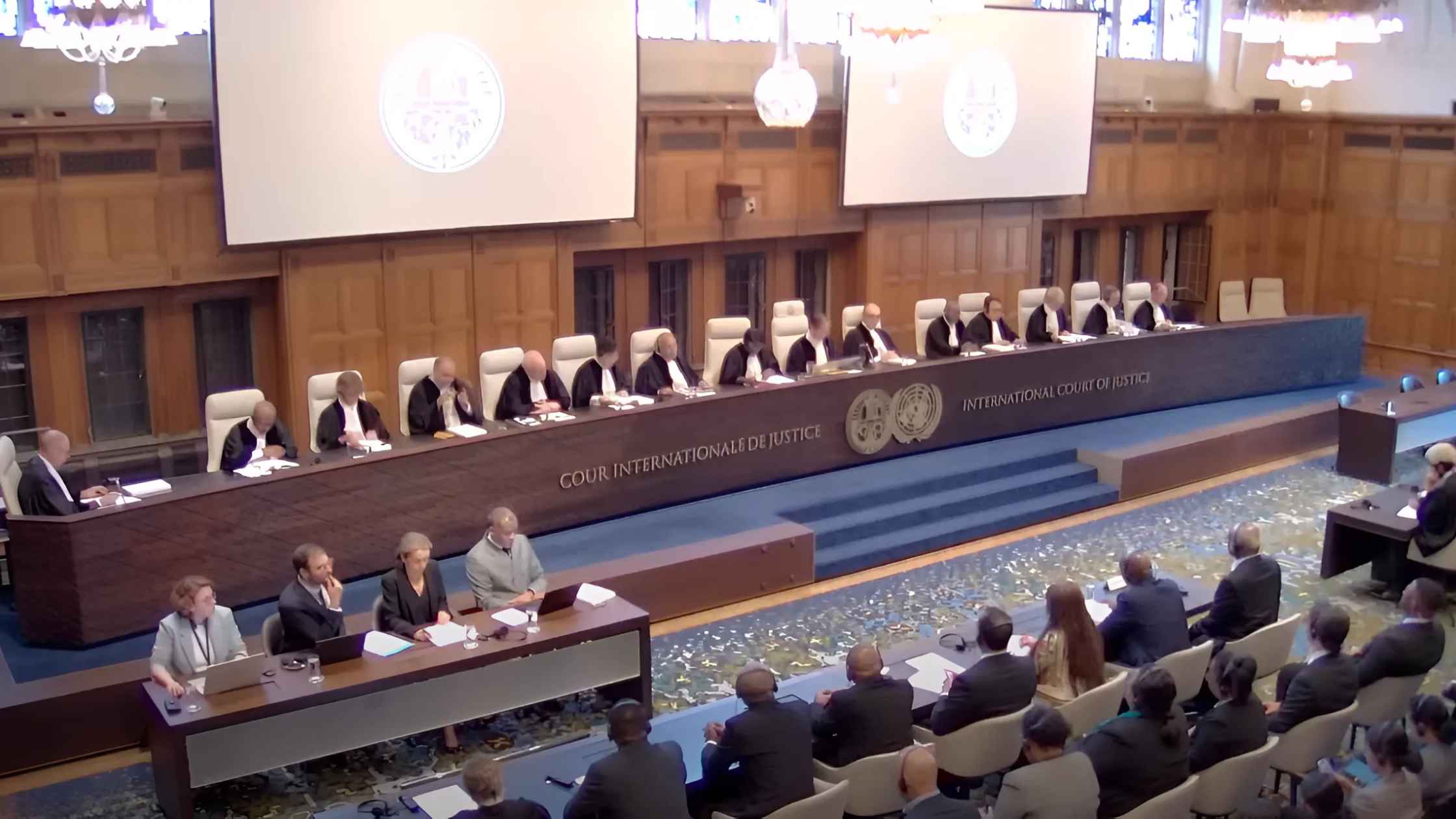
Please be seated. The sitting is open. The court meets today pursuant to Article 67 of the statute to deliver its advisory opinion on the request submitted by the General Assembly of the United Nations on the question of the obligations of States in respect of climate change. I note the presence of His Excellency Philemon Yang, president of the 79th session of the United Nations General Assembly in the Great Hall of Justice today, in addition to the representatives of the many States and international organizations that have taken part in these proceedings. The questions on which the advisory opinion of the court has been requested is set forth in Resolution 77/276, adopted by the United Nations General Assembly on 29 March 2023. By a letter dated 12 April 2023, the Secretary General of the United Nations officially communicated to the court the decision taken by the General Assembly to request a court to render an advisory opinion.
(02:36)
The final paragraph of the resolution reads as follows, I quote, "The General Assembly decides, in accordance with Article 96 of the Charter of the United Nations, to request the International Court of Justice pursuant to Article 65 of the statute of the court to render an advisory opinion on the following question. Having particular regard to the Charter of the United Nations, the International Covenant on Civil and Political Rights, the International Covenant on Economic Social and Cultural Rights, the United Nations Framework Convention on Climate Change, the Paris Agreement, the United Nations Convention on the Law of the Sea, the duty of due diligence, the rights recognizing that United Universal Declaration of Human Rights, the principle of prevention of significant harm to the environment, and the duty to protect and preserve the marine environment."
(03:50)
"A. What are the obligations of States under international law to ensure the protection of the climate system and other parts of the environment from anthropogenic emissions of greenhouse gases for States and for present and future generations."
(04:12)
"B. What are the legal consequences under these obligations for States where they, by their acts and omissions, have caused significant harm to the climate system and other parts of their environment, with respect to:"
(04:32)
"1. States, including, in particular, small island developing States, which due to their geographical circumstances and the level of development, are injured or specifically affected by or are particularly vulnerable to the adverse effects of climate change."
(04:55)
"2. Peoples and individuals of the present and future generations affected by the adverse effects of climate change."
(05:10)
In accordance with the usual practice, I shall not read out the introductory paragraphs of the opinion. These paragraphs set out the main elements of the procedural history of the proceedings. I shall also omit or summarize some of the other paragraphs of the opinion. I shall therefore begin the reading of the advisory opinion at paragraph 37. The full text of the opinion will of course be available at the close of the seating. When seized of a request for an advisory opinion, the court must first consider whether it has jurisdiction to give the opinion requested. And if so, whether there is any reason why the court should, in the exercise of its discretion, decline to answer the request.
(06:09)
The first question put to the court concerns the obligation of States and the international law to ensure the protection of the climate system and other parts of the environment from anthropogenic emissions of greenhouse gases, which I shall refer to as GHGs, for States and for present and future generations. The second question concerns the legal consequences under these obligations for States where they, by their act and omissions, have caused significant harm to the climate system and other parts of the environment with respect to States and peoples and individuals of the present and future generations affected by the adverse effects of the climate change. The court considers that these questions are legal questions. The court concludes that it has jurisdiction to render the requested opinion. It then concludes that there is no compelling reason for it to decline to give the opinion requested by the General Assembly.
(07:24)
Turning to the relevant scientific background, the court notes that the consequences of climate change is severe and far-reaching, they affect both natural ecosystems and human populations. These consequences underscore the urgent and existential threat posed by climate change. In its examination of the scientific aspect, the court relies primarily on the reports of the Intergovernmental Panel on Climate Change, which I shall refer to as the IPCC. Participants agree that these reports constitute the best available science on the causes, nature, and consequences of climate change. The court further observes that the adverse effects of climate change on the climate system have been acknowledged by the United Nations, including UNEP, and it's [inaudible 00:08:32] the agencies such as the WMO, WHO, and the IMO.
(08:39)
The IPCC defines the climate system as the global system consisting of five major components, the atmosphere, the hydrosphere, the cryosphere, the lithosphere, and the biosphere, and the interactions between them. For the purposes of this advisory opinion, the court notes that this definition is substantially equivalent to that of Article I, Paragraph III of the United Nations Framework Convention on Climate Change, which I shall refer to as the Framework Convention. Article I, Paragraph III of the Convention defines the climate system as the totality of the atmosphere, hydrosphere, biosphere and geosphere and their interactions. The IPCC has concluded, with very high confidence, that risks projected adverse impacts and related loss and damage from climate change will escalate with every increment of global warming. It added that these risks projected adverse impacts and related loss and damage are higher for global warming of 1.5°C than at present and even higher at 2°C.
(10:21)
Indeed, in 2018, the IPCC concluded, with high confidence, that, I quote, " Warming of 1.5°C is not considered safe for most nations, communities, ecosystems, and sectors and poses significant risks to natural and human systems." The court then turns to the scope of the questions posed by the General Assembly. Regarding their material scope, the court considers that the two questions put to it are interrelated and require the court to identify the obligation of States in respect of activities that adversely affect the climate system as well as the legal consequences arising from the breach of these obligations. In this regard, the court is further of the view that the relevant conduct for the purposes of these advisory proceedings is not limited to conduct that itself directly result in GHG emissions, but rather comprises all actions or omissions of States which result in the climate system and other parts of the environment being adversely affected by anthropogenic GHG emissions. The court considers that the material scope of its inquiry encompasses the full range of human activities that contribute to climate change as a result of the emission of GHGs, including both consumption and production activities.
(12:25)
Turning to the territorial scope of the request, it follows from the Court's conclusions on the material scope of the questions put to it that the General Assembly did not intend to impose any territorial limits to the court's inquiry. The court is requested to formulate its reply not in respect of any particular territory or regions, but in global terms, especially since GHG emissions are unequivocally caused by human activities which are not territorially limited. With regard to the temporal scope of the request, the court observes that while temporal issues may be particularly relevant for an incongruity assessment of the responsibility of States for breaches of obligations pertaining to the protection of the climate system, the present opinion is not concerned with the invocation and determination of the responsibility of individual States or group of States. Rather, the present opinion considers the legal obligation of all States under question A and identifies the relevant legal regime applicable to legal consequences arising under those legal obligations in its reply to question B.
(14:08)
Concerning the scope of question A, the court notes that the unqualified reference to obligations under international law indicates the intention of the General Assembly to seek the court's opinion on the obligations incumbent upon states under the entire corpus of international law and not to limit the court's reply to any particular source or area of international law. With regard to the scope of question B, the court observes that this question is connected with question A insofar as it refers to the obligations enumerated in question A. Thus, the legal consequences to be determined by the court are those arising from the various obligations under international law which the court is called upon to identify under question A. In the court's view, nothing in question B indicates that the General Assembly intended to request the court to opine on the legal consequences, if any, for injuries arising out of acts not prohibited by international law.
(15:30)
The court considers that it has been requested to address legal consequences in a general manner and that it is not called upon to identify the legal responsibility of any particular State or group of States. It also bears noting in this context that the responsibility of individual States or group of States requires an incongruity assessment that must be undertaken on a case-by-case basis. In its view, in relation to question B, the court is only called upon, first, to establish the applicable legal framework of State responsibility in respect of States that have breached their obligations to protect the climate system, and second, to outline in general terms the legal consequences flowing therefrom. In doing so, the court does not prejudge the merits of any future claims that may be brought in relation to the subject matter of the present proceedings before courts or tribunals.
(16:53)
As for legal consequences with the respect to certain category of States that are especially affected or are particularly vulnerable, the court notes that the application of rules of state responsibility under custom international law does not differ depending on the category or status of an injured State. Thus, specifically affected States or States that are particularly vulnerable are, in principle, entitled to the same remedies as other injured States. The challenges faced by certain States, owing to their geographical circumstances and level of development, are governed by the relevant primary rules of international law and thus will be addressed by the court in relation to the relevant obligations of States under question A. The court observes that the second part of question B inquires about the legal consequences with the respect to peoples and individuals of the present and future generations affected by the adverse effects of climate change. The court considers that whether individuals have any entitlement to invoke the legal responsibility of States or to make a claim in a particular circumstance involving injury or harm arising from climate change is dependent on the relevant primary obligations of States. Having defined the scope and meaning of the questions posed by the General Assembly, the court then addresses question A. And begins by considering the applicable law. In its request, General Assembly invites the court to have particular regard to, I quote, "The Charter of the United Nations, the International Covenant on Civil and Political Rights, the International Covenant on Economic Social and Cultural Rights, the United Nations Framework Convention on Climate Change, the Paris Agreement, United Nations Convention on the Law of the Sea, the duty of due diligence, the rights recognized in the Universal Declaration of Human Rights, the principle of prevention of significant harm to the environment, and the duty to protect and preserve the marine environment."
(19:57)
The phrase particular regard to, while indicating that the wide range of international legal rules and principles are potentially relevant, that does not mean that the General Assembly requests the court to address every rule of international law, including the obligations contained therein is in respect of climate change. The court therefore identifies the most directly relevant, applicable law governing the questions of which it has been seized. It first identifies those rules which are most directly relevant and thereafter determines whether any of those rules are excluded by virtue of the interpretative principle of the [inaudible 00:21:01]. The court begins with the Charter of the United Nations, which is a pillar of contemporary international law. The Charter provides that the member States shall act in accordance with certain principles such as the fulfillment in good faith of the obligations assumed by States under the Charter, including when addressing problems of common concern such as climate change. Accordingly, Charter forms part of the most directly relevant applicable law.
(21:39)
The court then turns to the applicability of the climate change treaties. It observes that the Framework Convention, the Kyoto Protocol, and the Paris Agreement are the principle legal instruments regulating the international response to the global problem of climate change. These instruments complement each other. Framework Convention establishes the ultimate objective as well as the basic principles and general obligations of States in respect of climate change. Whereas the Kyoto Protocol and Paris Agreement respectively translate these basic principles and general obligations into a set of more specific interrelated obligations, each of which gives expression to a broad, practical approach of the community of States parties to the problem of climate change. The court thus concludes that the three climate change treaties, namely the Framework Convention, the Kyoto Protocol, and the Paris Agreement form part of the most directly relevant applicable law. In view of the court, UNCLOS also forms part of the most directly relevant applicable law.
(23:13)
With respect to other environmental treaties, the court considers that the following treaties form part of the most directly relevant applicable law given their close connection with the issue of climate change. The Vienna Convention for the Protection of the Ozone layer, which I shall refer to as the Ozone Layer Convention. The Montreal Protocol on Substances that Depletes the Ozone Layer, which I shall refer to as the Montreal Protocol. The Convention on Biological Diversity, which I shall refer to as the Biodiversity Convention. And the United Nations Convention to Combat Desertification in those countries experiencing serious drought and/or desertification, particularly in Africa, which I shall refer to as the Desertification Convention.
(24:20)
The court is aware that there are many other treaties which are relevant for their efforts of the [inaudible 00:24:27] community of States to address the global problem of climate change. However, it confines itself to examining the most directly relevant applicable law regarding climate change. The court then goes on to consider the applicability of the relevance of customary international law. In the advisory opinion on the legality of the threat or use of nuclear weapons, the court affirmed that the duty to prevent significant harm to the environment is not confined to instances of direct cross-border harm and that it applies to global environmental concerns. In the court's view, the customary duty to prevent significant harm to the environment also applies with respect to the climate system and other parts of the environment.
(25:29)
The duty to prevent significant harm to the environment is an obligation to act with due diligence. The conduct required by due diligence has several elements to which I shall return later. Determination of what is required by due diligence ultimately calls for an assessment in concreto of what is reasonable under the specific circumstances in which a State finds itself. However, this does not exclude the identification of a required standard of conduct at the general level depending on the overall character of the risk to the parts of the environment in question. This is particularly opposite with respect to climate change because the specific character of the risk of significant harm to the climate system is indisputably established. Climate change poses a quintessentially universal risk to all States. This risk is of a general and urgent character requiring the identification of a corresponding general standard of conduct to be applied subject to the principle of common but differentiated responsibility and respective capabilities.
(27:10)
Under these circumstances, the court recognizes that the standard of due diligence for preventing significant harm to the climate system is stringent. As concerns of climate change, a heightened degree of vigilance and prevention is required. The court concludes that the duty of States to prevent significant environmental harm applies in the context of climate change and that this duty forms part of the most directly relevant, applicable law. Concerning the duty to cooperate, the court recalls that it lies at the core of the Charter of the United Nations and has been spelled out in the Foundational Declaration on Friendly Relations. Court has held that the adoption by States of this text affords an indication of their opinions as to custom international law. That observation also applies to the duty to cooperate insofar as it finds expression in many binding and non-binding instruments relating specifically to the environment.
(28:40)
The duty to cooperate is a central obligation under the climate change treaties and other environmental treaties. In view of the related practice of States, the court considers that the duty of States to cooperate for the protection of the environment is a rule whose customary character has been established. This duty to cooperate is intrinsically linked to the duty to prevent significant harm to the environment because uncoordinated individual efforts by States may not lead to a meaningful result. It also derives from the principle that the conservation and management of shared resources and environment are based on shared interests and governed by the principle of good faith. For these reasons, the court considers that the duty to cooperate for the protection of the environment forms part of the custom international law and can also serve as a guiding principle for the interpretation of other rules. It forms part of the most directly relevant, applicable law.
(30:07)
Turning to Human Rights Law. The court considers that the core human rights treaties and the human rights recognized under custom international law form part of the most directly relevant, applicable law. The court then examines whether certain principles are part of the applicable law for the purposes of the present advisory opinion. It concludes that the principles of sustainable development, common but differentiated responsibilities and respective capabilities, equity, intergenerational equity, and the precautionary approach or principle are applicable as guiding
Speaker 1 (31:00):
… Guiding principles for the interpretation and application of the most strictly relevant legal rules. The court finally turns to the question of whether any of the rules identified above are excluded by virtue of the interpretative principle of lex specialis. This question concerns the relationship between the climate change treaties and other rules of international law. The court notes at the outset that it is a generally recognized principle that when several rules bear on a single issue, they should, to the extent possible, be interpreted so as to give rise to a single set of compatible obligations. The principle of lex specialis is a maxim of interpretation that is used for determining which of several potentially applicable rules is to prevail or whether the rules simply coexist. The application of the lex specialis principle depends on the circumstances of each case.
(32:23)
The court cannot find any actual inconsistency between the provisions of the climate treaties and other rules and principles of international law that may be relevant for the response to question A. On the contrary, the preambles to the Framework Convention and the Paris Agreement themselves contain references to other rules and principles. The state parties to these treaties have thereby recognized that climate change constitutes a problem for food solution other rules and principles also play a role. Nor can the court identify a discernible intention of the parties to the climate change treaties generally to displace other possibly applicable rules or principles. There is, in particular, no indication that the climate change treaties are meant to apply while simultaneously excluding general custom international law or other treaty rules on the protection of the environment. For these reasons, the court considers that the argument, according to which the climate change treaties constitute the only relevant, applicable law cannot be upheld and finds that the principle of lex specialis does not lead to a general exclusion by the climate change treaties of other rules of international law.
(34:09)
The court emphasizes that it has determined only the applicable law, which is most greatly relevant for answering question A put to it by the General Assembly. This determination is without prejudice to other rules of international law that may also be relevant under various circumstances in the context of climate change. The court then turns to the obligation of states under the climate change treaty framework, which comprises three legal binding instruments concluded by states to address the problem of climate change caused by anthropogenic GHG emissions, namely the Framework Convention, the Kyoto Protocol, and the Paris Agreement.
(35:10)
The court takes into consideration the rules, principles, mechanisms, and institutions established under the climate change treaties in order to identify and clarify the obligation of the parties. In this context, the key principles that permeate all three climate change treaties are those contained in Article III of the Framework Convention. These guiding principles include common but differentiated responsibilities and respective capabilities, the precautionary approach of principle, sustainable development, equity, and intergenerational equity. The court recalls that while these principles do not constitute stand-alone obligations within the climate change treaty framework, they guide the interpretation of the treaty obligations. In interpreting their obligations under the climate change treaties, states also need to have recourse to the relevant decisions of the governing bodies of these treaties, which are the conference of the parties of the Framework Convention, the conference of the parties serving as the meeting of the parties to the Kyoto Protocol, and the conference of the parties serving as the meeting of the parties to the Paris Agreement.
(36:49)
The court observes that in certain circumstances the decision of these bodies have certain legal effects. First, when the treaty so provides the decision of conference of parties may create legally binding obligations for the parties. Second, decisions of these bodies may constitute subsequent agreements under Article 31 paragraph 3A of the Vienna Convention on the Law of Treaties insofar as such decisions express agreement in substance between the parties regarding the interpretation of the relevant treaty. The court observes that it's not required to address each and every obligation of the parties under the climate change treaties. It focuses its inquiry on the main obligations of states under the Framework Convention, the Kyoto Protocol, and the Paris Agreement pertaining to the obligation to protect the climate system from anthropogenic GHC emissions, which it considers may be grouped broadly into obligations of mitigation, adaptation, and cooperation. Concerning the relationship between the Framework Convention, the Kyoto Protocol, and the Paris Agreement, the court observes with respect to the applicability of lex posterior rule that it is only where the treaties are incompatible, i.e., their obligations cannot be complied with simultaneously, that the later-in-time obligations will supersede the earlier obligations.
(38:54)
The mere fact that the treaties regulate the same subject matter does not necessarily constitute a conflict or result in one superseding the other. In the view of the court, there is no incompatibility between the three climate change treaties. On the contrary, they are mutually supportive with the Kyoto Protocol and Paris Agreement providing greater specification to the general obligations contained in the framework convention. The court turns to the obligation of parties under the Framework Convention. It observes that the Framework Convention provides a general framework for addressing the problem of climate change caused by anthropogenic GHG emissions. In this connection, the Framework Convention addresses the full range of GHGs with exception of those already controlled by the Montreal Protocol.
(40:08)
The ultimate objective of the Framework Convention and set out in Article II is to achieve stabilization of GHG concentrations in the atmosphere at the level that would prevent dangerous anthropogenic interference with the climate system and to ensure that such a level should be achieved within a timeframe sufficient to allow ecosystems to adapt naturally to climate change to ensure that food production is not threatened and to enable economic development to proceed in a sustainable manner. A key feature of the Framework Convention is the distinction it draws between developed country parties and developing country parties, which are subject to differing obligations. The Framework Convention accomplishes this by providing for specific additional obligations on certain developed country parties and other parties listed in Annex I, which I shall refer to as Annex I parties. The main obligations under the Framework Convention concerning mitigation are to be found in Article IV paragraph one.
(41:41)
The court observes that certain obligations under this provision such as those to develop, update, publish, and make available national inventories of anthropogenic GHG emissions and removals by sinks, the obligation to formulate and publish national programs and obligation to communicate information to the COP are obligations of result. Other obligations under Article IV paragraph one are obligations of conduct because they do not require parties to bring about a particular result, but rather require parties to use their best efforts to achieve certain results relating to mitigation. In the court's view, the obligations under Article IV paragraph one are interconnected obligations of conduct and result. The court further observes that Article IV paragraph two sets forth a number of distinct but interrelated mitigation obligations that are legally binding for Annex I parties. The court finds it necessary to recall that all obligations identified are legally binding upon the parties to which they pertain regardless of whether the obligation in question is one of result or one of conduct.
(43:25)
As the court has observed, the distinction between obligation of conduct and obligation of result is not necessarily a strict one. It must be stressed that both types of obligations may result in the responsibility of a state for breach of the relevant obligation. With regard to adaptation obligations under the Framework Convention, the court observes that adapting to the adverse effects of climate change is, along with mitigation, a major area of action for parties under the Framework Convention. Several provisions of the Framework Convention refer to obligations relating to adaptation. These provisions, like all provisions in Article IV paragraph one, are introduced with the term shall and are legally binding in nature. While the aforementioned obligations pertain to all parties, article IV paragraph four of the Framework Convention provides that Annex II parties shall assist the developing country parties that are particularly vulnerable to the adverse effects of climate change in meeting the cost of adaptation to those diverse effects. This is a legally binding obligation on all parties that are listed in Annex II.
(45:09)
The court further observes that the Framework Convention establishes an obligation for parties to cooperate in different areas, including in mitigation and adaptation. The court considers that international cooperation is indispensable in the field of climate change and that the customary duty to cooperate for the protection of the environment is reflected in several provisions of the climate change treaties. The duty to cooperate is an obligation of conduct, the fulfillment of which is assessed against a standard of due diligence. The court then turns to the Kyoto Protocol to the Framework Convention, the court notes that the absence of a new commitment after 2020 does not deprive the Kyoto Protocol of its legal effect. Kyoto Protocol remains in force and the provisions may still serve as inter alia, one, interpretative aids for the identification of the obligations under the climate change treaty framework and, two, substantive provisions to assess the compliance of Annex B parties with applicable emission reduction targets, i.e., to determine whether a state during the relevant commitment period has complied with its emission reduction commitments.
(46:56)
Thus, no compliance with emission reduction commitments by a state may constitute an internationally wrongful act. The court then addresses the obligation of state parties to the Paris Agreement. As a general matter, the court notes that while the Paris Agreement provides for limiting the global average temperature increase to well below two degrees Celsius above pre-industrial levels as a goal and to 1.5 degrees Celsius as an additional effort, 1.5 degrees Celsius has become the scientifically based consensus target under the Paris Agreement. In this connection, the court refers to decisions of the meeting of the parties to the Paris Agreement. In the court's view, these decisions express the agreement in substance between the parties regarding the interpretation of articles two and four of the Paris Agreement, and thus constitute subsequent agreements in relation to the interpretation of the Paris Agreement within the meaning of Article 31 paragraph 3A of the Vienna Convention on the Law of Treaties. Accordingly, the court considers that 1.5 degrees Celsius threshold to be the party's agreed primary temperature goal for limiting the global average temperature increase under the Paris Agreement.
(48:45)
The court notes that the principle of common but differentiated responsibilities and respective capabilities has been formulated differently in the Paris Agreement through the addition of the phrase, I quote, in the light of different national circumstances, end of quote. In the view of the court, the additional phrase does not change the core of the principle of common but differentiated responsibility and respective capabilities. Rather, it adds nuance to the principle by recognizing that the status of a state that developed or developing is not static. It depends on an assessment of the current circumstances of the state concerned.
(49:45)
The court also notes that the Paris Agreement contains several obligations of conduct and obligations of result, which are mutually supportive. With regard to obligation of conduct, parties are required to act with due diligence. Thus, the compliance of parties with their obligation of conduct under the Paris Agreement is assessed on the basis of whether the party in question exercised due diligence and employed best efforts by using all the means at its disposal in the performance of that obligation. The court turns to mitigation obligations under the Paris Agreement. It recalls that mitigation involves human intervention to reduce emissions or enhance carbon sinks. The court notes that the mitigation obligation of state parties and that the Paris Agreement are set out in Article IV. The court observes that the achievement of the temperature goal set out in Article II of the Paris Agreement constitute, in addition to the object and purpose of the agreement, the context relevant for the interpretation of other obligations found elsewhere in the Paris Agreement such as the mitigation obligation under Article IV.
(51:27)
The Paris Agreement reinforces the obligations relating to the promotion and enhancement of carbon sinks and reservoirs set forth in Article IV of the Framework Convention. To achieve its objectives, Paris Agreement establishes obligations concerning nationally determined contributions, which I shall refer to as NDCs, whereby parties outline and communicate their climate actions. Under Article IV paragraph two, each party must first prepare, communicate, and maintain the successive NDCs that intends to achieve and, second, parties must pursue domestic mitigation measures with the aim of achieving the objectives of such contributions. This provision set forth two binding legal obligations which must be performed by parties individually. In respect of the obligation to prepare, communicate, and maintain successive NDCs, the court observes that this obligation is procedural in nature and constitutes an obligation of result. Therefore, the failure to prepare, communicate and maintain successive NDCs to account for them and to register them would constitute a breach of the obligations set out in Article IV of the Paris Agreement. The mere formal preparation, communication, and maintenance of successive NDCs is not sufficient to comply with the obligations under Article IV.
(53:34)
The court then turns to the question of whether and the extent to which the content of the NDCs is left to the discretion of each party under the scheme of the Paris Agreement. The court considers that this question depends on the interpretation of Article IV. First, the clause in Article IV paragraph three, which states that each party's successive NDCs will represent a progression beyond that party's current NDCs means that the party's NDCs must become more demanding over time. Second, a party's NDCs must reflect its highest possible ambition. While this term is not defined in the Paris Agreement, the court considers that the level of ambition to be reflected in a party's NDCs has not been left entirely to the discretion of the parties. The provision reveals that the content of a party's NDCs must be capable of making an adequate contribution to the achievement of the temperature goal.
(54:59)
In light of the above, the court considers that the discretion of parties in the preparation of their NDCs is limited. As such, in the exercise of their discretion, parties are obliged to exercise due diligence and to ensure that their NDCs fulfill their obligations under the Paris Agreement. In the current context, because of the seriousness of the threat posed by climate change, the standard of due diligence to be applied in preparing NDCs is stringent. This means that each party has to do its utmost to ensure that the NDCs it puts forward represent its highest possible ambition in order to realize the objectives of the agreement. The obligation to prepare and communicate NDCs applies to all parties. However, consistent with the varying character of due diligence and the practice of common but differentiated responsibilities and respective capabilities, the standard to be applied when assessing the NDCs of different parties will vary depending, inter alia, on historical contributions to cumulative GHG emissions and the level of development and national circumstances of the party in question.
(56:46)
In light of the foregoing, the court concludes that rather than being entirely discretionary, as some participants argued, NDCs must satisfy certain standards under the Paris Agreement. All NDCs prepared, communicated, and maintained by parties under the Paris Agreement must, when taken together, be capable of realizing the objectives of the agreement which are set out in Article II. A court turns next to the obligations contained in the second sentence of Article IV paragraph two, which concerns the implementation of NDCs and domestic mitigation measures. The court underlines that the obligation for parties to pursue domestic mitigation measures is substantive in nature and creates individual obligations for each party to the agreement. Moreover, this obligation is one of conduct and not of result. Accordingly, parties are required to act with due diligence in taking necessary measures to achieve the objectives set out in their successive NDCs.
(58:22)
In the present instance, the court considers that the standard due diligence attaching to the obligation to pursue domestic mitigation measures is stringent on account of the fact that the best available science indicates that the risks and projected adverse impact and related loss and damage from climate change escalate with every increment of global warming. Turning to adaptation obligations under the Paris Agreement, the court finds that specific obligations pertaining to adaptation are contained in Article VII, paragraph nine of the Paris Agreement. This provision imposes legally binding obligations upon the parties to undertake adaptation planning actions. The court considers that the fulfillment of parties adaptation obligations is to be assessed against a standard of due diligence. It is therefore incumbent upon parties to enact appropriate measures that are capable of enhancing adaptive capacity, strengthening resilience, and reducing vulnerability through climate change.
(59:52)
In this connection, parties must use their best possible efforts in line with the best available signs. Finally, the court observes that the adaptation obligations under the Paris Agreement complement the mitigation obligations in preventing and reducing the harmful consequences of climate change. Next, the court notes that the Paris Agreement establishes obligations of cooperation with respect to specific issue areas such as adaptation and loss and damage. As observed earlier in respect of the obligation to cooperate under Framework Convention, such obligations exist for states both under conventional international law, including Article 7, 9, 12 of the Paris Agreement and Customary International Law.
(01:00:59)
These coexisting obligations inform each other, and in the present instance the court considers that the customary duty to cooperate for the protection of the environment reinforces the treaty-based cooperation obligations under the Paris Agreement. The court notes that states are free to select the means of cooperating as long as such measures are consistent with the obligations of good faith and due diligence. The court considers that the principal forms of cooperation prescribed by the Paris Agreement of financial assistance, technology transfers, and capacity building. For all these reasons, the court considers that the climate change treaties establish stringent obligations
Speaker 1 (01:02:00):
… I want states to ensure the protection of the climate system and other parts of the environment from anthropogenic GHG emissions. The court then turns to the obligation of states under customary international law relating to climate change. With regard to the duty to prevent significant harm to the environment, the court considers that it also applies to the climate system, which is an integral and vitally important part of the environment, and which must be protected for present and future generations.
(01:02:48)
There are two main elements of this duty. The environment harm to be prevented and due diligence as the required standard of conduct. For the duty to prevent to arise, there must be a risk of significant harm to the environment. This is the case either where no harm has yet been caused, but the risk of future significant harm exists, or where some harm has already been caused and there exists a risk of further significant harm. Whether an activity constitutes a risk of significant harm depends on first the probability or foreseeability of the occurrence of harm and its civility or magnitude. It should therefore be determined by, among other factors, and assessment of the risk and level of harm combined. The degree of a given risk of harm is always an important element for the application of the due diligence standard. The higher the probability and the seriousness of possible harm, the more demanding the required standard of conduct.
(01:04:21)
The court is of the view that the risk of significant harm may also be present in situations where significant harm to the environment is caused by the cumulative effect of different acts undertaken by various states, and by private actors subject to their respective jurisdiction on control.
(01:04:48)
Even if it is difficult in such situations to identify a specific share of responsibility of any particular state, state must assess the possible cumulative effect of their act and the planned activities under their jurisdiction or control.
(01:05:14)
In the context of climate change, it is the sum of all activities that contribute to anthropogenic GHG emissions over time, not any specific emitting activity, which produces the risk of significant harm to the climate system.
(01:05:35)
The risk associated with the climate change is a consequence of a combination of activities by different states, and that states need to avert the risk through a coordinated and cooperative response. The determination of significant harm to the climate system and other parts of the environment must take into account the best available science.
(01:06:08)
The question whether any specific harm or risk of harm to a state constitutes a relevant adverse effect of climate change must be assessed in concreto in each individual situation or case. Accordingly, the court considers that the diffuse and multifaceted nature of various forms of conduct, which contribute to anthropogenic climate change does not preclude the application of the duty to prevent significant harm to the climate system and other parts of the environment.
(01:06:53)
With regard to due diligence as a required standard of conduct, the court reaffirms that states must fulfill their duty to prevent significant harm to the environment by acting with due diligence. The following elements are particularly relevant when it comes to determining what due diligence requires from a state in a particular situation, including in the context of climate change.
(01:07:27)
First, appropriate rules and measures including, but not limited to, regulatory mitigation mechanisms that are designed to achieve the deep, rapid and sustained reductions of GHG emissions that are necessary for the prevention of significant harm to the climate system and adaptation measures. Second, the availability of and the need to acquire and analyze scientific and technological information.
(01:08:07)
Third, current standards that may arise from binding and non-binding norms, and that may be reflected in certain decisions of the conference of parties, the climate change treaties, and in recommended technical norms and practices. Fourth, the capabilities of a state as reflected in the principle of common but differentiated responsibilities and respective capabilities.
(01:08:41)
Fifth, scientific information regarding the probability and seriousness of possible harm, as states should not refrain from or delay taking actions of prevention in the face of scientific uncertainty. Six, the duty to exercise due diligence in preventing significant harm to the environment. Also, required states to take certain procedural steps, including conduct of a risk assessment and environmental impact assessment, and notification and consultation, which are particularly warranted when an activity significantly affect collective efforts to address harm to the climate system.
(01:09:33)
Turning to the duty to cooperate for the protection of the environment. The court recalls that it has customary character. The court emphasizes the importance of cooperation in the context of a resource shared by a limited number of states. This applies even more to the climate system, which is a resource shared by all states. Cooperation between states is a very foundation of meaningful international efforts with respect to climate change.
(01:10:13)
The duty to cooperate requires sustained and continuous forms of cooperation, of which treaties and their coordinated forms of implementation are a principle expression. While states are not required to conclude treaties, they're required to make good-face efforts to arrive at appropriate forms of collective actions. State must cooperate to achieve concrete emission reduction targets or a methodology for determining contributions of individual states, including with respect to the fulfillment of any collective temperature goal.
(01:11:04)
The court recognizes that the duty to cooperate leaves states some discretion in determining the means for regulating their GHG emissions. However, this discretion cannot serve as an excuse for states to refrain from cooperating with the required level of due diligence, but to present their effort as an entirely voluntary contribution which cannot be subjected to scrutiny. The court then turns to the relationship between obligations arising from treaties and those arising from customary international law relating to climate change.
(01:11:58)
The court recalls that the treaty rules and rules of customary international law, as norms belonging to two sources of international law, retain a separate existence. However, when several norms bear on a single issue, they should, to the extent possible, be interpreted so as to give rise to a single set of compatible obligations. The climate change treaties established standards that may enable or facilitate the identification and application of the diligence that is due in specific instances.
(01:12:47)
The court also considers that the obligations arising from the climate change treaties, as they interpreted herein, and state practice and implement them, inform the general customary obligations just as the general customary obligations provide guidance for the interpretation of the climate change treaties.
(01:13:13)
As it is difficult to determine in the abstract the extent to which the climate change treaties and their implementation practice influenced the proper understanding of the relevant customary obligations and their application, the court considers that at the present stage compliance in full and in good faith by a state with the climate change treaties, as interpreted by the court, suggests that this state substantially complies with the general customary duties to prevent significant environmental harm and to cooperate. This does not mean, however, that the customary obligations will be fulfilled simply by states complying with their obligations under the climate change treaties. While the treaties and customary international law inform each other, they establish independent obligations that do not necessarily overlap. It follows from thereabouts, that the customary obligations of any state, which is not the party, that one or more of the climate change treaties at present find expression, at least in part in the general practice of states, which is in accordance with the obligations under the climate change treaties, as the interpreted herein.
(01:14:53)
Customary obligations are the same for all states, and exist independently regardless of whether a state is a party to the climate change treaties. On this basis, the court considers that it is possible that a non-party state which cooperates with a community of state parties to the three climate change treaties, in a way that is equivalent to that of a state party, may in certain circumstances, be considered to fulfill its customary obligations through practice that comports with the required conduct of states under the climate change treaties. However, if a non-party state does not cooperate in such a way, it has the full burden of demonstrating that its policies and practices are in conformity with its customary obligations. The court then addresses the obligation of states under other environmental treaties. It examines, in turn, the relevant obligations in the Ozone Layer Convention, the Montreal Protocol, the Biodiversity Convention, and the Desertification Convention, and concludes that the obligations under those treaties are obligations that contribute to ensuring the protection of the climate system as a whole.
(01:16:39)
The court considers that the environmental treaties it addresses, the climate change treaties, and the relevant obligations under customary international law inform each other. State parties must therefore take their obligations under these environmental treaties into account when implementing the obligations under the climate change treaties and under custom international law, just as they must take their obligations under the climate change treaties and under custom international law into account when implementing their obligations under these environmental treaties. The court then turns to the obligation of states under UNCLOS. The court is of the view that anthropogenic GHG emissions may be characterized as pollution of the marine environment within the meaning of UNCLOS. The court therefore considers that Part XII of UNCLOS, on the protection of the marine environment, is applicable in the context of anthropogenic GHG emissions, and is thus relevant to answering question A in the present advisory proceedings.
(01:18:16)
On this basis, the court considers the most relevant obligation of states under UNCLOS to ensure the protection of the climate system. In the view of the court, the obligation under Article 192 of UNCLOS consists of a positive obligation to take measures to protect and preserve the marine environment, and a negative obligation not to degrade it. Standard of due diligence to be applied when complying with the obligation to protect and preserve the marine environment is stringent.
(01:19:04)
The court also observes that state parties are under, Article 194, paragraph 1 of UNCLOS, under an obligation to take all necessary measures to reduce and control pollution with the ultimate aim of preventing its occurrence altogether. Although, they're not required to ensure an immediate cessation of marine pollution caused by anthropogenic GHG emissions.
(01:19:40)
In the view of the court, it is not necessarily sufficient for state parties to fulfill their obligations under the Framework Convention and the Paris Agreement in order to satisfy the obligations laid down by Article 194, paragraph 1 of UNCLOS. The court considers that what constitutes a necessary measure within the meaning of that provision should be assessed according to objective criteria, taking into account the best available science international rules and standards relating to climate change, and the available means and capabilities of the state concerned, including their different national circumstances.
(01:20:36)
With regard to the obligation to cooperate under Article 197 of UNCLOS, the court is of the view that it is an obligation of conduct which requires states to act with due diligence. This obligation is of a continuing nature, and it requires state parties, inter alia, to make ongoing efforts to formulate and elaborate rules, standards, and recommended practices and procedures.
(01:21:14)
The adoption of treaties for the protection of climate system, such as the Framework Convention or the Paris Agreement, does not release state parties from this requirement under UNCLOS. The court further considers that UNCLOS, the climate change treaties, and other relevant environment treaties, as well as the relevant obligations under customary international law, inform each other.
(01:21:51)
The court then turns to the obligation of states in relation to sea level rise and related issues. With respect to sea level rise and its implications, the court considers that the provisions of UNCLOS do not require state parties, in the context of physical changes resulting from climate change-related sea level rise, to update their charts, or a list of geographical coordinates that show the baselines and outer- limit lines of their maritime zones months once they have been duly established in conformity with the convention.
(01:22:40)
For this reason, state parties to UNCLOS are under no obligation to update such charts or list of geographical coordinates. The court notes that several participants argued that sea level rise also poses a significant threat to the territorial integrity, and thus to the very statehood of small island states. In their view, in the event of the complete loss of a state's territory and the displacement of its population, a strong presumption in favor of continued statehood should apply. In the view of the court, once a state is established, the disappearance of one of its elements would not necessarily entail the loss of its statehood.
(01:23:45)
The court then turns to the obligation of states under international human rights law. At the outset, it notes that the environment is the foundation for human life, upon which the health and well-being of both present and future generations depend. The court thus considers that the protection of the environment is a precondition for the enjoyment of human rights.
(01:24:16)
The court notes that the adverse effect of climate change, including inter alia, impact on the health and livelihoods of individuals through events such as sea level rise, drought, desertification, and natural disasters may significantly impair the enjoyment of certain human rights, including the right to life. The court considers the conditions resulting from climate change, which are likely to endanger the lives of individuals, may lead them to seek safety in another country or prevent them from returning to their own.
(01:25:06)
In the view of the court, states have obligations under the principle of non-refoulement, where there are substantial grounds for believing that there is a real risk of irreparable harm to the right to life if individuals are returned to their country of origin. The court is also of the view that the adverse effects of climate change may significantly impair the effective enjoyment of such human rights as the right to health, the right to an adequate standard of living, which for its part encompasses access to food, water, and housing, the right to privacy, and the rights of women, children and Indigenous peoples. The court considers that a clean, healthy, and sustainable environment is a precondition for the enjoyment of many human rights, such as the right to life, right to health, and the right to an adequate standard of living, including access to water, food, and housing. The right to a clean, healthy, and sustainable environment result from the interdependence between human rights and the protection of the environment.
(01:26:37)
Consequently, insofar as state parties to human rights treaties are required to guarantee the effective enjoyment of such rights, it is difficult to see how these obligations can be fulfilled without at the same time ensuring the protection of the right to a clean, healthy, and sustainable environment as a human right. The human right to a clean, healthy, and sustainable environment is therefore inherent in the enjoyment of other human rights. The court thus concludes that under international law, the human right to a clean, healthy, and sustainable environment is essential for the enjoyment of other human rights.
(01:27:29)
With regard to the territorial scope of certain universal human rights treaties that are relevant to answering question A, the court recalls that it has previously recognized the applicability of human right treaties when a state exercises jurisdiction outside its territory. In the context of the present advisory proceedings, the court need not determine the specific circumstances under which a state can be regarded as exercising its jurisdiction outside its own territory, since any such determination depends on the provisions of each treaty. The court emphasizes, in this regard, that the scope of human rights treaty law, and that of customary law, are distinct.
(01:28:26)
Taking into account the adverse effect of climate change on that enjoyment of human rights, the court considers that the full enjoyment human rights cannot be ensured without the protection of the climate system and other parts of the environment. In order to guarantee the effective enjoyment of human rights, state must take measures to protect the climate system and other parts of the environment. Under international human rights law, states are required to take necessary measures in this regard.
(01:29:08)
The court is of the view that international human rights law, the climate change treaties, and other relevant environmental treaties, as well as the relevant obligations under customary international law, inform each other. State must therefore take their obligations under international human law into account when implementing the obligations under climate change treaties and other relevant environmental treaties under customary international law, just as they must take their obligations under the climate change treaties and other relevant environmental treaties, and under customary international law into account when implementing their human rights obligations.
(01:30:09)
The court then turns to question B. As observed earlier, the court considers that this question concerns the legal consequences arising for states that have breached any of the obligations identified in relation to question A. In respect of question B, the court's task is to identify, in a general manner, the legal framework under which the conduct of states can be assessed in order to determine whether a state or group of states is responsible for a breach of its obligations pertaining to the protection of the climate system, and the remedies that are available to the injured state or states in case of such a breach.
(01:31:09)
The court observes that the participants in these proceedings are divided in their views as to whether the general rules on state responsibility apply in the context of climate change, or whether the legal consequences are solely or primarily governed by the Climate Change Treaty Framework. With regard to the question of applicability of the rules on state responsibility under question B, the court notes that those rules do not vary with the nature of the wrongful act in question in the absence of a clearly expressed lex specialis.
(01:31:58)
In order for the lex specialis maxim to apply, there must be some actual inconsistency, or else a discernible intention that one provision is to exclude the other. The court finds that the text, context, and object and purpose of the climate change treaties do not support the proposition that the parties intended to exclude the general rule on state responsibility. In particular, the court finds no evidence in articles 8 and 15, or in the procedural mechanisms there under of any discernible intention on the part of the parties to Paris Agreement to derogate from the customary international law rules on state responsibility
Speaker 1 (01:33:00):
… for breaches of those treaty obligations.
(01:33:04)
The Court concludes that responsibility for breaches of obligations under the climate change treaties, and in relation to the loss and damage associated with adverse effect of climate change, is to be determined by applying the well-established rules on state responsibility and the customary international law. The unprecedented nature and scale of harm resulting from climate change give rise to particular issues in relation to the application of the customary rules on state responsibility. Chief among these issues are questions relating to attribution and causation, which the court addresses in turn. In considering the alleged difficulties in attributing actions or emissions to a state, the Court emphasizes at the outset that attribution is to be based on criteria determined by international law. In the Court's view, the well-established rule of international law that the conduct of any organ of a state must be regarded as an act of that state is applicable in the context of climate change.
(01:34:31)
Failure of a state to take appropriate action to protect the climate system from GHG emissions, including through fossil fuel production, fossil fuel consumption, the granting of fossil fuel exploration licenses or the provision of fossil fuel oil subsidies may constitute an internationally wrongful act which is attributable to that state. The court also emphasizes that the internationally wrongful act in question is not the emission of GHGs per se, but the breach of conventional and customary obligations identified under question (a) pertaining to the protection of the climate system from significant harm resulting from anthropogenic emissions of such gases.
(01:35:35)
In relation to private actors, the Court observes that the obligations it has identified under question (a) include the obligation of states to regulate the activities of private actors as a matter of due diligence. Therefore, attribution in this context involves attaching to a state its own actions or emissions that constitute a failure to exercise regulatory due diligence. Thus, a state may be responsible where, for example, it has failed to exercise due diligence by not taking the necessary regulatory and legislative measures to limit the quantity of emissions caused by private actors under its jurisdiction.
(01:36:35)
The Court further notes that some participants submitted that it is difficult to invoke responsibility in the context of climate change given that the wrongful conduct is cumulative in nature, involving different states over a period of time. And involving a plurality of states that cause injury to a plurality of injured states. In this respect, the Court observes that while climate change is caused by cumulative GHG emissions, it is scientifically possible to determine each state's total contribution to global emissions, taking into account both historical and current emissions. What constitutes a wrongful act is not the emissions in and of themselves, but actions or omissions causing significant harm to the climate system in breach of a state's international obligations.
(01:37:46)
Furthermore, with the respect to the invocation of responsibility for conduct involving a plurality of states that causes injury to a plurality of states, the Court acknowledges that the fact that multiple states have contributed to climate change may indeed increase the difficulty of determining whether and to what extent individual state's breach of an obligation identified in question (a) has caused significant harm to the climate system. However, the Court considers that in principle, the rules on state responsibility and the custom international law are capable of addressing a situation in which there exists a plurality of injured or responsible states. Therefore, in the climate change context, the Court considers that each injured state may separately invoke the responsibility of every state which has committed an internationally wrongful act resulting in damage to the climate system and other parts of the environment. And whether and where civil states are responsible for the same internationally wrongful act, the responsibility of each state may be invoked in relation to that act.
(01:39:25)
With regard to causation, the Court begins by observing the causation of damage is not the requirement for the determination of responsibility as such. Causation or causality is a legal concept that plays a role in determining reparation. Since reparation implies the existence of damage, causation must be established between the wrongful act of a state or a group of states and particular damage suffered by the injured state, or in the case of a breach of obligation under international human rights law, by the injured individuals. In the Court's view the fact that the damage was the result of concurrent causes is not sufficient to exempt the state from any obligation to make reparation.
(01:40:28)
The existing legal standard for establishing causation, which has been developed in the jurisprudence of the Court, is capable of being applied to the establishment of causation between the internationally wrongful act of non-compliance with states' obligations to protect the climate system and the damage suffered by states as a result of such a wrongful act. The Court is of the view that the required legal standard of a sufficiently direct and certain causal nexus between alleged wrongful action or omission and the alleged damage is flexible enough to address the challenges arising in respect of the phenomenon of climate change.
(01:41:24)
The Court observes that causation involves two distinct elements. First, whether a given climate event or trend can be attributed to anthropogenic climate change. And second, to what extent damage caused by climate change can be attributed to a particular state or group of states. While the second element must be established in concreto in respect of specific claims brought by states in respect of damage, in many cases the first elements may be addressed by recourse to science. The scientific evidence adduced in these proceedings establishes that significant harm to the climate system has been caused as a result of anthropogenic GHG emissions.
(01:42:25)
The Court has observed in the past, I quote, " In cases of alleged environmental damage, particular issues may arise with respect to the existence of damage and causation. The damage may be due to several concurrent causes or the state of science regarding the causal link between the wrongful act and the damage may be uncertain. These are difficulties that must be addressed as and when they arise in light of the facts of the case at hand and the evidence presented to the Court."
(01:43:10)
In light of the foregoing, the Court concludes that while the causal link between the wrongful actions or omissions of a state and the harm arising from climate change is more tenuous than in the case of local sources of pollution, this does not mean that the identification of a causal link is impossible in the climate change context. It merely means that the causal link must be established in each case through an in concreto assessment.
(01:43:48)
The Court then turns to the question whether the character of certain obligations identified under question (a) result in any special legal consequences for states. In the present context, the Court considers that all states have a common interest in the protection of global environment commons like the atmosphere and the high seas. Consequently, states' obligations pertaining to the protection of the climate system and other parts of the environment from anthropogenic GHG emissions, in particular the obligation to prevent significant transboundary harm under the customary international law, are obligations erga omnes. In the treaty context, the Court recalls that the framework convention and the Paris Agreement acknowledge that climate change is a common concern of humankind, requiring a global response. These treaties seek to protect the essential interest of all states in safeguarding the climate system which benefits the international community as a whole.
(01:45:04)
As such, the Court considers that the obligations of states under these treaties obligations of the erga omnes partes. As a result, all state parties have a legal interest in the protection of the main mitigation obligations set forth in the climate change treaties and may invoke the responsibility of other states for failing to fulfill them.
(01:45:36)
The Court then turns to the legal consequences arising from wrongful acts. The Court cannot, in the context of these advisory proceedings, specify precisely what consequences are entailed by the commission of an internationally wrongful act of breaching obligations to protect the climate system from the anthropogenic GHG emissions since such consequences depending on the specific breach in question and on the nature of the particular harm. As a general observation, the Court notes that breaches of state obligations under question (a) may give rise to the entire panoply of legal consequences provided for under the law of State responsibility. The Court also notes that breaches of states' obligations do not affect the continued duty of the responsible state to perform the obligation breached.
(01:46:47)
Under customary international law, a state responsible for an internationally wrongful act is under an obligation to cease that act if it is continuing and if the breached obligation is still in force. In this context, the court is of the view that obligations to put an end to the wrongful act may require a state to revoke all administrative, legislative and other measures that constitute an internationally wrongful act of that state.
(01:47:23)
The duty of cessation may also require States to employ all means at their disposal to reduce their GHG emissions and to take other measures in a manner and to the extent that ensures compliance with their Obligations. Additionally, in appropriate circumstances, a responsible State could be required to offer appropriate assurances and the guarantees of non-repetition.
(01:47:58)
Concerning the duty to make reparation, the appropriate nature and quantum of reparations cannot be assessed in the abstract and depends on the circumstances of a particular case. The Court observes that the remedy of restitution, which involves the re-establishment of the situation that existed before the wrongful act was committed, may prove difficult or unfeasible in the case of environmental harm, since such harm for harm is often not easily reversible. Nevertheless, the Court considers that in the circumstances of climate change caused by emissions of GHGs restitution may take the form of reconstructing damaged or destroyed infrastructure and restoring ecosystems and biodiversity. Whether or not these special forms of restitution are appropriate as reparation for damage suffered by States in relation, climate change is to be determined on a case-by-case basis. Such as determinations cannot be made in the abstract.
(01:49:28)
In the event that restitution should prove to be materially impossible, responsible States have an obligation to compensate. The Court considers that it is within the scope of this opinion to consider whether compensation could be owed for significant harm caused by climate change if a sufficiently direct and certain causal nexus can be shown between the wrongful acts of one or more states and the resulting harm. In the climate change context, reparation in the form of compensation may be difficult to calculate as there is usually a degree of uncertainty with respect to the exact extent of the damage caused.
(01:50:17)
Finally, whether satisfaction is warranted for a violation by a State or States of obligations regarding the emission of GHGs and what form that satisfaction could take will depend on the nature and circumstances of the breach.
(01:50:41)
Before concluding, the Court recalls that it has been suggested that these proceedings are unlike any that have previously come before the Court. At the same time, as the Court concluded earlier, the questions put to it by the General Assembly are legal ones and the Court as a court of law can do no more than address the questions put with through and within the limits of its judicial function. This is the Court's assigned role in the international legal order.
(01:51:24)
However, the questions posed by the General Assembly represent more than a legal problem. They concern an existential problem of planetary proportions that imperils all forms of life and the very health of our planet. International law, whose authority has been invoked by the General Assembly, has an important but ultimately limited role in resolving this problem. A complete solution to this daunting and self-inflicted problem requires the contribution of all fields of human knowledge, whether law, science, economics, or any other. Above all, a lasting and satisfactory solution requires human will and wisdom at the individual social and political levels to change our habits, comforts and current way of life in order to secure a future for ourselves and those who are yet to come. Through this opinion, the Court participates in the activities of the United Nations and the international community represented in that body with the hope that its conclusions will allow the law to inform and guide social and political action to address the ongoing climate crisis.
(01:53:15)
For these reasons,
(01:53:16)
The Court,
(01:53:17)
(1) Unanimously,
(01:53:21)
Finds that it has jurisdiction to give the advisory opinion requested;
(01:53:25)
(2) Unanimously, Decides to comply with the request for an advisory opinion;
(01:53:33)
(3) As regards question (a) put by the General Assembly,
(01:53:41)
A. Unanimously,
(01:53:44)
Is of the opinion that the climate change treaties set forth binding obligations for States parties to ensure the protection of the climate system and other parts of the environment from anthropogenic greenhouse gas emissions. These obligations include the following:
(01:54:04)
(a) State parties to the United Nations Framework Convention on Climate Change have an obligation to adopt measures with a view to contributing to the mitigation of greenhouse gas emissions and adapting to climate change;
(01:54:23)
(b) State parties listed in Annex I to the United Nations Framework Convention on Climate Change have additional obligations to take the lead in combating climate change by limiting their greenhouse gas emissions and enhancing their greenhouse gas sinks and reservoirs;
(01:54:45)
(c) State parties to the United Nations Framework Convention and Climate Change have a duty to cooperate with each other in order to achieve the underlying objective of the Convention;
(01:54:59)
( d) State parties to the Kyoto Protocol must comply with the applicable provisions of the protocol;
(01:55:08)
(e) State parties to the Paris Agreement have an obligation to act with due diligence in taking measures in accordance with their common but differentiated responsibilities and respective capabilities capable of making an adequate contribution to achieving the temperature goal set out in the agreement;
(01:55:32)
(f) State parties to the Paris Agreement have an obligation to prepare, communicate and maintain successive and progressive nationally determined contributions which, inter alia, when taken together are capable of achieving the temperature goal of limiting global warming to 1.5 degrees Celsius above pre-industrial levels;
(01:56:02)
(g) State parties to the Paris Agreement have an obligation to pursue measures which are capable of achieving the objectives set out in their successive nationally determined contributions;
(01:56:16)
(h) State parties to the Paris Agreement have obligations of adaptation and cooperation including through technology and financial transfers which must be performed in good faith;
(01:56:36)
B. Unanimously,
(01:56:39)
Is of the opinion that custom international law set forth obligations for to ensure the protection of the climate system and other parts of the environment from anthropogenic greenhouse gas emissions. These obligations include the following:
(01:56:56)
(a) States have a duty to prevent significant harm to the environment by acting with due diligence and to use all means at their disposal to prevent activities carried out within their restriction or control from causing significant harm to the climate system and other parts of the environment in accordance with their common but differentiated responsibilities and respective capabilities;
(01:57:26)
(b) States have a duty to cooperate with each other in good faith to prevent significant harm to the climate system and other parts of their environment, which requires sustained and continuous forms of cooperation by states when taking measures to prevent such harm;
(01:57:51)
C. Unanimously,
(01:57:54)
Is of the opinion that state parties to the Vienna Convention for the Protection of the Ozone Layer and to the Monterey protocol on Substances that Deplete Ozone Layer and its Kigali amendment, the Convention on Biological Diversity and the United Nations Convention to Combat Desertification in Those Countries Experiencing Serious Drought and/or Desertification, particularly in Africa, have obligations under these treaties to ensure the protection of the climate system and other parts of the environment from anthropogenic greenhouse gas emissions;
(01:58:43)
D. Unanimously,
(01:58:46)
Is of the opinion that state parties to the United Nations Convention on the Law of the Sea have an obligation to adopt measures to protect and preserve the marine environment, including from the adverse effects of climate change and to cooperate in good faith;
(01:59:05)
E. Unanimously,
(01:59:08)
Is of the opinion that states have obligations under international human rights law to respect and ensure the effective enjoyment of human rights by taking necessary measures to protect the climate system and other parts of the environment.
(01:59:26)
(4) As regards question (b) put by the General Assembly.
(01:59:34)
Unanimously,
(01:59:36)
Is of the opinion that the breach by a state of any obligations identified in response to question (a) constitute an internationally wrongful act entailing the responsibility of that State. The responsible State is under a continuing duty to perform the obligation breached. The legal consequences resulting from the commission of an internationally wrongful act may include the obligations of:
(02:00:08)
(a) cessation of the wrongful actions or omissions if they're continuing;
(02:00:14)
(b) providing assurances and guarantees of non-repetition of wrongful actions or omissions if circumstances so require; and
(02:00:26)
(c) full reparation to injured States in the form of restitution, compensation, and satisfaction, provided that the general conditions of the law of State responsibility are met, including that a sufficiently direct and certain causal nexus can be shown between the wrongful act and injury.
(02:00:55)
I shall now call upon the registrar to read the operative part of the opinion in French.
Speaker 2 (02:01:05):
For these reasons,
(02:01:06)
The Court,
(02:01:06)
(1) Unanimously,
(02:01:09)
Finds that it has jurisdiction to give the advisory opinion requested;
(02:01:12)
(2) Unanimously,
(02:01:14)
Decides to comply with the request for an advisory opinion;
(02:01:17)
(3) As regards question (a) put by the General Assembly,
(02:01:25)
A. Unanimously,
(02:01:27)
Is of the opinion that the climate change treaties set forth binding obligations for States parties to ensure the protection of the climate system and other parts of the environment from anthropogenic greenhouse gas emissions. These obligations include the following:
(02:01:46)
(a) States parties to the United Nations Framework Convention on Climate Change have an obligation to adopt measures with a view to contributing to the mitigation of greenhouse gas emissions and adapting to climate change;
(02:02:03)
(b) States parties listed in Annex I to the United Nations Framework Convention on Climate Change have additional obligations to take the lead in combating climate change by limiting their greenhouse gas emissions and enhancing their greenhouse gas sinks and reservoirs;
(02:02:25)
(c) State parties to the United Nations Framework Convention and Climate Change have a duty to cooperate with each other in order to achieve the underlying objective of the Convention;
(02:02:39)
(d) States parties to the Kyoto Protocol must comply with the applicable provisions of the protocol;
(02:02:50)
(e) States parties to the Paris Agreement have an obligation to act with due diligence in taking measures in accordance with their common but differentiated responsibilities and respective capabilities capable of making an adequate contribution to achieving the temperature goal set out in the agreement;
(02:03:13)
(f) States parties to the Paris Agreement have an obligation to prepare, communicate and maintain successive and progressive nationally determined contributions which, inter alia, when taken together are capable of achieving the temperature goal of limiting global warming to 1.5 degrees Celsius above pre-industrial levels;
(02:03:39)
(g) States parties to the Paris Agreement have an obligation to pursue measures which are capable of achieving the objectives set out in their successive nationally determined contributions;
(02:03:55)
(h) State parties to the Paris
Speaker 2 (02:04:00):
… agreement have obligations of adaptation and cooperation, including through technology and financial transfers, which must be performed in good faith.
(02:04:12)
B. Unanimously is of the opinion that customary international law sets forth obligations for states to ensure the protection of the climate system and other parts of the environment from anthropogenic greenhouse gas emissions. These obligations include the following.
(02:04:33)
A. States have a duty to prevent significant harm to the environment by acting with due diligence, and to use all means at their disposal to prevent activities carried out within their jurisdiction or control from causing significant harm to the climate system and other parts of the environment in accordance with their common but differentiated responsibilities and respective capabilities.
(02:05:06)
B. States have a duty to cooperate with each other in good faith to prevent significant harm to the climate system and other parts of the environment, which requires sustained and continuous forms of cooperation by states when taking measures to prevent such harm.
(02:05:27)
C. Unanimously is of the opinion that states parties to the Vienna Convention for the Protection of the Ozone Layer, and to the Montreal Protocol on Substances that Deplete the Ozone Layer and its Kigali Amendment, the Convention on Biological Diversity, and the United Nations Convention to Combat Desertification in those countries experiencing serious drought and/or desertification, particularly in Africa, have obligations under these treaties to ensure the protection of the climate system and other parts of the environment from anthropogenic greenhouse gas emissions.
(02:06:14)
D. Unanimously is of the opinion that states parties to the United Nations Convention on the Law of the Sea have an obligation to adopt measures to protect and preserve the marine environment, including from the adverse effects of climate change, and to cooperate in good faith.
(02:06:32)
E. Unanimously is of the opinion that states have obligations under international human rights law to respect and ensure the effective enjoyment of human rights by taking necessary measures to protect the climate system and other parts of the environment.
(02:06:53)
Four. As regards question B put by the General Assembly, unanimously is of the opinion that a breach by a state of any obligations identified in response to question A constitutes an internationally wrongful act entailing the responsibility of that state. The responsible state is under a continuing duty to perform the obligation breached.
(02:07:22)
The legal consequences resulting from the commission of an internationally wrongful act may include the obligations of A, cessation of the wrongful acts or emissions if they are continuing. B, providing assurances and guarantees of non-repetition of wrongful acts or emissions if circumstances so require. And C, full reparation to injured states in the form of restitution, compensation and satisfaction, provided that the general conditions of the law of state responsibility are met, including that a sufficiently direct and certain causal nexus can be shown between the wrongful act and injury.
Speaker 1 (02:08:15):
Vice President Sebutinde Appends a separate opinion to the advisory opinion of the court. Judge Tomka appends a declaration to the advisory opinion of the court. Judges Yusuf, Xue and Bhandari append a separate opinions to the advisory opinion of the court.
(02:08:35)
Judge Bhandari and Cleveland append a joint declaration to the advisory opinion of the court. Judge Nolte appends a declaration to the advisory opinion of the court. Judge Charlesworth appends a separate opinion to the advisory opinion of the court. Judges Charlesworth, Brant, Cleveland and Aurescu append a joint declaration to the advisory opinion of the court.
(02:09:05)
Judge Cleveland appends a declaration to the advisory opinion of the court. Judge Aurescu appends a separate opinion to the advisory opinion of the court. Judge Tladi appends a declaration to the advisory opinion of the court. The text of the opinion is available from today in TypeScript. It will also be available almost immediately on the Court's internet site. The printed text will be available in the near future. As the court has no other business before it, I declare the sitting closed.