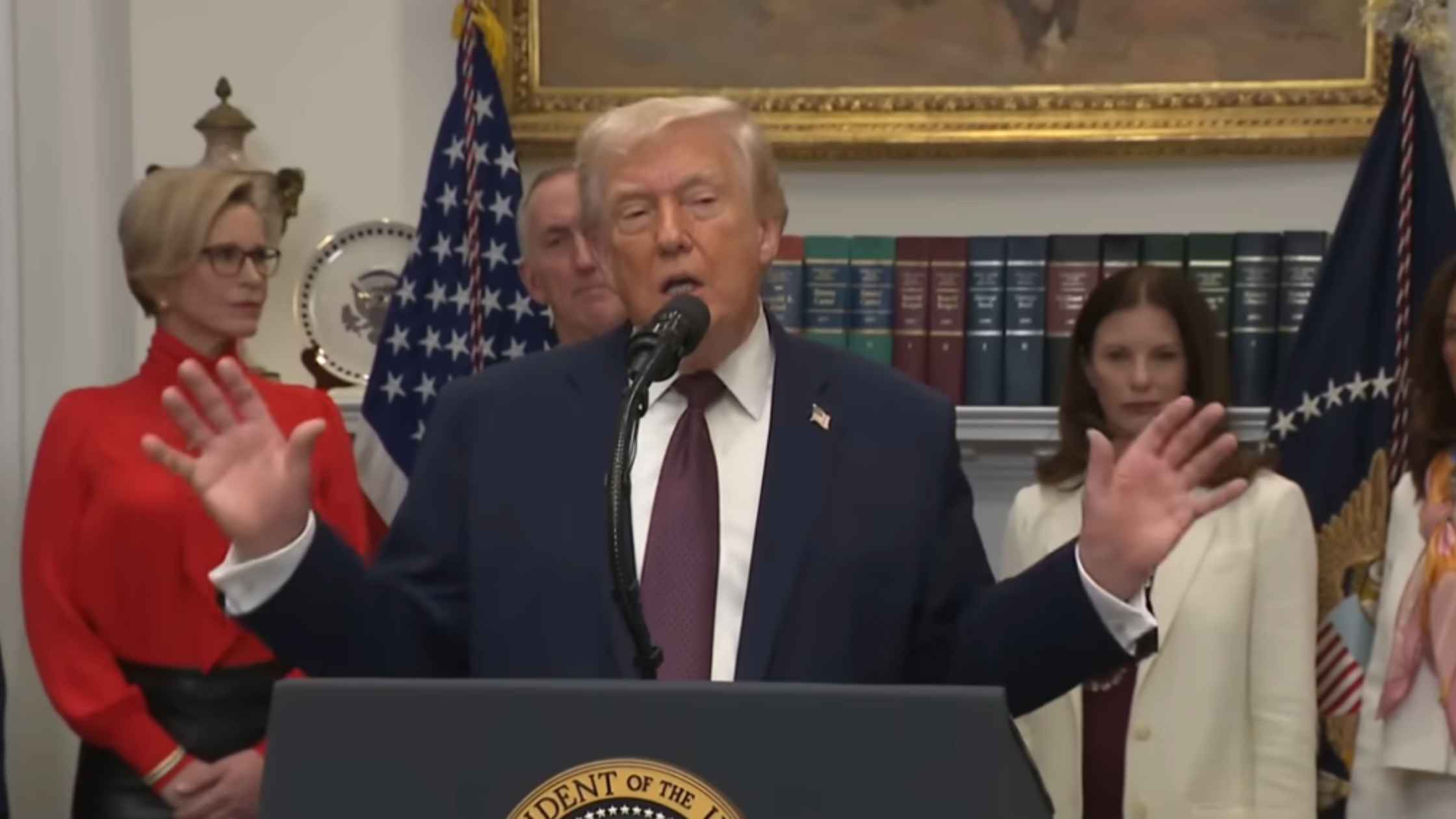
President Trump (00:08):
They make a lot of money. It's a hell of a group. How are you? Pleasure. The greatest executives in the country, of the world. Nice to see you. It's a great honor. These are among the greatest executives anywhere in the world, so it's an honor to have them with us. I think they'd be very happy about what we have to say. I thought I'd start by announcing two things. This is the gold card. As you know, the Secretary of Commerce and myself and some others have been working on it for quite a while. Howard, how much have we sold in a few days?
Howard (00:55):
$1 billion, 300 million worth in a matter of a couple of days.
President Trump (01:01):
Essentially, it's the green card on steroids. And it's a pathway, and it's been an amazing thing. And as you know, millions of people pour into our country from the border, not anymore, nobody comes in actually anymore. But under the Biden administration, 25 million people came in and they came from prisons and mental institutions and they were drug dealers and all sorts of people came in that shouldn't be here. They came from the jails. The jails all over Venezuela, all over the world, the Congo.
(01:35)
And now when they come in, they have to pay a million dollars. And we've had a tremendous surge. And you're going to be happier than anybody, because when you go to Harvard and the Wharton School of Finance and all of the great schools and you want to hire somebody and then you find out that I'm sorry they can't stay in our country for more than 24 hours. They graduate from the top schools. These people want to hire them.
(01:58)
Now you're able to buy a card, and you're able to keep people in the country. They can't keep people in the country. And they go to Canada, they go to other countries. A lot of times they go to Canada even though they work for the companies behind me. So now you're able to buy… The companies are able to buy the card and use it for people coming in to our country so they can stay in our country instead of being immediately shipped out after graduating number… They graduate number one in their class at the best school, and they want to go to work for Johnson & Johnson, as an example, who's not here today, who will be here next week. They're well represented here. But they want to go to work for one of the great companies behind me, and you learn they can't do that because they're shipped out of the country. They're not shipped out anymore. So your company will pay a little bit, but that's okay. You'll be able to get them.
(02:54)
So I just want to… It's called the Gold Card, the Trump Gold Card. Quite a beautiful thing. And you've taken in just a few days, you've taken in over a billion and a half dollars. That goes all toward reducing debt, goes into the treasury of the United States. And I thought I'd do this before we start on most favored nations. I want to read this because I would have said it the other night, but I was not allotted too much time actually. You had a couple of brand new shows opening and I understand that.
(03:26)
But I do want to say, and some people say, "oh, you shouldn't say it, it sounds negative." To me, I think it sounds positive. The only reason our unemployment tucked up and went up to 4.5%. Which, it went up to 4.5%, which is quite a low number, but still, is because we are reducing the government workforce by numbers that have never been seen before. In other words, government jobs are way down. And as you know, we don't need 10 people to fill one job, which is what we had in government in many cases. So the government workforce by numbers that have never been seen before has been reduced very substantially and will continue to be reduced. 100% of our new jobs are in the private sector. So this is for the last number of months. Think of that, 100%. Are you shocked to hear that? That's the way to make America great again, when you think, right? It's the only way. 100% of new jobs are in the private sector. And I could reduce unemployment to 2%, 1%, or practically zero by just hiring people into the federal government, even though those jobs are not necessary, which is what we had before. We had millions and millions of people having jobs that they never even showed up.
(04:52)
So I wish that the media would report that the 4.5% is an amazing number. And again, if they don't report it, I guess maybe I'll just let some people go into the federal workforce, it'll look really wonderful. And what we're doing is the only way you can do it to make a country great, you can't have the government jobs, you have to have the private sector jobs. And these are among the biggest hirers of private sectors.
(05:22)
So we have reduced the federal workforce by a tremendous… 100s of 1000s of people. And that reflects in unemployment, but that will be used up very quickly. And 100% of the new jobs, which by the way, it's a record setting number of jobs too, is in the private sector. And I think that'll get even stronger when these buildings being built all over the country, of which they're building some too. AI and auto plants and everything else, they're being built all over the country. When that happens, your numbers will be even better. But I would like you to report it the way it is. We don't do the federal workforce jobs. We're reducing that very substantially.
(06:08)
I'm thrilled to be joined by the leaders of nine of the world's largest pharmaceutical manufacturers, all very big names, celebrities in their own right, very, very powerful people. And they head some of the most admired companies anywhere in the world. It's a great group. To announce that they've agreed to offer many of their flagship drugs, really all of their flagship drugs, at heavily discounted most favored nation's prices. In other words, whatever the drug sales were over the world, in the world, whatever the lowest number is, if it's Germany, if it's in UK, anywhere, we will match that price. Right now, sometimes it's 10 times higher. We've been laughed at and scoffed at for years, for years.
(07:02)
In fact, I was going to do it in my first term, but unfortunately with the advent of COVID, as you would say, I don't think it was a very good time to be hitting up Spain, Italy, France, but now we're doing it. So the hardest thing to do was going to be to get a country to do it. Because we would have a pill in New York that was for sale for $130 and you could buy it in Germany and France and Spain and someplace anyways, they set their own prices for $10. So we'd pay 10 or 13 times more, pay five times more, pay all different prices. Now whatever the lowest price is.
(07:45)
Now, the pharmaceutical companies were difficult, but they also love our country. They knew it was unfair. And they were great, I appreciate it. But the bigger problem was going to be the countries. How are you going to get the countries to do it? And we told them, "If you don't do it, we're going to have to use tariffs and we're going to charge you a 10% tariff, which is far more money than the money we're talking about." And they immediately agreed to do it. So we have all the foreign countries agreeing to do it.
(08:16)
If we didn't have the use of tariffs, we would never be able to do this. But we used tariff and they said, "is it a threat?" I said, "Yes, it is a threat." And they said, "We will do it." And they dropped the price. So what's happening, because the world is bigger than the United States in terms of people, that same pill would go from $10 to $20 for them, which is an increase, but it wouldn't go to midway, but it would go from $10 to $20. Ours would go from $130 to $20. So we dropped way down. They went up a little bit. And everyone knows that's the way it is. They, for years, would just say, "no, no, no," as medicine got more expensive for us, it would stay. They said, "nope, you can't sell it in this country. Let United States pay." And we had other presidents, all of them said, "okay, we'll pay." So we were subsidizing the entire world. We're not doing it anymore.
(09:10)
This is the biggest thing having to do with drugs in the history of the purchase of drugs. And I don't think maybe press will treat it as a story. This is the biggest front page story that you'll ever see. This is a huge bearing too on the healthcare because a big part of healthcare is drugs, pharmaceuticals, right. And so this will have a tremendous impact on the reduction of healthcare.
(09:41)
The biggest impact is going to be that the money should be paid not to the insurance companies, directly to the people and the people buy their own healthcare. So we're going to be working that. The problem is that the Democrats are very much controlled by the insurance companies that make all that money, but we're not going to let that happen.
(09:57)
Starting next year, American drug prices will come down fast and furious and will soon be among the lowest in the developed world. So in other words, whatever the lowest price for a certain drug, of which these companies make much of it, whatever the lowest price is, that price will come down to that price. So we will get the lowest price anywhere in the world. If they're lower in England than they are in Germany, we take the England price.
(10:26)
As of today, 14 out of 17 largest pharmaceutical companies have now agreed. 14 out of 17, those three companies, they're in deep trouble. But actually they've agreed, because I think those three companies are coming in at a different time next week. So they've agreed. Johnson & Johnson is one of them, right?
Howard (10:49):
After the holidays.
President Trump (10:50):
Why? They couldn't do it faster?
Howard (10:52):
No, we're going to be talking about Trump RX.
President Trump (10:54):
Oh, okay, Trump RX. Trump RX is doing well. As of today, 14 out of the 17 largest pharmaceutical companies. But they've all agreed, have now agreed to drastically lower drug prices for their American patients, for the American people and patients. This represents the greatest victory for patient affordability in the history of American healthcare by far, and every single American will benefit.
(11:19)
So this is the biggest thing ever to happen on drug pricing and on healthcare. This will have a tremendous impact on healthcare itself. I want to thank Sanofi CEO, Paul Hudson, Paul.
Paul Hudson (11:36):
Yep.
President Trump (11:36):
Hi, Paul. I hope they have you in some order. I'll be checking.
Paul Hudson (11:40):
Hypothetical, yes.
President Trump (11:41):
Okay. Well, we'll do the best we can. Thank you, Paul. Great company, by the way. Novartis CEO, Vas Narasimhan. Thank you very much, Vas. Great job. Genentech CEO, Ashley Magargee. Where are you, Ashley?
President Trump (12:00):
How are you? Hi. Thank you very much. Great companies. Boehringer Ingelheim president, Jean-Michel Boers. Jean-Michel? Thank you very much. Gilead CEO, Dan O'Day. Dan? Thank you, Dan.
Daniel O'Day (12:22):
Thank you.
President Trump (12:23):
Great job. It's a good company. Bristol-Myers Squibb, Executive Vice President, Cari Gallman. Cari?
Cari Gallman (12:33):
Right here.
President Trump (12:34):
Thank you, darling. Thank you very much. GSK CEO, Emma Walmsley.
Emma Walmsley (12:40):
Mr. President.
President Trump (12:41):
Emma? Thank you very much, Emma. Great job. Merck, CEO. Rob Davis. Great company. Thank you. Great company. How long have you been CEO?
Rob Davis (12:51):
Almost five years.
President Trump (12:52):
Very good. You're doing a good job. And Amgen, executive vice president and CFO, Peter Griffith. Peter. Thank you, Peter. Thank you very much. You okay? Fake news.
(13:13)
We want you to be healthy. Are you all right? The camera's not okay, but she's okay. That's more important. We have good medicine for you. If you need some medicine, one of them can take good care of it. We're also joined by Secretaries Robert F. Kennedy Jr., Howard Lutnick, ambassador, and really some incredible ambassadors. Administrator of the Centers for Medicare and Medicaid Services, Dr. Mehmet Oz, and the FDA commissioner, Marty Makary. They're doing a phenomenal job. Thank you. Thank you, fellas. Good job.
(13:52)
For decades, Americans have been forced to pay the highest prices in the world for prescription drugs by far. By far, not just a little bit. We were like a whipping post, the United States, and it's just been 4% of the world's population. We have 4% of the world's population, and consumers pay only 13% of all prescription drugs, yet pharmaceutical companies make 75% of their profits.
(14:21)
Think of that. So we have 4% of the population, 13% of prescription drugs, and yet the people behind me, who are wonderful people, make 75% of their profits from the American customer. So they understood that better than anybody, that we have to do something. That's why I signed an executive order instructing my administration to do everything in its power to slash prescription drug prices for Americans while getting other countries to pay more. And we don't want more. We want this fair. We want to pay the same thing. They used to blame it, remember, on research and development. And I said, "Well, research and development for everybody." And everybody understood. And as a result, the United Kingdom's National Health Service agreed to pay the fair share for prescription drugs for the first time in 26 years. And we expect other countries in Europe will do the same.
(15:18)
And if they don't, we're going to put tariffs on them and we'll get the same amount of money plus we'll take a nice return on the money. We signed historic agreements with Pfizer, Eli Lilly, AstraZeneca, Novo Nordisk, and EMD Serono to reduce prices by 300, 400, 500, 600, and even 700%, and sometimes even more than that. I remember when I had a news conference in my first term, I was the first president that reduced prices from the beginning of my term to a year from January to December, one quarter of 1%. And I thought it was the greatest thing because it's the first one in 28 years. Now we're talking about numbers that are so incredible. One quarter of one, think of that. I was proud of it because it hadn't happened in 28 where drug prices went down. Well, now you're going to see numbers that nobody would believe possible.
(16:16)
Think of that. 500, 600, 700, 800%. Today we're building on these accomplishments. The companies assembled in this room have agreed to offer all of their drugs to Medicaid and most favored nations. Pricing, you're going to get most favorite nations pricing, meaning they're going to pay our country the lowest price paid anywhere in the world. And they will list their most popular drugs on trumprx.gov. Trumprx.gov. And I didn't name it that, somebody named it that, and I guess they assumed that was… Did you name it, Oz, or Bobby name it?
Dr. Mehmet Oz (16:56):
We all named it together.
President Trump (16:56):
Okay. Well, I'm honored to have the name. And so far that's turned out because the numbers are so incredible. It's an honor. And you're going to get massive discounts to all consumers. So massive discounts will be not even offered. It's just going to be a fact. All consumers will get massive discounts. That's trumprx.gov. Every new drug produced by these companies in the future will permanently be offered to American patients at most favored nation prices.
(17:33)
People used to talk about that for years, but nobody ever did anything about it, no other president did. And it wasn't easy, but it worked out great and I'm so proud of the people behind me. As an example of the price reductions we have secured through these new agreements, Sanofi will cut the cost of its blood thinner Plavix from $750 to less than $16. Wow. Where's Sanofi? Where are you? What? That's incredible, huh? Could have gone to $17, maybe. That's amazing. And you're going to do tremendous business. You're going to do much more business. So that's coming from… Think of that, $750…
(18:21)
And that's the number one blood thinner. I don't want to know about that. I take an aspirin.
(18:25)
… to less than $16. Think of that. Bristol-Myers Squibb, great company, both great companies, will cut the price of HIV medication Reyataz from nearly $1,500, $1,500 to $217. And it will cut the cost of hepatitis B medication, Baraclude from $1,400 to $413. Gilead will cut the hepatitis C medication Epclusa from nearly $25,000 to less than $2,500. And all prices are like that because we're bringing them down to the world's lowest price, everything. And these people really are pioneers, what they're doing is so great. And in the end, they're going to do much more business, and I think it's going to even out for them as a company. The other countries, the countries will have to pay more, but even for them, because of the fact that the world is quite a bit bigger, it won't be very severe, I hope. I also want to thank these companies and their incredible executives for their generous contribution to American national security, because it's really what it is. It's to a large extent, national security. In addition, you can't continue to pay 13, 14 times more than other countries and think you're going to have security.
(20:03)
Collectively, they will invest over $150 billion to build up domestic pharmaceutical manufacturing in America. They're going to be… Because of tariffs, they're coming in. And I think because of the love of our country, it may be because of the November 5th election. But because of tariffs, they're going to be coming in. They're building already. Just about all of them have started. They're building their plants in all states all over the country, and they're building incredible pharmaceutical plants. We're going to have close to 100% of our pharmaceuticals in a very short period of time made in the USA.
(20:42)
As part of these agreements, Merck will also donate 3.5 tons of anti-bacterials to be placed in America's strategic reserve. Thank you very much. GSX will donate over 200 pounds of ingredients to make rescue inhalers, which is a big deal. And Bristol-Myers Squibb will donate 6.5 tons of blood thinners. We appreciate it. Such amazing companies.
(21:11)
Every president for a generation has promised to reduce drug prices, but they were talking about a little bit, like that. I am the only one of them to ever even think in terms of favored nations, and that's what this is. Favored nations, it's called most-favored nation. We are now a most-favored nation.
(21:31)
I want to thank the leaders in the room and I also want to thank the leaders of all of the countries that had to pay a little more so that we were treated fairly. I really do. I want to thank the leaders of countries. And they knew that alternative was not much of an alternative, because if they didn't do it, we're going to charge them tariffs, and the tariffs would have been much more severe than what they did, but they did do it as soon as they realized about the tariffs, then they did it very easily.
(22:02)
No, they're very good people. Let's start with Amgen's executive vice president, who I already introduced, and I introduced the people here. So I'd like to ask Bobby and Oz to say a few words. And also, I'd like to ask if anybody would like to speak on behalf of your company, or just say how great this country is doing. And you're all building tremendous facilities now in the United States instead of other countries that we all know about. But if you'd like to say something, so Oz, do you want to start and Bobby?
Dr. Mehmet Oz (22:36):
Thank you. Thank you, Mr. President. Thank you very much. Mr. President, he gets taller with time here.
(22:43)
Mr. President, each of these nine CEOs will speak very briefly about what they have done because it is a patriotic effort. This is affordability in action. We talk about it in abstract, but this is not an abstract concept. This is a very concrete, tangible, personal reality because we've got moms with sick children who cannot afford their medications, working families cannot make ends meet, seniors on fixed income. We have 80 million people who have to pay more than $100 a month for their prescriptions. They just can't keep up. So this is a hardcore approach to this driven by a bold leader who's taken bold action. With that bold action, we've now created a standard for the industry. The nine leaders behind us run the biggest pharmaceutical companies in the world. They're joining four other, rather five other companies that have been through this White House process over the last two months.
(23:33)
I want to make sure you appreciate that it doesn't happen with just the people in the room. They're wonderful individuals, Chris Klump, Inma Hernandez, John Brooks, Theo Merkel, Corey, Heidi, a lot of folks worked their tails off to make this happen and that's why we've gotten to the finish line.
(23:47)
The prices that President Trump left to the next administration on pharmaceuticals have gone up 25% until the president took office. We are reversing that trend and making sure that Americans
Dr. Mehmet Oz (24:00):
… can afford to get the life-saving solutions, because if these brilliant innovators create solutions to cancer, hypertension, hepatitis, and a bunch of other viruses, illnesses that have been lethal throughout human history, but you can't afford them, then we're not treating you fairly. That's why what the president has done is so critically important. He mentioned quickly the amount of money that they've contributed towards our strategic stockpile and to building in this country. But fundamentally the health of the American people will benefit because this president took bold action. From my personal position, I couldn't do anything I do without Secretary Kennedy who just does not take no for an answer and will call me even more than the president does to make sure things happen right. Mr. Secretary. Even more.
Donald Trump (24:45):
That's not nice.
Secretary Kennedy (24:45):
I don't think that's true. I think we got a lot of calls from the president, and at one point in this negotiation, we both stopped answering our phones late at night because we couldn't take it anymore.
(24:56)
But I want to thank you, Mr. President, for doing this. President Trump, when he was up here a moment ago, talked about how historic this is and how every one of the news outlets in here ought to have World War 3-size headlines about this. I was reminded about how astonishing this achievement is.
(25:19)
A couple of days ago when one of my sons, 29 years old, very, very left-wing Democrat and disagrees with a lot of the policies of this administration. He called me and he said, "Dad, I want to tell you how proud I am about this. This is the best achievement that could happen to our country." This is something Bernie Sanders has been clamoring for for 25 years. Elizabeth Warren has been clamoring for. Joe Biden promised the American people. President Obama, President Clinton all promised to do this for the American people. All of them expressed their outrage, their indignation that we are paying one-tenth in some cases the price of drugs that they're selling in Europe.
(26:03)
We developed them here. We manufactured some them in New Jersey. We were paying $1,300 for a drug manufactured in New Jersey. The same drug manufactured in the same plant was being sold for $88 in London. Everybody recognized how unfair this was. We were paying for all the innovation in this country, and yet the rest of the world was free-riding on it. President Trump told me, and Dr. Oz, at the beginning of this term, "This is what I want you to do," and he leaned on us. I think both of us were very skeptical at that point that it could be done. But I would say this is a miracle. I'm very grateful to all the CEOs who saw the sense in this, who understood the injustice and the unsustainability of the system and who put public health, and particularly the public health of Americans, ahead of some of their other priorities.
(27:07)
All of them came to the table and President Trump asked us to do three things. One, to deliver the lowest prices in the world and make this affordable for Americans. Number two, to do it in a way that we would not hurt innovation, that we would keep America as the incubator and the dominating forces in innovation around the world. Three, to bring drug manufacturing home to this country.
(27:36)
I can tell you by the end of this term, 95% of the drugs we will have MFN. In other words, Americans will be paying the lowest price in the world for 95% of the drugs.
(27:50)
You talk about affordability. People are talking about affordability. Nobody has done anything for affordability greater than this. So I want to thank you, President Trump, for your leadership, for your vision, and for your relentless harassment of us to make sure this all got done. I really want to just thank all of the CEOs, all these companies for coming to the table in good faith, working out a very, very pragmatic agreement that allows them to continue to do the innovation that is going to save lives and alleviate suffering around the world, and do it in a way that is more fair to the American people. Thank you.
Donald Trump (28:32):
[inaudible 00:28:34].
Dr. Mehmet Oz (28:33):
We're going to [inaudible 00:28:35].
Speaker 2 (28:37):
So this is an example of what President Trump does. It's the entire administration, the whole government working together. Bobby and I met at the beginning of the administration of how we could work together to bring drug prices down as the president instructed and bring manufacturing home. So they've said they're going to have 95% of the drugs be at the lowest price in the world. When we walked in and the president walked in, we were making about 16% of our drugs were being made in America. We are having hundreds, the people behind us are committed to hundreds of billions of dollars to bring their manufacturing here and bring their research here and that employs Americans and keeps our drugs produced safely.
(29:27)
You want to know when you take that drug, that drug is made in America, overseen by the FDA, and it is safe. So the president not only is driving prices down, he's doing a one-two punch of bringing production here. The third thing he's doing is when you take that drug, you know it was made in America, protected by Americans, and it's safe. I can't be more proud.
(29:50)
I think this is the most impressive thing I've ever seen because none of you, and maybe even none of us, thought this was possible. Only President Trump, he knew it, he drove it, and he has delivered it here today, and I can't be more proud to be standing next to him because this is delivering for America.
Donald Trump (30:07):
Thank you. Very good.
Dr. Mehmet Oz (30:10):
We'll start with Amgen. It is alphabetical.
Donald Trump (30:12):
If you'd like to say something, feel free to do that. [inaudible 00:30:16].
Dr. Mehmet Oz (30:15):
They're all going to say something short, so go ahead.
Donald Trump (30:17):
But you go ahead.
Speaker 1 (30:18):
Yes. Thank you, Mr. President.
Donald Trump (30:21):
Please.
Speaker 1 (30:21):
Mr. President-
Secretary Kennedy (30:22):
[inaudible 00:30:22] podium.
Speaker 2 (30:23):
To the podium.
Speaker 1 (30:23):
To the podium. Here we go. We're going to move it back up, get taller again. Mr. President, thank you for the opportunity to work with you to improve the affordability of medicines for American patients. Amgen recently launched AmgenNow, a direct-to-patient option for Repatha that cuts out PBM middleman and significantly improves affordability for people who are uninsured facing high out of-pocket costs or paying on their own. Repatha will also soon be added to trumprx.com.
(30:55)
A US-based pioneer for more than four decades, we've invested more than $40 billion in US research and manufacturing since 2018, supported by pro-innovation policies that you've championed. Thank you again, Mr. President. We look forward to continuing to work together to deliver meaningful benefits and innovation for US patients.
Donald Trump (31:19):
Thank you very much. Great job. Thank you.
Jean-Michel Boers (31:26):
Thank you, Mr. President. Jean-Michel Boers from Boehringer Ingelheim. It's a true honor to be here for an agreement that we believe will make a true difference for American patients. For 140 years, Boehringer Ingelheim, a family-owned company, has been committed to improving health and outcomes to save lives of patients. With today's agreement, we believe that we have actually struck the delicate balance that there is to protect America's leadership in research and innovation, and at the same time ensure that patients pay a fair price for their medicines. So from rare diseases in oncology or pulmonary fibrosis, where we do research into chronic diseases, diabetes, chronic kidney disease, obesity maybe in the future-
Dr. Mehmet Oz (32:11):
[inaudible 00:32:12].
Jean-Michel Boers (32:11):
I will go quick. We will continue to work for the American patients. We are onshoring manufacturing to the US to very rapidly within the time of this administration have the majority of our products produced in US.
Donald Trump (32:23):
[inaudible 00:32:24].
Jean-Michel Boers (32:24):
Thank you, Mr. President.
Donald Trump (32:28):
Thank you.
Speaker 3 (32:28):
Thank you, Mr. President. Bristol Myers Squibb is an American company that for more than 6,500 years has been protecting and extending American lives. Today I'll make two very brief announcements. One, we are very proud to announce that we will provide Eliquis, our number one prescribed medicine, to Medicaid for free.
Speaker 2 (32:48):
[inaudible 00:32:51].
Speaker 3 (32:54):
We're also answering the administration's calls, as the president said, to shore up the national medicine reserves by donating more than six and a half tons of Eliquis. These actions build on BMS's commitment to invest $40 billion in the US in research and development and manufacturing, and these investments reflect our enduring commitment to work with the administration to improve patient lives. So thank you.
Donald Trump (33:17):
[inaudible 00:33:17]. It's incredible. Thank you.
Speaker 4 (33:22):
Thank you, Mr. President, for shining a light on the importance of our innovation and getting all countries to pay for this innovation. I'm proud to represent Genentech, America's first biotech company. We are offering our flu medicine, which is very important this year, given the severity of the flu, Xofluza, for $50 direct to patients. That's a 70% price reduction, and that also will be available on TrumpRX. We're also very proud of our $50 billion investment in US manufacturing and new research labs. Our new facility in North Carolina will bring 11,000 jobs to America. These are important steps forward for Americans and also for patients. Thank you very much.
Donald Trump (34:16):
I saw your rendering. It's beautiful, what you're building. Thank you very much.
Speaker 4 (34:23):
Thank you.
Speaker 5 (34:23):
Thank you, Mr. President, to you and the administration. I think this objective of achieving the commitment to affordability and future innovation is extraordinary. Let me just say that the company I represent, Gilead Sciences, the scientists reach for cures every day. In fact, they've come up with medicines that have cured both certain forms of hepatitis and also certain forms of blood cancer. We just recently launched a new medicine that's only given twice a year to prevent HIV. We're working with Secretary Kennedy and his entire team, as well as the State Department, as a part of your XUS strategy to support ending the epidemic really during your term.
(35:01)
And so, we look forward to working with you on that. I've never been more optimistic about the innovation that exists across these companies and the impact this can have on America's health and economy. Thank you very much.
Donald Trump (35:14):
[inaudible 00:35:15] well with HIV.
Speaker 5 (35:15):
Yeah, this-
Donald Trump (35:15):
It's a big event.
Speaker 5 (35:17):
It literally prevents HIV almost 100% given twice a year. And so, the America First State Department strategy, we've partnered with them and we're also partnering with Secretary Kennedy and his team.
Donald Trump (35:28):
Thank you.
Speaker 5 (35:29):
Thank you very much.
Donald Trump (35:29):
Thank you very much.
Speaker 6 (35:34):
GSK cares deeply about improving the affordability of medicines, which is why today we're announcing for the 40 million Americans who live with asthma or COPD, we're going to be significantly lowering the cost of the medicines they rely on to breathe more easily every day. We're going to be going direct on eight of our core medicines with deep discounts, and we're investing in American health security by donating
Speaker 6 (36:00):
… the ingredients that go into rescue inhalers like this one so that people can access them when they need them. This triple win is on top of our commitment to invest $30 billion in American manufacturing, American research, American technology, and American talent. And all of this to do the right thing for American patients, whether that's John in North Carolina who says he can now visit with his granddaughters without worrying whether he will have to struggle for breath, or Marsha in Kentucky who says if her asthma inhaler is cheaper, she can properly celebrate with her family this holidays. Mr. President, thank you so much for your ambition for American patients and for the partnership of all of your teams so we get ahead of disease together.
President Trump (36:46):
Thank you very much. Very much. Thank you.
Speaker 7 (36:50):
Mr. President, as the others have said, I just want to say thank you for your leadership. I reflect on your goal of driving affordability and access to Americans, but equally getting prices up outside the United States. We're 100% supportive of your actions. As many of the colleagues have talked about, I represent Merck and we also are looking to what we can do on trumprx.gov. In addition to bringing our diabetes drugs, one of the things I just wanted to highlight… We have a novel oral cardiovascular drug, which has an opportunity to meaningfully lower LDL and really still go after what is the leading cause of death in the United States, which is cardiovascular disease, kills a million people in the United States annually. Thanks to trumprx.com, you will not only be able to get this pill and have an easy to take pill, but it'll be easy to get and it'll be affordable. I appreciate your leadership and look forward to continuing to partner with you. Thank you.
President Trump (37:44):
Great company. Thank you very much.
Speaker 8 (37:48):
Mr. President, my name is Vas Narasimhan, CEO of Novartis. Novartis is a 250-year-old company and today we're the global leader in bringing advanced technologies to patients in the United States around the world, technologies like radioligand therapies and cell and gene therapies. What I want to highlight to you is we're bringing the manufacturing of these technologies to the United States now. We've committed to build nine new facilities, seven of them we already have a groundbreaking for. Dr. Makary was with me in North Carolina. We were opening up four new plants. Our plan is to scale manufacturing here and ensure all our critical medicines, including these most advanced technologies, are made here in the United States for US patients.
President Trump (38:28):
Thank you very much.
Speaker 9 (38:33):
First of all, thank you, Mr. President. I think you've convened on an extremely important subject and made more progress than perhaps anybody ever thought was frankly possible. For Sanofi, this is another day to reaffirm our commitment to patients, our unwavering support to trying to do the right thing to help patients get better outcomes. But simply, affordability has been at the heart of that for a very long time. Having concluded this contract with the president and the administration, we find ourselves able, as a joint effort, to go further than we ever thought was possible. And that's kudos to you and for what you have done.
(39:13)
Improving affordability and preserving innovation and rewarding innovation is a very difficult balance to take. I think we feel the negotiations and the conversations have had the patient at the center throughout the entire time, as difficult as it may have been on occasions. I think what many can learn from the way this was handled, but simply is that when you bring industry and you bring government together with the spirit of doing the right thing for patients, it is almost limitless what can be achieved.
(39:48)
On behalf of Sanofi, I'd like to thank you, Mr. President, and the team for what has been simply an incredible amount of progress. Thank you.
President Trump (39:56):
Thank you very much. [inaudible 00:39:58].
Speaker 9 (39:57):
[inaudible 00:39:58].
President Trump (39:58):
Thank you very much.
Speaker 9 (39:58):
Thank you.
President Trump (40:02):
As I watch, these are the greatest business leaders and they're beyond that. Many are doctors and they ended up running the biggest businesses in the country, but you've done so much and you made it a lot easier than we thought it would be. You understood to do the right thing. I know all of them, not personally, a couple of them personally, but I know them all through reading lots of business magazines and other magazines and newspapers. These are highly respected people. And I said to myself, "Look at what they've done. They've done something that…" And as you said, "Something that you never thought was possible to get done."
(40:40)
Most people thought for the United States to have favorite nations, where we have the lowest drug price of the world, is unthinkable. I said to myself, "We have a thing called the Unaffordable Care Act." It's unaffordable because the insurance companies make so much money and the insurance companies totally control the Democrats. I said to myself, standing watching these great leaders, and we have four other leaders coming in, Johnson & Johnson, and four other very big companies, actually, very great companies.
(41:08)
They've all agreed and they'll be coming in next week and we appreciate them too, but they've agreed to the same thing, lowest price anywhere in the world. I said, "I think that the insurance companies… We should have a meeting and we should talk to them." Because I would say that maybe with one talk, they would be willing to cut their prices by 50, 60, or 70%. They've made a fortune. They've had stock prices that have gone up 13, 14, 15, 16, 17, and even 18… Think of this. They went up 1,800%. One of them went up numbers that nobody's ever seen before. They had nice return, not a 2%, an 1,800% return. One went up more than that.
(41:55)
Therefore, there's a lot of fat that can be cut. I'd like to announce here, this is just an idea that I had standing here, watching these great leaders saying that we're going to have the lowest prices anywhere in the world, something that nobody would have thought possible, and they're going to come out great. But also donating incredible different medications, medications that are world-famous medications that one or another of them make and donating them in some cases for free or very, very low prices.
(42:27)
I said, "I'll bet you if I called a meeting of the insurance companies, the companies that are involved with healthcare costs, I would be willing to bet, I think, that they would reduce their prices very, very substantial. We could have fair healthcare in the country." Now, my initial thought, and this is what I want to do as of right now, this is the alternative, is that all of the billions and billions, ultimately trillions and trillions of dollars that's paid to these companies, we're going to pay directly to the people. But there's another way of doing it, and that's getting the insurance companies to ease up and to cut their pricing way, way down and stay part of the system.
(43:10)
I'm going to call a meeting. It could be in Florida this coming week or it could be back in the White House the first week, not the second or third week. I'm going to call a meeting of the big insurance companies that have gotten so rich by receiving money and really far, far more money than they're entitled to. I have a feeling maybe if they would act like these incredible, brilliant, responsible citizens behind me, people that love our country and they love the world. These are international companies for the most part.
(43:47)
I'm going to call a meeting of the insurance companies. I'm going to see if they get their price down, to put it very bluntly, and I think that is a very big statement. What happened here is the biggest statement of all, because nobody thought a thing like this was possible. I think based on that, I won't even take questions today, because there's no way I can take questions that are anywhere comparable to what you just witnessed. You just witnessed drug prices that will go down at levels never thought even possible, Marty, right? Never thought even possible.
(44:19)
I think that the second biggest part of this meeting is going to be the fact that I'm going to call in the insurance companies that are making so much money and they have to make a lot less and maybe we can have reasonable healthcare without having to cut them out and let it all go awry. We're going to be calling a meeting. It'll be either in Florida or it'll be here the first week. I prefer not talking and asking questions only for the reason that this is such a big announcement, meaning what these people have said and what the other four companies are going to say, which is exactly the same thing, that I really don't want to soil it up by asking questions, even questions that are very fair questions that I'd love to answer.
(45:08)
I think we have to just stop right here. I really appreciate the fact that these companies came here. Again, a lot of the media's not aware, not really cognizant of the people standing behind me. These are the biggest executives in the world and what they're doing today is monumental. I want to stand it on that and I'll see you later if you'd like, but I don't want to be asking questions having to do with anything else.
(45:39)
I do want you to remember what I said about the 4.5%. We took 100% of the new workers was in the private sector and we've cut tremendous numbers of government jobs. That's why if you look at our numbers, they're so good. I don't know if you've read… This came out a week ago. More than 50% of our trade deficit was cut. We cut it more than 50% in a period of a few months. Nobody thought any of these things were possible. Thank you very much, everybody.
Audience (46:13):
[inaudible 00:46:15]