


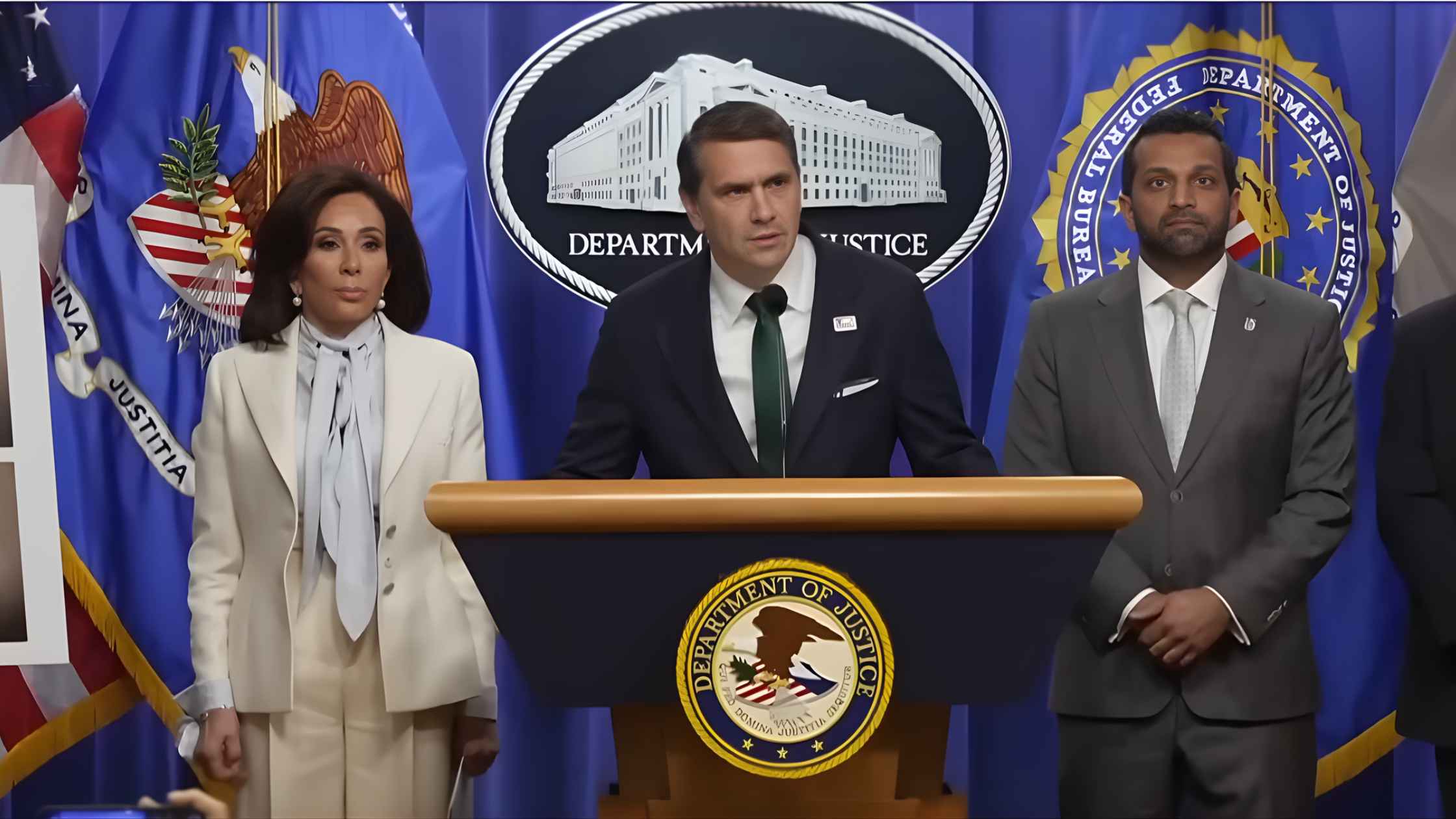
Todd Blanche (25:49):
Good afternoon, everybody. Thanks for being here.
(25:54)
On Saturday night, as you all know, an act of violence occurred at a gathering that symbolizes something fundamental to our system of government, the ability of a free press and public officials to come together in celebration and not fear. That act, that horrible act, was stopped because of the courage and professionalism of law enforcement, the officers who responded without hesitation and did their jobs as they were trained to do. Secret Service agents promptly tackled and detained the suspect, Cole Tomas Allen. The President and all the protectees and participants at the dinner were safe. One brave officer was injured and is receiving care and has been released from the hospital.
(26:51)
I want to make this clear. This man was a floor above the ballroom with hundreds of federal agents between him and the President of the United States. The Department of Justice approaches incidents like this with urgency and clarity of purpose. Violence has no place in civic life. It cannot and will not be used to disrupt democratic institutions or intimidate those who serve them, and it certainly cannot continue to be used against the President of the United States. We are investigating this matter fully, we will apply the law fairly, and we will ensure that accountability is swift and certain. But we also should recognize what did not happen. Law enforcement did not fail. They did exactly what they are trained to do. This was not an accident. It was a result, as we know now, of preparation, but the men and women who protected us that night were trained, professional, and had an enduring commitment to the rule of law.
(28:07)
Today, the Department of Justice filed three federal charges in United States District Court against Cole Tomas Allen. The first count is attempted assassination of the President of the United States. This count is punishable by up to life in prison. The second count is interstate transportation of a firearm to commit a felony. This is punishable by up to 10 years in prison. And the third count is discharge of a firearm during a crime of violence, which is punishable by a mandatory minimum term of imprisonment of 10 years, a maximum of life, and the 10 years is consecutive to any other sentence imposed.
(28:47)
Just to go through very quickly the timeline, which many of you in this room already know, the defendant, Allen, made a hotel reservation at the Washington Hilton for April 24th through April 26th. On April 21st of this year, he traveled by train from Los Angeles to Chicago and then from Chicago to Washington, DC. On April 24th, he arrived in Washington, DC, at approximately 1:00 in the afternoon and checked into the Washington Hilton. Approximately at 8:40 on the night of April 25th, Allen approached a security checkpoint on the terrace level of the hotel, which was again a floor above where the dinner was taking place. He ran through the magnetometer holding a long gun. As he did so, U.S. Secret Service personnel assigned to the checkpoint heard a loud gunshot. One Secret Service officer was shot in the chest, but was wearing a ballistic vest that worked. This heroic officer who was hit fired five times at Allen,
Todd Blanche (30:00):
... who was not shot, but fell to the ground and was promptly arrested. I want to thank everybody who worked tirelessly on Saturday, Sunday, and continuing today. This includes members of the FBI and Director Patel is going to address that in a minute. It includes members of the Metropolitan Police Department who were immediately on the scene, the chief, the mayor, to make sure that law enforcement was available to do their jobs and had all the tools they needed to do so.
(30:31)
And lastly, the United States Attorney's Office here in DC, our US Attorney, Jeanine Pirro and her team, our prosecutor stayed up all night long, didn't sleep all day yesterday, making sure that we got what we needed from all over the country. It included search warrants in California, search warrants here in DC, multiple interviews that have been conducted already of witnesses and of family members of the charged individual, and continue to work hard today.
(31:01)
This investigation is ongoing. It's not complete. A lot of the information that the media is hearing through leaks or sources, some of it is true, some of it is not true. And at the right time, you will hear information from us as appropriate. I'd like to ask our US Attorney, Jeanine Pirro, to say a few words and then followed by Director Patel. Thank you.
Jeanine Pirro (31:27):
Thank you, Mr. Attorney General. Cole Allen's journey of accountability in the criminal justice system starts today. Todd Blanche just indicated to you the charges. Those charges are only three charges that are in the complaint that has been presented in Federal District Court about an hour ago. There will be additional charges as this investigation continues to unfold.
(31:56)
But make no mistake, this was an attempted assassination of the President of the United States with the defendant making clear what his intent was, and that intent was to bring down as many of the high ranking cabinet officials as he could. This is the kind of situation that we cannot tolerate. And as the Attorney General has just indicated, it could have been so much worse, but for the reality that we had the Secret Service, as well as the Metropolitan Police Department and the FBI.
(32:35)
Now, the facts make it very clear what this intent was. You may recall that it was on March 2nd that the president indicated that he would be attending this public event at the Hilton. And on April 6th, that's when Cole Allen first made a hotel reservation at the Washington Hilton for three nights, the 24th, the 25th, and the 26th. It was on April 21st that he traveled all the way from the West Coast from his home near LA.
(33:12)
He gets to Chicago on April 23rd and has been indicated he arrives in DC on the 24th and he checks into the hotel at about 3:00 PM. He stays overnight. He is very much aware that the president and the first lady entered the ballroom at 8:00 PM, and it was at 8:40 that he made a decision to rush the ballroom. And thank goodness law enforcement, the Secret Service was able to prevent him from getting into that ballroom. He was not injured other than some kind of scrape on his knee.
(33:53)
Now, as indicated, these are the weapons that the defendant had on his person. You can see that's a 12 gauge pump action Mossberg shotgun. It's a 38 semi-automatic. He had at least three knives and all kinds of paraphernalia. So any suggestion that he wasn't there to do harm is absurd. We will prove when he purchased these guns, they were purchased California. Why is that relevant? It is relevant because he crossed interstate lines with those firearms and those are the firearms that he used on the night of the 25th or attempted to use at the very least.
(34:37)
Now, the manifesto also makes clear about his expected rules of engagement. You can look at it and read it, and it may seem kind of la la la, but at the end, make no mistake, he says. "I am targeting the administration officials. They are my targets and I'm prioritizing from the top down the highest ranking from the lowest, and I will not hesitate to get involved in any kind of encounter with anyone who blocks me from the president."
(35:10)
Now, finally, let me say one thing. Within days of the President nominating me to be the United States Attorney for the District of Columbia, I was at the scene of a double homicide where one Elias Rodriguez crossed state lines from Chicago with a firearm to commit a felony in the district. He's now indicted for the murder of two individuals, Lauren Lashinsky and Sarah Milgram here in Washington. Not long after that, another individual, Ramanella Lockenwall, crossed state lines again with a firearm with intent to commit a felony here in Washington. He traveled from the state of Washington. He is now indicted with the murder of Sarah Beckstrom, a National Guardsman and the attempted murder of National Guard, Andrew Wolf. Today, we have Cole Allen, another individual, charged with crossing state lines coming from California with a firearm with the intent to commit a felony here in the district. Let this be a message to anyone who thinks that Washington DC is the place to act out political violence. And if you are willing to do so with a firearm and cross state lines, we will find you, we will track your steps from the inception of your plan, and we will prosecute you to the fullest extent of the law.
(36:34)
Washington DC is not the place to travel to commit acts of violence. The Constitution and the laws of the United States permit us to register our views through our voices and our votes. What they don't permit is making your views known through violence, especially violence directed at the President of the United States. This is anti-Democratic at its core.
Kash Patel (37:03):
Thank you, Judge. Excuse me. Thank you, General. This one hits a little differently. We were all there. Many of you were there. Many of you watching were there as well. The president was there. The vice president was there. The cabinet was there. And what you saw described by the general and the US attorney is absolutely true. The president spoke on late Saturday evening with the message of unity and a backing of law enforcement, and we have followed through on that message of unity and the effectuation of law enforcement across this country.
(37:39)
This FBI is grateful to the United States Secret Service, the Department of Homeland Security, and our inter agency partners, including the Metropolitan Police Department for swiftly jumping into action. All of a sudden there put us in a unique position, but all of us also acted uniquely. The Washington Field Office jumped into action immediately, sending a mobile command center to the scene, along with our evidence response technicians who showed up in speedy fashion to make sure we could collect the evidence that the prosecutors and the department needed to make this announcement today.
(38:11)
Also on scene, you were told about the brave heroics of the United States Secret Service and other members of law enforcement, and that should be celebrated by every single American. They did exactly what they were trained to do. They stopped a massive attack from becoming even worse. They stood in the way, they safeguarded America, and they should be nothing but applauded for their bravery and their dedication to their mission and their self a sacrifice to this country.
(38:37)
The FBI, along with standing up mobile command units, evidence tech response team and Washington SWAT on scene also established our NC3, our National Crisis Coordination Center almost immediately. And almost immediately in parallel, we stood up our command center at the Washington Field Office under ADIC Darren Cox's leadership. Throughout the evening, we immediately began working with our Department of Justice partners to find the evidence necessary to effectuate the legal process necessary and enter into the suspect's room at the Washington Hilton successfully and lawfully and obtain the relevant evidence for exploitation that was on scene.
(39:14)
Back at the headquarters division and the Washington Field Office, we were coordinating a national scale investigation that literally spanned from coast to coast. As you heard, FBI agents along with the inter agency were immediately dispatched to the suspect's home in California where we conducted interviews that provided critical information about this horrific attack.
(39:35)
We also dispatched investigators and agents to New London, Connecticut, where we conducted further interviews that provided necessary information that you will find in this criminal complaint as the United States Attorney has just laid out. While officers were working diligently through the night to conduct those interviews, we were also conducting interviews of witnesses on scene. Those interviews are ongoing. As you know, there was almost 2,000 people there. We are sifting through and prioritizing who to talk to and we will get to each and every one of you with any bit of relevant information.
(40:06)
Again, we ask everybody who has any relevant information, like I did on Saturday night with the president, 1-800, call FBI. Any piece of information is information we want to have and must receive. On top of the on scene response by this FBI, the headquarters response, and the Washington Field Office response, the FBI flipped on its enterprise-wide response to this critical incident. What does that mean? We dispatched fixed wing assets across the country so that we could immediately transport evidence that was acquired in California and Connecticut and sent it to our laboratories in Quantico for analysis.
(40:39)
We collected the shell casings on scene, including the firearms and the weapons that the judge talked about. Those were also sent to our Quantico laboratories for immediate analysis. America should be proud that this FBI acted with the urgency that was needed for the moment that we had to answer. The president rightly said that we will act in a unified fashion, and it's because of President Trump's leadership and backing of the blue, every single person in law enforcement that I stood with into late evening hours on Saturday, early evening hours on Sunday, and all day yesterday and today are thrilled to wear the badge and defend this country.
(41:13)
Each and every one of them deserves our thanks, and I encourage everyone listening to go out there and shake the hand of a federal agent or police officer and say thank you for doing their job. Thank you for training endlessly to make sure they meet the mission requirements. And for me as the director of the FBI, I want to thank our headquarters components for working diligently with our prosecutors and make sure that the American public knows it's not just federal agents that do this works, it's our intelligence analysts, our support staff, our laboratories, our fixed wing assets, our critical incident response groups, our hostage rescue teams. Agents sprung into action, got out of bed and haven't slept since.
(41:46)
These prosecutors haven't slept since, and I promise you, they're not going to be sleeping. They are going to give you every piece of evidence. As the journal said, we will make public when appropriate to protect the integrity of the investigation to make sure that due process is served and we will meet the highest standards of the Constitution as we always do. And that is when we will continue to disclose information.
(42:08)
I know the public has a yearning for information, but just remind yourself of how much information you have already received, how transparent this administration has been. In less than 48 hours, you know almost every single thing we know. And what we have not told you yet, we will tell you in short order.
(42:24)
So once again, from me as director of the FBI, I want to thank the inner agency. I want to thank the United States Secret Service and their director, Mark Wayne Mullen, the Secretary of Homeland Security, the Attorney General and the United States Attorney Pirro and ADIC Cox for springing into action on a night that should have been celebrating free speech, but we will be doing it again shortly, as the president said, and we look forward to seeing you all there.
Speaker 12 (42:50):
Two questions, please. Beyond the evidence and what the judge described as the manifesto, what other evidence can you point to that tells us that the president was the primary target of the suspect?
Todd Blanche (43:03):
So we're a day and a half into the investigation. As we talked about earlier, we were able to get multiple devices from various locations, the hotel room and also where he lived in California. We have started that process. There's nothing more that would be appropriate to share at this time until we have thoroughly gone through it, which we're doing, and we'll share that information as appropriate in the future. Second question, go ahead.
Speaker 12 (43:33):
Beyond the assassination attempts against President Trump, you had someone try to burn down the mansion with the governor leaders in Pennsylvania. You had those state lawmakers attacked in Minnesota. You've had two Israeli embassy staff members murdered in the city here. You had the Charlie Kirk assassination. You had the national guardsmen killed in the city. Can you, each of you describe the current threat environment and what DOJ's stance is about?
Todd Blanche (44:01):
Well, you just described the current threat environment pretty accurately, which is that the political violence and rhetoric has got to stop. And that's something President Trump said right after the incident on Saturday night. It's something that Carolyn Levitt talked about a couple of hours ago. It is something that is... When you have a president who... And many people in this room, if we're going to be honest about it, has done it as well. They're just as guilty as a lot of people on X.
(44:26)
When you have reporters, when you have media just being overly critical and calling the president horrible names for no reason and without evidence, without proof, it shouldn't surprise us that this type of rhetoric takes place. If you look at what it appears that this defendant had in his past, we're talking about somebody who is college educated, who has a job, who is otherwise living his life, and we'll find out more about him as I expect in the coming days and weeks, but he chose to do what he did. And so our threat environment is...
Todd Blanche (45:00):
... we are ready. I mean, I'm not going to go through what Director Patel just talked about with the way we responded, but this was something that we will always be prepared for. And it's sad that it has to happen, but it's not a new thing, unfortunately.
Speaker 14 (45:13):
Thank you.
Todd Blanche (45:13):
[inaudible 00:48:00]?
Speaker 15 (45:16):
Have you been able to determine whether the gunman fired shots? If so, how many shots he fired and exactly whose bullet hit the agent?
Todd Blanche (45:27):
We want to get that right. So we're still looking at that. It appears, and I don't want to overstate, because we are still looking at this, that there were five shots that law enforcement fired. All the evidence is being examined very carefully and expeditiously, and we'll know more soon. We do believe that as the complaint lays out, that the suspect, that the defendant fired out of his shotgun, and we know that that happened. But as far as getting into exacting ballistics, I'm not going to do that today, because it's still being looked at and finalized.
Speaker 16 (46:02):
Thank you for taking my question. You personally have called for a construction of this ballroom at the White House. The president has called for this as well. Today, the National Trust President put out a statement, it says that they're grateful that everybody's okay, and I quote, "We are not planning to voluntarily dismiss our lawsuit, which endangers no one and which respectfully asks the administration to follow the law. Ballroom construction is continuing unabated until June 5th at the earliest because the injunction is on hold." Where does the Justice Department go from here? And then I have a follow-up on that.
Todd Blanche (46:34):
Well, we filed a motion today asking the court to do what the plaintiffs refused to do. We absolutely believe that there is no better example of why this ballroom is necessary, aside from all the very positive things the ballroom will bring to this country into Washington DC, than what happened on Saturday night. You guys, many of you all were there. That's one of the only places in DC that you can hold an event like that due to its size and the structure of what we need. So we're basically stuck at this point in this city with having an event like that at a hotel, so underneath a ton of hotel rooms.
(47:08)
And so again, aside from the fact that the ballroom is spectacular, it's going to be beautiful, it's going to make this country look great every time it's used, it's also a meaningful safety issue. And so I very much wish that the plaintiffs and their council would take a different view, but if they don't, we are going to continue to fight in court like we have been. And hopefully the judges at the DC Circuit Court will do the right thing. Back?
Speaker 13 (47:35):
Are you aware of-
Todd Blanche (47:37):
Not you, the red.
Speaker 17 (47:38):
Thank you. Are you investigating connections that Cole Allen allegedly had two left wing groups? I think one is called the Wide Awakes reportedly.
Todd Blanche (47:47):
Yes. Well, of course we're investigating that. Now you.
Speaker 13 (47:50):
Are you aware of his video game development past, including a potential shooter style RPG game?
Todd Blanche (47:58):
I've seen the news reports that talk about that. I think that the positive and negatives of this type of case is that there's a lot of people investigating this man right now, including the FBI. But the only investigations that truly matter in the court of law are the ones that Director Patel and his men and women are doing. So we'll wait for them to do that and get an answer.
Speaker 18 (48:18):
Just really quick. Do you know anything about his alleged Christian faith past? Because he said something about it in the manifesto.
Todd Blanche (48:29):
I have read reports in the news and I've read reports that say various things regarding his views of Christianity, his views in the past of Christianity. And I'm certainly not going to speak to news reports. I will wait, as I hope all of you would, for the investigation to continue until we actually have answers. Yeah.
Speaker 15 (48:49):
A little technical question. You mentioned that so far you think that Allen fired at least one shot. That doesn't say that in the affidavit yet, so I'm just curious if you can explain the discharging of weapon charge at this point?
Todd Blanche (49:06):
Well, he's charged with violating 924C, discharge of a firearm during a crime of violence. So by definition, that charge means that it was discharged. I can tell you from what I know with the understanding that we're a day and a half in, that this is the gun that he discharged and as those of us that have ever shot one of these know, what happens when you shoot that is the casing stays inside the firearm. And then if you reload it it pops it out. My understanding is that it was inside the firearm, but hadn't been ejected, which means that it hadn't been pulled back again. But again, I want folks to understand, I'm the Acting Attorney General. I'm not on the ground doing the investigation, so I'm telling you what I've been told, and if that information changes, I'm sure that we'll let you know. Yeah?
Speaker 19 (49:54):
I just want to ask you about this letter that you posted yesterday that's sent from Brett Schumate to the plaintiffs in that lawsuit. It says that the Washington Hilton is, "Demonstrably unsafe for the President of the United States." It said that, "With the ballroom, that Trump will no longer need to venture beyond the safety of the White House perimeter." Just engaging with those lines, was there an assessment in advance of the dinner that the Hilton was demonstrably unsafe? And if so, why was President Trump allowed to attend it? And then separately, just the idea that by building the ballroom that President Trump wouldn't need to go outside of the confines of the White House, I mean, is that something that the American people should find acceptable that the President would have to be for major events confined to the White House? It seems like a [inaudible 00:50:43] law situation.
Todd Blanche (50:44):
That is obviously not what he means by that. And the fact that that question comes with respect to President Trump is laughable in the extreme, I mean, laughable in the extreme. You have a president who willingly speaks with you guys multiple times a day, I would say seven days a week. He is active all over the country. I think with that, keeping it to the four corners of that statement, when he says, "demonstrably" it's demonstrated by what happened on Saturday night. So that doesn't mean that the Secret Service would ever let the president go into an unsafe environment. I know that the director of the Secret Service will be focused on making sure that we always keep him safe.
(51:20)
And by the way, as we said before, and as anybody that was in that room knows, we were safe. We were safe. We heard a lot of loud noises that at the time, many of us thought could be guns going off. It was mostly plates falling because of the staff understandably were running. So my reaction to that is I'll leave anything with respect to security up to the great men and women of the Secret Service, but when we talk about having an environment like the ballroom, it's an environment like what you saw last night. So an environment where you have a unique blend of cabinet members, leadership of this country, leadership of Congress, reporters and members of the public coming together for an event like that, that's different than other public facing situations, which I have no doubt, President Trump will continue to do as he said he would on Saturday night. Yeah?
Speaker 20 (52:08):
Thank you. This is for FBI Director Patel.
Todd Blanche (52:10):
Sure.
Speaker 20 (52:11):
Is there any other credible threats at this time related to events in the city, including King Charles? And then separately the manifesto, I don't really want to give too much weight to this, it did mention your name in it as someone that they maybe were not targeting. Do you want to elaborate on that? And then also the political motivations there?
Kash Patel (52:31):
As to the latter, no. As to the former, the FBI and the inter-agency is constantly evaluating intelligence provided to us by inter-agency collection methods, our partners in the federal and state and local levels. We are constantly relaying that information to the White House, to the Attorney General, to the United States Attorney, specifically here in DC. And we will always assess each piece of intelligence and base it on the credibility that it was received and give it the due weight that it has. But as the U.S. Attorney has stated, and as President Trump's task force for Washington DC has shown, we have reduced crime in this city by historic levels, and we will continue to do so and we will continue to safeguard the men and women that call Washington DC their home.
Todd Blanche (53:11):
All right, just a couple more.
Speaker 21 (53:14):
Acting Attorney General, in paragraph 14 of the complaint today, it says that the suspect fell, and you said that he was tackled. I just want to see if we can try to make sure we understand what was involved [inaudible 00:53:28]?
Todd Blanche (53:28):
Well, I think that both can be true. And I would rely on the complaint, because that was sworn to by an agent and not by the words out of the Acting Attorney General who most certainly was not there, but I think both can be true.
Speaker 21 (53:41):
All right. But the U.S Attorney yesterday also mentioned that one of the charges possibly would be for assault on an officer, and I noticed today it's a different charge. Is this because you've determined that what he shot didn't actually strike the officer?
Todd Blanche (53:55):
We're still looking at that, and I think that that's something that you'll hear about in the coming days as we know the answer to that. It doesn't legally matter in that situation, but after an event like this happens, not surprisingly, there's initial charges that we consider. Then you have the U.S. Attorney's team and the FBI looking through the evidence and figuring out what's the best thing to do and that's what you have, right? Just one more question. Yeah?
Speaker 22 (54:21):
I have two quick questions.
Todd Blanche (54:21):
All right, two questions.
Speaker 22 (54:22):
I just wanted to clarify, you said one officer fired their weapon five times. Was that the only officer who discharged their firearm?
Todd Blanche (54:32):
I want to be very careful in answering that question because this is... When you do ballistics evidentiary collection and research, it is very complicated. So when you fire a bullet, the bullet ends up somewhere. Sometimes you find it, sometimes you don't. And so with that qualifier, we believe right now that there was five shots fired from the same firearm, but there's a team of folks looking at this that are experts and the evidence collection team that were in that area of the hotel where the shots were fired will work all night. They have the evidence they collected, but it's not an exact science from the standpoint that, for example, the buck shot, when that's shot, it scatters everywhere. Sometimes it just disappears actually, depending on where it hits. So you don't have to... Hopefully with that qualifier, that's where we are right now.
Speaker 16 (55:28):
One more question about the timeline, sir.
Todd Blanche (55:29):
Hold on.
Speaker 17 (55:30):
I just wanted to ask what law enforcement has learned about why he was targeting President Trump? Do you guys believe he was upset about a certain policy or decision by the president?
Todd Blanche (55:40):
The complaint lays out what I think is described as a manifesto, which is something that he's allegedly sent to many folks, his family. That's what we have so far as far as his motivation. As the U.S. Attorney said a few minutes ago, what is clear from the complaint and from what we have so far, is he was targeting President Trump. He described that in his manifesto. He was targeting administration officials, he described that. But as far as us understanding additional motivation, that's for the FBI and law enforcement. All right, thanks a lot guys. I appreciate it. Thank you.
Speaker 21 (56:17):
[inaudible 00:56:17] the Amtrak security measures. Will there be any announcement about Amtrak security?
Speaker 17 (56:20):
Did any other agents say they discharged their weapons?