


Mr. Risch (00:00:56):This committee will come to order. Good morning, everyone. And welcome, everyone. Today, we have important business to do. Before I start, I will tell everyone, those of you in the audience, we're so glad to have you here. Thanks so much for coming. This is a public hearing. It is also the official business of the United States of America. And as a result of that, the committee has a zero tolerance policy for interruptions or for attempts by anyone in the room to communicate with somebody up here or the witness. So as a result of that, if you do disrupt, you will be arrested, you'll be banned for a year.(00:01:38):However, I'm told that we have some guests today who have completed their ban and are back with us again today. We hope you've had the time to think about your indiscretions and will behave yourself today. If you don't, as a persistent violator, you'll be banned for three years this time. So in any event, welcome to everyone and certainly Secretary Rubio, we're glad to have you here and welcome back. The new co-pilot I got, Pete, is doing just fine in the seat you used to sit in, and I'm glad to have him. Thank you so much for being here. We were a little afraid we were going to lose you to the Miami Dolphins there for a while, but I guess that went a different direction, so it's certainly our gain.(00:02:22):I'd like to start this hearing on the Venezuela situation by recognizing the brave men and women who participated in this operation. The intelligence gathering, planning, and execution were incredible. Only the US could have pulled off this mission, and that's only because of the dedication and professionalism of each and every one of our service members. As we know, much of their work is done in secret, but I do hope these people will receive the accolades that they so rightly deserve.(00:02:53):I also want to acknowledge the leadership of President Trump that he has shown and also you, Secretary Rubio. It's no easy job keeping drugs and narco terrorists off our streets and keeping Americans safe. Thank you for extraditing Nicholas Maduro and bringing him to account for his many crimes against the American people. Let me reiterate a point that I've made many times on the Senate floor. President Trump's actions against narco terrorist and his capture of Maduro have made America safer. Every American should be thanking Donald Trump and Marco Rubio for what they have done. There are a lot of Americans today who wouldn't be alive if not for your commitment and dedication to stemming the flow of drugs into our country.(00:03:43):The actions in Venezuela were limited in scope, short in duration, and done to protect US interests and citizens. What President Trump has done in Venezuela is the definition of the president's Article II constitutional authorities as commander-in-chief, and wholly consistent with what other presidents' efforts and what they have done and actions they have taken to protect the American people from threats in our own hemisphere. In fact, President George HW Bush authorized similar, but much broader and more extensive military operations to arrest and bring Panama's Manuel Noriega to the United States to sand trial for drug related charges.(00:04:23):In that case, President Bush deployed more than 9,000 troops into Panama for more than a month. At the time, all leaders of the Senate, including Democrats, praised that move. Unlike in Panama, President Trump authorized a much more limited military action in Venezuela with only about 200 troops inside the country for a couple of hours and a firefight that lasted less than 27 minutes, with no loss of life on the United States side, but significant casualties on the other side. This military action was incredibly brief, targeted, and successful.(00:04:59):When bad guys are in the business of flying drugs in the United States, drugs that kill our children, hurt our country, violate US laws and destabilize our hemisphere, then they'll have to be held to answer for those actions, and that's what's being done now. Maduro was not recognized as a legitimate leader of Venezuela by President Trump or even by President Biden or by most of the international community. It is a service to the world that this illegitimate leader is no longer in power.(00:05:29):Now, the United States has a tremendous opportunity before us in Venezuela. Because of the complexity of this operation, there has been some confusion as to how it will be done. I've been impressed by the way you, Secretary Rubio, explained the plan to me going forward right from the start. It is clear and it's doable. I know you'll lay that out for us here today. Venezuela's natural resources have frequently been used to bolster of the economy of our adversaries, especially China. Through President Trump's actions, we have effectively cut off that supply, giving the United States tremendous leverage.(00:06:02):After our lengthy engagements in the Middle East in years past, many Americans are rightfully concerned about so called forever wars. I know this administration is laser focused on avoiding those experiences. With Nicholas Maduro out of power, the United States has the opportunity to better protect America by bringing stability to Venezuela. The country has a history of democracy, capitalism, and a respect for human rights. It is only during the last two dictatorships that it has lost these attributes. The Venezuelan people are not strangers to these concepts and long to have them reinstated.(00:06:38):They have you and the President Trump to thank for giving them another chance. It is all our hope that the Venezuelan people will soon be able to hold free and fair elections for their leaders. To get there, Venezuela may require US and international oversight to ensure these elections are indeed free and fair, unlike their most recent elections. Secretary Rubio, thank you for being here today. I look forward to a productive discussion. And with that, I'd like to hear the distinguished ranking members' views on these matters. Senator Shaheen.Senator Shaheen (00:07:15):Thank you, Mr. Chairman. Welcome back, Secretary Rubio. Thank you for being here. I certainly agree with the chairman in terms of his comments relative to Nicholas Maduro. He was bad for Venezuela. He was bad for the region and he was bad for the United States. I think the question we have to ask now is, was the raid to arrest him worth the cost? And I also share the chairman's admiration for the military operation that took him out. But the US naval blockade around Venezuela and the raid have already cost American taxpayers hundreds of millions of dollars. Outside estimates are as high as a billion dollars, and yet the Maduro regime is essentially still in power. All the same people are running the country. Maduro's vice president, now the interim president, has taken no steps to diminish Iran, China, or Russia's considerable influence in Venezuela, one of the reasons that has been given for the mission. Her cooperation appears tactical and temporary and not a real shift in Venezuela's alignment. In the process, we've traded one dictator for another. So it's no wonder that so many of my constituents are asking, why is the president spending so much time focused on Venezuela instead of the cost of living and their kitchen table economic concerns?(00:08:39):Unfortunately, I think this has been a pattern across the administration, losing sight of what actually advances America's interests and delivers results for the American people. Take the elimination of personnel and departments that were critical to our national security, for example. These are cost-effective tools like Voice of America that help us advance America's interest globally. And Mr. Secretary, as you remember, you strongly supported most of these programs when you were on this side of the dais. The administration says those cuts were about saving money, but the total federal spending last year went up by 4%, not down. We spent more, not less.(00:09:20):As a result, our adversaries like China are expanding their influence, and there is broad bipartisan agreement in Congress that China is the central strategic challenge of our time. The president himself has said that as well, but we're cutting foreign aid and diplomacy tools. We're leaving embassies without leadership. We're shutting down counter disinformation programs. We are driving talent away from the United States while Beijing is actively recruiting it. And I would just like to point out this is a picture of the globe. These are countries where China has ambassadors in those countries, all of the red. Those are China, and places where their diplomats are on the ground, except of course, for China, which is in blue, and they don't need to put diplomats there.(00:10:11):This map, this is where we have diplomats. You can see the red is where we're filled. And look at all of the white, where we do not have ambassadors on the ground. We're even giving China some of our most advanced semiconductors. And after a year of tariffs that were supposed to make us stronger, China's posted the largest trade surplus in history, and American families are paying more at a time when the prices were already too high. Since the start of the tariff campaign in 2025, US manufacturing employment has fallen by anywhere from 50 to 70,000 jobs, depending on whose estimates you look at.(00:10:58):That's a trend that undercuts promises that tariffs would bring factory jobs roaring back. And instead of creating a united front against China, we're pushing our closest allies into their arms. Just look at Canada, whose business with the state of New Hampshire has been really critical. They recently cut a trade deal with China because they no longer view the United States as a reliable partner. Pushing allies away like that is not strategic competition. It is unilateral disarmament. We see the same gap between rhetoric and reality and how this administration deals with other authoritarian regimes.(00:11:38):At a time when Iran is violently cracking down on protests, the US is coming to agreements to deport Iranians in this country back to Iran. People who will face persecution and interrogation by Iranian security forces, and yet President Trump told the Iranian people that help was on the way, but the United States has largely stood on the sidelines as the situation has deteriorated. Americans are right in thinking that the Trump administration is tougher on our allies than on most of our adversaries. I just returned from Denmark where I met with Danish and Greenlandic leaders. Senator Coons was also on that trip, he led it.(00:12:20):What I heard directly is that President Trump's threats to take Greenland have shaken public confidence in the United States to the core. And this from an ally who first recognized the new United States of America in 1792, has fought on our side in both world wars and in Afghanistan. And I heard from one Danish American woman whose son holds both citizenships and is approaching conscription age that she's worried that her son might one day be forced to choose between the two countries that he loves. That kind of fear would have been unthinkable two years ago, or 10 years ago, or 50 years ago. There is no strategic objective in Greenland that cannot be achieved through cooperation.(00:13:08):The only thing these threats have accomplished is weakening trust in the United States. That trust is the foundation of our alliances. And at a moment when Russia is waging the largest land war in Europe since World War II, we should be strengthening allied unities. Instead, we're undermining it. European allies are worried about open conflict with the United States. Canadian trading partners are turning toward China instead of the US, and the constant threat of new tariffs raising prices and making it impossible for businesses to invest is ever present. So from Venezuela to Europe, the United States is spending more, risking more, and achieving less. That does not project strength. It hands our adversaries exactly what they want. Thank you, Mr. Chairman.Mr. Risch (00:14:01):Thank you, Senator Shaheen. We're now going to hear from Secretary Rubio. After that, we'll do a round of five minute questions. And so with that, Secretary Rubio, welcome back to the committee. Love to hear what you have to say.Secretary Rubio (00:14:13):Thank you. I appreciate it. And I'll be brief in my opening statement so we can leave more time for questions. I've submitted a written statement, but I'm not going to use it. I'm just going to talk to you guys for a few minutes and ...Speaker 1 (00:14:24):Marco Rubio, [inaudible 00:14:25]-Mr. Risch (00:14:24):All right here we go.Speaker 1 (00:14:24):... [inaudible 00:14:26].Mr. Risch (00:14:27):Suspend. You know the drill, off the jail.Speaker 1 (00:14:30):That's a war crime. [inaudible 00:14:32].Mr. Risch (00:14:31):That's a one-year ban from the committee. Anyone who is a persistent violator will be banned for three years. So don't know whether the guy falls in that category, looks like it. I hope after three years, he'll find a more productive means of employment. Secretary Rubio, we have two hearings a week. You seem to have a more robust following than most of our witnesses that come before us. But anyway, have at it.Secretary Rubio (00:14:57):There'll be a couple more, so thank you for stopping the clock, but I appreciate it. And I know there's a lot of other topics you're going to ask me about, so we can talk about those, including the ones that Senator Shaheen just outlined. But let me just talk about Venezuela in particular.Mr. Risch (00:15:13):Please.Secretary Rubio (00:15:14):I think we can talk if you want, I'm sure your questions will be about what happened before and led up to in the operation. I want to focus my comments this morning on what happens now moving forward, because you're going to ask about the going back. And let me just say this, what is our goal going in? We had in our hemisphere a regime operated by an indicted narco trafficker that became a base of operation for virtually every competitor, adversary and enemy in the world. It was for Iran, their primary spot of operation in the Western hemisphere was Venezuela. For Russia, their primary base of operation in that western hemisphere along Cuba and Nicaragua was Venezuela.(00:15:52):In the case of China, China was receiving oil at a huge, about $20 a barrel, discount and they weren't even paying money for it. It was being used to pay down debt that they were owed. This is the oil of the people of Venezuela and it was being given to the Chinese as barter at a $20 discount per barrel in some cases. And so you had basically three of our primary opponents in the world operating from our hemisphere from that spot. It was also a place where you had a narco trafficking regime that openly cooperated with the FARC and the ELN and other drug trafficking organizations using their national territory.(00:16:28):It was an enormous strategic risk for the United States, not halfway around the world, not in another continent, but in the hemisphere in which we all live. And it was having dramatic impacts on us, but also on Columbia and on the Caribbean basin and all sorts of other places. It was an untenable situation and it had to be addressed. And it was addressed. And now the question becomes what happens moving forward. As I've described to you in previous settings and individual conversations, we had three objectives here.(00:16:54):The final, I'll work it backwards because the end state here is we want to reach a phase of transition where we are left with a friendly, stable, prosperous Venezuela and Democratic in which all elements of society are represented and free and fair elections. By the way, you can have elections. You can have elections all day, but if the opposition has no access to the media, if opposition candidates are routinely dismissed and unable to be on the ballot because the government, those aren't free and fair elections. That's the end state that we want. Free, fair, prosperous, and friendly Venezuela. We're not going to get there in three weeks. It's going to take some time. And so objective number one was stability. In the aftermath of the removal of Maduro, the concern was what happens in Venezuela? Is there civil war? Do the different factions start going at each other? Are a million people crossing the border into Columbia? All of that has been avoided. And one of the primary ways that it has been avoided is the ability to establish direct, honest, respectful, but very direct and honest conversations with the people who today control the elements of that nation, meaning the law enforcement, the government apparatus, et cetera.(00:18:03):And one of the tools that's available to us is the fact that we have sanctions on oil. There is oil that is sanctioned that cannot move from Venezuela because of our quarantine. And so what we did is we entered into an arrangement with them. And the arrangement is this. On the oil that is sanctioned and quarantined, we will allow you to move it to market. We will allow you to move it to market at market prices, not at the discount China was getting. In return, the funds from that will be deposited into an account that we will have oversight over and you will spend that money for the benefit of the Venezuelan people.(00:18:35):Why was that important? Venezuela was running out of storage capacity. They were producing oil, they were drilling oil, they had nowhere to put it. They had nowhere to move it. And they were facing a fiscal crunch. They needed money in the immediacy to fund the police officer, the sanitation workers, the daily operations of government. And so we've been able to create a short-term mechanism. This is not going to be the permanent mechanism, but this is a short-term mechanism in which the needs in the Venezuelan people can be met through a process that we've created where they will submit every month a budget of this is what we need funded. We will provide for them at the front end what that money cannot be used for. And they've been very cooperative in this regard.(00:19:09):In fact, they have pledged to use a substantial amount of those funds to purchase medicine and equipment directly from the United States. As in fact, one of the things they need is diluten, or diluten, depending how you want to pronounce it. And that basically is the light crude that you need to mix with their heavy crude in order for the oil to be able to be mixed and moved. They used to get 100% of that from Russia. They are now getting 100% of that from the United States. So we're using that short-term mechanism, both to stabilize the country, but also to make sure that the oil proceeds that are currently being generated through the licenses we'll now begin to issue on the sanctioned oil goes to the benefit of the Venezuelan people, not to fund the system that existed in the past.(00:19:53):The second is a period of recovery, and that is the phase in which you want to see a normalized oil industry. Again, this is ... Look, we've got plenty of oil. There's plenty of oil all over the world. Canada produces heavy crude, so it's not like Venezuela's oil is unique in that regard, despite the fact they have the largest known reserves in the world. It's not irreplaceable. But we understand that that is the lifeline. Their natural resources are going to allow Venezuela to be stable and prosperous moving forward. And so what we hope to do is transition to a mechanism that allows that to be sold in a normal way, a normal oil industry, not one dominated by cronies, not one dominated by graft and corruption.(00:20:28):To that end, the authorities there deserve some credit. They have passed the new hydrocarbon law that basically eradicates many of the Chavez era restrictions on private investment in the oil industry. It probably doesn't go far enough to attract sufficient investment, but it's a big step from where they were three weeks ago. So that's a major change. We can address some of the other components, but I'll run out of time. But one of parts of the transition phase or the recovery phase is beginning to create space for different voices inside of Venezuelan politics to have an ability to speak out.(00:21:00):Part of that is a release of political prisoners, by some estimates up to 2,000. They are releasing them. They're releasing them probably slower than I would like them to, but they are releasing them. And in fact, you're starting to see some of the people being released, beginning to speak out and participate in political life in the country. We have a long ways to go. Look, we can talk in more detail about all of these things. Suffice it to say, I'm not here to claim to you this is going to be easy or simple.(00:21:22):I am saying that in three and a half, almost four weeks, we are much further along on this project than we thought we would be given the complexities of it going into it. And I recognize that it won't be easy. I mean, look, at the end of day, we are dealing with people over there that have spent most of their lives living in a gangster paradise. So it's not going to be like from one day to the next, we're going to have this thing turn around overnight, but I think we're making good and decent progress. It is the best plan, and we are certainly better off today in Venezuela than we were four weeks ago. And I think and hope and expect that we'll be better off in three months, in six months, in nine months than we would have had Maduro still been there. So thank you.Mr. Risch (00:21:58):Well, thank you, Secretary Rubio. We'll now do a round of questions, five minutes each. I'd like to start and I'd ask you to go ... I understand we're not in a classified setting, but I think a lot of people had no understanding of the groundwork that was done before the actual action took place.(00:22:23):I was incredibly impressed with what you told me about how you, the president negotiated with parties there on the ground, particularly the parties who were going to be in charge after Maduro was removed. And I wonder if you could talk about that for a minute, understanding that we aren't in a classified setting. And I'd like to, if you could, say a few things about that.Secretary Rubio (00:22:52):Well, one of the things I've come to maybe more fully appreciate that I didn't when I was here in the Senate was the number of contingencies that the Department of War plans for all over the world. The overwhelming vast majority of them will never come to fruition, but there's all kinds of contingencies that are planned for. And one contingency that had to be planned for is the fact that sitting in Venezuela with a $50 million reward on his head was an indicted narco trafficker. In fact, I believe it's the largest reward we've ever issued for anybody. I remind everybody, the Biden administration had a $25 million reward on an indicted narco trafficker, the same person.(00:23:24):And so, multiple administrations from both parties have wanted this man arrested. And one of the options the president had before him was the opportunity if things didn't work out to go in and remove this individual because he was wanted in a law enforcement operation. Now, obviously a law enforcement operation against the de facto head of a regime is not as simple as going after some fugitive hiding in a closet somewhere. It required planning and it required eliminating anything that was a threat to the forces that were going in to extract him.(00:23:54):I want to be clear, and I'll share with you what I've shared publicly. We made multiple attempts to get Maduro to leave voluntarily and to avoid all of this because we understood that he was an impediment to progress. You couldn't make a deal with this guy. This guy has made multiple deals. He's broken every one of them. As a point of example, he made a deal with the Biden administration and here was the deal that he made. It was a bad deal. We knew he wouldn't keep it. He made the following deal. Pardon my nephews, his nephews, who were convicted narco traffickers, convicted already and serving time in jail, pardon them, pardon and release Alex Saab, who was his money man, his bag man, primarily in charge of the portfolio with Iran. Release these people.(00:24:34):He in turn agreed to release some political prisoners, which he did. Many of them were subsequently exiled or rearrested, and that he would hold free and fair elections, which he did not. In fact, he basically disqualified Mar�a Corina Machado and any other candidate, and Edmundo Gonz�lez ends up being the nominee for the opposition party simply because they forgot to ban him and they forgot to put him on the ban list. And then despite that, he loses an election that everyone around the world recognizes in a legitimate election.(00:25:01):So he's made previous deals. In fact, he's broken so many deals, not even the Vatican has been willing to interact with Maduro in the past because he's broken so many of these deals. He's just simply not a guy you can make a deal with. He had no intent of keeping it. What he wanted to do was tap us along and buy three years of time until he could deal with a new administration that he thought may be more favorable, et cetera. He was an impediment to progress. None of the things we're talking about now, not the release of political prisoners, not the transition of the oil industry to a legitimate oil industry, not the erosion of Iranian, Russian or Chinese influence, none of these things would have been possible as long as Maduro was there.(00:25:37):And so this was one option that was available to the president, after exhausting every other option to remove this individual from the scene. Again, I'm not here to tell you these are all going to be roses along the way and it's all going to go perfectly, but for the first time in 20 years, we are having serious counter-narcotic talks with Venezuelan authorities about going after narcotics, about going after narcotics organizations. For the first time in 20 years, we are having serious conversations about eroding and eliminating the Iranian presence, the Chinese influence, the Russian presence as well.(00:26:09):In fact, I would tell you that there are many elements there in Venezuela that welcome a return to establishing relations to the United States on multiple fronts. We are at the end talking about a Western country that has a long history of cooperation and work with the United States. At one time, Venezuela, pre-Chavez, was a very strong US ally, and we hope to get back to that point. We're not there. This thing still isn't its infancy, but I certainly think a lot of progress has been made in that regard.Mr. Risch (00:26:33):I was impressed with your description of the fact, how careful you were in the operation not to dismantle either institutions or infrastructure because you wanted to see the Venezuelan people take that over and get back on their feet again. I think that was really a wise decision to make and have it as surgical as it was.(00:26:58):The last thing I'd ask about, if you could touch on for just a minute, because I know you spent a considerable period of time negotiating with the people that were going to do day-to-day operations, the Venezuelans who were going to fill the vacuum. How's that going and how do you feel about where we are there?Secretary Rubio (00:27:16):Well, first of all, let me understand something. I spent 14 years in the US Senate going after these people pretty hard, along with many of you. So I mean, I understand who they are and I understand this portfolio from a personal level quite well. So we are very realistic about what we're dealing with here. We also understand that in geopolitics, sometimes that's required. And in this particular case, there are an alignment of interests.(00:27:37):And we certainly think that the approach we're taking is preferable to some of the other alternatives that people speculate about or fear. And I would say at this point, I do have to characterize, again, being realistic, clear eyed, and understanding that there will be impediments and unexpected events along the way. What we have found so far is cooperation, respect, dialogue, and it's not just me. As has been reported in the media, Director Ratcliffe traveled to Caracas and met with leaders there and discussed important items of potential cooperation.(00:28:06):I've also discussed, and I think I've alerted some of you that we have Laura Dogu, who was our ambassador to Nicaragua in the past and to Honduras, will be taking over the [inaudible 00:28:18] Affairs Unit first in Bogota, but ultimately in Caracas. We've had a team on the ground already there. We already had 70 locally employed that sort of maintain that facility, but we have a team on the ground there assessing it. And we think very quickly, we'll be able to open a US diplomatic presence on the ground, which will allow us to have real time information and interact, by the way, not just with officials in the regime and with the interim authorities, but also interact with members of civil society, the opposition.(00:28:45):We think we're going to be much further along when we get them along the way. They've been very cooperative on that front. Obviously, there's some hard asks along the way. We'll see what the response is to those, but whether it's General Caine with this counterpart or Director Ratcliffe or myself with Delcy Rodriguez, we've established what I think so far has been a very respectful and productive line of communication as we go through this stabilization phase and towards the recovery phase. But there's a lot of work to be done here and we ultimately are going to judge actions, not words, and that's what we're hoping to work towards.Mr. Risch (00:29:19):Well done. Senator Shaheen.Senator Shaheen (00:29:21):Thank you. I'm pleased that we are looking at a diplomatic presence in Venezuela in the near future. I think that's very important, but the DEA has reportedly identified Delcy Rodriguez as a significant actor in the drug trade. Do you agree with that? And if you do, how are we to assure the American people that the money that's going to Venezuela is not going to any of the cartels or drug running?Secretary Rubio (00:29:50):Yeah. And that, well, first of all, on the first point, I would say she's not indicted the way Maduro and his wife were.Senator Shaheen (00:29:55):I understand.Secretary Rubio (00:29:56):So I'm not going to speculate about newspaper articles and what law enforcement is working on. If in fact, there were such an investigation, I mean, that's something that we would speculate on. Suffice it to say that this was not a normal system. We all should stipulate to that. That regime, as everyone understood, was held together by corruption. The glue that kept people together was not loyalty to Maduro. It was the fact that these five guys had five separate oil fields that were assigned to them. These people have drug reps.Senator Shaheen (00:30:20):No, I understand that answer-Secretary Rubio (00:30:20):So that's going to become-Senator Shaheen (00:30:20):... and I'm not defending the regime. In fact, I'm concerned that we haven't really changed the regime enough and that America's dollars are still going to drug runners and to significant organizations who we don't want to have benefit from the funding that we're selling now of oil and providing to Venezuelan government.Secretary Rubio (00:30:44):Yeah. Look, I acknowledge that we are dealing with, I told you, with individuals that have been involved in things that in our system would not be acceptable, would not be acceptable to us in the long term. By no means is our policy to leave and place something permanent that's as corrupt as you've described. We are in the transition and stabilization phase. We are just acknowledging reality and that is you have to work with the people that are in charge of the elements of government. Now what are systems-Senator Shaheen (00:31:06):Okay, but can you reassure people that money is not going, continuing to go to the drug cartel?Secretary Rubio (00:31:11):Right. So that's the process that I outlined to you. So on the sanctioned oil, the oil that requires US permission to move, that oil, the proceeds of that oil, which by
Venezuela Policy Congressional Hearing
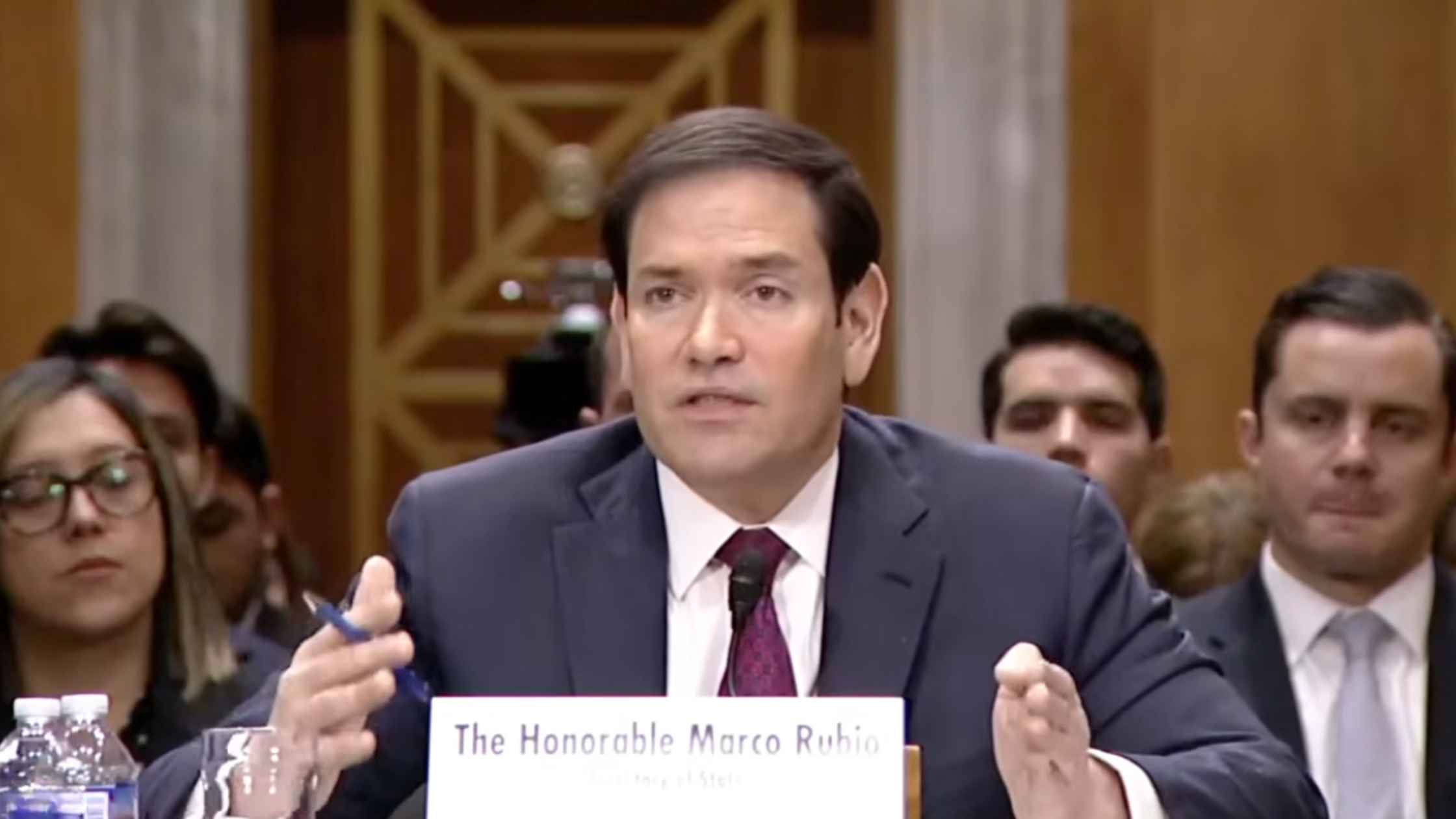
Marco Rubio testifies at a Senate hearing on U.S. policy toward Venezuela. Read the transcript here.
January 29, 2026
Topics:
No items found.