
Speaker 1 (06:01):
Thank you for being here. Thank you for your patience.
Speaker 2 (06:02):
[inaudible 00:07:46]
Speaker 1 (07:48):
Thank you, Sheriff. You know I always have something to say. Welcome again to CF Industries. I'll give you a quick little safety briefing. Though we don't anticipate any issues, please do know that you are in a safe, secure area and we have a lot of representatives that will direct should there be anything. Please mark the exits for you. Again, welcome. Thank you so much for being here at CF Industries Blue Point Complex. We're delighted for you to be with us here today. Thank you for silencing your cell phones. Now please help me to welcome the president and CEO of CF Industries, Mr. Chris Bohn.
Speaker 3 (08:21):
There you go. Go for it.
Chris Bohn (08:49):
All right.
Speaker X (08:49):
Good morning.
(08:49)
Good morning.
(08:49)
Good morning.
Chris Bohn (08:49):
I got to say good morning to you here, Secretary [inaudible 00:08:51] Good morning. I'm Chris Bohn, President and CEO of CF Industries, and on behalf of our joint venture partners, JERA-
Chis Bohn (09:00):
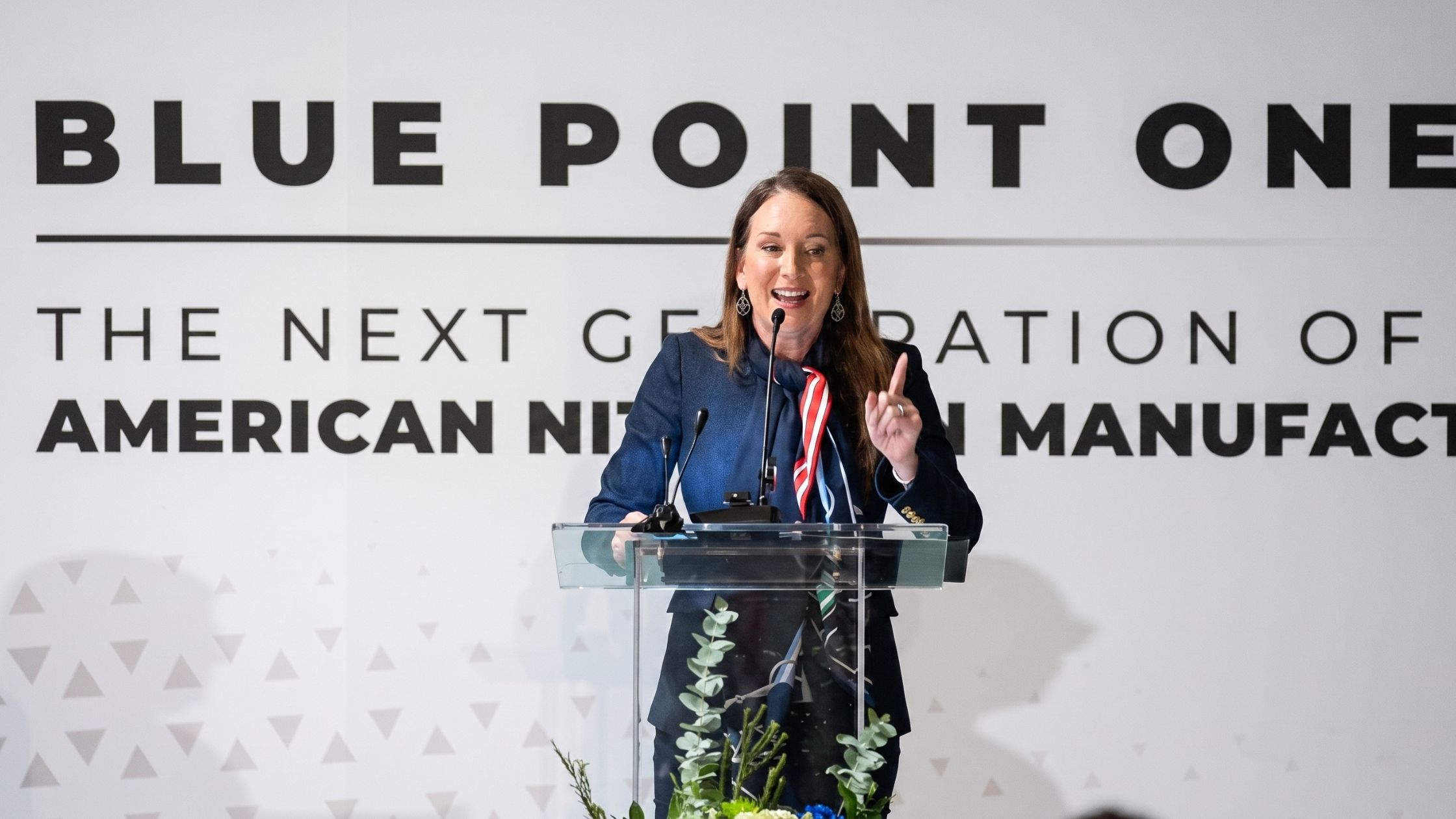
... and on behalf of our joint venture partners, JERA and Mitsui, I'd like to welcome you to the groundbreaking of Blue Point One. I want to extend a special thank you to the US Secretary of Agricultural, Brooke Rollins, Deputy Secretary, Steven Vaden, Assistant Secretary of the Army for Civil Works, Adam Telle, US Representative Julia Letlow, and Executive Director of Federal Permitting, Emily Domenech, along with all our distinguished guests that are here today. Your presence underscores just how much this moment matters to Ascension Parish, the state of Louisiana, as well as to the nation and our allies around the world. Today, we stand on the ground of the next generation of nitrogen manufacturing.
(09:53)
Blue Point One is a $3.7 billion investment in the United States backed by over $2 billion of foreign direct investment from our Japanese partners. That commitment is a powerful vote for the confidence of the American workforce, American infrastructure, and America's leadership in energy. Abundant, low-cost natural gas, the key feedstock of ammonia, help bring us here. But what we're building goes far beyond a conventional ammonia plant.
(10:28)
Blue Point One will be the world's largest ammonia plant once completed. It'll be among the world's first ammonia plants built with auto thermal reforming technology. That technology paired with permanent carbon capture and sequestration will enable this plant to operate with one of the lowest environmental footprints in our entire industry, good for our communities, our customer requirements, and the future of American nitrogen manufacturing. To make this project possible, we have leveraged world-class partnerships. This includes our joint venture partners. It also includes industry leaders like Linde and 1PointFive. Every part of this project is engineered to achieve best in class safety, reliability and environmental performance. At its core, this facility is built to serve people. It'll grow access to reliable domestic nitrogen supply for American farmers to feed the world. It'll expand our nation's export capacity, shipping American-made energy to global markets. And right here on the West Bank of Ascension Parish, it'll bring long-term, high-paying manufacturing and engineering careers, as well as thousands of construction jobs over the next four years.
(11:57)
Crucially, this site is designed for future growth. Blue Point is built with the shared infrastructure to support multiple future world scale nitrogen plants. We believe that what we break ground on today is just the beginning, and milestones like this do not happen in a vacuum. I want to express my deep gratitude to our teams at CF Industries, JERA, Mitsui, and local state and federal leadership.
(12:27)
In particular, thank you, Secretary Rollins and the administration. By delivering a transparent, efficient, and predictable permitting process without compromising rigor, you enabled us to break ground today. You also strengthen our confidence in pursuing additional growth opportunities, not just here at Blue Point, but across our American Nitrogen Network. When you bring together American energy resources, world-class engineering and partnerships and trusted global allies, you create something transformative.
(13:03)
So we aren't just churning dirt today. We are laying the foundation for an incredible resource that'll support the American heartland and help power the global economy. We're excited to get to work. Now with that, please join me in welcoming the United States Secretary of Agricultural, Brooke Rollins. Thank you.
Brooke Rollins (13:25):
I like your shoes.
Chis Bohn (13:25):
Thank you.
Brooke Rollins (13:28):
Wow. What an amazing day to be in the beautiful state of Louisiana. I am a Texas girl, but I have been to this state many, many times, mostly for Texas A&M v. LSU Tiger football games, which are also exciting in the world of college football, which we're about to start again. But this day particularly is one that will go down for me as the best trip to Louisiana until perhaps we actually open up production in some time.
(14:11)
So I just want to thank you, Chris. I want to thank Jackie. I want to thank the entire CF team. From the moment I think we called you on a Monday, on a Wednesday afternoon, you were sitting in my office in Washington and talking about your commitment to the American farmer. And in fact, it was a bit of an uncertain time last spring. And I remember you all led the way by saying that you were going to, as a company, defer scheduled maintenance so that you could ensure that you could keep prices as low as possible for our great American farmers. And I will never, never forget that. So thank you. A big round of applause for this incredible company.
(14:57)
I also have some friends from USDA here, our great deputy secretary, Stephen Vaden, who gets really excited about a lot of topics, but nothing gets him more excited than fertilizer. So it's a big day. Stephen and I, we really never do anything together. We're kind of a divide and conquer kind of team, but this may be the first, in fact, thing outside of Washington, Stephen, you and I have done in 18 months. But again, it goes to the importance of the day, what we're doing today, what this groundbreaking symbolizes and what it means for the future of American agriculture. But Deputy Secretary Vaden, what a joy to have you on the podium well.
(15:44)
My great friend, Representative Julia Letlow, who is here, she does such a remarkable job, not just representing the interests of her citizens in her district in Louisiana, but all of Louisiana and certainly in the agriculture community. There is no better friend for our farmers and our ranchers and those who feed and fuel us than your Congresswoman Julia Letlow. Please help me give her a round of applause as well. Very special.
(16:17)
I'm going to keep my comments very short because we have a couple other people to hear from, but again, I just want to thank Chris and the entire team. What an honor to be here today. And as together we take the latest and perhaps the greatest at least step so far, putting farmers first in this country and moving back toward American fertilizer independence.
(16:39)
Since day one, this administration has been working at lightning speed to help farmers manage input prices, the cost of which has certainly shot up and that we have to work every hour of every day, of every week, of every month, of every year since we stepped foot 18 months ago back into the White House and into the US Department of Agriculture.
(17:03)
The president has activated not just me on this issue, but our entire cabinet. And this is a top priority to make fertilizer more affordable and more available for our nation's farmers, both today with some short-term steps we're taking, but most importantly for the long term, which is what today's groundbreaking represents.
(17:25)
As I mentioned, working across the cabinet, in fact, you'll appreciate, as I was driving in this morning, I had a conversation with our EPA administrator, Lee Zeldin, a conversation with our Secretary of Energy, Chris Wright, who himself will say that the greatest energy that we need is what we feed and fuel this country. And so even the Department of Energy has put fertilizer at the top of their list. Adam Telle, you were not on my list to introduce, but it just occurred to me. I'm so sorry. You'll hear from our deputy at the US Army Corps of Engineers, an old friend and a young friend, not necessarily ... Old in friendship, not old in-
Brooke Rollins (18:02):
... friend. Not necessarily... Old in friendship, not old in years, Adam, of course. But Adam, when we talk about the extraordinary speed of permitting that was undertaken in just the last year to get to this point today, what would have normally been maybe a couple of years, we're going to talk about how we moved that permitting, and Chris, you did as well, at lightning speed. I would love to take credit for that, but all I did was call my friends over at the Department of War, specifically Pete Hegseth. He then passed this on to General Graham at the Army Corps of Engineers, who then passed it on to the incredible Adam Telle, who of everyone that deserves credit for getting to today at such fast speed, it is that man. You'll get to hear from him in a little bit. But if you'll help me give him a round of applause as well.
(18:49)
The single most important thing that we can do to reduce America's reliance on foreign countries for the fertilizer that our farmers need, amongst other inputs, is what we're representing and what's happening today. America imports currently roughly 50% of the 20 million tons of fertilizer that we use each year. This is a daily threat to the security of our supply chain, and therefore to the very freedom that we celebrate today at our 250th birthday. And that's why today's groundbreaking of the $3.7-billion Blue Point project ammonia plant marks such a giant leap forward. Once operational, this plant will be the world's largest by nameplate capacity. As I mentioned, my good friend, assistant secretary for the Army for Civil Works, Adam Telle worked around the clock with his team for the past several months to move this project through federal permitting review in roughly 45 days, again, after being told this would take years. And now, we are ready, as of today, to move to the next stage.
(19:57)
Construction alone is projected to create thousands of jobs, the number I have here is 3,900 jobs here over the next four years, and the plant will eventually provide more than a hundred full-time manufacturing and related jobs to this area. Blue Point will produce 1.4 million metric tons of low-carbon ammonia. To give you an idea of how significant this really is, the fertilizer coming from this plant alone is expected to support 6.7 million acres of corn production in the United States. 6.7 million acres. That is 1.2 billion bushels of corn. This is a remarkable, remarkable facility that is being built here. This, of course, will provide, as I mentioned, much needed stability to the American supply chain and American farm production. The Trump administration's streamlined permitting process that is making today possible, combined with an incredible partnership with this amazing company and working across the entire cabinet to get to today, but also what comes after today will go down as a textbook example, as a model as we work to reshore what is needed for our great American farmers and ranchers.
(21:20)
God bless you all. God bless the great state of Louisiana. God bless our American farmers and ranchers. And God bless CF Industries. Thank you. What an honor to be here. Thank you so much.
Speaker 4 (21:34):
Thank you. I'd now like to introduce Deputy Secretary Vaden to make some remarks.
Stephen Vaden (21:45):
Well, the secretary is very much correct. We usually divide and conquer, and are not frequently in the same place. But it shows you how important what is going on in the state of Louisiana here today that we are both here. And let me put this in context about how important this is. If you're involved in agriculture, if you grow corn and soybeans, fertilizer is not a new topic to you. You have known for the past five-plus years that prices have been elevated, supplies have been questionable, and you have heard previous administrations promise you that help is on the way, and yet no spades were turned, no meaningful amounts of fertilizer were produced. That ends today. There's been a lot of talking. We're now at the action phase, and it's because of this administration, this secretary of agriculture, and this cabinet that things are actually being done government-wide, and that's represented here today by the multi-billion-dollar investment of CF Industries, bringing the world's largest ammonia manufacturing plant to life here in the United States. This will not only help American farmers. We have the Department of War here today because this is also a matter of national security. A nation that cannot effectively feed itself and depends on foreign sources for key inputs in order to feed itself is not a nation that is secure. The Trump administration understands that. We have put the resources behind American companies like CF to solve this longstanding problem, and thanks to their partnership and the partnership of our federal partners at the Department of War, the Permitting Council, the Department of Energy, and the Environmental Protection Agency, just to name a few, there is finally action being taken.
(23:47)
My message today is simple. Farmers have been rightly skeptical as multiple politicians have come up and promised them to do something about fertilizer. That skepticism's time has ended, because action is now being taken, fertilizer is going to be produced in this country, and thanks to the investment being announced here today, for literally decades to come, America will be more food secure, farmers will know that they no longer have to look overseas for the supplies they need, and our nation will be better for it. Thank you all very much for all that you have done on behalf of American agriculture, and I cannot wait to come back and see this plant in operation.
Speaker 4 (24:33):
Next, I would like to introduce Assistant Secretary Adam Telle to come up and say a few remarks as well.
Adam Telle (24:42):
Good morning. I'm Adam Telle. I'm the 14th assistant secretary of the Army for Civil Works. I serve under the great leadership of Secretary of War Pete Hegseth and Secretary of the Army Dan Driscoll. I'm so honored to be here in Louisiana today, and I'm really here to pay respect and tribute to Secretary Rollins and Deputy Secretary Vaden, their leadership on this, their ability to convene the cabinet. The first meeting we had on this topic at the Department of Agriculture, I think we probably had six, seven, eight cabinet officials that Secretary Rollins had called together within a matter of hours to try to solve this problem, and she brought it to our attention. The U.S. Army Corps of Engineers processes 100,000 Clean Water Act Section 404 permits annually. And Secretary Rollins had the vision and the leadership to understand that the permit for this facility was the key to ensuring that our farmers had agriculture and that our people had food security. And she and Deputy Secretary Vaden saw this all the way through to today.
(25:42)
Really quickly, I want to explain something that's sort of interesting about the U.S. Army Corps of Engineers, because the average American citizen might think, well, why is the U.S. Army here helping and playing a part in something like this? And it really goes back to our nation's founding and it really goes back to the state of Louisiana. Back in Thomas Jefferson's era, the United States of America was not producing engineers. We didn't have a Texas A&M University to produce great engineers, a Louisiana State University to produce great engineers. We were relying on the French to help build out our infrastructure as a nation. And President Jefferson wisely knew that the Mississippi River was key to expanding our nation westward and becoming a nation from sea to shining sea. And he said, "What's the one place in America that is producing engineers?" And it was the U.S. Military Academy at West Point.
(26:41)
And so he got two guys named Lewis and Clark and said, "I want you to go explore westward. I want you to use America's rivers to do it." We're the only nation in the world that has this beautiful bounty and this beautiful blessing of this amazing river system running right up through the heart of our country. And so he got Lewis and Clark to do that, but it was really about the Louisiana Purchase. He knew that if-
Adam Telle (27:00):
... but it was really about the Louisiana Purchase. He knew that if he could secure the watershed of the Mississippi River for the United States of America, our destiny would be in our hands. And he did that. And really the reason that the Corps of Engineers is here in Louisiana today dates all the way back to President Jefferson's vision that the US Army would be the engineers that would help conquer our nation. And that gets back to why this was such a struggle to get to where we are today, and why we're solving it in the Trump administration.
(27:33)
The Corps of Engineers grew and became the organization that built the Panama Canal, changed the economy of the world, that built the Pentagon in less than 16 months. But over the course of our history, lost its way and forgot that it has built great things for the United States of America. And back in 1972, when America's waters were polluted and Congress was thinking about how to clean it up, they created the Environmental Protection Agency and Lee Zeldin is doing an outstanding job running that agency. But the reason they gave the Corps of Engineers a role in permitting under the Clean Water Act is because the Corps of Engineers knows how to build things, and they didn't want to hold up building things. We, under this Trump administration, have re-imagined and rejuvenated the Corps of Engineers to get back to building things. And so when Secretary Rollins and Deputy Secretary Vaden called and said, "Hey, we've got a problem in Louisiana. We got to solve it."
(28:24)
We were able to do it in 45 days, and we lived up to that commitment that we made. We made it happen. And I'll say this, as American citizens, you shouldn't have to expect your Secretary of Agriculture to get on the phone to solve simple problems, bureaucratic red tape created in large part by the previous administration. You shouldn't have to have a cabinet member like the Secretary of Agriculture to do that. And that's why Emily Domenech, who is at the end of this group here, she is the key in the Trump administration to taking the most complicated machine in the world, the US government, and simplifying it to get Americans back to work, to get the federal government out of the way of them living out their version of the American dream. She is making all that happen, reaching across agencies and building a better future for American citizens when they interact with their federal government on permitting.
(29:15)
And finally, before I get offstage, I'm really honored to be a part of this very important moment for Louisiana and for the nation. But I just want to recognize Congresswoman Julia Letlow, an incredible leader for Louisiana, somebody that has got a long future ahead of her serving Louisiana, somebody that has been a good friend and has just reflected an amazing deal of credit on this state in the United States Congress. Look forward to hearing from you.
Chis Bohn (29:48):
Well, I think you took the thunder there. US Representative Letlow, why don't you join us for some remarks?
Congresswoman Julia Letlow (29:59):
Well, good morning. What an incredible day to be in Ascension Parish! Wow, this is exciting news! To CF Industries, to our CEO, Chris Bohn, thank you so much for today. What an incredible gift you have given all of us in stepping up and helping us find a remedy for something that has been plaguing our farmers for so long. I'm looking in this room, and I see so many of our producers and farmers who have poured into me over the last five and a half years, who have taught me so much. I don't know, I don't have to tell you Secretary, but our farmers, you'll find in Louisiana, I know all across the country are the kindest, warmest, most amazing people. And it's not lost on us that every single year you put your livelihoods on the line. I cannot imagine what that feels like. And so I want you to know that this is us listening to you, being here for you, and trying to find solutions to you because like it was mentioned, it's not just a matter of putting food on the table.
(31:04)
It is a matter of national security. And I have to give kudos where kudos is due. I have had the immense honor of serving on the subcommittee for agriculture on appropriations. And we have had quite a few secretaries come before our committee to testify and there is no greater secretary than Secretary Brooke Rollins. And I will tell you this, whenever she comes to our committee, we all represent our districts and we bring our concerns to her, and we bring our issues to her. Now, we only have five minutes usually, but she's so gracious and she listens, and I can see her writing down with every single issue that not only I have, but all of my colleagues. And you can see her mind twirling and trying to find solutions like she found here today. And not only that, I don't know, there are 435 of us representatives and I have watched her personally give her cell phone number to every single one of us and you best believe we use it.
(32:06)
And whenever I call our Secretary, she is there for me, for you all. I've never seen a bigger heart when it comes to agriculture. I am so incredibly blessed to call her my secretary, but also my friend, and a friend to all of the farming community and agriculture across this great country and Louisiana. Thank you so much to our Secretary, and to everyone in the administration who works so hard. We were just talking earlier behind stage. We can't let one single day pass without getting the job done. And that's what today is, thousands of jobs. And I'd be remiss if I didn't share my appreciation to you all for what you do for education, investing in Ascension Parish, early childhood education, everything that you do. It's not just about agriculture, it's about teaching our next generation how important farming is, and teaching them that we have to continue producing for the next generation.
(33:07)
I'm so grateful to Sia for all that you do in that regard. My goodness, it is just an honor to be a part of this special day today. Thank you so much for having me. God bless you all. Thank you so much for producing for Louisiana, for the country, and for the world. Thank you!
Chis Bohn (33:27):
Thank you, Representative Letlow for your support. And I think everyone can see the energy on this stage, which is what has helped us get to where we are. So, thank you again, Secretary Rollins, Deputy Secretary Vaden, Assistant Secretary Telle, Representative Letlow, and then also Executive Director Domenech. Before we conclude this part of the program, I want to recognize Governor Landry and his team for their collaboration with Blue Point One. Thank you for your support for manufacturing, investment, and job creation in Louisiana.
(34:04)
I also want to thank Ascension Parish President Clint Cointment and Donaldsonville Mayor Leroy Sullivan, all of our elected officials, and our nonprofit and education partners. We have been proud members to call the West Bank of Ascension Parish our home for 60 years. And we look to expand upon that once again now with the Blue Point operations.
(34:28)
Finally, thank you to everyone who helped make this project possible, and all of you for being here today. With that, I'd like to invite our guest to join us in the groundbreaking ceremony. Thank you.