Donald Trump (00:00):
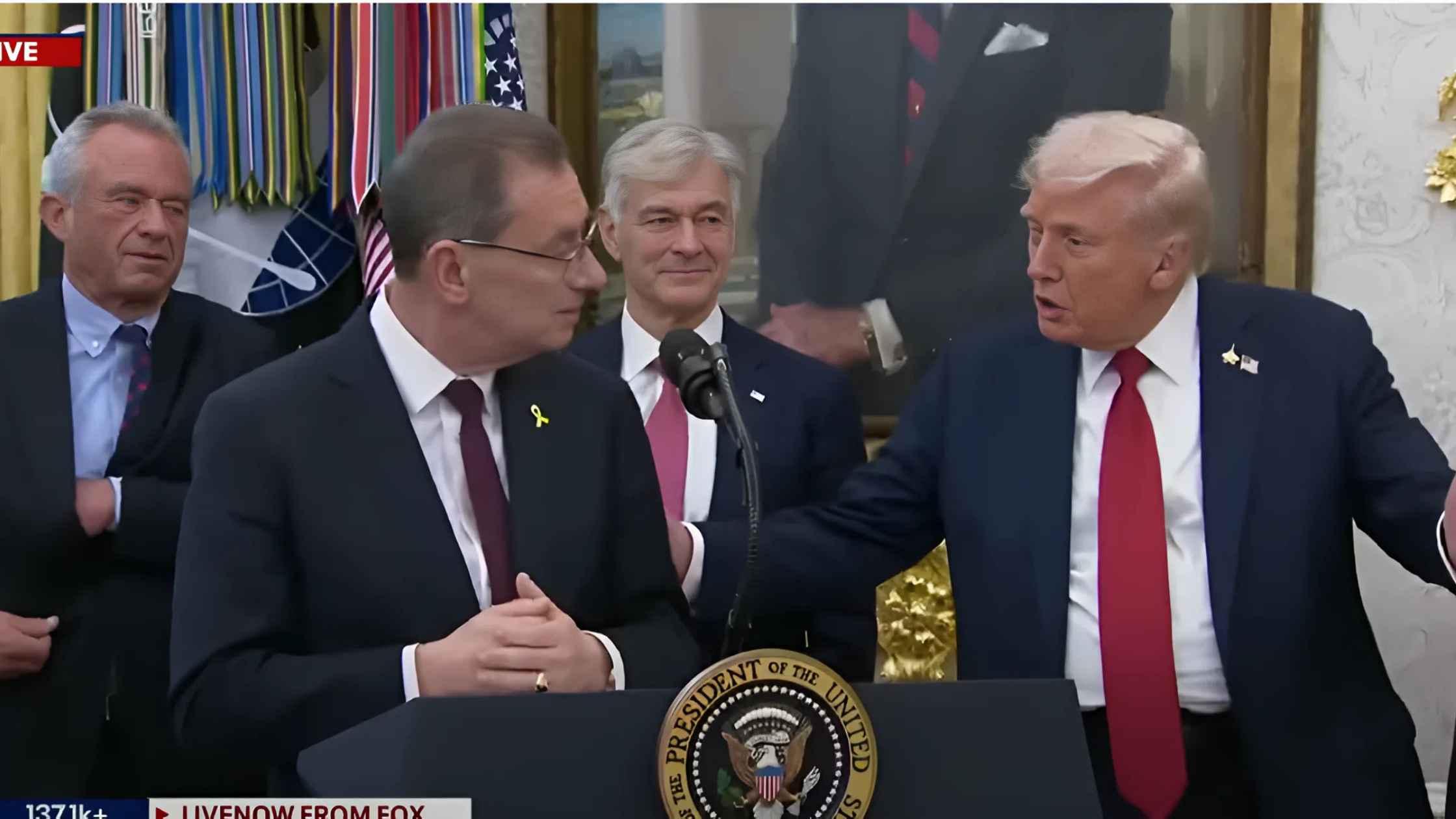
Then other countries for the exact same product. A major reason is that the American consumers have been subsidizing research and development costs for the entire planet. They put all of that on us, and yet they were the beneficiaries too. So it's being changed as of today. The United States had just 4% of the world's population and consumers, only 13% of all prescription drugs, yet pharmaceutical companies make 75% of their profits from the United States. So think of that. We have 4% of the market, 13% of prescription drugs. And yet Albert, I didn't know you were that violent. I'm surprised you're agreeing to this.
Albert Bourla (00:40):
I'm getting better.
Donald Trump (00:43):
Come here. No, he's doing the right thing. Thank you. And yet they make 75% of their profits from the American customers. It's something. That's why I signed an executive order combating this practice and we signed it very happily a little while ago. Today, Pfizer is committing, as will other drug companies as we go through the weeks, but Pfizer is truly one of the biggest in the world and one of the greatest in the world. Today, Pfizer is committing to offer all of their prescription medications to Medicaid, and it will be at the most favored nation's prices. It's going to have a huge impact on bringing Medicaid costs down like nothing else. I told you that in my first term, I was so proud of the fact that for the first time in 28 years, drug prices came down and I had a news conference that I explained. It was 1/10 of 1%, but it was down. And here we're talking about in one case over 1,000%.
(01:42)
This is a critical step forward to our work and to improve healthcare of hard working low-income Americans, especially low-income Americans, will be helped so greatly. In addition, Pfizer is agreeing to provide some of their most popular current medications to all consumers at heavily discounted prices of anywhere between 50 and 100%, and that's off the price. And in some cases even more than that. These drugs will be available for direct purchase online at a website operated by the federal government. We're also announcing that moving forward, all new medications introduced by Pfizer to the American market will be sold at the reduced most favored nation costs. So we'll be paying essentially what other countries are paying who have been much lower, much, much lower for many, many years.
(02:31)
Furthermore, Pfizer will invest $70 billion to reshore domestic manufacturing facilities. In other words, they're going to bring a lot of their facilities to make their drugs and make what they make, their product, they're going to make it in the United States. I appreciate that. $70 billion investment and fund research and development right here in America. We're working with other major pharmaceutical companies to secure similar agreements. Everyone understands that the status quo where Americans pay more for drugs, prescription drugs, and they pay more than foreign countries who take advantage of us in many other ways, although not so many anymore. I think we've pretty well got that stopped, right? I think so. We've stopped that, but they took advantage of a lot of other presidents, that I can tell you.
(03:18)
But we're making this pay to be very unacceptable what they've done in the past. That's why my administration has also taken historic action to investigate the unfair and discriminatory trade practices of other countries that extort our pharmaceutical makers to shift costs onto the American consumer. They say, "No, give us a price, a very low price and just charge the American consumer. Charge it to the U.S." The United States is done subsidizing the healthcare of the rest of the world. It's a big thing. I can't tell you how big this is, and I was all set to go on it first term, but then you had the COVID and we had a focus on that. But I said, I want to get back here. So because this is, you're talking about 14, 15, 1,600% reductions in some cases. But by taking this small step, we're ending the era of global price gouging at the expense of American families and we're making America healthy again, which is our little theme for the people behind me.
(04:17)
And I want to just ask Secretary Kennedy to come up and we'll start and we'll go through it with Oz and Klomp and Bourla and Makary. We'll go through it and if you have any questions, but this is a really big announcement. This is something that most people said was not doable and other countries are going along because we told them that if you don't go along, they didn't have to go along. But if they didn't go along, we were going to put extra tariffs on those countries and we were going to charge them the amount of money that they should be paying for the reduction in costs. So I think we had a pretty good negotiating position. So Bobby, I'd like you to speak about this and what a great job and thank you very much.
Robert F. Kennedy Jr. (05:00):
I'd like to thank a couple of people who aren't up here, Theo Merkel, Dr. Heidi Overton who played key roles in this negotiation and helped make this happen. And also Emma Hernandez, who's not up here, but John Brooke and Chris Klomp who were the people who were negotiating, in some cases, I think including last night, 24 hours without any sleep. This would not have happened without President Trump's leadership. I told my son last night, we're all under secrecy about this, but I told my son late last night, a 27-year old son Connor, who's a very liberal Democrat, and I told him this was happening and he just paused for a minute and he said, "Thank you, dad. I'm so proud of you." Because this is something Democrats have wanted for 20 years. Republicans have wanted for 20 years. Everybody said they're going to do it. Nobody has even taken a step towards doing it.
(06:04)
And the reason was because it was such a daunting task. And even all of the negotiators you say, I also want to thank Howard Lutnick. This would not have happened without him. But even all of the negotiators here and all the people at HHS and at the White House team, all we could see was all the reasons that this couldn't happen. Everybody had tried, nobody could make it happen. And it was President Trump alone with his doggedness, his persistence his… He saw this clearly in a way that none of us are in its most simplest terms. Why are we spending more on this country than any other country? Why are we spending 75% of the revenues that come to the pharmaceutical industry? We're doing all the research and everybody else is riding on our slipstream. And President Trump, I would say harangued and harassed us to make this happen. I was getting calls at 11:30, 12:00 at night, "Oh, are you asleep? You got to get MFN done." And at one point, Dr. Oz told me, "I can't take the President's calls anymore. My wife has a lot of reasons say to me about different things that happened in my life and doesn't that give you anxiety?" And I say, "I don't get anxiety." "This gave me anxiety." Oh, thank you President Trump. It would not have happened without you. This is real leadership. He's a president who has a vision and makes that vision happen. And I can't think of any other president of the United States who could have done this in our history. I'm very grateful to you. This is an extraordinary benefit to the American people.
(08:02)
Thank you for your vision, President Trump, you bold action, your unwavering commitment to health and well-being of the American people. Never has a president stood up so bravely for the American people with respect to healthcare. By the way, I forgot to thank Albert Bourla. Albert and I have had a long history of antipathy and antagonism toward each other, but I have to say his leadership in this took tremendous courage and he really created a template for corporate responsibility for putting public health ahead of his individual interests. I'm very, very grateful to you, Albert.
(08:45)
Under the leadership of President Trump, the U.S. is now acting as a tough negotiator on behalf of the American people. Today is about fairness. It's about equality. It's about giving hope to those who are trying to stay healthy or managing illness and/or fighting for their lives. We refuse to make the most vulnerable citizens continue to pay an unthinkable price for the world's pharmaceutical breakthroughs which we pay for. This policy is a shield for the chronically ill who have carried the burden of high drug costs for far too long. It's a signal to every American family that we're finally putting their health and financial security first.
(09:26)
And it sets a new standard, one that says, we won't write blank checks to the drug industry any longer. No family should ever be forced to choose between filling a prescription and putting food on the table. Americans should not be gouged paying 300 or 400 or 1,000% more than people in other countries for the exact same drug, many times manufactured in the same factory in New Jersey and sold in Great Britain for 1/10 the price that it's being sold for here. This week, and I was with some friends up in Martha's Vineyard and an old friend, one of my oldest friends, his wife and daughter have a chronic disease, and that chronic disease last year cost $150,000 to treat.
(10:14)
And the mother had to choose whether she was going to take that money and spend it on her or her daughter. She spent it on her daughter, so she had to make that choice. It's a choice that no mother should have to make. We did a roundtable recently on drug prices. One patient spent more than $180,000 on one drug, on cash in all of her savings, and worked three jobs to make ends meet. One almost quit her job and moved to Germany to get the drug cheaper. Some looked at getting the drug on unsafe secondary markets because they could not afford it through the legitimate markets.
(10:53)
Today, we begin to right that ship. For the mother trying to help a child get better, for a grandmother at the pharmacy counter, and for millions of Americans who want to restore their health, today is about another promise made by President Trump and another promise kept by President Trump to the American people. And it's only just the beginning. This is all thanks to your unwavering leadership, Mr. president.
Donald Trump (11:19):
Thank you.
Robert F. Kennedy Jr. (11:19):
Thank you.
Donald Trump (11:21):
Thank you very much. Thank you very much.
Mehmet Oz (11:27):
There is a fine line between vision and hallucination. People have to follow you for it to be a vision. And President Trump, you made a lot of people follow you. An idea that most people thought was not possible even remotely. And when we have that shared vision, and I'll speak to some of the people who are involved in this process because it was incredible effort that gives me great pride to serving this administration. And the fact that it did not leak is also an issue of pride for us because these were tough, tough challenges. And Albert Bourla looks very calm up here and cat-like, but he's ferocious when you get him in a negotiating room. This is true for all the pharmaceutical companies that we are negotiating with.
(12:06)
And Secretary Kennedy, my son Oliver, who I told about this deal as we was walking over here, is a Republican. And you know what he said? "Thank you for making us proud." Because it's not just a Democratic problem, it's a Republican problem. This has not happened before. And it took a crusader like President Trump with the support of Secretary Kennedy, Secretary Lutnick. I see the vice president's here as well. Just unwavering, dogged pursuit of change. And now I have to admit that I know the President has me on speed dial. And most of the time when he would call me as Secretary Kennedy alluded to, it was about MFN.
(12:41)
And he always had reasons why we needed to go faster and why people were being hurt today, because we're allowing the kinds of pricing that had been tolerated for so many decades in America. The time of the day didn't matter. The day of the week didn't matter. And that's how the President was functioning. This was such an important part of what he saw as his legacy, which is why it brings such pride to all of us up here and many others to deliver it. And the laser focus that the President had on this, which he shared with me the day that I was nominated, that he nominated me for this position and has reminded me frequently since, made it a top priority for us as well at CMS.
(13:18)
Now, to do this, you have to have tactics. Not just vision but tactics. And the first tactic the President shared was to introduce me to Albert Bourla. He took us to dinner with Secretary Kennedy and he argued, and he's a great deal-maker as you know, that if you're going to make a deal of this scope of this nature, you need trust. So the President lit the kindling, he got the embers going, but he needed us to nurture that beginning of a fire so they would blaze into what today we can announce as the grand deal, one of the greatest ever, certainly in the space of pharmaceuticals.
(13:49)
I gained to respect Albert, and I'll tell you why in particular. It was because he recognized the dangerous problems facing so many Americans, that they had to choose between taking medications prescribed by their doctor that could be lifesaving, or shopping at the grocery store, paying for their kids, a fundamentally important need that would be squeezed out because they couldn't compromise on drugs, or often worse, they'd compromise on the drugs. One-third of all prescriptions are not filled in the pharmacy because of this. We talked through the winter, we talked through the spring, we talked through the summer, and we got nowhere. We stalled. The industry is powerful. They're important. They have smart people. There's no reason for them to give the numbers that the President is articulating today.
(14:32)
And you see these numbers on the charts around this. These are massive wins for the American people. But the president in July demanded after the executive order that manufacturers make a firm commitment and the lower prices or else, and it sent shockwaves through the industry. It got the ball rolling again. Our talks with Albert heated up, but it wasn't until last week, if you want an inside story, it wasn't until last week that we made a major breakthrough and our hardworking team embarked on a remarkable
Mehmet Oz (15:00):
Story that I think books will be written about 24/7 non-stop with industry, with Albert, with his great team at Pfizer and with this partnership we began to deal with the fundamental challenges we have, which is protecting medical advances for the future while at the same time, securing the prices Americans want today. We're going to continue to stimulate and strengthen innovation. That's what a great country does, and we are a great country with a great leader. We're going to protect the US hegemony in R&D. We dominate the planet in discovering cures for illnesses, all those orphan ailments, all those remarkable advances, they come from resource labs here with companies like Pfizer and other great ones in the pharmaceutical space. We're going to lead in the life sciences, we're going to lead in ideas and we're going to make sure that we do all that while we're being fair to the American people, especially our most vulnerable. We're going to finally deliver on the fair drug prices that President Trump has been speaking about for two terms.
(15:51)
We're going to celebrate this historic day. I predict this historic day in the medical field for generations to come. The heroic negotiators that I do feel compelled to mention is Secretary Kennedy kindly also mentioned their names. Some of them can't be in here because they're busy negotiating future deeds. Inma Hernandez Delso, John Brooks, who's a deputy administrator of mine. Theo Merkel, who is in the back and tall and hard to miss with DPC and Coria, insulin with the same group, did a spectacular job and Don Dempsey at OMB. Just wonderful human beings work tirelessly to get this done. We will be able to secure this first MFN deal and the president touched on this, but we have much more to come. You'll be hearing breaking news from the president for the rest of the fall, and Mr. President, these brilliant minds are here because of you.
(16:38)
Now, I don't want to just pay homage this. I want to actually speak this a little bit. The passion to protect the American people brings top-tier Americans into the government. We've created a powerful administration with the president's leadership and administration of winners. People get things done. They see the generational opportunity to fix the biggest problems our nation faces, and the person who led this negotiation, Chris Clump, embodies this seal. Now Chris Clump came to visit Secretary Kennedy and I the very first day we were looking for staff to try to bring in the government and neither of us really had an idea of how challenging this might be, and he came to the interview and we knew that he had built a business that was worth several hundred million dollars, and the secretary, very poker-faced as he tends to be looked at him and said, "Are you willing to give it all up and move your family to Washington?"
(17:26)
A young family, four young children, beautiful wife, "Are you willing to come across the country and serve our nation, serve this president to ensure vital programs like Medicare, which he runs will keep our seniors healthy for years to come?" He gave it all up like so many have in this administration, passionate to follow the president's lead and serve on the Secretary Kennedy, and for those of you at home who are watching, and I hope there are quite a few, I think this shows just how cool a place it is to work is in this government, and I take great pride in the hand the ball to Chris. Chris, tell the American people what they have won thanks to your passionate ability to deliver on President Trump's promise.
Chris Klomp (18:12):
Thank you Mr. President. You have enabled something that is recently as last night nearly everyone has said was impossible, and Secretary Kennedy and Administrator Oz, thank you for having trust in us as a negotiating team to drive this forward on behalf of the American people, it is an absolute honor and privilege, and Mr. Bourla to you and to the team at Pfizer, you have taken a step that I think few appreciate requires a level of courage to change something that for decades administrations have tried and there was no incentive rationally for you to do, and yet you've done it because you recognize the opportunity to align your economic interest with the social interest of the American people, And we are grateful. Today is historic as it's been discussed. This is a major win in the battle for affordable healthcare and affordable drugs. As the President said, on average, we pay nearly three times what the rest of the wealthy world pays for branded pharmaceuticals.
(19:14)
And yet we drive more than 50% of global R&D, 50% of revenues, nearly 70% of profits. It's unjust, it's morally unjust, and when this happens, we stifle innovation and we limit access for the most vulnerable people across the planet and in America who need these medications, and so the president directed us to make deals. That's what he does and it's what we do, and all great deals and this is a great deal, are rooted in principles, and this deal was rooted in the principle of fairness. Now, the president could have directed us to go to the poorest country on the planet and find the cheapest price for every single drug and bring that back to the United States and use the might of the government to insist that that's the price we pay, and that might've worked actually for just a little bit, but very quickly it would've utterly destroyed innovation in pharmaceuticals.
(20:05)
It would've destroyed American privacy in building life-saving medications. There are nearly 20,000 known diseases on the planet. We have treatments or cures for far fewer than 10% of them. So that would've been a bad strategy and it would've limited access to those who need those medications the most, but he didn't call for that. He didn't call for 50% lower than the lowest price on the planet. What he called for was fairness, and that's a powerful principle because we all grow up wanting to be on the right side of fair and it allowed us to do what has not been done before, which is to call on manufacturers and ask them to be fair and allows us to go to countries and ask them to pay their fair share in the battle against global disease, and that is the unlock for this great deal. Now, it's my privilege to talk just for a few minutes about the details of the deal.
(20:54)
First, let's start with the definition of MFN. What do we mean by that? This is not made up list prices that have often been quoted in prior administrations stuffed with fees and rebates. We're talking about we start at net prices after fees, after rebates, the prices people actually pay here, the prices people actually pay in other wealthy countries. We then index to a basket of countries, wealthy countries across the world, and we go drug by drug and we look for the lowest price, and that becomes the starting point for what an MFN price is in the United States, and then we've built this principles of fairness on five key pillars as we've talked about. Number one, as has been discussed, direct access for patients. At TrumpRx, which is a site soon to be launched, available often at full MFN and always at lower prices than currently available.
(21:44)
This is by passing middlemen, it increases transparency. In many instances, prices are 80% lower than they are today. No more Canadian detours to purchase drugs more inexpensively than our neighbor. You do it from home, you do it at a click. This is American ingenuity outsmarting the system. Number two, the president was very clear to us and directed us to ensure that we secure the lowest prices for the most vulnerable Americans, those who are served by Medicaid. So we focused there first. So Pfizer will be putting virtually all of its portfolio of drugs at MFN prices available to Medicaid in the near future. This safeguards the program. This ensures that this program lives as a lifeline without undue burden on the taxpayer for those who need it most, for our vulnerable Americans whom we are charged morally to care for. The third principle is about future proofing fairness.
(22:34)
This is the idea that Pfizer has committed as are other manufacturers, that they will not launch a new drug for commercial Medicare, Medicaid, or cash pay markets at a price that is higher than the other wealthy world. Now, they are free to price their drugs wherever they want. These are not price caps, these are not price controls. They can price however they'd like. We are simply asking them and they are committing not to undercut us in other countries. This is an essential principle. This allows us to retrain other countries to appropriately value innovation for their citizens, to appropriately understand what fair share means to contribute global R&D. This allows us not to compromise access for those who need it most and this is a powerful commitment. The fourth principles around shared savings as our commerce colleagues and as our US trade representative colleagues succeed in encouraging other countries to pay more for existing medications.
(23:31)
A portion of that will go to fund additional R&D, and a portion of that will repatriate back to the United States to offset prices, lower prices further for Americans on those existing drugs, and the fifth principle as discussed with hats off to Secretary Lutnick and Ambassador Jamison Greer from US trade is about Pfizer committing to onshore 100% of the value of all imports that currently imports to the United States, thus ensuring that we seal our great American resurgence. If you're watching this right now and you have been looking for evidence that this is a president who knows or cares about you, who is fighting for you, who is fighting for every American, this is exhibit A. This is not an empty promise. It's not platitudes, it's not lacking a plan. These are hard contracts with teeth lowering prices now that we will all feel.
(24:25)
These are the most significant historical, substantive, mathematically quantified price reductions in the history of our country in modern-day pharmaceuticals. I cannot thank you enough for leadership in enabling this to happen. It is an absolute pleasure. The President has showed us that the impossible can be achieved and that is what's happened today. God bless America. With that in mind, it is my absolute pleasure to introduce Albert Bourla, CEO of Pfizer.
Albert Borla (25:02):
Mr. President, what an honor to be here today in this office to announce a landmark agreement. I think it's an historic day.
Donald Trump (25:12):
Is this the coolest office? He has a beautiful office, but the oval is the coolest, right? What do you think?
Albert Borla (25:19):
I think by far and I've seen other presidents offices, there's nothing like that.
Mehmet Oz (25:25):
It's good office.
Albert Borla (25:26):
Yeah, so it's an historic day because I think today we're turning the tide and we are reversing an unfair situation. For years, other rich nations refused to pay the first serve for the medical innovation, and as a result, Americans had to assume this proportional cost on their shoulders. This situation we all knew is not sustainable. This situation is a situation that many wanted to change but no one could. This is changing today with this agreement. In July, the president sent to me and other heads of pharmaceutical companies a letter, and over there, he articulated four specific requests. These requests, it was obvious to us, were designed to lower drug costs in the America in different ways, it's one of them and altogether holistically to have synergistic effect in the impact that that will have in the US health care costs and patients. With this deal that we signed today, we satisfied all four of president's requests, all four.
(26:44)
The big winner of this deal clearly will be the American pace. There is no doubt about it. They are the ones that will see significant impact in their ability to buy medicines, but I would argue that it is not the only winner. I think who else is a winner here, it is American innovation and American economy. In our industry, we had two major overhangs that have substantially reduced our valuations and create concerns for us in our ability to invest. We are addressing both of them right now and I will speak about them. The first one was the uncertainty of tariffs, because president is absolutely right, tariff is the most powerful tool to motivate behaviors, Mr. president and clearly motivated ours, all right?
(27:41)
So by this agreement that we did, we commit to onshore the production of our medicines that are consumed in the US and are made outside the US, and for that, we are ready to unleash our investment portfolio in this country, and the president graciously gave us a three-year grace period that we will not be subject to the 232 tariffs as long as of course we move the products here. That's one. The second overhang in our industry was this uncertainty, what will happen with the framework of pricing in the country? Because this uncertainty, it was what was holding people from investing in the pharmaceutical industry, which resulted in significant reduction of our multiples.
(28:31)
Actually, our multiples are at historical law. Well, now we have clarity about what is the framework for the US pricing. Read the letter of President Trump, read the four points and this is the framework and we will abide to that, and going forward, this is how things will be priced in the US and abroad. We are ready to invest as the president also mentioned, $70 billion in the next few years from Pfizer in manufacturing and research in America. I really think this is an historical moment because also I can put that behind us and focus on the things that I want to spend my time, cancer treatments, to bring better obesity medicines, to bring better vaccines, to bring things that people value, and thank you for allowing us to do that. I want to thank Secretary Kennedy.
(29:27)
I want to thank Secretary Lutnick. Your leadership helped us to pull that together. You are the mastermind of everything, and without the brilliant way that you designed the whole thing, we wouldn't be able to make it happen, but you were even more brilliant because you had someone in your team that he was the driving force behind everything, and I don't have words to thank you for your integrity and it is what you have said. We created trust from day one and that was the most important thing that allowed us to be able
Albert Borla (30:00):
… very difficult negotiations. Of course, I also want to thank the U.S. trade representative, who is also heavily engaged, and he's probably the first trade representative that I have seen that cares about our industry, and cares to do something about unfair situations out there.
(30:20)
But more than anyone else. Mr. President, I want to thank you-
Donald Trump (30:23):
Thank you very much.
Albert Borla (30:24):
… for your leadership, and, frankly, for your friends.
Donald Trump (30:28):
Thank you.
Albert Borla (30:28):
Thank you.
Donald Trump (30:28):
I will thank you very much. Great job. Great job.
Speaker 1 (30:34):
Thank you, Mr. President. The growth of drug spending, that is the increase in drug pricing, is the fastest and biggest increasing area of healthcare spending. So, today's announcement has incredible implications for healthcare spending in the United States, and today marks the beginning of the end of the great American rip-off.
(31:02)
And it also marks the beginning of the end of a great American tragedy, something I've seen as a physician at the bedside, patients getting spun up into a financial rage doing GoFundMe campaigns online, sending repeat reminders asking people to donate, getting their churches to pass the offering plate from pew to pew, Sunday after Sunday to try to get enough money to pay for a drug in the United States, a drug that's five or 10 times more expensive than the same drug in France or Germany or the UK.
(31:40)
People get spun up, and it's a tragedy. Having cancer is hard enough. Getting spun up into a financial rage in order to try to get the money to pay for treatment makes it so much harder.
(31:54)
37% of people who go through cancer care say in the end that the financial toxicity makes them want to avoid or delay care in the future. That is, they're done with it. They're done with the system. That's how toxic financial toxicity can be.
(32:12)
And for what? For what? So, the U.S. can finance the R&D of the world? Well, that ends today thanks to President Trump. So, we want to see R&D, we want to see American pharmaceutical companies thrive, we want to see pharmaceutical companies that do business, and manufacturers in the United States thrive.
(32:35)
At the FDA, we're doing our part. If you're going to equalize your price to that of other wealthy countries, we're not talking about Zimbabwe, we're talking about Germany, France, UK, Japan, other wealthy countries, the OECD countries. If you equalize your price, then we're going to put your future applications at the front of the line.
(32:58)
A voucher to get a review in weeks has a market street value of about $500 million, because every day is money when it comes to getting a drug approved. And so, if you meet one of the president's national priorities stated very clearly, moving manufacturing to the United States, meeting a large unmet public health need, or equalizing your prices … We're the largest purchasers of drugs, we deserve the best prices. And so, we're going to do our part. And the generic company makes their drug in the United States, that application is going to move to the front of the line as well. And if you're going to build a plant in the United States, our FDA inspectors will walk through that plant during the construction phase, something never done before, so, that it's ready on day one.
(33:46)
So, thank you, Mr. President for your leadership. They said it couldn't be done, and here we are.
Donald Trump (33:50):
Thank you. Chris, you may want to go up, and just show one of the boards about how quickly the price has come down. These are small examples. We're going to have it over 1000% in some cases. You'll see that during the week. But we just picked out four at random, and you see the kind of numbers.
(34:12)
Bobby, maybe … Good.
Chris Klomp (34:15):
You picked four examples, but I want to be totally clear, these are not the only four examples, and as the president mentioned, this is not the only agreement. It is the first. It's a historic agreement. There are many to come, and we're excited to talk about them, and that means hundreds and hundreds of drugs. We are not exaggerating when we talk about reductions of up to 80%.
(34:36)
We give you four examples here. One for dermatitis, a new price [inaudible 00:34:40] results in 80% reduction to what's available today. One in post-menopausal osteoporosis, 85%. Migraines that affect so many Americans, 50% reductions. Rheumatoid arthritis, something my own mother struggled with, 40% reductions.
(34:54)
This is about access. This is about ensuring Americans have access to life-saving medications. These are real prices. These are net prices. They're not made up. They're not funny numbers.
Donald Trump (35:05):
Thank you very much. [inaudible 00:35:07] everybody here has been incredible. We've been standing here talking about the Make America Healthy Again a lot lately, and I think our meeting the other day was excellent on a thing called Tylenol. That was a very important meeting. I think that's a very important meeting.
(35:27)
And this in terms of pricing, it's going to be great for Medicare, Medicaid, Social Security. It's going to be great for everything, because your medicine costs are coming way down. We have some examples that I think we'll be able to show you next week of over 1000% in some cases for a pill that costs $10 in London was costing $130 in New York, and various other places within the United States.
(35:51)
And the same thing with Canada. People would go to Canada, they'd go to Mexico, they'd go to other places to buy drugs. They don't have to do that anymore. So, we have favored nations. So, this is what we have. And that's one of the biggest days I think anybody will ever have.
(36:07)
We're talking about massive numbers, and the numbers are going to get even better with a little time. And I will say, Albert, I think that the drug companies are going to be the same. The world … We're really competing against the world. So, they have more people. So, we'll come down a lot, and the world's going to go up a little bit, and the end result is you're going to I think do the same business pretty much. Maybe you'll figure a way to do more business I think knowing you.
(36:31)
But I think the drug companies … We're going to come down a lot, the U.S. The U.S. will come down a lot, but the world, many more people is going to go up a little bit, and it equalized, and it's a great tribute. And I want to thank everybody up here. JD, thank you for all of your help too, and Howard, great, really great job. Thank you all very much. Do you have any questions? How about we focus on this? It's so big, let's focus on this.
Speaker 2 (36:57):
Mr. President-
Speaker 3 (36:58):
Can you please give us a timeline?
Speaker 2 (36:59):
Mr. President, first of all, this goes along with your America First campaign promises. Right? Lowering healthcare costs. On a day that it seems like we're going into a government shutdown, led by Democrats, on the premise of providing health benefits to illegals, this seems to cut … Your move here is a starch contrast to that. Could the same principles that you did today apply to health insurance? To maybe lower the cost of health insurance when Americans are struggling-
Donald Trump (37:27):
Yeah. And we're working on just that. A little different group, but we're working on just that. I don't know to this extent. We have a pill, one pill, in particular, we're going to show you next week. It sells for $10 in other countries, and $137 in the U.S. and that's coming down now to probably $15 or $18. They'll go up to $18. I think that's pretty much right, Albert. It's not you, but they'll go up to $18, and we'll come down from $135 or whatever down to $18. That's a massive number. Remember, I was the one that held a news conference, because I lowered drug prices by one-quarter of 1%. I think it was one-eighth of 1%. But it was the only one in 28 years that brought drug prices down for the year, but it was a very small number.
(38:17)
Now we're talking about … You're going to see one over 1000%. Look at these numbers. And this has a big impact, even on the discussion that we'll have with Chuck Schumer, who was here yesterday, along with the very nice gentleman, who I didn't really know. You know who I'm talking about.
(38:37)
The two of them came, and they had a good discussion, and we're going to see what happens. We're going to see what happens, but this has a huge impact on that, because these numbers are going to bring Medicaid's … We're talking about Obamacare. Obamacare is a failure. Obamacare is not good. It's there, but relative to other healthcare programs, it's in the lower 20%. It's not good, and I asked the Democrat representatives, "What do you think about coming up with a better healthcare?"
(39:08)
This actually allows you to do that, because the costs of prescription medicine is I guess a very big … More than 50% the costs of what we're talking about. So, we might be able to do something like that.
(39:20)
This is one of the biggest news conference, from a medical standpoint, that I think has ever been had by any administration. Yeah, please.
Speaker 4 (39:28):
Mr. President, thank you. I'm curious where are the other companies other than Pfizer? Are you expecting them to come-
Donald Trump (39:36):
[inaudible 00:39:36], and I was honored to have Albert be the first. He's done a fantastic job, as you know, with the COVID. He did a fantastic job with a lot of things. He's a leader, and Pfizer is right at the top. It's there. Eli Lilly has been fantastic also, your friend, my friend. And they're all coming in over the next week. We're making deals with all of them.
(39:59)
And I said if we don't make a deal, then we're going to tariff them an extra 5%, 6%, 7%, 8%, whatever the difference is, and we'll take it that way. So, we took away the advantage by the fact that we have tariffs. We took away the advantage that they would have of just saying no, and we couldn't do anything about it. If they do that, what we do is we'll put a tariff on them of an equivalent amount, and we take it that way. And nobody wants to play that game.
Speaker 4 (40:22):
[inaudible 00:40:23].
Donald Trump (40:22):
So, they're all going to be good.
Speaker 4 (40:26):
Are you-
Donald Trump (40:26):
We didn't have to mention that to Albert, but maybe I whispered it to him very slightly. We had to give ourselves a little bit of an advantage. But, no. But the tariffs played a big role, because they know that's what's going to happen.
Speaker 5 (40:42):
[inaudible 00:40:40] you mentioned the exemption of the 232s, but can you share a timeline to that 232 investigation?
Donald Trump (40:52):
I'll let Howard answer that question, please.
Speaker 6 (40:54):
Sure. So, while we're negotiating with these companies, we're going to let them play out and finish these negotiations, because they are the most important thing to American people. So, we are standing by, helping …
(41:09)
… the driver of the 232 outcomes is our HHS team, because look what they've accomplished today. So, we are on their side helping them, but that is the model that's [inaudible 00:41:23].
Donald Trump (41:23):
And you have to understand Albert's spending $70 billion that he wouldn't be spending, because of the tariffs, let's say, and other reasons. I think he liked the winner of November 5th, in all fairness, but because of the tariffs.
(41:34)
And that wouldn't happen … He's not going to pay any tariffs, because when he moves here, there are no tariffs. So, he won't be paying tariffs. That's the beauty of it. If you move here, there are no tariffs, and we have over $17 trillion, Albert. So, can you believe these numbers?
(41:51)
So, Biden had less than a trillion for four years. We have over $17 trillion for, essentially, eight months. Pretty amazing.
Speaker 7 (42:01):
[inaudible 00:42:01] when the prices come down, Mr. President? When [inaudible 00:42:05]?
Donald Trump (42:09):
Immediately they're going to start coming down. Drug prices, they'll be starting immediately. Yeah.
Speaker 8 (42:10):
Mr. President, can you speak to what impact you think this reduction in drug prices will have on midterms coming up?
Donald Trump (42:17):
I think it's going to have a huge … I said if we can pull this off before midterms … I've wanted to do it from the beginning, from my first day and first term. And we were doing so well. We had the greatest economy we've ever had. Everything was good.
(42:30)
And then we're ready to do this, which is complex and big. It's a big change. But what happened is COVID came, and we focused on COVID. We focused on COVID very hard with Albert, with the other companies, with everybody. Regeneron was a great thing. We did a lot of therapeutics that were fantastic.
(42:50)
And so, we focused on that, and I said, "If I pull this off again, the first thing I'm going to do …" And we've been working on this for eight months. It's a very big deal. This is a big shock to the system. But it's not as much as I said. The world is going to go up a little bit, and we're going to come down a lot. But now it's fair.
Speaker 9 (43:08):
Mr. Trump-
Donald Trump (43:09):
We're going to be paying the same thing. Yeah.
Speaker 9 (43:11):
President Trump, in first term when you cut the price of insulin, Biden later came in and tried to steal credit for that.
Donald Trump (43:17):
Yeah.
Speaker 9 (43:19):
Do you worry that the Democrats are going to try to steal credit for these historic cuts?
Donald Trump (43:22):
Yeah. [inaudible 00:43:23] do is … I really appreciate your question, because I did. I cut the price of insulin down to $35. And the problem is with many of these things … This case, it's going to be pretty quick, but often times you'll do something medically, because of the process, and it won't be seen for two or three years. That happened also with … I could say four different things.
(43:47)
But just if you talk about insulin, so, it was $200, $300, $500, and you couldn't get it, and I got it down to $35. And I said, "I hope I win the next election, because, otherwise, whoever wins is going to take credit for it." Well, what happened is we did win the election. We did great, but, unfortunately, it didn't work out that way from a practical standpoint.
(44:07)
And Biden, when I saw him get up and take credit for the $35, and even less, insulin, that was 1000% lower than what it was just previous, boy, I tell you I didn't like it. I didn't like it.
(44:22)
So, I did the best I could to let them know we did it, because we want to be given credit. But we are the ones that got insulin down to that number, and you're right. They tried to take credit for it. They had nothing to do … In fact, they didn't even know what happened. All of a sudden, the insulin price kicked in to $35, and they asked Biden about it. He had no idea what the hell they were talking about, but after they explained and … They didn't really explain it to him, because he was not capable really of understanding, but when they went out and talked about it, they acted like it was a great feat, but it had nothing to do with him.
(44:52)
And it continues, and we'll get it down even further, but insulin was … People weren't taking it, I would imagine. They couldn't …
Donald Trump (45:00):
God bless you, Bobby. I hope I didn't catch COVID just there. Don't you have Paxlovid? He's got Paxlovid. Give me a Paxlovid immediately.
Speaker 10 (45:17):
While Nancy Pelosi is ignoring what you're doing for the American people. She's going after your administration for cutting taxpayer-funded healthcare for illegal aliens last night.
Donald Trump (45:27):
Who was doing that?
Speaker 10 (45:27):
Nancy Pelosi. She went on NBC last night, dropped a bunch of F bombs, told Republicans to go F themselves. Has she lost her mind?
Donald Trump (45:36):
We have done an unbelievable job medically. Just this, if you did nothing else, we've done a lot, like the insulin. But just this, nobody can ever catch this. This is the biggest price-reduction, maybe 10 times, 15 times that has ever been given before. And this is going to have a huge impact. As I said, Obamacare is not a good thing. It's been bad and I'd like to make it better. I spoke to a lot of people, a lot of Democrats recently. I said, "Why don't we change it? We can make Obamacare much better. We could come up with a new system that would be much better, less expensive for the people and better."
(46:13)
This is maybe the biggest breakthrough because when you're talking about the prescription drugs, that's a big part of it. So, this is prescription, but we're going to be looking at that. We could come up, and through this whole thing because, I don't know, we'll probably have a shutdown. Because one of the things they want to do is they want to give incredible Medicare, the Cadillac Medicare to illegal immigrants. And what that does is it keeps them coming into our country, like they do in California, and no country can afford that, no country. And we have the border stopped up, we have it closed. We have nobody for four months, zero. Zero people came in. That wasn't me. That's by the authorities who happen to be liberally-oriented.
(46:57)
But just think of that, we have people offering healthcare to people all over the world that they can't afford to pay, and that's the Democrats. And what that does is it brings people into the country because they want to come in for the healthcare, but no country can afford it and they can't afford it. So, we cannot allow them to charge tremendous amounts of money for healthcare for people that aren't even citizens. And in many cases, they come in from prisons, jails, and mental institutions. And we can't let that happen. So, we have a big fight over that.
(47:33)
We have a fight over open borders. They still want open borders. We're having a fight over men in women's sports, if you believe it. You would've thought they would've learned that it's not a good issue. And we have a fight in transgenders, as you know, transgender for everybody. And that, when you talk medically, that's a lot of money too. Those operations are bad.
(47:56)
So, those things are also being discussed right now. I mean, can you imagine we're actually talking about open borders? We now have a great border and we have a great country. Our country was dead one year ago. Now, we have the hottest country anywhere in the world. Big difference. Yeah?
Speaker 11 (48:11):
Mr. president, what does it say about the Democrat party when they have a 33% favorability rating on average in recent months, and they're willing to shut down the government over healthcare?
Donald Trump (48:21):
They are shutting it down. We're not shutting it down. We don't want it to shut down because we have the greatest period of time ever. I told you we have $17 trillion being invested. So, the last person that wants to shut down is us. Now, with that being said, we can do things during the shutdown that are irreversible, that are bad for them and irreversible by them, like cutting vast numbers of people out, cutting things that they like, cutting programs that they like. And you all know Russell Vought, he's become very popular recently because he can trim the budget to a level that you couldn't do any other way.
(48:56)
So, they're taking a risk by having a shutdown, because of the shutdown, we can do things medically and other ways, including benefits, we can cut large numbers of people out. We don't want to do that, but we don't want fraud, waste and abuse and we're cutting that. But they want to have illegal aliens come into our country and get massive healthcare at the cost to everybody else and we don't have it. And that's, I would say the number one reason that they want to strike is to get illegal immigrants healthcare. And Gavin Newsom wants that too in California, and it's destroying California. We can't have that. We're not going to let it happen.
Speaker 14 (49:38):
Do you have a plan for dealing with drug companies that are responding to MFN only by raising prices overseas, as opposed to lowering prices in the US.
Donald Trump (49:47):
No, they're responding. I understand that question very well, but they're responding by lowering prices. They're helped by lowering prices. There's a price at which they can't sell, and they're helped by lowering prices. And in the case of Eli Lilly, the fact is our prices are coming down massively. You see, that's just a few of the basics, but they're coming down much more than that with many drugs. And over 1,000%, think of that, over 1,000% reduction. And we'll show you that next week because we have some of them on the board next week where you have over 1,000% price reduction. Now, what's going to happen is the market will kick in. This way the market kicks in. The other way, it was just a form of control. You were stifling the market. Yeah.
Speaker 15 (50:33):
At this point, is a shutdown inevitable? And how would you describe the negotiations with Democrats yesterday? Are more meetings scheduled?
Donald Trump (50:42):
So, nothing is inevitable, but I would say it's probably likely because they want to give healthcare to illegal immigrants, which will destroy healthcare for everybody else in our country. And I didn't see them bend even a little bit when I said, "We can't do that." Okay?
Speaker 12 (51:00):
Can I ask a question to Dr. Oz and the Ministry of Health?
Donald Trump (51:01):
Yes.
Speaker 12 (51:03):
If there is no deal reached on the Obamacare subsidies with the Democrats, is there anything that CMS can do to mitigate the increases of those Obamacare subsidies?
Mehmet Oz (51:16):
Not really, but we have time. We have time till the end of the year to make the changes. I know the president is evaluating, but we should have a clean, continuing resolution, get past this budget process, as it has happened so many times, and allow the president and leadership some freedom to be able to put some good ideas in front of the legislative bodies.
Speaker 13 (51:35):
Mr. president, undocumented immigrants-
Donald Trump (51:37):
We actually do have time for that.
Speaker 13 (51:39):
… they're not eligible for the healthcare subsidies that Democrats are demanding. So, can you clarify what are you talking about when you say Democrats want to protect their healthcare?
Donald Trump (51:49):
So, when an illegal person comes in, a person who came into our country illegally, therefore breaking the law. And look, we all have big hearts. I have a bigger heart than you do. They're all breaking the law and they're coming into our country. And we, just as a country, cannot afford to take care of millions of people who have broken the law coming in. We want them to come into our country, but we want them to come in legally.
(52:12)
Now, we have a strong border, very strong border, thanks to Christie and Tom Homan and the whole group. They've done an amazing job at the border. I mean, we had a border that was reckless. We had a border that was a disaster. They were coming in by the millions. I say 25 million people, you're saying less, but I say 25 million people came in illegally. And no system can take care of the healthcare of all of those people that came in. Now, a lot of them have gone out. We have over 11,000 murderers. We got many of them out. Many of those people have been taken out of the country, brought back to where they came from. In some cases, put in prison because they're so dangerous, we don't want to take them out. We have to watch them. We don't want them coming back.
(52:52)
But if you look at what's happened in Washington DC right now, it is such a… I just drove through it and it's clean and nice and beautiful and people are walking around, and they're not afraid of being mugged. We haven't had murders, we haven't had anything happen in a long time. It took us 12 days to make it very good. It took us 20 days to make it beautiful. And now, we're going to Memphis. But I think we should always keep a presence here because if we don't keep a presence, it's going to come back, never like it was because we got rid of 1,700 career criminals. You know what that is? One career criminal could give you a lousy reputation for danger because they commit many crimes a day in some cases. But Washington DC is an unbelievable example of what can happen. And now we're going, as you know, to Memphis, which was very similar to Washington, very dangerous. And we're there and we're working along very well with the governor, the mayor. A lot of these Democrat mayors, what they don't want, they don't want to have us do well because if we do well, it makes them look bad and they shouldn't feel that way.
(53:54)
If I were a Democrat and I was a governor or mayor, I'd be calling Trump. I'd say, "Get your troops over here. Just help." Because the mayor of Washington's getting a lot of credit for what we did, a lot of credit. But the beauty is, isn't it nice? Seriously, you walk down the street, you're not going to be mugged, you're not going to be hit. We had a meeting about three, four months ago, and I was saying to the media, "How many of you people have been threatened or mugged or accosted during your walk to the White House?" And they said, "We don't walk to the White House anymore." But the answer was… Remember Brian? Almost everybody's…
(54:29)
Oh, look at this guy, they even attacked this big strong guy, right? Didn't you get attacked?
Speaker 16 (54:33):
[inaudible 00:54:33] Mr. President, with all due respect-
Donald Trump (54:34):
Yeah, just take a look at the other guy, right? What happened to the other guy? I don't know. Those other guys are pretty tough. They're tough with a gun in their hand, right?
Speaker 16 (54:40):
Yeah.
Donald Trump (54:41):
And yeah, you were hit pretty hard, but almost everybody was. And now, anybody been accosted in the last three weeks? If I would've said that six months ago, half the hands would've been raised out. No, we have a very safe city now. The country's going to be safe. We're doing one at a time and we'll be going to Chicago. I told you this story. Union Pacific, head of the railroad, he knows this country very well. Started off as a very low-rung employee of the Union Pacific. He's now chairman. He came to me and he said, "Sir, save Chicago. It's a great city. It's going down fast." They had 11 people killed over the last couple of weeks. 11 people killed. 48 shot. That's not a city, that's a war zone. There's no city in the world like that.
(55:29)
And then, we have to listen to this Pritzker get up. I know him well. The family throw him out of the business because he's a loser. But we have to listen to Pritzker get up. He should call me and say, "Get the troops and…" You ever hear that 11 people over a week and a half killed, and I think it's, when you add it up, 48 people shot. And then, I have to listen to a governor say how nice it is. It's a wonderful experience. Now, what is a wonderful experience is DC. People are eating in the restaurants. They just opened two new restaurants, which hasn't worked in years.
(56:04)
And we had it pretty good four years ago. We were just getting ready to do this, but we did it right. And we have a big victory in the Supreme Court. It's called merit, and that includes the military, our soldiers. Did you see what they looked like? These guys, they looked like serious soldiers. They weren't playing games. And they went in there and they did a fantastic job. And Washington DC is now a beautiful, safe city. The restaurants are thriving. The people are walking down the street, holding their husband or their boyfriend's hand, and they're not worried about being raped or mugged or shot at. And it's been an amazing thing. And we'll do that in every city. We'll do them one at a time. We'll do a couple at a time and we have a tremendous force because as you know in recruitment numbers, two years ago when Biden would put out recruitment, nobody would join. Nobody wanted to be in the military. Nobody wanted to be police. It was just announced this morning, you probably saw my speech over with the military, with the generals, admirals, record numbers of people signing up for the Navy, the Army, Air Force, Marines, Coast Guard, Space Force. I love Space Force. That was my baby. But we have record numbers of people signing up, and that includes police department, fire department. So, it's been an amazing thing.
(57:24)
Well, we're going to have another meeting next week on this. We have another great company coming in. Similar kind of numbers, but we're going to show you some 1,000% drops in prices. There has never been anything like this in the history of medicine and it's an honor. And Albert, I want to thank you and I want to thank everybody behind me because you are a great team. We have a great team. Everybody says you have a great cabinet, it's a great team. So, thank you, Bobby. Thank you very much. Thank you-