Prime Minister Keir Starmer (00:00):
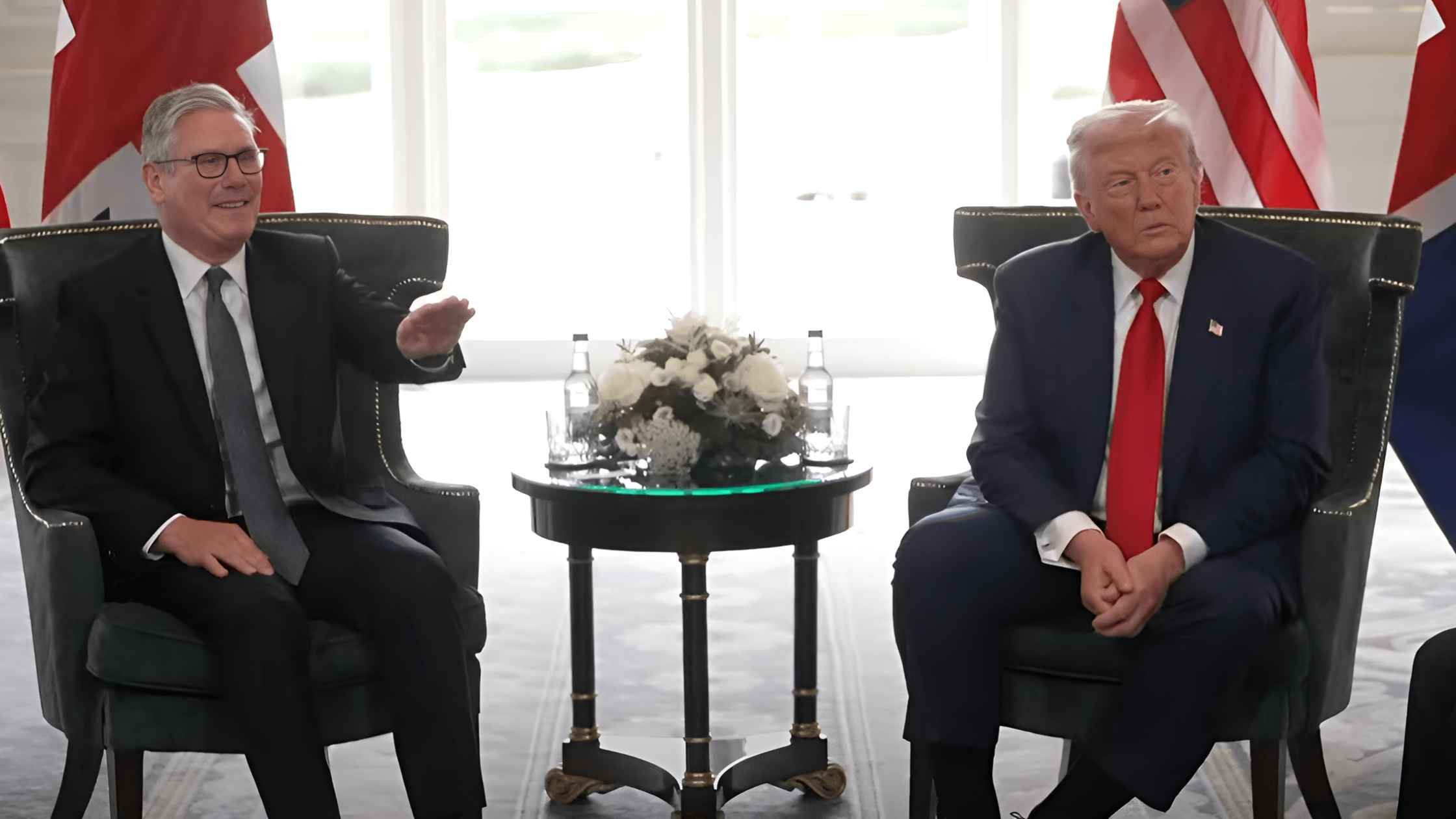
Well, let me welcome you, Mr. President, to Scotland and fantastic to be here at Turnberry with you. Thank you so much for showing us around and having this opportunity to sit in this fantastic ballroom, which is absolutely incredible.
(00:17)
And to start talking about some of the issues that are most pressing in your country and in my country. And in particular, we've had the opportunity to talk about the situation in Gaza, the intolerable situation, including images of starvation.
(00:34)
And I think both of us know that we have to get to that ceasefire and we have to increase humanitarian aid in. And thank you for what you've already been doing, are doing and are committed to because without you, this would not be capable of resolution.
(00:52)
And I think that if we can work not just on the pressing issues of the ceasefire, but also on this issue of getting humanitarian aid in at volume, at speed.
(01:05)
And then we've discussed a plan for what then happens afterwards. I think we can do our very best to alleviate what is an awful situation at the moment.
(01:18)
So thank you very much for the discussion we've had so far and the discussion we're about to continue on that really important issue.
(01:26)
But it's fantastic to be here.
President Donald Trump (01:28):
Thank you very much.
Prime Minister Keir Starmer (01:28):
Thank you for your hospitality and to see this amazing golf course. I'll invite you to a football ground at some stage and we can exchange sports.
President Donald Trump (01:40):
It's been great being with you and thank you very much Mr. Prime Minister. And you've done a fantastic job with regard to the trade deal.
(01:46)
You know they've wanted a trade deal here for years, many years, through many different terms of different people, and you got it done. So I want to congratulate you on that and it's a great deal for both.
(02:00)
It brings unity. We didn't need unity, but it brings us even closer together, I think. It's good for both parties.
(02:08)
We also discussed obviously Gaza and I think before we get to phase two, which is what's going to happen afterwards, we want to get the children fed.
(02:16)
We made a contribution a week ago of $60 million all going into food. We only hope the food goes to the people that need it. So much as you know, when you do something there, it gets taken by Hamas or somebody, but it gets taken.
(02:36)
And we're prepared to help. We want to help. It's a terrible situation. The whole thing is terrible. It's been bad for many years, but it's great to hear you feel the same way that I do.
Prime Minister Keir Starmer (02:48):
Yeah.
President Donald Trump (02:49):
We have to help on a humanitarian basis before we do anything. We have to get the kids fed. So we've been sending in a lot of food. A lot of the food that's been going there has been sent by the United States. I spoke yesterday with the President of the European Union, Ursula, who was terrific also in the subject, and she's going to play a big role also in helping us. So we have a good group of countries that are going to help with the humanitarian needs, which is food, sanitation and some other things.
(03:21)
It's very difficult to deal with Hamas. As I said, we got a tremendous amount of hostages out, but it would take place in drips and drabs. You'd get 10, you'd get five, you'd get two, you'd get 10, 12, we get 12 one time. Many of them would come to the White House and they were so thankful.
(03:39)
But I always said, when you get down to the final 10 or 20, you're not going to be able to make a deal with these people because they use them as a shield and when they give them up, they no longer have a shield.
(03:49)
And the people of Israel feel so strongly about the hostages. Some people would take a different view, but they feel so strongly about the hostages. So that's an ongoing process.
(04:02)
Hamas has become very difficult to deal with in the last couple of days because they don't want to give up these last 20 because they think as long as we have them, they have them, they have protection. But I don't think it can work that way.
(04:16)
So I'm speaking to Bibi Netanyahu and we are coming up with various plans. We're going to say it's a very difficult situation. If they didn't have the hostages, things would go very quickly. But they do, and we know where they have them in some cases. And you don't want to go riding roughshod over that area because that means those hostages will be killed.
(04:41)
Now there are some people that would say, "Well, that's the price you pay," but we don't like to say that. We don't want to say that. And I don't think the people of Israel want to say that either, which is pretty amazing.
(04:51)
A lot of people would say, just get it done and whatever it is. You could also say speed might be better for the hostages, you go through with speed. You may have a better chance because in deep trouble. They're in deep trouble.
(05:06)
You saw October 7th and you saw what the damage and the horror that they committed. People can't forget that. They tend to forget it, but they can't forget. That was one of the most evil things I've ever seen and you just cannot forget that.
(05:22)
So we're very much involved, the Prime Minister's involved. I'm involved. And I think I can speak, we just signed a very big trade deal, the biggest of them all yesterday. Right?
Prime Minister Keir Starmer (05:31):
Yeah.
President Donald Trump (05:31):
And the European Union is very much involved and wanting to help with really the Palestinians in terms of getting people fed. But the area of Gaza, another way of defining it is the area of Gaza.
(05:49)
It's a very troubled place, and it has been for many, many years. It has been for many decades. So it's not like this just happened. This has been on for a long period of time. So that's it.
(06:02)
Our hearts are in the right place. We have some good news because the recent war that you just saw, they just announced I see, the newest of the five. Now this would be six that we've stopped. I've stopped six wars in the last… I am averaging about a war a month.
(06:25)
But the last three were very close together, India and Pakistan, and a lot of them. Congo was just, and Rwanda was just done. But you probably know, I won't go into it very much because I don't know the final numbers yet. I don't know. Numerous people were killed. And I was dealing with two countries that we get along with very well, very different countries from certain standpoints.
(06:50)
They've been fighting for 500 years intermittently. And we solved that war. You probably saw it just came out over the wire, so we solved it through trade. I said, "I don't want to trade with anybody that's killing each other." So we just got that one solved.
(07:07)
And I'm going to call the two prime ministers who I got along with very, very well and speak to them right after this meeting and congratulate them. But it was an honor to be involved and it was going to be a very nasty war. Those wars have been very, very nasty.
(07:24)
So we've done a lot of good work. We've had great support from the Prime Minister. Anytime we needed help, anytime we needed any form of support, you've been there. We appreciate it very much and we're going to continue onward.
(07:37)
We do have to take care of the humanitarian needs on what they used to call the Gaza Strip. You don't hear that line too much anymore. You don't hear the Gaza Strip, but it is the Gaza Strip and it's amazing.
(07:52)
It's now being handled a little bit differently. We're going to set up food centers and we're going to do it in conjunction with some very good people and we're going to supply funds.
(08:04)
And we just took in trillions of dollars. We've got a lot of money and we're going to spend a little money on some food and other nations are joining us. I know your nation's joining us and we have all of the European nations joining us and others also have called and they want to be helpful.
(08:23)
So we're going to set up food centers and where the people can walk in and no boundaries. We're not going to have fences and they can't… They see the food from 30, you would say, yards away, and they see the food. It's all there. But nobody's at it because they have fences set up that nobody can even get it. It's crazy what's going on over there.
(08:45)
So we're going to work very closely together with your country, a great country. We also discussed inside that we are, you know there's a whole new thing happening with regard to energy from nuclear.
Prime Minister Keir Starmer (08:59):
Yeah.
President Donald Trump (09:00):
And the Prime Minister is looking at that very strongly. And I know you have Rolls-Royce nuclear plants. That sounds pretty good, right? I love that. What a great brand that is. But you're also doing the Rolls-Royce or the nuclear plants. It's smaller plants.
(09:15)
We're doing smaller and bigger, but the small is interesting. They do a small plant, very easy, very safe, and as they need more, they hook up another plant and they have a series of plants. Instead of doing the $20 billion plant, that gets tough for a lot of people to do.
(09:33)
So we're just studying that and it sounds like you're very far progressed, but that's a great thing you're doing on nuclear. We opened up nuclear about two months ago and it's now safe and very inexpensive.
Prime Minister Keir Starmer (09:45):
Now we see civil nuclear as a big part of the future as we go to sustainable independent energy. And I think that between the two of us, we can work very much more closely on this.
President Donald Trump (09:57):
Yes.
Prime Minister Keir Starmer (09:57):
And we've agreed that that's our ambition, that's our aspiration, and this is going to be a big part of the future when it comes to energy.
(10:04)
And you can see in the last few years, energy has been weaponized. Prices have dictated both families and businesses across the United Kingdom, and therefore taking control of energy is a huge prize.
(10:18)
So the more we can work together on this, the better.
President Donald Trump (10:20):
Right.
Prime Minister Keir Starmer (10:20):
And small modular reactors are a very big part of the future here. And we've got great companies like Rolls-Royce involved in that.
(10:28)
So I'm very much looking forward to working together with you, Mr. President.
President Donald Trump (10:32):
Good. We'll do that. We'll do that. We're going up to your oil capital in a little while. We're going up to Aberdeen, that's called the oil capital of Europe. And that's a great asset that you have up there someday.
(10:46)
If they ever change their thinking on that, you have a great and valuable asset. There's a lot of valuable resources underground there, but that's a decision for you to make.
(10:59)
But it's a very amazing place and it is considered the oil capital of Europe, so it's another option that you have.
(11:09)
So we are doing really well as a country, and I think that the Prime Minister has been so supportive of us and so strong and so respected, and I respect him much more today than I did before because I just met his wife and family. He's got a perfect wife and family and that's never easy to achieve, right?
Prime Minister Keir Starmer (11:31):
I take no credit for that.
President Donald Trump (11:33):
But he's become a friend. And together we got a deal done that has not been able to be done. It was a deal that's very good for both parties.
Prime Minister Keir Starmer (11:42):
A really good deal for both of our countries and very, very well received here in the United Kingdom.
President Donald Trump (11:49):
Yeah. So thank you very much for having us.
Prime Minister Keir Starmer (11:50):
Thank you.
President Donald Trump (11:51):
Appreciate it. Any questions?
JOURNALIST #1 (11:53):
Mr. President, [inaudible 00:11:54] about Russia, earlier you said that you were going to change the deadline from 50 days. What is your new deadline, sir?
President Donald Trump (12:01):
Yes. I'm going to make a new deadline of about 10 or 12 days from today. There's no reason in waiting. There's no reason in waiting. It's 50 days. I want to be generous, but we just don't see any progress being made.
JOURNALIST #2 (12:19):
Mr. President, you just talked about setting up food centers in conjunction with other organizations.
President Donald Trump (12:25):
Right.
JOURNALIST #2 (12:25):
You're talking about the Garza Humanitarian Foundation or recognized aid agencies. How will this work?
President Donald Trump (12:30):
Well, it's going to be working where the United States will be helping with the food. We have a lot of access to food. We got a lot of food ourselves, and we're going to bring it over there.
(12:40)
We're also going to make sure that they don't have barriers stopping people. You've seen the areas where they actually have food and the people are screaming for the food in there. They're 35, 40 yards away and they won't let them because they have lines that are set up. And whether they're set up by Hamas or whoever, but they're very strict lines. So we have to get rid of those lines.
(13:02)
But we're going to be getting some good, strong food. We can save a lot of people. I mean, some of those kids are, that's real starvation stuff. I see it. And you can't fake that.
(13:14)
So we're going to be even more involved. We did some airlifts before, some air drops, and the people are running for it. And the Prime Minister's going to help us. They're very effective with that. You've done that before. And for many… They've done that for a hundred years very well. So it's not very hard to do, actually. Yes?
JOURNALIST #3 (13:39):
Mr. President, you say you love Scotland. You're the most Scottish president ever in the White House. It's not a [inaudible 00:13:42] deal to be done for Scotland, for the Scottish industry and the deal that you've done with the Prime Minister. [inaudible 00:13:50], for example.
President Donald Trump (13:51):
Well, I have great love for Scotland. My mother loved Scotland and she loved the Queen. I don't know. I might hurt myself by saying that the Monarchists are going to like it, some other people, but she loved the queen. Whenever the queen was on television, she wanted to watch.
(14:08)
And she would come back religiously. She'd come back to Scotland once a year with my sister Maryanne primarily, and sometimes my sister Elizabeth also.
(14:18)
But they loved this part of the world. And we're talking about the Isle of Lewis. We're talking about serious Scotland. That's serious Scotland. There was no doubt about it.
(14:30)
So yeah, it gives me a feeling… It's different. You go to another country, you have no relationship to it. You got like maybe the head of the country or something.
(14:39)
But it's different when your mother was born here, Stornoway; right in Stornoway, a beautiful little place.
JOURNALIST #3 (14:49):
Because of your love of Scotland, is there a better trade deal to be done for Scottish businesses like whiskey?
President Donald Trump (14:55):
I assume when we do our trade deal overall, a lot of it comes through Scotland, I hope. Maybe all of it should go to Scotland.
Prime Minister Keir Starmer (15:02):
It's a very good deal for the whole United Kingdom. And we're already achieved great things under the deal and we'll achieve even more as we work together.
President Donald Trump (15:12):
A lot of it is [inaudible 00:15:13] Scotland. I mean, I do know that. But I mean, we're dealing with the UK, but a lot of it comes to Scotland. And I was very particular. This is a part of the world I want to see thrive. It's going to thrive.
JOURNALIST #1 (15:27):
Mr. President, back to Gaza. You talk about Hamas stealing food and stealing aid. What responsibility does Israel have for limiting aid to the region?
(15:37)
And if I could ask a follow-up to the Prime Minister, what pressure can be put on Israel? Is that something that you and the United States could work on [inaudible 00:15:44]?
President Donald Trump (15:45):
Israel has a lot of responsibility. They're hampered by the fact that you still have 20 hostages or so. And the people of Israel are very concerned about the 20 hostages. It's very interesting.
(15:57)
You could say they could be more concerned about retribution than the 20 hostages, but they really want the 20 hostages to survive and live to make it.
(16:08)
Many of the hostages came to my office, the Oval Office, and I was amazed by, I would ask them the question, "Was there any sign of love?"
(16:20)
When you were a hostage, and you have all of these people from Hamas around you, sometimes a hundred, sometimes 10, sometimes two, but you're a hostage and you're being stored in a pipe. It's not even really a cave. It's a pipe, a little pipe.
(16:36)
And some said they didn't think they were going to make it because they were losing air. There wasn't enough air, and they'd open up the pipe just in time, but they didn't do it on purpose. They just happened to open it. They got lucky.
(16:47)
But I said, "Did they ever wink at you and say like, 'Don't worry. You're going to be okay.' Did they ever give you some extra food, even it if was a piece of bread? Did they ever give you anything during that time?"
(16:58)
And some were there for four or 500 days now, right? It's a long time. A year and a half, more than that.
(17:04)
And not one person said there was any love from anybody. In other words, you have hundreds of people, and you see it in the movies where somebody's a prisoner and somebody's helping.
(17:16)
You even see it with Germany, where people would be led into a house and live in an attic in secret. You'd see signs of something.
(17:27)
I said, "Did you see anything like, did they wink at you? Did they say, 'Don't worry, you're going to be okay.'"
(17:33)
I asked that question all the time. I've never received one answer that said, "Yeah, they really wanted to help." No, the hatred is just incredible.
JOURNALIST #1 (17:42):
The access to food issue. What more can Israel do and with Congress as well?
President Donald Trump (17:49):
Well, I think Israel can do a lot. I will say that Iran, I think, interjected themselves in this last negotiation.
(17:59)
Can you imagine the beating they took? We wiped out their nuclear possibilities. They can start again. If they do, we will wipe it out faster than you can wave your finger at it. We'll have to do that. We will do that gladly, openly, and gladly.
(18:15)
They've been saying… Iran's been sending out bad signals. I'll tell you, for a country that just got wiped out, they've been sending very bad signals, very nasty signals, and they shouldn't be doing that. They shouldn't be doing that. They were talking about things that they shouldn't be talking about.
(18:33)
They were interviewed on a recent show, the Foreign Minister, saying things that he shouldn't be talking about, shouldn't be saying. And I think they got involved in this negotiation telling Hamas and giving Hamas signals and orders, and that's not good. That's not good.
Prime Minister Keir Starmer (18:54):
Yeah, I'd like to say, look, we need to get the hostages out. They've been held for a very, very long time, and we must always
Prime Minister Keir Starmer (19:00):
Start from there, but also recognize, the situation on the ground in Gaza is absolutely intolerable. And I think that certainly speaking for the British public and myself, seeing those images of starving children in particular are revolting. And there's a sense of revulsion in the British public at what they're seeing. And they know and we know that humanitarian aid needs to get in at speed at volume. Yes, some could be airdropped and we're working with others with the US, with Jordan on that. But the trucks need to get in because that's the only way you can get the volume in. And we do thank the President for the work he's done to try to get to a ceasefire, which we desperately need, but also to put aid in to the region. There needs to be much more of that, we need to galvanize other countries in support of getting that aid in.
(19:53)
And yes, that does involve putting pressure on Israel because absolutely this is a humanitarian catastrophe. Now we also need to look beyond that situation to what then happens in the event of a ceasefire, which is desperately needed. And that's why I'm really pleased that we're having a discussion about what a peace plan would look like after that, the component parts of that. And we have to be really clear at this point that Hamas can play absolutely no part in any future governance in Palestine and in Gaza. And it's really important that we are clear about what triggered this, who took the hostages, and calling out Hamas for what they are, which is a terrorist organization. But I think today the focus has to be on getting that humanitarian aid in.
Speaker 1 (20:50):
Will the UK avoid your pharmaceutical tariffs and will it happen before August the first?
President Donald Trump (20:56):
Well, we'll be announcing on pharmaceuticals sometime in the very near future. We have a very big plan on pharmaceuticals. We want to bring a lot of the pharmaceuticals back to America the way they should be. If you look at COVID, it sort of taught us a lesson. We were getting our pharmaceuticals from other countries, we almost didn't make any. We used to make them ourselves and we're going to want to be making a lot of them ourselves, all of them in a sense. But you also have a good pharmaceutical business. We'll be dealing with you on pharmaceuticals also. And we certainly feel a lot better with your country working on pharmaceuticals for America than some of the other countries. With the relationship we have. You would not use that as a cudgel, you wouldn't be using it as a block. But we're going to be announcing sometime very soon, I think pharmaceuticals, our whole thing. And the companies know and drug prices are going to be coming down very substantially in the US, very, very substantially. And that'll happen very soon.
Speaker 2 (21:59):
Mr. President, we can all sense your frustration with Vladimir Putin.
President Donald Trump (22:09):
No, go ahead.
Speaker 2 (22:09):
We can all sense your frustration with Vladimir Putin. Do you think he's been lying to you about his intentions?
President Donald Trump (22:11):
Well, I don't want to use the word lying. All I know is we'd have a good talk and on let's say three occasions, it seemed that we were going to have a ceasefire and maybe peace and you divide it up and you do whatever you have to do obviously to get to the end. And all of a sudden missiles are flying into Kiev and other places. And I said, "What's that all about?" I spoke to him three, four hours ago and it looked like we were on our way. And then I'd say, "Forget it, and I'm not going to talk anymore." This has happened on too many occasions and I don't like it. I don't like it.
Speaker 3 (22:49):
Mr. President you have successful social media sites. There are new powers here to censor your site, state mandated.
President Donald Trump (22:57):
To censor my site?
Speaker 3 (22:58):
To censor your site.
President Donald Trump (22:59):
You mean Truth?
Speaker 3 (23:02):
I mean Truth. Is that, okay?
President Donald Trump (23:02):
Well, I don't think he's going to censor my site because I say only good things. Will you please uncensor my site?
Prime Minister Keir Starmer (23:08):
Yeah, we're not censoring anyone. We've got some measures which are there to protect children in particular from sites like suicide sites. We've had too many cases in the United Kingdom of young children taking their own lives. And when you look through their social media, they've been accessing sites which talk about suicide and encouraging, if you like, children down that road. And that is what we want to stop. Nothing about censoring free speech. This country is the proud free speech in this country, has been for a very long time. We're very, very proud of it. We will protect it forever. But at the same time, I personally feel very strongly that we should protect our young teenagers, and that's what it usually is, from things like suicide sites. I don't see that as a free speech issue. I see that as a child protection issue.
President Donald Trump (23:59):
We actually passed a bill in Congress headed up by my wife actually, which was to pull bad stuff out, having to do with children because it is a problem. But I cannot imagine him censoring Truth Social. That's more of a very political and it's been a very big success.
Prime Minister Keir Starmer (24:18):
Not going to happen.
President Donald Trump (24:19):
And I only say good things about him and his country. So they say to me, "You're making a mistake after," I'm going to give my ambassador to the job, make sure it's not censored.
Prime Minister Keir Starmer (24:28):
It's not happening.
President Donald Trump (24:29):
I had not heard that.
Press (24:30):
You're a brilliant investor in this area, Mr. President.
President Donald Trump (24:34):
Say it?
Press (24:34):
You're a big investor in this area.
President Donald Trump (24:36):
To put it mildly, like this ballroom that we built from scratch.
Press (24:41):
Do you worry though about the risk increased taxes here? A lot have stopped investing. And do you have a message last out on the soccer to the English Lionesses who won the European trophy?
President Donald Trump (24:52):
So I think that I have a theory that low taxes bring growth. We just passed a big tax cut bill, the biggest bill in the history of our country actually. One Big Beautiful Bill I used to call it The Great One Big Beautiful. We took word great out, but it's actually called the One Big Beautiful Bill. It's essentially a very large tax cut bill for everybody. And our country's, pretty soon, I think I can say it right now, our country's never done better. We had a country that was dead. It was dead six months ago, a year ago. Leaders from NATO, we had a very successful meeting at NATO. Your Prime Minister was there. It was an unbelievable love fest with all of those countries and they agreed to go 5% and all the things, very smart to do.
(25:42)
But many of the leaders, essentially they said, "Your country was dead one year ago." And we did, we had a dead country. We had a president who didn't know where the hell he was. We had horrible, horrible people running our country. I think they were sick people actually, sick. You talk about censorship, those are big. All they did was censor, they didn't know what to do. And they had high taxes, they wanted more tax, total censorship, transgender for everybody, men playing in women's sports. Everything bad they wanted and they still do. That's what they still do. That's why they're down at 15% or something. I saw today the lowest that the other part of the Democrats have ever been.
(26:29)
But no, I find that when you lower taxes, you get growth. I will say this, and the Prime Minister hasn't been here very long on oil affairs, I think he'll be a tax cutter. But I find that as we cut taxes, we did more business. In my first tax bill, we cut taxes from 39% down to 22%. And we ended up at the end of the first year, the first year, when it was still a little raw, we ended up taking in much more revenue than we did at 39%. It was pretty amazing. And we're taking in a lot of revenue right now and this was an additional tax cut. So I find for whatever it's worth, tax cuts are very good.
Speaker 4 (27:13):
We moved up the deadline. It's now 10, 12 days. Is the sanction the same that you're going to slap a hundred percent tariff on anybody who does business with Russia?
President Donald Trump (27:20):
So what I'm doing is we're going to do secondary sanctions unless we make a deal and we might make a deal. I don't know. I don't know, you don't know. We've done so many peace deals. This is the one I started out with. I know President Putin called me. He wanted to know if I could help him with Iran. I said, "No, I don't need your help with Iran. I need you help with Russia." And so that's the one deal that continues to linger. I'm not losing, you're not losing, but 5,000 Russian and Ukrainian kids a week are dying. And that's not mentioning the people that are dying also in towns where he's lobbing missiles into certain towns like Kiev and he's got to make a deal. It's too many people are dying. It's a really bloody war. And the five now they're really telling me that number is obsolete, it's like seven.
Prime Minister Keir Starmer (28:18):
That's terrible.
President Donald Trump (28:19):
So you have 7,000 Russian and Ukrainian soldiers dying every single week for no reason whatsoever. So you would think based on common sense, you would think he would want to make a deal. We'll find out.
Speaker 4 (28:31):
Mr. President, communication publicly, have you had any other channels, conversations with the Russians reiterating this?
President Donald Trump (28:37):
In what?
Speaker 4 (28:39):
Reiterating this new pressure and deadline?
President Donald Trump (28:43):
Yeah, I mean well you're the press. I'm reiterating it to you. Yeah, I'd say 10 to 12 days. I'll announce it probably tonight or tomorrow. But there's no reason to wait. If you know what the answer is going to be, why wait? And it would be sanctions and maybe tariffs, secondary tariffs. You know what a secondary tariff is. Look, I don't want to do that to Russia. I love the Russian people. They're great people. I don't want to do that to Russia. But this thing, they're losing a lot of Russians. They've lost a million Russians. And that's the sons and daughters of Russian families. They leave the house, they go "Bye, Mom, bye, Dad," and then they get blown away. And Ukrainian too. Look at Ukraine, it's a disaster what's happened there. But it continues to go on.
(29:41)
As you know, we made a deal where the European Union is essentially involved, but it's NATO and we're supplying weapons to NATO. NATO is now paying because the United States, because of Biden's in for $350 billion, the European nations are in for about a hundred billion. Should be the opposite way, by the way, because we have a big ocean in between, should be the opposite way. But I think that eventually something's going to happen. It should happen fast. So many people are dying. When I settled out with Congo and Rwanda, they lost almost 8 million people and it just made so much sense. And if I didn't get involved, they wouldn't have done it. They weren't even thinking about settling it. It was just going on forever. And nobody could go into those territories because they'd get killed. They'd get killed. And now I hear it's a whole different ballgame. We settled it. This is one that should be settled. Russia, Ukraine, this is one that really should be settled.
Speaker 5 (30:50):
Scotland's First Minister has today set out his plans for our second referendum, which is Scottish independence. Can I get your reaction to that as someone with deep ties to Scotland? Sorry, Prime Minister, can I also get your thoughts on that? If you do win a majority of next year's election and they have the right to hold the referendum.
President Donald Trump (31:07):
Well, I don't want to get involved in your politics. We got enough politics of our own. I will say that I predicted what was going to happen the last time. You remember? I was opening the first course over at Aberdeen and I was over here and at the same time and they asked me that question. I made a prediction. It was the day before the vote and I like to be correct, but I made a correct prediction. I don't know. I do say that when they made that deal, and I remember this very distinctly, I said, "Could they do this all the time?" There was a little bit of a restriction like 50 or 75 years before you could take another vote because a country can't go through that too much. I don't know the first minister, but I've heard great things about him. I've spoken to him, I hear very good things about him and I'm meeting him today. So maybe I'll have a better opinion then.
Prime Minister Keir Starmer (32:05):
And let me answer that straightforwardly because I believe in a stronger Scotland, in a better United Kingdom. And I think that at a time like this, when it's quite clear that there's uncertainty and volatility around the world, the strength of the United Kingdom together is very important for all four nations, very important for Scotland. And that should be our priority. That should be our focus. Not on the politics, which feels like the politics of yesteryear now at a time like this. And I think that the first minister should probably focus more on his delivery in Scotland than on his constitutional issues and we might have a better health service in Scotland. But at a time like this, I think the United Kingdom is always stronger as four nations. I think that's better for all four nations. I think that's how Scotland is stronger. Look at the deal that we've been able to do with the United States. A really important deal that we made just months ago. That is what the United Kingdom can do when we act as a powerful set of four nations together. And there are very many other examples.
Speaker 6 (33:25):
Mr. President, you toured the Federal Reserve last week.
President Donald Trump (33:28):
I did.
Speaker 6 (33:32):
And it's set to be this week, do you think your visit has inspired a potential rate cut or how you see things shaping out?
President Donald Trump (33:37):
Oh, it's interesting. I did tour it. I toured the building. And if you looked at this building, if you came here 14, 15 years ago, we've had it a long time. It's been an honor to have Turnberry. But I was on much more opulent walls, ceilings, floors. We had to do this and we did a very great job. I mean, you see how beautiful it is inside. Everything was saved. Everything was preserved. We had ceilings that were in bad shape, they were falling down. It's very old, wasn't properly maintained. Now it's brand new and beautiful and we saved everything.
(34:17)
If you really think here, you took a look and you sort of commenting, the coloring, the building. Now this is a brand new building, but if you look outside, it's equally opulent and beautiful. And we didn't do that by spending hundreds of millions of dollars in surrounding a railing underneath the area that you're painting. I've never seen anything like it. Brand new, beautiful plywood, very expensive, wrapped around a figurine or a railing to preserve it. But you don't have to do that. You can just wrap a cloth, they call it a blanket. And you don't even have to do that if you're careful when you're doing the ceiling. But I don't know what they did to take down a ceiling and put up a new ceiling. And the new ceiling had no opulence to it or they'd fix the ceiling. But I would say that all I need is a good plaster and a can of paint. And they spent $3.9 billion. And I spent a lot of money too, but it's, I would say 3.8 billion less. Meaning I spent probably a hundred million dollars making this place incredible.
Prime Minister Keir Starmer (35:33):
And you're saying a lot of that was local trades?
President Donald Trump (35:35):
I used local trades.
Prime Minister Keir Starmer (35:37):
We were looking at the windows I think in the next room.
President Donald Trump (35:39):
I had local trades do a lot of this. We have the most opulent windows next door. And I had a choice. Do I take them out? They suffered through 125 years of storms. You have very big storms in this area. When you have a storm, you have a storm.
Prime Minister Keir Starmer (35:56):
We do it properly.
President Donald Trump (35:57):
And they made it barely, but they were in bad shape. So I had some local people come up and we looked at them. You have some great craftsmen here I think is what you're getting at. And they said, "Sir, honestly, they've had it. We can copy it and do it much better." And they did. If you take a look at the windows in the various dining rooms, they're magnificent and they're new and they're much better looking than what was the same exact look other than a much higher quality. And they're local people. I used a lot of your local people. You have really great local tradesmen here. Yes?
Speaker 6 (36:37):
Do you foresee a rate cut this week. Do you expect-
President Donald Trump (36:39):
A rate cut? Meaning a tax cut?
Speaker 6 (36:42):
No, no, no. Do you expect the fed to cut rates this week?
President Donald Trump (36:46):
I think he has to. You had 11 cuts. In Europe, they had 11 cuts. In other places, they had 10 or 11 cuts and we had none. But I'm not going to say anything bad. We're doing so well even without the rate cut. With the rate cut, it would be better. It affects our housing a little bit. Look, we should be three points lower. Each point is $360 billion. Can you imagine that? That's big numbers. Each point, one point of cut is the equivalent of $360 billion in savings. That's big stuff. Those are big numbers in the US. Everything's big. He should cut. A smart person would cut. He leaves very soon, so it's like one of those things. But I'll miss him greatly. I'll miss him.
Press (37:43):
Turnberry, if I may, have you or will you enlist the Prime Minister in your effort to bring the open back to Turnberry? And Prime Minister, you described this beautiful course. Do you agree with the President that it's time to bring the Open back to Turnberry?
Prime Minister Keir Starmer (37:54):
Well, as you know, that's not a matter directly for me, that's for the sporting authorities. But look,
Prime Minister Keir Starmer (38:00):
Look, I mean, it is the first time I've been here. It's absolutely magnificent both inside and out. And looking at the courses itself and the building, it's incredible. But the decision on the opening is not a decision for me, as you'll understand. I should just pick up on the earlier question because I, for one, will say congratulations to the Lionesses. Last night our women's football team won the Euros. Well, defended the Euros I should say-
President Donald Trump (38:25):
That's right. That's right. It's a big story.
Prime Minister Keir Starmer (38:26):
… which was a really big success. And the mental and physical resilience that they showed was quite incredible, so-
President Donald Trump (38:33):
It's a big deal.
Prime Minister Keir Starmer (38:34):
… there's a lot of bunting out today and tomorrow to celebrate them bringing that cup home.
Press (38:39):
Did you get the chance to do any planning for the upcoming state visit, and how is that going to work, where would you stay and anything about this?
President Donald Trump (38:44):
Well, I'm looking forward to it. It's never been done before twice. We had our original at Buckingham Palace, and now I guess we're going to Windsor?
Prime Minister Keir Starmer (38:52):
Windsor, yeah.
President Donald Trump (38:53):
And it's never been done. And I'm a big fan of King Charles. I've known him for quite a while. He's a great guy, great person. He looks really well to me. He looks great. So we look forward to coming over. It was one of the most beautiful evenings I've ever seen. I hate to say it, but nobody does it like you people in terms of the pomp and ceremony.
Prime Minister Keir Starmer (39:18):
Yeah. It's true.
President Donald Trump (39:18):
And I look forward to being here with the ambassador. Our ambassador's a very, very successful man who just wanted to do this. And I said, "How are you going to be able to do that?" And he's so committed to the relationship between the countries, but he's very great guy and a very, very successful man, so I very much thank you for doing this.
Prime Minister Keir Starmer (39:42):
No, thank you for the honors.
Press (39:43):
Mr. President, will there be a state visit when you go to London or are you worried it's no longer about this?
President Donald Trump (39:48):
About what?
Press (39:49):
Will you visit London during the state visit or are you worried-
President Donald Trump (39:57):
I will. I'm not a fan of your mayor.
Press (39:57):
Why not?
President Donald Trump (39:57):
I think he's done a terrible job, the mayor of London. But a nasty person.
Press (40:01):
[inaudible 00:40:03].
President Donald Trump (40:02):
No, I think he's-
Prime Minister Keir Starmer (40:03):
He's a friend of mine [inaudible 00:40:06].
President Donald Trump (40:06):
No, I think he's done a terrible job. But I would certainly visit London, yeah.
Press (40:17):
[inaudible 00:40:13]. So MP Nigel Farage has asked for Parliament to be recalled when you're there [inaudible 00:40:19].
President Donald Trump (40:18):
Well, I like Nigel. I mean, Nigel, as you know, is a friend of mine. Nigel's done very well. He's a friend of mine. And Keir's a friend of mine.
Press (40:27):
Would you recall Parliament so that the president can talk to MP?
Prime Minister Keir Starmer (40:31):
Well, Parliament's in recess at the time. But look, I do want to be clear, this is an unprecedented and very special state visit. This has never been done before and there'll be many elements of it that have never been seen before. So this is going to be a historic occasion, and we're all very much looking forward to it. And I was very, very pleased to be able to put forward the invitation when we were at the White House earlier this year. So this is not just a state visit. They're always incredible occasions, and this is an unprecedented second state visit. So you can imagine just how special that's going to be.
President Donald Trump (41:14):
The fact that it's never been done before, and that's because it's non-consecutive and it's the only reason it could be, made it even more interesting, frankly. So it's going to be great. And being with Charles and Camilla and everybody I've gotten to know because of four years and now six months, I've gotten to know a lot of the family members. They're great people. They're really great people. And in that sense, I think that the UK is very lucky. You could have people that weren't great people. I don't know if I'd say that, but you could have people that weren't. But-
Prime Minister Keir Starmer (41:48):
We're very lucky to have our royal family, absolutely fantastic.
President Donald Trump (41:51):
So we really look forward to that. As far as Parliament, if he wants me to speak in Parliament, I'll do it. Okay? But it doesn't have to be then. It could be some other time. Maybe we should save it for another time. We'll let the one visit speak for itself. But anytime if I could be helpful, I would certainly do it. Thank you.
Press (42:08):
Mr. President, [inaudible 00:42:09] what kind of alternatives are you considering to get the hostages out if there's no ceasefire?
President Donald Trump (42:15):
Well, there are a couple of alternatives. Some are pretty strong. But the most sensible alternative is talk and negotiation. But I said a long time ago, at a certain point they're not going to be talking because they're going to lose their shield. The hostages are a shield for them. They did horrible things on October 7th, and the hostages are a shield. And I said, "You're going to get down a number and the number's going to be at a point where you're not going to be able to get them back unless you're going to be very energetic, or to put it a different way, unless you're going to be very ruthless and violent." It's a bad situation to be in. Very bad.
Press (43:00):
Mr. President, with the EU deal last night-
(43:02)
You talked during the campaign about President Putin respecting you and that helping you have a relationship with him. Do you still feel that way, that he respects you, considering the conversations you've had that have been really [inaudible 00:43:15]?
President Donald Trump (43:14):
Yeah, I've always gotten along with President Putin. I had a great relationship with him. And he went through the Russia, Russia, Russia hoax too. I mean, we used to talk about it. We used to say, "It's too bad we really can't do anything between our country." Because if we did, they'd say, "Oh…" Look, I was tough on Putin because I was the one that closed up Nord Stream, and Biden came along and opened it up. I was very tough on Putin in one way, but we got along very well and I never really thought this would happen. I thought we'd be able to negotiate something. And maybe that'll still happen, but it's very late down the process. So I'm disappointed.
(43:56)
And the funny thing is that their economy isn't that big and it's having a hard time right now, but it's a relatively small economy. A strong military but strong economy. And it used to be a strong economy. Now it's not. He's going through a lot economically. It's not easy. But it's pretty small compared to that magnificent size of that land. The land is massive. It's got, I guess, nine time zones or something. It's a massive piece of land.
(44:27)
Russia could be so rich. It could be so rich. It could be thriving like practically no other country. And they're holding that back because he wants to do trade deals with us. He talks about it all the time. He wanted to. And I envision that a lot of trade with Russia… They have a lot of valuable things. When you talk about rare earth, they have serious rare earth. They have just about every form you can have. So Russia could be so rich right now. Instead, they spend all their money on war. They spend everything on war and killing people, and it doesn't make sense to me. I thought he would want end this thing quickly. I really felt it was going to end. But every time I think it's going to end, he kills people.
Press (45:16):
Could a meeting help and are you considering… as been proposed [inaudible 00:45:20]?
President Donald Trump (45:19):
I don't know. I'm not so interested in talking anymore. He talks… We have such nice conversations, such respectful and nice conversations. And then people die the following night with a missile going into a town and hitting… I mean, recently I guess the nursing home, but they hit other things. Whatever they hit, people die. So I don't know. We'll see what happens.
Press (45:48):
We just had a sense of your differences in political persuasion with Nigel Farage and Sadiq Khan in the conversation. I wonder if you have any advice, either of you, for a very divided, polarized world on how you make [inaudible 00:46:00] relationships [inaudible 00:46:01]?
President Donald Trump (46:00):
Not differences. Yeah, not differences. I happen to like both men. I like this man a lot. And I like Nigel. And I don't know the politics over here. I don't know where they stand. I would say one's slightly liberal, not that liberal, slightly. And the other one is slightly conservative, but they're both good men.
Press (46:25):
Mr. President [inaudible 00:46:27]-
Prime Minister Keir Starmer (46:27):
Look, we like each other. We respect each other. We get on. And we've both got a great love of our countries, of our families, and therefore there's a huge amount that we have already achieved, actually, together and will achieve as we go forward leading our respective countries and of course the relationship between our countries. Donald, we were talking about this this morning that whether it's defense, security, intelligence sharing, it's a close, historic relationship. We have fought together in the past. We've always stood together. And I, for one am very pleased that we've got such a good personal relationship between us. And I think it just shows that even if you come from different political perspectives, different backgrounds, actually, there's a huge amount of common ground when it comes to what is in the best interests of our two great countries. And they are two great countries. And I think that because we focus on what's best for our countries, we get along very well. And I'm really pleased that that's the case.
Press (47:32):
Mr. President-
President Donald Trump (47:32):
Well, I do know he wants to cut taxes as much as he can. And politics is pretty simple. I assume there's a thing going on between you and Nigel, and it's okay. It's two parties. But generally speaking, the one who cuts taxes the most, the one who gives you the lowest energy prices and the best kind of energy, the one that keeps you out of wars, he's kept you out of wars, but the one that keeps you out of wars. You have a few basics. And you can go back a thousand years, a million years, whoever does these things… But low taxes, keep us safe, keep us out of wars, no crime, stop the crime. And in your case, a big immigration component because I know that your attitude has become strong on immigration, strong on the toughness of immigration.
(48:23)
But I think whoever's going to be… I think I won because of… I think I won because we had a lousy president, to be honest with you. We had an incompetent president. But I won because of I was very strong on immigration. Now we had inflation. We had sort of a bad economy with this guy. We had a lot of problems. But I focused on immigration more than I did anything else. And I think I won because of immigration. I think I won because of the border. I had a bad border where millions of people were coming into our country illegally. And as you know, in last month, zero people came into our country illegally. Zero. So we went from a bad incompetently run border to the most competently run border that anybody's ever seen.
Press (49:08):
The president makes it look easy dealing with illegal migration. You must be envious of his record in such a short period.
Prime Minister Keir Starmer (49:16):
Well, I think we've been discussing irregular illegal migration is a huge issue in both of our countries. In the United Kingdom it is a real cause for concern, and that's why we must bear down on it in all its aspects upstream across Europe where a lot of ours comes into through northern France, across the channel, working with our allies, with our colleagues to break the gangs that are actually running this trade. But equally being very strong that when people have arrived in this country who've got no right to be here, then we should be removing them to their own country. And that's why I'm really pleased that we've been able to focus on this very intensely and get 35,000 people out of the United Kingdom having no right to be here. Because the message has to be, you can't make your way to the United Kingdom. We won't tolerate our rules being broken. And if you get here, you will be returned to where you came from. And it's really important that we bear down on that.
Press (50:22):
With such an attractive place, people come because they want better life because we are a wonderful country.
Prime Minister Keir Starmer (50:28):
People coming via the rules are always welcome. But of course we've welcomed talent and people into this country for centuries, literally. But what the British people will not tolerate is those that break the rules, those that come through irregular routes. And that's the really important distinction here, and that's what we're bearing down on. And I'm really pleased that through pretty well all of the international engagement I've done, all the meetings I've had, the country we've done deals with… We've done deals with countries in the last 12 months that many people thought it was not possible to deal with when it came to immigration, irregular immigration. And we've returned thousands of people who've got no right to be here.
(51:16)
And that I think is… For the British people, we're a reasonable tolerant country where people are coming lawfully to contribute to our communities, to our country. Then of course they're welcome and have made a great contribution. But what people will not tolerate is those that are breaking the rules. And that is an issue of today, but it's a very British thing. We are people who respect rules. We don't approve of those that break rules.
Press (51:49):
Mr. President-
President Donald Trump (51:50):
I can say though that I had one of the greatest victories. They say the most consequential in 129 years. I don't know about that, but it was pretty close. And we won all of the swing states, which never happens. We won the popular vote by millions of votes. We won tremendous electoral college sweep. And I believe I did it more than anything else because of my strong stand on immigration. And I don't think this country's any different in that sense. I think it's a big factor. And it is with a lot of the European countries. Some of the countries have lost their way and they have tremendous crime because of it.
(52:29)
I mean, you had countries with no crime that now have tremendous crime. And you know the countries, and I know the countries. And so I think it's a huge factor in any election, not just this election, but in any election. I think the one that's toughest and most competent on immigration is going to win the election. But then you add low taxes and you add the economy. He did a great thing with the economy because a lot of money's going to come in because of the deal that was made. But I think that immigration is now bigger than ever before.
Press (53:06):
Mr. President, your treasury secretary, is meeting with Chinese trade-
President Donald Trump (53:09):
Right now.
Press (53:11):
Right now. Have you received an update? Do you expect a deal when these talks are over? [inaudible 00:53:16].
President Donald Trump (53:16):
Know they're meeting right now and we have a good relationship with China, but China's tough, and like you're tough. We're all tough, I guess. But we're going to see what happens. We just concluded our deal with Japan. It was very good, good for everybody. We're making great deals. We're making deals that are good for us, but we want them to be good for everybody. It's important. Sometimes I'll do something that I shouldn't do because it's not very important for our country, but it's very meaningful for the country on the other side. And I'll let them have that point because it's very important for them. So I don't know.
(54:03)
But we've made a lot of deals in the last couple of months. And then ultimately, as you might as well know, we're going to just… You have 200 countries, more, but people don't know that. You got a lot of countries. And I wouldn't want to sit down with 200 people to have to deal the way… He was calling me all the time. "We want this. We got to have that. These are tough negotiators. Look, they're smart people. They're tough negotiators. They know what they want.
(54:31)
But we're going to be setting a tariff for essentially the rest of the world, and that's what they're going to pay if they want to do business in the United States. Because you can't sit down and make 200 deals. But we've made the big ones. We just finished Indonesia. They opened up their country. We just finished Japan. They opened up their country. Japan opened up the country. They were totally closed. They opened it up to our cars, even to rice. Rice was a big deal. They would never take anybody else's rice. They're taken rice. But they opened up their country. Philippines we just finished. They opened up their country. They were very closed. I'd love to see China open up their country. So we're dealing with China right now as we speak. Yeah, we're dealing with China right now.
Press (55:20):
The deal you've got with UK is better than the one with the European Union. Is that because you think Brexit [inaudible 00:55:26] this country?
President Donald Trump (55:28):
Look, we have a very special relationship with this country. My mother was born here. And not only born here, loved it. She'd come back, I told you, religiously every year. And she'd go up to Stornoway and see her relatives. But she loved the country. Yeah, that probably has… It always has an impact. Always has an impact. But Germany has a new leader, and I think he's terrific. I think you like him too.
Prime Minister Keir Starmer (56:00):
Yeah. Yeah, we get along.
President Donald Trump (56:00):
I think he's terrific. My father was born in Germany. Or Germany was… His parents said, "We're just out." So you have a lot of feeling for this part of the world. I do. I want to see this part of the world do well. Germany, Scotland, the UK. I want this part of the world to do well, all of the nations. You do feel a certain… You have a feeling, a warm feeling toward a part when your parents are born, essentially here, and oh, I think maybe it's slightly different. Maybe it's not. I don't know. But maybe it's slightly different.
Press (56:42):
Mr. President, you didn't completely rule out a pardon for Ghislaine Maxwell when you landed, is that something you would ever consider and why?
President Donald Trump (56:48):
Pardon for who?
Press (56:49):
For Ghislaine Maxwell.
President Donald Trump (56:51):
Well, I'm allowed to give her a pardon-
Press (56:52):
Yeah, you are.
President Donald Trump (56:53):
… but nobody's approached me with it. Nobody's asked me about it. It's
President Donald Trump (57:00):
… in the news about that aspect of it, but right now it would be inappropriate to talk about it, so…
Press (57:09):
Mr. President, Mr. President, your opposition to offshore wind is well-known, and Scotland-
President Donald Trump (57:15):
Wind is a disaster.
Press (57:16):
But in Scotland and across the UK wind farm is [inaudible 00:57:18]-
President Donald Trump (57:18):
I know, it's a shame. It's not his fault. I used to tell Alex Salmon.
Press (57:27):
Have you spoken to the Prime Minister, and will you speak to the [inaudible 00:57:27]-
President Donald Trump (57:27):
Well, all I can do is give my word. Look, wind is the most expensive form of energy, and it destroys the beauty of your fields and your plains and your waterways. Look out there, there's no windmills. But if you look in another direction, you see windmills. When we go to Aberdeen, you'll see some of the ugliest windmills you've ever seen, they're the height of a 50-story building. And you can take 1000 times more energy out of a hole in the ground this big. This big, it's called oil and gas. And you have it there, the North Sea. This big that nobody would even see.
(58:12)
You can take 1000 times more power because the wind is intermittent, it doesn't work, it's extremely expensive. All the windmills are made in China. They used to be Germany and China, now they're mostly in China. They all come out of China. They say that the blades which are carbon fiber, you can't bury. Oh, okay, you can't bury. What are you going to do, dump them in the ocean someplace? Because they only last a certain period of time. And remember, a windmill has a life of eight years, especially when they're out in the salty sea, and they start to rot and to rust. You're going to have to replace them, it's very hard to replace them.
(58:51)
Wind needs massive subsidy, and you are paying in Scotland and in UK and all over the place where they have them, massive subsidies to have these ugly monsters all over the place. So I've restricted windmills in the United States. Now, a couple. We have the poor, stupid people at the beginning they approved them, so they have their full approvals. But I've restricted windmills in the United States because they also kill all your birds, they wipe out. It's interesting, if you shoot a bald eagle in the United States, they put you in jail for five years. And yet windmills knock out hundreds of them, they don't do anything. You explained that. So it's a very expensive energy, it's a very ugly energy, and we won't allow it in the United States.
Prime Minister Keir Starmer (59:40):
So we believe in a mix. And obviously oil and gas is going to be with us for a very long time, and that'll be part of the mix. But also wind, solar, increasingly nuclear, which is what we've been discussing this morning, civil nuclear as we go forward. The most important thing for the United Kingdom is that we have control of our energy, and we have energy independence and security. Because at the moment, whatever the attributes and facilities in the North Sea, that is sold onto the international market, and we buy back off the international market, that was a historic mistake in my view. But what we need is a mix so that we get the energy security that we need for the future. And that's the focus of everything that we are doing.
(01:00:26)
But what we have discussed today is that the energy prices are too high, which is why we recently took measures to reduce the energy prices, particularly for energy-intensive businesses. But in the long run, the only way to reduce your energy price is to take control of your energy. And that's what we're doing, taking control of our energy.
Press (01:00:45):
Mr President. Our King Charles, who you great friend of big as big fan of [inaudible 01:00:52] windmills, as you call them. Is he wrong?
President Donald Trump (01:00:55):
So King Charles is an environmentalist, I will tell you. And I say that in a positive way, not a negative way. And every time I've met with him, he talked about the environment, how important it is. And I'm all for it, I think that's great. King Charles more than anything else, loves the country, but I got to know him very well. He truly is an environmentalist. He wants clean air, clean water, all of the things that we all want.
Press (01:01:22):
Mr. President. You have said that you have not been briefed on the Epstein files, or your name does not appeared in the Epstein files. But doesn't the AG have to tell you if your name is?
President Donald Trump (01:01:34):
Well, I haven't been overly interested in it. It's something, it's a hoax that's been built up way beyond proportion. I can say this, those files were run by the worst scum on earth. They were run by Comey, they were run by Garland, they were run by Biden. And all of the people that actually ran the government, including the autopen. Those files were run for four years by those people. If they had anything, I assume they would've released it. The whole thing is a hoax. They ran the files, I was running against somebody that ran the files. If they had something they would've released.
(01:02:15)
Now, they can easily put something in the files that's a phony. Like as an example, Christopher Steele, a person well happens to be from your country. But Christopher Steele as an example, wrote a book, a dossier, we call it the Fake News Dossier. And the whole thing was a fake. The whole thing was a fake. They can put things in the file that are fake, but those files were run by bad sick people. If they had anything, why didn't they use it when I was killing Joe. And then he gave out because he was 25 points down, and then I got somebody new, nobody even knew anything about her. She was a horrible vice president. She was our Border Czar, but she never went to the border, she never once called the border patrol agent to find out how we're done. But she was the border czar, her name was Kamala. Nobody knows her last name, it was Harris. But nobody knew her last name.
(01:03:11)
So I ended up, how would you like to end up in a race where you're killing somebody, you're beating himself. And then they say, "All right, we'll take him out, he's not working. Let's put somebody else. And then she had a six-week honeymoon. It was amazing, they predicted she will have a six-week honeymoon and she did. And then she got slaughtered. But think of it, those files were run by these people. They were run by my enemy. If there was anything in there, they would've used them for the election.
Press (01:03:48):
Do you think that drawing… I think I heard you say something the other day that the drawing that was as subject to the Wall Street Journal report [inaudible 01:03:48]-
President Donald Trump (01:03:48):
I don't do drawings. I'm not a drawing person.
Press (01:03:51):
Do you think it was fraudulent-
President Donald Trump (01:03:51):
I don't do drawings-
Press (01:03:52):
[inaudible 01:03:53] name or-
President Donald Trump (01:03:52):
Sometimes people say, "Would you draw a building?" And I'll draw four lines and a little roof for a charity stuff. But I'm not a drawing person. I don't do drawings of women that I can tell you. They say there's a drawing of a woman, and I don't do drawings of women. And also Epstein was always a very controversial guy. I was at a very high position pretty much all my life. In all fairness, I've been doing this for a long time. I had the top show on television, I had the number one bestsellers, I had everything, right? And I was a very successful business guy. He was a very controversial. Who would do a controversial drawing?
(01:04:32)
Now, with that being said, they say there were many letters done by many people. And many big people, big successful people. When you talk about files, I just keep going back, and other people too. Even the enemy says this thing is not correct. Because if we had it, we would've used it on the guy. It's a bad issue. They say it's a good issue for Trump. Do you know that my poll numbers are up 4.5 points since this ridiculous Epstein stuff? My poll numbers have gone up 4.5 points because people don't buy it. Okay, people don't buy it. And he's gone, and we want to focus on trade deals, I want to focus on the deal we just made with the European Union, which is the biggest trade deal in history. It's the biggest deal I think in history, not just trade deal. So if they would've had something, they would've used it.
Press (01:05:30):
And people keep writing stories about the time you threw him out of Mar-a-Lago, can you settle that? What was it about? What caused the breach for him?
President Donald Trump (01:05:37):
That's such old history. Very easy to explain, but I don't want to waste your time by explaining it. But for years I wouldn't talk to Jeffrey Epstein. I wouldn't talk because he did something that was inappropriate. He hired help. And I said, "Don't ever do that again." He stole people that worked for me. I said, "Don't ever do that again." He did it again and I threw him out of the place, persona non grata. I threw him out and that was it. I'm glad I did, if you want to know the truth.
Press (01:06:08):
Mr. President.
(01:06:08)
Mr. President.
President Donald Trump (01:06:09):
And by the way, I never went to the island, and Bill Clinton went there supposedly 28 times. I never went to the island, but Larry Summers I hear went there, he was the head of Harvard. And many other people that are very big people, nobody ever talks about them. I never had the privilege of going to his island. And I did turn it down, but a lot of people in Palm Beach were invited to his island. In one of my very good moments, I turned it down, I didn't want to go to his island. Yeah.
Press (01:06:39):
Mr President. On Gaza, next time you speak to Netanyahu, what will you ask him to do?
President Donald Trump (01:06:43):
Say what? Louder.
Press (01:06:44):
Next time you speak to Netanyahu, what will you ask him to do to [inaudible 01:06:48]-
President Donald Trump (01:06:47):
Well, I'm going to say, "Look, we're giving money and we're giving food, but we're over here in the United States, and I think I could speak for the Prime Minister. We're giving money and things, he's got to sort of run it.
Press (01:07:00):
What should he do?
President Donald Trump (01:07:01):
well.,I want them to make sure they get the food.
Press (01:07:03):
Open.
President Donald Trump (01:07:04):
I want to make sure they get the food, every ounce of food. I think you want the same thing.
Prime Minister Keir Starmer (01:07:09):
Yeah, absolutely. It's an absolute [inaudible 01:07:10]-
President Donald Trump (01:07:09):
Because that food is a being delivered.
Press (01:07:11):
Mr. President-
President Donald Trump (01:07:12):
… or at least all of it.
Press (01:07:13):
… you said you were going to set essentially tariff for the [inaudible 01:07:17], for the rest of the world-
President Donald Trump (01:07:18):
For the world.
Press (01:07:19):
What percent will that tariff be?
President Donald Trump (01:07:21):
I would say it'll be somewhere in the 15 to 20% range.
Press (01:07:25):
So maybe 15 or 20 or?
President Donald Trump (01:07:29):
No, I sort of know, but I just want to be nice. I would say in the range of 15 to 20%.
Press (01:07:37):
[inaudible 01:07:36] make to UK steel-
President Donald Trump (01:07:38):
Probably one of those two numbers.
Press (01:07:40):
[inaudible 01:07:40] but UK and steel aluminum makers here are worried about them tariff, will you do anything to help them here?
President Donald Trump (01:07:40):
Aluminum?
Press (01:07:40):
And steel.
President Donald Trump (01:07:46):
You're pretty big aluminum maker.
Prime Minister Keir Starmer (01:07:48):
Yeah. That's already covered in the deal that we've agreed, so we're just doing the implementation of that.
Press (01:07:54):
But Mr. President, when will that come down from 25% to zero?
President Donald Trump (01:07:56):
You mean the overall, on the world?
Press (01:08:00):
On steel aluminum from Britain, it's 25.
President Donald Trump (01:08:04):
Well, we're going to know pretty soon, we're going to have it pretty soon that…
Press (01:08:07):
Mr. President, I'm sure you-
President Donald Trump (01:08:08):
You have no idea that these people are tough negotiators, okay. But we're a big buyer of steel, but we're going to make our own steel, and we're going to make our old aluminum for the most part. But we buy a lot of aluminum from right here, and a lot of steel too.
Prime Minister Keir Starmer (01:08:22):
Yeah.
President Donald Trump (01:08:23):
Who are you with? Who are you with? Because you're asking such a nice question.
Press (01:08:26):
TV News, [inaudible 01:08:26] TV News.
President Donald Trump (01:08:26):
Very good. Good. They're lucky.
Press (01:08:26):
We have a lot of unhappy farmers in this country at the moment, and I'm sure the [inaudible 01:08:34] for raising this. We've had changes to the terrorist attacks, which mean lot farmers we have are going to heir farms when they die of [inaudible 01:08:41]. How important are farmers to a country?
President Donald Trump (01:08:46):
You mean they're going to lose the farm because of estate taxes?
Press (01:08:49):
Correct. So when they-
President Donald Trump (01:08:50):
So what I've done-
Press (01:08:52):
[inaudible 01:08:52] pay so much, they're cash poor, but they have great [inaudible 01:08:54]-
President Donald Trump (01:08:54):
I know. Well, they're cash poor. They're land rich and cash poor. I've had that too. Sometimes I'm land rich and cash… Sometimes I'm cash and land-poor. I like it both ways, but as they get older, I like the more conservative, right? So I did something that I don't know if you can do, but it was great. I love our farmers. As you know in our tax bill, we have a clause that's very important. We were losing a lot of farms to the banks because a loving mother and father would die, and left their farm to their children or their child, but their children, their family. And they loved their family and they thought they were doing them a favor, but they had a 50% tax to pay. So the land would get valued at a high number because some of the farms were valuable, but they couldn't quantify it. And they go out and borrow money to pay the estate tax, or the death taxes it's called. And they'd overextend and they'd lose the farm, and they'd commit suicide in many cases.
Press (01:10:05):
We're seeing that.
President Donald Trump (01:10:05):
You have that.
Prime Minister Keir Starmer (01:10:05):
No, no, no, no. Our levels are nowhere near 50%.
Press (01:10:05):
They're not 50% but [inaudible 01:10:06]-
Prime Minister Keir Starmer (01:10:06):
We've just introduced where it's paid over many years works out about-
President Donald Trump (01:10:10):
Well, that's good.
Prime Minister Keir Starmer (01:10:10):
… an extra 2% a year over 10 years. So it's not at those levels by any stretch of the imagination. But the other thing that we've done as you know, is make sure that we've got a pathway for farmers that actually increases their year-on-year income, which is the most important thing. And in all of the deals that we do, we ensure that our farmers are the central focus for much of it, particularly on the agriculture-
President Donald Trump (01:10:36):
That's good.
Prime Minister Keir Starmer (01:10:36):
… I mean, including in the U.S. deal, because I don't think we can go on for years saying that it's acceptable for farmers to have a year-on-year income, which isn't sufficient. We've got to fix that problem, we can't simply live with that problem. So it's a very different situation.
President Donald Trump (01:10:52):
Well, we ended the estate tax. There is no estate tax on farmers.
Press (01:10:57):
[inaudible 01:10:57] you're saying-
President Donald Trump (01:10:58):
So when a parent leaves their farm, because again, a lot of these farms they don't make a lot of money, but it's a way of life and they love their way of life, and they love that dirt. That dirt is the most beautiful thing they've ever seen, they love it. I mean, they're farmers, they love doing. They don't know how to do anything else, but they don't want to do anything else. I speak to farmers, they say, "Would you like to live in my penthouse in Manhattan? It's always beautiful." "No sir, I want this farm."
(01:11:24)
Now, what happens is, I mean, we were losing a lot of people to suicide. They'd borrow money to pay the estate tax, and they were not able to pay it. And some banks are ruthless, they wouldn't do anything. And they would end up committing suicide. We have totally ended the estate tax in those situations. So there's no estate tax. So when a parent leaves the farm to the kids, they don't have to worry about their local, possibly unfriendly banker coming in and stealing their farm.
Press (01:11:57):
Mr. President, on [inaudible 01:12:02] migration. One of the factors that are huge in Britain is migrants being housed in hotels, and people in the communities not feeling safe. Is that an appropriate [inaudible 01:12:09]-
President Donald Trump (01:12:10):
I don't like anything about it. They shouldn't be allowed in. Anybody illegally should not be allowed in the country. Thank you all very much.
Press (01:12:25):
Mr. President. Thank you.
President Donald Trump (01:12:29):
Thank you.
Press (01:12:29):
Thank you for doing this [inaudible 01:12:30].
(01:12:29)
Take everything.
President Donald Trump (01:12:29):
Thank you.
Press (01:12:29):
[inaudible 01:12:30].
(01:12:29)
Thank you.
(01:12:29)
Thank you.