




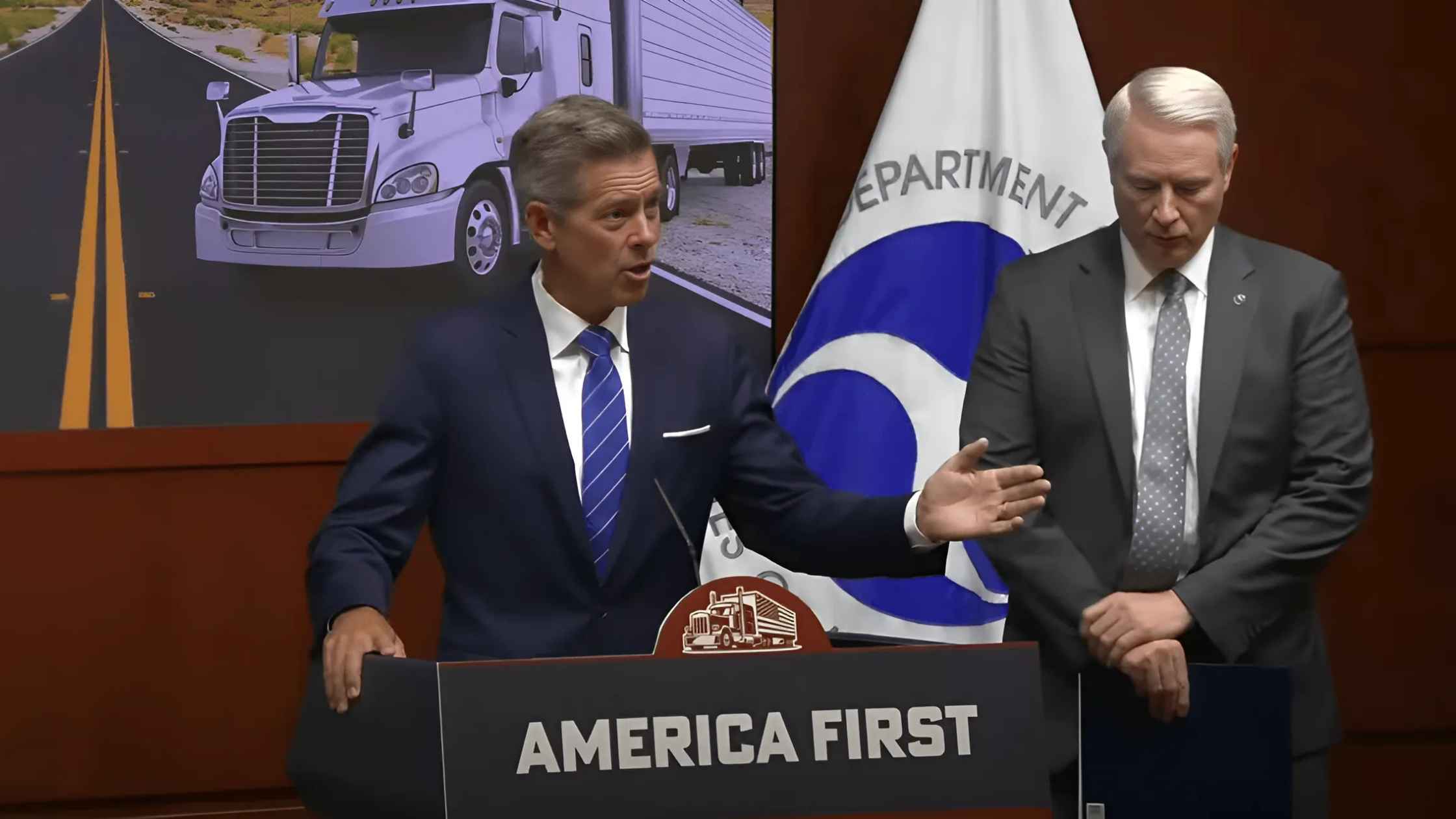


Sean P. Duffy (00:58):
… complained to us that we were being unfair to people, that we were being mean to people. And what we said was, "No, this is a safety issue." Making sure drivers of very heavy 80,000 pound rigs can speak. The language is truly a critical safety issue. And some complained about it. We implemented it at the end of June and all of us in America saw what happened in Florida where we had an individual who we tested this individual after the crash, but no doubt could not speak the English language and could not understand road signs when he was operating that very deadly rig. And so we at DOT and Federal Motor Carriers, we are not going to tolerate states that don't comply with the rules that come from this department. And so we are going to, first of all, we've identified several states that have not been in compliance.
(02:04)
That would be Washington, California and New Mexico. Those are the three states that have not complied with this rule, which by the way, this driver in Florida had received a CDL in Washington, California and was pulled over in July for speeding and no doubt couldn't speak the English language and law enforcement in New Mexico did not take his rig out of service. So this one driver touched all three states. Based on our review, they are not complying with our rule. And so phase one for us, which I'm announcing today, is we are going to give these states 30 days to come into compliance with truck drivers speaking proficiently the English language, or we're going to look at federal funding that they receive under the Motor Carrier Safety Assistance Program. So I believe California's is 20 million or 30 million?
Jesse Elison (03:08):
30.
Sean P. Duffy (03:09):
30 million. Washington is 10 million in New Mexico was 7 million?
Jesse Elison (03:13):
Correct.
Sean P. Duffy (03:14):
Jesse will confirm that in a second. But these are millions of dollars. By the way, this is phase one. There are other actions that we can take to make sure states comply and hopefully in the next 30 days we won't have to withhold any money from them. But if they don't commit to compliance, we will start with withholding this money and then we will take additional steps to guarantee compliance. And just to be clear, this is not just about saying, "We have some obscure rule that we want them to comply with that truck drivers speak English proficiently," this is about keeping people safe on the road, your families, your kids, your spouses, your loved ones, your friends. We all use the roadway and we need to make sure that those who are driving big rigs, semis can understand the road signs that they've been well-trained and that when they're pulled over by law enforcement, they're stopped by law enforcement or there's a crash and law enforcement responds.
(04:18)
They can effectively communicate what they have on their rig. There might be a history that they have to be able to communicate to law enforcement when they're pulled over or there's an accident. And if they can't do that, that creates a significant issue for the traveling public. And so this is step one, and again, we hope there'll be compliance in the next 30 days, if not, we'll take additional steps. With that, I do want to turn it over to our Chief Counsel from Motor Carriers, Jesse Elison to talk a little more about what our plan is and how we're going to move forward. Jesse.
Jesse Elison (04:55):
Thank you, Mr. Secretary. Before I explain the enforcement actions that FMCSA will take, I want to emphasize the two dates that you mentioned. May 20th is the date that the secretary directed FMCSA to implement a new policy. And part of that policy included the assessment to determine whether a driver could meet the English language proficiency requirement. And by June 25th, when CVSA, the Commercial Vehicle Safety Alliance, the alliance of the state partners put the new out-of-service rule into effect, they shared that policy with the assessment as part of it with all of the state partners. And so all of the states have had this information since May 20th and at the latest since June 25th. Today, the Federal Motor Carrier Safety Administration will be serving a notice of proposed determination of nonconformity to the states of California, Washington, and New Mexico. And this notice proposes a finding of non-compliance with the Motor Carrier Safety Assistance Program commonly referred to as MCSAP with the qualifying conditions.
(06:17)
This notice, the MCSAP program is FMCSA's main formula grant program and it provides financial assistance to states to reduce the number of severity of crashes and injuries and fatalities. MCSAP funding requires the states to adopt and enforce laws and regulations compatible with the Federal Motor Carrier Safety Regulations, which includes the English language proficiency requirement. And let me just quote what that requirement is that the secretary described just a minute ago. But commercial drivers must be able to read and speak the English language sufficiently to converse with the general public, to understand highway traffic signs and signals in the English language to respond to official inquiries and to make entries on reports and records. The states must enforce ELP requirements to maintain MCSAP funding. Even before the tragic accident in Florida taking three lives, FMCSA reached out earlier this month to all of the state partners and asked a couple of questions.
(07:33)
We were reviewing the enforcement data and we wanted to know what your plan was and if you did not have a plan, what actions you were taking to deprioritize your non-enforcement actions. And so we took that feedback and reviewed that in combination with the data that we were reviewing and part of that data that I'll share with you right now, but those answers were critical in determining these notices to California and Washington and New Mexico because they didn't have a plan or they hadn't communicated with us the steps that they would take to deprioritize what they weren't doing. What we found in determining California between the enforcement date of June 25th and August 21st, so through last week, was that California has done about 34 investigations where they actually cited a violation and one of those involved the English language proficiency requirements. Very importantly, California inspected over 20 drivers who had previously been cited in other states for English language proficiency violation and were taken out of service.
(09:01)
So what that means is subsequent to that violation, they drove again in California and California did not honor that previous violation. In Washington, there have been over that time period from June 25th to August 21st about just over 5,000 inspections that resulted in a violation, six of which did have the ELP requirement, two of which were not properly done within the commercial zones. But like California, Washington had at least four drivers coming to their state who had previously been cited for an ELP requirement violation and put out a service and they did not respect and honor that previous violation. In New Mexico Over that same time period, from June 25th to August 21st, New Mexico has provided zero violations out over about 5,000 inspections. And like Washington and California drivers came into New Mexico at least seven drivers who had previously been cited and put out of service for the English language proficiency requirement.
(10:18)
And yet New Mexico, just like Washington and California did not honor that previous violation and returned them to out of service. Just to underscore this point, an out of service violation could be various citations, it could be brakes, no state officer is going to look at a previous citation of a brake violation in a state a month before they're doing their inspection and then just not inspect the brakes and just let that driver go on their way. And yet all three of these states are doing that and they're allowing people to be on the road that were taken off the road. So all three of these states will have 30 days from the notice that we send out today to respond to the agency and to provide a corrective plan.
(11:17)
And after that 30 days, FMCSA will make a final determination of non-conformity and impose the appropriate sanctions that can be up to withholding all of MCSAP funding. And as the secretary said, that's just over, I think 33 million in California, 10 and a half million in Washington and I think 7 million in New Mexico. We anticipate all of the states coming in compliance. We do not want to penalize the states. We want the states to comply and to enforce the English language proficiency requirement, which is directly related not only to the safety of the citizens of their states, but the citizens of all of the states around all of the United States with drivers driving into those states. And that covers the notices.
Sean P. Duffy (12:13):
Wonderful. Just as a quick note, we have so many great people who work here at DOT. Jesse and I have worked arm-in-arm for the last seven months together. You haven't met Jesse yet, you met him today, but this is a hard work and the dedication that our team puts in, to make sure our rules and regulations are appropriate to keep people safe. I'll take your questions in a moment, but again, we have drivers that were taken out of service because of English language proficiency. They go to one of these three states and they're pulled over again. So their records are run by law enforcement. Of course, that's what law enforcement does. And so law enforcement in those states sees this is a flashing light. Listen, this person, this driver was taken out of service in a different state because they couldn't speak English.
(13:09)
And what do they do? Nothing. They turned them loose, put them back on the road. We've also asked for plans from these three states to which they have not provided them, which has indicated to us that there has not been a willingness to comply with this rule. And so this is phase one. We do want compliance. We don't want to take away money from states, but we will take money away and we'll take additional steps that get progressively more difficult for these states. There's a lot of great tools that we have here that we don't want to use. We just want keep drivers safe, not in just red states. Americans drive in all states and California, Washington and New Mexico, Americans drive in and they deserve to be safe in those states like in every other state. So with that, I'll take a couple of your questions. Yes.
Speaker 1 (14:04):
I'm [inaudible 00:14:02]. You referenced that this announcement's phase one. What are the next steps that you might like to take, if we've seen this before?
Sean P. Duffy (14:08):
So this is the only phase I want to take and we're giving 30 days for compliance because I don't want to take away their money. I don't. I want them to get these resources, but if not, this will be phase one. I'm not going to lay out all of the phases that we have tools that we have to garner compliance, but we have wonderful tools that will make it very challenging for states to do business if they don't comply.
Speaker 1 (14:38):
I had a follow-up. The 19 states in the District of Columbia currently don't consider immigration status when issuing commercial driver's licenses. Is DOT looking into ways to make those states consider immigration status when issuing driver licenses? And if so, how?
Sean P. Duffy (14:52):
So, again, Jesse, you might have a different answer or will supplement mine. We need congressional assistance on this, but of course I do think we should be a US citizen or be legally in this country if you're going to drive. We have a number of other issues that we deal with with our partners to the north and to the south that we are trying to unpack and make sure our laws are complied with. As I've found out now very quickly from Jesse, this gets very complicated very quickly, but we are putting every asset in place to make sure that we get compliance and get anyone who drives in America to follow the law. Jesse, do you have a…
Jesse Elison (15:40):
I would just add that the rules are very clear on what's required of issuing a CDL and a non-domiciled CDL. And those requirements are a very important part of the national audit that we're doing with the issuance of those licenses.
Sean P. Duffy (15:56):
Yes.
Speaker 2 (15:57):
[inaudible 00:15:57] transport topics. I have a couple of questions. Where are you at with the audits? What [inaudible 00:16:03]?
Jesse Elison (16:04):
We're making progress and we'll have some updates in the very near future, but we've done a number of states. We still have a lot of states to do, but we do and will have an update in the very near future on that.
Speaker 2 (16:19):
And then, in some of my reporting, it's come to my attention that with the ELP, that can only be enforced by CVSA inspectors that in states like Wyoming, I was listening to a hearing last week, they're trying to pass the state law because a state policeman or sheriffs can't pull someone over for violation of an ELP and it's happening, they're going in different areas of our interstates. Is that correct? Is that your understanding as well?
Jesse Elison (16:47):
No, that's not correct. Both the federal enforcement and the states can enforce ELP violations and do. What's really important is that the CVSA or the Commercial Vehicle Safety Alliance, they are the ones who set the standards for the North American out of service criteria, and that's why it was significant for them to start that date of enforcement on June 25th.
Speaker 2 (17:14):
They don't have to be a federal inspector and do an inspection to pull them off the road, it can be our sheriffs?
Jesse Elison (17:21):
Most of our partners are state and local partners that are performing the ELP assessments. And just real quick, the assessment actually only is triggered when there's a challenge to communicate. It's not something that's just always done, but if there's a challenge in communication, then there's a two-step assessment process that as part of the policy that we issued and that CVSA incorporated into their guidance.
Speaker 2 (17:55):
And one last question. Okay. So the violations of the out-of-service orders that you mentioned in the three states, do you know, were those non-domiciled work visa CDLs? Or [inaudible 00:18:05]-
Jesse Elison (18:05):
So those issues are separate issues. I do have an idea on some of those issues, but those are separate, the CDL and the visa and immigration. And so we are addressing those issues. In the future.,We'll have more to say about those, but right now we're sending out notices limited to English proficiency, the English language proficiency requirement, and the non-conformity with that requirement.
Speaker 3 (18:37):
Hi, I'm Rebecca from [inaudible 00:18:40]. My first question is what methods of standardization are used for the ELP assessment and when was the methodology established?
Jesse Elison (18:47):
Yeah, that's a great question. And so on May 20th, when the secretary directed FMCSA to issue the guidance, that's when it was established. And so it's uniformity. There's a lot of attention paid to that. And again, this is why I mentioned these two dates, is part of that guidance includes a two-step assessment to determine whether or not that requirement 391.11(b)(1) is met. So part 391 is all of the driver qualifications, and this is one of the ability to sufficiently converse in the four categories that I read, that sets the standard and that's what the assessment follows on whether or not a driver can meet those four categories that are mentioned in the requirement itself. And so there's question and answers in our guidance portal that's available to companies to ensure compliance. But CVSA took the FMCSA policy and that assessment and used that. Exactly, and that's what most of the states are using today. Does that answer your question?
Speaker 3 (20:06):
That does. I'm curious if there's any enforcement mechanism to ensure that the technology is applied sort of in a equal standardized way across states.
Jesse Elison (20:14):
So there are specific sets of the questions for both parts of the assessment, but it is up to CVSA and the states to implement the policy, but there's absolutely enough emphasis on uniformity in their doing that.
Speaker 4 (20:35):
Thank you, guys.
Sean P. Duffy (20:37):
And as we leave, I'll make one last point, and this is something we're looking at and working on. When someone, an individual comes in to take their test to become a commercial driver and they do a skills test, had my CDL for 30 years, I think, it's a process in which we all go through. And at that point it would be clear that this driver doesn't understand all the road signs and doesn't speak the language, but miraculously they're passing the skills test that I think any common sense analysis would say, "Well, that doesn't make sense. How could that happen?" And so just to note, for future reference, we are going to be looking at that as well. How are these tests being administered and are they following the rules and is there some gaming of the system that we have to address?
(21:38)
I would just tell you all stay tuned. We are going to… Again, we have been on this before. You all were covering it, we are going to stay on it because again, this is about keeping our American road safe and that we lost three people for no purpose, no reason, but for a driver who should not have been driving a big rig, that's unacceptable. And I do hope, it's my wish that these states understand the common sense nature of what we're doing and they comply and they become good partners. That would be my hope. And because this is, again, this is not about politics. This is about doing the right thing by way of the American people and keeping individuals and families safe as we all use our roadways. So with that, thank you all for coming out. Stay tuned for more developments as we continue to push these common sense policies, not just at Federal Motor Carriers, but also across all our modes here at DOT. Thank you.
Speaker 4 (22:45):
Thanks, guys.