




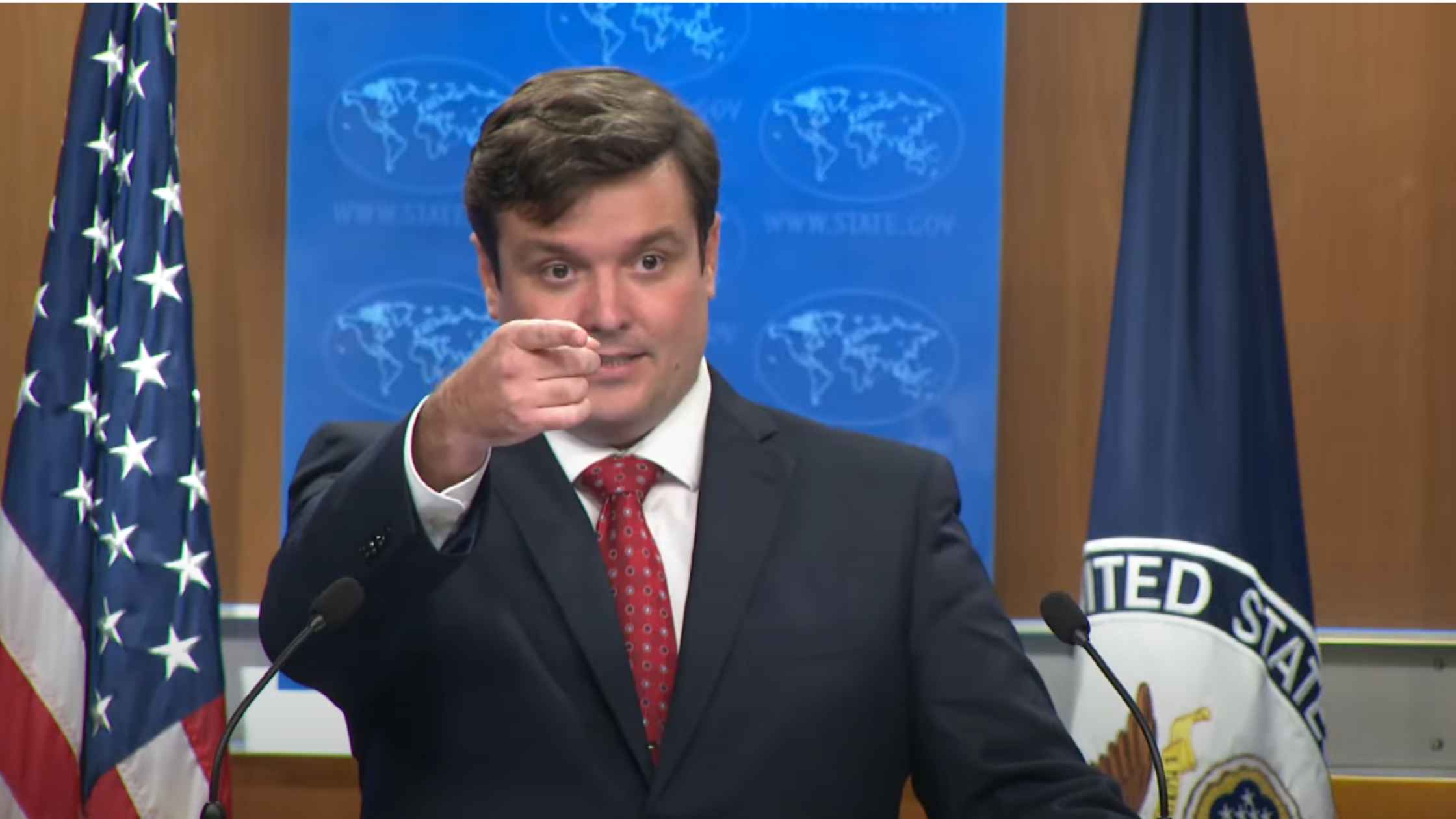


Tommy Pigott (00:00):
We of the United States is restoring strength, securing prosperity, and standing up for American interests on the world stage. Turning to trade, President Trump has delivered on his promise to rebalance US trade. This week marks the successful conclusion of eight historic trade agreements with key partners, the European Union, South Korea, Pakistan, Japan, Indonesia, the Philippines, China and the United Kingdom. Liberating the US economy from decades of failed anti-American trade policies and delivering lasting benefits for American workers and businesses. On global health and humanitarian leadership, the United States is providing an additional $93 million to treat nearly one million children suffering from malnutrition with life-saving, ready-to use therapeutic food, RUTF, from and by American producers. This critical funding will help save lives in 13 countries, Haiti, Mali, Niger, Ethiopia, Sudan, South Sudan, Nigeria, Madagascar, Central African Republic, Democratic Republic of Congo, Djibouti, Kenya, and Chad. Drawing down the entire preposition stock of RUTF and supporting continued production to meet ongoing needs.
(01:13)
Moving to the Pacific. This week, the United States and the Cook Islands announced a new partnership to advance scientific research and responsible seabed mineral development. As a regional leader, the Cook Islands is at the forefront of sustainable exploration and the United States is proud to support the shared vision for innovation and mutual prosperity. Finally, turning to Southeast Asia, the United States welcomes today's general border committee meeting in Kuala Lumpur as a constructive first step forward in the Cambodia-Thailand ceasefire arrangement. President Trump and Secretary Rubio call on both governments to fully honor their commitments and pursue enduring peace. We commend Malaysian Prime Minister Anwar Ibrahim for his leadership in facilitating this process and for co-hosting the pivotal July 28 special meeting with the United States. And with that, I'll take some questions. Yes?
Speaker 1 (02:08):
Thank you, Tommy. My name is Ali Barada from Asharq Al-Awsat Newspaper, and my question is that Lebanon's government today took a very critical decision regarding disarming Hezbollah and to accept in fact the US proposal to solidify the cessation of hostilities with Israel. Would you please comment on that?
Tommy Pigott (02:32):
Yes. What I can say is the United States welcomes the Lebanese government's decision on Tuesday to task Lebanese armed forces with a plan to bring all weapons under state control by the end of the year. This is an important step towards Lebanese sovereignty. We continue to watch developments in Lebanon very closely. Special Envoy Tom Barrack made it clear what the president needs to see. As long as Hezbollah retains arms, words will not suffice. The Lebanese armed forces must fully commit and act now to fully implement the government's decision. The credibility of Lebanon's government rests on its ability to match principle with practice.
Speaker 1 (03:05):
A quick follow up. Iran's Foreign Minister Abbas Araghchi said that this decision by Lebanese government will fail. And I wonder whether you have some comment on that and also whether you can tell us if Ambassador Barrack will visit Lebanon anytime soon.
Tommy Pigott (03:29):
Well, on that front, I have nothing to preview on that. He's been in discussion with all the players in the region multiple times as we've discussed publicly here. What I can say again in terms of your other question is that we welcome this decision and like I said at the end of that response, we need to see action match the principle that they're having there. So we need to see practice, not just principle. Yes?
Speaker 2 (03:49):
Thank you. My question is about China. While both the US and Chinese leaders are trying to have a summit meeting in the near future, the Russian and Chinese navies carried out joint exercises in the Sea of Japan, including anti-submarine drills. And China continues to purchase Russian oil. So how are you concerned of the China's move that might help Russia and then have a brief follow up?
Tommy Pigott (04:16):
Well let me take, for the specifics, let me take that back and see if we can get further details for you on that. What I can say though is we've been clear about how the United States views itself as a Pacific nation. We are a Pacific nation. We've seen the highest levels of engagement with our allies and partners across the region. The fact that we stand with our allies and partners across the region. Both the secretary of course going to the region, but other high-level delegations from this department over just the last few weeks. So we've seen that engagement, we've seen that commitment here and that engagement will continue.
Speaker 2 (04:45):
And it's been reported that Indian Prime Minister Modi sets to visit China for the first time in seven years. And Chinese Foreign Minister Wang Yi has criticized the US tariffs, imports in countries including Brazil and India. Are you concerned that China and other BRICS countries are trying to take the lead in organizing a pushback against the US trade measures?
Tommy Pigott (05:06):
Well, what I can say in terms of India is the president has been very clear in terms of the concerns he has regarding the trade imbalance, regarding the concerns he has when it comes to the purchase of Russian oil. You see him take action directly on that and I refer you to the President's comments for that. India is a strategic partner with whom we engage in a full and frank dialogue. That'll continue, the secretary also spoke to that. Like anything in foreign policy, you're not going to align a hundred percent of the time on everything, but it is very clear the president's been clear, the concerns that he has with the trade imbalance, the concerns he has with India purchasing Russian oil, he's been clear on that. He's taken action and I refer you to his comments for further on that. Yes?
Speaker 3 (05:44):
Hi.
Tommy Pigott (05:46):
Hi.
Speaker 3 (05:46):
Hope you're doing okay. Noting your statement on Lebanon a moment ago. I mean, I know you said that the US will be watching developments, but the US has not been a passive player in the Lebanon situation. It's been very active. Going forward, is the US going to continue to be a broker? Is it going to take on kind of an enforcer role? Can you give me a picture of how deeply involved you're going to be going forward here as Lebanon tries to implement the disarmament of Hezbollah?
Tommy Pigott (06:15):
Well, obviously we've seen discussions from the ambassador, Tom Barrack, the special envoy in the region. We've also seen comments here on Lebanon from this podium just now and in the past. In terms of our specific role, what I can say is what I said earlier, that we'll continue to watch developments in Lebanon very closely and that we need to see the practice there match the principle that they have.
Speaker 3 (06:34):
One other question. The report today that the Gaza Humanitarian Foundation finally secured a meeting with United Nations officials. A, can you confirm that? And B, I know that GHF and the State Department have been calling for cooperation to happen, but never really an idea of what that cooperation would actually look like in practice. Can you give us an idea of what exactly the State Department envisions in a cooperative agreement between GHF and the UN?
Tommy Pigott (07:01):
Well, I refer you to GHF for more details on meetings they may or not be having with different organizations or the United Nations. What I can say is we've been clear is that we want to see as much aid as possible go to the people of Gaza without it being looted by Hamas. We've been clear that we want to see creative solutions, that there's a mechanism in place that has been able to deliver 110 million meals without it being looted by Hamas. We've also been clear on our concerns about how other different delivery systems have seen issues when it comes to the diversion of aid. So the specifics, we'll see exact, the president's talked about wanting to see more aid get into Gaza. We've seen, for example, from this podium talking about how the Ambassador and Special Envoy Witkoff have briefed the president after their recent trip to the region. We'll see what specifics come out in terms of future steps, but there are many options being discussed. We want to see as much aid gets to the people of Gaza without it being looted by Hamas as possible. Yes?
Speaker 4 (07:50):
A question about Europe. It has been reported in the past hours that the United States government has launched a diplomatic campaign targeting the European Union's Digital Services Act. According to this reporting, the United States would be arguing that it's imposing excessive restrictions on free speech. And given the ongoing negotiations between the United States and the European Union, could you confirm that that campaign is active and what would be the main motivation and the outcome that the United States would like to see regarding the USA?
Tommy Pigott (08:21):
In terms of negotiations, are you referring to trade on that front?
Speaker 4 (08:23):
Yeah.
Tommy Pigott (08:24):
So in terms of specifics on the trade negotiations, I refer you to USTR, the White House, and those directly involved in those negotiations. We have been clear from the beginning of this administration the importance this administration places on free speech. That is something that the vice president spoke to in Munich when he said, "Democracy rests on the sacred principle that the voice of the people matters. We shouldn't be afraid of our people, even when they express views that disagree with their leadership." This has been an honest and frank conversation that we have been having with our partners in Europe around the world. The importance that we place on free speech and that importance is going to continue. Yes?
Speaker 5 (08:58):
Thank you. Asking
Speaker 6 (09:00):
About President Trump and the potential summit with Russian leader Vladimir Putin. I know White House officials have said that for that meeting to take place, Putin needs to be willing to meet with Ukrainian president Volodymyr Zelenskyy. But I was wondering, can you put a fine point on that? Is there any world in which this summit between President Trump and President Putin can happen without Putin agreeing to his Zelenskyy meeting as well?
Hugh (09:24):
Well, I'm going to refer you to the White House on that one for details on the president's schedule. What I can say is looking backwards, as the Secretary has described, we have been in continual communication with our partners in Europe, continual communication with Ukraine. Our ultimate goal is to end this conflict, get the parties to the table, see the ceasefire and the long and enduring piece. But for details on the president's schedule, I'll refer you to the White House. Yes?
Rachel (09:49):
Rachel with [inaudible 00:09:50] Broadcasting, good to see you. In regards to Ukraine, does the Secretary have any maybe scheduling a chance meeting with his counterpart with Ukrainian officials or with any Russian officials?
Hugh (10:02):
I have nothing to preview in terms of his schedule at this point.
Rachel (10:04):
Okay. And then Hugh, real quick on Haiti, you mentioned that millions of dollars are going to go towards the malnutrition problem in Haiti. However, the State Department could potentially deport thousands of people, Haitians, that are currently residing in the United States back to Haiti. There's still political instability there. What does the State Department have to say about that?
Hugh (10:24):
Well, look, we've seen actions from this administration in order to try to encourage stability in Haiti. We've seen actions, announcements taken to try to go after those that are leading to instability in Haiti, announcements the Secretary himself has made. We see this aid from American producers by American producers going to these 13 countries. For specifics on TPS, I assume that you're talking about are free to DHS in terms of those specific decisions. But we have seen actions here from the State Department to try to encourage stability in Haiti. We've seen, again, this announcement of aid going to Haiti and other countries as well.
Rachel (10:55):
Thank you.
Hugh (10:56):
Yes.
Speaker 7 (10:56):
Thank you, Tom.
Tom (10:56):
[Inaudible 00:10:59].
Speaker 7 (10:56):
I want to ask, Tom apologies. Follow up on-
Hugh (11:03):
It is tough. My phone sometimes auto corrects the [inaudible 00:11:05] nowadays. So my own phone does it, I don't know.
Speaker 7 (11:08):
Follow up on Russia, Ukraine. Again, what is your level of trust to Putin, that he's not engaging in another delaying tactic here? And how over-optimistic or would it be over-optimistic for us to expect anything out of this meeting potentially?
Hugh (11:26):
Well, it's not a question of trust, it's a question of actions. The president has described how he's been disappointed in the actions that we have seen from Russia over recent weeks. He's talked about needing, seeing actions, not just words. He's described that himself. So this is not a question of trust per se. This is a question of seeing actions to match up the words, but also is indicative of the commitment that we have made clear from the beginning of this administration that we stand ready to aid in the pursuit of peace to try to end this conflict, stop the carnage. That is our driving policy here, that remains our driving policy and getting the size to the table is key to reaching a diplomatic solution to this conflict. So it's not about trust, it's about action, and it's about doing everything we can to aid in the pursuit of peace and bring this war to an end.
Speaker 7 (12:11):
I want to follow up on Russia again. Today marks 17 years since Russia invaded in Georgia. They are housing Georgia land. They successfully seems to have implanted their pro-Russian government that is cracking down against Georgian opposition, civil society. So do you have any comment on both Russian occupation and also Georgian government's behavior?
Hugh (12:37):
The United States Embassy in Georgia put out a statement. I refer you to that statement for further details there. Yes?
Speaker 8 (12:43):
Thank you, Tom. Following up once again on Russia-Ukraine, you talk about the goal of a peaceful solution. What does stake if we can't get that peaceful solution from a potential upcoming meeting if negotiations go nowhere?
Hugh (12:59):
Well, I'm not going to speculate on what may come out of these meetings. I'm not going to predict the future. What I can talk about again is our commitment now, what we have done, what we continue to do, engagement at the highest levels of this administration to try to end this conflict and stop the carnage. We stand ready, like I said, to aid in the pursuit of peace. We continue to do that. So I'm not going to speculate or predict the future, but I can talk about that commitment we've seen already and continue to see. Yes?
Speaker 9 (13:25):
Thank you. On the West Bank. I'm sorry?
Tom (13:29):
[inaudible 00:13:31]
Speaker 9 (13:31):
Okay. Again, thank you, Tom. On the West Bank, it's been much in the news. We've seen legislators go and visit settlements and so on, a legal settlement, talk about settlement. We know that the Speaker of the House was shown actually a plan for annexation. Now, a group of Israeli academicians issued a paper. They said that the West Bank is actually being annexed very quietly and so on, and the settlers are targeting some villages where a lot of Palestinian-Americans go because they go and they build homes and so on to basically discourage development of the West Bank.
(14:07)
My question to you, what kind of designation do you assign to the Palestinians and the West Bank and under occupation? Are they an occupied people? What status do they have? Do they occupy, let's say they have autonomy, partial autonomy, whatever? So can you please give us, if you have a position on what designations that Palestinians have in the West Bank, we would like to hear it?
Hugh (14:35):
Well, the position that we do have is that we want to see a stable West Bank that keeps Israel secure and is aligned with this administration's role to achieve peace in the region. But in the short term, we remain focused on ending the war in Gaza. And then once we have broader discussions in terms of what we may see, that leads to longer peace and prosperity in the region. I'm not going to preview those here, but we have continually decried violence in the West Bank in this podium and elsewhere, no matter who commits it. And we want to see a stable West Bank that again in keeps Israel secure and is in line with our ultimate goal to see a prosperous region.
Speaker 9 (15:13):
Now the family of Khamis Ayyad is Palestinian-American that was killed last week, have requested the State Department or the U.S. government to investigate the circumstances of his death, he died as a result of fire and smoke inhalation that was started by the settlement. Have you talked to the Israelis about this? Do you have any results? Do you trust their investigation?
Hugh (15:32):
Well, look, I refer you to comments that spokesperson [inaudible 00:15:35] at this podium just a few days ago. I'll also repeat here that we have no higher priority in the safety and security of the American people. Yes?
Speaker 10 (15:44):
Thank you, Thomas. I have two questions. One is related to Europe and the relationship with the U.S. So we've seen in the war of Ukraine, a big division in Europe, and the inability to sort it out and how much the issue that we're seeing in Europe, this division forced the President of the United States to take it over and say, "Hey, I have to deal with this and try to meet Putin because the European were unable to put on the table Zelenskyy and Putin."
Hugh (16:20):
Well, if the president has been clear, he wants to see our European partners step up in a variety different areas. We saw, for example, the recent NATO deal in terms of weapons being sold to NATO, and then they can then give those weapons to who they wish. The president is a dealmaker, as the Secretary was describing to us yesterday. He's a dealmaker. He's able to reach deals on behalf of the American people, but then also that lead to a safer world. So the president stands ready, like I said, to aid in the pursuit of this peace. But he has also been clear that we want to see, we need to see our European partners stepping up in terms of defense spending, in terms of a whole variety of other measures here. And that remains in terms of even to see our European partners also stepping up.
Speaker 10 (17:01):
Yeah. And if I can ask you on the other front, will the United States will be involved on the Gaza and Israeli situation? Beside humanitarian foundation, are there in place any other plan to try to bring this war to an end [inaudible 00:17:20]?
Hugh (17:21):
Well, so I'm not going to preview what decision the president may make. I already described how we're each following the trip, Special Envoy Witkoff and Ambassador Huckabee. There's been several different options that have been discussed. The main driver here is creative solutions. We want to see creative solutions, and we want to see a mechanism in place that delivers aid to the people of Gaza without it being looted by Hamas, without seeing aid diversion. That is the primary goal that we're having here. That's what we want to see. And we've been calling for creative solutions in order to get to that end. We've supported the Gaza Humanitarian Foundation because that mechanism, it is a mechanism in which that has been allowed to happen, 110 million meals that have been delivered to the people of Gaza without it being diverted or looted, stolen by Hamas.
Hugh (18:01):
So we're continuing to call for creative solutions. We want to see more people involved. We want to see partnerships, but based under a mechanism that allows aid to reach the people that need it.
Speaker 11 (18:10):
Thank you.
Hugh (18:11):
Yes.
Speaker 12 (18:14):
Want to ask two questions. First, just following up on your topper, can you tell us a little bit more about when you expect the RUTF to actually move? And can you clarify, is this the same food aid that was previously frozen as part of the review?
Hugh (18:28):
We had another announcement on food aid. I'm not entirely sure what you're referring to there specifically, but there have been two recent announcements on food. What I can say in terms of this proposal is that this proposal is for 11,285 additional metric tons of RUTF under this award. In terms of these commodities are currently held in warehouses operated by the RUTF and they're produced by producers in Rhode Island or Georgia. The details of this specific procurement are sensitive. It is ongoing. We've announced this intent to have the $93 million worth of drawing down and then additional procurement. When we have additional information in terms of exact timing, we can provide it.
Speaker 13 (19:08):
Sorry, Tommy-
Speaker 12 (19:08):
And can I have one more on-
Speaker 13 (19:11):
… did you just say that on this specifically this is stuff that was … your comments said that you're drawing down the entire stock of prepositioned supplies.
Hugh (19:18):
And then replacing it as well. So it's …
Speaker 13 (19:20):
Yeah, yeah, yeah.
Hugh (19:20):
Yeah.
Speaker 13 (19:20):
But all of this stock that you're distributing, this 11,285 tons, was actually purchased and sent to these warehouses in the previous administration; is that correct?
Hugh (19:31):
Well, I'll find out exactly when it was sent. I know that there's the 11,285 additional metric tons. So in terms of the breakdown of how much of that is additional versus prepositioned, I can't speak to now.
Speaker 13 (19:41):
But you said it was additional. An additional 93 million. Okay? But-
Hugh (19:48):
Yeah, excuse me. That was request for proposals to producers for the additional 11,285 metric tons.
Speaker 13 (19:53):
So that's all going to be new?
Hugh (19:55):
That was the request for proposal for additional metric tons. That is what I have here. In terms of making sure I get you the exact specifics on the numbers I can, yeah.
Speaker 13 (20:03):
I just want to know if this is food assistance that this administration has put into these warehouses or if it was food assistance that was put in under the previous administration, some of which as we know was destroyed.
Hugh (20:15):
Yeah. So as I was going through the numbers, I do have a breakdown here. A benefit of having some notes here. So the entire prepositioned stock of RUTF is 1,209 metric funds, but the funding will also be used to order the production of an additional 11,285 metric tons.
Speaker 13 (20:34):
Thank you.
Speaker 14 (20:37):
Can I follow up on the one other question? Now that the Israeli prime minister has confirmed in a Fox interview his intention to occupy all of Gaza, can you speak a little bit more on the U.S. position on this? Do you see this as a way that is helpful to secure the release of the hostages still being held there and to see humanitarian aid flow?
Hugh (20:56):
What I can speak to is our policy and our initiatives here. And our three focuses, as the Secretary outlined yesterday, remain getting humanitarian aid into Gaza without it being looted by Hamas, remains seeing the hostages released, and remains making sure that Hamas cannot continue to exist, because there can be no long-term prosperity with Hamas as a governing force or otherwise within Gaza.
(21:16)
So that's what our policy is. That's where our focus is. That's what I can speak to. For further details on Israel's policy, I would refer you to the Government of Israel.
(21:20)
Yes.
Speaker 15 (21:21):
Yes, thank you, Tommy. I wanted to follow up on my colleague's question about India, because I understand, we've certainly heard, as you mentioned, the President's frustration and upset about India purchasing Russian oil. But we've seen a longer-term tension, it seems, rising in U.S.-India relationship. We saw Indian officials back in May who were upset about the President talking publicly about a role in having brokered a ceasefire between India and Pakistan. We saw the meeting with the prime minister of India that was supposed to take place at the G7 in June canceled because the President had to leave early to return to Washington. And now this tension over tariffs.
(22:12)
Is there a concern from this department or the Secretary about an overall worsening in the relationship with India and the potential for India to be turning more to China and away from the U.S. at a time when the U.S. looks to India, has been looking for many years to India, as a partner?
Hugh (22:31):
What this is about is an honest, full, and frank dialogue about real concerns that this administration has, that the President has outlined very clearly, addressing those concerns through his actions. He's spoken about them, whether it's about the purchase of Russian oil, whether it's about the trade imbalance. Addressing those concerns is important, and that's part of what it means to have a frank dialogue, to address those concerns that you have, and then hopefully have conversations to see those concerns addressed.
(23:01)
So the President's been very clear; his concerns about what he has seen from India speak for themselves. He's truthed multiple times about it. But ultimately, this is about a frank and full dialogue, and that's what it means to advance American interests. That's what it means to really have full diplomatic dialogue with partners to address concerns that we need to see addressed.
Speaker 16 (23:20):
Can we go back of the room?
Hugh (23:21):
Yes.
Speaker 17 (23:22):
Thanks, Tommy. Earlier today the President truthed, and this is how we call it on Truth, that he was hoping that all our nations would join the Abraham Accords. Do you have concern that Israel's decision to take over Gaza completely will, if not delay, really kind of jeopardize the ability to move forward with the Abraham Accords?
Hugh (23:46):
Well, I'm not going to predict the future or speak for the opinions of other governments. What I can say is that President Trump is a deal-maker. President Trump wants to see peace and constructive dialogue. He knows how to make a deal. He knows how to bring people to the table. That has been evident both in the previous administration when we saw the beginning of the Abraham Accords and now the Abraham Accords then being something that many people thought would not have been possible, and yet he still was able to accomplish that, with many different nations joining the Abraham Accords.
(24:15)
So I think what's clear is that the President can accomplish what many people think is not possible. I'm not going to predict the future or speculate on how others may view certain actions. But the President remains committed on this; he's made that clear.
(24:27)
Yes.
Speaker 18 (24:28):
Hi, Tommy. Thank you. In his interview yesterday, Secretary Rubio made it clear that, of Russia and Ukraine, the U.S. would have to bring them close enough in order for a meeting involving President Trump to be worthwhile and productive. As of right now, are they close enough?
Hugh (24:44):
Well, I'm not going to get ahead of what the White House may announce here. I mean, ultimately the Secretary laid out saying that that was one of the things that they were discussing here when we're looking towards a potential meeting or other sort of engagement. So I will leave that to the White House or the President to decide when that happens and take his lead here, and it is a credit to his leadership that we've seen the engagement we have seen, the parties come to the table when they have come to the table, and the further engagement to try to pursue peace here.
Speaker 18 (25:08):
Assuming that you're not close enough and there is no ceasefire in place by tomorrow, which was the previously stated deadline in order to forestall sanctions by the U.S., are sanctions going to be imposed tomorrow, either secondary or any other sort?
Hugh (25:21):
A lot of speculation involved there. I'm not going to speculate from here.
Speaker 18 (25:24):
I mean, it was a pretty hard deadline by the President. And administration officials had indicated they were expected to be put in place.
Hugh (25:30):
Well, as you said, assuming, that's kind of where I draw the line in terms of speculation.
Speaker 18 (25:34):
Yeah.
Hugh (25:34):
I'll defer to the White House to speak more to the President, and defer to the President, don't want to get ahead of him. But not going to speculate from here.
Speaker 18 (25:40):
One last finer-point question. The Secretary also, in this interview, indicated that Special Envoy Witkoff heard from the Russians about what they were asking for in order to bring an end to the war. Did they put any concessions on the table?
Hugh (25:53):
Well, as the Secretary described in his interview, yesterday we saw conditions, which is the first time, as he described, that we have seen some of these conditions that would be needed to see an end to this war. I'll leave it to him to characterize what we saw from the Russians and conditions is the word that he used.
Speaker 18 (26:08):
On the Human Rights Report?
Hugh (26:08):
Yes.
Speaker 19 (26:10):
Thank you. Thanks, Tommy. Two questions on Syria. As President Trump has instructed the State Department to review the removal of Syria's Sponsor of Terrorism status, will that happen soon? And what would that mean in terms of sanctions?
Hugh (26:26):
Sorry, repeat your question one more time.
Speaker 19 (26:27):
Yeah. President Trump has instructed the State Department to review the removal of the Syrian Sponsor of Terrorism status. Will that happen soon? And what would that mean in terms of sanctions?
Hugh (26:39):
I'm not going to preview the finalization of certain sanctions announcements. When we have something to announce, we'll announce it. What I can say is, as the President has said, as Special Envoy Barrack has said, as the Secretary has said, we want to give Syria a chance for greatness, and that Syria is at a critical crossroads here when it comes to the ability to achieve that.
(26:56)
So we continue in dialogue here. We continue having the conversations with all
Hugh (27:00):
Different stakeholders in the region only as something to announce [inaudible 00:27:03] .
Speaker 20 (27:03):
The second question, as you are mediating the negotiation between the Syrian Democratic forces and the Syrian government, have you seen any progress in these negotiations recently. And last week Tammy said that the US position has not changed on the evolution of these negotiations. Can you clarify that? Whether the US dictating the Syrians and SDF in these negotiations or they are leaving that for the Syrians to make decision if they want a federal state or if they want to have a centralized state?
Hugh (27:32):
Well, Special Envoy Eric has spoken about this not to go further than his comments in terms of talking about sensitive conversations between different parties are free to his comments on more detail there. Yes, Michelle and back.
Speaker 21 (27:44):
Thank you. I'm sorry I'm sitting way back. Can you explain why the State Department is rewriting the human rights report? I understand it's coming out soon, but it's been changed and you're dropping certain things like LGBTQ rights. Just explain why.
Hugh (28:03):
You know what? What I can say is that this human rights report, in terms of the one that is set to come, just for people watching at home, is set to talk about 2024. It's a series of reports for different countries. Part of the reason why we are seeing an effort to readjust this is to make it more readable, to make it more digestible and also to reflect some of the changing priorities that we've seen from the previous administration to this one. Priorities that were voted by the American people and we, at the State Department, are here to carry out and fulfill. So we're seeing an ongoing conversation in regards to that. We're seeing an effort in order to try to make this more usable, more readable, while also reflecting the changing priorities of this administration compared to the last one.
Speaker 21 (28:44):
So it's always, in the past, seen is not a political thing. I mean, you're judging people based on human rights law, but does this mean that you see it as a political tool?
Hugh (28:57):
No, not at all. I mean, we have seen changes in the previous administration, when President Biden took office, changes in terms of different examples that are used. Speaking of past reports, the examples in these reports are oftentimes illustrative, highlights of ways that we want to … or concerns we want to raise or conversations we want to have. So, no, it's more of just making sure that we're implementing the policy and priority of this administration. It's not political in terms of how that was described. Yes.
Speaker 22 (29:25):
[inaudible 00:29:25] a couple of questions [inaudible 00:29:26] Armenia. First, there are reports that the trilateral summits [inaudible 00:29:32] with Azerbaijan [inaudible 00:29:34] leaders will result in the signing of an initial peace deal. Can you confirm? Could you please elaborate on that and [inaudible 00:29:43] also, could you please clarify the US position on this Zangezur corridor, this transit corridor?
Hugh (29:48):
Well, on that second point, let me see if I can get you more details there. On your first, I refer you to the White House for details and what will happen. It may or may not be happening [inaudible 00:29:55].
Speaker 22 (29:54):
And on Turkey, how do you see Turkey's role in this, that Turkish President Erdogan recently worked separately, met both with Armenian and Azerbaijanian leaders? How does the US see Turkey's role in this peace process and also generally, overall, its role in the post-conflict region with Erdogan?
Hugh (30:20):
Well, what I can say is that both the president and the secretary have said we hope to see, speaking in general, some sort of agreement soon. They both said that multiple times. The secretary often talks about this when he has the opportunity. When there's something to announce, we'll announce. It in terms of the specifics of how that looks, when we have something to announce, in terms of specifics, I'm not going to speculate or get ahead of those announcements at this time. Yes. Yes.
Speaker 23 (30:38):
Oh, thank you so much. My name is Irana from Habbar Agency US Ambassador to Uzbekistan, Mr. Jonathan Henick, said that it's the best time for Donald Trump to visit Central Asia. I know you don't speak for President, but this year is 10th anniversary of C5+ 1 platform where central Asian five countries engage with United States to make relationship more fruitful. So do you have any plans to do for this year? Because it's already August and we'll have like three months left. Anything planned for United States and Central Asia cooperation?
Hugh (31:19):
Well, nothing to preview, at this point, in terms of the schedule there. Yes.
Speaker 24 (31:26):
Thank you. My name is Nazir Aziz Karimi. I'm Afghan journalist. I have two questions, sir. One question is any update about US policy toward Taliban, Taliban regime? Number two, foreign minister of Taliban had a plan to visit Pakistan. There is rumor that United States stopped him, prevented his visa. Is that true? And my second question. President Trump said we are going to help Afghan allies to come to the United States. The people who was a SIV visa, which kind of help, US authority will prepare for them because a lot of them waiting in Doha, Qatar, Abu Dhabi, Pakistan, and different part of country.
Hugh (32:09):
So a couple questions there.
Speaker 24 (32:11):
Thank you.
Hugh (32:11):
I believe on your second regarding Pakistan, I'm not going to comment on rumors from this podium.
Speaker 24 (32:16):
Visas, [inaudible 00:32:17] visas.
Hugh (32:17):
Yeah, so I'm not going to comment on rumors from this podium. In terms of your question on SIVs. We see a continual processing of SIVs. That processing has continued. That has continued for many, many years. We have seen that, because of the initiative that President Trump was talking about. So the SIV processing has continued. We expect that to continue, but also we're seeing many hundreds of those visas being processed as we go forward here. So nothing further beyond that. The processing for SIVs for Afghans has continued.
Speaker 24 (32:48):
Thank you.
Hugh (32:48):
Yes.
Speaker 25 (32:52):
Thank you. I would like to ask you about Serbia. Secretary Rubio had a meeting with Serbian officials yesterday. Can you please provide some details, beyond the readout that I'm familiar with, specifically on Secretary Rubio's broader plans for US-Serbia relations, and the strategic policy frameworks surrounding the engagement? What's the goal for the state department when it comes to Serbia? Is it the beginning of a new chapter? Is it not? What do you have for me?
Hugh (33:21):
Well, nothing further to provide beyond the readout. So I'll refer you to that readout for further information. And with that, that's all I have today. Thank you.