Speaker 1 (00:00):
(silence)
JB Pritzker (00:00):
Good afternoon.
Speaker 2 (00:00):
Good afternoon.
Speaker 3 (27:20):
Afternoon.
JB Pritzker (27:22):
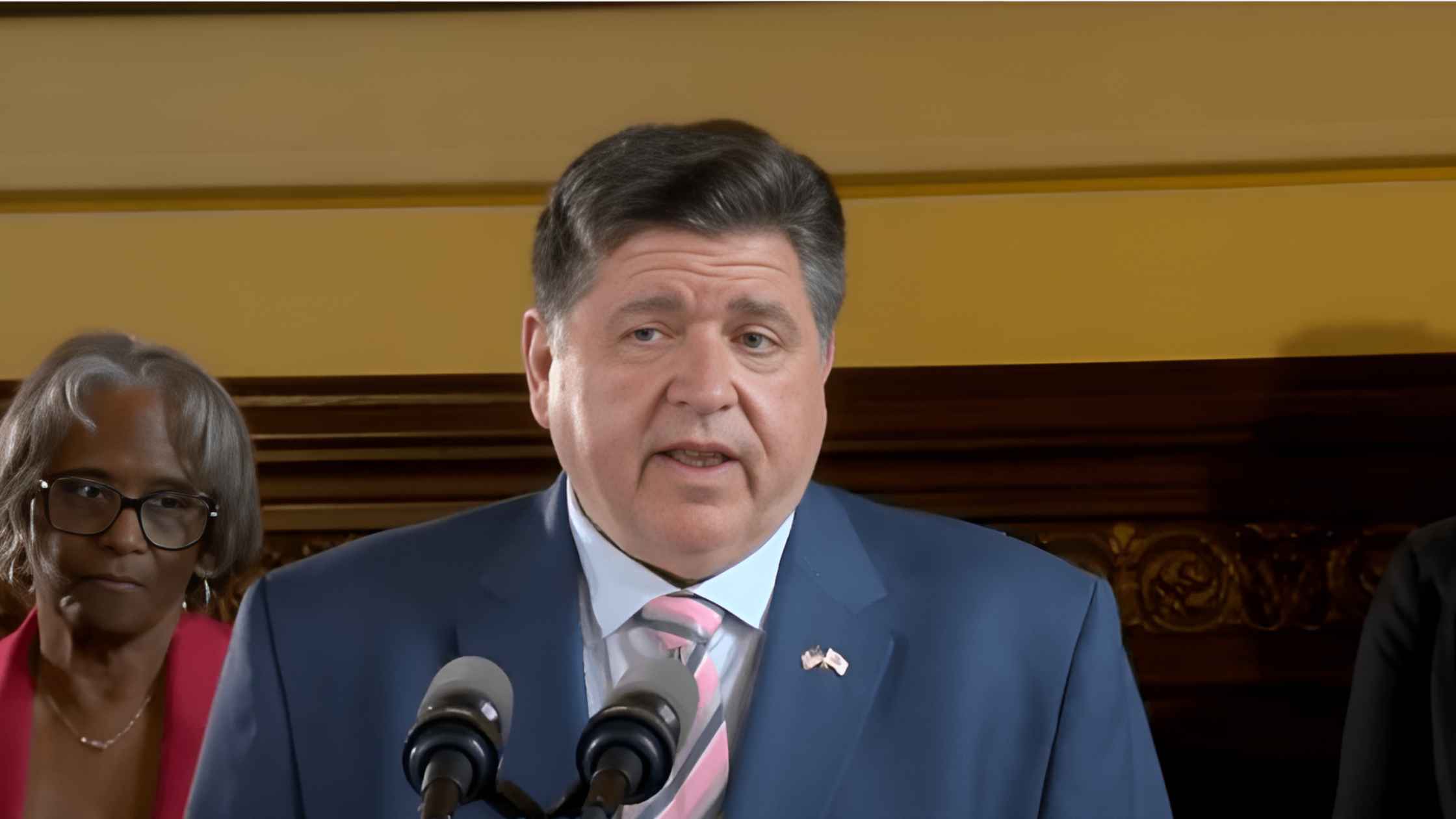
This is an important day for everyone who cares about public safety and accountability in the State of Illinois. Indeed, perhaps across the country. We're undertaking a big step forward that will make our community safer and better connected., And in doing so, we honor and remember those we have lost and those who have suffered along the way to get us here.
(27:48)
Today I'm thinking of Sonya Massey. Our hearts break for her children and family, her friends, this community. She loved, and she was loving, taken from us far too soon. What happened to her was the very definition of injustice. We can't bring her back, but we can let her spirit guide us to action. When Sonya Massey feared for her safety, she did what anyone would do. She called for help. That became a death sentence for her.
(28:29)
Unfortunately, what happened to Sonya is not an isolated incident in America. So what we do today should serve as an example across the nation for other states and jurisdictions. Each and every one of these incidents is a preventable tragedy and a moral strain. So when I sign this bill, our state together is pledging that we will do what is necessary so that others will not suffer as Sonya did and as her family does. We commit ourselves to serving the cause of justice and keeping all of our communities safe.
(29:13)
Accountability is a crucial first step, and I'm grateful that the Springfield State's Attorney's office has filed the appropriate charges to bring Sonya Massey's killer to justice. Today we take the next step. I will affix my signature to Senate Bill 1953, Sonya Massey's bill, to help prevent these tragedies, to better equip law enforcement to keep our community safe, and to continue working to build a justice system that protects all of our citizens.
(29:48)
Let me take a moment to recognize law enforcement representatives and community advocates, the legislative champions and executive branch leaders who played an important role in making this possible, including especially the outstanding leadership of Senator Doris Turner, along with House Sponsor, Representative Kim Buckner and Lieutenant Governor Juliana Stratton. This legislation was informed by the outpouring of community response that brought forward the Massey Commission. I want to thank Sangamon County Board Chair, Andy Van Meter for his leadership on that front, as well as his co-chairs, Dr. Jerry Kruse, JoAnn Johnson, and Shadia Massey for their tireless efforts. Finally, I want to thank Sonya Massey's entire family, especially her mother, Donna, who has demonstrated such strength in not just caring for this family, but in pushing for change. To advocate for others as you are suffering through your own tragedy takes an unending amount of courage for which we all owe you, Donna, a debt of gratitude.
(31:11)
With my signature today, we'll begin making fundamental reforms to the hiring process for law enforcement officers across the State of Illinois. Officers with histories of serious disciplinary issues should not be serving in those capacities in our communities, and those histories should not come to light only after disaster happens. Hiring and interview procedures will now include a comprehensive review of prospective officers' previous employment, seeking to confirm their physical and psychological ability to do the job.
(31:51)
Illinois is setting a national example with this legislation. Our justice system needs to be built on trust. Communities should be able to trust that when they call the police to their home, the responding officer will be well-trained and without a history of bias or misconduct. And police officers should be able to trust that they are serving alongside responsible and capable individuals. I'm pleased to say that this bill passed with bipartisan unanimous approval in the Illinois Senate and overwhelmingly in the House. It was supported by community advocates as well as law enforcement such as the Illinois Association of Chiefs of Police and the Illinois Sheriffs' Association.
(32:40)
It's a reminder that at the core, people are working towards the same goals. Today is an important step forward, and there is yet more work to do. We must continue fighting for an Illinois where all of our communities are safe and protected. And with that, I'm pleased to hand over this podium to the driver of this work and a powerful advocate for safety and justice, Senator Doris Turner. Senator.
Doris Turner (33:18):
Good afternoon.
Speaker 2 (33:19):
Afternoon.
Doris Turner (33:21):
Today is a very emotional day for me for a lot of different reasons, and I will tell you unequivocally in my 25 years of elected office, this is the least political thing I have ever done, but it's the most important thing I have ever done.
(33:44)
When I received the telephone call from Sonya Massey's cousin, Natasha Massey, I couldn't believe what I was hearing. This is something that happens on television shows or something that we hear about on the network nightly news, not in my hometown, and certainly not involving someone that is an integral part in my life. Sonya was not just a constituent or someone I casually knew, her grandmother and my grandmother were friends. Her aunt was married to my mother's best friend's son, my childhood friend.
(34:20)
I moved on the corner of Lawrence and Wheeler in 1981, and during this time … I still live there … and during this time, there have been five Massey families living on the block, including Sonya's grandparents, her mother, her aunts, uncles, and my current immediate neighbor to the west bears the last name of Massey. Sonya was a regular visitor to my home. We actually visited on my front porch literally a week before her murder, and during our visits she always called me Auntie and would occasionally bring me a small gift. I actually ran across some Footies with the initial D on them a few weeks ago that she had gifted me.
(35:10)
So when I spoke to Sonya's mother to try and console her, and she said to me, "Nothing else matters. It's not about the money, it's not about the attention. Nothing else matters to me. I just want you to get justice for my baby," I immediately made her that promise and that promise has guided my every step, my every action from that day to this one.
(35:41)
I want to thank Governor Pritzker and Lieutenant Governor Stratton. Again, not for any political action or political move that they made, but they from day one were present and engaged. It wasn't about
Doris Turner (36:00):
… about anything other than they were concerned. They were concerned about what was happening with me personally. They were concerned about the Massey family. They were concerned about the Springfield community. They reached out on an almost daily basis just checking in, just asking what if anything they could do to be helpful to me and my community. They were among the first to publicly call for the Sheriff's resignation. That, again, not a political move. They didn't get any political capital from that. If anything, it may have cost them some, but they felt it was the right thing to do and that's why they did it.
(36:52)
I also want to thank county board chair, Andy Van Meter. He and I were in constant communication and almost immediately we created the Massey Commission, a citizens commission that is a direct response to the thoughtful comments from members of the community voiced after Sonya's murder. Again, this is not a political situation. This happened under a Republican Sheriff Administration in Sangamon County. Andy Van Meter is the chair of the Sangamon County board. He gained nothing from standing with me day after day after day to put together the Massey Commission and not just with his words, but with funding from the county.
(37:53)
This commission is not about politics. He and I both stepped away immediately after its formation because we didn't want to get in the way. We didn't want people to say, "They're doing this because of political reasons." We stepped totally away, have not been in contact with anyone, and the commission continues to be committed to leading a process for the community to listen, learn, act, and continue the healing process. The commission is in the process of putting together their final report.
(38:32)
They issued a six-month report during the process of putting together a final report that should probably be ready mid-October because their work will conclude that first year in September, and I'm really looking forward to seeing what their recommendations are and then doing everything that I can to pull together the advocates, stakeholders, legislators. I'll be calling on you, Leader Buckner, to put into action those recommendations because I really feel like they will make a generational change in our community, and I believe not just in the Springfield Sangamon County community, but in communities across the state.
(39:22)
All along this journey I was listening to and being driven by my constituents, my community, and the Massey family. However, we don't get here today unless we have the significant cooperation and work with the Illinois Sheriff's Association, the Association of Chiefs of Police, and I have to give a special shout out to Senate staff Giovanni Randazzo and Ted Teros. These four people came to the table immediately and never ever left. We worked tirelessly for over a year to get here. This is not something that just happened overnight. This is a year in making with us being in a room together constantly hammering things out. They understood how much this meant to me personally, the Massey family and my community, and that's why we're here today.
(40:34)
I believe that Senate Bill 1953 goes a long way to prevent individuals with backgrounds such as Sean Grayson's from ever becoming associated with law enforcement. It requires law enforcement agencies to conduct a more comprehensive review of a prospective officer's past employment to ensure his or her physical and psychological fitness for duty as a police officer before making an offer of employment. If that would've happened with Sean Grayson, Sonya would still be here with us today.
(41:07)
Additionally, to ensure the highest degree of integrity and professionalism in the hiring processes of sheriff's, deputies and other personnel, the legislation expands the creation of Sheriff's Merits Boards and Sheriff's Merit Commissions for counties with a population of at least 75,000. The current legislation sets that standard at a million. I have learned that this legislation is the first of its kind in the nation, and I'm hopeful that we can work with other legislative bodies to replicate our success.
(41:46)
When we call law enforcement, it's never a good day and the expectation is that the responding officer will live up to the motto, protect and serve. With Governor Pritzker's signature on this legislation today, I feel confident that going forward and over time our communities and law enforcement will have built a trusting relationship and I will have kept my promise to my childhood friend and Sonya's mother.
Donna Massey (42:29):
I just wanted to say thank you to Governor Pritzker, Senator Doris Turner, Ben Crump, all the lawyers and the support, and everybody in this room actually. Thank you for support and God bless you.
Kam Buckner (42:50):
Good afternoon.
Doris Turner (43:01):
Good afternoon.
Kam Buckner (43:03):
Thank you, Governor Pritzker, Lieutenant Governor Stratton, Senator Turner, the Massey family. Thank everyone else gathered here today for the signing of SB1953, the signing of the Massey Act, because this moment truly does matter. August 12th is not just today's date, it's history. 117 years ago this week a mob tore through the streets of Springfield, Illinois. Burning Black homes, lynching Black people, and forcing hundreds of families to flee the city that Abraham Lincoln, the great emancipator once called home. That violence sparked the founding of the NAACP that exposed the lie that racial terror only lived in the South, and it reminded this country that up to that point, freedom for Black folks had always been conditional, always negotiated and always fragile.
(44:02)
Today we return to Springfield for a different reason, to turn pain into policy, to turn injustice into law, to say her name and not just as a headline, but as a mother, as a daughter, as a human being. Sonya Massey, she should be here. Sonya was 36 years old. She was a mother to Summer and to Malachi, she was the beloved child of Donna and James. She was loved. She was trying. She was human and her life mattered. I never met Sonya. Our paths never crossed, but after hearing her family's stories, after seeing her through their eyes, I feel like I've known her all my life. I've looked at her picture, at her smile, at her eyes, and when you are with her family, you can feel the warmth surrounding you. It's clear that each of them carries a piece of her with them, not just in memory, but in the way that they move through the world.
(45:06)
In my family, we celebrate half birthdays. We mark the moment in the middle, six months since your last birthday, six months until your next birthday. It's a small thing, but it's our way of saying that every part of your life is worth noticing and worth celebrating. Plus, my family is from New Orleans, so we celebrate everything. But today would've been Sonya's half birthday, six months to the day since her birthday in February and standing here that halfway mark feels a little bit heavy. It reminds us that her life was cut short, that she did not get the full measure of years that she deserved, but it also reminds us that we can't settle for halfway measures in her name.
(45:50)
On Sonya's half birthday, we are not here to give a half response. We are here to give a whole one, a full unflinching commitment to her memory, to her family, and to a promise that no one else will ever have to endure the loss that this family has endured. Because with Governor Pritzker signing of the Sonya Massey Act, we say no more secrets in personnel files, no more hiring officers with known records of violence, no more looking the other way, not in Illinois.
(46:24)
This didn't happen in the vacuum. You've heard it before. It took a coalition of lawmakers, of advocates, of law enforcement leaders, of the Massey Commission, of community voices who refused to let this moment pass us by, and I want to once again, especially thank Senator Doris Turner who allowed me to be her partner in this work from day one. For Senator Turner, as she said, this is not just her constituency, this is her community. These aren't just voters, these are her neighbors, her people, folks who count on her to be Senator Turner, but who know her as Doris. She brought not only her legislative skill, but she brought her deep roots here, her relationships across the aisle, and her relentless focus on getting this right. She knew the stakes and she carried Sonya's story into every room and she never let the urgency fade. Thank you, Senator Turner.
(47:12)
This bill is stronger because she was in the fight, and it stands today because so many others, survivors, families, and organizations kept showing up, kept telling the story, and kept demanding change. The Sonya Massey Act is their work too, and today belongs to all of them as well. Let's be clear, this is not just about policy, it's about people. It's about Summer and Malachi, it's about Donna and James, and it's about every Black woman in America who is still negotiating her safety, her dignity, and her right to be seen as fully human. Governor Pritzker turns a bill into a law today, and we also make a promise that Sonya Massey's name will not be forgotten, that her children will know that their mother changed this state, and that in the land where riot once raged against Black freedom, we are writing a new legacy, one of accountability, one of justice and one of care.
(48:10)
History and our children and their children and their children will weigh and measure us. Let them say of this day that the state of Illinois did not flinch, that when we were faced with the truth, we chose change, and that Sonya Massey's life, though cut far too short, helped protect thousands more. May her memory be a blessing. May her name live on in this law, and may we never stop fighting for the safety and dignity of all of our people. It's now my pleasure to bring up to the podium the great Lieutenant Governor of the State of Illinois, a true champion in this fight, Lieutenant Governor Juliana Stratton.
Lieutenant Governor Juliana Stratton (48:52):
Good afternoon, everyone, and thank you all for your powerful words. Donna, I am awestruck by your spirit today. Thank you for your voice and for being with us today. I continue to pray for you and your entire family.
Donna Massey (49:11):
Thank you.
Lieutenant Governor Juliana Stratton (49:13):
Thank you to our bill sponsors, Senator Doris Turner, who from the very beginning said that she wanted to effectuate real change and she has done that. And thank you to Speaker Pro-Tem Kam Buckner and all of our partners in the General Assembly for centering the needs of Illinoisans in your work. In doing so, you have delivered meaningful change and have turned a tragedy into action. To all of our special guests joining us today, thank you for standing with us and I'm forever proud to stand alongside Governor JB Pritzker. Thank you for your unwavering dedication to protecting our people and doing so with such compassion. I'd like to root this moment in honor, honor for Sonya's life, honor for the grief her children and loved ones continue to carry, and honor for the way Sonya's family and neighbors transformed their pain into motivation. After her tragic death last year, the governor and I privately met with Sonya's family, and when I walked away, I was taken aback by how in the midst of palpable agony, her family was so determined to enact change. Their commitment to not only protecting Sonya's memory, but using her story to protect others was as empowering as it was gut-wrenching.
(50:50)
While I wish we weren't here paying tribute to the preventable loss of an irreplaceable life, we are, and although nothing we say or do will bring Sonya back, it is our responsibility as leaders to do everything in our power to deliver change. When something like this happens and a community cries out for help, it is our job to respond with action. We have a duty to ensure everyone who went through this trauma of this incident can heal and move forward knowing that their voices were heard. This bill also arrives against a backdrop of fear as we watch our country rise under the weight of uncertainty, of cruelty. And I know that there are many people, especially young people asking themselves, "Is the world always going to feel this way? What can I do to make a difference?" Well, at this moment, we're looking at a harsh but crucial example of what is possible.
(51:57)
Something tragic happened right here in Springfield last year, and we cannot rewrite that part of our story and we cannot breathe life back into who we lost. But because of the strength that exists in Sonya Massey's family and the resilience that lives in the community she left behind, collective pain has been harnessed to make a difference for a better tomorrow. Illinois is making it clear that a call for help should only ever be met with that, help. And that begins by ensuring that every law enforcement officer has the highest standard of vetting and can do the job with integrity. This right here is what happens when we meet each other with humanity. I offer my love and continuing prayers to Donna and Sonya's entire family as you reconstruct your hearts around the hole she left. Sonya Massey, I speak her name, may we all speak her name and remember her for the fullness of her life. She will not be forgotten. And with that, I will welcome Governor Pritzker back up to sign this bill into law.
JB Pritzker (53:21):
[inaudible 00:54:13].
(53:21)
Why don't you just step, yeah, next to the senator and I'll step back?
(53:21)
Sir, go ahead.
Doris Turner (53:21):
[inaudible 00:54:39].
Speaker 4 (53:21):
Say her name. Sonya Massey.
Group (53:21):
Sonya Massey.
Speaker 4 (53:21):
[inaudible 00:56:01], appreciate it.
Speaker 5 (56:22):
Thank you father for blessing us with this day. Thank you.
Speaker 6 (56:26):
Amen.
Speaker 5 (56:53):
Yes, amen.
Speaker 4 (56:53):
[inaudible 00:56:54].
JB Pritzker (56:53):
I'd be pleased to take any questions from members of the media.
Journalists (56:57):
Governor, [inaudible 00:57:00] if it's all right, then I'll sit down. What about the police officer, with this law what happens? [inaudible 00:57:10].
JB Pritzker (57:11):
Yeah, I might ask the bill sponsor just to give you the blow-by-blow.
Doris Turner (57:14):
I'm sorry I didn't hear the question.
Journalists (57:17):
I'm going to apply your job as a police officer, thanks to this law, what happens?
Doris Turner (57:20):
Before there's an offer of employment, the agency where you made application would seek to get all of your past employment records, including everything.
Journalists (57:34):
Just to follow up on that before [inaudible 00:57:37] off-topic, does this require them to do anything?
Doris Turner (57:35):
Yes.
Journalists (57:35):
Not just collect the information, say they find some stuff and they just decide then, what is it they're going to need from that person?
Doris Turner (57:51):
While… And this is a really good question, Leader Buckner had it had it before, and I will echo what he said at that time… we can't tell people who to hire and who not to hire. We can provide them with all of the relevant information and if they choose to go outside of that, we can't dictate that.
Speaker 4 (58:14):
There will be accountability.
Journalists (58:14):
So there is [inaudible 00:58:14] more accountability before it made that decision?
Doris Turner (58:15):
Yes, exactly. Because a big part of this legislation is accountability. For its law enforcement being accountable for the officers that they put out on the streets to do that policing. And not to prolong things, but if you look back at what was uncovered in Sean Grayson's history, he was at, I believe, six agencies within five years. He should have been fired from the very first one and put on a do not hire list. But it was one of those things where, I believe, they were just trying to get rid of him and move him along to the next place, so he would be someone else's problem.
Journalists (59:03):
[inaudible 00:59:03] and DAs court seals on records, there are avenues for getting access to those as well?
Doris Turner (59:14):
Yeah, and if an applicant decides that he doesn't want to provide that information, then he just doesn't get hired.
Journalists (59:24):
Sir, you hae seen these legislative maps in your sleep I'll bet. You've been asked about them on national TV-
JB Pritzker (59:30):
Talking about me? Oh, sorry. I thought I heard you say-
Journalists (59:30):
[inaudible 00:59:34] on Massey, you signed.
JB Pritzker (59:30):
Yes.
Journalists (59:37):
You've been asked about Michael Bayer-
JB Pritzker (59:38):
Yes, I have.
Journalists (59:38):
… the press, and right now in this room at least once. How do you get out from under all that and the gerrymandered maps and try to come out on top on that or can we?
JB Pritzker (59:51):
It's Texas that is breaking the law. It's Texas that's violating the Voting Rights Act. It's Texas that is bootlicking Donald Trump when he asks that they give him five more seats. So this has nothing to do with anything else but that.
Journalists (01:00:08):
[inaudible 01:00:07] on a skateboard.
JB Pritzker (01:00:09):
Listen, every 10 years there is a decennial census, and the year after that and a year ending in one, there is a map that's drawn in every state. And now, what they're trying to do is, in midstream because they know they're going to lose in 2026, they're trying to steal votes and take them away from Black and Brown people in the state of Texas. And make sure that Donald Trump gets the Congress that he wants, when we know that because of the big ugly bill, they are likely to lose the United States House of Representatives. Yes?
Journalists (01:00:39):
Can you endorse the Democratic primary [inaudible 01:00:43]?
JB Pritzker (01:00:44):
I'm sorry, am I?
Journalists (01:00:44):
Can you endorse and identify [inaudible 01:00:47]?
JB Pritzker (01:00:47):
I don't currently have any plans, but I certainly am waiting to see who all the candidates are.
Journalists (01:00:53):
On that topic, Sir, have you heard from the White House administration on whether or not they're going to mobilize the National Guard in Chicago?
JB Pritzker (01:00:59):
We have not heard anything directly from the White House at all.
Journalists (01:01:03):
Senator Turner, on topic, I remember the day we filed the scope, we talked for quite some time in your office. And at that time, we, in the Springfield community, were seeing so much [inaudible 01:01:14] who lives here too, I know we were all feeling this. Today, we're seeing this bill signed into law, can you talk about the message of not only for Springfield, for the whole state?
Doris Turner (01:01:27):
You're absolutely right. With Sonya's murder, the whole community rallied around a message of we have to do something. This cannot stand. The entire community came together. It was Black and white, east side, west side, rural, Democrats, Republicans, young, old. And everyone, outsiders, were really stirring up a lot of things saying, " Oh my goodness, there's going to be rioting in the streets." And I was never more proud of my community than the way that they rallied around this moment and have continued to rally around this moment.
(01:02:12)
And I think, even though it was a horrific, horrific murder, a horrific, horrific tragedy, there was always hopefulness. There was always hopefulness that was running through, that we would become a better community, our law enforcement would be better, and we would relate to each other in a better way. And I have really seen that. I see that each and every day. I see that in the work that the Massey Commission is doing, and the way that the community has rallied around the Massey Commission. I see that in the outpouring of support now for a 708 Board to deal with mental health in a very collective way. That would not have happened had it not been for the work of the Massey Commission and the work of the community to bring the issue of mental illness to the forefront.
(01:03:15)
I see it in the way that the educational community rallied around Malachi, as he was graduating from high school, and ensuring that, even though his mother wasn't there, his family would have the support that they needed. Because he was struggling. I mean, think about it, to lose your mother is horrible, no matter how old you are. But to be a teenager, to have it happen in such a horrific way, that's struggle. And I saw how the educational community rallied. So there has been that hopefulness throughout this entire tragedy and I have never been more prouder of my community than I am on this day.
Journalists (01:04:10):
Senator, do you wish that this law could have perhaps been stronger, and actually set some guidelines that would have prevented people from being hired as police officers? 'Cause it sounds like while this sets up a background check, it wouldn't prevent bad people from still being hired.
Doris Turner (01:04:30):
There always has to be a level of accountability in everything. There is no law that we can write that would say, "Sangamon County, you cannot hire this person." There's no law that you can write. But what I can tell you, and what I am very, very proud of, is that during this entire process, like I said, from day one, the Chiefs of Police Association and the Sheriff's Association have been at the table, and they have worked with us to make this bill extremely strong. And again, the first in the nation. And that doesn't happen without them being at the table.
(01:05:14)
Because law enforcement does not want bad officers on the streets. That was the message that I got over and over and over. Every time we had a meeting and talked about this bill, "Doris, we don't want bad officers on the streets. We want to do everything that we can to keep them off the streets." And so there's that level, like I said, there has to be that level of accountability.
(01:05:42)
And the other part about that is, is that sheriffs are elected by the people and they are accountable to the people. And we have to be a more engaged, educated electorate to see who we are electing to those positions.
Journalists (01:06:04):
Senator, are you hoping is that this is a wake-up call to those chiefs and [inaudible 01:06:08] law enforcement to say, "Be a lot more scrupulous about who you're looking at and who you're considering?"
Doris Turner (01:06:15):
Well, that actually happened when… I will tell you, unfortunately, it happened too late. But when Sean Grayson's background started being unfolded, every place where he had worked, those administrators were coming forward and saying, "What we should have done. What we should have done." So I think that this gives administrations an opportunity to look forward and say we don't want this to happen on our watch.
Journalists (01:06:52):
Senator, you talked about this being a one-of-a-kind legislation. So we've also talked to Mr. [inaudible 01:07:02] about this perhaps being a bill that could go nationally, somehow. Your insight into that and also what about the prospects of [inaudible 01:07:15]?
Doris Turner (01:07:17):
So I do believe that Illinois has been a trailblazer in a number of different areas. And I think that this is one in which we can do that. And we're very fortunate in Illinois, we just had the National Conference of State Legislators conference in Boston, and Leader Marcus Evans was elected president. So we have a phenomenal opportunity to… instead of trying to meet with and do things state by state on this issue, we have a remarkable opportunity with Leader Evans and Leader Buckner to address it from that perspective.
Journalists (01:08:04):
Is that true, do you support continuing the Massey Commission?
Doris Turner (01:08:11):
I believe that the Massey Commission has done a phenomenal job in their work, and I believe that there's still more work that needs to be done. Whether it continues as the Massey Commission or whether it continues as another iteration of that, I do believe that there will be some form of a body that will allow that work to continue.
Speaker 7 (01:08:42):
Last question.
Journalists (01:08:43):
Governor, [inaudible 01:08:44] where they wanted the state to provide some level of voter data to the federal [inaudible 01:08:52], is that the same level that you provide to the parties, is that the right decision, should they provide more [inaudible 01:08:59] hunting around for that?
JB Pritzker (01:09:04):
Well, it's clear why they're hunting around for voter data, right? They're trying to say that in the next election that there would be fraud because they know they're going to lose. So once again, this is an effort to look at voter rolls. We're not the only ones, we happen to have been targeted here. But they are looking essentially to say that, "Well, we found somebody who died who's still on the rolls, and therefore there's fraud and therefore these elections are fraudulent and should be overturned." And so that's why they're doing it.
(01:09:42)
We have actually one of the safest, best systems in the entire country, because it's run by individual county clerks. So it's unhackable. It's actually overseen, more specifically, by county clerks than when you have a statewide Secretary of State's office looking at those rolls.
Journalists (01:10:01):
Did the court make the right decision in releasing the voter data?
JB Pritzker (01:10:05):
I know that they consulted with attorneys and tried to make sure that what they were doing was the best that they could do to protect people's privacy. But I can't speak to how they made that decision or whether it's in fact the right decision because I didn't hear what it was that the attorneys were telling them behind closed doors.
Speaker 7 (01:10:26):
All right, thanks everybody.
JB Pritzker (01:10:27):
Thank you.
Doris Turner (01:10:29):
So before… No, Sir, go ahead.
Speaker 7 (01:10:41):
Talk for just for a moment there.
Malachi Massey (01:10:43):
I just want to say that I miss my mom every single day, like every day. And it hurts that she's not here with me, but I am very happy that we could also get a bill put in her name and her name can live on for forever, like ever.
Doris Turner (01:10:56):
Thank you.