
Sec. Brooke Rollins (06:23):
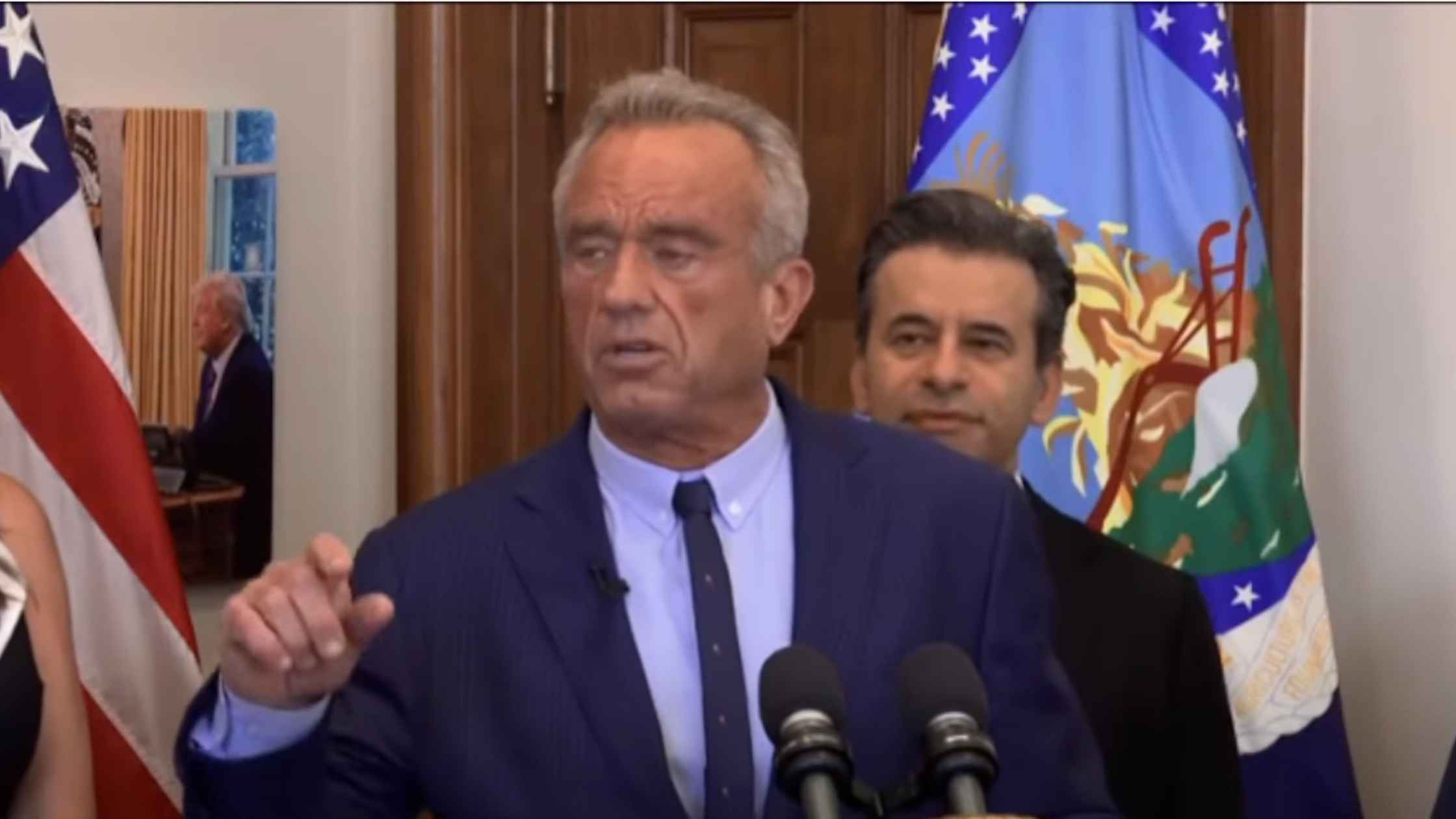
Get everybody in. All right. Well, first of all, welcome for many of you back to the USDA for another round. You'll see the stack of snap waivers sitting on my desk that I will soon sign the extraordinary people standing behind me that have made today possible. We are so grateful for all of the interest. I think we've had 29 different media outlets that you all represent. They're today to hear what we're doing next, to hear about these signings, to hear about the extraordinary leadership and work out in the states with innovation and everything that this has meant. Specifically today, with Governor Morrisey from West Virginia over my left shoulder and Governor Kim Reynolds from Iowa over my right shoulder.
(07:04)
But there are many other governors out across the country that have just been such pioneers and such innovators. So you'll hear a little bit more about that today. We each have a couple of minutes of remarks just to give you a sense of how the press conference will go. Once the remarks are finished, we'll all move over to my desk where I will sign each of the six states waivers that we are announcing today. We'll then come back to the podium to take your questions. Hopefully we can get to everybody's questions, but if we can't, forgive us. We do have a tight timeline we're going to stick to because if you haven't noticed, there is a farmer's market going on across the street.
(07:40)
But Bobby and I, secretary Kennedy and I, and honestly all of us will be moving across the street to begin programming over there on our Make America Healthy Again Farmers Market day. So that's what the next hour or so will look like. But again, we're just so grateful you're all here. What a great day for our great American families and for the people of the six states that we are talking about and signing waivers for today. We are here at the start of the National Farmer's Market Week, and as I mentioned, right outside on the National Mall, is a terrific showcase of what American agriculture has to offer. The Great American Farmers Market reminds us that agriculture is at the heart of the solution to the problems that we face in our health in America today.
(08:27)
And that's why President Trump with his leadership, alongside Secretary Kennedy and I are working so closely to make America healthy again, alongside again, so many of our partners across the country. We also have the amazing Dr. Marty Makary here as well with FDA. But first, it is important to mention that before that wonderful wholesome food gets to our plates, our great farmers from seed to harvest work tirelessly for all of us. President Trump has already unleashed the American economy and boosted markets for our farmers and ranchers. As we know, the One Big Beautiful Bill made the largest tax cut in American history permanent, slashed the crippling death tax. Specifically 2 million small family farms are now shielded from the death tax, thanks to that bill, and increased reference prices for our farmers working on already such thin margins.
(09:22)
Every day we are getting new and better trade deals, including removing barriers to trade, getting our beef, for example, into Australia for the first time in 20 plus years, removing non tariff barriers in Mexico, the EU, and other places around the world, and cementing relationships with massive markets around the world. Thanks to President Trump, we have unprecedented trade wins with South Korea, the Philippines, Indonesia, Japan, and Vietnam. Alongside that, our own team here at USDA, a little lesser known, has secured additional trade wins for agriculture in South Africa, in Egypt, in Ethiopia, in Pakistan, in Nigeria, and Namibia. And there are more, just not named today.
(10:07)
We are lowering energy costs that affect every American at the pump and plays a huge role in overall consumer cost by unleashing American energy dominance and expanding access to mining and drilling here, part of the USDA plan. And of course, all of this is not possible if our farms are under threat. Farm security policy is at the center of our national security strategy. In the Trump-Vance administration, foreign adversaries are no longer permitted to take advantage of our farmland farmers and programs paid for by American taxpayers. And so many of you covered that launch a couple of weeks ago, and we're really grateful for that.
(10:44)
We are ensuring that government works better and more efficiently by cutting waste, fraud, and abuse in our programs at USDA. And as again, many of you have covered, our announcement last week of moving the heart of the leadership at USDA out into the country and out of Washington D.C. This is all about right-sizing government to improve our programs for the people that we serve. However, and the reason we're here today, we are at a point where we must do something to correct the chronic health problems that all Americans face. Over 75% of Americans youth between the ages of 17 and 24 are ineligible for military service because of obesity, poor physical fitness, or mental health challenges. Think about that. 75%.
(11:32)
Over 350,000 American children have been diagnosed with diabetes. As MAHA moms, and I consider myself one as the mom of four teenagers, as MAHA moms across the country know behind these statistics are mothers and fathers and sons and daughters, and neighbors and co-workers. President Trump and our cabinet are doing things a little differently than the typical Washington D.C. Since my confirmation, our department has encouraged states to think
Sec. Brooke Rollins (12:00):
… differently and creatively about how to solve the many health issues facing Americans. One way is by not allowing taxpayer-funded benefits to be used to purchase unhealthy items like soda, candy, and other junk food. The number one purchase by SNAP recipients is sugary drinks. SNAP is a supplemental nutrition program, meant to provide health food benefits to low-income families to supplement their grocery budget, so they can afford the nutritious food essential to health and well-being. That is the stated purpose of the SNAP program. The law states it, and President Trump's USDA plans to deliver on it, alongside our partners at HHS.
(12:43)
So today I'm proud to sign six more waivers for Florida, West Virginia, Oklahoma, Texas, Louisiana, and Colorado. This is in addition to the waivers we've already signed for Iowa, Indiana, and others across the country. I continue to encourage states to be laboratories of innovation, think through how you can promote healthy families and healthy communities.
(13:09)
And because of our historic partnership, USDA and HHS, and the visionary leadership of the governors here with us today and of the states represented by the signings, we are doing something about it. These SNAP waivers are just one piece of the MAHA effort. We work so closely together to encourage voluntary commitments to remove artificial food dyes, among other things, from our food supply. And together, we are crafting sensical dietary guidelines for Americans, that prioritize whole, healthy and nutritious foods.
(13:42)
I am so proud to stand with Secretary Kennedy, Governor Morrisey, Governor Reynolds, FDA Commissioner Marty Makary, and so many others, as we work to make America healthy again. Secretary Kennedy is the face of the MAHA movement, and a relentless warrior for health policy that puts the American people first. It's such a privilege to stand with my friend and my partner, and the leader of it all, Secretary Kennedy.
Sec. RF Kennedy Jr. (14:14):
Thank you. I've said again and again publicly that Secretary Rollins is the best USDA secretary in history. And the reason for that is, up until this point, that every USDA secretary has focused on food quantity. This is the first USDA secretary who is focused on food quality, on nutrient-dense food, on food that is actually going to increase the health of the American people at a time when we are in a chronic disease crisis. Her changes to the SNAP program are emblematic of that commitment of the SNAP. SNAP, we're spending $405 million a day on SNAP, and about 10% is going to sugary drinks. And if you add candies to that, it's about 13 to 17%.
(15:17)
And we all believe in free choice. We live in a democracy. People can make their own choice about what they're going to buy and what they're not going to buy. If you want to buy a sugary soda, you ought to be able to do that, but the US taxpayer should not pay for it. The US taxpayer should not be paying to feed kids foods, the poorest kids in our country, with foods that give them diabetes. And then my agency ends up through Medicaid and Medicare paying for those injuries. No, we're going to put an end to that and we're doing it step-by-step, state by state.
(15:59)
I'm also working with Secretary Rollins on the dietary guidelines, which should come out next month. The dietary work, they're coming out, I think it's at the end of September, three months ahead of schedule. And the dietary guidelines that we inherited from the Biden administration were 453 pages long. They were driven by the same commercial impulses that put Froot Loops at the top of the food pyramid, and they were incomprehensible. And we are going to release dietary guidelines that are four or five or six pages long, that are understandable, that are simple and will allow people to make good choice about their food.
(16:43)
They will drive changes in the school lunch program, in prison lunches, in military food, and they will begin to change America almost immediately. We're also working on the release of the MAHA report. We're working, Brooke especially, has been adamant about the issue that we need to keep farmers as partners in the MAHA movement if we're going to have nutrient-dense food. And that is what we care about. We've had over 138 meetings with farmers to understand their concerns, to learn from them, and to understand how we can help them to transition towards more and more nutrient-dense food. I also want to thank President Trump for the Big Beautiful Bill. If we're going to save the American farmers, we need to save rural America right now. Medicaid gives about 7% of its funds to rural hospitals. 7%. It's about $20 million a year, $20 billion a year. We are now going to add through the Rural Transformation Bill, we're going to add another 50 billion over five years. So 10 billion a year that's going to be distributed to the states, to rural areas. And that is going to add about a third of the money that they now receive from Medicaid, and it will transform them. And it will allow these institutions, which are so critical to the economies, to the culture, to the health of rural life, it will allow them to flourish.
(18:25)
And the president understands the American farmer. He did more during his first term to save American farmers than any other president, and we are going to continue that tradition. So thank you very much for your leadership, Secretary Rollins.
Sec. Brooke Rollins (18:40):
Thank you, Bobby. Thank you, Secretary Kennedy. It's just such an honor to continue to partner with you. One of the key partners in the effort, within the first hour of being sworn in on February 13th, earlier this year, we sent a letter to every governor in America, Republican and Democrat, and said, " The founders' vision of the laboratories of democracy have never been more important. And what I challenge you to do is think outside the box and how we can partner with you, but want you to lead the way in solving some of these crises, especially regarding things like food stamps and chronic health disease from the agriculture perspective."
(19:18)
And the governor that perhaps stood up very first in all of that was our great governor from Iowa. So I will always be grateful for her friendship and for her support. And I think this coming Saturday, I'm going to be even more grateful when I beat her at the Celebrity Steer Show at the Iowa State Fair, when hopefully a buckle is involved. But Governor Reynolds, what a great, great time to have you here.
Gov. Reynolds (19:46):
Well, a buckle is involved and we can't wait to have you to the Iowa State Fair, but I take that challenge and we'll see who comes out on top. We can't wait to have you back in Iowa, so thank you very much for that. And thank you, Brooke, for that kind introduction. I appreciate it very much and appreciate both you and Secretary Kennedy. Thank you for the opportunity to speak today and really for enabling Iowa to help lead the nation in SNAP reform.
(20:10)
We have spent the last several years realigning our state government with common sense goals and priorities. And we've taken the same approach with SNAP and nutrition in our state. While the USDA, as you heard, clearly states that the purpose of SNAP is to support the health and well-being of low income families, the reality is often the opposite. As you heard, 20% of all SNAP dollars are spent on sweet drinks, desserts, salty snacks and sugar, with sweetened beverages the second-highest purchase. And this truly isn't helping low income families. In fact, it's hurting them. And Iowans are seeing the impact of that. 37% of our adults and 17% of our youth, ages 6 through 17, are suffering from obesity. And that's something that, as a governor of this great state, I can't accept. And it's why that we've really begun to strategically reform our efforts to help address food insecurity and nutrition.
(21:11)
Iowa was one of 12 states that opted not to participate in the Biden administration's SUN Bucks program over the summer to help feed our school-aged children. Instead, we submitted a waiver to address our unique needs in Iowa, and to have a health and nutrition focus. And I'm sorry to say that that waiver was denied. And when you contrast that to the Trump administration and Secretary Rollins' approach of innovative solutions, we again re-submitted that waiver to USDA and I'm proud to say that in June we launched Healthy Kids Iowa.
(21:48)
So we leverage… I'll tell you just a little bit about that real quick and then talk about our SNAP waiver as well… We're leveraging existing food banks to purchase and distribute monthly food boxes to our meal site partners. Over 264 pantry sites, where they're in all 99 of Iowa counties. We utilize schools and churches and non-profits to provide our eligible families with healthy and kid-friendly nutritious food. The monthly boxes contain $40 of nutritious food per child for those that qualify. And in the first month alone, we served over 35 children and the program will run from June to August.
(22:26)
Food banks, some of the food banks that weighed in and our partners in this effort, said that they can actually buy up to six times more food than a person using that SUN Bucks program at retail prices. And it really was that experience that positioned Iowa to be the first state in the country to submit a waiver to pilot a healthy SNAP initiative.
(22:49)
So starting January 1, SNAP dollars in Iowa can only be used to purchase non-taxable food items, eliminating soft drinks, candy and other taxable foods and beverages as eligible SNAP purchases. And by using Iowa's sales tax exemption, it was an approach that our retail partners have really praised as simple and a practical way to ensure that SNAP purchases are healthier. More importantly, I think these changes really empower families to take charge of their health and to achieve SNAP's foundational goals of meeting their traditional needs. So once again, I just want to say thank you to Secretary Rollins and her team for making these initiatives possible. They've been incredible partners throughout the process. And Secretary Kennedy, we're looking at what we can do this next legislative session to adopt some of the MAHA [inaudible 00:23:44] policies as well. So I really appreciate the flexibility and the innovative approach that they've encouraged and allowed us to take, so thank you.
Sec. Brooke Rollins (23:53):
Thank you. Thank you, thank you. Thank you. And I can't [inaudible 00:23:59] look forward to, and
Sec. Brooke Rollins (24:00):
… and Bobby said, "Wait, what are you doing Saturday?" I said, "It's a steer show. We're going to be showing 1,200 pound animals at the Iowa State Fair, so just to clarify, stay tuned.
(24:12)
Next, Governor Patrick Morrisey of West Virginia. No greater warrior. Really, I think Secretary Kennedy, it was one of his first visits, was to visit you to talk about this in West Virginia. As the former Attorney General of West Virginia, watching you fight for the people of your state has been very inspiring. Congratulations today, you're one of the states that we're signing and we're just so grateful for your leadership.
Patrick Morrisey (24:32):
Thank you so much.
Sec. Brooke Rollins (24:32):
Governor Morrisey.
Patrick Morrisey (24:32):
I really appreciate it.
Sec. Brooke Rollins (24:35):
Thank you.
Patrick Morrisey (24:35):
Oh, sorry.
(24:38)
Well, thank you very much, Secretary Rollins, and it's wonderful to be here today. What a beautiful building to be at the Department of Agriculture. It's an incredible place, and I think everyone up here on the stage, Secretary Kennedy, Governor Reynolds, she's been a real leader among the governors for a long time. Commissioner Makary, they're doing a lot of great work and work that's long overdue.
(25:03)
I know that the collective group here, their leadership and their commitment to making America healthy again, I think it's already making a huge difference in our country, and I'd also like to make sure we thank the person responsible for it all. President Trump has picked really good people within his cabinet and these agency heads, and he's given them the ability to enact fundamental change that really helped make America reach her potential. It's inspiring and I'm glad to be a part of it.
(25:35)
Now, there's no way around it when it comes to West Virginia. Unfortunately, we're ranked at or near the bottom of a lot of the tough public health metrics. We lead the country … we're near-leading in the country in obesity, in diabetes, and a lot of the chronic conditions that have really been disabling our people. Usually at the top of the list for more people who are disabled in our state than virtually any other. Our kids, they're diagnosed with ADHD at rates that are well above the national average and we have one of the lowest life expectancy rates in the United States.
(26:14)
Now, that's the bad news, and I believe in telling the truth to the American people about where we are, because that's going to make the rise all the more better when West Virginia is able to reach her potential and to get healthy again. The good news today is that we all have the power to change it. And I think the people on stage here today, the wonderful staffs who are working at the federal level and the state level to make that happen, I think you're going to start to see some needle movement in all these categories.
(26:46)
You see, I want all West Virginians to have happy, long, healthy, and purposeful lives, spending time with friends and family and doing things that matter. Earlier this year, alongside Secretary Kennedy in Martinsburg, I signed legislation making West Virginia the first state in the country to restrict the number of the artificial dyes in the schools. We need to clean up and get the crap out of the food and in West Virginia, we're taking the lead. That law has gone into effect. It's already started right now, and beginning this year, kids in West Virginia will no longer be exposed to these harmful dyes and chemicals at the schools, and there'll be more changes in the future. We're very proud of this achievement and we're happy to work with other states and school districts across the country to see additional changes that help people get healthier.
(27:44)
Now, during that visit in Martinsburg, we talked about a number of other pillars of health that my administration would focus on to benefit the health of West Virginians. Along with cleaning up the food, we're trying to promote fitness and making healthy food choices. I'm happy to report, Secretary Kennedy, that our Mountaineer Mile efforts, that's a statewide fitness challenge that we asked our citizens to be involved in, it's spreading all across West Virginia and there's a Mountaineer Mile in every one of our state parks and I could volunteer … I have followed through to do a Mountaineer Mile every single day since I met with you. I'm going to do a lot more of that.
(28:27)
Making sure that we're healthy, exercising is a core pillar, but there's more that we need to do and that's part of why we're here today. We know that the changes to the SNAP program, they're long overdue, and that's why I'm so happy to work with all of our federal partners to make sure that tax dollars is going toward nutritious foods. I'm always fond of saying that the SNAP, the N for SNAP, it stands for nutrition, but unfortunately, over a long period of time, that wasn't always the case, so I'm happy now, that in West Virginia, taxpayers are not going to be subsidizing soda and these sugary drinks, things that have no nutritional value and are directly linked to obesity, diabetes, and a lot of other terrible healthcare outcomes.
(29:19)
If a law says that a program is meant to help people get a more nutritional diet, then that's going to be the standard. That's what we're going to work on. So I'm happy to be here today and to celebrate the growth of the MAHA movement and all the amazing things that Secretary Rollins, Secretary Kennedy and the entire Trump administration is doing. They're aligning words with actions and we're not stopping here. In the future, we're not only going to be focusing on our food, I'm looking forward to working with Secretary Rollins on the work requirements. We have that for Medicaid and for SNAP, and I want to make sure that West Virginia is out in front on that. A state with one of the lowest, the lowest workforce participation rate in the nation, I want to get more people to work and I'm really excited to partner to make that happen.
(30:13)
This administration is making big things happen, and I'm eager to talk about it. So thank you for everyone and God bless our great country and the wonderful state of West Virginia.
Sec. Brooke Rollins (30:31):
And now as an honor, one of the country's greatest doctors, researchers, scientists, and now the leader of the Food and Drug Administration, Dr. Marty Makary.
Marty Makary (30:40):
Thank you so much. Thank you, Secretary Rollins. It's so great to be here. This is a historic day in the United States. This begins the end of the government subsidization of our obesity, diabetes, insulin-resistance epidemic. And it got pretty bad. Look at where we are today. 40% of our nation's kids now have a diagnosed chronic disease. 31% have diabetes, pre-diabetes or insulin resistance. We can't keep just talking about the price of insulin. We also have to talk about what we are feeding children.
(31:18)
We need amazing treatments, and this FDA is committed to delivering cures and meaningful treatments, but we have to talk about nutrients and fiber, not just Ozempic and other medications to medicate our nation. We're medicating our nation's kids at scale. And so this is a historic day in the United States, and Secretary Kennedy, you've been talking about this, gosh, for a long time. You've got me motivated and it's just amazing to work in your leadership here. I hear people all the time from all different political persuasions say, I'm not a Republican or Democrat or political, but I love the food stuff that they're doing.
(32:04)
And Secretary Rollins, you have been the perfect partner, and watching you and the secretary work together has been magical and it's just amazing, here we are, for the first time ever, not just talking about how to fund our broken healthcare system, but how to fix our broken healthcare system by finally getting at the root issue, and that is the health of the population starting with children. And so people say to me, I love some of this MAHA stuff, and what else are you doing to make America healthy again? Well, as Governor Morrissey just said, we're just getting started. We're now talking about ultra-processed foods. And Deputy Secretary Diamantis is here, has put out an RFI now, request for information, where we're going to have a consensus definition of ultra-processed foods, so we can help educate people in a meaningful way instead of misleading them with the broken food pyramid misinformation. We're rewriting those dietary guidelines with USDA and HHS. We're doing an inventory of all the chemicals in our food supply that are banned outside of the United States and asking, what are the most concerning chemicals here?
(33:23)
We are cleaning up infant formula. We took action to remove the nine petroleum-based food dyes. We are re-evaluating and addressing the broken GRAS standard. We are talking about medical devices now and how we can prioritize medical devices that empower people with good information about their own glycemic load. Most of the chronic diseases we see in medicine are really related to a couple basic principles, insulin resistance and general body inflammation, and what drives that sugar and junk food. We're not talking about complex carbohydrates and things that come out of the ground. We're talking about ultra-processed foods that drive up the glycemic index.
(34:13)
We're addressing the poisons in the US food supply. And today, with this amazing moment, for the first time in American history, talking about taxpayer funding of our chronic disease epidemic in children, addressing the SNAP program to restore it to its mission, to talk about the N in SNAP, which is nutrition, so I'm just so thankful to be a part of this historic day in America. It's been great to watch, especially with Governor Reynolds and Governor Morrissey. The great American experiment was that states would be the laboratory of innovation, and we're witnessing that right here today at this table, so thank you and I'm looking forward to it.
Sec. Brooke Rollins (34:57):
Thank you. Well done. Well done. All right, everybody, we are going to sign the waivers right now. We'll take some pictures on each of the states, then we'll come back and answer questions.
(35:15)
Governor Morrissey will do West Virginia first.
Patrick Morrisey (35:17):
Great.
Sec. Brooke Rollins (35:26):
All right. There's West Virginia.
Patrick Morrisey (35:28):
That's great. Thank you.
Sec. Brooke Rollins (35:33):
All right. You're so welcome.
(35:35)
Number two, we will do Governor Jared Polis's request approved of Colorado. Again, this is not red or blue, Republican or Democrat, we are discussing and working with every state, so really excited to continue to work with Governor Polis, Colorado.
(35:57)
Third on the list is Florida,
Sec. Brooke Rollins (36:00):
Governor Ron DeSantis, so grateful to Florida for continuing to be such a leader in so many things, including the SNAP waivers.
(36:13)
Number four, Louisiana, the wonderful Governor Jeff Landry, who was really hoping to be here today but couldn't make it, but here is Louisiana.
(36:26)
Number five, Governor Kevin Stitt of Oklahoma, another great friend of freedom and of real reform, Oklahoma.
(36:39)
And finally, no offense to anyone here, but the greatest state, Texas. Governor Greg Abbott and his wonderful team in Texas. Here, we have Texas.
(36:53)
Thank you, everybody. We'll head back to the podium and we will take some questions. Thank you. All right, first question. Yes, ma'am.
Cheyenne Haslett (37:04):
Hi, Cheyenne Haslett with ABC News. Food regulation, and more broadly in the States, but also the SNAP waivers, has historically been a policy approach taken on mostly by Democrats and criticized by Republicans as [inaudible 00:37:18]. Now, nearly 10 Republican states have passed MAHA legislation. Secretary, can you talk about how you have convinced Republican governors to take up this legislation.
Sec. RF Kennedy Jr. (37:30):
I was at the Governor's conference in Colorado last week and I met with a whole string of Democratic Governors, including Governor Polis, and they all committed to filing SNAP waivers and doing other MAHA legislation as well. I don't want to call it MAHA, because I think that's become kind of a partisan brand and I don't care what they call it. They want to protect their children and there's no such thing as Democratic children or Republican children. They're our children and we should all care about them.
(38:08)
And, you know, I don't care what party you're in. There's been more enthusiasm today from Republicans. You're right, traditionally it was a Democratic issue and I'm very, very hopeful that more and more Democrats will continue to be in their party, but sign up to protect their children.
Gov. Reynolds (38:34):
Secretary Rollins, thanks so much for doing this. And Skylar Woodhouse, with Bloomberg News. I just wanted to check in. The president released last week, a flurry of trade deals and the different rates and different countries. In the ag space, we're approaching harvest season. Crop prices, soy beans, they were down a little bit. I was just wondering if you could give an update on if you're still tracking, you know, farmer aid, how the administration is looking to protect farmers as we enter that harvest season, given that we're seeing these trade deals come to life.
Sec. Brooke Rollins (39:10):
No, I appreciate you saying that. Obviously, the first thing I think it's important to note is this President made a promise in February to realign the entire world economy around America and Americans first. As we are renegotiating trade deals around the world, historically on average American ag products are charged 15% on average as they move into other countries. We, in fact, charge on average 5% as their ag products moved into America. So obviously, that realigning and the idea of American, especially American farmers and ranchers, bowing to the altar of other country's tariff regimes and tariff structures ended when President Trump announced on Liberation Day.
(39:50)
But having said that and to your question, which is a very good one, the importance of understanding the uncertainty of what this means for our agriculture producers, especially for our row croppers. Some really great ones from Iowa, others from West Virginia across this country when they were already operating on such thin margins, barely making it day to day, month to month, year to year. We've lost almost 200,000 family farms in just the last four or five years. The cost of inputs went up 30% under the last administration.
(40:22)
Those margins are very precarious and what we have said, and what the president has committed to from day one, is that this opening of markets around the world is unprecedented. Ultimately, our agriculture community, our farmers and ranchers, are entering into a golden age of agriculture. But in this time of readjustment, there will be some uncertainty. So as we move into harvest season, the commitment remains that just as we've been saying for the last few months, that if in fact farmers are hurt in the short-term while we work for the long-term prosperity, that the USDA will be there to step in.
Marcia Brown (40:59):
Secretary Rollins?
Sec. Brooke Rollins (41:00):
Yes, ma'am.
Marcia Brown (41:00):
Marcia Brown with Politico. The MAHA report is due out later this month and a lot of MAHA advocates I've spoken to have said that they want to see this administration ban or limit pesticides. Will the MAHA report ban or limit pesticides, or make policy recommendations to do so?
Sec. Brooke Rollins (41:16):
I'll answer that, and then if Secretary Kennedy wants to lean in. There is no question that the use of crop protection tools remains one of the most important tools, if not the most important for our farmers to thrive and to, as I mentioned, to remain prosperous. There is no chance that our current system of agriculture can survive without those crop protection tools, including the fertilizers that you mentioned.
(41:41)
Having said that, and I don't want to put words in Secretary Kennedy's mouth, so I'll let him answer if he wants to add anything, the vision of moving America and supporting our farmers and ranchers and allowing, again, a golden age of agriculture, we will continue to work together. Secretary Kennedy mentioned he and his team have met with 130 different groups representing the farming and ranching industry. I have been with him on a lot of those. We visited a farm together in Texas. I have rarely seen anyone more open to understanding, and learning, and talking to.
(42:19)
And I've also heard him say that we can't compromise our farmers and their ability to feed and fuel and clothe the world. So I continue to look forward to working with him. The MAHA report, the second part's coming to conclusion. We'll have announcements on that soon, but I feel very confident that his and our commitment to make sure that farmers are at the table remains paramount and that the report will reflect that. I don't know. Secretary, if you want to add?
Sec. RF Kennedy Jr. (42:45):
Nothing to add.
Sec. Brooke Rollins (42:46):
Okay, perfect. Thank you. Yes ma'am?
Alison Snyder (42:48):
Thank you so much. Alison Snyder for [inaudible 00:42:51]. It's been reported that Susie Wiles and Laura Loomer convinced President Trump to fire Drug Evaluation and Research Director, Vinay Prasad. This was over your Secretary Kennedy and Governor Kerry's commission. It seems as though he was restoring Gold Star Science and really improving drug and vaccine review. Do you think this is going to be a detriment to MAHA and everything you guys are working to accomplish? And how can we be reassured that the new person incoming is not a lapdog for big pharma?
Marty (43:24):
First of all, the idea that he was pushed out by anybody is simply untrue. He saw some media headlines and didn't want to be a distraction. We have encouraged him to reconsider and we're still doing that and I'm confident the FDA is going to continue to be strong. The FDA is one of the greatest brands in the world and it's going to continue to do that.
Luke Zarzecki (43:51):
Secretary Kennedy, Luke Zarzecki with Inside Health Policy. Your proposed administration for Healthy America was not in the HHS Senate Appropriations Committee's funding bill, and I'm curious why that was.
Sec. RF Kennedy Jr. (44:10):
Is this the reorg?
Luke Zarzecki (44:11):
Yeah.
Sec. RF Kennedy Jr. (44:15):
Right now, we were held up by a court order on the reorg, but we are going through with the reorg.
Luke Zarzecki (44:18):
Oh.
Sec. RF Kennedy Jr. (44:25):
Whether it was in the… I'm not sure what the funding is for this Senate bill, but we are going through with the reorg.
Luke Zarzecki (44:31):
Do you plan to get some MAHA priorities in that administration passed, or are you working on that?
Sec. RF Kennedy Jr. (44:37):
I think we have full support from the president. He wants this done. He promised to make America healthy again and he's going to do that. He calls me three or four times a week and says, "Where are you? Why aren't people healthier yet?"
Sec. Brooke Rollins (44:50):
That's true, that's true.
Sec. RF Kennedy Jr. (44:50):
He's keeping me under pressure.
Speaker 1 (44:50):
We have time for one more question.
Grace Moon (45:04):
Secretary Kennedy, Grace Moon, I'm with the Washington Post. The Wall Street Journal reported that you're planning to dismiss all 16 members of the US Preventive Task Force. Is that the case? And if so, what is your reasoning?
Sec. RF Kennedy Jr. (45:16):
We have not made a decision. We're reviewing that now. The task force has done very little over the past five years and we want to make sure that it is performing, that it is approving interventions that are actually going to prevent the health decline of the American public, and it hasn't. Let me put it this way, it hasn't been stellar at doing that job. We're looking at the personnel and we're making a decision now, but no decision has been made.
Speaker 1 (45:52):
Okay, thanks press.
Sec. Brooke Rollins (45:53):
Thank you, all. We're headed to the farmer's market, so y'all go buy some beef and dairy and produce. That'll be great. Right across the street. Thank y'all for coming.
Grace Moon (46:01):
Thank you.
Speaker 2 (46:02):
Nice to see you, Brooke.
Sec. Brooke Rollins (46:02):
Thank you. Are you coming to… Yeah, yeah, yeah. Oh, you're welcome. Thank you. Thank you, thank you.
Marty (46:05):
Great job.
Sec. Brooke Rollins (46:05):
Thank you, Marty.