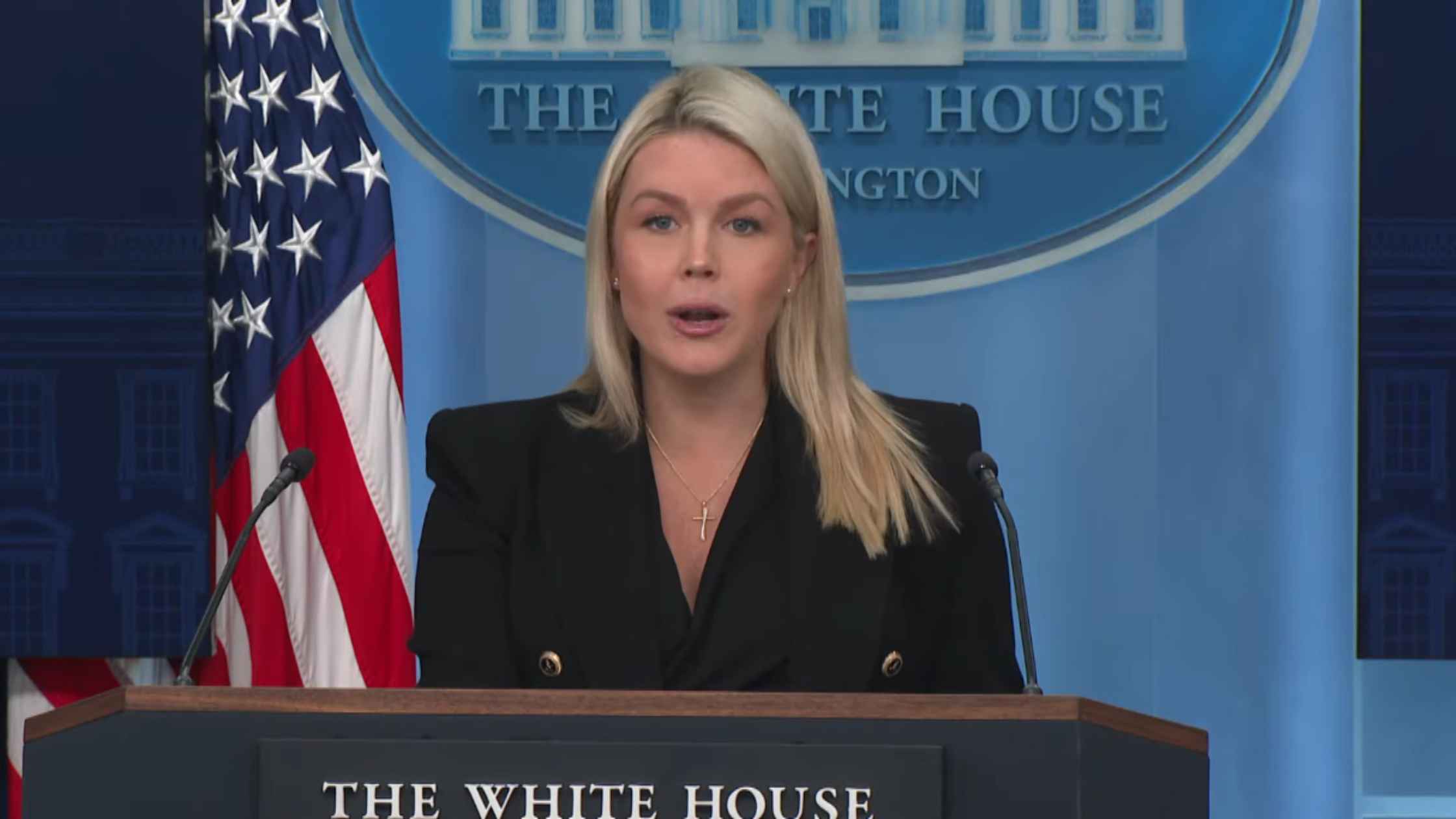

Secretary Rollins (00:00):
... over to our great as of day, what, 67 on the job at the General Services Administration leader, who's right here to my right, Senator Joni Ernst, who's been such a warrior on this for years now, and of course our great Deputy Secretary Stephen Vaden, who has led the effort that leads us to today on reorganization. Just a couple of quick points at the top. I want to talk just for a second about the State of the Union. Last night, the president was very clear in making sure that America understands that the battle, that the fight, that the work that goes seven days a week, 24 hours a day as we fight for America will continue. And what has been able to be achieved so far is really just the beginning, with so much more progress ahead of us.
(00:49)
I want to make sure, as we talk about USDA today at the US Department of Agriculture, that I note that this has truly been the great privilege of my life to lead this incredible team. I know several of you or many of you are here today from the political side, but also the incredible career employees at USDA that we've worked with over the last year. I'm so grateful to all of you. Of course, the United States Department of Agriculture was coined the People's Department by President Abraham Lincoln when he founded this department back in 1862, and it is under his vision that we continue that fight to make sure that we never forget that it is the people of America that we serve every single day, making sure that these incredible patriots receive the very best possible services, and giving all Americans confidence in their tax dollars, that their tax dollars are being spent wisely. That is one of our key purposes at USDA, and it is what brings us together today.
(01:49)
During the last administration, USDA's workforce grew by 8%, and our employees' salaries shot up close to 15%. This included hiring thousands of employees with no realistic way to pay them and without any tangible increase in service to USDA's core constituencies. In short, paying more people using taxpayer dollars to do the same amount of work just wasn't and isn't sustainable. That's why back in July, we announced the reorganization of the US Department of Agriculture, refocusing our core operations to better align with our founding mission of supporting American farming, ranching, and forestry. This reorganization is supported by four key pillars. First, ensuring the size of the USDA workforce aligns with available financial resources and agricultural priorities. Second, bringing USDA closer to our customers around the country. Third, eliminating management layers and bureaucracy, and fourth, consolidating redundant support functions.
(03:03)
In the past six months, we have made good progress in carrying out these goals, and today, I'm excited to announce that we are taking the next step to rightsize our federal real estate footprint to root out waste, to better align our workforce to meet operational needs, and to deliver the very best Department of Agriculture to the American people. Behind me, along this entire city block in bricks and mortar is what government that has grown too big, too bloated, and too disconnected from its citizens, looks like. At one time, the South Building was all the beating heart of USDA, alive with research and teeming with activity decades ago, but today, it is a former shell of what it once was, and yet another reason for Americans to wonder just exactly who their government is serving.
(04:01)
If you were to walk in the South Building today, here's what you would find: empty office after empty office after empty office. On any given day, more than 70% of the seats in this building sit empty. Taxpayers foot the bill for these empty offices, all while deferred maintenance costs continue to add up and up and up, now mounting well over 1 billion, with a B, $1 billion and counting on this building alone. The bottom line is that taxpayers are getting shortchanged. But under the leadership of President Trump and our great friends up on the Hill, who they all know a thing or two, especially the president, about managing real estate, that all changes starting today, because today, we are officially starting the process of turning the South Building back over to the General Services Administration, which exists to manage and support the federal agencies with our highest level of efficiency.
(05:03)
But let me be clear. We are firing on all cylinders here. We are being strong stewards of taxpayer dollars, while also ensuring top-notch customer service and fulfilling our promises to America. We can and will do both. On Monday, we opened applications for our Farmer Bridge Assistance Program, providing $11 billion in targeted support. We've administered over 25 different disaster block grants with states and processors. We've worked with Secretary Chavez-DeRemer to lower the H-2A adverse-effect wage rate at lightning speed, saving farmers $2 billion in labor costs annually.
(05:42)
We've established over 15 new trade deals as trade exports continue to increase, and we are meeting our deadlines for implementing the One Big Beautiful Bill. And last month, producers across the country were able to begin signing up for more affordable and robust coverage under the enhanced programs. Our farmers are some of the hardest working Americans out there. They deserve capable and well-run government that is every bit as good as they are. Now I'd like to invite our incredible GSA Administrator Forst to share a few words. Then we'll turn it over to Senator Ernst, Deputy Secretary Vaden, and then we'll take questions. Thank you again.
Edward Forst (06:24):
Thank you, Secretary. Thank you, Secretary. It's great to see everybody here. Usually, when you're in the seats, you think you have the prime real estate, but the people standing in the sun, I think they're enjoying this beautiful day just a little bit more. Good afternoon, everybody. And it is an honor to be here today with Secretary Rollins, Deputy Secretary Vaden, and of course Senator Ernst. Thank you. Today, we jointly announce a significant step forward in the Trump administration's commitment to the responsible stewardship of taxpayer dollars and common sense approach to the federal government. The president has set a bold agenda to shrink the federal real estate footprint and transform what was once a fiscal drain of empty space into an engine of economic opportunity. And this is GSA's mission.
(07:11)
We applaud Secretary Rollins, Deputy Secretary Vaden, and all of the USDA leadership for empowering their workforce and their commitment to recalibrate their footprint. I also want to thank Senator Ernst for her incredible support and her longstanding work to highlight government inefficiencies, to eliminate unnecessary regulatory hurdles, and to fast-track the sale of buildings. She was ahead of many on the issue, and I am really eager to work with her on this and so many other opportunities. The re-envisioning of this building, Ag South, is not just about selling a building, it's about being a catalyst for the economic prosperity of Southwest DC for generations to come. And great stewardship means not clinging to assets that no longer serve the government.
(08:04)
American taxpayers are currently carrying this building, which is about 80% vacant. This disposition actually removes $1.6 billion in delinquent maintenance. It is the largest liability of all GSA buildings. It eliminates our risk, it increases USDA space utilization, and they're going to go in the capital region to almost 80%, which is well above the USE IT data and where we need to be. USDA has developed a comprehensive strategy to better empower its workforce to ensure that they have the resources and the environment they need to deliver on their crucial mission. Their plan to dispose of unnecessary and excessive space aligns perfectly with the president and the administration to scale federal real estate for the needs of tomorrow, not just today, and surely not just yesterday.
(09:01)
We're thrilled to partner on this project, and we look forward to working with the secretary, the Deputy Secretary, Senator Ernst, and the entire USDA team. The work we're doing now is a great example of how we're putting our principles in action. We advance fiscal responsibility, we reinvigorate our real estate portfolio, and we ensure the strategic use of federal headquartered buildings to come. Thank you very much.
Senator Ernst (09:27):
Well said. Why don't you just stay up here and hold that for me? Okay. All right. Yeah, I can juggle this, so I really appreciate it. I want to... Oh, thank you. Oh, Deputy Secretary. He can do more than one thing. Okay. Well, I am really, really proud to be here and help announce years of work resulting in the sale of the Ag South Building. And to that, I want to say thank you so much to Secretary Rollins and to the deputy secretary and to our administrator, Ed Forst, for being part of this initiative. And I love the fact that this is the People's Department. I am the daughter of an Iowa farmer. I am from a farm family, and it's so good to know that, both at the Department of Agriculture and at our GSA, that you are representing people in Middle America. So God bless you for that.
(10:37)
So the previous administration's USDA denied their ghost town, but Secretary Rollins took action on this. She tracked down the utilization numbers and ensured that taxpayer dollars and space are being used wisely. Even after President Trump's return to work order, which was right at the beginning of this administration, and the USDA doubling down on the number of employees in the office, nearly two-thirds of this space is still unused. And now, folks, it will be officially for sale. So we have one federal government building down, with 1.6 billion in repairs and millions a year in operating expenses saved. We've got many, many more of these federal government unused buildings yet to go. So next, let's just keep on draining the swamp. Oh, and, Secretary Rollins, moving our federal workers closer to the people that they represent. And I would say that the great state of Iowa is a good place to start. So thank you all so much for turning out. We really appreciate the support. Thank you. Thanks, Deputy Secretary.
Deputy Secretary Vaden (12:10):
My pleasure. Well, it's wonderful to be here today to accomplish something that should have been done long ago. This building, as has been noted by multiple speakers, is approaching 80% vacant, all while having a backlog of maintenance of more than $1 billion. We are following the law that Senator Ernst and her colleagues in Congress passed when they passed the USE IT Act, requiring that for every federally owned or leased space, the minimum acceptable occupancy rate must be 60%. That's an incredibly low bar. No private sector enterprise in the country would have 40% of its real estate footprint vacant. And yet, that is all Congress has asked of us, and every building USDA has in the National Capital Region currently fails to meet that 60% framework. We have no greater responsibility than to steward taxpayer dollars like they were our own, and we're doing that today by shrinking our footprint to fit our actual need.
(13:14)
And I have good news for you, Senator. This isn't the only building that we're turning back over to GSA today. We have a facility in Alexandria, Virginia that currently houses our Food and Nutrition Service. It is leased space. It has been the subject of employee complaints for years regarding the landlord's lack of upkeep of that building, the private sector landlord. I visited it myself just before Christmas to attend their Christmas party with the Food and Nutrition Service. I couldn't use the elevators. They were blocked off by caution tape, which is an everyday headache that details what our employees are being asked to deal with. We are returning that leased space to the General Services Administration as well, and we will be moving those employees to much better offices, where the elevators work, here in Washington, DC, starting in our Yates Building, which currently houses the Forest Service, as well as the George Washington Carver Center.
(14:14)
We picked FNS to be the first of our reorganization announcements, because our employees told us that they didn't like the working conditions. They needed to be better. They've complained to Politico. They complained to the Hill. Occasionally, they even talked to us, and we listened. And so they will now have office space that is worthy of the important mission on behalf of the government that they carry out. And we are looking forward to further aligning USDA's footprints with the goals the president has set out through his President's Management Council to see to it that we are spending dollars only where necessary. And as you may have noticed, there's not a lot of rural around here. So we're getting the employees of the Department of Agriculture closer to the farmers and residents of rural America that they serve, so we can serve them better and serve the taxpayer better.
(15:10)
It's an honor to work under Secretary Rollins, who has the bravery to continue what the president started in term one, when we relocated the ERS and NIFA agencies, and I'm excited to be part of a team that's here to get the job done. Thank you very much.
Secretary Rollins (15:26):
Great job, Stephen. All right. We'll take any questions from the press. Yes, sir.
(15:52)
I'll let you answer that. Yeah, we'll take that.
Edward Forst (16:04):
Okay. Why don't I take the first part of that, if that's okay? And the question for folks couldn't hear it is, with GSA now being engaged in this project, what happens with the building? And at this point, we launch a process. And that involves consulting with very many different stakeholders here. We are committed to economic prosperity for DC. That's one of our initiatives. We also talked to the private sector and others about the best-case use and how we also deliver the best results for the American taxpayers. So it is a long... It's a comprehensive process. We want to be good listeners, and then we'll execute on this.
Deputy Secretary Vaden (16:41):
With regard to the question about the employees located in this building, we've got a total of eight mission areas. I've already shared with you that we will be moving our Food and Nutrition Service employees in a local move from their current facility in Alexandria, Virginia, which we're turning back over to the GSA as well, to here in Washington, DC. We'll be making mission area by mission area announcement in the weeks ahead for where each of our remaining seven mission areas and their employees will be going, and so that we will work to empty this building by the end of the year and have them in our new hub and other locations throughout the country.
Secretary Rollins (17:22):
Yes, sir. And would you announce your name and who you're with? The heating and water? Good. Yeah, I'll let Stephen jump into that, but I do think it's an important point to understate again, or it can't be overstated enough, that there's 1.6 billion in deferred maintenance on this building that just to run it is tens and tens of millions of dollars every year just to keep the lights on, keep the heat going, keep the air conditioning on. And these are things, again, that is a very empty building. I wish I could walk everyone through the hallways. The first time I walked through about a year ago, I was stunned. It has been here for 50 or 60 years. At one point, it was the largest office building in the world, I think almost 7,000 offices in this building, but it is pretty much sitting empty today while it's draining all of those resources. But yes, Stephen, I'll let you answer specific questions.
Deputy Secretary Vaden (18:27):
So while this is the first public announcement of what we've been doing, we have not been resting on our laurels after the secretary issued her reorganization memorandum. For the past year, we've been working with our good partners at the GSA, and we already have well under plan how we are going to de-link these buildings so that the Whitten Building, which will continue on as part of the USDA footprint, will be able to operate independently from the South Building as GSA prepares to de-requisition it and see to it that it has a bright future ahead.
Secretary Rollins (19:02):
Yes.
Edward Forst (19:19):
I will take that. We'll take your bid if you've got one, okay? So please step forward.
Senator Ernst (19:23):
[inaudible 00:19:24].
Edward Forst (19:25):
There is a box of interest over here, so drop your bids in. The answer is we're just beginning the process right now. And yes, this building, as it is, has $1.6 billion of what we call delinquent maintenance, because it's gone on too long. It's more than deferred, it's delinquent. And we'll work with potential buyers on what they could repurpose this site for in its form or in some revised and renewed form. So I think that's a process of discovery right now. We're not going to take forever to do it. We're going to approach this with urgency and importance and get it done, but I think there's a lot of people who are sophisticated real estate who can see the promise of this particular building. Thanks.
Senator Ernst (20:03):
[inaudible 00:20:04].
Secretary Rollins (20:07):
That's true. A building across the street has a great example of what could happen. Last question. Yes, sir. And please introduce yourself.
(20:32)
Do the first one, yeah.
Edward Forst (20:34):
Okay, okay. Thanks for the question. As I said, we're at the very preliminary stage right now, so I don't want to commit to a timeframe, other than I have two years and 10 months left in this job, and we're going to get a lot done in that timeframe, okay?
Secretary Rollins (20:48):
Yeah, thank you.
Deputy Secretary Vaden (20:49):
With regard to the greater USDA reorganization, we've said before, and I'll say again, we'll have it done by the conclusion of this calendar year. And we're taking our employees into account. We know many of them have school-aged children. We want them to make them move to our new hub locations across the country. So as part of that, we're planning to go through all the legal and union and other regulatory steps that we need to take to do so lawfully and give the proper notice. But our goal is to have our employees complete the school year here in Washington, DC and be in place in their new hub locations at the time school starts in those new hub locations, so that their children can start the new school year with their new classmates on day one, like all of their other soon to be new friends.
Senator Ernst (21:37):
In Iowa.
Secretary Rollins (21:37):
Joni says in Iowa. All right, everybody, thank you all so much. Thanks for being here. The work will continue. We'll keep you up to date. Thank you, press, for coming today. Thanks.