Speaker 1 (00:08):
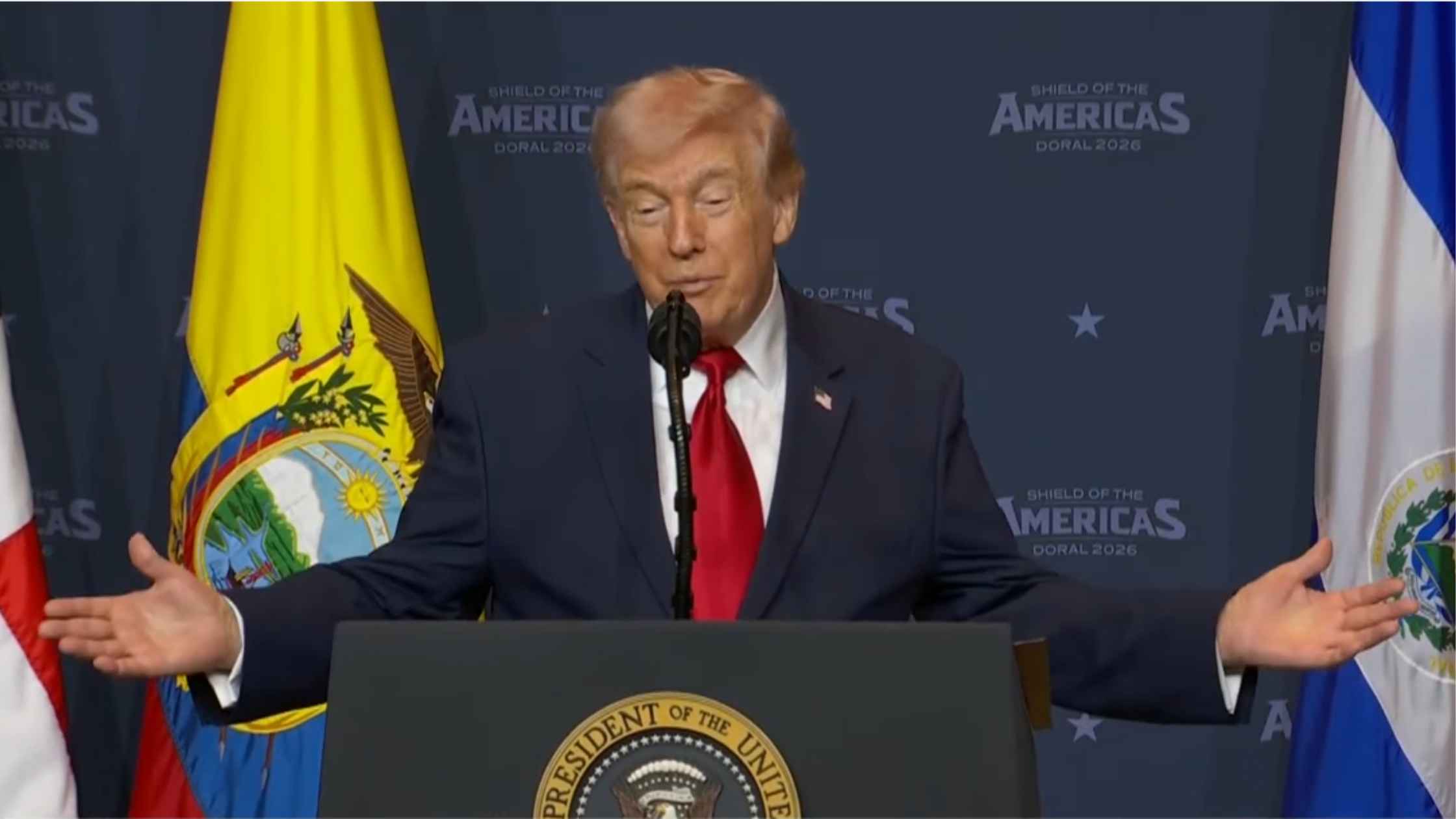
Ladies and gentlemen, the 45th and 47th President of the United States, Donald J. Trump.
Donald Trump (00:36):
Well, thank you very much. It's been a pretty wild time, but it's going very well. Sit down, please. And tremendous progress has been made, as you're probably seeing just by watching. We're doing something. I built the military and rebuilt it and made it really strong in my first administration, along with a lot of other things we did, we had a great first term. And now we're using it. Unfortunately, we have to, but you're seeing how great it is. There's no military like it on Earth, not even close.
(01:11)
And we're doing very well in Iran, you see the result. And it's been amazing. We've knocked out 42 Navy ships, some of them very large, in three days. That was the end of the Navy. We knocked out their Air Force, we knocked out there communications and all telecommunications is gone. I don't know how they communicate, but I guess they will figure something out. It's not working out too well.
(01:42)
And they're bad people. They're just bad people. When you look at October 7th and beyond October 7th, look at all the killing that they've done over the years for 47 years. And this had to be done. They were very close to a nuclear weapon. They would have had one if we didn't do our B2 hit Midnight Hammer. They would have had it eight months ago. They would have had a nuclear weapon and they're crazy and they would have used it, so we did the world a favor.
(02:16)
And they said, "Well, how are you doing on a scale of zero to 10? How are you doing with the attack?" And I said, "About a 15, I would say," with 10 being the best. But it's something that had to be done and we're doing it well. And I want to thank everybody involved.
(02:35)
I'll be going, right after this, I'll be leaving for Dover, very sad situation, to greet the families of the heroes coming home from Iran, coming home in a different manner than they thought they'd be coming home. But they're great heroes in our country, and we're going to keep it that way. When it comes to war, there's always that, but we're going to keep it to a minimum, I think, Pete, and going to be something, a service that we're really providing, not for the Middle East, but for the world. These were sick people, very sick people.
(03:18)
This morning, I'm honored to welcome distinguished heads of state from across the Western hemisphere for the first Shield of the America's Summit. And it's something very, very special. Marco's been working on it very hard, so have a lot of other people, because it's a very important place for us. It's nice to be home. It's very, very important. We go all over the world, 9,000 miles away, 12,000 miles away. I said, "How long is this flight?" "Sir, "This flight is 19 hours." I said, "Oh, that's great." I said, "Now I have flights that last for two hours. I like that better." Much better.
(04:02)
But on this historic day, we come together to announce a brand new military coalition to eradicate the criminal cartels plaguing our region. And you have a lot of it. One of the things when we were talking backstage, you were telling me the crime, the cartels, and we're knocking the hell out of them where we can. We're going to go heavier. So what we were doing with the boats coming in, the boats, there's not a lot of people coming in by boats anymore. We knocked down drugs coming in by sea. Drugs coming in through water is down 96%. We're trying to find out who the other 4% are because I think they're the bravest people in the world. Either that or they don't watch television. They're either very brave or they're not watching.
(04:50)
But we're calling this military partnership the America's Counter Cartel Coalition, and that's what you need. You have cartels. They seem to grow in this region unbelievably, rapidly, has to do with drugs, largely. Earlier this week here in Miami, Secretary of War Pete Hegseth, who's right here. Pete, you are fantastic. Doing a great job, we're proud of you. And representatives of 17 different nations formally entered this new alliance. The heart of our agreement is a commitment to using lethal military force to destroy the sinister cartels and terrorist networks once and for all. We'll get rid of them. We need your help. You have to just tell us where they are. We have amazing weaponry, as you probably noticed over the last short period of time.
(05:45)
But I want to thank members of the coalition, most of whom are friends of mine. Few of them I just met, but most of whom are friends, many of whom I endorsed. And they took that endorsement and they went on to win big. I haven't had a bad endorsement yet, right?
Audience (06:00):
Yeah.
Donald Trump (06:00):
He says yes. He was happy. He was a couple of points down and went up like a rocket ship, right? In Argentina. But the president of Argentina is here. Javier Milei, thank you very much. Thank you very much for being here.
(06:16)
President of El Salvador, another friend, Nayib Bukele. He is a man who we've gotten very close to. I saw him as a young man my first time. You were young and handsome. Now you're older and handsome. You're older and handsome. But he runs a good operation. That's all I care about, right? When I first saw him, I said, "He's too young." And then I saw the job he did, I said, "Well, I guess he's not too young." Because I was young and did well. But you've been a great president and we appreciate the relationship very much.
(06:54)
President of Paraguay, Santiago Pena. Thank you very much. Thank you very much.
(07:02)
President of Ecuador, Danielle Noboa. Danielle, thank you. Thank you, Danielle.
(07:09)
President of Panama. I love that canal. Jose, I think he made the greatest deal in history. He bought it for $1. One of our brilliant presidents. I can't sleep over that deal. They gave it to him for $1. Jose Raul Mulino [inaudible 00:07:34]. Do you know you made one of the greatest real estate deals in history? Jimmy Carter. One of our great presidents.
(07:45)
President of Honduras, Tito Asfura. Thank you, Tito. Thank you very much. Great to see you the other day.
(07:55)
President of Guyana, Irfaan Ali. Thank you.
(08:01)
President of Bolivia, Rodrigo Paz. Thank you very much. Great people.
(08:08)
Prime Minister of Trinidad and Tobago. And I have to be very careful with this because your word, your first name is very similar to a first name that we have, but fortunately it's pronounced difference, it's Kamla, as opposed to Kamala. I like Kamla better in many ways. And I just want to say thank you very much, but I had to be careful with that first name. I didn't want to get it mixed up because it would ruin your reputation completely. Right? I said, "Is this the same pronunciation?" "No, sir. It's a little different." It's Kam, right? Kam as opposed to Kam. We don't like Kam.
(08:55)
President of Costa Rica, Rodrigo Chaves, as well as the president elect of Costa Rica, Laura Fernandez Delgado. So thank you very much. Thank you very much.
(09:07)
And the president of the Dominican Republic, Luis Abinader, and so many of my friends are in the Dominican, including the Sugar King, right? He is indeed the Sugar King. He got a lot of sugar. I don't know if that's good or bad, but he's got a lot of it, right?
(09:27)
But we're grateful to be joined as well by the president elect of Chile, Jose Kast. Congratulations. It's an endorsement. Give you a little endorsement. I love when I give endorsements and people win.
(09:43)
But you know what? They don't lose. I don't know, I guess it would be illegal. Could you imagine if I could say they spend millions and millions and millions of dollars on a campaign. They're losing and they beg me for an endorsement. I give them an endorsement, they win by 30 points and I get nothing. If I could sell that, is there a way? Do we have any of our legal people? Marco's close enough. Is there a way I could get paid for that, Marco? I'd make a lot. They spend millions of dollars and I give it for nothing. Even if I put it into the Treasury of the United States, it would be pretty good, right, Marco? But Marco's saying, "It's not a good idea."
(10:24)
No, but it's an honor to do it. It's an honor to have that power where I can endorse somebody. And even in foreign countries. Here it was, we had one this week, 124 and 0 with endorsements. So that's good. But now I'm doing foreign countries all of a sudden. They say, "Sir, would you endorse me?" And it's an honor, if I like you. I only do it if I think you're good. If I think you're not good, I've turned down many more than I've accepted, believe me.
(10:52)
I want to thank Secretary of State Marco Rubio for his leadership in organizing this really important summit. He's fantastic.
Donald Trump (11:00):
He's a fantastic Secretary of State. And thus far, look, we've had the most incredible year of any president. I ended eight wars. We're not going to go into it too much today, but what we've done is incredible. And we're going to be doing some incredible things together because I look at our region, if I can call it that, as being very important. It's been abandoned by the United States for so many years. They went so far away. They went to these far away places where they weren't even wanted. And a lot of stupid people, really stupid people. But Marco's going to go down, I think, is the best Secretary of State in history. That's my opinion. Now I'm a little prejudiced because I like him too, but I think he's on his way. So you've done 25%. You got 75%. He's got three years left.
(11:59)
So he's got 25% under your belt. So far you're leading, you're very leading by just about a smidge over a couple of pretty great ones. We've had a couple of pretty great ones, right? But I think he's going to do that. And I think Pete's right there too. If Pete keeps going, he's going to be something too. And what he does, all of the nations in this room share the same priorities, security, prosperity, free commerce and the rule of law. And you want the rule of law. Sometimes your communities don't let you have it because you got some rough communities, man. That's why together we're also forming the Shield of Americas, a new organization to advance these shared priorities in our hemisphere. And we're pleased to be joined as well by secretaries, Pete Hegseth. Scott Bessent. Scott, thank you very much, Scott. Oh, it has to be a big deal if you're here.
(12:53)
Well, he controls the purse strings of the country. He goes on television and he just soothes everybody. He did it yesterday. The prices were going. He got on. He's a soothing person. He's actually a killer, but I don't want to say that. No, he's a soothing person. He goes on television. Right, Pete? I think nobody better. So we could use him for war every once in a while. Soothe. Although we don't really want that kind of a personality for war. We want your personality for war. You're just perfect. Howard Lutnick. Thank you, Howard. Chris Wright.
(13:33)
Kristi Noem. Along with US Trade Representative Jamieson Greer, who you all know and you deal with. You deal very successfully. I ask Jamieson all the time, "Can you get more? Can you get more?" He's the king of tariffs, right? But he's very gentle. We want to be very gentle with our friends, right Jamieson? Deputy Secretary of State, Chris Lando. Chris, where is Chris? I haven't seen Chris. He's fantastic. He's an incredible student. He went to the best schools and he was number one in his class at all times. And Marco saw that and saw the talent he's got. And she said, "That's the guy I want as a deputy and I heard you're doing a great job. Thank you very much." Deputy chief of staff, Stephen Miller. Stephen is ... I don't have to tell you anything about Stephen. Everyone knows. There's nothing. Stephen, there's nothing I can say. He's fantastic. That's all I can say.
(14:31)
And Senator Bernie Moreno, who's an incredible friend of mine, and he ran a great race. He was not given much of a chance. He was running against a person who was there for a long time and was sort of considered a shoe-in, right, Bernie? And we knocked him out. We knocked him out. He's trying to make a comeback, but we took him out. And Bernie's done a great job. For decades, leaders in this region have allowed large swaths of territory, the Western hemisphere to come under the direct control. And transnational gangs have taken over and they've run areas of your country. We're not going to let that happen. We'll help you. And bloodthirsty cartels that impose their will through murder, torture, extortion, drug trafficking, bribery, and terror. And some of you are in danger. I mean, you're actually in danger. It's hard to believe. But we're working with you to do whatever we have to do. We'll use missiles. If you want us to use a missile, they're extremely accurate.
(15:34)
Right into the living room. That's the end of that cartel person. But we'll do whatever you need if you want. A lot of countries don't want to do that. They say, "Oh, sure. I'd rather not have that. I'd rather not have ... ", I believe they could be spoken to. I don't think so. Many of them don't want, and that's okay too. You're going to do you. But if you need help, you're going to let us know. Okay? Many of the cartels have developed sophisticated military operations, highly sophisticated. In some cases, they say they're more powerful than the military in the country. We can't have that. These brutal criminal organizations pose an unacceptable threat to national security, and they provide a dangerous gateway for foreign adversaries in our region. And we don't want them near our country either. We don't want them to come in.
(16:23)
They're cancer. They're cancer. And we don't want it spreading. We have a very strong border. We have a border now, where for nine months, zero people have been able to come through. It's hard to believe actually, because we went from 25 million people coming in over the Biden, sleepy Joe Biden, one of the worst presidents in history of the world. He was the worst president in the history of our country. We've had some pretty bad ones. Recently, we've had some pretty bad ones, but he's the worst. But he would go down as one of the worst in the world. I'm going to up his category now. Horrible what he did. And what he didn't do was probably worse than what he did. Every leader here today is united in the conviction that we cannot and will not tolerate the lawlessness in our hemisphere any longer.
(17:13)
The only way to defeat these enemies is by unleashing the power of our militaries. We have to use our military. You have to use your military. You can't fight these people with ... And you have great police. You have some great police, but they threaten your police, they scare your police. You're going to use your military. In many cases, our forces have already been working closely with yours and the United States looks forward to deepening and expanding that cooperation in the months ahead. And it's so good that we got to know so many of you. I mean, so many. And I'd love to get to your countries at some point. Marco loves going to your countries. He's always at one of these countries. He likes your country's the best. Okay? Where are you? I'm in Chile. Oh, good. How's Chile doing? Good. He likes it.
(18:03)
He feels very calm. We all like him, right? It helps. He's got a language. He's got a language advantage over me because I'm not learning your damn language. I don't have time. I was okay with languages, but I'm not going to spend time learning your language. That much I won't do. Just give me a good interpreter. Interpreter, very important. And I know if somebody's good. I may not speak the language, but I know I had an interpreter recently that wasn't good, talking to a very strong person from a different part of the world. And I could tell, even though I don't speak the language, I could tell the interpreter was not good. When you go ah, ah, ah.
(18:51)
When I give a long flowing, beautiful sentence, and in this case, it was a woman and she gave it in about one fourth the time. I said, "Well, their language may be efficient, but it's not that efficient." And I could also tell one half great interpreters. Interpreters are very important. You have a bad interpreter. You think you're doing well? Boy, did I do a good job talking to this one or that? Was I great when I spoke to Putin today? Was I great when I spoke to president... Was I great? But if the interpreter isn't speaking right or is weak or is ineffective or just not good or not interpreting your words correctly.
(19:39)
In one case, we had an interpreter who when she disagreed with what we were saying, she actually changed it. We considered her a foreign minister, right? But no, the interpreter is ... I talk about it all the time. Interpreters are really important. When you don't speak the language, they don't speak the language. People have no idea. People have no idea how valuable, and I'm on them all the time. People have no idea how valuable a good interpreter is. But over the last year, the world has witnessed the supreme power of the United States. We're the most powerful military country in the world. Again, I rebuilt it in my first ... I spent so much time rebuilding it over a trillion dollars, and now we just had another budget. We may be going to a trillion and a half dollars. We're building a thing called the battleship, like in the old days, remember?
(20:36)
We have a secretary of the Navy and he suggested, I suggest ... I've always said, "Why don't we have battleships anymore shooting big bullets instead of $3 million rockets?" And they said, "Well, sir, we just don't have them." Nobody could give me the answer, but we're actually building 10 of them. And I said, "You remember the old ones from, you'd see Victory at Sea, remember Victory at Sea?" And you'd see these ships going through those waves like the waves were nothing, although the waves are pretty powerful. They knock out a lot of territory, but you'd see these incredible ... They're pieces of art, beautiful, most beautiful, the big battleships of the 1940s, right? Power. I said, "Well, would we want to bring them back because we have some of them in the museums and other things." And they said, "Sir, the new ship is 100 times more powerful than what we were looking at with those guns." Amazing, right?
(21:37)
100 times, I said, "You sure it's not maybe 90 times?" 100 times more powerful. And we're building 10 of them, not to use them. We don't want to use them, but by having them, nobody's going to play games. So it's good to have them. We don't want to use them. They'll say, "Oh, he's very militaristic." I'm the one that ended eight wars. And we have another one coming. I think
Donald Trump (22:00):
The easiest was that, and that was just ... And you know it as you would understand this, the hatred between Putin and his counterpart is so great. It's so great that Ukraine, Russia, you'd think there'd be a little bit of camaraderie this night, and the hatred is so great. It's very hard for them to get there. It's very, very hard to get there. So we'll see what happens, but we've been close a lot of times and one or the other would back out. But we're losing, they're losing.
(22:43)
It doesn't really affect us very much because we've got an ocean separating. I'm doing it as a favor to Europe and I'm doing it as a favor to life, because they're losing 25,000 souls. Think of that every month. 25, 000. Last month, 31,000. Both sides, 31,000 people died, mostly soldiers. So I have an ability to get those things done, to bring people together, and I did great with so many. India, Pakistan, that was going to be a disaster. I was raging for a number of days. I did that through trade. I used tariffs in trade and it was amazing, but we did amazing. One was 32 years, one was 34, and one was 37 years, and we got it done very quickly. And we'll get this one done too.
(23:41)
Hatred's an amazing thing. People do bad things and people don't get things done when the hatred is too great, and that's a lot of it. Just as we formed a coalition to eradicate ISIS to the Middle East, we must now do the same thing to eradicate the cartels at home. So we did eradicate ISIS. Now, during the four years, we had a rigged election. You probably read about it, probably heard something, so it gave me four years to contemplate and to stage my comeback. I staged big comeback. They say it was a comeback. I didn't think it was a comeback, because I had the people on my side. So I didn't view it as a comeback, but they did everything possible during that four years. They're crooked politicians, dirty cops. They're dirty cops. They did everything possible to make it impossible for me to win. And I won in a landslide.
(24:37)
But during that period of time, I learned a lot. And I learned how you people, and I saw it so badly, how you're suffering with what's happening with the crime in the region. And I said, "If we ever come back, we're going to eradicate that crime and I'm going to work with you. And if you want, we're going to do it. We can do it pretty easily."
(24:58)
As part of our commitment to countering the cartel presence in our region, we must recognize the epicenter of cartel violence is Mexico. The Mexican cartels are fueling and orchestrating much of the bloodshed and chaos in this hemisphere. And the United States government will do whatever's necessary to defend our national security and to protect the safety of the American people. No, look, it's coming through Mexico, and I like the president very much. She's a very good person. She's got a beautiful voice, a beautiful woman, but beautiful voice. "President, President, President." I said, "Let me eradicate the cartel." "No, no, no, please, President."
(25:50)
We have to eradicate them. We have to knock the hell out of them, because they're getting worse. They're taking over that country. The cartels are running Mexico. We can't have that. Too close to us, too close to you, but everything comes in through Mexico, mostly. At the same time, all of us must recommit to ensuring that law and order within our own nations, and that includes showing zero tolerance for the gang activity, tremendous gang activity.
(26:26)
In Venezuela, that's in much better shape than it ever has been. We've developed a great relationship in Venezuela. The savages who murder and rape with impunity must be permanently removed from society. We must not allow our criminal justice systems to be corrupted so that they protect these criminals and animals at the expense of your people. And for some reason, all over the world, this is a region that has problems that other regions don't have. They have different problems, but they don't have this problem. The United States last year, we achieved the largest drop in murder rate in recorded history. We have the lowest murder rate in 125 years. Hard to believe, because I don't know. We've got a lot of amount, but we allowed through the Biden policies and Obama, who was another terrible president, by the way. He was Barack Hussein Obama, terrible president. He was a divider, great divide. I call him the great divider, but they allowed a lot of people into our country. They shouldn't be here. But in particular, Biden, because Biden had no idea what he was doing, he had no clue. It was being run by whoever got near the autopen was running the country. He was the autopen president.
(27:49)
And frankly, they let at least 25 million people come into our country, some from prisons, some from mental institutions, gang members, the heads of gangs, the mentally insane. I'll tell you, people came in from mental institutions and insane asylums and we took them. We had an open border policy. It's a policy divided and devised by idiots, but they poured into our country. So we went from the worst border in history to by far the best border. We're the best, strongest border we've ever had.
(28:29)
We have great people that did that job by securing our border and cracking down on traffickers and smugglers. We've reduced the fentanyl pouring across our border by 67%. This is in our first year. Give me a little more time, we'll do better. 67%, which is a number that's unthinkable. They say if you could do 2%, 1%, but we got it down 67%. And we got a lot of the murderers out. We had 11,888 murders allowed in our country with this ridiculous open border policy that these eggheads put in. But we're also working closely with you on ending human smuggling and the implementing of the safe third country agreements, which are very important.
(29:17)
In January, America's armed forces also ended the reign of one of the biggest cartel kingpins of all with the Operation Absolute Resolve to bring outlaw dictator, Nicholas Maduro, to justice in a precision raid that nobody's ever seen anything like it. This was in a very powerful military base fort. And they went in and they took him out and they got him out and people couldn't believe it. They couldn't believe it. We were right into the heart to come out and it was nasty. It was about 18 minutes of pure violence and we took them out. We lost nobody. Not one person was lost, not one aircraft or no military equipment, zero. People have never seen anything like it. And you're talking about into a military base with a lot of soldiers, good soldiers.
(30:19)
Since that operation, we've been working closely with the new president of Venezuela, Delcy Rodríguez, who's doing a great job working with us. I mean, she's doing a great job because she's working with us. If she wasn't working with us, I would not say she's doing a great job. In fact, if she wasn't working with us, I'd say she's doing a very poor job. Unacceptable. No, but she's doing a great job. Marco, right? And she gets along great with Marco. And we're taking out tremendous amounts of oil.
(30:50)
They're making more money now than they've ever made. Ever made. We have the big oil companies in. They making more money. We're getting some, they're getting a lot. They're making more money now than they've ever made in the history of their country. Can you imagine? And it's being spent properly and they're watching it closely. And I'm pleased to say that this week we have formally recognized the Venezuelan government. We've actually legally recognized them. We have also just reached a historic gold deal. It's called the gold deal with Venezuela to allow our two countries to work together to facilitate the sale of Venezuelan gold and other minerals. They have great amounts of gold. They have good land. Tell you, very good land, but they weren't able to take advantage. The system didn't allow them to take advantage of the value of their land.
(31:48)
As we achieve a historic transformation in Venezuela, we're also looking forward to the great change that will soon be coming to Cuba. Cuba's at the end of the line. They're very much at the end of the line. They have no money. They have no oil. They have a bad philosophy. They have a bad regime that's been bad for a long time. And they used to get the money from Venezuela. They get the oil from Venezuela, but they don't have any money from Venezuela. They don't have any oil. They don't have anything from ...
(32:27)
They land in Cuba, they can't get gasoline to fly out. They have to leave their planes behind, and they want to negotiate, and they are negotiating with Marco and myself and some others. And I would think a deal would be made very easily with Cuba. But for 50 years I've been hearing as a little boy, I'd be hearing about Cuba. Cuba's a disaster, but I've been hearing so much about Cuba, but Cuba is in its last moments of life as it was. It'll have a great new life, but it's in its last
Donald Trump (33:00):
Last moments of life the way it is. But our focus right now is on Iran and we'll do that. I would say, what will you do? Take about two days off, Marco? No, he won't. Maybe an hour. He'll take one hour off and then he'll finish up a deal on Cuba. That'll be an easy one. But it'll be the entire region that we're doing that. Many of you have come today and they say, "I hope you can take care of Cuba." Because you've had problems with Cuba, right? You mentioned. I was surprised, but four of you said actually, "Could you do us a favor? Take care of Cuba." I'll take care of it, okay?
(33:45)
Soon as these situations in Venezuela and Cuba should make clear under our new doctrine, and it is a doctrine. We will not allow hostile foreign influence to gain a foothold in this hemisphere. That includes the Panama Canal, which we talked about. We're not going to allow it. And together, we'll protect our sovereignty, our security, and our cherished freedom and independence. And just in finishing up, the nations gathered here today are filled with unlimited potential. You have tremendous potential. It's a great part of the world, but to fulfill that tremendous potential, we must smash the grip of the cartels and criminal gangs and horrible organizations run by, in some cases, absolute animals and truly liberate our people. And some people are afraid to do it because they've gotten such a foothold, but I think you can get out of that and we'll work with you if you need.
(34:49)
With the courage and resolve of the leaders in this room, great leaders, we'll make our nations safer, stronger, richer, and more successful than ever before. So I want to thank you all very much for coming. I look forward to the incredible progress that's soon to come. You're going to see some incredible things. And now I'd like to ask Secretary Rubio and Secretary Hegseth to say a few words, and then I'll sign a proclamation formally launching the Americas Counter Cartel Coalition, which is what it is. It's a counter cartel coalition. And thank you all for being here. Very much appreciate it. Thank you.
Marco Rubio (35:36):
Well, thank you. Thank you, Mr. President. I want to thank all the leaders that are here today. I'll be very brief. First of all, Mr. President, thank you for making this region a priority. We've had successive American presidents say that the Western Hemisphere is going to be a priority and they never do it. And the president has made it a personal priority. He's also a president of action. It's why I believe he will go down as the historic figure, one of the most historic figures in American history and certainly of the last hundred years because of what he has been able to do and is doing right now with the Western Hemisphere. Thank you for your bold leadership. It's an honor to be able to serve in your administration.
(36:10)
And Mr. President, two points I want to make. The first is we have a lot of allies around the world and we are grateful for our allies. And the countries represented here today, all 12 of the leaders here are allies, but they're more than allies. They're friends. At a time when we have learned that oftentimes an ally, when you need them, maybe may not be there for you. These are countries that have been there for us and these are leaders that are not just allies, they are friends and they are always willing to work and cooperate with the United States and we're grateful to you.
(36:36)
And as you said, Mr. President, these are also countries with extraordinary potential. Some are fulfilling it, some are well on their way to fulfilling it. And this is important. We want to be a partner with you in that. We want the world to see that when you are a friend and an ally of the United States, it is a good thing. It's reciprocated. It comes back the other way as well. And so the fact the president is here today and making this a priority is so critical. If I may, because some of these cameras cover in Spanish, you're all right with that.
Donald Trump (37:05):
Go ahead.
Marco Rubio (37:06):
Oh, good.
Donald Trump (37:06):
Please.
Marco Rubio (37:07):
We don't need an interpreter for this one. [foreign language 00:37:09]. I think I'm a good interpreter. You'll find out in a second, but [foreign language 00:37:14]. Thank you very much. Thank you.
Donald Trump (38:10):
Is he better in Spanish or in English? I think he's better in Spanish. I mean, it's great. Pete, please.
Pete Hegseth (38:18):
Thank you, sir. Mr. President, I only speak American.
Marco Rubio (38:27):
That's all right. I only speak Cuban.
Pete Hegseth (38:30):
Well, Mr. President, it's an honor to be here and to establish in this hemisphere peace through strength. For far too long, our country's gaze was only on borders in far flung places, not our own border, not our own hemisphere, not the Western Hemisphere. President Trump has established the Trump corollary of the Monroe Doctrine, the Donroe Doctrine. And the War Department is implementing it as fast as we can. In fact, two days ago, Mr. President, we launched 18 countries were signatories to the Americas Counter Cartel Coalition, ACCC, which is not just an organization that's going to hold conferences and release white papers.
(39:11)
That's not what we exist to do. It's an action coalition of like-minded countries who are going to bring their capabilities to bear with American leadership at the forefront to ensure we attack and get after this cartel challenge, which for far too long we have accepted as some new normal in our own countries. President Trump and the American people rejected that in our own. We don't have to live with communities flooded with drugs or violence or cartels and gangs. We can seal our border and we have to for our citizens. We share a hemisphere and geography. We share cultures, Western Christian civilization. We share these things together. We have to have the courage to defend it.
(39:51)
And we have a commander-in-chief in our country who's set that compass heading. And at the War Department, we look forward to working with all of your countries and more that are not here to say with our shared assets and our intelligence and our capabilities with American leadership, we will go on offense against the cartels. They will know that we're just around the corner. Whether it's drug boats or on land, the Americas Counter Cartel Coalition, the ACCC, will be a force for good for peace through strength in this hemisphere. And we look forward to working with your great countries. Thank you very much. Thank you, Mr. President.
Donald Trump (40:25):
Would you like to come up and surround us here?
Speaker 2 (40:25):
It's a beautiful moment. Thank you.
Donald Trump (40:25):
Thank you very much, everybody. Thank you.
Speaker 3 (40:25):
Mr. President, when you said you're going to [inaudible 00:42:23].