Speaker 1 (00:00):
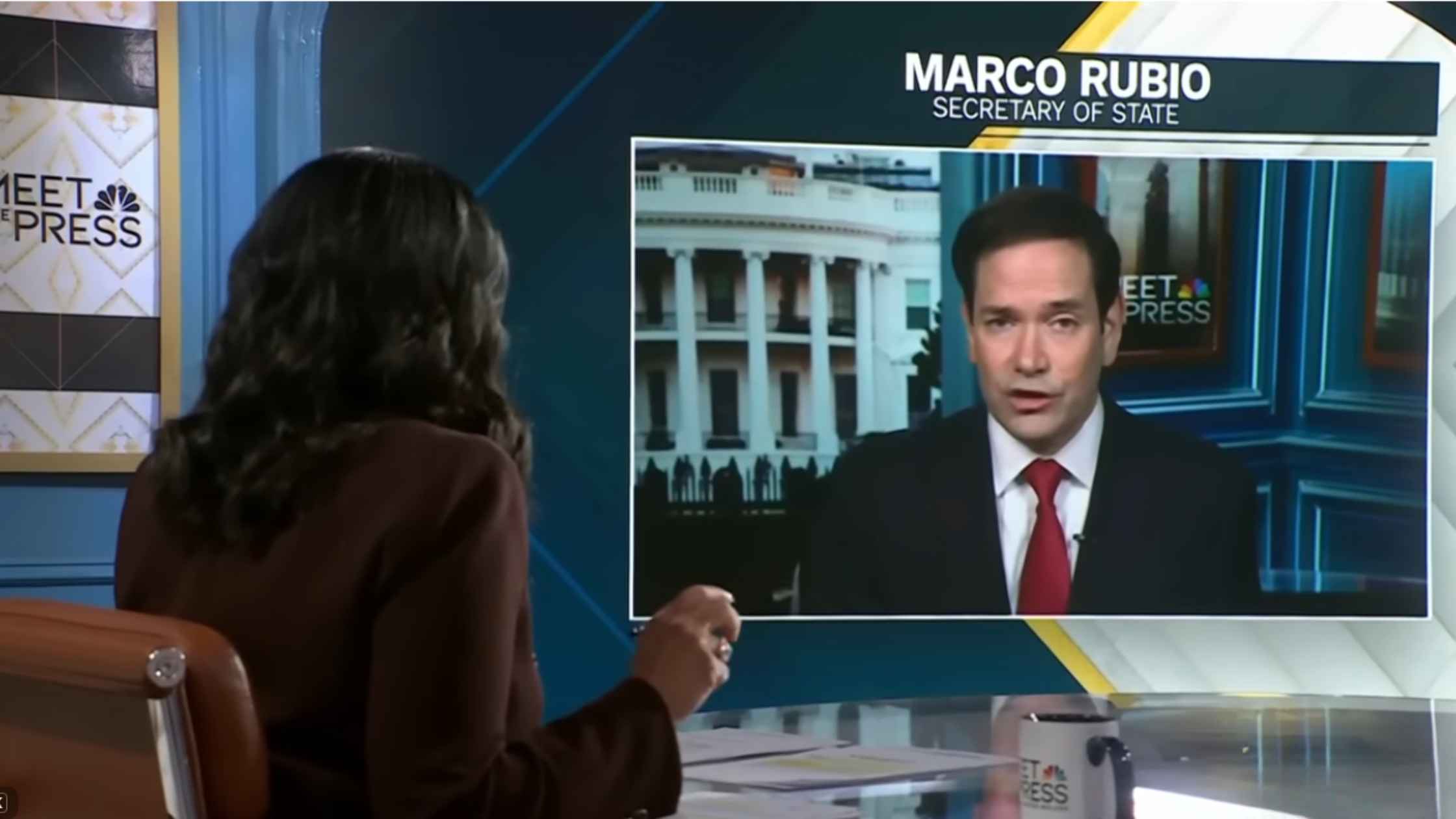
Joining me now is Secretary of State, Marco Rubio. Secretary Rubio, welcome back to Meet the Press.
Speaker 2 (00:09):
Thank you.
Speaker 1 (00:10):
Thank you so much for being here. I want to start with this big picture question. Is the United States now at war with Venezuela?
Speaker 2 (00:21):
There's not a war. We are at war against drug trafficking organizations, it's not a war against Venezuela. We are enforcing American laws with regards to oil sanctions. We have sanctioned entities. We go to court, we get a warrant, we seize those boats with oil and that will continue.
(00:36)
And we would continue to reserve the right to take strikes against drug boats that are bringing drugs towards the United States that are being operated by transnational criminal organizations, including the Cartel de la Soles. Of course, their leader, the leader of that cartel is now in US custody and facing the US justice in the Southern District of New York, and that's Nicolas Maduro. So we made a big progress in that regard.
Speaker 1 (01:03):
Mr. Secretary, who is in charge? Are you running Venezuela right now?
Speaker 2 (01:12):
Yeah. I keep people fixating on that. Here's the bottom line on it is we expect to see changes in Venezuela. Changes of all kinds long-term, short-term. We'd love to see all kinds of changes, but the most immediate changes are the ones that are in the national interest of the United States. That's why we're involved here, because of how it applies and has a direct impact on the United States.
(01:31)
We are not going to be able to allow, in our hemisphere, a country that becomes a crossroads for the activities of all of our adversaries around the world. We just can't allow it. We can't have a country where the people in charge of its military and in charge of its police department are openly cooperating with drug trafficking organizations. We're not going to allow that. These things are direct threats to the United States, and we intend to use every element of leverage that we have to ensure that that changes.
(01:57)
The one I would point everyone to is that our military is helping the Coast Guard conduct a law enforcement function, which is not just the capture of Maduro, but the enforcement of our sanctions. We go to court, we get a warrant, we seize the boats, and we think that's this tremendous leverage, incredible crippling leverage, which we intend to continue to use until we see the changes that we need to see that are benefit to the American people. And by the way, we believe to the people of Venezuela as well.
Speaker 1 (02:23):
But Mr. Secretary, I think there's a lot of questions about who the point people are during this transition. President Trump said, "We're going to run the country." So is it you? Is it Secretary Hegseth? Who are those people who will be running the country specifically?
Speaker 2 (02:41):
Well, it's not running the… It's concerning policy. The policy with regards to this, we want Venezuela to move in a certain direction because not only do we think it's good for the people of Venezuela, it's in our national interest. It either touches on something that's a threat to our national security or touches on something that's either beneficial or harmful.
Speaker 1 (02:58):
And are you involved in that transition secretary?
Speaker 2 (02:58):
So obviously, I'm very involved in this. Well, of course, I think everyone knows I'm pretty involved on politics in this hemisphere. Obviously the Secretary of State and National Security Advisor are very involved in all these elements. The Department of War plays a very important role here along with the Department of Justice, for example, because they're the ones that have to go to court.
(03:16)
So this is a team effort by the entire national security apparatus of our country, but it is running this policy. And the goal of the policy is to see changes in Venezuela that are beneficial to the United States first and foremost, because that's who we work for, but also we believe beneficial for the people of Venezuela who have suffered tremendously.
(03:34)
We want a better future for Venezuela, and we think a better future for the people of Venezuela also is stabilizing for the region and makes the neighborhood we live in a much better and safer place.
Speaker 1 (03:45):
President Trump said the administration is working with Maduro's Vice President Delcy Rodriguez. Why does the administration oppose working with the opposition leader, Maria Karina Machado? She's the Nobel Peace Prize winner, of course, as well. Her coalition has the support of 70% of Venezuelans. Why not work with her?
Speaker 2 (04:08):
Well, a couple of things. So first of all, Maria Karina Machado's fantastic and she's someone I've known for a very long time and that whole movement is. But we are dealing with the immediate reality. The immediate reality is that unfortunately, and sadly, but unfortunately, the vast majority of the opposition is no longer present inside of Venezuela. We have short-term things that have to be addressed right away.
(04:29)
We all wish to see a bright future for Venezuela, a transition to democracy. All of these things are great, and we all want to see that. I've worked on that for 15 years on a personal level, both in the Senate and now as National Security Advisor and Secretary of State. These are things I still care about, we still care about. But what we're talking about is what happens over the next two, three weeks, two, three months, and how that ties to the national interest of the United States.
(04:51)
And so we expect to see more compliance and cooperation than we were previously receiving. With Nicolas Maduro, you could not make a deal or an arrangement. Although he, by the way, was given very generous offers. He could have left Venezuela as recently as a week and a half ago. There were opportunities available for him to avoid all of this because he's not someone we can work with.
(05:11)
He suckered the Biden administration into stupid deals. He's made a career out of not keeping deals and figuring out how to save himself by buying time. And President Trump was not going to fall into that trap. So now there are other people in charge of the military and police apparatus there. They're going to have to decide now what direction they want to go. And we hope they will choose a different direction than the one Nicolas Maduro picked.
(05:35)
Ultimately, we hope this leads to a holistic transition all the way around in Venezuela, societal, political, all of that. We're in favor of all of that. But right now, we have to take the first steps. And the first steps are securing what's in the national interest of the United States and also beneficial to the people of Venezuela. And those are the things that we're focused on right now.
(05:53)
No more drug trafficking, no more Iran Hezbollah presence there, and no more using the oil industry to enrich all our adversaries around the world and not benefiting the people of Venezuela are frankly, benefiting the United States and the region.
Speaker 1 (06:08):
You talk about a holistic transition. I think there's a lot of focus on potential elections. How soon will elections be held within 30 days, Mr. Secretary?
Speaker 2 (06:22):
Elections? Well, look, this is a country that's been governed by this regime now for 14 or 15 years. The election should have happened a long time ago. The elections did happen. They lost them and they didn't count the votes or they refused to count the votes and everyone knows it. So all of that, I think, is premature at this point. There's a lot of work to be done here.
(06:39)
Right now, let's be realistic here, what we are focused on right now is all of the problems we had when Maduro was there, we still have those problems in terms of them needing to be addressed. We are going to give people an opportunity to address those challenges and those problems. Until they address it, they will continue to face this oil quarantine. They will continue to face pressure from the United States.
(07:01)
We will continue to target drug boats if they try to run towards the United States. We will continue to seize the boats that are sanctioned with court orders. We will continue to do that and potentially other things until the things we need to see addressed are addressed because ultimately, above everything else, we care about elections, we care about democracy, we care about all of that.
(07:20)
But the number one thing we care about is the safety, security, wellbeing, and prosperity of the United States. And that's what we're going to focus on first and foremost here. And that's what these policies, these changes we need to see made are about.
Speaker 1 (07:33):
Okay. Significant there, you say you will continue to seize boats when necessary. I want to ask you about boots on the ground, a lot of attention on that. The president was asked about the possibility of US boots on the ground. He said, quote, "We're not afraid of it." How many US forces are on the ground right now in Venezuela? Are there any?
Speaker 2 (07:55):
We don't have US forces on the ground in Venezuela. No, we don't have US forces on the ground, everyone knows. They were on the ground for about two hours when they went to capture Maduro. And I think what the President is saying is very simple. And that is, as President of the United States, he is not going to go around telling people what he's not going to do.
(08:11)
He's not going to go around saying, "I won't do this. I won't do that. Yes, I care about this issue, but I'll only go so far." He retains all this optionality. In the particular case you're citing, this was, in essence, at its core, a law enforcement function. The Department of Justice, dating back in the Biden administration that had a $25 million reward for his capture.
(08:30)
So we have a reward for his capture, but we're not going to enforce it. That's the difference between President Trump and everybody else. It's easy to make a wanted poster and say $50 million for the capture of Maduro, but no one takes that seriously because you're not going to do anything about it. President Trump did something about it.
Speaker 1 (08:45):
Let me ask you-
Speaker 2 (08:45):
He did something about it. We went in, we grabbed him, he was arrested, and he's now in New York. No Americans were killed, no equipment was lost. It had to be done and it's been done. And I assure you, the people left behind in Venezuela now that are in charge of the police and everything else, I assure you, they're going to probably be a lot more compliant than Maduro was as a result of this.
Speaker 1 (09:04):
Well, President Trump told the New York Post there won't be troops in Venezuela as long as Delcy Rodriguez "does what we want." She's already though demanding the release of Nicolas Maduro. As you know, she's insisting that her country never become a colony.
(09:18)
What exactly does Rodriguez need to do to keep US troops out of Venezuela?
Speaker 2 (09:26):
Well, forget about the US troops portion of it. What needs to happen for any of this to change for our relations with Venezuela to change and our whole approach for it to change, the things we have talked about are the ones I've highlighted already. You can't flood this country with gang members.
(09:40)
You can't flood this country with drugs that are coming out of Columbia through Venezuela with the cooperation of elements of your security forces. You can't turn Venezuela into the operating hub for Iran, for Russia, for Hezbollah, for China, for the Cuban intelligence agents that control that country. That cannot continue. Those things cannot continue to be in place.
(09:59)
You cannot continue to have the largest oil reserves in the world under the control of adversaries of the United States, not benefiting the people of Venezuelan and stolen by a handful of oligarchs around the world, including inside of Venezuela, but not benefiting the people of that country.
(10:16)
We've seen how our adversaries all over the world are exploiting and extracting resources from Africa, from every other country. They're not going to do it in the Western hemisphere. That is not going to happen under President Trump. Read our national security strategy. He is serious about it and he's going to do something about it and we're doing something about it.
Speaker 1 (10:33):
Let me ask you about oil. The president says the US is taking over the oil. The question is, if the purpose of the operation was to capture Maduro and bring him to justice, why does the United States need to take over the Venezuelan oil industry?
Speaker 2 (10:52):
Well, we don't need to. First of all, let me go back up. We don't need Venezuela's oil. We have plenty of oil in the United States. What we're not going to allow is for the oil industry in Venezuela to be controlled by adversaries of the United States.
(11:04)
You have to understand, why does China need their oil? Why does Russia need their oil? Why does Iran need their oil? They're not even in this continent. This is the Western hemisphere. This is where we live and we're not going to allow the Western hemisphere to be a base of operation for adversaries, competitors and rivals of the United States.
Speaker 1 (11:19):
Have specific oil companies-
Speaker 2 (11:20):
We'll also want to see that oil and the proceeds from it… Hold on. We want to see the oil proceeds of that country benefit the people of Venezuela. Why have eight million people left Venezuela? Eight million. The single largest mass migration probably in modern history left Venezuela in 2014 because all the wealth of that country was stolen to the benefit of Maduro and his cronies in the regime, but not to the benefit of people of Venezuela.
(11:42)
You know how destabilizing eight million migrants is? The number one fear that Brazil has, that Columbia has, that all these countries in the region have about what's happening in Venezuela and our involvement is they're afraid of another mass migration event. That's what they fear. This is deeply destabilizing stuff. It's not going to continue to happen. They are not going to come from outside of our hemisphere, destabilize our region in our own backyard, and us have to pay the price for it, not under President Trump.
Speaker 1 (12:07):
Let's talk big picture here. US regime change, historically speaking, has not gone very well for the United States, in Iraq, in Libya, to name a few examples, can you assure Americans, the people of the United States, that this time will be different?
Speaker 2 (12:29):
Well, here's what's happened. We've got this phobia built up and this sort of thing that's like, number one, most of the experts that people have on Talia, I watched these experts and it's clown hour. Okay. These are people that have focused their entire career on the Middle East or some other part of the world because that's where all the action was. Very few of them know anything about Venezuela, the Western hemisphere.
(12:47)
Venezuela looks nothing like Libya. It looks nothing like Iraq. It looks nothing like Afghanistan. It looks nothing like the Middle East other than the Iranian agents that are running through their plotting against America. These are Western countries with long traditions out of people to people and cultural level and ties to the United States. So there's nothing like that. So I think people need to stop ascribing the apples and oranges here, the apples of the Middle East to the oranges of the Western hemisphere.
(13:11)
Number two, this is about the national interest of the United States. And what I'm confident of is we are in a safer and better place because we're taking it seriously. The alternative would have been to leave Maduro there as an indicted drug trafficker, illegitimate president, running the country, open invitation for all of our adversaries to do whatever they want against the United States from Venezuela. That was not going to continue.
(13:33)
The alternative would have been to allow a drug trafficker to continue to use national territory and elements of nation state power to further drug trafficking organizations. Read the indictment. This guy used the levers of their security apparatus, not to arrest drug traffickers, but to cooperate and facilitate the trafficking of drugs for the purpose of getting them into the United States. That's going to stop.
Speaker 1 (13:56):
And yet, Mr. Secretary, a month ago, President Trump pardon the former president of Honduras who was just starting a 45-year sentence for trafficking more than 500 tons of cocaine. Does that not undercut the administration's stated goal, as you just said, to go after these narco terrorists?
Speaker 2 (14:18):
Number one, the former president of Honduras. So this is not someone who was in power, had any influence of the politics of Honduras any longer. Number two, I don't do the pardon file. I'm not against it or for it. I just didn't review the file. So I can't speak to you about the dynamics that led the president to make the decision that he made.
(14:32)
I think he talked about it yesterday at the press conference. He reviewed the file. He went through the arguments in it and he felt that the former President of Honduras was treated very unfairly by the previous administration and made the decision that he made. But I think the answer, whether you agree with that decision or not, people can disagree. There's people out there who make a living out of disagreeing with anything President Trump does. That doesn't mean you leave Maduro in place.
(14:54)
That doesn't mean you don't go after Maduro. That's not the answer. I see people saying that. It's like, "Well, how can you go after Maduro if you didn't do this? " That's absurd. The answer to that, whether you have a problem with it or not, is not to leave and place someone who's been indicted, who hasn't even faced American justice yet, but now will.
Speaker 1 (15:09):
Yeah. And you're absolutely right. I was referencing, obviously, the former president, White House Chief of Staff, Susie Wiles, told Vanity Fair that an attack on Venezuela's mainland would require approval from Congress. Why didn't that happen and will it happen with any future action the administration plans to take in Venezuela or elsewhere?
Speaker 2 (15:29):
Yeah. This was not an action that required congressional approval. In fact, it couldn't require congressional approval because this was not an invasion. This is not an extended military operation. This was a very precise operation that involved a couple of hours of action. It was a very delicate operation too.
(15:44)
It was one that required all these conditions to be in place at the right time in the right place. You couldn't afford leaks. We couldn't afford anything out there that would've endangered the mission and gotten people killed or killed off the mission and the optionality. We didn't even know if the mission was going to happen. How can you notify something you're not even sure if it can happen? Because in order for it to happen, you needed to have weather conditions in place. He needed to be at the right place at the right time. We needed to have forces prepared to go.
(16:09)
There were a lot of factors in place. It was a trigger based operation. You can't notify that, number one, because you don't even know if it's going to happen if those conditions will ever align. And number two, you can't risk it being disclosed. But this was not an attack on Venezuela. This was a law enforcement function to capture an indicted drug trafficker.
(16:26)
And of course, we needed the Department of War to support it because they do have anti-aircraft missiles that could shoot down those helicopters. We had to take down radars. We had to take down those anti-air elements on the way in and on the way out. And that's what this was limited to.
Speaker 1 (16:40):
But will you seek congressional approval for any further action in Venezuela or the region?
Speaker 2 (16:46):
Well, we will seek congressional approval for actions that require congressional approval. But otherwise, they will get congressional notification. And this is not an operation that required congressional approval.
(16:58)
In fact, this is an operation akin to what virtually every single president, for the last 40 years, is conducted. The difference is that when it's Donald Trump, all these Democrats go bonkers.
Speaker 1 (17:09):
Is the Cuban government, the Trump administration's next target, Mr. Secretary? Very quickly.
Speaker 2 (17:15):
Well, the Cuban government is a huge problem, yeah. The Cuban government is a huge problem. First of all, Cuba-
Speaker 1 (17:21):
So is that a yes?
Speaker 2 (17:22):
But I don't think people fully appreciate… I think they're in a lot of trouble, yes. I'm not going to talk to you about what our future steps are going to be and our policies are going to be right now in this regard, but I don't think it's any mystery that we are not big fans of the Cuban regime who, by the way, are the ones that were propping up Maduro.
(17:37)
His entire internal security force, his internal security apparatus is entirely controlled by Cubans. One of the untold stories here is how, in essence, you talk about colonization, because I think you said Delcy Rodriguez mentioned that. The ones who have sort of colonized, at least inside the regime, are Cubans. It was Cubans that guarded Maduro. He was not guarded by Venezuelan bodyguards. He had Cuban bodyguards. In terms of their internal intelligence, who spies on who inside to make sure there are no traders, those are all Cubans.
Speaker 1 (18:05):
All right. Secretary of State, Marco Rubio, thank you for joining us after an incredibly busy 48 hours.
Speaker 2 (18:11):
Thank you.
Speaker 1 (18:11):
Really appreciate it.
Speaker 3 (18:12):
We thank you for watching. And remember, stay updated on breaking news and top stories on the NBC News app or watch live on our YouTube channel.