


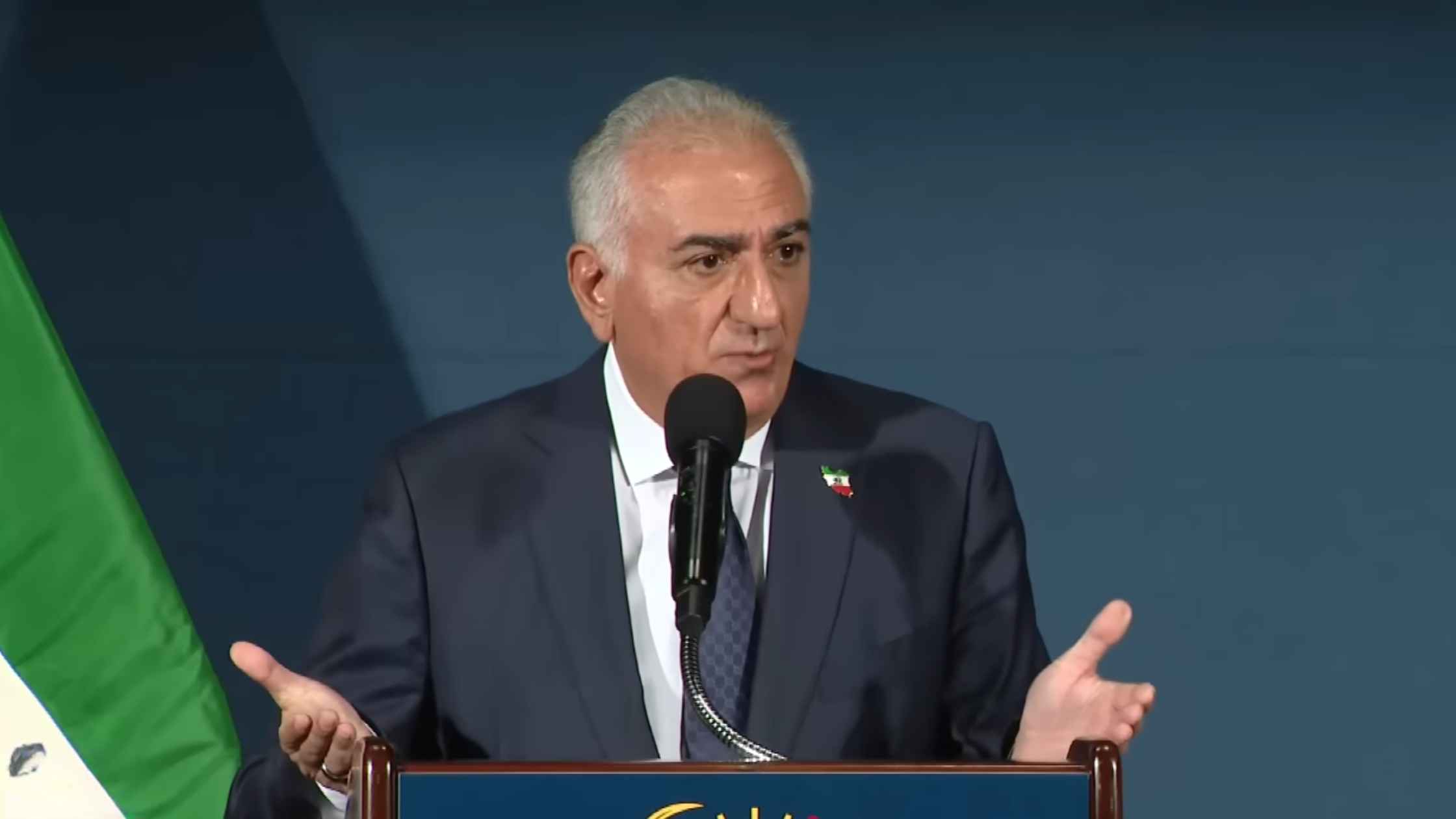
Reza Pahlavi (00:00):
... is not the government of Iran. It is a hostile occupying force that's hijacked our homeland. After invading five neighboring countries and sowing chaos across the region, this regime has invaded Iran itself, using foreign terrorists, Hezbollah fighters, Iraqi militias, and other mercenaries to slaughter the Iranian people. This is no longer mere repression. This is foreign occupation wearing clerical robes.
(00:41)
Just as Saddam Hussein drowned the marshes in blood, and Bashar al-Assad turned barrel bombs on his own children, Ali Khamenei and his thugs have committed mass crimes against Iranian people and against all of humanity. And just like those other tyrannies, the Islamic Republic will fall. Not if, but when.
(01:09)
The world must hear this clearly. The battle in Iran today is not between reform and revolution, it is between occupation and liberation. And the Iranian people have already chosen their side. Their heads are bloodied, but unbowed. Yet the cost has been heartbreaking. The people of Iran are being slaughtered in the streets and in their homes by a regime that shows no mercy. More than 12,000 Iranians were massacred in 48 hours. One murder every 14 seconds. Khamenei's killers even haunted the wounded protestors in hospitals and executed them in cold blood.
(02:04)
The regime collected piles of bodies with dump trucks and forced worried families to search unlabeled body bags. They refused to return bodies for burial without payment for the cost of the bullets that killed their loved ones. And where a family cannot pay up to several thousand dollars and most of them can't, they buried the dead in unmarked mass graves.
(02:33)
And despite the lies you're hearing from the regime, its bloodlust has not diminished. The slaughter has not stopped. My brave compatriots still holding the line with their broken bodies, but unbreakable will, need your urgent help right now. Make no mistake, however, the Islamic Republic is close to collapse. Ali Khamenei and his thugs know this. That's why they are lashing out like a wounded animal, desperate to cling to power.
(03:14)
The people have not retreated. Their determination has made one thing clear, they are not merely rejecting this regime, they are demanding a credible new path forward. They have called for me to lead. The bond between me and the Iranian people is not new. It's been with me since birth and it cannot be broken. Even in exile, I pledge my life to the service of the Iranian nation. When Saddam Hussein invaded Iraq, I volunteered as a fighter pilot to defend my country against his invasion. Today, as my compatriots call on me for leadership, I reaffirm my lifelong pledge by stepping in to lead the movement that will take back our country from the anti-Iranian hostile force that occupies it and kills its children. I will return to Iran. I am uniquely positioned to ensure a stable transition. That's not my opinion, that's the verdict delivered loudly and clearly by the people in the face of bullets.
(04:38)
Large sections of the army and security forces have already refused to participate in the killing of civilians. They have whispered their loyalty to me. Tens of thousands have already signaled their readiness to defect, and this process has been underway for months. What's clear is both the public and members of the military see me as a national figure who can unite all opposition forces from every background, ethnicity, republican and monarchist, right, left, and everything in between. I have a comprehensive plan for an orderly transition which is ready to be implemented immediately.
(05:27)
The Iranian people are taking decisive actions on the ground. It is now time for the international community to join them fully. Today, I ask the world to do six things:
(05:42)
First, protect the Iranian people by degrading the regime's repressive capacity, including targeting the Islamic Revolutionary Guard leadership and its command and control infrastructure.
(05:58)
Second, deliver and sustain maximum economic pressure on the regime. Block their assets worldwide. Target and dismantle their fleet of ghost tankers.
(06:12)
Third, break through the regime's information blockade by enabling unrestricted internet access. Deploy Starlink and other secure communications tools widely across Iran, and conduct cyber operations to disable the regime's ability to shut down the internet.
(06:34)
Fourth, hold the regime accountable by expelling its diplomats from your capitals, and pursue legal enforcement actions against those responsible for crimes against humanity.
(06:49)
Fifth, demand the immediate release of all political prisoners.
(06:56)
Sixth, prepare for a democratic transition in Iran by committing to recognize a legitimate transitional government when the moment comes.
(07:09)
Supporting the Iranian people is not an act of charity, nor is it unwarranted interference. Global stability itself depends on the removal of this regime. It's 47 years of exported terror, nuclear threats, and regional chaos must end. This does not require putting boots on the ground, the Iranian people boots are already on the ground. They are the ones marching, sacrificing, and fighting for their freedom every single day. What they need from the world is resolute, targeted support to protect lives, amplify their voices, and hasten the collapse that is already underway. But let me be clear - with or without the world's help, the regime will fall. It will fall sooner, and more lives will be saved if the world turns its words into action. A free democratic Iran will not be a source of endless crisis, it will be a pillar of peace, partnership, and prosperity for the Middle East and beyond. The choice is clear, stand with the people now or watch the cycle of instability continue.
(08:47)
As I have said to my compatriots, the noble and courageous people of Iran, particularly the young generation, I speak directly to you. Know that you have commanded the world's attention and admiration. History itself stands in awe of your bravery and your sacrifices. You are the immortal guard of Iran, continue the fight as you have done so far. Do not allow this regime to create the illusion that life is normal. After all the massacres, there is a sea of blood between us and the regime.
(09:36)
The regime through severe repression, killing, and cutting off communications is trying to instill fear and terror in you and to make you despair of continuing the movement and struggle. But know that because of your steadfastness and fight, thousands of military and security forces have not gone to work, so as not to participate in the repression. Save the name of all these criminals, they will be prosecuted for what they have done. Yet justice alone will not heal all the wounds, but it will open the door to healing and a national rebirth.
(10:20)
As for the day after our victory, I have a clear plan for the transition to democracy - millions of Iranians inside and outside Iran are united around these four core principles: Iran's territorial integrity, separation of religion and state, individual liberties and equality of all citizens, and the Iranian people's rights to decide a democratic form of government.
(10:56)
The end of the regime will mark the rebirth of one of the most accomplished civilizations in history, for the future of Iran and its people. Iran is blessed with extraordinary human talent and vast natural resources. Our people are highly educated, producing one of the highest numbers of engineers in the world, with around 70% women.
(11:23)
Today, the corrupt regime wastes these gifts. In a free Iran, our resources and ingenuity will drive prosperity at home and strengthen global supply chains, including America's. A free Iran will be a game changer for peace in the Middle East and for Iran's relations with the United States and the West.
(11:50)
The Iranian people love America and hate this regime. After its collapse, instead of death to America, the world will find a nation that embraces America as a true friend. President Trump brokered the Abraham Accords, bringing peace between Arab nations and Israel. I see extending this idea to a free Iran through what we could call the Cyrus Accords, honoring our ancient heritage of tolerance and partnership. The possibilities are endless.
(12:29)
There will be a peaceful, stable, and orderly transition. My team of experts have developed a plan for the first hundred days after the regime's collapse and the long-term reconstruction and stabilization of our country. It is backed by business leaders and provides a detailed roadmap for national recovery, restoring economic confidence, ensuring that essential services continue uninterrupted, and laying the foundation for prosperity in a free Iran.
(13:05)
A constitutional process will follow under international observation, allowing Iranians to finally determine their own destiny through free and fair elections. A free and democratic Iran that emerges will live at peace with our neighbors. It will be an engine of growth and opportunity in the region and the world. There are moments in history where the moral imperative for action is so strong that the weight of inaction becomes unbearable. This is one of those moments, the people of Iran have reason to reclaim their country. History will honor those who stand with them. Long live Iran. Thank you.
Speaker 1 (14:06):
We're going to take a few questions. Some people have asked in advance. I'm going to coordinate, and also from the audience, don't worry, and Prince Reza Pahlavi will reply to them.
(14:15)
I'm going to call firstly Ardavan, who is birthed from Iran International.
Speaker 2 (14:21):
[foreign language 00:15:00].
Reza Pahlavi (14:21):
[foreign language 00:15:12].
Moderator (16:22):
Pass it on. We just need to make sure everyone has a mic [inaudible 00:16:21] when you ask your questions, otherwise it's not picked up [inaudible 00:16:22] with the audience with mics, you can bring it.
James Matthews (16:26):
[inaudible 00:16:25], you spoke about undeniable truth [inaudible 00:16:28].
Moderator (16:27):
Can you introduce yourself? Excuse me, sir. Can you just introduce yourself, sir?
James Matthews (16:33):
James Matthews from Sky News. Thank you. You spoke about undeniable truth [inaudible 00:16:39]. It's also an undeniable truth that when your father ran the country, there were executions, there was tortures, there was secret police. What would you say to Iranians today who are concerned that under your leadership, they would be swapping one dictator for another?
Reza Pahlavi (16:59):
First of all, I'll let historians write history. I'm here to make history, not to write it. Second, you hear the Iranian people standing behind me and calling my name. This doesn't occur incidentally. They have known my track record. They know my unwavering commitment to democracy and human rights. This has been my position the day I started and remains my position to this day. They know they can trust me because they've never seen me waiver from this. And ultimately, what I'm trying to make sure is the final element that will prove to the Iranians that they are in full control of their own destiny is to turn power back to them, a power that has been taken away from them by this regime, which we are fighting today. That's my commitment, and they can trust me on that.
Moderator (17:45):
Bloomberg.
Speaker 4 (17:45):
[inaudible 00:17:54].
Moderator (17:53):
No, I've called Bloomberg, please. It's a gentleman or lady from Bloomberg. No? They asked a question.
Speaker 4 (18:00):
I think he's gone.
Moderator (18:01):
No, Reuters, please.
Riley Johnson (18:02):
I'm from Bloomberg.
Moderator (18:04):
Oh, there. There's a microphone that's coming.
Riley Johnson (18:10):
Thank you. Hi, I'm Riley Johnson from Bloomberg. Are you having any further conversations with Witkoff or the Trump administration?
Reza Pahlavi (18:18):
Look, these are sensitive times and I'm not going to discuss details of who I'm meeting with and what has been discussed. What I can tell you, however, is that there's strong support for the Iranian people, and I believe that President Trump is a man of his word, and ultimately he will stand with Iranian people as he has said.
Moderator (18:37):
Lady from DW.
Speaker 3 (18:39):
Thank you very much. I'm with Deutsche Welle, Germany's international broadcaster. Thank you so much. I have two questions. We saw a slide there saying Donald Trump, help. What exactly does this mean? What do you hope Donald Trump to do? And my second question is regarding Europe and especially Germany. What do you hope for Europe does to support your cause? Thank you very much.
Reza Pahlavi (19:02):
Thank you for the question. Well, clearly President Trump did say that if the regime was to hit the Iranian people hard, they would face with serious consequences. That the Iranian people have taken his word as a man of his words, as I said. They know that unlike his predecessors that threw us under the bus one time, this president is not about to do the same thing. And that's very encouraging and empowering.
(19:29)
Number two, you asked me about European countries. Look, we already are past the point of whether you should try the IRGC as a terrorist organization or not. And frankly, I'm flabbergasted that there's still some countries that are not willing to take the next step as if they are supposed to worry about how the regime will retaliate. This regime is on its last leg. It's about to collapse. And I think the world, especially the democratic free world, that champions freedom and human rights and equality of citizens at the face of this regime's brutal repression, should act now. I call for them to start acting as opposed to talking. We need your help. We need your action. We need to take all the steps that I've indicated in my opening remarks, all those six elements.
(20:14)
Anything that can be done in that direction is a morale boost and beyond morale boost, an actual act of support for a defenseless society and civilians that, as you can see, have been treated in the worst possible way. And the only hope they have is that their fight for freedom, their sacrifices will be less loss of life based on your action to expedite this regime's collapse. That's what the Iranian people are expecting from you.
(20:48)
And let me reiterate, as I said again, we are not waiting for you to act to continue our fight. We are. But imagine how much more we can protect more innocent lives from dying by acting and helping us today. These are critical moments that are game changers, not just for us Iranians, but for the whole world. This is what we need from you, so help us.
Moderator (21:10):
Reuters. Microphone over here, please.
Humeyra Pamuk (21:20):
Thank you. Humeyra Pamuk from Reuters. In an interview a couple of days ago, President Trump actually expressed some doubts about your support inside Iran. How are you planning to win him over, convince him that you do have the support that you say you do? Also, you're talking about thousands of potential defectors, but the IRGC and other forces have hundreds of thousands. So how are you going to assert your control over this establishment? And are you anytime soon going to meet with President Trump? Are you making an active effort? Thank you.
Reza Pahlavi (22:02):
President Trump has said that it's up to the Iranian people to decide, and I totally agree. I've always said it's for the Iranian people to decide. And I think the Iranian people have already demonstrated in great numbers who it is that they want them to lead through the transition. So I'm confident that I have the support of my compatriots and it's for the international leaders to assess the facts on the grounds and see who is capable of doing that. I believe I can, and I have the Iranian people's support. And of course, if anybody in the world is willing to help the Iranian people achieve that goal, that's what I'm trying to do to help them liberate themselves and attract as much support as I can internationally to be behind the Iranian people this time and on the right side of history.
(22:47)
Now, as far as the defection goes, this campaign has started months ago. In fact, I announced it in another press conference I had in Paris a few months ago. Some of you might have heard about it at which point we established a system whereby people who want to defect or want to access us or want to indicate their interest to join with us have a secure means of communicating their intentions to us. Since then, tens of thousands have applied. Many of them are from the security forces in Iran, police force, military, IRGC, and we are vetting them as we're speaking. And the mechanism for defection does exist, but most importantly is the principle of having an exist strategy. And on that I've said, anyone whose hand is not soiled in the blood of the Iranian people will survive regime change. We're not talking about de-Ba'athification. We're not talking about the disaster of post-Saddam Hussein, post-Gaddafi collapse. We're not going to have a failed state.
(23:43)
And for me to be able to guide a smooth transition, I'm counting on security forces to be the element that keeps the country secure, protects people's lives and their livelihood, and be part of the solution. As a result, we have already seen people indicating their cooperation. We have already seen elements that refuse to be used as an instrument of repression, which is why the regime is now, as we speak, importing elements from outside the country to be in the instrument of repression as they're running out of their own forces to do that for them inside Iran. And all of this is the indication of the beginning of that collapse.
(24:21)
Hopefully, by more support from the outside world, by a determined strike on the regime's elements that are the instrument of repression, as I stated in my opening remarks, in my opinion, that will expedite the process and will also increase the number of defections to be more rapid so that we are not faced with remnants and pockets of resistance as much as possible. There's never going to be 100% defection, but there comes a point where the regime sees its futile and hopefully by then, Khomeini will be joining Bashar in Moscow and we'll be rid of him.
Moderator (24:52):
This gentleman here.
Ben Leo (24:59):
Thank you. Sir, good morning. Thank you. Ben Leo from GB News in London. In London, sir, in England, we have Iranian sleeper cells on their way to the Israeli embassy accused of trying to blow up the embassy. We have a former Iranian government minister living in North London, living in a council house, actually, who supported the fatwa on Salman Rushdie, praised Soleimani, so on and so on. Why is it in Britain's interests and indeed the West for this Islamic regime to fall, please?
Reza Pahlavi (25:29):
I'm sorry, could you repeat? I want to make sure I understood your question. Could you repeat it please? The End point?
Ben Leo (25:33):
Yeah. We have lots of Iranian sleeper cells and activity in London. Three people who were arrested trying to blow up the Israeli embassy. Some months ago, there's a former government minister living in North London who supported Soleimani, backed the fatwa on Rushdie. We have lots of Iranian activity in the UK connected with the regime here in Iran, sorry. Why is it in Britain's interests and the West for this regime to fall?
Reza Pahlavi (26:00):
Right. Well, I'm glad you asked the question because in fact, one of the topics that I raised in some discussions I had the last time I was in London with former prime ministers was exactly to explain to them the mapping of every instrument that the regime is using under Khomeini's direct supervision through so called centers through which they antagonized British citizens and of course, many of those sleeper cells that you indicated. It doesn't stop in England, by the way, in America as well. So we're trying to explain to various governments, the whole methodology that the regime is using with assets they have on the ground in respective countries, not to mention money laundering that goes on in many countries, including in Great Britain.
(26:43)
So there are many ways that they can push back against that and protect not only the citizenry of whether it's Great Britain or America, but in what way it connects to why we need to do that ultimately by putting an end to the regime.
(26:56)
And one thing that is now becoming even more clear, and the fact that the regime could be threatening the world as a last gasp, we should not allow this regime to catch a second wind and be able to do further damage, which is why the strike is not just needed to help the Iranian people overcome this unfair disadvantage, but it's also one way to completely dismantle the regime's aspect of threatening and cut off the chain of income that it uses to fund all of these operations, including the sleeper cells, which is why I'm also calling for any means to cut off the lifeline to the regime, which is its revenue from whether it's oil exports or what are other means of income that they have. We need to dry the well that funds terrorism once and for all against Iranian people and the world.
Moderator (27:45):
Just hand him the mic.
Dan Rivers (27:48):
Sir, hello, Dan Rivers from ITV News in the UK. Two U.S. aircraft carriers are heading, we understand, to the Gulf and Donald Trump has said help is on its way, but they may take up to 10 days to get there. And meanwhile, more and more people are dying. Are you losing faith in President Trump?
Reza Pahlavi (28:10):
I believe the President is a man of his word, as I said before. How many days it might take? Who knows. Hopefully sooner than later. But as I said before, regardless of whether action is taken or not, we as Iranians have no choice to carry on the fight. We're halfway across the river, there's no turning back. We will continue. The quicker the action happens, the more lives can be saved and the sooner we can see the regime's collapse. So timing is of course important, and I would still believe in the president's commitment that help is on the way.
Dan Rivers (28:43):
But does he need to do something today, tomorrow to help your fellow countrymen who will die?
Reza Pahlavi (28:51):
Well, I'm not the president's advisor. All I can say that Iranians are, of course, right now, as we speak, witnessing the kind of massacre that has been unprecedented in human history, and this is why the urgency becomes quite clear. The timing, I leave it to the experts to decide. All I can say is the sooner, the better.
Moderator (29:08):
Okay. I'm going to call now Ben Amini from Manoto. Microphone over here, please.
Reza Pahlavi (29:17):
Sorry. There's too much bright light. I can't see who is where. Okay,
Moderator (29:34):
Here's the mic too.
Ben Amini (29:34):
Oh, thank you. Thank you.
Speaker 6 (29:34):
[foreign language 00:30:01].
Reza Pahlavi (31:06):
[foreign language 00:30:01]. A quick translation for those of you who don't speak Farsi. The question related to the regime's importing foreign elements into Iran to use as a mechanism of repression. And I said that this is a clear indication of the regime's weakness that it cannot even count on its own forces to do the dirty job and it has to resort to bring people from the outside.
(31:25)
But reason more for the world to realize that as this desperation act of the regime to try to brutalize its own people as a last gasp effort cannot be left unanswered, which is why we're calling for the world to help us out.
Speaker 5 (31:39):
Thank you. AFP, please.
Shaun Tandon (31:47):
Thank you very much. Shaun Tandon with AFP. Nice to see you. Could I follow up? The momentum, you mentioned that that's in the hands of Iranians, but at one point is it too late for the intervention that you're talking about from President Trump? Could there be the sense that he's talked for over 10 days about, "Help is on the way?" Is there a sense that that could actually weaken the momentum?
(32:07)
Specifically, you said at the beginning that there should be targeting of the revolutionary guards. Do you mean necessarily military strikes? How should the revolutionary guards be targeted? Thanks.
Reza Pahlavi (32:17):
It's never too late. Any fight for freedom doesn't have a deadline. Some of your reporters have deadlines to make your reports, but this fight doesn't have deadline. We will fight until we win. That is the national will of the Iranian people. We are all going to fight until we win.
(32:39)
The only question is, what are the elements that can expedite it? And the immediate issue remains, what will hurt the regime most? By dismantling its apparatus of state terror and repression. A lot of it are the regimes, military, paramilitary assets, mostly IRGC targets. So I'm calling for a surgical strike on those means. I think it should be quite obvious to any of you. How do you weaken the regime's first and foremost means of instituting terror at home or terrorism abroad? And all ties...
(33:20)
The targets are quite obvious. They're not going to hit a factory or a school or a hospital. Clearly, it's obvious what the targets should be. And the regime knows it. That's exactly what those who have to decide, how to decide what should be the legitimate targets will decide upon it. I think the Iranian people naturally say the people who hurt us the most should be the first one to be targeted. I think that it should be quite obvious what should be done, in my opinion.
Speaker 5 (33:49):
CBS. CBS here. Newsmax.
Reporter Newsmax (34:01):
Thank you. Good morning, sir. President Trump up to this point, as we know, has decided not to take military action up to this point. He recently said, "That the killing has stopped, the plant executions have been halted." Is it your belief that American intervention, specifically military intervention, is necessary for this current movement today to be successful?
Reza Pahlavi (34:21):
As I said in my opening remarks, the Iranian people are defenseless on the streets unarmed against a regime that is unleashing on them with military weapons, AK47's, assault cars trying to rip them apart. And these are the odds that are not fair for a nation that is trying to overcome a regime by means of protesting peacefully on the streets. So the only way you can equalize the playing field is to help them have a better chance by weakening the regime's apparatus of repression. And these are mostly paramilitary institutions such as the IRGC.
(35:03)
IRGC has been the main instrument of the regime's repression at home and terror abroad. So clearly any strike on those entities will facilitate our task, will prevent more loss of lives and will weaken the regime to a point that resistance will be futile. We will try to encourage the regime's top echelon to ultimately depart and the rest of society will know the regime is now totally crumbling and we are prepared to collect the rest of them that will then rally around the people and stand with them. Hopefully we can enter the phase of transition.
(35:39)
This is pretty much the scenario I see unfolding, but right now, the decision is in the process of being made. I'm not going to speculate where it is right now. I'm not going to go follow every headlines that the news says in any news cycle. There's a lot that is happening in its unfolding, and I'd rather not speculate. All I say is that if action happens, great. If it doesn't, we will still fight. The difference is it will be longer, costlier to us as a nation, more loss of life.
(36:08)
If the world does care about Iranian loss of life, then they better act and equalize the playing field for us so we'll have a better chance to succeed with less casualties and less deaths in the process.
Speaker 5 (36:21):
This gentlemen here.
Robert Tate (36:26):
Thank you. Robert Tate from the Guardian. Mr. Pahlavi, you have said that you have a detailed plan to lead the transition when the regime falls. Does that include establishing a constitutional monarchy on the basis of the one your father was head of or do you foresee yourself as merely a transitional temporary figure? And if so, how would that differ from the vow of Ayatollah Khomeini in 1979, who said at the time of the revolution that he would simply be a transitional figure who would return to home and would retire from act of politics only to set up a repressive theocracy.
(37:09)
I mean, can you give a pledge there will not be a second Ayatollah Khomeini?
Reza Pahlavi (37:14):
I invite all of you after this press conference and I have some of our experts available to you to explain all of this process in more details.
(37:22)
One of the projects that I started a few years ago is called IPP, Iran Prosperity Project. This project is meant to address all of the issues beginning with the first 100 days of have to manage the transition and stabilize the country. A short midterm range anywhere between six months to two years of the rest of the normalization phase, and ultimately Iran's development down the line. Many documents have been generated with the help of legal experts, economists, and others to explain the chronology of events.
(37:54)
But in relationship to your question, the way we have proposed the process to go is that the minute the regime collapses, the transitional government takes control, it works towards working in a process where we have its own judiciary branch, executive branch, legislative branch, and temporary parliament to oversee the elections of ultimately a national assembly. By first allowing the Iranian people after about four months time and many other debates, what is the form they would like to have as a future system of governance, by means of referendum.
(38:33)
Whatever the majority of the Iranian people decide, the representative in a constitutional assembly will be tasked with the responsibility to draft the constitution of this next system and present that constitutional project to the nation. The nation will have any opportunity to either ratify that proposed constitution or if not, send it back to that constitutional assembly to rewrite it whatever way is fitted, again submit it to a secondary referendum.
(39:05)
If in the second referendum, there's still no consensus in majority, that constitutional assembly will dissolve. A new constitutional assembly will be created and the process will again occur until finally we have a ratified proposed constitutional project. Once that happens, the first parliament of this new democracy will be elected and the first government of that new system will be elected. If it's a republic, the president will be elected. If it's a monarchy, the prime minister will be elected.
(39:42)
At that time, the transitional government dissolves itself and passes over and hands over the responsibility and the authority to the newly elected government based on that new constitution. This is the process from beginning to end.
(39:58)
My role in all this is to lead this transition, help with the transitional structure, bring in all the elements that check all the boxes because the country has to function.
(40:09)
Day one, somebody has to pick up the trash, the train has to run on time, basic services have to be provided. And at this stage, what we are inviting to have the quickest, smoothest transition, the maximum participation on the one hand of the military and paramedic forces to play their role and the civil society and the bureaucracy to be also in place to be able to address these things.
(40:34)
So the majority of these instruments are already in place and again, against the model of debatification, we count on the majority of these people to remain in their jobs. We want to make sure that the world can help us so the transition government can pay salaries, so people can maintain their jobs and do all of that. All of these things have been studied and explained in details.
(40:56)
As I said, I invite you to study those... this, I don't know, I think at least 170 pages of it. As I said, we have our experts here who can further in detail explain to all of you what is it exactly that we propose. But in a nutshell, this is what we're doing and this is the process you can expect and anticipate.
Speaker 5 (41:13):
Thank you. On BFM.
Antonerel (41:14):
My name is Antonerel with BFMTV, French television. In France, the government has been criticized for being too soft by saying that the regime is too brutal. What is your message to the president of France and what do you expect from him to put pressure on the regime? Thank you.
Reza Pahlavi (41:48):
Again, I think the more we have solidarity from the international community, and France is a very important country. The relationship that France has had with Iran goes back centuries. I know many French people. I know their sympathy and their appreciation and love of Iranian culture and whatever it is that we stand for, and we have had very good relationships in the past.
(42:09)
The question is, what is the behavior of this regime? Does it adhere, in any simple way, to the very principles that France stands for [foreign language 00:42:20] all those main principles that we're fighting for.
(42:25)
So as a president of a democratic secular like nation, and as I said, one of the top principles is separation of church and state. I think the message should be clear that the French people and its government stand on the side of people who seek the same liberties, the same human rights, the same freedom of religions, and the same protection of equality of citizens under the law that the French people enjoy in France.
(42:52)
We would like as Iranians to have it in Iran. So this is an important message. Are we continuing to go and appease a regime that is murdering his own people, or is it time to abandon that path and now stand with Iranian people and help them in their liberation?
Antonerel (43:11):
I-
Reza Pahlavi (43:12):
It's a very simple choice to make, and I advise the French president, if I may, to heed the call of millions of Iranians who turn towards the free world and say, "What says you, are you with us?" And I hope the French president will say at the end of the day that he stands with Iranian people.
Antonerel (43:31):
Just a follow-up in French. [foreign language 00:43:35].
Reza Pahlavi (43:32):
[foreign language 00:43:42]...
Reza Pahlavi (43:32):
[foreign language 00:45:01]
Moderator (43:32):
The lady here.
Michele Kelemen (45:00):
Hi, Michele Kelemen with with NPR.
Moderator (45:36):
Would you...
Michele Kelemen (45:36):
[inaudible 00:45:38] mic.
Moderator (45:39):
From a microphone.
Michele Kelemen (45:41):
Thanks. Michele Kelemen with NPR. You mentioned that you wanted to see the Ayatollah in exile in Moscow, but the Russians are providing political cover for the Iranians of the UN. Today, Putin called Netanyahu to present himself as a peacemaker. What do you think the Russians are doing? Do you think Trump could believe the Russians in this case?
Reza Pahlavi (46:09):
Once the dust settles, as far as the Iranian people are concerned and how in this game of geopolitics things sometimes unfold in one direction or the other, even Moscow is considering: what if this regime is no longer there? Then what?
(46:35)
The Chinese are doing the same. They've been very quiet lately, not taking any position. So I'd rather not speculate, but simply say that a stable Iran, a strong Iran, a democratic Iran will not be antagonistic to anyone's interest, including Russia and China.
(46:59)
What we want as Iranians is a fair deal. We don't want to be taken advantage of in lopsided unfair deals that is against the national interest of Iran simply because of corrupt regime and weak is offering concessions left and right. We want to have a fair relationship with everyone.
(47:21)
It's a normal interest for us to look towards the West, primarily because we are focused on democratic free nations to partner with in alliance and cooperation. And of course, our immediate neighborhood, which is why it is crucial for the world to understand that a different Iran will be committed to cordial relations with our immediate neighbors, with Israel, with the Saudis, and the rest of them in the Arab world, and the rest of the countries in our immediate neighborhood. And that extends to everybody else, provided, of course, that we as a sovereign nation are able to protect our liberties and our rights and will deal accordingly and reciprocally with anybody respecting that based on mutual respect. That's the end of the subject.
(48:04)
So whatever we see now happening depends on the clarity of the ultimate outcome. The more the Iranian people are empowered, the more we can then tell the world, "We as Iranians, unlike this regime, are committed to peace, are committed to stability, are committed to improve the lives of people by means of trade, commerce, cooperation, and everything else that this regime has taken away from us..."
(48:33)
Iran today should have been the next South Korea of the Middle East. Iran at the time had five times the GDP of South Korea. Today, we have become North Korea, not because we don't have the human resources, not because we don't have the natural resources, but because we have a governance that doesn't give a damn about the people and the livelihood, that have exploited our nation and its resources, that has impoverished our nation while funding radical extremist terrorist groups and proxies in the region and beyond, have outstretched their arms all the way to Latin America and are still standing there only because the delay in their collapse was a result of appeasement.
(49:24)
The game changer is: enough is enough. The game changer is: these people deserve better and they have proven that unlike this regime that hates the Western world, in particular and particularly the United States, that wants to wipe off a country off the map of the world, we as Iranians are committed to a different future.
(49:48)
I went to Israel two years ago to show that we are the descendants of Cyrus the Great, who 25 centuries ago helped Jewish slaves be freed from the Babylonian government, helped them rebuild the temple in Jerusalem. A country that in the Second World War period gave refuge to Jews escaping the tyranny of Hitler; a country that unlike this regime, wants to have cordial relationship with the state of Israel and the rest of our neighbors; a country that holds high in our principles and values the first declaration of human rights that Cyrus to Great provided that was inspiring people like Thomas Jefferson and was included into the American Bill of Rights and Constitutional Declaration of Independence. We have pride in that.
(50:51)
And the childrens of Cyrus are now telling you that we are committed to that. That's when I talk about the Cyrus, of course, is in that spirit. This is not me saying it. This is our nation, its culture, its national identity. And this is your truest friend that is now being clobbered as you saw in that video by a regime that is on Iranian and is a threat to all of us. And this is what's at stake simply at the end of the day.
(51:16)
So it's better for all of us to now think of how different the world will be with the liberated Iran. And this is our moment in time. This is Iran's chance to finally, after 47 years, liberate itself.
(51:31)
And I hear people from across the world. I see how much sympathy now there is for Iranians, from Australia to Argentina, to Canada, to Sweden, to many, many, many, many countries that are standing with Iranian people. The people do.
(51:50)
Now it's time for their governments to be online and on par with the expectation of various countries that are demonstrating their support for the Iranian people, and even they ask their respective governments to act.
(52:05)
It's not just Iranians asking the outside world to act. People in different countries are beginning to ask the governments to act, and I hope that such governments hear their people and our people and stop listening to the regime that has been lying to them deceitfully and is hanging onto power by yet trying to find another opportunity to get out of this quagmire. Let's not give them that chance yet again.
Moderator (52:31):
I'm afraid last two questions. BBC Persian and then NDTV. BBC Persian first. Is there BBC Persian?
Speaker 7 (52:42):
[foreign language 00:52:46]
Reza Pahlavi (52:42):
[foreign language 00:53:27]
Moderator (52:42):
Last question, NDTV.
Lalaja (56:09):
Thank you, Crown Prince. This is Lalaja from NDTV. People of Iran has had a strong historical cultural and civilizational ties with India. What is your best-
Reza Pahlavi (56:18):
I'm sorry, you're talking a bit too fast. Could you please announce it so I can hear you properly? Thank you.
Lalaja (56:22):
Lalaja, representing NDTV, an Indian News channel.
Reza Pahlavi (56:26):
Yes.
Lalaja (56:26):
People of India has had a strong cultural civilizational ties with Iran.
Reza Pahlavi (56:31):
Yes.
Lalaja (56:32):
Two questions. What is your message to the people of India and what kind of relationship would you like to have with India? Thank you.
Reza Pahlavi (56:39):
Well, I remember the days where, of course, visits that we had, and I think Prime Minister Gandhi had visited Iran. I was very young at the time. So the relationship goes a long time. Culturally, it was many, many years, but in modern history, we had very good relations, of course, with India.
(57:03)
And it's natural, as I said, that a democratic Iran is committed to have the best possible relationship in the context of sovereignty and the liberty to have the best possible relationship with any country that adheres to the same values and can work with us and can partner with us in many different domains.
(57:25)
And of course, it's a rich culture and a rich history that we observe in India as well. I think we can, as nations, be very proud of our heritage, and this could be a natural path to a very good bond and cooperation.
(57:40)
Look, we have so many challenges to face in our planet. We have issues of energy. We have issues of population. We have issues of energy shortages. We have water crisis. We have so many different things. And that's where I think the world needs to really rise up and reach each other hands for cooperation.
(57:58)
The four corners of this world have to remain connected. We cannot be introverted. We cannot be isolationists. We need to be able to work together. And the closer ties we have, the better we can address.
(58:10)
India is one of the leading countries when it comes to technology, when it comes to expertise. I think these are the kind of things that will help us in every area that we need to focus on: renewable energies, IT, whatever it is out there. And I'm looking forward to have our experts, our entrepreneurs, our business sector, and anybody else working very closely with our Indian counterpart. Hopefully, once we are free, we can start an entirely new chapter.
Moderator (58:41):
No, I think that's it. Thank you very much though for your question, sir. Thank you very much for coming today from the ladies and gentlemen of the press. Thank you, Prince Reza Palavi.
(58:52)
As he's mentioned, we have some of his team and some experts here. Parmida, where are you? Parmida over there. Kenfield, any interviews that people want to do with the experts, whether it's around the prosperity project or the situation in Iran, and we have human rights experts and a whole range of people that can do interviews if you would like to, and just speak to Parmida. Thank you, Prince.
Reza Pahlavi (59:14):
Thank you all.