


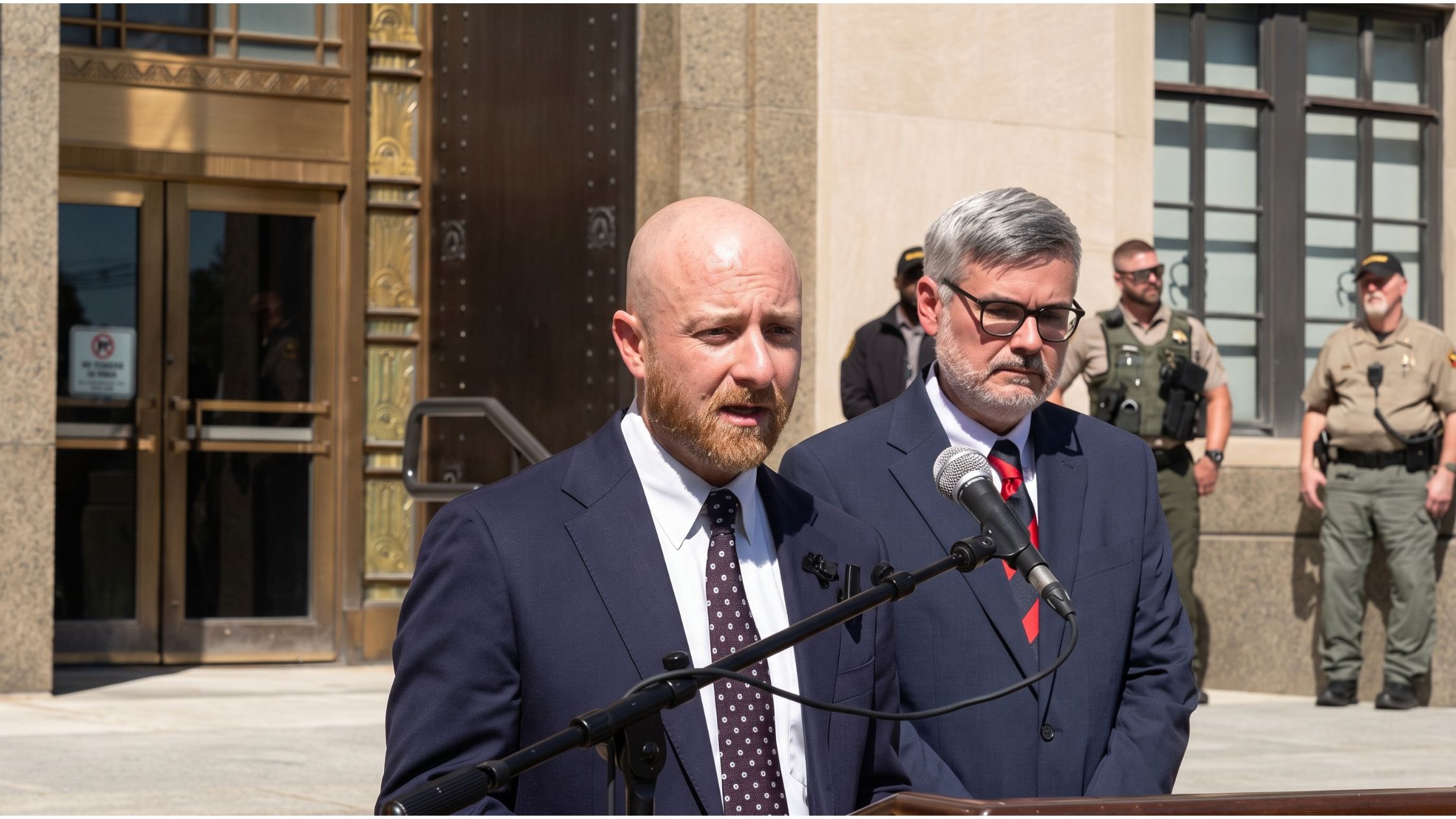
Speaker 1 (00:01):
We'll have Luke Ihnen speak first with the Federal Defender's Office of Eastern Tennessee, and then followed by Randy Spivey with Defendant's Conviction Defender's Office. We'll take about five questions after each of them speak.
Luke Ihnen (00:13):
So thank you all for being here. I hope that you saw today some of the frustration that we've had, the council that represent the death sentence inmates across Tennessee, the goalposts keep moving. Today's hearing was just a first step of many to preserve and enforce Krista's constitutional rights after this unprecedented botched execution.
(00:38)
As I said repeatedly, we have not asked the state to turn over any evidence at this point, only demanding that they preserve it so that her lawyers, experts, and the public can learn what really happened Wednesday night. Today's hearing was about transparency. About why Krista, the courts, the media and the public should not simply take the state's word about what happened last Wednesday. Because as we saw a little bit today, their word is shrouded in secrecy and legal jargon in attempts to obfuscate and obscure what really happened.
(01:19)
We appreciate you all sharing these concerns. We encourage you all to use the tools at your disposure to keep pushing for information from the Department of Corrections. We encourage you to ask questions not only of us, but of the state, of TDOC, of the Attorney General's office, of the governor to figure out what really happened last week. Thank you.
Randy Spivey (01:56):
Krista is a survivor. She survived child sexual abuse. She survived rapes of multiple men. She survived a suicide attempt when she was 12, and she survived the state's attempt to execute her. She deserves answers about what was done to her, and the people of Tennessee deserve those answers too.
(02:14)
On Monday night, it was our understanding that Krista was brain-dead and that life support would be removed the next day. But on Tuesday, to the shock of everyone, including me, including her team and including the medical team, Krista woke up and began talking. I do not have an explanation for what happened between Monday night and Tuesday morning. But what we do know is that Krista has a long road to recovery.
(02:41)
She has a blood clot in one of her arms. She has pneumonia. She is not able to swallow yet, so she has not eaten. She cannot move either of her arms. Both of her arms and hands are tremendously swollen, and we do not know what, if any, function she will regain in her arms. But we do know that there's a long road ahead. And that is just the physical toll that all of this has taken.
(03:09)
Neither we nor Krista have even begun to process what this means for her mental health. Krista was at peace. She helped the execution team find what they thought was venous access. She was kind and polite as they worked for an hour, stabbing her arm with needle after needle. And then she felt the burn of the Phenobarbital. And then she woke up in a hospital surrounded by people she didn't know with a tube down her throat. We don't know the toll all of this will take. But Krista is a survivor and we remain hopeful.
(03:45)
All of this was foreseeable and foreseen. What happened to Krista is exactly what the state was warned would happen. And there are so many questions that need to be answered, not by Krista, but by the state of Tennessee. But one of those questions has to be how much suffering is enough? Krista has endured child sexual abuse, physical abuse, rapes, and more than 20 years of solitary confinement. And then September 30th happens. We have to ask how much suffering is enough?
(04:20)
We continue to ask Governor Lee to commute Krista's death sentence. After all we have seen and all that we still do not know, it is unimaginable that the state would try to execute her again. Thank you.
Speaker 4 (04:33):
[inaudible 00:04:33].
Speaker 5 (04:33):
I understand that you-
Speaker 4 (04:33):
[inaudible 00:04:33].
Speaker 6 (04:33):
Okay. What was the first thing that Krista said or what has she been talking about since then? Does she remember what happened?
Randy Spivey (04:48):
I was not in the room when she woke up, so I don't want to speculate too much. Our understanding was the first thing she said was, "Where am I and who are you?" There's still a lot of cognitive confusion, and so I will say that. She has wanted to know what's happened and she's asked about several people. She's asked about her team. She's asked about the victim's family. I think she is angry and confused about everything right now.
Speaker 7 (05:22):
Is she aware that the state tried to execute her and-
Speaker 1 (05:26):
Go ahead.
Speaker 7 (05:26):
... has she said anything about what [inaudible 00:05:30]?
Randy Spivey (05:30):
She is very aware that the state tried to execute her. And again, I don't want to say what she remembers and what she doesn't remember at this point because I think that's evolving. And I want to be very, very careful of that. But she's very aware of what they did to her up to a point. And that's as best I can do.
Speaker 8 (05:52):
How will the preservation of evidence affect her legal claims going forward?
Luke Ihnen (05:57):
So as we said today, the state has an obligation to preserve that evidence. We don't know what future claims Krista might raise. We don't know if the state's going to attempt to execute her again. We've certainly warned them that this exact thing would happen. And so the request today that the judge granted was just to preserve all that evidence. To preserve her constitutional right to be free from cruel and unusual punishment should that need arise in the future.
Speaker 9 (06:35):
Had tests been done to ascertain [inaudible 00:06:36].
Randy Spivey (06:36):
I'm not going to talk about test and medical procedures because I'm not a doctor and I want to be very careful with HIPAA things. I can only comment on what I've seen. And so what I will say is there was levels of confusion. And there were times that she, for lack of a better sense, kind of spaced out a little while. I don't know about the rest and I'm not going to comment on the rest.
Speaker 10 (07:08):
[inaudible 00:07:08].
Speaker 11 (07:08):
Can you talk about where she is right now and what state she's in?
Speaker 1 (07:08):
Go ahead.
Speaker 11 (07:08):
Can you talk about the state that she's in right now? What she's connected to, the medical care that she's receiving? Any of that [inaudible 00:07:12].
Randy Spivey (07:11):
I'm not going to comment on the medical care she's receiving or what she's connected to. One, because I have no idea what any of that stuff means. I'm not a doctor and so I want to be very careful with that.
Speaker 11 (07:21):
[inaudible 00:07:22] handcuffs. The handcuffs.
Speaker 12 (07:25):
Can I go? Pertaining to what we heard today, why was there an effort made to hold the state accountable to following the procedure? Are there concerns things will disappear?
Randy Spivey (07:36):
I want to fit you first. You're just asking about the restraints?
Speaker 11 (07:38):
Yes.
Randy Spivey (07:40):
Yes. So she is shackled at her feet and on her right arm to the bed.
Speaker 12 (07:46):
I'm happy to repeat, but-
Luke Ihnen (07:48):
Yeah, can you repeat it?
Speaker 12 (07:49):
Yeah. The state said over and over again today that it is making every effort to follow the procedures. It has told to you all that it is following procedures. The judge even said there are differences between efforts and a court ruling. Are there concerns things could disappear?
Luke Ihnen (08:06):
I don't want to assume any sort of ill intent on the state's half. I will say four years ago, the governor paused elections and we had an independent review and we're back in the same place. In January, we were in the same courtroom raising these concerns. They were dismissed, scoffed at. And so we don't have a lot of faith when the Attorney General's office say that they're going to do something that they're going to do.
Speaker 1 (08:32):
Go ahead.
Luke Ihnen (08:32):
[inaudible 00:08:35].
Speaker 13 (08:32):
Sir, can you describe the injuries on her arms a little more and what they look like? And is there any chance that you may have to have an amputation?
Randy Spivey (08:43):
So I have no idea about the second part. I'm not going to make a diagnosis. And a lot of the arm was covered up obviously with medical whatever. I will say that the swelling is what I noticed. And her hands looked like if you were to blow up a surgical glove. The swelling was extraordinary and that's probably as far as I can go with that.
Speaker 14 (09:14):
Can you elaborate on [inaudible 00:09:14].
Speaker 1 (09:14):
Go ahead. Last one. Last question.
Speaker 15 (09:14):
Sir, could you give us a layman's term on what happened today?
Luke Ihnen (09:16):
I can try. So we filed a lawsuit in January raising... And if you were in the courtroom, I read many of the allegations that we raised pertaining to her vein access. Potential problems pertaining to the drug that the Tennessee Department of Correction is using. Pertaining to the secrecy around the entire procedure. Who's involved, what their qualifications are.
(09:44)
The court dismissed that complaint. Transferred that case to the Tennessee Supreme Court based on a new rule that the Tennessee Supreme Court passed. And that is the procedure that led to the hearing in August. After the botched execution last week, we wanted to seek to preserve all of that evidence. The state, as I said today, had made assertions in public filings before the United States Supreme Court that this matter was still actively pending.
(10:16)
Until yesterday, Ms. Pike was unable to speak. She was unconscious. She was not able to authorize us to file any sort of new lawsuits. And so the motion that we filed is just to preserve evidence. It's the very, very first step of what will be a long legal battle, we presume.
Speaker 1 (10:39):
Thank you everybody. Thank you.
Speaker 17 (10:40):
Commissioner Frank Strada has resigned.
Randy Spivey (10:40):
Thank you.