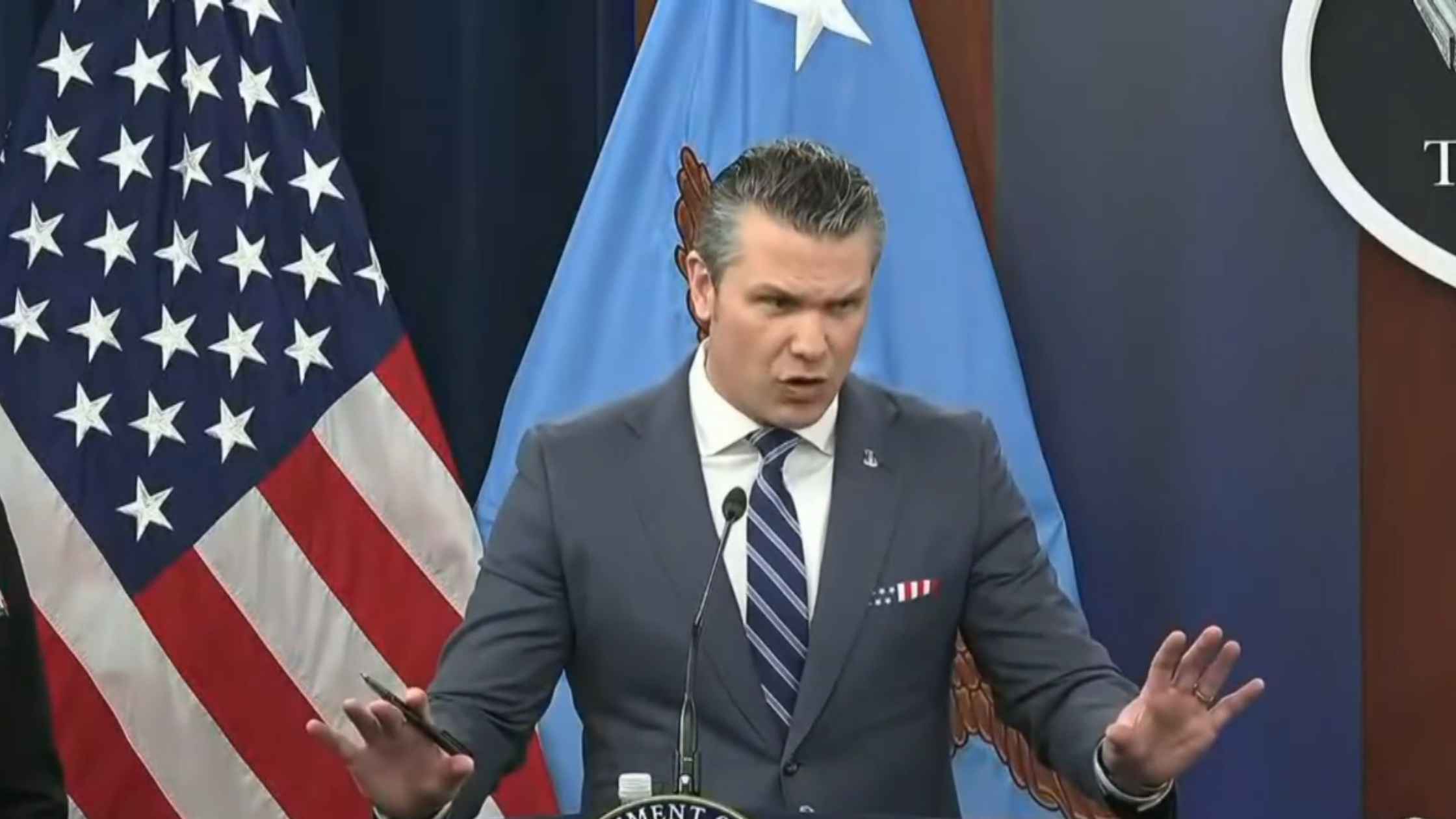
Pete Hegseth (08:07):
Well, good morning. And as you may have noticed, the chairman and I are joined today by the CENTCOM Commander Admiral Bradley Cooper. He just returned from the front lines to see the troops and meet with allies, and this morning briefed us just before this briefing on the latest on all aspects of Operation Epic Fury. So after the chairman concludes, we'll ask Admiral Cooper to share a quick update on the ground truth from his trip to the region as he continues to implement an iron-clad blockade and ensures that our forces are maximally postured to restart combat operations should this new Iranian regime choose poorly and not agree to a deal. And that is what we urge this morning, that this new Iranian regime choose wisely.
(08:54)
Which is where we'll start, with a message to Iran's military leadership. To the KH leadership and IRGC leadership, we're watching you. Our capabilities are not the same, our military and yours. Remember, this is not a fair fight. And we know what military assets you are moving and where you are moving them to. While you are digging out, which is exactly what you're doing, digging out of bombed out and devastated facilities, we are only getting stronger. You are digging out your remaining launchers and missiles with no ability to replace them. You have no defense industry, no ability to replenish your offensive or defensive capabilities.
(09:39)
You only have what you have. You know that and we know that. You can move things around, but you can't actually rebuild. You can dig out for now, but you can't reconstitute. But we can. We are reloading with more power than ever before and better intelligence. Even more importantly, better intelligence than ever before, as you expose yourself with your movement to our watchful eye.
(10:08)
We are locked and loaded on your critical dual-use infrastructure, on your remaining power generation and on your energy industry. We'd rather not have to do it, but we're ready to go at the command of our president and at the push of a button. This blockade, which the chairman will detail this morning, is the polite way that this can go. Your energy is not moving and will not move, and we can do this all day. But it's not destroyed yet, your energy industry is not destroyed yet.
(10:43)
You like to say publicly, Iran, that you control the Strait of Hormuz, but you don't have a navy or real domain awareness. You can't control anything. To be clear, threatening to shoot missiles and drones at ships, commercial ships that are lawfully transiting international waters, that is not control, that's piracy. That's terrorism. The United States Navy controls the traffic going in and out of the Strait because we have real assets and real capabilities. And we're doing this blockade, performing it with less than 10% of America's naval power. The math is clear. We're using 10% of the world's most powerful navy and you have 0% of your navy. That's real control and we have a long track record of dealing with pirates and terrorists.
(11:43)
But there is an alternative. As our negotiators have said, you, Iran, can choose a prosperous future, a golden bridge, and we hope that you do for the people of Iran. In the meantime and for as long as it takes, we will maintain this blockade, successful blockade. But if Iran chooses poorly, then they will have a blockade and bombs dropping on infrastructure, power and energy. And at the same time, Treasury Secretary Scott Bessent and our friends over at Treasury are launching Operation Economic Fury as well, maximizing economic pressure across the entirety of the government. To Iran, choose wisely.
(12:27)
The world watched and so did you as the US Military moved seamlessly from major combat operations to a world-class blockade. We can make that transition again, very quickly and even more powerfully than ever. At the direction of President Trump, the War Department will ensure that Iran never has a nuclear weapon. Never. We'd prefer to do it the nice way, through a deal led by our great vice president and negotiating team, or we can do it the hard way. We urge
Pete Hegseth (13:00):
... This new regime to choose wisely. Speaking of choosing wisely, a note to the press, to the press corps, to the American media. As I just can't help, but notice the endless stream of garbage, the relentlessly negative coverage you cannot resist peddling despite the historic and important success of this effort and the success of our troops. Sometimes it's hard to figure out what side some of you are actually on. It's incredibly unpatriotic. This same press corps, not this exact same press corp, but at least an older press corps, bent over backwards during the Biden administration to explain away, you explained away, the disastrous and disgraceful Afghanistan withdrawal. You called it the greatest airlift in American history. It's almost like you're cheering only for one side. This past Sunday, I was sitting in church with my family and our minister preached from the Book of Mark, the third chapter.
(14:14)
And in the passage, Jesus entered a synagogue and healed a man with a withered hand. The Pharisees came to watch. And as the scripture reads, they came to see whether he, Jesus, would heal him, or he would heal him on the Sabbath so that they might accuse him. You see, the Pharisees, the so called and self-appointed elites of their time, they were there to witness, to write everything down, to report. But their hearts were hardened. Even though they witnessed a literal miracle, it didn't matter. They were only there to explain away the goodness in pursuit of their agenda. As the passage ends, the Pharisees went out and immediately held counsel against him, how to destroy him. I sat there in church and I thought, our press are just like these Pharisees. Not all of you, not all of you, but the legacy Trump hating press.
(15:21)
Your politically motivated animus for President Trump nearly completely blinds you from the brilliance of our American warriors. The Pharisees scrutinized every good act in order to find a violation, only looking for the negative. The hardened hearts of our press are calibrated only to impugn. I would ask you to open your eyes to the goodness, the historic success of our troops, the courage of this president and this historic moment for a deal that could end the Iranian nuclear threat. The incredible battlefield victory laid before your eyes. The not one, but two incredible rescue missions, miracles, you might say, or a locked in blockade. Or how about historic recruiting numbers? Yesterday, we announced that the Air Force and the Space Force met new, higher goals in FY '26, five months in advance of the end of the fiscal year, five months ahead of time. The Marine Corps and the Army will soon do the same. Two, three years ago, we couldn't meet lower recruiting numbers, not even close. Where are the reports on that? Where's the coverage of the new spirit in the country, the new spirit in the ranks, the surge of Americans wanting to join the greatest military in the world? Nothing from the fake news. We sense a pattern. You see, on the battlefield, these are demonstrations of uniquely American capabilities, strength and resolve. It's all around you each and every day. But in the press, you only seek the negative. Earning each and every day, the fake news label. But the American people with goodness in their hearts see past the Pharisees in our press. They see the goodness, you watching, you see the goodness. They see the success. They see the reality. And they don't demand perfection, and perfection is not possible on any battlefield, but they see the incredible feats that our troops accomplish every single day.
(17:36)
So to those troops, stay focused, block out the noise, stay aggressive. You are showing the world what it means to be an American warrior. You are making this building and the American people proud. We pray for you every day and we have your back in every way. And to Iran, choose wisely. I pray you choose a deal, which is within your grasp for the betterment of your people and for the betterment of the world. In the meantime, the war department is locked and loaded. Mr. Chairman, over to you.
Dan Caine (18:16):
Thank you, Mr. Secretary. Good morning, ladies and gentlemen. Thank you for being here today. Last week, the President of the United States directed a ceasefire that temporarily paused major combat operations in Iran. The unprecedented effort by America's Joint Force during Operation Epic Fury set the conditions for this ceasefire. And as the secretary said, I'd like to emphasize during this pause that the United States Joint Force remains postured and ready to resume major combat operations at literally a moment's notice. This morning, I'd like to give you an update on the ongoing blockade in the CENTCOM AOR, area of responsibility. On Monday, 13th April at 10:00 A.M. Eastern Standard Time. At the direction of the president, America's Joint Force began implementing a blockade against Iran under the leadership of Admiral Cooper and the team at CENTCOM. Let me be clear. This blockade applies to all ships regardless of nationality heading into or from Iranian ports.
(19:25)
The US action is a blockade of Iran's ports and coastline, not a blockade of the Strait of Hormuz. Enforcement will occur inside Iran's territorial seas and international waters. In addition to this blockade, the Joint Force through operations and activities in other areas of responsibility, like the Pacific area of responsibility under the command of Admiral Paparo will actively pursue any Iranian flagged vessel or any vessel attempting to provide material support to Iran. This includes dark fleet vessels carrying Iranian oil. As most of you know, dark fleet vessels are those illicit or illegal ships evading international regulations, sanctions, or insurance requirements. More than 10,000 sailors, Marines, and airmen, over a dozen ships and dozens of aircraft are executing this mission. And let me walk you through this operation a little bit. Please go to the first slide. First to the graphic, this is taken before the blockade began.
(20:42)
North is up. You can see the blockade line here in the center of the graphic denoted by the red dashed line. This map is a pull from our common operating picture that we use to allow commanders and key leaders to see what is happening in near real time. We just grabbed screen grabs to highlight the actions and activities. What is not shown is how incredibly congested this area is and the incredible work that our sailors are doing to ensure that they can work in and around an incredibly busy water space. What is also not depicted here is the massive force of fighters, intelligence aircraft, helicopters, and other embarked forces to include aerial refueling tankers that are up overhead this blockade area. You'll note that the US forces are in blue. Iranian ships are in red. And as we started this blockade, there were seven ships of interest that were of concern for US Central Command. Through a variety of intelligence tools and with the assistance of the Office of Naval Intelligence and other intelligence agencies, the force began to hunt for potential interdictors at 10:00 A.M. Eastern Standard Time. Next slide, please. It's now 12:40 Eastern Daylight Time, two hours and 40 minutes into the blockade as attempted blockade runners attempt to hop the line. US forces began to commit. Out in front of them was a range of intelligence, surveillance, reconnaissance, and tactical assets, and immediately these runners began to see, sense, and feel America's combat power compressing upon them. The lead ship, normally a destroyer, as depicted here, along with air power off of the USS Abraham Lincoln Strike Group, began to move towards those ships. At each point, the United States Navy will transmit a warning. A young sailor, normally on the bridge of one of those destroyers, a junior officer picks up that mic and transmits, and I quote, "Do not attempt to breach the blockade. Vessels will be boarded for interdiction and seizure transiting to or from Iranian ports. Turn around or prepare to be boarded. If you do not comply with this blockade, we will use force."
(23:36)
And as this message is being transmitted, as I mentioned earlier, those ship masters can literally see, sense, and feel the pressure around them. It's a finely tuned machine rehearsed multiple times and executed now 13 times since the blockade has begun. Next slide, please. We're now 24 hours plus into the blockade. You can see the turning around of multiple ships, 12 of which stayed inside the blockade line, one of which not depicted off to the eastern side, turned around before even attempting it. Any ship that would cross the blockade would result in our sailors executing pre-planned tactics designed to bring the force to that ship, if need be board the ship and take her over. And that includes a series of escalated force options, which could include warning shots and others. Next slide.
(24:37)
The final graphic shows taken at 11:20 P.M. the night of 14 April. You can see that the captains of all these ships have made the wise decision not to move, transit, or run this blockade. As I mentioned, so far, 13 ships have made the wise choice of turning around. And as we continue to hold this blockade at the order of the secretary and the president, any vessel that compares to comply with our instructions will be dealt with accordingly. As of this morning, US Central Command has not been required to board any particular ships. And I'll remind you that we are also conducting similar maritime interdiction actions and activities in the Pacific AOR against those ships that left that area before we began the blockade.
(25:33)
Before I turn it over to Admiral Cooper, I want to talk briefly today about the men and women enforcing the blockade, America's sailors and Marines, and today, particularly our destroyer and surface forces. When we talk about an American destroyer, it's important that you and the American people understand their capabilities. An Arleigh Burke class destroyer are the backbone of the United States Navy surface fleet. Over
Dan Caine (26:00):
... Over 500 feet long, they displace 9,000 tons and it is the sports car of the United States Navy. From the keel to the mast, they stand nearly 10 stories tall and their 4 gas turbine engines can drive the ship at 30 plus knots. These ships are armed to the teeth with surface air missiles, land attack cruise missiles, anti-ship missiles, anti-submarine rockets, torpedoes, five-inch naval guns, multiple electronic warfare systems, embarked helicopters extending the reach and capability of each and every one of these destroyers. But far and away, the most important weapon on board these ships is the American sailor. Over 300 war fighters are the heart and soul of these warships. At sea, sometimes for months, and these ships out in the CENTCOM AOR have been out there for months. They operate around the clock in a constant state of readiness, always delivering for our joint force.
(27:06)
It's hot in the engine room. The engineering team keeps the lights on and the ship powered and able to respond to the orders from the bridge. On that bridge, our sailors maintain a constant watch maneuvering the ship tactically and safely through always congested water space. And there is a lot out there. It is like driving a sports car through a supermarket parking lot on a payday weekend with thousands of kids in that parking lot as you attempt to maneuver through there to get to that ship that would attempt to run that blockade.
(27:45)
Down in the Combat Information Center, the CIC, the tactical warfare center of the ship, that is where the decisions are made. As threats appear, these young sailors are making real time decisions on how to identify these threats and handle them, and they always deliver. These ships are run by the youngest sailors in our surface warfare navy. The helmsman, the sailor on the watch at the bridge is normally just between 18 to 19 years old, and they are trusted to drive this warship through that supermarket parking lot without hitting anything. The conning officer, an equally young, commissioned officer who's normally just a few years out of college, is the ones that are giving that young helmsman the orders on where to take that American warship to execute the mission that the Secretary and the President has given us.
(28:44)
These are incredibly well-trained sailors. They are led by incredible leaders, salty, experienced leaders, and trusted with deep responsibility. And I'm so humbled and proud of America's Navy. These sailors choose to take the road less traveled to go into the historic surface navy and they deliver every single day.
(29:09)
Finally, as I often do, I want to highlight one of those surface sailors today and remember our fallen. Today, we remember Ensign Robert Thompson of the US Laffey who died on this day in 1945 in the Battle of Okinawa. He was killed while fighting a fire along with 31 others as 2 Japanese Kamikaze aircraft hit their ship. He passed away 1 week after his 22nd birthday and was posthumously awarded the Navy Cross. We remember Ensign Thompson today and all of our World War II vets who continue to give us the gift of a great example. And those surface warfare sailors who are out there doing the job right now take the courage, grit, and determination that those World War II vets gave us into these actions and activities that they're tasked to do every single day. So now I'd like to turn it over to Admiral Cooper to give us a readout of his recent trip to the region.
Admiral Cooper (30:13):
Well, good morning and Mr. Secretary, thank you for the kind invitation. And chairman, great to join you. It's a real honor to be here representing the more than 50,000 American service members deployed throughout the Middle East today, supporting operations. And it's great to have the opportunity to highlight the tremendous efforts our war fighters operating forward and the important partnerships with regional allies that continue to thrive. In fact, yesterday I returned from my second trip to the Middle East in the past 15 days. Two very different visits. One during our offensive operations against Iran and the second in this most recent trip during the ongoing ceasefire. Very different. During both of my recent trips, I visited with our troops who were deployed across the region in more than 70 different locations, an existence that largely spans between Florida and Arizona. I've long believed that every success that we have starts and ends with our people, and boy, does this shine through brightly.
(31:08)
During these visits, I had the privilege of personally recognizing more than 100 service men and women for their extraordinary valor, their courage, and their initiative under fire and delivering fire. And every time I interact with these young men and women down range, I am deeply inspired by their courage, their resilience, and their unwavering commitment. The stories are remarkable. In many cases, you've seen this play out over TV, fighter pilots who took out Iranian missile launchers in the moments prior to their launch against Americans and our partners, and who hit key military targets in and around Tehran on the attack more than 13,000 times. I met with some of the teams that helped to bring our F-15 airmen home safely from Iran and heard first person accounts of the stories. Absolute heroes.
(31:55)
I spent time with our troops who are employing cutting edge tactics and technology for the first time in warfare. I won't be able to talk about what those are, but these young men and women are breaking new ground. It's incredibly inspiring. I met with teams who launched our own one-way attack drones into Iran. These were originally Iranian designed drones. We brought them back to America, took the guts out, put a made American stamp on them and fired them right back to Iran. Very effective. Met with teams who were employing AI every single day to help us sift through vast amounts of information to help us make decisions faster. And importantly, humans are always in the loop in this process. I met with our Space Force teams and our cyber specialists whose work cannot be discussed, but who serve with indispensable impact. I met with our logisticians and sustainers all over the region. There is just no military that executes logistics like the U.S. Military. This group is doing exceptional work, moving thousands of tons every single day.
(32:54)
I met with our air defenders who shot down Iranian ballistic missiles. My message for this group in particular is that their actions most certainly saved thousands of lives across the Middle East during Epic Fury. And all told my personal assessment is after these couple of trips is our troops are highly motivated, they're focused, they're vigilant, and they're ready, and they're using this time to do a couple of things. We're re-arming. We're retooling and we're adjusting our tactics, techniques, and procedures. There's no military in the world that adjusts like we do, and that's exactly what we're doing right now during the ceasefire.
(33:29)
A little note about partners. My discussion with regional allies and partners, both at the senior civilian level and the senior military level, reinforced our shared commitment to regional security. But beyond that, having now fought together side by side, I assess that our military partnerships are stronger than ever as we continue to maintain a very active defense posture across the region during the ceasefire. And that posture stretches across the entire Arabian Peninsula and it runs from Northern Iraq all the way down into the Northern Arabian Gulf. In creating the largest air defense umbrella in the world across the Middle East, we embedded specially trained U.S. Military air defenders alongside our partner nation soldiers side by side, literally side by side. And to give you a sense of their contribution and impact, the King and Crown Prince of Bahrain both personally knew our soldiers by name. These leaders expressed appreciation for our service members who continue to stand shoulder to shoulder with our partners in support of regional defense. And this is a sentiment that is widely shared across every Gulf ally. I heard this message over and over again, which is we stand with you.
(34:38)
As the Secretary and the Chairman have said, Bahrain, UAE, Saudi Arabia, Qatar, Kuwait, and Jordan have been exceptional teammates. I had a chance to meet with both their senior leadership as well as their troops. Boy, equally inspiring and equally committed to mutual defense. They defended Americans and they offended their own country. It was inspiring. And there's been no better teammate than Israel. Together, the four best air forces in the world, the Israeli Air Force, the U.S. Air Force, and the Air Forces of the U.S. Navy and U.S. Marine Corps together met and exceeded our own military objectives over and over again. Twice in the past two weeks, I've met with the Israeli Chief of Defense to ensure that we remain closely aligned and we do.
(35:20)
And then finally, let me just close by saluting the brave men and women who are in uniform and who continue to answer the call with unrivaled lethality, great teamwork and resolve. We've asked them to stay ready during this period, and that's exactly what they're doing. I couldn't be prouder, and I know that you and the American people share in that same pride. Thank you so much.
Pete Hegseth (35:41):
Thank you. Appreciate that. All right, we'll take a few questions. Go ahead.
Alexandra Ingersoll (35:46):
Thank you. Alexandra Ingersoll, One America News. How is the Iranian's decimated command and control affecting the ceasefire at this juncture? Ergo, how are we enforcing a ceasefire with an enemy who has virtually no command and control? And then one other question about the Houthis being ... Have the Houthis been an issue in the Strait of Hormuz and the Bab al-Mandab Strait at the Red Sea? Are we tracking that militarily?
Pete Hegseth (36:17):
Appreciate that. On the ceasefire front, it's right, their command and control capabilities are highly degraded. So their ability to talk, see sense is at the worst it's ever been. But their motivation to want to stay in the ceasefire is very high because they understand that a violation of that ceasefire means a commencement once again of Admiral Cooper's forces, which went very poorly for them. So they have a high incentive to maintain that ceasefire even though they can't talk and organize as well as they'd like to. And then as far as the Houthis thus far, they have stayed out of it, which of course we think is a good decision by them, and I think is a reflection of the fact that over a year ago in Operation Rough Rider, we had an ongoing and intense campaign that demonstrated American capabilities, which has them hesitating to want to do something on that strait, which I think would be a poor choice right here. Right here.
David Zere (37:12):
Good morning, Mr. Secretary, gentlemen. David Zere, Real America's Voice. As commercial shipping ramps up, there was 130 ships a day going through that as that happens, ships have to anchor up and wait to pass through the narrow strait. Is there any progress with an international force to phase out U.S. Military led escorts or other? Is anyone stepping up to do that?
Pete Hegseth (37:41):
It's a great question.
David Zere (37:43):
Long term.
Pete Hegseth (37:43):
They should be. There's a lot of talk and what we've seen in this conflict from allies and those is a lot of talk, except for the ones that were mentioned by Admiral Cooper in the region who've been phenomenal. Other allies have talked a lot and haven't done anything. And as the President has pointed out, this is a waterway that the American commerce doesn't use all that much. We don't rely on the energy coming out of the Strait of Hormuz, but Asia does, and Europe does, and large parts of the rest of the world do. And so their ability to muster a collective defense or a clearing of the straits would be a wonderful thing. And we hear and see the talk about it, but when shots were fired and those countries were needed the most, they weren't there. They weren't in the strait, they weren't alongside us. Their leaders weren't rallying what they have of their navies.
(38:32)
If they decide after CENTCOM does the heavy lifting, which again, they should be able to do. We should live in a world where other countries can defend waterways, not just the United States Navy. Should that conclude, which we believe it will, then we would welcome other countries coming in after the fact, but you can't live in a world in perpetuity, and this is a message to the rest of the world and our allies where you just rely on America to continually do the heavy lifting. Oh, Iran might get a nuclear bomb. Who's going to do something about it? America
Pete Hegseth (39:00):
... and America only. Other allies need to invest in their capabilities, so they can project power and do basic tasks, like clearing a strait. So, we're not counting on it, but it would be wonderful to see it if it ever materialized. Yes.
Alexandra Ingersoll (39:13):
Thank you, Mr. Secretary. Thank you all for your time. I have a couple questions. I know you said a few weeks ago that Iran's supreme leader was wounded and disfigured. Do you have an update on whether he's even alive at this point? And then, another question for you. Iranian embassy accounts are sharing an AI video of Jesus Christ bloodily killing President Donald Trump. Does The Pentagon have a response to this, including the fact that this AI Jesus is casting Trump into hell? And then, finally, for Admiral Cooper, could you speak to us about the morale of the American service members that you're seeing in the Middle East? I think Americans are really interested in what their experiences and testimonies are like.
Pete Hegseth (39:55):
As far as the status of the individual you mentioned, I believe it's the same. Not a lot coming from him right now, understandably so. A lot of fear. Believed to be alive, wounded and disfigured. Status remains the same. As far as a video like that, of course, that's disgusting and detached from reality. Iran says a lot of things in the propaganda space based on complete lies and their actions have been lies. We see missiles going into civilian facilities and hotels in the Gulf states and they say, "We only target military targets," as you watch drones and missiles go into... So, they are going to misrepresent lie, spin in a multitude of ways, which we are quite used to. Ultimately, they need to come to the table and make a deal. And I'll hand it over to Admiral Cooper for this.
Admiral Cooper (40:44):
Yeah. I would just reiterate my previous comment, morale is very high. And anyone in the military can take about two seconds to figure out what morale looks like by meeting around with the people. And it is crystal clear, these are motivated young men and women. I had the wonderful privilege of writing a letter early on in the operation to the team forward. And I told them this was going to be a mission of extreme consequence. And serving at a time where you are making a difference, consequential, as the secretary and the chairman have described over and over again, is incredibly and deeply meaningful. And I think that's the key part of the drive, as well as being great teammates across the board. It's a privilege to watch.
Pete Hegseth (41:19):
Absolutely. Jerry.
Jerry Dunleavy (41:22):
Thank you. Jerry Dunleavy with Just The News. I have a couple of questions. First is some critics of the Trump administration policy, including former NCTC director, Joe Kent, have attempted to claim that the Trump administration's policy of zero enrichment for the Iranians is not actually President Trump's policy, but was foisted upon him by the Israelis. Looking back, doing a bit of a refresher for myself, I saw that zero enrichment was the Trump State Department's policy in the first admin-
Pete Hegseth (41:59):
Just stop for a second. As someone who, unlike the individual you referenced, is in the presence of the president nearly every day and has been inside every single key meeting that has happened surrounding the idea of Operation Epic Fury, not a single thing has been foisted upon the president of the United States. President Trump makes his own decisions about the interests of this country and defending our interests, and then working with allies and partners, in this case, Israel, who's got a lot of will and a lot of capabilities, which we're grateful for. Nothing gets foisted on President Trump. So, people who are not in those meetings who like to say things about that are just flat wrong.
Jerry Dunleavy (42:37):
I had a quick one for Admiral Cooper, if that's okay?
Pete Hegseth (42:39):
Sure.
Jerry Dunleavy (42:40):
Thank you, sir, and thank you for being here. So, during Operation Epic Fury, 13 US service members have lost their lives. Some of them in an apparent aircraft refueling accident and some of them from Iranian strikes, including a drone strike. I was wondering if you could share a little bit with us about how those Iranian strikes were able to be successful? And what lessons you've learned and how you're applying those lessons in the future to make sure that we're able to defend a little bit better against that sort of thing?
Admiral Cooper (43:18):
Sure. Really broad question. But first, we will always honor the fallen and the 13 who lost their lives really helped steel the resolve and congeal the motivation of the forces that are... I met many people who knew the fallen personally. I met many who were reported as wounded and are back. 90% of those who have been wounded have been back to duty. It gives you a sense of purpose and motivation. We have collected dozens, if not hundreds of lessons learned. And as we sit here right now, the joint force across the board is taking them and very tactically applying them right here, right now.
(43:53)
If I think about a football analogy, if it's halftime or between the third and fourth quarter, great teams are always adjusting, and we are certainly a great team. And that's what we're doing right now, taking the lessons and applying them in a meaningful way. What those are, I'm not going to talk about.
Speaker 1 (44:07):
I'll say they extend also outside of CENTCOM and across the rest of the joint force, we are a learning organization, so adversaries around the world should recognize that and be aware of that.
Pete Hegseth (44:18):
No doubt. And likewise, I mean, the chairman and I have had the opportunity to greet those 13 and their families at Dover, and it does steel our resolve. And I can just attest to the planning that went into every aspect of this and Force Protection, ensuring that CENTCOM has whatever it needs and that they're taking the proper posture has always been a number one in this effort. Last question.
Speaker 2 (44:41):
Thank you, Secretary Hegseth. There's reporting that says US intelligence indicates China is preparing weapons shipments to Iran during this ceasefire. What's your reaction? Are these reports accurate? And what would be the consequences for the Chinese if they move forward with these shipments?
Pete Hegseth (44:56):
Well, as you know, President Trump has a very strong and direct relationship with President Xi, and they communicated on that and China has assured us that that indeed is not going to happen and in the spirit of the meeting they'll have next month. Thank you very much. Appreciate it. Thank you.
Speaker X (45:11):
[inaudible 00:45:13].
Speaker 3 (45:11):
Will you respond to the pope, Mr. Secretary?