Mayor Zohran Mamdani (00:03):
Good afternoon. Before I speak about our city's fiscal situation, I want to take a moment to mourn the loss of a true titan, Reverend Jesse Jackson. When Reverend Jackson marched, millions followed. When Reverend Jackson organized, laws changed and coalitions formed. When Reverend Jackson spoke, the world listened. Time and again, we knew that hope still lived because Reverend Jesse Jackson kept it alive. I know that I'm joined by millions of New Yorkers in sending my deepest condolences to his wife and to their children.
(00:45)
Now I want to turn to today's budget presentation as I share our preliminary budget for the upcoming fiscal year. I want to be clear about the moment we are in and the two paths that lie before us. As the mayor of New York City, I have a legal obligation to balance the budget. I will meet that obligation. This administration will govern with the seriousness, responsibility and accountability that has too long been absent from city hall.
(01:14)
When we took office, we inherited a historic budget gap, our aggressive savings plan, daily incorporation of updated revenue and bonus estimates, and our deployment of in-year reserves in tandem with more than a billion dollars in additional aid from Governor Hochul have lowered that deficit from an initial $12 billion to $5.4 billion. While considerably less, it is still a significant chasm. I know that for those who have watched budget after budget, it is tempting to assume that we are engaging in the same dance as our predecessors.
(01:48)
Let me assure you nothing about this is typical. That's why our solutions won't be either. There are two paths to bridge this gap. The first is the most sustainable and the fairest path. This is the path of ending the drain on our city and raising taxes on the richest New Yorkers and the most profitable corporations. The onus for resolving this crisis should not be placed on the backs of working and middle-class New Yorkers.
(02:14)
If we do not fix this structural imbalance and do not heed the calls of New Yorkers to raise taxes on the wealthy, this crisis will not disappear. It will simply return year after year, forcing harder and harsher choices each time, and if we do not go down the first path, the city will be forced down a second more harmful path. Faced with no other choice, the city would have to exercise the only revenue lever fully within our own control. We would have to raise property taxes. We would also be forced to raid our reserves to balance the budget as required by law, our preliminary budget takes the only path within our control.
(02:54)
The second path. The options of the second path are the options of last resort options that we will only employ if there is no other means of arriving at a balanced budget. We will spend the coming months doing everything in our power to ensure that our final budget reflects the first path. We remain firmly within a budget crisis. It is a crisis that we can and will overcome, but we cannot do so without either significant structural changes in Albany or painful decisions of last resort here at home. I'm encouraged and heartened by the relationship that we have built with Governor Hochul and the state legislature and hopeful that we can arrive at a fair solution at the end of this budget process.
(03:46)
Now, let's walk through what we inherited, what we have done so far and what lies ahead. We begin with the budget crisis we inherited. This crisis did not materialize overnight. It originated with Mayor Adams 2025 November plan. The city's budget at the time was $118.2 billion. That plan projected a $4.7 billion gap in fiscal year 2027 and a $6.3 billion gap over fiscal years 2028 and 2029. We now know that those gaps were significantly understated.
(04:24)
To understand the magnitude of what we inherited, the deficit left to us was larger than the gaps left by both Mayor Bloomberg and Mayor de Blasio to their successors, and that's even before accounting for enormous under budgeted needs by the prior administration. Adams November plan left the city with a $12 billion budget gap. When we took office, our team scrutinized every facet of city spending. What we found was in line with what former City Comptroller Lander found on December 16th, what State Comptroller DiNapoli found on December 22nd, and what City Comptroller Levine affirmed on January 16th. The $12 billion budget deficit confronting our city was historically vast. After incorporating $4 billion in revenue above what the November plan had assessed, and after taking standard budget actions, our administration found that our city's deficit was in line with the controller's projections. Today as we lay out our preliminary budget, every decision we have made has been informed by this context and the challenges we inherited. This was a historic deficit larger even than those faced during the Great Recession. Much of this gap came in the form of significant under budgeting for major expenses. The prior administration ignored projections that estimated costs would rise across six foundational city services like cash assistance, rental assistance, and shelter costs. More than $7.5 billion were left unaccounted for the consequence was an enormous deficit within our budget. Beyond those six areas, there are additional major unfunded needs. The city must fulfill more than $6.6 billion in additional unfunded needs and state mandates, the most sizable of which are detailed on the screen.
(06:11)
While we had no say over the budget crisis we inherited, we have taken a number of steps to address expenses and are monitoring our revenues daily to tackle the gap. In January in this very room, I promised we would continue to incorporate up-to-date Wall Street revenues into our budget. That is exactly what we have done. Part of our ability to shrink the gap has come from incorporating higher than expected revenues from Wall Street.
(06:35)
Wall Street profits are at a record high surpassing any projections and allowing us to incorporate more revenue than anyone anticipated. Those record profits translate into increased tax revenue, $2.4 billion more than anticipated in fiscal year 2026 and $4.9 billion more than anticipated in fiscal year 2027. That's on top of revenue already added in the November plan. We are being as aggressive as we can and recognizing additional revenue and have surpassed the state in our estimates of personal income tax, corporate tax and sales tax.
(07:09)
But responsible governance is not only about revenue, it is also about discipline. That means finding savings across city government, reducing bureaucratic waste, and rendering agencies more efficient and cost-effective. That is why I signed an executive order establishing a chief savings officer in every city agency. Chief savings officers or CSOs have a simple remit identifying savings within the agencies they serve. They will consolidate redundancies in-source programs that have been outsourced to bloated consultant contracts and eliminate extraneous programs.
(07:45)
Each CSO will issue a public report by March 20th, detailing the savings they have found and provide updated assessments every six months. These CSOs will have clear goals, 1.5% in savings in fiscal year 2026 and 2.5% in fiscal year 2027. Our work to find savings, however, is not limited to CSOs. We are pursuing a number of other avenues as well. We are significantly reducing current vacancies and removing hiring constraints to promote effective agency operations.
(08:17)
We are hiring 50 new auditors at the Department of Finance, which we expect will generate $100 million in new revenue per year. We are also adding 200 lawyers to the law department to reduce tort liability, which we anticipate will yield $125 million in savings in fiscal year 2027 alone. We are not just looking for savings and efficiencies in the short term. We are also going after long-term causes of cost growth.
(08:43)
Taken together, these aggressive savings measures maximal use of in-year reserves and daily recognition of updated revenues have allowed us to reduce the budget cap from $12 billion to $7 billion. I want to commend the members of my team who have exhausted every option to improve our fiscal outlook. I also want to thank Governor Hochul for her partnership. Yesterday, she announced that Albany would contribute 1.5 billion in state aid to help us bridge this gap.
(09:13)
As the governor aptly said, a strong New York City means a stronger New York state. I'm grateful to the governor for her support throughout the budget crisis. Here is what the state's $1.5 billion contribution includes $150 million per year reversing the distressed hospital sales tax intercept, $60 million per year reversing of a public health cost shift, $300 million per year invested in youth programming and $500 million in one-time unrestricted state aid. Much of the state assistance reverses long-standing Cuomo era cost shifts, and we've also just received information that new data in the state's school aid formula will bring an additional $97 million to New York City on a recurring basis.
(09:59)
All of that brings the fiscal deficit down to $5.4 billion, but I want to be clear, $5.4 billion is still a very steep mountain to climb, and there are two paths that we can walk. One that offers long-term stability and a second one with significant pain that we deeply hope to avoid.
(10:20)
The first path repairs the structural imbalance between the city and the state. We want to work with Albany to raise personal income taxes by 2% on the 33,000 New Yorkers earning more than $1 million a year and to raise corporate taxes on the most profitable corporations, and we know that for far too long, New Yorkers have given far more to the state than what we have received in return. It is time to end the drain.
(10:44)
If we cannot follow this first path, we will be forced onto a much more damaging path of last resort, one where we have to use the only tools at the city's disposal, raising property taxes and raiding our reserves. The second path is painful. We will continue to work with Albany to avoid it. This first path will deliver the structural change that we need to recalibrate the relationship between the city and the state because as we know, New Yorkers contribute 54.5% of state revenue, but receive only 40.5% back.
(11:18)
At the same time, New York City's portion of the state's GDP has grown by nearly 10% since 2010. That imbalance is untenable. Once again, I'm calling for Albany to end the drain. There is no third option of failing to balance the budget. By law, ever since the fiscal crisis of the 1970s, which placed the city on the brink of bankruptcy, New York City has been legally required to balance its budget. We will do so if we cannot pursue the first path. The only option we have remaining is the second path. At the heart of this path is a property tax increase. This would effectively be a tax on working in middle-class New Yorkers who have a median income of $ 122,000. The second path also requires us to raid our reserves. It would mean withdrawing $980 million from our city's rainy day fund in fiscal year 2026 and $229 million from the Retiree Health Benefit Trust in fiscal year 2027.
(12:18)
These are steps that have been taken before, but only in moments of extraordinary external crisis. Mayor Bloomberg's response to the 2008 financial collapse and Mayor de Blasio's response to the enormous revenue shortfall caused by the pandemic. We do not want to have to turn to such drastic measures to balance our budget.
(12:37)
Now, let's talk about what this means for our future. Let me share the details of our preliminary budget for the upcoming fiscal year, the needs that we're meeting and the investments we're making in New Yorkers. This is a budget that is balanced at 122 billion in fiscal year 2026 and 127 billion in fiscal year 2027. You can see here the breakdowns in spending by percentage of agency budgets. 40% of funding that goes to agencies is going to DOE, 26% is going to social services, 12% to our uniformed agencies and the remaining 22% to the many other agencies that keep our city running.
(13:15)
This reflects our priorities, education, healthcare, safety, and the everyday functioning of the city that we love. This preliminary budget increases city expenses by over $14 billion, expenses that we have to fund because the Adams administration failed to. This includes $7.5 billion for the six underbudgeted areas I mentioned earlier, including cash and rental assistance and shelter costs, and $5.85 billion to fund additional needs that were previously left unbudgeted.
(13:45)
As you can see here of our city dollars in this plan, only 4% represents new programmatic spending. Again, of $14 billion, only $576 million is
Mayor Zohran Mamdani (14:00):
... is going to deliver new programmatic spending. Some of that spending includes immediate protections for New Yorkers in this winter. $5 million helped us open warming centers and street outreach increases for homeless New Yorkers during the recent snowstorm. This also includes an addition of a hundred million dollars to our snow removal budget.
(14:19)
Beyond winter response, we are expanding services to our most vulnerable neighbors. We are increasing clinical and behavioral health services to New Yorkers living with severe mental illness and deepening our efforts to connect homeless New Yorkers with shelter and healthcare. And as we look to protect New York's fiscal health, we will also protect New Yorkers' rights. We are bringing on two hundred attorneys and a hundred support staff within the Law Department, and we are more than tripling baseline funding for HRA's Community Food Connection Emergency Food Program adding $54 million in fiscal year 2027 and onwards so that we meet the needs of New Yorkers in crisis.
(14:59)
Let's close with the long-term investments that we are making in our capital plan to deliver a healthy, vibrant, safe city for New Yorkers. We are showing you here the city's $113 billion preliminary five-year capital plan. Those investments span transportation, environmental protection, housing, schools, and other core priorities, the physical foundation of a thriving city. This capital plan also makes major investments in NYCHA developments including $662 million in fiscal year 2027 to boost renovations and over $38 million specifically to install heat pumps in more than 700 housing units in the Rockaways. We'll also invest over $48 million in the expansion of the adult comprehensive psychiatric emergency program at Bellevue Hospital. This is a critical need that will make an enormous difference in the lives of 2,500 additional New Yorkers each year.
(15:55)
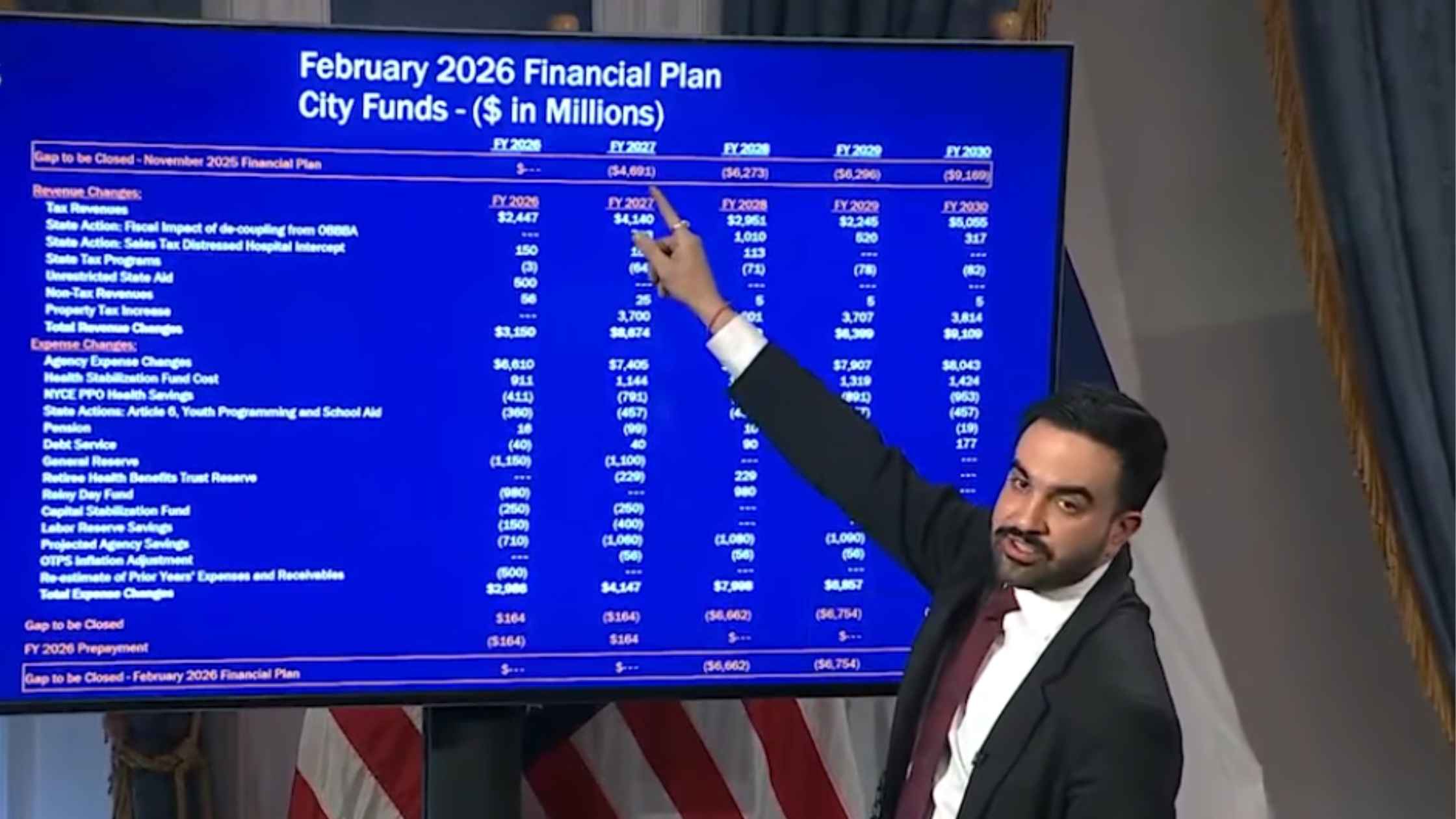
To conclude here is our preliminary budget as it stands. It reflects the second path that the city is forced to go down because today it is the only path fully within our control. But let me repeat what I have said many times this morning. This is the preliminary budget, we will do everything in our power to [inaudible 00:16:17] budget reflects the first path, a path that ends the drain and asks the wealthiest among us and the most profitable corporations to contribute that little bit more so that working New Yorkers do not bear the burden of this financial crisis. Now I will go through our financial plan. As you can see here at the top, this is the November 2025 financial plan released by the Adams administration that projected a balance of fiscal year 2026 and then the out year gaps of more than $6 billion with a gap of $4.6 billion in the fiscal year 2027. Here we see tax revenues, $2.4 billion, $ 4.1 billion fiscally in 2027 and then we have the out years. We can see here of the state action, the fiscal impact of the decoupling from federal legislation will yield $723 million in additional revenue starting in the next fiscal year.
(17:15)
Here is part of the $1.5 billion that I was referring to earlier from the state. This is the sales tax distressed hospital intercept. Here is the impact from state tax programs that we support but also have a fiscal impact on the city taking $3 million in revenue this year, 64 million the next year. This is the one one-time unrestricted state aid that I was referring to earlier, $500 million. Here are the non-tax revenues. These are effectively fines fees that are collected by the city, 56 million this year, 25 million the next year. This reflects the second path that we are forced to take within this preliminary budget, which showcases an increase in property taxes yielding $3.7 billion in the next fiscal year.
(17:58)
All of that leaves us with the total revenue changes of more than $3 billion in fiscal year '26, more than $8.6 billion in fiscal year 2027. Then if we go into the expense changes we see by finally acknowledging the under budgeted agency needs, we see a $6.6 billion change in this fiscal year, $7.4 billion in fiscal year 2027. This is a cost that the city has paid in recent years but not reflected on its budget. We are bringing that to be clear with New Yorkers as to the money that we are spending as the city, $ 911 million in fiscal year '26 for the Health Stabilization Fund, 1.144 billion in the next fiscal year.
(18:38)
These are the savings that we anticipate from the NYCE PPO Health savings, 411 million this year, 791 million next year through the renegotiation of city healthcare plans. Then here is part of the 1.5 that I was referring to earlier. This is the reversal of Article 6, the provision of youth programming and school aid. $360 million in fiscal year 2026, increases to 457 in the next fiscal year because of the addition of the 97 million in additional school aid. These are the costs of pension. We have 16 million this year, savings of 99 next year. Then we have debt service savings of 40 million this year, spending of 40 million the next year. Then we have the General Reserve 1.150 in fiscal year 2026, 1.1 billion in fiscal year 2027, leaving the required amount within that reserve.
(19:31)
This is the rating of the reserves that I was referring to earlier that we are forced to do in the second path. That's 229 million from the Retiree Health Benefits Trust Reserve. However, I will also show that in fiscal year 2028, we then return that funding back into both the Retiree Health Benefits Trust Reserve as well as the rainy day fund because we are seeking to put our city on firm financial footing. Rainy day fund, a withdrawal of 980 million in fiscal year 2026. Then we see the capital stabilization fund, 250 million, 250 million in both fiscal years labor reserve savings, 150 million here, 400 million in the next.
(20:09)
These are the savings I was speaking about of 1.5% in this fiscal year, 2.5% in the next projected agency savings with the CSOs. This is an adjustment for OTPS inflation of 56 million in 2027 fiscal year. This is a re-estimate of prior year expenses and receivables. All of that leaves us with expense changes of nearing three billion in fiscal year 2026, more than four billion in 2027, and then we go into the out years. Then as you can see as a result of these approaches, it is a balanced budget in fiscal year 2026. A balanced budget in fiscal year 2027 is required by law and then out year gaps here from '28 to '30.
(20:51)
And I'll just go through the next slide as well. This is an overview of the amount of money that we are receiving in the subtotal of taxes. You can see existing property tax, other taxes, tax audit revenue, tax programs, and then the increase in property taxes if the city is forced to do so. You then see the subtotal of city funds where in addition to those taxes we are adding in miscellaneous revenues, unrestricted intergovernmental aid, things of that nature. Brings us to 91 billion in fiscal year '26, 97.6 billion fiscal year '27, and then that brings us out with the addition of categorical grants to $122 billion for fiscal year '26, $127 billion in fiscal year '27.
(21:35)
Then if we look at expenditures, we're seeing personal service, we're seeing that come out to about 61.4 billion in fiscal year '26, 62.9 fiscal year '27, and then other than personal service, we see the subtotal of about 59.2 billion this fiscal year, 56.5 in the next fiscal year. All of those things added together with addition to the reserves as well, we find the total expenditures of $122.3 billion for this fiscal year, $127 billion for the next fiscal year. The gap to be closed in '26 is zero and '27 is zero as required by law and then the gaps in the out years.
Speaker 1 (22:13):
We'll now take your questions and I have the first deputy mayor and budget director available for them as well. We'll start with Katie. Go ahead.
Katie (22:28):
Hi, Mayor Mamdani, I'm [inaudible 00:22:32]. Could you just explain if the nuclear option is the one you have to go with, what would the property tax rate be increased to, and that would be for all the four class of properties? And then secondly, on a broader level, I know you ran on an affordability agenda and this would likely, if this happens, if this goes down that path, not only would it go up for homeowners and you haven't reformed the property tax system yet, but it would likely go up for renters because of the tax rate on multi-unit buildings. Do you want to first talk about the tax ratings and then also the betrayal that some of your supporters might feel by increasing things for them?
Mayor Zohran Mamdani (23:07):
So I'll first speak about this broadly and then I'll go [inaudible 00:23:11]. I want to be first very clear, this is a preliminary budget. This is a budget that reflects the only tools that the city has at its disposal. When we are speaking about property taxes, that is a tool of very last resort. We believe it should be viewed as such not only because it is a broken property tax system, but also because this is a fiscal crisis that was not created by working and middle-class New Yorkers. It should not be placed on their backs in order for the city to resolve it.
(23:40)
That is why we will continue to spend each and every day through this budget process emphasizing the need to chart out the course of the first path. That path would mean increasing taxes on the wealthiest New Yorkers, the most profitable corporations, and ending the drain that has long characterized the relationship between the city and the state. The property tax increase, if the city was forced to do so would be at a 9.5% increase. This is something that we do not want to do and this is something that we are going to utilize every single option to ensure does not come to pass.
Speaker 2 (24:13):
So Mayor, do you then blame Governor Kathy Hochul for refusing to do a tax hike both on the wealthy and on corporations, and just yesterday she gave you 1.5 billion additional dollars, but is it not enough? Will New Yorkers suffer at the expense of a governor who doesn't want to at all be criticized during an election year?
Mayor Zohran Mamdani (24:33):
I am encouraged by the partnership that we have been building with Governor Hochul, and I'm thankful for yesterday's announcement of 1.5 and now what we see translates into $1.6 billion in additional state aid, and I'm also very clear-eyed about the fact that we need to put the city back on firm financial footing. This is the beginning of both the city and the state budget process and that the most sustainable and fairest means by which we can do so is by raising taxes on the wealthiest, the most profitable corporations and ending the drain that has long characterized the relationship between the city and the state.
Speaker 2 (25:08):
[inaudible 00:25:09] her if she doesn't agree to that.
Mayor Zohran Mamdani (25:10):
I think what we are seeing right now is what the fiscal deficit is that the city is facing, $5.4 billion, and we are now going to use every single tool at our disposal to ensure that this is a fiscal crisis not resolved on the backs of working and middle class New Yorkers.
Speaker 3 (25:27):
It looks like there's a second part to this path. Number one, not just the income and corporate tax, but also ending the drain by fixing the imbalance. Is there a specific number that you're looking for in additional state funding that is part of that path number one? And is there, dare I say, a path number three that includes some of this, some of pulling out from reserves? Is it really just one or two in your eyes?
Mayor Zohran Mamdani (25:54):
The city contributes 54.5% to the state's revenue and receives 40.5% in return. We are looking for a fair reflection of the city's role within our state. And I'm heartened by the actions that the governor has taken yesterday, the reversal of a number of Cuomo-era cost shifts that we saw the city be targeted time and time again on. There are sadly many more examples of those cost shifts and the reason that we are emphasizing the need to increase revenue by taxing the richest New Yorkers, the most profitable corporations, the need to end the drain is that we need structural solutions to a structural crisis.
(26:38)
This is a crisis that if we do not resolve in a structural manner, we will only be postponing to have to return to it once again. I know that I do not want to be standing here in this blue room one year from now speaking to you about the very same nature of a crisis. It is a crisis that has long been brewing. This year is an opportunity for us to resolve it and put the city back on firm financial footing.
Speaker 3 (27:03):
Is there a dollar figure though in that ask?
Mayor Zohran Mamdani (27:04):
I can tell you the dollar figure that we are looking for is $5.4 billion to ensure that we do not have to go beyond the responsible use of in-year savings, the aggressive savings plan that we have also put forward and have to broach into the path that we have laid out today.
Speaker 1 (27:20):
Max, go ahead.
Max (27:22):
Two quick ones. The February 25th bunch of groups are going up to Albany to follow through on your demand here to pass the Tax the Rich. The Times reported you aren't going. Has that changed? How are you going to kind of keep this push going? Second, what did you do to inform your coalition partners here that you were proposing this kind of nuclear option that is scary to a lot of working class New Yorkers about a property tax increase?
Mayor Zohran Mamdani (27:47):
We have been clear from the very beginning of our time as an administration that the city is facing a significant fiscal crisis, the likes of which we have not seen in a
Mayor Zohran Mamdani (28:00):
Long time and it is a fiscal crisis that will require attention to structural fixes. So when we first came forward in this blue room, we spoke about the $12 billion that we saw as the fiscal deficit in line with controllers assessments. That was a $12 billion deficit after the assumption of $4 billion in increased revenue on top of the November, 2025 plan. In the time since then, we look to utilize every tool at our disposal to bring that number down. That is why we've put forward an aggressive savings plan. That's why we have CSOs. That's why we're looking at every potential efficiency at every opportunity to eliminate waste. That was a key part of driving that 12 billion down to seven. Now, thanks to the state's aid, we are looking at $5.4 billion.
(28:48)
However, we are reaching this number having exhausted almost every option in front of us, which then requires us to chart out what the two courses of action are. The course that we believe is not only the fairest course, also the most sustainable course is by ensuring that we end the drain, and that we increase taxes on the richest New Yorkers as well as the most profitable corporations.
(29:14)
That is something that I have long said. It is something that I will continue to say because what we are seeing is the absence of that would force us to resolve a generational fiscal crisis on the backs of working and middle-class New Yorkers who did not create it.
Nick (29:29):
Tell that to your council member allies. And also February 25th.
Mayor Zohran Mamdani (29:33):
We have shared this over the...
(29:36)
As to the scale of this crisis and today the actions that we're taking to resolve this crisis. And I can tell you that I've just returned back from Albany from a five-hour budget hearing and also being at caucus weekend. We will continue to make plans as to how we engage with Albandy, it's going to be a constant part of these next few months.
Speaker 4 (29:54):
Morgan, go ahead then Marc.
Speaker 5 (29:55):
Hi, Mr. Mayor.
Mayor Zohran Mamdani (29:56):
Hi, Morgan.
Speaker 5 (29:56):
I'm just wondering why for a third option, why isn't savings a third option for the administration? Why isn't maybe getting relief from the class size mandates? A third option that you guys are looking at? And then separately, what happens if the council doesn't go along with the property tax raise?
(30:14)
Right now, the council speaker Julie Menin is saying that this is not something that should be on the table an option. So wondering what happens if the council stands opposed to this agenda.
Mayor Zohran Mamdani (30:23):
I agree that this is not something that should be on the table.
(30:26)
However, the city has very limited tools by which it can reach the legal requirement of a balanced budget in both this fiscal year and the next fiscal year. We are looking at every which way we can to bridge a $5.4 billion fiscal deficit.
(30:43)
And as part of our path of reducing the 12 billion to this point, we have a very aggressive savings plan. One that we anticipate as we showcase will yield around $1.7 billion over two fiscal years. And what we are doing in that savings plan is not just interrogating the efficiencies, the potential to eliminate waste, as well as pulling the city back from its instinct to engage in so many acts of outsourcing to consultants, but also to look at what are the medium-term actions we can take that could reduce the city's expenses.
(31:18)
Part of this is tort reform. Part of this is also hiring more fiscal auditors. That work will continue.
(31:23)
March 20th is when our CSOs will be presenting their plans to achieve those 1.5 and 2.5% savings. However, we are looking to exhaust every option in front of us. What we have to share with New Yorkers directly is that is how we got to $5.4 billion.
(31:40)
If we find additional savings, we will absolutely use them. However, responsibly, I cannot tell New Yorkers that that is the likelihood over these next few months. Instead, what we have to do is ensure that we do not balance this budget on the backs of working and middle-class New Yorkers.
Speaker 6 (31:55):
Mr. Mayor, this is an election year for Governor Hochul in the legislature. We already have a situation where the governor said, "I don't want to raise taxes on millionaires."
(32:06)
And this morning she said she doesn't support property tax hikes. I wonder if we have a situation where this is a clash between ideology and reality, and if faced with the fact that you won't get those taxes from Albany, would you really, really, really raise property taxes here in New York City?
Mayor Zohran Mamdani (32:25):
This is not a conversation on the basis of ideology. This is a conversation about a fiscal crisis. I have long believed in the importance of taxing the rich. I've said so publicly many a time, and I've long believed in the need for the state and the city's relationship to be a fair one.
(32:48)
What we are speaking about in this moment, however, is not just that long-standing belief, the long-standing issues that have characterized that relationship, but a generational fiscal crisis of $ 5.4 billion.
(33:02)
And when faced with this crisis, the question is who should pay these taxes? I believe that it should be the wealthiest New Yorkers, the most profitable corporations. I believe that they can afford to pay a little bit more. We are in the most expensive city in the United States of America. I firmly believe in the need to make this an affordable city.
(33:22)
I believe that we do so and reckon with structural crises by pursuing the first path, one of raising taxes on the richest New Yorkers, the most profitable corporations and ending the drain.
Speaker 6 (33:31):
But would you really, when push comes to shove raise the property taxes?
Mayor Zohran Mamdani (33:36):
I do not want to raise property taxes. I have said time and time again that it is a broken system, one that we are sincerely looking to reform, which is why we're going to be sending up a proposed piece of legislation in the next few weeks.
(33:50)
What I am showcasing to New Yorkers is that there is one tax the city can raise. It is a broken property tax system. We do not want to do so, which is why we have said time and again that we want to work with Albany to ensure that we resolve this fiscal crisis by addressing the structural roots of it.
(34:11)
Thank you.
Speaker 4 (34:11):
Go next.
Speaker 7 (34:11):
As you're considering structural problems, are the chief savings officers or city budget officials looking at all at any potential structural problems within some of the cost drivers that are driving up the spending?
(34:25)
I know there's been a bunch of criticism of the Carter cases and who it goes to and rental assistance payments going landlords who've already been critical of... Are you looking to propose any changes in some of the legislation that is actually pushing the costs up?
Mayor Zohran Mamdani (34:41):
We are taking a firm look at every single part of our city's budget, and that includes not only interrogating the immediate causes of this deficit, but also the medium and long-term structural issues that the city is facing.
(34:54)
I'm going to pass it over to my budget director to add to that.
Sherif Soliman (34:59):
Sure, and the short answer is yes. You mentioned the due process cases. It really stems from federal law and also state regulation, but we're looking at that.
(35:07)
We're also making investments in more special education programs. So the Department of Education that would obviate the need to have the Carter cases in the first place. So we're looking at that. The mayor mentioned tort reform. We're looking at that to reduce the amount of judgements and claims.
(35:23)
So the short answer is yes, we're exploring every opportunity.
Speaker 4 (35:26):
All right. Nick, go ahead then Sally,
Nick (35:31):
Hi. Could you explain how the property tax increase would [inaudible 00:35:35] in the next two weeks, if that were pass, would that mitigate it in the next few weeks? If that were to pass, would that mitigate any of what you said would be a severe impact on middle-class and working-class homeowners?
(35:53)
And just quickly, I also wanted to ask about, you said the vacancy reductions you're pursuing in this plan. Is there any risk of that affecting services and exacerbating short-staffing, which you've said is a huge issue?
Mayor Zohran Mamdani (36:04):
So I'll start with the second question, then I'll go to the first.
(36:08)
We are eliminating the two-for-one rule that agencies have been subject to for prior years. We are allocating funding such that agencies can hire 50% of the vacancies that have been longstanding in city government. And this is actually a part of our commitment to ensure that we're delivering the best possible city government to New Yorkers. Because what these rules and the inability of these agencies to hire for these vacant positions have done is ground government to a halt.
(36:37)
And we are looking to make the most efficient and excellent city government possible. And this will be a part and parcel of the approach that we're pursuing. Your other question?
Nick (36:46):
Property taxes.
Mayor Zohran Mamdani (36:47):
Yes, we are going to deliver a bill to Albany. It is not a hope, it is commitment. We are going to do so in the next few weeks. This has been part of a longstanding belief, not only of mine, but of many New Yorkers that the current property tax system is a broken system.
(37:06)
That is a belief separate from the preliminary budget. We are not looking to raise property taxes. We are not looking to reform the system only to then use the system in this fiscal year.
(37:17)
We believe the system has to be reformed, and we believe that the way to bridge this fiscal gap is by increasing taxes on the wealthiest and the most profitable, and by ending the drain. And I will also just add before we go to the next question, that this is the preliminary budget.
(37:32)
We will obviously have an executive budget and then we will have an adopted budget. We are showcasing the tools at our disposal that we can use to reach the legal requirement of a balanced budget.
(37:43)
Over the next few months. We will use every single day to ensure that we are building a adopted budget that reflects our desire for this to be a budget that not only reckons with the fiscal crisis that New Yorkers are facing, but also doesn't resolve it on the backs of working and middle-class New Yorkers.
Speaker 4 (37:59):
Sally.
Sally (38:00):
Mayor, I had two questions also. One of the ways you're balancing the budget, as you've said, is to pretty significantly draw down these reserves. They're generally intended for even more dire times than this one perhaps at the recession. I'm just wondering if this, I know this is just your first offer and there's a negotiation coming, but how committed are you to drawing down the reserves as substantially as you have in this?
(38:23)
And my second question is, when do your labor negotiations start and have you budgeted any kind of placeholder for that?
Mayor Zohran Mamdani (38:29):
So I'll start with the first question. If we can actually bring the slide back to this, exactly, right here. So what the second path forces us to do is to utilize the rainy day fund and the retiree health benefits trust reserve.
(38:44)
Now, as you can see in fiscal year '28, we do put investments back into those very reserves because we want the city to be on firm financial footing. However, there is a reason that we did not include these in our city's attempts to get to 5.4 billion, because these are the rating of reserves that we do not want to pursue.
(39:03)
These are the kinds of reserves that what we would rather do is ensure that they remain as they are so that the city can be on firm financial footing.
(39:10)
However, in order to get to this point of closing the gap on both this fiscal year and the next fiscal year, we are forced to raid the rainy day fund, the retiree health benefits trust reserve, and to increase property taxes across these other years.
(39:26)
Do you want to...
(39:28)
Oh, on the labor? Labor, sure.
Speaker 8 (39:30):
Labor negotiations are ongoing. They never really end. There are a few contracts that were never settled in the last administration like EMTs. Most of the labor contracts though, don't start to sunset until the summer.
(39:48)
There is a labor-
Speaker 4 (39:51):
All right, Melissa, then Henry.
Mayor Zohran Mamdani (39:54):
One moment, Melissa, we'll just finish that one.
Speaker 5 (39:57):
One and a quarter percent is in the labor reserve.
Melissa (39:59):
If you were to have your property tax reform passed through Albany, would ultimately we end up with the system that does what you're hoping for the state to do, which is for the wealthier property owners to be paying more.
(40:15)
And would that, in your view, potentially mitigate the problem of it falling on working class people? And then in addition to that, how can you say that property... How can you say that raising property taxes is necessary if your chief officers, your savings officers have not yet completed the process of looking through these various agencies?
Mayor Zohran Mamdani (40:40):
So, in this same budget, we can go back to this budget. So what you will find is the agency savings, 710 million in this fiscal year, 1.06 billion in the next fiscal year. The reason that I point to these is that while the CSOs have not yet returned with their analysis and assessments of their individual agencies, these are the savings goals that we are putting to them. 1.5% in this year, 2.5% in next year.
(41:12)
And so these are the most aggressive savings that we can pursue without inhibiting the functioning of city government.
(41:20)
We have seen in prior years what is required of city government when you are putting together 3%, 5%, things of that nature. What we are talking about is eliminating inefficiencies and waste, and ensuring that we're still a fully functioning city government.
(41:37)
And then to your earlier question on real property tax, before I pass it over to our budget director, we need to reform the real property tax system. And that has been something that's been understood in our city for years prior to this budget crisis. It's a system that is unfair. It's a system that is inequitable. It's a system that can barely stand up in court. And so the reforms that we are
Mayor Zohran Mamdani (42:00):
... we're going to put forward the piece of legislation. It builds on the work that has been done over many years. So I don't know, Sherif, if you can add to this.
Sherif Soliman (42:09):
So to add to what the mayor said, the property tax reform legislation will be modeled on the recommendations of the New York City Advisory Commission on property tax reform, which really advances structural changes to the property tax system that makes it inequitable in the first place. One of the things that we would be looking at is the elimination of the assessed value caps that create the inequities in the first place by having effective tax rates for homeowners, and Staten Island homeowners, and southwest Brooklyn homeowners in Canarsie in southeast Queens, higher than you would find in many cases in other parts of the city, for example.
(42:46)
To your question about co-ops and condos, one of the reforms is to use sales-based models to be able to value the property so that effective tax rates can be more in line with condos, for example, that are in the many tens of millions. It creates the structural form to create more equity throughout the system based on property value.
Speaker 9 (43:10):
Thank you. Henry, go ahead and we'll go to Josie.
Henry (43:12):
Hi, mayor. First on police and then on big picture. I see in the budget you brought the police number down to roughly 35,000. You promise this during the campaign, sought in the budget. I'm wondering what the overtime number is next year and in the out years? And then zooming out big picture here, I think you ran a campaign that you could best describe as like joy for working-class people for affordability. There's not a lot of joy in this room right now. We're not talking about free buses, we're talking about dipping into the rainy day fund. We're not talking about taxing millionaires, we're talking about taxing working-class people.
Mayor Zohran Mamdani (43:46):
Well, I am talking about taxing millionaires, but, yes.
Henry (43:49):
But not in-
Mayor Zohran Mamdani (43:49):
No, I think to your question, what we are speaking about today, what we are presenting on is what we have inherited. We have to engage with honesty, transparency, and directness with New Yorkers as to the fiscal health of the city that we have inherited over these last few months and then the years prior. And our agenda is not simply one to protect the city services that we already provide. It's to advance an agenda that makes it easier for working-class people to live in this city. Because as we all know, this is both the wealthiest city in the wealthiest country in the history of the world. And it's a city where one in four New Yorkers are living in poverty.
(44:39)
And so what we are looking to do is put our city back on a firm financial footing that also allows us to tackle the affordability crisis. And we know that part of this crisis has been fomented by the inability of government to meet the moment. We've spoken about this briefly with regards to the vacancies that have been kept year over year. We want to deliver the most excellent city government so that we can transform the most expensive city in the United States of America into one that every New Yorker can afford.
(45:06)
And that is precisely why I have been emphasizing the need for structural solutions to a structural crisis because what we do not want to do is engage in an annual budget dance where the city is trapped in annual deficits that it needs every single year one-time assistance with. What we need to do is reckon with the structural nature of this and put ourselves back on the kind of footing that allows us to advance an agenda.
Henry (45:33):
On the police questions. I mean, the projected over time, which you promised to slash.
Mayor Zohran Mamdani (45:38):
So what we have shown in this budget is an actual accounting of the cost that the city is paying for. Typically, what we've seen is a lot of these costs are obscured in the budget only to then be paid out later. So we have put that forward in this budget and we are also working towards the reduction of it as we have seen already through the police commissioner's actions.
Henry (45:58):
I didn't see a number. I mean, perhaps this is for the technical briefing. I don't mean to-
Sherif Soliman (46:02):
We can cover it in the technical briefing.
Speaker 9 (46:03):
We'll cover it in the technical briefing.
Henry (46:04):
Thank you.
Speaker 9 (46:04):
We've got time for a few more here. Just to remind you that the budget director will be available later. Liz go ahead and then Chris.
Liz (46:09):
Hi, Mr. Mayor. During the campaign you argued that raising taxes on the rich would help you fund an agenda like free buses, like city-owned grocery stores that would make the city more affordable. But now it seems as if you're proposing to ask the governor to raise taxes on the rich to help address this budget gap. At what point does those ongoing revenue stream will allow you to then fund things like the buses and other things that you have proposed? That's my first question. And my second question is, you're keeping NYPD money relatively flat, but you've been critical of the way the NYPD spends money. Why not extract savings from the NYPD and where is your department of community safety in this budget?
Mayor Zohran Mamdani (47:02):
So we have investments in the Department of Community Safety within our executive budget and what we have put forward in terms... If we can go back to the other [inaudible 00:47:13] These projected agency savings, they are across every agency. We are looking at a entirety of city government approach to achieve the 1.5 and 2.5%. And the reason for that is that this is a crisis that the entirety of city government is facing. And I've also said, as was previously covered, the importance of us continuing to not only address the long-term imbalance that has characterized the relationship between the city and the state, also to raise taxes on the richest New Yorkers and the most profitable corporations.
(47:54)
These are structural solutions that will provide with the foundation so that we can advance not only a solution to the fiscal crisis, but also an affordability agenda. Now, in the campaign I spoke about the importance of raising about $9 billion in additional taxes. I laid out the mechanisms by which we would do so. That continues to be the case. I continue to believe in the importance of that. What I'm addressing today is the immediate crisis at hand of which we are outlining is a 5.4 billion fiscal deficit that is critical for the city to be able to address by the time that it adopts its final budget.
Liz (48:29):
[inaudible 00:48:29] any new initiatives that are not in this current budget plan?
Mayor Zohran Mamdani (48:33):
Taxing the rich will put the city back on its firm financial footing and taxing the rich at the scale that we proposed not only does that, but also advances the affordability agenda. Now one thing I will also add is that within our budget also is a reflection of the state's more than billion dollar commitment to fulfill our campaign promise of delivering universal child care to New Yorkers. What we are seeing is not only money that's earmarked to fix 3K meeting the demand of New Yorkers across the city, but also for the first time in city history to deliver child care for two-year-olds, which will begin with 2,000 seats this year, 12,000 seats next year by the end of year four, a seat for every single two-year-old.
Speaker 9 (49:13):
All right. Got time for just two more. So, Josie, go ahead and then Chris will be last question.
Josie (49:16):
Hey, Mayor, how are you?
Mayor Zohran Mamdani (49:17):
Hi, Josie. How's it going?
Josie (49:18):
I have follow up on Melissa's question. I believe about the CSOs. Sounds like you're putting a ceiling on how much savings they can find. Can you clarify that?
Mayor Zohran Mamdani (49:28):
I would describe it more as a floor.
Josie (49:32):
You're not capping it at the...
Mayor Zohran Mamdani (49:34):
We are saying this is the goal that we have and if a CSO comes back and they find more savings or more efficiencies, then we will absolutely take it. However, given the nature in which the functioning of city government has been hamstrung by the prior administration's approach, whether it be through vacancies, whether it be for a two-for-one rule, whether it be by the grounding to a halt of many city services, we believe that 2.5% is the highest level of savings that we can anticipate agency-wide without starting to inhibit city services.
Josie (50:15):
All right. My next question regarding property taxes. Are you ready for blowback from black homeowners who would largely be most impacted by a property tax hike. This is a constituency that you've struggled with, especially obviously on the campaign trail. And today's announcement is likely to irk them, let alone if property taxes actually or higher property taxes actually come to be.
Mayor Zohran Mamdani (50:41):
What we are announcing is a path of last resort, one that we do not want to pursue. And I join in anyone across the city who is concerned by the prospect of raising property taxes because I do not believe that it is either the most sustainable or the fairest way to resolve this fiscal deficit. And I will be spending each and every day of this budget process looking to ensure that our final budget reflects the first path that we have put forward today.
Speaker 9 (51:09):
Thanks. Last question before we go to technical briefing in a bit. Chris, go ahead.
Chris (51:12):
Thank you. Want to follow up on Liz's question, Mr. Mayor. You're saying just to put the city on firm financial footing, so I just want to make sure I understand that clearly because I feel like you didn't answer Liz's question. Are you saying that this year's budget, the FY27 budget will not really be able to make good on your affordability agenda? Is this just a plan to stabilize the picture and that the promises will be acted on later on?
Mayor Zohran Mamdani (51:38):
We showed on day eight of our administration our ability to deliver on the largest promise within our campaign, which was to deliver universal childcare to New Yorkers. That is a commitment in tandem with the governor to not only fix childcare for three-year-olds, 3K, with more than a hundred million dollars earmarked for that, but also to deliver for the first time in city history childcare for two-year-olds for free from city government. 2,000 seats this year, 12,000 seats by the end of next year until we get to every single two-year-old by the end of year four.
(52:14)
We also continue our focus on making buses not only fast but free, taking every action we have at the city level to speed up the nation's slowest buses and continuing to advocate and work on making those same buses free. This budget that we have put forward, it is a budget that both looks to reckon with the kind of a fiscal crisis that we have not seen in this city in years and is also a budget that does not lose sight of the fact that this city as it is today is one that is far too expensive for working class New Yorkers and utilizing every tool that we have to advance an agenda to make it easier for them to keep calling the city their home.
Chris (52:53):
Just to follow up on police department.
Speaker 9 (52:59):
Make it quick.
Chris (53:00):
It's in there, that direction, increasing spending for the police department by $600 million. The largest driver of that is something called personal service adjustment. What is that exactly? Is that overtime spending?
Sherif Soliman (53:10):
Generally, yes, that's what it is. And we can cover the other investments like fleet, for example, core operational functions as well.
Mayor Zohran Mamdani (53:18):
And I think [inaudible 00:53:19] this is a reflection of what overtime actually is. What we've seen under prior administrations is an inability to account for the actual costs of city services, whether they be overtime, whether they be cash assistance, whether they be rental assistance. I mean, we've gone through slides or just across six specific areas. We're looking at more than $7 billion. And then across others close to another $7 billion. And as was stated earlier, we have made clear that this is a budget that will look for savings in every single agency across our city government because it is a crisis that faces every single agency in our city government. [inaudible 00:54:00] Thank you, guys.