







Speaker 1 (00:01):
And please stand and welcome the 57th governor of the State of New York, Governor Kathy Hochul.
Governor Kathy Hochul (00:17):
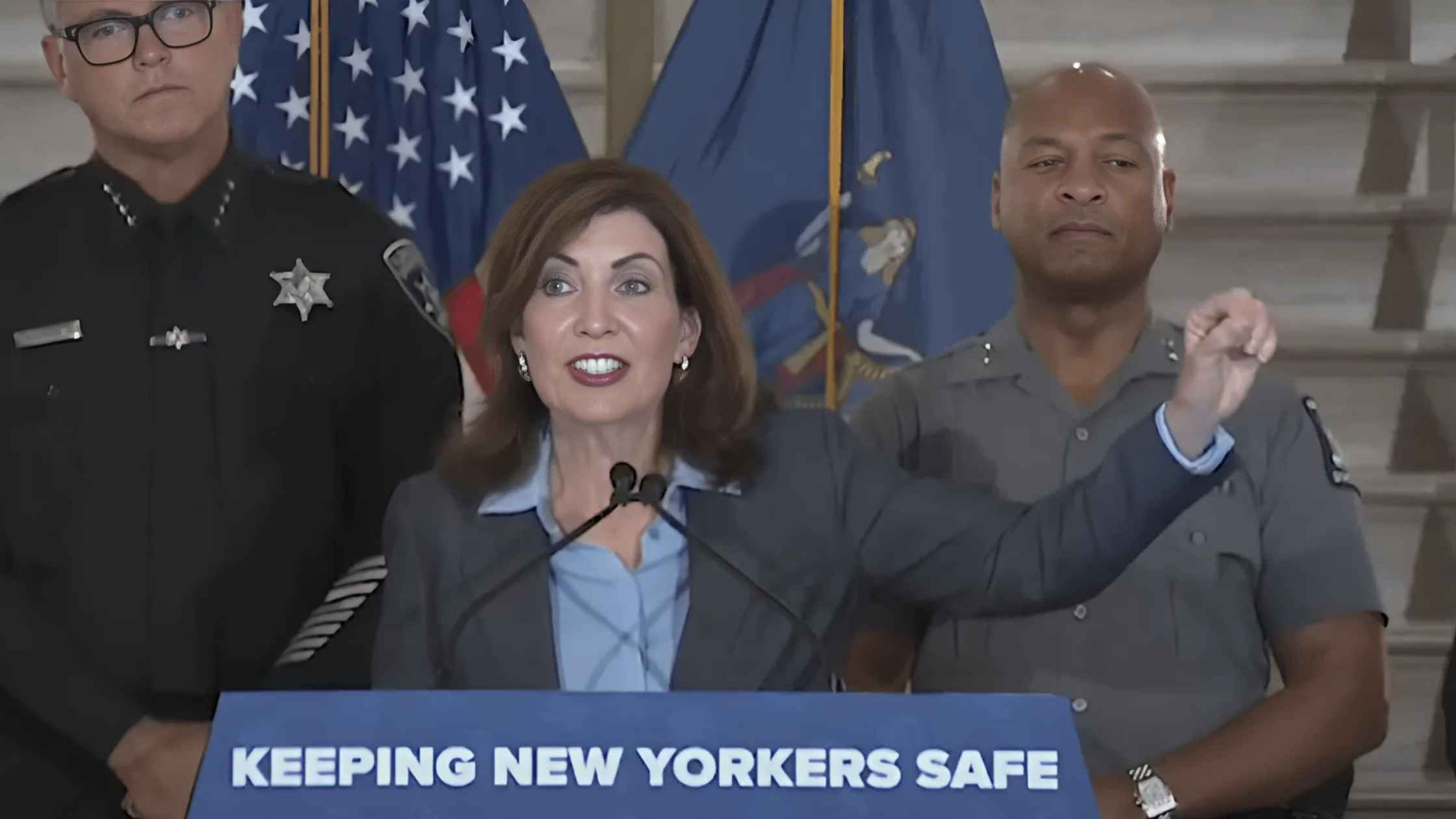
Good morning. Indeed this is a day that'll forever be remembered as a day we took back our streets and our communities and made them safer. Please sit down.
(00:31)
First of all, I want to recognize the elected officials who've been on this journey with us, particularly those in law enforcement. And I have utmost respect for all those men and women who put on a uniform, put themselves in harm's way, and are willing to sacrifice their lives for all of us so we can sleep safer at night with our families and children. Always grateful to them. And our elected officials, from our Sheriff Craig Apple, to district attorneys who work hard to enforce the laws that we and the legislature working together enact. And I want to acknowledge District Attorney Mary Pat Donnelly, who's joined us as well. Let's give her a round of applause, and Sheriff Apple.
(01:18)
We have our district attorney from Columbia County. Chris Liberati-Conant is here. Chris, I want to thank you for joining us as well. You've been on this journey. Chief Joe Meany from the Albany County District Attorney's Office has joined us, the executive director of DAASNY, which is the Association of District Attorneys, who I think almost all 62 of them with maybe an exception from one part of our state, joined in this effort. And the DAs in New York City, who could not join us here today, were an extraordinary part of this journey as well as those who were involved up here in Albany County. So I want to thank them enormously.
(01:56)
We also have Lindsey Crusan-Muse, the director of Victim Crime Services from St. Peter's Health Partners, who will give an account of what this really means to real people. We sit in our capitol and we debate every word of these bills. And it was contentious and it drove a later session, but I'm fine with that because we got the results we needed. And at the end of the day though, there's real people's lives being affected by the system as it was, and that's why we are so motivated to make these dramatic changes.
(02:28)
Also, my great ally partner and advisor in keeping the people of this great state safe, and that is our superintendent of the state police, Steven James. Let's give him a round applause as well. I know my partners in state government have been acknowledged. I want to thank them again for all they do. Great leaders here we have in this part of our state.
(02:52)
Seven months ago I made a vow to stop dangerous criminals from walking free on minor technicalities. These stories were starting to surface, and it was maddening, not just to me as the leader of the state, but also district attorneys. I'd go into the offices and talk to local DAs, young people right out of law school some of them, and excited about their careers. And then they find out after they build a case to defend the rights of a person and victimized in a crime, they put their heart and soul in this and they find out at the last minute that it's thrown out on a technicality. The whole case they built to show society that there will be justice for victims, it's turned upside down on its head, and there was no justice for victims.
(03:38)
So my goal was to stop this, protect the rights of defendants, always paramount to us. We hold that belief strongly. But also hold offenders accountable. And also the voiceless victims that I have stood with time and time again who feel they don't matter after the sensation of a crime that's been committed or even a minor crime in the privacy of their home, they feel like they've been ignored. I want the victims to have justice.
(04:10)
So my friends, we fought, we won, and we got it done. That era ends today where common sense discovery norms are now the norm. We champion them and they're to take effect today all across the great state of New York. So yes, that does deserve a round applause. It was a long, hard fought battle.
(04:30)
I want to, first of all, thank the crime victims who came forward, especially the women who were victims of domestic violence. You know this is a cause that's personal to me for what my mother had witnessed as a child and how she dedicated her life to being a champion and advocate to get the laws in New York changed. Even when I was an intern for the assembly, my mother traveled here to make the case that people were not taking care of the people who were victimized time and time again in the sanctity of their home by someone who should have been there to protect and cherish them and loved them, who turned on them and betrayed them and sometimes made their own homes a torture chamber in front of their children. Those people have always mattered to me.
(05:18)
We've heard the voices of so many who just in tears found out that their cases had been dismissed on technicalities. They came and spoke so eloquently about what they endured. And I want to thank the advocates and the prosecutors who stood by them time and again, showed up day after day here in our capitol and across the state to demand the changes, common sense changes. And together we brought this to the forefront and work with legislators, persuaded legislators who weren't with us at the beginning. Some were, some were not. But we persuaded them. It was finally time to rebalance the scales of justice.
(06:02)
And I know there's a lot of passion behind the reforms that are put in place in 2019. I understand that because this pendulum had swung too far in one direction, but it should not have swung so far in the opposite direction. And that's the status of the laws in the state of New York up until now. And I'll always keep fighting to protect people.
(06:26)
My top priority, we had to fix the bail laws. Now you'll see there's some headlines in papers in the state, championing how crime has gone down over the last couple years. They have. It's been a multi-faceted approach working with our cities, our police officers, police commissioners, a partnership formed with our state police to deal with gun and interdiction, taking guns out of the streets, off our streets.
(06:55)
Our gun violence rates are down historic lows. Could not have said that back when I first became governor. Oh, no. No. They were frightening. And the trajectory was continuing to go upward and upward and upward. And now to see not only has that stopped, but the trend is going downward. And part of it is we've done a lot. The legislature and I worked hard on this. $2.6 billion we've allocated for law enforcement efforts since I became governor. That's not defunding the police. That is supercharging funding for our police officers, and I'll always continue to do that as long as I'm governor.
(07:37)
Also changing the red flag laws. What does that mean? It means finally, there'll be an early warning system that works. When someone telegraphs they're about to do harm to themselves or to others, whether it's through social media posts, what they said in their school, what they're saying to colleagues, their behavior, finally, we can stand up and protect ourselves as a society. That is working beyond all of our expectations.
(08:04)
And also, as I mentioned, the scourge of domestic violence. Increasing funding to support programs for victims, survivors to be able to get out of that environment. Like the home that my family started years ago while my mother was alive, she ran this, a transitional home for families to come to so they can get out of an environment they feel trapped in because they don't have the income to take care of their kids. So they stay, they endure the abuse.
(08:34)
And finally, through our small way, we can make a difference at least a few lives. But that is happening by incredible advocates and champions all over our state. We had to fund those programs.
(08:45)
We cracked down our retail theft. Remember all the articles about how no one could walk into a store without seeing everything locked up? Our laws need to be toughened, and we got it done. Even in New York City, all you heard about was subway crimes. Now one crime is too many anywhere. And we're not done. But I supported and financially supported overtime trains having two police officers on every one. That drove down crime dramatically, and I'm proud of that.
(09:21)
And now we've closed this loophole. Not just the bail laws we changed over multiple sessions that we're contentious. That's having an effect. But there's one more issue that our district attorneys came to us and begged us to change, said, "If you could just do this, it'll make a profound difference in the outcomes of these cases." Otherwise, people are cycling in and out of the criminal justice system without consequences because too many cases are being dismissed for very minor technical changes. So that loophole was undermining all these efforts.
(09:59)
And I'll go back again to 2019. Reforms were well intended. But finally, where a case we're saying, "Let's look at the record. Do we go too far? Can we fix this?" And so dismissal surged under those laws, dismissal surged from, get this, 10,000 dismissals across the state in 2019 to almost 50,000 dismissals in 2024. Look at that. That's 50,000 victims who did not get justice. I'm sure that there were numbers of those that were justified. But for the ones that were dismissed on technicalities or minor omissions that have nothing to do with the guilt or innocence of a defendant, those are the ones that we're getting after today. Something had to change.
(10:54)
So we're here for those victims to let them know their voices have broken through. A young mother trapped in abusive relationship, a commuter smashed into by a drunken driver, small business owner repeatedly having their livelihood in jeopardy because retail thieves are clearing the shelves. These are the people that we're fighting for. They're our neighbors, our friends, our fellow citizens, and they deserve a justice system that works for them as well. So starting tomorrow, cases will no longer be thrown out of our trivial areas that have no bearing, as I said, on guilt or innocence. Criminals won't walk free because someone hit the wrong button uploading a surveillance video. Criminals will not walk free when a police personnel file is submitted a day late or prosecutors leave out a report of which there's already a duplicate copy of it in the file.
(11:53)
This is a good day, my friends. Tomorrow we'll finally lift the burden that's been on our justice system to bring justice to victims. And we won't to lose sleep. Our prosecutors won't have to lose sleep over defenseless playing the gotcha game, waiting until the last second for challenges when they know the clock has run out. That's over.
(12:15)
Going forward, defense attorneys must flag any potential issue with prosecutors first. Flag the issue. That's your job. But don't wait 'till the 11th hour when you know it's too late to do something about remedying that.
(12:32)
Work in good faith. Make sure you do it right. These are common sense changes you'll hear more from our district attorney about how they're going to work. But now he has a focus where it matters, on the evidence, on accountability, and ultimately on justice for victims.
(12:50)
Now, a lot of people, again, wondered why we dug in so hard on this. Why was the budget five weeks late? As an aside, a reminder, when I was that assembly intern, the budgets were done in July and August. I don't support that. But five weeks to change a system that was broken to me was well worth it. Well worth it.
(13:17)
And so our budget made this change, ultimately our end of session because I knew this, at the end of all the legal jargon, all the chatter back and forth, all the hysteria around these changes, I knew there were real lives of New Yorkers waiting for us to do what was right by them, to make sure that justice is finally delivered.
(13:46)
So I'm proud of this. I believe that this will be a dramatic change in outcomes, respect the rights of defendants, but also know that our victims have rights as well. That's what starts today.
(14:02)
Thank you very much, everyone. Appreciate your support. Let me bring up not only the individual who is a local district attorney, Rensselaer County District Attorney Mary Pat Donnelly. She is also the head of the entire statewide association representing district attorneys, so she speaks with a powerful voice. Ladies and gentlemen, welcome our DA.
Mary Pat Donnelly (14:34):
Good morning. Rensselaer County District Attorney Mary Pat Donnelly. And as the governor explained, I'm privileged to serve as the president of the District Attorney's Association of the State of New York.
(14:43)
I want to thank Governor Hochul for listening to New York State's prosecutors and for prioritizing discovery reform in her budget proposal. Discovery has been a significant issue in every district attorney's office from New York's five boroughs to Albany, to Buffalo, to Essex, to Rensselaer, and every county in between.
(15:05)
Discovery is a complex topic, often unfamiliar to those who work outside the courts of New York state. But make no mistake, discovery is a public safety issue. When materials are gathered and shared in a timely and diligent fashion, prosecutors are able to fashion remedies that hold offenders accountable and deliver justice to victims.
(15:28)
In 2020, Article 245 was enacted, which required broad and mandatory discovery. As the governor said, and as we have said all along, it was a well-intentioned change in the law. Unfortunately, that law was rife with vagaries, which resulted in litigation, delays, and tragically full dismissals of important cases attached to real victims; our families, our friends, our neighbors.
(15:55)
The new amendments which go into play tomorrow will adjust the playing field once again. Prosecutors will still be held to a standard to make diligent efforts to gather and turn over evidence in a timely fashion so that we can have meaningful discussions about the resolution of a case. However, these cases will be protected from dismissal when there are errors in that delivery as long as they are disclosed and documented.
(16:25)
Further, we will be able to secure physical addresses, Social Security numbers, and other sensitive information without the need for motion practice. Counsel for the defendant will be held to a standard to actually review the volumes of information that we do turn over in a timely fashion and not waiting until the eve of trial. There will be a period of time during which they can make objections to what we have turned over. And more importantly, they will be required to alert us to any missing information or perceived missing information so that we can have a discussion about where that information is and how we can remedy the concern.
(17:04)
Finally, under the new laws, courts will be vested with the authority to look at the totality of the circumstances, to look at a particular case and the efforts that a particular prosecutor has made to gather all of the information required and to turn it over timely. They need to look at that and make an evaluation on the individual case before employing a drastic remedy such as dismissal. These changes require good faith, due diligence, and collaboration. The cornerstone of any just prosecution.
(17:37)
I have said this before and I will say it again. This is not a step backward. In fact, it is a critical step forward, requiring communication, evaluation and a meaningful dialogue between both sides so that we can get it right.
(17:53)
Once again, thank you to Governor Hochul for standing with us on this important issue as we work every day to deliver justice to victims around the state. Thank you very much.
(18:10)
It's my privilege to introduce Lindsay Crusan-Muse, director of Crime Victim Services from St. Peter's Health Partners.
(18:15)
[inaudible 00:18:21].
Lindsay Crusan-Muse (18:22):
Thank you very much, DA Donnelly, and thank you Governor Hochul. It's an honor to be here representing victims of crime and also program serving victims of crime in this very historic change to our discovery laws.
(18:36)
I want to acknowledge the meaningful and lasting impact that this reform will have for victims and survivors across New York State and their families and their loved ones. While the original intent of the discovery law was to build a more transparent, fair, and efficient system, the reality is that it also brought about unintended consequences, creating real barriers to justice and safety for victims and survivors of crime.
(19:03)
Across the state, since the implementation of the original law, we have seen very serious cases involving domestic violence, sexual assault, child abuse, and other violent crimes dismissed outright on technical grounds such as missing text message exchanges between the victim and detective or a missing activity log. These dismissals were never the intention or the intended outcome of this law. Reform was necessary, but the impact on victims as well as on law enforcement and prosecutors striving to keep our communities safe has been profound.
(19:43)
Beginning tomorrow, judges will have the discretion to consider the nature and impact of a discovery violation rather than outright dismissing the case. This change will bring balance and fairness to the process and give victims a voice that they have not had for the past several years.
(20:04)
These reforms also significantly strengthen victim privacy protections. Many survivors of crime hesitate to report to law enforcement out of fear of retaliation or concerns about their own safety or the safety of their family and loved ones. By allowing sensitive information about victims and witnesses to be redacted, the law will help protect survivors from unnecessary exposure and encourage more victims and survivors of crime to come forward and participate in the justice process.
(20:36)
With these updates, New York continues to lead the way, preserving one of the most transparent discovery laws in our nation, while reaffirming our commitment to protecting victims and ensuring accountability. In many cases, this change is the difference between life and death for survivors of crime.
(20:55)
Thank you, Governor Hochul, for your leadership and for standing with survivors throughout our state. Thank you.
(21:00)
It is now my privilege and honor to introduce State Police Superintendent Steven James.
Steven James (21:20):
Good morning.
Governor Kathy Hochul (21:20):
Good morning.
Steven James (21:24):
I want to express my appreciation certainly to Governor Hochul for your continuing support of law enforcement and your work to improve public safety for the people that we serve. The updates, as referenced with regard to the discovery law that become effective tomorrow, they certainly represent a logical step to restore the balance between protecting the rights of those who are arrested, the personal safety of the witnesses to crime and their loved ones, and the victims who deserve justice. These changes, they also address the frustration of law enforcement members who work on the behalf of victims and their concerns that a lack of accountability of criminals would erode the public safety.
(22:14)
As the superintendent of the New York State Police, I can tell you that our members are committed to ensuring that justice is pursued effectively and fairly and that the victims are in fact heard. And with Governor Hochul's changes to the discovery laws, as articulated, New York is doing just that. Thank you.
(22:44)
Now it's my pleasure to introduce Sheriff Craig Apple.
Craig Apple (22:54):
Good morning. First of all, Governor, thank you. And on a side note, your last several trips to Albany County have been outstanding, very positive, so we appreciate you coming back. And members of the legislature, thank you for rolling up your sleeves and pitching in and getting this done. It's very important to us.
(23:09)
As a sheriff, my top priority is keeping our community safe while ensuring justice is served fairly. That's why I support the recent changes to New York's discovery laws. These reforms give law enforcement and prosecutors the tools we need to hold defenders accountable without getting cases tossed out over paperwork technicalities, which has happened obviously over 50,000 times.
(23:32)
Too many victims, especially survivors of domestic violence and sexual assault, were being traumatized under the old system. Sensitive personal information was being handed over unnecessarily, and dangerous individuals were walking free due to minor administrative delays. With these changes, we're restoring balance. Prosecutors can now focus on evidence that truly matters. Judges have more discretion to assess good faith and efforts and victims are better protected throughout the process. This is smart measured reform. It keeps the discovery process transparent and fair while making sure we don't let bureaucracy stand in the way of justice.
(24:12)
Governor, thank you.
Speaker 1 (24:18):
That concludes our program. Thank you all for joining us today.